Sunday, May 24, 2009

The Sixth Sunday of Pascha: The Sunday of the Blind Man

Christ is risen! Truly He is risen!
Icon of Christ healing the Blind Man (Icon courtesy of www.eikonografos.com used with permission)
 
"Reading:
The Lord Jesus was coming from the Temple on the Sabbath, when, while walking in the way, He saw the blind man mentioned in today's Gospel. This man had been born thus from his mother's womb, that is, he had been born without eyes (see Saint John Chrysostom, Homily LVI on Matthew; Saint Irenaeus, Against Heresies, Book V:15; and the second Exorcism of Saint Basil the Great). When the disciples saw this, they asked their Teacher, "Who did sin, this man, or his parents, that he was born blind?" They asked this because when the Lord had healed the paralytic at the Sheep's Pool, He had told him, "Sin no more, lest a worse thing come unto thee" (John 5:14); so they wondered, if sickness was caused by sin, what sin could have been the cause of his being born without eyes. But the Lord answered that this was for the glory of God. Then the God-man spat on the ground and made clay with the spittle. He anointed the eyes of the blind man and said to him, "Go, wash in the Pool of Siloam." Siloam (which means "sent") was a well-known spring in Jerusalem used by the inhabitants for its waters, which flowed to the eastern side of the city and collected in a large pool called "the Pool of Siloam."

   
Therefore, the Saviour sent the blind man to this pool that he might wash his eyes, which had been anointed with the clay-not that the pool's water had such power, but that the faith and obedience of the one sent might be made manifest, and that the miracle might become more remarkable and known to all, and leave no room for doubt. Thus, the blind man believed in Jesus' words, obeyed His command, went and washed himself, and returned, no longer blind, but having eyes and seeing. This was the greatest miracle that our Lord had yet worked; as the man healed of his blindness himself testified, "Since time began, never was it heard that any man opened the eyes of one that was born blind," although the Lord had already healed the blind eyes of many. Because he now had eyes, some even doubted that he was the same person (John 9:8-9); and it was still lively in their remembrance when Christ came to the tomb of Lazarus, for they said, "Could not this man, who opened the eyes of the blind man, have caused that even this man should not have died?" Saint John Chrysostom gives a thorough and brilliant exposition of our Lord's meeting with the woman of Samaria, the healing of the paralytic, and the miracle of the blind man in his commentaries on the Gospel of Saint John." (taken from: http://www.goarch.org/chapel/saints_view?contentid=912&PCode=5PS&D=S&date=5/24/2009)
   
Icon of Christ healing the Blind Man, and washing in the Pool of Siloam, from Ravanica Monastery (http://www.srpskoblago.org/gallery/main.php?g2_itemId=2180&g2_jsWarning=true)
   
Kontakion. Tone 4
With the eyes of my soul mutilated I come to you, O Christ, as the man blind from birth, crying to you in repentance: You are the radiant light of those in darkness.

The Ikos.
Grant me a stream of inexpressible wisdom, and knowledge from above, O Christ, light of those in darkness and guide of those who stray; that I may recount what the divine book of the Gospel of peace teaches: the miracle of the blind man; for being blind from birth he receives both physical eyes and eyes of the soul, as he cries: You are the radiant light of those in darkness.

Doxastikon of the Praises - Plagal of the 4th Tone.
Who will recount your powers, O Christ? Who number the multitudes of your wonders? For twofold you appeared on earth through your goodness, twofold also the healings you bestow: for you opened not only the bodily eyes of one who was maimed from the womb, but also those of his soul. Therefore he confessed you the hidden God, who grant to all your great mercy.
Christ is risen from the dead, by death, trampling down upon death, and to those in the tombs, bestowing life!
Truly the Lord is risen!

Thursday, May 21, 2009

Sts. Constantine and Helen the Equal-to-the-Apostles

Christ is risen! Truly He is risen!
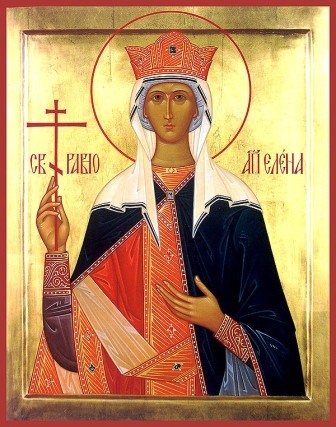
Sts. Constantine and Helen the Equal-to-the-Apostles - Commemorated on May 21st (http://pravicon.com/images/sv/s0767/s0767006.jpg)
  
"The Church calls St Constantine (306-337) "the Equal of the Apostles," and historians call him "the Great." He was the son o the Caesar Constantius Chlorus (305-306), who governed the lands of Gaul and Britain. His mother was St Helen, a Christian of humble birth.

At this time the immense Roman Empire was divided into Western and Eastern halves, governed by two independent emperors and their corulers called "Caesars." Constantius Chlorus was Caesar in the Western Roman Empire. St Constantine was born in 274, possibly at Nish in Serbia. In 294, Constantius divorced Helen in order to further his political ambition by marrying a woman of noble rank. After he became emperor, Constantine showed his mother great honor and respect, granting her the imperial title "Augusta."
  
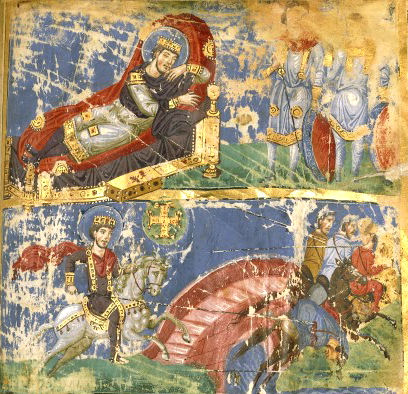
St. Constantine seeing the vision of the Holy Cross of Christ, and receiving his call from the Lord (source)
  
Constantine, the future ruler of all the whole Roman Empire, was raised to respect Christianity. His father did not persecute Christians in the lands he governed. This was at a time when Christians were persecuted throughout the Roman Empire by the emperors Diocletian (284-305) and his corulers Maximian Galerius (305-311) in the East, and the emperor Maximian Hercules (284-305) in the West.

After the death of Constantius Chlorus in 306, Constantine was acclaimed by the army at York as emperor of Gaul and Britain. The first act of the new emperor was to grant the freedom to practice Christianity in the lands subject to him. The pagan Maximian Galerius in the East and the fierce tyrant Maxentius in the West hated Constantine and they plotted to overthrow and kill him, but Constantine bested them in a series of battles, defeating his opponents with the help of God. He prayed to God to give him a sign which would inspire his army to fight valiantly, and the Lord showed him a radiant Sign of the Cross in the heavens with the inscription "In this Sign, conquer."

The vision of St. Constantine of the Precious Cross of Christ, and his victory in battle (http://vatopaidi.files.wordpress.com/2010/06/to-orama-tou-megalou-konstantinou.jpg)
 
[The following night, our Lord Jesus Christ appeared to him in a dream and declared to him the power of the Cross and its significance. When he arose in the morning, he immediately ordered that a labarum be made (which is a banner or standard of victory over the enemy) in the form of a cross, and he inscribed on it the Name of Jesus Christ. On the 28th Of October, he attacked and mightily conquered Maxentius, who drowned in the Tiber River while fleeing. The following day, Constantine entered Rome in triumph and was proclaimed Emperor of the West by the Senate, while Licinius, his brother-in-law, ruled in the East. But out of malice, Licinius later persecuted the Christians. Constantine fought him once and again, and utterly destroyed him in 324, and in this manner he became monarch over the West and the East.]

St. Constantine the Great, the Equal-to-the-Apostles (fresco by Manuel Panselinos, Protaton, Mount Athos) (http://pravicon.com/images/sv/s1199/s1199002.jpg)
 
After Constantine became the sole ruler of the Western Roman Empire, he issued the Edict of Milan in 313 which guaranteed religious tolerance for Christians. St Helen, who was a Christian, may have influenced him in this decision. In 323, when he became the sole ruler of the entire Roman Empire, he extended the provisions of the Edict of Milan to the Eastern half of the Empire. After three hundred years of persecution, Christians could finally practice their faith without fear.

Renouncing paganism, the Emperor did not let his capital remain in ancient Rome, the former center of the pagan realm. He transferred his capital to the East, to the city of Byzantium, which was renamed Constantinople, the city of Constantine (May 11). Constantine was deeply convinced that only Christianity could unify the immense Roman Empire with its diverse peoples. He supported the Church in every way. He recalled Christian confessors from banishment, he built churches, and he showed concern for the clergy.

St. Helen with the Precious Cross of Christ (http://www.pigizois.net/sinaxaristis/05/21_eleni.jpg)
 
The emperor deeply revered the victory-bearing Sign of the Cross of the Lord, and also wanted to find the actual Cross upon which our Lord Jesus Christ was crucified. For this purpose he sent his own mother, the holy Empress Helen, to Jerusalem, granting her both power and money. Patriarch Macarius of Jerusalem and St Helen began the search, and through the will of God, the Life-Creating Cross was miraculously discovered in 326. (The account of the finding of the Cross of the Lord is found under the Feast of the Exaltation of the Cross, September 14). The Orthodox Church commemorates the Uncovering of the Precious Cross and the Precious Nails by the Holy Empress Helen on March 6.

 
While in Palestine, the holy empress did much of benefit for the Church. She ordered that all places connected with the earthly life of the Lord and His All-Pure Mother, should be freed of all traces of paganism, and she commanded that churches should be built at these places [at the sites of the Crucifixion and Resurrection, in Bethlehem at the cave where our Saviour was born, another on the Mount of Olives whence He ascended into Heaven, and many others throughout the Holy Land, Cyprus, and elsewhere.]

The emperor Constantine ordered a magnificent church in honor of Christ's Resurrection to be built over His tomb. St Helen gave the Life-Creating Cross to the Patriarch for safe-keeping, and took part of the Cross with her for the emperor. After distributing generous alms at Jerusalem and feeding the needy (at times she even served them herself), the holy Empress Helen returned to Constantinople, where she died in the year 327.

St. Helen with scenes from her life (http://pravicon.com/images/sv/s0767/s0767015.jpg)
 
Because of her great services to the Church and her efforts in finding the Life-Creating Cross, the empress Helen is called "the Equal of the Apostles." The peaceful state of the Christian Church was disturbed by quarrels, dissensions and heresies which had appeared within the Church. Already at the beginning of St Constantine's reign the heresies of the Donatists and the Novatians had arisen in the West. They demanded a second baptism for those who lapsed during the persecutions against Christians. These heresies, repudiated by two local Church councils, were finally condemned at the Council of Milan in 316.

The Dormition of St. Helen, as she is surrounded by her son, St. Constantine, Angels, and many of the faithful (source)
   
Particularly ruinous for the Church was the rise of the Arian heresy in the East, which denied the Divine Nature of the Son of God, and taught that Jesus Christ was a mere creature. By order of the emperor, the First Ecumenical Council was convened in the city of Nicea in 325.
  
St. Helen holding the Precious Cross, the Crown of Thorns and the Holy Nails of Christ which she found (source)
  
318 bishops attended this Council. Among its participants were confessor-bishops from the period of the persecutions and many other luminaries of the Church, among whom was St Nicholas of Myra in Lycia. (The account about the Council is found under May 29). The emperor was present at the sessions of the Council. The heresy of Arius was condemned and a Symbol of Faith (Creed) composed, in which was included the term "consubstantial with the Father," confirming the truth of the divinity of Jesus Christ, Who assumed human nature for the redemption of all the human race.

One might possibly be surprised by St Constantine's grasp of theological issues during the discussions at the Council. The term "consubstantial" was included in the Symbol of Faith at his insistence.

[Falling ill near Nicomedia, he requested to receive divine Baptism, according to Eusebius (The Life of Constantine. Book IV, 61-62), and also according to Socrates and Sozomen; and when he had been deemed worthy of the Holy Mysteries, he reposed in 337, on May 21 or 22, the day of Pentecost, having lived sixty-five years, of which he ruled for thirty-one years. His remains were transferred to Constantinople and were deposed in the Church of the Holy Apostles, which had been built by him (see Homily XXVI on Second Corinthians by Saint John Chrysostom).]"
(taken from: http://ocafs.oca.org/FeastSaintsViewer.asp?SID=4&ID=1&FSID=101452, and quotes in brackets taken from: http://goarch.org/chapel/saints_view?contentid=62&type=saints&date=5/21/2009&D=TH)
  
Mosaic of St. Constantine the Great, Hagia Sophia, circa 1000 AD (taken from: http://en.wikipedia.org/wiki/Constantine_I)
  
Additional Details about St. Constantine
The following quote about St. Constantine at the First Ecumenical Council is taken from: http://www.orthodoxphotos.com/Holy_Relics/St._John_Iacob_the_Hozevite/index.shtml.

"In the History of the Church by the most-wise hierarch Meletius, it says that when the First Ecumenical Council in Nicaea ended, the Emperor St. Constantine the Great rejoiced greatly at the victory of the the Church against the slanderers. The emperor was present at the Council and honored the Holy Fathers with rich gifts, according to their merit, piously kissing the plucked eyes of the devoted Paphnutius with zeal, as well as the hands maimed by the tyrants. He also devoutly kissed all the other confessors, in order to sanctify himself through their wounds, which they suffered in the time of the persecution.

Some of the Council's fathers handed the emperor some complaints against a number of bishops of bad conduct. But the great Emperor Constantine did not even read their papers, nor was he interested in the identity of the accused clerics, but burned the papers in the presence of all, saying: "If with my own eyes I were to see a cleric sin, I would cover him with my mantle, that is with the mantle of the emperor.""

The Life of St. Nicholas mentions how he appeared to St. Constantine in a dream, telling him to free three generals who were wrongly imprisoned. See: http://full-of-grace-and-truth.blogspot.com/2008/12/life-of-st-nicholas-archbishop-of-myra.html, for an account and an icon.

 
And for one primary source account of the Life of St. Constantine, see that of Eusebius at the following link: http://www.newadvent.org/fathers/2502.htm. This has many details from the life of St. Constantine, many quotes and letters of his. As an example, the following quote is of St. Constantine's request for Baptism, and of the sacrament itself:
"'The time is arrived which I have long hoped for, with an earnest desire and prayer that I might obtain the salvation of God. The hour is come in which I too may have the blessing of that seal which confers immortality; the hour in which I may receive the seal of salvation. I had thought to do this in the waters of the river Jordan, wherein our Saviour, for our example, is recorded to have been baptized: but God, who knows what is expedient for us, is pleased that I should receive this blessing here. Be it so, then, without delay: for should it be his will who is Lord of life and death, that my existence here should be prolonged, and should I be destined henceforth to associate with the people of God, and unite with them in prayer as a member of his Church, I will prescribe to myself from this time such a course of life as befits his service.' After he had thus spoken, the prelates performed the sacred ceremonies in the usual manner, and, having given him the necessary instructions, made him a partaker of the mystic ordinance. Thus was Constantine the first of all sovereigns who was regenerated and perfected in a church dedicated to the martyrs of Christ; thus gifted with the Divine seal of baptism, he rejoiced in spirit, was renewed, and filled with heavenly light: his soul was gladdened by reason of the fervency of his faith, and astonished at the manifestation of the power of God. At the conclusion of the ceremony he arrayed himself in shining imperial vestments, brilliant as the light, and reclined on a couch of the purest white, refusing to clothe himself with the purple any more."
(taken from: http://www.newadvent.org/fathers/25024.htm)

And finally, the life of St. Paisios is recounted a vision he received of St. Constantine the Great, in which he praises the Monastic Life (see the previous post: http://full-of-grace-and-truth.blogspot.com/2008/10/vision-of-st-paisios-of-st-constantine.html)


Icon of St. Helen (taken from: http://www.photosled.com/data/1985/0521_Eleni.jpg)
  
Churches built by St. Helen
Many of the churches built by St. Helen still exist to this day. These include (besides those listed above) the Chapel at the Burning Bush on Mount Sinai (http://www.sinaimonastery.com/en/index.php?lid=65), the Church of Ekatontopyliani (Church of One Hundred Doors) on the Greek island of Paros (http://www.ekatontapyliani.org/), the Church of the Holy Cross in Rome (Santa Croce: http://www.sacred-destinations.com/italy/rome-santa-croce-in-gerusalemme.htm), etc. The Church of the Holy Apostles in Constantinople was also built by Sts. Constantine and Helen, however almost nothing remains of it to this day, and a mosque has been built over it (http://www.sacred-destinations.com/turkey/istanbul-church-of-holy-apostles.htm).
  
"Depiction of the Church of the Holy Apostlesin an illuminated manuscript." (taken from: http://www.sacred-destinations.com/turkey/istanbul-church-of-holy-apostles.htm)
  
A major portion of the Relics of St. Helen are purported to reside in Paris, in the Church of St. Leu - St. Gilles, where they go largely unnoticed by both tourists and the local population. In the following article from Road to Emmaus Journal, "A CITY OF SAINTS: THE FORGOTTEN RELIQUARIES OF PARIS", there is an interview with an Orthodox priest in Paris, Fr. Nicholas Nikichine, who has researched many of the incredible Relics in or near Paris, many of which are generally unknown to the faithful. These include the Crown of Thorns of Christ, the Head of St. John the Baptist, etc., but also the Relics of St. Helen. See the following link for the full interview: http://www.roadtoemmaus.net/back_issue_articles/RTE_25/A_CITY_OF_SAINTS.pdf.
  
May Sts. Constantine and Helen intercede for all of us and help us!
  

Sts. Constantine and Helen the Equal-to-the-Apostles (Icon courtesy of www.eikonografos.com used with permission)
  
Apolytikion in the Plagal of the Fourth Tone
He beheld the image of Your Cross in the Heavens and, as Paul, he too did not receive the call from men. Your Apostle among Kings placed the care of the Royal City in Your hands. Through the intercessions of the Theotokos, O only Loving Lord, keep it ever in peace.
  
Kontakion in the Third Tone
Today, Constantine with his mother Helen present the Cross, the most precious wood. It shames unbelievers. It is a weapon of faithful kings against their adversaries. A great sign has come forth for us which is awesome in battle.


Christ is risen from the dead, by death, trampling down upon death, and to those in the tombs, bestowing life!
Truly the Lord is risen!

Tuesday, May 19, 2009

The Holy Martyr and Unmercenary St. Thallelaios, and those with him

Christ is risen! Truly He is risen!
St. Thallelaios the Martyr and Unmercenary, taken from the full icon of the Synaxis of the Holy Unmercenaries (Icon courtesy of www.eikonografos.com used with permission)
  
  
"The Martyrs Thallelaeus, Alexander and Asterius [Commemorated on May 20] lived during the reign of Numerian (283-284). The prefect of the city of Aegea sent soldiers to seek out Christians. They brought to him Thallelaeus, an eighteen-year-old blond-haired youth. To the prefect's questions St Thallelaeus replied, "I am a Christian, a native of Lebanon. My father, Beruchius, was a military commander, and my mother was named Romylia. My brother is a subdeacon. I, however, am studying medicine under the physician Macarius. During a former persecution against Christians in Lebanon, I was brought before the prefect Tiberius, and barely escaped execution. But now that I stand before this court, do with me as you will. I wish to die for Christ my Savior and my God, and hope to endure all torments with His help."

The enraged prefect ordered the two torturers Alexander and Asterius to bore through the knees of the martyr, pass a rope through the bone, and suspend him head downwards. But the executioners, by God's design, bored into a block of wood, which they hung up in place of the martyr. When the prefect saw that they had deceived him, he then ordered that Alexander and Asterius be whipped. They also confessed themselves Christians and glorified God. The prefect immediately gave orders to cut off their heads. Twice he attempted to carry out the execution, and to bore through the saint's knees, but the grace of God prevented him. Then he commanded that St Thallelaeus be drowned.

The returning servants reported to the prefect that they had carried out the execution, but just as they finished their report, St Thallelaeus appeared in white raiment. For a long time everyone was numbed with terror, but finally the prefect said, "Behold, this sorcerer has bewitched even the sea."

Then one of his advisers, the magician Urbician, told the prefect to have the martyr thrown to the wild beasts. But neither the vicious bear, not the hungry lion and lioness, would touch the saint, all meekly lay down at his feet. Seeing this happen, the people began to shout, "Great is the God of the Christians. O God of Thallelaeus, have mercy on us!"

The crowd seized Urbician and threw him to the beasts, which did not hesitate to tear the magician apart. Finally, the prefect gave orders to kill the holy martyr with a sword. They led Christ's martyr to the place of execution, called Aegea, where he prayed to God and bent his neck beneath the sword. This occurred in the year 284.

The relics of the holy martyr Thallelaeus are in the church of St Agathonicus of Constantinople and have performed many miracles. St Thallelaeus treated the sick without payment. For this reason, the Church calls him an Unmercenary Physician. He is invoked in prayers for the sick in the Mystery of Holy Unction, and during the Blessing of Waters."


St. Thallelaios is honored in many Orthodox locations throughout the world. One of these is the village named after him on the island of Naxos in Greece. This may be one of the reasons why St. Nikodemos of the Holy Mountain composed a full service of the Saint, in which St. Thallelaios is called "the protector of the island of Naxos", and where St. Nikodemos mentions that he works many miracles for those who flee to him for help (for the Greek text of the Service of St. Thallelaios, see: http://voutsinasilias.blogspot.com/2009/05/20.html).
  
And as mentioned above, St. Thallelaios is considered one of the Holy Unmercenaries, and invoked in the services of Holy Unction, the Blessing of Holy Water, and services for the Synaxis of the Holy Unmercenaries (see a previous post for more information: http://full-of-grace-and-truth.blogspot.com/2008/10/synaxis-of-holy-unmercenaries.html). May St. Thallelaios the Holy Martyr and Unmercenary intercede for us all and help us!
  
Icon of St. Thallelaios (Thallelaeus) the Martyr and Unmercenary (taken from: http://ocafs.oca.org/FeastSaintsViewer.asp?SID=4&ID=1&FSID=101446)
  
Apolytikion of St. Thallelaios in the Third Tone
Thallelaios, saintly champion and healer, intercede with our merciful God to grant our souls remission of sins.
(The apolytikion of St. Panteleimon, substituted with the name of St. Thallelaios as in the service by St. Nikodemos, taken from: http://goarch.org/chapel/saints_view?contentid=143)
  
Kontakion in the Third Tone
With the Martyrs of the Lord thou didst contest and wast shown forth as a valiant soldier of the King of Glory, Who crowned thee for the harsh and bitter tortures that thou didst suffer, trampling down the pride of them that worshipped the idols. O Thalleleus, we therefore praise thine august and blessed remembrance today.
Christ is risen from the dead, by death, trampling down upon death, and to those in the tombs, bestowing life!
Truly the Lord is risen!

Saturday, May 16, 2009

The Fifth Sunday of Pascha: The Sunday of the Samaritan Woman

Christ is risen! Truly He is risen!

Icon of Christ meeting the Samaritan Woman, later St. Photini (Icon courtesy of www.eikonografos.com used with permission)
   
"Reading:
One of the most ancient cities of the Promised Land was Shechem, also called Sikima, located at the foot of Mount Gerazim. There the Israelites had heard the blessings in the days of Moses and Jesus of Navi. Near to this town, Jacob, who had come from Mesopotamia in the nineteenth century before Christ, bought a piece of land where there was a well. This well, preserved even until the time of Christ, was known as Jacob's Well. Later, before he died in Egypt, he left that piece of land as a special inheritance to his son Joseph (Gen. 49:22). This town, before it was taken into possession by Samaria, was also the leading city of the kingdom of the ten tribes. In the time of the Romans it was called Neapolis, and at present Nablus. It was the first city in Canaan visited by the Patriarch Abraham. Here also, Jesus of Navi (Joshua) addressed the tribes of Israel for the last time. Almost three hundred years later, all Israel assembled there to make Roboam (Rehoboam) king.

When our Lord Jesus Christ, then, came at midday to this city, which is also called Sychar (John 4:5), He was wearied from the journey and the heat, and He sat down at this well. After a little while the Samaritan woman mentioned in today's Gospel passage came to draw water. As she conversed at some length with the Lord and heard from Him secret things concerning herself, she believed in Him; through her many other Samaritans also believed.

Concerning the Samaritans we know the following: In the year 721 before Christ, Salmanasar (Shalmaneser), King of the Assyrians, took the ten tribes of the kingdom of Israel into captivity, and relocated all these people to Babylon and the land of the Medes. From there he gathered various nations and sent them to Samaria. These nations had been idolaters from before. Although they were later instructed in the Jewish faith and believed in the one God, they worshipped the idols also. Furthermore, they accepted only the Pentateuch of Moses, and rejected the other books of Holy Scripture. Nonetheless, they thought themselves to be descendants of Abraham and Jacob. Therefore, the pious Jews named these Judaizing and idolatrous peoples Samaritans, since they lived in Samaria, the former leading city of the Israelites, as well as in the other towns thereabout. The Jews rejected them as heathen and foreigners, and had no communion with them at all, as the Samaritan woman observed, "the Jews have no dealings with the Samaritans" (John 4:9). Therefore, the name Samaritan is used derisively many times in the Gospel narrations. After the Ascension of the Lord, and the descent of the Holy Spirit at Pentecost, the woman of Samaria was baptized by the holy Apostles and became a great preacher and Martyr of Christ; she was called Photine, and her feast is kept on February 26." (taken from: http://goarch.org/chapel/saints_view?contentid=884&PCode=4PS&D=S&date=5/17/2009)

See the following link for St. John Chrysostom's divine interpretation of this Gospel passage: http://www.ccel.org/ccel/schaff/npnf114.iv.xxxiv.html.

And see a previous post for more info about St. Photini the Great Martyr and those with her: http://full-of-grace-and-truth.blogspot.com/2009/02/st-photini-great-martyr-and-those-with.html.

Fresco of Christ meeting with the Samaritan Woman, from Decani Monastery (taken from: http://www.srpskoblago.org/Archives/Decani/exhibits/Collections/PublicMinistry/CX4K2851_l.html)
   
Doxastikon of the Stichera - Tone 6.
Finding the woman of Samaria by the well of Jacob, Jesus, who covers the earth with clouds, asked water of her. O the wonder! He who rides on the Cherubim converses with a woman who is a harlot. He who hung the earth upon the waters, asks for water. He who pours out springs and pools of water, seeks water, as he wishes truly to draw her who is hunted by the warlike foe, and to quench with the water of life the thirst of her who is aflame with foul desires, as he alone is compassionate and loves mankind.
  
Doxastikon of the Aposticha - Tone 8.
When through your inexpressible dispensation, Christ God, you appeared on earth, the woman of Samaria, having heard your word, full of love for mankind, left her bucket at the well and ran saying to those in the city: Come, see the one who knows the heart: is not this the expected Christ, who has great mercy?

Doxastikon of the Praises - Tone 6.
The spring of life’s source, Jesus our Saviour, came to the spring of the Patriarch Jacob and sought water to drink from a woman of Samaria. But when she objected that there was no sharing vessels by the Jews, the wise creator diverts her with sweet words rather to ask for the eternal water; which she accepted and proclaimed to all, saying: Come, see the one who knows hidden things, and is God come in the flesh to save mankind.

(hymns from the Great Vespers and Orthros of the Sunday of the Samaritan Woman taken from Fr. Ephraim Lash at: http://www.anastasis.org.uk/SamarSun.htm)

Christ is risen from the dead, by death, trampling down upon death, and to those in the tombs, bestowing life!
Truly the Lord is risen!

Friday, May 15, 2009

St. Pachomius the Great

Christ is risen! Truly He is risen!
Icon of St. Pachomius (Icon courtesy of www.eikonografos.com used with permission)


St. Pachomius the Great - Commemorated on May 15 (text taken from: http://ocafs.oca.org/FeastSaintsViewer.asp?SID=4&ID=1&FSID=101384)

"St Pachomius the Great was both a model of desert dwelling, and with Sts Anthony the Great (January 17), Macarius the Great (January 19), and Euthymius the Great (January 20), a founder of the cenobitic monastic life in Egypt.

St Pachomius was born in the third century in the Thebaid (Upper Egypt). His parents were pagans who gave him an excellent secular education. From his youth he had a good character, and he was prudent and sensible.

When Pachomius reached the age of twenty, he was called up to serve in the army of the emperor Constantine (apparently, in the year 315). They put the new conscripts in a city prison guarded by soldiers. The local Christians fed the soldiers and took care of them.

When the young man learned that these people acted this way because of their love for God, fulfilling His commandment to love their neighbor, this made a deep impression upon his pure soul. Pachomius vowed to become a Christian. Pachomius returned from the army after the victory, received holy Baptism, moved to the lonely settlement of Shenesit, and began to lead a strict ascetic life. Realizing the need for spiritual guidance, he turned to the desert-dweller Palamon. He was accepted by the Elder, and he began to follow the example of his instructor in monastic struggles.

Once, after ten years of asceticism, St Pachomius made his way through the desert, and halted at the ruins of the former village of Tabennisi. Here he heard a Voice ordering him to start a monastery at this place. Pachomius told the Elder Palamon of this, and they both regarded the words as a command from God.

They went to Tabennisi and built a small monastic cell. The holy Elder Palamon blessed the foundations of the monastery and predicted its future glory. But soon Palamon departed to the Lord. An angel of God then appeared to St Pachomius in the form of a schemamonk and gave him a Rule of monastic life. Soon his older brother John came and settled there with him.

St Pachomius endured many temptations and assaults from the Enemy of the race of man, but he resisted all temptations by his prayer and endurance.

Gradually, followers began to gather around St Pachomius. Their teacher impressed everyone by his love for work, which enabled him to accomplish all kinds of monastic tasks. He cultivated a garden, he conversed with those seeking guidance, and he tended to the sick.

St Pachomius introduced a monastic Rule of cenobitic life, giving everyone the same food and attire. The monks of the monastery fulfilled the obediences assigned them for the common good of the monastery. Among the various obediences was copying books. The monks were not allowed to possess their own money nor to accept anything from their relatives. St Pachomius considered that an obedience fulfilled with zeal was greater than fasting or prayer. He also demanded from the monks an exact observance of the monastic Rule, and he chastized slackers.

   
His sister Maria came to see St Pachomius, but the strict ascetic refused to see her. Through the gate keeper, he blessed her to enter upon the path of monastic life, promising his help with this. Maria wept, but did as her brother had ordered. The Tabennisi monks built her a hut on the opposite side of the River Nile. Nuns also began to gather around Maria. Soon a women's monastery was formed with a strict monastic Rule provided by St Pachomius. The number of monks at the monastery grew quickly, and it became necessary to build seven more monasteries in the vicinity.

The number of monks reached 7,000, all under the guidance of St Pachomius, who visited all the monasteries and administered them. At the same time St Pachomius remained a deeply humble monk, who was always ready to comply with and accept the words of each brother.

Severe and strict towards himself, St Pachomius had great kindness and condescension toward the deficiencies of spiritually immature monks. One of the monks was eager for martyrdom, but St Pachomius turned him from this desire and instructed him to fulfill his monastic obedience, taming his pride, and training him in humility.

Once, a monk did not heed his advice and left the monastery. He was set upon by brigands, who threatened him with death and forced him to offer sacrifice to the pagan gods. Filled with despair, the monk returned to the monastery. St Pachomius ordered him to pray intensely night and day, keep a strict fast and live in complete solitude. The monk followed his advice, and this saved his soul from despair.
The saint taught his spiritual children to avoid judging others, and he himself feared to judge anyone even in thought.

St Pachomius cared for the sick monks with special love. He visited them, he cheered the disheartened, he urged them to be thankful to God, and put their hope in His holy will. He relaxed the fasting rule for the sick, if this would help them recover their health. Once, in the saint's absence, the cook did not prepare any cooked food for the monks, assuming that the brethren loved to fast. Instead of fulfilling his obedience, the cook plaited 500 mats, something which St Pachomius had not told him to do. In punishment for his disobedience, all the mats prepared by the cook were burned.

St Pachomius always taught the monks to rely only upon God's help and mercy. It happened that there was a shortage of grain at the monastery. The saint spent the whole night in prayer, and in the morning a large quantity of bread was sent to the monastery from the city, at no charge. The Lord granted St Pachomius the gift of wonderworking and healing the sick.

The Lord revealed to him the future of monasticism. The saint learned that future monks would not have such zeal in their struggles as the first generation had, and they would not have experienced guides. Prostrating himself upon the ground, St Pachomius wept bitterly, calling out to the Lord and imploring mercy for them. He heard a Voice answer, "Pachomius, be mindful of the mercy of God. The monks of the future shall receive a reward, since they too shall have occasion to suffer the life burdensome for the monk."

Toward the end of his life St Pachomius fell ill from a pestilence that afflicted the region. His closest disciple, St Theodore (May 17), tended to him with filial love. St Pachomius died around the year 348 at the age of fifty-three, and was buried on a hill near the monastery." (taken from: http://ocafs.oca.org/FeastSaintsViewer.asp?SID=4&ID=1&FSID=101384)

See the following link for the prayer rule that St. Pachomius received from the Angel, and which forms the backbone of almost every service of the Orthodox church: http://www.saintjonah.org/services/stpachomius.htm. May St. Pachomius intercede for all of us and help us!

Icon of St. Pachomius the Great receiving the tradition of the monastic habit and coenobitic rule from an Angel (Icon courtesy of http://www.eikonografos.com/ used with permission)
   
Apolytikion in the Plagal of the First Tone
Thou didst prove a chief pastor of the Chief Shepherd, Christ, guiding the flocks of monastics unto the heavenly fold, whence thou learntest of the habit and the way of life that doth befit ascetic ranks; having taught this to thy monks, thou now dancest and rejoicest with them in heavenly dwellings, O great Pachomius, our Father and guide.


Kontakion in the Second Tone
Since thou hadst shown forth the life of the Angels while in a body, O God-bearing Pachomius, thou wast also counted worthy of their glory; and with them thou standest before the Lord's throne, interceding that divine forgiveness be granted unto all.
Christ is risen from the dead, by death, trampling down upon death, and to those in the tombs, bestowing life!
Truly the Lord is risen!

Thursday, May 14, 2009

Sts. Isidore and Myrope the Great Martyrs of Chios

Christ is risen! Truly He is risen!


Icon of Sts. Isidore of Chios and Therapon, both celebrated on May 14th (taken from: http://www.stlukeorthodox.com/html/saints/may/14th.cfm)
   
"The Holy Martyr Isidore lived during the III Century on the Island of Chios, and was a native of Alexandria. During the first year of rule of the emperor Decius (249-251) there was issued an edict to make a census of all those capable to serve in the armies of the Roman empire. Saint Isidore, tall and strong of body, was drafted into the regiment of the military-commander Numerius. Saint Isidore was a Christian, he led a life of temperance and abstinence, he was chaste and he shunned all the pagan customs. Another imperial edict then commanded, that all the soldiers were to worship the Roman pagan gods and to offer them sacrifice. Not to obey the edict carried the penalty of torture and death. The centurion reported to the military-commander Numerius, that Isidore was a Christian.

Synaxis of All Saints of Chios (source)
  
At the interrogation before Numerius Saint Isidore without flinching confessed his faith in Christ the Saviour and refused to offer sacrifice to idols. Numerius urged the saint not to expose himself to tortures and to obey the will of the emperor, but Saint Isidore answered, that he would obey only the will of the eternal God, Christ the Saviour, and never would he renounce Him. The saint was handed over to torture. During the time of torments he praised Christ God and denounced the pagan idols.


One of the churches of St. Isidore in Chios (taken from: http://www.homeroupolis.info/agios_isidoros_eng.htm)
   
[When the Saint's father learned that St. Isidore was a confessed Christian, he journeyed to Chios to convince him to deny his faith. He succeded in convincing Numerius to deliver St. Isidore into his custody, and proceeded to try to convert him. The Saint, however, entreated his father to open the eyes of his soul and behold the truth [of Christ]. His father was uncompromising, and could not accept that his son believed in the Crucified Nazarene and refused to accept his ancestral religion of idols. He condemned him and delivered him to the admiral Numerius, entreating him to expedite the death sentence of his son. Numerius therefore tied him to a horse that dragged him over rocks. (translated, summarized and paraphrased from: http://www.synaxaristis.googlepages.com/14μαϊου)]
   

Another church dedicated to St. Isidore, this one built near Neochori, on the site where St. Isidore is believed to have been beheaded (taken from: http://www.chios.gr/agiosminas/english_version/neochori_en.htm)
   
The military-commander gave orders to cut out the tongue of the saint, but even after this the saint continued distinctly to give glory to Christ. Numerius in fright fell to the ground and himself lost the gift of speech. Getting up with the help of soldiers, by means of gestures he demanded a small board and on it wrote an order -- to cut off the head of Saint Isidore. Saint Isidore welcomed his death sentence with joy and said: "I glorify Thee, O my Master, that by Thy mercy Thou hast accepted me in Thine Heavenly Habitation!" The death of the martyr occurred in the year 251.


After execution his body was cast out without burial, but another saint, the secret Christian Ammonios, took up his body and committed it to earth [along with St. Myrope; see below]. Later on Ammonios himself accepted a martyr's death in the city of Kyzikos (Comm. 4th of September)." (taken from: http://www.stlukeorthodox.com/html/saints/may/14th.cfm)
   
The tomb of St. Isidore, where St. Myrope was also buried, in Chios (taken from: http://www.fragrant-chios.com/images/saintisidoros_1_l.jpg)
   
"[St. Isidore's] body was taken to Venice in 1125 and hidden in the palace of the Doge; it was re-discovered in the early 14th century. His skull was discovered in Chios, encased in a silver and jeweled reliquary, and translated to Venice in 1627. The Orthodox Church celebrates his feast day on May 14." (taken from: http://orthodoxwiki.org/Isidore_of_Chios)
   

Icon of St. Isidore the Great Martyr of Chios (taken from: http://orthodoxwiki.org/images/9/99/Isidore_of_Chios.jpg)
   
"St. Myrope was born in Ephesus of Christian parents. [Her name is derived from the fact that she would visit the grave of the Holy Martyr St. Hermione in Ephesus, and distribute the myrrh flowing therefrom to heal the sick] After the death of her father, she moved with her mother to the island of Chios, where she suffered for Christ. The suffering of this holy virgin took place soon after the suffering and death of the glorious Martyr Isidore the soldier (May 14). When the torturers had beheaded Isidore, the courageous Myrope secretly took his body, censed it, and honorably buried it in a special place. The villainous prince Numerian heard that the martyr's body had been stolen and wanted to kill the guards. Learning that innocent men would suffer for her good deed, blessed Myrope appeared before the authorities and acknowledged that she had taken the martyr's body and buried it. By order of the prince, the entire body of Christ's holy virgin was severely whipped, and finally she was cast into prison covered with wounds. But the Lord did not leave His martyr comfortless. At midnight a heavenly light illumined the prison, and many angels, with St. Isidore in their midst, appeared to her. ``Peace be to you, Myrope,'' St. Isidore said to her. ``Your prayer has reached God, and soon you will be with us and will receive the wreath prepared for you.'' The holy martyr rejoiced and at that moment surrendered her soul to her God. A sweet fragrance issued from her body, filling the entire prison. One of the guards, seeing all of this and sensing the fragrance, believed in Christ, was baptized, and soon received a martyr's death. St. Myrope took up her habitation in eternity in the year 251 [on December 2nd]." (taken from: http://www.westsrbdio.org/prolog/prolog.cgi)
   

Icon of St. Myrope the Great Martyr (Icon courtesy of www.eikonografos.com used with permission)
   
"Her body was interred beside Isidore's, and a chapel erected over the graves. Saint Marcian built another in the fifth century. In 1525, the relics of Isidore and Myrope were moved by the Latins to the Church of Saint Mark in Venice." (taken from: http://orthodoxwiki.org/Isidore_of_Chios)
   
St. Myrope the Virgin Martyr of Chios (http://syndesmosklchi.blogspot.com/2009/12/2.html)
  
And finally, there is a very touching local tradition that in the place where St. Isidore was martyred, the mastic trees shed fragrant tears at the suffering of the Holy Martyr of Christ. The tradition holds that the mastic, which is a major product of the island of Chios, can only be gathered and prepared from the trees in the area of the Saint's martyrdom. Thus the masticha, or mastic, is a divine gift, and a blessing to the people of Chios (taken and translated from: http://www.matia.gr/7/72/7203/7203_2_21.html)


The Mastic Trees of Chios, which shed tears at St. Isidore's Martyrdom (taken from: http://en.wikipedia.org/wiki/Mastic)
  

Ἀπολυτίκιον. Ἦχος δ'. Ὃ ὑψωθεῖς ἐν τῷ Σταυρῷ.
Ὡς στρατευθεῖς τῷ Βασιλεῖ τῶν αἰώνων, τῶν ἐπιγείων τὴν στρατείαν ἀπώσω, καὶ εὐθαρσὼς ἐκήρυξας Χριστὸν τὸν Θεὸν ὅθεν τὸν ἀγῶνα σου, τὸν καλὸν ἐκτελέσας, Μάρτυς θεοδόξαστος, τοῦ Σωτῆρος ἐδείχθης ὂν ἐκδυσώπει σώζεσθαι ἠμᾶς, τοὺς σὲ τιμώντας, παμμάκαρ Ἰσίδωρε.
   
Apolytikion in the Fourth Tone (amateur translation)
As a soldier of the eternal King who abandoned the earthly army, and bravely preached Christ God. Therefore as you completed your struggle well, O Martyr, you were glorified by God the Savior, Whom you entreat that we who honor you may be saved, O all-blessed Isidore.

St. Isidore the Great Martyr of Chios (Icon courtesy of www.eikonografos.com used with permission)
  
Apolytikion (for a male Martyr) in the Fourth Tone
Thy Martyr, O Lord, in his courageous contest for Thee received the prize of the crowns of incorruption and life from Thee, our immortal God. For since he possessed Thy strength, he cast down the tyrants and wholly destroyed the demons' strengthless presumption. O Christ God, by his prayers, save our souls, since Thou art merciful.
   
Kontakion of St. Isidore the Great-Martyr of Chios in the Fourth Tone
In thy holy prayers to God, thou hast shone brightly, a great guide for all the world. Wherefore, we praise thee on this day, O Saint, thou Martyr of godly mind and boast of Chios, O glorious Isidore.
(http://anemi.lib.uoc.gr/search/?dtab=m&search_type=simple&search_help=&display_mode=&wf_step=init&show_hidden=0&number=10&keep_number=&cclterm1=%CE%BD%CE%AD%CE%BF%CE%BD&cclterm2=&cclterm3=&cclterm4=&cclterm5=&cclterm6=&cclterm7=&cclterm8=&cclfield1=term&cclfield2=&cclfield3=&cclfield4=&cclfield5=&cclfield6=&cclfield7=&cclfield8=&cclop1=&cclop2=&cclop3=&cclop4=&cclop5=&cclop6=&cclop7=&isp=&search_coll[metadata]=1&&stored_cclquery=&skin=&rss=0&display_mode=detail&ioffset=1&offset=31&number=1&keep_number=10&old_offset=31&search_help=detail)

Three of the great Patron Saints and Wonderworkers of Chios: Sts. Markella, Isidore and Matrona (source)
  
Apolytikion in the First Tone (amateur translation)
O great martyr Myrope, and spotless Bride of Christ, you now stand beside Him with beauty and comeliness. As radiant and shining stones you bear your body's wounds, and the porphyry of your blood as a royal robe, O glorious one. Entreat Him on behalf of us who praise your divine Struggle with fervor in victorious hymns and odes.
   
Apolytikion (for a female Martyr) in the Fourth Tone
O Lord Jesus, unto Thee Thy lamb doth cry with a great voice: O my Bridegroom, Thee I love; and seeking Thee, I now contest, and with Thy baptism am crucified and buried. I suffer for Thy sake, that I may reign with Thee; for Thy sake I die, that I may live in Thee: accept me offered out of longing to Thee as a spotless sacrifice. Lord, save our souls through her intercessions, since Thou art great in mercy.
(taken from: http://www.goarch.org/chapel/saints/208)
   
St. Isidore the Great Martyr of Chios (http://syndesmosklchi.blogspot.com/2010/05/blog-post_13.html)
  
Christ is risen from the dead, by death, trampling down upon death, and to those in the tombs, bestowing life!
Truly the Lord is risen!