Showing posts with label Endurance. Show all posts

Thursday, September 9, 2021

Elder Symeon Kragiopoulos on the Nativity of the Theotokos: "The heavier the burdens we’ve got to lift in this world, the greater God’s blessing will be..."

The Nativity of the Theotokos (source)
   

The heavier the burdens we’ve got to lift in this world, the greater God’s blessing will be, as was the case of saint Anna who, though infertile, brought the Virgin Mary into the world.

Something similar will happen to each one of us, if we don’t despair and if we take this difficult and unbearable burden as special grace from God. Indeed, that’s the way things are. So great will the blessing from God be that man will remain in wonder.

To get to this point, man shouldn’t grumble. On the contrary, let us allow this unbearable cross, this unbearable shame we have to carry be the reason we refuse to grumble. Let it be the reason why we learn to feel gratitude to God. Let it be the reason we cry out to God with all our might, the reason we entrust ourselves to God and indeed expect for His blessing, His grace, His love to come. 

Archimandrite Symeon Kragiopoulos (†)

From the book: Archimandrite Symeon Kragiopoulos, “SPIRITUAL MESSAGES” Panorama Thessaloniki, 2017

(source)

Most-holy Theotokos, save us!

Monday, December 28, 2020

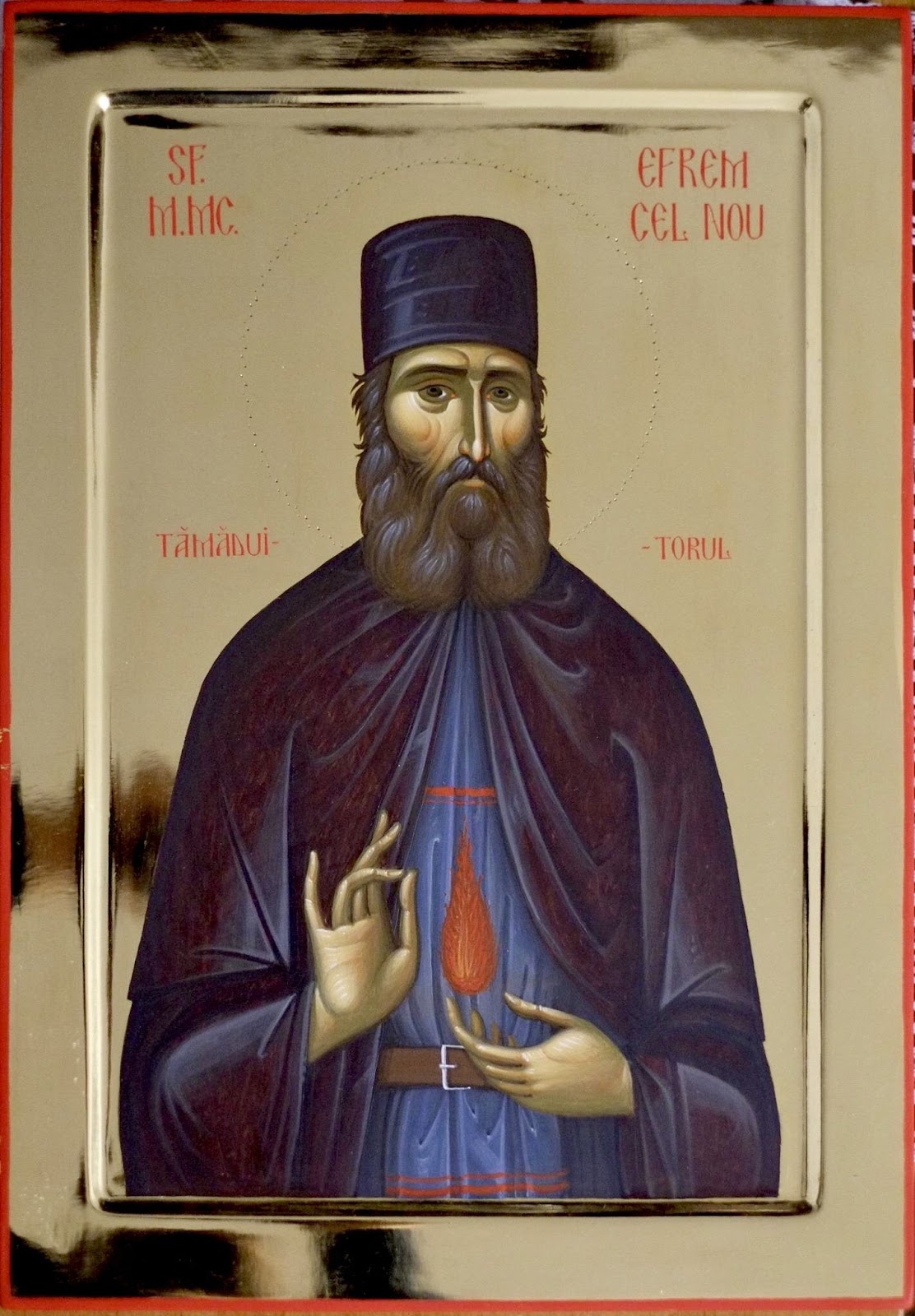
St. Ephraim of Katounakia on the Humble Simplicity of the Cave of Bethlehem

Christ's Nativity in the humble Cave of Bethlehem (source)

"I remember," said St. Ephraim of Katounakia, "that I was astonished by everywhere in the Holy Lands, but when I went to the Cave of Bethlehem, there, my heart was broken! It was torn into a thousand pieces! And I said, 'how was God born in this place, in this cave, without any consolation, like one thrown out of the city? This God Who could make anything for Himself, but, without complaint, far from every worldly comfort, during the night (and the coldest night of the year), the longest night of the year, in a totally abandoned place, He Who created everything--Heaven and Earth--He was born in this place!

"And when I returned [to his cell on Mount Athos], I entered in and saw my blankets (what blankets did He have?), and I saw what I had, and I was ashamed, and said: 'If God was born in that cave, how could I need all of these things?' I saw pots and pans..."

Metropolitan Athanasios of Lemesou, who was relating the story, comments that: "If I were to describe his pots...not even our dogs would eat from them! And if I could describe his bed...not even our pigs would we put in them!

"But, he perceived his place to be a luxury, over the top. And from then on, when they would tell him: "Elder, your cell is small." He would reply: "God was born in a cave. If I thought of God's cave, well then, what could I say regarding my own?"

(source)

Through the prayers of our Holy Fathers, Lord Jesus Christ our God, have mercy on us and save us! Amen!
Wednesday, December 9, 2020

St. Porphyrios on the Condemnation of Bishops

The Holy Fathers (source)

"We should never attack a Bishop with our mouth. He has the episcopacy upon him. Regardless of the mistakes he has done, we must cover him with our prayers. Thus is created around the Bishop a spiritual defense, a spiritual surrounding wall, without him knowing it, which encircles him, and eventually will allow him, as a rule, for God to revive him."***

-St. Porphyrios of Kavsokalyvia

(source)

***Note: St. Porphyrios is not referring to reaching out, in the proper manner and the proper channels, to discuss moral or canonical transgressions by bishops through a Synod or Archbishops above him. He is also not referring to hierarchs canonically deposed by a Synod or church council. He is properly trying to limit the endless gossip, slander, condemnation and judging that gets hurled against hierarchs throughout the world, but even worse now in the age of the internet. May we humbly pray for our bishops before rushing to condemn them, and thus help both of their and our repentance and our souls. 

Through the prayers of our Holy Fathers, Lord Jesus Christ our God, have mercy on us and save us! Amen!

Friday, July 31, 2020

Homily on the Holy Maccabees by Metropolitan Avgoustinos Kantiotes

Icon of the Holy Maccabees with their Mother St. Solomone, and their teacher Eleazar (source)
  
Homily on the Holy Maccabees by Metropolitan Avgoustinos Kantiotes: "Our Faith is True"
We will speak, my beloved, on the Holy Maccabees. They are a star cluster of nine stars, one being their teacher Eleazar, the second was their mother Solomone, and the other seven are her distinguished children of this large family.

These heroes lived in the 2nd century before Christ, during the reign of the King of Syria and Judea of one of the successors of Alexander the Great, Antiochos the Epiphanes (175-163BC). This man, a fanatical idolater, had endless hatred of the Jews, who were the only ones who believed in the true God. He tried with his whole being to uproot from their hearts their faith which had been given to them by Moses. And he slaughtered, slaughtering like a wild beast, more wild than a tiger or a lion. A beast might eat three or four people, but can't eat more. He, however, slaughtered 80,000 Jews, and blood poured through the streets of Jerusalem like a river. And in order to put an end to their religion, he organized an idol-worshiping feast. In the center of the city, he placed a great and large altar, and there sacrificed sheep and goats and bulls and rams, like the Jews would do typically, but--in order to corrupt them--he also sacrificed pigs, hundreds of pigs, to the gods of the idols. And in order to defile the Jews and to strike their religious consciences, he forced them to consume the meat. We must know that the Jews never ate pork. To this day, if you go to a Jewish home, they never eat pork. I won't go into the reasons that they do it, but in any case they continue to keep this.

The Jews fast. Do we? We also need to fast. And here I will make an aside. Are you a Christian, are you Orthodox? I'm not sure. If you were Orthodox, if you firmly believed in our Orthodoxy, you must keep the fasts. Which fasts? You should fast on Wednesday and Friday: Wednesday because on that day was our Lord Jesus Christ betrayed, and Friday, because on that day He was crucified. If you were Orthodox, you would fast during holy and Great Lent, and the other fasting periods, including January 5th, the day before Theophany, August 29th, the day of the Beheading of the Forerunner, and the Exaltation of the Precious Cross.

Do Christians fast today? Unfortunately, this holy practice seems to be going by the wayside. You can break whatever you wish, and you see people even breaking the fast on Holy Friday. During fasting periods, the meat markets are full and the restaurants at night dish out tons of meat. We [Greeks] have become among the largest meat-eaters in the Balkans. We even buy and ship in meat from Bulgaria and Serbia. All of this eating of meat is very serious for our health as well.

So the Jews therefore fasted, and to mock their fasting, Antiochos forced them to eat pork that had been sacrificed to the idols. First, he called the teacher Eleazar, who was an honorable priest. He told him: "I am 90 years old. Until now I have kept the fast according to the divine law, and I cannot even begin to think about abandoning our holy tradition..." He was seized by the soldiers of Antiochos, bound, and thrown into the fine. Thus, he gave up his soul to God.

After this, one by one he called the seven brothers, the Maccabees. He hold them: "Take pity on your youth." He told the first: "I will give you honor, glories, respect." "Keep your honors, I will remain in the home of my fathers/ I will never taste pork sacrificed to the idols..." Thus, the first said not. The same occurred with the second, the third, the fourth, the fifth, the sixth and the seventh. And after they all denied, each began their terrible martyrdom, which one shudders to even think about. Open the Old Testament to the end and turn to the book of Fourth Maccabees (5-12). Don't just read magazines and newspapers. If you are a Christian, read the holy Scriptures. You will say, I don't have time, or I'm tired...Good try!

Let me make another aside. I tell you to fast, but you don't fast. I tell you to read the Holy Scriptures, but you don't read them. The one you don't do, neither do you do the other. What Christian are you, can you tell me? I tell you to pray, but you don't pray. I tell you to confess, but you don't confess. I tell you to commune, but you don't commune. I tell you to go to church, but you don't go. You only go to church when you're invited to a sacrament [i.e. a baptism or a wedding]. Many go for a memorial service. But this is a sin. Because every church every Sunday is a memorial service. What memorial?  Not of our father or our mother. Every Sunday, we serve a memorial for the Lord. And if you go to the memorial of your father or mother, even more so should you go to the memorial of our Lord Jesus Christ. What does faith cost you? To the martyrs it cost terrible pains and death.

The Maccabees therefore said no, and began their martyrdom. A martyrdom that makes man shudder to read it, as is described in the Holy Scriptures. They put a trident between their eyes. Another they cut off his right hand. Another they cut off the left with a saw. Another they cut off his fingers. Another, they pulled off his nails. Another they raked his flesh with iron nails. Another they skinned him alive, like the butcher skins an animal... But it was as if nothing to them! They remained steadfast.

And in front of all of this, in the presence of the martyrdom of the seven children, who was there, I ask? Their mother, St. Solomone. O, what a mother! She was not at all like some mothers today who would say: "Eat, my child, a little meat, it's nothing..." Today, many mothers are only thinking of their children's bodies, their flesh, in other words. Above the body, they don't see anything else. St. Solomone was a unique mother, a historic mother, a rare example throughout the ages. "No, my children!" she said, "Do not pollute our religion, do not loose the crown of glory!" And their mother prepared them, her seven children, for a terrible martyrdom. It was their faith in God, and this faith showed her to be a heroine, a unique and grand and lady of a woman. How did she find the strength to support all her children to be sacrificed? Don't you think that she felt pain? Of course she felt pain. As her children were being martyred, and she saw them one by one being put to death in the most terrible manner, she suffered. She was pained for each separately, and for them all together. Her pain was greatly multiplied. Mothers, when their children get sick with a fever, they entreat God for the fever to flee from their children and to come to them instead. If, therefore, each child of St. Solomone was martyred once, then she was pained for each, and it was as if she was martyred seven times, multiplied by seven. And, having endured steadfastly and unshaken throughout this trial, in the end, she herself fell into the fire (IV Maccabees 17:1). Thus, they were all burned and became a sacrifice for the love of God, martyrs before Christ.

This, my brethren, in a few words, is the martyrdom of the seven Maccabee children, of their mother Solomone, and their teacher Eleazar. What does it teach us?

One lesson comes forth today. Our faith is not a myth. It is living and wondrous. We have the most true religion, the only truth in the world. Because of this, the Prophets prophesied and gave their lives, including the Maccabees in the Old Testament, and because of this, the Apostles and Martyrs were sacrificed in the New Testament, and because of this, the Fathers and the Teachers of the Church lived in asceticism, and preached theology, and confessed the faith.

Let us as well honor and imitate their struggles out of love, that we might, together with them, become partakers in the glory of the Kingdom of God, to Whom be glory and might unto the ages of ages. Amen.
(+) Bishop Avgoustinos
(Delivered in the Church of the Holy Trinity, Ptolmaidos, on Sunday August 2nd, 1987)
(source)
  
The Holy Maccabee Martyrs (source)  
Through the prayers of our Holy Fathers, Lord Jesus Christ our God, have mercy in us and save us! Amen!

Tuesday, July 14, 2020

Elder Ephraim of St. Andrew's Skete on the Repose of St. Paisios

The wondrous body of St. Paisios the Athonite during his funeral (source)
  
"Gerontissa (Eldress) Philothei, from the Monastery of Souroti, told me that, as soon as St. Paisios reposed, his face shown, and his whole body began to pour forth fragrance and lightning!!! And he went from being very pale from his afflictions, to becoming totally white!

"A sign of his great humility and the many signs from God that he had in his life.

"St. Paisios had very many revelations, some of which he revealed to people, but he asked them to not make them known until he had died!

"His life was a martyrical one, and his battle with the devil and with the demons was not insignificant!

"To live one's whole life as a monk, this shows that he had a leonine soul, for otherwise he could not have withstood the attacks of the enemy, being totally alone."
-Elder Ephraim of St. Andrew's Skete, Mount Athos

(source)
  
Icon depicting the dormition of St. Paisios the Athonite (source)
  
Through the prayers of our Holy Fathers, Lord Jesus Christ our God, have mercy on us and save us! Amen!

Thursday, June 11, 2020

St. Luke of Crimea: The Meaning of Sorrows

Christ healing the Ten Lepers (source)
 
St. Luke of Crimea: The Meaning of Sorrows
Continuously, people ask why the Lord God sends them sorrows and many times very great trials. It is very important for every Christian to understand that our sorrows are sent according to the will of God, Who is always good and saving. Most of the time, they are not sent to us as punishments for our sins, but in order for us re-orient our paths and our hearts, or they are sent as a response to requests that we offer to God. People many times expect God to accomplish what they ask in prayers to Him in the manner that they think is best. God, however, continuously responds to our prayers in a totally different manner, and not according to how they wished or could imagine.

If they would ask, for example, for God to give them humility, they might imagine that slowly, day by day, humility would grow within their hearts under the beneficial affection of God. The Lord, however, continuously works in a different way: He sends them an unexpectedly harsh blow, which wounds their pride and their ego and which humbles them. Frequently, our God sends afflictions, and we complain and in no way think that, the majority of the times, this is a great beneficence of God, and most likely is the response of God to our prayers, with which we entreated Him to strengthen our faith.

Do you know recognize that, many times, our Lord sends us terrible bodily afflictions and wounds our body in order to strengthen us spiritually? This occurred with the Venerable Pimen the Much-suffering, who lived in asceticism in the Monastery of the [Kiev] Caves, and whose whole life was found on the bed of pain, enduring an incurable sickness, and through this manner, he reached sanctity. Other people, who give great significance to earthly goods, seek from the Lord to increase their wealth. And the Lord responds to them with the destruction of their properties with fires, and in this manner, He helps to turn them away from their attachment to earthly things and from their greed, and to correct their deviations from the correct path, which is taught to us by the Lord's Beatitudes.
  
God treats us like His true sons, whom He chastens for their good. The sorrows that are sent to us by the Lord, we must receive as St. Peter says: "Humble yourselves therefore under the mighty hand of God, that in due time He may exalt you." (I Peter 5:6). If we cannot, despite all our efforts, come to understand the reason that God sends us sorrows, then at least let us humble ourselves below the mighty hand of God, and He will lift us up at the proper time, in order for us to understand His paths, with which He is leading us for this reason. We must, with great humility and without the smallest complaining, accept all the trials and sorrows that are sent to us from God, having the humble conviction that, with these, God is guiding us, and not that He is pouring His wrath upon us. (Isaiah 27:4) We usually think that the Lord is angry with us, and this is why He is sending us sorrows. No. Never think that God is angry. "God is love." (I John 4:8). And perfect love is foreign to any form of injustice.
 
But many times, when our God gives us a harsh blow, through which He humbles us and then later exalts us, we complain against God. Do you understand, however, what a serious sin is complaining against God? When we complain against God, it means that we perceive Him as unjust, we perceive that He has not treated us properly and that He must act towards us in a different manner. However, is it not a serious sin to condemn God for injustice and to slander Him? See, therefore, how great a sin is complaining against God. Because of this: "Conduct yourselves with fear throughout the time of your exile." (I Peter 1:17). We must pray greatly for our mistakes and for our impediments on our path to the Kingdom of the Heavens. But even more than that, we must have fear to break that great commandment of Christ: "Judge not, that you might not be judged." (Matthew 7:1). And complaining against God is not only judging God, but also condemning Him.
  
Let us lay aside judging those unfortunate people who willingly destroy themselves, whom our Lord Jesus Christ does not correct nor chasten, because they are not able to be corrected and are incurable. We only seek His help on our path towards salvation, that we might glorify Him and ever honor Him, together with His beginningless Father and the Lord Spirit. Amen.
(source) 
  
St. Luke the Blessed Surgeon, Archbishop of Simferopol and Crimea (source)


Through the prayers of our Holy Fathers, Lord Jesus Christ our God, have mercy on us and save us! Amen!

Tuesday, June 9, 2020

"And He opened His mouth and taught them..."

Icon of the Hospitality of Abraham, and type the Holy Trinity (source)
  
Seeing the crowds, he went up on the mountain, and when he sat down his disciples came to him. And he opened his mouth and taught them, saying:
"Blessed are the poor in spirit, for theirs is the kingdom of heaven.
"Blessed are those who mourn, for they shall be comforted.
"Blessed are the meek, for they shall inherit the earth.
"Blessed are those who hunger and thirst for righteousness, for they shall be satisfied.
"Blessed are the merciful, for they shall obtain mercy.
"Blessed are the pure in heart, for they shall see God.
"Blessed are the peacemakers, for they shall be called sons of God.
"Blessed are those who are persecuted for righteousness' sake, for theirs is the kingdom of heaven.
"Blessed are you when men revile you and persecute you and utter all kinds of evil against you falsely on my account. Rejoice and be glad, for your reward is great in heaven, for so men persecuted the prophets who were before you.
-Matthew 5:1-12
 
Through the prayers of our Holy Fathers, Lord Jesus Christ our God, have mercy on us and save us! Amen!

Tuesday, May 26, 2020

"You were led away like a stranger and a slave..."

Christ is risen! Truly He is risen!
St. John the Russian (source)
  
You were led away like a stranger and a slave, by the hands of the Hagarenes, O Father, and lived a strange life, O glorious one, living in a stable like another Job upon a dunghill, amidst struggles and trials, and ever shedding streams of fervent tears, which reached Him Whom you desired, O John, truly the namesake of grace.
-Prosomoion from the Aposticha

(source)

Christ is risen from the dead, by death trampling down upon death, and upon those in the tombs He has granted life!
Truly the Lord is risen!

Saturday, May 9, 2020

Elder Symeon on Healing and God's Providence

Christ is risen! Truly He is risen!
Christ healing the Paralytic (source)
   
"The sacrament of the Anointing of the Sick is for the healing of our illnesses. If we are not healed, we don't need to be healed. This is why we were not healed. If you comprehend this lack of healing, you already healed. You know already that an illness, which lingers and does not leave, is precious.

"Whatever needs to go, God will remove. Whatever doesn't need to stay, God removes, whether it is an illness or a demonic influence. And for whatever things that continue on and hurt us, we should pray to God. We should pray multiple times, again and again we should pray, not only for deliverance from our soul's illnesses and the demonic influences, but also for deliverance from bodily illnesses, as well.

"Let us pray to God for everything again and again. Not because God needs to hear our prayers repetitiously, but because we need to demonstrate by our seeking of Him, our faith. For modern man such lessons are learned from repetition.

"If you pray again and again and you will need to do this, and God does not answer your prayer or remove your illnesses, realize this: either you have not shown as much faith as He wants and expects from you, or the illness should not go because it is necessary for you.

"If you understand your illness from God's perspective, then, when it remains, you will feel twice healed. If He heals you, you are healed once. If the illness lingers, you will feel healed twice. Both when the time comes to be healed from your illness and at the right time your soul will experience healing also. When this occurs your inner person will be healed, this is the person who suffers from illness, from the leprosy of sin.

"The same goes for all mental illness and whatever else hurts us.

"If man sees all his issues within the providence of God, he will feel such a relief, as if all his problems are solved.

"Because in God all is resolved!"
-Elder Symeon Kragiopoulos (+2015),
Excerpt from the Book: Are You in Pain? Looking deeply into the mystery of pain
(source)
 
Christ is risen from the dead, by death, trampling down upon death, and to those in the tombs, He has granted life!
Truly, the Lord is risen!

Tuesday, May 5, 2020

"I am Saint Efraim..."

Christ is risen! Truly He is risen!
St. Ephraim of Nea Makri (source)
   
I am Saint Efraim
(Written by a Pilgrim to the Monastery on June 17, 1971)
"Venerable Mother, I will tell you about a dream I had today. I dreamt that I was in the Church and we had the prayer after Supper. When it was over, as we were leaving I turned my head back and I saw Saint Efraim in front of the Altar. With fear, I went to Him and I heard Him telling me, "I am Saint Efraim. Light the oil candles of the Holy Altar." I was very scared and I called one of the Sisters. Saint Efraim approached me and once again told me, "I am Saint Efraim and He started chanting with His sweet voice, "Restrained by many temptations..." (from the Small Paraklesis to the Theotokos). 

Sts. Ephraim of Nea Makri and Nektarios of Aegina, two great Wonderworkers of the 20th Century (source)
   
He signaled us to stop, He sat down and started to tell us all about His sufferings; how much those bloodthirsty wolves, those infidel Ottomen had tortured Him. And he kept talking, "They were torturing me even after I had died. You don't know how much I have suffered. They put in my head big sharp nails and nailed it to the tree. He did His cross and said, "I suffered a lot", and did his cross again.

I wanted to cry, my Saint. To cry for your terrible ordeal, but I don't have this kind of tears that can reach you. My Saint, with your intercessions, purify my tears and accept them as a supplication of love to your Saintly martyr holiness.

My Saint, we most devoutly [venerate] your sufferings.
Don't stop mediating to the Lord to have mercy on us.

Sts. Ephraim of Nea Makri and Nektarios of Aegina, the Wonderworkers (source)
  
It is true that the Saint's grace has gotten outside our boundaries. A young woman from Kalamata told us that she had gone to Zakynthos to a Monastery and the Mother Superior had told her, "We are expecting a Saint to pass by here." When the young woman asked who that Saint was, she was told it was Saint Efraim, in glory and grandeur. Before Saint Efraim, a Nun with a lit candle was marching in solemnity.

It was September 14, 1971 that I was planning to come to the Monastery for my offering. A few days earlier, I saw the following dream: It was noon time and I was resting when Saint Nectarios along with some other Saint that I didn't know, appeared in front of me. That other Saint was dressed in an ascetic cassock. He was tall and very thin and had a calm ascetic and serious expression. When I asked them who they were, the Saint told me, "Efraim" and started telling me something about the 14th of September, the day of the Holy Cross..., but before I could understand what He wants, I woke up. Later I learned that the Saint was born on that day and on that day His sufferings started and ended on May 5, 1426."

Excerpt from the Book Visions and Miracles of the Great Martyr and Miracle-Worker Ephraim Neophanous
 
Sts. Nektarios of Aegina and Ephraim of Nea Makri, two great Wonderworkers and Healers of Christ in our days (source)
 
Christ is risen from the dead, by death, trampling down upon death, and to those in the tombs, He has granted life!
Truly, the Lord is risen!

Friday, April 10, 2020

Photios Kontoglou: "Blessed is He Who comes in the name of the Lord"

Christ raising Lazarus, by Photios Kontoglou (source)
  
Photios Kontoglou: "Blessed is He Who comes in the name of the Lord"
He Whose throne is heaven, and Whose footstool is the earth, the Son of God and His Logos, Who is eternal with Him, today humbles Himself, and comes to Bethany on a little donkey.

And the children of the Hebrews received Him, crying out: "Hosanna in the highest, blessed is He Who comes, the King of Israel."

The warlords of the world, when they would finish a war and threw down their enemies, they would return glorified, and sitting on golden chariots to enter their city. Before them would go the trumpets and flags and brave generals and a multitude of soldiers, covered with iron armor and bearing weapons around a chariot that was filled with many pieces of armor and swords and spears that remained from the conquered nation.

Similar things like these were the great nails that they used in the Crucifixion of our Savior Jesus Christ!

All of these warriors were iron-clad like wild beasts, their heads locked within fearsome helmets, their spears and hairy hands were bloodied from war, their strong legs walked proudly and stretched, like a lion that tore apart a deer with its claws and stretches with roars and frightens the world.

Later would come the golden chariot of the warlord, where he would sit on a throne, adorned with precious stones, proud, haughty, fearsome, who could not be looked upon in the eye without averting one's gaze, carrying his terrible scepter, whose every movement of his command was an order, without opening the mouth of the one holding it.

Horses on that day, were harnessed to that chariot, with gold-embroidered straps with carousels and they also walked pompously and proudly like the humans. A beautiful girl, like a fairy, was decorated, holding a golden crown above the head of the champion, and other girls and boys tossed incense and other spices in great censers shaped like candelabras.

Behind them came the men and women who were taken as slaves, who were sick and wounded, and they were being dragged by the soldiers who struck them.

As much glory as the people had in front, so much disdain and misfortune had those who followed behind. They were bound with ropes and chains, many were pierced, tattered, wounded, jaundiced and half-dead, from their martyrdoms and from their vigils. Many were half-naked and their backs were darkened from the whips. Among them were women, ashamed virgins, stolen mothers with their innocent children in their hands, elderly who were holding on to their grandchildren by the hand, all traumatized like lamps going to the marketplace. Around them, the world grew insane and cried out, glorifying the victor, with many mouths foaming. A cry rose like smoke above the whole city. This scene, they called a "triumph."

One such triumph is performed today by Christ, the Price of Peace and of Love. However, He has changed all the rest and turned it upside down from what men were used to, and thus, His triumph is the triumph of poverty and humility.

The Roman ruler was seated upon a throne and golden chariot, but Christ is seated on a little donkey, possibly among the most humble and disdained among the animals.

And He Himself was humble, meek, silent, poorly-dressed, as the Prophecy which says: "Say to the daughter of Zion: Behold your King is coming, meek and having salvation is He, humble and mounted on a donkey, on a colt, the foal of a donkey." (Zachariah 9:9) His hand had never held a scepter, but blessed the world. He Himself is returning from war, but a war much more difficult to win, a war against evil and falsehood and hypocrisy and love of money.

And He was not going to rest from that war, but was going to begin another, even harder, to be crowned with a crown of thorns, and to be beaten and to mocked, and in the end, to be nailed upon a Cross like an evil-doer.

He was not surrounded by wild servants, but by innocent fishermen, who were disdained like Him. And He neither carried behind Him slaves that He tyrannized, but men whom He freed from the slavery of the Devil, and the dead whom He had raised through His voice.

They did not blare trumpets and drums to glorify Him, but innocent children, which symbolized the simplicity which Christians have, cried out: "Blessed is He Who comes", and instead of holding flags waved the green branches of trees. Verdant branches and clothes strewn on the road for the donkey to walk over.

And this blessed donkey, with a bowed head, humble, ignorant, bore Christ Who was sitting on its back, Whom the fiery six-winged Seraphim stand about with fear. He was not carried by a golden chariot, nor a prized stallion, nor even a seat held by others, but by a little donkey. What eye does not shed a tear and is not astonished by this mystery!

Christ overturned what sinful man saw regarding what is right and true. Who, however, is in the position to sense the freedom which He brings us, and would follow the donkey, and not the fine horses that glow proudly, which enter Rome with many idols, instead of entering together into the kingdom of Peace, the Jerusalem on high?

Many "serious" people, one could say, did not understand this, saying that the children where childish, and the men were manly. The same was said by the high priests, men of authority: But when the chief priests and the scribes saw the wonderful things that he did, and the children crying out in the temple, “Hosanna to the Son of David!” they were indignant;  and they said to him, “Do you hear what these are saying?” And Jesus said to them, “Yes; have you never read, ‘Out of the mouth of babes and sucklings thou hast brought perfect praise’?” And leaving them, he went out of the city to Bethany and lodged there." (Matthew 21:15-17)

The chief priests and the scribes had read the Psalm of David which said how the Christ would be met by the babes and they did not believe Him Whom they hymned. And if we have read today's Gospel and the Psalm and what Christ said to the Hebrews, would we not be judged more strictly than if we had not believed Him? Our vanity and our pride prevent us from going along His poor path, and we are ashamed to follow a leader Who is riding upon a donkey. We don't want the humble, the poor. Can one become a Christian who does not love that which Christ loved?

Yesterday, Saturday, He raised a dead man, Lazaros. Who was this Lazaros? Was he a notable, famous person? Lazaros was a poor villager, but as the Gospel says, he was a friend of Christ, Who would have all men as His friends.

The Gospel notes that Christ had a friend in the world, and that he was poor and unlearned. But who among us loves this rich poverty of Christ? Where Christ is missing, there is the true poverty, because where Christ is missing, there is also missing true life and death rules. This you would understand well if you look around you and ponder. Where are those almighty Roman leaders who made their triumphant entry, as we described above?  What happened to them, and the myriads that worshiped them and knelt before them like the reeds before the north wind? Who brings to mind those who wrote the history of that time?


Bodies, souls, thrones, diamonds, horses, pride, horrors, voices, all fell into a pit and were lost and extinguished as if they had never been drunk. And what is left of all this in people's hearts? Nothing and even less than nothing.
But man is unfaithful even to what he sees and what he grasps with his hands, and he pulls the path that they have taken, and he happily drags Nero's chariot, because "his neck is iron." His ears are pricked by Him Who says: "I am God, the first and the last, I am. I nourish my sheep and I will give them rest." He Who was sitting upon the donkey, it is He Who remains alive within simple souls unto the ages, and is for them a source of nourishment, a source of immortality, joy and delight, according to the words that say: "The heart of those who seek the Lord shall rejoice."

Yes, whoever senses the joy of Christ, is like that dead man [Lazaros] who was raised. There are many kinds of pain in the world. Those who suffer in body and soul, their pain cleanses them and takes them to God, and these are the beloved ones of Christ and walk in His army with His consoling light. The others suffer futily. That is why the Apostle Paul wrote to the Corinthians: "Now I rejoice, not because you were grieved, but because you were grieved into repenting; for you felt a godly grief, so that you suffered no loss through us.  For godly grief produces a repentance that leads to salvation and brings no regret, but worldly grief produces death." (2 Corinthians 7:9-10).

For those who hope in God, Christ transforms their futile sweat into sweat of salvation "a refreshing sweat", but we mourn and are pained in every way like the idolaters, slaughtered by the knives of fate. They did not allow their sweat of agony to become transformed into sweat of prayer and hope.

Whoever does not believe in Christ and in the Gospel is dead, as no true life exists within him. Because life does not mean to breath and to walk and to eat and drink, but to sense the grace of immortality. Then, one can chant together with that exceptional hymn that is the Apolytikion:

"By raising Lazarus from the dead before Your passion, You did confirm the universal Resurrection, O Christ God! Like the children with the palms of victory,  we cry out to You, O Vanquisher of death; Hosanna in the Highest! Blessed is He that comes in the Name of the Lord!
(source)
  
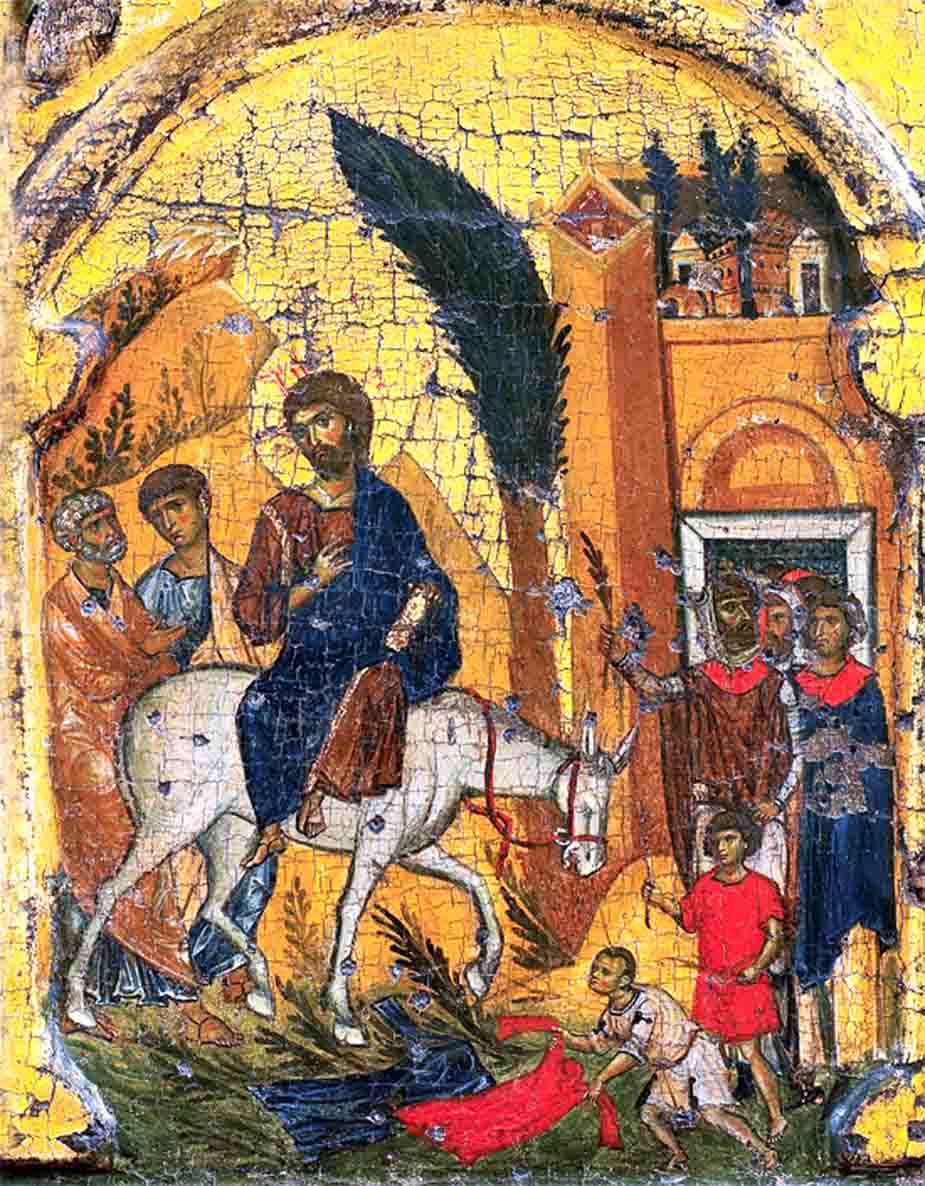
Christ entering Jerusalem on Palm Sunday (source)
  
Through the prayers of our Holy Fathers, Lord Jesus Christ our God, have mercy on us and save us! Amen!

Thursday, April 9, 2020

St. John Chrysostom on Job's Suffering as Consolation

Holy Prophet Job (source)
  
St. John Chrysostom on Job's Suffering as Consolation
On both sides, beloved, reap the utmost gain, and avoid the imitation of Adam knowing how many ills are begotten of laziness and imitate the piety of Job, learning how many glorious things spring from earnestness. Consider him, the conqueror throughout, and you shall have much consolation in all pain and peril. For as it were in the common theatre of the world that blessed and noble man stands forth, and by means of the sufferings which happened to him, discourses to all to bear all things which befall them nobly and never give in to the troubles which come upon them. For verily, there is no human suffering which cannot receive consolation as a result. For the sufferings which are scattered over the whole world, these came together, and bore down upon one body, that of Job. What pardon then shall there be for him who is unable to bear with thankfulness his share of the troubles which are brought upon him? Since he appears not bearing a part only, but the entire ills of all men, and in order that you may not condemn the extravagance of my words, come, and let us take in hand severally the ills that came upon him, and bring forward this fulfillment of them.
  
And if you wish, let us first bring forward that which seems to be the most unendurable of all, I mean poverty, and the pain which arises from it. For everywhere all men bewail this. Who was poorer, then, than Job, who was poorer than the outcasts at the baths and those who sleep in the ashes of the furnace, poorer in fact than all men? For these, indeed, have one ragged garment, but he sat naked, and had only the garment which nature supplies, the clothing of the flesh, and this the Devil destroyed on all sides with a distressing kind of decay. Again, these poor folk are at least under the roof of the porches at the baths and are covered with a shelter, but he continued always to pass his nights in the open air, not having even the consolation of a bare roof. And what is still greater, the fact that these are conscious of many terrible evils within themselves, but he was conscious of nothing against himself. For this is to be noticed in each of the things which happened to him, a thing which caused him greater pain, and produced more perplexity; the ignorance of the reason of what took place. These persons, then, as I said, would have many things with which to reproach themselves. And this contributes much to consolation in calamity; to be conscious in oneself of being punished justly. But he was deprived of this consolation, and while exhibiting a conversation full of virtue, endured the fate of those who had dared to do extreme wickedness. And these folk who are with us, are poor from the outset, and from the beginning are experienced in calamity. But he endured calamity in which he was unexperienced, undergoing the immense change from wealth. As then the knowledge of the cause of what takes place, is the greatest consolation; so it is not less than this, to have been experienced in poverty from the beginning and so to continue in it. Of both these consolations that man was deprived, and not even then, did he fall away. Do you see him indeed come to extreme poverty, even in comparison with which it is impossible to find a fellow? For what could be poorer than the naked who has not even a roof over him? Yes rather not even was it in his power to enjoy the bare ground, but he sat upon the dunghill. Therefore whenever you see yourself come to poverty, consider the suffering of the just one, and straightway you shall rise up, and shake off every thought of despondency. This one calamity therefore seems to men to be the groundwork of all sufferings together.
  
And the second after it, yes rather before it, is the affliction of the body. Who then was even so disabled? Who endured such disease? Who received or saw any one else receive so great an affliction? No one. Little by little, his body was wasted, and a stream of worms on every side issued from his limbs; the running was constant; the evil smell which surrounded him was strong, the body being destroyed little by little, and decaying with such putrefaction, used to make food distasteful; and hunger was to him strange and unusual. For not even was he able to enjoy the nourishment which was given to him. For he says, “I see my food to be loathsome” (Job 6:7). Whenever, then, you fall into weakness, O man, remember that body and that saintly flesh, for it was saintly and pure, even when it had so many wounds. And if any one belong to the army, and then unjustly and without any reasonable pretext, be hanged upon the pillory2, and has his sides rasped to pieces, let him not think the matter to be a reproach, nor let him give way to the pain when he thinks upon this saint. But this man, says one, has much comfort and consolation in knowing that God was bringing these sufferings upon him. This indeed especially troubled and disturbed him, to think that the just God Who had in every way been served by him was at war with him. And he was not able to find any reasonable pretext for what took place, since, when at least he afterwards learned the cause, see what piety he showed, for when God said to him “Do you think that I have had dealings with you in order that you might appear righteous?” (Job 40:8), he says while conscious-stricken, “I will lay my hand upon my mouth, once have I spoken but to a second word I will not proceed,” (Job 40:4, 5), and again “as far as the hearing of the ear I have heard you before, but now mine eye has seen you, wherefore I have held myself to be vile, and am wasted away, and I consider myself to be earth and ashes” (Job 42:5, 6).
  
But if you think that this is sufficient for consolation, you will yourself also be able to experience this comfort. And even if you do not suffer any of these misfortunes at the hands of God, but owing to the insolence of men — and yet give thanks and do not blaspheme Him Who is able to prevent them indeed, but Who permits them for the sake of testing you — just as they who suffer at the hands of God are crowned, so also you shall obtain the same reward, because you have borne nobly the calamities which were brought upon you from men and did give thanks to Him Who was able indeed to hinder them, but not willing.
  
Behold, then! You have seen poverty and disease, and both in the extremest degree brought upon this just man. Do you wish that I should show you the warfare at nature’s hands, in such excessive degree waged then against this noble man? He lost ten children, the ten at one fell swoop, the ten in the very bloom of youth, ten who displayed much virtue, and that not by the common law of nature, but by a violent and pitiable death. Who could be able to recount so great a calamity? No one. Whenever, therefore, you lose son and daughter together, have recourse to this just man, and you shall find altogether much comfort for yourself. Were these, then, the only misfortunes which happened to him? The desertion and treachery of his friends, the gibes, raillery, mockery and derision, and the tearing in pieces by all was something intolerable. For the character of calamities is not of such a kind, that they who reproach us about our calamities are inclined to vex our soul. Not only was there no one to soothe him, but many from all sides troubled him with taunts. And you see him lamenting this bitterly and saying, “but even you, too, fell upon me” (Job 19:5). He calls them pitiless and says, “My neighbors have rejected me, and my servants spoke against me, and I called the sons of my concubines, and they turned away from me” (Job 19:14, 16). “And others,” he says, “sport upon me, and I became the common talk of all (Job 19:9, 10). And my very raiment,” he says, “abhorred me” (Job 9:31). These things at least are unbearable to hear, still more to endure in their reality, extreme poverty, and intolerable disease new and strange, the loss of children so many and so good, and in such a manner, reproaches and gibes, and insults from men. Some indeed mocked, some reproached, and others despised; not only enemies, but even friends; not only friends, but even servants, and they not only mock and reproach, but even abhorred him, and this not for two or three, or ten days, but for many months; and (a circumstance which happened in that man’s case alone) not even did he have comfort by night, but the delusions of terrors by night were a greater aggravation of his misfortunes by day. For that he endured more grievous things in his sleep, hear what he says “why do you frighten me in sleep, and terrify me in visions?” (Job 7:14). What man of iron, what heart of steel could have endured so many misfortunes? For if each of these was unbearable in itself, consider what a tumult their simultaneous approach excited. But nevertheless he bore all these, and in all that happened to him he sinned not, nor was there guile in his lips.
  
Let the sufferings of that man then be the medicines for our ills, and his grievous surging sea the harbor of our sufferings, and in each of the accidents which befall us, let us consider this saint, and seeing one person exhausting the misfortunes of the universe, we shall conduct ourselves bravely in those which fall to our share, and as to some affectionate mother, stretching forth her hands on all sides, and receiving and reviving her terrified children, so let us always flee to this book, and even if the pitiable troubles of all men assail us, let us take sufficient comfort for all and so depart. And if you sayest, he was Job, and for this reason bore all this, but I am not like him; you supply me with a greater accusation against yourself and fresh praise of him. For it is more likely that you should be able to bear all this than he. Why, you ask? Because he indeed was before the day of grace and of the law, when there was not much strictness of life, when the grace of the Spirit was not so great, when sin was hard to fight against, when the curse prevailed and when death was terrible. But now our wrestlings have become easier, all these things being removed after the coming of Christ; so that we have no excuse, when we are unable to reach the same standard as he, after so long a time, and such advantage, and so many gifts given to us by God. Considering therefore all these things, that misfortunes were greater for him, and that when the conflict was more grievous, then he stripped for the contest; let us bear all that comes upon us nobly, and with much thankfulness, in order that we may be able to obtain the same crown as he, by the grace and lovingkindness of Jesus Christ our Lord, with whom be glory to the Father together with the Holy Spirit, now and always and for ever and ever. Amen.
(source)
  
Excerpt from a 12th century illuminated manuscript of the Book of Job from Great Lavra, Mount Athos, depicting the Pre-incarnate Logos speaking to Job "through the whirlwind and clouds" (Job 38:1), coming to console and vindicate him (source)
  
Through the prayers of our Holy Fathers, Lord Jesus Christ our God, have mercy on us and save us! Amen!

Tuesday, March 31, 2020

Excerpts from St. John of the Ladder on Illness

Christ healing the paralytic (source)
  
"When we see one of our athletes in Christ in bodily suffering and infirmity, let us not maliciously seek to learn the explanation of his illness, but rather with simple and genuine love let us try to heal him as though he were part of our own body, and as a fellow warrior wounded in the fray.

"Sickness is sometimes for the cleansing of sins, and sometimes to humble our mind.

"All that happens to us, seen or unseen, can be taken by us in a good or a passionate or some middle disposition. I saw three brethren punished: one was angry, one suppressed his grief, but the third reaped the fruit of great joy."
-St. John of the Ladder

(source)
  
St. John Climacus (source)
  
Through the prayers of your Holy Fathers, Lord Jesus Christ our God, have mercy on us and save us! Amen!

Friday, January 31, 2020

"You were made worthy of the joy and rejoicing of the Angels..."

St. Tryphon the Great Martyr and Unmercenary (source)


You were made worthy of the joy and rejoicing of the Angels, O all-blessed Tryphon, having denied the joys of this life, and through steadfastness of soul, you counted all [worldly] things as nothing, and with endurance, proceeded to Martyrdom, and you ever intercede on behalf of our souls.
-Prosomoion of the Stichera for the feast of St. Tryphon

(source)
  
Through the prayers of our Holy Fathers, Lord Jesus Christ our God, have mercy on us and save us! Amen!

St. Porphyrios: "Christ will conquer in the end..."

Christ willingly being judged before Pilate (source)
  
"My child, we Christians do not have money, nor power. Today, this world is governed by the mighty. Mighty powers, banks with a lot of money, other forces, very great...We are unable to cope with these forces and it is natural that these forces, many times, are antithetical to the Christian spirit, with the result being danger to Christians and those who desire to live according to the law of God. We cannot resist these forces, because in a worldly manner, we are unable. We, however, have Christ, my child. And if we ask Christ, then, we can resist whatever is difficult that comes our way, and we will be able to endure. Christ will conquer in the end, and righteousness and truth will prevail."
-St. Porphyrios of Kavsokalyvia

(source)
  
Through the prayers of our Holy Fathers, Lord Jesus Christ our God, have mercy on us and save us! Amen!

St. Porphyrios: "One does not become a Christian with laziness..."

Jesus Christ the Son of God the Savior of the world (source)
  
A spiritual child of St. Porphyrios spoke of the Saint: "He spoke to me, not of some piecemeal good effort, but on the decisive, definitive passing from an old life of sin into a new life of holiness, in which we live in Christ and Christ lives within us, and for this transition, we must give all our strength.

Once, he asked me: "Tell me, to study to become a lawyer, how many years does it take?" I answered him.

He asked again: "To study to be an engineer, a chemist, a physician, how many years does it take?" I answered correspondingly, curious as to the nature of his questions.

And the Elder continued: "Do we study to learn the will of God and to apply it?"

I understood what he was referring to, and I was reluctant to respond. What could I say? That most of us faithful are lazy, lukewarm, "amateur Christians"? He knew this.

And he told me: "One does not become a Christian with laziness. It requires work, much work."

He himself was an example, without showing off. He had dedicated himself with zeal all the years of his long life to studying and to living Christ.

He was a worker, bodily and spiritually, and he wished to transmit this love of work to others. He believed that laziness leads to despondency and to many afflictions of soul and body. He recommended occupational therapy. Especially for those who were disorganized and desperate.

For the Elder, it was never too late to make a new start. He perceived of course that the denial of worldly hopes and the crushing of selfishness as the best precondition for this beginning.
Everything is transformed with effort, both with the soul and the body.

Do not leave the prayer. Simply and without being forced, fervently entreat for others. You will benefit them with prayer, not with words.

Regarding my problems, St. Porphyrios told me: "If we spoke a little on the phone, you would see that everything had immediately gone well. Tire the body, do not fear effort. Everything is transformed with effort, both the soul and the body. If they ask you about it, say humbly: 'That's how I think, but whatever you think.'"
-From a spiritual child of St. Porphyrios, in an Anthology of Instructions of Elder Porphyrios
(source)

  
St. Porphyrios of Kavsokalyvia (source)
  
Through the prayers of our Holy Fathers, Lord Jesus Christ our God, have mercy on us and save us! Amen!

Wednesday, December 18, 2019

Fr. Andreas Konanos: "When things don't go your way"

This is a great talk from the noted speaker, Fr. Andreas Konanos (in Greek, with English subtitles) on the topic of "When things don't go your way". Fr. Andreas' humor, wisdom, and joyful anecdotes and advice are very helpful, as he discusses how to face difficulties in life, illnesses, afflictions, temptations and how to achieve peace and endurance amidst trials (source)
  
Through the prayers of our Holy Fathers, Lord Jesus Christ our God, have mercy on us and save us! Amen!

Wednesday, December 4, 2019

The Answer to "Why me?"

The Crucifixion of Christ (source)
  
"The answer to 'Why me?', to the sorrows that occur for you, are you yourself."
-St. Sophrony of Essex
   
"The greatest humility is for our nous to submit before the mysteries of God, and not to ask "how" and "why".
-Blessed Ierotheos of Hydra
  
"After our death, when we face Christ face to face, we will understand the 'why' and 'how' of our life, and He will explain to us everything that we passed through in that world. Then, with the whole strength of our being, we will tell Him: 'Thank you, my God, that You allowed those things to happen to me!'"
-St. Paisios the Athonite

(source)
  
Through the prayers of our Holy Fathers, Lord Jesus Christ our God, have mercy on us and save us! Amen!

Friday, November 22, 2019

St. Iakovos of Evia on the Eternal Soul

St. Iakovos of Evia (source)
  
"I have a heart, and I have many afflictions. But "the afflictions of the present time lead to glory in the age to come", and so I don't reckon them as anything. Daily I see my grave, that I am a dead man. But within this dead flesh dwells an eternal soul. I care for my soul which is something eternal. Because of this, my child, you also should care for your soul, near the Fathers of the Church."
-St. Iakovos of Evia

(source)

Through the prayers of our Holy Fathers, Lord Jesus Christ our God, have mercy on us and save us! Amen!

Tuesday, October 15, 2019

St. Porphyrios on the Expectation of God

Icon of the Parable of the Ten Virgins (source)
  
When you desire and wait to be united with God, when you force God, He does not come. But He comes "at a day that is not expected, and at the hour that you do not know." It is a most-holy way, but you cannot learn it from outside.
-St. Porphyrios of Kavsokalyvia
  
(source)
  
Through the prayers of our Holy Fathers, Lord Jesus Christ our God, have mercy on us and save us! Amen!