Showing posts with label The Ascension of Christ. Show all posts

Thursday, May 28, 2020

Fr. George Florovsky: "And Ascended into Heaven..."

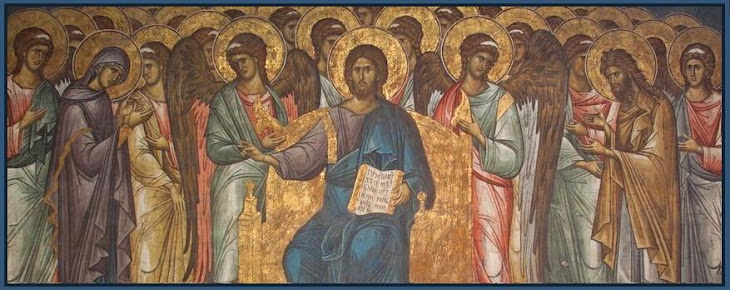
The Holy Ascension of Christ (source)
  
“AND ASCENDED INTO HEAVEN....”
V. Rev. George Florovsky, D.D.
“I ascend unto My Father and your Father, and to My God, and Your God” (John 20:17). In these words the Risen Christ described to Mary Magdalene the mystery of His Resurrection. She had to carry this mysterious message to His disciples, “as they mourned and wept” (Mark 16:10). The disciples listened to these glad tidings with fear and amazement, with doubt and mistrust. It was not Thomas alone who doubted among the Eleven. On the contrary, it appears that only one of the Eleven did not doubt—Saint John, the disciple “whom Jesus loved.” He alone grasped the mystery of the empty tomb at once: “and he saw, and believed” (John 20:8). Even Peter left the sepulcher in amazement, “wondering at that which was come to pass” (Luke 24:12).  
  
The disciples did not expect the Resurrection. The women did not, either. They were quite certain that Jesus was dead and rested in the grave, and they went to the place “where He was laid,” with the spices they had prepared, “that they might come and anoint Him.” They had but one thought: “Who shall roll away the stone from the door of the sepulcher for us?” (Mark 16:1-3; Luke 24:1). And therefore, on not finding the body, Mary Magdalene was sorrowful and complained: “They have taken away my Lord, and I know not where they have laid Him” (John 20:13). On hearing the good news from the angel, the women fled from the sepulchre in fear and trembling: “Neither said they anything to any man, for they were afraid” (Mark 16:8). And when they spoke no one believed them, in the same way as no one had believed Mary, who saw the Lord, or the disciples as they walked on their way into the country, (Mark 16:13), and who recognized Him in the breaking of bread. “And afterward He appeared unto the Eleven as they sat at meat, and upbraided them with their unbelief and hardness of heart, because they believed not them who had seen Him after He was risen” (Mark 16:10-14).  
  
From whence comes this “hardness of heart” and hesitation? Why were their eyes so “holden,” why were the disciples so much afraid of the news, and why did the Easter joy so slowly, and with such difficulty, enter the Apostles’ hearts? Did not they, who were with Him from the beginning, “from the baptism of John,” see all the signs of power which He performed before the face of the whole people? The lame walked, the blind saw, the dead were raised, and all infirmities were healed. Did they not behold, only a week earlier, how He raised by His word Lazarus from the dead, who had already been in the grave for four days? Why then was it so strange to them that the Master had arisen Himself? How was it that they came to forget that which the Lord used to tell them on many occasions, that after suffering and death He would arise on the third day?  
  
The mystery of the Apostles’ “unbelief” is partly disclosed in the narrative of the Gospel: “But we trusted that it had been He which should have redeemed Israel,” with disillusionment and complaint said the two disciples to their mysterious Companion on the way to Emmaus (Luke 24:21). They meant: He was betrayed, condemned to death and crucified. The news of the Resurrection brought by the women only “astonished” them. They still wait for an earthly triumph, for an exernal victory. The same temptation possesses their hearts, which first prevented them from accepting “the preaching of the Cross” and made them argue every time the Saviour tried to reveal His mystery to them. “Ought not Christ to have suffered these things and to enter into His glory?” (Luke 24:26). It was still difficult to understand this.  
  
He had the power to arise, why did He allow what that had happened to take place at all? Why did He take upon Himself disgrace, blasphemy and wounds? In the eyes of all Jerusalem, amidst the vast crowds assembled for the Great Feast, He was condemned and suffered a shameful death. And now He enters not into the Holy City, neither to the people which beheld His shame and death, nor to the High Priests and elders, nor to Pilate—so that He might make their crime obvious and smite their pride. Instead, He sends His disciples away to remote Galilee and appears to them there. Even much earlier the disciples wondered, “How is it that Thou wilt manifest Thyself unto us, and not unto the world?” (John 14:22). Their wonder continues, and even on the day of His glorious Ascension the Apostles question the Lord, “Lord, wilt Thou at this time restore again the kingdom to Israel?” (Acts 1:6). They still did not comprehend the meaning of His Resurrection, they did not understand what it meant that He was “ascending” to the Father. Their eyes were opened but later, when “the promise of the Father” had been fulfilled.   In the Ascension resides the meaning and the fullness of Christ’s Resurrection.  
  
The Lord did not rise in order to return again to the fleshly order of life, so as to live again and commune with the disciples and the multitudes by means of preaching and miracles. Now he does not even stay with them, but only “appears” to them during the forty days, from time to time, and always in a miraculous and mysterious manner. “He was not always with them now, as He was before the Resurrection,” comments Saint John Chrysostom. “He came and again disappeared, thus leading them on to higher conceptions. He no longer permitted them to continue in their former relationship toward Him, but took effectual measures to secure these two objects: That the fact of His Resurrection should be believed, and that He Himself should be ever after apprehended to be greater than man.” There was something new and unusual in His person (cf. John 21:1-14). As Saint John Chrysostom says, “It was not an open presence, but a certain testimony of the fact that He was present.” That is why the disciples were confused and frightened. Christ arose not in the same way as those who were restored to life before Him. Theirs was a resurrection for a time, and they returned to life in the same body, which was subject to death and corruption—returned to the previous mode of life. But Christ arose for ever, unto eternity. He arose in a body of glory, immortal and incorruptible. He arose, never to die, for “He clothed the mortal in the splendor of incorruption.” His glorified Body was already exempt from the fleshly order of existence. “It is sown in corruption, it is raised in incorruption. It is sown in dishonor, it is raised in glory. It is sown in weakness, it is raised in power. It is sown a natural body, it is raised a spiritual body” (I Cor. 15:42-44). This mysterious transformation of human bodies, of which Saint Paul was speaking in the case of our Lord, had been accomplished in three days. Christ’s work on earth was accomplished. He had suffered, was dead and buried, and now rose to a higher mode of existence. By His Resurrection He abolished and destroyed death, abolished the law of corruption, “and raised with Himself the whole race of Adam.” Christ has risen, and now “no dead are left in the grave” (cf. The Easter Sermon of Saint John Chrysostom). And now He ascends to the Father, yet He does not “go away,” but abides with the faithful for ever (cf. The Kontakion of Ascension). For He raises the very earth with Him to heaven, and even higher than any heaven. God’s power, in the phrase of Saint John Chrysostom, “manifests itself not only in the Resurrection, but in something much stronger.” For “He was received up into heaven, and sat on the right hand of God” (Mark 16:19).  
  
And with Christ, man’s nature ascends also.   “We who seemed unworthy of the earth, are now raised to heaven,” says Saint John Chrysostom. “We who were unworthy of earthly dominion have been raised to the Kingdom on high, have ascended higher than heaven, have came to occupy the King’s throne, and the same nature from which the angels guarded Paradise, stopped not until it ascended to the throne of the Lord.” By His Ascension the Lord not only opened to man the entrance to heaven, not only appeared before the face of God on our behalf and for our sake, but likewise “transferred man” to the high places. “He honored them He loved by putting them close to the Father.” God quickened and raised us together with Christ, as Saint Paul says, “and made us sit together in heavenly places in Christ Jesus” (Ephes. 2:6). Heaven received the inhabitants of the earth. “The First fruits of them that slept” sits now on high, and in Him all creation is summed up and bound together. “The earth rejoices in mystery, and the heavens are filled with joy.”  
  
“The terrible ascent....” Terror-stricken and trembling stand the angelic hosts, contemplating the Ascension of Christ. And trembling they ask each other, “What is this vision? One who is man in appearance ascends in His body higher than the heavens, as God.”   Thus the Office for the Feast of the Ascension depicts the mystery in a poetical language. As on the day of Christ’s Nativity the earth was astonished on beholding God in the flesh, so now the Heavens do tremble and cry out. “The Lord of Hosts, Who reigns over all, Who is Himself the head of all, Who is preeminent in all things, Who has reinstated creation in its former order—He is the King of Glory.” And the heavenly doors are opened: “Open, Oh heavenly gates, and receive God in the flesh.” It is an open allusion to Psalms 24:7-10, now prophetically interpreted. “Lift up your heads, Oh ye gates, and be lifted up, ye everlasting doors, and the King of Glory shall come in. Who is this King of glory? The Lord strong and mighty....” Saint Chrysostom says, “Now the angels have received that for which they have long waited, the archangels see that for which they have long thirsted. They have seen our nature shining on the King’s throne, glistening with glory and eternal beauty.... Therefore they descend in order to see the unusual and marvelous vision: Man appearing in heaven.”  
  
The Ascension is the token of Pentecost, the sign of its coming, “The Lord has ascended to heaven and will send the Comforter to the world”   For the Holy Spirit was not yet in the world, until Jesus was glorified. And the Lord Himself told the disciples, “If I go not away, the Comforter will not come unto you” (John 16:7). The gifts of the Spirit are “gifts of reconciliation,” a seal of an accomplished salvation and of the ultimate reunion of the world with God. And this was accomplished only in the Ascension. “And one saw miracles follow miracles,” says Saint John Chrysostom, “ten days prior to this our nature ascended to the King’s throne, while today the Holy Ghost has descended on to our nature.” The joy of the Ascension lies in the promise of the Spirit. “Thou didst give joy to Thy disciples by a promise of the Holy Spirit.” The victory of Christ is wrought in us by the power of the Holy Spirit.  
  
“On high is His body, here below with us is His Spirit. And so we have His token on high, that is His body, which He received from us, and here below we have His Spirit with us. Heaven received the Holy Body, and the earth accepted the Holy Spirit. Christ came and sent the Spirit. He ascended, and with Him our body ascended also” (Saint John Chrysostom). The revelation of the Holy Trinity was completed. Now the Spirit Comforter is poured forth on all flesh. “Hence comes foreknowledge of the future, understanding of mysteries, apprehension of what is hidden, distribution of good gifts, the heavenly citizenship, a place in the chorus of angels, joy without end, abiding in God, the being made like to God, and, highest of all, the being made God!” (Saint Basil, On the Holy Spirit, IX). Beginning with the Apostles, and through communion with them—by an unbroken succession—Grace is spread to all believers. Through renewal and glorification in the Ascended Christ, man’s nature became receptive of the spirit. “And unto the world He gives quickening forces through His human body,” says Bishop Theophanes. “He holds it completely in Himself and penetrates it with His strength, out of Himself; and He likewise draws the angels to Himself through the spirit of man, giving them space for action and thus making them blessed.” All this is done through the Church, which is “the Body of Christ;” that is, His “fullness” (Ephesians 1:23). “The Church is the fulfillment of Christ,” continues Bishop Theophanes, “perhaps in the same way as the tree is the fulfillment of the seed. That which is contained in the seed in a contracted form receives its development in the tree.”  
  
The very existence of the Church is the fruit of the Ascension. It is in the Church that man’s nature is truly ascended to the Divine heights. “And gave Him to be Head over all things” (Ephesians 1:22). Saint John Chrysostom comments: “Amazing! Look again, whither He has raised the Church. As though He were lifting it up by some engine, He has raised it up to a vast height, and set it on yonder throne; for where the Head is, there is the body also. There is no interval of separation between the Head and the body; for were there a separation, then would the one no longer be a body, nor would the other any longer be a Head.” The whole race of men is to follow Christ, even in His ultimate exaltation, “to follow in His train.” Within the Church, through an acquisition of the Spirit in the fellowship of Sacraments, the Ascension continues still, and will continue until the measure is full. “Only then shall the Head be filled up, when the body is rendered perfect, when we are knit together and united,” concludes Saint John Chrysostom.   The Ascension is a sign and token of the Second Coming. “This same Jesus, which is taken up from you into heaven, shall so come in like manner as ye have seen Him go into heaven” (Acts 1:11).The mystery of God’s Providence will be accomplished in the Return of the Risen Lord. In the fulfillment of time, Christ’s kingly power will be revealed and spread over the whole of faithful mankind. Christ bequeathes the Kingdom to the whole of the faithful. “And I appoint unto you a Kingdom as My Father has appointed unto me. That ye may eat and drink at My table in My Kingdom, and sit on thrones judging the twelve tribes of Israel” (Luke 22:29-30). Those who followed Him faithfully will sit with Him on their thrones on the day of His coming. “To him that overcomes will I grant to sit with Me in My throne, even as I also overcame, and am set down with My Father in His throne” (Rev. 3:21). Salvation will be consummated in the Glory. “Conceive to yourself the throne, the royal throne, conceive the immensity of the privilege. This, at least if we chose, might more avail to startle us, yea, even than hell itself” (Saint John Chrysostom).  
  
We should tremble more at the thought of that abundant Glory which is appointed unto the redeemed, than at the thought of the eternal darkness. “Think near Whom Thy Head is seated....” Or rather, Who is the Head. In very truth, “wondrous and terrible is Thy divine ascension from the mountain, O Giver of Life.” A terrible and wondrous height is the King’s throne. In face of this height all flesh stands silent, in awe and trembling. “He has Himself descended to the lowest depths of humiliation, and raised up man to the height of exaltation.”What then should we do? “If thou art the body of Christ, bear the Cross, for He bore it” (Saint John Chrysostom).“With the power of Thy Cross, Oh Christ, establish my thoughts, so that I may sing and glorify Thy saving Ascension.” Originally published in Saint Vladimir’s Seminary Quarterly, Vol. 2 # 3, 1954.
(source)
  
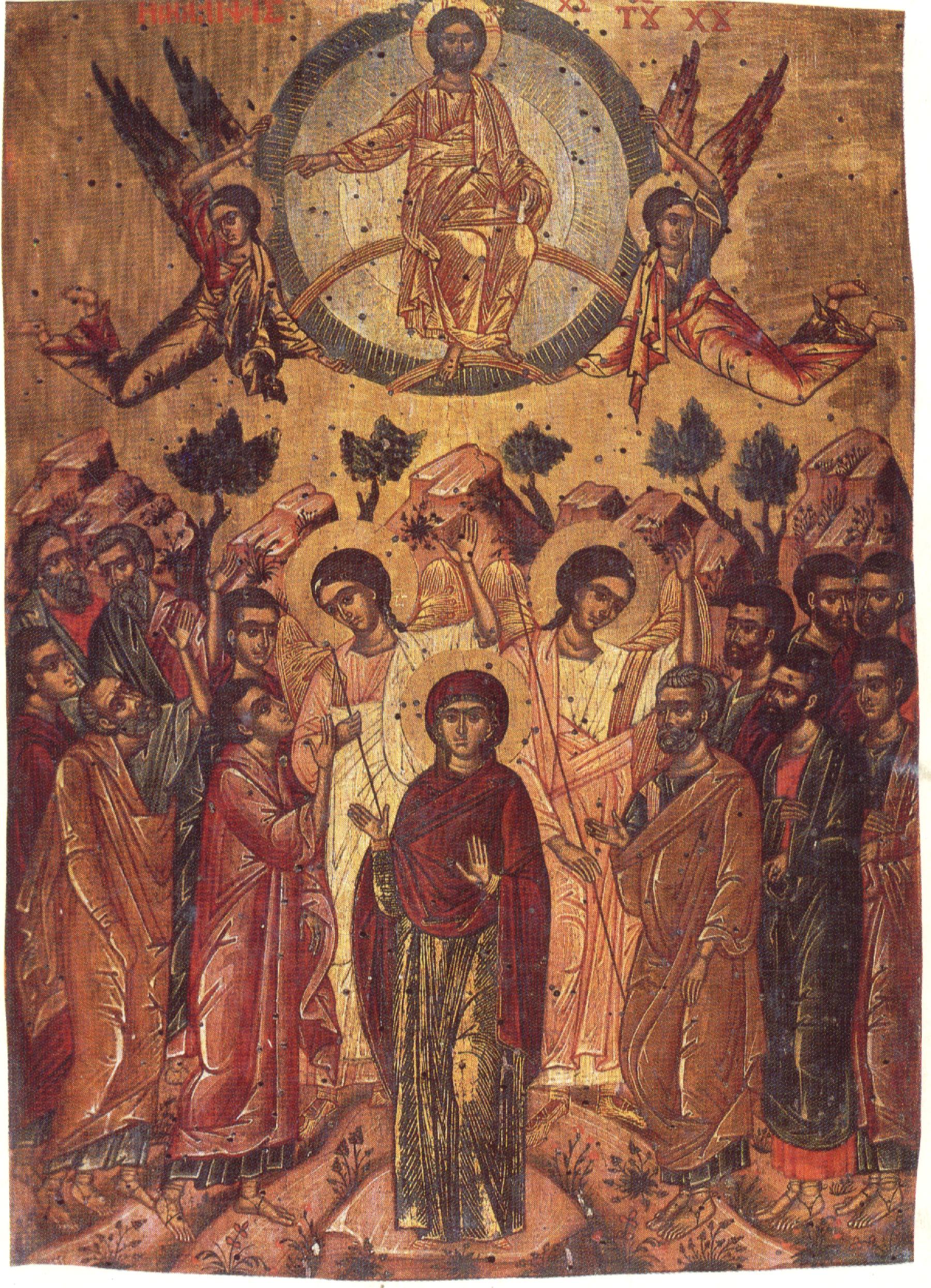
The Ascension of Christ (source)
  
Through the prayers of our Holy Fathers, Lord Jesus Christ our God, have mercy on us and save us! Amen!

Wednesday, May 27, 2020

"O Lord, wishing to fulfill the mystery of Your economy..."

The Ascension of Christ, depicted with the Holy Trinity, the Preparation of the Throne, and various Saints (source)
  
O Lord, wishing to fulfill the mystery of Your economy, You took Your Disciples up to the Mount of Olives, and behold, You departed for the firmament of Heaven, You Who had become poor for me, and You were lifted up, therefore, You did not leave us, but You sent down Your All-Holy Spirit, to enlighten our souls.
-Idiomelon of the Stichera from the Great Vespers of the Ascension

(source)
  
Through the prayers of our Holy Fathers, Lord Jesus Christ our God, have mercy on us and save us! Amen!

Wednesday, June 5, 2019

"Not parted from the Father's bosom, O sweetest Jesus..."

The Ascension of Christ (source)
  
Not parted from the Father's bosom, O sweetest Jesus, and having lived among those on earth as man, today You have been taken up in glory from the Mount of Olives, and exalting in Your compassion our fallen nature, You have seated it with the Father. Therefore the heavenly ranks of the Bodiless Powers were amazed at the wonder, and beside themselves with fear; and seized with trembling, they magnified Your love for mankind. With them, we on earth also give glory for Your condescension to us and Your Ascension from us; and we supplicate You, saying: “At Your Ascension You filled with boundless joy the Disciples and the Theotokos who bore You; by their prayers make us also worthy of the joy of Your elect through Your great mercy!”
-Doxastikon of the Stichera for the Great Vespers for the Ascension of Christ

(source)
  
Through the prayers of our Holy Fathers, Lord Jesus Christ our God, have mercy on us and save us! Amen!

Wednesday, May 16, 2018

"Strange and awesome is Your divine Ascension..."

The Holy Ascension of Christ (source)
  
Strange is Your Nativity, strange is Your Resurrection, strange and awesome is Your divine Ascension from the mountain, O Giver of Life, which was depicted before by Elijah's ascent in the chariot, hymning You, O Lover of Man.

O, the gifts surpassing description! O awesome mystery! For He Who is the Master of all is lifted from the earth to the heavens, in order to send down upon the Disciples the Holy Spirit, to enlighten their minds, and make them fiery through grace.
-Excerpts from the Matins Canons of the Feast of the Ascension.
  
(source)
  
The Ascension of Christ, detail (source)
  
Through the prayers of our Holy Fathers, Lord Jesus Christ our God, have mercy on us and save us! Amen!

Thursday, May 21, 2015

"This is truly the King of glory. And why are Your garments scarlet?"

Icon depicting Christ's Ascension. It is interesting to note, and theologically correct, that the iconographer depicts the wounds from the Crucifixion in Christ's hands and feet. The Fathers hold that Christ had these wounds after His Resurrection, ascended with them into Heaven, and will have them for the rest of eternity as a sign of His love and what He suffered to save the world. As the Holy Angels saw Him ascending into Heaven, they marveled at this wonder. This fact was prophesied beforehand in the reading included below by the Prophet Isaiah (i.e. the Savior seen with the "clothing" of the flesh, which are "red", "as from a trodden winepress" from the Holy Passion), and mentioned in the hymn below as well. (source)
  
The Reading is from the Prophecy of Isaias.
[62,10-63,3; 7-9]
Thus says the Lord: Walk, go through my gates; prepare my way and make a way for my people, and cast the stones out of the way; raise up a standard for the nations. For see, the Lord has made it heard to the ends of the earth: Say to the daughter of Sion: See, your Saviour has come, and his reward is with him, and his work before his face. And he will call it a holy people, redeemed by the Lord; while you will be called a city sought after, and not forsaken. Who is this who comes from Edom, the scarlet of his garments from Bosor, thus beautiful in his apparel? He cries out with much strength. I reason of justice and judgement of salvation. Why are your garments red, and your clothing as from a trodden winepress? I am full of the trodden grape; I have trampled the winepress quite alone, and no man from the nations was with me. I have remembered the mercy of the Lord, I will recall the Lord’s virtues, the Lord’s praise for all the things with which He rewards us. The Lord is a good judge for the house of Israel; he deals with us according to his mercy and according to the multitude of his justice. And he said: Are you not my people? Children will surely not be rebellious; and he became for them salvation out of their every distress. It was not an emissary, not an Angel, but the Lord himself saved them because he loved them and spared them. He redeemed them and took them up and exalted them all the days of the age.
  
Christ's holy wounds from His passion (source)
  
As you were taken up from the mount of Olives, the powers seeing you cried one to the other: Who is this? And they were told: This is the Mighty One, the Powerful, this is the Powerful in war, this is truly the King of glory. And why are your garments scarlet? He has come from Bosor, that is, from the flesh. But as God seated at the right hand of the Majesty you have sent us the Holy Spirit, to guide and save our souls.
-Idiomelon of the Aposticha for the Feast of the Ascension, in the Second Tone.
(source)
  
Icon depicting the Ascension of Christ, and the Etimasia (Preparation) of the Throne, and the Holy Trinity. Also included are icons of Sts. John the Forerunner, James the Apostle, Nicholas the Wonderworker, Anthony the Great, Onouphrios the Great, Sebastian the Martyr, Catherine and Paraskevi the Great Martyrs, and Constantine and Helen (source)
     
Through the prayers of our Holy Fathers, Lord Jesus Christ our God, have mercy on us and save us! Amen!

Wednesday, May 20, 2015

Homily on the Ascension, by Metropolitan Avgoustinos Kantiotes (+2010)

The Ascension of Christ (source)
  
Homily on the Ascension, by Metropolitan Avgoustinos Kantiotes (+2010)
Today, my beloved, is a great feast of the Master, the Ascension of the Lord. What is the story of the day? I will speak simply, so that everyone can understand me, so that it is not a sermon with the “voice of one crying out in the wilderness.” (Matthew 3:3)

Forty days have passed since our Lord rose from the dead. He appeared to many. His disciples saw him blessing them, heard Him and touched Him. And Thomas furthermore was compelled to say: “My Lord and my God.” (John 20:28) Forty days later, He told them to gather at the Mount of Olives, a hill a short distance from Jerusalem. They gathered there. It was Peter, James, John, Andrew, Philip, Thomas, Bartholomew, Matthew, James the son of Alphaeus, Simon the Zealot, and Jude the son of James. Together with them were the Myrrhbearers, Mary, the Panagia and Mother of the Lord, as we see in the icon of the Ascension, and those who were called his brethren. (see Acts 1:13-14)
  
As they waited, Christ appeared before them, spoke to them, and gave them His final commandments. He blessed them, and then--even if the faithless do not believe, it is their right--a miracle occurred. As they were watching Him, the holy feet that had walked kilometers to find the lost sheep, the human sinner, those feet that furthermore bore the marks of the nails of the Cross, began to not walk on the earth anymore, but to be lifted up…
  
I once saw an eagle seated on a stone high up in the mountains of Grevena--it was a golden eagle--and I was amazed. And straightaway, I see it open its great wings and to fly. And I kept looking at it ascend into the air, ascend high, very high, as it turned into a small dot, and ultimately disappeared into the skies. The same occurred with Christ, Whom is named an eagle by the Revelation (12:14). It is Him Who have power to birds to fly, wouldn’t He have the same power?
   
Christ--to use a modern tongue--like the airplane which breaks through the clouds, ascended. And the disciples gazed at Him ascending. The Lord “ascended to heaven” today, and “sat at the right hand of God” (Mark 16:19). Then two angels appeared and told them: “Why are you standing looking at heaven? This Jesus that ascended, will return again in the same manner."
   
Yes, He will come. What are we thinking? --Who will come! Are you are telling us fairy tales now? Yes, the Lord will come “in [great] glory” (Matthew 24:30), to the wailing of the demons, to judge the whole “world in righteousness” (Acts 17:31). The Lord will come: joy to the righteous, and sadness to the sinners.
  
This is the story of the feast. From everything we have said, let us pay attention to one thing: that the disciples and the Panagia remained looking up at heaven. They did not look down at the earth. They were looking high up. What does this mean?
  
From the creations of God, the four-legged creatures walk with their heads looking down. Only man was created to walk upright. Many say that this is a wonder. And the word “human” (“anthropos” in Greek), if we look at it etymologically, what does it mean? It means he who faces upwards. He looks on high, for he was created for the heavens.
  
It is said that an atheist once wanted proofs. When it became night, one of his friends showed him the countless stars and asked: “Who made all of these?” There is one answer, no other: God! Gaze above, therefore, at the firmament, and you will trust that God exists. “The heavens declare the glory of God, and the firmament is the work of His hands.” (Psalms 18:2)
  
A German poet saw a herd of pigs in the forest. The pigs love acorns. They therefore gathered to eat those that fell in the forest. And the poet, with an eloquent tongue, noted this. When he left the forest, no one returned to look at the acorns to say thank you!... Thus are many of us, and this comparison should not appear offensive to us. Our Christ thus characterizes some people: “Do not give the holy things to the dogs, and do not put pearls before swine.” (Matthew 7:6) This occurs. We partake of myriads of good things, but we never lift up our eyes to say: “Glory to You, O God.”
  
Is this perhaps a hyperbole? ...When you get up in the morning, and see the sun shining brightly, you should say: “Glory to You, O God”, “Glory unto You Who have shown forth the light” (Great Doxology). Nothing. You go out to go to work. Entreat God, and make the sign of the Cross. But not even one Cross [do we do]. Noon comes, you at the table for lunch, you have all good things: say a prayer. Nothing without thanksgiving. When you drink water, you should say thank you. When you eat bread, you should say thank you. The situation is becoming like swine. Have in mind that famine is coming, a great famine, and our bread will be little.
  
How it was in the older years! I remember in my village, around 1910, there were some older people who had not gone to school, neither high school nor college. Before they drank a cup of water, they made the sign of the Cross. And do you see anyone do it now? Because of this I tell you, the hour is coming that there will be a shortage of water, and fountains and springs, rivers and lakes will be dry, the water will become twice as valuable. And then, a glass of water will cost a lira! As St. Kosmas Aitolos prophesied, a handful of flour will cost a handful of gold. We will be punished for our swine-like state, where we live like animals, without being raised, without exalted thoughts, and in some ways being worse that animals. Do you see the dog? You toss him a bone, and though he doesn’t have a tongue, he turns to you as if to say: “Master, thank you.” Thankless and pitiless people, who often times blaspheme God night and day.
  
This is how it is, therefore. We are lower than animals. There is not the time to develop the theme and explain the word of the Psalms which says: “Man cannot abide in his pomp, he is like the beasts that perish.” (Psalms (Septuagint) 48:13). He is equal to, and sometimes lower than the animals (oxen, sheep, goats) and birds.
  
On the domes and bell-towers of churches, we see the birds’ nests. What should we say about the stork? The stork loves his children, and they love him. When a stork gets old, do you know what occurs? His children bring him food. And because the old stork is shedding and cold, they warm him with their wings! And man? When he doesn’t have ideals, resurrections, exaltations, and great ideas, what should we say of man? Tell me what he thinks about at midnight, and I’ll tell you that he is. If he thinks of money, rewards, women, other earthly things, then what is he? A small and insignificant being.
  
It is said, my beloved, that the pig, as we mentioned, that has its head turned down and eats clay, only once looks up to see heaven. When? When the butcher takes him to slaughter him. This also occurs with many people. They don’t think about God, they don’t step foot in church, they don’t pray. And they think that it will always be thus. However, the hour of death comes. Then, at the last instant, the Archangel will come with his sword, and they will only then remember God.
  
We were not created for the earth, which is a handful of sand, a drop amidst the universe. Is it worth it, O man, for a handful of sand or a drop of water to wage wars and shed blood of humanity? We have departed from God. Because of this: “Let us lift up our hearts.” (Divine Liturgy). And not just today, but the whole year. This is what the Ascension means. In every Divine Liturgy we honor the Ascension. When the Priest says: “Let us lift up our hearts”, what does he mean? Gaze on high, for you were created for heaven, for great and uplifted things. This does not mean indifference for this present life, no. If we embrace the whole Gospel of Christ, this earth will become Paradise. Now, old, young, grandfathers, bishops, right-wing, left-wing, white, black, in many ways we have trampled upon the Gospel, and this earth has become hell.
  
May we repent. May our Lord Jesus Christ bless everyone, Whom, O children of the Greeks, praise and exalt supremely, unto all the ages. Amen.
  
+Bishop Avgoustinos
Delivered in the Church of the Ascension, Perdikka, Eordaias, May 24th, 1990
     
(amateir translation of text from source)
  
The Ascension of Christ (source)
  
Through the prayers of our Holy Fathers, Lord Jesus Christ our God, have mercy on us and save us! Amen!

Thursday, June 13, 2013

St. Silouan the Athonite on the Joy of the Ascension of Christ

The Ascension of Christ (source)
 
St. Silouan the Athonite on the Joy of the Ascension of Christ (amateur translation)
After the Ascension of the Lord, the Apostles returned to Jerusalem with great joy, as the Gospel says (Luke 24:52).

The Lord knows what joy He gave them, and their souls experienced this joy.

Their first joy was that they came to know the true Lord Jesus Christ.

Their second joy was how He loved them.

Third, how they came to know eternal, heavenly joy.

And their fourth joy, how they yearned for the salvation of the world, as their own.

And finally, they rejoiced, because they came to know the Holy Spirit, and saw how He worked within them.

The Apostles went throughout the earth and preached to the people the good news regarding the Lord and the Kingdom of Heaven. Their souls, however, yearned and thirsted to behold the beloved Lord, and because of this, they did not fear death, but they met it with joy. And if they desired to live on the earth, this was only for the joy of the faithful, who loved them.

The Apostles loved the Lord, and because of this they did not fear any suffering. They loved the Lord, and they loved the people, and this love casted out every fear from among them. They did not fear martyrdom, nor death, and because of this the Lord sent them into the world to enlighten the people.
Through the prayers of our Holy Fathers, Lord Jesus Christ our God, have mercy on us and save us! Amen!

Wednesday, June 12, 2013

Our Ascended Lord: The Saving Swallow Who Opened the Way to the Eternal Spring

Christ is risen! Truly He is risen!
When the Disciples made haste and went to the mountain for His elevation from the ground, the Lord appeared unto them. And when they saw Him they worshipped Him. And they were told of the omnipresent authority He was given. Then they were sent abroad to preach in all the earth under heaven the resurrection from the dead and the restoration in the heavens. And He, being truthful, promised that He is with them eternally, as Christ our God and the Savior of our souls.
Eothinon Doxastikon of the First Tone
(sources 1, 2)
   
Our Ascended Lord: The Saving Swallow Who Opened the Way to the Eternal Spring.
by the Blessed Bishop Nikolai (Velimirovich) (†1956)
"When swallows run short of food and the cold weather is coming, they set off to warm climes, where there is plenty of sun and food. One swallow flies ahead, testing the air and showing the way, while the rest of the flock follows after.

When our souls run short of food in the material world, and when the cold of death draws near—ah, is there a swallow like that one, to take us to a warm place, where there is plenty of spiritual warmth and food? Is there such a place? Is there, oh, is there such a swallow?

Outside the Christian Church, there is no one who can give any sort of reliable answer to this. The Church alone knows, and knows with certainty.

It has seen that part of Paradise for which our souls yearn in the frozen twilight of this earthly existence. It has also seen this blessed swallow, the first to fly to that yearned-for place, dispersing the darkness and cutting through the heavy atmosphere between earth and Heaven with its powerful wings,opening the way to the flock behind it. Apart from this, the Church on earth can tell one of innumerable flocks of swallows that have followed the first Swallow and flown off with it to that blessed land, a land abounding with all good things—the land of eternal Spring.

You will see from this that, by this saving Swallow, I am thinking of the ascended Lord Jesus Christ.

Has He not said of Himself that He is theWay? Did He not Himself say to His Apostles:“I go to prepare a place for you...and if I go...I will receive you unto Myself”(St. John 14:2–3)? And did He not say to them before this:

“And I, if I be lifted up from the earth, will draw all men unto Me”

(St. John 12:32)? This that He Himself said began to be fulfilled a few weeks later, and has continued to be fulfilled right down to our own day, and shall be to the end of time. That is, being the beginning of the first creation of the world, He became also the beginning of the second creation, or the blessed renewing of the old. Sin clipped Adamʼs wings and those of all his descendants, and they all fell away from God, went off, and were blinded with the dust from which their bodies were created. Christ, as the New Adam, the first Man, the Firstborn among men, was the first to rise up to Heaven on spiritual wings, to the throne of Eternal Glory and power,thus cleaving the way to Heaven and opening all Heavenʼs gates to His followers, with their spiritual wings—as an eagle cleaves the way for its eaglets,as the swallow which goes ahead, showing the flock the way and breaking the airʼs heavy resistance.

“O that I had wings like a dove; for then would I flee away and be at rest”(Psalm 54 [55]:6), the Psalmist cried in distress before Christʼs coming.

Why? He himself explains:“My heart is disquieted within me, and the fear of death is fallen upon me. Fearfulness and trembling are come upon me, and an horrible dread hath overwhelmed me”(vv. 4–5). Such a terrible sense of deathly fear and of the horror of existence in the wastes of this life must,

like a heavy nightmare, have weighed on the whole rational, honest world before Christ. “Who would give me wings, to fly away from this life?”: this must be a question asked by many noble and sensitive souls. But whither will you fly, O sinful human soul? Can you still, as in a dream, feel that place of warmth and light from which you have been driven out? Lo, the gates were closed behind you, and Cherubim with flaming swords were placed there, to forbid your approach. Lo, sin has clipped your wings—not birdʼs wings but Divine wings—and has forced you firmly down to the ground.

Someone is needed, first to free you from the weight of sin, to wash you and make you stand erect. And then someone is needed to implant and nourish new wings in you, so that you can fly. Then you need someone, someone very strong, for

whom the Cherubim with flaming swords will stand aside, to let you through to your glorious homeland. Lastly, you need someone who will find mercy for you from your grieved Creator, so that He will receive you once more into the lands of His immortal country. This “someone” was unknown to the pre-Christian world. He revealed Himself as our Lord and Savior Jesus Christ,the Son of the living God. From love for you, He bowed down from Heaven to earth and came down on earth, clothed Himself in flesh, became a prisoner for the sake of you prisoners, suffered sweat and frost, endured hunger and thirst, gave His face to spitting and His body to be nailed to the Cross, lay in the tomb as a corpse, went down to Hades to destroy a prison worse than this life, that was intended for you after your parting from the body—and all this in order to save you from the mire of sin, and set you on your feet. He then rose from the dead, by this means to give you wings for flight to Heaven, and finally ascended into Heaven to open the way to you and bring you into the Angelsʼ abode. You do not now have to sigh in fear, trembling and horror as King David did, nor to desire wings like a dove,for the Eagle has appeared,and has shown and cloven a road through. You have only to nurture the spiritual wings that you were given at your Baptism in His name, and to desire with all your strength to climb up there where He ascended. He has done ninety-nine percent of all that is needed for your salvation; will you not striveto do that one remaining percentage point for your own salvation, and this when, for you, an entrance shall be ministered...abundantly into the everlasting Kingdom of our Lord and Savior Jesus Christ(II St. Peter 1:11)?


The Lordʼs Ascension from earth to Heaven is as unexpected to men as His coming down from Heaven to earth and His birth in the flesh was to

the Angels. What event in His life does not represent something unique and uniquely unexpected to the world? As the Angels watched with wonder how God, at the first creation, separated light from darkness and water from dry

land, how He placed the stars in the heavenly vault, and how He brought forth plants and animals from the dust and finally formed man, giving him a living soul, so each one of us must look with wonder at the events of the Saviorʼs life, beginning with the wondrous Annunciation to the most holy Virgin by the Archangel Gabriel in Nazareth, and then through in order to His mighty Ascension on the Mount of Olives. It is all, at first sight, unexpected, but, when they are made aware of the plan for the dispensation of our salvation, all rational men must shout for joy and glorify Godʼs power, His wisdom, and His love for mankind. You can take no single great event out of

Christʼs life and not disfigure the whole, as you cannot cut off a living manʼs arm or leg and not disfigure him, or remove the moon from the heavenly vault or blot out a part of the starry myriads, and not disfigure the order and beauty of the heavens. So do not think of saying: “It was unnecessary for the Lord to ascend!” When some of the Jews were constrained to acknowledge and cry out:“He hath done all things well!” (Mark 7:37), how can we, who are Baptized in His name, not believe that all He did, He did well: devising

and ordering with great wisdom.

And His Ascension is therefore also good,devised and ordered with great wisdom, as are also His Incarnation, Baptism, Transfiguration and Resurrection.

“It is expedient for you that I go away”(St. John 16:7), said the Lord to His disciples. Do you see how He disposes and does everything as is best for me? Every word and act of His have our good as their aim. His Ascension is of boundless good for us all. Were it not so, He would not have ascended..."
   
(Source: [St.] Nikolai (Velimirovich), Bishop of Ohrid, “Homily 27. The Ascension of the Lord,” in Homilies (Birmingham: Lazarica Press, 1996), Vol. I, pp. 296-299. Source)
  
The Ascension of Christ (source)
  
Christ has risen from the dead, by death he has trampled on death, and to those in the graves given life!
Truly the Lord is risen!


Thursday, May 24, 2012

Excerpt from Homily III on the Ascension of Christ by St. John Chrysostom

 
Excerpt from Homily III on the Ascension of Christ by St. John Chrysostom (amateur translation)

The theater of the Church is joyous to me, not amusing men working futility, but causing great weeping to the devil. He sees above those who were dead below, as roots of the Resurrection. He sees Him Whom he delivered to the cross below, beheld in the heavens. He sees angels on earth in fulfillment. He sees Him paradoxically passing through the air. He sees the heavenly powers all gathered together to say: “Open the gates, our princes, and the King of glory shall enter”, and others saying in reply: “The Lord strong and mighty in war.” Which war? That against the common foe of all men, which neither men, nor prophets, neither the righteous were able to conquer....

For all, today's feast becomes even more serious, as we behold all the ranks of angels everywhere dancing, some following Him, other going before, others gathering around, others further with the choir of the apostles, telling them: “O Gallileans, why do you stand looking into heaven? This Jesus Whom you see ascended from you into heaven, He will come again in the same manner as you saw Him ascend to heaven.” This is Jesus Who showed a multitude of wonders. At this feast of the Master, the day of the Ascension, the devil is wailing, as we said, while the faithful are joyful. Now has the joyous spring dawned, and the beauty of flowers blossomed. The branches of vines are pruned, the olive trees give their sweet fragrance, the fig trees give their immature fruit, and the wind blows rustling the leaves, mimicking the dancing of the waves: all things rejoice with us at the ascension of the Master. Bring, therefore, with us the words of David, that we might rightly cry out to the Master Who has ascended: “Let all the nations clap their hands, crying to God with a voice of rejoicing. The Lord ascends with the sound of the trumpet, to where He was.” He ascends, but is not separated. For he who descended, has ascended above the heavens. The prophets saw no other, nor did the apostles eat with another. No other was in the bosom of the Father, nor was another judged by Pilate. No other was nailed to the cross with nails, nor was another carried by the Cherubim. No other was wrapped in a shroud by Joseph, nor does another hold creation in the palm of His hand. No other was laid in a tomb, nor was another hymned by the Seraphim. No other is seated with the Father, Who took root in the virginal womb. God ascended with a shout, the Lord with the cry of the trumpet, He Who is the Creator from the ages, Who brought all things into being, Who fashioned Adam, Who generated human nature, Who translated to life Enoch who pleased Him, Who preserved Noah together with the world, Who called Abraham from the land of the Chaldeans, Who made Isaac to be a sign of the mystery of the cross, Who granted Jacob the twelve-pillars of offspring, Who granted Job patience, Who made Moses to become the leader of the people, Who filled Samuel with prophecy from his mother's womb, Who anointed David as king from the prophets, Who granted Solomon wisdom, Who took up Elias in a flaming chariot, Who instilled the prophets with foreknowledge, Who granted the apostles gifts of healing, and Who cried to them: “Take heart, I have overcome the world.”

This is the Lord of glory Who is ascended into the heavens with a shout, and is seated on the right hand of the Father. Under His authority are angels, and dominions and powers, and it is He Who receives our pained prayers, and makes us victors over the pirates of this world. Under His dominion is every rank of the unclean spirits, as He says to us: “Behold, I have given you authority to trample upon snakes and scorpions.”

Unharmed and spotless, healthy and whole, preserve us in soul and body and spirit, filling us with the fruits of righteousness and fruitfulness, You Who are the God of all, You Who didst make us worthy to gather to celebrate this feast, for to You belong all glory, honor and worship, to the Father and to the Son and to the Holy Spirit, now and ever, and unto the ages of ages. Amen.
   
   
Through the prayers of our Holy Fathers, Lord Jesus Christ our God, have mercy on us and save us! Amen!

Tuesday, October 18, 2011

Commentary of St. John Chrysostom on the beginning of the Acts of the Apostles

Christ appearing to His disciples (at Emmaus) after His Resurrection (http://roadsfromemmaus.files.wordpress.com/2010/08/at-emmaus.jpg)


Commentary of St. John Chrysostom on the beginning of the Acts of the Apostles

The former treatise have I made, O Theophilus, concerning all things which Jesus began both to do and to teach, until the day on which, having given charge to the Apostles, whom He had chosen, by the Holy Spirit, He was taken up.”

To many persons this Book is so little known, both it and its author, that they are not even aware that there is such a book in existence. For this reason especially I have taken this narrative for my subject, that I may draw to it such as do not know it, and not let such a treasure as this remain hidden out of sight. For indeed it may profit us no less than even the Gospels; so replete is it with Christian wisdom and sound doctrine, especially in what is said concerning the Holy [Spirit]. Then let us not hastily pass by it, but examine it closely. Thus, the predictions which in the Gospels Christ utters, here we may see these actually come to pass; and note in the very facts the bright evidence of Truth which shines in them, and the mighty change which is taking place in the disciples now that the Spirit has come upon them. For example, they heard Christ say, “Whoso believeth on Me, the works that I do shall he do also, and greater works than these shall he do” (John xiv. 12): and again, when He foretold to the disciples, that they should be brought before rulers and kings, and in their synagogues they should scourge them, and that they should suffer grievous things, and overcome all (Matt. x. 18): and that the Gospel should be preached in all the world (Ib. xxiv. 14): now all this, how it came to pass exactly as it was said, may be seen in this Book, and more besides, which He told them while yet with them. Here again you will see the Apostles themselves, speeding their way as on wings over land and sea; and those same men, once so timorous and void of understanding, on the sudden become quite other than they were; men despising wealth, and raised above glory and passion and concupiscence, and in short all such affections: moreover, what unanimity there is among them now; nowhere any envying as there was before, nor any of the old hankering after the preeminence, but all virtue brought in them to its last finish, and shining through all, with surpassing lustre, that charity, concerning which the Lord had given so many charges saying, “In this shall all men know that ye are My disciples, if ye love one another.” (John xiii. 35.) And then, besides, there are doctrines to be found here, which we could not have known so surely as we now 2do, if this Book had not existed, but the very crowning point of our salvation would be hidden, alike for practice of life and for doctrine.


The greater part, however, of this work is occupied with the acts of Paul, who “laboured more abundantly than they all.” (1 Cor. xv. 10.) And the reason is, that the author of this Book, that is, the blessed Luke, was his companion: a man, whose high qualities, sufficiently visible in many other instances, are especially shown in his firm adherence to his Teacher, whom he constantly followed. Thus at a time when all had forsaken him, one gone into Galatia, another into Dalmatia, hear what he says of this disciple: “Only Luke is with me.” (2 Tim. iv. 10.) And giving the Corinthians a charge concerning him, he says, “Whose praise is in the Gospel throughout all the Churches.” (2 Cor. viii. 18.) Again, when he says, “He was seen of Cephas, then of the twelve,” and, “according to the Gospel which ye received” (1 Cor. xv. 5, 1), he means the Gospel of this Luke. So that there can be no mistake in attributing this work to him: and when I say, to him, I mean, to Christ. And why then did he not relate every thing, seeing he was with Paul to the end? We may answer, that what is here written, was sufficient for those who would attend, and that the sacred writers ever addressed themselves to the matter of immediate importance, whatever it might be at the time: it was no object with them to be writers of books: in fact, there are many things which they have delivered by unwritten tradition. Now while all that is contained in this Book is worthy of admiration, so is especially the way the Apostles have of coming down to the wants of their hearers: a condescension suggested by the Spirit who has so ordered it, that the subject on which they chiefly dwell is that which pertains to Christ as man. For so it is, that while they discourse so much about Christ, they have spoken but little concerning His Godhead; it was mostly of the Manhood that they discoursed, and of the Passion, and the Resurrection, and the Ascension. For the thing required in the first instance was this, that it should be believed that He was risen, and ascended into heaven. As then the point on which Christ himself most insisted was, to have it known that He was come from the Father, so is it this writer’s principal object to declare, that Christ was risen from the dead, and was received up into Heaven, and that He went to God, and came from God. For, if the fact of His coming from God were not first believed, much more, with the Resurrection and Ascension added thereto, would the Jews have found the entire doctrine incredible. Wherefore gently and by degrees he leads them on to higher truths. Nay, at Athens Paul even calls Him man simply, without saying more (Acts xvii. 31). For if, when Christ Himself spoke of His equality with the Father, they often attempted to stone Him, and called Him a blasphemer for this reason, it was little to be expected that they would receive this doctrine from the fishermen, and that too, with the Cross coming before it.

But why speak of the Jews, seeing that even the disciples often upon hearing the more sublime doctrines were troubled and offended? Therefore also He told them, “I have many things to say unto you, but ye cannot bear them now.” (John xvi. 12.) If those could not, who had been so long time with Him, and had been admitted to so many secrets, and had seen so many wonders, how was it to be expected that men, but newly dragged away from altars, and idols, and sacrifices, and cats, and crocodiles (for such did the Gentiles worship), and from the rest of their evil ways, should all at once receive the more sublime matters of doctrine? And how in particular should Jews, hearing as they did every day of their lives, and having it ever sounded in their ears, “The Lord thy God is one Lord, and beside Him is none other” (Deut. vi. 4): who also had seen Him hanging nailed on the Cross, nay, had themselves crucified and buried Him, and not seen Him even risen: when they were told that this same person was God and equal with the Father, how should they, of all men, be otherwise than shocked and revolted? Therefore it is that gently and little by little they carry them on, with much consideration and forbearance 3letting themselves down to their low attainments, themselves the while enjoying in more plentiful measure the grace of the Spirit, and doing greater works in Christ’s name than Christ Himself did, that they may at once raise them up from their grovelling apprehensions, and confirm the saying, that Christ was raised from the dead. For this, in fact, is just what this Book is: a Demonstration of the Resurrection: this being once believed, the rest would come in due course. The subject then and entire scope of this Book, in the main, is just what I have said. And now let us hear the Preface itself.

“The former treatise have I made, O Theophilus, of all that Jesus began both to do and to teach.” (v. 1) Why does he put him in mind of the Gospel? To intimate how strictly he may be depended upon. For at the outset of the former work he says, “It seemed good to me also, having had perfect understanding of all things from the very first, to write unto thee in order.” (Luke i. 3.) Neither is he content with his own testimony, but refers the whole matter to the Apostles, saying, “Even as they delivered them unto us, which from the beginning were eyewitnesses and ministers of the word.” (Luke i. 2.) Having then accredited his account in the former instance, he has no need to put forth his credentials afresh for this treatise, seeing his disciple has been once for all satisfied, and by the mention of that former work he has reminded him of the strict reliance to be placed in him for the truth. For if a person has shown himself competent and trustworthy to write of things which he has heard, and moreover has obtained our confidence, much more will he have a right to our confidence when he has composed an account, not of things which he has received from others, but of things which he has seen and heard. For thou didst receive what relates to Christ; much more wilt thou receive what concerns the Apostles.


What then, (it may be asked), is it a question only of history, with which the Holy Spirit has nothing to do? Not so. For, if “those delivered it unto us, who from the beginning were eyewitnesses and ministers of the word;” then, what he says, is theirs. And why did he not say, ‘As they who were counted worthy of the Holy Spirit delivered them unto us;’ but “Those who were eyewitnesses?” Because, in matter of belief, the very thing that gives one a right to be believed, is the having learned from eyewitnesses: whereas the other appears to foolish persons mere parade and pretension. And therefore John also speaks thus: “I saw, and bare record that this is the Son of God.” (John. i. 34.) And Christ expresses Himself in the same way to Nicodemus, while he was dull of apprehension, “We speak that we do know, and testify that we have seen; and no one receiveth our witness.” (Ib. iii. 11.) Accordingly, He gave them leave to rest their testimony in many particulars on the fact of their having seen them, when He said, “And do ye bear witness concerning Me, because ye have been with Me from the beginning.” (John xv. 27.) The Apostles themselves also often speak in a similar manner; “We are witnesses, and the Holy Spirit which God hath given to those that obey Him.” (Acts ii. 32); and on a subsequent occasion, Peter, still giving assurance of the Resurrection, said, “Seeing we did eat and drink with Him.” (Acts x. 41.) For they more readily received the testimony of persons who had been His companions, because the notion of the Spirit was as yet very much beyond them. Therefore John also at that time, in his Gospel, speaking of the blood and water, said, he himself saw it, making the fact of his having seen it equivalent, for them, to the highest testimony, although the witness of the Spirit is more certain than the evidence of sight, but not so with unbelievers. Now that Luke was a partaker of the Spirit, is abundantly clear, both from the miracles which even now take place; and from the fact that in those times even ordinary persons were gifted with the Holy [Spirit]; and again from the testimony of Paul, in these words, “Whose praise is in the Gospel” (2 Cor. viii. 18); and from the appointment to which he was chosen: for having said this, the Apostle adds, “But also appointed of the Churches to travel with us with this grace which is administered by us.”


Now mark how unassuming he is. He does not say, The former Gospel which I preached, but, “The former treatise have I made;” accounting the title of Gospel to be too great for him; although it is on the score 4of this that the Apostle dignifies him: “Whose praise,” he says, “is in the Gospel.” But he himself modestly says, “The former treatise have I made—O Theophilus, of all that Jesus began both to do and to teach:” not simply “of all,” but from the beginning to the end; “until the day,” he says, “in which He was taken up.” And yet John says, that it was not possible to write all: for “were they written, I suppose,” says he, “that even the world itself could not contain the books written.” (John xxi. 25.) How then does the Evangelist here say, “Of all?” He does not say “all,” but “of all,” as much as to say, “in a summary way, and in the gross;” and “of all that is mainly and pressingly important.” Then he tells us in what sense he says all, when he adds, “Which Jesus began both to do and to teach;” meaning His miracles and teaching; and not only so, but implying that His doing was also a teaching.


But now consider the benevolent and Apostolic feelings of the writer: that for the sake of a single individual he took such pains as to write for him an entire Gospel. “That thou mightest have,” he says, “the certainty of those things, wherein thou hast been instructed.” (Luke i. 4.) In truth, he had heard Christ say, “It is not the will of My Father that one of these little ones should perish.” (Matt. xviii. 14.) And why did he not make one book of it, to send to one man Theophilus, but has divided it into two subjects? For clearness, and to give the brother a pause for rest. Besides, the two treatises are distinct in their subject-matter.


But consider how Christ accredited his words by His deeds. Thus He saith, “Learn of Me, for I am meek and lowly in heart.” (Ib. xi. 29.) He taught men to be poor, and exhibited this by His actions: “For the Son of Man,” He says, “hath not where to lay His head.” (Ib. viii. 20.) Again, He charged men to love their enemies; and He taught the same lesson on the Cross, when He prayed for those who were crucifying Him. He said, “If any man will sue thee at the law, and take away thy coat, let him have thy cloak also” (Ib. v. 40): now He not only gave His garments, but even His blood. In this way He bade others teach. Wherefore Paul also said, “So as ye have us for an example.” (Philip. iii. 17.) For nothing is more frigid than a teacher who shows his philosophy only in words: this is to act the part not of a teacher, but of a hypocrite. Therefore the Apostles first taught by their conduct, and then by their words; nay rather they had no need of words, when their deeds spoke so loud. Nor is it wrong to speak of Christ’s Passion as action, for in suffering all He performed that great and wonderful act, by which He destroyed death, and effected all else that He did for us.

“Until the day in which He was taken up, after that He, through the Holy Spirit, had given commandments unto the Apostles whom He had chosen. After He had given commandments through the Spirit” (v. 2); i.e. they were spiritual words that He spake unto them, nothing human; either this is the meaning, or, that it was by the Spirit that He gave them commandments. Do you observe in what low terms he still speaks of Christ, as in fact Christ had spoken of Himself? “But if I by the Spirit of God cast out devils” (Matt. xii. 28); for indeed the Holy [Spirit] wrought in that Temple. Well, what did He command? “Go ye therefore,” He says, “make disciples of all the nations, baptizing them into the Name of the Father, and of the Son, and of the Holy [Spirit]; teaching them to observe all things whatsoever I have commanded you.” (Ib. xxviii. 19, 20.) A high encomium this for the Apostles; to have such a charge entrusted to them, I mean, the salvation of the world! words full of the Spirit! And this the writer hints at in the expression, “through the Holy [Spirit]” (and, “the words which I spake unto you,” saith the Lord, “are Spirit”) (John vi. 63); thus leading the hearer on to a desire of learning what the commands were, and establishing the authority of the Apostles, seeing it is the words of the Spirit they are about to speak, and the commandments of Christ. “After He had given commandments,” he says, “He was taken up.” He does not say, ‘ascended;’ he still speaks as concerning a man. It appears then that He also taught the Disciples after His resurrection, but of this space of time no one has related to us the whole in detail. St. John indeed, as also does the present writer, dwells at greater length on this subject than the others; but none has clearly related every thing (for they hastened to something else); however, we have learnt 5these things through the Apostles, for what they heard, that did they tell. “To whom also He shewed Himself alive.” Having first spoken of the Ascension, he adverts to the Resurrection; for since thou hast been told that “He was taken up,” therefore, lest thou shouldest suppose Him to have been taken up by others he adds, “To whom He shewed Himself alive.” For if He shewed Himself in the greater, surely He did in the minor circumstance. Seest thou, how casually and unperceived he drops by the way the seeds of these great doctrines?


“Being seen of them during forty days.” He was not always with them now, as He was before the Resurrection. For the writer does not say “forty days,” but, “during forty days.” He came, and again disappeared; by this leading them on to higher conceptions, and no longer permitting them to stand affected towards Him in the same way as before, but taking effectual measures to secure both these objects, that the fact of His Resurrection should be believed, and that He Himself should be ever after apprehended to be greater than man. At the same time, these were two opposite things; for in order to the belief in His Resurrection, much was to be done of a human character, and for the other object, just the reverse. Nevertheless, both results have been effected, each when the fitting time arrived.


But why did He appear not to all, but to the Apostles only? Because to the many it would have seemed a mere apparition, inasmuch as they understood not the secret of the mystery. For if the disciples themselves were at first incredulous and were troubled, and needed the evidence of actual touch with the hand, and of His eating with them, how would it have fared in all likelihood with the multitude? For this reason therefore by the miracles [wrought by the Apostles] He renders the evidence of His Resurrection unequivocal, so that not only the men of those times—this is what would come of the ocular proof—but also all men thereafter, should be certain of the fact, that He was risen. Upon this ground also we argue with unbelievers. For if He did not rise again, but remains dead, how did the Apostles perform miracles in His name? But they did not, say you, perform miracles? How then was our religion (ἔθνος) instituted? For this certainly they will not controvert nor impugn what we see with our eyes: so that when they say that no miracles took place, they inflict a worse stab upon themselves. For this would be the greatest of miracles, that without any miracles, the whole world should have eagerly come to be taken in the nets of twelve poor and illiterate men. For not by wealth of money, not by wisdom of words, not by any thing else of this kind, did the fishermen prevail; so that objectors must even against their will acknowledge that there was in these men a Divine power, for no human strength could ever possibly effect such great results. For this He then remained forty days on earth, furnishing in this length of time the sure evidence of their seeing Him in His own proper Person, that they might not suppose that what they saw was a phantom. And not content with this, He added also the evidence of eating with them at their board: as to signify this, the writer adds, “And being at table with them, He commanded.” (v. 4.) And this circumstance the Apostles themselves always put forth as an fallible token of the Resurrection; as where they say, “Who did eat and drink with Him.” (Acts x. 41.)

St. Luke the Evangelist, depicted (most likely) with his teacher, St. Paul (http://upload.wikimedia.org/wikipedia/commons/0/00/Luke_by_roslin.jpg)


And what did He, when appearing unto them those forty days? Why, He conversed with them, says the writer, “concerning the kingdom of God.” (v. 3.) For, since the disciples both had been distressed and troubled at the things which already had taken place, and were about to go forth to encounter great difficulties, He recovered them by His discourses concerning the future. “He commanded them that they should not depart from Jerusalem, but wait for the promise of the Father.” (v. 4.) First, He led them out to Galilee, afraid and trembling, in order that they might listen to His words in security. 6Afterwards, when they had heard, and had passed forty days with Him, “He commanded them that they should not depart from Jerusalem.” Wherefore? Just as when soldiers are to charge a multitude, no one thinks of letting them issue forth until they have armed themselves, or as horses are not suffered to start from the barriers until they have got their charioteer; so Christ did not suffer these to appear in the field before the descent of the Spirit, that they might not be in a condition to be easily defeated and taken captive by the many. Nor was this the only reason, but also there were many in Jerusalem who should believe. And then again that it might not be said, that leaving their own acquaintance, they had gone to make a parade among strangers, therefore among those very men who had put Christ to death do they exhibit the proofs of His Resurrection, among those who had crucified and buried Him, in the very town in which the iniquitous deed had been perpetrated; thereby stopping the mouths of all foreign objectors. For when those even who had crucified Him appear as believers, clearly this proved both the fact of the crucifixion and the iniquity of the deed, and afforded a mighty evidence of the Resurrection. Furthermore, lest the Apostles should say, How shall it be possible for us to live among wicked and bloody men, they so many in number, we so few and contemptible, observe how He does away their fear and distress, by these words, “But wait for the promise of the Father, which ye have heard of Me.” (v. 4.) You will say, When had they heard this? When He said, “It is expedient for you that I go away; for if I go not away, the Comforter will not come unto you.” (John xvi. 7.) And again, “I will pray the Father, and He shall send you another Comforter, that He may abide with you.” (ib. xiv. 16.)


But why did the Holy [Spirit] come to them, not while Christ was present, nor even immediately after his departure, but, whereas Christ ascended on the fortieth day, the Spirit descended “when the day of Pentecost,” that is, the fiftieth, “was fully come?” (Acts ii. 1.) And how was it, if the Spirit had not yet come, that He said, “Receive ye the Holy [Spirit]?” (John xx. 22.) In order to render them capable and meet for the reception of Him. For if Daniel fainted at the sight of an Angel (Dan. viii. 17), much more would these when about to receive so great a grace. Either this then is to be said, or else that Christ spoke of what was to come, as if come already; as when He said, “Tread ye upon serpents and scorpions, and over all the power of the devil.” (Luke x. 19.) But why had the Holy [Spirit] not yet come? It was fit that they should first be brought to have a longing desire for that event, and so receive the grace. For this reason Christ Himself departed, and then the Spirit descended. For had He Himself been there, they would not have expected the Spirit so earnestly as they did. On this account neither did He come immediately after Christ’s Ascension, but after eight or nine days. It is the same with us also; for our desires towards God are then most raised, when we stand in need. Accordingly, John chose that time to send his disciples to Christ when they were likely to feel their need of Jesus, during his own imprisonment. Besides, it was fit that our nature should be seen in heaven, and that the reconciliation should be perfected, and then the Spirit should come, and the joy should be unalloyed. For, if the Spirit being already come, Christ had then departed, and the Spirit remained; the consolation would not have been so great as it was. For in fact they clung to Him, and could not bear to part with Him; wherefore also to comfort them He said, “It is expedient for you that I go away.” (John xvi. 7.) On this account He also waits during those intermediate days, that they might first despond for awhile, and be made, as I said, to feel their need of Him. and then reap a full and unalloyed delight. But if the Spirit were inferior to the Son, the consolation would not have been adequate; and how could He have said, “It is expedient for you?” For this reason the greater matters of teaching were reserved for the Spirit, that the disciples might not imagine Him inferior.


Consider also how necessary He made it for them to abide in Jerusalem, by promising that the Spirit should be granted them. For lest they should again flee away after His Ascension, by this expectation, as by a bond, He keeps them to that spot. But having said, “Wait for the promise of the Father, which ye have heard of Me,” He then adds, “For John truly baptized with water, but ye shall be baptized with the Holy [Spirit] not many days hence.” (v. 4, 5.) For now indeed He gives them to see the difference there was betwixt Him and John, plainly, and not as heretofore in obscure hints; for in fact He had spoken very obscurely, when He said, “Notwithstanding, he that is least in the kingdom of heaven is greater than he:” but now He says plainly, “John baptized with water, but ye shall be baptized with the Holy [Spirit].” (Matt. xi. 11.) And he no longer uses the testimony, but merely adverts to the person of John, reminding the disciples of what he had said, and 7shows them that they are now become greater than John; seeing they too are to baptize with the Spirit. Again, He did not say, I baptize you with the Holy [Spirit], but, “Ye shall be baptized:” teaching us humility. For this was plain enough from the testimonyof John, that it was Christ Himself Who should baptize: “He it is that shall baptize you with the Holy [Spirit] and with fire” (Luke iii. 16.); wherefore also He made mention of John.


The Gospels, then, are a history of what Christ did and said; but the Acts, of what that “other Comforter” said and did. Not but that the Spirit did many things in the Gospels also; even as Christ here in the Acts still works in men as He did in the Gospels: only then the Spirit wrought through the Temple, now through the Apostles: then, He came into the Virgin’s womb, and fashioned the Temple; now, into Apostolic souls: then in the likeness of a dove; now, in the likeness of fire. And wherefore? Showing there the gentleness of the Lord, but here His taking vengeance also, He now puts them in mind of the judgment likewise. For, when need was to forgive, need was there of much gentleness; but now we have obtained the gift, it is henceforth a time for judgment and examination.


But why does Christ say, “Ye shall be baptized,” when in fact there was no water in the upper room? Because the more essential part of Baptism is the Spirit, through Whom indeed the water has its operation; in the same manner our Lord also is said to be anointed, not that He had ever been anointed with oil, but because He had received the Spirit. Besides, we do in fact find them receiving a baptism with water [and a baptism with the Spirit], and these at different moments. In our case both take place under one act, but then they were divided. For in the beginning they were baptized by John; since, if harlots and publicans went to that baptism, much rather would they who thereafter were to be baptized by the Holy [Spirit]. Then, that the Apostles might not say, that they were always having it held out to them in promises (John xiv. 15, 16), (for indeed Christ had already discoursed much to them concerning the Spirit, that they should not imagine It to be an impersonal Energy or Operation, (ἐνέργειαν ἀνυπόστατον) that they might not say this, then, He adds, “not many days hence.” And He did not explain when, that they might always watch: but, that it would soon take place, He told them, that they might not faint; yet the exact time He refrained from adding, that they might always be vigilant. Nor does He assure them by this alone; I mean, by the shortness of the time, but withal by saying, “The promise which ye have heard of Me.” For this is not, saith He, the only time I have told you, but already I have promised what I shall certainly perform. What wonder then that He does not signify the day of the final consummation, when this day which was so near He did not choose to reveal? And with good reason; to the end they may be ever wakeful, and in a state of expectation and earnest heed.


For it cannot, it cannot be, that a man should enjoy the benefit of grace except he watch. Seest thou not what Elias saith to his disciple? “If thou see me when I am taken up” (2 Kings ii. 10), this that thou askest shall be done for thee. Christ also was ever wont to say unto those that came unto Him, “Believest thou?” For if we be not appropriated and made over to the thing given, neither do we greatly feel the benefit. So it was also in the case of Paul; grace did not come to him immediately, but three days intervened, during which he was blind; purified the while, and prepared by fear. For as those who dye the purple first season with other ingredients the cloth that is to receive the dye, that the bloom may not be fleeting; so in this instance God first takes order that the soul shall be thoroughly in earnest, and then pours forth His grace. On this account also, neither did He immediately send the Spirit, but on the fiftieth day. Now if any one ask, why we also do not baptize at that season of Pentecost? we may answer, that grace is the same now as then; but the mind becomes more elevated now, by being prepared through fasting. And the season too of Pentecost furnishes a not unlikely reason. What may that be? Our fathers held Baptism 8to be just the proper curb upon evil concupiscence, and a powerful lesson for teaching to be sober-minded even in a time of delights.


As if then we were banquetting with Christ Himself, and partaking of His table, let us do nothing at random, but let us pass our time in fastings, and prayers, and much sobriety of mind. For if a man who is destined to enter upon some temporal government, prepares himself all his life long, and that he may obtain some dignity, lays out his money, spends his time, and submits to endless troubles; what shall we deserve, who draw near to the kingdom of heaven with such negligence, and both show no earnestness before we have received, and after having received are again negligent? Nay, this is the very reason why we are negligent after having received, that we did not watch before we had received. Therefore many, after they have received, immediately have returned to their former vomit, and have become more wicked, and drawn upon themselves a more severe punishment; when having been delivered from their former sins, herein they have more grievously provoked the Judge, that having been delivered from so great a disease, still they did not learn sobriety, but that has happened unto them, which Christ threatened to the paralytic man, saying, “Behold thou art made whole: sin no more, lest a worse thing come unto thee” (John v. 14): and which He also predicted of the Jews, that “the last state shall be worse than the first.” (Matt. xii. 45.) For if, saith He, showing that by their ingratitude they should bring upon them the worst of evils, “if I had not come, and spoken unto them, they had not had sin” (John xv. 22); so that the guilt of sins committed after these benefits is doubled and quadrupled, in that, after the honour put upon us, we show ourselves ungrateful and wicked. And the Laver of Baptism helps not a whit to procure for us a milder punishment. And consider: a man has gotten grievous sins by committing murder or adultery, or some other crime: these were remitted through Baptism. For there is no sin, no impiety, which does not yield and give place to this gift; for the Grace is Divine. A man has again committed adultery and murder; the former adultery is indeed done away, the murder forgiven, and not brought up again to his charge, “for the gifts and calling of God are without repentance” (Rom. xi. 29); but for those committed after Baptism he suffers a punishment as great as he would if both the former sins were brought up again, and many worse than these. For the guilt is no longer simply equal, but doubled and tripled. Look: in proof that the penalty of these sins is greater, hear what St. Paul says: “He that despised Moses’ law died without mercy, under two or three witnesses: of how much sorer punishment, suppose ye, shall he be thought worthy, who hath trodden under foot the Son of God, and hath counted the blood of the covenant an unholy thing, and hath done despite unto the Spirit of grace?” (Heb. x. 28, 29.)


Perhaps we have now deterred many from receiving baptism. Not however with this intention have we so spoken, but on purpose that having received it, they may continue in temperance and much moderation. ‘But I am afraid,’ says one. If thou wert afraid, thou wouldest have received and guarded it. ‘Nay,’ saith he, ‘but this is the very reason why I do not receive it,—that I am frightened.’ And art thou not afraid to depart thus? ‘God is merciful,’ saith he. Receive baptism then, because He is merciful and ready to help. But thou, where to be in earnest is the thing required, dost not allege this mercifulness; thou thinkest of this only where thou hast a mind to do so. And yet that was the time to resort to God’s mercy, and we shall then be surest of obtaining it, when we do our part. For he that has cast the whole matter upon God, and, after his baptism, sins, as being man it is likely, he may, and repents, shall obtain mercy; whereas he that prevaricates with God’s mercy, and departs this life with no portion in that grace, shall have his punishment without a word to be said for him. ‘But how if he depart,’ say you, ‘after having had the grace vouchsafed to him?’ He will depart empty again of all good works. For it is impossible, yes, it is in my opinion impossible, that the man who upon such hopes dallied with baptism should have effected ought generous and good. And why 9dost thou harbor such fear, and presume upon the uncertain chance of the future? Why not convert this fear into labor and earnestness, and thou shalt be great and admirable? Which is best, to fear or to labor? Suppose some one to have placed thee, having nothing to do, in a tottering house, saying, Look for the decaying roof to fall upon thy head: for perhaps it will fall, perhaps not; but if thou hadst rather it should not, then work and inhabit the more secure apartment: which wouldest thou have rather chosen, that idle condition accompanied with fear, or this labor with confidence? Why then, act now in the same way. For the uncertain future is like a decayed house, ever threatening to fall; but this work, laborious though it be, ensures safety.


Now God forbid that it should happen to us to fall into so great straits as to sin after baptism. However, even if aught such should happen, God is merciful, and has given us many ways of obtaining remission even after this. But just as those who sin after baptism are punished for this reason more severely than the Catechumens, so again, those who know that there are medicines in repentance, and yet will not make use of them, will undergo a more grievous chastisement. For by how much the mercy of God is enlarged, by so much does the punishment increase, if we do not duly profit by that mercy. What sayest thou, O man? When thou wast full of such grievous evils, and given over, suddenly thou becamest a friend, and wast exalted to the highest honor, not by labors of thine own, but by the gift of God: thou didst again return to thy former misconduct; and though thou didst deserve to be sorely punished, nevertheless, God did not turn away, but gave unnumbered opportunities of salvation, whereby thou mayest yet become a friend: yet for all this, thou hast not the will to labor. What forgiveness canst thou deserve henceforth? Will not the Gentiles with good reason deride thee as a worthless drone? For if there be power in that doctrine of yours, say they, what means this multitude of uninitiated persons? If the mysteries be excellent and desirable, let none receive baptism at his last gasp. For that is not the time for giving of mysteries but for making of wills; the time for mysteries is in health of mind and soundness of soul. For, if a man would not prefer to make his will in such a condition; and if he does so make it, he gives a handle for subsequent litigation (and this is the reason why testators premise these words: “Alive, in my senses, and in health, I make this disposal of my property:”), how should it be possible for a person who is no longer master of his senses to go through the right course of preparation for the sacred mysteries? For if in the affairs of this life, the laws of the world would not permit a man who was not perfectly sound in mind to make a will, although it be in his own affairs that he would lay down the law; how, when thou art receiving instruction concerning the kingdom of heaven, and the unspeakable riches of that world, shall it be possible for thee to learn all clearly, when very likely too thou art beside thyself through the violence of thy malady? And when wilt thou say those words to Christ, in the act of being buried with Him when at the point to depart hence? For indeed both by works and by words must we show our good will towards Him. (Rom. vi. 4.) Now what thou art doing is all one, as if a man should want to be enlisted as a soldier, when the war is just about to break up; or to strip for the contest in the arena, just when the spectators have risen from their seats. For thou hast thine arms given thee, not that thou shouldest straightway depart hence, but that being equipped therewith, thou mayest raise a trophy over the enemy. Let no one think that it is out of season to discourse on this subject, because it is not Lent now. Nay, this it is that vexes me, that ye look to a set time in such matters. Whereas that Eunuch, barbarian as he was and on a journey, yea on the very highway, he did not seek for a set time (Acts viii. 27); no, nor the jailer, though he was in the midst of a set of prisoners, and the teacher he saw before him was a man scourged and in chains, and whom he was still to have in his custody. (ib. xvi. 29.) But here, not being inmates of a jail, nor out on a journey, many are putting off their baptism even to their last breath.


Now if thou still questionest that Christ is God, stand away from the Church: be not here, even as a hearer of the Divine Word, and as one of the catechumens: but if thou art sure of this, and knowest clearly this truth, 10why delay? Why shrink back and hesitate? For fear, say you, lest I should sin. But dost thou not fear what is worse, to depart for the next world with such a heavy burden? For it is not equally excusable, not to have gotten a grace set before you, and to have failed in attempting to live uprightly. If thou be called to account, Why didst thou not come for it? what wilt thou answer? In the other case thou mayest allege the burden of thy passions, and the difficulty of a virtuous life: but nothing of the kind here. For here is grace, freely conveying liberty. But thou fearest lest thou shouldest sin? Let this be thy language after Baptism: and then entertain this fear, in order to hold fast the liberty thou hast received; not now, to prevent thy receiving such a gift. Whereas now thou art wary before baptism, and negligent after it. But thou art waiting for Lent: and why? Has that season any advantage? Nay, it was not at the Passover that the Apostles received the grace, but at another season; and then three thousand (Luke says,) and five thousand were baptized: (ch. ii. 41; iv. 4, and ch. x.) and again Cornelius. Let us then not wait for a set time, lest by hesitating and putting off we depart empty, and destitute of so great gifts. What do you suppose is my anguish when I hear that any person has been taken away unbaptized, while I reflect upon the intolerable punishments of that life, the inexorable doom! Again, how I am grieved to behold others drawing near to their last gasp, and not brought to their right mind even then. Hence too it is that scenes take place quite unworthy of this gift. For whereas there ought to be joy, and dancing, and exultation, and wearing of garlands, when another is christened; the wife of the sick man has no sooner heard that the physician has ordered this, than she is overcome with grief, as if it were some dire calamity; she sets up the greatest lamentation, and nothing is heard all over the house but crying and wailing, just as it is when condemned criminals are led away to their doom. The sick man again is then more sorely grieved; and if he recovers from his illness, is as vexed as if some great harm had been done to him. For since he had not been prepared for a virtuous life, he has no heart for the conflicts which are to follow, and shrinks at the thought of them. Do you see what devices the devil contrives, what shame, what ridicule? Let us rid ourselves of this disgrace; let us live as Christ has enjoined. He gave us Baptism, not that we should receive and depart, but that we should show the fruits of it in our after life. How can one say to him who is departing and broken down, Bear fruit? Hast thou not heard that “the fruit of the Spirit is love, joy, peace?” (Gal. v. 22.) How comes it then that the very contrary takes place here? For the wife stands there mourning, when she ought to rejoice; the children weeping, when they ought to be glad together; the sick man himself lies there in darkness, and surrounded by noise and tumult, when he ought to be keeping high festival; full of exceeding despondency at the thought of leaving his children orphans, his wife a widow, his house desolate. Is this a state in which to draw near unto mysteries? answer me; is this a state in which to approach the sacred table? Are such scenes to be tolerated? Should the Emperor send letters and release the prisoners in the jails, there is joy and gladness: God sends down the Holy [Spirit] from Heaven to remit not arrears of money, but a whole mass of sins, and do ye all bewail and lament? Why, how grossly unsuitable is this! Not to mention that sometimes it is upon the dead that the water has been poured, and holy mysteries flung upon the ground. However, not we are to blame for this, but men who are so perverse. I exhort you then to leave all, and turn and draw near to Baptism with all alacrity, that having given proof of great earnestness at this present time, we may obtain confidence for that which is to come; whereunto that we may attain, may it be granted unto us all by the grace and mercy of our Lord Jesus Christ, to Whom be glory and power for ever and ever. Amen.
(Note: hosted by a non-Orthodox site: http://www.ccel.org/ccel/schaff/npnf111.vi.i.html)

St. John Chrysostom Patriarch of Constantinople (http://solzemli.files.wordpress.com/2011/08/fresco_of_stjohnchrysostom.jpg)


Through the prayers of our Holy Fathers, Lord Jesus Christ our God, have mercy on us and save us! Amen!