Showing posts with label Mount Sinai. Show all posts

Friday, February 1, 2019

"The Ancient of Days, Who formerly granted the Law to Moses on Mount Sinai..."

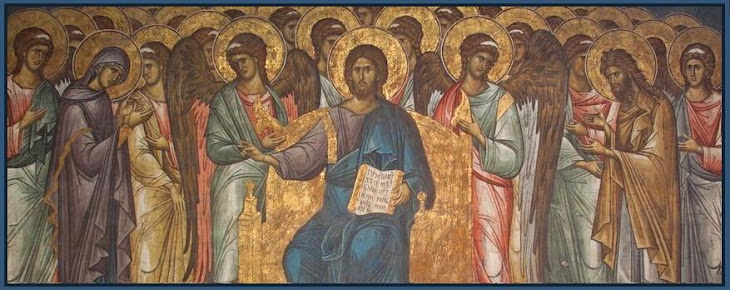
Detail from the icon of the Presentation of Christ to the Temple (source)
  
The Ancient of Days, Who formerly granted the Law to Moses on Mount Sinai, today is seen as an infant, and according to the Law, as the Creator of the Law fulfills the Law, being brought into the Temple and is given to the Priest. The Righteous Symeon receiving Him, and beholding the dissolving of bonds being performed, cries out joyfully: My eyes have seen the Mystery hidden from before the ages, but which has been revealed to us in these latter days, the Light that disperses the darkness of the faithless nations, and the glory of the new Israel. Therefore, let your servant depart from the bonds of this flesh towards the heavenly and wondrous eternal life, You Who grant the world the great mercy.
-Idiomelon from the Litia of Vespers for the Feast of the Presentation of Christ to the Temple
  
(source)
  
Through the prayers of our Holy Fathers, Lord Jesus Christ our God, have mercy on us and save us! Amen!

Thursday, September 3, 2015

St. John of Kronstadt on Mount Sinai and the Divine Liturgy

The vision of God to the Prophet Moses in the Burning Bush (source)
  
"When the Lord descended upon Mount Sinai the Hebrew people were ordered to prepare and cleanse themselves beforehand. In the Divine Liturgy we have an even greater event than God's descent upon Mount Sinai, here before us is the very face of God the Lawgiver. When the Lord appeared to him in the bush on Mount Horeb, Moses was ordered to put off his shoes from his feet: but here God is manifested in a manner far greater than upon Horeb; there was only the type, here is the antitype Himself."
-St. John of Kronstadt, 'My Life in Christ'
  
  
Icon of St. John of Kronstadt from Sretensky Monastery (source)

Through the prayers of our Holy Fathers, Lord Jesus Christ our God, have mercy on us and save us! Amen!

Saturday, January 18, 2014

Nun Mary Magdalene (+2014)

Nun Mary Magdalene (+2014) (source)
   
Nun Mary Magdalene reposed in the Lord. She was a rich woman from France, who spoke with St. Porphyrios of Kavsokalyvia without her knowing English, nor his knowing Greek!

She experienced the miracle!

She left for the desert. She lived in asceticism near the Monastery of St. Catherine, near the ascetical place on Sinai where St. John Klimakos (of the Ladder) lived in asceticism, and where she built a small chapel in his honor.

May we have her blessing! May she have a blessed Paradise.
   
Through the prayers of our Holy Fathers, Lord Jesus Christ our God, have mercy on us and save us! Amen!

Saturday, April 13, 2013

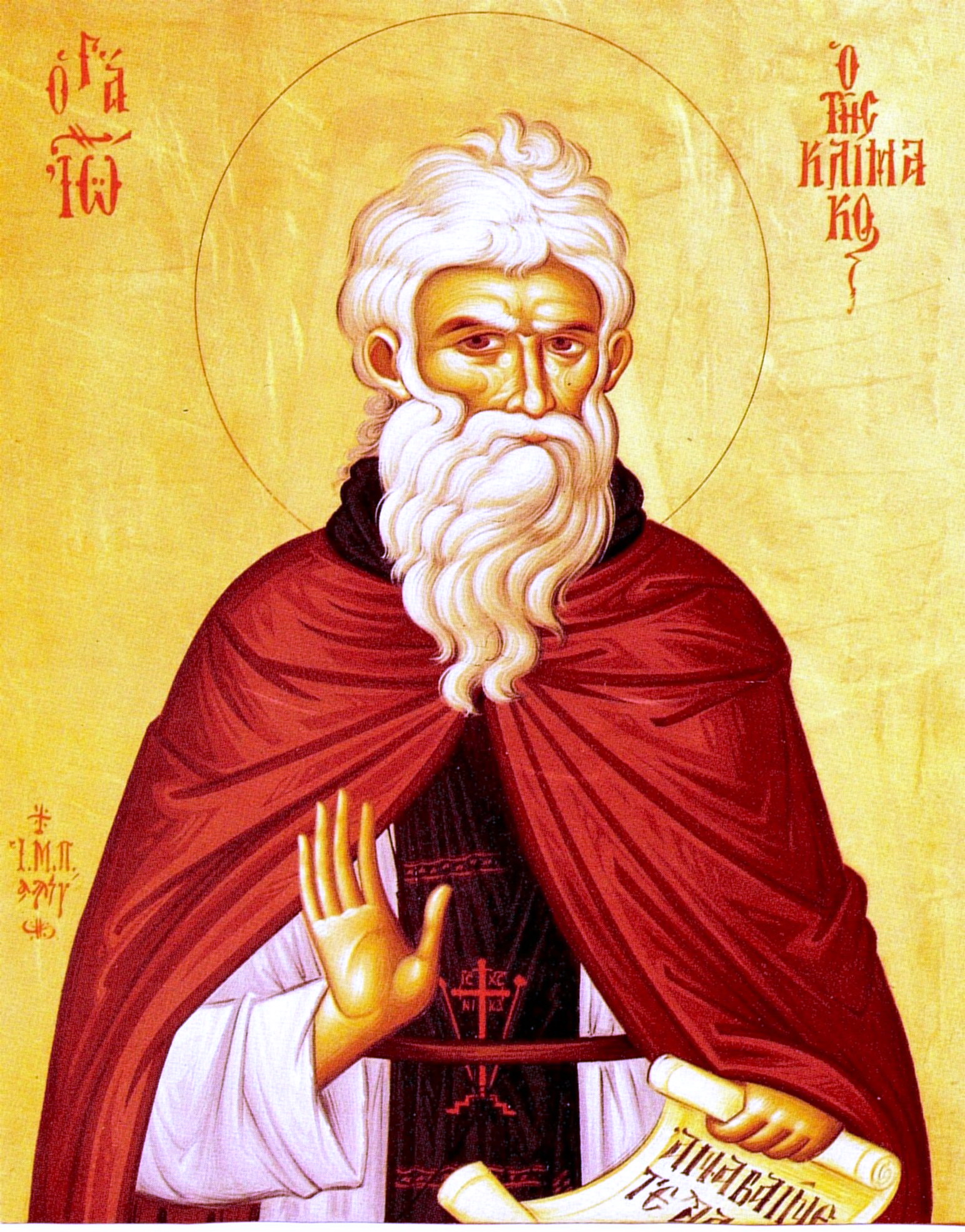
St. John Klimakos (of the Ladder), the Abbot of Mount Sinai

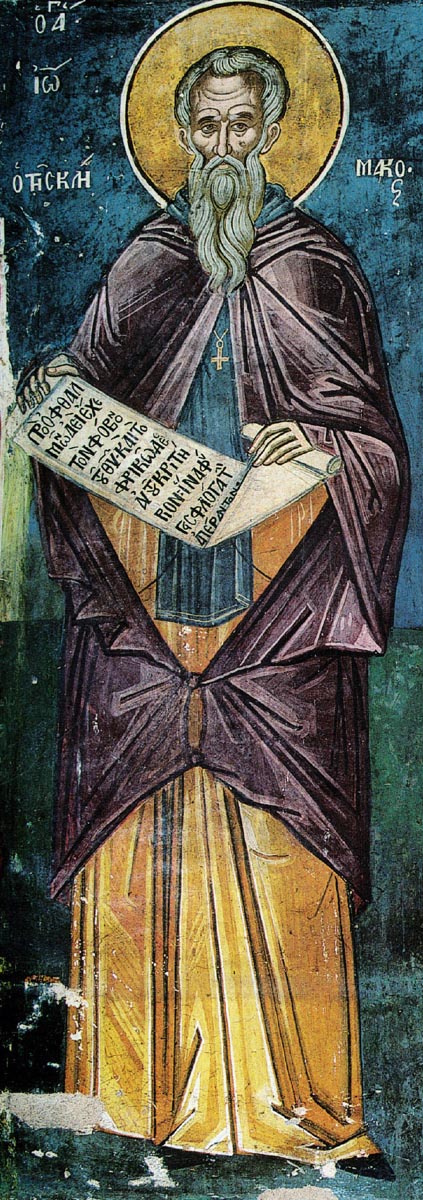
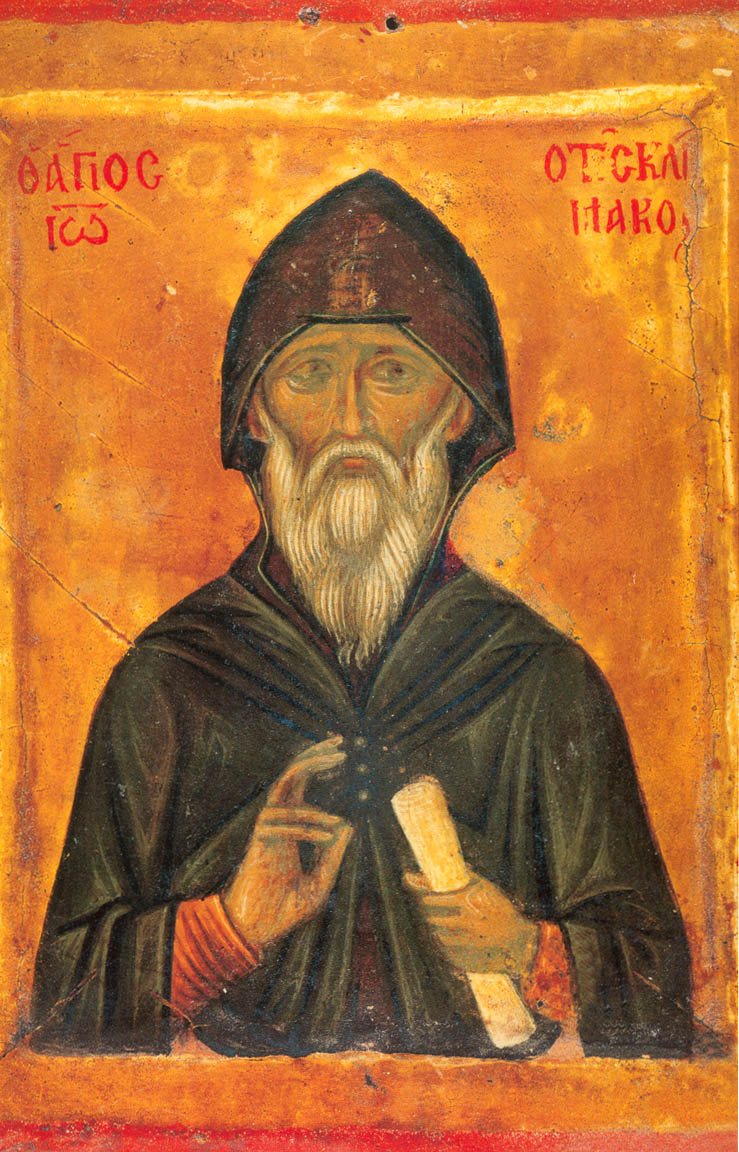
St. John Klimakos (of the Ladder), the Abbot of Mount Sinai - Commemorated March 30 and the Fourth Sunday of Great Lent (source)
   

By St. Nikolai Velimirovich

John Klimakos (Climacus) is the author of "The Ladder of Divine Ascent."

John came to Mt. Sinai as a sixteen year old youth and remained there, first as a novice under obedience, and afterwards as a recluse, and finally as abbot of Sinai until his eightieth year. He died around the year 563 A.D.

His biographer, the monk Daniel, says about him: "His body ascended the heights of Sinai, while his soul ascended the heights of heaven." He remained under obedience with his spiritual father, Martyrius, for nineteen years. Anastasius of Sinai, seeing the young John, prophesied that he would become the abbot of Sinai. After the death of his spiritual father, John withdrew into a cave [at Thola], where he lived a difficult life of asceticism for [forty] years.

St. John of the Ladder (source)
   
His disciple, Moses, fell asleep one day under the shade of a large stone. John, in prayer in his cell, saw that his disciple was in danger and prayed to God for him. Later on, when Moses returned, he fell on his knees and gave thanks to his spiritual father for saving him from certain death. He related how, in a dream, he heard John calling him and he jumped up and, at that moment, the stone tumbled. Had he not jumped, the stone would have crushed him.

At the insistence of the brotherhood, John agreed to become abbot and directed the salvation of the souls of men with zeal and love. From someone John heard a reproach that he talked too much. Not being angered by this, John however remained silent for an entire year and did not utter a word until the brothers implored him to speak and to continue to teach them his God-given wisdom.
   
St. John Klimakos (source)
   
On one occasion, when six-hundred pilgrims came to the Monastery of Sinai, everyone saw an agile youth in Jewish attire serving at a table and giving orders to other servants and assigning them. All at once, this young man disappeared. When everyone noticed this and began to question it, John said to them, "Do not seek him, for that was Moses the Prophet serving in my place."

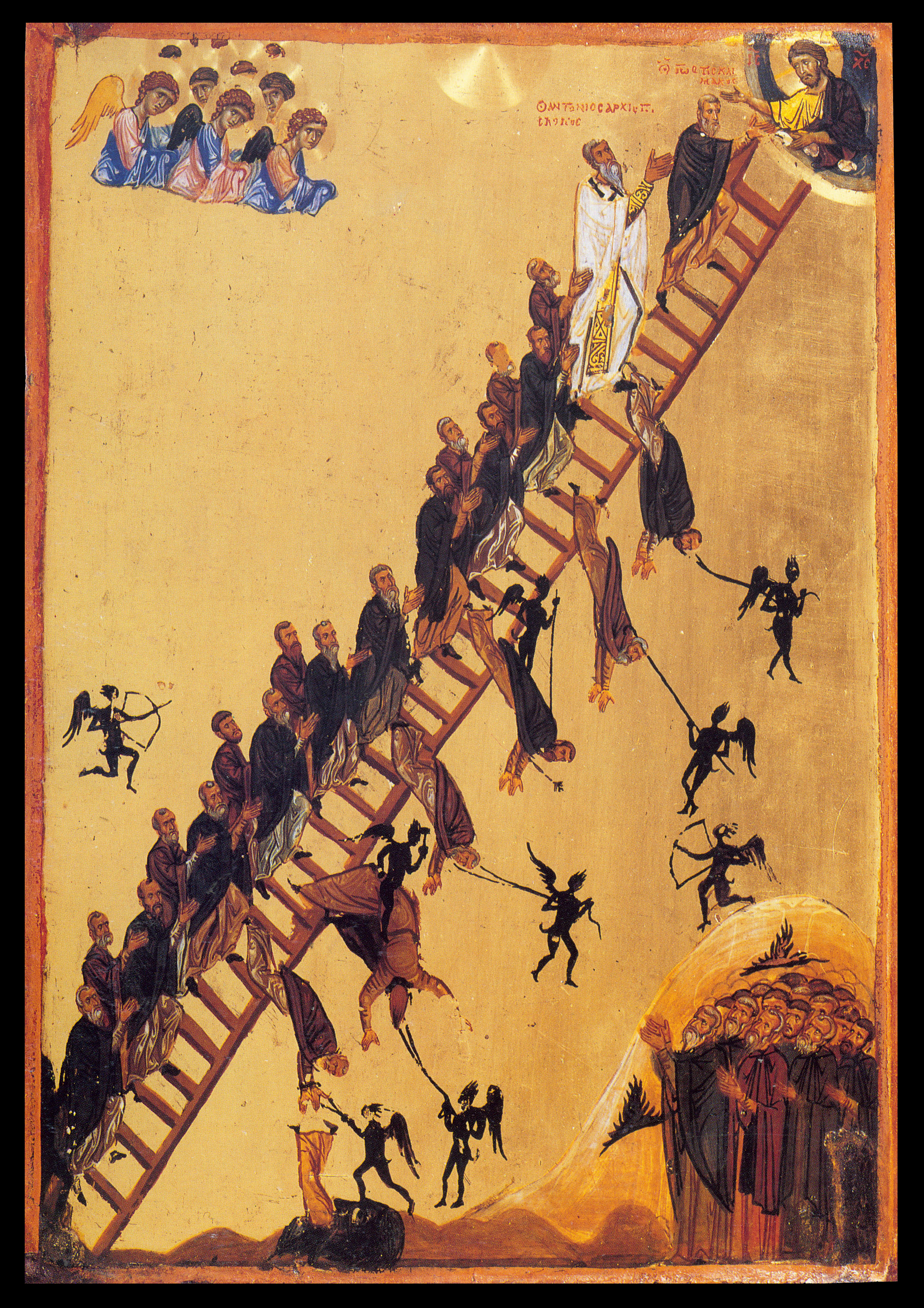
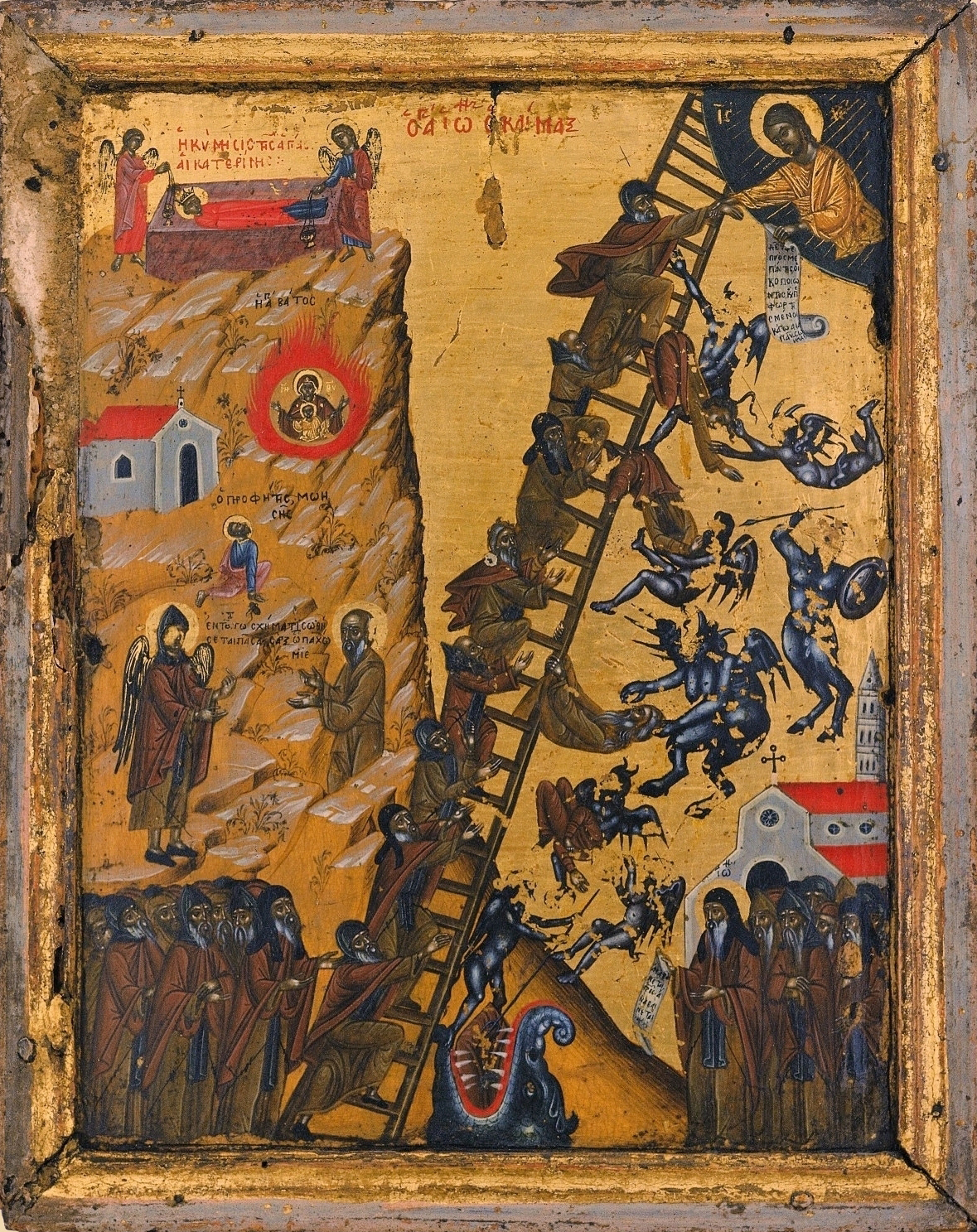
During the time of his silence in the cave, John wrote many worthwhile books, of which the most glorious is "The Ladder". This book is still read by many, even today. In this book, John describes the method of elevating the soul to God, as ascending a ladder.
  
The Ladder of Divine Ascent by St. John of Sinai (source)
  
Before his death, John designated George, his brother in the flesh, as abbot. George grieved much because of his separation from John. Then John said to him, that, if he [John] were found worthy to be near God in the other world, he would pray to Him, that, he, [George], would be taken to heaven that same year. And, so it was. After ten months George succeeded and settled among the citizens of heaven as did his great brother, John.
 (source)
   

"Ascend, brothers, ascend eagerly, and be resolved in your hearts to ascend and hear him who says: Come and let us go up to the mountain of the Lord, and to the house of our God, who makes our feet like hind's feet, and sets us upon high places, that we might be victors with His song."

- St. John Climacus, The Ladder of Divine Ascent, 30.36.


Iconographic depiction of The Ladder of Divine Ascent, written by St. John of the Ladder (source)
   
Apolytikion in the Fourth Tone
With the rivers of your tears, you have made the barren desert fertile. Through sighs of sorrow from deep within you, your labors have borne fruit a hundred-fold. By your miracles you have become a light, shining upon the world. O John, our Holy Father, pray to Christ our God, to save our souls.

Kontakion in the First Tone
As ever-blooming fruits, thou dost offer the teachings of thy God-given book, O wise John, thou most blessed, while sweet'ning the hearts of all them that heed it with vigilance; for it is a ladder from the earth unto Heaven that conferreth glory on the souls that ascend it and honour thee faithfully.
 (source)
   
The Ladder of Divine Ascent (source)
   
Through the prayers of our Holy Fathers, Lord Jesus Christ our God, have mercy on us and save us! Amen!

Thursday, November 5, 2009

Sts. Galaction and Episteme the Righteous Martyrs

Sts. Galaction and Episteme the Righteous Martyrs - Commemorated on November 5th (icon taken from: http://christopherklitou.com/icon_5_nov_galaction_epistime.htm)

"They were born in the city of Edessa in Phoenicia, both of pagan parents. Galaction's mother was barren until she was baptised. After her baptism, she brought her husband also to the true Faith and baptised her son Galaction, bringing him up a Christian. When the time came for Galaction to marry, his devout mother Leucippe died, and his father betrothed him to a maiden called Episteme. Galaction did not wish to enter into marriage at all, and he quickly urged Episteme to be baptised and then to become a nun at the same time as he became a monk. Both went away to the mountain of Publion, Galaction to a men's monastery and Episteme to a women's, and each of them became a true light in the monastery. They were first in labours, in prayer, in humility and obedience, and first in love. They did not leave their monasteries, and neither saw the other until the time of their death. A fierce persecution arose, and they were both brought to trial. While they were mercilessly whipping Galaction, Episteme was weeping, and they then whipped her also. They cut off their hands and feet, and finally their heads. One Eutolius, a man who had been a servant of Episteme's parents and then a monk together with Galaction, took their bodies and buried them. He also wrote the Lives of these two wonderful martyrs for Christ, who suffered and received their heavenly crowns in 253."
(taken from: http://www.pomog.org/prologue/November/18.htm)

Fresco from Decani Monastery depicting the martyrdom of Sts. Galaction and Episteme (taken from: http://www.srpskoblago.org/Archives/Decani/exhibits/Menologion/November/CX4K3478_l.html)

Excerpt from "A Synoptic View of the Orthodox Ascetical Tradition of Mount Sinai", by Archimandrite Isaiah of Simonopetra
"Certainly, by the 3rd century, the presence of Christian ascetics in Sinai is known, because, during the reign of Diocletian (284-305), Bedouin tribesmen, then still idolaters, killed and sacrificed monks instead of camels to their gods. These monks are probably to be identified with the Abbades of Sinai and Raitho, whose Martyrdom the Orthodox Church celebrates on the 14th of January. A "Discourse upon the Holy Fathers slain on Mount Sinai and Raitho" was written by the Egyptian Abba Ammonius, who became one of the first ascetic spiritual advisers at the Byzantine Imperial Court in the late 4th century, and ended his life as the Metropolitan of Adrianople in Thrace.

Picture (I believe) of the Mountain of Sts. Galakteon and Episteme (taken from: http://www.sinaimonastery.com/en/index.php?lid=50#)

Just before this, under the Emperor Decian (250), the martyrdom took place of Galaction and Episteme, a young married couple, so the story goes, living in chastity. Instructed by their spiritual mentor Onouphrius and by mutual consent, they had spent periods apart in solitary ascesis on Mount Sinai, where their relics were conveyed after death. A pure legend say, some, a travesty of marriage, say others, an exemplary triumph over nature, says the Orthodox Church."

Picture (I believe) of the Hermitage of Sts. Galaction and Episteme; Elder Paisios the Athonite lived here for two years (1962-1964) in great asceticism. (taken from: http://www.sinaimonastery.com/en/index.php?lid=50#; http://www.balamandmonastery.org.lb/fathers/fatherspaisios1.htm#top)

The Mountain of Sts. Galakteon and Episteme (Jebel el-Deir)
"The mountain to the north of the monastery [of St. Catherine at Mount Sinai] derives its name from Saints Galakteon and Episteme, who lived in asceticism at Sinai before their subsequent martyrdom in the reign of the Emperor Decius. The hermitage dedicated to their memory is a small complex with a chapel, two cells, and a kitchen area, located some forty-five minutes from the monastery. From the complex, the pilgrim has a commanding view of the summit of Sinai opposite."

Icon of the Synaxis of the Fathers of Mount Sinai (taken from: http://www.pigizois.net/galery/agiografies/sinaxi_sinaiton_pateron.jpg)

Another icon of Sts. Galaction and Episteme (taken from: http://www.sinaimonastery.com/en/index.php?lid=50#)

Troparion - Tone 4
Let us the faithful honor these two betrothed athletes: Galácteon and modest Epistémis. Their ascetic labors blossomed into martyrdom, therefore we cry to them: "Glory to Him who has strengthened you! Glory to Him who has crowned you! Glory to Him who through you grants healing to all!"

Kontakion - Tone 2
You are numbered among the hosts of martyrs for you were illustrious in mighty contests. Galácteon, together with Epistémis, your faithful wife and companion in struggle, unceasingly intercede to the one God for us all.
 
St. Paisios the Athonite (source)
  
Through the prayers of our Holy Fathers, Lord Jesus Christ our God, have mercy on us and save us! Amen!

Sunday, December 7, 2008

Simple but Profound Miracles of our Living Orthodox Faith

St. Paisios the Athonite (source)
   
"Today, increased knowledge and trust in logic has, unfortunately, shaken our faith to its foundfations and filled our souls with question marks and doubts. This is why we don't have miracles anymore, because a miracle cannot be explained logically, it can only be experienced. But faith in God will bring down divine power and overturn all human expectations. It will perform miracles, resurrect the dead and astonish science. From the outside, all things pertaining to the spiritual life seem upside down. Indeed, the mysteries of God will be impossible to know and will appear strange and contrary to nature as long as we don't overturn our secular mindset and see everything with spiritual eyes. Those who believe that they can come to know God's mysteries through mere scientific theory, without a spiritual life, resemble a fool who thinks he can look through a telescope and see Paradise."

-St. Paisios of the Holy Mountain

(from pg. 244-255 of With Pain and Love for Contemporary Man, Published by the Holy Monastery of St. John the Theologian, Souroti, Greece)


Greetings!

I found this short list of some miracles that happen continuously, and are a constant witness of the Grace of the Holy Spirit in the Holy Orthodox Faith and traditions. You may have heard of some or all of them, but if not, may these help renew our zeal for the Faith, if only in a small way. They are translated and re-worded from http://agiooros.freeforums.org/topic-t828.html , from Nicholas Zachariades from the book: «Εμπειρίες από τον αμίλητο κόσμου του Άθω» Τόμος Β’ Πύργος Ηλείας.

"1. Did you know that the flowers and basil from the Holy Cross that we get from the priest on the feast of the Exultation of the Holy Cross can catch yeast, and because it makes the dough rise wonderfully, we can make bread [prosforo] for the Divine Liturgy?

[I've never done this, but I think what the author is saying is that the blessed basil from church is sufficient to cause bread to rise to be used for church]

The Feast of the Exultation of the Holy Cross in Jerusalem with the Greek Orthodox Patriarch of Jerusalem (taken from: http://christian-feasts.com/len/agalleries/c1397-i13.php)

2. Did you know that holy water that is blessed in church by the Orthodox priest for the Holy Feast of Theophany or any other feast, as long as you keep it, will not spoil?

3. Did you know that in Jerusalem at the All-Holy Tomb of Christ, every year on Holy Saturday a Holy Fire miraculously comes only to the Orthodox Patriarch? A pilgrimage will convince you
.

[The fire is a visible symbol of the real presence of the Uncreated Light of Christ's Holy Resurrection. I've heard that for the first few minutes after the Patriarch comes out of the Holy Tomb, the fire does not burn anything that it touches. For more info, see: http://www.holyfire.org/eng/index.htm]

Picture of the Holy Sepulcher, the Tomb of Christ (from Wikipedia)

4. Did you know that at Mount Sinai where the God-seer Moses saw the Burning Bush that was not consumed, when a stone is broken open, on the walls are depicted the Bush of the Prophet Moses?

5. Did you know that when monks die in the monastery of St. Savas in Jerusalem, their bodies do not freeze or dry-out or smell and they do not bury them in the soil but put them in a room?

6. Did you know that on the head (the bone) of the fish «Goulianos» which lives in Lake Gennisaret is depicted the Baptism of Christ in the Jordan River?

7. Did you know that every year on Mount Tabor in Jerusalem on Aug. 6, the Day of the Transfiguration of our Savior, a light-bearing Cloud appears, which covers the site of the monastery and illuminates the perimeter all night?

[Another summary by Archbishop Seraphim of Canada (http://www.archdiocese.ca/e_bishop/desk/2008/2008.08.19Sermon.htm): " Some of you will remember Archbishop Nikolai of the Patriarchal Jurisdiction who was bishop in this area a long time ago. When I was visiting him one time, he told me how it was when he was an archimandrite in the Middle East a very long time ago. In those days, he always had to go to Mount Tabor to serve the Liturgy on this feast-day. Always on the feast of the Transfiguration (and I didn’t realise it, but I learned this year that it happens on both old and new calendars), at night-time, at the time of the vigil...there are clouds already gathering around the top of Mount Tabor. (At this time of year in Palestine there are no clouds at all – just sun, sun, sun.) The people go into the church on the top of Mount Tabor, and they are praying in the middle of the night. During this time, this cloud, which is not exactly like ordinary clouds (they say it has a different quality of some sort), comes down on top of the mountain. Archbishop Nikolai says that instead of bringing all their fruit into the church, the people leave it outside. The cloud comes down, and when they come out of the church in the early morning, everything is all wet. The people understand that God, Himself, has blessed their fruit. This happens every year. I heard from somebody who just came back from there who was there on August sixth on the new calendar, and it happened then, too. It is happening on both feasts. The LORD doesn’t care too much about the calendar; He cares about us, and reassuring us with His love..."

Also, if I'm not mistaken, I believe that something similar occurs every year at the Orthodox Feast of Pentecost in Jerusalem.]

8. Did you know that when celebrating the Holy Martyr Markella in Chios, when the priest and the people visit the place of her martyrdom near the coast, and chant her Paraklesis [Supplication service], the sea water becomes heated and boils with bubbles, and as soon as the Paraklesis finishes, all these phenomena stop?
[For more info see: http://www.monachos.net/forum/showthread.php?t=5212 , http://www.stdgocunion.org/saintmarkella.html ]


The site of the martyrdom of St. Markella in Chios, and apparently the red color in the water in the foreground of the picture is the blood of St. Markella which also appears on her feast (taken from: http://www.stdgocunion.org/saintmarkella.html)

9. Did you know that in the Monastery of Panagia near Malevis in Tripoli is an ancient icon of the Theotokos which mysteriously makes myrrh that is highly fragrant?

[There are many such miraculous icons of the Theotokos throughout the world as a testement to the Grace of Christ and Panagia. The icon of Panagia Malevi here is a wonderful example, and for forty years this icon of the Dormition of the Theotokos puts forth holy myrrh which creates a fragrance that is perceivable from miles away from the Monastery and through which Panagia has healed many, many people. Here is an account in Greek: http://www.ecclesia.gr/greek/monshrines/malevi.html , and here is a later post with this site translated/summarized: http://full-of-grace-and-truth.blogspot.com/2009/01/miraculous-myrrh-flowing-icon-of.html]

10. Did you know that on the Holy Mountain [Mount Athos] the Virgin Mary has spoken many times with the monks to protect them from dangerous pirates, such as happened in the Monastery Vatopedi with the Holy Icon of the Panagia "Paramythia" [of Consolation?]?

[The Panagia has helped and saved countless numbers of the faithful throughout the centuries. This specific story may be provided here another time, but is a link to it: http://www.mountathos.gr/active.aspx?mode=en{1cd9d117-cfde-4050-948a-df212f28fdb2}View]


The Miraculous Icon of the Theotokos "Paramythia" (Vatopedi Monastery, Mount Athos) (taken from: http://www.mountathos.gr/active.aspx?mode=en{1cd9d117-cfde-4050-948a-df212f28fdb2}View)

11. Did you know that every year during the feast of the Theotokos [from August 6th to the 15th] in Markopoulo of Cephalonia [an island in Greece] snakes appear on the icon of the Virgin Mary and do not bite the pilgrims?"
[This is a very real miracle that happens every year. A multitude of small snakes fill the holy church of the Theotokos only from August 6th-15th, they have small white crosses on them, they never harm anyone, they climb all over the icons in the church, and immediately after the feast, they disappear and are not seen for another year. For more info see: http://www.youtube.com/watch?v=F5Za9-uX4b8&feature=related , http://orthodoxwiki.org/Holy_Snakes, http://www.johnsanidopoulos.com/2009/08/holy-snakes-of-virgin-examining.html].

Additional Miracles:

-The Jordan River reverses its flow - Every year when the Orthodox celebrate the Great Feast of Theophany, and during the Blessing of the Waters, the Jordan River, in which Christ was baptized, turns back and reverses its flow. Here is more information and a video: http://frmilovan.wordpress.com/2009/01/19/the-jordan-reversed-its-flow/, http://www.youtube.com/watch?v=s1t5CFClsBk.

-St. Nicholas the New and the flowing blood - Every year at the feast of St. Nicholas, the new Righteous Martyr of Vounena, Greece, a miraculous and wonderworking liquid like blood flows from the place of his martyrdom. See the following post for more details: http://full-of-grace-and-truth.blogspot.com/2009/05/st-nicholas-new-righteous-martyr-of.html.

-The Flowers of St. John the Theologian - Marmaketos, Lasthiou, Crete - Every year, the people of the small village of Marmaketos in Crete (50 inhabitants), gather local wild flowers to decorate the Epitaphio of Christ on Holy Friday. On Holy Saturday, they gather the flowers and hang them throughout the church on string, where they dry out. On May 8th, the feast of St. John the Theologian, during the reading of the Gospel in the Divine Liturgy, these dead flowers miraculously show new flowers and green shoots. They are gathered by the people and placed near their icons for a time of need. When someone is sick, the weather is troublesome, etc., they place these flowers in the censer instead of incense and this works many miracles. This happens every year as a testament to Christ's Resurrection and the grace of Christ's Beloved Disciple. The following link shows two (Greek) video clips of the villagers explaining the miracle, recording of the service, and showing the miraculous flowers after the service: http://apantaortodoxias.blogspot.com/2009/05/blog-post_17.html
   

St. Paisios the Athonite (source)


Through the prayers of our Holy Fathers, Lord Jesus Christ our God, have mercy on us and save us! Amen!

Tuesday, November 25, 2008

St. Catherine the Great Martyr and All-wise

St. Catherine the Great Martyr - Celebrated on November 25th*** (13th Century Icon of St. Catherine with Scenes from her life, from the Monastery of St. Catherine - Mount Sinai (http://pravicon.com/images/sv/s0756/s0756002.jpg)
  
***Note: According to the ancient usage, Saints Catherine and Mercurius were celebrated on the 24th of this month, whereas the holy Hieromartyrs Clement of Rome and Peter of Alexandria were celebrated on the 25th. The dates of the feasts of these Saints were interchanged at the request of the Church and Monastery of Mount Sinai, so that the festival of Saint Catherine, their patron, might be celebrated more festively together with the Apodosis of the Feast of the Entry of the Theotokos. The Slavic Churches, however, commemorate these Saints on their original dates.
"The Holy Great Martyr Katherine was the daughter of Constus, the governor of Alexandria in Egypt, during the reign of the emperor Maximian (305-313). Living in the capital, Katherine received a most splendid education, having studied the works of the finest philosophers and teachers. Young men from the most worthy families of the empire sought the hand of the beautiful Katherine, but none of them was chosen. She declared to her parents that she would only enter into marriage with someone who surpassed her in reputation, wealth, beauty and wisdom.

Katherine's mother, a secret Christian, sent her for advice to her own spiritual father -- a saintly elder pursuing prayerful deeds in solitude in a cave not far from the city. Having listened to Katherine, the elder said that he knew of a youth, who surpassed her in everything, such that "His beauty was more radiant than the shining of the sun, His wisdom governed all creation, His riches were spread throughout all the world ". The image of the Christ produced in the soul of the holy maiden an ardent desire to see Him. In parting, the elder handed Katherine an icon of the Mother of God with the God-Child Jesus on Her arm and bid her to pray with faith to Mary to show her a vision of Her Son.

Another icon of St. Catherine with scenes from her life (taken from: http://vatopaidi.files.wordpress.com/2009/11/agia-aikaterina-1.jpg)
  
Katherine prayed all night and was able to see the Most Holy Virgin who told Her Divine Son to look upon the kneeling of Katherine before Them. But the Child turned His face away from her saying that He was not able to look at her because she was ugly, of shabby lineage, beggarly and mindless like every person -- not washed with the waters of holy Baptism and not sealed with the seal of the Holy Spirit. Katherine returned again to the elder deeply saddened. He lovingly received her, instructed her in the faith of Christ, admonished her to preserve her purity and integrity and to pray unceasingly; he then performed over her the sacrament of holy Baptism. And again Saint Katherine had a vision of the Most Holy Mother of God with Her Child. Now the Lord looked tenderly at her and gave her a ring -- a wondrous gift of the Heavenly Bridegroom.
 
The Theotokos and Christ appearing to St. Catherine (source)
 
At this time the emperor Maximian was himself in Alexandria for a pagan feast day. Because of this, the feast was especially splendid and crowded. The cries of the sacrificial animals, the smoke and the smell of the sacrifices, the endless blazing of fires, and the bustling crowds at the arenas filled Alexandria.
  
St. Catherine before the Emperor, fresco by Alevizakis (source)
  
Human victims also were brought -- because they chose to die in the fire rather than deny Christ under torture. The Saint's love for the Christian martyrs and her fervent desire to lighten their fate impelled Katherine to go to the emperor-persecutor Maximian.
 
St. Catherine the Great Martyr (source)
 
Introducing herself, the saint confessed her Christian faith and with wisdom denounced the errors of the pagans. The beauty of the maiden captivated the emperor. In order to convince her and show the superiority of pagan wisdom, the emperor gave orders to gather 50 of the most learned men of the empire, but the Saint got the better of the wise men, such that they themselves came to believe in Christ. Saint Katherine shielded them with the sign of the cross, and they bravely accepted death for Christ and were burnt by order of the emperor.

St. Catherine debating and defeating Fifty philosophers (taken from the following link, see for the full account of St. Catherine's defense: http://www.johnsanidopoulos.com/2009/11/50-philosophers-who-converted-to.html)
  
Maximian, no longer hoping to convince the saint, tried to entice her with the promise of riches and fame. Having received an angry refusal, the emperor gave orders to subject the saint to terrible tortures and then throw her in prison. The Empress Augusta, who had heard much about Katherine, wanted to see her. Having succeeded in convincing the military-commander Porphyry to accompany her with a detachment of soldiers, Augusta went to the prison. The strong spirit of Saint Katherine, whose face glowed with Divine grace, impressed the empress. The holy martyr explained the teachings of the Christians to the people and they believed and were converted to Christ.

16th Century icon of St. Catherine (from the iconostasis of the Katholikon), holding the Cross of a Martyr, the wheel on which she was tortured, and a palm branch symbolizing victory. At her feet are books, geographical tools, etc. which symbolize her great wisdom and learning. Behind her in the icon are depicted the Prophet Moses and the Burning Bush (prefiguring the Theotokos) and the Angels transferring St. Catherine's Relic. (taken from: http://vatopaidi.files.wordpress.com/2009/11/5sf-mc-ecaterina-sinai-16.jpg)
  
On the following day they again brought the her to the judgment court where, under the threat of being tortured on a wheel of spikes and nails, they urged that she recant from the Christian faith and offer sacrifice to the pagan gods. The saint steadfastly confessed Christ and she herself approached the wheel; but an Angel smashed the sharp tools, which broke up into pieces that hit pagans who were passing by. Having beheld this wonder, the empress Augusta and the imperial courtier Porphyry with 200 soldiers confessed their faith in Christ in front of everyone, and they were beheaded. Maximian again tried to entice Saint Katherine, proposing marriage to her, and again he received a refusal. She confessed her fidelity to the Heavenly Bridegroom Christ, and with a prayer to Him she herself put her head on the block under the sword of the executioner and was beheaded." At her execution, milk flowed from her wounds instead of blood by the Grace of God."

Icon of St. Catherine's body being carried by Holy Angels to Mount Sinai (Icon courtesy of www.eikonografos.com used with permission)
  
"Following her martyrdom, angels bore her body to the peak of Mount Saint Catherine, where they rested until they were translated to the catholicon of the Holy Monastery of Sinai. Here they continue to emit a sweet fragrance, and many miracles are wrought to this day. The veneration of Saint Catherine spread throughout the West, especially after the translation of relics of Saint Catherine to Rouen by Symeon Pentaglosses, in the early eleventh century. The numerous pilgrims to the monastery from that time resulted in the gradual change of name from the Holy Monastery of Sinai to that of Saint Catherine’s Monastery." (taken from: http://www.sinaimonastery.com/en/index.php?lid=29#)
  
Reliquary of St. Catherine, Mount Sinai (taken from: http://www.sinaimonastery.com/en/index.php?lid=84#)
  
"The marble chest containing the relics of Saint Catherine is located at the south side of the sanctuary in the catholicon of the holy monastery. It is the construction of Procopius the stonecutter, who took nine years to complete the shrine in honor of Saint Catherine. This shrine replaced the earlier marble chest, which is preserved today in the monastery’s treasury. Inside are to be found two precious reliquaries given by the Russian Empire for this purpose, the one enshrining the precious head of the martyr, and the other her left hand. The relics of Saint Catherine are brought out for the veneration of the faithful on special occasions, at which time each pilgrim is given a silver ring bearing the monogram of the saint, in honor of the ring that Saint Catherine received from Christ. These are preserved by pilgrims as a blessing from the saint." (taken from: http://www.sinaimonastery.com/en/index.php?lid=84)
  
For three hymns in praise of St. Catherine, see: http://full-of-grace-and-truth.blogspot.com/2009/11/three-hymns-in-honor-st-catherine-great.html.
  
Icon of St. Catherine the Great Martyr (Icon courtesy of www.eikonografos.com used with permission)
  
Apolytikion in the Plagal of the First Tone
Let us praise the most auspicious bride of Christ, the divine Katherine, protectress of Sinai, our aid and our help. For, she brilliantly silenced the eloquence of the impious by the sword of the spirit, and now, crowned as a martyr, she asks great mercy for all.
  
Kontakion in the Second Tone
O friends of martyrs, now divinely raise up a renewed chorus, praising the all-wise Katherine. For, she proclaimed Christ in the arena, trampled on the serpent, and spat upon the knowledge of the orators.
(taken from: http://goarch.org/chapel/saints_view?contentid=307&type=saints)
  
St. Catherine the Great Martyr, with scenes from her life (http://pravicon.com/images/sv/s0756/s0756009.jpg)
  
Saint Catherine the Great-martyr, intercede for us!
Through the prayers of our Holy Fathers, Lord Jesus Christ our God, have mercy on us and save us! Amen!