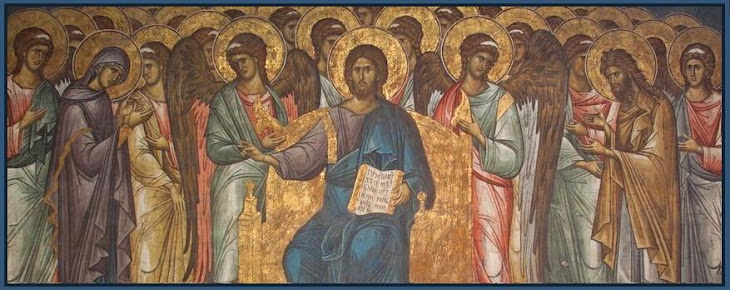
Christ communing His Disciples with the Holy Eucharist (meaning Thanksgiving), His All-Precious Body and Blood (source)
You have heard the words of the
Apostle, in which he addresses the Thessalonians, prescribing rules
of conduct for every kind of person. His teaching, to be sure, was
directed towards particular audiences; but the benefit to be derived
therefrom is relevant to every generation of mankind. Rejoice
evermore, he says; Pray without ceasing. In everything give thanks (I
Thessalonians 5:16-18). Now, we shall explain a little later on, as
far as we are able, what it means to rejoice, what benefit we receive
from it, and how it is possible to achieve unceasing prayer and give
thanks to God in all things.
However, it is necessary to anticipate
the objections that we encounter from our adversaries, who criticize
the Apostles injunctions as unattainable. For what is the virtue,
they say, in passing ones life in gladness of soul, in joy and good
cheer night and day? And how is it possible to achieve this, when we
are beset by countless unexpected evils, which create unavoidable
dejection in the soul, on account of which it is no more feasible for
us to rejoice and be of good cheer than for one who is being roasted
on a gridiron not to feel agony or for one who is being goaded not to
suffer pain?
And perhaps there is someone among
those who are standing among us here who is ailing with this sickness
of the mind and makes excuses in sins (Psalm 140:4, Septuaginta), and
who, through his own negligence in observing the commandments,
attempts to transfer the blame to the law-giver for laying down
things that are unattainable. How is it possible for me always to
rejoice, he may ask, when I have no grounds for being joyous? For the
factors that cause rejoicing are external and do not reside within
us: the arrival of a friend, long-term contact with parents, finding
money, honors bestowed on us by other people, restoration to health
after a serious illness, and everything else that makes for a
prosperous life: a house replete with goods of all kinds, an abundant
table, close friends to share ones gladness, pleasant sounds and
sights, the good health of our nearest and dearest, and whatever else
gives them happiness in life. For it is not only the pains that
befall us which cause us distress, but also those that afflict our
friends and relatives. It is from all of these sources, therefore,
that we must garner joy and cheerfulness of soul.
In addition to these things, when we
have occasion to see the downfall of our enemies, wounds inflicted on
those who plot against us, recompense for our benefactors, and, in
general, if no unpleasant circumstance whatsoever that would disturb
our life is either at hand or expected, only then is it possible for
joy to exist in our souls. How is it, therefore, that a commandment
has been given to us that cannot be accomplished by our own choice,
but depends on other antecedent factors? How am I to pray without
ceasing, when the needs of the body necessarily attract the attention
of the soul to themselves, given that the mind cannot attend to two
concerns at the same time?
And yet, I have been commanded to give
thanks in everything. Am I to give thanks when I am strapped to a
rack, tortured, stretched out on a wheel, and having my eyes gouged
out? Am I to give thanks when I am beaten with humiliating blows by
one who hates me? When I am stiff from the cold, perishing from
hunger, tied to a tree, suddenly bereft of my children, or deprived
even of my very wife? If I lose my wealth as a result of a sudden
shipwreck? If I run into pirates on the sea, or brigands on the
mainland? If I am wounded, slandered, wander around, or dwell in a
dungeon?
Raising these objections, and more
besides, our adversaries find fault with the lawgiver, thinking that,
by slandering the precepts that we have been given as impossible to
fulfill, they furnish themselves with a defense for their own sins.
What, therefore, shall we say in response to them?
That, while the Apostle is looking
elsewhere and attempting to elevate our souls from the earth to the
heights and to transport us to a heavenly way of life, they, unable
to attain to the loftiness of the lawgivers mind, and preoccupied
with the earth and the flesh, crawl around in the passions of the
body like worms in a swamp and demand that the Apostle issue precepts
which are capable of being fulfilled. For his part, the Apostle
summons not just anyone, but one who is as he was to rejoice always,
no longer living in the flesh, but having Christ living in himself,
since union with the highest good does not in any way allow sympathy
for the demands of the flesh (cf. Galatians 2:20). And even if an
incision is made in the flesh, the disintegration occasioned by its
continued presence remains in the part of the body that suffers it,
since the pain is unable to spread to the noetic part of the soul.
For, if, in accordance with the Apostles precept, we have mortified
our members which are upon the earth (Colossians 3:5) and we bear in
the body the dying of the Lord Jesus (II Corinthians 4:10),
necessarily the injury suffered by the mortified body will not reach
the soul which has been freed from contact with the body. Dishonor,
losses, and deaths of our nearest and dearest will not rise up to the
mind, nor will they incline the sublimity of the mind to sympathy
with things below. For, if those who fall into difficulties have the
same attitude as the virtuous man, they will not cause annoyance to
anyone, seeing that not even they themselves endure sorrowfully what
befalls them; but if they live according to the flesh (Romans 8:13),
not even in this way will they annoy anyone, but will be reckoned
pitiable, not so much because of their circumstances, as because they
do not choose to react properly.
In short, a soul which has once and for
all been held fast by the desire for its Creator and is accustomed to
delighting in the beauties of the heavenly realm will not alter its
great joy and cheerfulness under the influence of carnal feelings,
which are varying and unstable; but things which distress other
people it will regard as increasing its own gladness. Such was the
Apostle, who took pleasure in infirmities, in afflictions, in
persecutions, and in necessities, counting his needs an occasion for
glorying (II Corinthians 12:9-10); in hunger and thirst, in cold and
nakedness, in persecutions and distresses (II Corinthians 12:10;
11:27), conditions in which others endure only with difficulty,
bidding farewell to life: in these he rejoiced. Therefore, those who
are ignorant of what the Apostle has in mind, and do not understand
that he is calling us to the evangelical way of life, dare to accuse
St. Paul of laying down things that are impossible for us. Well then,
let them learn how many legitimate occasions for rejoicing are made
available to us through Gods munificence. We were brought from
non-being into being; we were made in the image of the Creator
(Genesis 1:27); we have the mind and reason to perfect our nature,
and through them we have knowledge of God. And perceiving the
beauties of nature carefully, we thereby recognize, as if through
letters, God's great providence and wisdom concerning all things. We
are capable of discerning good and evil; we are taught by nature
itself to choose what is beneficial and to avoid what is harmful.
Having been estranged from God through sin, we have been called back
to kinship with Him, being released from ignominious slavery by the
blood of His Only-begotten Son. We have the hope of resurrection, the
enjoyment of Angelic goods, the Kingdom of Heaven, and promised
goods, which transcend the grasp of mind and reason.
How is it not proper to think that
these things are sufficient reasons for unending joy and unceasing
gladness? How is it proper to suppose that one who is a glutton, who
delights in hearing flute-playing, and who lies on a soft bed and
snores, is living a life worthy of joy? I would say that such people
are worthy of lamentation on the part of those who are endowed with
intelligence, whereas we should call blessed those who endure the
present life in the hope of the age to come and who exchange present
joys for eternal joys. Whether they stand amid flames, as did the
three Youths in Babylon, who were united with God (Daniel 3:21), or
are shut up with lions (Daniel 6:16-23), or swallowed by a whale
(Jonah 2:1), we should call them blessed, and they should pass their
lives in joy, not being distressed over present sufferings, but
rejoicing in the hope of what is in store for us in the next life.
For, in my opinion, a good athlete, once he has stripped down for the
arena of piety, should valiantly endure the blows of his adversaries
in hope of the glory that comes from crowns of victory. Indeed, in
gymnastic contests, those who have become inured to pain in wrestling
schools are not depressed at the prospect of suffering pain from
blows, but advance to close quarters with their foes, disdaining
momentary pains in their desire to be publicly proclaimed victors.
Thus, even if some misfortune befalls a virtuous man, it will not
cast a shadow over his joy. For tribulation worketh patience, and
patience, experience, and experience, hope; and hope maketh not
ashamed (Romans 5:3-5). Hence, in another place, Saint Paul enjoins
us to be patient in tribulation and to rejoice in hope (Romans
12:12). It is hope, therefore, that makes joy to dwell within the
soul of a virtuous man. But the same Apostle bids us weep with those
who weep (Romans 12:15); and, writing to the Galatians, he wept over
the enemies of the Cross of Christ (Philippians 3:18). And what need
have I to speak of the tears of Jeremiah (Lamentations), of Ezekiel
writing lamentations over the rulers of Israel, at Gods command
(Ezekiel 2:9), or of many other Saints who mourned? Alas, my mother,
that thou hast borne me (Jeremiah 15:10); Woe is me, for the godly
man hath perished from the earth, and there is none among men that
ordereth his way aright (Micah 7:2); Woe is me, for I am become as
one gathering straw in the harvest (Micah 7:1).
So, in a word, scrutinize the sayings
of the righteous, and when anywhere you find one of them emitting a
rather doleful expression, you will be convinced that all who are of
this world bemoan the misery of the life that is led therein. Woe is
me, for my sojourning is prolonged (Psalm 119:5, Septuaginta). For
the Apostle has a desire to depart, and to be with Christ
(Philippians 1:23). He is, therefore, vexed at the prolongation of
this earthly sojourn as an impediment to his joy. David, too,
bequeathed to us a lamentation in song for his friend Jonathan, in
which he also mourned for his enemy: I am grieved for thee, my
brother Jonathan (II Kings 1:26); and: O daughters of Israel, weep
for Saul (II Kings 1:24). He mourns for Saul, as one who died in sin,
but for Jonathan, as one who shared his life in every respect. Why
should I speak of the other examples? And yet, the Lord wept over
Lazarus (St. John 11:35) and He wept over Jerusalem (St. Luke 19:41),
and He calls blessed those who mourn (St. Matthew 5:4) and likewise
those who weep (St. Luke 6:21).
But how, you say, are these things to
be reconciled with the words: Rejoice always? For weeping and joy do
not derive from the same source. Weeping, for example, is naturally
engendered as a result of some blow, in which the involuntary impact
strikes and constricts the soul, while the spirit surrounding the
heart is depressed; but joy is like a leap of the soul, as it were,
which rejoices at things that are under its control. Hence, the
physical symptoms are different. For, in the case of those who are
distressed, their bodies are sallow, livid, and cold, whereas in the
case of those who feel joyous, the condition of their bodies is
efflorescent and reddish, while their souls all but leap outwards,
propelled by delight.
To this we will say that the Saints
lamented and wept on account of their love for God. And so, ever
beholding Him Whom they loved and increasing the gladness that they
themselves derived from Him, they provided for the needs of their
fellow-servants, mourning for those who sinned and correcting them
through their tears. Just as people who stand on the shore and feel
sympathy for those who are drowning in the sea do not jettison their
own security in their concern for those in peril, so also, those who
are distressed at the sins of their neighbors do not efface their own
gladness; on the contrary, they increase it, being vouchsafed the joy
of the Lord by virtue of the tears that they shed for their brothers.
This is why those who weep and those who mourn are blessed, for they
themselves will be comforted and they themselves will laugh. By
laughter, one means not the sound which is emitted through the cheeks
when the blood boils, but the cheerfulness which is pure and unmixed
with any sadness. Therefore, the Apostle allows us to weep with those
who weep, because tears of this kind are like the seed and pledge of
eternal joy. Ascend with me in mind, please, and behold the Angelic
estate and consider whether any other condition befits them than that
of rejoicing and gladness; for they are vouchsafed to stand before
God and enjoy the ineffable beauty of the glory of Him Who created
us. And so, it is to that life that the Apostle urges us on, bidding
us always to rejoice.
Now, as for the fact that the Lord
wept over Lazarus and the city, we have this to say: He ate and
drank, not because He needed these things Himself, but so as to leave
you with measures and limits by which to control the unavoidable
emotions of the soul. Thus, He wept in order to correct the
propensity to excessive emotion and dejection among those given to
mourning and lamentation. For if there is anything that needs to be
moderated by reason, it is weeping: that is, over what things, to
what extent, when, and how it is proper to weep. For that the Lord's
weeping was not emotional, but didactic, is clear from this verse:
Our friend Lazarus sleepeth; but I go, that I may awake him out of
sleep (St. John 11:11). Who among us mourns for a sleeping friend,
whom he expects to awake after a short while? Lazarus, come forth
(St. John 11:43). And the dead man was brought back to life; he who
was bound walked. This is a miracle within a miracle: that his feet
were bound with grave-clothes and yet were not prevented from moving.
That which strengthened him was greater than that which impeded him.
Why, therefore, did the Lord, Who was
about to accomplish such things, judge the incident worthy of tears?
Is it not clear that, disregarding our infirmity in every way, He
contained the necessary emotions within certain measures and limits,
avoiding a lack of sympathy, on the one hand, as something
appropriate to wild beasts, and, on the other hand, refusing to give
way to excessive grief and lamentation as something ignoble? Hence,
in weeping over His friend, He both displayed that He Himself shared
in our human nature, and freed us from either kind of extreme,
allowing us neither to indulge our emotions nor to be unfeeling in
the face of sorrows.
Therefore, just as the Lord accepted
hunger, after digesting solid food, submitted to thirst, after the
moisture in His body was consumed, and felt weary, when His muscles
and nerves were strained from travel-ling—although it was not that
His Divinity succumbed to weariness, but that His body accepted its
natural attributes; so also, He accepted weeping, permitting a
natural property of the flesh to supervene. This occurs when the
hollow parts of the brain, filled with vapors arising from grief,
discharge the burden of moisture through the opening of the eyes as
through some kind of duct. Hence, one experiences a certain ringing
in the ears, dizziness, and darkening of the eyes when he hears about
unexpected sorrows, and ones head is set in a whirl by vapors which
are emitted by compressed heat deep inside him. Then, in my opinion,
just as a cloud dissolves into raindrops, so also the thickness of
vapors dissolves into tears. Hence, those who grieve feel a certain
pleasure when they lament, because the burden that weighs on them is
secretly evacuated through weeping. Experience of events proves the
truth of this account. For we know many people who, in desperate
straits, forcibly restrain themselves from weeping; then, in some
cases, they fall into incurable sufferings, either apoplexy or
paralysis, while in other cases, they completely faint, their
strength having been broken down, like a weak support, by the weight
of sorrow. For, what is observable in the case of fire, that it is
stifled by its own smoke if it does not escape, but rolls around
it—this, it is said, occurs also in the case of the faculty that
governs a living creature; that is, it wastes away and is
extinguished if there is no way for it to ex-hale.
Therefore, let those who are given to
mourning not adduce the Lords tears in support of their own weakness.
For, just as the food which the Lord ate is not an occasion of
pleasure for us, but, on the contrary, the highest criterion of
restraint and sufficiency, so also, His weeping is not an ordinance
prescribing lamentation, but is a most fitting measure and an exact
standard whereby we may, with proper dignity and decorum, endure
sorrows while remaining within the limits of our nature. Thus,
neither women nor men are permitted to indulge in mourning and
excessive weeping, but only to the extent that it is fitting to
grieve over sorrows; they are permitted to shed a few tears, but this
must be done calmly, without bellowing or wailing, without rending
ones tunic or sprinkling oneself with dust, or committing any of the
other improprieties that are typical of those who are ignorant of
heavenly things. For one who has been purified by Divine doctrine
must be fenced around by right reason, as by a strong wall, and must
manfully and strenuously ward off the onslaughts of such emotions; he
must not accept any crowd of emotions that flows in, as it were, to
some low-lying place, with a submissive and compliant soul.
It is the mark of a craven soul, and
one that is lacking in the vigor that comes from hope in God, that it
utterly collapses and succumbs to adversities. For, just as worms are
particularly inclined to breed on more tender pieces of wood, so also
sorrows grow in men of lesser moral fiber. Was not Job adamantine in
heart? Were his inward parts not made of stone? His ten children fell
dead in one brief moment of time, overwhelmed by a calamity in the
house of their gladness at a time of enjoyment, when the Devil
brought down their dwelling upon them. He saw the table drenched with
blood; he saw his children, who had been born at different times, but
who had ended their lives together. He did not wail aloud; he did not
pluck his hair out; he did not let out a degenerate cry; but he
uttered that thanksgiving which is renowned and acclaimed by all: the
Lord gave, the Lord hath taken away; as it seemed good to the Lord,
so hath it come to pass; blessed be the name of the Lord (Job 1:21).
Was this man not lacking in sympathy? How could this be so? For about
himself, at any rate, he says: I wept over every man who was
afflicted (Job 30:25). But was he not lying when he said this? But
here, too, the truth bears witness to him that, in addition to his
other virtues, he was also truthful: ...That man was blameless,
righteous, godly, and truthful (Job 1:1).
Yet many of you keep on wailing in
dirges that are designed to express dejection, and you deliberately
waste away your soul with mournful melodies; and, just like the
make-believe and paraphernalia with which they adorn theatres to
typify tragedies, so, also, you suppose that the proper outfit for a
mourner consists of black clothing, squalid hair, dirt, and dust,
complete with a darkened house and lugubrious chanting, which
preserves the wound of grief ever fresh in the soul. Let those who
have no hope do these things. You, however, have been taught,
concerning those who repose in Christ, that it [the body] is sown in
corruption; it is raised in incorruption; it is sown in dishonor; it
is raised in glory; it is sown in weakness; it is raised in power; it
is sown a natural body; it is raised a spiritual body (I Corinthians
15:42-44). Why, then, do you weep for one who has gone to change his
vesture? Neither mourn for yourself, as one who has been deprived of
a helper in this life; for it is better to trust in the Lord than to
trust in man (Psalm 117:8-9, Septuaginta). Nor lament for this
helper, as one who has suffered a terrible calamity. For, a little
later, the trumpet sounding from Heaven will awaken him, and you will
see him standing before the judgment-seat of Christ. So, dismiss
these dejected and ignorant cries: Alas, these unexpected woes! Who
would have thought that this would happen? Could I have ever
anticipated that I would cover this dearest friend of mine with
earth? If we should hear someone else saying such things, it behooves
us to blush, since we have been taught from both past memories and
present experience that these natural occurrences are inevitable.
Therefore, neither untimely deaths nor
other misfortunes that unexpectedly befall us will ever cause
consternation in us who have been educated by the doctrine of piety.
For example, let us say that I had a son who was a young man—the
sole heir of my estate, the comfort of my old age, the adornment of
his family, the flower of his peers, the support of his household,
and at that time of life which is most charming—, this lad having
been carried off by death, he becoming earth and dust who, a short
while ago, uttered sweet sounds and was a most pleasing sight in the
eyes of his father. What, then, am I to do? Shall I rend my clothing?
Shall I consent to roll around on the ground, scream in vexation, and
act in front of those present like a child crying out in pain and
having convulsions? Rather, paying heed to the inevitability of
events, that the law of death is inexorable and affects every
age-group alike, dissolving all compound things in order, surely I
should not be surprised at what has happened. Surely I should not be
upset in my mind, as if I had been devastated by some unexpected
blow, since I have been taught beforehand that, being mortal, I had a
mortal son, that there is no constancy in human affairs, and that
nothing wholly abides for those who possess it.
Why, even great cities, which were
renowned for the elegance of their buildings and the abilities of
their inhabitants, and conspicuous for their prosperity both in the
countryside and in the marketplace, now display tokens of their
erstwhile dignity only in ruins. A ship which has frequently been
preserved from the sea, and which has made countless speedy voyages
and conveyed innumerable amounts of merchandise for traders, vanishes
with a single gust of wind. Armies which have many times defeated
their foes in battle have, on suffering a reversal of fortune, become
a pitiful sight and one pitiful to relate. Entire nations and
islands, which have attained great power, and have raised many
trophies both by land and by sea, and have gathered much wealth from
booty, have either been consumed by the passage of time or been taken
captive and exchanged their liberty for enslavement. Indeed, in
short, whatever great and unbearable evil you care to mention, life
already has prior examples of it.
Therefore, just as we determine weights
by a turn of the scale and assay gold by rubbing it with a
touchstone, so also, if we were to remember the limits revealed to us
by the Lord, we would never exceed the bounds of prudence. Whenever,
therefore, any involuntary adversity befalls you, by virtue of being
mentally prepared, you will avoid confusion, and you will make light
of present afflictions by your hope for the future. For, just as
those whose eyes are weak divert their gaze from things that are
excessively bright and give them rest by looking at flowers and
grass, so, also, the soul must not constantly behold that which
causes grief or be fixated on present sorrows, but must direct its
gaze towards what is truly good. In this way will it be feasible for
you always to rejoice, if your life always looks towards God and if
hope of recompense alleviates life's colors.
Have you been dishonored? Then have
regard for the glory which is laid up in Heaven through patient
endurance. Have you suffered a loss? Then contemplate the heavenly
wealth and treasure which you have laid up for yourself through your
good deeds. Have you been expelled from your homeland? Then you have
Jerusalem as your heavenly homeland. Have you lost a child? Then you
have Angels, with whom you will dance around the Throne of God,
rejoicing eternally. By thus opposing anticipated good things to
present sorrows, you will keep your soul in the cheerfulness and
tranquillity to which the Apostles precept summons us. Neither let
the joys of human affairs create immoderate and excessive gladness in
your soul, nor let sorrows diminish its exultation and sublimity by
feelings of dejection and abasement. Unless you have previously
trained yourself in this way regarding the eventualities of life, you
will never have a calm and tranquil life. But you will easily achieve
this if you have dwelling within you the commandment which advises
you always to rejoice, dismissing the vexations of the flesh and
gathering that which gladdens the soul, transcending the sensation of
present realities and extending your mind to the hope of eternal
realities, the mere thought of which is sufficient to fill the soul
with rejoicing and to make Angelic exultation reside in our hearts;
in Christ Jesus our Lord, to Whom be the glory and the dominion, unto
the ages. Amen.
Through the prayers of our Holy Fathers, Lord Jesus Christ our God, have mercy on us and save us! Amen!