Showing posts with label Martyrdom. Show all posts

Wednesday, September 16, 2020

Homily on Sts. Sophia and her Daughters, by Metropolitan Avgoustinos Kantiotes

St. Sophia and her daughters: Sts. Faith, Hope and Love (source)
  
Homily on Sts. Sophia and her Daughters, by Metropolitan Avgoustinos Kantiotes
After the feast of the Exaltation of the Cross, our Church celebrates, my beloved, the memory of Saints Sophia and her three daughters: Faith, Hope and Love.

St. Sophia was born, according to the Synaxarion, in a great city of Italy. She lived during the era of early persecutions, which, as is known, lasted for at least three centuries.

During that era, for one to be a Christian, it was costly. It cost one positions, honors, money, and even this life. Millions were sacrificed then for the love of Christ. With this heroic spirit, St. Sophia lived as well, and thus raised her daughters.

It is not possible to not rouse the evil of persecutors. They seized her, therefore, together with her daughters, and led them before the governor. He gave them the opportunity of three days in order to make a response, and possibly change their minds. But, after three days, the mother and her daughters remained unshakable in their dedication towards our Lord Jesus Christ.

The mother had fear that her daughters might deny Christ, because they were very young. The first, Faith, was twelve years old. Hope was ten. and Love was nine. Despite this, their weak flesh was strengthened by the grace of God, and they endured martyrdom with unprecedented boldness.

They locked them in prison. They beat them with whips. They pierced them with fiery arrows. They threw them in cauldrons of boiling water. However, like the Three Youths in the Furnace, thus, these three girls hymned God, as those around heard the hymn harmoniously: "Praise ye the Lord, and exalt Him beyond measure unto all the ages."

In the end, the three were beheaded by the sword of the tyrant. Their martyrdom was followed by that of their holy mother.

St. Sophia and her three daughters teach us, my beloved, that, if we wish to be faithful Christians, that Christianity will cost us. And the more faithful we are, the more it will cost us.

Many of us have become successful in this world. We find a myriad of ways to justify our seemingly proper and scandalous station. And later with think that we are Christians. Woe to us, if we do not set as a foundation the heroic mindset which defined the holy martyrs. These three little girls should censure the world. And their mother, St. Sophia, censures those mothers who are upset and tremble, thinking that through their fasting, prayer and reading, that the bodily strength of their little girls will be lessened.

The Martyrs are the greatest censure of our lukewarm, miserable and thrice-wretched Christianity.

However, St. Sophia and her three daughters teach us not only through their martyrdoms, but also through their names.

The name "Sophia", what does this teach us? "Wisdom", we hear in Church when the Priest holds the Gospel and raises it, showing it to the whole multitude of the faithful. The Gospel, in other words, is full of wisdom. There is no wiser book. Wisdom is Christ Himself, the Logos of God. Do you remember the wondrous apostolic reading which we read three days ago, on the feast of the Cross? He said: "But we preach Christ crucified, a stumbling block to Jews and folly to Gentiles, but to those who are called, both Jews and Greeks, Christ the power of God and the wisdom of God." (I Corinthians 1) Christ is wisdom, truth and life.

St. Sophia, therefore, through her name, brings to mind that we must seek from God the illumination of divine wisdom. The names of her three daughters bring to mind the three great theological virtues.

Faith! Awesome power, light, a star, foundation and root. Oh, if there were within our hearts this virtue! We could even bring down the stars from the heavens to the earth, and we could melt the mountains, and even the greatest hindrances would be solved. Do we have faith? If we had faith, 100% faith, the world would be different. But today, people don't even believe 1%. Take almost any Christian and ask him, and you would see that he is full of doubts, totally full of "ifs." If one has an "if", then you don't have faith. Faith is to believe 100% in reality that which our holy Church teaches us.

Hope also brings to mind that, in this world, we have a need for life-giving hope, which would warm us like the sun. The Christian who believes that God is a loving and nurturing Father, an almighty Father and all-wise, he would hope that all those things that God promised, all kinds of great and uplifted and indescribable good things, He will give to him.

And finally, Love, with her name reminds us of the fulfillment and the crown of the virtues. In this world of hatred, egotism, greed, and other evils, love today has grown cold. It is truly a terrible thing, as the sacred Chrysostom says, for us to see the sun be quenched one day. But it is even more terrible for love to be quenched. It is better for the sun to be quenched than for love to be quenched, because it is the sun for our souls. And Christ Himself prophesied, that there will come a cursed day, in which the sun of love will be quenched, and cold and frost will reign upon the earth. (Matthew 24:12)

We are speaking about love, but we don't possess love. Love is a heavenly thing, which is ineffably joined with humility, with obedience, with discipline, the great virtues. It is not something indiscriminate, like ecumenists reach, like worldly people teach. Love differs from love. There is carnal love, love of money, love of small and meaningless things. And there is furthermore love for one's father and mother, which, in the final analysis, also contains something physical. The love which Christ brings to the world, however, has the wings of an eagle, and flies to the third Heaven, and makes man a Cherubim and Seraphim.

Love, therefore, not only for relatives and friends, not just towards Christians, but love for the whole world. Love, even for those who crucify you! For we have Christ as our prototype, Who is love crucified. This love we must have as well.

My beloved, if one were to ask now which of these three virtues are the greatest, the greatest is the third, love. Its beauty is indescribable. The Apostle Paul paints all of this in his beautiful sayings on love, which we have properly heard in vain to this point. "If," he says, "I spoke in the tongues of men and Angels," even if I have done miracles, even if I distribute my earthly goods, even if I go to martyrdom and shed my blood, "and I have not love, then I have become a noisy gong or a clanging cymbal." "I am nothing." (I Corinthians 13:1-2)

These, my beloved, I have to tell you. Believe, in this age of faithlessness. Hope, in this age of hopelessness. Love, in this age of hatred. And first and foremost, keep love, which, as the Apostle Paul says, remains eternally. (ibid 13:7)

For what is Paradise? Is it rivers, crystalline springs? Is it the songs of the Angels, the Cherubim and the Seraphim, is it the Saints, the Martyrs, is it that whole and beautiful world, and indescribable good things? It is these things. But first and foremost, it is love, the love of God towards man. If I took out love from Paradise, immediately Paradise would become Hell.

That Paradise we ourselves should seek, if we sense the dawn of love, if we believe unshakably in the Lord, and if we have steadfast hope in the promises of God unto the ages.

Then, in the heights of Heaven, together with St. Sophia and her three daughters, Faith, Hope and Love, we will hymn the Triune God, saying: "Praise ye the Lord, and exalt Him beyond measure unto all the ages."
(+) Bishop Avgoustinos
Recorded from a homily that occurred in the Chapel of St. Sophia of the Orphanage of the "Agape" Brotherhood of Florina on 9/17/1970, (source)
  
Sts. Sophia, Faith, Hope and Love (source)
  
Through the prayers of our Holy Fathers, Lord Jesus Christ our God, have mercy on us and save us! Amen!

Friday, July 31, 2020

Homily on the Holy Maccabees by Metropolitan Avgoustinos Kantiotes

Icon of the Holy Maccabees with their Mother St. Solomone, and their teacher Eleazar (source)
  
Homily on the Holy Maccabees by Metropolitan Avgoustinos Kantiotes: "Our Faith is True"
We will speak, my beloved, on the Holy Maccabees. They are a star cluster of nine stars, one being their teacher Eleazar, the second was their mother Solomone, and the other seven are her distinguished children of this large family.

These heroes lived in the 2nd century before Christ, during the reign of the King of Syria and Judea of one of the successors of Alexander the Great, Antiochos the Epiphanes (175-163BC). This man, a fanatical idolater, had endless hatred of the Jews, who were the only ones who believed in the true God. He tried with his whole being to uproot from their hearts their faith which had been given to them by Moses. And he slaughtered, slaughtering like a wild beast, more wild than a tiger or a lion. A beast might eat three or four people, but can't eat more. He, however, slaughtered 80,000 Jews, and blood poured through the streets of Jerusalem like a river. And in order to put an end to their religion, he organized an idol-worshiping feast. In the center of the city, he placed a great and large altar, and there sacrificed sheep and goats and bulls and rams, like the Jews would do typically, but--in order to corrupt them--he also sacrificed pigs, hundreds of pigs, to the gods of the idols. And in order to defile the Jews and to strike their religious consciences, he forced them to consume the meat. We must know that the Jews never ate pork. To this day, if you go to a Jewish home, they never eat pork. I won't go into the reasons that they do it, but in any case they continue to keep this.

The Jews fast. Do we? We also need to fast. And here I will make an aside. Are you a Christian, are you Orthodox? I'm not sure. If you were Orthodox, if you firmly believed in our Orthodoxy, you must keep the fasts. Which fasts? You should fast on Wednesday and Friday: Wednesday because on that day was our Lord Jesus Christ betrayed, and Friday, because on that day He was crucified. If you were Orthodox, you would fast during holy and Great Lent, and the other fasting periods, including January 5th, the day before Theophany, August 29th, the day of the Beheading of the Forerunner, and the Exaltation of the Precious Cross.

Do Christians fast today? Unfortunately, this holy practice seems to be going by the wayside. You can break whatever you wish, and you see people even breaking the fast on Holy Friday. During fasting periods, the meat markets are full and the restaurants at night dish out tons of meat. We [Greeks] have become among the largest meat-eaters in the Balkans. We even buy and ship in meat from Bulgaria and Serbia. All of this eating of meat is very serious for our health as well.

So the Jews therefore fasted, and to mock their fasting, Antiochos forced them to eat pork that had been sacrificed to the idols. First, he called the teacher Eleazar, who was an honorable priest. He told him: "I am 90 years old. Until now I have kept the fast according to the divine law, and I cannot even begin to think about abandoning our holy tradition..." He was seized by the soldiers of Antiochos, bound, and thrown into the fine. Thus, he gave up his soul to God.

After this, one by one he called the seven brothers, the Maccabees. He hold them: "Take pity on your youth." He told the first: "I will give you honor, glories, respect." "Keep your honors, I will remain in the home of my fathers/ I will never taste pork sacrificed to the idols..." Thus, the first said not. The same occurred with the second, the third, the fourth, the fifth, the sixth and the seventh. And after they all denied, each began their terrible martyrdom, which one shudders to even think about. Open the Old Testament to the end and turn to the book of Fourth Maccabees (5-12). Don't just read magazines and newspapers. If you are a Christian, read the holy Scriptures. You will say, I don't have time, or I'm tired...Good try!

Let me make another aside. I tell you to fast, but you don't fast. I tell you to read the Holy Scriptures, but you don't read them. The one you don't do, neither do you do the other. What Christian are you, can you tell me? I tell you to pray, but you don't pray. I tell you to confess, but you don't confess. I tell you to commune, but you don't commune. I tell you to go to church, but you don't go. You only go to church when you're invited to a sacrament [i.e. a baptism or a wedding]. Many go for a memorial service. But this is a sin. Because every church every Sunday is a memorial service. What memorial?  Not of our father or our mother. Every Sunday, we serve a memorial for the Lord. And if you go to the memorial of your father or mother, even more so should you go to the memorial of our Lord Jesus Christ. What does faith cost you? To the martyrs it cost terrible pains and death.

The Maccabees therefore said no, and began their martyrdom. A martyrdom that makes man shudder to read it, as is described in the Holy Scriptures. They put a trident between their eyes. Another they cut off his right hand. Another they cut off the left with a saw. Another they cut off his fingers. Another, they pulled off his nails. Another they raked his flesh with iron nails. Another they skinned him alive, like the butcher skins an animal... But it was as if nothing to them! They remained steadfast.

And in front of all of this, in the presence of the martyrdom of the seven children, who was there, I ask? Their mother, St. Solomone. O, what a mother! She was not at all like some mothers today who would say: "Eat, my child, a little meat, it's nothing..." Today, many mothers are only thinking of their children's bodies, their flesh, in other words. Above the body, they don't see anything else. St. Solomone was a unique mother, a historic mother, a rare example throughout the ages. "No, my children!" she said, "Do not pollute our religion, do not loose the crown of glory!" And their mother prepared them, her seven children, for a terrible martyrdom. It was their faith in God, and this faith showed her to be a heroine, a unique and grand and lady of a woman. How did she find the strength to support all her children to be sacrificed? Don't you think that she felt pain? Of course she felt pain. As her children were being martyred, and she saw them one by one being put to death in the most terrible manner, she suffered. She was pained for each separately, and for them all together. Her pain was greatly multiplied. Mothers, when their children get sick with a fever, they entreat God for the fever to flee from their children and to come to them instead. If, therefore, each child of St. Solomone was martyred once, then she was pained for each, and it was as if she was martyred seven times, multiplied by seven. And, having endured steadfastly and unshaken throughout this trial, in the end, she herself fell into the fire (IV Maccabees 17:1). Thus, they were all burned and became a sacrifice for the love of God, martyrs before Christ.

This, my brethren, in a few words, is the martyrdom of the seven Maccabee children, of their mother Solomone, and their teacher Eleazar. What does it teach us?

One lesson comes forth today. Our faith is not a myth. It is living and wondrous. We have the most true religion, the only truth in the world. Because of this, the Prophets prophesied and gave their lives, including the Maccabees in the Old Testament, and because of this, the Apostles and Martyrs were sacrificed in the New Testament, and because of this, the Fathers and the Teachers of the Church lived in asceticism, and preached theology, and confessed the faith.

Let us as well honor and imitate their struggles out of love, that we might, together with them, become partakers in the glory of the Kingdom of God, to Whom be glory and might unto the ages of ages. Amen.
(+) Bishop Avgoustinos
(Delivered in the Church of the Holy Trinity, Ptolmaidos, on Sunday August 2nd, 1987)
(source)
  
The Holy Maccabee Martyrs (source)  
Through the prayers of our Holy Fathers, Lord Jesus Christ our God, have mercy in us and save us! Amen!

Tuesday, July 28, 2020

A Study on the Apolytikion of St. Paraskevi


St. Paraskevi the Great Martyr (source)
 
Note: The short but powerful Apolytikion (troparion) of St. Paraskevi, is often times not fully or clearly translated from the original Greek, and is even less often explained regarding its deep meaning and how the Saint illustrates Christ. This is an excerpt from a very lengthy study on the Saint's hymn, including many pertinent scriptural references. May the Saint's love and diligence for the Lord help us to prepare ourselves, and may the Lord make us worthy of His Kingdom, through her prayers.
  
Excerpt from a Study on the Apolytikion of St. Paraskevi
By Archimandrite Theophilos Lemonzi, PhD
Together with the holy icons, it is undeniable that the most beautiful hymns of the Church serve as teaching on the spiritual life, as the faithful person receives the knowledge of the wondrous deeds of the Saints, and is moved to imitate them. While the holy icons spiritually nourish the sight of the faithful, the hymns spiritually nourish the hearing of the faithful.

A special place in the heart and the pious lips of the Orthodox Christians is the Apolytikion of St. Paraskevi, which is as follows:
"Τὴν σπουδήν σου τῇ κλήσει κατάλληλον, ἐργασαμένη φερώνυμε, τὴ ὁ μώνυμόν σου πίστιν εἰς κατοικίαν κεκλήρωσαι, Παρασκευὴ ἀθληφόρε· ὅθεν προχέειςἰ άματα, καὶ πρεσβεύεις ὑπὲρ τῶν ψυχῶ ἡμῶν."
"Working with a diligence proper to your calling, corresponding to your name, you inherited your faith of the same name as a dwelling-place, O Champion Paraskevi, therefore you pour forth healings, and you intercede on behalf of our souls."
 
The author of this perfectly-worked hymn is unknown, however, we can surmise that he was learned and had a deep knowledge of the Holy Scriptures and of Theology. From our pastoral experience we believe that very many have discussed the great teaching that this brings, and the deepest meaning of this Apolytikion, and have tried to translate it into modern Greek...
  
In the first part: "Working with a diligence proper to your calling, corresponding to your name" the main issue is the address «φερώνυμε» ("corresponding to your name", "name-bearer" or "namesake"). This is one who receives his name from someone, and the author is likely using the deepest meaning of the name "Paraskevi" which the Saint bears. The name that we are given at Holy Baptism has a deepest spiritual significance, and we are called to express throughout our life as a Christian that which our name means in reality. The author, with this word, tries to give the reason for which the Saint not only was named "Paraskevi", but also lived this name out in deed, because with her holy life was given meaning corresponding to her name: she correspondingly prepared herself with dedication for Martyrdom, and for the Kingdom of Heaven.
  
The word "Paraskevi" comes from the word "παρασκευάζω", meaning I prepare, but also I make myself something in order to obtain an identity, and it further means preparation, production, and ascesis. The sixth day of the week "Paraskevi" ("Friday") received its name from the Jews, for during that day they prepared for Sabbath rest with whatever they would need for that day, e.g. the food that they would eat. In the same way, St. Paraskevi, through the working of the commandments and asceticism of virtue, she prepared, in other words, she made herself worthy, preparing herself beforehand for her Martyrdom, and for her entrance into eternal life.

The phrase "Working with a diligence proper to your calling, corresponding to your name" furthermore expresses the whole Christian life of the Saint. The phrase "your calling" refers to the call from God towards the Saint for salvation, but also for every person. The meaning of divine call plays a central role in holy history. God called Abraham (Genesis 12:1-2), Moses in the desert of Sinai (Exodus 3:2), and the Holy Prophets. The Holy Apostles (Matthew 4:18-25) and the Apostle Paul (Acts 9:1-19) were called by Jesus to follow and to preach the Gospel. God calls all men "with a holy calling, not in virtue of our works but in virtue of his own purpose and the grace which he gave us in Christ Jesus ages ago," (II Timothy 1:9) through His Grace (Galatians 1:15). What distinguishes this is the freedom of man, and if he will respond to this call, for, as St. John of the Ladder says, even God directs Himself towards all men, because He does not remove their free will, He becomes life and salvation for those alone who desire Him. Because of this, the faithful become partakers in their heavenly calling (Hebrews 3:1), and are called "called and chosen" (Romans 1:6, Revelations 17:14). The significance of this calling is one's participation in eternal life (I Timothy 6:12), however, the faithful must show their love of struggle: ["For to this you have been called, because Christ also suffered for you, leaving you an example, so that you should follow in his steps."] (I Peter 2:21)

With the phrase: "Working with a diligence" is expressed this response to the calling of God towards the Saint for salvation. On Holy Friday, Jesus "worked salvation in the midst of the earth" (Psalm 73:12), through His life-giving death, and St. Paraskevi "worked with diligence", in other words, worked with dedication, zeal and willingness to respond to the divine calling for salvation (see the phrase of St. Paul:  "For see what earnestness this godly grief has produced in you, what eagerness to clear yourselves" (II Corinthians 7:11)) being obedient to the commandment of St. Paul "work out your own salvation with fear and trembling" (Philippians 2:12).

The participation through "working", describes the working of the commandments of the Gospels, and the asceticism of virtue, as a struggle and agony of freedom. The Christian, as a worker of virtue, ought to work with goodness and to turn away from evil: "lead a life worthy of the calling to which you have been called, with all lowliness and meekness, with patience, forbearing one another in love." (Ephesians 4:1-2) As the Saints, who "worked righteousness", and also "received promises" (Hebrews 11:33), thus, the faithful should "work goodness" (Romans 2:10), because God will give to each "according to his works" (Romans 2:6).

The word «σπουδή» comes from the verb "σπουδάζω", which means I hasten, I am going, I am paying attention to details, willingly in order to accomplish something, I am dedicated to something with a unique interest, zeal and care. The faithful should work with care towards their salvation: "be zealous to be found by him without spot or blemish, and at peace" (II Peter 3:14), according to the Apostle Peter, and as the Apostle Paul commands St. Timothy: "Do your best to present yourself to God as one approved, a workman who has no need to be ashamed" (II Timothy 2:15).

St. Paraskevi was detail-oriented regarding the words of the Gospel, and she showed special care, willingness and zeal to be diligent to the Holy Scriptures, such that she was shown a missionary of Christ, and embodied non-possessiveness, giving away all her goods to the poor, studying the ascetical life "and through purity, making her soul beautiful", working ceaselessly for the Gospel and life according to God, confessing her faith in Christ and hastening towards Martyrdom.

The diligence and care of the Saint is further adorned through all of her working of the commandments and through her virtue, her struggles of asceticism and martyrdom, and her uncompromising love, to the point that she healed her persecutor, Antoninus. And all of these occurred with a special desire to be obedient to the word of the Apostle Paul "Never flag in zeal, be aglow with the Spirit, serve the Lord." (Romans 12:11), and because of this, she was continuously witnessing to Christ, even after the first tortures that she suffered. She did not shy away, she was afraid, but continued "receiving the good witness".

The author, therefore, using this word "diligence", wishes to bring to the mind of the faithful the response of the Saint to the call of God towards salvation, her love of struggle, her willingness and care for asceticism in her Christian life, and her bearing witness. The spiritual life, even though it does not come from man, requires the consent of man to bear fruit. This presupposes an unending struggle against the passions, and simultaneously a working towards the keeping of the virtues of the Gospel, as noted by blessed Fr. Michael Karadamakes. The phrase, therefore "Working with a diligence proper to your calling", has the same content as the suggestion of the Apostle Peter to the faithful: "therefore, brethren, be the more zealous to confirm your call and election, for if you do this you will never fall; so there will be richly provided for you an entrance into the eternal kingdom of our Lord and Savior Jesus Christ." (II Peter 1:10-11) and reveals the consent of the Saint to the divine calling towards asceticism and the keeping of the commandments. And all of these she worked with a corresponding and illustrative manner, with humility and love, for the asceticism of virtues, when they do not occur according to the commands of the Gospel, they are not pleasing to God: "An athlete is not crowned unless he competes according to the rules." (II Timothy 2:5) Similar to the Pharisee of the Parable (Luke 18:1-14), who worked to keep the commandments of God, but his inspiration was to please men, and because of this, he was not justified...

In the second part: "you inherited your faith of the same name as a dwelling-place, O Champion Paraskevi", a most important point is point is the word "inherited", which serves as the immediate continuation of the beginning phrase "working with a diligence proper to your calling, corresponding to your name", and reveals that which the Saint received as a gift and inheritance from God due to the diligence and willingness that she showed. The word «κληροῦμαι» means to receive something through lot, and the hymnographer says that the Saint received through her lot, as a lawful inheritor, this faith of the same name as a dwelling-place.

St. Paraskevi with scenes from her life and martyrdom (source)
   
But what does this phrase mean: "your faith of the same name"?

That which she herself possesses is called synonymous, because it shares the same name with something. Synonymous unites two words which have the same meaning. In this specific case, the word «ὁμώνυμον» has the final meaning of the word and means that the two words «πίστις» and «παρασκευή» ("faith" and "preparation") have the same meaning. But why does the hymnographer use this meaning to unite these two words? The reason is most deep and theological. As we mentioned above, the name of the Saint means preparation for martyrdom and for the Kingdom of Heaven, through her working of the commandments of God, her asceticism and love of struggle. As a consequence, the Christian faith is not possible as a theoretical religious ideology, but, as was remarked by Blessed Elder Joseph of Vatopedi, if we keep the commandments, this is a confession. As long as sin is a denial of God, then love of struggle and the taking up of one's Cross is a practical outcome of one's Christian identity. Through Holy Scripture, the meaning of faith plays an essential role.

The faith of holy people goes together with works: the Apostles, having believed in Christ, at the same time: "immediately left their nets and followed Him" (Mark 1:18), and Abraham believed "By faith Abraham obeyed when he was called to go out to a place which he was to receive as an inheritance; and he went out, not knowing where he was to go" (Hebrews 11:8), he left his homeland according to the directive of God and "you see that faith was active along with his works, and faith was completed by works" (James 2:22). Therefore, Blessed Elder Joseph of Vatopedi teaches us that: "our Lord convinces us that it is not enough, and it does not benefit us to know only abstractly that God exists. ['Not every one who says to me, ‘Lord, Lord,’ shall enter the kingdom of heaven, but he who does the will of my Father who is in heaven. (Matthew 7:21)] ["He who has my commandments and keeps them, he it is who loves me.” (John 14:21)]. He who "has", in other words, he who cared to learn the meanings and the goal of my commandments, and who afterwards "keeps" them, in other words, uses them. And He notes the meaning of the commandments "and he who loves me will be loved by my Father, and I will love him and manifest myself to him." (John 14:21) and He confirms again: " He who does not love me does not keep my words."" (John 14:24)

Blessed Fr. John Romanides remarks that, according to Orthodox Theology, man cannot, like Protestant heresies, become a perfect and saved Christian by himself, through some rational decisions regarding the faith and compliance with some general idea about love. He requires ascesis, trial and struggle against the schemes of the devil. This is what St. Paraskevi did. She was not only faithful in words, but expressed this through her asceticism of virtue "faith worked through love" (Galacians 5:6), being obedient to the command of the Apostle Peter "supplement your faith with virtue, and virtue with knowledge" (II Peter 1:5)...

Therefore, the phrase "your faith of the same name" shows that faith means struggle and ascesis for virtue, and serves as a practical confession, for "faith without works is dead" (James 2:26). It means that I prepare myself, through the keeping of the commandments, to receive the Grace of God and to enter the Kingdom of God. The Christian faith does not have a notion of stasis, in other words, that I simply accept an ideology, for "What does it profit, my brethren, if a man says he has faith but has not works? Can his faith save him?" (James 2:14) but it has a dynamic meaning, to confess my faith in Christ with my deeds according to St. Paul's exhortation to Timothy: "Fight the good fight of the faith; take hold of the eternal life to which you were called when you made the good confession in the presence of many witnesses." (I Timothy 6:12) In essence, the phrase "your faith of the same name" summarizes the whole meaning of the "life in Christ".

The hymnographer says that the Saint received from God through lot, "inherited", to have it as a dwelling place sharing the same name with this faith. The word "κλήρος" has to do with the casting of lots (see Acts 1:26), but also the meaning of the lawful part which one receives as an inheritance. The Apostle Paul offers thanksgiving "to the Father, who has qualified us to share in the inheritance of the saints in light." (Colossians 1:12) and the sacred Chrysostom, interpreting this says that the Apostle Paul wishes to teach that sanctification and theosis is not the outcome of human virtue, but serves as a gift of God....

The author, therefore, wishes to show the great gift of the Grace of God to the Saint due to her holy life, and that this gift is given, for she obtained adoption, she became a child of God, and as a result, inherited from Him, according to the word of the Apostle Paul "and if children, then heirs, heirs of God and fellow heirs with Christ, provided we suffer with him in order that we may also be glorified with him." (Romans 8:17) God the Word became man "that we might receive adoption as sons" (Galatians 4:5). The presupposition, however, is for us to "suffer together with Him", as St. Paul says, in other words, ascesis and love of struggle, the diligence for which the Saint showed, and therefore having kept this, "But to all who received him, who believed in his name, he gave power to become children of God" (John 1:12)

The Saint faithfully kept this presupposition, to "suffer together" through asceticism of the virtues and martyrdom, and through this manner she allowed herself to receive the grace of adoption, and because of this, to become a genuine inheritor of His Kingdom.

The content of this lot, of the inheritance which the Saint received was given to her as a dwelling-place sharing the name of the faith. This phrase is difficult to explain, and for us to understand this, we need to understand what we mean by "place" (II Corinthians 5:1-5), as St. Paul compares the biological and mortal status of man with a "tent", in which dwells sin and the passions. We the faithful dwell in this house as well ["Here indeed we groan, and long to put on our heavenly dwelling"] as we experience the consequences of corruption from the passions, and we long to come to dwell in "a building from God, a house not made with hands, eternal in the heavens...For while we are still in this tent, we sigh with anxiety; not that we would be unclothed, but that we would be further clothed, so that what is mortal may be swallowed up by life. He who has prepared us for this very thing is God, who has given us the Spirit as a guarantee..."

St. John Chrysostom, interpreting this, says that this place specifically is not a dwelling made by hands in which we are called to dwell, it is not some stable of the body, but sanctification and incorruption which the faithful receive through Divine Grace...

The person who finds himself under the slavery of the passions comes to dwell in this "earthly tent", in other words, in corruption and sin. He is called to respond to the call from God to repent with a disposition of self-denial, to deny the devil and his words and to walk the path of asceticism, that he might become a recipient of Divine Grace. Blessed Elder Joseph of Vatopedi teaches that, as long as we keep the commandments, we confess our faith in God, and turn our freedom towards God, then Divine Grace is moved, which destroys the old man and builds within us the new, dispassionate one. Divine Grace gives such strength that the Holy Martyrs could endure all the inhumane tortures from their persecutors.

This new reality, the new man, the life in Christ, is the tent not made by human hands, which the faithful hope to be adorned with, and which was received by St. Paraskevi as a gift from God. the hymnographer wishes to show that the Saint, by holding steadfast to her faith, "for we walk by faith, not by sight." (II Corinthians 5:7), endured the struggles of asceticism, and through the keeping of the commandments, of obedience and self-denial, she became a recipient of Divine Grace, receiving "grace sent from above", which works salvation within us...
(source)
 
St. Paraskevi the Great Martyr (source)
 
Through the prayers of our Holy Fathers, Lord Jesus Christ our God, have mercy on us and save us! Amen!

Wednesday, July 22, 2020

Homily II on St. Paraskevi by Metropolitan Avgoustinos Kantiotes

St. Paraskevi the Great Martyr (source)
   
Homily II on St. Paraskevi by Metropolitan Avgoustinos Kantiotes: "A Sacrifice out of Love"
Who, my beloved, was St. Paraskevi whom we are celebrating? What was her life, her words and her miracles? It is not easy to relate these in detail. But let us reverently approach her sacred face.

St. Paraskevi was born in the capital of the ancient world, in Rome, during the reign of Emperor Antoninus (138-161AD). Her upstanding parents, Agathon and Politia, were Christians, but were childless. They promised, therefore, if they would be granted a child, to dedicate it to the Lord. God in reality granted them this girl, and because she was born on Friday, they gave her the name "Paraskevi" [Greek for "Friday", literally the "Day of Preparation", i.e. for the Sabbath]. They raised her as a Christian. But this girl had the misfortune of losing her two parents while she was still young. She had, however, the great blessing to have had the faith in Christ taken root within her at the proper time. As she grew, her love for the Lord lit a fire within her soul. This holy fire, which is not from the earth, but which is lit from Heaven, was so great, that all the waters could not quench it (Song of Songs 8:7). Blessed are all those who experience this.

She loved Christ with her whole heart. Not simply with words, but with deeds. The sign of this was how she responded to the voice of the Gospel: "Sell your goods and give to the poor..." (Matthew 19:21). If this voice were heard in our community, would there be souls that would thus respond? St. Paraskevi, the orphan who inherited a great fortune, distributed her goods to the poor.

She embraced the monastic life and began to preach Christ in Rome, and the surrounding areas. She founded a convent, in which were gathered girls who loved the Lord, and she made a missionary sisterhood, whose goal was to show mercy on the poor and to teach women. With the good example of this sisterhood, and with the fiery preaching of St. Paraskevi, many women who were idolaters came to believe in Christ.

She shown like a star at dawn, like an Angel. Other women and girls of her time were dressed in silk. The patricians of Rome and the ladies of the great families would be seen with their adornments worth more than their whole fortunes. Vain women like these were like swallows who carried their whole nests on them, and thus they would carry the whole fortunes of their husband.

St. Paraskevi did not wear silk. She had another garment, one incorrupt and eternal. She was adorned with modesty, a garment which is not corrupted by time.

Other women then and today attempted to appear beautiful externally. They would pain with makeup and lipstick on their lips, put on their cheeks, their eyebrows, their eyelashes. But if you were to ask me which woman were more beautiful, I would respond that the more beautiful woman is she who weeps when she hears the name of Christ, when she prayers, when she beholds the Epitaphios and the Holy of Holies. This was the beauty that St. Paraskevi had. She was not adorned with accessories but only with tears, which ran from her eyes, when she arose at midnight and prayed beneath the stars of Heaven. These were her very precious diamonds, which were taken by the Angels and brought to Paradise, to adorn the garment of her virginity.

Other women adorn their ears with earings, very precious and very expensive. But if you were to ask me, which woman were more beautiful, I would say: It is not those ears adorned with that kind of earings, which eventually will be destroyed or stolen. The more beautiful woman is she who readily turns to hear the voice of her husband, and this readiness had the ears of St. Paraskevi, who hearkened to the voice of the Gospel, to the voice of Christ Who said: "Blessed are those who hear the word of God and keep it." (Luke 11:28)

Other women of her time, like the queens of Rome, wore luxurious belts on their waist. For St. Paraskevi, her belt was the self-control which she wore. This was the adornment of St. Paraskevi, and thus all women and girls who desire to be called Orthodox Christians should be adorned.
  
St. Paraskevi the Great Martyr (source)
  
Her activities, however, brought about a backlash; this is the law of life. Whoever is struggling, will be fought against. Only the dead do not fight. Those who struggle in the world "fighting the good fight" (I Timothy 6:12) will face all kinds of backlash from the enemy. Evil children don't throw rocks at fruitless, but at fruitful trees. And St. Paraskevi, who was a tree full of fruit, was next to receive the stones thrown by the instruments of Satan. She was fought first by Hebrews who were fighting Christianity. Two of them condemned her to the King Antoninus, that there was a woman who was stirring up his kingdom, and if she were to continue thus, there would remain no one who would not believe in Christ. According to the command of Antoninus, St. Paraskevi was seized, and led before the Emperor. He remained astonished before her physical beauty, and suggested to her: "Deny Christ and I will make you the Queen." She responded: "I would be very senseless to deny the light and to accept the darkness, to deny Christ and to worship the devil, because the idols are the devil."

He tried again with sweet words and promises to shake her, but she stood immovable. "I will give you three days to think properly and to decide, either to become Queen or to suffer martyrdom."

"O King, do not think that three days, or thirty days or thirty years that you might give me could change my mind. Whatever you have to do, do it immediately."
  
Do you see, my beloved, how this woman stood unshaken? Whoever believes in truth and loves Christ, either a woman or a man, does not fear neither seduction nor threats, neither men nor the devil, nor this whole world. The true Christian is a hero, because the Gospel brings forth heroes. A heroine and an unshakable rock of the faith was St. Paraskevi shown to be.

Her martyrdom is one of the most moving. I will only offer a small detail. Antoninus ordered that she be placed in a large cauldron, in which was boiling pitch. And even though the pitch was boiling over, St. Paraskevi was swimming in the cauldron. Many don't believe this, it is their right. We believe in Christ and in the wonders of the Saints. As soon as the Saint entered the cauldron, she made the sign of the Cross, and boiling was transformed into refreshment, as if in soothing water! Antoninus was astonished. He wondered whether this were a trick: "Throw me some of that", he said. She threw some into his face, and the Emperor was blinded, his whole face was burned, and he began to entreat the Saint. And she, with her prayer, healed him, and all the people cried out: "Great and true is the God of the Christians!" Thousands of people believed on the day of her martyrdom.

Ultimately, Antoninus believed, but his successor continued the persecution against the Christians, and because of this, the Saint was later martyred. A soldier led her to the place of her execution, and with the lightning strike of his sword, her precious head was cut off, but her holy soul flew like a dove to the Heavens, to be together with the Most-Holy Theotokos, the Saints and the Angels, and to pray on behalf of us sinners.

See, my beloved, what one woman accomplished! She astonished the whole world. And what are we doing today, clergy and laity? In comparison to her, we have not accomplished anything. On the occasion, however, of her memory, let us honor her with love, and be taught by her example, and let us live as true Christians, and work in our social circles with philotimo.

Let us entreat St. Paraskevi. And let us light a candle not just for our family and for our children, but for our homeland, that we might continue to walk the path of Christ, because only then there will be blessedness. May the Lord be with us. Amen.
  
(+) Bishop Avgoustinos
(Homily delivered at the Holy Monastery of St. Paraskevi, Milochoriou, Eordaias, on Wednesday July 26th, 1967, Source)
  
St. Paraskevi the Great Martyr (source)
  
Through the prayers of our Holy Fathers, Lord Jesus Christ our God, have mercy on us and save us! Amen!

Tuesday, July 14, 2020

Elder Ephraim of St. Andrew's Skete on the Repose of St. Paisios

The wondrous body of St. Paisios the Athonite during his funeral (source)
  
"Gerontissa (Eldress) Philothei, from the Monastery of Souroti, told me that, as soon as St. Paisios reposed, his face shown, and his whole body began to pour forth fragrance and lightning!!! And he went from being very pale from his afflictions, to becoming totally white!

"A sign of his great humility and the many signs from God that he had in his life.

"St. Paisios had very many revelations, some of which he revealed to people, but he asked them to not make them known until he had died!

"His life was a martyrical one, and his battle with the devil and with the demons was not insignificant!

"To live one's whole life as a monk, this shows that he had a leonine soul, for otherwise he could not have withstood the attacks of the enemy, being totally alone."
-Elder Ephraim of St. Andrew's Skete, Mount Athos

(source)
  
Icon depicting the dormition of St. Paisios the Athonite (source)
  
Through the prayers of our Holy Fathers, Lord Jesus Christ our God, have mercy on us and save us! Amen!

Tuesday, June 9, 2020

"And He opened His mouth and taught them..."

Icon of the Hospitality of Abraham, and type the Holy Trinity (source)
  
Seeing the crowds, he went up on the mountain, and when he sat down his disciples came to him. And he opened his mouth and taught them, saying:
"Blessed are the poor in spirit, for theirs is the kingdom of heaven.
"Blessed are those who mourn, for they shall be comforted.
"Blessed are the meek, for they shall inherit the earth.
"Blessed are those who hunger and thirst for righteousness, for they shall be satisfied.
"Blessed are the merciful, for they shall obtain mercy.
"Blessed are the pure in heart, for they shall see God.
"Blessed are the peacemakers, for they shall be called sons of God.
"Blessed are those who are persecuted for righteousness' sake, for theirs is the kingdom of heaven.
"Blessed are you when men revile you and persecute you and utter all kinds of evil against you falsely on my account. Rejoice and be glad, for your reward is great in heaven, for so men persecuted the prophets who were before you.
-Matthew 5:1-12
 
Through the prayers of our Holy Fathers, Lord Jesus Christ our God, have mercy on us and save us! Amen!

Tuesday, May 5, 2020

"I am Saint Efraim..."

Christ is risen! Truly He is risen!
St. Ephraim of Nea Makri (source)
   
I am Saint Efraim
(Written by a Pilgrim to the Monastery on June 17, 1971)
"Venerable Mother, I will tell you about a dream I had today. I dreamt that I was in the Church and we had the prayer after Supper. When it was over, as we were leaving I turned my head back and I saw Saint Efraim in front of the Altar. With fear, I went to Him and I heard Him telling me, "I am Saint Efraim. Light the oil candles of the Holy Altar." I was very scared and I called one of the Sisters. Saint Efraim approached me and once again told me, "I am Saint Efraim and He started chanting with His sweet voice, "Restrained by many temptations..." (from the Small Paraklesis to the Theotokos). 

Sts. Ephraim of Nea Makri and Nektarios of Aegina, two great Wonderworkers of the 20th Century (source)
   
He signaled us to stop, He sat down and started to tell us all about His sufferings; how much those bloodthirsty wolves, those infidel Ottomen had tortured Him. And he kept talking, "They were torturing me even after I had died. You don't know how much I have suffered. They put in my head big sharp nails and nailed it to the tree. He did His cross and said, "I suffered a lot", and did his cross again.

I wanted to cry, my Saint. To cry for your terrible ordeal, but I don't have this kind of tears that can reach you. My Saint, with your intercessions, purify my tears and accept them as a supplication of love to your Saintly martyr holiness.

My Saint, we most devoutly [venerate] your sufferings.
Don't stop mediating to the Lord to have mercy on us.

Sts. Ephraim of Nea Makri and Nektarios of Aegina, the Wonderworkers (source)
  
It is true that the Saint's grace has gotten outside our boundaries. A young woman from Kalamata told us that she had gone to Zakynthos to a Monastery and the Mother Superior had told her, "We are expecting a Saint to pass by here." When the young woman asked who that Saint was, she was told it was Saint Efraim, in glory and grandeur. Before Saint Efraim, a Nun with a lit candle was marching in solemnity.

It was September 14, 1971 that I was planning to come to the Monastery for my offering. A few days earlier, I saw the following dream: It was noon time and I was resting when Saint Nectarios along with some other Saint that I didn't know, appeared in front of me. That other Saint was dressed in an ascetic cassock. He was tall and very thin and had a calm ascetic and serious expression. When I asked them who they were, the Saint told me, "Efraim" and started telling me something about the 14th of September, the day of the Holy Cross..., but before I could understand what He wants, I woke up. Later I learned that the Saint was born on that day and on that day His sufferings started and ended on May 5, 1426."

Excerpt from the Book Visions and Miracles of the Great Martyr and Miracle-Worker Ephraim Neophanous
 
Sts. Nektarios of Aegina and Ephraim of Nea Makri, two great Wonderworkers and Healers of Christ in our days (source)
 
Christ is risen from the dead, by death, trampling down upon death, and to those in the tombs, He has granted life!
Truly, the Lord is risen!

Thursday, April 23, 2020

The Final Prayer of St. George before his Martyrdom

Christ is risen! Truly He is risen!
St. George the Great Martyr and Trophy-bearer, in prayer to Christ (source)
  
The Martyr of Christ, George, when he had reached the place of his execution, entreated the guards to give him a short time to himself. This is the gift that the Saint asked of the enemies of his Faith. They fulfilled his request. Then, the Great Martyr gathered himself together for prayer, and lifted up his eyes to Heaven, and prayed from the depth of his heart:

St. George the Great Martyr and Trophybearer (source)
   
"O Lord my God, to Whom I belong from birth, and to Whom I have placed my hopes, You Who gave me boldness and prepared me for this struggle, You Who are my sweet hope, the unerring promise, the unalterable eros of sacred souls, You Who look down with care upon the intentions of our hearts and fulfill our requests, and to Whom we address our requests in prayer, I ask of You: help me to complete this struggle well, which I have taken on in confession of Your name, and receive my soul, and having preserved my from the evil spirits, do number me with those who have pleased You throughout the ages. Forgive, O Master, the people who out of ignorance have worked this grave things against me, and make them worthy to truly come to know You, for You are blessed unto the ages of ages."
(source)
  
Sts. George and Demetrios the Great Martyrs (source)
  
Christ is risen from the dead, by death, trampling down upon death, and to those in the tombs, He has granted life!
Truly, the Lord has risen!

Thursday, April 16, 2020

A Message of Consolation from Gerontissa Thekla of Panagia Parigoritissa Monastery, Quebec, Canada

Blessed Makrina of Portaria, at her Monastery of Panagia Odigitria, in springtime (source)
  
A Message of Consolation from Gerontissa Thekla of Panagia Parigoritissa Monastery, Quebec, Canada
Having entered the fourth week of quarantine, and in view of the coming of the Holy days of Pascha, being pressured by the stress and fear that is being imposed on us; with the pressure developing from trying to govern the monastery under such circumstances and with deep sadness filling my heart from the pain and sadness of the people around us, due to their lack of certain basic necessities but mainly due to the deprivation of the consolation and strength offered by the church attendance and the strongest medicine, Holy Communion, brought me to seclusion and prayer. I implored and I continually implore God to send His ineffable mercy to the world, to heal the sick to strengthen them, to comfort the elderly and those that are struck by loneliness and are living difficult situations.
  
I was somehow feeling guilty because we at the Monastery, at these times are comforted by the sacramental life, where on the contrary our brethren are lacking this, and I was looking for a way to comfort them. Then I heard a voice telling me; “Remember what you used to do?” Then, as if my mind opened, I saw and believe me, I relived (in feeling) those unique moments.
  
When I first entered the Monastery in 1975 (forty five years ago), it was at a time that the Holy Monastery of Philotheou on Mount Athos did not number many monks and there were very few priests. Therefore there were not enough priests to serve the Metochia. Our Monastery was a Metochi (dependence) of the Monastery of Philotheou, so for many years we did not have a priest to serve our needs. Someone would come, (very rarely), throughout the year, but never on Great Feasts: i.e. the Nativity of Christ, Pascha, Annunciation, Pentecost…, we were always left on these holy days with no priest.
  
If such a situation would take place at a Parish, the parishioners would complain, would yell, use indecent words, maybe even curse and the only one happy from all of this would be the “tempter” with his angels.
  
For us it would be the opposite. We would fast as if preparing for Holy Communion, we would gather together in our chapel which was an extension to a hallway, (¼ of the size of our Monastery’s church here). We would read the services and at the end, our Most Holy Gerondissa Makrina would “commune” us by giving us Great Holy Water and Holy Bread. She would always counsel us that, “If we would be as we should be spiritually, then it is possible noetically to receive Holy Communion from Holy Angels, just like we have read many times in the lives of the Saints.”
  
Believe me, back then we lived many heavenly moments which we never encountered again even after when we had a permanent priest and would serve forty day liturgies. Now I realize that due to the deprivation but also to the great zeal and patience we had, the Lord would bless us with grace that accompanies martyrdom.
  
The chapel would be fragrant as if someone had sprinkled it all over with myrrh. Our eyes would stream with endless tears. Our heart would leap from the Grace of God. On the days that we supposedly “communed”, without even realizing it, we would speak softly because we felt as if we had partaken in some sacred ceremony. Saying the prayer, our mouth would taste as if we had taken a very fragrant candy. We would feel the presence of Holy Communion, even though we had not received it, and throughout the day we would be cautious not to spit, nor chew gum and throw it out. So great was the sense of the presence of Holy Communion. No matter what I write, it is not possible to describe the feeling of Christ’s grace that we lived back in those days of deprivation, because there are not words to express this. A few years later, at the Holy Monastery of Philotheou, the number of priests grew and we no longer had a problem needing a priest; everything found its place in our monastery.
  
After 19 years, when obedience brought myself and sister Ephraimia here to Canada, we again encountered the same problem; the lack of priests. For 7 years, our Monastery did not have a priest. But now it was not so bad because the priests here had the order from the Archbishop to come during the week and serve the Divine Liturgy, so that we would commune. However, again Saturdays and Sundays and feast days we would not have a priest. The priests had to serve at their own parishes and communities. So, we would read the services, on our own, decorate the icons, the Cross for the Elevation of the Holy Cross, and for the Sunday of the veneration of the Cross during Great Lent; we would bring out the Lord’s Cross on Holy Thursday; and we would try to raise the morale of the young novices, who had complete inexperience of these things.
  
These, along with so many more are now a wealth of experiences that exists inside of us and whenever it is needed we open the “treasure box” of experiences and we choose whatever is needed depending on the circumstance.
  
Then suddenly, as if my nous opened and I relived all of this spiritual state very intensely, as it being an answer to my prayer; the message being that whoever prepares themselves with humility, without grumbling and protesting, but with much prayer and faith in the Providence of God, and receives Holy water and Holy Bread in replacement of Holy Communion and contemplates that theoretically “God did not permit me to receive Holy Communion, as being “unworthy and unprepared”, then this person will be filled by God’s grace of endurance of martyrdom, of which Saint Luke the doctor would say: “I loved much the grace of martyrdom, which so wonderfully cleanses the soul”.
  
The tempter wanted to close the churches; let us make our homes into churches. He shut 11 churches; let us open 11 thousand. May each home become a church; let prayer be raised like a torch of fire towards heaven; let the incense fragrance all the neighbourhoods; may the candle and the vigil lamp always be lit. Let us attend the services through electronic correspondence, praying together, and not lying down, or eating, or smoking. If we do this, instead of closing down the churches, they will grow and spread and whole cities will become churches. Then God will give His blessing, and seeing our repentance and our faith He will cast away this evil plague and give us the freedom along with our churches to live many years working for Him.
  
I wish you a Blessed Holy week, a spiritual ascent, a double well-being of spirit and soul, patience and unwavering trust in God’s Providence, so that the light of the Resurrection will shine forth in our hearts and replenish us with the gifts of the Most Holy Spirit. Amen.
“Blessed and Bright Resurrection!”
With infinite love in Christ
Τhe least in Christ,
Abbess Thekla & the sisters
(source)
  
The Holy Monastery of Panagia Parigoritissa, Quebec, Canada (source)
  
Through the prayers of our Holy Fathers, Lord Jesus Christ our God, have mercy on us and save us! Amen!

Friday, January 31, 2020

"You were made worthy of the joy and rejoicing of the Angels..."

St. Tryphon the Great Martyr and Unmercenary (source)


You were made worthy of the joy and rejoicing of the Angels, O all-blessed Tryphon, having denied the joys of this life, and through steadfastness of soul, you counted all [worldly] things as nothing, and with endurance, proceeded to Martyrdom, and you ever intercede on behalf of our souls.
-Prosomoion of the Stichera for the feast of St. Tryphon

(source)
  
Through the prayers of our Holy Fathers, Lord Jesus Christ our God, have mercy on us and save us! Amen!

Friday, October 11, 2019

St. John Maximovitch on Struggle and Victory in Christ

Jesus Christ crucified (source)
  
God’s grace always assists those who struggle, but this does not mean that a struggler is always in the position of a victor. Sometimes in the arena the wild animals did not touch the righteous ones, but by no means were they all preserved untouched.
What is important is not victory or the position of a victor, but rather the labor of striving towards God and devotion to Him.
Though a man may be found in a weak state, that does not at all mean that he has been abandoned by God. On the cross, the Lord Jesus Christ was in trouble, as the world sees things. But when the sinful world considered Him to be completely destroyed, in fact He was victorious over death and hades. The Lord did not promise us positions as victors as a reward for righteousness, but told us, “In the world you will have tribulation — but be of good cheer, for I have overcome the world” (Jn. 16:33).
The power of God is effective when a person asks for the help from God, acknowledging his own weakness and sinfulness. This is why humility and the striving towards God are the fundamental virtues of a Christian.
+ St. John Maximovitch

(source)
  
St. John Maximovitch the Wonderworker (source)
  
Through the prayers of our Holy Fathers, Lord Jesus Christ our God, have mercy on us and save us! Amen!

Wednesday, July 24, 2019

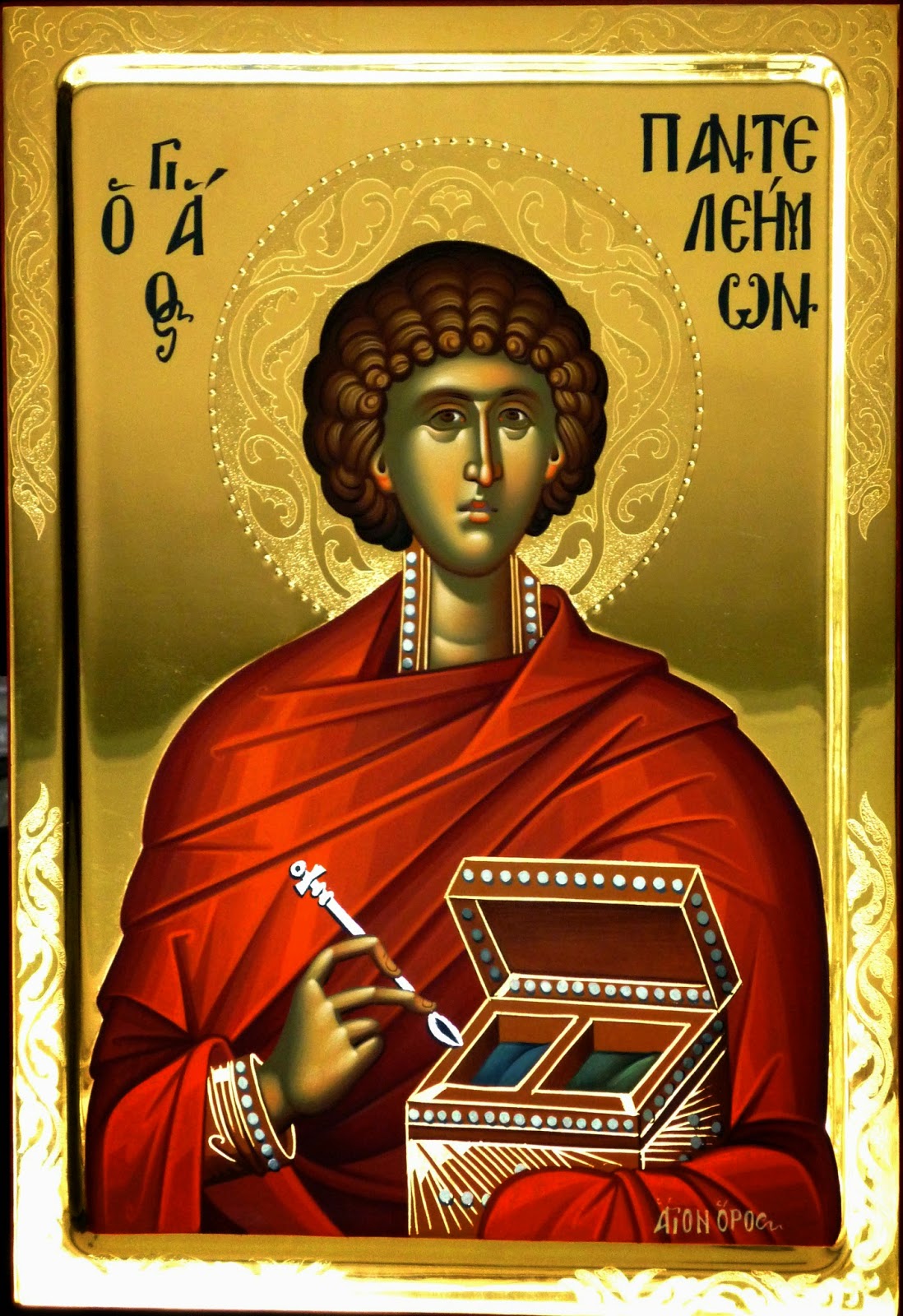
Metropolitan Avgoustinos Kantiotes on St. Panteleimon the Great Martyr

St. Panteleimon the Great Martyr and Unmercenary (source)
  
Metropolitan Avgoustinos Kantiotes on St. Panteleimon the Great Martyr: He was cast out due to jealousy
"For he knew that for envy they had delivered him" (Matthew 27:18)

My beloved, we are honoring the holy memory of the Great Martyr Panteleimon. Our topic will be the question: What was the reason that St. Panteleimon was persecuted? To this we will give a short response.

St. Panteleimon lived and struggled during the era of persecutions, when the Roman Emperor was Diocletian. He was born in Nicomedia of Asia Minor. His father was an idolater, but his mother was from the women who planted deeply into the heart of their children their faith in Christ. Therefore, she taught St. Panteleimon the truths of the faith.

He was well-sown. He had a call towards learning. He studied medicine near noted scientists. He became an exemplary physician. There were many physicians then, like there are today. However, it is rare today to find a Christian physician. The majority are faithless, materialists. And these have no worth; may God protect you from falling into their hands.

St. Panteleimon differed from them. In what way did he differ? He differed in three ways.

First, regarding money. They were lovers of money. They charged their patients a lot and became rich. St. Panteleimon was unique, a man of ideology. He used science as a mission. He was seen at night visiting huts [of the poor and sick] like an angel. While the others went only to the houses of the great ones, he went to the houses of the poor and served the sick.

And a second way in which he differed from the others. As a famous Greek university professor once said, physicians frequently study medicine like veterinary medicine, and many doctors act like veterinarians. They don't see anything else beyond veins, bones, flesh, ribs, hearts and lungs. Man of course is these, but behind this is something invisible. There is a "little motor", which moves the biological body, and there is the existence of man. And the doctor, when he doesn't see this "little motor", is blind, and is not in the position to perform his work. This "little motor" is the spiritual factor, the soul of man. A multitude of experiments and observations have shown that the soul with the passions, feelings, conscience and impulse greatly impacts the body. There is an interconnectedness between body and soul. This is what our Church chants during the 15-days of August, and which is scientifically correct: "From the great multitude of my sins, ill am I in body, ill am I also in soul..." (from the Small Paraklesis to the Theotokos). And both are sick but the root of evil is sin. Therefore, St. Panteleimon made the correct diagnosis. He saw that, when the soul is freed from guilt, the body is given life, and man breathes deeply. Many illnesses (apoplexies, heart attacks, cancer) have as their cause the spiritual world. Some bitterness from remorse or from slander or from divisiveness or from injustice or anxiety waters the body with poison.
  
St. Panteleimon the Great Martyr and Unmercenary (source)
  
So he differed first for not taking money, secondly because he saw man as a psychosomatic whole, and thirdly, for besides the other medicines which the other physicians had, St. Panteleimon had a rare and unique medicine, and this was the faith. He believed deeply. Because of this, together with medicines from herbs from the earth that he gathered, he knelt next to the pillow of the sick, praying, and--let the faithless disbelieve it, we believe it--the sick man was healed. And to this day, we see the sign of the Cross in clinics, hospitals and healing centers. How truly awesome a thing is the power of faith, a medicine of healing for bodily and spiritual illnesses.

This was St. Panteleimon. And because of this, his healing center was marked every day with a line of sick people, while they did not go to the other physicians of Nicomedia anymore. This being passed over, however, enflamed the hearts of his colleagues with the yellow lamp of jealousy. They were jealous of him, they hated him. They saw that, as long as he was a physician in Nicomedia, they would have to change careers because everyone was hastening to St. Panteleimon. And the sick, who themselves were loosing hope, found their healing near him. Behold therefore the cause of jealousy. Because of this they cast him out. They hated him from the beginning. With what slander did they do so? As an unmercenary? As one taking advantage of people? As an adulterer? As a fornicator? As a dangerous person? As a criminal? None of these things. If they condemned him with these during that decadent regime, it wouldn't work. They condemned him with a condemnation that took hold. Isn't that how it is, that the slanders of the faithful change in every age? Sometimes they use slander A, other times B, other times C. I will not dwell on this, I will just mention that, from the time...with various slanders, with foolish things the jealous attack the worthy men to discredit them--though at the heart of the matter, they don't believe the slanders--and people are no longer judged according to proper and steadfast criteria (ethically), but according to other criteria (politics).

They condemned him therefore with the condemnation of that era that was so devastating: that he was a Christian. And this condemnation led man to dash him to pieces. He was seized, led before rulers, confessed his faith with boldness, suffered all kinds of martyrdom, and thus, his holy soul flew to the heavens like a wholly-white dove to dwell in the heavenly mansions, in order to rejoice together with the Holy Angels and Archangels.

Behold, my beloved, the cause of the persecution and the martyrdom of St. Panteleimon: jealousy.

O jealousy, a great and abyss of a passion! It is a worm and viper that consumes the bowels of he who is jealous, but is also the grave of great men. Terrible are its consequences. If we open the holy stories, we will see that, from the beginning, this was the destruction of the human race. "Out of the jealousy of the devil", says Solomon, "death entered into the world" (Wisdom of Solomon 2:24). Satan was jealous of the magnificence of man, and was filled with wrath against him. Because of this was the first blood spilled upon the earth, due to jealousy. Cain was jealous of his brother Abel and he murdered him "in the field" (Genesis 4:8). From jealousy Esau persecuted Jacob (ibid 27:41), the eleven children of Jacob persecuted Joseph the All-comely (ibid 37), King Saul persecuted David (I Kings 19:10), and a long line of holy men were snuffed out.

And we have examples from our own national history. Great men were snuffed out like the righteous Aristides in antiquity, Socrates who drank the poison, and in later years, Harilaos Trikoubes, etc.

But why do we need other examples? Cast your eye on the Praetorium and to Golgotha. "Which of these two do you wish that I release?" asked Pilate, "Barabbas or Jesus?" Everyone cried out together: "Barabbas". And the Evangelist notes psychologically: "This he did", Pilate, in other words, "for they delivered Him up out of envy." (Matthew 27:18) The envy of the Scribes and Pharisees, which were like fireflies quenched before the great sun that is Christ, led our Lord to Golgotha. Therefore, my brethren, it is a general rule. If there ever appears some person, some worthy personality, who would perform their duty, he will elicit envy and rouse up persecution. Meaningless people do not bother, those who offer help and give their lives to those around them, they are the ones persecuted. St. Paul said this: "All those who desire to live piously in Christ Jesus will be persecuted" (II Timothy 3:12). All those who believe in Christ will be persecuted, along with all those seek to live according to His commandments. It is their fate. All those living, either through his word or through his example, bring about an earthquake. However, this is an earthquake of salvation. Blessed are the communities who have such men, either in science or in the military or in politics or in the holy clergy, for they become the agents of the proper way.

Pray, my brethren, that the sickness of envy might be healed, that it might abandon you. And may our Lord, through the intercessions of St. Panteleimon, transform all our hearts, and may we go forth with virtue and love, to the glory of God. Amen.

+Bishop Avgoustinos

(Homily of Metropolitan of Florina Avgoustinos Kantiotes, delivered in the Holy Church of St. Panteleimon, Florina, 7/27/1976) (source)
  
St. Panteleimon the Great Martyr and Unmercenary (source)
  
Through the prayers of our Holy Fathers, Lord Jesus Christ our God, have mercy on us and save us! Amen!