Showing posts with label St. Proclus Patriarch of Constantinople. Show all posts

Sunday, January 5, 2014

Homily on Theophany by St. Proclus of Constantinople

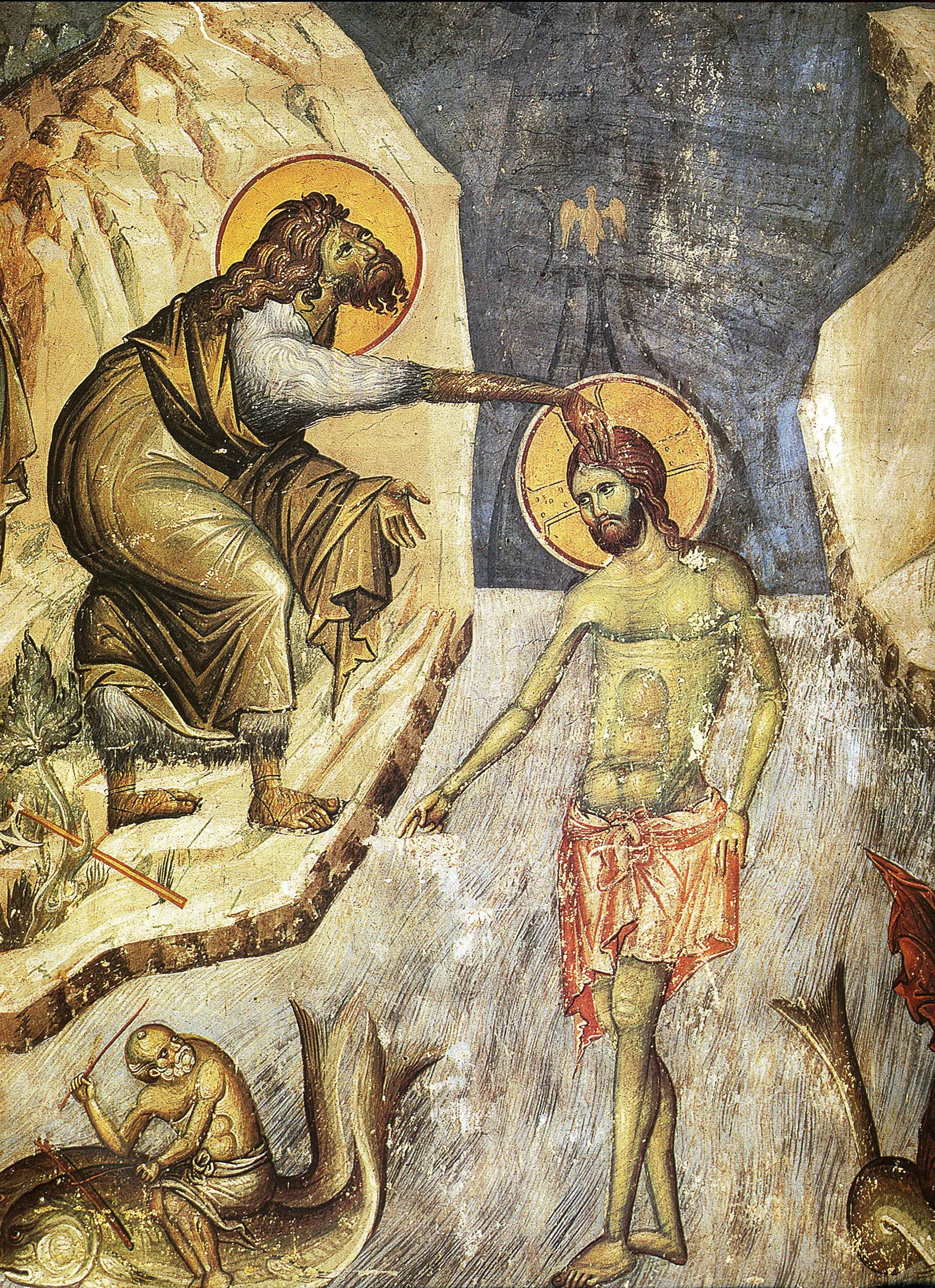
The Baptism of Christ, Holy Theophany (source)
 
Homily on Theophany by St. Proclus of Constantinople

Christ appeared in the world, and, bringing beauty out of disarray, gave it luster and joy. He bore the world’s sins and crushed the world’s enemy. He sanctified the fountains of waters and enlightened the minds of men. Into the fabric of miracles he interwove ever greater miracles.
For on this day land and sea share between them the grace of the Savior, and the whole world is filled with joy.
Today’s feast of the Theophany manifests even more wonders than the feast of Christmas.
On the feast of the Savior’s birth, the earth rejoiced because it bore the Lord in a manger; but on today’s feast of the Epiphany it is the sea that is glad and leaps for joy; the sea is glad because it receives the blessing of holiness in the river Jordan.
At Christmas we saw a weak baby, giving proof of our weakness.
In today’s feast, we see a perfect man, hinting at the perfect Son who proceeds from the all-perfect Father.
At Christmas the King puts on the royal robe of his body; at Epiphany the very source enfolds and, as it were, clothes the river.
Come then and see new and astounding miracles: the Sun of righteousness washing in the Jordan, fire immersed in water, God sanctified by the ministry of man.
Today every creature shouts in resounding song:
Blessed is he who comes in the name of the Lord.
Blessed is he who comes in every age, for this is not his first coming.
And who is he? Tell us more clearly, I beg you, blessed David:
The Lord is God and has shone upon us.
David is not alone in prophesying this; the apostle Paul adds his own witness, saying:
The grace of God has appeared bringing salvation for all men, and instructing us. Not for some men, but for all. To Jews and Greeks alike God bestows salvation through baptism, offering baptism as a common grace for all.
Come, consider this new and wonderful deluge, greater and more important than the flood of Noah’s day. Then the water of the flood destroyed the human race, but now the water of Baptism has recalled the dead to life by the power of the one who baptized.
In the days of the flood the dove with an olive branch in its beak foreshadowed the fragrance of the good odor of Christ the Lord; now the Holy Spirit, coming in the likeness of a dove reveals the Lord of mercy.
(source)
   
The Baptism of Christ, Holy Theophany (source)
   
Through the prayers of our Holy Fathers, Lord Jesus Christ our God, have mercy on us and save us! Amen!
Friday, April 19, 2013

Homily on the Annunciation by St. Proclus Patriarch of Constantinople


The Most-holy Theotokos and Christ (source)
   
Homily on the Annunciation by St. Proclus Patriarch of Constantinople
Our present gathering in honor of the Most Holy Virgin inspires me, brethren, to say of Her a word of praise, of benefit also for those come unto this churchly solemnity.
   
It comprises a praise of women, a glorying of their gender, which (glory) is brought it by Her, She Who is at one same time both Mother, and Virgin. O desired and wondrous gathering! Celebrate, O nature, that wherein honor be rendered to Woman; rejoice, O human race, that wherein the Virgin be glorified. "For when sin did abound, grace did superabound" (Rom 5:20). The Holy Mother of God and Virgin Mary hath gathered us here, She the pure treasure of virginity, the intended paradise of Second Adam -- the locus, wherein was accomplished the co-uniting of natures, wherein was affirmed the Counsel of salvific reconciliation.
   
Whoever is it that ever saw, whoever heard, that within a womb the Limitless God would make habitation, Whom the Heavens cannot circumscribe, Whom the womb of a Virgin limiteth not!?
   
He born of woman is not only God and He is not only Man: This One born made woman, being the ancient gateway of sin, into the gateway of salvation: where evil poured forth its poison, bringing on disobedience, there the Word made for Himself a living temple, bringing in thither obedience; from whence the arch-sinner Cain sprang forth, there without seed was born Christ the Redeemer of the human race.
   
The Lover-of-Mankind did not disdain to be born of woman, since this bestowed His life. He was not subject to impurity, being settled within the womb, which He Himself arrayed free from all harm. If perchance this Mother did not remain a Virgin, then that born of Her might be a mere man, and the birth would be no wise miraculous; but since she after birth remained a Virgin, then how is He Who is born indeed -- not God? It is an inexplicable mystery, since in an inexplicable manner was born He Who without hindrance went through doors when they were locked. When confessing in Him the co-uniting of two natures, Thomas cried out: "My Lord, and my God!" (Jn 20:28).
   
The Apostle Paul says, that Christ is "to the Jews indeed scandal, and to the Gentiles yet folly" (1 Cor 1:23): they did not perceive the power of the mystery, since it was incomprehensible to the mind: "for had they understood, they would not have crucified the Lord of Glory" (1 Cor 2:8). If the Word had not settled within the womb, then the flesh would not have ascended with Him onto the Divine Throne; if for God it were disdainful to enter into the womb, which He created, then the Angels too would have disdained service to mankind.
   
That One, Who by His nature was not subject to sufferings, through His love for us subjected Himself to many a suffering. We believe, that Christ not through some gradual ascent towards the Divine nature was made God, but being God, through His mercy He was made Man. We do not say: "a man made God"; but we confess, that God was incarnated and made Man.
   
His Servant was chosen for Himself as Mother by That One Who, in His essence did not have mother, and Who, through Divine foresight having appeared upon the earth in the image of man, does not have here father. How one and the same is He both without father, and without mother, in accord with the words of the Apostle (Heb 7:3)? If He -- be only a man, then He cannot be without mother -- but actually He had a Mother. If He -- be God only, then He cannot be without Father -- but in fact He has the Father. And yet as God the Creator He has not mother, and as Man He has not father.
   
We can be persuaded in this by the very name of the Archangel, making annunciation to Mary: his name -- is Gabriel. What does this name mean? -- it means: "God and man." Since That One about Whom he announced is God and Man, then his very name points beforehand to this miracle, so that with faith be accepted the deed of the Divine dispensation.
   
To save people would be impossible for a mere man, since every man has need in the Saviour: "for all, -- says Saint Paul, -- have sinned, and come short the Glory of God" (Rom 3:23). Since sin subjects the sinner to the power of the devil, and the devil subjects him to death, then our condition did become extremely hapless: there was no sort of way to be delivered from death.
   
There were sent physicians, i.e. the prophets, but they could only the more clearly point out the malady. What did they do? When they saw, that the illness was beyond human skill, they summoned from Heaven the Physician; one of them said "Lord, bend the heavens, and come down" (Ps 143[144]:5); others cried out: "Heal me, O Lord, and I shalt be healed" (Jer 17:14); "restore Thine power, and come yet to save us" (Ps 79[80]:3). And yet others: "For if God truly be settled with man upon the earth" (3[1] Kg 8:27); "speedily send before Thine tender mercy, O Lord, for we are brought very low" (Ps 78[79]:8).
   
Others said: "O woe to me, my soul! For the pious art perished from the earth, and of the upright amongst men there is none" (Mich 7:2). "O God, in help attend to me, O Lord, shield me with Thine help" (Ps 69[70]:1). "If there be delay, endure it, for He that cometh shalt come, and not tarry" (Hab 2:3). "Perishing like a lost sheep: seek out Thine servant, who doth hope on Thee" (Ps 118[119]:176). "For God wilt come, our God, and wilt not keep silence" (Ps. 49[50]:3).
   
That One, Who by nature is Lord, did not disdain human nature, enslaved by the sinister power of the devil, the merciful God would not accede for it to be forever under the power of the devil, the Ever-Existing One came and gave in ransom His Blood; for the redemption of the race of man from death He gave up His Body, which He had accepted of the Virgin, He delivered the world from the curse of the law, annihilating death by His death. "Christ hath redeemed us from the curse of the law" -- exclaims Saint Paul (Gal 3:13).
   
Thus know, that our Redeemer is not simply a mere man, since all the human race was enslaved to sin. But He likewise is not God only, non-partaking of human nature. He had body, since if He had not clothed Himself in me, He then likewise should not have saved me. But, having settled within the womb of the Virgin, He clothed Himself in my fate, and within this womb He perfected a miraculous change: He bestowed the Spirit and received a body, That One only indeed (dwelling) with the Virgin and (born) of the Virgin. And so, Who is He, made manifest to us? The Prophet David doth point it out for thee in these words: "Blessed is He that cometh in the Name of the Lord" (Ps 117[118]:26).
   
But tell us even more clearly, O prophet, Who is He? The Lord is the God of Hosts, says the prophet: "God is the Lord, and hath revealed Himself unto us" (Ps 117[118]:27). "The Word was made flesh" (Jn 1:14): there were co-united the two natures, and the union remained without mingling.
    
He came to save, but had also to suffer. What has the one in common with the other? A mere man cannot save; and God in only His nature cannot suffer. By what means was done the one and the other? Wherein that He, Emmanuel, being God, was made also Man; both this, that what He was, He saved by -- and this, that what He was made, He suffered as. Wherefore, when the Church beheld that the Jewish throng had crowned Him with thorns, bewailing the violence of the throng, it said: "Daughters of Zion, go forth and behold the crown, of which is crowned He of His mother" (Sng 3:11).
   
He wore the crown of thorns and destroyed the judgement to suffering from the thorns. He Only is That One both in the bosom of the Father and in the womb of the Virgin; He Only is That One -- in the arms of His Mother and in the wings of the winds (Ps. 103[104]:3); He, to Whom the Angels bowed down in worship, at that same time reclined at table with publicans.
   
Upon Him the Seraphim dared not to gaze, and at the same time Pilate pronounced sentence upon Him. He is That One and Same, Whom the servant did smite and before whom did tremble all creation.
   
He was nailed to the Cross and ascended to the Throne of Glory -- He was placed in the tomb and He stretched out the heavens like a skin (Ps. 103[104]:2) -- He was numbered amidst the dead and He emptied hell; here upon the earth, they cursed at Him as a transgressor -- there in Heaven, they exclaimed Him glory as the All-Holy.
   
What an incomprehensible mystery! I see the miracles, and I confess, that He is God; I see the sufferings, and I cannot deny, that He is Man. Emmanuel opened up the doors of nature, as man, and preserved unharmed the seal of virginity, as God: He emerged from the womb thus as He entered through the announcing; the same wondrously was He both born and conceived: without passion He entered, and without impairment He emerged, as concerning this doth say the Prophet Ezekiel: "He returned me back the way of the gates of the outer sanctuaries, looking upon the east: and these had been shut. And saith the Lord to me: son of man, these gates shalt be closed, and not open, and no one go through them: for the Lord God of Israel, He Only, shalt enter and come forth, and they wilt be shut" (Ez 44:1-2). Here it clearly indicates the Holy Virgin and Mother of God Mary.
   
Let cease all contention, and let the Holy Scripture enlighten our reason, so that we too receive the Heavenly Kingdom unto all eternity. Amen.
   
Through the prayers of our Holy Fathers, Lord Jesus Christ our God, have mercy on us and save us! Amen!

Tuesday, January 26, 2010

The Translation of the Relics of St. John Chrysostom, and some Modern Miracles of the Saint


The Translation of the Relics of St. John Chrysostom
"The memory of this illuminary of the Church is celebrated on November 13 and January 30 but, on this date, the Church celebrates the translation of his honorable relics from the Armenian village of Comana, where he died in exile, to Constantinople, where earlier he had governed the Church. Thirty years after his death, Patriarch Proculus delivered a homily in memory of his spiritual father and teacher.*** He so enflamed the love of the people and Emperor Theodosius the Younger toward this great saint that all of them desired that Chrysostom's relics be translated to Constantinople. It was said that the sarcophagus, containing the relics of St. John Chrysostom, did not allow itself to be moved from its resting place until the emperor wrote a letter to Chrysostom begging him for forgiveness (for Theodosius' mother, Eudoxia, was the culprit responsible for the banishment of this saint) and appealing to him to come to Constantinople, his former residence. When this letter of repentance was placed on the sarcophagus, its weight became extremely light. At the time of the translation of his relics, many who were ill and who touched the sarcophagus were healed. When the relics arrived in the capital, then the emperor in the name of his mother as though she herself was speaking over the relics, again, prayed to the saint for forgiveness. "While I lived in this transient life, I did you malice and, now, when you live the immortal life, be beneficial to my soul. My glory passed away and it helped nothing. Help me, father; in your glory, help me before I am condemned at the Judgment of Christ!" When the saint was brought into the Church of the Twelve Apostles and placed on the patriarchal throne, the masses of people heard the words from St. Chrysostom's mouth saying: "Peace be to you all." The translation of the relics of St. John Chrysostom was accomplished in the year 438 A.D."
(http://www.westsrbdio.org/prolog/prolog.htm)

See the following link for the full account: http://www.chrysostompress.org/saints-0127-john-chrysostom-translation-of-relics.


***St. Proclus' Eulogy for St. John Chrysostom
"Only if another John [the Beloved] were to appear could John fittingly be praised! When the faithful recall his labors, struggles, and discourses, their thirst is slaked, as though by a mighty river overflowing its banks. From John shine rays of God's grace in which one man clearly discerns the sun of the Godhead, another beholds the cleansing of Orthodoxy from heresy, another perceives the deceptiveness of idolatry, another distinguishes truth from error, another is confirmed in faith and virtue, and another observes gleaming heavenly crowns. Oh, hierarch whose memory is like a fragrant breeze! Oh, namesake of grace, whose deeds were truly divine! Oh, golden mouth declaring the word of God! Oh, tongue which spoke of mysteries loftier than the heavens! Oh, teacher proclaiming the gospel more loudly than thunder! Verily like unto John the Forerunner, the preacher of repentance, was this John. One was a herald, the other a trumpet. One was unshakeable, the other invincible. One was a virgin, the other a champion of purity. One baptized in the wilderness, the other lowered his nets in cities. One denounced adultery, the other reproved the avaricious. One was cast into prison, the other was exiled. One was beheaded, the other desired beheading for the truth. Many were John Chrysostom's struggles on earth, many are his crowns in heaven. He now cries out with the Apostle Paul, 'I am a sweet savour of Christ, having cleansed the whole world of the stench of error. In Ephesus I expunged the delusion of Midas, in Phrygia I rendered childless the mother of false gods, in Caesarea I did away with the houses of ill fame, in Syria I abolished the assemblies of the godless, and in Persia I sowed the seed of the word of God. Everywhere I have planted the Orthodox faith. By my teaching I have disseminated the knowledge of God throughout the earth; by my books I have spread the nets of salvation far and wide. With John the Theologian I theologized concerning the Word of the Father; with Peter I laid the foundation of an Orthodox confession; with the fishermen I cast the net of piety into the world.' O John, your life was truly sorrowful, but your death is precious, your sepulcher glorious, and your reward great!"
(http://www.chrysostompress.org/saints-0127-john-chrysostom-translation-of-relics)

The Translation of the Relics of St. John Chrysostom to Constantinople (http://upload.wikimedia.org/wikipedia/commons/6/6e/Apostoles_Constantinople.JPG)

Excerpt from the "Anonymous Description of Constantinople", before 1439 AD
“The Tomb of St. John Chrysostom, however, is at the high altar in the sanctuary of [Hagia Sophia], and is covered with a slab worked in gold and precious stones. [His body] was still whole, and reposes there as if [he were] alive. There is nothing dismal about his vestments or hair, but to this day [the body] exudes a strong sweet fragrance. A large concourse gathers on his festival, not only Christians, but Franks and Latins too, and much healing and forgiveness come.”

(http://books.google.com/books?id=teyNhL3AuGEC&pg=PA134&lpg=PA134&dq=%22tomb+of+St.+John+Chrysostom%22&source=bl&ots=CrCI_1RPRI&sig=yYCJYgp31qI-RapgxQ_jTXVpMvM&hl=en&ei=eXdfS8CbIIaWtgfg3unqCw&sa=X&oi=book_result&ct=result&resnum=1&ved=0CAkQ6AEwAA#v=onepage&q=%22tomb%20of%20St.%20John%20Chrysostom%22&f=false)

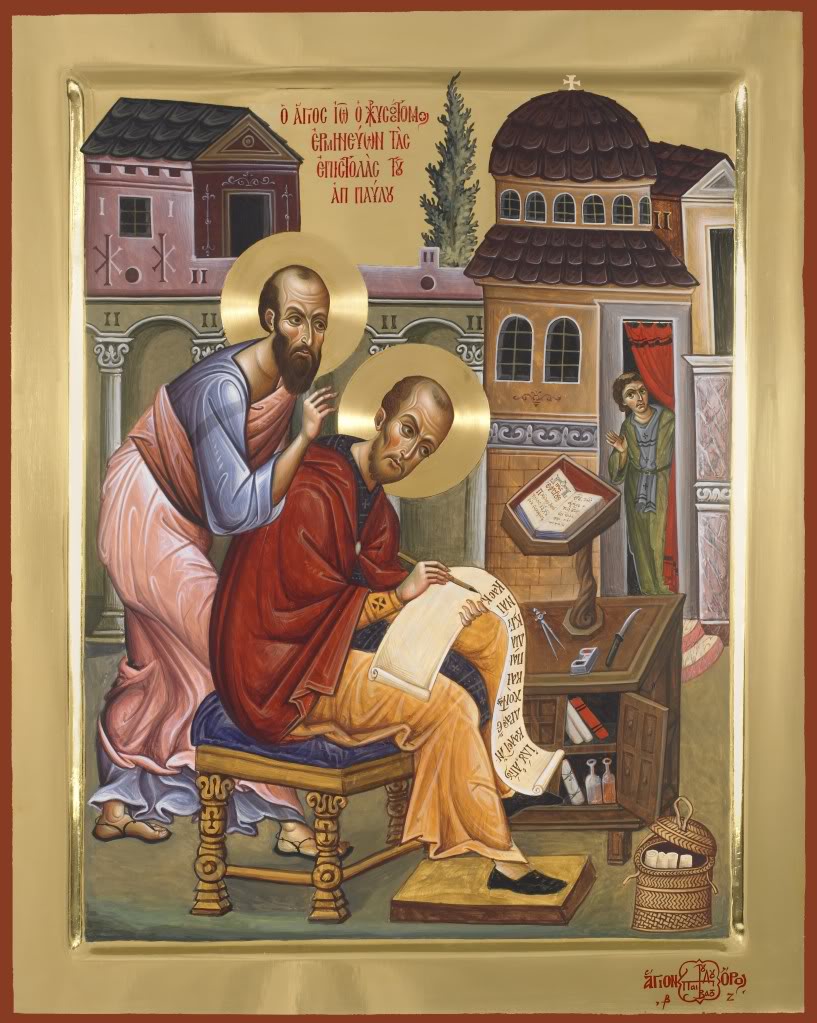
Left: Icon depicting St. Paul divinely inspiring St. John Chrysostom's commentary of the New Testament; Right: the Precious Skull of St. John Chrysostom, treasured by the Monastery of Vatopedi on Mount Athos (http://www.dailygreece.com/2007/01/post_33.php, http://vatopaidi.files.wordpress.com/2010/01/ceacceb3ceb9cebfcf82-ceb9cf89ceaccebdcebdceb7cf82-cebf-cf87cf81cf85cf83cf8ccf83cf84cebfcebccebfcf82.jpg; for more, see: http://full-of-grace-and-truth.blogspot.com/2008/11/divine-inspiration-and-st-john.html)

Modern Miracles of St. John Chrysostom – 2007 (amateur translation)
During the reception of the precious Skull of St. John Chrysostom in Cyprus (November 10-19 2007), the following miracles occurred [through the prayers of the Saint]:

...And the Saint did not leave his presence among us without witness. “The Lord our God lives” glorified in His saints. As we vividly experienced his presence, we vividly experienced his power to work signs and wonders.

From the first instant when they departed the Holy Mountain [from the Monastery of Vatopedi] until their return, the whole endevor was characterized by one continuous miracle. The terrible weather and stormy sea died down to make the trip possible. It appears that the Saint wanted to visit Cyprus. He wanted it, for he knew the spiritual offering which characterizes the people. The continuous fragrance of the Skull, many times poured forth in the Church in waves, and the warmth of the skin of the Saint was one of the first miraculous signs. The living and wonderworking presence of the Saint was revealed by the various healings of people of difficult diseases. The following are the accounts of some of them, for the glory of God:

A) Healing of a woman with a right foot drop. After the vespers on Saturday November 10th, the woman rushed from the Church and banged her foot, which was later found to be broken near the ankle. In the hospital where she was transferred, her foot was placed in a cast and she was ordered to keep it immobile and to use crutches to get around only where necessary. She was in great pain when she returned being supported to the Church for the Saint's feast to venerate the Skull. After venerating the pains left, the break in her foot healed, and she left her crutches and removed the cast.

B) The healing of a ten-year-old of hemiplagia. Following a head injury, a ten-year-old student from Archangelo was left with hemiplagia, numbness and paralysis of his whole left side. For a period of at least two weeks before the Skull arriving in Cyprus, he was being cared for in the General Hospital of Levkosia. After venerating the precious Skull, according to his own and his family's confession, his condition, to the surprise of everyone, disappeared. This event and the previous one, were carried by the media.

C) Disappearance of a large tumor in the neck and the healing of a man with neurological problems, problems with the vertebrae and dyskinesia. There was a couple in which the woman had a large tumor on her neck, and her husband suffered from the aforementioned sicknesses. With great effort they entered the line to venerate. One instant the husband thought that two fingers were pushing his lower back. The pains became stronger and their agony more apparent as they wondered whether they would be able to venerate. When it was their turn to venerate, with wonder they noted that from the wife the tumor disappeared, and the husband was left totally healthy.

D) Healing of a man with back dyskinesia. According his own confession, he had a most severe problem, which was localized in his back, and during the veneration of the Skull and after intense vibrations he felt when he bent over to venerate, his problems disappeared.

E) The healing of a child ready to die from Sri Lanka. Formerly a buddist, a woman later embraced Orthodoxy in Cyprus and was baptized. With fervent faith she prayed at the Skull of the Saint and when she venerated it, she prayed for her niece in Sri Lanka that was near death. After this she received a call from her homeland, which she made know as there was no reason to keep silent, that the child escaped from danger. She, knowing what had taken place, attributed this to the wonderworking power of the Saint, and informed her family of this in Sri Lanka. The result of this was an intense anxiety of that family and those around about what was the true faith and their position in the search for truth.

Finally, the greatest wonder, greater than these and other healings, were the resurrections of the souls of people, the soul and spiritual healing, the turn towards repentance and correction of life. A wonder, which the eye can't behold and the hear is unable to hear. It is felt however in the heart of every man and is experienced in the depth of his existence...
(amateur translation and summary of text from: http://www.agiooros.net/forum/viewtopic.php?f=45&t=5818&start=0)

For more on St. John Chrysostom, see: http://chrysostom.org/, http://full-of-grace-and-truth.blogspot.com/2009/11/st-john-chrysostom-patriarch-of.html, http://full-of-grace-and-truth.blogspot.com/2008/11/divine-inspiration-and-st-john.html, http://www.voskrese.info/spl/Xjn-xrysost.html. See here fore the Akathist to the Saint: http://chrysostom1600.org/index.php/akathist/. May St. John Chrysostom intercede for us all and help us!

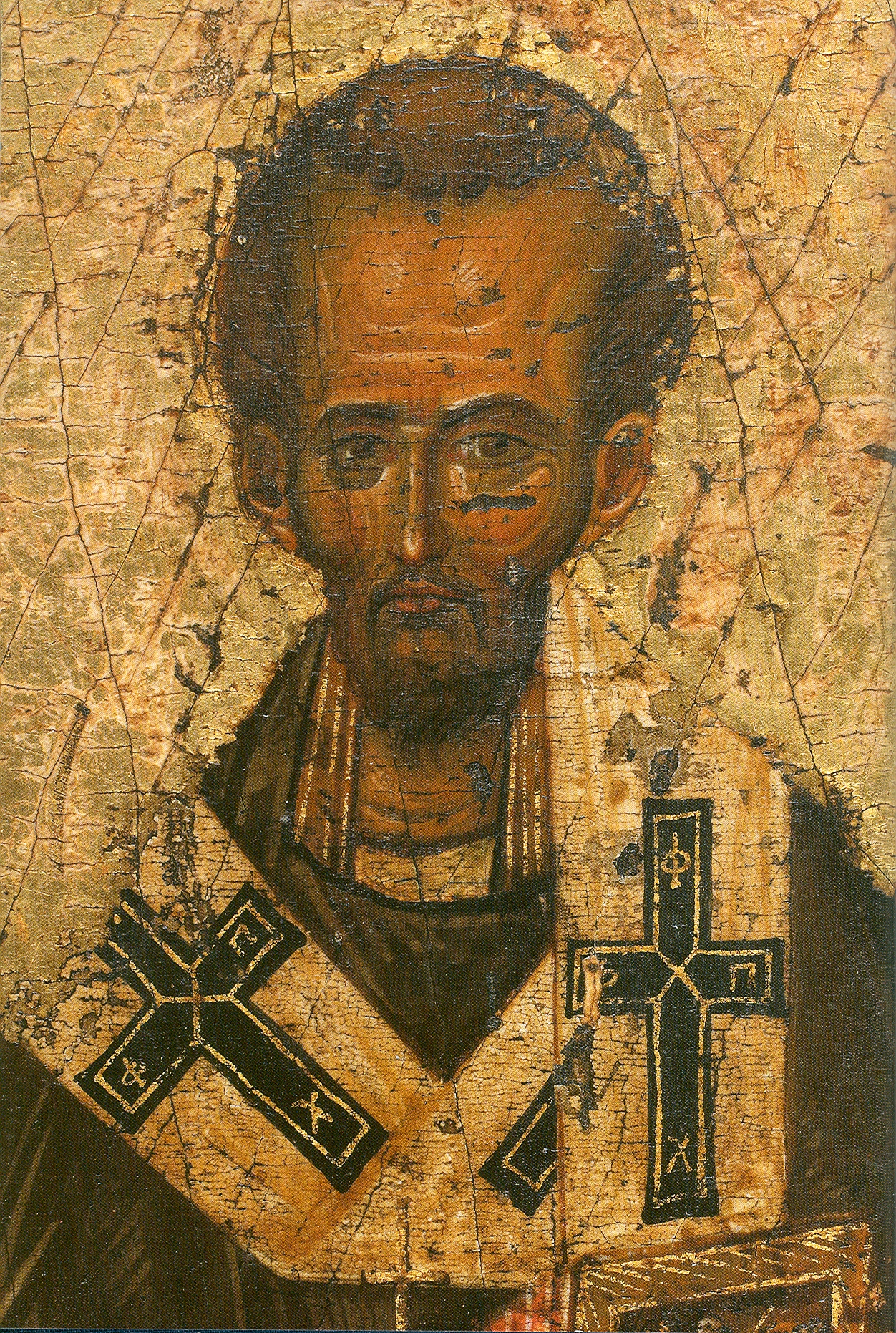
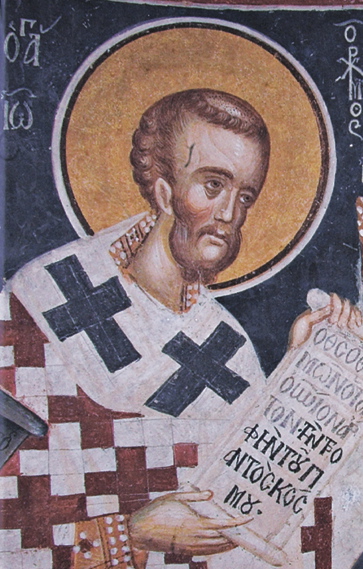
St. John Chrysostom, Patriarch of Constantinople (http://vatopaidi.files.wordpress.com/2009/11/chrysostom.jpg)

Apolytikion in the Plagal of the Fourth Tone
The grace of your words illuminated the universe like a shining beacon. It amassed treasures of munificence in the world. It demonstrated the greatness of humility, teaching us by your own words; therefore, O Father John Chrysostom, intercede to Christ the Logos for the salvation of our souls.

Kontakion in the First Tone
The holy and august Church is mystically gladdened today on the translation of thy holy relics. And though she had kept them hid in concealment like precious gold, by thine intercessions she unceasingly granteth, unto them that praise thee, the divine grace of healing, O Father John Chrysostom.

Through the prayers of our Holy Fathers, Lord Jesus Christ our God, have mercy on us and save us! Amen!

Thursday, November 13, 2008

Divine Inspiration and St. John Chrysostom

Icon depicting the Divine inspiration of St. John Chrysostom: St. Proclos his disciple witnessing St. Paul speaking into St. John's ear. (Icon courtesy of www.eikonografos.com used with permission.)
  
"Saint John [Chrysostom] was renowned for his explanations of the Holy Scriptures. He also interpreted the Epistles of Saint Paul, whom he admired greatly. In order to assure himself that the interpretation of the Epistles were correct, he asked God to offer him a sign.
At that same time, a nobleman had risen against Emperor Arcadius. The Emperor, in turn, confiscated all of the man's possessions and threatened to execute him. The nobleman became desperate and decided to ask for Saint John's assistance. When he arrived at the Patriarchate, Saint John could not offer him an audience immediately, but instructed him to return that evening. Saint John told the assistant priest, Proclos (who later succeeded Saint John as Patriarch), to show the nobleman to the Saint's room when he arrived. That evening, the nobleman returned and Proclos went to inform the Patriarch of his arrival. The door to the room was shut, so Proclos looked through the keyhole. He saw Saint John sitting at his desk writing, with a bald-headed man, slightly bent, looking over his shoulder. Seeing this, Proclos returned to the nobleman and told him that the Patriarch was in conference. Proclos returned to the Patriarch's room several times during the night, but the man was still talking with John. Thus the nobleman waited the entire night to see Saint John. Morning came and the Patriarch prepared to perform the orthros, realizing neither that the nobleman had waited all night for him, nor that Proclos had seen the vision.

That morning the nobleman returned to the Patriarchate since it was of the utmost importance for him to see the Patriach. Proclos went again to inform John of the nobleman's arrival, but again saw the same man in the Patriarch;s room. John looked extremely interested in what the man was telling him. Proclos was bewildered on how the man was entering, since everyone had to come by him.
The nobleman returned for the fourth time and Proclos assured him that the Patriarch was alone, for he had made certain that no one passed without his knowledge. When Proclos went to the Patriarch's room, he was shocked to find the same man still there. He returned to the nobleman and told him to go to his home for it was impossible for him to see John.

That third day, the Saint had remembered the nobleman and inquired about him. Proclos told John that the man had come three times, but each time, the Patriarch was busy talking to the same man. John asked Proclos whom he had seen in the room. Proclos told him that it looked as if it were the Apostle Paul, whose icon sat on the Saint's desk. Joyously, Saint John realized that this was the sign he had asked for from God concerning his interpretations of the Apostle's epistles. Thus, Saint John wrote The Fourteen Epistles of the Apostle Paul containing the explanation of the letters. This book is one of the greatest works in the writings of the Orthodox Church.

After conferring with the nobleman, the Patriarch agreed to act as mediator between the nobleman and the Emperor. Within a short time, the differences were settled and the nobleman was again granted his confiscated property"
(For the Glory of the Father, Son and Holy Spirit: A History of Eastern Orthodox Saints, by Michael James Fochios, translations from the Great Synaxaristes)

A real photograph of the Holy Skull of St. John Chrysostom, treasured by the Holy Monastery of Vatopedi on Mount Athos. It is clear that St. John's ear is incorrupt after 1600 years by the Grace of the Holy Spirit, as a testament to the miracle related above.
  

St. John Chrysostom's introduction to his commentary on the Epistle of St. Paul to the Romans (Downloaded from http://www.ccel.org/ccel/schaff/npnf111.vii.ii.html)

"As I keep hearing the Epistles of the blessed Paul read, and that twice every week, and often three or four times, whenever we are celebrating the memorials of the holy martyrs, gladly do I enjoy the spiritual trumpet, and get roused and warmed with desire at recognizing the voice so dear to me, and seem to fancy him all but present to my sight, and behold him conversing with me. But I grieve and am pained, that all people do not know this man, as much as they ought to know him; but some are so far ignorant of him, as not even to know for certainty the number of his Epistles. And this comes not of incapacity, but of their not having the wish to be continually conversing with this blessed man. For it is not through any natural readiness and sharpness of wit that even I am acquainted with as much as I do know, if I do know anything, but owing to a continual cleaving to the man, and an earnest affection towards him. For, what belongs to men beloved, they who love them know above all others; because they are interested in them. And this also this blessed Apostle shows in what he said to the Philippians; “Even as it is meet for me to think this of you all, because I have you in my heart, both in my bonds, and in the defence and confirmation of the Gospel.” (Phil. i. 7.) And so ye also, if ye be willing to apply to the reading of him with a ready mind, will need no other aid. For the word of Christ is true which saith, “Seek, and ye shall find; knock, and it shall be opened unto you.” (Matt. vii. 7.) But since the greater part of those who here gather themselves to us, have taken upon themselves the bringing up of children, and the care of a wife, and the charge of a family, and for this cause cannot afford to all events aroused to receive those things which have been brought together by others, and bestow as much attention upon the hearing of what is said as ye give to the gathering together of goods. For although it is unseemly to demand only so much of you, yet still one must be content if ye give as much. For from this it is that our countless evils have arisen—from ignorance of the Scriptures; from this it is that the plague of heresies has broken out; from this that there are negligent lives; from this labors without advantage. For as men deprived of this daylight would not walk aright, so they that look not to the gleaming of the Holy Scriptures must needs be frequently and constantly sinning, in that they are walking in the worst darkness. And that this fall not out, let us hold our eyes open to the bright shining of the Apostle’s words; for this man’s tongue shone forth above the sun, and he abounded more than all the rest in the word of doctrine; for since he labored more abundantly than they, he also drew upon himself a large measure of the Spirit’s grace. 336(1 Cor. xv. 10.)"

For the life of St. John Chrysostom, see http://goarch.org/chapel/saints/290, among many other sources.
  
Icon of St. John Chrysostom. (Icon courtesy of www.eikonografos.com used with permission.)
  
Apolytikion. Tone 8. Model Melody.
The grace which shone from your mouth like a torch of flame enlightened the whole earth; it laid up for the world the treasures of freedom from avarice; it showed us the height of humility. But as you train us by your words, Father John Chrysostom, intercede with Christ God, the Word, that our souls may be saved.
  
Kontakion. Tone 6.
You received divine grace from heaven, and through your lips you teach us all to worship one God in Trinity, venerable John Chrysostom, wholly blessed. Fittingly we praise you, for you are a teacher who makes clear things divine.
  
The Ikos.
I bow the knee to the Maker of all things, I stretch out my hands to the eternal Word seeking the gift of words that I may sing the praise of the Saint whom he magnified. For he who lives to the ages said to the Prophet: I glorify those who glorify me with faith. He then, who among those of old exalted Samuel, has now glorified his Hierarch. For having traded well he brought the talent with which he had been entrusted to the King. Therefore the One above all being also exalted him. For this reason I the unworthy ask that words be given me that I may have strength to sing his praise. For he is the instructor of the of the world who makes clear things divine.
  
(Hymns to St. John Chrysostom above translated by Fr. Ephraim Lash, downloaded from: http://www.anastasis.org.uk/13%20nov.htm)
  
Through the prayers of our Holy Fathers, Lord Jesus Christ our God, have mercy on us and save us! Amen!

Saturday, October 4, 2008

The Origin of the Trisagion Hymn

Icon courtesy of www.eikonografos.com used with permission.
   
Many of us forget that besides the traditions of our church being beautiful, they are filled with the Grace of the Holy Spirit, and arise from revelation from God. The Trisagion hymn which is recited or chanted in probably every set of prayers and services of the church is a perfect example of this. Here is an excerpt from the Synaxarion for September 25th (New Calendar) (taken from http://www.abbamoses.com/months/september.html):

Commemoration of the Great Earthquake at Constantinople (447) and the Miracle of the Trisagion

"During the reign of the Emperor Theophilus, the city of Constantinople was visited by earthquakes for almost four months. The Emperor, the Patriarch Proclus [who is actually St. Proclus, the disciple of St. John Chrysostom, whose feast is celebrated on November 20th], and the people joined in a barefoot procession to make prayer to God for their safety. While they were gathered, the tremors increased dramatically, and a young boy was taken up into the sky in the sight of the people, who fearfully cried out Kyrie eleison! When the boy came down from the heavens, he said that he had been among choirs of Angels who sang Holy God, Holy Mighty, Holy Immortal, have mercy on us! and that a voice had commanded him to tell the Patriarch that the people should make supplication to God in this way. The Patriarch instructed the people to chant this hymn, whereupon the ground stopped shaking and the child died. The Empress Pulcheria (September 10) asked the Patriarch to order that this hymn be chanted henceforth in the Divine Liturgy, as it still is today."

Holy God, Holy Mighty, Holy Immortal, have mercy on us!