Showing posts with label The Dormition of the Theotokos. Show all posts

Sunday, August 15, 2021

Elder Symeon Kragiopoulos: "If we’re humble like the Virgin Mary, we will spiritually bear Christ in us in our measure..."

The Dormition of the Theotokos (source)
   

The Gospel of Matins says, “For he hath regarded the low estate of his handmaiden”. It is said by the saints that if we’re humble like the Virgin Mary, we will spiritually bear Christ in us in our measure, just like the Virgin Mary did, who was pregnant with Christ, the Son of God, Who sanctified her and sanctifies all of us. And I say so, according to the words of Apostle Paul: “My little children, of whom I travail in birth again until Christ be formed in you”. Everything else in life is worth nothing.

It’s a pity if we get distracted, if we are led astray and get tossed to and fro, and lose what is of the utmost importance: Christ. Let’s humble ourselves before God in order to gain Christ.

The fact that you can’t stand any pressure is a reaction of the old man. Through the chaos that takes place inside you because of the pressure you may be feeling, all you will have to lose is your self-love and pride.

Archimandrite Symeon Kragiopoulos (†)

From the book: Archimandrite Symeon Kragiopoulos, “SPIRITUAL MESSAGES” Panorama Thessaloniki, 2017

(source)

Most-Holy Theotokos, save us!

Thursday, August 20, 2020

"The knees of Mary have withered from praying for all of you."

The Most-Holy Theotokos praying for the world (source)
  
"Once, when St. Iakovos [of Evia] was casting out demons from a wretched demoniac, his ears heard: 'Hey Iakovos, you should know! The knees of Mary have withered from praying for all of you.' What are we doing? Are we worthy of these prayers or do we fall and get carried away from our passions and fall into sin? And if we fall, do we go afterwards to kneel under the stole of a spiritual father, that our sins might be washed away? Because, we will have to give an account for our deeds, our desires, our thoughts...so while there is still time, let us repent! Let us change our way of thinking and our way of life, to enter into the space of our Church. She is the ark of our salvation, that we might partake of the Spotless Mysteries, in Confession and Divine Communion, and when we commune, we become even more closely related to our Panagia, because our Panagia hosted within her womb the Son of God and her Son, and when we commune, we host, we give a dwelling-place within us, within our body, to God, like our Panagia."
-Quote from a sermon of Elder Gabriel of St. David's Monastery in Evia on the Feast of the Dormition of the Theotokos
(source)
  
Most-Holy Theotokos save us!

Thursday, August 13, 2020

Homily II on the Dormition of the Theotokos by Metropolitan Avgoustinos

The Dormition of the Theotokos (source)
  
Homily II on the Dormition of the Theotokos by Metropolitan Avgoustinos Kantiotes (+2010): "The Glorious Dormition"

"Your glorious Dormition caused the Heavens to rejoice, along with the ranks of the Angels, while the whole earth is glad..." (Sticheron from the Praises of the Feast of the Dormition of the Theotokos

Panagia was a poor girl from Nazareth, from unassuming parents. She did not have anything that would bespeak of glory. Her nativity passed by unnoticed [by the world]. Humble was her entrance into the world, and humble was her life.

But while her entrance was humble, her exit was glorious, and righteous. For she passed throughout her whole life in purity, humility, and utter obedience to the will of God. Which other woman has a calling that could be reckoned with hers? Every [woman] gives birth to mortals, but she was made worthy to become the Mother of the Son of God. As St. Kosmas Aitolos preached: "There were thousands of thousands of women in the world, but none could be found to fill the side of Adam, except our Lady the Theotokos."

When Panagia gave up her spirit to her Son and God, the earth and Heaven were astonished. The burial of her sacred body had a unique grandeur. The Apostles were brought from the ends of the earth to Gethsemane upon the clouds. Myrrh-bearing women and the faithful people followed. An impious Judean tried to defile the sacred body, but was repulsed...

The earth, with her most chosen children gathered to bury the King's Mother. But what were the honors of the earth before the honors of Heaven? As she ascended to the Kingdom on high, she was given an exceptional reception.

The leaders of the Angels knelt to venerate. The Son received the Mother. And she stood and continues to remain at His right hand, interceding on behalf of sinners.

Humble was her entrance, glorious, all-glorious, was her exit. Are these a phantasy, are these a myth? No, a thousand times, no. Our holy Church confirms this, who ordained that today the Dormition of the Most-Holy Theotokos be celebrated. Today, most-beautiful hymns are chanted, with which the greatness of Panagia is praised, and especially, the event of her repose, of her Dormition.
  
Detail from the icon of the Dormition of the Theotokos (source)
  
Many, my beloved, are the lessons of this feast. We will limit ourselves to one thing only, one lesson, which is contained in the word which the Church uses to characterize the event of the repose of the Virgin. Her repose is not called "death", but "dormition". Why? Please pay attention.

In the language of the Holy Scriptures, death does not mean the disappearance of the human existence. No. At death there is a separation. The soul is separated from the body. The soul leaves towards the things above, towards the heavenly world of the spirits. This path is not fantastical, but is a reality, which is confirmed by the word of God. Then, what does the soul meet, how many tollhouses does it pass through, what censures does it undergo, we do not know in detail. The words of holy people, who saw the souls of the reposed pass towards the verdant meadows of Paradise, or towards the dark places of hell, shine some light on this, but this light is dim, and unable to satisfy people's curiosity. To man, through the Scriptures, it has been revealed that the soul that leaves the body does not die (see Luke 12:20, 16:23-26, 23:42-43). This is a fact and the Christian cannot deny this.

But while the soul of man, which has finished this station of his life, ascends as a spirit to the other world, the body, as physical creation is given away to corruption, to temporary corruption. For from this corrupted body, during the universal Resurrection [at the Last Judgment], there will come a renewed and incorrupt body, which will be united with the soul and they will live together unto the ages of ages.

Yes! The body will be raised. In anticipation of the Resurrection, death according to the Scriptures is called "dormition". The Prophet David "slept" (Acts 13:36). The Protomartyr Stephen "slept" (Acts 7:60). The Apostle Paul, when he speaks of those who have left for the other life, does not say that they "died", but he calls them "those who are sleep". "I do not want you to be ignorant, my brethren, concerning those who are asleep, that you might not grieve as the others do who have no hope." (I Thessalonians 4:13). Our Lord Jesus Himself called death "sleep". When He entered the house of Jairus and saw them weeping for the dead girl, He told them: "Do not weep. She has not died, but is only sleeping." (Luke 8:52, Mark 5:39) And regarding Lazarus He said that he had "fallen asleep" (John 11:11-15). And He proceeded to resurrect him, with such ease as if he were waking him from sleep.

Dormition! This word of the Scriptures should be sufficient to teach, console and strengthen Christians, at least those who hasten to churches to celebrate and feast at the "glorious", "all-sacred", and "dormition transcending death", of the Most-Holy Theotokos. Do you hear this, O you who celebrate? Panagia has not died, but has fallen asleep! Her body was buried, placed within the grave, but as the Church chants: "the grave and death could not hold her, for as the Mother of Life, she has proceeded to Life, Who dwelt within the womb of the Ever-Virgin." (Kontakion of the Feast of the Dormition) Panagia, shining forth with all the light of the virtues, "as arrayed in gold" (Psalm 44:10) has proceeded towards the Heavens. "Who", cry out the Angels, "is this that appears like the dawn, fair as the moon, bright as the sun, majestic as the stars in procession?" (Song of Songs 6:10)
  
The Dormition of the Theotokos (source)
  
Panagia, from the height of her glory, is heard to say to all Christians who are tempted here: "Faithful children of the heavenly Father, have strength. What do you fear? Death? But death is the gateway to the new life. Here on high where I am there is a new life, which no one on earth could even begin to imagine. This life is preordained for those who will live with faith and virtue. Here there is no partiality. My Son is the just Judge. When I was below on the earth, I heard voices that blessed me, for I was made worthy to become His Mother, and He said that, in the cycle of blessedness, it would not be me alone who gives Him birth, but for all those who hear Him and keep His word. For Christ is born spiritually in every soul who believes in Him and worships Him as the only Savior. 'Yea of a truth, blessed are those who hear the word of God and keep it.' (Luke 11:28) Therefore, I invite you all to the glory of Heaven."

As the Church chants, truly glorious was the Dormition of the Most-Holy Theotokos. Glorious was also the dormition of all the Righteous, who faithfully completed their missions. Each of them, as they left from this world, could say like the Psalm: "In peace I will lie down and sleep, and I awoke, for You, O Lord, have made me to dwell in hope." (Psalm 4:9) The antithesis occurs with those who did not love God and their neighbor, and did not fulfill their holy duties, and did not complete their mission, but were conquered by evils and passions, and trampled upon divine gifts, walling themselves off and making themselves unworthy of their holy calling, betraying the faith. Their dormition was not radiant, but dark, not glorious, but inglorious. Not radiant Angels, but dark demons were their fellow travelers during the exodus of their souls to the other world. For mourning and cutting are heard during the exodus of the unrepentant sinner. Who would not weep?

O Christians! Panagia had a glorious dormition. But we also must have a glorious dormition. Glorious through faith and virtue. May we receive even one laurel leaf from that glory! May the Lord, through the intercessions of the Most-Holy Theotokos, who proceeds to the Heavens, grant us an end like this. May the prayer of the Church be fulfilled for each of us: "For a Christian ending to our life: painless, blameless, peaceful, and a good defense before the dread Judgment Seat of Christ, let us pray."
(+) Bishop Avgoustinos 
(source)
  
The Dormition of the Theotokos (source)
  
Most-Holy Theotokos, save us!

Tuesday, August 11, 2020

Selected hymns from the Annunciation of the Translation of the Theotokos (August 12th)

The Archangel Gabriel bringing the news of the Dormition to the Theotokos three days beforehand (source)
  
Note: Many of the hymns and traditions surrounding the Dormition of the Theotokos come from the living witness of the Orthodox of the Holy Lands. One beautiful such tradition is celebrating the day when Archangel Gabriel came to the Mount of Olives (where the Theotokos would routinely go to pray) to bring the news to Panagia that she would be departing for her Son in three days (i.e. August 12th being three days before August 15th). The selected hymns translated from the service below beautifully praise the Theotokos, who prepares to depart (as we prepare to remain beside her at this wonder). May she continue to pray for the whole world!
  
Prosomoia of the Stichera in the First Tone. O what paradoxical miracle!
O, what paradoxical miracle! The radiant Gabriel descends to the Mount of Olives to inform the Mother of God of her translation to her Son after the third day. And we, the faithful, reverently hymn this, and cry out together: Rejoice, O Full-of-Grace, the Lord is with you, and translates you to the unspeakable glory.
  
O strange are your wonders, O Pure One! As the Mother of God, all the trees of the Mount of Olives bowed to you, offering up prayers in the place where your Son prayed. And we, the faithful, offer up pre-festal odes: O Lady Full-of-Grace, through your sacred Dormition, you proceeded in glory to the Kingdom of the Heavens.
  
We celebrate fore-festally the holy memory of your radiant Translation that brings joy to the world, as we hymn you with all reverence, O Virgin Mother of God, standing on the Mount of Olives, where Gabriel brought to you this good news: O Lady Full-of-Grace, rejoice, as we cry out to you, who grants to all forgiveness and divine mercy.
  
Doxastikon of the Stichera in the Plagal of the Second Tone.
Who can rightly hymn your all-radiant great deeds, O Virgin Theotokos? For you surpassed all creation, having born God in a manner surpassing speech, and you surpass description, in whom was worked strange and paradoxical things. And your Translation to the Heavens is revealed to you by the Angel in this holy place, that after three days, you would be received in glory, proceeding to the Heavenly Kingdom, where you stand, O Spotless One, ceaselessly interceding that we be granted divine mercy.
  
Doxastikon of the Aposticha in the Plagal of the Fourth Tone.
You bore God in the flesh, thereby being shown forth as a spring of incorruption to the race of men, O Ever-Virgin Theotokos. Strange are your wonders and your unspeakable glory! For the King of all and your Son would descend to receive you into eternal life, and He sent His Angel to bring you this news. Therefore, we too hymn your Translation: deliver us from corrupting passions, and from every temptation.
  
Icon depicting the tradition that Archangel Gabriel brought to Panagia a palm branch from Paradise, in anticipation of her upcoming Dormition (source)
  
Apolytikion in the Fourth Tone. Speedily anticipate.
The godly message of your Translation from earth to Heaven, you received on the Mount of Olives, O All-Spotless One. Therefore, offering up a divine hymn for your Dormition, we hymn you, O Theotokos, and cry out to you with faith: Rejoice, you who are translated from earth to the Heavens.
  
Kontakion in the Fourth Tone. You have appeared today.
In this place where you were praying, O Spotless One, the Archangel Gabriel descended from Heaven to inform you of your holy Translation with joy.
  
Oikos
Gabriel previously descended from Heaven to the city of Nazareth, according to divine pleasure, to tell the Pure One of her seedless conception of the Surpassingly-Divine Logos, for the recreation of the world. And now, at the command of your Son, he comes to the Mount of Olives, to the place where you offered up prayers to the Lord, to inform you of your ascent and divine Translation, when you would proceed to the Kingdom on high, as the Queen of all things, proceeding to the Heavens in glory.
  
Synaxarion
On the 12th of this Month (August), we commemorate the annunciation of the Translation of our Most-Holy Lady, the Theotokos, and Ever-Virgin Mary, by the Archangel Gabriel, on the Mount of Olives.
  
Verses
Gabriel brings the news of your Translation,
He who beforehand cried out to you: "Rejoice", O Virgin.
On the twelfth, Gabriel came to the Lady on the Mountain.
  
Doxastikon of the Praises in the Plagal of the First Tone.
As the one who gave birth to God, you were shown to be a servant of His mysteries, O Virgin Theotokos, for according to the ancient will of the Father, within you, the Beginningless Son and Logos took on flesh, delivering man from his former curse. And now, on the Mount of Olives, you receive the message of your ascent to be received by Heaven. But, O All-hymned Lady, do not cease to intercede that we who ever magnify you might be saved.
  
The Theotokos receiving the news of her upcoming Dormition (source)
  
Most-Holy Theotokos, save us!

Friday, August 7, 2020

"When was such a wonder of wonders ever seen by men?"

The Most-holy Theotokos and Christ (Source)
  
When was such a wonder of wonders ever seen by men? How does the Queen of all lie breathless? How has the Mother of Jesus reposed? Thou, O Virgin, wast the preaching of the prophets; thou art heralded by us. All the people venerate thee; the angels glorify thee. Rejoice, thou who art full of grace, the Lord is with thee, and through thee, with us. With Gabriel we hymn thee, with the angels we glorify thee; and with the prophets we praise thee, for they announced thee.
  
Habakkum beheld thee as an overshadowed mountain, for thou art covered with the gifts of the Holy Spirit. Daniel beheld thee as a mountain from whom, seedlessly, the solid and strong King, the Christ, issued forth. Jacob saw thee as a ladder upon Whom Christ came down to eat and drink with us. And although we, His slaves, contemplate ascending into the heavens, yet thou hast ascended before all. Rejoice, O Virgin, for Gideon beheld thee as a fleece. David saw thee as the virgin daughter of the King. Isaias called thee Mother of God and Ezekiel a gate. All the prophets prophesied thee!
  
What shall we call thee, O Virgin? Paradise. It is meet, for thou hast blossomed forth the flower of incorruption, Christ, Who is the sweet-smelling fragrance for the souls of men. Virgin? Verily, a virgin thou art, for without the seed of man thou gavest birth to our Lord Jesus Christ. Thou wast a virgin before birth and virgin at birth and still a virgin after. Shall we call thee Mother? This is meet too; for as a Mother thou gavest birth to Christ the King of all. Shall we name thee Heaven? This thou art also for upon thee rose the Sun of righteousness. Wherefore, rejoice O Virgin, and hasten to thy Son’s rest and dwell in the tents of His beloved. Hasten there and make ready a palace and remember us and all thy people also, too. O Lady Mother of God, for both we and thyself are of the race of Adam. On account of this, intercede on our behalf; for this supplicate thy Son Whom thou hast held in thine embrace, and help us in our preaching and then afterwards that we may find rest in our hopes. Go forward, O Virgin from earth to heaven, from corruption to incorruption, from the sorrow of this world to the joy of the Kingdom of the heavens, from this perishable earth to the everlasting Heaven. Hasten, O Virgin to the heavenly light, to the hymns of the angels, to the glory of the saints from all the ages. Hasten, O Virgin, to the place of thy Son, to His Kingdom, to His power, where the angels chant, the prophets glorify and the Archangels hymn the Mother of the King, who is the lit lampstand, wider than the heavens, the firmament above, the protection of Christians, and the mediatress of our race.”
-St. Ierothos
(source)
  
Most-holy Theotokos save us!

Friday, August 16, 2019

St. Silouan the Athonite: "She is our joy and our hope!"

The Most-holy Theotokos and Christ, "More Spacious than the Heavens" (source)
  
A remarkable and incomprehensible thing. [The Theotokos] lives in the Heavens and ceaselessly beholds the Glory of God, but she does not neglect us poor ones, and she embraces with her compassion the whole earth and all the faithful. This Spotless Mother of His the Lord gave to us. She is our joy and our hope!
-St. Silouan the Athonite

(source)

Most-holy Theotokos save us!

Tuesday, August 13, 2019

Elder Ephraim of Arizona on the Dormition of the Theotokos

The Dormition of the Theotokos (source)
  
A Transition to Life: The Dormition of the Mother of God
by Elder Ephraim of Arizona
Every time we celebrate the Dormition of the Mother of God, it’s as if we’re having Easter – the Easter of the summer. Our Lady the Mother of God prepares Easter for us. A glorious crossing “from death to life”. A second Easter, holy spotless, life-giving for the human race, because today “the laws of nature are overcome”.
  
“How the source of life goes towards life, passing through death”, says Saint John the Damascene. The death of the life-giving Mother of the Lord transcends the concept of death, so that it’s not even called death, but “dormition” and “divine transition” and an emigration and immigration towards the Lord. And even if it’s called death, it’s a life-bringing death, since it transports to a celestial and immortal life.
  
The transition of the Mother of God, as an indisputable fact preserved by sacred Tradition, has been incorporated into the teaching of the Orthodox Church and has nothing to do with the ­­­­­pietistic beliefs of the Westerners concerning the conception without seed and life without death of the Virgin Mary.
  
The Virgin was the particular creation of God who surpassed all people and the angels. She is the only mortal ever to have lived a spotless life and to have become what is beyond the understanding of all reasoning beings- the Mother of God. Because she never sinned, never gave in to sensuous thoughts, it was proper that she lived on earth without the pains of the flesh, or illnesses. Even though she had a life-giving body, still, as a human being she was subject to the sickness of death and she did, in fact, die. But her body and soul were not separated from God. For a short time, the connection binding them together was loosed, as was the case with Christ.
  
After her death, her soul was united immediately with Christ. Because at the time of the Dormition of His Mother, attended by the celestial ranks of the angels and the saints, He took her holy soul, not merely to heaven, but “to His royal throne, to the heavenly Holy of Holies”, as John the Damascene tells us. And the life-giving and God-receiving* body of Our Most Holy Lady, after three days, was transported to the celestial realms, uncorrupt, to her Only-Begotten and beloved Son. In other words, we can speak of the resurrection of the Mother of God in the flesh. But this resurrection was not activated by Our Lady herself, but by her Son and God.
  
One witness of this resurrection/transportation of the Mother of God was the Apostle Thomas, who had not been present at her interment. He arrived late, as usual- three days late, in fact- and requested the other apostles to open the grave, only to find that the God-glorified body was not there. They did, however, see the Mother of God ascending into the heavens and giving the Apostle Thomas her Precious and Holy Belt, as proof of her ascension, rather in the same way as Christ allowed the same apostle to touch His wounds after the Resurrection.
  
The body of Our Lady – like that of her Son – did not undergo any corruption in the grave, that is it was not altered, it did decompose into the material elements that constituted it. In any case, since Christ’s resurrection, the bodies of many of His saints have not decayed and have become, in part, undecomposed relics. How much more reasonable it is that the God-receiving body of the Mother of God would not decay.
  
Saint Andrew of Crete says that the fact that the Mother of God did not lose her virginity at Christ’s birth had, as its natural concomitant, that her body did not decompose at the time of death. “The birth avoided despoilment and the grave did not accept decomposition”.
  
After her Dormition, Our Lady the Mother of God became the mother of the new creation, the Church of Christ. Because she had the central position in the dispensation of salvation, since it was from her that the Head of the Church, the Lord, took His human flesh. Now, in the celestial Church, she has the fullness of Grace and glory and boldness. She has become the benefactress of the whole of nature and creation, which is why all creation venerates her as Lady and Maiden and Queen and Mother of God.
  
Through the Mother of God and because of her, the history of the whole world entered another orbit, incomparably more magnificent and superior to what had existed before her. No creature could have or could ever be more perfect than her, nor could she have been more perfect than she was. According to the Fathers, there are three things that Almighty God could not have made more perfect: the incarnation of the Divine Word, the Virgin Mother of God and the bliss that the saved will enjoy.
  
After the resurrection of Christ, Our Lady was the support of the apostles and of the newly-founded Church of Christ. She taught the new Christians, guided them and consoled them in their sorrows. In the expanded version of her Life, we read that the Archangel Gabriel visited her three days before her Dormition, as he had done at the Annunciation, and told her of her glorious transition from death to life. The Holy Spirit, in miraculous wise, then gathered all the apostles in Gethsemane, in the house of the Mother of God, so that they could be present at her interment and take her blessing. After they had lauded the greatly-praised Mother of God, they asked her to pass on to them a final teaching, as a legacy. The Mother of God then told them a parable, in which this world was compared with a trade fair at which whoever does best at trading will be the who gains the greatest profit. She went on to explain that so it is also in matters of the spirit. Whoever observes Christ’s commandments with the greatest zeal and heed will gain the greatest profit and will be glorified more greatly in the kingdom of heaven. And she urged them to persist in the “good fight”.
  
And, indeed, how greatly pleased Our Lady is when she sees us struggling for our salvation. What satisfaction this brings her! And she herself, while on earth, how hard she struggled in her quiet way- though, since she was sinless, there was no need for her to do so- so as to leave us with an example of perfect asceticism. After her dormition, they found in Gethsemane where she lived, slabs where had preformed her prostrations and they were deeply indented from all the wear and tear she had subjected them to.
  
Let us also imitate her direct obedience, her endearing humility, her secret, internal, spiritual effort, her ardent prayer, the constant watchfulness which she showed, her divine love, and the spiritual pain she felt as a knife at the Cross of her Son.
  
To those who struggle, she becomes a “supportive ally”, even if they have previously lived prodigal lives. Let’s remember that the Mother of God “stood bail” for Mary the Egyptian after the latter’s repentance. And when Saint Mary retreated into the desert to take on her relentless struggle, Our Lady herself consoled her with her divine appearances.
  
As novice-mistress of monastics, the Mother of God is also the provider of divine gifts to them, especially those on the Holy Mountain. It was she who gave the gift of the prayer of the heart to Saint Maximos Kavoskalivis, Gregory Palamas, Silouan the Athonite and also to the late Elder Iosif the Hesychast, who is directly linked to our brotherhood. Another reason why today is of particular importance to us who are the spiritual grandchildren of Elder Iosif the Hesychast is that it was on this day, in 1959, that he fell asleep in the Lord. He loved Our Lady very much- our sweet little mother, as he called her- and he received so many insights, divine appearances and gifts from her. And, indeed, one particular characteristic of the blessed Athonite Fathers is their love of the Mother of God. At the sound of her name, they were unable to restrain their tears which came from pure love for the Virgin Mother. Merely on hearing her name, a soul that loves God is moved to wonder, gratitude and  thankfulness. So even the recollection of the Mother of God, that is recalling the person of Our Lady to the mind, sanctifies the person who does this. The late Fr. Athanasios Iviritis used to say that love of the Mother of God saved people, even if they didn’t have any works to show.
  
People today have to use the mediation of the Mother of God, which is for our salvation. In every one of our sorrows and problems we mustn’t forget “the help of the saddened, the protectress, defender, comfort of the faint-hearted”, to whom we can have recourse and find consolation, immediate release and response. We pray that Our Lady the Mother of God, who has been “transported to Life”, will always give her blessing to all of us, so that we may spend the present life as safe and sound as possible from the deceits and wiles of the Evil One, and that she will make us worthy of the heavenly kingdom of her Son. Amen.
  

* The first Friday after Easter, a feast of the Mother of God, is often referred to in English, as that of the Life-Giving Spring. In fact this should be, Life-Receiving Spring. The most likely explanation, perhaps is a lapsus calami on the part of a translator, who read Î¶Ï‰Î¿Î´ÏŒÏ„ος for Î¶Ï‰Î¿Î´ÏŒÏ‡Î¿Ï‚.
  
  
The Dormition of the Theotokos (source)
  
Most-Holy Theotokos save us!

Tuesday, August 14, 2018

Elder Nikon on the Theotokos

This is a beautiful talk on the Theotokos by Elder Nikon of New Skete. May Panagia help all those who need her comforting embrace throughout the world!
   
Most-holy Theotokos, save us!

Monday, August 13, 2018

St. John of Kronstadt on the Dormition of the Theotokos

The Dormition of the Theotokos (source)
 
(Refrain for the 9th Ode of the Canon)
Let us be happy, beloved brothers and sisters that we belong to the Holy Orthodox Church, worthily and rightly glorifying the Most Holy Sovereign Theotokos on this eminent day out of all the days of the year with special solemnity. There exists on earth many societies and entire governments that do not consider the need nor the obligation to call upon and glorify the Queen of heaven and earth, the Mother of Our Divine Lord Jesus Christ, and other saints and angels; to submissively serve Her lovingly, as the true Mother of God. Sadly in Russia nowadays we have heretics (among us) who actively dishonor the Mother of God, the saints, their icons, their relics and their festivals. O, if only they also unanimously with us glorified the worthy Queen of heaven and earth!
Today the Holy Church solemnly glorifies the honorable Dormition or translation of the Mother of God from earth to heaven. A wonderful translation – she died without serious illness, peacefully. Her soul is taken up in the divine hands of Her Son and carried up into the heavenly abode, accompanied by the sweet singing of angels. And then, her most pure body is transferred by the apostles to Gethsemane where it is honorably buried, and on the third day it is resurrected and taken up to heaven. You see this on the icon of the Dormition of the Theotokos. On it is represented the life-bearing body of the Theotokos laying on a bier, surrounded by the apostles and hierarchs, and in the center of the icon the Lord holding in His hands the most pure soul of the Theotokos. The translation of the Mother of God is a paradigm of the translation in general of the souls of Christians to the other world.
We say that our dead have “fallen asleep” or “passed away.” What does this mean? This means that for the true Christian there is no death. Death was conquered by Christ on the cross. But there is a translation, i.e, a rearrangement of his condition, i.e. his soul is in another place, in another age, in another world beyond the grave, eternal, without end, that is what is meant by “falling asleep”. It is as if it were a temporary dream after which, by the voice of the Lord and the fearful yet wonderful trumpet of the Archangel, all the dead shall live and come forth each to his place: either to the resurrection of life or to the resurrection of condemnation (John 5:29). This is what the Christian means by translation. We should be ready for this translation, for the day of the general resurrection and judgment, for this indescribable world event, recorded in the Holy Scriptures.
This preparation for the meeting of the heavenly King before the dread judgment seat, after death, is essentially the person’s preparation throughout the whole of his life. This preparation means a change in all his thoughts, and the moral change of all his being, so that the whole man would be pure and white as snow, washing clean everything that defiles the body and spirit, so that he is adorned with every virtue: repentance, meekness, humility, gentleness, simplicity, chastity, mercifulness, abstention, spiritual contemplation, and burning love for God and neighbor.
Our preparation for meeting the heavenly King, and for the inheritance of eternal life in heaven, should consist of these things. The heavenly King desires souls adorned with immutable virtue, souls prepared so that the Very Lord Himself could abide in them. Do not marvel that the Very Lord wants to live in us. In fact the human soul is more spacious than the heavens and the earth, for it exists in the image of God. And if one removes sins from the soul, the Lord of all will settle in it and will fill it with Himself. “We will come to him and make our dwelling with him” (John 14:23), says the Lord about the souls who love Him.
And so, ye participants in the Christian feasts, and especially the present feast of the Dormition of the Mother of God, ye who are brightly adorned with every virtue and translated to the heavenly kingdom, to Her Son and God, proclaim to each and every one about preparing their souls to be the dwelling place of the Lord, about continual repentance, and about the incorruptible adornment of Christian virtue. Let your death also be unashamed and peaceful, serving as the pledge of a good answer at the dread judgment seat of Christ. Amen.
 http://www.pravoslavie.ru/
The Dormition of the Theotokos (source)
   
Most-holy Theotokos save us!

Tuesday, August 15, 2017

"O the wonders of the Ever-virgin..."

The Dormition of the Most-holy Theotokos (source)
 
O the wonders of the Ever-virgin and Mother of God, surpassing mind! For she dwelt in a tomb, and showed it to be Paradise, which we stand beside today, rejoicing as we chant: praise the Lord, O you works of the Lord, and exalt Him supremely unto all the ages.
-Excerpt from the Canon for the Dormition of the Theotokos

(source)
 
Most-holy Theotokos, save us!

Saturday, August 15, 2015

Homily on the Dormition of the Theotokos, by Metropolitan Avgoustinos Kantiotes (+2010)

The Dormition of the Most-Holy Theotokos (source)


Homily on the Dormition of the Theotokos, by Metropolitan Avgoustinos Kantiotes (+2010)
  
The Most-Holy Theotokos is she who is hymned by the generations of generations. It is she who was praised by Gregory Palamas, one of the greatest of the hymnists of the Most-holy Theotokos. The Most-Holy Theotokos is the golden link between the visible and invisible creation. It is she who is the bridge which unites earth with the things of heaven. It is she who is the "throne touched by the sun", she is "more pure than the radiance of the sun". It is she through whom "the Word became flesh and dwelt among us" (John 1:14). Only angelic tongues could hymn the grandeur of the Most-holy Theotokos.

Our Orthodox Church differs from the heretics, who do not offer any honor to the Most-Holy Theotokos, but perceive her to be a woman like the many others. Our holy Church, with hymns, supplications, and feasts, hastens to praise and honor her. And the first feast, the beginning of the feasts is the Nativity of the Theotokos, which as you know, we celebrate September 8th. After her Nativity, we celebrate another feast on November 21st, the Entrance of the Most-holy Theotokos [into the Temple]. And after this comes another feast, which deeply moves all of Greece, for it is linked with our national feast, March 25th, the Annunciation of the Theotokos. And after this comes the end. For everyone in this world has an end. The end is coming, the dormition is coming, of the Most-holy Theotokos. In honor of the Most-holy Theotokos, this church is celebrating a vigil.

We will search and see which teachings we can gather from the feast of the Dormition of the Theotokos. Because I think that it is not enough to come here to church to kiss this holy icon, it is not enough to simply light the vigil lamp and the candles, but we must enter deeply into the mysteries of the feast, and to partake of teachings which are beneficial to ourselves, beneficial to our homes, beneficial to our community. I want to hope that this homily will be useful to your hearing.

Beloved, from the Gospels, we know that the Most-holy Theotokos was present at the Crucifixion of Christ. She was furthermore present at the Resurrection and the Ascension of the Lord, and also at Pentecost. She was furthermore present on that very day on which the band of the Disciples, the first Church, chose Matthias to replace Judas the betrayer. From then on, the Gospels and the Acts of the Apostles and the other ancient documents of the Church of the New Testament are silent. What I will tell you from here on, we don't receive from the New Testament, but we receive it from another source of our Orthodoxy, from holy tradition. In this way we differ from the heretics. They only have the Gospel, but we, besides the Gospel, have the holy tradition. Our holy tradition, which we Orthodox have unshakable trust in, completes where the account of the Gospel left off. What does our holy tradition say therefore regarding the Dormition of the Theotokos? It says this, that after the Ascension of Christ, the Theotokos had beautiful habit. What habit was this?

The first Christians, in those ancient, blessed years, like those who now fill the city squares to take a walk like a river of hades, those Christians of the first centuries knew where to take their walks to breathe fresh air. They took their walks in the cemeteries, in the tombs, especially on Sundays and great feasts. Like those who now run to soccer tournaments and to the ocean, those Christians of the first centuries had as a delightful place, as a place full of thoughts and heroic ideas, as a place of true philosophy and translation to the things on high, had the cemeteries, the tombs of the dead.

The Most-Holy Theotokos therefore, had this custom. For after the Ascension of Christ, within her heart was only one person. It was Him Whom she nursed from infancy. It was Him Whom she served throughout the course of her earthly life. Within her heart was the Beloved of the beloved, was our Lord Jesus Christ. If every mother loves her child, who has so many faults, and despite all of the faults that he has is loved by the mother's heart, imagine how much love, to what height, to what breadth, and what holy sensations did the Most-holy Theotokos have with respect to her love towards her only-begotten Son. Her only-begotten Son, our Lord Jesus Christ, the King of the Saints and the Angels, the Most-honored Word, the surpassingly-divine Word, the Lord was the axis, the mystical axis, around which the entire sensible world rotates, the richly-sensible world of the Most-Holy Theotokos. The Lord was the alpha and the omega of her life. The Lord, as we chant in the Lamentation hymns, was her "sweet springtime", the sweet spring of her life.

The Theotokos lived after the Ascension with the memories of her only-begotten Son. She lived with His teaching and with the whole aroma which He poured forth from His super-worldly character. Because of this, with her steps, she had the habit of visiting that holy place, the place where the Lord prayed in agony, that place in which He shed tears, the place that was watered by His sweat, which fell like drops of blood. She would visit Gethsemane.

Many times she visited Gethsemane. But one day, which was the last time that she was visiting Gethsemane, something occurred there, an astonishing and unique event. Let the unbelievers doubt it. We believe in the holy tradition, we believe that which was granted to us by the Fathers, we believe in our Orthodoxy. Our Orthodoxy says that, when the Theotokos visited Gethsemane for the last time, something astonishing and unique occurred: the trees, the tops of the trees, at the passing-by of the Theotokos, and when the Most-holy Theotokos knelt and lifted up her hands to heaven and prayed with tears to the Lord, her Son and God, when she knelt, then the tops of the trees, bent towards the ground. As if to do a metanoia (prostration), as if they wished to venerate the Queen of the world, the Queen of Heaven.

Do you see, my beloved, what power prayer has? What kind of woman this was, who knelt and at the hour of prayer with faith, this woman causes the stars of heaven to shake! This is not a small example of the Most-holy Theotokos, who went to Gethsemane, and prayed on behalf of the world for salvation and redemption.

She prayed, therefore. And when the trees bent down, tradition says that Gabriel again appeared to her. Again, that Angel appeared, the Archangel who brought her the joyous news of the centuries, the joyous knowledge that she would give birth to the Savior of the world. But the first time that the Archangel appeared to her, according to the tradition of the Church and as it is depicted in precious icons, the Archangel carried a lily, a lily from heaven, a spiritual lily, a lily which symbolized her virginity, her incorrupt, spotless virginity. The second time that he appeared before her, he was no longer holding a lily, but holding a palm, a branch of a palm tree. And this was so, because palms are a symbol of victory, a symbol of the triumph against trials and against death. And he greeted her, the Most-holy Theotokos, anew, as the fathers say, and informed her that in a short time, she would travel from earth to heaven to meet her only-begotten Son.

Filled with sacred emotion, the Theotokos descended from the hill of Gethsemane, and traveled to her poor house. It was not a great hall, and it was not at all like any of the houses today, which shine like lightning. It was a poor little house below the summit of Gethsemane, and there she remained with the memories of the Lord. The Theotokos entered the house. She did not have servants, like those ladies of the aristocracy whose servants they often times misuse and in many ways are unjust to. I am saying that the Most-holy Theotokos, who is served by the ranks of the holy Angels and Archangels, did not have servants. She was not a prideful or egotistical woman, like those who after they are married, have the power from her husband to command the poor servants and to burden them, only to show that they have power. The Most-holy Theotokos, as soon as she returned to her poor house, and understood that the end of her earthly life was coming to an end, the tradition says, that she took a broom in her hands--which modern women are ashamed of today, those who do not wish to do any house work--, and she went and swept her whole house. She prepared her whole house, made it ready to receive the Lord Who would come to receive her pure spirit. And having swept and prepared her house with her own hands, she immediately called two neighbors, who were widows and had orphans, and called them and distributed among them her poor garments. And after this, she announced to this friendly environment which always surrounded the Most-holy Theotokos, that in three days, se would depart from the earth to heaven. And after, she lied down on her bed, crossed her holy hands, and from that hour was deep in thought and deep emotion, because in a short time she would depart from this world.

Brethren! Let us stop here. This event, that the Most-holy Theotokos prepared for her death, this should inform us what manner we should use to radio heaven, to travel from earth to the heavens. This event should teach us!
 
The Dormition of the Theotokos (source)
 
Brethren! It is a gift of Christ and a blessing of the chosen of God for a man to sense his death beforehand. In the old, blessed years, when people lived with purity, with love and with dedication to God, people sensed their death ahead of time, and they told their children: "My child, I am dying." "But Father, what's wrong? Mother, what do you have?" "I will die, my child, my end has come." They understood it. They prepared ahead of time. An internal voice, some mystical and invisible link between eternity, some winged and anonymous angel informed the soul and said: "You will die!" Holy abbots, venerable ascetics who lived in caves, and holy characters who lived the married life in the world, precious men and women, foresaw their death and prepared for the eternal journey. And like him who is going to take a journey does not wait until the last instant himself, but days before prepares for his journey, thus those pious souls prepared ahead for the eternal journey.

Sudden death is a sign of the times and a curse. Do you hear what the Church says in the Artoklasia (the Blessing of the Five Loaves)? That God might preserve us from many dangers. What dangers? "From pestilence, famine, earthquake..." and... "from sudden death." Our Church perceives sudden death like pestilence, like earthquake... And it is a sign of evil that within our generations that sudden deaths are continuously increasing. Sudden death is evil, because it does not give a person even a minute. It resembles a hawk...the chickens sit and graze in the meadow, and think that they will return to the coop. But they will not return to their coop. From above, suddenly, the hawk descends with momentum and seizes the bird, and with its wings takes it to its nest. Like the hawk strikes and seizes the chicken in the field and takes it up, thus the hawk, death, with momentum flies and descends. On the road, on the sidewalk, on the airplane, in the office...wherever you may be. It seizes man and tells him...Here you go! It does not give him even a minute to say, "Remember me, [O Lord, when You come into Your kingdom...]"

Sudden death is something very bad. And because of this, the Church prays to be delivered from sudden death. O, my God, my God!... Through the intercessions of Your All-spotless [Mother], I pray that none of us here might be found to die by a sudden death, but that God might give all of us a sign that we are leaving from this vain world, and that we prepare ahead of time for eternity, for the journey to heaven.

But pay attention to something else also. The Christian, sensing his death beforehand, whether he is a father, a mother, listen to me, he should do this. He should not leave things this way. Do you see that, the older one gets, the more snow falls upon your head. St. Kosmas Aitolos (a saint that I love, and who celebrates on August 24th, especially in Ioannina), St. Kosmas said that, when the crops turn white, what are they expecting? They are expecting the sickle. And when the hair turns white, what does it expect, my brethren? The sickle of the Archangel. Before the sickle of the Archangel comes, women and men, mothers and fathers who have children, who see snow falling upon their heads, whoever is a father or mother should prepare his house. He should prepare what he has. He should distribute to his children with justice. He should not leave things hanging. If you love your homes, imitate the example of the Most-holy Theotokos, who distributed her things while alive to her neighbors. Thus, don't leave things hanging within your home, but prepare beforehand and distribute them. Because after your death, if you leave things hanging, your children will run to the courts. I know of a family that has been fighting for 15 years and even reaching Areos Pagos (i.e. like the Supreme Court) and the children fight among themselves, because their parents did not plan ahead of time and prepare their house, but left things hanging.

But the Most-holy Theotokos teaches us something else regarding almsgiving. Don't [wait to] do almsgiving after your death. While you are alive, when these hands can move and dip into your portfolio, while you are alive, then almsgiving has great value. For after death, it is no longer almsgiving, but it is money which no longer belongs to you. I, when I have the ability, would go to great philanthropic institutions, which were built by foundations, and I would note the names engraved outside them that say, built by this or that person. If it was built while he was alive, I make a prostration and venerate it. If it was built after death, I doubt the almsgiving after death. I don't doubt it myself, but it is doubted by the Holy Fathers. Have you heard of the philanthropic foundations that were built after the death of someone and which perform almsgiving? Those people partook of their money during their lives, and they partied as long as they lived, and after death they do almsgiving. If I had the right, I would write outside: "This foundation was built by the death of the benefactor." Because of this, the person who senses his death beforehand, should give almsgiving, like was done by the Most-holy Theotokos.

Let's continue. Death also came for the Mother of God. The Most-holy Theotokos was now dead, dead on her bed. She was dead who gave birth to the Author of life. How could they bury her? Where were her children? The children bury the parents. But did she have children? She did. Which children? Her spiritual children, who loved her more than natural children. Who were they? Parents, you who are without children, don't worry. You can give birth to children who love you more than fleshly children. The Most-holy Theotokos had spiritual children. She only had one Son according to the flesh, our Lord Jesus Christ, and we don't accept the filthy and unholy thought of the heretics that she had other children besides the Lord. But while she did not have [other] physical children, she had spiritual sons who loved her even more. And her spiritual children were the Twelve Apostles.

Where were the Apostles at the time of her Dormition, however? They were far away. Peter was in Rome, Paul in Macedonia, Andrew in Patras, Thomas in India, John in Ephesos, Titus in Crete, Timothy in Ephesos... They were all in the diaspora. How were they informed of this? How would she have informed them, have you wondered this? Believe it. And if you believe, then you will believe what occurred at the Dormition of the Theotokos. If a man with his mind which God gave him, was able to find a way to inform someone in Chicago, or London, or another corner of the world (i.e. with a telegraph, telephone, etc.), can't the Creator find a way to inform the others through His heavenly telegraph? My, my my! The ranks of the Holy Angels fly here and there "sent in service" (Hebrews 1:14). The winged angels flew to all the corners of this planet to inform the Apostles.

And...above the sky like doves, on bright clouds like on chariots, came Peter, came Paul, John and the other Apostles. And last of them all, delayed as he always was, came the Apostle Thomas. They came near her. And based on this tradition is that most-beautiful and sweetest hymn which we hear, "O ye Apostles from afar...", which is one of the most-beautiful and sweetest hymns which our Holy Church has.

Yes, the Apostles gathered. And what does this teach us? That when some friend of our dies, we should stop everything that we are doing. Our first responsibility should be to go to the dead person. We should go to the dead person to fulfill a sacred duty. First of all, this is for the dead person, who has fled from this vain earth and traveling towards the heavens, to the world of the bodiless spirits. And secondly, this is for the relatives, who are consoled by our presence. But also, this is to fulfill above all another duty to ourselves. What duty? To remind ourselves of eternity. If I would ask you, who is the greatest preacher in Athens, no one would be able to tell me. But if I asked you who is the greatest preacher of the whole world, the greatest preacher is death. There is no greater preacher. when you see him who was yesterday with you, who was conversing with you and saying whatever, and then see him laid out dead, then you cry out: "Vanity!..." (Ecclesiastes 1:2) Because of this, St. Kosmas Aitolos said that when someone dies, that you should not bury him immediately, but for 24 hours, gather around him and don't speak, but pray. Because there is no greater preacher than death in the whole world... Every dead person, whether he is poor or rich, whether a general or a soldier, whether a king or politician or a vagrant of the street, teaches. And if every dead person reminded us of eternity, of repentance and of return to Christ, if every dead person becomes a spring of teaching for man, imagine what teaching is offered to us by the body of the Most-holy Theotokos!

The Apostles gathered, therefore, holding in their hands the bier and brought it outside of the city. There, however, at that instant, something happened. What happened? At that hour, when the branches bowed down, and the demons trembled, and everyone offered up a funeral hymn, what did a Hebrew man do? He extended his filthy hand to the bier [in order to push it over]. And immediately, like a flash of lightning, his hand was cut by [by the hand of an Angel], as it appears in icons. This filth and sin the Hebrew man did at the hour when the holy body was being carried by the hands of the Apostles, heading outside the city. [He later repented and was healed, according to tradition.]

Brethren, I am finishing. I won't go any further. These are a few words regarding the historic frame of the feast of the Dormition of the Theotokos. At the end of this homily, where we are, a voice from heaven cries out to us and says:
You mothers, come near the Prototype of mothers, to learn how to love your children. All those who are children, and especially orphans, come near the sweet Mother of the world, to find refuge. All those who are spotless and pure virgins, come near the Virgin, and preserve this lily of virginity, "the beauty of virginity." All those who are unlearned, come to the Panagia to learn the greatest philosophy of the world. All those who are wise, come to Panagia to learn that wisdom is the depth of humility. All of us who are sinners, let us come to the Theotokos, that she might lead us near to Christ. I think that this will be tomorrow's lesson.

However, beyond all of the individual lessons which we gather from the various details of the story of the Dormition of the Theotokos, the most important lesson which the Most-Holy Theotokos offers is that the name of death has changed. Death, from the hour when Christ was crucified, from the hour that He descended to hades and shattered the gates of brass and triumphed, from that hour, it is no longer something fearsome or abominable, like it was to be feared and hated in the world before Christianity. From the time that Christ rose as a victor from the pits of hades, from that hour, death changed from its fearsome and abominable character. On this point, we speak of, for those before Christ, the death of Socrates, of Aristotle, of Plato. But what do we say? From [the time o Christ] on, if you believe, death is falling asleep. Because of this, we say the Dormition of the Theotokos. Man does not perish. That which remains in the earth, that which goes in the tomb, is not man. The primary man is the soul. Man lives and reigns in the world of the bodiless spirits, amidst eternity. Death does not exist. For the Christian who believes in Christ Who said "I am the Resurrection and the Life" (John 11:25), death is falling asleep.

As soon as it is evening, the mother takes her child and places him in the cradle to sleep. Is there a mother who, when she places her child in the cradle, cries? Have you ever seen this? Never. Because she hears the child's breath and says: "Sleep, my child, sleep." She knows that when morning comes, the child will awaken alive, like the flower that comes from the dew. Like the mother who doesn't cry, therefore, when her child is sleeping in her arms, because she knows that he will awake again, thus Christians do not wail for the dead, according to the advice of the Apostle Paul: "Do not mourn." (1st Thessalonians 4:13).

It is not a lie--our religion is true--it is a fact that, above the graves, above the tombs, there will come the sound of a trumpet. As certain as we are that tomorrow morning is Monday, be so certain that the day will come, the great day, when above the graves will be heard the heavenly trumpet, and the dead will arise. Because of this, when we pray, it is not "on behalf of the dead", but "on behalf of our beloved who have fallen asleep". And because of this, in the ancient years, those people who believed expressed themselves with faith. What would I do today with degrees, what would I do with universities and diplomas, when there is no faith? Give me a letter from one of the faithful, and I will give you all the diplomas of the world. Faith is above everything. Therefore, in the ancient years, when there was faith, the places where the dead were buried were not called nekrotaphia (or burial place of the dead), but cemeteries [i.e. the place where they are sleeping]. And above the crosses they did not write "died", but "reposed".

This is the lesson given us by today's feast. And something else: that we might prepare ourselves ahead of time.
  
+Bishop Avgoustinos
(old homily, before 1967, offered in Athens at a vigil the day before the feast of the Dormition, which was on a Sunday, amateur translation of text from source)
  
The Dormition of the Most-Holy Theotokos (source)
  
Most-Holy Theotokos, save us!
Through the prayers of our Holy Fathers, Lord Jesus Christ our God, have mercy on us and save us! Amen!
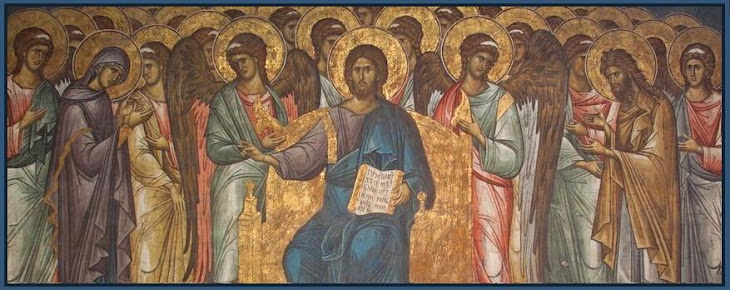
Friday, August 14, 2015

"She who is higher than the heavens..."

The Dormition of the Theotokos (https://kaiserswest.files.wordpress.com/2013/08/dormition-icon.jpg)
 

She who is higher than the heavens, more glorious than Cherubim and greater in honour than creation, who through her surpassing purity became the vessel of the eternal being, today places in the hands of her Son her all-holy soul. With her the universe is filled with joy and to us is given his great mercy.
-Idiomelon of the Litia by Anatolios in the Second tone
   
(http://anastasis.org.uk/15aug.htm)
   
Most-holy Theotokos, save us!

Thursday, August 14, 2014

The Doxastikon of the Dormition in All Eight Tones

The Dormition of the Theotokos (source)
 
The following is the Doxastikon of the Stichera from the Great Vespers for the Feast of the Dormition of the Theotokos. This is a beautiful hymn with vivid imagery, but it is most notable for the fact that it is written with portions to be chanted in all eight tones of Byzantine music. This, to my knowledge, is the only hymn in Orthodox hymnology that is like this, and we should take note of this. I take it to mean that our Orthodox Fathers and Hymnographers, enlightened by the Holy Spirit, hope to show that, by praising the Theotokos in all eight tones, the entirety of the visible and invisible Church gathers to honor the Dormition of her who is the "Mother of Life", being translated to "Life". We praise her with every manner and every glory that we have been given, though "it is not possible to render her worthy honor". May she ever intercede for the whole world!


Glory. Both now.
For both Choirs in the 8 Tones.

Tone 1
By divine command the god-bearing Apostles were caught up from all over the world by clouds on high.
   
Tone 5.
Reaching your all-immaculate body, source of life, they kissed it with mighty honour.
   
Tone 2.
The highest Powers of heaven stood by with their own Master.
   
Tone 6.
Seized with dread they accompanied your inviolate body that had contained God; while they went on before in a manner not of this world and crying out, unseen, to the ranks above them: See, the Queen of all, God’s Child, has come.
   
Tone 3.
Lift up the gates, and in a manner not of this world receive the Mother of the everlasting light.
   
Tone 7.
For through her the salvation of all mortals has come. We have not the strength to gaze on her, and it is not possible to render her worthy honour.
   
Tone 4.
For her excellence outstrips all understanding.
   
Tone 8.
Therefore, immaculate Mother of God, as you live for ever with the life-bearing King, your Offspring, pray without ceasing that he guard and save from every hostile assault your new people; for we have gained your protection.
   
Tone 1.
As to the ages with splendour we call you blessed.

The Dormition of the Theotokos (source)
   
Most-holy Theotokos, save us!