Showing posts with label Carnal Warfare. Show all posts

Tuesday, April 28, 2020

Paraklesis to St. Argyre the New Martyr, Protector of Marriage

Christ is risen! Truly He is risen!
St. Argyre the New Martyr of Bursa, Protector of Marriage - Commemorated April 5th and April 30th (source)
   
Paraklesis (Supplication Service) to St. Argyre the New Martyr, Protector of Marriage
Written by Fr. Athanasios of Simonopetra

The Priest says the "Blessed is our God...", followed by the Psalm "Lord hear my prayer..." If it is during the Paschal period, "Christ is risen..." is chanted thrice before the Psalm.

Tone Four.
God is the Lord and has revealed Himself to us, blessed is He Who comes in the name of the Lord. (x 4, with verses)

Tone Four. You Who were lifted up upon the Cross.
You were arrayed in the robe of self-control, and trampled upon the serpent of debauchery, and taunted the delusion of Hagar steadfastly, therefore, you were martyred through many forms of torture, and glorified Christ, Whom we pray that you entreat, on behalf of those who honor you, O divine Argyre, that they be granted self-control, and a life of purity.

Glory. Both now.
O Theotokos, we shall never be silent...

Then Psalm 50, followed by the Canon in Plagal of the Fourth Tone.

Ode I. Crossing the waters as on dry land.
Ceaselessly entreat the Trinity on behalf of those who hymn you with fervor, O Argyre, asking for self-control in life, and steadfast purity of hearts.

You greatly loved Jesus, the divine Teacher of purity, O Argyre, entreat Him, as you have great boldness before Him, that He might ever keep us in purity.

You were victorious over the guileful serpent, O Martyr, who desired to separate you from Jesus, dissolve his soul-corrupting schemes against us, through your prayers.

Theotokion.
You are the true Mother of the sweetest Jesus, and the Mother of the faithful by grace, do not cease to intercede that we be granted purity, O All-Pure Lady.

Ode III. Of the vault of the Heavens.
As a surpassingly beautiful bride of Christ, you denied to take upon your shoulders a barbarous life, O namesake of silver, therefore grant me grace to deny the tyrannical life with which the body tempts me, to deny Christ.

With a most-joyous heart, you stood before judges, and confessed the divinity of Christ, O Martyr, make us worthy to worship Him as is proper, that we might reach Heaven where He is praised.

O Argyre, you were shown to be a brave rhetor through your divine words against the Hagarenes, who were sitting in darkness, therefore, make us who honor your ever-memorable memory, worthy to go forth with the light of Christ.

Theotokion.
You were shown to be a spiritual Heaven, O Lady, for you bore Christ the Sun within your womb in purity, through His rays, enlighten us, and show the souls of the faithful to be another heaven through your intercessions.

Deliver, O Argyre, those who honor you with fervor, and drive away every dangerous temptation of the enemy, and grant us our requests through your prayers.

Look down on me, in your good favor...

St. Argyre the New Martyr (source)

Then the Priest says the Entreaty, followed by the Kathisma.

Second Tone. A fervent prayer.
As a bride of Christ and a Martyr steadfast in soul, ever entreat Him, O Argyre, that all of us who honor your divine memory might be protected, and grant purity of souls through the grace of your intercessions.

Ode IV. I have hearkened and heard, O Lord.
You kept your marriage spotless from the corruption of the enemy that wars against us, therefore, O Martyr, ever preserve married couples in reverence and purity.

You submitted everything meaningful in your life to the Lord, and endured tortures, O Argyre, therefore entreat Him that we might be granted patience.

O all-precious one, you endured until victory over the enemy that hates purity, and who greatly assaulted you, therefore, grant to us purity in all things, O Argyre, for those who pray to you.

Theotokion.
You have freed the race of man, O Spotless One, from the bonds of the serpent, and cleanse me from his venom, which has polluted my heart.

Ode V. Lord, enlighten us.
Heal the illnesses of soul and body, O Argyre, for those who hymn you, as you entreat Jesus the Physician, on Whose behalf you suffered.

Censure the darkness and delusion of Hagar, O all-praised one, and grant the light of the Holy Spirit to the souls of those hymning you.

Deliver us from the enemy, O thrice-blessed Argyre, we who are caught within his traps and in danger, and free us from his soul-wounding schemes.

Theotokion.
Grant true knowledge of the Lord, O All-Spotless One, to those who hymn your spotless birth giving, and who magnify your divine glory.

Ode VI. My supplication.
You endured the tortures of godless barbarians for years, O Argyre, and in prison you received the crown of martyrdom for your brave dedication, therefore grant us patience amidst the dangers of this life, O Martyr.

We have known you to higher than rhetors through your victory through silence, O Martyr, and through your passion lasting many years, you proclaim without words to those bearing the name of Christ how to live amidst temptations, O new-martyr Argyre, and Champion of Christ.

The grace of the Holy Spirit, with Which the Savior strengthened you, allowed you to endure in afflicted flesh all things manly like brass, O Argyre, intercede that His Grace will strengthen us as well in life's trials.

Theotokion
Your bore the Teacher of virginity, O Virgin Mary Theotokios, you who were followed by Argyre, desiring your purity, disdaining the fleeting pleasure of life. We entreat that you deliver your servents from this bitterness.

Deliver, O Argyre, those who honor you with fervor, and drive away every dangerous temptation of the enemy, and grant us our requests through your prayers.

Spotless One, who by a word did bring to us the Word eternal...
  
St. Argyre the New Martyr (source)
Zoom in (real dimensions: 528 x 479)
Then the Priest says the Entreaty, followed by the Kontakion.
 
Second Tone. O Protection of Christians.
You have appeared to be a defender of marriage, and a canon of purity through your struggle, O dove of the Lord Argyre, therefore, preserve us well from the schemes of the enemy, that your servants might live their married lives with self-control, and that they might be made worthy of the reward with which you were granted by the Teacher of purity [Christ].
 
Prokeimenon
God is wondrous among His Saints. (2)
Verse: With patience, waited upon the Lord, and He heard me.
God is wondrous among His Saints.
 
The Gospel according to St. Matthew (25:1-13)

Then the kingdom of heaven shall be compared to ten maidens who took their lamps and went to meet the bridegroom. Five of them were foolish, and five were wise.  For when the foolish took their lamps, they took no oil with them;  but the wise took flasks of oil with their lamps.  As the bridegroom was delayed, they all slumbered and slept.  But at midnight there was a cry, ‘Behold, the bridegroom! Come out to meet him.’  Then all those maidens rose and trimmed their lamps.  And the foolish said to the wise, ‘Give us some of your oil, for our lamps are going out.’  But the wise replied, ‘Perhaps there will not be enough for us and for you; go rather to the dealers and buy for yourselves.’  And while they went to buy, the bridegroom came, and those who were ready went in with him to the marriage feast; and the door was shut.  Afterward the other maidens came also, saying, ‘Lord, lord, open to us.’  But he replied, ‘Truly, I say to you, I do not know you.’  Watch therefore, for you know neither the day nor the hour.

Glory.
Through the intercessions of St. Argyre, O Lord of mercy, wash away my many personal offenses.

Both now.
Through the intercessions of the Theotokos...

Verse: Have mercy on me, O God...
Plagal of the Second Tone. Having placed all their hopes in Heaven.
You were shown to be a vessel of purity and self-control, O all-glorious Argyre, and through tortures you received your reward, therefore we entreat you, incline your ear and hearken to your servants, and grant them that grace of purity of soul, and preserve their precious marriages from the attacks of the enemy, for you struggled in Martyrdom for the love of Christ, and through your prayers, may we all be granted Paradise.

Then, the Priest says the "Save O God, Your people..."
   
St. Argyre the New Martyr, depicted in the prison where she remained for 17 years for Christ and to preserve the purity of her marriage (source)
  
Ode VII. Once from out of Judea.
You did not give way at all to the slavery of the body, O Martyr of Christ, but you stoked the fire of your love and increased it, O godly-minded Argyre, which we entreat might be granted to those who celebrate your memory in faith.

You were shown to be steadfast, as you were truly a tower founded upon the rock amidst tortures, O thrice-blessed one, and out of eros for the Master, having this has your foundation, may we also have this in our souls, O Argyre, through your prayers.

Your manly soul, was offered up like a whole-burnt lamb to the Master, and through your love surpassing nature, you endured tortures and trials, O Argyre, therefore, help us, who are storm-tossed with trials.

Theotokion
Remain with us, O Mother, at the time when the arrows of the enemy are launched against us your children, and our lamp of patience is not at all shining, but the darkness of faithless terror surrounds us. Dissolve them all by your light.

Ode VIII. The King of the Heavens.
Behold, our day of need has come, O New Martyr Argyre, hasten, give your helping hand to your servants, out of your sympathy.
 
Grant peace to my scattered nous, and to the thoughts that war against me from the hater of purity, O Martyr, and grant to it the memory of the Lord.
 
O Argyre, through your prayers, speedily dissolve the terrible and shameless bonds of sin that are drowning the souls of your entreaters.
 
Theotokion.
As the One who surpassed all self-control of all generations of women, O Pure Virgin, grant self-control to those who hymn you with fervor.
 
Ode IX. Saved through you, Theotokos.
O Argyre, you overlooked the ways of the world, and you now ever behold that which the eyes of men cannot behold, grant all of those who hymn you to be made worthy of this as well.
 
You trampled upon the serpent through your struggles, O Argyre, and you received the face of your Bridegroom [Christ], pray for us as well, O Martyr, that we might some day behold Him.
 
Show forth to be temples of self-control and purity, all young people and those who honor you with fervor, O Argyre, and deliver us all from the traps of the enemy.
 
Theotokion.
O undefiled Virgin, strengthen those who are living in self-control and purity, entreating the Master together with Argyre.
  
St. Argyre the New Martyr, holding the Marriage Crowns as a great Protector of Marriage (as she had requested her icon be painted, through divine revelation) (source)

Then, the "Truly it is right to call you blessed...", followed by the Megalynaria.

O all-famed Martyr of the Lord, thrice-blessed Argyre, preserve those who venerate your body with faith and fervor, from all dangers and passions and trials.

You dawned like a radiant star from Bithynia, as a greatly-suffering Martyr of Christ, and you enlighten the whole multitude of the faithful, O Argyre, you praise you with fervor.

Rejoice, radiant lamp of self-control, and dwelling-place of purity on behalf of Jesus, and grant every gift to those you praise you, O godly-minded Argyre, the boast of women.

Preserve married couples well, O Martyr of Christ, who lived with self-control and purity and kept your faith, help them to keep their marriages as you did, O sacrifice of purity.

Those who approach your temple on Lesvos full of reverence, make worthy, O Argyre, to live this life with purity in Christ, and make them to be partakers of the divine Kingdom.

All the ranks of Angels, God's messangers...

Then the Trisagion, followed by the Apolytikion of the Saint.

Apolytikion of St. Argyre in the Fourth Tone
You put to shame tyrants through your tortures, O pure one, you were shown forth, O much-suffering one, as strong as a diamond, O glorious martyr of Christ. You shown forth in struggles with love and zeal and unquenchable longing, for Christ the Savior, Who worthily glorified you, O Argyre.
  
St Argyre the New Martyr (source)
   
Then the Priest says the Entreaty, commemorating the desired names, followed by the Apolysis, then the final hymns.

Prosomoion in the Second Tone. When from the Tree.
Rejoice, O New Martyr Argyre, rejoice and hearken to those who entreat you, grant self-control for those in the yoke of marriage, and purity to those unmarried, and health to those afflicted in body and soul through your prayers, for you have been shown to all to be a golden and fragrant vessel of Jesus, crowned by Christ.

As you were beheld in the sacred vision, bearing the Marriage Crowns, and sought for your icon to be thus depicted, O Argyre, send down crowns from on high upon those who are married, and keep their precious marriages well, that, having been victorious over temptations, and every sin of the flesh, they might be crowned by God like Martyrs.

Lady, do you receive...

My numerous hopes are placed...
(source)
   
St. Argyre the New Martyr (source)
   
Christ is risen from the dead, by death, trampling down upon death, and to those in the tombs, He has granted life!
Truly the Lord is risen!

Tuesday, January 14, 2020

St. John the Forerunner: The Wild Flower that adorns the World

St. John the Forerunner (source)
  
Behind the Prophet, see the ascetic.
Behind the Baptist, see the virgin.
Behind the Great, see the humble.
Behind the Saint, see John.
Behind every Saint of the Church, there is a whole life of struggles, efforts, tears. There is hidden a life of prayer and asceticism, simplicity and obscurity.
It is not that which we know of St. John the Baptist and the Forerunner of our Lord. It is that which we do not know about him that contributes to making him Great before men and Saints. It is all that our Triune God knows of him.
This fascinates me about St. John...that he is an incredible wild flower that adorns the world, and that the world does not know...
-by Fr. Pavlos Papadopoulos
  
(source)
  
Through the prayers of our Holy Fathers, Lord Jesus Christ our God, have mercy on us and save us! Amen!
 

Thursday, March 21, 2019

St. Seraphim of Vyritsa on the sin and repentance of the youth

St. Seraphim of Vyritsa (source)
  
[St. Seraphim of Vyritsa] loved the youth very much. Then the young people didn't go to church almost at all and the Elder rejoiced very much when they would visit him. Father Seraphim used to say that the role of the youth will be very great in the future revival of the ecclesiasti­cal life. He also used to say that there will come a time when corruption and lewdness among the youth will reach the utmost point. There will hardly be any virgin youth left. They will see their lack of punishment and will think that everything is allowable for them to satis­fy their desires. God will call them, however, and they will realize that it will not be possible for them to con­tinue such a life. Then in various ways they will be led tο God. In many people there will be a tendency to­wards the ascetic life. They who formerly were sinners and alcoholics will fill the churches and they will feel great thirst for the spiritual life. Many will become monastics. The monasteries will open and the churches will be full of believers. The young will go οn ρilgrimages tο the holy lands. That time will be beautiful. That today they are sinning greatly, will lead them tο a deeper repentance. Just like the candle before it goes out, it shines strongly and throws sparks; with its light, it enlightens the surrounding darkness; thus, it will be the Church's life in the last age. And that time is near.
(source)
  
Through the prayers of our Holy Fathers, Lord Jesus Christ our God, have mercy on us and save us! Amen!

Wednesday, February 13, 2019

St. Paisios the Athonite on Abstinence as Martyrdom

St. Paisios the Athonite, depicted with St. Arsenios and St. Euphemia (source)
  
The abstinence and chastity of the young people will be considered as a martyrdom of the moral sense.
-St. Paisios the Athonite
  
(source)
  
Through the prayers of our Holy Fathers, Lord Jesus Christ our God, have mercy on us and save us! Amen!

Saturday, July 25, 2015

Homily on St. Paraskevi by Metropolitan Avgoustinos Kantiotes

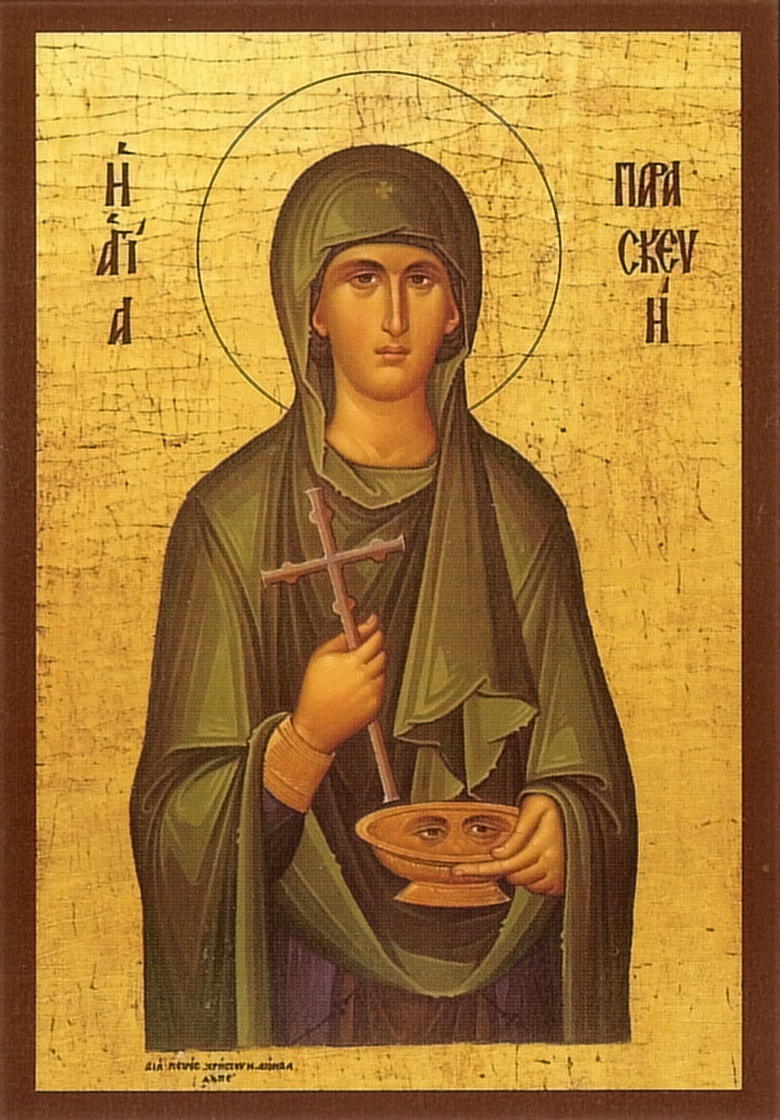
St. Paraskevi the Great Martyr (source)
  
Homily on St. Paraskevi by Metropolitan Avgoustinos Kantiotes (+2010)
"A Bedrock of Virtue"
St. Paraskevi was not an ordinary woman. She was a spiritual meteor, a bedrock of virtue, unshakable amid the ocean of the corrupt community.
  
She implemented that which Christ said, that: “He who hears my words and keeps them resembles a house built upon the rock, and though the rains came and the winds and the rivers fell upon it, the house was not shaken.” (Matthew 7:24-25) And St. Paraskevi was a bedrock of virtue. Foamy waves fell upon her, the greatest waves of life.
  
First, the wave of corruption fell upon her. She was not born in a small village. She was born in the most corrupted city, which in the Holy Scriptures is called the Babylon of the world due to its corruption (Revelation 17:5). She was born in Rome, in a suburb of Rome. But however, she remained uplifted. She was a lily among the dung of her community.
  
Let us all hearken to this, for when we see some woman being led astray, we say: “The community is responsible.” Yes, the community is responsible, I don't deny this. But she herself is also responsible. Give me a woman who loves Christ like St. Paraskevi, and throw her into the most corrupted community, and no wave and no devil could shake her.
  
As soon as one wave left, a stronger wave fell upon her: the wave of orphanhood. This wave is terrible. St. Paraskevi was orphaned of her father and her mother. Because of this she is a protector of orphans. She was orphaned at that age when children could become prey to unscrupulous traffickers who try to exploit them. But she stood tall even while an orphan. She had within her a great fervor for holiness, the life of virginity and grandeur.
  
Woe to the woman who does not have these great desires. No matter how high she climbs, no matter how many qualifications she has, she is deplorable. It is better to be an unlettered villager, which is like a lily, like the flowers that grow in the crags of the rocks of our homeland.
  
Therefore, the waves of corruption and orphanhood fell upon her, but she remained untouched. Because of this I call her a rock. Furthermore, another rock fell upon her, that of money, of wealth. After the death of her pious parents, she remained the sole inheritor of their vast property, which they left to her.
  
Every other girl would think differently. One might buy silken clothes, one might go to dances and gatherings, one might run right and left, would go on trips, would experience the spirit of the sinful life. St. Paraskevi however did the opposite.
  
Money is a great temptation. It is better to be a blessed poor person. Thrice-blessed are little huts, more than great homes. Because in huts dwell diamonds, while in the palaces and the large homes dwell many times prideful souls, who do not love Christ.
  
Money fell into the hands of St. Paraskevi. But she did what St. Anthony did, who had also inherited vast property. He went into church one day. His ear hearkened to the Priest who was reading the Gospel: “Sell your goods and give them to the poor.” (Matthew 19:21) Sell everything and give them to the poor. Anthony heard this. And he did not say that Christ was saying this to others. He distributed his property to the poor. As he hearkened to the words of Christ, so did St. Paraskevi. She kept only a small amount, and with this she founded a small sisterhood of orphan women virgins, who were dedicated to preaching, to enlightenment and to philanthropy.
  
So many foamy waves fell upon St. Paraskevi. Finally, the red wave of blood fell upon her! It was a time when only one would be heard to be a Christian, and one would be put in prison. They seized her at that hour when she had gathered the girls together to teach them. They led her before the judge. They asked her: “Are you a Christian?” She responded: “I boast that I am a Christian.” “We give you,” they said, “three days time to deny Christ.” “No,” the Saint responded, “I don't need time to decide. From this instant I dedicated to sacrifice my life for Christ. Do whatever you wish.”
  
And her martyrdom began. They threw her in a dungeon in the prison. They whipped her with bullwhips. They threw her to the wild beasts. They threw her into a cauldron with burning tar and oil. She endured many forms of martyrdom, but all of these she conquered through the power of Christ.
  
At the end, her hour came. They took her to a temple of the idols with statues of the false gods. She knelt, closed her eyes and made a mystical prayer to God. Immediately, there was an earthquake. The statues fell to the earth and became dust.
  
They couldn't stand it anymore. Thousands of barbarous hands of the idolaters seized her, took her outside and to the place of execution. Her face was shining like the sun. She knelt, prayed and thanked God. Finally, she was beheaded by a Roman soldier. And while her precious head fell down, and her blood watered the earth, her soul, white as a dove, flew to the heavens.
  
St. Paraskevi the Great Martyr (source)
  
Since then, how many years have passed! But as long as the world will exist, the name of St. Paraskevi will remain unto eternity. For: “The memory of the righteous is unto eternity.” (Psalms 111:6)
  
My brethren, St. Paraskevi is an example for all of us. But foremost, she is an example of a virtuous life and faith for women and young people. In this age of great corruption, she is the example and the mirror for virtue for womanhood
  
We live in a time of Babylon, a time of the Apocalypse, when the devil is roaring. He tries to strike the whole world. But most of all, he rabidly fights to strike and to soil girls and women. He wants not a single girl to remain unsoiled.
  
He fights we terrible magazines and newspapers. He soiled our girls with terrible brochures, with movies, with TV shows, which are schools of crime and dishonor. He soils them with mixed baths, with terrible photographs, with corrupting dances, with parties. The day will come when you will not find a pure girl. What will we do?
  
To arms, my brethren, to arms! Not to physical weapons, but to spiritual ones. Fathers, mothers, look towards the honor of your girls.
  
I'm finished, but rather, I'm not yet finished, because I want to be paid. What payment? Money? I am a monk and I leave that to you. I will not finish my homily unless my soul is satisfied.
  
Do you want your homes to be blessed and your girls to be secure? Today, the feast of St. Paraskevi, I entreat you all to do three things. First, go straightaway to your home, and look everywhere to find terrible articles and pictures, and gather them to light them with a holy fire to burn them all. Second, I recommend to all of you to go buy the life of St. Paraskevi and an icon of hers to hang in your home, and speak to your children: “My daughter, my child, become like St. Paraskevi.” And the third thing? Having done the first two, light a candle for the wayward women, those who live in filth and dishonor, and say to St. Paraskevi: “St. Paraskevi, you who are a lily of heaven, help these women of Greece, the women of the whole world to return near the Panagia, near to God, near to Greece, so that we might all have the protection of the Holy Trinity”, Whose blessings I pray might be with you all. Amen.
  
+Bishop Avgoustinos
(homily delivered in Chaidari, Athens, before 1967)
  
(amateur translation of text from source)
  
St. Paraskevi the Great Martyr (source)
  
Through the prayers of our Holy Fathers, Lord Jesus Christ our God, have mercy on us and save us! Amen!

Sunday, July 5, 2015

An awesome recent vision of the Theotokos

The wondrous icon of Panagia Paramythia, Vatopedi Monastery, Mount Athos (source)
  
Note: This is the summary of an astonishing recent vision regarding the help of the Theotokos. In some ways it resembles prior visions, such as those of Panagia Paramythia from Vatopedi, and the Holy Protection to St. Andrew the Fool-for-Christ. Please note that I have not independently confirmed this, I have only provided my amateur translation as presented on the source site.
Several points though may benefit from clarification:
1. Christ has utter love and mercy, and He shed His Blood for the whole world. When scriptures discuss punishment or "wrath" of God, this is an idiom of our perception. Christ allows trials and tribulations as a last ditch effort to bring us to contrition and repentance, only when nothing else will work.
2. This does not mean to imply that the Theotokos would ever disobey or dishonor Christ. It just underlines how much she loves and cares for us, as she did at the Wedding at Cana.
3. As long as we repent and return to the Church during our lives, there is no sin that overcomes the love and mercy of Christ.
4. Though this might seem primarily for the people of Greece, the admonition is just as applicable for the whole world. We all have great sins to repent of, and if we do not repent speedily, it may soon become too late to do so.
May we speedily repent and return to our Lord, Who desires all men to be saved and come to the knowledge of the Truth! May the Most-Holy Theotokos continue to bless, protect and guide everyone throughout the world!
  
About one year ago, one of our more enlightened, great Athonite Elders from the outside [i.e. outside of Greece]***, saw an astonishing vision, which we offer below in summary:
  
Our Panagia was kneeling before Christ, the Righteous Judge. She was entreating Him to save Greece from some great danger and catastrophe which would later come!
  
“No, my Mother,” the Lord said, “Look at what is happening in Greece. Look at the sin (bringing to mind the carnal and other sins)...”
  
“Forgive them, my Son, save Greece which believes in You and loves us...”
  
“No, Mother. They do not love me nor do they believe in me, with such carnal sins...”
  
“I entreat You my child,” as the Panagia now entreats the Lord with tears, “Do not let this happen...”
  
“It is not going to happen, Mother, and I ask you not to seek this,” said Christ, embittered by the Greeks, who had lost every piety and measure, every purity and spirituality, polluting themselves with sin and evil and impious deeds, both small and great...
  
“Listen, my child and my Lord,” the Panagia persisted, “Hearken to my prayers and to my children who call upon me, and who entreat me to entreat of You..”
  
“It's not going to happen, O Mother...Sin has overflowed...Do not persist...” says the all-radiant Christ, as He disappeared...
  
Therefore, our Panagia was saddened, and as the Champion General of Greece, she does something unexpected. She stands upright, takes off her mandya, and holds in a protecting manner above Greece! As the Holy Protection! As the Awesome Protection!
  
An astonishing vision, with which our Christ leaves us with one final opportunity for repentance and correction, only in thanks to His Mother! He holds the door half open for us still, astonishingly, on behalf of our Mother, the Mother of Greece, who has saved us through how many storms and wars and earthquakes, for centuries!
  
The Most-holy Theotokos, showing the way to Christ (source)
     
Our Panagia defends us with her own responsibility, because we so greatly call upon her, and have continuous supplications and prayers, especially of our Monasteries, and we seek her continuous protection, despite our sinfulness, which brings forth the wrath of God, such as atheism, cursing holy things, utter impiety, and especially adulteries, of the mouth, and every carnal passion, and the terrible homosexuality, which is the greatest sin of the world, and which destroyed Sodom and Gomorrah, and brought about the Cataclysm of Noah...
  
A short time before the terrible dangers that are coming, of which we are unable to comprehend, but which may include poverty, destitution, hunger, civil war, invasions, earthquakes, epidemics, individually or all together, the evils which we see in Syria, Libya, Africa, let us take advantage of this movement of love and sacrifice of our Panagia! Let us return to our Christ! With a simple movement! Repenting, ceasing immediately, now, today, from this instant and forever, whatever evil things that we have done, whatever we do, say, think, or plan to do, sacrificing “pleasures and delights, egotism and evils”, in order to win over the love of the Queen of the Angels, and of God Himself! In order to save ourselves, and the most beautiful and once blessed Greece!
  
And then, let us run to a spiritual father or Elder to confess, seeking with tears and contrition, for forgiveness from Christ, Whom we have wounded and embittered so...
It is very easy...
  
It is such a small beginning step, which however takes us immediately to the other shore of the All-Mighty Kingdom of Christ, and eternal joy and Grace.
  
That our Panagia might rejoice!
That we might justify her deed and her choice!
That we might not disappoint her!
That we might return now to the honors and beginnings passed down from the Fathers!
To our Orthodoxy!
  
And it is sure that thus we will be saved and glorify our Greece, with the help of Panagia, who so much will give their eyes a scrubbing! Like in 1940!
  
And let us send as our first sign into Heaven, the lighting of our candle, the prayer of our soul!
  
And finally, let us chant, as ones besieged and surrounded by hundreds of thousands of savages and barbarian enemies of the City [Constantinople]:
O Champion General, I your city now inscribe to you triumphant anthems as the tokens of my gratitude, being rescued from the terrors, O Theotokos. But since you have the dominion unassailable, from all kinds of perils free me so that unto you, I may cry aloud: rejoice, O Bride unwedded.
(source)
  
***Elder Nikodemos, Abbot of the Holy Monastery of Philotheou, acknowledged that this vision was seen by Elder Ephraim of Arizona, of blessed memory.
  
The Holy Protection of the Theotokos (source)
  
Most-Holy Theotokos save us!
Through the prayers of our Holy Fathers, Lord Jesus Christ our God, have mercy on us and save us! Amen!

Friday, March 29, 2013

St. Isaac the Syrian on Fasting

Christ fasting for forty days after His Baptism, and being tempted by the devil, 12th century mosaic from the Basilica of St. Mark, Venice, Italy (source)
 
St. Isaac the Syrian on Fasting

The man who during his whole life loves the conversation of this yoke-mate fasting is a friend of chastity. Just as the satisfaction of the belly is the source of all evils, and as the slackness of sleep kindles the lust of fornication, so fasting, vigil, and wakefulness in God’s service by withstanding the sweetness of sleep through crucifying the body throughout the day and night, are God’s holy pathway and the foundation of every virtue. Fasting is the champion of every virtue, the beginning of the struggle, the crown of the abstinent, the beauty of virginity and sanctity, the resplendence of chastity, the commencement of the path of Christianity, the mother of prayer, the well-spring of sobriety and prudence, the teacher of stillness, and the precursor of all good works. Just as the enjoyment of light is coupled with healthy eyes, so desire for prayer accompanies fasting that is practiced with discernment.
When a man begins to fast, he straightway yearns in his mind to enter into converse with God. For the body that fasts cannot endure to sleep upon its pallet all the night through. Fasting naturally incites wakefulness unto God, not only during the day, but also at night. For the empty body of a faster is not greatly wearied by the battle against sleep. And even if his senses are weakened, his mind is wakeful unto God in prayer. It is better for a man to desist from his liturgy because of weakness due to fasting, than because of sloth due to eating. When the seal of fasting is set upon a man’s lips, his thought reflects with compunction, his heart pours forth prayer, gloom lies upon his countenance, shameful thoughts are far removed from him, cheer cannot be detected in his eyes, and he is an enemy of lusts and vain conversations. No one has ever seen a discerning faster enslaved by evil desires. Fasting with discernment is a spacious mansion for every good thing; but he who neglects fasting makes every good totter. For fasting was the commandment that was given to our nature in the beginning to protect it with respect to the tasting of food, and in this point the progenitor of our substance fell. There, however, where the first defeat was suffered, the ascetic strugglers make their beginning in the fear of God as they start to keep His laws.
And the Saviour also, when He manifested Himself to the world in the Jordan, began at this point. For after His baptism the Spirit led Him into the wilderness and He fasted for forty days and forty nights. Likewise all who set out to follow in His footsteps make the beginning of their struggle upon this foundation. For this is a weapon forged by God, and who shall escape blame if he neglects it? And if the Lawgiver Himself fasts, who among those who keep the law has no need of fasting? This is why the human race knew no victory before fasting, and the devil had never experienced defeat from our nature; but this weapon has made him powerless from the outset. Our Lord was the firstborn Leader of victory, so as to set the first crown of victory upon the head of our nature. When the devil, that foe and tyrant, sees a man bearing this weapon, he is straightway frightened and he recollects and considers that defeat which he suffered in the wilderness at the hands of the Saviour; at once his strength is shattered and the very sight of this weapon, given us by our Commander-in-chief, burns him. What weapon is more powerful and gives more boldness to the heart in the time of battle against the spirits of wickedness, than hunger endured for Christ’s sake? For the more the body toils and endures hardship when the phalanx of the demons encompasses a man, the more his heart is given succour by the power of confidence. He who has armed himself with the weapon of fasting is afire with zeal at all times. Elias the zealot also pursued the work of fasting when he was zealous for God’s law. Furthermore, fasting reminds the faster of the commandments of the Spirit and it is an intermediary between the old Law and the grace given us by Christ. He who is negligent with respect to fasting is slothful, heedless, and feeble in the other ascetical struggles as well and he manifests an inception and an evil token of slackness in his soul, thus giving his antagonist an opportunity for defeating him. It is evident that he who enters naked and unarmed into the struggle will retreat from it without gaining the victory; for his limbs were not shielded with the warmth of fasting’s hunger. Such is the nature of fasting, that whoever perseveres in it will possess an unshakeable mind, one ready to encounter and repel all the troublesome passions.
It is said concerning many of the martyrs, that when they foreknew, either by revelation or by information received from one of their friends, the day on which they were to receive the crown of martyrdom, they did not taste anything the preceding night, but from evening till morning they stood keeping vigil in prayer, glorifying God in psalms, hymns, and spiritual odes, and they looked forward to that hour with joy and exultation, waiting to meet the sword in their fast as ones prepared for the nuptials. Therefore let us also be vigilant, we who are called to an unseen martyrdom so as to receive the crowns of sanctification, so that we may never give our enemies a sign of denial with any member or part of our body. 
St Isaac the Syrian, First Collection, from Homily 37. Source.
   
Through the prayers of our Holy Fathers, Lord Jesus Christ our God, have mercy on us and save us! Amen!

Wednesday, February 13, 2013

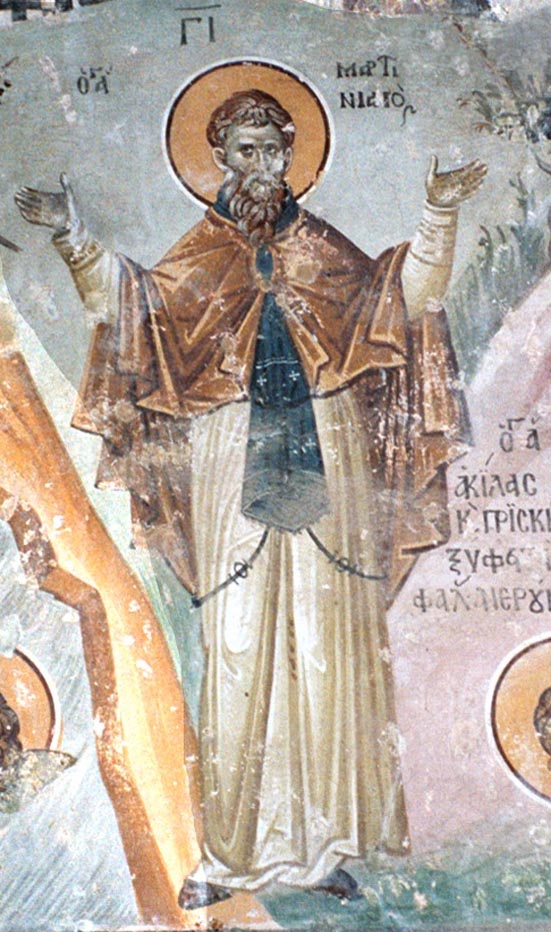
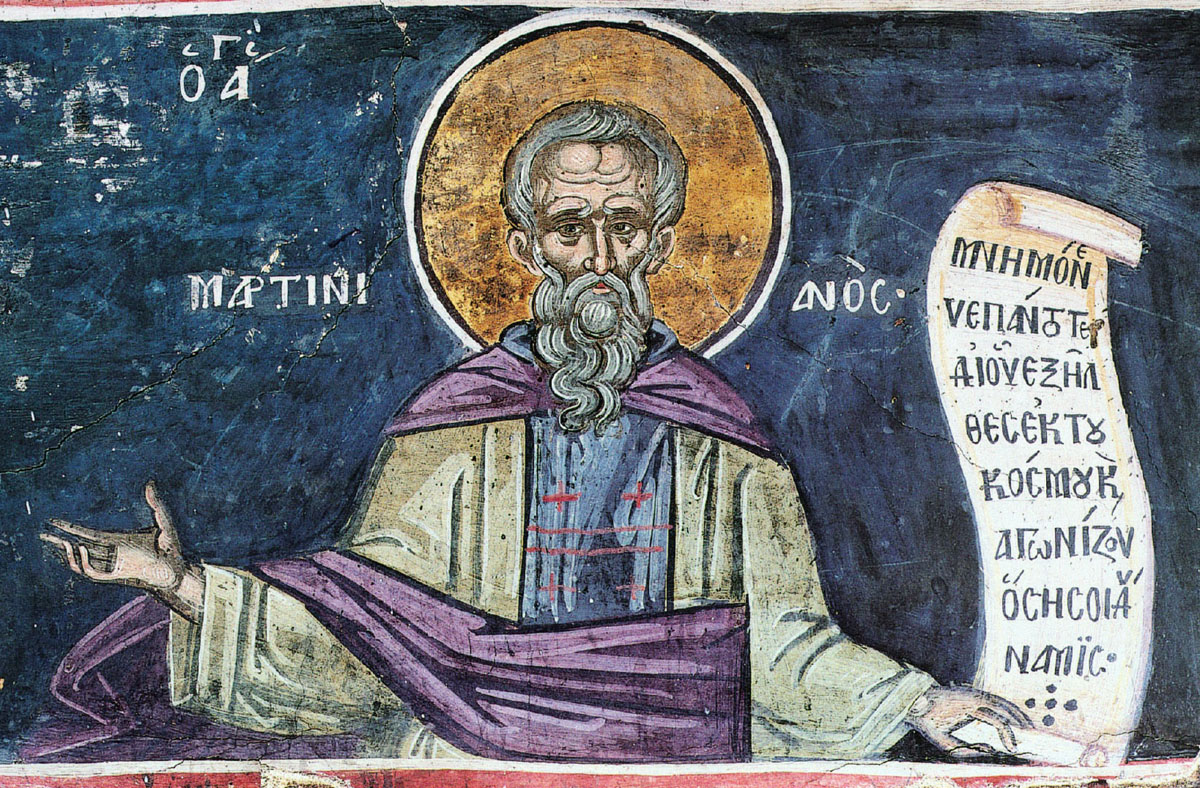
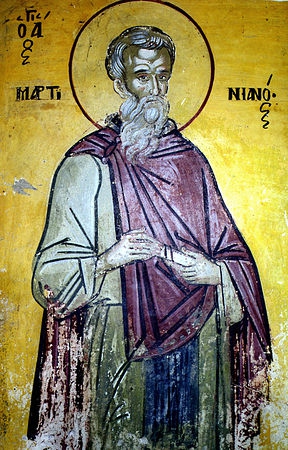
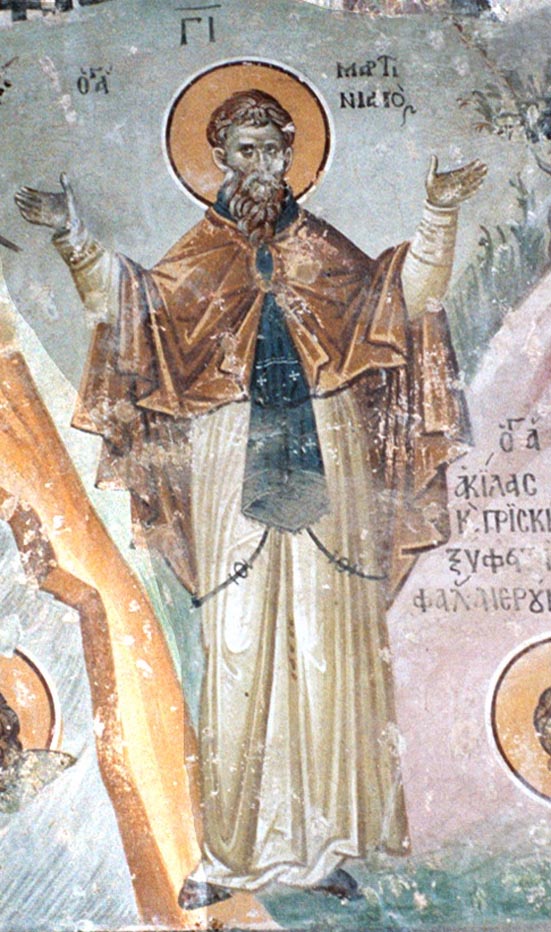
St. Martinianos (Martinian) the Venerable of Caesarea

St. Martinianos (Martinian) the Venerable of Caesarea - Commemorated on February 13 (source)
 
Saint Martinian went to live in the wilderness at the age of eighteen, not far from the city of Caesarea in Palestine. For twenty-five years, he devoted himself to ascetic deeds and silence, and he was granted the gift of healing illnesses and casting out demons. However, the Enemy of the race of man would not stop bothering the hermit with various temptations.

Once a profligate woman made a wager with some dissolute people that she could seduce St Martinian, the fame of whose virtuous life had spread throughout all the city. She came to him one night pretending that she had lost her way in the storm, and asking for shelter. The saint let her enter, unable to turn her away in such a storm. He went into his room and locked the door. The wicked guest changed into beautiful clothes and began to tempt the ascetic.

When morning came, St Martinian came out to send the woman away. Though he was tempted by the woman's beauty, he was determined not to fall into sin. Lighting a fire, he stepped into it, saying, "You want me to burn with temptation, and want to lead me into the fires of Hell. I will not let you. Instead, I will burn for my virginity and save my soul."

The woman came to see how evil she was. She repented and asked the saint to guide her onto the way of salvation. He told her to go to Bethlehem, to St Paula (January 26). There she lived as a nun for twelve years in strict asceticism until her blessed end. The woman's name was Zoe.

St Martinian went to an uninhabited rocky island, and lived on it under the open sky for several years, nourished by the provisions brought by a certain sailor from time to time. In return the monk wove baskets for him.

Once a powerful storm wrecked a ship, and a woman named Photina floated on pieces of the wreckage to the island of St Martinian. St Martinian helped her to survive the island. "Remain here," he told her, "for here is bread and water, and in two months a boat will come."

Then he jumped into the sea and swam off. Two dolphins carried him to dry land. Thereafter, St Martinian led the life of a wanderer. Later, he came to Athens and fell ill. Sensing the approach of death, he went into church and lay upon the floor. God revealed to the Bishop of Athens who St Martinian was, and the bishop buried his body with honor. This occurred around the year 422.

(source)
   
St. Martinianos (source)
 

Troparion - Tone 8

You quenched the flames of passion, blessed Martinian, with abundant tears; you calmed the waves of the sea and checked the assaults of wild beasts, saying:"Almighty God, You are most glorious, for You have saved me from the fire and storm!"

Kontakion - Tone 2

Let us worthily praise with hymns the ever-venerable Martinian, the tried ascetic who struggled for piety, an honorable athlete by deliberate choice, and a resolute citizen and inhabitant of the desert; for he has trampled down the serpent.

(source)
   
St. Martinianos (source)
   
Through the prayers of our Holy Fathers, Lord Jesus Christ our God, have mercy on us and save us! Amen!

Thursday, January 19, 2012

St. Basil the Martyr of Mangazeya

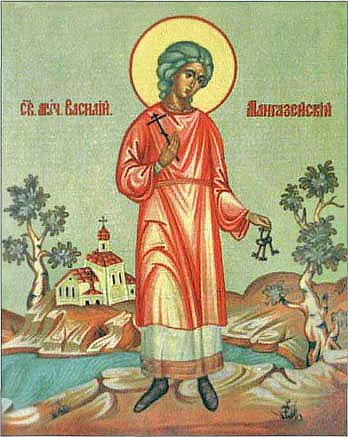
St. Basil the Martyr of Mangazeya - Commemorated March 23 (his martyrdom) and May 10 (the translation of his relics) (http://www.ihtus.ru/092007/st05_01.jpg)
  
Saint Basil was born in 1587 in the very old town of Yaroslavl. Yaroslavl was an important port on the Volga River. Basil's father Theodore was a poor merchant and his family often had very little food.

Even when he was a very small boy, Saint Basil used to go to the church every time he could. He loved God's house and wanted to be there more than any place else.

In those days, when a boy was twelve years old, he could become an apprentice. An apprentice is someone who works for a company without pay just to learn the business. The boss pays the boy's father a certain ammount and then gives the boy food and a place to live.

Because Basil's family was very poor, he agreed to become an apprentice too. The saint became an apprentice for a merchant in the Siberian town of Mangazeya.

St. Basil of Mangazeya (http://cr-sobor.narod.ru/icon9.htm)
  
Sibera was a very dangerous place, full of wild animals, war-like native tribes and lawless men. The journey to Mangazeya was long, difficult and full of danger. When Saint Basil arrived there safely, he hurried to the church to give thanks to God for protection on the road. Then he went to the merchant's office where he was given the job of clerk. Saint Basil was a very good and careful worker. Soon he was given a more responsible job in the company.

Unfortunately, at that time Siberia was a frontier area, and there were almost no women there. Because of this, some men who had beastial passions used to commit homosexual acts with young men and boys. Saint Basil's boss was one of these perverse men. Soon after Saint Basil had arrived in Mangazeya, the boss tried to entice the youth into homosexual relations. He tried flattery, he offered Basil money and finally, he tried threats and punishments.

Saint Basil only continued to fast and pray and ask God to help him remain pure.

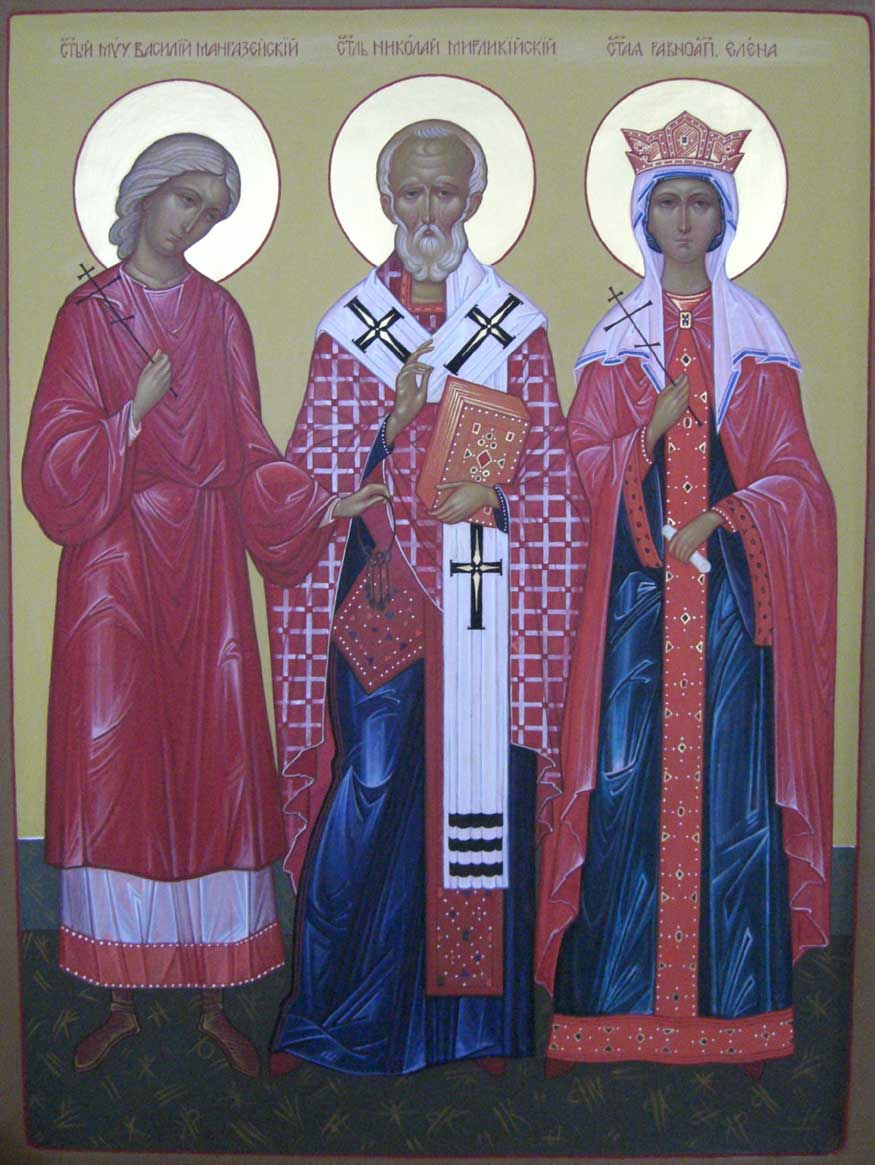
St. Basil of Mangazeya, St. Nicholas the Wonderworker, and St. Helen the Equal-to-the-Apostles (http://www.divinum.ru/images/nikolai-vasily-elena-big.jpg)
  
The boss began to hate Basil. He was angry that he would not submit to his evil lust, and he hated Basil's prayerful, religious life. He especially hated Basil for his meek and humble personality. But no matter how much he persecuted and mistreated the innocent lad, Saint Basil continued to faithfully and honestly perform all his duties and responsibilities.

Finally, the persecutions and slanders reached a terrible point. During the Paschal Matins, theives robbed the merchandise house in which Basil worked. The boss, discovering the theft, went to the governor and reported the theft. But then a terrible deed occured: the merchant hated Basil so much and the evil in him was so strong that he formally accused the innocent of being the robber.

Thus, on the day of Christ's Bright Pascha, when the Holy Church calls all people to peace and love, this inocent, God-fearing boy was betrayed by a false witness, just as Christ had been betrayed by false witnesses. The governor did not even investigate the charges. He sent officers to arrest Saint Basil and drag him right out of the church. The governor and Basils boss began to torture the boy in order to force a confession out of him. In spite of all the fierce tortures, the blessed one would only reply meekly: "I am innocent."

The pain of the torture became so unbearable that the youth fainted, but when he came to, he again quietly repeated, "I am innocent."

The meek, humble, Christ-like endurance and peaceful reply of the young saint enraged the evil merchant even more. Finally, he flew into a demonic rage and struck the innocent virgin on the head with a heavy chain of keys. Saint Basil fell to the floor, sighed heavily and gave up his pure soul into the hands of the Lord, on the day of Christ's Radiant Pascha, 1600.

In order to hide this foul crime, the Governor, Mr. Pushkin, and the passion-crazed merchant, placed the body of the holy martyr into a rough coffin and lowered it into a nearby marsh, weighed down with stones.

Rumors of the brutal murder circulated around the town of Mangazeya almost immediately after the incident, but God chose to conceal the sacred relics of His saint for fifty-two years.

St. Basil of Mangazeya, with the implement of his martyrdom (http://norilsk-sobor.ru/files/attaches/1172137201_vasiliymangazeyskiy.jpg)
  
In 1652, during the tenure of the military governor Ignaty Stepanovich Korsakov, God willed to reveal the glory of His Virgin Martyr. In that year, many wonderous events began to occur in the area around Mangazeya. Many pious people had dreams in which a beardless youth appeared to them and many ill people were healed by this holy boy. A strange light was seen over the marsh and unseen voices were heard chanting nearby.

Then, the coffin of the saint rose slowly to the top of the mud. A pious archer, Steven Shiryaev, noticed the coffin, but did nothing about it. Saint Basil appeared to him in a dream and told him to open the the coffin. The whole story of Saint Basil's martyrdom became known.

The coffin was brought out of the swamp and opened. Inside they found the sacred relics of the saint, whole and incorrupt. A chapel was built over the relics and many people received healing through the prayers of the young martyr.

  
[A chapel was built over his grave, and in 1670 the relics were placed in the church of Holy Trinity Monastery near Turakhanov.

In 1719 the holy Metropolitan Philotheus of Siberia (May 31) sent a carved reliquary to the monastery. Many miracles took place there, and St Basil helped Metropolitan Philotheus on many occasions

The Holy Relics of St. Basil of Mangazeya (I believe they remain to this day in the Holy Trinity Monastery, Turukhansk). In 1997, the Saint's Relics were found for the third time (after they had been lost under the Communists), and have been associated with many miracles since then (source 1, source 2)
  
A new stone church was built at Holy Trinity Monastery in 1787, and the relics were transferred there.

In iconography, St Basil is portrayed as a young man with light brown hair, bare-footed and wearing only a shirt. He is also depicted on the Abaletsk Icon "Of the Sign" (July 20, November 27). (http://ocafs.oca.org/FeastSaintsViewer.asp?SID=4&ID=1&FSID=100874)]

Holy Virgin Martyr Basil of Mangazeya, pray to God for us!
(http://www.johnsanidopoulos.com/2010/03/saint-basil-of-mangazeya-12-year-old.html)

  
For another account with more miracles of the Saint (in Russian), see: http://www.ihtus.ru/092007/st05.shtml.
     
  
Apolytikion in the First Tone
Thou O Basil didst witness unto death to the glory of virginity, and having been cast into the darkness of a swamp by thy cruel tormentors, thou didst ascend to the heights and shine forth with the glory of the Eternal Light, wherefore we cry to thee rejoicing, glory to Christ Who has glorified thee, glory to Him Who has made thee wondrous, glory to Him Who worketh healings for all through thee.

Kontakion in the Plagal of the Fourth Tone
Chosen Martyr of Christ, patron of missionaries, protector of those who struggle for chastity, we see thee as a radiant lamp in the darkness of a wicked and perverse generation. And since thou hast been thrice-crowned by our Saviour, free us from passions, who cry to thee: Rejoice Holy Martyr Basil, radiant light of virginity.
(
http://www.johnsanidopoulos.com/2010/03/saint-basil-of-mangazeya-12-year-old.html)
  
  
Selected hymns to St. Basil of Mangazeya (in Russian)

Тропа́́рь, глас 8:
Бога́тство ви́дев чи́стыя души́ твоея́, Васи́лие, / укра́сти тща́шеся пра́ведных враг, / подусти́ господи́на твоего́, / и́же покра́денного ра́ди бога́тства своего́ преда́в тя судии́, / и от того́ непови́нне мно́гия претерпе́л еси́ му́ки, / непобеди́м пребы́в до сме́рти. / Тем, я́ко прие́мый вене́ц страда́ния от всех Влады́ки, / моли́ всем от напа́стей свобо́дным бы́ти, / чту́щим любо́вию святу́ю па́мять твою́.
Ин тропа́рь, глас 8:
Я́ко пресве́тлое со́лнце, / возсия́л еси́ чудесы́ свои́ми в Сиби́рстей стране́, / в Мангазе́йских преде́лех, / но́вый му́чениче, непови́нный страда́льче, свя́те Васи́лие! / За чистоту́ душе́вную и теле́сную пострада́л еси́ от лю́таго врага́ / распале́нием и немилосе́рдием господи́на своего́ / и от нача́льствующаго бо ту градска́го непра́веднаго судии́, / и му́ки непови́нно претерпе́л еси́, / и кровь свою́ святу́ю пролия́л еси́, / жела́я ве́чнаго Ца́рствия Небе́снаго. / Сего́ ра́ди Христо́с Бог венча́ тя му́ченическими венцы́ на Небеси́, / и на земли́ просла́ви, / и Свои́м Бо́жиим про́мыслом повеле́ земли́ само́й от недр свои́х / гроб, и те́ло твое́, и сра́чицу, обагре́нную кро́вию твоею́, израсти́ нетле́нно. / И ны́не притека́ющим к тебе с ве́рою и везде́ призыва́ющим свято́е и́мя твое́ / поле́зная вся, и грехо́в оставле́ние, и телесе́м здра́вие подава́й, / чту́щим ве́рою святу́ю па́мять твою́, / и моли́ Христа́ Бо́́га спасти́ся душа́м на́шим.
Ин тропа́рь, глас 8:
От гра́да Яросла́вля Бо́жиим смотре́нием / в страну́ Сиби́рскую прише́дшаго / и за целому́дрие от господи́на своего́ / в Мангазе́и пострада́вшаго, / блаже́нного Васи́лия почти́м, / его́же Христо́с Бог му́ченическим венце́м венча́ на Небеси́, / нетле́нием и чудесы́ просла́ви на земли́. / Ты же, честны́й страда́льче, / предста́тельством свои́м страну́ на́шу в ми́ре сохрани́ / и моли́ся о спасе́нии душ на́ших.

  
НА У́ТРЕНИ
На Бог Госпо́дь: тропа́рь свята́го, два́жды. Сла́ва, и ны́не, Богоро́дичен.
По 1-м стихосло́вии седа́лен глас 1:
Наста́ всечестны́й день пра́зднества / пренесе́ния моще́й твои́х, прехва́льне му́чениче Васи́лие, / от Тазу́ реки́ в Туруха́нск, в оби́тель Святы́я Тро́ицы. / Ра́дуются сердца́ ве́рных, красу́ется Це́рковь с вопию́щими: / его́же уби́сте и вмени́сте безче́стна, / сей ны́не на тве́рди Небе́сней изоби́лует сла́вою благода́ти, / в сы́нех Бо́жиих яви́ся. / Ди́вен еси́, Го́споди, не зри́ши лица́, но изволе́ния душе́вного. / Сла́ва венча́вшему Ти в ко́емждо ро́де му́ченики Твоя́, / сла́ва де́йствующему Ти си́лою во святы́х Твои́х.
Сла́ва, и ны́не, Богоро́дичен:
Ма́терь Тя Бо́жию и Де́ву мо́лим вси вои́стину, / в щедро́ты Твоя́ вопие́м, любо́вию прибега́юще к Твое́й бла́гости: / Тя бо и́мамы, гре́шнии, Засту́пницу / и Тебе́ стяжа́хом в напа́стех спасе́ние, еди́ну Пречи́стую.
По 2-м стихосло́вии седа́лен, глас 4:
Не ктому́ держа́ва го́рдых челове́к / возмо́жет по убие́нии над непови́нными мучи́тельство име́ти, / но па́че са́ми уразуме́ют, коль подвиза́вшееся окая́нне уби́йством, / и́бо мня́щиися пораже́ннии коль све́тлии душе́ю горе́ со А́нгелы ны́не торжеству́ют, / на земли́ же священносло́вятся Це́рковию страда́ния их в ро́де и ро́де. / Го́споди, му́ченика Твоего́ моли́твами изле́й на нас ве́лию Твою́ ми́лость.
Сла́ва, и ны́не, Богоро́дичен:
Сло́во О́тчее, Христа́, Бо́га на́шего, / от Тебе́ воплоти́вшагося, позна́хом, Богоро́дице Де́во, / еди́на Чи́стая, еди́на Благослове́нная, / тем непреста́нно Тя воспева́ющее, велича́ем.
По полиеле́и седа́лен, глас 8:
Прехва́льне му́чениче Госпо́день Васи́лие, / целому́дрия был еси зерца́ло, друг Христо́вы кро́тости, / исто́чник ми́лости, презира́тель тле́ннаго бога́тства, / в нищете́ су́щим обогати́тель. / и́стины яви́ся почита́тель, доброде́тели и благоче́стия о́браз, / над страстьми́ влады́ка, духо́в лука́вых прогони́тель, / боле́зней и нечисто́т цели́тель гото́внейший, / раздая́тель от Бо́га прося́щим ми́лости. / Умири́ жи́тельство в днех на́ших, приснопа́мятне, мо́лимся.
Сла́ва, и ны́не, Богоро́дичен:
Стена́ непобеди́мая нам, христиа́ном, еси́, Богоро́дице Де́во, / к Тебе бо прибега́ющее, невреди́ми пребыва́ем / и, па́ки согреша́ющее, и́мамы Тя Моли́твенницу. / Тем, благодаря́щее, вопие́м Ти: / ра́дуйся, Благода́тная, Госпо́дь с Тобо́ю.
Степе́нна, 1-й антифо́н 4-го гла́са. Проки́мен, глас 4: Возвесели́ться пра́ведник о Го́споде / и упова́ет на Него́. Стих: Услы́ши, Бо́же, глас мой, внегда́ моли́тимися к Тебе́. Вся́кое дыха́ние: Ева́нгелие от Луки́, зача́ло 63.
По 50-м псалме́ стихи́ра, глас 6:
Досто́йный ублаже́ния, му́чениче Васи́лие, / егда́, боле́знуя непови́нно, / в му́ках свои́х глаго́лал еси́: / лю́ты у́бо настоя́щия му́ки, / но ра́достна ве́чная жизнь.

  
Конда́к, глас 4:
Страда́ние соверши́в свя́те, / погребе́ния же честна́го не сподо́бився, / в ти́нное ме́сто вве́ржен / и попира́емь был еси́ от мимоходя́щих, / но Бог просла́ви мо́щи твоя́ чуде́сным явле́нием, Васи́лие, / прославля́яйся во святы́х Свои́х, / дая́й страда́льцем вене́ц нетле́нный.
Ин конда́к, глас 4:
Иже но́вый в му́ченицех непови́нный страда́льче, / свя́те Васи́лие, преревнова́л еси́ Ио́сифу Прекра́сному и Моисе́ю У́грину во искуше́ниих, / за чистоту́ душе́вную и теле́сную / му́ки непови́нно претерпе́л еси́. / Сих ра́ди просла́ви тя Бог,/ и святы́я твоя́ мо́щи, по явле́нию твоему́, / от Мангазе́и к Енисе́ю во оби́тель Святы́я Тро́ицы / ту су́щим настоя́телем принесо́шася / и подаю́т исцеле́ния с ве́рою приходя́щим / и везде́ призыва́ющим свято́е и́мя твое́. / Страстоте́рпче святы́й, / моли́ Христа́ Бо́га / о правосла́вном наро́де на́шем / и о всех во́ех на́ших, / побе́ду и одоле́ние нам на всех / непросвеще́нных иноязы́чных лю́дех дарова́ти, спобо́рствуя / ,и от междоусо́бныя бра́ни спасти́ся всем моли́.
Ин конда́к, глас 4:
Просвети́ся Боже́ственною благода́тию, Боголю́бче, / целому́дрием и терпе́нием тече́ние свое́ му́ченически сконча́л еси́, / те́мже и по сме́рти яви́ тя све́тлость жития́ твоего́, / источа́еши бо чудесы́, / с ве́рою приходя́щим к честно́му гро́бу твоему́ и вопию́щим: / ра́дуйся, святы́й Васи́лие, / Мангазе́йский и всея́ Сиби́ри чудотво́рче.
Моли́тва
Святы́й му́чениче Христо́в Васи́лие, ра́дости святы́х единовсе́льниче, на́ших скорбе́й и печа́лей премени́телю и вся́кого зла де́монскаго губи́телю, припа́дая, молю́ ти ся: прииди́ в заступле́ние мое́, я́ко да очи́стится ум мой от дея́ния грехо́внаго, поне́же лиша́юся за сие́ благода́ти Бо́жия; не име́ю тве́рда основа́ния к покая́нию, даждь ми умиле́ние душе́вное и сле́зы грехоомыва́тельныя, воздежи́ ру́це твоя́ святы́я за убо́гую мою́ ду́шу ко Го́споду Иису́су Христу́, не оста́ви мене́, гре́шнаго, ра́ди моего́ невоздержа́ния, укрепи́ мя бе́дсствующаго душе́вными по́мыслы и вне́шними обурева́нии, и́миже сам себе́ вина́ быва́ю, или́ от ненави́дящих мя впра́вду, но вся по грехо́м мои́м пра́ведно бы́ти испове́даю. Бу́ди ми, малоду́шному, покрови́тель и побо́рник благ и ми́лостив, присеща́й мя, гре́шнаго, в ско́рбех и печа́лех и сохраня́й от вся́каго смуще́ния проти́внаго, да не когда́ прогне́ваю Бо́га моего́ и тебе́, смоле́бника моего́ блага́го, но утверди́ мя моли́твами твои́ми в стра́се Бо́жии и досто́йна покажи́ своея́ всегда́ ми́лости. Ами́нь.
(http://hram.sk6.ru/index.php?option=com_content&task=view&id=16&Itemid=39)
  
St. Basil of Mangazeya (http://turuhansk.info/news/pic006.JPG)
  
Through the prayers of our Holy Fathers, Lord Jesus Christ our God, have mercy on us and save us! Amen!