Showing posts with label St. Nikolai Velimirovic. Show all posts

Saturday, May 6, 2017

St. Nikolai Velimirovic: "What does it mean: to take up your cross?"

Christ is risen! Truly He is risen!
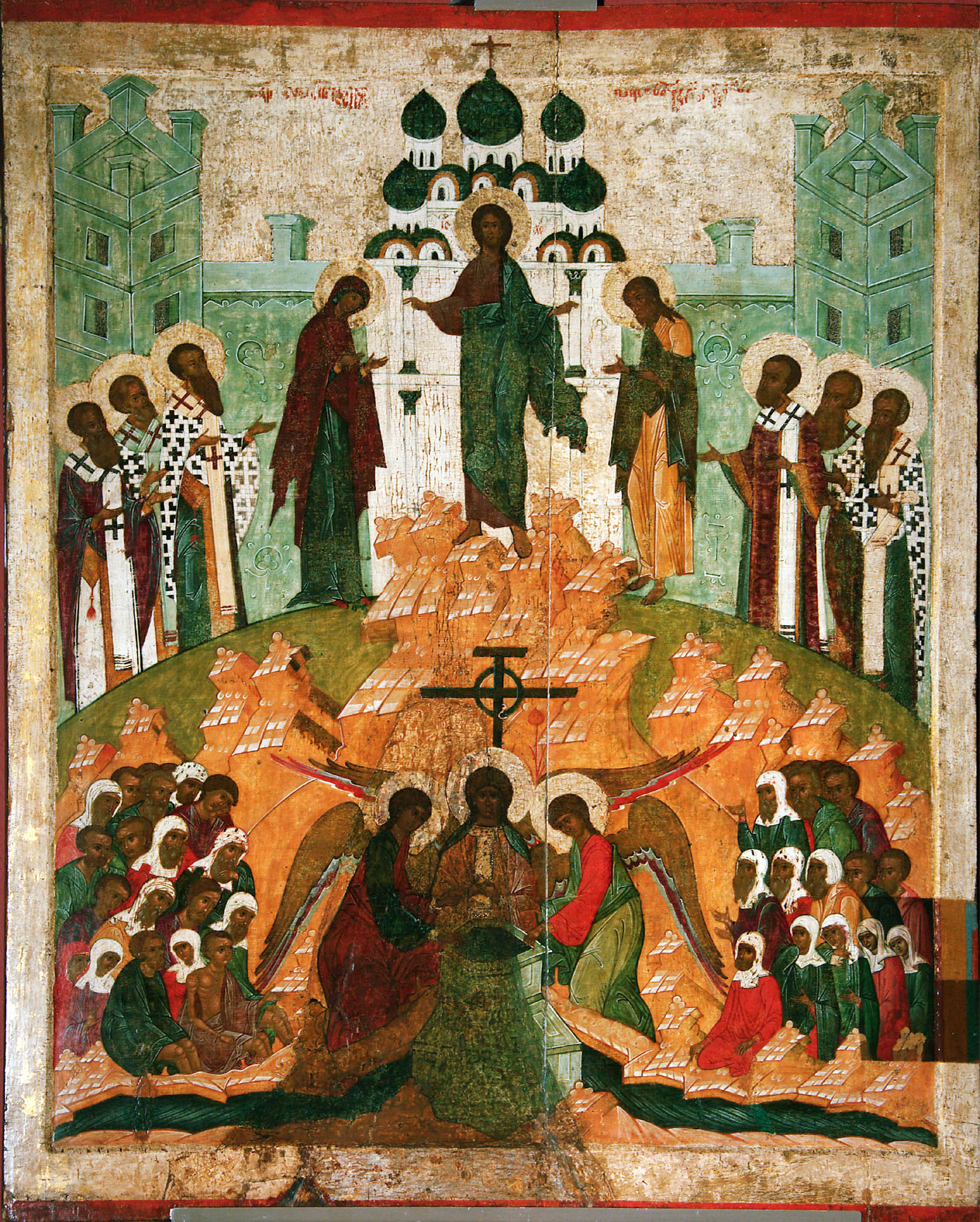
Icons of Christ's Passion and Resurrection (source)
   
...What does it mean: to take up your cross? It means the willing acceptance, at the hand of Providence, of every means of healing, bitter though it may be, that is offered.

Do great catastrophes fall on you? Be obedient to God's will, as Noah was.

Is sacrifice demanded of you? Give yourself into God's hands with the same faith as Abram had when he went to sacrifice his son.

Is your property ruined? Do your children die suddenly? Suffer it all with patience, cleaving to God in your heart, as Job did.

Do your friends forsake you, and you find yourself surrounded by enemies? Bear it all without grumbling, and with faith that God's help is at hand, as the apostles did.

Are you condemned to death for Christ? Be thankful to God for such an honor, like thousands of Christian martyrs. Nothing will be sought of you that has not been done before, but you will rather follow the example of many - apostles, saints, confessors and martyrs - who have done Christ's will. We must know, furthermore, that in seeking our crucifixion, The Lord is seeking the crucifixion of the old man, the man made up of evil habits and the service of sin. For, by this crucifixion, the old, animal-like man in us is put to death, and the new man, made in God's image and immortal, is raised to life.
-St. Nikolai Velimirovic: "The Holy Cross",
 
(source)
 
Christ is risen from the dead, by death, trampling down death by death, and to those in the tombs, He has granted life!
Truly the Lord is risen!

Tuesday, February 21, 2017

St. Nikolai Velimirovic: Christ, our Consolation

Jesus Christ, the Son of God, the Savior (source)
  
  Here is consolation above all consolations! Here is consolation for those broken by tempest. Let them only remember that Christ is among them, and let them not be afraid. He is the Helmsman.

     Here is the consolation for those in pain. Let them know that Christ is there by their bed, and let them not despair. He is the Healer.

     Here is consolation for the old. Let them not lose sight of the fact that Christ goes with them through the years right to eternity and eternal youth, and let them be at peace.

     Here is consolation for those who are tormented by men. Let them not think that they are left alone, for Christ is with them in all their pain, and at their judgment, and in prison; and let them rejoice. He is the Judge.

     Here is consolation for those tormented by evil spirits. Let them remember that Christ, the Conqueror of evil spirits, is on their side, and let them be strengthened. He is the Victor.

     Here is consolation for those who seek the light of righteousness and truth. Let them believe that Christ is closer to their souls than to their eyes, and let them follow His leading. He is the Light.

     Oh, my brethren, Christ is truly always with us, as a light that is ever present to the eyes of those who look, But, to our loss, if the eyes of our soul are closed, then the light seeks in vain to encounter the pupil of our eye! Oh, what sorrow and grief is ours when we are not with Christ!

     He comes to meet us - do we go to meet Him? He desires to be with us - do we desire to be with Him? If we desire consolation, we must be with Him every day to the end of our lives.

     O Lord, our only Consoler, do not leave us! To Thee be glory and praise forever.
  
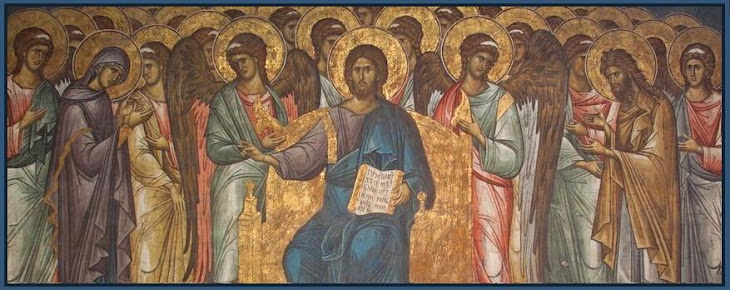
Christ Pantocrator, surrounded by the Holy Angels depicted as serving the Divine Liturgy (source)
   
Through the prayers of our Holy Fathers, Lord Jesus Christ our God, have mercy on us and save us! Amen!
Saturday, May 30, 2015

Serbian Patriarchate canonizes two new American Saints: Sebastian and Mardarije

Two new Serbian-American Saints: Sebastian of Jackson (+1940) and Mardarije of Libertyville (+1935) (source)
  
On May 29, 2015, the Holy Synod of Bishops of the Patriarchate of Serbia glorified two new Serbian Saints who spread the faith in Christ in America:

"St. Sebastian Dabovich (1863-1940) has the distinction of being the first person born in the United States of America to be ordained as an Orthodox priest, and also the first native-born American to be tonsured as an Orthodox monk. His greatest distinction, however, lies in the tremendous apostolic, pastoral, and literary work that he accomplished during the forty-eight years of his priestly ministry... St. Nicholai (Velimirovich) of Zhicha, Serbia, who buried Fr. Sebastian at the Zhicha Monastery when the latter reposed there in 1940, called him “a viceless man” and fittingly designated him “the greatest Serbian missionary of modern times.” (for a fuller life of St. Sebastian, see here) His feast has been designated as November 30th.
  
Sts. Mardarije and Sebastian of North America (source)
  
St. Mardarije Uskokovic (1889-1935) was the first Serbian Bishop of North America, and founded the famous Monastery of St. Sava in Libertyville, one of the center-pieces of Serbian Orthodoxy in America. His feast has been designated as December 12th. (see here for more info)
  
St. Mardarije of Libertyville with St. Sava of Serbia, depicted as founders of the Monastery, standing before Christ and the Theotokos (source)
  
Through the prayers of our Holy Fathers, Lord Jesus Christ our God, have mercy on us and save us! Amen!

Sunday, April 19, 2015

St. Nikolai Velimirovic on Christ appearing to St. Thomas

Christ is risen! Truly He is risen!
St. Thomas touching the Risen Christ (source)
  
"The Lord appeared this second time for Thomas' sake - for the sake of one man, one sinner. He who is surrounded by the angelic choirs that joyfully hail Him as Conqueror of death, leaves His heavenly flock and hastens to save one wandering sheep. Let all those who, coming to great glory and power in this world, forget their weak and humble friends and, with shame and scorn, draw back from them, be ashamed at His example. In His love for mankind, the Lord turned from no sort of humiliation or effort. In His love for mankind, He - glorified and almighty - came down a second time into one simple room in Jerusalem. Oh, that blessed room, out of which there poured more blessings on the human race that there could ever be from all the palaces of emperors!"
-St. Nikolai Velimirovic, "Homilies"
(source)
  
"The firmness of faith depends on God's grace. Who can comprehend the mysterious depths of God's providence? Who can say that God, in His providence, did not wish here to make use of Thomas' unbelief for the belief of many? In any case, two things have here been clearly shown: the terrible sickness of human nature, revealed in the stubborn unbelief of one of the apostles (who had innumerable reasons to believe), and God's most abundant wisdom and love. In His purity and holiness, God does not use evil that good may come, nor make use of evil means to achieve good ends, but, in His wisdom and His love for mankind, He corrects our evil ways and turns them to good."
-St. Nikolai Velimirovic, Homily: "The Gospel on the Apostle Thomas' Doubt and Faith"
(source)
  
St. Thomas touching the Risen Christ (source)
  
Christ is risen from the dead, by dead, trampling down upon death, and to those in the tombs, He has granted life! Truly the Lord is risen!

Sunday, March 30, 2014

St. Nikolai Velimirovich on the Five Wounds of Christ

Christ crucified in extreme humility, together with the Theotokos, and St. John the Theologian (source)
 
St. Nikolai Velimirovich on the Five Wounds of Christ (amateur translation)
You write that you heard from some old women about some myth regarding the five wounds of Jesus, and you asked where this myth can be found?

Read the New Testament! Are you not ashamed before heaven and earth at the ignorance of your faith! Leave aside all the other studies and readings until you first learn that which is the most meaningful and saving. First comes the science of the faith, and then the rest of the studies...

The five wounds of Jesus are not words, but awesome reality. Because of this, it is better to know them than words. Two wounds in the hands, two wounds in the feet, and one in the side. All from black iron, and much more so, from the utterly black sin of men. They pierced the hands which blessed. They pierced the feet that walked and led to the only true road. They pierced the chest, which poured forth fiery and heavenly love to the frozen chest of man.

The Son of God allowed them to pierce His hands on behalf of the many sinful hands—a forest of hands—which murdered, stole, burned, seized, set traps, physically assaulted. And [He allowed them] to pierce His feet for the sins of many feet—a forest of feet—which walked in evil, plundered the innocent, trampled upon justice, soiled the holy and trampled upon goodness. And [He allowed them] to pierce the chest on behalf of many stony hearts—quarries of hearts—in which were born every malice and every impiety, and the sacrilegious thoughts and the bestial desires, and which, throughout all the ages, were forged by the fires of plotting brother against brother, neighbor against neighbor, and man against God.

The hands of Jesus were pierced in order to heal every hand from sinful works. The feet of Jesus were pierced in order to return every foot from the sinful roads. The chest of Jesus was pierced in order to purge every heart of sinful desires and thoughts. When the abominable Cromwell, professor of England, began to seize the properties of monasteries and closed them, there was throughout the whole land of England a boisterous litany from a few thousand human souls to show the displeasure of the people. Before them were people bearing signs with the epigraph: “The five wounds of Jesus”, and chanted ecclesiastical hymns and were celebrating liturgies to God in the fields. The abominable professor was greatly afraid by these signs, and therefore lessened his violence.

May you learn of the five wounds of Jesus, and keep your five senses on the living God. The five wounds of Jesus are five wounds of five-times clean blood, with which the human race was cleansed and the earth was sanctified. From these five wounds the whole blood of the Righteous One was shed, until the last drop. The Wonderworking Lord, Who knew to multiply bread, and to give five loaves to feed five thousand hungry men, multiplied His five-times pure blood, and with this He feeds and unites thousands of churches and millions of the faithful. This is the Divine Communion.

On Holy Friday, spiritually approach, together with the Panagia and Mother of God, below the Cross, in order to be washed by that life-giving blood from the five wounds of Jesus. That you might, with a  cleansed and regenerated soul, cry out on Sunday together with the Myrrhbearers: Christ is risen!
   
Through the prayers of our Holy Fathers, Lord Jesus Christ our God, have mercy on us and save us! Amen!

Saturday, December 14, 2013

Why are vigil lamps lit before icons?

The wondrous icon of Panagia Gorgoepikoos ("Quick-to-hear") with vigil lamps that ever burn before it (source)
 
St. Nikolai Velimirovic: Why are vigil lamps lit before icons?
1. Because our faith is light.  Christ said: I am the light of the world (John 8:12).  The light of the vigil lamp reminds us of that light by which Christ illumines our souls.

2. In order to remind us of the radiant character of the saint before whose icon we light the vigil lamp, for saints are called sons of light (John 12:36, Luke 16:8).

3. In order to serve as a reproach to us for our dark deeds, for our evil thoughts and desires, and in order to call us to the path of evangelical light; and so that we would more zealously try to fulfill the commandments of the Saviour: "Let your light so shine before men, that they may see your good works" (Matt. 5:16).

4. So that the vigil lamp would be our small sacrifice to God, Who gave Himself completely as a sacrifice for us, and as a small sign of our great gratitude and radiant love for Him from Whom we ask in prayer for life, and health, and salvation and everything that only boundless heavenly love can bestow.

5. So that terror would strike the evil powers who sometimes assail us even at the time of prayer and lead away our thoughts from the Creator. The evil powers love the darkness and tremble at every light, especially at that which belongs to God and to those who please Him.

6. So that this light would rouse us to selflessness. Just as the oil and wick burn in the vigil lamp, submissive to our will, so let our souls also burn with the flame of love in all our sufferings, always being submissive to God's will.

7. In order to teach us that just as the vigil lamp cannot be lit without our hand, so too, our heart, our inward vigil lamp, cannot be lit without the holy fire of God's grace, even if it were to be filled with all the virtues.  All these virtues of ours are, after all, like combustible material, but the fire which ignites them proceeds from God.

8. In order to remind us that before anything else the Creator of the world created light, and after that everything else in order: And God said, let there be light: and there was light (Genesis 1:3).  And it must be so also at the beginning of our spiritual life, so that before anything else the light of Christ's truth would shine within us.  From this light of Christ's truth subsequently every good is created, springs up and grows in us.

May the Light of Christ illumine you as well!

(source)
   
Through the prayers of our Holy Fathers, Lord Jesus Christ our God, have mercy on us and save us! Amen!

Wednesday, June 12, 2013

Our Ascended Lord: The Saving Swallow Who Opened the Way to the Eternal Spring

Christ is risen! Truly He is risen!
When the Disciples made haste and went to the mountain for His elevation from the ground, the Lord appeared unto them. And when they saw Him they worshipped Him. And they were told of the omnipresent authority He was given. Then they were sent abroad to preach in all the earth under heaven the resurrection from the dead and the restoration in the heavens. And He, being truthful, promised that He is with them eternally, as Christ our God and the Savior of our souls.
Eothinon Doxastikon of the First Tone
(sources 1, 2)
   
Our Ascended Lord: The Saving Swallow Who Opened the Way to the Eternal Spring.
by the Blessed Bishop Nikolai (Velimirovich) (†1956)
"When swallows run short of food and the cold weather is coming, they set off to warm climes, where there is plenty of sun and food. One swallow flies ahead, testing the air and showing the way, while the rest of the flock follows after.

When our souls run short of food in the material world, and when the cold of death draws near—ah, is there a swallow like that one, to take us to a warm place, where there is plenty of spiritual warmth and food? Is there such a place? Is there, oh, is there such a swallow?

Outside the Christian Church, there is no one who can give any sort of reliable answer to this. The Church alone knows, and knows with certainty.

It has seen that part of Paradise for which our souls yearn in the frozen twilight of this earthly existence. It has also seen this blessed swallow, the first to fly to that yearned-for place, dispersing the darkness and cutting through the heavy atmosphere between earth and Heaven with its powerful wings,opening the way to the flock behind it. Apart from this, the Church on earth can tell one of innumerable flocks of swallows that have followed the first Swallow and flown off with it to that blessed land, a land abounding with all good things—the land of eternal Spring.

You will see from this that, by this saving Swallow, I am thinking of the ascended Lord Jesus Christ.

Has He not said of Himself that He is theWay? Did He not Himself say to His Apostles:“I go to prepare a place for you...and if I go...I will receive you unto Myself”(St. John 14:2–3)? And did He not say to them before this:

“And I, if I be lifted up from the earth, will draw all men unto Me”

(St. John 12:32)? This that He Himself said began to be fulfilled a few weeks later, and has continued to be fulfilled right down to our own day, and shall be to the end of time. That is, being the beginning of the first creation of the world, He became also the beginning of the second creation, or the blessed renewing of the old. Sin clipped Adamʼs wings and those of all his descendants, and they all fell away from God, went off, and were blinded with the dust from which their bodies were created. Christ, as the New Adam, the first Man, the Firstborn among men, was the first to rise up to Heaven on spiritual wings, to the throne of Eternal Glory and power,thus cleaving the way to Heaven and opening all Heavenʼs gates to His followers, with their spiritual wings—as an eagle cleaves the way for its eaglets,as the swallow which goes ahead, showing the flock the way and breaking the airʼs heavy resistance.

“O that I had wings like a dove; for then would I flee away and be at rest”(Psalm 54 [55]:6), the Psalmist cried in distress before Christʼs coming.

Why? He himself explains:“My heart is disquieted within me, and the fear of death is fallen upon me. Fearfulness and trembling are come upon me, and an horrible dread hath overwhelmed me”(vv. 4–5). Such a terrible sense of deathly fear and of the horror of existence in the wastes of this life must,

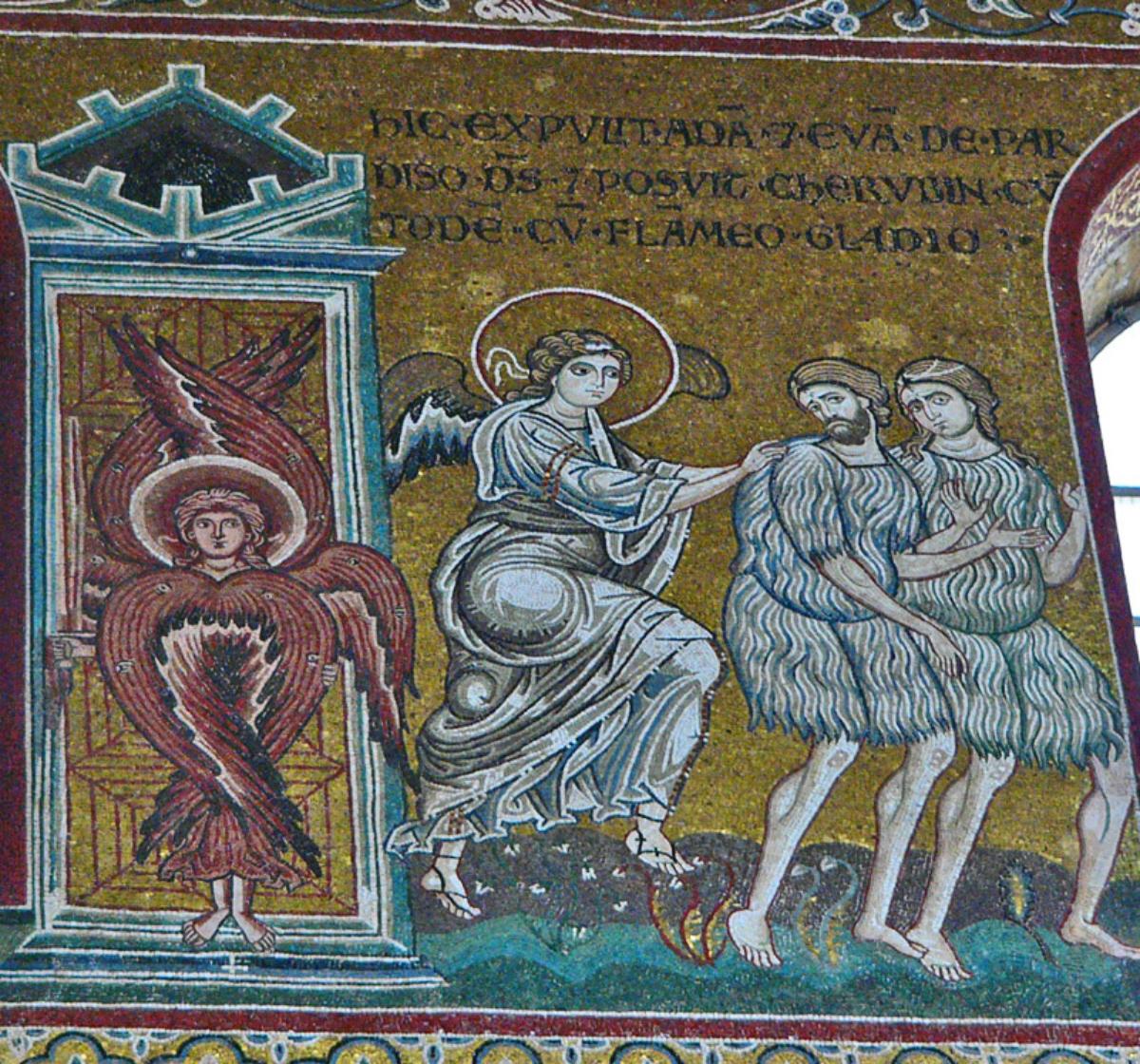
like a heavy nightmare, have weighed on the whole rational, honest world before Christ. “Who would give me wings, to fly away from this life?”: this must be a question asked by many noble and sensitive souls. But whither will you fly, O sinful human soul? Can you still, as in a dream, feel that place of warmth and light from which you have been driven out? Lo, the gates were closed behind you, and Cherubim with flaming swords were placed there, to forbid your approach. Lo, sin has clipped your wings—not birdʼs wings but Divine wings—and has forced you firmly down to the ground.

Someone is needed, first to free you from the weight of sin, to wash you and make you stand erect. And then someone is needed to implant and nourish new wings in you, so that you can fly. Then you need someone, someone very strong, for

whom the Cherubim with flaming swords will stand aside, to let you through to your glorious homeland. Lastly, you need someone who will find mercy for you from your grieved Creator, so that He will receive you once more into the lands of His immortal country. This “someone” was unknown to the pre-Christian world. He revealed Himself as our Lord and Savior Jesus Christ,the Son of the living God. From love for you, He bowed down from Heaven to earth and came down on earth, clothed Himself in flesh, became a prisoner for the sake of you prisoners, suffered sweat and frost, endured hunger and thirst, gave His face to spitting and His body to be nailed to the Cross, lay in the tomb as a corpse, went down to Hades to destroy a prison worse than this life, that was intended for you after your parting from the body—and all this in order to save you from the mire of sin, and set you on your feet. He then rose from the dead, by this means to give you wings for flight to Heaven, and finally ascended into Heaven to open the way to you and bring you into the Angelsʼ abode. You do not now have to sigh in fear, trembling and horror as King David did, nor to desire wings like a dove,for the Eagle has appeared,and has shown and cloven a road through. You have only to nurture the spiritual wings that you were given at your Baptism in His name, and to desire with all your strength to climb up there where He ascended. He has done ninety-nine percent of all that is needed for your salvation; will you not striveto do that one remaining percentage point for your own salvation, and this when, for you, an entrance shall be ministered...abundantly into the everlasting Kingdom of our Lord and Savior Jesus Christ(II St. Peter 1:11)?


The Lordʼs Ascension from earth to Heaven is as unexpected to men as His coming down from Heaven to earth and His birth in the flesh was to

the Angels. What event in His life does not represent something unique and uniquely unexpected to the world? As the Angels watched with wonder how God, at the first creation, separated light from darkness and water from dry

land, how He placed the stars in the heavenly vault, and how He brought forth plants and animals from the dust and finally formed man, giving him a living soul, so each one of us must look with wonder at the events of the Saviorʼs life, beginning with the wondrous Annunciation to the most holy Virgin by the Archangel Gabriel in Nazareth, and then through in order to His mighty Ascension on the Mount of Olives. It is all, at first sight, unexpected, but, when they are made aware of the plan for the dispensation of our salvation, all rational men must shout for joy and glorify Godʼs power, His wisdom, and His love for mankind. You can take no single great event out of

Christʼs life and not disfigure the whole, as you cannot cut off a living manʼs arm or leg and not disfigure him, or remove the moon from the heavenly vault or blot out a part of the starry myriads, and not disfigure the order and beauty of the heavens. So do not think of saying: “It was unnecessary for the Lord to ascend!” When some of the Jews were constrained to acknowledge and cry out:“He hath done all things well!” (Mark 7:37), how can we, who are Baptized in His name, not believe that all He did, He did well: devising

and ordering with great wisdom.

And His Ascension is therefore also good,devised and ordered with great wisdom, as are also His Incarnation, Baptism, Transfiguration and Resurrection.

“It is expedient for you that I go away”(St. John 16:7), said the Lord to His disciples. Do you see how He disposes and does everything as is best for me? Every word and act of His have our good as their aim. His Ascension is of boundless good for us all. Were it not so, He would not have ascended..."
   
(Source: [St.] Nikolai (Velimirovich), Bishop of Ohrid, “Homily 27. The Ascension of the Lord,” in Homilies (Birmingham: Lazarica Press, 1996), Vol. I, pp. 296-299. Source)
  
The Ascension of Christ (source)
  
Christ has risen from the dead, by death he has trampled on death, and to those in the graves given life!
Truly the Lord is risen!


Sunday, February 26, 2012

Selected Quotes of the Fathers on Forgiveness

  
Selected Quotes of the Fathers on Forgiveness
As it is not to be imagined that the fornicator and the blasphemer can partake of the sacred Table, so it is impossible that he who has an enemy, and bears malice, can enjoy Holy Communion. […] I forewarn, and testify, and proclaim this with a voice that all may hear! ‘Let no one who has an enemy draw near the sacred Table, or receive the Lord’s Body! Let no one who draws near have an enemy! Do you have an enemy? Do not approach! Do you wish to draw near? Be reconciled, and then draw near, and only then touch the Holy Gifts!’ (Homily 20)

Thou dost not so much desire thy sins to be forgiven, as He desires to forgive thee thy sins. In proof that thou dost not so desire it, consider that thou hast no mind either to practice vigils, or to give thy money freely: but He, that He might forgive our sins, spared not His Only-Begotten and True Son, the partner of His throne.
St John Chrysostom

‘And forgive us our debts as we also forgive our debtors.’ For we have many sins. For we offend both in word and in thought, and very many things we do worthy of condemnation; and ‘if we say that we have no sin’ (1 John 1.8), we lie, as John says. […] The offenses committed against us are slight and trivial, and easily settled; but those which we have committed against God are great, and need such mercy as is His only. Take heed, therefore, lest for the slight and trivial sins against you, you shut out for yourself forgiveness from God for your very grievous sins. (Catechetical Lectures, 23.16)

For God seeks nothing else from us, save a good purpose. Say not, How are my sins blotted out? I tell thee, By willing, by believing. What can be shorter than this? But if, while thy lips declare thee willing, thy heart be silent, He knoweth the heart, who judgeth thee. Cease from this day from every evil deed. Let not thy tongue speak unseemly words, let thine eye abstain from sin, and from roving after things unprofitable. (Procatechesis)
St Cyril of Jerusalem

Do we forgive our neighbours their trespasses? God also forgives us in His mercy. Do we refuse to forgive? God, too, will refuse to forgive us. As we treat our neighbours, so also does God treat us. The forgiveness or non-forgiveness, then, of your sins—and hence also your salvation or destruction—depend on you yourself, man. For without forgiveness of sins there is no salvation. You can see for yourself how terrible it is.
St Philotheos of Sinai

No one is as good and kind as the Lord is; but He does not forgive one who does not repent.
St Mark the Ascetic

Even if all spiritual fathers, patriarchs, hierarchs, and all the people forgive you, you are unforgiven if you do not repent in action.
St Kosmas Aitolos

Forgiveness is better than revenge.
St Tikhon of Zadonsk

Abba Poemen also said this about Abba Isidore that whenever he addressed the brothers in church he said only one thing, 'Forgive your brother, so that you also may be forgiven.'
From the Sayings of the Desert Fathers

Hence, in whatever state a person is, he sometimes finds himself making pure and intense prayers. For even from that first and lowest sort, which has to do with recalling the future judgment, the one who is still subject to the punishment of terror and the fear of judgment is occasionally so struck with compunction that he is filled with no less joy of spirit from the richness of his supplication than the one who, examining the kindnesses of God and going over them in the purity of his heart, dissolves into unspeakable gladness and delight. For, according to the words of the Lord, the one who realizes that more has been forgiven him begins to love more. (The Conferences)
St John Cassian (the Roman)

In smaller sins, sinners may do penance for a set time and come to public confession according to the rules of discipline. Then they receive the right of communion through the imposition of the hand of the bishop and clergy.

I entreat you, beloved brethren, that each one should confess his own sins while he is still in this world—while his confession can still be received and while the satisfaction and remission made by the priests are still pleasing to the Lord.
St Cyprian of Carthage

He, then, who has received the forgiveness of sins ought to sin no more. For in addition to the first and only repentance from sins (that is, from previous sins in the first and heathen life—I mean those in ignorance), there is forthwith proposed to those who have been called, the repentance which cleanses the seat of the soul from transgressions, that faith may be established. And the Lord, knowing the heart, and foreknowing the future, foresaw both the fickleness of man and the craft and subtlety of the devil from the first, from the beginning; how that, envying man for the forgiveness of sins, he would present to the servants of God certain causes of sins; skilfully working mischief, that they might fall together with himself. Accordingly, being very merciful, He has vouchsafed, in the case of those who, though in faith, fall into any transgression, a second repentance, so that should any one be tempted after his calling, overcome by force and fraud, he may receive still a repentance not to be repented of. ‘For if we sin willfully after that we have received the knowledge of the truth, there remaineth no more sacrifice for sins, but a certain fearful looking for of judgment and fiery indignation, which shall devour the adversaries.’ But continual and successive repentings for sins differ nothing from the case of those who have not believed at all, except only in their consciousness that they do sin. And I know not which of the two is worst, whether the case of a man who sins knowingly, or of one who, after having repented of his sins, transgresses again. For in the process of proof sin appears on each side—the sin which in its commission is condemned by the worker of the iniquity, and that of the man who, foreseeing what is about to be done, yet puts his hand to it as a wickedness. And he who perchance gratifies himself in anger and pleasure, gratifies himself in he knows what; and he who, repenting of that in which he gratified himself, by rushing again into pleasure, is near neighbour to him who has sinned wilfully at first. For one, who does again that of which he has repented, and condemning what he does, performs it willingly. (Stromata, Book 2.13)
St Clement of Alexandria

If your heart has been softened either by repentance before God or by learning the boundless love of God towards you, do not be proud with those whose hearts are still hard. Remember how long your heart was hard and incorrigible. Seven brothers were ill in one hospital. One recovered from his illness and got up and rushed to serve his other brothers with brotherly love, to speed their recovery. Be like this brother. Consider all men to be your brothers, and sick brothers at that. And if you come to feel that God has given you better health than others, know that it is given through mercy, so in health you may serve your frailer brothers. (Prologue, 31 March)
St Nikolai of Serbia (Velimirovic)

Often during the day I have been a great sinner, and at night, after prayer, I have gone to rest, justified and whiter than snow by the grace of the Holy Spirit, with the deepest peace and joy in my heart! How easy it will be for the Lord to save us too in the evening of our life, at the decline of our days! O save, save, save me, most gracious Lord; receive me in Thy heavenly Kingdom! Everything is possible to Thee! (My Life in Christ, Part 1, p. 27)
St John of Kronstadt
(http://www.monachos.net/content/liturgics/seasonal/index.php?option=com_content&view=article&id=706&catid=63)

  
Forgive me the sinner, my brethren, and may God grant us all forgiveness!
Through the prayers of our Holy Fathers, Lord Jesus Christ our God, have mercy on us and save us! Amen!

Wednesday, September 21, 2011

The Holy Prophet Jonah

The Holy Prophet Jonah - Commemorated on September 21 (Greek) / 22 (Russian) (http://pravicon.com/images/sv/s1018/s1018006.jpg)

The Holy Prophet Jonah lived in the eighth century before the birth of Christ and was a successor of the Prophet Elisha.

[It is said that he was that son of the widow of Zarephath in Sidon whom the Prophet Elias had raised from the dead. (http://www.westsrbdio.org/prolog/prolog.htm)]

The Book of the Prophet Jonah contains prophecies about the judgments on the Israelite nation, the sufferings of the Savior, the downfall of Jerusalem, and the end of the world. Besides the prophecies, the Book of Jonah relates how he was sent to the Ninevites to preach repentance (Jon. 3: 3-10).

Icon depicting Jonah fleeing from the Lord on the ship, being thrown overboard, being disgorged by the sea beast, and preaching repentance to the people of Ninevah. Note that the full story is read annually in the Vespers of Holy Saturday (http://anastasis.org.uk/HWSat-V.htm) (http://pravicon.com/images/sv/s1018/s1018009.jpg)

Our Lord Jesus Christ, addressing the Scribes and the Pharisees who demanded a sign from Him, said that no sign would be given except for the sign of the Prophet Jonah, "As Jonah was in the belly of the whale three days and three nights, so also shall the Son of Man be in the heart of the earth three days and three nights (Mt. 12: 40). From these words the Lord shows clearly the symbolic meaning of the Book of the Prophet Jonah in relation to Christ's death on the Cross, descent into Hell, and the Resurrection.

Reproaching the lack of penitence and recalcitrance of the Jews, the Lord said, "The Ninevites shall rise in the judgment with this generation and will condemn it, because they repented at the preaching of Jonah; and one greater than Jonah is here" (Mt. 12: 41).
(http://ocafs.oca.org/FeastSaintsViewer.asp?SID=4&ID=1&FSID=102696)

Prophet Jonah being disgorged by the sea beast, prefiguring Christ's Third-Day Resurrection (http://pravicon.com/images/sv/s1018/s1018007.jpg)

HYMN OF PRAISE
by St. Nikolai Velimirovitch

The Holy Prophet Jonah
Nineveh! Nineveh resounds with sin,
And God sends Jonah to heal Nineveh.
Jonah does not want to, and flees from God!
Oh, where will you go, Jonah, to hide from the Most High?
Jonah sleeps; he sleeps and the tempest rises.
God moves slowly, but He will find you in time.
Hurled into the waves, swallowed by the whale,
``From whom did I flee?'' Jonah asks himself.
``I fled from Him, from Whom one cannot hide!''
God chastises Jonah and yet delivers him,
And, by His providence, glorifies him forever.
Jonah, you do not want to speak to the Ninevites,
But through your punishment you will prophesy the immortal Christ.
You do not want to by words? Then you must, by deeds,
Prophesy Christ and the death and resurrection of the body!
Your deeds, Jonah, will not fade away,
And Christ the Lord will speak of you to men,
That, through you, the mercy of the Living God might be revealed,
By which you will be saved, as well as Nineveh.
Through you, the power of repentance shall be revealed-
The power of repentance and God's forgiveness.
You pitied the gourd, and God pitied men.
Help us to repent, O God, and save us from condemnation.

Prophet Jonah being spit up by the sea beast, and being protected by the shade of the plant.
"And God said to Jonas: Are you then so very grieved over the gourd [which withered in the sun]? And he said: I am very grieved, even to death. And the Lord said: You had pity for the gourd, for which you had suffered no evil, nor did you rear it; it came into being before night, and perished before night. And I, shall I not have pity for Nineve the great city..." (Fourth Reading of the Vespers of Holy Saturday (http://anastasis.org.uk/HWSat-V.htm)) (http://pravicon.com/images/sv/s1018/s1018003.jpg)

Troparion - Tone 2
The memory of your Prophet Jonah, we celebrate today, O Lord. By his prayers we entreat you: O Christ God, save our souls!


Through the prayers of our Holy Fathers, Lord Jesus Christ our God, have mercy on us and save us! Amen!

Thursday, September 15, 2011

St. Niketas the Great Martyr, the Goth

St. Niketas the Great Martyr, the Goth - Commemorated on September 15 (http://pravicon.com/images/sv/s1523/s1523006.jpg)

"The Holy Great Martyr Nicetas was a Goth (a Germanic tribe). He was born and lived on the banks of the Danube River, and suffered for Christ in the year 372. The Christian Faith was then already widely spread throughout the territory of the Goths. St Nicetas believed in Christ and accepted Baptism from the Gothic bishop Theophilus, a participant in the First Ecumenical Council. Pagan Goths began to oppose the spread of Christianity, which resulted in internecine strife.

After the victory of Fritigern, heading a Christian army and inflicting defeat on the pagan Athanaric, the Christian Faith began to spread increasingly among the Goths. The Arian bishop Ulfilas, the successor to Bishop Theophilus, created a Gothic alphabet and translated into the Gothic language many priestly books. St Nicetas worked intensely among his fellow Goths at spreading Christianity. By his personal example and inspired words he brought many pagans to the Christian Faith.

However, after his defeat Athanaric again contrived to gather his own forces, return to his own country and regain his former power. Since he remained a pagan, he continued to hate Christians and persecute them.


[When the Gothic prince Athenarik began to torture Christians, St. Nicetas stood before the prince and denounced him for his paganism and inhumanity. Subsequently harshly tortured, Nicetas confessed his faith in Christ even more strongly, and prayed to God with thanksgiving. His mind was unceasingly raised up to God, and on his breast under his robe he bore an icon of the Most-holy Theotokos with the Pre-eternal Christ Child standing and holding the Cross in His hands. St. Nicetas carried this icon because the Holy Theotokos had appeared to him and comforted him. (http://www.westsrbdio.org/prolog/prolog.htm)]

St Nicetas endured many tortures, and died after being thrown into a fire. His body remained unharmed by the fire and was illumined by a miraculous light. By night, a friend of the martyr, a Christian named Marianus, retrieved the body of St Nicetas,and buried it in Cilicia. Afterwards, it was transferred to Constantinople. Part of the relics of the Great Martyr Nicetas were later transferred to the monastery of Vysokie Dechani in Serbia. St Nicetas received an unfading crown of glory from Christ in the year 372.

We pray to St Nicetas for the preservation of children from birth defects."
(http://ocafs.oca.org/FeastSaintsViewer.asp?SID=4&ID=1&FSID=102615)

The Martyrdom of St. Niketas the Great Martyr (http://pravicon.com/images/sv/s1523/s1523003.jpg)

HYMN OF PRAISE
The Holy Martyr Nicetas
by St. Nikolai Velimirovitch
He is a true patriot who, among his own people,
Erects a true altar to the Living Lord.
Athenarik the Goth ruled by force,
And offered sacrifices to lifeless idols.
But holy Nicetas, the soldier of Christ God,
Was a preacher of eternal salvation.
He cast rays of the Eternal Light throughout the night,
Dispersing the idolatrous darkness that shrouded souls.
Holy Nicetas opposed the prince,
And his brave endurance amazed his people.
By the power of the Honorable Cross, he confounded the darkness
And filled all the people with the fear of God.
His blood was the rosy hue of the new dawn,
And his spirit was raised up to the heavenly courts.
In the terrible fire, Nicetas burned,
But, not even today, has he been consumed.
With the truth of Christ the Goths were baptized,
And they glorified Nicetas, their wonderful one.
O Saint Nicetas, voice of God's trumpet,
Courageous martyr, true patriot;
From the tents of the earth you have departed,
And you stand in the royal courts with the angels.
Pray for us, for the King listens to you,
That He grant our souls mercy.


Troparion - Tone 3
You defeated error and triumphed in martyrdom, Nicetas, namesake of victory; for you conquered the ranks of the enemy and ended your contest by fire. Pray to Christ our God to grant us His great mercy.

Kontakion - Tone 2
You stood firm and defeated delusion and have received your martyr's crown, Nicetas, namesake of victory; you are rejoicing with the angels, together with them you are praying unceasingly to Christ God for us all.


Through the prayers of our Holy Fathers, Lord Jesus Christ our God, have mercy on us and save us! Amen!


Thursday, August 4, 2011

The Holy Seven Youths of Ephesus

The Holy Seven Youths and Martyrs of Ephesus - Commemorated on August 4 and October 22 (http://www.korners.com.ua/russian/painters/912)


"The Seven Youths of Ephesus: Maximilian, Iamblicus, Martinian, John, Dionysius, Exacustodianus (Constantine) and Antoninus, lived in the third century. St Maximilian was the son of the Ephesus city administrator, and the other six youths were sons of illustrious citizens of Ephesus. The youths were friends from childhood, and all were in military service together.

When the emperor Decius (249-251) arrived in Ephesus, he commanded all the citizens to offer sacrifice to the pagan gods. Torture and death awaited anyone who disobeyed. The seven youths were denounced by informants, and were summoned to reply to the charges. Appearing before the emperor, the young men confessed their faith in Christ.

Their military belts and insignia were quickly taken from them. Decius permitted them to go free, however, hoping that they would change their minds while he was off on a military campaign. The youths fled from the city and hid in a cave on Mount Ochlon, where they passed their time in prayer, preparing for martyrdom.

The youngest of them, St Iamblicus, dressed as a beggar and went into the city to buy bread. On one of his excursions into the city, he heard that the emperor had returned and was looking for them. St Maximilian urged his companions to come out of the cave and present themselves for trial.

Learning where the young men were hidden, the emperor ordered that the entrance of the cave be sealed with stones so that the saints would perish from hunger and thirst. Two of the dignitaries at the blocked entrance to the cave were secret Christians. Desiring to preserve the memory of the saints, they placed in the cave a sealed container containing two metal plaques. On them were inscribed the names of the seven youths and the details of their suffering and death.

The Lord placed the youths into a miraculous sleep lasting almost two centuries. In the meantime, the persecutions against Christians had ceased. During the reign of the holy emperor Theodosius the Younger (408-450) there were heretics who denied that there would be a general resurrection of the dead at the Second Coming of our Lord Jesus Christ. Some of them said, "How can there be a resurrection of the dead when there will be neither soul nor body, since they are disintegrated?" Others affirmed, "The souls alone will have a restoration, since it would be impossible for bodies to arise and live after a thousand years, when even their dust would not remain." Therefore, the Lord revealed the mystery of the Resurrection of the Dead and of the future life through His seven saints.

The owner of the land on which Mount Ochlon was situated, discovered the stone construction, and his workers opened up the entrance to the cave. The Lord had kept the youths alive, and they awoke from their sleep, unaware that almost two hundred years had passed. Their bodies and clothing were completely undecayed.

Preparing to accept torture, the youths once again asked St Iamblicus to buy bread for them in the city. Going toward the city, the youth was astonished to see a cross on the gates. Hearing the name of Jesus Christ freely spoken, he began to doubt that he was approaching his own city.

When he paid for the bread, Iamblicus gave the merchant coins with the image of the emperor Decius on it. He was detained, as someone who might be concealing a horde of old money. They took St Iamblicus to the city administrator, who also happened to be the Bishop of Ephesus. Hearing the bewildering answers of the young man, the bishop perceived that God was revealing some sort of mystery through him, and went with other people to the cave.

At the entrance to the cave the bishop found the sealed container and opened it. He read upon the metal plaques the names of the seven youths and the details of the sealing of the cave on the orders of the emperor Decius. Going into the cave and seeing the saints alive, everyone rejoiced and perceived that the Lord, by waking them from their long sleep, was demonstrating to the Church the mystery of the Resurrection of the Dead.

Soon the emperor himself arrived in Ephesus and spoke with the young men in the cave. Then the holy youths, in sight of everyone, lay their heads upon the ground and fell asleep again, this time until the General Resurrection.

The emperor wanted to place each of the youths into a jeweled coffin, but they appeared to him in a dream and said that their bodies were to be left upon the ground in the cave. In the twelfth century the Russian pilgrim Igumen Daniel saw the holy relics of the seven youths in the cave.

There is a second commemoration of the seven youths on October 22. According to one tradition, which entered into the Russian PROLOGUE (of Saints' Lives), the youths fell asleep for the second time on this day. The Greek MENAION of 1870 says that they first fell asleep on August 4, and woke up on October 22.

There is a prayer of the Seven Sleepers of Ephesus in the GREAT BOOK OF NEEDS (Trebnik) for those who are ill and cannot sleep. The Seven Sleepers are also mentioned in the service for the Church New Year, September 1."
(http://ocafs.oca.org/FeastSaintsViewer.asp?SID=4&ID=1&FSID=102195)


HYMN OF PRAISE: THE SEVEN HOLY YOUTHS OF EPHESUS
by St. Nikolai Velimirovich
When the last rays of the sun turned the west bloody red,
Seven Youths, to God prayed,
That, on the morrow again find themselves alive and healthy,
Before Emperor Decius, brought forth to torture.
And lay down to sleep a long dream, a deep dream,
Time walked by a wide step.
One morning, from the east, the sun dawned
And the Seven from their deep sleep awakened.
And Jamblichus the youngest, to Ephesus hurried
To see, to hear, about everything he inquired,
Does Decius, even them, seek to slaughter,
And bread to buy for the Seven of them.
But behold, what kind of miracle: this is not the gate!
And even the town is totally different!
Everywhere, beautiful churches, domes, crosses,
Jamblichus asks himself: are those not dreams?
Nowhere a familiar face, nowhere kinsmen,
There are no persecutions; there are no martyrs.
"Tell me brethren, the name of this town,
And tell me the name of the emperor, who now reigns?"
Thus Jamblichus inquires. The people, at him, look,
And about him, everyone judges differently.
"This town is Ephesus, now and before,
In Christ, reigns Emperor Theodosius."
This Antipater [The Consul] heard and [Martin] the graying bishop,
The entire town was perplexed,
Everyone, to the cave hurries.
And saw the miracle, glorified God,
And the resurrected servants of Christ the Resurrected One.


Prayer from the Great Euchologion "For One Who Is Ill And Cannot Sleep"

Priest: Let us pray to the Lord.

People: Lord, have mercy.
Priest: O God, Great, Praised, Incomprehensible and Ineffable, Who didst fashion man with Thy hands, taking dust from the earth, and Who didst honor him with Thine Image, O Jesus Christ, Most-desired Name, together with Thy Father Who is without beginning, and Thy Most-Holy, Good, and Lifegiving Spirit: Do Thou manifest unto Thy servant, N., and visit him (her) in soul and body, being entreated by our most-glorious Sovereign Lady, the Theotokos and Ever-Virgin Mary; by the holy Bodiless Powers of Heaven; by the honorable and glorious Prophet, Forerunner and Baptist John; by the holy, glorious and all-praised Apostles; by the holy, glorious and right-victorious Martyrs; by our Fathers among the Saints and ecumenical Teachers: Basil the Great, Gregory the Theologian, and John Chrysostom; by Athanasius and Cyril, Nicholas of Myra in Lycia, Cyril and Methodius, Teachers of the Slavs, Spyridon the Wonderworker, and all the holy Hierarchs; by the holy Apostle, Protomartyr and Archdeacon Stephen; by the holy, glorious Greatmartyrs: George the Trophy-bearer, Demetrius the Myrrgusher, Theodore Stratelates, and all the holy Martyrs; by our Venerable and Godbearing Fathers: Anthony, Euthymius, Savvas the Sanctified, Theodosius (Founder of the Common Life), Onouphrius, Arsenius, Athanasius the Athonite, and all the Venerable Ones; by the holy Unmercenary Physicians: Cosmas and Damian, Cyrus and John, Panteleimon and Hermalaeus, Samson and Diomedes, Thalelaeus and Tryphon, and all the rest; by Saint(s), N. (of the Day); and by all Thy Saints; and grant unto him (her) a peaceful sleep, the sleep of bodily health and salvation, and life and strength of soul and body, as once Thou didst visit Abimelech, Thy favorite, in the house of Agrippa, and gavest him the consolation of sleep, that he not see the Fall of Jerusalem, and having nourished him with sleep, didst raise him up again in the twinkling of an eye, to the glory of Thy goodness; and as Thou didst make manifest Thy holy glorious Seven Youths, confessors and witnesses of Thine Appearance in the days of the Emperor Decius and the Apostate, having sustained them in the cave for 372 years[1], as infants kept warm in their own mother's womb, none having endured corruption, to the praise and glory of Thy love for mankind, and for a testimony and confession of our regeneration and the resurrection of all. Do Thou Thyself, therefore, O Lover of Mankind and King, be present now also with the infusion of Thy Holy Spirit, and visit Thy servant, N., and grant unto him (her) health, strength and power, by Thy grace, for with Thee every action is good, and every gift is perfect. For Thou art the Physician of our souls and bodies, and unto Thee do we send up glory, thanksgiving and worship, together with Thy Father Who is without beginning, and Thy Most-Holy, Good, and Lifegiving Spirit, now and ever, and unto the ages of ages. Amen.
1. It was actually about 184 years.
From The Great Book of Needs (vol. III), St. Tikhon's Seminary Press, 2002, pp. 4-5.
(http://www.johnsanidopoulos.com/2011/08/prayer-of-holy-seven-youths-for-one-who.html)


Holy Seven Youths of Ephesus, Troparion, in Tone IV
In their sufferings, O Lord,/ Thy martyrs received imperishable crowns from Thee, our God;/ for, possessed of Thy might,/ they set at nought the tormentors and crushed the feeble audacity of the demons.// Through their supplications save Thou our souls.

Or this troparion, in the same tone
Great is the wonder of faith!/ The seven holy youths abode in the cave/ as in a royal chamber,/ and died without falling into corruption;/ and after much time they arose as from sleep,/ as an assurance of the resurrection of all men.// Through their supplications, O Christ God, have mercy on us.

Kontakion, in Tone IV, "Having been lifted up..."
Spurning the corrupt things of this world and accepting gifts of incorruption,/ though they died yet did they remain untouched by corruption./ Wherefore, they arose after many years,/ burying all the unbelief of the wicked.// O ye faithful, praising them today in laudation, let us hymn Christ!

Through the prayers of our Holy Fathers, Lord Jesus Christ our God, have mercy on us and save us! Amen!

Sunday, July 31, 2011

The Procession of the Venerable Wood of the Life-Creating Cross of the Lord

The Procession of the Venerable Wood of the Life-Creating Cross of the Lord - Commemorated on August 1 (02846_hires.jpg)

The Procession of the Venerable Wood of the Life-Creating Cross of the Lord: In the Greek Horologion of 1897 the derivation of this Feast is explained: "Because of the illnesses that occur in August, it was customary, in former times, to carry the Venerable Wood of the Cross through the streets and squares of Constantinople for the sanctification of the city, and for relief from sickness. On the eve (July 31), it was taken out of the imperial treasury, and laid upon the altar of the Great Church of Hagia Sophia (the Wisdom of God). From this Feast until the Dormition of the Most Holy Theotokos, they carried the Cross throughout the city in procession, offering it to the people to venerate. This also is the Procession of the Venerable Cross." 

In the Russian Church this Feast is combined also with the remembrance of the Baptism of Rus, on August 1, 988. In the "Account of the Order of Services in the Holy, Catholic and Apostolic Great Church of the Dormition," compiled in 1627 by order of Patriarch Philaret of Moscow and All Rus, there is the following explanation of the Feast: "On the day of the Procession of the Venerable Cross there is a church procession for the sanctification of water and for the enlightenment of the people, throughout all the towns and places." 

Knowledge of the day of the actual Baptism of Rus was preserved in the Chronicles of the sixteenth century: "The Baptism of the Great Prince Vladimir of Kiev and all Rus was on August 1." 

In the present practice of the Russian Church, the Lesser Sanctification of Water on August 1 is done either before or after Liturgy. Because of the Blessing of Water, this first Feast of the Savior in August is sometimes called 'Savior of the Water." There may also be a Blessing of New Honey today, which is why the Feast is also called "Savior of the Honey." From this day the newly gathered honey is blessed and tasted.

(http://oca.org/FSlives.asp)


The Elevation of the Precious Cross (00817_hires.jpg)


HYMN OF PRAISE
THE HONORABLE CROSS OF CHRIST
by St. Nikolai Velimirovitch
The Honorable Cross of Christ
Before it, all honorably prostrate,
By the power of the Cross of Christ
From temptation, we are redeemed.
The Holy Cross is mightier than the demons
And from every earthly king,
From sickness, the Cross saves
And from the assaults of barbarians.
Prince Andrew, by the power of the Cross
Enslaved lands, saved,
King Manuel, by the power of the Cross
The Saracens, gloriously destroyed.
From the armies of pagans,
From the tyrannical conquerors,
From all evils demonstrated that
The power of the Cross is mightier.


Stichera of the precious Cross. Tone 4. As noblest of Martyrs.
As general protection, as source of sanctification, let us embrace the precious Cross; for it calms sufferings, brings an end to diseases and delivers sufferers from pains of every kind. More than the great deep it forms a sea with streams of wonders for those who faithfully venerate and reverence its image.


We mortals, who sail among the waves of life and are storm-tossed by a tempest of sufferings, let us with faith take refuge in the precious Tree as a vessel of salvation, and it will silence the waves and the winds and break the passions, and we will reach in joy the haven of salvation without storms.


The all-holy Cross has shone more brightly than the sun, shedding wonders like sunbeams and healings like flashes of lightning. Let us mortals, ever held fast by the darkness of dread dangers, draw near and we shall receive the light-bringing grace of healings as we magnify the God who was nailed to it in the flesh.


Doxastikon of the Aposticha of the Cross in the Plagal of the Fourth Tone
Both now and ever, and unto the ages of ages. Amen.
The saying of your Prophet Moses has been fulfilled, O God, which said, ‘See your life hanging before your eyes.’*** Today the Cross is exalted and world is freed from error. Today the Resurrection of Christ is consecrated, and the ends of the earth rejoice as with David’s cymbals they offer you their hymn and say, ‘You have wrought salvation in midst of the earth, O God, good and the lover of mankind: the Cross and Resurrection, through which you have saved us. All-powerful Lord, glory to you.’


[***"καὶ ἔσται ἡ ζωή σου κρεμαμένη ἀπέναντι τῶν ὀφθαλμῶν σου" (Deuteronomy 28:66)]


Canon of the Cross. Ode 9. Heaven was amazed.
Once fixed to the Cross with nails through feet and hands, pierced in the side, your thirst quenched with vinegar and gall, you healed my wounds, O King of all, supremely good, the joy, the sweetness, glory and eternal redemption of all.


Fair beyond sapphire and gold, bright as the sun you are, divine Cross, lying circumscribed by place and ever manifestly surrounded by spiritual Powers, yet enlightening every part of the inhabited world with rays of the divine power.


The Cross is the harbour of the storm-tossed, guide and support of the wandering, glory of Christ, strength of Apostles and Prophets, boast of Champions, refuge of all mortals. As we all see it set fourth in the midst, we greet it with loving devotion.


When you are about to come on earth to judge the world which you fashioned, Lord, with the Angelic hosts marching ahead and the Cross shining out more brightly than the beams of the sun, take pity on me by its power and save me who fallen more than all mortals.


Cross-Theotokion.
‘Without corruption I gave birth to you from the womb, whom the Father begot before the ages; how do corrupt mortals rend you, my Son, and inhumanly gouge your side with a lance, your hands and feet with nails?’ cried the All-pure, whom we fittingly magnify.


During the veneration of the Cross, we sing the following Idiomel Sticheron.
Tone 2.
Come, believers, let worship the life-giving Tree on which Christ the King of glory willing stretched out his hands and raised up to the ancient blessedness us whom of old the foe, luring us through pleasure, had made exiles from God. Come, believers, let us worship the Tree though which we have counted worthy to crush the heads of invisible enemies. Come, all you families of nations, let us honour with hymns the Cross of the Lord. Hail, O Cross, the complete redemption of Adam. In you our faithful Sovereigns boast, as by your power they mightily defeat the people of Ishmael. We Christians, as with fear we now lovingly greet you, glorify God who was nailed to you, as we say, ‘O Lord, who were nailed upon it, have mercy on us as you are good and love mankind’.


All texts and translations on this page are copyright to
Archimandrite Ephrem ©
This page was last updated on 10 May 2009 
(http://anastasis.org.uk/1august.htm)


Through the prayers of our Holy Fathers, Lord Jesus Christ our God, have mercy on us and save us! Amen!