Showing posts with label The Holy Myrrhbearers. Show all posts

Saturday, May 2, 2020

"Where are the seals on the grave? Where are Pilate's guard of soldiers, closely guarding?"

Christ is risen! Truly He is risen!
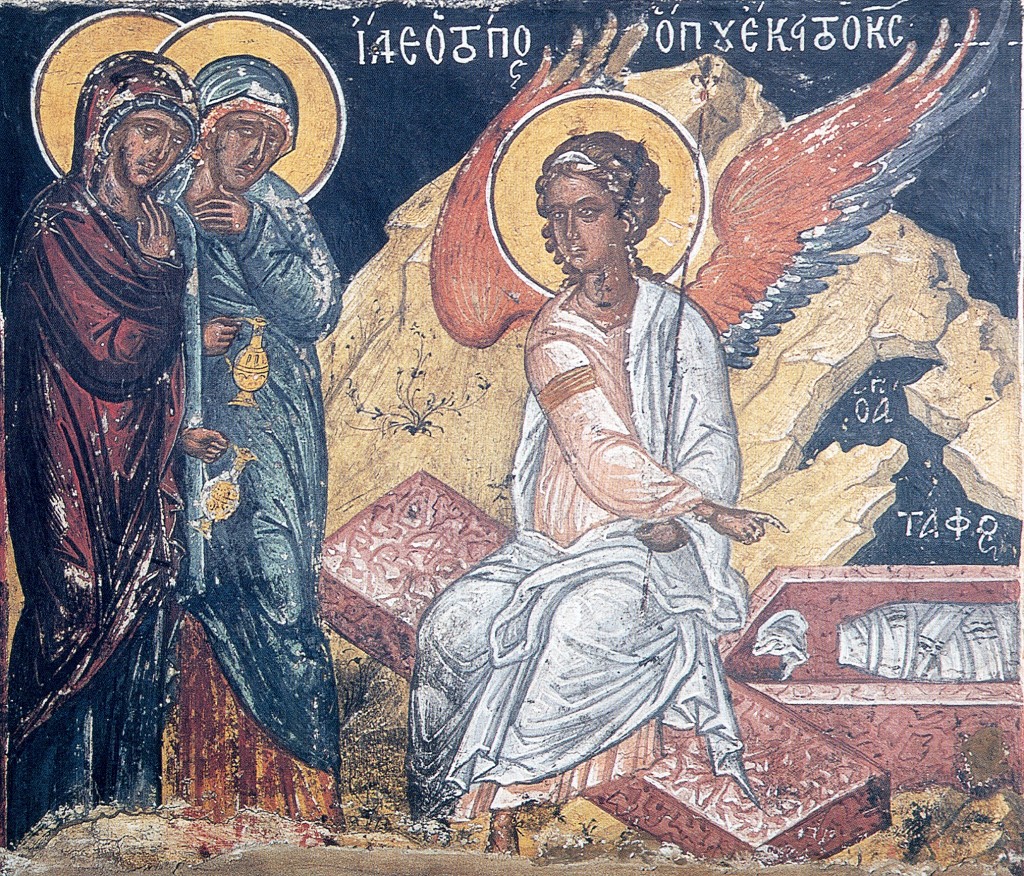
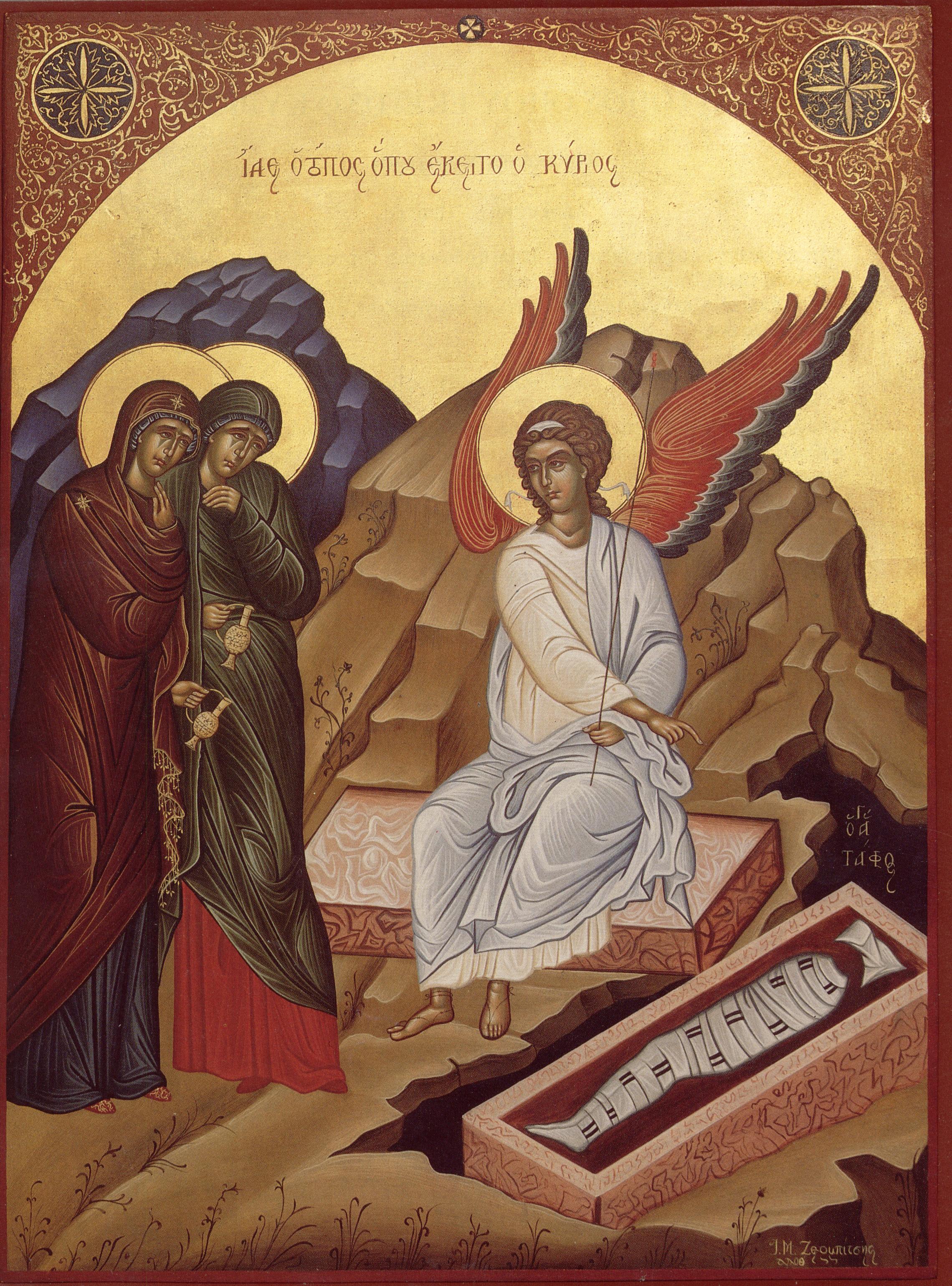
The Holy Myrrhbearers seeing the Angel at the empty Tomb of Christ (source)
 
The Myrrhbearing Women went in early morning to bring spices to the tomb of the Lord, and when they saw the stone was rolled away, their hope was shaken, and they said to one another: "Where are the seals on the grave? Where are Pilate's guard of soldiers, closely guarding?" But a shining Angel became the messenger of hidden things to the women, and he said to them: "Why do you seek the Living among the dead, Who gave life to the race of men? Christ our God has risen from the dead, as the Almighty One, granting to all of you incorruption and life, illumination, and the great mercy.
-Idiomelon of the Stichera from the feast of the Holy Myrrhbearers, by Anatolios

(source)

Christ is risen from the dead, by death, trampling down upon death, and to those in the tombs, He has granted life!
Truly, the Lord is risen!

Sunday, April 19, 2020

Photios Kontoglou on the Resurrection of Christ

Christ is risen! Truly He is risen!
Fresco of the Resurrection of Christ by Kontoglou, from the Church of Panagia Kapnikarea, Athens (source)

Photios Kontoglou: "Let us purify our senses..."
Orthodox Christians, today, the God-inspired tongue of the melodist, St. John of Damascus, says: "Let us purify our senses and we will see the unapproachable light of the Resurrection, and we will behold Christ shining forth, and we will hear Him say "Rejoice", as we sing the hymn of victory". (Canon of Pascha) Therefore, he cries to us to purify our senses, so that we might behold Christ Who is risen from the grave. We should purify our senses, because they are unclean, soiled, because we use them for fleshly and material ends.

And how are the senses cleansed? If our heart and mind are cleansed with spiritual nourishment, and with the grace of the Holy Spirit, then our senses will also be cleansed, and will changed from fleshly to spiritual. The melodist says this because he was taught this by our Lord and Savior Himself, when He said during the Beatitudes: "Blessed are the pure in heart, for they shall see God." And if we cleanse our senses, he says that we will see Christ "shining forth", with lightning, not dull, but most pure and shining with the uncreated Light of the Resurrection, "the unapproachable light of the Resurrection." And not only will be see Him "clearly", but we will hear Him also say (for this is why all of our senses must be pure), and His voice will not come from afar, that we might be unsure if we actually heard Him, but we will hear "clearly", with power.

We do not only soil our senses when we use them for fleshly deeds and activities, in other words, to use them for pleasures of the body, but when we use them for some deeds which even the world calls "spiritual", while they are in reality fleshly, and in some ways are even more evil than those that appear fleshly.***

These "spiritual" deeds are the evil thoughts which our nous has, seeking divine things, but are impious ones, and with these our pride is spread and our brazenness before God, because we give food to our vanity, so we appear to know more than others, while the wise Solomon said: "The beginning of wisdom (in other words, wisdom according to God) is the fear of the Lord". With these rummaging and with these philosophies, the Christian truly pollutes his senses, blunts them, and instead of making them spiritual, makes them organs of coarseness, because with them we have been studying coarse, physical things, and not spiritual things. Because, as I had said before, all of these activities appear spiritual, but in reality they are fleshly, according to the Apostle Paul, who says that we have made "the nous to be flesh", as he writes to the Colossians: "Let no one disqualify you, insisting on self-abasement and worship of angels, taking his stand on visions, puffed up without reason by his sensuous mind." (Colossians 2:18) And in the Epistle to the Ephesians he writes: "They are darkened in their understanding, alienated from the life of God because of the ignorance that is in them, due to their hardness of heart." (Ephesians 4:18) Why, therefore, does he say "you must no longer live as the Gentiles do, in the futility of their minds" (Ephesians 4:17)? Is he not speaking of those vain rummages which the philosophers do, even if done by those who appear more spiritual? Because that which they are speaking of is of the flesh (for "from the flesh come the things of the flesh"), in other words, we make spiritual things fleshly. Whoever seeks and studies with this fleshly spirit, first will loose the virginal simplicity of the mind, with which he was first blessed (this is the first blessedness), which our sweetest Christ has bestowed on them, saying: "Blessed are the poor in spirit". Later, he who uses his mind to excavate divine things troubles God, Who is hidden beneath undiscerning minds and covered by a dark cloud, and this is revealed by the mouth of the Prophet Isaiah, as he said: ""I revealed myself to those who did not ask for me; I was found by those who did not seek me." (Isaiah 65:1) St. Cyril of Alexandra says: "Faith is not something that is obtained, for it is a way of hope that beholds where there is no hope, and faith that searches for that which is lacking and cannot be found, faith is not according to the same reason as hope." And St. Basil the Great says: "The simple faith is more mighty than rational words of proof."

And many Christians pollute themselves even today, and even more so follow this form of rummage and searching  "distanced from the life of God", as St. Paul said of the Gentiles, and we stir up the faith, which these unfortunate people do not even recognize, and they "water it down" with various sciences and philosophies, with "commonly-held beliefs", while their vain thought becomes something "vain and false", abolished by arrogance and deafness to the holy Tradition of Orthodoxy, until Christianity becomes a systematic way of life, without revelation of Immortality, in other words, without Christ. And they wish to teach the simple and innocent sheep of Christ, Who blessed them with the Beatitudes, especially with the first and the eighth.

Therefore, how can people like this celebrate Christ Risen from the dead? How strange and paradoxical! Do philosophers and scientists believe? But whoever believed in a philosophy? I ask to learn. With Christ, philosophy is finished and buried for whoever believed in Him. Let us listen to St. Paul cry out: "The ancient things have passed away, for behold all things have been made new." What are the ancient things? "The vanity of the nous", the wise and mellifluous weavers of words, in order to falsely appear humble, while their pride is reavealed by their messages, like the ethical philosophers before Christ, and the current "ethical" Christians today. "Behold, all things have been made new." A voice bearing the hope of the blessed Paul, which again speaks to our heart, saying the "Rejoice" of his and our Risen Lord! "Yes, all things have been made new!" We have become new, because the Resurrection of Christ is something "new and strange", and this "newness" has made all things new, because all former things have been deposed. The old things have been deposed by Him Who "deposed death", because wherever is "The Author of Life" is lacking, there death reigns. He deposed the curse of the flesh and brought the blessing of the Spirit. He deposed knowledge and brought the Faith ("Righteousness is found from the faith").

The old things were Knowledge, searching, and man seeking blindly and not finding anything. The new is the Faith, which opens the spiritual eyes of man and beholds the Sun of Righteousness "Christ shining forth with the unapproachable light of the Resurrection." He is sufficient for all, our mind does not need anymore to seek like the philosophers of the nations, for "The Way" has been found, in other words, as He Himself said cleanly and in few words: "All things have been delivered to me by my Father; and no one knows the Son except the Father, and no one knows the Father except the Son and any one to whom the Son chooses to reveal him." (Matthew 11:27)

"Any one to whom the Son chooses to reveal Him", anyone to whom the Son wishes to reveal, can come to know the Father. Where are you going, therefore, O Christian, to come to know God and Christ, you who are blind, weak, impure, with your own power, while our Lord Himself said that only the Father can illumine the mind to come to know Christ, and Christ to come to know the Father? And you don't dare lower yourself to pray and to entreat Him to enlighten you, but you become filled with impious seeking, like the ancients beforehand who had not yet heard of Christ, speaking words with authority?  Elsewhere He says: "I am the door, I am the way, I am the teacher, I am the light, I am the physician, the intercessor" (I Timothy 2:2), the shepherd, the Rabbi. He is the "First-born of new creation", Who made "all things new", and also made "new men", "granting life to those in the graves."

Yes, with the Resurrection of Christ, all things have been made new. Because of this, the melodist says with joy and exaltation: "Come let us drink a new drink, not one marvelously brought forth from a barren rock (of philosophy), but the spring of incorruption which springs forth from the grave of Christ, in Whom we are fortified," and "Come, let us partake of the new vine of divine rejoicing on the auspicious day of the Resurrection, let us commune with the Kingdom of Christ, hymning Him as God unto the ages." (Canon of Pascha)

O Christians, my brethren, you who occupy yourselves [solely] with the sciences and with philosophies, hearken to our Lord Who speaks through the mouth of the prophet: "They have left me, Who am the spring of life, and have dug dry pits that have no water." And He says with His own mouth in the Gospel "Whoever puts his hand to the plow and looks back (in other wards, does not deny worldly knowledge which consumed men before I came into the world) is not fit for the Kingdom of God" (Luke 9:62) And He said another time: "you do not put new wine into old wine skins".

Let us therefore purify our minds from the filth of all forms of [vain] knowledge, because otherwise, we will not be able to behold Christ "shining forth with the unapproachable light of the Resurrection", and neither will we hear Him clearly say to us "Rejoice". Eyes to see Him and ears to hear Him cannot be given with knowledge that is "empty vanity", but only with the blessed Faith in our Lord and Savior Jesus Christ, Who is glorified unto the endless ages of ages. Amen.
Photis Kontoglou
(Kivotos Menaion, March 1st, 1952)
(source)
   
***Note: Kontoglou is referring to what many others have described as well, how we can even use external spiritual things for our pride and “spiritual gluttony”. For example, see this article by Abbot Tryphon: https://blogs.ancientfaith.com/morningoffering/2019/11/authentic-orthodoxy/.
  
Icon of Jesus Christ "The Savior of Souls", by Photios Kontoglou (source)
   
Photios Kontoglou: Faith and the Resurrection
The faith of the Christian is tested with the Resurrection of Christ, like gold in the furnace. From the whole Gospel, the Resurrection of Christ is the most unbelievable fact, totally unexpected by our logic, and a true witness to its truth. But because it is something totally unbelievable, our faith must be complete in order to believe it. We men continually say that we have faith, but we only hold what is believed from our mind. Therefore, there is no need for faith, because reason is sufficient. Faith requires unbelievable things.

Many men are faithless. The very Disciples of Christ did not put faith in the words off their Teacher, when He said that He would arise, despite all of the honor and dedication that they had towards Him, and their trust in His words. And when the Myrrhbears went at sunrise to the Tomb of Christ, and saw two Angels who spoke to them, saying that He had risen, they hastened to tell this joyous news to the Disciples, but they did not believe their words, having the notion that they were fantasies: "And their words appeared to them an idle tale, and they did not believe them."

Do you see all of the faithlessness that Christ Himself struggled against? Even with His own Disciples. Do you see with how much forbearance He endured it all? And despite this, today most of us are separated from Christ by a frozen wall, the wall of faithlessness. He opens His embrace and calls us, and we deny Him. He shows us His pierced hands and feet, and we say that we don't believe...

Yes, those who have this blessed simplicity of conscience, were blessed by the Lord, saying: "Blessed are the poor in spirit, for theirs is the kingdom of the heavens. Blessed are the pure of heart, for they will see God." And to Thomas, who needed to touch Him to believe, He said: "Because you have seen me, Thomas, do you believe? Blessed are those who have not seen and believe."

Let us entreat the Lord to grant us this rich poverty, and this pure heart, that we might be resurrected, and stand together with Him.

This "ignorance" is greater than knowledge: "This is the ignorance that is higher than knowledge." Blessed and thrice-blessed are those who have this. Christ is risen!
  
The Myrrhbearers at the Tomb of Christ, by Kontoglou (source)
  
Christ is risen from the dead, by death, trampling down upon death, and to those in the tombs, He has granted life!
Truly the Lord is risen!

Tuesday, May 28, 2019

"Thus saith the Lord: wait upon me until the day when I rise up..."

Christ is risen! Truly He is risen!
The Holy Myrrhbearers at the Tomb of Christ beholding the Angel who announces to them the Resurrection of Christ (source)
  
Thus saith the Lord: wait upon me until the day when I rise up for a witness: because my judgment shall be on the gatherings of the nations, to draw to me kings, to pour out upon them all my fierce anger: for the whole earth shall be consumed with the fire of my jealousy. For then will I turn to the peoples a tongue for her generation, that all may call on the name of the Lord, to serve him under one yoke. From the boundaries of the rivers of Ethiopia will I receive my dispersed ones; they shall offer sacrifices to me. In that day thou shalt not be ashamed of all thy practices, wherein thou hast transgressed against me: for then will I take away from thee thy disdainful pride, and thou shalt no more magnify thyself upon my holy mountain. And I will leave in thee a meek and lowly people; and the remnant of Israel shall fear the name of the Lord, and shall do no iniquity, neither shall they speak vanity; neither shall a deceitful tongue be found in their mouth: for they shall feed, and lie down, and there shall be none to terrify them. Rejoice, O daughter of Zion; cry aloud , O daughter of Jerusalem; rejoice and delight thyself with all thine heart, O daughter of Jerusalem. The Lord has taken away thine iniquities, he has ransomed thee from the hand of thine enemies: the Lord, the King of Israel, is in the midst of thee: thou shalt not see evil any more.
-Zephaniah 3:8-15
  
Christ is risen from the dead, by death trampling down upon death, and upon those in the tombs He has granted life!
Truly the Lord is risen!

Friday, May 10, 2019

"Shine, Shine, O Jerusalem, for thy light is come, and the glory of the Lord is risen upon thee..."

Christ is risen! Truly He is risen!
The Holy Myrrhbearers beholding the empty Tomb of Christ at His Resurrection (source)
    
"Shine, Shine, O Jerusalem, for thy light is come, and the glory of the Lord is
risen upon thee. Behold, darkness shall cover the earth, and there shall be gross
darkness on the nations: but the Lord shall appear upon thee, and his glory shall be
seen upon thee. And kings shall walk in thy light, and nations in thy brightness. Lift
up thine eyes round about, and behold thy children gathered: all thy sons have come
from far, and thy daughters shall be borne on men's shoulders. Then shalt thou see,
and fear, and be amazed in thine heart; for the wealth of the sea shall come round to
thee, and of nations and peoples; and herds of camels shall come to thee, and the
camels of Midian and Ephah shall cover thee: all from Saba shall come bearing gold, and shall bring frankincense, and they shall publish the salvation of the Lord. And all
the flocks of Kedar shall be gathered, and the rams of Nebaioth shall come; and
acceptable sacrifices shall be offered on my altar, and my house of prayer shall be
glorified. Who are these that fly as clouds, and as doves with young ones to me? The
isles have waited for me, and the ships of Tarshish among the first, to bring thy
children from afar, and their silver and their gold with them, and that for the sake of
the holy name of the Lord, and because the Holy One of Israel is glorified. And
strangers shall build thy walls, and their kings shall wait upon thee: for by reason of
my wrath I smote thee, and by reason of mercy I loved thee. And thy gates shall be
opened continually; they shall not be shut day nor night; to bring in to thee the power
of the Gentiles, and their kings as captives. For the nations and the kings which will
not serve thee shall perish; and those nations shall be made utterly desolate. And the
glory of Lebanon shall come to thee, with the cypress, and pine, and cedar together,
to glorify my holy place. And the sons of them that afflicted thee, and of them that
provoked thee, shall come to thee in fear; and thou shalt be called Zion, the city of the
Holy One of Israel. Because thou hast become desolate and hated, and there was no
helper, therefore I will make thee a perpetual gladness, a joy of many generations.
And thou shalt suck the milk of the Gentiles, and shalt eat the wealth of kings: and
shalt know that I am the Lord that saves thee and delivers thee, the Holy One of
Israel."
-Isaiah 60:1-16,
read during the Vesperal Liturgy of St. Basil on Great and Holy Saturday
(source)


Holy Prophet Isaiah (source)
  
Christ is risen from the dead, by death, trampling down upon death, and to those in the tombs, He has granted life!
Truly, the Lord is risen!

Wednesday, July 18, 2018

Homily on St. Marina by Metropolitan Avgoustinos Kantiotes

St. Marina the Great Martyr (source)
  
Excerpts from a Homily on St. Marina by Metropolitan Avgoustinos Kantiotes, Bishop of Florina: "Christ honored the woman"
Today is a feast, the feast of St. Marina. The churches built in her name celebrate, as do the women who bear her name.

We are honoring a woman. But also the New Testament continuously speaks of women. The Gospel reading today speaks of the woman with the issue of blood (Mark 5:24-34), who was healed by Christ. The Apostle Paul says that between woman and man there is no difference in worth, men and women are equal, for whatever rights the man has, the same does a woman. "There is neither man nor woman", he says, "for you are all one in Christ Jesus" (Galatians e3:28). These words we should say more simply to make it clear.

I don't know how much men love Christ, but women must love Him even more. If men love Him once, women should love Him thousands of times. Why? There is a specific reason.

Do you know what woman was before Christ? Man did with her whatever he wished. He locked her inside and didn't let her go out. The children that she gave birth she had no say over, but the man did. If he wanted, he would just kill them. She herself was so poorly treated that he kept her like an animal. He kept her like an adornment until he threw her out. He took another one, and another, and another... as many as he wanted. Thus woman was truly unhappy. In some places this still occurs. In India, for example, where they don't believe in Christ, the woman has no worth. Did her husband die? They were required to bury her with him. She couldn't be allowed  to live, and they would bury her near her husband in the same grave.

This was the state of the woman. When did it change? Who honored her? Only Christ.

How did Christ honor the woman?

First, with her "side". The Holy Scriptures say that there is no difference in honor. Man was created by God from the dust (Genesis 2:7), but woman was not created from dust, but from the man. He took a piece of his body, to show that she is yoked with the man. But the piece that he took was neither the head, nor the feet. It wasn't from the head so that she would not think that she should rule over the man. Neither was it from the feet, so that she might not think that she is a slave to be trampled upon by the man. He took a piece from his side, which covers his heart, to show that the woman must be beside him, next to him, supporting the man throughout the whole of life, in both joy and sorrow.

Secondly, Christ honored woman with His incarnation. As God He could have chosen not to have been born of a woman. He could have been like the first man, Adam, for not even the Angels are born of a woman. He could have come into the world by some other way. However, He was born of a woman, the Most-Holy Theotokos and Ever-virgin Mary. Why? In order to honor the woman. He was born of a virgin, in order to honor virginity. He was born of one betrothed in order to honor marriage.

Therefore Christ honored the woman. And because of this reason exactly, the women were with Him until the end, such as the Myrrhbearing women, St. Mary Magdalene and the others. And the greatest honor that He gave is that, after the Resurrection, the first "Christ is risen" was not heard by men. No, the woman was the first to receive this joyful news.

Thus did Christ honor the woman. Because of this, women loved Him greatly. One of those was St. Marina, whom we are celebrating today. Who was St. Marina? She was a beautiful and wealthy 15-16 year old girl. She could have found the finest husband. And a potential husband approached her, who had houses, fields and power. But she told him that she preferred Christ above men. And she remained faithful to Him until death.

This, therefore, is what the Apostle is speaking of: there is no difference between woman and man, they are one. And this is what was ordained by Christ, this is what our holy Church teaches.

Let's leave the past for the time being, my beloved, and let's come to today. Do we see woman today as Christ speaks of her, being equal to man? I doubt it.

Where do you want to go? To Athens, to Paris, to New York, to other great cities? There the opposite occurs. There, woman, not one of beauty but of corruption, exercises authority over man. You see a wise university professor or a general who strikes fear in the hearts of the world, and is overcome by a harlot. I'm not speaking of a specific person, I'm speaking generally. If you read history, you will see that many times corrupted women seized strong men by the nose and led them astray like the pied piper. Such women are the tools of the devil...

However, let's leave the big cities and return to the villages, there chaste women, are [unfortunately, sometimes] slaves of men. I had visited many villages as a preacher and I will offer some examples of what I saw.

Once, when I entered a village, I saw a man riding on a horse like a ruler, while behind him was walking his wife, overburdened on her back with wood and with a child in her arms...

Slavery of women, my beloved, and objects of terrible exploitation, either in marriage or outside of marriage. In marriage, regardless of how precious and hard working a woman might be, if she didn't have a good dowry, she couldn't be married off. But the corrupted and inglorious world doesn't even think about marriage. In a thousand satanic ways, such as the terribly "beauty pageants", the woman is prepared and her flesh is sold off like a butcher hangs his meat in the window.*** We have spoken against this, we have struggled against this, and because of this they called us crazy. But one prophecy says: When you see a woman walking naked outside, then the end of the world is coming.

Christ honored the woman, and the Church has shown forth holy women like St. Marina. And today's feast teaches women and men that we should all live with purity and honor.

+Bishop Avgoustinos
From a recorded homily in the Church of St. Marina, Florina, 7/17/1973
(amateur translation of excerpts of text from: source)
  
***Note: One wonders what the Bishop would have said about the terrible and tragic spread of abuse and exploitation of women, from internet pornography to human trafficking to women being abused by men in positions of power, many orders of magnitude worse than he is describing. May our Lord and His Mother deliver all women from such evil, and may His Saints, like St. Marina, both protect and heal those who suffer, and serve as an example of purity and sacrifice of body and soul for Christ!
  
St. Marina the Great Martyr (source)
  
Through the prayers of our Holy Fathers, Lord Jesus Christ our God, have mercy on us and save us! Amen!

Saturday, April 21, 2018

"O women, hearken to the voice of rejoicing..."

Christ is risen! Truly He is risen!
The Holy Myrrhbearers greeted by the Angel at the Tomb of Christ (source)
 
O women, hearken to the voice of rejoicing, for the tyrant Hades has been trampled upon, and the world has been raised up from corruption. Hasten, tell the glad tidings to My friends, for I desire that my creation, from which came forth sorrow, would be the same to shine forth joy.
-Exaposteilarion for the Sunday of the Holy Myrrhbearers

(source)
   
Christ is risen from the dead, by death, trampling down upon death, and to those in the tombs, He has granted life!
Truly the Lord is risen!

Tuesday, April 10, 2018

"As imitators of the Passion of the Savior, and of the radiance of His Resurrection..."

Christ is risen! Truly He is risen!

Sts. Raphael, Nicholas and Irene the Newly-revealed Martyrs and Wonderworkers of Lesvos (source)
 
As imitators of the Passion of the Savior, and of the radiance of His Resurrection, you clearly shine forth to us, O Holy Martyrs, for as He appeared to the chaste Myrrhbearers after His Resurrection, you likewise appeared to pious women, confirming the mystery, and clearly proclaiming to them the revelation of hidden things. Having beheld the outcome [of your lives], O Raphael and Nicholas, together with the virgin Irene, we magnify Christ Who glorified you.
-Doxastikon of the Aposticha of Great Vespers
 
(source)
 
Sts. Raphael, Nicholas and Irene, together with those martyred with them at Karyes, Lesvos (source)
 
Christ is risen from the dead, by death, trampling down upon death, and to those in the tombs, He has granted life!
Truly the Lord is risen!

Sunday, April 12, 2015

St. Gregory Dialogos on the Mystery of the Resurrection

Christ is risen! Truly He is risen!
The Holy Myrrhbearers at the empty Tomb of Christ (source)
  
St. Gregory Dialogos on the Mystery of the Resurrection
Given to the People in the Basilica of the Blessed Virgin Mary, on the Holy Day of the Resurrection
1. It has been my custom, beloved brethren, to speak to you on many of the Gospel readings, by means of a sermon I had already dictated for you. But since I have been unable, because of the weakness of my throat, to read to you myself what I had prepared, I notice that some among you listen somewhat indifferently. So, contrary to my usual practice, I shall for the future make the effort during the sacred solemnities of the Mass to explain the Gospel, not through a sermon I have dictated, but by speaking directly to you myself.
  
So for the future it shall be the rule for me to speak to you in this way. For the words which are spoken directly to sluggish souls awaken them more readily than a sermon that is read to them; moving them by that touch as it were of authority, so that they listen with more attention. I am not, as I well know, competent to fulfill this office: but let your charity make good what my ignorance denies me. For I have in mind Him Who has said: Open thy mouth wide, and I will fill it (Ps. lxxx. ii). We all have in mind a good work , and it will be perfected by His divine assistance (II Tim. iii. 17). And also, this great solemnity of the Sunday of the Resurrection gives us a fitting occasion for speaking to you: for it would indeed be unfitting that the tongue of our body should be silent in the praises that are clue this day; that day on which the Body of our Author rose again from the dead.
  
2. You have heard, Beloved, how the holy women who had followed the Lord came to His tomb, bringing with them sweet spices, so that with tender affection they might tend Him in death Whom they had loved in life. And this tells us something which we should observe in the life of our holy Church. And it is important we give attention to what here took place: to see what we mint do to imitate them. And we also, who believe in Him Who died, truly come with sweet spices to His tomb, when we come seeking the Lord, bringing with us the sweet odour of virtue, and the credit of good works.
But these women who came bringing sweet spices beheld angels. And this signifies that those souls who, because of their holy love, come seeking the Lord, bearing the sweet spices of virtue, shall also see the citizens of heaven. And let us also take note of what it means that the angel is seen sitting on the right side. For what does the left side mean but this present life; and the right hand side, if not life eternal? Because of this it is written in the Canticle of Canticles: His left hand is under my head, and his right hand shall embrace me (Cant. ii. 6).
  
And so, since Our Redeemer has now passed over beyond the mortality of this present life, tightly does the Angel, who had come to announce His entry into eternal life, sit at the right side . And he came clothed in white: for he was announcing the joy of this our present solemnity. For the whiteness of his garments signifies the glory of our great Feast. Should we say ours 0t His? That we may speak truly let us say that it is both ours and His. For this day of our Redeemer’s Resurrection is also our day of great joy; for it has restored m to immortality. It is also a day of joy for the angels: for restoring us to heaven, it has filled up again the number of its citizens. On this our festival day, and His, an angel appeared, clothed in white robes, because they are rejoicing that because we are restored to heaven the losses their heavenly home had suffered are now made good.
  
3. But let us hear what is said to the women who came? Be not affrighted! As though he said to them: Let them fear who love not the coming of the heavenly citizens. Let them fear who, steeped in bodily desires, have no hope of belonging to them. But you, why should you fear, meeting your own? Matthew also, describing the appearance of the Angel, says of him: And his countenance was as lightning, and his raiment as snow (Mt. xxviii. 3). Lightning awakens dread and fear, the white radiance of snow is soothing. For Almighty God is both terrifying to sinners, and comforting to those who are good. Rightly then is the Angel, the Witness of the Resurrection, revealed to us with countenance like the lightning, and his garments white as snow: so that even by his appearance he might awaken fear in the reprobate, and bring consolation to the just.
  
And rightly also, for the same reason, there went before the Lord’s People in the desert, a column of fire by night, and a column of smoke by day (Ex. xiii: 21, 22). For in fire there is fear; but in the cloud of smoke the comforting assurance of what we can see: day also meaning the life of the just, and night the life of sinners. Because of this Paul, speaking to converted sinners, says: For you were heretofore darkness, but now light in the Lord (Eph. v. 8). So a pillar of cloud was set before them by day, and a pillar of fire by night: because Almighty God shall appear mild of countenance to the just, but fearful to the wicked. Coming to judge us, He shall comfort the one by the mildness of His countenance, and terrify the other with the severity of His justice.
  
4. Now let us hear what the angel says. You seek Jesus of Nazareth .  Jesus, in the Latin tongue, is saving ; that is, Saviour . Then however many were called Jesus, by name, not because of the reality it means. So the place is added, to make clear of what Jesus he is speaking: Of Nazareth . And to this he adds the reason they seek Him: Who was crucified . And then he goes on: He is risen, he is not here . That He was not there was said only of His Bodily Presence; for nowhere is He absent in the power of His divinity. But go , he continues, tell his disciples and Peter, that he goeth before you into Galilee .
  
Now we have to ask ourselves, why did he, speaking of the Disciples, single out Peter by name? But, had the Angel not referred to him in this way, Peter would never have dared to appear again among the Apostles. He is bidden then by name to come, so that he will not despair because of his denial of Christ. And here we must ask ourselves, why did Almighty God permit the one He had placed over the whole Church to be frightened by the voice of a maid servant, and even to deny Christ Himself? This we know was a great dispensation of the divine mercy, so that he who was to be the shepherd of the Church might learn, through his own fall, to have compassion on others. God therefore first shows him to himself, and then places him over others: to learn through his own weakness how to bear mercifully with the weakness of others.
  
5. And well did he say of Our Redeemer that: He goeth before you into Galilee; there you shall see him, as he told you . For Galilee means, passing-over . And now our Redeemer has passed over from His suffering to His Resurrection, from death to life, from punishment to glory, from mortality to immortality. And, after His Resurrection, His Disciples first see Him in Galilee; as afterwards, filled with joy, we also shall see the glory of the Resurrection, if we now pass over from the ways of sin to the heights of holy living. He therefore Who is announced to us from the tomb is shown to us by crossing over: for He Whom we acknowledge in the denial of our flesh is seen in the passing over of our soul. Because of the solemnity of the day, we have gone briefly over these points in our explanation of the Gospel. Let us now speak in more detail of this same solemnity.
  
6. There are two lives; one of which we knew, the other we did not know of. The one is mortal, the other immortal; the one linked with human infirmity, the other to incorruption; one is marked for death, the other for resurrection. The Mediator between God and man, the Man Jesus Christ, came, and took upon Himself the one, and revealed to us the other. The one He endured by dying; the other He revealed when He rose from the dead. Had He then foretold to us, who knew His mortal life, the Resurrection of His Body, and had not visibly shown it to us, who would believe in His promises? So, becoming Man, He shows Himself in our flesh; of His own will He suffered death; by His own power He rose from the dead; and by this proof He showed us that which He promises as a reward.
But perhaps some one will say: Of course He rose: for being God He could not be held in death. So, to give light to our understanding, to strengthen our weakness, He willed to give us proof, and not of His Resurrection only. In that hour He died alone; but He did not rise alone from the dead. For it is written: And many bodies of the saints that had slept arose (Mt. xxvii. 52). He has therefore taken away the argument of those who do not believe.
  
And let no one say: No man can hope that that will happen to him which the God-man proved to us in His Body; for here we learn that men did rise again with God, and we do not doubt that these were truly men. If then we are the members of our Redeemer, let us look forward to that which we know was fulfilled in our Head. Even if we should be diffident, we ought to hope that what we have heard of His worthier members will be fulfilled also in us His meanest members.
  
7. And here there comes to mind what the Jews, insulting the Crucified Son of God, cried out: If he be the king of Israel, let him come down from the cross, and we will believe him . Had He, yielding to their insults, then come down from the Cross, He would not have proved to us the power of patience. He waited for the little time left, He bore with their insults, He submitted to their mockery, He continued patient, and evoked our admiration; and He Who refused to descend from the Cross, rose again from the sepulchre. More did it matter so to rise from the sepulchre than to descend from the Cross. A far greater thing was it to overcome death by rising from the sepulchre, than to preserve life by descending from the Cross.
  
And when the Jews saw that despite their insults He would not descend from the Cross, and when they saw Him dying, they rejoiced; thinking they had overcome Him and caused His Name to be forgotten. But now through all the world His Name has grown in honour, because of the death whereby this faithless people thought they had caused Him to be forgotten. And He Whom they rejoiced over as slain, they grieved over when He was dead: for they know it was through death He had come to His glory.
The deeds of Samson, related in the Book of Judges, foreshadowed this Day (Judges xvi. 1-3). For when Samson went into Gaza, the city of the Philistines, they, learning he had come in, immediately surrounded the city and placed guards before the gates; and they rejoiced because they had Samuel in their power. What Samson did we know. At midnight he took the gates of the city, and carried them to the top of a hill outside. Whom does Samson symbolize, Beloved, in this, if not our Redeemer? What does Gaza symbolize, if not the gates of hell? And what the Philistines, if not the perfidy of the Jews, who seeing the Lord dead, and His Body in the sepulchre, placed guards before it; rejoicing that they had Him in their power, and that He Whom the Author of life had glorified was now enclosed by the gates of hell: as they had rejoiced when they thought they had captured Samson in Gaza.
  
But in the middle of the night Samson, not alone went forth from the city, but also bore off its gates, as our Redeemer, rising before day, not alone went forth free from hell, but also destroyed the very gates of hell. He took away the gates, and mounted with them to the top of a hill; for by His Resurrection He bore off the gates of hell, and by His Ascension He mounted to the kingdom of heaven.
  
Let us, Beloved, love with all our hearts this glorious Resurrection, which was first made known to us by a Figure, and then made known in deed; and for love of it let us be prepared to die. See how in the Resurrection of our Author we have come to know His ministering angels as our own fellow citizens. Let us hasten on to that great assembly of these fellow citizens. Let us, since we cannot see them face to face, join ourselves to them in heart and desire. Let us cross over from evildoing to virtue, that we may merit to see our Redeemer in Galilee. May Almighty God help us to that life which is our desire: He Who for us delivered His only Son to death, Jesus Christ our Lord, Who with Him reigns One with the Holy Ghost, for ever and ever. Amen.
  
(non-Orthodox host site)
  
Christ is risen from the dead, by dead, trampling down upon death, and to those in the tombs, He has granted life! Truly the Lord is risen!
Sunday, May 4, 2014

St. John Chrysostom on the Myrrhbearing Women

Christ is risen! Truly He is risen!
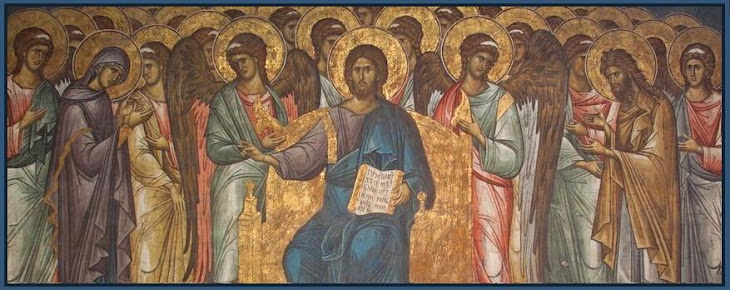
Christ appearing the the Myrrhbearing Women (The Theotokos, to Christ's right, St. Mary Magdalene, to His left) (source)
   
There is ever rejoicing among the church of Christ, but much more so on the present, lamp-bearing day of myriads of light, for on this day, Christ, the Master of all, the Sun of Righteousness, from the grave as from a bridle chamber, has shown forth through His resurrection, and before all, to womankind has shown his rays, saying to them: “Rejoice”. The first voice of the resurrection is “rejoice”, for fear has been dispelled and grace has been given.

The first voice of the resurrection is “rejoice”, and before all, He meets the women, and to them the Lord said: “Go quickly, tell my Disciples that I have risen from the grave, and I go before you to Galilee, there you will see me.” He met [womankind], among whom had sin been multiplied, and greatly multiplied grace. O, the wisdom of the Lord's deed! He did not send to the Disciples an angel, nor did He go Himself to them, but sent a woman. And not a simple woman, but a faithful woman, who was herself soldier-like. She sent them to the Disciples to bring joy, but also to censure. Joy, for He had risen from the dead and was "free among the dead", but censure, for the Disciples, though they were men, out of fear hid, while the women out of boldness, joyously evangelized the resurrection.
   
(amateur translation of text: "On Holy Pascha, and on the Myrrhbearers, and on the Newly-Illumined, and on the "In the beginning was the Word..." from source)
   
Christ is risen from the dead, by dead, trampling down upon death, and to those in the tombs, He has granted life! Truly the Lord is risen!

Saturday, May 3, 2014

Miracles of the Archangel Michael the Taxiarch to Mother Stavritsa the Missionary

Christ is risen! Truly He is risen!

The wondrous icon of the Holy Archangel Michael, Mantamados, Mytilene (Lesvos) (source)
   
Note: The Sunday of the Holy Myrrhbearers is one of the major feasts of the Holy Archangel Michael the Taxiarch, Mantamados, Mytilene (Lesvos). This is because that church was consecrated on this day. Thousands of pilgrims flock to celebrate this feast, seek the intercessions of the great Taxiarch, and thank him for his prayer and his protection, for "Where your grace casts its shade, Archangel, there the devil’s power is chased away; for the fallen Morning Star cannot endure in your light." (source) May he intercede for us all and protect us!
   
Miracles of the Archangel Michael the Taxiarch to Mother Stavritsa the Missionary (+2000)
My name is Stavritsa Zachariou, and I am a Greek American. In 1969 I went to Africa as a missionary. I am 75 years old, and 15 years I spent in Africa, near our suffering brothers, sowing the seed of the Gospel. I stay by myself in Nairobi, Kenya, and from there I go to Kampala, Cameroon, and other places, where the seed of the Gospel of Christ needs to be sowed.

I am a missionary of the Archdiocese of America. With the help of God and of benefactors, we built 12 holy Churches in [Africa]. We built the 10th holy church in honor of the Archangel Michael, and I wanted to paint his icon from the prototype from the north gate of the Patriarchate. As I was finishing the icon, when I went to the post office, I received a letter from Fr. Soterios Trampa. I know Archimandrite Fr. Soterios, who was a missionary for many years in Korea, and who also served as a preacher of your Metropolis, along with Chancellor of the Archdiocese of Athens from 1968-1973. In his letter was a small booklet on the Taxiarch of Mantamados. Then I learned about Mantamados, and the bas-relief icon of the Archangel Michael. Fr. Soterios wrote: “I am sending you the information on the Taxiarch of Mantamados, that you might come to know his wondrous icon. Within this you will see one of his many miracles, which occur daily to the glory of God. I served there in the past, and I especially honor him...”
  
Modern rendering of the wondrous icon of the Holy Archangel Michael of Mandamados (source)
  
I began to read the booklet on the Taxiarch, including the miracle of the sword. As I continued reading, I reached the place regarding the passing of the sword from some unknown person to Mr. Diamante, when there was as if some marked commotion in the icon [that she had painted]. I turned around to see what was happening then and, O my God!!!! The Archangel of the icon began to come to life, to take on flesh and bones! I was astonished! I knelt before it and began to pray with tears and to ask for his help and his protection. After a short while, slowly the icon began to return to its natural state.

I was supposed to go for a trip to Kampala. I always thought that when I would go on some trip, that I should take with me the icon of some Saint from my icon corner. That time, I took with me the little icon of the Taxiarch of Mantamados.

We reached the border of Kampala and Kenya, and Kampala at that time (1988) had a military regime. When we speak about a military regime in the center of Africa, it means that human life is cheaper than the life of a blackbird!

As we were passing through, my driver (a Kenyan and my Koumbaro) did not notice that at one place there was a stop sign and he kept going. Five wild motorcyclists surrounded us. They got off their motorcycles, drew their weapons, and knelt, preparing to fire at us and to take our car and our possessions as spoil. That is what usually occurred there...

Then, I don't know what strength was within me, but I opened the door of the car..I exited with the icon of the Taxiarch in my hands, and approached them, crying out:
“For God's sake, stop! I have with me the Taxiarch of God, who is dark-colored like you, come see him!!!”

Automatically, it was as if someone grabbed them by the hands. They calmed down, left their weapons in the grass, and ran up to me, took the icon, like something holy and venerable, and began to examine it carefully and to shout. They bowed their faces to the ground and holding my hands, they asked for forgiveness. Then I saw that one of them was injured badly in the hand by a knife. I took my first aid kit from the car, nursed the wound and dressed it. We became friends! The most impressive thing is that, there was sown the word of God, and the five of them received Christ, and became Christians!

After all of this, I promised to the Archangel to come to Greece, to Mantamados, to thank him. And today, I feel very blessed that the Lord made me worthy to fulfill my promise. I thank Him from all my heart!

(Amateur translation of text, from Protopresbyter Eustratios Dessou, “The History and Miracles of the Taxiarch of Mantamados,” Volume II, pg. 158. http://antexoume.wordpress.com/2013/11/08
   
The Holy Apostle and Evangelist Mark, depicted as the Apostle and Missionary bringing Christ's Gospel to Africa (source)  
Christ is risen from the dead, by dead, trampling down upon death, and to those in the tombs, He has granted life! Truly the Lord is risen!

Sunday, May 19, 2013

Why was the Angel seated on the stone at the Resurrection of Christ?

Christ is risen! Truly He is risen!
The Myrrhbearers beholding the Angels seated at the Tomb of Christ after His Resurrection (source)
 
Every word of the Holy Scriptures is placed appropriately with deep meaning, and we can perceive this if we struggle to obtain the humility and the illumination of the Fathers to understand how this is so. In the following short excerpt from St. Romanos the Melodist's Kontakion on the Resurrection of Christ (the beginning of which, "Though you descended into the grave, O Immortal One..." is still included in the Paschal service), he explains the significance of why the Angel was seated on the stone after Christ's Resurrection.


            Λαβούσαι θάρσος άμεμπτον εκ της φωνής του αγγέλου
φρονίμως αι γυναίκες απεκρίθησαν προς τούτον∙
«Αληθώς ανέστη ο κύριος, καθώς έφης∙
έδειξας ήμιν και τω ρήματι και τω σχήματι
ότιπερ ανέστη ο ελεήμων∙
ει μη γαρ ηγέρθη και επορεύθη της ταφής,
ουκ αν αυτός εκάθισας∙
πότε γαρ στρατηγός του βασιλέως
παρόντος κάθηται και διαλέγεται;
ει δε και τελείται εν γη τα τοιαύτα,
αλλ’ εν τω ύψει ουκ έστι ταύτα,
όπου θρόνος αθέατος και άφραστος ο καθήμενος,
ο τοις πεσούσι παρέχων ανάστασιν.»
   
The Holy Myrrhbearers coming the the Tomb of Christ, beholding the Angel, and the soldiers who became like dead men (source)
   
Taking unassailable courage from the voice of the angel,
The prudent women replied to him:
"Truly, the Lord has risen, as you said.
You indicate this to us by word and sign
That the Merciful One has risen,
For if He had not risen and proceeded from the tomb,
You would not be seated,
For when does the soldier before the King
Ever remain seated and speaking?
Though, therefore, things such as this are accomplished on earth,
In the highest, things are not like this,
For there is a throne invisible, and unspeakable, on which sits
He Who grants resurrection to the fallen."
   
(amateur translation, see here for the full Greek text)
   
The Angel proclaiming to the Myrrhbearing Women: "See the place where the Lord was laid..." (source)
   
Christ has risen from the dead, by death he has trampled on death, and to those in the graves given life!
Truly the Lord is risen!

Homily on the Sunday of the Myrrhbearers by St. Gregory Palamas


Christ is risen! Truly He is risen!
The Holy Myrrhbearers beholding the Angel at the Life-giving, empty Tomb of Christ after His Resurrection (source)
   
Homily of Saint Gregory Palamas For the Sunday of The Myrrhbearing Women (The Third Sunday of Pascha) (Gospel of Saint Mark 15:43-16:8)
Translated by Fr. Hierodeacon Photios Touloumes
The resurrection of the Lord is the regeneration of human nature.  It is the resuscitation and re-creation of the first Adam, whom sin led to death, and who because of death, again was made to retrace his steps on the earth from which he was made.  The resurrection is the return to immortal life.  Whereas no one saw that first man when he was created and given life—because no man existed yet at that time—woman was the first person to see him after he had received the breath of life by divine inbreathing.  For after him, Eve was the first human being.  Likewise no one saw the second Adam, who is the Lord, rise from the dead, for none of his followers were near by and the soldiers guarding the tomb were so shaken that they were like dead men.  Following the resurrection, however, it was a woman who saw Him first before the others, as we have heard from Saint Mark’s Gospel today.  After his resurrection Jesus appeared on the morning of the Lord’s Day [Sunday] to Mary Magdalene first.
   
It seems that the Evangelist is speaking clearly about the time of the Lord’s resurrection - that it was morning - that he appeared to Mary Magdalene, and that he appeared to her at the time of the resurrection.  But, if we pay some attention it will become clear that this is not what he says. Earlier in this passage, in agreement with the other Evangelists, Saint Mark says that Mary Magdalene had come to the tomb earlier with the other Myrrhbearing women, and that she went away when she saw it empty.  Therefore, the Lord had risen much earlier on the morning on which she saw him.  But wishing to fix the time more exactly, he doesn’t say simply “morning,” as is the case here, but “very early in the morning.”  Thus the expression “and the rising of the sun” as used there refers to that time when the slightest light precedes from the east on the horizon.  This is what Saint John also wants to indicate when he says that Mary Magdalene came to the tomb in the morning while it was still dark and saw the stone pulled away from it.
   
According to Saint John, she did not come to the tomb alone, even though she left the tomb without yet having seen the Lord.  For she ran to Peter and John, and instead of announcing to them that the Lord was risen, told them that he had been taken from the tomb.  Therefore, she did not yet know about the resurrection.  It is not Mary Magdalene’s claim that Christ appeared to her first but that he appeared after the actual beginning of the day.  There is, of course, a certain shadow covering this matter on the part of the Evangelists that I shall, through your love, uncover.  The good news of the resurrection of Christ was received from the Lord first, before all others, by the Theotokos.  This is truly meet and right.  She was the first to see him after the resurrection and she had to joy to hear his voice first.  Moreover, she not only saw him with her eyes and heard him with her ears but with her hands she was the first and only one to touch his spotless feet, even if the Evangelists do not mention these things clearly.  They do not want to present the mother’s witness so as not to give the nonbelievers a reason to be suspicious.  In that now my words about the joy of the risen one are directed to believers, the opportunity of this feast moves us to explain what is relative to the Myrrhbearers. Justification is given by him who said:  There is nothing hidden that shall not be made known, and this also will be made known.
   
The Myrrhbearers are all those women who followed with the mother of the Lord, stayed with her during those hours of the salvific passion, and with pathos anointed him with myrrh.  After Joseph and Nicodemos asked for and received the body of the Lord from Pilate, they took it down from the cross, wrapped it in a cloth with strong spices, placed it in a carved out tomb, and closed the door of the tomb with a large stone.  The Myrrhbearers were close by and watched, and as the Evangelist Mark relates, Mary Magdalene and the other Mary were seated opposite the grave. With the expression “and the other Mary” he means the mother of Christ without a doubt.  She was also called the mother of Iakovos [James] and Joses, who were the children of Joseph, her betrothed. It was not only they who were watching the entombment of the Lord but also the other women.  As Saint Luke relates:
And the women, also, who had come with him from Galilee, followed after, and beheld the sepulcher and how his body was laid. These women were Mary Magdalene, Joanna, Mary the mother of Iakovos, and the other women who were with them.
He writes that they went and bought spices and myrrh; for they did not yet clearly know that he is truly the perfume of life for those who approach him in faith, just as he is also the odor of death for those who remain unbelievers to the end.  They did not yet clearly know that the odor of his clothes, the odor of his own body, is greater than all perfumes, that his name is like myrrh that is poured out to cover the world with his divine fragrance.  For those who wanted to remain close by the body, the contrived an antidote of perfumes for the stench of decomposition and anointed it.

Thus they prepared the myrrh and the spices and rested on the Sabbath according to the commandment.  For they had not yet experienced the true sabbath, nor did they understand that exceedingly blessed sabbath that transports us from the confines of hell to the perfection of the bright and divine heights of heaven. Saint Luke says that “on the first day of the week, very early in the morning,” they came to the sepulchre bearing the spices that they had prepared.  And Saint Matthew says that those who came “late on the Sabbath towards the dawn of the Lord’s day” were two in number.  Saint John says that it was only Mary Magdalene who came, and that it was “morning, even though it was still dark.”  But Saint Mark says that three women came very early in the morning on the first day of the week.  By ‘’the first day of the week” all the Evangelists mean the Lord’s Day [Sunday] and they use expressions like “late on the Sabbath,” ”early dawn,” ”early dawn,” “early morning,” “morning,” and “even though it was still dark” [to refer to the Lord’s Day which is Sunday].  They mean the daybreaking hour when the darkness fights with the light and the hour when the eastern part of the horizon begins to become light as it presages the day.  Observing from afar, one sees the light changing colors in the east at about the ninth hour of the night, which colors remain until the fulfillment of the day three hours later.  It seems that the Evangelists disagree some-what concerning both the time of the visits and the number of women [that are involved].  This is attributable to the fact that, as we said, the myrrhbearers were many; that they did not come to the sepulchre one time only but two and three times, and not always in the same groups; that all the visits were at dawn but not at exactly the same hour.  Mary Magdalene also came by herself without the others and stayed longer.  Each of the Evangelists, therefore, relates one journey of some of the women and leaves the others. Consequently, by comparing all the Evangelists—and I said this before–I conclude that the Theotokos was the first who came to the grave of her son and God, together with Mary Magdalene.  We are informed of this by the Evangelist Matthew who said: In the end of the sabbath, as it began to dawn toward the first day of the week, came Mary Magdalene and the other Mary to see the sepulchre  (Matthew 28:1)
Mary Magdalene and the other Mary–who was, of course, the Mother of the Lord-went to look at the sepulchre. And behold there was a great earthquake: for an angel of the Lord descended from heaven, and came and rolled back the stone from the door of the tomb and sat upon it. His countenance was like lightening and his raiment white as snow. And for fear of him the guards did shake and become like dead men.
   
The other women came after the earthquake and the flight of the guards, and found the grave open and the stone rolled back.  The Virgin Mother, however, was there when the quake occurred, when the stone was rolled back, when the grave opened, and while the guards were there, even though they were completely shaken with fear.  That is why the guards immediately thought of fleeing when they came to from the earthquake but the Mother of God rejoiced without fear at what she saw. I believe that the life-bearing grave opened first for her.  For her and by her grace all things were revealed for us, everything that is in heaven above and on the earth below.  For her sake the angel shone so brightly so that, even though it was still dark, she saw by means of the bright angelic light not only the empty grave but also the burial garments carefully arranged and in an orderly fashion, thereby witnessing in many ways to the resurrection of the one who was entombed.  He was, after all, that same angel of the Annunciation, Gabriel; he watched her proceed rapidly towards the grave and immediately descended.  He who in the beginning had told her “fear not, Mary, you have found grace with God,” now directs the same exhortation to the Ever Virgin.  He came to announce the resurrection from the dead to her who, with seedless conception, gave him birth; to raise the stone, to reveal the empty grave and the burial garments, so that in this manner the good news would  be verified for her.  He writes:  And the angel answered the women and said: fear not.  Do you seek the Christ whom they crucified? He is risen.  Here is the place where the Lord was placed.  If you see the soldiers overcome with fear, do not be afraid. I know that you seek the Christ whom they crucified. He is risen. He is not here.  For not only can He not be held by the keys, the bars, and the seals of hell, of death, and of the grave, but he is even the Lord of the immortal angels of heaven, and the only Lord of the whole world.  See the place where the Lord lay.  Go quickly and tell his disciples that he is risen from the dead. And they departed, he says, with fear and great joy.  At this point I am of the opinion that Mary Magdalene and the other women who had come up to that point were still frightened.  For they did not understand the meaning of the angel’s powerful words nor could they contain to the end the power of the light so as to see and understand with exactitude.  But I think that the Mother of God made this great joy her own, since she comprehended the words of the angel.  Her whole person radiated from the light in that she was all pure and full of divine grace.  She firmly appropriated all these signs and the truth and she believed the archangel, since, of course, he formerly had shown himself to be worthy of trust for her in other matters.  And why shouldn’t the Virgin understand with divine wisdom. what had occurred in that she observed the events at first hand?  She saw the great earthquake and the angel descending from heaven like lightening, she saw the guards fall as dead men, the removal of the stone, the emptying of the tomb, and the great miracle of the burial garments which were kept in place by smyrna and aloes, even though they contained no body.  In addition to all of these things, she saw the joyous countenance of the angel and heard his joyful message.  But Mary Magda-lene, in responding to the annunciation, acted as if she had not heard the angel at all–he had not in fact spoken directly to her.  She testifies only to the emptying of the tomb and says nothing about the burial garments, but runs directly to Peter and to the other disciples, as Saint John says. The Mother of God went back to the tomb again when she met the other women and, as Saint Matthew says, behold Jesus met them and told them to rejoice. 
   
So you see that even before Mary Magdalene, the Mother of God saw Him who for our salvation suffered and was buried and rose again in the flesh.
 
And they approached, touched his feet and worshipped him. 
 
Just as the Theotokos alone under-stood the power of the angelic words–even if she heard the good news of the resurrection together with Mary Magdalene–when she met her son and God with the other women she saw and recognized the risen one before all the other women.  And falling down, she touched his feet and became his apostle to his apostles.  We learn from Saint John that Mary Magdalene was not with the Mother of God when, on her return to the sepulchre, she encountered the Lord. He writes:
She runs to Peter Simon and the other disciple whom Jesus loved and tells them: they have taken the Lord from the tomb and we don’t know where they have put him. 
 
If she had seen and touched him with her hands and heard him speak, how could she say the words “they have taken him and placed him elsewhere, and we don’t know where?”  But after Peter and John ran to the grave and saw the burial clothes and returned, Saint John says that Mary Magdalene was standing near the tomb and crying. 
 
You see that not only had she not yet seen him but neither had she been informed of the resurrection.  And when the angels that appeared asked her “why are you crying, woman,” she again answered as if she thought that he was dead.  Thus when, upon turning, she saw Jesus and still did not understand, she answered his question “why do you weep” in the same manner.  Not until he called her by her name and showed her that he was the same did she understand.  Then, when she also fell down before him wishing to kiss his feet, she heard him say: “Don’t touch me.”  From this we understand that when he appeared previously to his mother and to the women who accompanied her, he allowed only his mother to touch his feet, even if Matthew makes this a common concession to all the women.  He did not wish, for the reason we mentioned in the beginning, to suddenly present the appearance of the mother into the issue.  It was the Ever Virgin Mary who came to the grave first and she was the first to receive the good news of the resurrection.  Many women then gathered and they also saw the stone rolled back and heard the angels, but they were separated on their return. As Saint Mark says, since they were afraid, some of the women left the tomb in a frightened and ecstatic state without saying anything to anyone.  Other women followed the Mother of the Lord and because they happened to be with her they saw and heard the Lord.  Mary Magdalene left to go to Peter and John, and with them was returning to the grave.  And even though they left, she stayed and she also was made worthy to see the Lord and to be sent by him to the apostles.  Thus, as Saint John says, she again comes to them shouting to all that she had seen the Lord and that he had told her these things.
   
And Saint Mark says that this appearance happened in the morning, the indisputable beginning of the day, when the dawn had passed.  But he does not contend that the resurrection of the Lord occurred at that time, nor that it was his first appearance.  Therefore, we have information concerning the Myrrhbearers that is exact and the general agreement of the four Evangelists as a higher confirmation.  But even with all that they had heard on the same day of the resurrection from the Myrrhbearers, from Peter, and even from Luke and Cleopas that the Lord lives and that they had seen him, the disciples showed disbelief.  That is why He castigates them when he appeared to all of them gathered together.  When, however, he showed them many times through the witness of many that he was alive, not only did they all believe but they preached it everywhere.
   
Their voice poured out on all the earth and their words spread to the ends of the earth; and the Lord worked with them and confirmed his word by signs that accompanied it.  For until the teaching is preached to all the earth, the signs were indispensable.  Exceptional signs were needed to represent and certify the truth of the message.  But excellent signs are not needed for those who accept the word through firm belief.  Who are these [who have firm belief]? They are those whose deeds bear witness [to their faith].  ‘’Show me your faith in your deeds,” he says.  “Who is faithful?  Let him manifest it with the deeds of his good life.”  For who will believe that he who commits wicked acts and is oriented to the earth and material things has a true, exalted, great, and heavenly under-standing which is, so to speak, exactly what piety is?  Brethren, what does it profit a man to say that he has divine faith if he does not have deeds analogous to the faith?  What did the lamps profit the foolish maidens when they had no oil, in other words, the deeds of love and of compassion?  What did it profit that rich man who, when he was burning in the unquenchable flame because of his indifference to Lazarus, invoked the father of Abraham?  What did it profit that a man to accept an invitation to the divine wedding and that incorruptible bridal chamber when he did not have a suitable garment of good deeds?  Of course, in so much as he believed anyway, he received an invitation and went to sit amongst those holy ones who were at the banquet.  But he also received the examination and was ashamed because he was clothed in the wickedness of his attitude and works, through which his hands and feet were tied and he was lowered to Gehenna where wailing and gnashing of teeth reverberates.  May no one who has the name of Christ experience [such a thing]. Rather let us all manifest a life analogous with the faith and enter the bridal chamber of unstained joy and eternal life with the saints, which is the resting place of all who perceive the true joy.
Translated from MIGNE P.G. vol 151, pp 236-248  on the  Feast of the Holy Annunciation, 1976. Source
 

Christ has risen from the dead, by death he has trampled on death, and to those in the graves given life!
Truly the Lord is risen!