Showing posts with label Icons of the Theotokos. Show all posts
Friday, April 3, 2020
"O Champion General, I your City now inscribe to you..."
The Theotokos appearing and delivering Constantinople from the siege (source)
Deceased have been quickened through your power, * for pregnant were you with life hypostasized. * They who once were speechless now * speak with newfound eloquence. * Diseases are exterminated, lepers purified. * The legions of * the aerial spirits, * O Virgin, are defeated, for you are man’s salvation.
-from the Canon of the Akathist, by St. Joseph the Hymnographer
Tone Eight (Pl. IV). Original Melody.
O Champion General, I your City now inscribe to you
Triumphant anthems as the tokens of my gratitude,
Being rescued from the terrors, O Theotokos.
Inasmuch as you have power unassailable,
From all kinds of perils free me so that unto you
I may cry aloud: Rejoice, O unwedded Bride.
(source)
(source)
The wondrous Icon of the Theotokos and Christ "Of the Akathist", treasured to this day by Dionysiou Monastery on Mount Athos. This was the icon carried by Patriarch Sergios in procession and prayer along the walls of Constantinople when she was being sieged by a seemingly invincible foreign army. The Theotokos later appeared and wondrously defended the Christians, and may she ever hearken to our prayers to defend us from our enemies, visible and invisible! (source)
Most-holy Theotokos save us!
Tuesday, April 16, 2019
The Cross-bearing Theotokos of Paris
Icon of the Cross-bearing Theotokos painted by St. Maria of Paris (source)
The Theotokos and St. Genevieve, the Protectors of Paris (source)
Notre Dame de Paris in flames (source)
Most-holy Theotokos, save, protect, heal and guide your children who suffer throughout the world!
Most-holy Theotokos, save us!
Thursday, March 14, 2019
Photios Kontoglou on Panagia as the Humble Queen
The Most-holy Theotokos and Christ surrounded with Angels depicted in the wonderworking icon of Panagia Pantanassa (Queen of All) treasured by Vatopedi Monastery, Mount Athos (source)
"Panagia is the spiritual adornment of Orthodoxy. For us Greeks [and for all peoples], she is the pained mother, the consolation, the protector, who stands beside us in every circumstance.
"In every part of Greece are built countless churches and monasteries, palaces to this humble Queen, and a multitude of chapels in the mountains, the fields, the islands, that are fragrant from her virginal and spiritual fragrance.
"Within each of these is found her ancient and honored icon with her dark hair and golden face, which receives all of the tears of our tortured faithful, because we have no one else to help us except Panagia: 'we who sin have no one else, who intercedes for us before God, praying endlessly, in ills and all dangers, for us who are laiden with our many sins and mistakes' (Paraklesis to the Theotokos).
"The beauty of the Panagia is not a bodily beauty, but spiritual, because where there is pain there is also found holiness, there alone is spiritual beauty. Bodily beauty brings bodily excitement, but spiritual beauty bring contrition, respect and pure love. This is the beauty which our Panagia has.
"And this beauty is depicted in her [Byzantine] icons which pious men fashion, who fast and chant and are found with contrite heart and spiritual purity.
"In the face of Panagia are depicted this mystical beauty which attracts like a magnet pious souls and brings them silence and consolation."
-Photios Kontoglou (+1965)
(source)
Forgive me, and may the Lord forgive us all and grant us a blessed Lent!
Most-holy Theotokos, save us!
Thursday, September 28, 2017
The Holy Monastery of Chrysopigis, Chania, Crete
The Holy Monastery of Chrysopigis, Chania, Crete (source)
The Holy Patriarchal and Stavropegic Monastery of Chrysopigi lies a short distance from the town of Chania. It was founded in the middle of the 16th century in the last period of Venetian rule in Crete. The Monastery is dedicated to our Lady of the Life-Giving Spring, who is known popularly as ‘Chrysopigi’, the Golden Fountain.
The founder of the Monastery was a physician and philosopher by the name of Ioannis Chartophylax, a prominent citizen of the town of Chania, who founded the Monastery in the middle of the 16th century.
During the period of Venetian rule the Monastery of Chrysopigi developed into an important spiritual centre for Chania with numerous monks and a rich library.
Icon of Panagia Chrysopigis ("The Golden Fount", or the Life-giving Spring of the Theotokos) (source)
In 1654, during the period of Ottoman rule, the Monastery became a Patriarchal Stavropegic establishment. It suffered greatly at Ottoman hands, sharing the fate of the rest of Crete. In 1821, on the outbreak of the Greek Revolution, it was destroyed and abandoned. In the years following 1848, however, the Monastery was renovated and rejuvenated with the advent of new monks.
During the Second World War the Monastery was commandeered for use as their Administrative Headquarters by the occupying German forces. The monks were forced to leave, grievous damage was caused to the buildings and the architectural structure was seriously compromised. There followed a period of what appeared to be terminal decline.
In 1976 the Monastery of Chrysopigi was transformed into a coenobitic community of sisters. The new community restored the Monastery from its foundations, while at the same time pursuing the work of renewal in a spiritual and social dimension.
At the Monastery of Chrysopigi, worship is the centre of life. The Divine Liturgy and all of the daily services attract many young people from near and far.
The feast day of the monastery (source)
The sisters of the community ply the traditional monastic crafts: icon-painting and also the fresco painting of Churches, ecclesiastical embroidery, stone carving, book-binding, bee-keeping, candle-making, and the production of incense and of hand-made soap et al.
An important activity of the Monastery is the publication of books. The books containing the words of Saint Porphyrios of Kavsokalyvia have been translated into more than twenty languages.
The sisters cultivate the Monastery lands using organic farming methods. The organic produce of the Monastery lands provides food for the community and for visitors. Olive oil which is produced in larger quantities is placed on the market in appropriate packaging.
The olive groves of the monastery (source)
The monastic community seeks to raise ecological consciousness through environmental education programmes aimed at school children of all ages and at students, as well as other groups of young people.
At the same time, the treasures which survived in the Monastery are conserved and preserved in the Ecclesiastical and the Folk Museum.
The Holy Patriarchal and Stavropegic Monastery of the Life-Giving Spring-Chrysopigi
73100 Chania, Crete
Tel: +3028219-91125, 28210-29840
Fax: +30 28210 97600
e-mail: imx@otenet.gr
website: www.imx.gr
73100 Chania, Crete
Tel: +3028219-91125, 28210-29840
Fax: +30 28210 97600
e-mail: imx@otenet.gr
website: www.imx.gr
(source)
Besides the katholikon of the Monastery, there are the chapels in honor various saints, many in caves surrounding the monastery. The chapels include those in honor of St. John the Theologian, St. Catherine, St. Charalampos, St. John Kalyvites, St. Arsenios of Cappadocia, the Holy Seven Sleepers of Ephesus, St. Anthony, Panagia Myrtidiotissa / St. Silouan the Athonite, and the Holy New Martyrs of Crete.
Some of the holy relics treasured by the Monastery, including the left hand of St. John Kalyvites (source)
Besides the katholikon of the Monastery, there are the chapels in honor various saints, many in caves surrounding the monastery. The chapels include those in honor of St. John the Theologian, St. Catherine, St. Charalampos, St. John Kalyvites, St. Arsenios of Cappadocia, the Holy Seven Sleepers of Ephesus, St. Anthony, Panagia Myrtidiotissa / St. Silouan the Athonite, and the Holy New Martyrs of Crete.
(source)
Video of the consecration of the katholion of the Monastery, on September 2nd, 2012, by the Ecumenical Patriarch Bartholomew (source)
The Monastery also had St. Porphyrios of Kavsokalyvia as a spiritual Father and guide, so they honor and celebrate him. For example, the Abbess of the Monastery recently gave a wonderful talk in Canada on the life of St. Porphyrios:
Patriarch Bartholomew recently blessing the groundbreaking at the Monastery for a new church in honor of St. Porphyrios (source)
Through the prayers of our Holy Fathers, Lord Jesus Christ our God, have mercy on us and save us! Amen!
Saturday, September 16, 2017
"A Diplomacy of Icons"
"A Diplomacy of Icons", as thousands walk in a litany of prayer at the recent visit of the wondrous icons of Panagia Soumela and Panagia of Kazan to St. Petersburg (source)
Most-holy Theotokos, save us!
Labels:
Greece,
Holy Icons,
Icons of the Theotokos,
Peace,
Russia
Thursday, September 24, 2015
"Now rejoice, O beautiful myrtle plant..."
Panagia Myrtidiotissa ("Of the Myrtle Tree") (source)
-Troparion from the Canon for the feast of Panagia Myrtidiotissa.
(source)
Most-holy Theotokos, save us!
Thursday, August 28, 2014
St. Theophan the Recluse on Wonderworking Icons
-Why do some icons turn out to be wonderworking?
"Because God desires it so. The working of wonders is possible only to God, and not to anyone else. Neither the icons, nor the men who take refuge with reverence in them have the power to work a wonder. The mercy of the Lord is the reason and the source of all the wonders. God, as the Master of the universe, can use every thing as an organ of His mercy."
-St. Theophan the Recluse
(amateur translation of text from source)
Through the prayers of our Holy Fathers, Lord Jesus Christ our God, have mercy on us and save us! Amen!
Friday, January 17, 2014
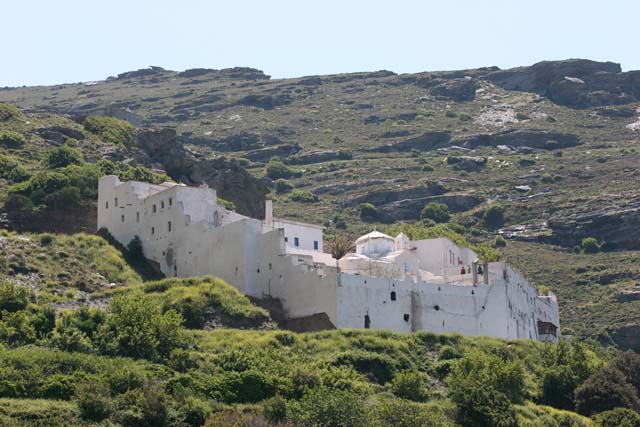
The Holy Monastery of Panagia Panachrantos, Andros
The Holy Monastery of Panagia Panachrantos, Andros (source)
This monastery appears to be literally clinging to the top of the mountain, surrounded by large rock formations, where the air, with the passage of the ages, has carved hundreds of small caves, the largest of which were used as hermitages for ancient monks.
The monastery is designed, according to the form of Byzantine monasteries, with the appearance of a fortress, and the land which it occupies is significantly large, with its buildings designed in a rectangular shape, having a much larger length than width. Because of the steep landscape, and the monastery’s long and narrow design, it gives the impression of a labirynth, since other than the narrow central road, there are only narrow alleys that lead to the rest of the cells.
When you reach her highest point, the panoramic view rewards you, giving you a true sense that you are hanging in the air.
The view from the pinnacle of the Monastery (source)
Regarding the historical beginning of the monastery, unfortunately, we do not have many details, and this gives us uncertainty as to what conditions were like then. We base the history on two documents, which are preserved to this day, and in the local tradition, where we see that the history begins as follows: Before 960 AD, two monks, who lived in asceticism on the opposing mountain, saw a light every night at the place near where the monastery today is built.
Seeing such a wonder, after a long while they decided to go investigate the phenomenon.
Fresco from the monastery showing the monks finding the wondrous icon (source)
Having looked for a while, they were made worthy by the grace of God, to find the sacred icon of the Panagia “Panachrantou” (“The Immaculate One”) below a cave, near the place where today is found the Church of the “Photodoti” ([Christ] “The Giver-of-Light”), (the name which was given most likely by the light which was revealed here).
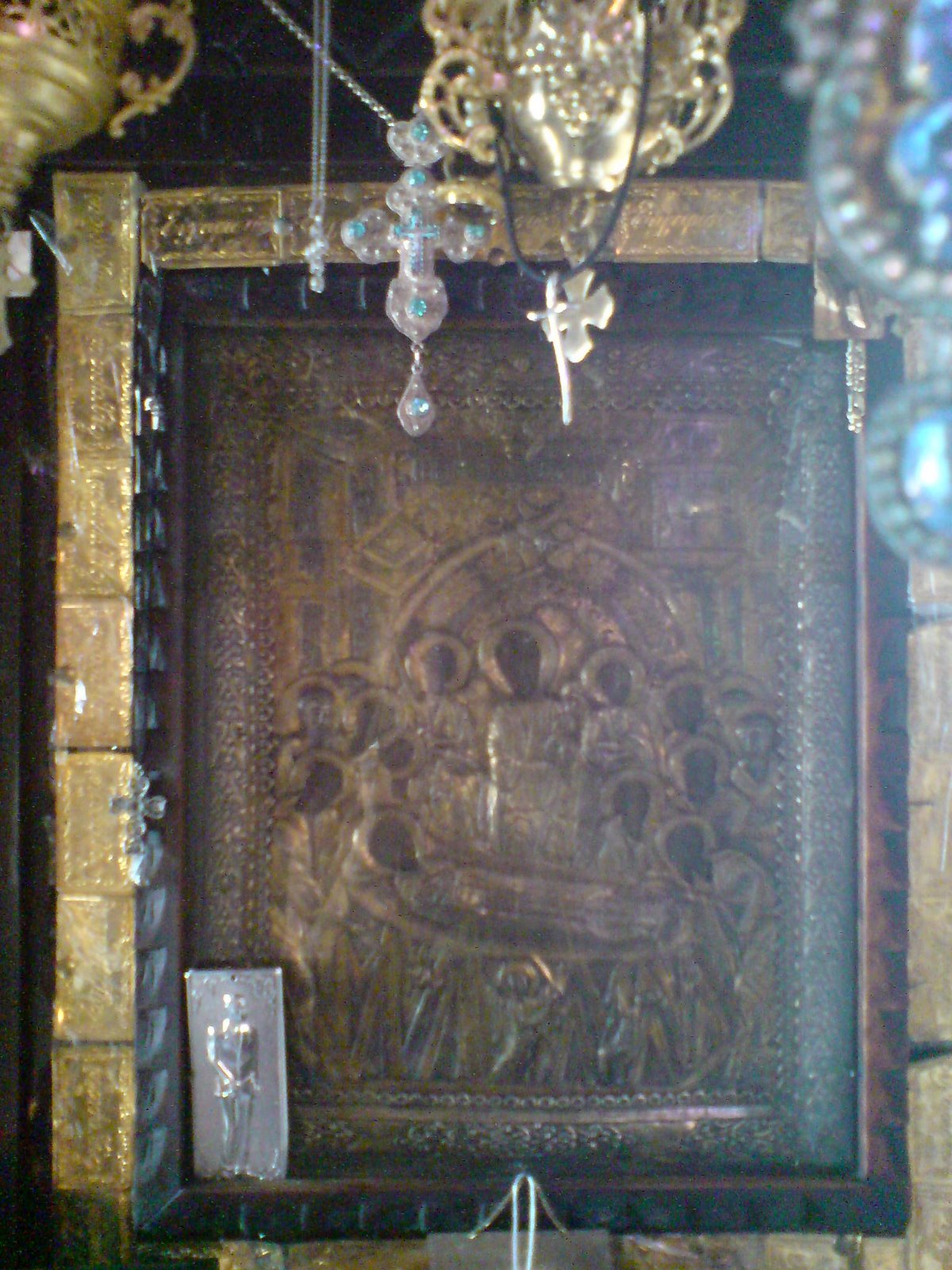
The wondrous icon of Panagia Panachrantou (The Immaculate One), Andros (source)
After waiting a significant time there, in case another monk lived there in asceticism, and praying towards the icon, having not found anyone, they took the icon back with them to their cell at the opposing mountain. That night, the light which they saw, did not reappear, which confirmed to them that this was due to the grace of the Panagia. When the new day dawned, the icon had disappeared from the place where they placed it, and to their greater astonishment, the light appeared again on the opposing mountain.
Returning to the place where they had found the icon, they saw that it had wondrously returned there!
Having entreated with tears to the Panagia that they might take her icon, they took it, but the following night, the Panagia returned again to her same place.
This occurred several times again, until they ultimately were enlightened to move their dwelling to near the cave, where they built a small hermitage.
Their fame spread quickly, and thus other monks came there and founded the first brotherhood. Later, in 961 AD, the Emperor Nikephoros Phokas, was battling the Cretans who had apostatized, but due to the wind being against him, he decided to stop on the island of Andros.
The Roman Emperor Nikephoros Phokas (source)
Desiring to pray somewhere for the difficult task that he had undertaken, the inhabitants of the island showed to him the hermitage, which the monks mentioned above had built. Thus, Phokas visited the place, and having venerated the Panagia, promised that he would help the monks build the monastery, which he would protect from possible attacks, if ultimately he would be victorious in war.
Phokas, in the end, liberated Crete, and returned to Andros, where he left a lot of money, which the monks used to build the first buildings of the monastery, which from then on was named the Holy Monastery of Panachrantou, in honor of the Panagia. From the foundation of the Monastery until 1590, unfortunately, not a single document survives from the archives of the Monastery, but most likely it played an important role during the long period of Frankish rule on Andros (1200-1566).
Panachrantou Monastery, Andros (source)
From 1590 and on, however, when Andros passed into the hands of the Turks, the monastery went through a great period, through the efforts of the then Metropolitan of Andros and Keas, Gabriel.
During this period, the Katholikon of the Monastery was founded (1602-1608), and took the form which exists to this day. Slowly, the strength of the monastery began to grow, and it reached the point where there were around 360 enrolled monks and large tracts of land throughout the largest portion of Andros, but also metochia (dependencies) in Constantinople, Chios, Mytilene, Rhodes and Smyrna.
The Katholikon of the Monastery (source)
In order to support this property, the monks traveled greatly, which likely played a role in the gathering in the Monastery of very many artifacts, along with a multitude of Holy Relics.
The most important of the Holy Relics treasured here is [a portion of] the precious Skull of St. Panteleimon, which was transferred here from Constantinople in 1705, with the consent of the then Patriarch Kosmas III, while furthermore there are preserved portions from the relics of Sts. Aethalas, Averkios, Charalampos, Tryphon, etc.
Fr. Eudokimos, the Abbot of Panachrantou Monastery, carrying the Relic of St. Panteleimon in a recent visit to Piraeus (source)
[At the following link is a recording (in Greek) of Fr. Evdokimos, the Abbot of Panachrantou Monastery, Andros, in which he discusses various spiritual topics, as well as miracles that have occurred through St. Panteleimon. It is interesting to note that at first Fr. Evdokimos was uneasy hearing that the Skull of St. Panteleimon was on Andros, as he had previously venerated it on Mount Athos. However, the Saint appeared to him and reassuringly showed him the part of his Skull which was on Mount Athos, and the other part, including some of his teeth, which was at Panachrantou Monastery of Andros. Fr. Evdokimos sought permission to open the Saint's reliquary, and confirmed that it was the same portion that the Saint had revealed to him in a dream.]
The great progress of the Monastery reached the Ecumenical Patriarchate, where the monastery was proclaimed to be “Stavropegial” in 1683, which gave greater independence to the Monastery, and privileges.
A portion of the Holy Skull of St. Panteleimon the Great Martyr and Unmercenary, treasured by the Holy Monastery of Panagia Panachrantou, Andros (source)
Monks of the Monastery extended to many places outside of Andros, and were then poised to place an important role in the historic events which marked our fatherland.
Panachrantou Monastery, Andros (source)
Before the period of the National Independence, first the monks of Panachrantou preached the revolution on the islands and historical places, granting energy to the first revolutionary endeavors. Furthermore, the monk of Panachrantou, Metropolitan Nicholas Roussos of TZias and Thermion, blessed the weapons of the revolutionary force of Moldovlachia, under Alexandros Ypsilantes, in February 1821.
We know, based on documents, in what manner and with what funds the Monastery helped, according to its strength, the Fatherland during that difficult period. Later, when Otto was King of Greece, the Monastery numbered many monks further, and for this reason it was not shut down, according to the order of Mauer, which shut down the majority of the monasteries, totaling five monks or less, along with all the convents with less than three nuns. During that period, the exiled monk Christophoros Panagiotopoulos, later known to us as “Papoulakos”, was sent to the Monastery.
This grace-filled monk lived here the final seven and half years of his life, where he reposed on January 18th, 1861.
A photograph of the blessed Christophoros Papoulakos (+1861), honored by many as a Saint, though he has yet to be officially canonized by the Ecumenical Patriarchate (source)
The life of the Greek Monasteries is always woven together with the history of our nations, with a tender and loving relationship, though some people today do not wish to accept this. Regarding the Monastery of Panachrantou, the following two events show the truth/
The first is with the influx of refugees from Asia Minor. The Holy Synod of the Church of Greece accepted at that time the large portions from the land holdings of the monasteries, in order to strengthen these men. From the Monastery of Panachrantos, they took all of the lands outside of Andros, along with roughly the half of that which it had on Andros.
The second event occurred during the period of the German occupation. Together with witnesses of men who are still living, the then Abbot of the Monastery appeared without fear before the German administrator, and entreated him to allow him to feed the children from the villages of Andros, which occurred. Thus, in many ways they showed their thanks to the Monastery, as the many animals which they had and the untiring offerings of the monks helped many of them not to starve.
In later years, the Monastery began to decline in man power, with the result being that only a few years ago, there only remained one monk. Despite all of this, the Grace of God, appeared to have other plans for the Monastery, and thus, instead of falling into decline, it was totally renovated by a monk, together of course with the help of many people of Andros, who did all the work in order to not loose the traditional icon of the monastery. This monk was Archimandrite Eudokimos Frangoulakes, who is the Abbot of the Monastery today. Today there are five monks enrolled at the monastery, who continue their hospitality, and their work of offering of the Monastery, including Fr. Aetios and Fr. Philaretos.
The Monastery can be visited throughout the year from sunrise to sunset, and one might be allowed to stay at the monastery for a few days.
The Bishop with the Fathers of the Monastery, and a multitude of the faithful celebrate the great feast of St. Panteleimon, where his Holy Relics are treasured (source)
The largest feasts of the Monastery are those of St. Panteleimon (July 27), when a great multitude from all over Greece come to celebrate together, along with August 15th, the feast of Panagia Panachrantou.
The other days, the services are celebrated very early, according to the monastic typikon, by the light of candles, in a compunctionate environment.
The Monastery is very large for its number of monks, and thus the visitor feels that this is a deserted place. It is, however, most sure that within the mountains of documents (of which there are many), the ancient Holy Vessels (which today stand “eaten” due to their great use in the Monastery’s museum), the ornate polyeleoi, and the silver vigil lamps, the lofts emptied of monks, and the ancient chapels which fill the Monastery, you will hear the souls of all those who consumed themselves upon this rock, in order to, with their offering, and more importantly with their prayers, to appease God, to have compassion on men, and especially sinners.
(amateur translation of text from here)
For an amazing account of the recent revelation of many Myrrhstreaming Skulls of Holy Fathers of the Monastery, see here.
For another spiritual treasure of the island of Andros, see the following article on the Monastery of St. Nicholas.
Panachrantou Monastery, Andros (source)
Through the prayers of our Holy Fathers, Lord Jesus Christ our God, have mercy on us and save us! Amen!
Wednesday, November 6, 2013
The Flock of the Theotokos
The Most-Holy Theotokos "Gerontissa" ("The Abbess"), depicted with Holy Angels and several Monastic Saints (source)
M.M. Elder, let us move onto a different topic. Speak to us on the relationship that you and every Athonite has with the Panagia.
Elder Markellos: It is Her Garden, and we are her children. Once, an Athonite monk was sick. In order to be healed, he took refuge in the Panagia of Tinos. There, of course from reverence, he slept at night within the church. In reality, therefore, Panagia visited him, but in a...unique manner. She gave him a motherly slap, saying at the same time: "What do you want here?"
He replied: "My Panagia, I came to find my health."
"Well, why didn't you call me and entreat me in my Garden? I'm there every day along with you. Was there a need to come here?" Then the poor monk lost it, and awoke thinking: "Wow, what a fool I am, what am I doing here?"
This motherly position Panagia has before all of us, and when we are pleasing before Her--according to Her promise--she gives us everything. The blessed Elder Ephraim of Katounakia said: "Are you being tempted? Grab hold of the Panagia by her dress and call upon Her! She is a mother, she will hear you." He said this with joy, and also with faith that it would thus occur. When he sought for something from the Panagia, She gave it to him.
The Most-holy Theotokos as the Abbess of the Holy Mountain, depicted with the Athonite Saints and Monasteries (source)
There is a story regarding an astonishing vision having to do with the Athonite Fathers and the Most-Holy Theotokos, which depicts her many times as an Abbess, as the Gerontissa of the Holy Mountain, with Her rod and mandya. She visits, she keeps vigil, she cares for Her children.
An Elder saw this astonishing vision: "The Second Coming, the Last Judgment had come. The Panagia as an Abbess passed by the cemeteries of the Holy Monasteries, by the Sketes, by the Hermitages, where there were the graves of the Fathers. As she passed by the place of the Fathers' rest, she would hit Her staff on the graves, and the Fathers would rise!"
An astonishing vision... All the resurrected Fathers followed the Panagia, who went before them, and arranged them into a large flock, the flock of the Most-Holy Theotokos. The Athonite Fathers were and are Her children, and she led them and leads them to the Kingdom of the Heavens.
An incredible vision. But once in a while, from certain graves, the Panagia did not take the Fathers. She left them there. They were those monks who did not take care in their life, who did not keep their monastic promises and their monastic duties. These cried out, mourned, wailed, entreated: "Take me too, Panagia! Take me together with You!" However, she did not take them, and they remained complaining and estranged from the great brotherhood, the Synodeia of the Most-Holy Theotokos.
Every Athonite monk senses the Panagia as his Mother. Whatever he asks of Her with faith and purity, the Panagia brings about, but he must try to always be pleasing before Her in his life. In other words, he must try to not make his life something that would sadden his Mother.
From Elder Markellos of Blessed Memory, Former Abbot of Karakallou Monastery, Mount Athos. From the Book: Logos Athonos, by Manolis Melinos.
(Amateur translation of text from source)
The Most-holy Theotokos depicted as the Abbess of the Holy Mountain (source)
Most-Holy Theotokos, save us!
Through the prayers of our Holy Fathers, Lord Jesus Christ our God, have mercy on us and save us! Amen!
Friday, July 19, 2013
A paralyzed boy is healed at Panagia Malevi
The wonderworking and myrrh-streaming icon of Panagia Malevi (source)
A paralyzed boy is healed at Panagia Malevi (amateur translation)
Nun Agne told us: "In 2007, a fifteen year-old boy came to the Monastery, who was one step away from the end.
He was from Cyprus, and suffered from his first steps in life from cancer.
His father had died, and his mother tried to remain strong for him, and for his smaller brother, Vasile. The child had had 23 surgeries, but nothing had happened.
His condition got worse, and thus the doctors at the great hospital of Athens told his mother that he needed another surgery. They didn't know if he would be able to survive the surgery, as he was already paralyzed.
His mother, one day before traveling to Athens, saw the Panagia in her sleep, who told her: "Don't worry. I am Panagia Malevi. Come to my home, and Andreas will be well."
The woman, as soon as she awoke, asked her mother who was Panagia Malevi, and she also did not know. The women asked around, and learned that the Monastery was in the area of Greece called Kyrouria. Thus, the woman took her child to the airport, and rented a taxi, and came here to the Monastery."
According to the nun, the inhabitants of the village and the nuns and the taxi driver helped the mother put the child in the wheelchair, and bring him into the church to venerate the icon. And as soon as he embraced it, Panagia filled him with strength. The child, as he said, felt within him something strange penetrate his body, and he straightaway cried out: "let me walk". His mother and all of those around him froze. Everyone began to cry, and Andreas stood up, walked and began to run.
Nun Agne mentioned: "I have been in the Monastery for forty years, and I confess that at that instant, I felt the presence of Panagia so clearly...I shudderd. Andreas left standing, and left his wheelchair here, because as he told us, he didn't need another." The doctors who tested the boy after his visit to Panagia Malevi could not believe how this child was walking, and they could see how he was still alive.
The tests furthermore still showed cancer in the largest part of his body, but the child is well. From then Andreas and his mother visit the Monastery once a year to thank Panagia.
(source)
Through the prayers of our Holy Fathers, Lord Jesus Christ our God, have mercy on us and save us! Amen!
Friday, May 10, 2013
The wondrous icon of Panagia Glykophilousa
Christ is risen! Truly He is risen!
The wondrous icon of Panagia Glykophilousa ("The Sweet-kissing"), treasured by the Holy Monastery of Philotheou, Mount Athos - Commemorated on the Sunday of St. Thomas, and Monday of Bright Week (source)
Like the Panagia Portaitissa, the Glykophilousa Icon is one of those which were saved during the iconoclastic period and brought miraculously to Mount Athos. It originally belonged to Victoria, the devout wife of the senator Symeon. Victoria was one who venerated the holy icons, especially that of the Most Holy Theotokos, before which she prayed each day. Her husband was an iconoclast who found her piety offensive, for he, like Emperor Theophilos (r. 829-842), found the veneration of icons distasteful. Symeon told his wife to give him her icon so that he could burn it. In order to save the icon from being destroyed, she threw it into the sea, and it floated away standing upright on the waves. After a few years, the icon appeared on the shores of Mount Athos near the Monastery of Philotheou, where it was received with great honor and rejoicing by the Abbot and Fathers of the Monastery, who had been informed of its impending arrival through a revelation of the Theotokos.
A spring of holy water sprouted forth on the very spot where they placed the icon on the shore. Every year on Monday of Bright Week there is a procession and blessing of water. Numerous miracles have occurred.
Chapel built at the "Agiasma", where the icon of Panagia wondrously reached Mount Athos, and a spring of holy water began to flow (source)
Although there are many miracles of the Glykophilousa Icon, we will mention only a few. In 1713, the Mother of God answered the prayers of the devout Ecclesiarch Ioannikios, who complained about the poverty of the monastery. She assured him that she would provide for the material needs of the monastery.
Another miracle took place in 1801. A pilgrim, after seeing the precious offerings (tagmata) hanging from the icon, a certain pilgrim planned to steal them. He stayed in the Temple after the Ecclesiarch closed it. Then he stole the offerings and left for the port of Iveron Monastery. There he found a boat that was leaving for Ierissos. After a while the ship sailed, but despite the excellent weather, it remained stationary in the sea. When the Ecclesiarch saw what had happened, the abbot sent monks out in various directions. Two went to the port of Iveron and when they saw the immobile ship, they realized what happened. Getting into a boat they went to the ship came aboard. The guilty man who committed this fearful sacrilege asked for forgiveness. The monks were magnanimous and did not want the thief to be punished.
A pilgrim from Adrianopolis visited Philotheou Monastery in 1830. He listened attentively to a monk tell the story of the holy Icon and the miracles associated with it, but he regarded the account as a fictitious tale which only a child might believe. The monk was grieved at the man’s unbelief, and tried to persuade him that everything he had said was absolutely true. The unfortunate pilgrim remained unconvinced.
That very day, as the pilgrim was walking on an upper balcony, he slipped and began to fall. He cried out, “Most Holy Theotokos, help me!” The Mother of God heard him and came to his assistance. The pilgrim landed on the ground completely unharmed.
The Glykophilousa Icon belongs to the Eleousa (the Virgin of Tenderness) category of icons, where the Mother accepts the affection shown by the Child Christ. The icon is commemorated by the Church on March 27 and also on Bright Monday. The icon depicts the Theotokos inclining toward Christ, Who embraces her. She seems to be embracing Him more tightly than in other icons, and her expression is more affectionate.
The Icon is located on a pillar on the left side of the katholikon (main church).
(source)
Holy Saturday in the Katholikon of the Philotheou Monastery, Mount Athos. The wondrous icon of Panagia Glykophilousa is seen on the veneration stand on the left (source)
Philotheou Monastery
The Holy Monastery of Philotheou stands among chestnut trees on a plateau on the north-eastern side of the peninsula, near the ancient Temple of Asclepius. It was founded by the Blessed Philotheus, a contemporary of St Athanasius the Athonite, around the end of the 10th century.
Among the Byzantine Emperors who made donations to the Monastery, the names of Nicephorus Botaneates in the 11th century, Andronicus II and Andronicus III and John V in the late 13th and in the 14th century stand out. Among Serbian princes, Stefan Dushan (1346) helped to provide the manpower for the Monastery. In the 14th century, St Theodosius, subsequently Metropolitan of Trebizond, and brother of St Dionysius, founder of the monastery of that name, was a monk in the Monastery. During the early years of Turkish rule, in the early 16th century, the Abbot Dionysios, known as the Blessed Dionysios of Olympus, succeeded in turning it from an idiorrhythmic into a coenobitic monastery. However, the reaction of Bulgarian-speaking monks was such that he was forced to leave the Monastery. In about the mid 17th century, the Tsars of Russia gave permission to the monks to go there every seven years on alms missions. The policy of support for the monasteries was also followed by the Greek princes of the Danubian provinces. Grigorios Ghikas was one of the Monastery's best known benefactors.
In the 18th century the missionary of modern Greece St Cosmas the Aetolian was a monk at Philotheou. A fire which broke out in 1871 left unscathed the new katholikon, which had been built in 1746 on the foundations of an older church, but caused the Monastery economic problems, so that in 1900 the Holy Community took it under its guardianship. Of the other buildings of the Monastery, the holy water phiale is of fine white marble, and the refectory was extended in the 16th century. Philotheou has six chapels and three outlying chapels. Of its 12 kellia, half are now uninhabited. Philotheou prides itself on the possession of the miracle-working icon of Our Lady Glykophilousa, and of our Lady Gerontissa.
Among the objects kept in the sacristy, pride of place goes to the right hand of St John Chrysostom, a piece of the True Cross, other relics of saints, vestments, and sacred vessels. The library contains 250 manuscripts, two liturgical scrolls, and about 2,500 printed books (of which some 500 are in Russian and Romanian). The Monastery is dedicated to the Annunciation of the Blessed Virgin, and since 1574 it has occupied twelfth place among the Athonite monastic foundations. Since 1973 its has followed the coenobitic system. At present it has about 60 monks.
(source)
Selected hymns from the service of Panagia Glykophilousa (written by Fr. Gerasimos of Little St. Anne's Skete, of Blessed Memory), commemorated on the Sunday of St. Thomas (Antipascha) (amateur translations below).
Doxastikon of the Theotokos in the Plagal of the Second Tone
Who can rightly tell of your goodness towards us, the saving appearances and gifts, O Virgin Theotokos? For your Holy Icon wondrously passed over the waves and was granted to us as a divine treasure, and a pledge of salvation. Through your invisible presence, you care for us, and you drove back the foreign army that had troubled your Mountain***. Therefore, we celebrate a dual feast: the receiving of your wonderworking Icon, which we praise, and the deliverance from the tyrranical siege. We cry out to you: ever protect and keep us, as you are our protection and defender, as I call you the Most-blessed One.***Note: On the Sunday of St. Thomas (Antipascha), all the Monasteries of Mount Athos commemorate the driving away of the Turks from the Holy Mountain.
Doxastikon of the Litia of the Theotokos in the Plagal of the Fourth Tone
As the servant of the awesome mystery of the incarnation of the Word, O Ever-Virgin Theotokos, strange and paradoxical things were worked for our salvation within your womb, through your incomparable motherly goodness. For in your divine Icon, you appear full of sympathy, kissing as a mother, Him Who was incarnate through you, the Son and Word of God. This was given to us as a heavenly treasure, and was thus named “Glykophilousa”, as we celebrate its arrival, we cry out to you: Hail, O Full-of-grace, the Lord is with you, granting to us through you, the great mercy.
Modern rendering of the wondrous Icon of Panagia Glykophylousa (source)
Apolytikion in the First Tone
Your holy Icon we praise as a very precious boast of Philotheou Monastery, for in it we behold you, O Pure One, kissing Christ as a babe, and we behold your great glory, O Virgin, and we cry out: glory to your great deeds, O Pure One, glory to your sympathy, glory to your providence for us, O Spotless One.
Kontakion in the Plagal of the Fourth Tone
The most-precious Icon of [Panagia] "Glykophilousa",Which came to us from Byzantium,
Let us who have gathered venerate it, crying out:
I behold you as a Mother of the Pantocrator, [full of] sympathy,
Grant the gifts of your compassions
To those who cry out: Hail, O Queen of All.
Synaxarion
On this day [The Sunday of St. Thomas], we commemorate the paradoxical receiving of the wonderworking Icon of the Most-holy Theotokos that is called “Glykophilousa”, which miraculously was granted to our holy Monastery of the Venerable Philotheos, during the reign of Theophilos the Iconoclast.
Megalynarion
Rejoice, O divine Monastery of Philotheou, for you possess the sacred Icon of the Virgin, where she sweetly-kisses the Lord as an infant, and grants to all, grace and mercy.(Source)
Christ has risen from the dead, by death he has trampled on death, and to those in the graves given life!
Truly the Lord is risen!
Monday, December 17, 2012
The wondrous icon of the Theotokos of Bethlehem, and her appearance to a muslim man
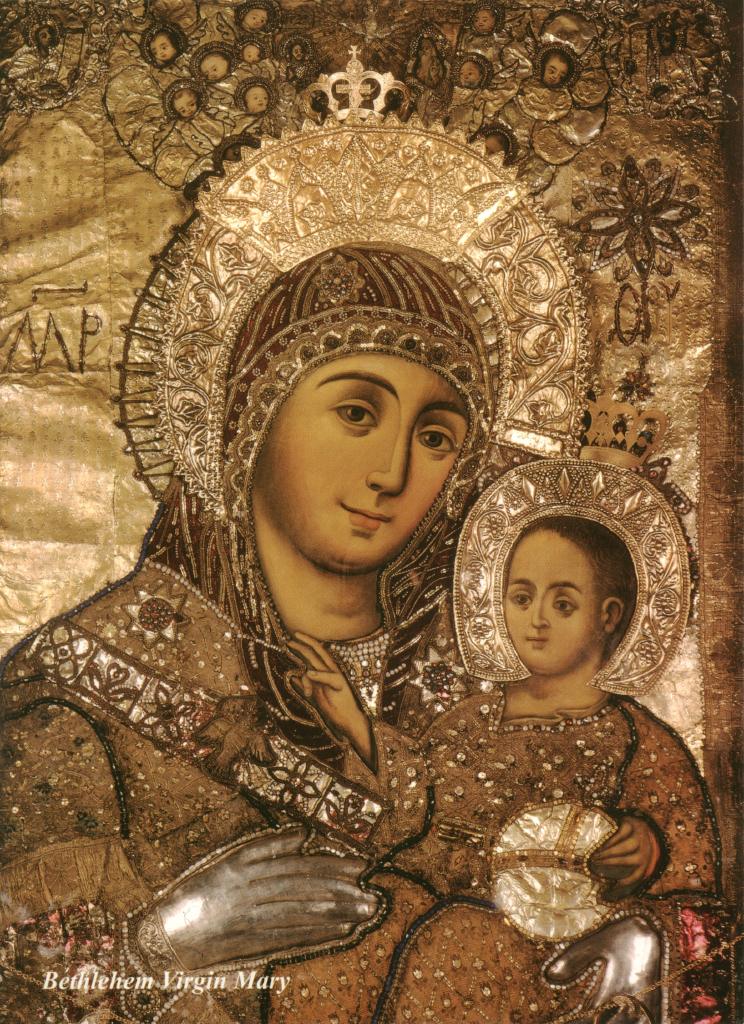
The wonderworking icon of the Theotokos of Bethlehem (source)
The wondrous icon of the Theotokos of Bethlehem ("Bhthleemitissa"), and her appearance to a muslim man
This is the story of the miraculous appearance of the Holy Mother to a Muslim in Bethlehem on the first day of Holy Week 2012. The Orthodox monastic community of the Church of the Nativity in Bethlehem related this story to Mr. Lycourgos Markoudes who writes here as he heard it.
The story begins on Holy Monday afternoon when the Church of the Nativity was practically empty of pilgrims. The monks were in the area of the Church where they attend to the needs of the Church. This is a short distance from the steps that lead to the Cave of the Birth of Christ. At one point, they saw a man approach them and he appeared to be very emotional. He took two candles and with great emotion he approached the icon of the Holy Mother of Bethlehem. He lit the candles before the icon and with tears flowing from his eyes he turned towards the monks who were looking at him with concern. He told them that he was a Muslim from the area around Bethlehem and that during the previous day he saw the Holy Mother in his sleep. The Holy Mother invited him to visit the place where She had given birth to Her Son and he was to enter the area through a low doorway. He was told to proceed to the right and then go to the area where he would find Her and then light two candles before her icon.
This man had not visited this Church since he was a very young child and he did not remember anything about the Church. When he arrived there on that afternoon, he left his car running with its emergency lights flashing in front of the main entrance of the Church, in an area that has restricted parking. His wife had remained in the car. When he arrived, he proceeded to enter walking briskly toward the low doorway of the Church. He realized as he was proceeding ahead that everything was exactly the way that our Holy Mother had described it to him. He then went right and down some stairs of Justinian’s Church and he entered the right area of the Church. This is the area that is under the jurisdiction of the Orthodox Church and it leads to the Cave where Jesus was born. The icon of the Holy Mother was exactly in the place where She had indicated it would be. And the icon was exactly the same one he had seen in his dream.
It was the icon of the Holy Mother of God of Bethlehem. This miracle-working icon is the resident icon of the Church of Bethlehem and it is located on a prominent icon stand on the right side of the steps that lead to The Cave of the Birth of Christ. The facial features of this icon overflow with an infinite expression of love and calmness while the faint smile on her face brings joy to the hearts of pilgrims. The icon is surrounded with precious fabrics and jewels. There are no solid details about the origin of the icon but tradition says that it comes from Russia and it is connected with the Russian Empress Katherine. This Empress visited the Holy Land after a miracle that was performed by the Mother of God. As a result of this, she gave her imperial clothing so that the Mother of the World could be dressed in them. She also gave her jewelry so that they could be placed on the icon. She also directed that future empresses should not wear rubies so that henceforth this distinctive honor would only belong to the Holy Mother. This is the icon that this Muslim came to reverence when he arrived at the Church of the Birth of Christ late afternoon of Holy Monday. He naturally did not know how to speak Greek and the conversation with the monks was in Arabic.
This was unbelievable news that this Muslim brought to the monks. The monks offered him a small icon of our Holy Mother which he accepted with thanksgiving. He left the Church quickly, just the way he arrived, but he then returned again in a few moments. He had forgotten that Our Holy Mother had also told him that while entering the Church, he should see her friends on the columns of the Church. The monks then took him to see the columns of the Church which have icons of saints painted on them; some of these icons today are just shadows, some are blackened and others are completely faded. These are life size figures of the Saints of our Church. These are the friends of our Holy Mother.
After seeing the columns the Muslim again left quickly and has never again returned to the Church. But the All-Holy One, the Mother of God and our Mother, through this miraculous occurrence came to show Her support for us so that we will have patience, hope and consolation and also to assure us that: “Her Son will come again and He will gather up all those who are close to Him.” Let us, therefore, not dare to distance ourselves from Him, so that we can taste His salvation. Amen.
TRANSLATED BY:
+Fr. Constantine J. Simones, June 2, 2012 (source)
Close-up of the icon of the Theotokos of Bethlehem (source)
Apolytikion of the Icon of the Theotokos of Bethlehem (amateur translation)
You
bless all those who hasten with faith to venerate your sacred image,
O Mother of God, gushing forth healings, O Lady of Bethlehem, and a
greatly-flowing river. And do not cease to protect those who
radiantly glorify your all-sacred Son, Who did not depart from the
Father's bosom, and, in an unspeakable manner, received mortal flesh
from your blood.
Through the prayers of our Holy Fathers, Lord Jesus Christ our God, have mercy on us and save us! Amen!
Subscribe to:
Posts (Atom)