O God, have mercy on our many sins and grant us all repentance!
Showing posts with label Constantinople. Show all posts
Friday, August 21, 2020
"O God, the nations have invaded your inheritance..."
Hagia Sophia, where the historic and sacred mosaic icons of Christ, the Theotokos and the Saints remain covered, not just at the hour of muslim prayer, but 24 hrs. a day (source)
O God, the nations have invaded your inheritance;(A)
they have defiled(B) your holy temple,
they have reduced Jerusalem to rubble.(C)
2 They have left the dead bodies of your servants
as food for the birds of the sky,(D)
the flesh of your own people for the animals of the wild.(E)
3 They have poured out blood like water
all around Jerusalem,
and there is no one to bury(F) the dead.(G)
4 We are objects of contempt to our neighbors,
of scorn(H) and derision to those around us.(I)
5 How long,(J) Lord? Will you be angry(K) forever?
How long will your jealousy burn like fire? ...
8 Do not hold against us the sins of past generations;(Q)
may your mercy come quickly to meet us,
for we are in desperate need.(R)
9 Help us,(S) God our Savior,
for the glory of your name;
deliver us and forgive our sins
for your name’s sake.(T)
10 Why should the nations say,
“Where is their God?”)...
13 Then we your people, the sheep of your pasture,(Z)
will praise you forever;(AA)
from generation to generation
we will proclaim your praise.
-from Psalm 79
The famous frescoes of the Chora Monastery in Constantinople, which was just announced will be converted into a mosque as well (source)
Icon depicting the Theotokos "Dakryrrousa" ("Weeping") and Christ, together with St. Constantine the Great, and the final Byzantine emperor, Constantine Palaiologos, in front of the mourning city of Constantinople (source)
O God, have mercy on our many sins and grant us all repentance!
Through the prayers of our Holy Fathers, Lord Jesus Christ our God, have mercy on us and save us! Amen!
Friday, July 10, 2020
"In Thy great mercy, keep Orthodox Christians and their pastors and all Thy people in peace..."
Mosaic of Christ from Hagia Sophia, Constantinople (source)
Apolytikion of Robe of Christ in Moscow in the Fourth Tone
On this day let us the faithful run to the divine and healing robe of our Saviour and God, Who was pleased to wear our flesh and pour out His holy Blood on the Cross, whereby He hath redeemed us from slavery to the enemy. Wherefore, we thankfully cry to Him: By Thy precious robe save and defend Orthodox Christians, and bishops, and cities, and all men everywhere, and save our souls, for Thou art the Friend of man.
The famous mosaic of Christ from the Deisis of Hagia Sophia (source)
Kontakion of Robe of Christ in Moscow in the Fourth Tone
Thou hast bestowed upon all men, O Master, Thy precious robe as a divine treasure, as a garment of incorruption, healing, and salvation, for thereby wast Thou pleased to clothe the holy and life-giving flesh of Thine Incarnation. Receiving this relic with faith, we joyfully celebrate this glorious occasion, and praising Thee with fear and love as our Benefactor, we cry to Thee, O Christ: In Thy great mercy, keep Orthodox Christians and their pastors and all Thy people in peace.
(source)
Icon depicting the life and Crucifixion of Christ and His wondrous Holy Cross and Robe (source)
Apolytikion of Elevation of the Holy Cross in the First Tone
Lord, save Your people and bless Your inheritance, granting our rulers to prevail over adversaries, and protecting Your commonwealth by Your Cross.
(source)
The Great Church of Christ, Hagia Sophia, or the Holy Wisdom of God, Constantinople (source)
O Lord, remember us in Your Kingdom, have mercy on us and on Your whole world, and grant us blessed Paradise!
Through the prayers of our Holy Fathers, Lord Jesus Christ our God, have mercy on us and save us! Amen!
Labels:
Constantinople,
Holy Relics,
Hymns,
The Holy Cross
Thursday, July 2, 2020
"You have given us Your Mother, O Lover of mankind, as a help to Your servants..."
The Mosaic of the Theotokos and Christ from the Apse of the Great Church of Christ: Hagia Sophia, in Constantinople (source)
You have given us Your Mother, O Lover of mankind, as a help to Your servants, as the Compassionate One, through whom You worked Your economy in an awesome manner, and You raised up our first-formed father to a divine rank. Therefore, as we honor this all-sacred festival, we hymn Your might, O All-mighty Jesus.
Mosaic from Hagia Sophia depicting Christ and the Theotokos, before the Holy Emperors Justinian and Constantine the Great (source)
The City that honors you, and glorifies you out of need, is cared by you through your precious Robe, O All-hymned [Theotokos], and O Spotless One, she is ever delivered from the most godless barbarians, from famine and earthquake, from civil war, O unwedded Virgin, and therefore she glorifies you, O Panagia and Bride of God, the helper of mankind.
Another mosaic from Hagia Sophia of the Theotokos and Christ (source)
Your precious Robe was granted to your City, O Lady graced by God, as an eternal treasure, a protection and pride and an unassailable wall, and a treasury of healings, and an ever-flowing spring of wonders, as an eternal harbor of salvation for those who are storm-tossed, and therefore we hymn you, O All-hymned Lady.
-Prosomoia of the Stichera from the Feast of the Deposition of the Robe of the Theotokos
(source)
On a sad day when the Turkish government votes to turn Hagia Sophia once again into a mosque, we pray that Most-Holy Theotokos might ever protect the Christians and their lands throughout the world, and most-importantly, that she might intercede that we be granted Paradise! (source)
Most-Holy Theotokos, save us!
Labels:
Constantinople,
Hymns,
The Most-Holy Theotokos
Friday, April 3, 2020
"O Champion General, I your City now inscribe to you..."
The Theotokos appearing and delivering Constantinople from the siege (source)
Deceased have been quickened through your power, * for pregnant were you with life hypostasized. * They who once were speechless now * speak with newfound eloquence. * Diseases are exterminated, lepers purified. * The legions of * the aerial spirits, * O Virgin, are defeated, for you are man’s salvation.
-from the Canon of the Akathist, by St. Joseph the Hymnographer
Tone Eight (Pl. IV). Original Melody.
O Champion General, I your City now inscribe to you
Triumphant anthems as the tokens of my gratitude,
Being rescued from the terrors, O Theotokos.
Inasmuch as you have power unassailable,
From all kinds of perils free me so that unto you
I may cry aloud: Rejoice, O unwedded Bride.
(source)
(source)
The wondrous Icon of the Theotokos and Christ "Of the Akathist", treasured to this day by Dionysiou Monastery on Mount Athos. This was the icon carried by Patriarch Sergios in procession and prayer along the walls of Constantinople when she was being sieged by a seemingly invincible foreign army. The Theotokos later appeared and wondrously defended the Christians, and may she ever hearken to our prayers to defend us from our enemies, visible and invisible! (source)
Most-holy Theotokos save us!
Friday, August 16, 2019
Archbishop Elpidophoros on Monasticism
Archbishop Elpidophoros meeting with Elder Ephraim of Arizona on his recent visit to the monastery (source)
A blessed and historic visit occurred by his Eminence Archbishop Elpidophoros of America to the Holy Monastery of St. Anthony in Arizona, where he spoke to the Fathers on his love of Monasticism, relating his support of their work and giving them promises that he will be beside them as a Father at their every step.
In the photograph, his Eminence is seen meeting with Elder Ephraim, who sat with him for a while in the archontariki.
After the Divine Liturgy, the Abbot of the Monastery discussed the [hope for the] canonization of Elder Joseph the Hesychast, but also spoke on the meaning of Monasticism and its offering to the world, including America, throughout the centuries.
The Fathers of the Monastery welcomed the Archbishop, who thanked him for the effort that he made to come near them having just recently taken on his new responsibilities, relating their thanks for his interest in them and for his presence at the Holy Monastery of St. Anthony.
In his address, the Abbot of the Holy Monastery of St. Anthony mentioned the work of their Elder, Elder Ephraim of Arizona, and the miracle of Monasticism, for which he himself has suffered greatly, saying that they appreciate and hopeful that they will have the support of the Archbishop for the difficult work that is occurring in Arizona.
Having mentioned Elder Ephraim, a true son of the Venerable Elder Joseph the Hesychast, he expressed his faith that the Archbishop will support the work begun by their Elder.
Having mentioned Elder Joseph the Hesychast, he related that they look forward to the blessed hour when he will be canonized.
During his address, his Eminence Archbishop Elpidophoros discussed his visits to Arizona, saying that it was the second time that he had come to Arizona and met with Elder Ephraim, noting that he had the blessing to hear spiritual words from his precious mouth, and came to know the brotherhood.
"This time, God has made me worthy to visit you as Archbishop of this beautiful Archdiocese, which is found to be the pinnacle of the Ecumenical Throne", said the Archbishop, while he also mentioned the Holy Monastery of the Holy Trinity [Halki], which was founded by the Great Patriarch Photios, of which he was the Abbot.
Reviewing the history of the Holy Monastery, the Archbishop mentioned how he himself, with the blessing of the Patriarch, began to create a brotherhood at the Monastery of the Holy Trinity, and spoke of the spiritual provisions and the asceticism and the tears of the Monks, which most likely will ultimately be that which will help to re-open the Theological School of Halki, together with all the rest that has occurred up till now.
Archbishop Elpidophoros arriving at the monastery (source)
"I entreat you, Fathers, to unite your spiritual efforts with those of the Holy Trinity of Halki, to create spiritual presuppositions that there might bear fruit again of the work of the Lord and give the Church clerics.
"The mystery of the Monastic and the Cleric is, if and to what degree, he is praying, if and to what degree he is communicating with the Lord," said the Archbishop.
"Here in Arizona, God blessed a holy Elder to come, your Elder, Elder Ephraim. He found a desert. America was not only a physical desert, but a spiritual desert thirsting, a desert that was seeking monasteries. The Elder came, and 'made the barren desert fertile'. The Good Sower [Christ], when He sows in the good earth, brings forth much fruit and increases. The Elder became a first-worker with the work of God, and bore the fruit of Monasticism in the barren land of the USA. He planted churches, monastics, which bring forth flowers and give fragrance to the USA.
"I came as Archbishop to express my thanks to Elder Ephraim who put forth many children, sons and daughters, in whom he can boast, and when the time comes for him to close his eyes, he can say: 'Master, now let Your servant depart in peace according to Your word, for my eyes have seen Your Salvation.'
"Now that God has allowed him to be near us, and when the Lord wishes to take him near Him, we will all express our thanks and our respect for him and for his spiritual children.
"The Archdiocese will be the protection and support of all Monastics, all Abbots [and Abbesses], all the Fathers who have chosen this difficult life, for our Patriarch himself is a lover of monastics, and he loves monasteries, and, my mediocrity, as a spiritual child of our Patriarch, learned to love monasteries and to love and protect monasteries.
"I did not come to America as an Archbishop, but as an Abbot, of the Monastery of the Holy Trinity in Halki, bringing with me also the Fathers and the brotherhood.
"I also would like to live here in America like I did in Halki with my brotherhood, my spiritual children, and, if God desires, may I found my brotherhood outside the offices of the Archdiocese, in honor of my Protector, St. Iakovos Tsalikis of Evia.
"Beloved Fathers and holy Abbot, you should see in my person a fellow monastic, a brother, who always has his door open, so you may come visit, that we can pray together and liturgize together.
In this spirit, we are organizing a synaxis of the Fathers throughout all America, and every year we will have it at a different monastery, that we might embrace our monasteries, that strengthen our faith and our tradition and our Hellenic conscience. May the Lord bless you."
(source)
Archbishop Elpidophoros blessing the people in the Katholikon (Source)
And here is the keynote address by Archbishop Elpidophoros to the above-mentioned Synaxis on Monasticism.
Through the prayers of our Holy Fathers, Lord Jesus Christ our God, have mercy on us and save us! Amen!
Sunday, March 23, 2014
A few quotes of St. Sophia of Kleisoura
St. Sophia the Ascetic of Kleisoura (+1974) (source)
Below are several amateur translations from a great new ascetic of our church. St. Sophia's quotes and teachings are remarkable for their brevity, power and meaning. Regarding dress in church, her words are very important and timely, as many of us have lost the great reverence and fear of God that our ancestors bore. Regarding prophecies of war and the retaking of Constantinople, of course such statements are not dogma (though they are in-line with those of other recent saints and elders; for a great approach to such prophecies, see here). Let St. Sophia's words be one more call for us all to repent and return to our Lord's embrace, before it is too late for us to do so.
May
you be well. May you have joy! Repent, my children...May you have
prayer...day and night...wherever you walk, wherever you are found,
wherever you are standing, always you should say: “My Christ, have
mercy on me!” With a sweet tongue speak to God, that your prayer
might reach Him.
Panagia
told me where, in the Holy Books of the chosen of my Son, it says
everything that will occur in time. A third war will
occur...Three-quarters of mankind will be destroyed...Only
one-quarter will be saved...
She
suggested: Let us have Love, humility and patience in temptations.
Pride is a bad thing...it sends the soul to hell...
The
Panagia told her: “Tell them...Tell them about the short
dresses...Tell them about the apostasy...Preach repentance!...Let
them not wear indecent dresses in Church...Let them have humble
dress.”
Be
prudent...Not short sleeves, not short hair. Panagia [χωλιάσκεται].
Lord
Jesus Christ, have mercy on Your world, and later, on us!
Greece,
if she keeps the faith, will be saved from the evil which is about to
come. If, however, she does not keep the faith, she will be
destroyed...All the demons will fall upon her...The evil will come
and the wheat will be separated from the chaff, the sheep from the
goats...
If
the world repents, we will take back the City [Constantinople] with
Love... If we do not repent, we will take it back with blood...
Have
fear of God...Have Love...Have compassion.
You
see me here how I am for so many years? Here, three demons have been
fighting me...The one is faithlessness...The other demon is
sloth...The third I don't remember, most likely anthropareskeias [the
desire to ever please other people]...
The
Ascetic of Kleisoura said: My soul is burning for Christ!
God
does not reveal sins to me...Only in the face of a person I see light
or darkness. And unfortunately, most are darkness...
Did
you see? Did you hear? Shut your mouth!
(source)
St. Sophia of Kleisoura (source)
Through the prayers of our Holy Fathers, Lord Jesus Christ our God, have mercy on us and save us! Amen!
Tuesday, May 28, 2013
The Wisdom of God, by Metropolitan Ierotheos Vlachos, Part I
Christ is risen! Truly He is risen!
Jesus Christ, the Wisdom of God, the Angel of Great Counsel (source)
The Wisdom of God, by Metropolitan Ierotheos (Vlachos) of Navpaktos and Agiou Vlasiou (amateur translation)
The following speech by Metropolitan Ierotheos Vlachos was offered in Levkosia, on the occation of the celebration of the feast of the new Holy Church of the Wisdom of God, the largest church on the island of Cyprus. In three parts, he discusses the identification of the "Wisdom of God" with Christ, the Churches of "Holy Wisdom", and the Feast of Mid-Pentecost.
I. Christ, the Wisdom of God
It is a fundamental teaching of the Fathers of the Church that the difference between the Old and the New Testament is that, in the Old Testament are recorded the appearances of the bodiless Word, the Angel of Great Counsel, the Wisdom of God, while in the New Testament is recorded the revelation of the incarnate Word. Thus, one of the names of Christ is the Wisdom of God.
According to Fr. George Florovsky “The name of wisdom is a biblical name”, which is used by the Apostle Paul. In reality, the Apostle Paul, speaking to the Jews and the Greeks of his time, says that while the Jews seek a sign, and the Greek-idolaters seek wisdom-philosophy, “we preach Christ crucified, to the Jews scandal, to the Greeks foolishness, but to those chosen, Jews and Greeks, Christ is the power of God and the wisdom of God” (Corinthians I 1:22-24). And later he writes: “It is because of him that you are in Christ Jesus, who has become for us wisdom from God—that is, our righteousness, holiness and redemption.” (Corinthians I 1:30)
Often it is said that in the Old Testament, Christ is characterized as Messiah. But this is not correct, because in the Old Testament, the Messiah was, as the word means, “the anointed one”, and this is offered to the kings and the Prophets, who were called by God and anointed for a special mission to Israel. Thus, the Messiah in the Old Testament was man. However, the Second Person of the Holy Trinity, in the Old Testament is characterized as the Angel of Great Council, the Wisdom of God. Foremost, the name “Wisdom of God” is met in the Proverbs and Wisdom of Solomon, and is attributed to Christ.
Thus, Christ is not the Messiah, in other words, a man who was [solely] born from the Panagia, but was the incarnate Word, Who took on human creation with the incarnation, which was anointed by the divine creation and became the Messiah in order to save the human race, and to deliver from the devil, death and sin. Fr. George Florovsky offers that “the identification of 'Wisdom' as one of the names of the Second Person of the Holy Trinity became a common theme in the homilies and theology of the Fathers. Origen perceived the name 'Wisdom' as the first and primary name of the Son (On John 10:22). And 'Wisdom' and 'Power' were commemorated in the Symbol of St. Gregory of Neo-caesarea. In the 4th century, the Arians and the Orthodox agreed that thee Holy Wisdom that is mentioned in the book of Proverbs was the Son of God”.
The wise Solomon, praying to the God of the Fathers and the Lord of mercy, among other things, says: “Give me wisdom, that sitteth by thy throne; and reject me not from among thy children...And wisdom was with thee: which knoweth thy works, and was present when thou madest the world, and knew what was acceptable in thy sight, and right in thy commandments. O send her out of thy holy heavens, and from the throne of thy glory, that being present she may labour with me, that I may know what is pleasing unto thee. For she knoweth and understandeth all things, and she shall lead me soberly in my doings, and preserve me in her power. So shall my works be acceptable, and then shall I judge thy people righteously, and be worthy to sit in my father's seat.” (Wisdom of Solomon 9:1-12).
It is sure that the wise Solomon here is speaking of the Second Person of the Holy Trinity, which is the Wisdom of God the Father, and Who is beside the throne of the glory of God, and at the creation of the world, and he is asking Him to send Him to him in the direction of his service.
That the Word of God is the Wisdom of God is seen from the word “Wisdom” which is mentioned either by itself or with some other entreaty in the holy Services, such as “arise, let us be attentive” and of course before the phrase, “He Who is blessed, Christ our true God” at the end of Vespers, in addition to following the service of the Artoklasia before the phrase “the blessing of the Lord and His mercy be upon you”. The union is clear between the Wisdom, which is the Word of God, with the phrases that speak of Him. Furthermore, the “Wisdom” is said during the Small Entrance of the Divine Liturgy, when the Deacon or the Priest raises the holy Gospel, because within it are the words of Christ. Thus, the Christians are called to lift up and to show reverence to the Wisdom of God, in other words, the Word of God, Christ. This word (Wisdom) is said also before the Epistle and Gospel readings, because within them are the words of Christ and the Apostles who are the members of the Body of Christ. And the same word, “Wisdom”, is said during the Liturgy of the Presanctified Precious Gifts before “the Light of Christ illumines all”, and during the Vespers before “O gladsome light of the holy glory”, which speaks about Christ...
Christ has risen from the dead, by death he has trampled on death, and to those in the graves given life!
Truly the Lord is risen!
Tuesday, June 26, 2012
St. Sampson the Innkeeper and Unmercenary
St. Sampson the Innkeeper - Commemorated on June 27 (http://pravicon.com/images/sv/s1830/s1830010.jpg)
Saint Sampson the Hospitable was the son of rich and illustrious Roman parents. In his youth he received an excellent education, he studied the medical arts, and doctored the sick without charge. After the death of his parents St Sampson generously distributed alms and set his slaves free, preparing himself to go into the wilderness.
With this intent in mind he soon journeyed from Rome to the East. But the Lord directed him onto a different path, that of service to neighbor, and so St Sampson came to Constantinople. Settling into a small house, the saint began to take in homeless wanderers, the poor and the sick, and he attended to them. The Lord blessed the efforts of St Sampson and endowed him with the power of wonderworking. He healed the sick not only through being a skilled physician, but also as a bearer of the grace of God. [St. Sampson is numbered with the Holy Unmercenary Saints.] News of St Sampson spread abroad. The patriarch heard of his great virtue and ordained him to the holy priesthood.
It was revealed to the grievously ill Emperor Justinian (527-565), that he could receive healing only through St Sampson. In praying, the saint put his hand on the afflicted area, and Justinian was healed. In gratitude the emperor wanted to reward his healer with silver and gold, but the saint refused and instead asked Justinian to build a home for the poor and the sick. The emperor readily fulfilled his request.
St Sampson devoted the rest of his life to serving his neighbor. He survived into old age and after a short illness he departed peacefully to the Lord. The saint was buried at the church of the holy Martyr Mocius, and many healings were effected at his grave. His hospice remained open, and the saint did not cease to care for the suffering. He appeared twice to a negligent worker of the hospice and upbraided him for his laziness. At the request of an admirer of St Sampson the hospice was transformed into a church, and beside it a new edifice was built for the homeless. During the time of a powerful fire at Constantinople the flames did not touch the hospice of St Sampson. Through his intercession a heavy rain quenched the fire.
(http://oca.org/FeastSaintsViewer.asp?SID=4&ID=1&FSID=101828)
See also: http://www.johnsanidopoulos.com/2010/06/st-sampson-hospitable-founder-of.html.
Troparion - Tone 8
Through your patience, your unceasing prayer, your love for the poor and the help you gave to them, you became worthy of your reward, O holy Sampson. Intercede with Christ God that He may save our souls.
Kontakion - Tone 8
We honor your relics, for you are an excellent physician and powerful intercessor; as we gather to praise you with psalms and hymns, divinely-wise and venerable Sampson, we glorify Christ, who granted you the grace of healing.
Through the prayers of our Holy Fathers, Lord Jesus Christ our God, have mercy on us and save us! Amen!
Monday, May 28, 2012
St. Andrew the Fool-for-Christ
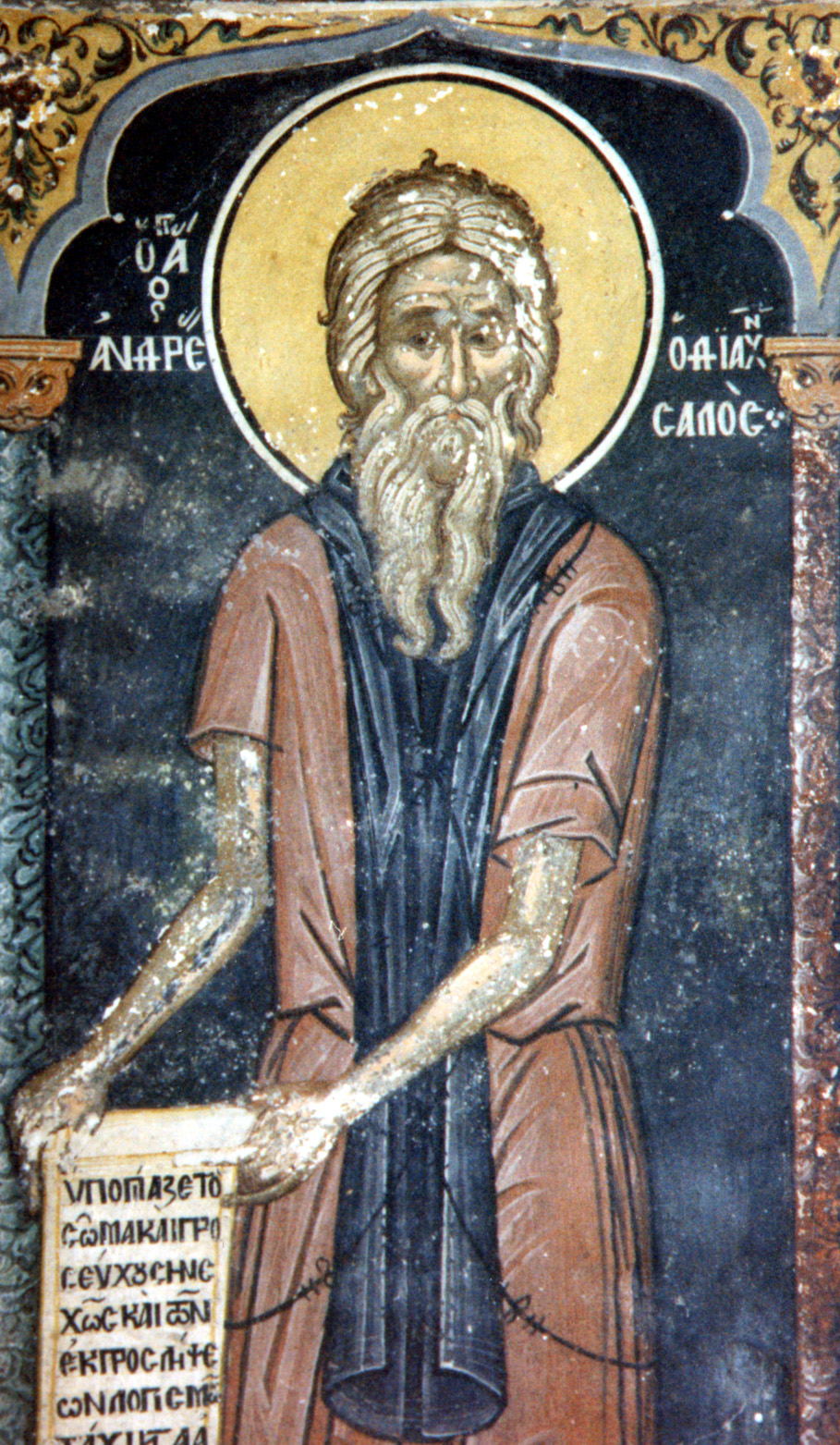
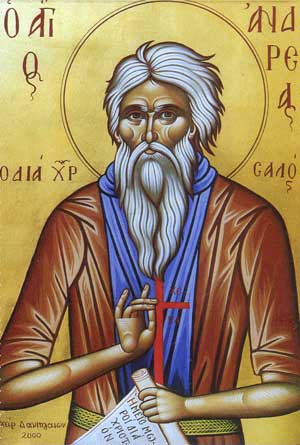
St. Andrew the Fool for Christ (Feast Day - October 2 in the Slavic Churches and May 28 in the Greek Churches) (http://pravicon.com/images/sv/s0181/s0181001.jpg)
The brief life of the Saint by St. Nikolai Velimirovich
Andrew was a Slav by birth. As a young man, he was enslaved; and was bought by Theognostus, a wealthy man in Constantinople, during the reign of Emperor Leo the Wise (son of Emperor Basil the Macedonian).
Andrew was handsome in body and soul. Theognostus took a liking to Andrew, and allowed him to become literate. Andrew fervently prayed to God, and with love attended church services.
Obeying a heavenly revelation, he adopted the ascesis of foolishness for Christ.
Once, when he went to the well for water, he tore off his clothes, and slashed them with a knife, feigning insanity. Saddened by this, his master Theognostus bound him in chains and brought him to the Church of St. Anastasia the Deliverer from Potions, so that prayers would be read for him. But Andrew did not improve, and his master freed him as mentally ill.
Andrew pretended insanity by day, but prayed to God all night long. He lived without shelter of any kind. He even spent the nights outside, walked around half-naked in a single tattered garment, and ate only a little bread when good men would give it to him. He shared all that he received with the beggars, and would mock them-to avoid being be thanked by them-for holy Andrew wanted all his reward to come from God. Therefore, the great grace of God entered into him and he was able to discern the secrets of men, perceive angels and demons, exorcize demons from men, and correct men from their sins.
Andrew was a Slav by birth. As a young man, he was enslaved; and was bought by Theognostus, a wealthy man in Constantinople, during the reign of Emperor Leo the Wise (son of Emperor Basil the Macedonian).
Andrew was handsome in body and soul. Theognostus took a liking to Andrew, and allowed him to become literate. Andrew fervently prayed to God, and with love attended church services.
Obeying a heavenly revelation, he adopted the ascesis of foolishness for Christ.
Once, when he went to the well for water, he tore off his clothes, and slashed them with a knife, feigning insanity. Saddened by this, his master Theognostus bound him in chains and brought him to the Church of St. Anastasia the Deliverer from Potions, so that prayers would be read for him. But Andrew did not improve, and his master freed him as mentally ill.
Andrew pretended insanity by day, but prayed to God all night long. He lived without shelter of any kind. He even spent the nights outside, walked around half-naked in a single tattered garment, and ate only a little bread when good men would give it to him. He shared all that he received with the beggars, and would mock them-to avoid being be thanked by them-for holy Andrew wanted all his reward to come from God. Therefore, the great grace of God entered into him and he was able to discern the secrets of men, perceive angels and demons, exorcize demons from men, and correct men from their sins.
St. Andrew and his disciple Ephiphanios behold the vision of the Theotokos (http://pravicon.com/images/sv/s0181/s0181002.jpg)
Andrew had a most beautiful vision of Paradise and the exalted powers of heaven. He also saw the Lord Christ on His throne of glory; and he, with his disciple Epiphanius, saw the Most-holy Theotokos in the Church of Blachernae as she covered the Christian people with her omophorion. This occurence is celebrated as the Feast of the Protection of the Most-Holy Theotokos (October 1). In a vision he also heard ineffable, heavenly words that he dared not repeat to men.
After a life of almost unparalleled harshness of ascesis, Andrew entered into rest in the eternal glory of his Lord in 911.
St. Andrew the Fool-for-Christ (http://days.pravoslavie.ru/jpg/ih4290.jpg)
A Vision of St. Andrew the Fool-for-Christ (1)
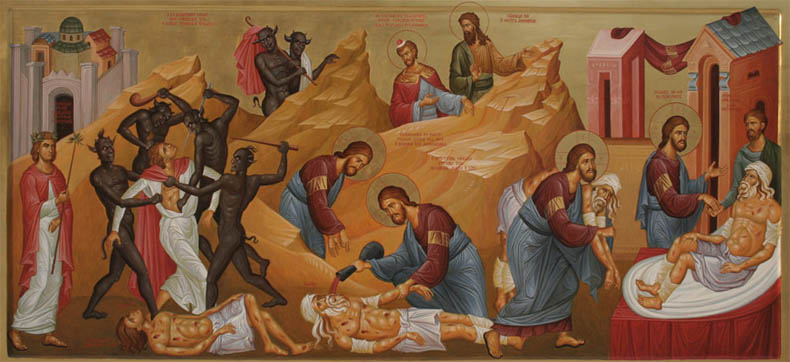
A monk in Constantinople was distinguished as an ascetic and spiritual father, and many people came to him for prayers. But this monk had the secret vice of avarice. He collected money and gave it to no one. St. Andrew met him on the street one day, and saw a terrible snake coiled around his neck. St. Andrew took pity on him, approached him, and began to counsel him: "Brother, why have you lost your soul? Why have you bound yourself with the demon of avarice? Why have you given him a resting place within yourself? Why are you amassing gold as though it will go to the grave with you, and not into the hands of others? Why are you strangling yourself by stinginess? While others hunger and thirst and perish from cold, you rejoice looking at your heap of gold! Is this the path of repentance? Is this the monastic rank? Do you see your demon?" At that, the spiritual eyes of the monk were opened, and he saw the dark demon and was greatly horrified. The demon dropped away from the monk and fled, driven by Andrew's power. Then a most radiant angel of God appeared to the monk, for his heart was changed for the good. Immediately, he went about distributing his hoarded gold to the poor and needy. From then on, he pleased God in everything and was more greatly glorified than before.
St. Andrew the Fool-for-Christ, with the demons fleeing him (http://i259.photobucket.com/albums/hh319/antonios13/antonios11/st-andrew-fool-for-christ.jpg)
A Vision of St. Andrew the Fool-for-Christ (2)
Once, St. Andrew was sitting with his disciple Epiphanius, talking about the salvation of the soul. Just then, a demon approached Epiphanius and began setting traps to distract his thoughts, but did not dare to approach Andrew. Andrew cried out: "Depart from here, impure adversary!" The devil drew back and replied maliciously: "You are my adversary, such as no other in all of Constantinople!" Andrew did not drive him away immediately, but permitted him to speak. And the devil began: "I feel that the time is coming when my work will be finished. At that time, men will be worse than I, as children will be even more wicked than adults. Then I will rest and will not teach men anything anymore, since they themselves will carry out my will in everything." Andrew asked him: "In what sins do your kind rejoice the most?" The devil replied: "The service of idols, slander, malice against one's neighbor, the sodomite sin, drunkenness and avarice-in this we rejoice the most." Andrew further asked him: "And how do you tolerate it when someone who first served you rejects you and your works?" The devil replied: "You know that better than I do; we find it difficult to tolerate, but we are comforted by this: we will probably bring them back to us-for many who have rejected us and turned to God have come back to us again." After the evil spirit had said this and much more, St. Andrew breathed on him and he disappeared.
St. Andrew the Fool-for-Christ (http://www.preguntasantoral.es/wp-content/uploads/2010/10/san-andrés-el-loco-de-constantinopla.jpg)
A Vision of St. Andrew the Fool-for-Christ (3)
Holy Andrew, walking one day along the streets of Constantinople, saw a great and splendid funeral. A rich man had died, and his cortege was magnificent. But when he looked more closely, Andrew saw a host of little black men capering merrily around the corpse, one grinning like a prostitute, another barking like a dog, a third grunting like a pig, a fourth pouring something filthy over the body. And they were mocking the singers and saying: "You're singing over a dog!" Andrew, marveling, wondered what this man had done. Turning round, he saw a handsome youth standing weeping behind a wall. "For the sake of the God of heaven and earth, tell me the reason for your tears", said Andrew. The young man then told him that he had been the dead man's guardian angel, but that the man had, by his sins, greatly offended God, casting his angel's counsel from him and giving himself over utterly to the black demons. And the angel said that this man was a great and unrepentant sinner: a liar, a hater of men, a miser, a shedder of blood and a dissolute man who had turned three hundred souls to immorality. In vain was he honoured by the Emperor and respected by the people. In vain was this great funeral. Death had caught him unrepentant, and the harvest had come without warning.
St. Andrew the Fool-for-Christ (https://blogger.googleusercontent.com/img/b/R29vZ2xl/AVvXsEhXqqA00YEfAhjqGcdaa9peINe51qgnchLUImpbSR30na1R4NIhU8Nv8pbKbudIJQgZyAJkncwWk8hs1t2zsnOg9quFun_CoJBBY9j1-LFseUJDYZep82Tz4CkxHpgNFBvr3dZTSj9xJJBj/s1600/ag-Andreas-dXR-Salos-2011.png)
A Vision of St. Andrew the Fool-for-Christ (4)
St. Paul was not the only one to be caught up into Paradise and hear "unspeakable words" (II Cor. 12:4). Over eight hundred and fifty years after St. Paul, this happened to St. Andrew. One winter night, holy Andrew was lying among the dogs on a dunghill, to warm his frozen body. An angel appeared to him and caught him up to Paradise (whether in the body or out of the body, Andrew himself was unable to explain) and kept him for two weeks in the heavenly world, bearing him to the third heaven. "I saw myself clad in shining garments like lightning, with a wreath of flowers on my head and girt with a kingly girdle, and I rejoiced greatly at this beauty, and marveled in mind and heart at the unspeakable loveliness of God's Paradise, and I walked around it with great gladness."
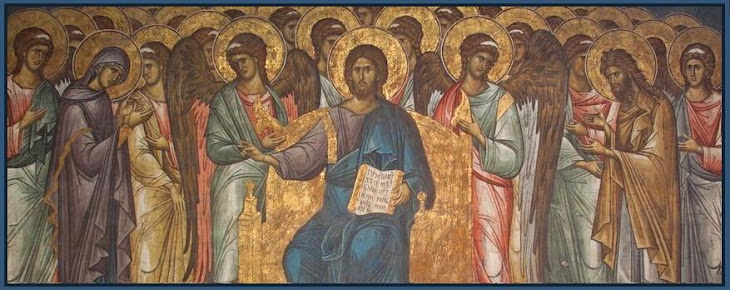
After that, Andrew writes of how he saw Christ the Lord: "And when a flaming hand drew aside the curtain, I saw my Lord as the Prophet Isaiah saw Him aforetime, sitting upon a throne, high and lifted up and surrounded by seraphim. He was clad in a red garment, His face shone and His eyes rested on me with great kindness. Seeing Him, I fell down before Him, worshipping before the awesome throne of His glory. I have no words for the joy that gripped me at the sight of His face; and now, remembering this vision, I am filled with unspeakable joy. And I heard my most merciful Creator speak three words to me with His most sweet and pure lips, which so sweetened my heart and inflamed it with love for Him that I melted as wax at such spiritual warmth." When St. Andrew asked also after this if it would be possible to see the Most-Holy Mother of God, it was said to him that she was for the moment not in heaven, but had gone down to earth to be of help to the poor and needy.
St. Paul was not the only one to be caught up into Paradise and hear "unspeakable words" (II Cor. 12:4). Over eight hundred and fifty years after St. Paul, this happened to St. Andrew. One winter night, holy Andrew was lying among the dogs on a dunghill, to warm his frozen body. An angel appeared to him and caught him up to Paradise (whether in the body or out of the body, Andrew himself was unable to explain) and kept him for two weeks in the heavenly world, bearing him to the third heaven. "I saw myself clad in shining garments like lightning, with a wreath of flowers on my head and girt with a kingly girdle, and I rejoiced greatly at this beauty, and marveled in mind and heart at the unspeakable loveliness of God's Paradise, and I walked around it with great gladness."
After that, Andrew writes of how he saw Christ the Lord: "And when a flaming hand drew aside the curtain, I saw my Lord as the Prophet Isaiah saw Him aforetime, sitting upon a throne, high and lifted up and surrounded by seraphim. He was clad in a red garment, His face shone and His eyes rested on me with great kindness. Seeing Him, I fell down before Him, worshipping before the awesome throne of His glory. I have no words for the joy that gripped me at the sight of His face; and now, remembering this vision, I am filled with unspeakable joy. And I heard my most merciful Creator speak three words to me with His most sweet and pure lips, which so sweetened my heart and inflamed it with love for Him that I melted as wax at such spiritual warmth." When St. Andrew asked also after this if it would be possible to see the Most-Holy Mother of God, it was said to him that she was for the moment not in heaven, but had gone down to earth to be of help to the poor and needy.
St. Andrew the Fool-for-Christ (http://pravicon.com/images/sv/s0181/s0181005.jpg)
HYMN OF PRAISE:
Saint Andrew the Fool-for-Christ
Fool-for-Christ Andrew stood at night
Under the starry firmament, praying:
"O Most-High God, three Persons in one Essence,
Salvation and Revival of souls that slumber!
O sweet Jesus, sweeter than life,
Treasury of joy and eternal beauty,
Cleanse the shepherds, enlighten the kings,
Console the troubled and sanctify the whole world.
Do not separate even me, the sinner, Andrew the Fool-for-Christ,
From Thy holy people, O Lord!"
O Saint Andrew, full of God's wisdom,
You who taught the world by words of foolishness-
With the language of the world you spoke to the world,
And by feigned foolishness you glorified Christ.
Men despised you for your foolishness,
And their dogs rose up from their lairs and chased you!
You were God's altar on the rubbish heap of the world.
You censed the world with your prayers-
And the world is not worthy of this marvel.
Glory to you, Andrew, holy Fool-for-Christ!
St. Andrew the Fool-for-Christ (http://days.pravoslavie.ru/Images/ii180&204.htm)
Apolytikion in the Fourth Tone
Thou didst choose foolishness for the sake of Christ and didst make the crafty one foolish. Thou didst persevere with thy struggle in the midst of turmoil, and Christ has brought thee to paradise. Intercede with Him, O Andrew for those who honor thee.
Apolytikion in the Second Tone
For Thy sake, O Christ, Thy servant Andrew became a fool on earth. He heard the Apostle Paul proclaiming, 'We are fools for the sake of Christ.' As we now honor his memory we pray Thee to save our souls.
Kontakion in the First Tone
Thou didst finish thy life in piety, O godly-minded Andrew, thou wast a pure vessel of the Trinity and a companion of the Angels. May peace and forgiveness be granted, through thine intercession, to those who honor thee.
Kontakion in the Fourth Tone
Of thine own free will thou didst become a Fool, O Andrew, and utterly hate the lures of this world. Thou didst deaden carnal wisdom through hunger and thirst, through heat and bitter frost. By never avoiding the hardships of weather thou didst purify thyself as gold in the furnace.
The full service to St. Andrew the Fool-for-Christ (in Greek) is available here: http://voutsinasilias.blogspot.com/2009/05/28.html.
Through the prayers of our Holy Fathers, Lord Jesus Christ our God, have mercy on us and save us! Amen!
Monday, April 2, 2012
On the Sanctification of the Holy Myrrh (Chrism)
Icon of the Descent of the Holy Spirit at Pentecost (https://blogger.googleusercontent.com/img/b/R29vZ2xl/AVvXsEg8w_2stYyYQik6kSgAbOX6_8y6_qc84KmNPPhqQqKBTSBEQDv9SPf_hbwqKODX-9GNCpYPL5GtqgvJHroTXZ7WjXOIj8NNsVfGfIvn2nnkxwUFoLHj9ZwBUavMZT4ioHgvC9c9w8-V4OE/s1600/pentecost.bmp)
On the Sanctification of the Holy Myrrh (Chrism)
It is worth noting that this year, through the Grace of the Holy Spirit, the Patriarch of Constantinople will once again consecrate the Holy Myrrh (Chrism) that will then be distributed through the churches under his care. The Holy Chrism is a visible sign of the gift of the Holy Spirit bestowed upon the Church of Christ, and is thus used in baptism services, along with consecration of churches throughout the world. As this event only occurs every ten years or so, it is worth following this great and rich mystery of our Church. Below is the encyclical of Patriarch Bartholomew, followed by other information about the sanctification of the Holy Chrism, that occurs during Holy Week.
Mar 28, 2012
PATRIARCHAL ENCYCLICAL
Prot. No. 217
Prot. No. 217
+ BARTHOLOMEW
By The Mercy Of God
Archbishop Of Constantinople-New Rome
And Ecumenical Patriarch
To The Holy Clergy And The Pious Plenitude
Of The Archdioceses
And Metropolises Of Our Most Holy Apostolic And Patriarchal Ecumenical Throne
By The Mercy Of God
Archbishop Of Constantinople-New Rome
And Ecumenical Patriarch
To The Holy Clergy And The Pious Plenitude
Of The Archdioceses
And Metropolises Of Our Most Holy Apostolic And Patriarchal Ecumenical Throne
Beloved children in the Lord,
Each person, created in the image and likeness of God, is a temple of the Lord. Much more so, those of us who have been baptized in Christ and chrismated with Holy Myrrh, grafted into the good olive tree of the Orthodox Church, are temples of the Holy Spirit that is within us, despite our various sins, both voluntary and involuntary, which alienate us from the Lord. “If we are faithless, yet He remains faithful. He cannot deny Himself.” (2 Tim. 2.13)
This grace is bestowed on us through the Holy Myrrh because, as St. Dionysios the Areopagite states, the service of myrrh perfects divine knowledge and understanding, whereby in a sacred manner our ascent to and blessed communion with the divinity is accomplished. The Myrrh grants the sanctification of the Spirit and is offered to the faithful as spiritual chrismation, a royal gift that sanctifies the soul and body.
Through the Myrrh we receive the pledge of the Spirit, from whom every good and perfect gift derive. Our God, who granted the Holy Spirit both in the law and to His Apostles, sanctifies all those who are anointed with holy myrrh and ranks them among the choir of those saved by grace, if only they preserve their garment of incorruption spotless from all defilement and struggle not to disappoint the Holy Spirit, which they received through Holy Chrism. For the myrrh renders the pious faithful familiar to and genuine servants of God; and when we are sealed with myrrh, we are known by the holy angels and by all heavenly powers, being conformed to these.
When we have holiness as the purpose of our existence in this life, we keep the commandments of God in order that the Holy Spirit, the good Comforter, may remain with us all and that we may inherit the heavenly Kingdom of God in accordance with the words: “Be holy, for I am holy.” (1 Peter 1.16)
Therefore, inasmuch as the periodical sanctification of the Holy Myrrh is a venerated institution of our Mother Church, our Modesty has, together with the Holy and Sacred Synod, decided that its consecration will be performed this year during the Holy and Great Week of our Lord’s Passion and will take place this coming Holy Thursday. The event will be preceded by the boiling of the Holy Myrrh from Holy Monday to Holy Wednesday, when we shall commemorate the sinful woman who anointed the Lord with precious fragrance and who was ultimately shown to be purer than everyone as a result of her great desire for Christ.
The sanctification of Holy Myrrh announced with this Patriarchal Encyclical constitutes a particular blessing for those of us performing, but also for all those who will attend and participate in this service. The Holy Myrrh will be distributed to other Orthodox Churches throughout the world, thereby becoming an unceasing source of sanctification, “a garment of incorruption and perfecting seal, marking those who receive the sacrament of Baptism with the sacred name of the Father and the only-begotten Son and the Holy Spirit.”
We ask you, then, beloved children and brothers in the Lord, not to overlook this historical event of the Sanctification of the Holy Myrrh at our Sacred Center and to do your utmost to participate in prayer and spirit, contributing in any way but especially by your presence at the most holy Patriarchal Church from Holy Monday to Holy Thursday, when the inspiring services of the Sanctification will conclude, so that we may all receive the blessing and grace of our Lord Jesus Christ as well as taste the benefits and gifts of the Holy Spirit.
May His divine grace and boundless mercy be with you all.
March 16, 2012
† BARTHOLOMEW of Constantinople
Fervent supplicant for all before God
Patriarch Bartholomew consecrating the Holy Chism in 2002 at the Patriarchate of Constantinople (http://www.amen.gr/uploads/Ecumenical%20Patriarchate%20life13%20/Myron2002.JPG)
The Sanctification of the Holy Chrism
In the Orthodox Church, the Holy Chrism is sanctified for use in the celebration of the sacrament of Chrismation.† It is a visible sign of the transmission of gifts of the Holy Spirit to those who are baptized.
During the early years of Christianity, the transmission of the gifts of the Holy Spirit to the baptized were given by the Apostles through the "laying of hands." It I stated in the Scriptures that, "Now when the Apostles at Jerusalem heard that Samaria had received the word of God, they sent to them Peter and John, who came down and prayed for them that they might receive the Holy Spirit, for it had not yet fallen on any of them, but they had only been baptized in the name of the Lord Jesus. Then they laid their hands upon them and they received the Holy Spirit." (Acts 8:14 17, R.S.V.)
When the Church spread throughout the world and the number of the baptized was greatly increased, it was not possible to continue the practice of Samaria. Consequently, the Apostles introduced the use of the sanctified Chrism.† The Holy Chrism was sanctified by the Apostles and was continued thereafter by the bishops through the Apostolic Succession. The "laying on of hands" was completely replaced by the Holy Chrism to transmit gifts of the Holy Spirit.
The use of the Holy Chrism was introduced to the Christian Church from the existing Old Testament practice. It is stated that, "The Lord said to Moses, 'Take the finest spices 12 pounds of liquid myrrh, 6 pounds of sweet smelling cinnamon, 6 pounds of sweet cane, and 12 pounds of cassia (all weighted according to official standard). Add one gallon of olive oil, and make a sacred anointing oil, mixed like perfume.''' (Exodus 30:22 25)
Over the years of its existence, the Holy Chrism has been known by many names, such as "oil," "oil of Thanksgiving," "oil of anointing," "Chrism," "Chrism of thanksgiving," "Chrism from heavens," "mystical Chrism," "myrrh," "divine myrrh," "mystical myrrh," "great myrrh," and "holy and great myrrh."† Today, the terms generally used are "Holy Myrrh" or "Holy Chrism."
The Holy Chrism is prepared from oil and another fragrant essences, which symbolize the variety of gifts of the Holy Spirit that the chrismated Christian receives. The most ancient list of materials and the aforementioned information "concerning the materials of the myrrh," which are still used today, date from the eighth century C.E.†† This list includes the materials used for the preparation and making of the Holy Chrism. At the Ecumenical Patriarchate of Constantinople, there is an official list of kinds of fragrances, from which the Holy Chrism is made," which includes 57 kinds of elements (***see below).
Information on how Holy Chrism was sanctified during the first centuries of Christianity is not available. The oldest reference is in The Apostolic Tradition of Hippolytos. Later, directions concerning the sanctification of the Holy Chrism were included in the Great Prayer Book (Mega Euchologion) and Goar's Euchologion. Constantinople presently uses this course in the preparation of the Holy Chrism.† During the nineteenth century and at the beginning of the present [twentieth] century, the Ecumenical Patriarchate made a special effort to revise carefully the prayer book containing the order and service of sanctification of the Holy Chrism.† The new revised edition was published for official use at the Ecumenical Throne.† Such services were published in 1890, 1912, and 1960.
In accordance with the rubrics followed by the Ecumenical Patriarchate, the sanctification of the Holy Chrism takes place in the following order:
After the doxology on Palm Sunday, the Patriarch blesses the Archon of the Myrrh who, along with the other Archons, work with him to make the Holy Chrism. They wear a white tunic reaching to the ground. After blessing the Archon of the Myrrh, the Patriarch then places a towel on him.
The next day, on Holy and Great Monday, after the Divine Liturgy of the Presanctified Gifts, the Patriarch enters the Patriarchal Church of the Great Myrrh, Saint George, where an appropriately decorated sepulched and the boilers for the Holy Chrism are located. The Patriarch then blesses the beginning of the cycle of the sanctification of the Holy Chrism with a special holy service. Following the blessing, he sprinkles holy water on the prepared materials, the utensils to be used, and the copper boilers. Then, holding a lighted candle, he touches each boiler, placing pieces of old charred holy icons in them. Then the Patriarch reads chapters from the Holy Gospel. The readings of the lessons (pericopes) from the New Testament are then continued by those present, including hierarchs, clergy from the Patriarchate, as well as visiting clergy. This order of readings continues all day on Holy Monday, Holy Tuesday, and Holy Wednesday.
On Holy and Great Tuesday, after the Divine Liturgy, a small supplication canon to the Theotokos is sung at the holy sepulcher. Prayers are offered for those who contributed material, money, and effort to prepare the Holy Chrism.
On Holy and Great Wednesday, after the Divine Liturgy of the Pre sanctified gifts, the Patriarch once again comes to the holy sepulcher and, after a brief service, places in the boilers rose oil, musk, and other sweet smelling oil. On this day, all preparations for making the Holy Chrism are completed.
On Holy and Great Thursday, after Matins (Orthros) at the Patriarchal chapel of Saint Andrew and after the complete vesting of the Patriarch and the other hierarchs, the procession from the Patriarchal Palace to the Patriarchal Church begins. The bells ring during the entire procession. During the procession, the Patriarch holds the small myrrh container.† The first in order of the hierarchs holds an alabaster containing pre sanctified Chrism.† The second in order of the hierarchs holds an alabaster containing unsanctified Chrism.† The other hierarchs hold small silver vases containing Chrism from the prepared materials to be sanctified. Twenty four archimandrites hold (one on each side) 12 silver containers filled with the Chrism to be sanctified.† During the Divine Liturgy, at the appointed time after the exclamation: "And may the mercy of our Great Lord," the Grand Archimandrite exclaims, "Let us attend."† The congregation kneels, and the Patriarch sanctifies the Holy Chrism according to the rubrics.
Saints of Constantinople: Panagia Pammakaristos (whose icon is kept in the Patriarchal Church of St. George), Sts. Euphemia, Theophano and Solomone (whose holy, incorrupt Relics adorn the Patriarchal Church, as well as part of the pillar of flagellation of the Lord, Holy Patriarchs of Constantinople, and depictions of Hagia Sophia and St. George (source)
[The Prayer of the Sanctification of the Holy Chrism (amateur translation)
O God, the Great and Exalted, Who is worshiped by all creation, the spring of wisdom and the abyss of goodness, the unlimited gulf of compassion, You, O Master Who loves man, God of the ages and wonders, Whom none is able to comprehend in mind: Look down and hearken to us, Your servants. We ask and entreat You and we pray to You, send down Your Holy Spirit and sanctify this Myrrh. And make this a myrrh of gladness of the Holy Spirit, and a myrrh of rebirth, a chrism of sanctification, a royal adornment, a breastplate of power against every attack and diabolic energy, an indelible seal, rejoicing of the heart, eternal gladness. That those who are anointed with it may shine as the stars in heaven with Your gladness, without spot or wrinkle, and be received into Your eternal resting place, and receive the confirmation of the calling from above. Through the grace and compassion and love for man of Your Only-begotten Son, through Whom You are blessed, together with Your All-holy and Good and Life-giving Spirit, now and ever, and unto the ages of ages. Amen. (http://voiotosp.blogspot.com/2009/07/19.html)]
At the end of the Divine Liturgy, the sanctified Holy Chrism is transferred from the church to the Patriarchal myrrh center in reverse order according to the order of the Procession. It is in the Patriarchal myrrh center that the alabasters and the containers that contain the Holy Chrism are deposited. Followingthis transfer, the dismissal of the Divine Liturgy takes place.
During the early centuries of Christianity, a firm tradition existed in the Church in which the Holy Chrism was sanctified only by the bishops of the Church and not by the presbyters (priests). At that time, there were no distinctions among bishops, that is among bishops of dioceses and metropolitanate bishops of greater church districts. As the years passed, however, the common right of all bishops was eventually transferred to the bishops of churches with greater status, that is, to the Patriarchs, and finally to the Ecumenical Patriarch, who today is able to transmit this right to the heads of local Orthodox churches. In other words, even though each bishop has the right to sanctify the Holy Chrism by his status as bishop, he is not permitted by canon law to do so. It appears that there are three reasons that restrict the right of sanctifying the Holy Chrism to the Ecumenical Patriarch. These reasons include: a) the scarcity of the materials and the difficulty for each bishop to prepare the Holy Chrism, b) the constant increase of dependence of the diocese on the head of the greater church and district, and c) the special position that the Ecumenical Patriarchate received through the centuries in relation to the other patriarchates of the East and that expresses the spiritual bond between the Church of Constantinople and the local churches of the people who received the Christian faith from its missionaries.
In reality, this exclusive right to sanctify the Holy Chrism of the Ecumenical Patriarchate does not mean that local churches are dependent and subordinate to Constantinople. This act of receiving the Holy Chrism from the Ecumenical Patriarchate is a tangible and visible sign of the amity and bond of local churches, patriarchates, and autocephalous churches with the Ecumenical Patriarchate.† It is a necessary sign, not a sign of superiority of the Ecumenical Patriarchate in the Orthodox Church, but an existing visible sign of unity among the cluster of local Orthodox churches. Nevertheless, in the Orthodox Church, the Holy Chrism, in addition to being sanctified in the Ecumenical Patriarchate, is sanctified in the contemporary patriarchates of Moscow, Belgrade, and Bucharest.
As was stated earlier, Holy Chrism is used mainly in the celebration of the sacrament of Chrismation, which takes place immediately following the sacrament of Baptism. It is, however, a separate, distinct sacrament from Baptism. According to Orthodox Church readings, through the administration of the sacrament of Chrismation, the baptized receive gifts (charismata) that are transmitted to them by the Holy Spirit.† Such gifts also help the baptized live a life in Christ, which they enter through baptism, and equip them in their struggle against sin and the attacks of evil.† Through the seal of Chrismation, the baptized attain "mature manhood, to the measure of the fullness of Christ." (Ephesians 4:13 R.S.V.)
The Holy Chrism is also used to chrismate the heterodox (non Orthodox) joining the Church, and to chrismate those fallen away from the Orthodox Faith and who are returning to the Orthodox Church.† In addition, it is also used to consecrate holy churches, altar tables, objects, and utensils, and for other sacred ceremonial circumstances. In past centuries, it was also used to anoint the Orthodox kings during their crowning.
The following is a list of dates and Patriarchs during the twentieth century when the Holy Chrism was sanctified in the Ecumenical Patriarchate:
1903, Patriarch Joachim III
1912, Patriarch Joachim III
1928, Patriarch Basileios III
1939, Patriarch Benjamin I
1951,Patriarch Athenagoras I
1960, Patriarch Athenagoras I
1973, Patriarch Demetrios 1
1983, Patriarch Demetrios 1
1992, Patriarch Bartholomew
Christ being anointed by the (un-named) woman shortly before His Passion (https://blogger.googleusercontent.com/img/b/R29vZ2xl/AVvXsEhCL4p95oOxQS4J0rmWd-qTdAciODbqIVli8fpSH9nEnSiiYSd1P-kOg0uYZi7Vszqv_4y1tYdUrOt6byfEDFiODOXBY0jmGBYbfu1HScoptYlkDMO5UwqVzEXnCLYEyVvabsRgol98M73V/s1600/Aleipsasa.png)
***Ingredients used for the Holy Chrism
The following are the 57 ingredients that are by tradition used to prepare the Holy Chrism by the Patriarch of Constantinople. Though I can't translate the whole list right now, a few of the ingredients include: olive oil, wine, rose water, mastic, styrax, cassia, cinnamon, etc.
The great number and value of these components is not spurious; they are a visible symbol of the many-varied and diverse gifts of the one Holy Spirit, and His honor and worth that surpasses all human understanding.
Α) ΥΛΗ ΕΨΟΜΕΝΗ:
1. Έλαιον καθαρόν………όκ. 700
2. Οίνος στίφων μέλας………όκ. 200
3. Ανθόνερον αρ ποιότητος………λίτ. 32
4. Ροδόνερον αρ ποιότητος……….λίτ. 40
5. Μαστίχη καθαρά…………λίτ. 20
6. Μετζουβί ή κόμμι ευώδες (ασιλμπέντ παδεμί)………λίτ. 20
7. Άμωμον (γενί παχάρ)………..λίτ. 6
8. Ξυλαλόη μαβέρτη (μαβέρτι ή οδ-αγατζί)………..λίτ. 6
9. Πέπερι μακρόν (δάρι φιλφίλ)…………λίτ. 4 ½
10. Κάρυα αρωματικά (τσεβίζ πεβά ή χηντιστάν)………..λίτ. 6
11. Φύλλος ινδικός (σαδέτζ χηντί η χήντ γιαπραγί)………λίτ. 1 ½
12. Ξυλοκασία ήτοι αγγέλικα Βοεμίας (σελιχί καπουγιού ή ατζελίκ κιοκιού ή μελέκ κιοκιού) …………λίτ. 4
13. Στύραξ υγρά (μεχαΐ σαϊλέ ή καρά κισενλούκ γιαγί)……..λίτ. 4
14. Σμύρνα καθαρά (μουρού σαφί)………λίτ. 12
15. Πέπερις (καρά μπιμπέρ, ή φουλφούλι ασβέστι)…λίτ. 10
16. Εχινάνθη (ιτχίρι μεκαΐ ή κιαπέ σαμανί)………..λίτ. 4
17. Ξυλοβάλσαμον (ουδ-παλασάν)………….λίτ. 1 ½
18. Άκορος ή κάλαμος ευώδης (αζάκ εγιρί ή βέτζ)……….λίτ. 6
19. Ίρις φλωρεντινή (ίρισα ή μενεξε κιοκιού)……………λίτ. 12
20. Βάκχαρις ή άντ΄ αυτής εμπερατόρια (σαφρέντ παχαρί ή κράτ κιοκιού)…………..λίτ. 6
21. Αριστολοχία βέρα (τζεραβεντί ταβίλ)……………….λίτ. 1 ½
22. Καρποβάλσαμον ή κουβέβι (χαμπούλ παλασάν ή κεπαπέ)……………..λίτ. 4
23. Κύπερις (τοπαλάκ κιοκιού ή σαδ)…………………λίτ. 6
24. Μυρισινόκοκκα (μερσίν τοχουμού)………………λίτ. 2
25. Νάρδος κελτική (σουμπούλι φρεγκί ή σουμπούλι ρούμι)………λίτ. 4
26. Κασσία μέλαινα ή άντ΄ αυτής κασκαρίλια όπερ εστί φλοιός αμπάρεως (καρεμφίλ απουγιού ή άμπερκα πουγιού)………………λίτ. 4
27. Βάλανος μυριψική (χαμπούλ μπάν)…………………λίτ. 1 ½
28. Καρδάμωμον μικρόν (κακουλεγί σαγήρ)……….λίτ. 6
29. Καρυοφύλλα (καρεμφίλ)……………….λίτ. 12
30. Κινάμωμον (ταρζίν)………………….λίτ. 12
31. Άσσαρον βερόν (εσαρούν)…………λίτ. 6
32. Μάκερος Ολλάνδας (μπεσμπάσεγι χηντί)………λίτ. 6
33. Τερέβινθος βενετική (τιρεμεντίνη βενεδίκ)………λίτ. 14
34. Ρετσίνη λευκή καθαρά (τσάμ σακίζ εμπιάζ)……………λίτ. 28
35. Μυροβάλανον καθαρόν (χελιλεγί χηντί)……………………λίτ. 4
36. Σάμψυχος ή ματζουράνα (μερτζαντζού)………………λίτ. 4
37. Λάδανος καθαρά (λαδενί κιριντί)……………λίτ. 20
38. Στάχυς νάρδου ινδικού (σουμπούλι χηντί)…………………λίτ. 4
39. Λίβανος λευκός (κισινλούκ εμπιάζ)……………….λίτ. 20
40. Ζηγγίβερις λευκή (τζεντζεμπίλ εμπιάζ)………………λίτ. 12
41. Ζαρνάβας (ζουρουμπάτ)……………..λίτ. 5
42. Τύλλις (χαλαμπέ τοπόϊ τοχουμού)………………λίτ. 4
43. Ελένιον (ατζί κιοκιού)…………………..λίτ. 4
Β΄) ΥΛΗ ΜΕΤΑ ΤΗΝ ΕΨΗΣΙΝ ΤΩΝ ΑΝΩΤΕΡΩ ΤΩ ΜΥΡΩ ΕΓΧΕΟΜΕΝΗ
44. Έλαιον κινναμώμου σεϊλανικόν (ταρτζίν γιαγί)……….λίτ. 1 ½
45. Έλαιον καρυοφύλλων……………..λίτ. 1 ½
46. Μοσχοκαρυοέλαιον Ολλάνδας πηκτόν (χηντιστάν τζεβισί γιαγί)............λίτ. 3
47. Βάλσαμον Μέκκας ήτοι βαλσαμέλαιον (κιαμπέ πελεσανί ή πελεσέγκ γιαγί)………….λίτ. 14
48. Ροδέλαιον ή έλαιον τριαντάφυλλου (γκιούλ αγατζί γιαγί)…..δραμ. 200
49. Έλαιον μάκερις (πεσπασεί χηντί γιαγί)……….δραμ. 20
50. Έλαιον κύτρου…………δραμ. 70
51. Έλαιον καρποβαλσάμου……..δραμ. 35
52. Έλαιον σαμψύχου……….δραμ. 35
53. Έλαιον δάφνης……………δραμ. 70
54. Έλαιον δενδρολιβάνου……..δραμ. 35
55. Έλαιον νάρδου ή λεβάντας……..δραμ. 35
56. Μόσχος ινδικός (μίσκι χηντί)………δραμ. 40
57. Αμπάρι (αμπέρ εμπιάζ)…………δραμ.65
Christ, the Good Samaritan, pouring the oil and wine of the Holy Mysteries on our wounds, and leading us to the Church (https://blogger.googleusercontent.com/img/b/R29vZ2xl/AVvXsEjfhkZ2uLlWSUVmuzJ9_azaQXc1p7gUuCWDWHqinwpkioT2JrT3b39jBOALNpLq1o5qG-SYv8uygYQ4np_MfsA6Ezrm_RQeoJSzQnIuRti6rAsAtbg7KS3ZvCFBOhKXoJUe0-qIBfIaYDY/s1600/good+samaritan+icon.jpg)
- Prosomoia chanted during the consecration of the Holy Chrism, in the Second Tone (amateur translation)
- Let us stand with fear and joy, let us stand with fervor, O faithful, in the courts of God; today a sacred mystery is accomplished, for the myrrh of anointing, the seal of gifts, is sanctified by the hands of the archpriests. Let us offer to our God glory, for He anoints us His children with chrism, the oil of gladness.
- O ranks of pious priests that lead the faithful people, let us approach the mystery with trembling, in the city of the living God, and cleanse our souls, and with pure hands, let us faithfully receive the alabaster container of the myrrh, for now the choir of the Apostles, bestow the laying on of their hands with us, and through the will of the godhead.
- Hail, O spotless bride of God, for to you was granted the spirit to cry: “Abba, Father”, for the Myrrh was consecrated in your arms, the seal of transformation that leads to grace. Within you was Christ your King, and we become truly sons of your sons in His kingdom, through the fragrant inbreathing of the Myrrh.
Through the prayers of our Holy Fathers, Lord Jesus Christ our God, have mercy on us and save us! Amen!
Subscribe to:
Posts (Atom)