Sunday, January 18, 2009

St. Anthony the Great

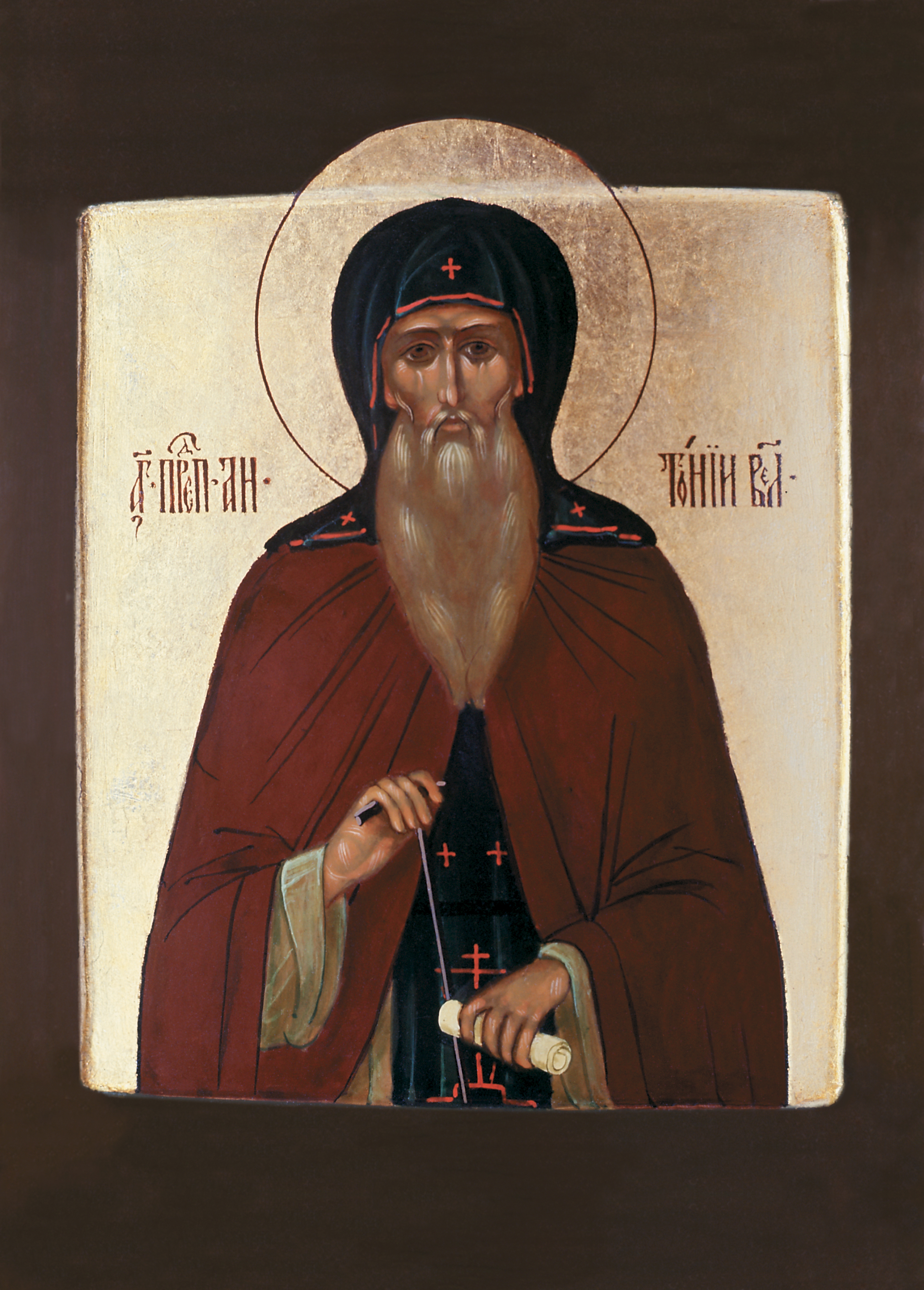
Yesterday (January 17th) we celebrated the feast of St. Anthony the Great. He is considered one of the major and first Fathers of the Monastic Life. The life of St. Anthony below is taken from: http://ocafs.oca.org/FeastSaintsViewer.asp from January 17th.


Icon of St. Anthony the Great (Icon courtesy of www.eikonografos.com used with permission)
  
"Saint Anthony the Great is known as the Father of monasticism, and the long ascetical sermon in The Life of St Anthony by St Athanasius (Sections 16-34), could be called the first monastic Rule.

He was born in Egypt in the village of Coma, near the desert of the Thebaid, in the year 251. His parents were pious Christians of illustrious lineage. Anthony was a serious child and was respectful and obedient to his parents. He loved to attend church services, and he listened to the Holy Scripture so attentively, that he remembered what he heard all his life.

When St Anthony was about twenty years old, he lost his parents, but he was responsible for the care of his younger sister. Going to church about six months later, the youth reflected on how the faithful,in the Acts of the Apostles (4:35), sold their possessions and gave the proceeds to the Apostles for the needy.

Then he entered the church and heard the Gospel passage where Christ speaks to the rich young man: "If you would be perfect, go, sell what you possess and give it to the poor, and you will have treasure in heaven; and come follow Me" (Mt.19:21). Anthony felt that these words applied to him. Therefore, he sold the property that he received after the death of his parents, then distributed the money to the poor, and left his sister in the care of pious virgins in a convent.

Leaving his parental home, St Anthony began his ascetical life in a hut not far from his village. By working with his hands, he was able to earn his livelihood and also alms for the poor. Sometimes, the holy youth also visited other ascetics living in the area, and from each he sought direction and benefit. He turned to one particular ascetic for guidance in the spiritual life.

St. Anthony the Great, with scenes from his life (http://pravicon.com/images/sv/s0215/s0215009.jpg)
  
In this period of his life St Anthony endured terrible temptations from the devil. The Enemy of the race of man troubled the young ascetic with thoughts of his former life, doubts about his chosen path, concern for his sister, and he tempted Anthony with lewd thoughts and carnal feelings. But the saint extinguished that fire by meditating on Christ and by thinking of eternal punishment, thereby overcoming the devil.

Realizing that the devil would undoubtedly attack him in another manner, St Anthony prayed and intensified his efforts. Anthony prayed that the Lord would show him the path of salvation. And he was granted a vision. The ascetic beheld a man, who by turns alternately finished a prayer, and then began to work. This was an angel, which the Lord had sent to instruct His chosen one.

St Anthony tried to accustom himself to a stricter way of life. He partook of food only after sunset, he spent all night praying until dawn. Soon he slept only every third day. But the devil would not cease his tricks, and trying to scare the monk, he appeared under the guise of monstrous phantoms. The saint however protected himself with the Life-Creating Cross. Finally the Enemy appeared to him in the guise of a frightful looking black child, and hypocritically declaring himself beaten, he thought he could tempt the saint into vanity and pride. The saint, however, vanquished the Enemy with prayer.

For even greater solitude, St Anthony moved farther away from the village, into a graveyard. He asked a friend to bring him a little bread on designated days, then shut himself in a tomb. Then the devils pounced upon the saint intending to kill him, and inflicted terrible wounds upon him. By the providence of the Lord, Anthony's friend arrived the next day to bring him his food. Seeing him lying on the ground as if dead, he took him back to the village. They thought the saint was dead and prepared for his burial. At midnight, St Anthony regained consciousness and told his friend to carry him back to the tombs.

St Anthony's staunchness was greater than the wiles of the Enemy. Taking the form of ferocious beasts, the devils tried to force the saint to leave that place, but he defeated them by trusting in the Lord. Looking up, the saint saw the roof opening, as it were, and a ray of light coming down toward him. The demons disappeared and he cried out, "Where have You been, O Merciful Jesus? Why didn't You appear from the very beginning to end my pain?"

The Lord replied, "I was here, Anthony, but wanted to see your struggle. Now, since you have not yielded, I shall always help you and make your name known throughout all the world." After this vision St Anthony was healed of his wounds and felt stronger than before. He was then thirty-five years of age.

  
Having gained spiritual experience in his struggle with the devil, St Anthony considered going into the Thebaid desert to serve the Lord. He asked the Elder (to whom he had turned for guidance at the beginning of his monastic journey) to go into the desert with him. The Elder, while blessing him in the then as yet unheard of exploit of being a hermit, decided not to accompany him because of his age.

St Anthony went into the desert alone. The devil tried to hinder him, by placing a large silver disc in his path, then gold, but the saint ignored it and passed by. He found an abandoned fort on the other side of the river and settled there, barricading the entrance with stones. His faithful friend brought him bread twice a year, and there was water inside the fort.

St Anthony spent twenty years in complete isolation and constant struggle with the demons, and he finally achieved perfect calm. The saint's friends removed the stones from the entrance , and they went to St Anthony and besought him to take them under his guidance. Soon St Anthony's cell was surrounded by several monasteries, and the saint acted as a father and guide to their inhabitants, giving spiritual instruction to all who came into the desert seeking salvation. He increased the zeal of those who were already monks, and inspired others with a love for the ascetical life. He told them to strive to please the Lord, and not to become faint-hearted in their labors. He also urged them not to fear demonic assaults, but to repel the Enemy by the power of the Life-Creating Cross of the Lord.

In the year 311 there was a fierce persecution against Christians, in the reign of the emperor Maximian. Wishing to suffer with the holy martyrs, St Anthony left the desert and went to Alexandria. He openly ministered to those in prison, he was present at the trial and interrogations of the confessors, and accompanying the martyrs to the place of execution. It pleased the Lord to preserve him, however, for the benefit of Christians.

At the close of the persecution, the saint returned to the desert and continued his exploits. The Lord granted the saint the gift of wonderworking, casting out demons and healing the sick by the power of his prayer. The great crowds of people coming to him disrupted his solitude, and he went off still farther, into the inner desert where he settled atop a high elevation. But the brethren of the monasteries sought him out and asked him to visit their communities.

Another time St Anthony left the desert and arrived in Alexandria to defend the Orthodox Faith against the Manichaean and Arian heresies. Knowing that the name of St Anthony was venerated by all the Church, the Arians said that he adhered to their heretical teaching. But St Anthony publicly denounced Arianism in front of everyone and in the presence of the bishop. During his brief stay at Alexandria, he converted a great multitude of pagans to Christ.

People from all walks of life loved the saint and sought his advice. Pagan philosophers once came to Abba Anthony intending to mock him for his lack of education, but by his words he reduced them to silence. Emperor Constantine the Great (May 21) and his sons wrote to St Anthony and asked him for a reply. He praised the emperor for his belief in Christ, and advised him to remember the future judgment, and to know that Christ is the true King.

St Anthony spent eighty-five years in the solitary desert. Shortly before his death, he told the brethren that soon he would be taken from them. He instructed them to preserve the Orthodox Faith in its purity, to avoid any association with heretics, and not to be negligent in their monastic struggles. "Strive to be united first with the Lord, and then with the saints, so that after death they may receive you as familiar friends into the everlasting dwellings."

St. Anthony the Great, with scenes from his life (http://pravicon.com/images/sv/s0215/s0215010.jpg)
  
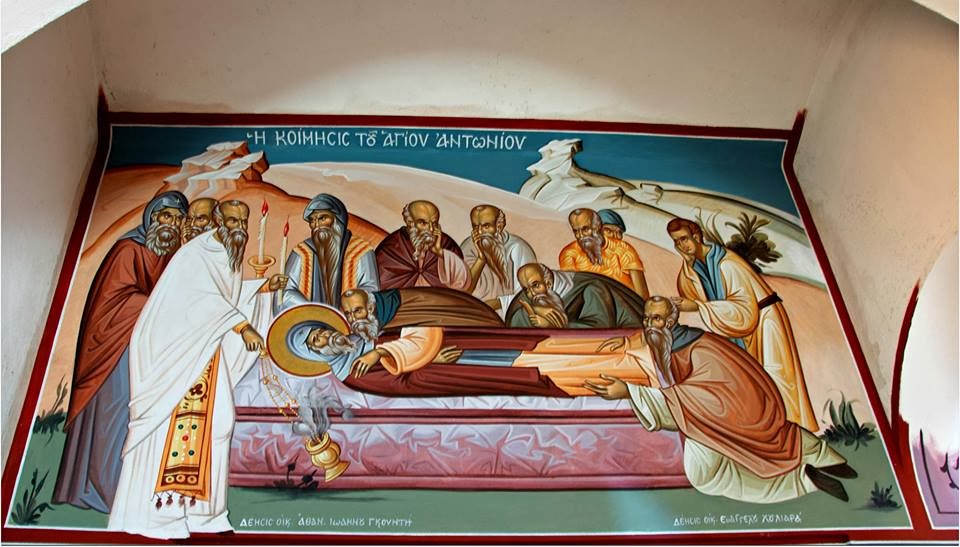
The saint instructed two of his disciples, who had attended him in the final fifteen years of his life, to bury him in the desert and not in Alexandria. He left one of his monastic mantles to St Athanasius of Alexandria (January 18), and the other to St Serapion of Thmuis (March 21). St Anthony died peacefully in the year 356, at age 105, and he was buried in the desert by his disciples.

The Life of the famed ascetic St Anthony the Great was written by St Athanasius of Alexandria. This is the first biography of a saint who was not a martyr, and is considered to be one of the finest of St Athanasius' writings. St John Chrysostom recommends that this Life be read by every Christian.

[See a full translation of the Life of St. Anthony the Great, written by St. Athanasios the Great, here: http://www.fordham.edu/halsall/basis/VITA-ANTONY.html]
 
The Dormition of St. Anthony the Great (source)
 
"These things are insignificant compared with Anthony's virtues," writes St Athanasius, "but judge from them what the man of God Anthony was like. From his youth until his old age, he kept his zeal for asceticism, he did not give in to the desire for costly foods because of his age, nor did he alter his clothing because of the infirmity of his body. He did not even wash his feet with water. He remained very healthy, and he could see well because his eyes were sound and undimmed. Not one of his teeth fell out, but near the gums they had become worn due to his advanced age. He remained strong in his hands and feet.... He was spoken of everywhere, and was admired by everyone, and was sought even by those who had not seen him, which is evidence of his virtue and of a soul dear to God."

The following works of St Anthony have come down to us: Twenty Sermons on the virtues, primarily monastic (probably spurious). Seven Letters to various Egyptian monasteries concerning moral perfection, and the monastic life as a spiritual struggle. A Rule for monastics (not regarded as an authentic work of St Anthony).

In the year 544 the relics of St Anthony the Great were transferred to Alexandria, and after the conquest of Egypt by the Saracens in the seventh century, they were transferred to Constantinople. The holy relics were transferred from Constantinople in the tenth-eleventh centuries to a diocese outside Vienna. In the fifteenth century they were brought to Arles (in France), to the church of St Julian."
  

Icon of St. Anthony the Great (Icon courtesy of www.eikonografos.com used with permission)
  
Apolytikion of St. Anthony the Great in the Fourth Tone
O Father Anthony, you imitated the zealous Elijah. You followed the straight paths of the Baptist and became a desert dweller. By prayer you confirmed the universe. Wherefore, intercede with Christ our God to save our souls.
  
Kontakion in the Second Tone
Forsaking the uproars of life O venerable one, you completed your life in quiet, fully imitating the Baptist. Therefore, we honor you with him, O Anthony, Father of Fathers.
St. Anthony the Great, intercede for us!
Through the prayers of our Holy Fathers, Lord Jesus Christ our God, have mercy on us and save us! Amen!

Saturday, January 17, 2009

The Veneration of the Precious Chains of St. Peter the Apostle

Greetings!

Yesterday (January 16th), our Church celebrates the Veneration and the many miracles which came about through the Precious Chains of the Apostle Peter.

Mosaic Icon of St. Peter the Apostle (Icon courtesy of http://www.eikonografos.com/ used with permission)

First, here is the account from the Greek Orthodox Archdiocese website (http://www.goarch.org/chapel/saints/388):
"Herod Agrippa, the grandson of Herod the Great and king of the Jews, grew wroth against the Church of Christ, and slew James, the brother of John the Evangelist. Seeing that this pleased the Jews, he took Peter also into custody and locked him up in prison, intending to keep him there until after the feast of the Passover, so that he could win the favour of the people by presenting him to them as a victim. But the Apostle was saved when he was miraculously set free by an Angel (Acts 12:1-19). The chains wherewith the Apostle was bound received from his most sacred body the grace of sanctification and healing, which is bestowed upon the faithful who draw nigh with faith.
That such sacred treasures work wonders and many healings is witnessed by the divine Scripture, where it speaks concerning Paul, saying that the Christians in Ephesus had such reverence for him, that his handkerchiefs and aprons, taken up with much reverence, healed the sick of their maladies: "So that from his body were brought unto the sick handkerchiefs or aprons, and the diseases departed from them, and the evil spirits went out of them" (Acts 19:12). But not only the Apostles' clothing (which certainly touched the bodies of the sick), but even their shadow alone performed healings. On beholding this, people put their sick on stretchers and beds and brought them out into the streets that, when Peter passed by, his shadow "might overshadow some of them"(Acts 5:15). From this the Orthodox Catholic [Catholic meaning "universal", not referring to Roman Catholicism] Church has learned to show reverence and piety not only to the relics of their bodies, but also in the clothing of God's Saints."
  

Picture of the Chains of St. Peter the Apostle kept in Rome (in San Pietro in Vincoli (St Peter in Chains) Roman Catholic Church) (taken from: http://www.sacred-destinations.com/italy/rome-st-peter-in-chains.htm)
  
Here is the account from the Orthodox Church of America website (http://ocafs.oca.org/FeastSaintsViewer.asp?FSID=100202):
"The Veneration of the Honorable Chains of the Holy and All-Praised Apostle Peter: In about the year 42, on the orders of Herod Agrippa, the Apostle Peter was thrown into prison for preaching about Christ the Savior. In prison he was held secure by two iron chains. During the night before his trial, an angel of the Lord removed these chains from the Apostle Peter and led him out from the prison (Acts 12:1-11).

Christians who learned of the miracle took the chains and kept them as precious keepsakes. For three centuries the chains were kept in Jerusalem, and those afflicted with illness and approached them with faith received healing. Patriarch Juvenal (July 2) presented the chains to Eudokia, wife of the emperor Theodosius the Younger, and she in turn transferred them from Jerusalem to Constantinople in either the year 437 or 439.

Eudokia sent one chain to Rome to her daughter Eudoxia (the wife of Valentinian), who built a church on the Esquiline hill dedicated to the Apostle Peter and placed the chain in it. There were other chains in Rome, with which the Apostle Peter was shackled before his martyrdom under the emperor Nero. These were also placed in the church.

On January 16, the chains of St Peter are brought out for public veneration."
  
Finally, St. Nikodemos of the Holy Mountain, in his Neon Eklogion, devotes a lengthy section to discussing the miracles associated with the Precious Chains of St. Peter. I'm not sure if a translation exists (perhaps in the Great Synaxaristes), but if not, perhaps at some point this in-depth discussion of the lives and miracles of the Saints can be translated. (For the Greek version, see the Νέον Εκλόγιον: http://anemi.lib.uoc.gr/search/?dtab=m&search_type=simple&search_help=&display_mode=&wf_step=init&show_hidden=0&number=10&keep_number=&cclterm1=%CE%9D%CE%AD%CE%BF%CE%BD&cclterm2=&cclterm3=&cclterm4=&cclterm5=&cclterm6=&cclterm7=&cclterm8=&cclfield1=term&cclfield2=&cclfield3=&cclfield4=&cclfield5=&cclfield6=&cclfield7=&cclfield8=&cclop1=&cclop2=&cclop3=&cclop4=&cclop5=&cclop6=&cclop7=&isp=&search_coll%5Bmetadata%5D=1&&stored_cclquery=&skin=&rss=0&display_mode=detail&ioffset=1&offset=15&number=1&keep_number=10&old_offset=11&search_help=detail)

But roughly, St. Nikodemos discusses that the Chains of St. Peter not only worked healings of physical ailments, but those for the soul, too. Once, a wise and pious Christian came to the Pope of Rome [who was Orthodox before the Great Schism] to confess a grave and fatal sin. The Pope showed joy at the man's repentance and confession, and he gave the man a canon of penance to fully deliver him from his sin by the authority of the Foremost (Κορυφαίον) of the Apostles [St. Peter]. So he told the man to put the Holy Chains of the Apostle on his hands, feet and body, and to proceed around the church where the Holy Apostle's Remains were kept seven times. Then, he would enter the center of the church, and hit his head against the door covering the Remains, and if they would open on their own accord, he would be assured of the forgiveness of his sin. The man did all this, and he touched the container of the Apostle's Remains, beseeching his help. And--O the speedy sympathy of the Foremost of the Apostles of Christ, Peter!--the seals were breached and the locks and doors opened on their own, and the man was assured of Christ's forgiveness! He returned to his home full of joy. For to him who received the keys to the Kingdom of Heaven and opens to whoever he wishes, it is paradoxical to see that the gates of that place [the container of the Apostle's Holy Relics] which were locked by the righteous from the unworthy, opened accordingly to him who was purified by repentance. And that Pope continued in the ways of compassion, and sharing this story with other Christians, he would fill them with joy. He became a model in the giving of canons, and gave confessing Christians a way of entreaty, and in this way they received the forgiveness of their sins.***
[***Note: So that this story is not misinterpreted, here is a short quote about the so-called "kanona" or canon of penance: "It is accompanied by our acceptance of whatever penance or kanona that may be possibly assigned by our spiritual father (e.g., fasting, almsgiving, or whatever else he considers suitable). We also must fully comprehend and accept that such penance does not constitute a “sentence” or a “punishment,” but it is a therapeutic and pedagogical element of our spiritual healing and means by which our spirituality is increased." (taken from: http://members.cox.net/orthodoxheritage/MOM%2005%202006.htm) Thus, Christ Himself runs to embrace us again as soon as we turn back to Him in repentance, and the canon is meant only to further help heal the penitent.]
  

Icon of the Veneration of the Precious Chains of the Apostle Peter (taken from: http://ocafs.oca.org/FeastSaintsViewer.asp?FSID=100202)
  
Apolytikion of the Veneration of St. Peter's Chains in the Fourth Tone
Without leaving Rome, thou didst come to us by the precious chains which thou didst wear. O foremost of the Apostles. And worshipping them with faith, we pray: By thine intercessions with God, grant us great mercy.
Kontakion in the Second Tone
Now Christ God, the Rock, doth glorify the rock of faith, illustriously, in calling all to celebrate the dread wonders of the most precious chains of Peter, the first and chief of the disciples of Christ our God, Who granteth forgiveness of sins unto all.
(taken from:
http://www.goarch.org/chapel/saints/388)
   

The Veneration of the Precious Chains of St. Peter the Apostle (http://www.ruicon.ru/exhibition/1x1.php?page_30=574&)
  
St. Peter the Apostle, intercede for us!
Through the prayers of our Holy Fathers, Lord Jesus Christ our God, have mercy on us and save us! Amen!

Thursday, January 15, 2009

Sts. Paul of Thebes and John the Hut-dweller

Four great ascetic Saints: Sts. Anthony the Great, Paul of Thebes, Sabbas the Sanctified, and John of the Ladder (http://pravicon.com/images/sv/s1641/s1641005.jpg)

 
Today (January 15th) our church celebrates the memory of two great ascetics: Sts. Paul of Thebes and John the Hut-dweller. The lives below are taken from the Prologue of St. Nikolai (http://www.pomog.org/prologue/January/28.htm)

  
"Our Holy Father Paul of Thebes.
Born of wealthy parents in Lower Thebes in Egypt in the reign of the Emperor Decius, he and a sister of his together inherited all their parents' property. But his brother-,in-law, an idol-worshipper, plotted to seize Paul's half of the inheritance. He therefore threatened Paul that he would betray him to the authorities as a Christian if he did not hand over his share of the property. This misfortune, coupled with the examples of self-sacrifice by the Christian martyrs that Paul saw with his own eyes, induced him to give his half of the property to his sister and go of into the desert, where he lived in asceticism until his death. The spiritual heights attained by this giant of a monk are testified to by no less a person than St Antony the Great, who once visited Paul and saw how the wild animals and birds of the air ministered to him. Returning from this visit, Antony said to his monks: 'Woe is me, my children, a sinful and false monk, who am a monk in name only. I have seen Elias, I have seen John in the desert, and I have seen Paul - in Paradise!' St Paul lived 113 years, and entered peacefully into rest in the Lord in the year 342.

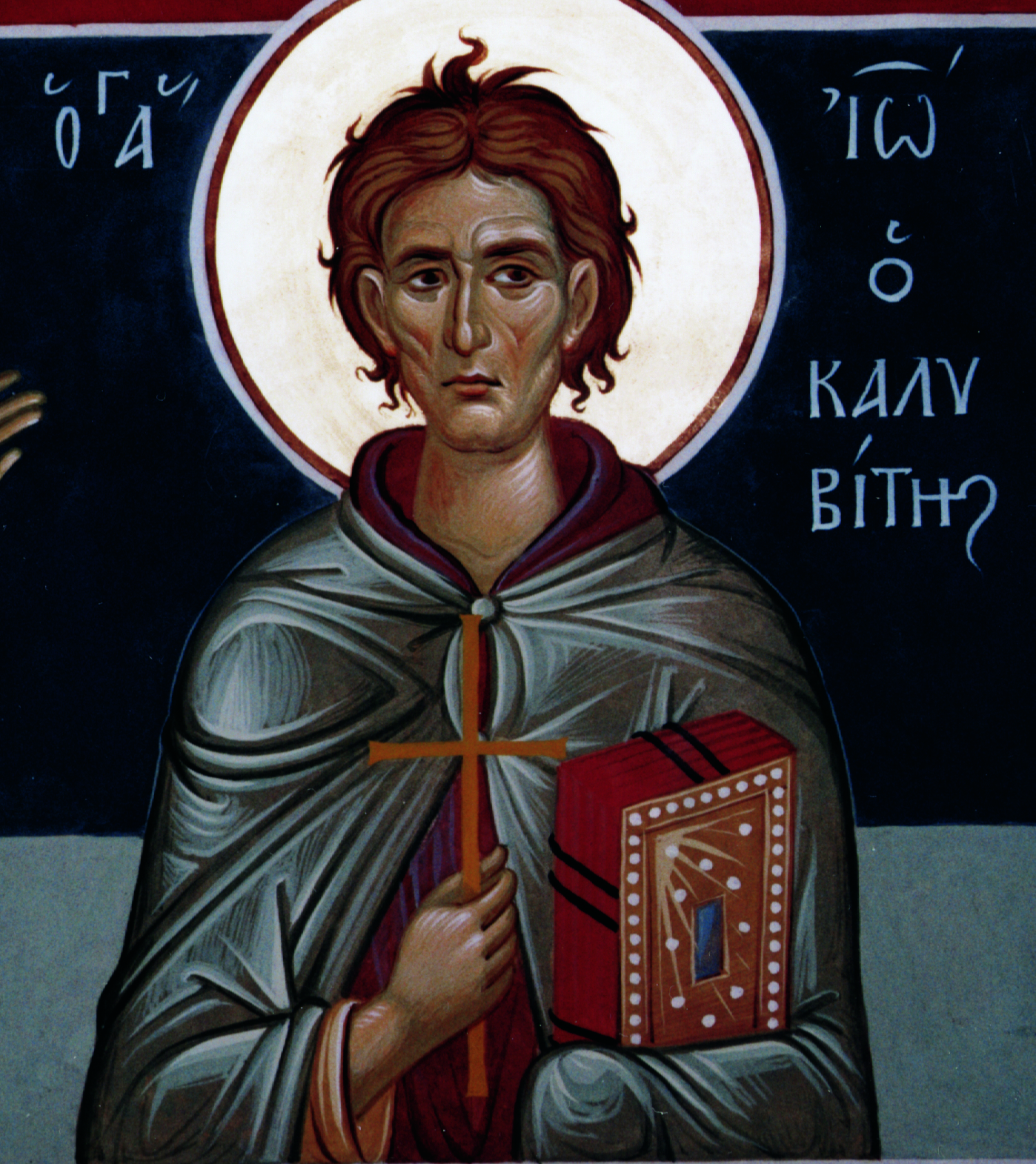
Icon of St. John the Hut-dweller (taken from: http://www.christopherklitou.com/icon_15_jan_john_kalyvites.htm)
  
Our Holy Father John (The Hut-Dweller) [Kalyvites].
He was born in Constantinople in the early part of the 5th century, of rich and eminent parents whose only child he was. Drawn by inclination to the spiritual life, the young John fled with a monk to a monastery in Asia Minor. He spent six years in this monastery in the greatest restraint, prayer and obedience to the superior. Then the devil attacked him with the temptation to leave the monastery and return to his parents, to live with them as a nobleman. He indeed returned to his parents' home, but dressed as a beggar. He saw his parents, but, not wishing to reveal himself to them as their son, remained as a beggar in their courtyard, living off the crumbs that the servants threw him and enduring much ridicule from all. He lived thus for three years, praying God that He would save the souls of his father and mother. When he fell ill and felt death approaching, he revealed himself to his parents. They recognised him by a precious Gospel-book which they had given him in childhood and which he had kept with him as his sole possession. And so this young man, albeit so rich, saved his soul and those of his parents, overcame the devil and entered into rest in the Lord in about the year 450."
  

Icon of Sts. John the Hut-dweller and Paul of Thebes (taken from: http://goarch.org/chapel/saints_view?contentid=387&type=saints)
  
Kontakion of St. Paul of Thebes in the Fourth Tone
O ye faithful, let us all laud the divine Paul, the bright luminary that shone at the virtues' lofty height; and let us joyously cry aloud: O Christ, Thou art the rejoicing of all the Saints.
Kontakion of St. John the Hut-dweller in the Second Tone
Since thou didst desire a poverty like unto Christ's, O wise Father John, thou didst forsake thy parents' wealth; and while holding in thy hands the most holy Gospel, O righteous one, thou didst follow after Christ God while ceaselessly praying to Him for us all.
Through the prayers of our Holy Fathers, Lord Jesus Christ our God, have mercy on us and save us! Amen!

Wednesday, January 14, 2009

"You came and shone forth, O Light unapproachable."

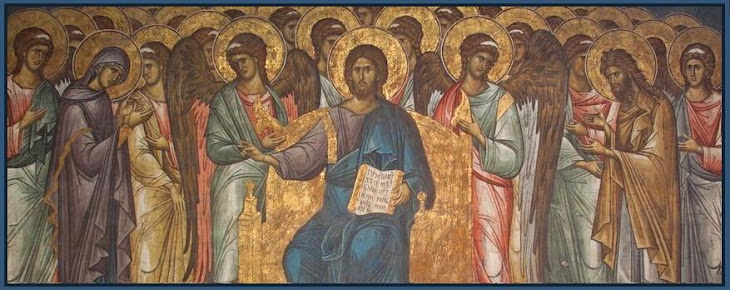
Icon of the Holy Feast of Theophany (Icon courtesy of www.eikonografos.com used with permission)

Kontakion for the Holy Feast of Theophany. Mode 4. Original Melody.
You appeared to us on earth* today, O Master,* and Your light was signed on us * who cry aloud to You and say * with understanding, O Christ our God: You came and shone forth, O Light unapproachable.

The Oikos for the Feast
On Galilee of the Gentiles, on the region of Zebulòn and the land of Nephthalím, as the Prophet declared, a great light has shone, which is the Christ. Dark-dwellers have seen a radiant dawn shining out of Bethlehem, rather out of Mary, as the Lord—the Sun of Justice—breaks His rays o’er the whole of civilization. Come then, all unclothed offspring of Adam: let us put on Christ and thus keep warm. For, as a mantle for the denuded and a beacon to the be-darkened, You came and shone forth, O Light unapproachable.
(text from:http://sgpm.goarch.org/ematins/bilingual/Jan06.pdf)
  
Holy Theophany, fresco by Manuel Panselinos, Protaton, Mount Athos (source)
  
Through the prayers of our Holy Fathers, Lord Jesus Christ our God, have mercy on us and save us! Amen!

The Great Miracle in Syria, and the Convent of Our Lady of Saidnaya

Greetings!
The account of this truly amazing miracle has been told in numerous places, but I thought to include it here also in case you haven't heard it yet. It should be a testement to the fact that our Faith is truly alive, and that the great miracles of the scriptures and the traditions of the Church are not fabrications, and that wonders that equal or exceed them continue to occur. For as Christ said, "Lo I am with you always, until the close of the age."


Picture of the Holy Monastery of the Theotokos of Saidnaya (taken from: http://en.wikipedia.org/wiki/Saidnaya)
  
The text of the story was taken from: http://www.pigizois.net/agglika/the_miracle_in_siria.htm.
"In December 2004 a Saudi Arabian man, a Moslem, appeared before several new agencies to relate the following incredible event he experienced and which changed his life (this story appeared on TV, the Internet, radio, and was circulated in newspapers, magazines, and pamphlets throughout Saudi Arbia, Syria, Palestine, and evidently in all neighboring countries.

Some years ago, this man married a very rich Moslem woman but sterile. As the years passed, and despite all their efforts and significant medical expenses with many doctors, they remained childless. The man's parents suggested to him that he marry a second woman, while upholding his initial marriage (as the local laws permits up to four concurrent marriages).

Being exhausted, worried, and downhearted, he did not accept his parents' advice but rather chose to vacation with his wife in Syria. There, they hired a limousine with a driver who would serve as tour guide fro all their site-seeing excursions throughout Syria. As the vacation progressed, the driver noticed that the Saudi Arabian couple was experiencing bitterness, pain, and grief. Having gained familiarity with the couple, the driver cautiously asked them whey they appeared to be so unhappy-was it perhaps because he was not conducting the tour to their satisfaction?

The couple confided to the driver that the source of their unhappiness was their inability to have children. The driver who was also a Moslem, then told them that in Syria the Christians, specifically the Orthodox Christians, have a monastery named Panagia Saidraya (Arabic word meaning Our Lady) and that many people who can't have children take refuge to Her miracle-producing icon. They go to the monastery and there they are given to eat, the wick form the lamp which burns before the miraculous icon. And then the "Mary" of the Christians gives them according to their faith, what they wish for.

Becoming excited, the Saudi Arabian and his wife asked the driver to take them to the monastery "Saidnaya" of "The Lady of the Christians" and said that if we have a child, then I will come back and I will give you $20,000.00 US and, I will give the monastery $80,000 US. So they went to the monastery and did as they were instructed. Later they returned to their homeland and after some time the wife was found pregnant. In a few months she gave birth to a charming baby boy. It was truly a miracle of Our Lady Theotokos.

Now, as soon as his wife gave birth the Saudi Arabian man wanted to return to Syria to uphold the promises he had made. Upon his return he called the same driver and asked to be picked up at the Damascus airport. But the driver was cunning and wicked and he persuaded two of his friends to go to the airport with him to pick up the rich Saudi Arabian man and to take his money and kill him. So they picked up the rich man at the airport and he, as they drove, without realizing that they had planned to kill him, told the friends of the driver that he would give them also $10,000 US each.

These men still not satisfied, deviated from the route to the monastery and went to a deserted place and proceeded to slay the Saudi Arabian man and to cut off his head and other parts (hands and legs) of his body into pieces. Blinded by passion and overcome by the horrific act that they just committed, they put the man's remains in the trunk of the car rather than just leaving him there. After taking his money, watch, and all that he had, they proceeded to find another deserted place to discard the remains.

Then on the National highway, their car broke down and stopped in the middle of that road. The three men got out to determine why the engine had stalled. Then a passerby stopped to help them but they, afraid that their terrible act would be discovered, pretended that they did not need any help. But as the passerby motorist was leaving, he noticed blood dripping from the rear of the vehicle and he called the police to investigate because the scene and the three men looked suspicious. The police came and they saw the blood under the car and on the pavement so they ordered that the trunk be opened.

Well, when the opened the trunk, lo and behold, the Saudi Arabian man lifted himself out, obviously and amazingly alive and in good health, saying to them "Just now this PANAGIA finished stitching my neck, right here (showing them the area of his Adam's Apple), after first stitching up the rest of my entire body". Seeing this, the three criminals immediately lost their minds-becoming like mad. The police handcuffed them and as they were being taken away to an asylum for the insane, the criminals started raving that it could not be possible that the Saudi Arabian man whom they killed, beheaded, and dissected could yet be alive.

The Saudi Arabian went to a medical facility to undergo examination by doctors and medical examiners who confirmed and attested that the stitching was done very recently, thereby validating the miraculous event. The stitches were, and still are, obvious. When the Saudi Arabian came out of the car's trunk, he had the appearance, literally, of just having been refabricated (put back together) to which he continuously confessed that they PANAGIA had rejoined his body and resurrected him with the help of her Son.

Immediately after this, the Saudi Arabian called his relatives to come to Syria and they all went together to the monastery of Panagia Saidnaya and offered up prayers, praises, and glorification, and instead of the initial gift of $80,000 US (which was promised), he gave $800,000 US to the Theotokos.Today, as this man relates the details of that overwhelming miracle, he starts his narration with "When I was a Moslem this happened to me" this indicating he is not longer a Moslem, as neither is his family.This miracle stunned with awesome surprise the entire Arabic/Moslem nation and all of the Middle East.

'LIVES LORD OUR GOD, THE LORD OF HOSTS' (Brotherhood of the Holy Sepulcher, Patriarchate of Jerusalem)By Father Ignatios, AbbotHoly Monastery of The ShepherdsBt Ahur-BethlehemGREAT LENT, MARCH 2005
Submitted and compiled by Very Rev. Archimandrite Nektarios SerfesBoise, Idaho USA. Eve of the Ascension of Lord, 8 June 2005. Glory to God for all things! Most holy Mother of God, save us! Peace to your souls! Humbly In Our Lord God,+Archimandrite Nektarios Serfes Who prays for you!"

The following information about the Monastery are taken from: http://saidnaya.com/:


Mosaic from the Moastery showing the Most-Holy Theotokos and Christ, and most-likely the Emperor (Justinian) and Empress (taken from: http://homepage.mac.com/hobwahid/Syria_Photos/PhotoAlbum102.html)
  
"The Story of the Construction of the Convent
It is said that Justinian I, Emperor of Byzantium, while crossing Syria with his troops either on his way to the Holy Land or on a campaign against the Persians, came to this desert, where his army encamped and soon suffered thirst for lack of water. When they despaired, the emperor saw a beautiful gazelle off in the distance. He vigorously gave chase, hunting the animal until it tired and stopped on a rocky knoll and approached a spring of fresh water, but without giving the emperor the opportunity to shoot it. Suddenly, it transformed into an icon of the Most-holy Theotokos, which shone with a brilliant light. A white hand stretched forth from it and a voice said, "No, thou shalt not kill me, Justinian, but thou shalt build a church for me here on this hill." Then the strange heavenly light and majestic figure disappeared. Upon his return, Justinian related what he had seen to his subordinates and ordered them immediately to draw up a plan for the contemplated church. After some time had passed and the architects were unable to resolve the problems of the plan, the Holy Virgin — the gazelle — reappeared to Justinian in a dream and confided a magnificent plan to him for a convent, of which she would be the Protectress. It is said that the basic structure of the convent follows this plan to this day. The convent soon gained such renown that it came to be ranked second only to Jerusalem as a place of pilgrimage, and nuns from every corner of Syria, Egypt, and other lands flocked to it. The holy Icon El Chagoura appeared many years after the convent was constructed. "

Holy and Miraculous Icon of the Theotokos of Saidnaya (taken from: http://www.impantokratoros.gr/8299EA31.en.aspx)
  
"The Icon of the All Virgin
In the late eighth century, a certain venerable Marina was abbess of the convent, and she was widely revered for her piety and sanctity of life. It happened that a hermit monk, a Greek pilgrim from Egypt named Theodore, stopped at the convent on his way to the Holy Land. When he was leaving, Abbess Marina asked him to buy in Jerusalem a precious and fine icon of the Holy Virgin. While at Jerusalem, he utterly forgot the task entrusted to him and started on his return journey. However, when he had not gone far from the city, he was stopped short by an unfamiliar voice: "Have you not forgotten something in Jerusalem? What have you done in regard to the commission from Abbess Marina?" Monk Theodore returned at once to Jerusalem and found an icon of the Theotokos. During the journey back to the convent, he was astounded by the miracles accomplished through the icon. He and his whole caravan were ambushed by bandits, and then attacked by wild beasts. Amidst these dangers, the hermit always invoked the aid of the Holy Virgin while holding her icon, and he and all the caravan were saved from every peril.
  
When Theodore returned to the convent, these events tempted him to keep the valuable icon for himself, and he decided to bypass Saidnaya and sail back to Egypt. However, he was unable to set sail, for such a fierce storm arose, it seemed the ship would inevitably sink. His conscience was pricked, and he quickly left the ship and returned by way of Saidnaya. After spending four days in the convent, he was again possessed by an irresistible desire to make the icon of the Mother of God his own. He apologized to the abbess, pretending that he had been unable to buy the required icon, and then he decided to leave the convent secretly. The next morning, as he was about to set out on the journey back to his own country and approached the convent gate, he was amazed to find that an invisible power barred his way, and it was as though a stone wall stood where the gate should have been. After many futile attempts, he was forced to hand the icon over to the abbess, confessing his intention. With tears of gratitude she glorified the Lord and His All-pure Mother. Since that day, the holy Icon has remained in the convent and has been the object of great veneration."
  
A more detailed view of the Mosaic of the Theotokos and Christ above (taken from: http://homepage.mac.com/hobwahid/Syria_Photos/PhotoAlbum102.html)
  
Great are you, O Lord, and wonderful your works, and no word is adequate to sing the praise of your wonders. Glory to you, Lord, glory to you!

Tone 2.
A fervent prayer, and wall most unshakable A merciful spring And shelter of all mankind; Fervently, we cry to you: Theotokos, our Lady, Come to us And from all dangers now deliver us The only protection who speeds to us.
(http://www.goarch.org/chapel/chant/paraklesis/index_html)
  
Modern reproduction of the Wondrous Icon of the Theotokos of Saidnaya (http://www.stjosephmelkitecatholicchurch.org/icons_of_our_lady_the_theotokos/theotokosofsaydnaya.jpg)
  
Most-holy Theotokos, save us!

Sunday, January 11, 2009

"You will have afflictions, but in Me you will have joy": A quote from St. Issac the Syrian

This is a quote selected by St. John the Hozevite (see: http://www.orthodoxphotos.com/Holy_Relics/St._John_Iacob_the_Hozevite/index.shtml) as being particularly beneficial for struggling Christians. It is quite sobering to me and my fellow sinners, and even if we are far from this state of the Saints, may we struggle to our end to reach the Kingdom of Heaven.

Icon of Jesus Christ "the Bridegroom" (Icon courtesy of http://www.eikonografos.com/ used with permission)

From Homily 36 of St. Isaac the Syrian
"This is the will of the Holy Spirit, to be His beloved in continual reality. The Spirit of God does not dwell in those who live in rest because the Most-Good God wished that His beloved servants should not have rest in this life, but rather live in suffering, difficul
ties, worries, poverty, and nakedness, in solitude and debts, in sicknesses and defamations, in battles and crushing of heart, with sickly body and image detested by others, in a state which does not compare to other people's, and a lonely, peaceful, and quiet dwelling, completely invisible to men and free of anything that produces earthly consolation. Therefore, these people weep, and the world laughs; these sigh, but the world enjoys; these fast, but the world amuses itself. During the day, they wear themselves out; and, during the night, they prepare for deprivation. There are some who offer themselves to weariness voluntarily and also submit to afflictions; some are persecuted, while others were killed, and some hid in cellars. In them was fulfilled the word that says, "You will have afflictions, but in Me you will have joy," because the Lord knows that the ones who live in rest cannot remain in His love. Therefore, Christ the Saviour has prevented these from rest and satisfaction. He Whose love is more powerful than death of the body wanted to show also in us the power of His love. Amen."

St. Isaac the Syrian (his scroll reads: "Above all, love silence") (Icon courtesy of http://www.eikonografos.com/ used with permission)

Through the prayers of our Holy Fathers, Lord Jesus Christ our God, have mercy on us and save us! Amen!

St. Theodosios the Cenobiarch

Greetings!

Today (January 11th) we celebrate the memory of St. Theodosios the Righteous, the Cenobiarch. Besides being a great ascetic and wonderworker, he was the first to organize the so-called Cenobitic monasticism, or a large monastic community living together under one elder (as opposed to lone hermits or small groups of monastics). The life below was taken from: http://www.stirene.org/archives/january/0111_sttheodosios.html .

St. Theodosios the Cenobiarch (Icon courtesy of http://www.eikonografos.com/ used with permission)

"RIGHTEOUS THEODOSIOS THE CENOBIARCH
January 11th
Του Οσίου Πατρός Ημών Θεοδοσίου του Κοινοβιάρχου

He lived during the fifth-sixth centuries, and was the founder of cenobitic monasticism. He was born in Cappadocia of pious parents. Endowed with a splendid voice, he zealously toiled at church reading and singing. St. Theodosios prayed fervently that the Lord would guide him on the way to salvation. In his early years he visited the Holy Land and met with St. Symeon the Stylite, who blessed him and predicted future pastoral service for him.

Yearning for the solitary life, Saint Theodosios settled in Palestine into a desolate cave, in which, according to Tradition, the three Magi had spent the night, having come to worship the Savior after His Nativity. He lived there for thirty years in great abstinence and unceasing prayer. People flocked to the ascetic, wishing to live under his guidance. When the cave could no longer hold all the monks, St. Theodosios prayed that the Lord Himself would indicate a place for the monks. Taking a censer with cold charcoal and incense, the monk started walking into the desert.

At a certain spot the charcoal ignited by itself and the incense smoke began to rise. Here the monk established the first cenobitic monastery, or Lavra (meaning "broad" or populous"). Soon the Lavra of St. Theodosios became reknowned, and up to 700 monks gathered at it. According to the final testament of St. Theodosios, the Lavra rendered service to neighbor, giving aid to the poor and providing shelter for wanderers.

St. Theodosios was extremely compassionate. Once, when there was a famine in Palestine and a multitude of people gathered at the monastery, the monk gave orders to allow everyone into the monastery enclosure. His disciples were annoyed, knowing that the monastery did not have the means to feed all those who had come. But when they went into the bakery, they saw that through the prayers of the abba, it was filled with bread. This miracle was repeated every time St. Theodosios wanted to help the destitute.

Photograph of the Holy Monastery of St. Theodosios (taken from: http://www.impantokratoros.gr/8299EA31.en.aspx)

At the monastery St. Theodosios built an home for taking in strangers, separate infirmaries for monks and laymen, and also a shelter for the dying. Seeing that people from various lands gathered at the Lavra, the saint arranged for services in the various languages: Greek, Georgian and Armenian. All gathered to receive the Holy Mysteries in the large church, where divine services were chanted in Greek.

During the reign of the Byzantine Emperor Anastasios (491-518) there arose the heresy of Eutychios and Severus, which recognized neither the sacraments nor the clergy. The emperor accepted the false teaching, and the Orthodox began to suffer persecution. St. Theodosios stood firmly in defense of Orthodoxy and wrote a letter to the emperor on behalf of the monks, in which they denounced him and refuted the heresy with the teachings of the Ecumenical Councils. He affirmed moreover, that the desert-dwellers and monks would firmly support the Orthodox teaching. The emperor showed restraint for a short while, but then he renewed his persecution of the Orthodox. The holy Elder then showed great zeal for the truth. Leaving the monastery, he came to Jerusalem and in the church, he stood at the high place and cried out for all to hear: "Whoever does not honor the four Ecumenical Councils, let him be anathema!" For this bold deed the monk was sent to prison, but soon returned after the death of the emperor.

St. Theodosios accomplished many healings and other miracles during his life, coming to the aid of the needy. Through his prayers he once destroyed the locusts devastating the fields in Palestine. Also by his intercession, soldiers were saved from death, and he also saved those perishing in shipwrecks and those lost in the desert.

Once, the saint gave orders to strike the semandron (a piece of wood hit with a mallet), so that the brethren would gather at prayer. He told them, "The wrath of God draws near the East." After several days it became known that a strong earthquake had destroyed the city of Antioch at the very hour when the saint had summoned the brethren to prayer.

Before his death, St. Theodosios summoned to him three beloved bishops and revealed to them that he would soon depart to the Lord. After three days, he died at the age of 105. The saint's body was buried with reverence in the cave in which he lived at the beginning of his ascetic deeds."


St. Theodosios the Cenobiarch (Icon courtesy of http://www.eikonografos.com/ used with permission)
Apolytikion of St. Theodosios in the Fourth Tone
With the rivers of your tears, you have made the barren desert fertile. Through sighs of sorrow from deep within you, your labors have borne fruit a hundred-fold. By your miracles you have become a light, shining upon the world. O Theodosius, our Holy Father, pray to Christ our God, to save our souls.

Kontakion in the Plagal of the Fourth Tone
As being planted in the courts of Christ thy Lord and God, with holy virtues thou delightfully didst blossom forth and didst multiply thy children amid the desert, who were watered with the showers of thy fervent tears, O chief shepherd of the godly sheepfold of our God. Hence we cry to thee: Rejoice, O Father Theodosius.
(taken from: http://goarch.org/chapel/saints_view?contentid=381&type=saints)
Through the prayers of our Holy Fathers, Lord Jesus Christ our God, have mercy on us and save us! Amen!