Thursday, September 3, 2009

St. Polydoros the New Martyr of Cyprus and New Ephesus

St. Polydoros the New Martyr of Cyprus and New Ephesus - Celebrated September 3rd (taken from: http://christopherklitou.com/icon_3_sept_polydorus_newmartyr_of_cyprus.htm)
  
His name is not know by many people. However he constitutes a real gem in the newer history of Cyprus and a heroic figure and a new martyr of the Orthodox Church. Polydoros was born in Nicosia, Cyprus a little bit after the middle of the 18th century. He was hung in New Efessos (Yeni Kusandasi) on September 3rd 1794. Those were difficult years.Years of darkness. Years of harsh slavery. Even so, his parents Hadjiloukas and Lourdanou,who were God-respecting and devoted persons, made sure to give their child a Christian upbringing and they send him to study theology.
  
When Polydoros grew up, he was naturally intelligent and creative and for this reason, he got started in the trade business. For his work, he began to travel in various parts of the world including Egypt. For a time, he followed the advice of his parents, and was careful about who he made friends with and their voices echoed permanently in his ears and restrained him from getting into bad company. However with time his attention became weak. In one of his travels in the country of the Nile, he became acquainted with a rich renegade from Zakynthos and went under his service.
  
In this job, he became connected with various types of men his age. The types that we would call today, men of the underground living, the type of men who had no moral barriers. Very soon Polydoros begun the night life, drinking and getting drunk, playing cards and spending the whole night until dawn in the various joints of debauchery.

One evening in one of these joints of pleasure, he became very drunk and in his drunkenness, he changed his religion and became Muslim. His new religion did not offer any joy to him and neither could it offer him the minimal mental satisfaction. Despite the money that he gained, the positions and the greatness that his new life ensured him, he could not find any happiness in his life. On the contrary the guilt that began to wake up in him and started to grow day by day and multiply, could not let him find rest. His conscience hit him hard and without mercy, it was a whip which strickened him without pity.

One evenings while he was in such a mental agitation, he remembered his house with sweet nostalgia. His parents were illiterate but they had the education of faith and virtue. Before they went for sleep in the evening, they all used to kneel down in front of the icon of the Virgin Mary and prayed to Her to look after them from the Turks. Now,it was the religion of these same Turks that he bowed to. Then he remembered the advice of his good mother. She told him the following words once when he did something which he should not have done and felt uneasy and distressed. "My child", she told him, "the only thing that appeases and gives peace to an upset conscience is penitence and confession". This recollection strengthened him somehow but also pushed him without any delay or postponement to leave Egypt and go to Beirut. When he reached there, with great agony he ran to see the local Orthodox Bishop. When he found him, deeply crashed, he fell in front of him and requested to accept his confession. He told him everything. He did not withhold anything. The Bishop who was a devoted clergyman, listened to him with compassion and teardrops of affection. At the end, after he gave him comfort which strengthened him, the Bishop advised him that for his safety and in order to find peace to resort to a monastery.

Polydoros listened to him with attention. He thanked the good spiritual father, left and hurried to execute the Bishop's advice. He took residence in a monastery, however he remained there for only a short time. Under the fear of exposing his spiritual father he left soon. He traveled to various places and ended up at the island of Chios. There he visited another spiritual father and once again with pain in his heart, he took confession and asked him to once more allow him to become accepted in the Orthodox Church. The spiritual father accepted his penitence. He read the forgiveness prayer and anointed him holy myrrh and gave him communion.

[Note: this spiritual father in Chios was none other than St. Makarios of Corinth (http://logismoitouaaron.blogspot.com/2009/05/shepherd-of-corinth-really-blessed.html), a great father of the Kollyvades movement (http://full-of-grace-and-truth.blogspot.com/2009/04/synaxis-of-holy-kollyvades-fathers.html), who helped compile the Philokalia with St. Nikodemos, and who also served as a spiritual guide to numerous neomartyrs. The following summarizes St. Makarios' role:

"The importance of one having such a spiritual Father was clearly acknowledged by the New Martyrs during the years of the Turkish yoke. This we learn from their lives, and from the lives of the Holy Fathers to whom they fled for comfort prior to their martyrdom, as a fitting preparation. In the life of St. Makarios, Bishop of Corinth, which was written by Athanasios of Paros, we read that many laymen went to him for confession and advice, there being among them many who afterwards courageously went to martyrdom for their Christian faith. Athanasios gives the names of three of them: Polydoros the Cyprian, Theodore the Byzantian, and Demetrios the Peloponnesian. Before going to their martyrdoms, they spent a period of time at the hermitage of St. Makarios on the island of Chios. He, as a wise and experienced trainer of martyrs, as Athanasios calls him, prepared them well for the test of martyrdom—by confession, fasting, prayer, and encouragement. Thusly prepared, they went to martyrdom with exceeding courage and great gratitude to St. Makarios for the good which he had done: that is, in preparing them to receive the crown of martyrdom.” (http://www.orthodoxinfo.com/praxis/discourselivingworld.aspx)


After his re-establishment in the bosom of the Church, Polydoros left for the city of New Efessos in Asia Minor. His desire to really rectify his sin, did not leave him in peace. A thought twirled continuously in his brain. The thought was for him to visit the Turkish Authorities and with frankness to declare in front of them his faith to Christ and his devotion to his will. One day he presented himself in front of the mufti (the Muslim judge and priest) and without fear asked him.

"Tell me Master, is it legal and right to give back a fake thing which was given to me a little while ago with fraud?"

The mufti replied affirmatively."Yes, he said to him, it is legal".

Then Polydoros added,"I request that you give me this decision in writing". The mufti wrote his decision and gave it to him. As soon as Polydoros took the decision(the fetfa) in his hand, without losing any time, he ran to the Muslim religion judge (the Cadi) and showing the decision of the mufti he told him,"Ten years ago I was cheated and I was made to deny my faith. I threw away the gold which I had in order to take the dirt. Now I regret it. I am sorry for what I did and am distressed and I cry. Take your dirt and I will take back my gold. I was Christian! I will remain Christian! And I am ready to die Christian!"

Upon hearing the words of the confessor, the cadi tried hard to retain his anger.He tried to say something. He began with flatteries. He advanced to promises. He tried to make Polydoros change his mind by promising him money, positions and honors... and concluded, "Once you were Christian. Now however you are Muslim"."No! No!" Polydoros protested intensely,"I am Christian and I will die Christian". The cadi was not disappointed. He continued the promises. Seductive promises. Improbable. But nothing.

At the end, when he was convinced that his efforts were lost, he ordered for Polydoros to be seized, and put him in prison were they begun the tortures. All night the executioners tortured the martyr. To count the different kinds of tortures Polydoros went through is impossible. We will say only this. The next day with his face deformed from the all night abuse and his body broken from the cruel beatings, Polydoros was led in front of a council made of Turkish nobles. For the second time Polydoros with enviable frankness declared his faith Christ and his irrevocable decision to die for it. In all the threats and pressures which they made, his answer was,

"I am Christian! I will remain Christian! And I will die Christian". His inflexible insistence had angered all the members of the Council, and in order to find a exit in the impasse, they ordered to throw the Saint once again in prison and have the tortures repeated. The executioners with unrestrained fury seized the victim again and threw him in a dark cell. There with cannibalistic passion,which is so well known even in our times,they begun their macabre work. They tied up the hands and the legs of the martyr in order for him not to be able to move and with whips they strucked him constantly everywhere. The Saint's body became a single wound from which the blood ran abundantly. After that, they put boiling hot irons and burning bricks on his shoulders and his armpits. In addition they inserted an iron rod into his penis. At the same time, some others put over his head a burning hot pot as a cap. We will not mention any other tortures as it is too much for us, not to mention that it is difficult for some-one even to read them. We will add only this. The courageous martyr endured all of them with courage and unique perseverance. He endured them by receding with faith, "Lord forgive me''. He had already decided for death and thus the pain did not scare him. With these martyrdoms he passed the whole night.

In the morning some executioners took the martyr and led him with insults and shoutings to the square in front of the judge, where he waited seated on a tall platform between a lot of Ottoman officials. A little below gallows were set up. The martyr looked first at the gallows and later at the judge. He felt a feeling of comfort seeing the first, and disgust as he looked at the second.

"Hey!! what you say?", shouted the judge with a sardonic laughter. "Did you knock some sense in your brains or you still insist in your opinions?''.

"I lost my brains only when I was carried away and exchanged my faith with yours. It is madness to throw away gold, in order to take dirt. Now I have found my sanity. Now that I have returned to Christ". In hearing the words of the martyr, the judge lost his patience and shouted,"Hang this gavour (pig) so that we can finish with him. Hang him, his mind does not change". The executioners led Polydoros to the gallows. After he approached them with determined steps, he kissed the rope with respect, made his cross with devotion and serenely accepted the rope to pass through his neck. The executioner pulled the rope. The body was raised in the air, while the Saint's soul flew to the blue chaos of the sky. The corpse of the Saint remained on the gallows for three days. The third day the Turks ordered the Christians to take him and bury him. Some people with good souls, Christians and paradoxically Muslims, lowered the Saint's body from the gallows, washed it with clean water and buried him near the Armenian cemetery with teardrops of admiration and love. Today his skull is kept at the church of Saint Catherine at Plaka, Athens."
(taken from: http://noctoc-noctoc.blogspot.com/2008/01/saint-polidorosthe-cypriot-neomartyr.html (with some slight edits); for the accounts of many other Orthodox Neomartyrs, see: Witnesses for Christ: Orthodox Christian Neomartyrs of the Ottoman Period, 1437-1860 by Vaporis )

The following are two miracles of the Saint translated from: http://www.synaxaristis.googlepages.com/3σεπτεμβριου:

a) In New Ephesus lived a Christian named Nicholas. This unfortunate man was possessed by a demon, which spoke with his mouth like child of the Phillipians revealed many times the secrets of those who fled to him. One day the sick man met a cleric, who had in his possession the relics of St. Polydoros and a piece of the rope of the noose, and was saddened by him. He took the holy possessions and went to his house:
  
As soon as he reached his door and the demoniac saw him he screamed:

-“You here? You here? What have you come to do? What do you want from me?”

The priest without losing time, took the holy relics from his bosom and made the sign of the cross towards the sick man.

The priest approached. He put the relics and the piece of the rope above, and O! the wonder! The sick man made a loud cry and then calmed down. The demon had fled and the man had become well again.

b) In those dangerous and black days when Hellenism, on account of our sins, was uprooted from the cradle of Asia Minor and was chased out, a Hieromonk, the Chancellor of the Holy Metropolis of Ephesus Kyrillos Psyllos grabbed the holy skull of the martyr to save it. The furiousness of the Turks against clerics and the control over them to seek them out was unbelievable. Their fury was directed further against the churches and the holy relics. When they uncovered clerics or other people holding icons, relics, etc., they slaughtered them without discussion. The act of the Chancellor was very bold, and had they found him, he would have paid immediately with his life. This pious worker of Christ however was decisive. He dressed like a gerontissa [an Abbess, but in this case it might just mean an old woman], and took with him his very-precious treasure, made his cross and left. An endless line was waiting before him to be searched. As if arriving at the Turkish prison for the search, the Turks were furious. They had uncovered some in disguise and were furious. At that hour when the faithless reviled and beat their victims and screamed in terror the disguised Kyrillou came to be searched.

The pious cleric, without losing his composure, clenched the skull of the Saint to his chest and whispered inside himself:

-“O Saint Polydoros, save me.” And he saved him.

-"Hurry up Turkish woman", the Turk cried and pushed him ahead. In a short time the hieromonk was found dropped into a boat of salvation with his treasure. How did this happen? He did not remember. He didn’t understand. He was saved along with the holy skull of the martyr. When he arrived in Athens, he deposited it in the Holy Church of St. Catherine in the Plaka. There it is found today. Tens of the faithful go every day to venerate it. And thousands every year on September 3rd, which is his feast day, hasten to honor the martyr, the renegade who repented and sought His grace. To fall is a dreadful evil to man. Very dreadful! Great is the worth of repentance. Very great. The fall destroys, degrades. Repentance reinstates, saves. Reinstates man to his father’s house. And it saves him. It makes him “a fellow citizen of the saints and the house of God” In reality! How beautiful it is for men to constantly remember this truth!
Another icon of St. Polydoros the Neomartyr (taken from: http://ocafs.oca.org/FeastSaintsViewer.asp?SID=4&ID=1&FSID=205392)
  
Απολυτίκιο Ήχος γ’.
Μέγα καύχημα της Λευκωσίας- μέγα στήριγμα πέλεις Εφέσου- μέγα κλέος τε των δύο πόλεων της μεν γαρ γόνος σεπτός εχρημάτισας την δε τα σα επορφύρωσαν αίματα, αλλά πρέσβευε Χριστώ τω Θεώ, Πολύδωρε, ίνα ρυσθώμεν κινδύνων και θλίψεων.
  

Apolytikion in the Fourth Tone
Thy Martyr, O Lord, in his courageous contest for Thee received the prize of the crowns of incorruption and life from Thee, our immortal God. For since he possessed Thy strength, he cast down the tyrants and wholly destroyed the demons' strengthless presumption. O Christ God, by his prayers, save our souls, since Thou art merciful.


Apolytikion Of St. Polydoros in the Third Tone (amateur translation)
A great boast of Levkosias- a great protector are you of Ephesus- a great glory of the two cities, of a sacred offspring were who shown to be by the purple of your blood, and intercede with Christ God, Polydoros, that we may be delivered from dangers and sorrows.
  
Through the prayers of our Holy Fathers, Lord Jesus Christ our God, have mercy on us and save us! Amen!

Wednesday, September 2, 2009

St. Jerusalem and her sons Sts. Sekendos, Sekendikos and Kegoros, the Martyrs

The Holy Martyrs St. Jerusalem and her sons Sts. Sekendos, Sekendikos and Kegoros - Celebrated on September 4th (14th Century icon in the Byzantine and Christian Museum of Athens, picture taken from: http://upload.wikimedia.org/wikipedia/commons/7/7e/Saint_Jerusalem_and_her_sons.jpg)

This saint was from Alexandria. After the death of her husband, she traveled to many places preaching Christ and reached Rome. Continuing her journey she reached our region [Veroia], became a nun, bringing monasticism to the area. She also continued her missionary activities, leading many idolaters to the Christian faith. Thus she was delivered to the duke of Thessaloniki Kindiano, who came himself to Veroia to question her. Seeing her steadfastness he ordered her to be tortured. Her sons were also killed by torture: one was dragged behind horses, the second was beat to death with sticks [ξυλοκοπήθηκε] and the third was forced to put on a heated helmet [πυρωμένη περικεφαλαία]. In the end their holy mother was beheaded between the years of 276 and 282 AD. The skull of St. Jerusalem is kept in the pilgrimage church of St. Anthony Poliouchlou [The Patron Saint; in Veroia] and September 4th their memory is celebrated festally in this church, and also in Kampochori, Alexandria. (amateur translation of text from: http://www.imverias.gr/dev/?option=com_content&view=article&id=23:c&catid=14:-c&Itemid=30&fontstyle=f-larger)
Sts. Jerusalem, Sekendos, Sekendikos and Kegoros (taken from: http://www.imverias.gr/dev/index.php?option=com_content&view=article&id=23:c&catid=14:-c&Itemid=30)

Ἀπολυτίκια. Ἦχος α΄. Τῆς ἐρήμου πολίτης
Ἀθλήσασα νομίμως τὸν Χριστὸν ὡμολόγησας, Ἱερουσαλὴμ ἀθληφόρε, σὺν υἱοῖς καὶ δεδόξασαι· ἐντεῦθέν σου τὴν κάραν τὴν σεπτήν, ἡ Βέῤῥοια πλουτήσασα πιστῶς, ἑορτάζει σου τὴν μνήμην τὴν ἱεράν, καὶ ἐκ ψυχῆς κραυγάζει σοί· δόξα τῷ δεδωκότι σοὶ ἰσχύν, δόξα τῷ στεφανώσαντι, δόξα τῷ ἐνεργοῦντι διὰ σοῦ, πᾶσιν ἰάματα.
Δόξα. Ἕτερον. Ἦχος δ´. Ταχὺ προκατάλαβε
Τετράριθμον ὅμιλον, τῶν ἀθλητῶν τοῦ Χριστοῦ, Σεκένδικον, Σέκενδον, σὺν τῷ Κηγόρῳ ὁμοῦ, συμφώνως τιμήσωμεν, ἅμα καὶ τὴν μητέρα, τὴν αὐτῶν συνυμνοῦντες, τούτοις συνηθληκυῖαν, Ἱερουσαλὴμ τὴν θείαν· Τριάδι γὰρ τῇ ἁγίᾳ, ὑπὲρ ἡμῶν πρεσβεύουσι.
Apolytikion of Sts. St. Jerusalem, Sekendos, Sekendikos and Kegoros in the Fourth Tone
O four-numbered band of athletes of Christ, Sekendikon, Sekendon with Kegoro, together let us honor, along with their mother, who is hymned along with them, she suffered along with them [συνηθληκυῖαν?], Jerusalem the divine, ever intercede for us before the Holy Trinity.
(hymns and amateur translation from the service and paraklesis to the Saints: http://voutsinasilias.blogspot.com/2009/09/4_02.html)

Through the prayers of our Holy Fathers, Lord Jesus Christ our God, have mercy on us and save us! Amen!

St. Mamas the Great Martyr

St. Mamas the Great Martyr - Commemorated on September 2nd (Icon courtesy of www.eikonografos.com used with permission)

The Holy Great Martyr Mamas was born in Paphlagonia, Asia Minor in the third century of pious and illustrious parents, the Christians Theodotus and Rufina. The parents of the saint were arrested by the pagans for their open confession of their faith and locked up in prison in Caesarea in Cappadocia.

Knowing his own bodily weakness, Theodotus prayed that the Lord would take him before being subjected to tortures. The Lord heard his prayer and he died in prison. St Rufina died also after him, after giving birth to a premature son. She entrusted him to God, beseeching Him to be the Protector and Defender of the orphaned infant.

St. Mamas milking deer to make cheese to feed the poor (source)
   
God heard the dying prayer of St Rufina: a rich Christian widow named Ammia reverently buried the bodies of Sts Theodotus and Rufina, and she took the boy into her own home and raised him as her own son. [He was named Mamas because, after he had long remained without speaking, he addressed his foster mother Ammia as "mama." (http://goarch.org/chapel/saints_view?contentid=190)] St Mamas grew up in the Christian Faith. His foster mother concerned herself with the developing of his natural abilities, and early on she sent him off to study his grammar.

The boy learned easily and willingly. He was not of an age of mature judgment but distinguished himself by maturity of mind and of heart. By means of prudent conversations and personal example young Mamas converted many of his own peers to Christianity.

The governor, Democritus, was informed of this, and the fifteen-year-old Mamas was arrested and brought to trial. In deference to his illustrious parentage, Democritus decided not to subject him to torture, but instead sent him off to the emperor Aurelian (270-275). The emperor tried at first kindly, but then with threats to turn St Mamas back to the pagan faith, but all in vain. The saint bravely confessed himself a Christian and pointed out the madness of the pagans in their worship of lifeless idols.

   
Infuriated, the emperor subjected the youth to cruel tortures. They tried to drown the saint, but an angel of the Lord saved St Mamas and bade him live on a high mountain in the wilderness, not far from Caesarea. Bowing to the will of God, the saint built a small church there and began to lead a life of strict temperance, in exploits of fasting and prayer.

Soon he received a remarkable power over the forces of nature: wild beasts inhabiting the surrounding wilderness gathered at his abode and listened to the reading of the Holy Gospel. St Mamas nourished himself on the milk of wild goats and deer.

The saint did not ignore the needs of his neighbors. Preparing cheese from this milk, he gave it away freely to the poor. Soon the fame of St Mamas's life spread throughout all of Caesarea.

St. Mamas the Great Martyr depicted riding a lion (taken from: http://ocafs.oca.org/FeastSaintsViewer.asp?SID=4&ID=1&FSID=102459)

The governor sent a detachment of soldiers to arrest him. When they encountered St Mamas on the mountain, the soldiers did not recognize him, and mistook him for a simple shepherd. The saint then invited them to his dwelling, gave them a drink of milk and then told them his name, knowing that death for Christ awaited him. The servant of God told the servant of the Emperor to go on ahead of him into Caesaria, promising that he would soon follow. The soldiers waited for him at the gates of the city, and St Mamas, accompanied by a lion, met them there.

Surrendering himself into the hands of the torturers, St Mamas was brought to trial under a deputy governor named Alexander, who subjected him to intense and prolonged tortures. They did not break the saint's will, however. He was strengthened by the words addressed to him from above: "Be strong and take courage, Mamas."
  
St. Mamas being thrown into the flames (source)
  
When they threw St Mamas to the wild beasts, these creatures would not touch him. Finally, one of the pagan priests struck him with a trident. Mortally wounded, St Mamas went out beyond the city limits. There, in a small stone cave, he gave up his spirit to God, Who in the hearing of all summoned the holy Martyr Mamas into His heavenly habitation [In the year 275]. He was buried by believers at the place of his death.

The Martyrdom of St. Mamas (Icon courtesy of www.eikonografos.com used with permission)

The Martyrdom of St. Mamas the Great Martyr (http://pravicon.com/images/sv/s1350/s1350005.jpg)
   
Christians soon began to receive help from him in their afflictions and sorrows. St Basil the Great speaks thus about the holy Martyr Mamas in a sermon to the people: "Remember the holy martyr, you who live here and have him as a helper. You who call on his name have been helped by him. Those in error he has guided into life. Those whom he has healed of infirmity, those whose children were dead he has restored to life, those whose life he has prolonged: let us all come together as one, and praise the martyr!" (taken from: http://ocafs.oca.org/FeastSaintsViewer.asp?SID=4&ID=1&FSID=102459)
  
For the full text in the original Greek of St. Basil's Encomium to St. Mamas the Great Martyr, see: http://khazarzar.skeptik.net/pgm/PG_Migne/Basilius%20Caesariensis_PG%2029-32/In%20Mamantem%20martyrem.pdf.
  
The Monastery of St. Mamas, Morphou, Cyprus (taken from: http://www.whatson-northcyprus.com/interest/guzelyurt/mamas.htm)
   
St. Mamas honored throughout the Orthodox world, but he is especially dear to the Christians of Cyprus. According to one source, all of the churches and chapels named after him in Cyprus total 66. (http://www.synaxaristis.googlepages.com/2σεπτεμβριου) Additional traditions hold that St. Mamas was either from Cyprus, or that his relics and coffin were moved there later. In any case, his Monastery and tomb on Cyprus is a great pilgrimage of the Saint (supposedly the third most sacred pilgrimage in North Cyprus, after St. Barnabas' tomb at Famagusta and Apostolos Andreas Monastery at Karpaz (http://northerncyprus.cc/default.asp?iID=LIDFJ)), and many people there and throughout the world are healed by this great Saint. May he intercede for all of us!

Icons and tomb of St. Mamas, Morphou, Cyprus (taken from: http://www.whatson-northcyprus.com/interest/guzelyurt/mamas.htm)
   
Note: The following prayer (similar to those of St. Modestos (also for animals) and St. Tryphon (for gardens) are said by the Priest following the Blessing of the Water service, specifically for those whose animals are sick or in any kind of danger. It is a beautiful prayer, and as I had mentioned previously, we can see the humility, faith and love of the Fathers, who would always take refuge in the Lord in every need or trial in their lives (and if livestock were one's means of sustenance, as was demonstrated above, then this truly becomes a great need indeed). May Christ heal all of His creation that suffer throughout the world, through the prayers of His Saints. Amen.
   
The Prayer of St. Mamas the Great Martyr (amateur translation)
Behold, I, the sinner and lowest one, Mamas, dwelling in the mountains, and through the power of our Lord Jesus Christ milked deer and made cheese, distributing to the poor, and walking through the mountains and caves until my dead. There when I was passing through, approached John and Philotheos, who entreated me saying: "The wrath of the devil has fallen upon our flocks and herdsmen, and are dying terribly. We pray you, O Saint of God, pray for them, that they might be healed from every evil, in memory of the age to come, and to the glory of God. I then said to them: "My spiritual brothers, I am a sinner, and God does not listen to sinners." But they persisted in entreating me. Hearkening, then, to their prayers, I pray to the Lord, saying:

I call upon You, our Lord Jesus Christ, the true God, Who descended from the Father's bosom, and was incarnate of the holy Theotokos, and Ever-virgin Mary, willingly enduring the Cross and death, and rose on the third day, and granting life to the race of mortals: hearken to me the sinner, and your unworthy servant Mamas, and all those whose spirits are spent and who are in great trouble, and who call upon Your name, O Lord our God, and remember the name of Your servant Mamas, do not allow their flocks or the herds of their animals to be afflicted by diabolical influence or any other sickness.

Yes, O Lord our God, Who made the heaven and the earth, and Whose word grants all things towards salvation to our people, do not neglect this my prayer, from Your humble and lowest servant, but hearken to me, O Lord Who loves mankind, and this my prayer is read, whether at a flock, or oxen, or mules, and do not let sickness or other temptation come close to these animals, that being always guarded by You, we might offer up glory and worship to the Father and to the Son and to the Holy Spirit, now and ever and unto the ages of ages. Amen.
(http://analogion.com/forum/showthread.php?t=13881)


HYMN OF PRAISE to The Holy Martyr Mamas
(by St. Nikolai Velimirovich)
Mamas the pious was born in prison,
And was kindred with Christ from his first day;
His father and mother, martyrs for God,
Birthed their only child in prison darkness.
For fifteen years, orphaned Mamas
Was alone in the prison of the world.
His only comfort and his only light
Shone upon him from the countenance of the Son of God:
This was his fulfillment and his wealth.
Mamas glorified Christ his God,
He glorified Him in word and in deed
By his prayerful soul and innocent body.
His friendship with God was more dear to him
Than the devious world that torments and lies.
He loved God and His pure Christ
And he became a friend to pure nature-
To the wilderness and forest and wild beasts,
To wild goats and fierce lions.
And God endowed his friend
With wondrous gifts of the Holy Spirit.
And Mamas shamed his persecutors,
And turned many torturers to Christ.
The emperor and the empire were against this boy,
But the right hand of God sustained him-
And, enduring torments, Mamas glorified the Savior.
The emperor and the empire collapsed to nothing,
While Mamas reigns, even now, with Christ,
And rejoices with the angels of God in heaven.
Another icon of St. Mamas depicted riding a lion (taken from: http://christopherklitou.com/icon_2_sept_mamas.htm)
   
Apolytikion in the Fourth Tone
Thy Martyr, O Lord, in his courageous contest for Thee received the prize of the crowns of incorruption and life from Thee, our immortal God. For since he possessed Thy strength, he cast down the tyrants and wholly destroyed the demons' strengthless presumption. O Christ God, by his prayers, save our souls, since Thou art merciful.

Kontakion in the Third Tone
With the staff bestowed on thee by God, O holy Great Martyr, shepherd us thy people now in green and life-giving pastures; swiftly crush with godly power unseen and wild beasts underneath the feet of them that praise thee with longing; for in dangers we all have thee, O Mamas, as our fervent protector and help.
(taken from: http://goarch.org/chapel/saints_view?contentid=190)
   
Sts. Tryphon and Mamas the Great Martyrs (source)
   
Additional Apolytikion of the Saint in the Third Tone (amateur translation)
Divine offspring of martyrs, whose godly teachings you in truth followed with incomparable longing, and you preached the name of the Savior, and were shown wondrous, O wise one, through your struggle. O glorious Mamas, entreat Christ God to grant us great mercy.
(http://synaxarion.gr/gr/sid/524/sxsaintinfo.aspx)


Through the prayers of our Holy Fathers, Lord Jesus Christ our God, have mercy on us and save us! Amen!

Tuesday, September 1, 2009

The Forty Holy Virgin Martyrs and Their Teacher, St. Ammoun the Deacon

Icon of St. Ammoun the Deacon (taken from: http://christopherklitou.com/icon_1_sept_ammoun_the%20_deacon.htm)
   
The following is an account of the Forty Holy Virgin Martyrs who are celebrated on September 1st, along with St. Ammoun the Deacon. It is taken from a longer article from the St. Nicodemos Publications site (http://www.saintnicodemos.org/articles/christianmartyrdom.php). Also scattered throughout are additional icons of some of the Forty Virgin Martyrs; many of the names of these Martyrs are popular Greek names.
   
The Forty Virgin Martyrs and Their Deacon Ammoun
One of the prophesies about the life of virginity, very prevalent in the New Testament, can be found in the 44th Psalm of David. There, Prophet David sees his distant, precious daughter, the Most Holy Theotokos and Ever-Virgin Mary, and prophesies: "Virgins shall be brought to the king after her. With joy and gladness they will be led to the temple of the king." The life of the Theotokos, the Birthgiver of God, as a model and fortress of the virgins, propelled many souls to devote themselves to Christ totally.

Icon of St. Ourania the Virgin Martyr (taken from: http://christopherklitou.com/icon_1_sept_urania.htm)
   

The Holy Spirit in the epistles of St. Paul, especially in the beginning of 1 Corinthians, exalts the state of virginity: "Now concerning the things which you wrote to me, it is good for a man not to touch a woman." In verse eight, St. Paul continues, "But I say to the unmarried and to the widows, it is good for them if they remain even as I am," meaning celibate. A few verses down (v. 32) St. Paul says, "But I want you to be without care. He who is unmarried cares for the things of the Lord how he may please the Lord. But he who is married cares for the things of the world how he may please his wife, or husband."So according to these verses of St. Paul, it is very clear that virginity and celibacy is more conducive to a higher spirituality. This is not to say that holiness cannot be reached within marriage that is also very, very possible. However, the great life of the Most Holy Theotokos, the Ever-Virgin, and the grace given to us in the New Testament and these great verses of St. Paul, spark a great love in Christians for a life of virginity and total devotion to the Lord.

Many young women lived in the homes of their parents. Just like the daughters of the deacon Philip, they lived a life of virginity, prayer, and devotion to the early Church. Although we did not have organized monasticism before the fourth century, all the elements of the ascetical or monastic lifestyle flourished in the life of the Church, and added to the Mother Church millions of martyrs.

Icon of St. Penelope the Virgin Martyr (taken from: http://christopherklitou.com/icon_1_sept_penelope.htm)
 
On the first day of September, which marks the opening of our ecclesiastical year, the Church opens its golden pages of martyrdom by celebrating the resolve of the forty women virgin ascetic martyrs who put to shame the torture mechanisms of Licinius. The forty women virgin martyrs lived in Adrianoupolis of Thrace, in northeast Greece, and they were disciples of Deacon Ammoun. During that time, around 305 AD, the emperor of the eastern region of the Roman Empire was Licinius, a dreadful persecutor of Christianity. Licinius had instituted a decree for the annihilation of all Christians who refused to sacrifice to idols. The decree of this bloodthirsty tyrant soon reached all cities, towns, and villages. Christians were slaughtered like lambs, refusing to submit to his soul-destroying promises and choosing rather to die for the love of their heavenly bridegroom.

Icon of St. Margarita (Margaret) the Virgin Martyr (taken from: http://christopherklitou.com/icon_1_sept_margaret.htm)
 
During these horrible years, the forty virgin martyrs were apprehended and put to the test along with their deacon Ammoun. The names of these glorious Christian women are as follows: Adamantine, Athena, Akrive, Antigone, Arivea, Aspasia, Aphrodite, Dione, Dodone, Elpinike, Erasmia, Erato, Ermeneia, Evterpe, Thaleia, Theanoe, Theano, Theonymphe, Theophane, Kalliroe, Kalliste, Kleio, Kleonike, Kleopatra, Koralia, Lambro, Margarita, Marianthe, Melpomene, Moscho, Ourania, Pandora, Penelope, Polymnia, Polynike, Sapfo, Terpsichore, Troada, Haido, and Harikleia.

By their daily ascetic struggles, by their prayers, vigils, and fasting, the seed of faith rooted, sprouted, and blossomed in the fertile ground of the virgins' souls. Steadfast faith, precise keeping of Christ's commandments, and obedience to their pious spiritual father Ammoun, made them as pure as lilies. This purity invites and hosts the two theological virtues of humility and love, which further house the Trinity in the Christian heart.

Icon of St. Athena the Virgin Martyr (taken from: http://christopherklitou.com/icon_1_sept_athena.htm)
 
The intimidations, threats, and tortures did not sway the virgins. The idolater archon Varos of Adrianoupolis did not sway the unshakable faith of this holy team of virgin martyrs. They united their godly prayers, and immediately and miraculously the priest of the idols was airborne. He remained suspended and hung in midair, thus punished for many, many hours, and finally he landed on the ground and breathed his last.

Icon of St. Aspasia the Virgin Martyr (taken from: http://christopherklitou.com/icon_1_sept_aspasia.htm)
   
Deacon Ammoun was hanged, and had his ribcage opened with knives. After this, a red-hot iron helmet was placed on his head. The above tortures caused no apparent harm to this athlete of Christ, so he was transported to Heraklea of Thrace, to the tyrant Licinius, along with the holy virgins. Licinius ordered to have ten of the virgin martyrs burned by fire, and another eight beheaded, along with deacon Ammoun. Another ten were put to death by the sword, being struck in the mouth or in the heart, thus giving up their spirit. Of those remaining, six were martyred by being forced to swallow sizzling hot iron marbles, and the last six were cut to pieces by knives.

Icon of St. Aphrodite the Virgin Martyr (taken from: http://christopherklitou.com/icon_1_sept_aphrodite.htm)
   
The forty martyred women and the martyr Ammoun exercised their faith, hope, and love toward Christ in an amazing way. They proved to the world that the Christian Gospel is not some ideology, but the source of life and power. They proved indefatigably that the Church of Christ is a divine creation. The fools for Christ defeated the wise.The weak defeated the mighty.. The words of St. John the Chrysostom find their full justification through the centuries: "The Church, under persecution, scores victories. When insulted, it becomes even more radiant. It receives injuries, but it does not succumb to the wounds. It sails through rough seas, but it does not sink. It fights, but it is never defeated. O man, there is nothing more powerful than the Church."

Icon of St. Antigone (Antigona) the Virgin Martyr (taken from: http://christopherklitou.com/icon_1_sept_antigona.htm)
   
With the unshakable and steadfast faith in the Resurrected Savior, the forty virgin martyrs did not simply show patience and perseverance through these various tortures. They didn't simply display boldness and heroism, but a characteristic element of Christian martyrdom the presence of joy, a joy quite inexplicable to the idolaters, and the cause of many conversions. Curious bystanders were often the eyewitnesses of a great marvel and profound mysteryPeople heavily injured dismembered, severely beaten, hanging on a cross (or about to be hung), engulfed by flames were full of joy. Instead of mourning,weeping and chest-beating, they were glorifying God. The day of martyrdom was a day of joy. They were rejoicing because they were deemed worthy to confess Christ, the cause of all joy. They irrigated the tree of the Church with their blood. There is no greater sermon, there is no better way to show to the unbelievers and idolaters that Christ is the true God. The blood of one martyr would bring in dozens of new believers to the Church often thousands.

Icon of St. Adamantina the Virgin Martyr (taken from: http://christopherklitou.com/icon_1_sept_adamantina.htm)

Eusebius, the early church historian, informs us, "They didn't seem to worry when faced with persecution and all kinds of tortures, but they displayed fearless boldness through their faith in the God of all, and they welcomed their final decision of death with joy and laughter and great rejoicing. Therefore they chanted hymns and offered thanksgiving to the God of all, up until their last breath" (Ecclesiastical History, Volume 8, 9:5).

Icon of the Forty Holy Virgin Martyrs, with St. Ammoun the Deacon (taken from: http://christopherklitou.com/icon_1_sept_the_forty_virginmaryrs.htm)
   
Dismissal hymn of the martyrs, Plagal First tone:
O athletes of Christ, come and participate, And the forty maidens, along with pious Ammoun, Exalt with glorious festivities, For they fought the great fight, And by their ascesis in Christ, Were made powerful and radiant. Intercede to the Lord, For the salvation of our souls.

Stichera Prosomia of Vespers, Fourth Tone:
Let us all hymn Deacon Ammoun, Athena and Antigone, Elpinike, Moscho, Haido, Harikleia, With Pandora, Lambro, Kalliste, Troada, and Dodone, Erasmia, Erato, Kleonike and Thaleia, Marianthe, Evterpe, Arivea, Akrive with Aspasia, let us praise with joyous songs.
   
St. Ammoun the Deacon, surrounded by his holy disciples, the Holy Forty Virgin Martyrs (http://vatopaidi.files.wordpress.com/2010/09/o-avvas-ammoun-kai-oi-40-parthenomartyres-mathitries-tou.jpg)
   
Through the prayers of our Holy Fathers, Lord Jesus Christ our God, have mercy on us and save us! Amen!

St. Symeon the Stylite

St. Symeon the Stylite - Commemorated on September 1 (taken from: http://christopherklitou.com/icon_1_sept_symeon_the_stylite.htm)

"Saint Simeon the Stylite was born in the Cappadocian village of Sisan of Christian parents, Sisotian and Martha. At thirteen years of age he began to tend his father's flock of sheep. He devoted himself attentively and with love to this, his first obedience.
Once, after he heard the Beatitudes in church, he was struck by their profundity. Not trusting to his own immature judgment, he turned therefore with his questions to an experienced Elder. The Elder readily explained to the boy the meaning of what he had heard. The seed fell on good soil, and it strengthened his resolve to serve God.
When Simeon was eighteen, he received monastic tonsure and devoted himself to feats of the strictest abstinence and unceasing prayer. His zeal, beyond the strength of the other monastic brethren, so alarmed the igumen that he told Simeon that to either moderate his ascetic deeds or leave the monastery.
St Simeon then withdrew from the monastery and lived in an empty well in the nearby mountains, where he was able to carry out his austere struggles unhindered. After some time, angels appeared in a dream to the igumen, who commanded him to bring back Simeon to the monastery.
The monk, however, did not long remain at the monastery. After a short while he settled into a stony cave, situated not far from the village of Galanissa, and he dwelt there for three years, all the while perfecting himself in monastic feats. Once, he decided to spent the entire forty days of Great Lent without food or drink. With the help of God, the monk endured this strict fast. From that time he abstained from food completely during the entire period of the Great Lent, even from bread and water. For twenty days he prayed while standing, and for twenty days while sitting, so as not to permit the corporeal powers to relax." (taken from: http://ocafs.oca.org/FeastSaintsViewer.asp?SID=4&ID=1&FSID=102448)
  
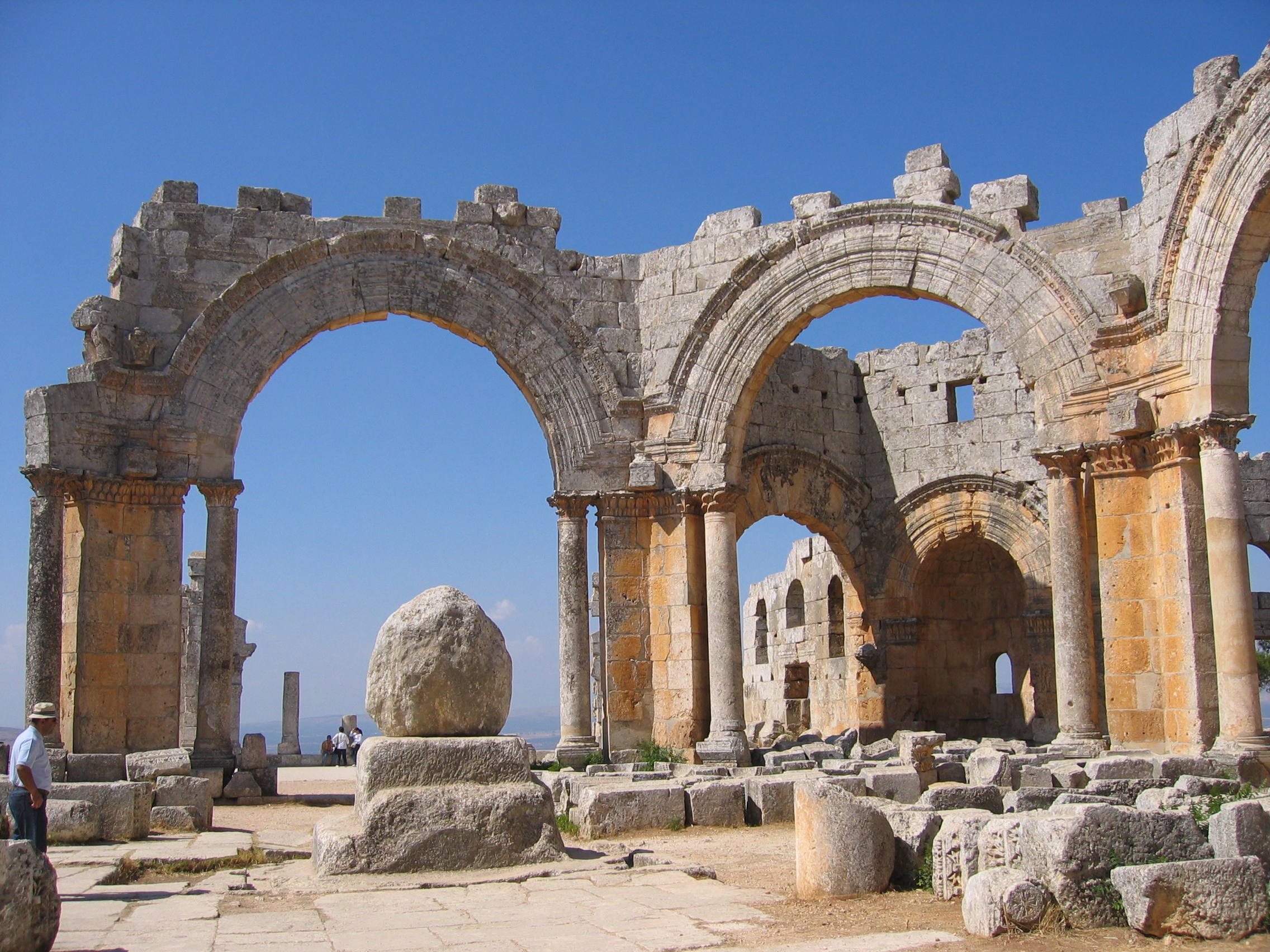
The remains of St. Symeon's Pillar, as it appears today in Syria (taken from: http://upload.wikimedia.org/wikipedia/commons/0/01/Column_of_Simeon_Syria.jpg)
  
"After trying various kinds of ascetical practices, both in the monastery and then in the wilderness, he began standing on pillars of progressively greater height, and heroically persevered in this for more than forty years; the greater part of this time he spent standing upright, even when one of his feet became gangrenous, and other parts of his body gave way under the strain. He did not adopt this strange way of life out of vainglory, a charge that some of his contemporaries made against him at the first: because he was already famous for his asceticism and holiness before ascending his first pillar (in Greek, style, whence he is called "Stylite"), many pious people came to him wishing to touch his garments, either for healing or for a blessing; to escape the continual vexation they caused, he made a pillar about ten feet high, and then higher and higher, until the fourth and last was about fifty feet high. The Church historian Theodoret of Cyrrhus, an eyewitness of his exploits who wrote of him while Symeon was yet alive, called him "the great wonder of the world." God gave him the grace to persevere in such an astonishing form of asceticism that multitudes came to see him from Persia, Armenia, South Arabia, Georgia, Thrace, Spain, Italy, Gaul, and the British Isles. Theodoret says that he became so famous in Rome that the Nomadic Arabs by the thousands believed in Christ and were baptized because of him; the King of Persia sent envoys to inquire into his way of life, and the Queen asked to be sent oil that he had blessed. He also was a great defender of sound doctrine, and confirmed the Orthodoxy of the Holy Council of Chalcedon for many who had been beguiled by the teachings of the Monophysites, including the Empress Eudocia, widow of Theodosius the Younger. After a life of unheard-of achievements and struggles, he reposed in peace at the age of sixty-nine, in the year 459."
(taken from: http://goarch.org/chapel/saints_view?contentid=646)
"The first one to learn of the death of the saint was his close disciple Anthony. Concerned that his teacher had not appeared to the people for three days, he went up on the pillar and found the dead body stooped over at prayer. Patriarch Martyrius of Antioch performed the funeral before a huge throng of clergy and people. They buried him near his pillar. At the place of his ascetic deeds, Anthony established a monastery, upon which rested the special blessing of St Simeon.
We pray to St Simeon for the return to the Church of those who have forsaken Her, or have been separated from Her."
(taken from: http://ocafs.oca.org/FeastSaintsViewer.asp?SID=4&ID=1&FSID=102448)

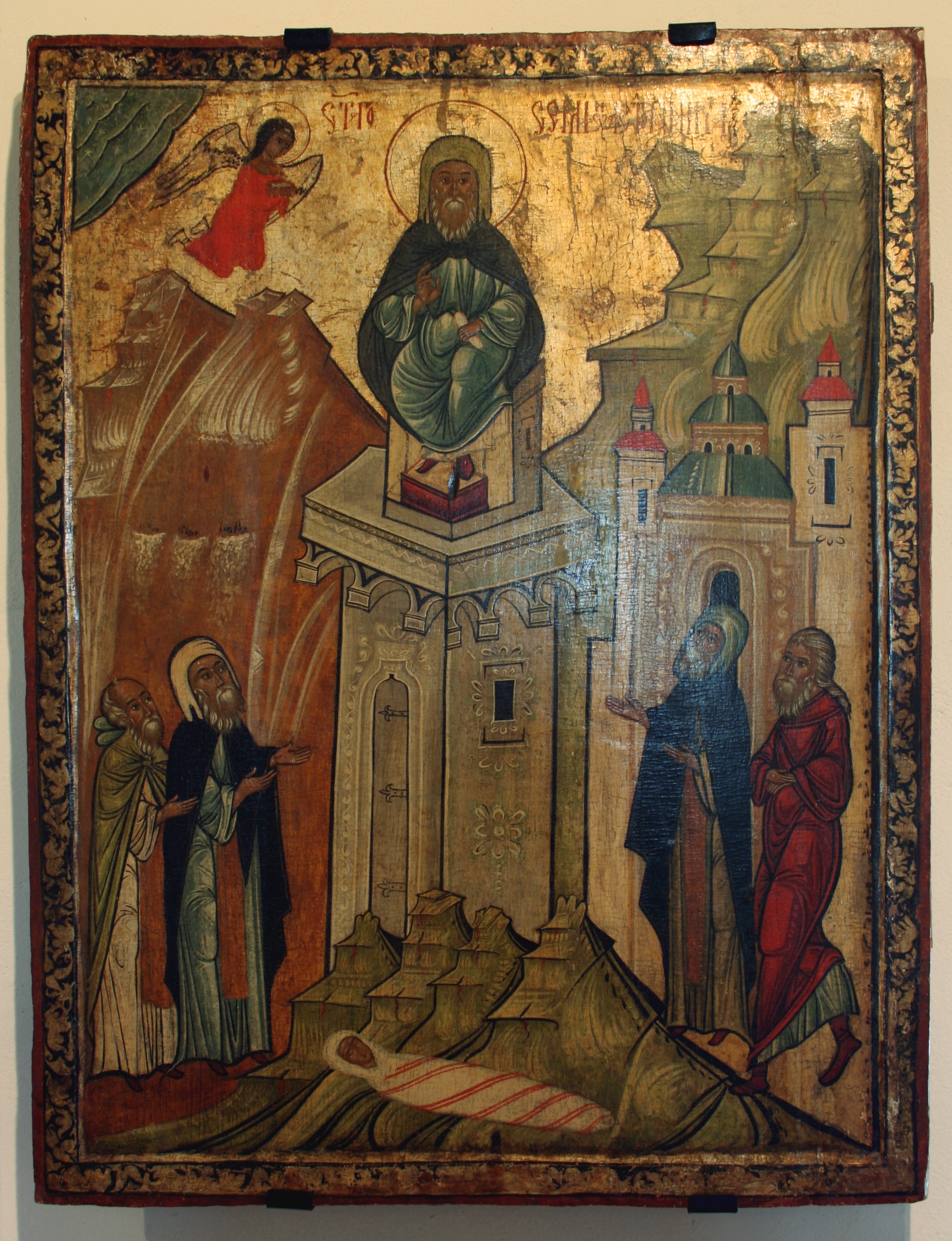
16th Century icon of St. Symeon the Stylite. The body below is the mother of St. Symeon (St. Martha, commemorated on July 4th) "On two occasions his mother Martha came to see him, but he refused to receive her, saying from atop the pillar: ``Do not disturb me now, my mother. If we become worthy, then we'll see each other in the next world.'' (http://www.westsrbdio.org/prolog/prolog.htm; icon from: http://upload.wikimedia.org/wikipedia/commons/4/46/MHS_Szymon_Slupnik_XVI_w_Kostarowce_p.jpg)
  
HYMN OF PRAISE
for Saint Simeon the Stylite
(by St. Nikolai Velimirovich)
Simeon the Stylite, the first of the pillar-dwellers,
An illuminated elder, with the radiance of an immortal,
Bound himself to the pillar as a willing sacrifice;
He was fully alive to heaven, and dead to the earth.
Fasting and prayer and all-night vigils-
By this hard path he sought salvation.
Early one morning, his mother came by:
``O Son, come down and let your mother see you!''
Thus she spoke, but Simeon was silent.
The mother repeated her plea again and again….
Simeon at last replied to his mother:
``I am in the service of the Heavenly King.
This life is a struggle and a preparation.
There is no time for empty conversation here.
But go, Mother, and choose the pure path-
Take care for your soul and live according to Christ!
After the present struggle is the next world;
If Christ finds us worthy,
You will see your son there, Mother,
And your son will delight in his mother's face.''

REFLECTION
We should use all that is necessary in this world for the cultivation of our souls, for when death separates us from this world we will take nothing to the other world except our souls, in whatever state they have been formed here. When he was eighteen, St. Simeon the Stylite was so concerned about the salvation of his soul that one day he fell face down on the earth and prayed to God that He would show him the path of salvation. And lying thus in prayer for a long time, he had a vision that he was digging a trench for a foundation and, exhausted from digging, stopped to catch his breath. A voice spoke to him, saying: ``Dig deeper!'' Then he began, with greater labor and effort, to dig yet deeper. Again he stopped to catch his breath. But again he heard the voice: ``Dig deeper!'' He again began to dig, with even greater labor and effort. At this the voice spoke to him again: ``Stop, it is sufficient! Now build what you wish to build; for without labor, you will succeed in nothing.'' Those who labor little, and build the life of their soul on sensual shallowness, build on sand, which cannot uphold anything, even in this transitory world-and even more so in eternity.
(http://www.westsrbdio.org/prolog/prolog.htm)
  

Icon of Sts. Symeon the Stylite and Genevieve of Paris from her tomb in Paris (taken from: http://orthodoxwiki.org/images/0/0a/Gen_tombicon.jpg)
  
"[St. Geneviève of Paris] made many pilgrimages in the company of other maidens to the shrine of Saint Martin of Tours. Her reputation for sanctity was so great that it reached as far away as Syria, to St. Simeon the Stylite. This holy old woman once received a delegation from St. Simeon, who learned of her greatness during prayers and sent visitors to her with words of greeting, asking for her prayers for his salvation."
(taken from: http://www.allsaintsbrookline.org/celtic_saints/genevieve.html)
  
"In St. Genevieve, we find that it was a weak woman who stopped Attila the Hun, the same Attila before whom the great warriors and governors of the empire trembled. And it was to this woman, out of all the theologians and clergy in France, that St. Simeon the Stylite sent a greeting from his pillar in Syria. His greeting to her is recorded in all the variants of the Life of St. Genevieve, but not in those of St. Simeon the Stylite. Why? Because he was the greatest contemporary figure of eastern monasticism, and she was still an unknown anchorite. Hers was one of tens of thousands of blessings he gave to those who sought him out, but, of course, it was important to St. Genevieve – as important as if we had received a blessing from one of the Optina elders. Certainly, our children, our grandchildren and our great grand-children would remember this."
(taken from: http://www.roadtoemmaus.net/back_issue_articles/RTE_25/A_CITY_OF_SAINTS.pdf)
  
Icon of St. Symeon the Stylite (Icon courtesy of www.eikonografos.com used with permission)

Apolytikion in the First Tone
Thou becamest a pillar of patience and didst emulate the Forefathers, O righteous one: Job in his sufferings, Joseph in temptations, and the life of the bodiless while in the body, O Symeon, our righteous Father, intercede with Christ God that our souls be saved.

Kontakion in the Second Tone
Thou soughtest the heights, though parted not from things below; thy pillar became a chariot of fire for thee. Thou becamest thereby a true companion of the angelic host; and together with them, O Saint, thou ceaselessly prayest Christ God for us all.

  
Through the prayers of our Holy Fathers, Lord Jesus Christ our God, have mercy on us and save us! Amen!

The Indiction (Ecclesiastical New Year), and the Orthodox Day of the Protection of the Environment

Icon of Christ preaching in the Synagogue in Nazareth. "According to Holy Tradition, Christ entered the synagogue on September 1 to announce His mission to mankind (Luke 4:16-22). Quoting Isaiah 61:1-2), the Savior proclaimed, "The spirit of the Lord is upon me; because He has anointed me to preach the gospel to the poor; He has sent me to proclaim release to captives, and recovering of sight to the blind, to set at liberty those who are oppressed, to proclaim the acceptable year of the Lord…" This scene is depicted in a Vatican manuscript (Vatican, Biblioteca. Cod. Gr. 1613, p.1)." (taken from: http://ocafs.oca.org/FeastSaintsViewer.asp?SID=4&ID=1&FSID=501)
  
The Indiction (Ecclesiastical New Year), and the Orthodox Day of the Protection of the Environment - Celebrated September 1st

Reading:
"For the maintenance of their armed forces, the Roman emperors decreed that their subjects in every district should be taxed every year. This same decree was reissued every fifteen years, since the Roman soldiers were obliged to serve for fifteen years. At the end of each fifteen-year period, an assessment was made of what economic changes had taken place, and a new tax was decreed, which was to be paid over the span of the fifteen years. This imperial decree, which was issued before the season of winter, was named Indictio, that is, Definiton, or Order. This name was adopted by the emperors in Constantinople also. At other times, the latter also used the term Epinemisis, that is, Distribution (Dianome). It is commonly held that Saint Constantine the Great introduced the Indiction decrees in A.D. 312, after he beheld the sign of the Cross in heaven and vanquished Maxentius and was proclaimed Emperor in the West. Some, however (and this seems more likely), ascribe the institution of the Indiction to Augustus Caesar, three years before the birth of Christ. Those who hold this view offer as proof the papal bull issued in A.D. 781 which is dated thus: Anno IV, Indictionis LIII -that is, the fourth year of the fifty-third Indiction. From this, we can deduce the aforementioned year (3 B.C.) by multiplying the fifty-two complete Indictions by the number of years in each (15), and adding the three years of the fifty-third Indiction. There are three types of Indictions: 1) That which was introduced in the West, and which is called Imperial, or Caesarean, or Constantinian, and which begins on the 24th of September; 2) The so-called Papal Indiction, which begins on the 1st of January; and 3) The Constantinopolitan, which was adopted by the Patriarchs of that city after the fall of the Eastern Empire in 1453. This Indiction is indicated in their own hand on the decrees they issue, without the numeration of the fifteen years. This Indiction begins on the 1st of September and is observed with special ceremony in the Church. Since the completion of each year takes place, as it were, with the harvest and gathering of the crops into storehouses, and we begin anew from henceforth the sowing of seed in the earth for the production of future crops, September is considered the beginning of the New Year. The Church also keeps festival this day, beseeching God for fair weather, seasonable rains, and an abundance of the fruits of the earth. The Holy Scriptures (Lev. 23:24-5 and Num. 29:1-2) also testify that the people of Israel celebrated the feast of the Blowing of the Trumpets on this day, offering hymns of thanksgiving. In addition to all the aforesaid, on this feast we also commemorate our Saviour's entry into the synagogue in Nazareth, where He was given the book of the Prophet Esaias to read, and He opened it and found the place where it is written, "The Spirit of the Lord is upon Me, for which cause He hath anointed Me..." (Luke 4:16-30).

It should be noted that to the present day, the Church has always celebrated the beginning of the New Year on September 1. This was the custom in Constantinople until its fall in 1453 and in Russia until the reign of Peter I. September 1 is still festively celebrated as the New Year at the Patriarchate of Constantinople; among the Jews also the New Year, although reckoned according to a moveable calendar, usually falls in September. The service of the Menaion for January 1 is for our Lord's Circumcision and for the memorial of Saint Basil the Great, without any mention of its being the beginning of a new year."

"Tradition says that the Hebrews entered the Promised Land in September."
(http://ocafs.oca.org/FeastSaintsViewer.asp?SID=4&ID=1&FSID=501)

Detail from a fresco from St. Paraskevi Shrine, Greenlawn, NY of the Creation (taken from: http://stparaskevi.org/dome_animals1.jpg)

On this day the Orthodox also offer special prayers to God to protect the environment, which because of our sins is continuously being harmed. The following is from the Synaxarion of the service for the Protection of the Environment (available in English here: http://www.anastasis.org.uk/environm.htm)

On the same day, the beginning of the Indiction, we entreat our God, who loves mankind, for the welfare of the earth on which we live and for the whole creation.

Verses
We fall before you, Master, as we cry:
O Saviour, from pollutions free the earth.

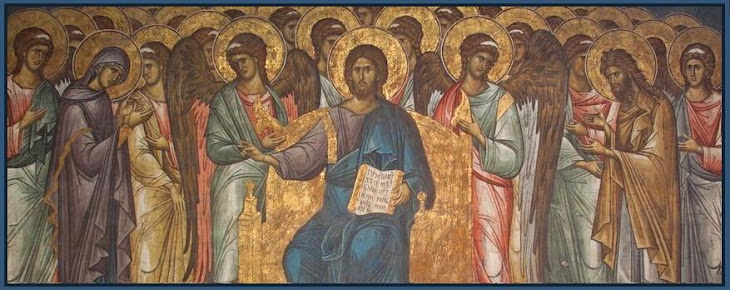
Fresco of Christ preaching at the Synagogue in Nazareth (taken from: http://www.srpskoblago.org/Archives/Decani/exhibits/Collections/PublicMinistry/CX4K3056_l.html)

Apolytikion for the Indiction in the Second Tone
Creator of the universe, setting times and seasons by Your sole authority, bless the cycle of the year of Your grace, O Lord, guarding our rulers and Your nation in peace, at the intercession of the Theotokos, and save us.

Kontakion in the Fourth Tone
You who created all things in Your infinite wisdom, and set the times by Your own authority, grant Your Christian people victories. Blessing our comings and goings throughout this year, guide our works according to Your divine will.

Apolytikion for the Protection of the Environment - Tone 4. Speedily anticipate.
Lord and Saviour, who as God brought all things into being by a word, establishing laws and governing them unerringly to your glory, at the prayers of the Mother of God, keep secure and unharmed all the elements which hold the earth together, and save the universe.
  
(taken from: http://www.anastasis.org.uk/environm.htm; see the link for the entire service in English)

Through the prayers of our Holy Fathers, Lord Jesus Christ our God, have mercy on us and save us! Amen!