Monday, September 7, 2009

St. Ahmed the New Martyr, the Calligrapher

St. Ahmed the New Martyr, the Calligrapher - Commemorated on May 3rd (icon taken from: http://vatopaidi.files.wordpress.com/2009/05/agios-ahmet.jpg)
"The holy New Martyr Ahmed was born in the seventeenth century to a Muslim family in Constantinople. By profession he was a copyist in the Great Archives. In accordance with Ottoman law, since he did not have a wife, he had a slave instead, a Russian woman. Another captive from Russia lived together with her, an old woman, also a slave. Both these women were very pious.
On feast days the old woman would go to church. Taking the blessed bread or antidoron, she would give it to the young woman to eat. The old woman would also bring her holy water to drink. Whenever this occurred and Ahmed was close to her, he would smell a beautiful and indescribable fragrance coming out of her mouth. He would ask her what she was eating to make her mouth smell so fragrant. Not realizing what was happening, the slave would say that she was not eating anything. However, he persisted in asking. Eventually she told him that she was eating the bread which had been blessed by the priests, which the old woman brought her whenever she returned from church.

On hearing this, Ahmed was filled with longing to see the Orthodox church and how Orthodox received this blessed bread. Therefore he summoned a priest and told him to prepare a secret place for him, so that he could go when the Patriarch was serving the Liturgy. When the appointed day arrived, dressed as an Orthodox, he went to the Patriarchate and followed the Divine Liturgy. While he was in church, he saw the Patriarch shining with light and lifted off the floor, as he came out of the altar and through the holy doors to bless the people. As he blessed, rays of light came from his finger tips, but though the rays fell on the heads of all the Orthodox, they did not fall on Ahmed's head. This happened two or three times and each time Ahmed saw the same thing. Thus, Ahmed came to the faith. Without hesitation he sent for the priest, who gave him rebirth through baptism. Ahmed remained a secret Orthodox for some time, concealing his baptismal name, which is why it has not come down to us.

However, one day Ahmed and certain noblemen were eating together. Afterwards they sat talking and smoking, as is the Muslim custom. In the course of the conversation they began to discuss what the greatest thing in the world. Each gave his opinion. The first guest said that the greatest thing in the world was for a man to have wisdom. The second maintained that woman was the greatest thing in the world. And yet a third said that the greatest thing in the world, and by far the most delightful, was good food - for was this not the food of the righteous in paradise?

Then it was Ahmed's turn. They all turned to him, asking him for his opinion on this matter. Filled with holy zeal, Ahmed cried out that the greatest thing of all was the Faith of the Orthodox. And confessing himself to be a Christian, he boldly censured the falseness and deception of the Muslims. At first, on hearing this the Muslims were aghast. Then, filled with unspeakable rage, they fell on the holy martyr and dragged him to a judge, so that he could be sentenced to death. He was beheaded, receiving the crown of martyrdom on the orders of the ruler on 3 May 1682.
Holy Martyr Ahmed, pray to God for us!"

Icon of St. Ahmed the Neomartyr (taken from: http://www.pigizois.net/agiologio/Agios%20Ahmet.jpg)
Apolytikion in the Fourth ToneThy Martyr, O Lord, in his courageous contest for Thee received the prize of the crowns of incorruption and life from Thee, our immortal God. For since he possessed Thy strength, he cast down the tyrants and wholly destroyed the demons' strengthless presumption. O Christ God, by his prayers, save our souls, since Thou art merciful.(taken from: http://goarch.org/chapel/saints_view?contentid=190)
Through the prayers of our Holy Fathers, Lord Jesus Christ our God, have mercy on us and save us! Amen!

Sunday, September 6, 2009

Commemoration of the Miracle of the Archangel Michael at Colossae (Chonae)

Miracle of the Archangel Michael at Colossae (Chonae) - Commemorated on September 6 (this 15th Century Russian icon taken from: http://upload.wikimedia.org/wikipedia/commons/5/5b/Mikharkhangel3.jpg)
"Near Hierapolis, in Phrygia, there was a place called Chonae (``plunging''), and in that place there was a spring of miraculous water. When Apostle John the Theologian, accompanied by Philip, preached the Gospel in Hierapolis, he looked upon that place and prophesied that a spring of miraculous water would open up there, from which many would receive healing, and that the great Archangel of God Michael would visit that place. Soon afterward, this prophecy was fulfilled: a spring of water burst forth and became widely known for its miraculous power. A pagan in Laodicea had a daughter who was mute, which caused him great sorrow. Archangel Michael appeared to him in a dream, and told him to take his daughter to the spring, where she would be cured. The father immediately obeyed, brought his daughter to the spring, and found many people there seeking deliverance from various infirmities. These people were all Christians. The man asked how he should seek healing, and the Christians told him: ``You must pray to the Archangel Michael, in the name of the Father and of the Son and of the Holy Spirit.'' The man prayed in this way, gave his daughter a drink of this water, and the girl began to speak. The pagan, his daughter and his whole household were baptized. He also built a church over the spring dedicated to the Archangel Michael. Later, a young man named Archippus settled there and lived a life of austerity, in fasting and prayer. The pagans did many malicious things to Archippus, for they did not like the fact that this Christian holy place emanated such spiritual power and attracted so many people to it. The pagans, in their wickedness, rerouted the nearest river in order to flood the church and the spring. By the prayers of Archippus, the holy Archangel Michael opened a fissure in the rock beside the church, and the river's water plunged into it. This is how that place was saved and why it was called Chonae, or ``of the plunging,'' for the river's water that plunged into the open fissure. St. Archippus labored in asceticism there until the age of seventy, and peacefully reposed in the Lord."


Fresco from Decani Monastery of the Holy Archangel Michael saving his church at Chonae (taken from: http://www.srpskoblago.org/Archives/Decani/exhibits/Menologion/September/CX4K3406_l.html)

"The Miracle of the Holy Chief Commander Archangel Michael at Colossae. In Phrygia, not far from the city of Hieropolis, in a place called Cheretopos, there was a church named for the Archangel Michael, built over a miraculous spring.

This church was built by a certain inhabitant of the city of Laodicia in gratitude to God for healing his mute daughter. The holy Chief Commander Michael appeared to this man in a dream and revealed to him that his daughter would receive the gift of speech after drinking from the water of the spring. The girl actually did receive healing and began to speak. After this miracle, the father and his daughter and all their family were baptized. In fervent gratitude, the father built the church in honor of the holy Chief Commander Michael. Not only did Christians begin to come to the spring for healing, but also pagans. In so doing, many of the pagans turned from their idols and were converted to the faith in Christ.

At this church of the holy Chief Commander Michael, a certain pious man by the name of Archippus served for sixty years as church custodian. By his preaching and by the example of his saintly life he brought many pagans to faith in Christ. With the general malice of that time towards Christians, and especially against Archippus, the pagans thought to destroy the church in order to prevent people from coming to that holy place of healing, and at the same time kill Archippus.


Reproduction of the Miraculous Icon of the Holy Archangel Michael of Mandamados (Icon courtesy of http://www.eikonografos.com/ used with permission)
Toward this end they made a confluence of the Lykokaperos and Kufos Rivers and directed its combined flow against the church. St Archippus prayed fervently to the Chief Commander Michael to ward off the danger. Through his prayer the Archangel Michael appeared at the temple, and with a blow of his staff, opened a wide fissure in a rock and commanded the rushing torrents of water to flow into it. The temple remained unharmed. Seeing such an awesome miracle, the pagans fled in terror. Archippus and the Christians gathered in church glorified God and gave thanks to the holy Archangel Michael for the help.

The place where the rivers plunged into the fissure received the name "Chonae", which means "plunging." The Chudov ("of the Miracle") monastery in Moscow is named for this Feast."
(taken from: http://ocafs.oca.org/FeastSaintsViewer.asp?SID=4&ID=1&FSID=102517)
For the full account of this feast from the Great Synaxaristes, see: http://www.johnsanidopoulos.com/2009/09/miracle-at-chonai-by-archangle-michael.html.
11th-12th Century Icon of the Miracle of Archangel Michael at Chonae, from St. Catherine's Monastery, Mount Sinai (taken from: http://ocafs.oca.org/FeastSaintsViewer.asp?SID=4&ID=1&FSID=102517)
Troparion - Tone 4
Michael, commander of the heavenly hosts, we who are unworthy beseech you, by your prayers encompass us beneath the wings of your immaterial glory, and faithfully preserve us who fall down and cry out to you: "Deliver us from all harm, for you are the commander of the powers on high!"
Kontakion - Tone 2
Michael, commander of God's armies and minister of the divine glory, prince of the bodiless angels and guide of mankind, ask for what is good for us, and for great mercy, as supreme commander of the Bodiless Hosts.
Prosomia of the Praises - First ToneLet us who dwell in the world now like angels keep the feast, * and unto God who is carried * on the throne of His glory * cry aloud the hymn, saying: “Father who art * in the heavens, Holy are You; * co-unoriginate Logos, Holy are You; * and all-holy Spirit, Holy are You.”
Since you are foremost in heaven, and have great freedom to speak, * O Chief Commander Michael, as you stand there in glory * near the unendurable throne of the Lord, * and behold things ineffable, * by your entreaties deliver us from distress * and temptations and from perils, we pray.
Among the bodiless Angels you are expressly the first. * O Chief Commander Michael, * an eye-witness and mystic * are you of that divine and resplendent light. * Hence we fervently pray to you: * Save us who piously honor you every year * and in faith extol the Trinity.
Through the prayers of our Holy Fathers, Lord Jesus Christ our God, have mercy on us and save us! Amen!

Saturday, September 5, 2009

Sts. Zacharias the Prophet and Elizabeth the Righteous, the Parents of the Precious Forerunner

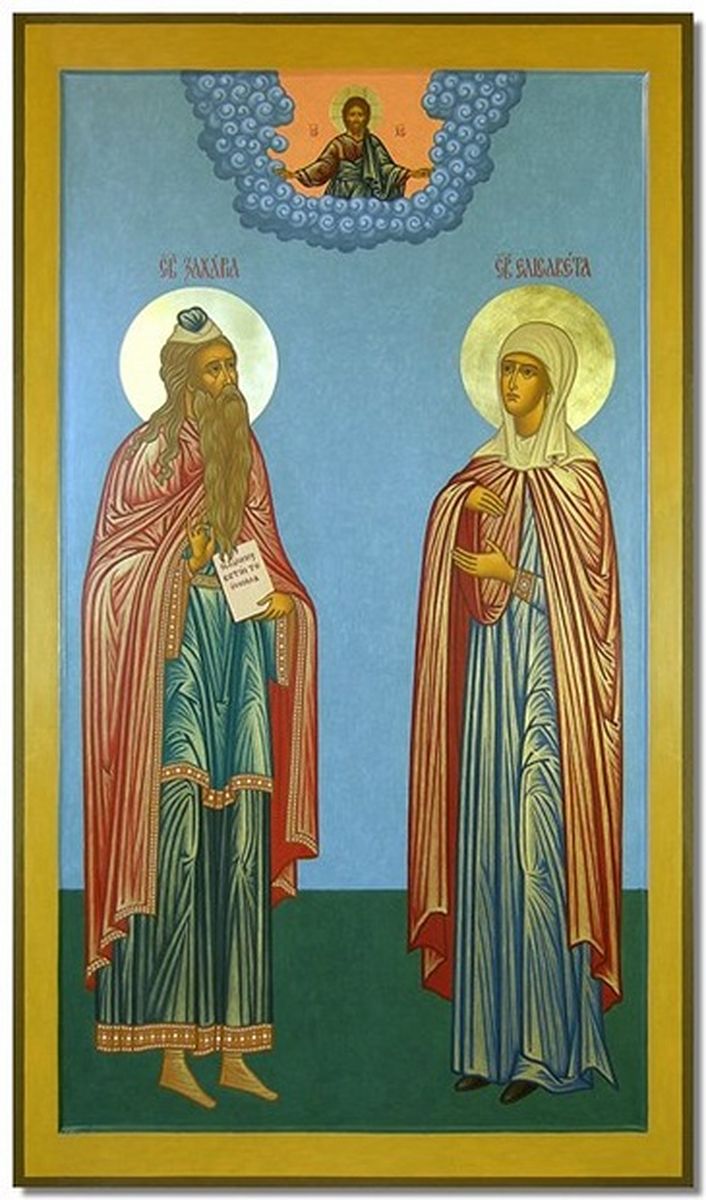
Sts. Zacharias the Prophet and Elizabeth the Righteous, the Parents of the Precious Forerunner - Commemorated on September 5th (icon taken from: http://www.rel.gr/photo/displayimage.php?pid=1302&fullsize=1)
  
"The Holy Prophet Zachariah and the Righteous Elizabeth were the parents of the holy Prophet, Forerunner and Baptist of the Lord, John. They were descended from the lineage of Aaron: St Zachariah, son of Barach, was a priest in the Jerusalem Temple, and St Elizabeth was the sister of St Anna, the mother of the Most Holy Theotokos. The righteous spouses, "walking in all the commandments of the Lord (Luke 1:6), suffered barrenness, which in those times was considered a punishment from God.
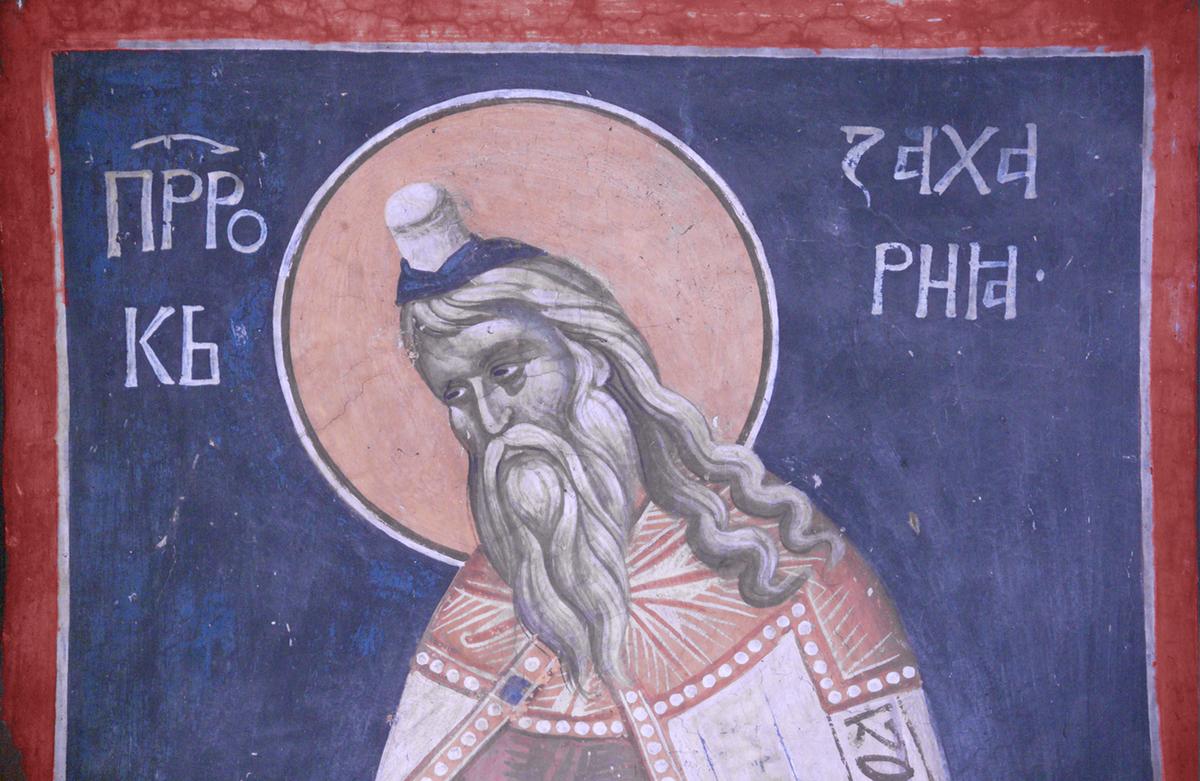
Icon of the Holy Prophet Zacharias (taken from: http://ocafs.oca.org/FeastSaintsViewer.asp?FSID=102502)
  
Once, during his turn of priestly service in the Temple, St Zachariah was told by an angel that his aged wife would bear him a son, who "will be great in the sight of the Lord" (Luke 1:15) and "will go before Him in the spirit and power of Elias" (Luke 1:17).
  
Zachariah doubted that this prediction would come true, and for his weakness of faith he was punished by becoming mute. When Elizabeth gave birth to a son, through the inspiration of the Holy Spirit she announced that his name was John, although no one in their family had this name.
They asked Zachariah and he also wrote the name John down on a tablet. Immediately the gift of speech returned to him, and inspired by the Holy Spirit, he began to prophesy about his son as the Forerunner of the Lord.
  
The Holy Prophet Zacharias writing: "His name shall be John" (http://days.pravoslavie.ru/Images/ii823&560.htm)
  
[Note: The conception of St. John the Forerunner is celebrated on September 23rd, while his birth is celebrated on June 24th]

When King Herod heard from the Magi about the birth of the Messiah, he decided to kill all the infants up to two years old at Bethlehem and the surrounding area, hoping that the new-born Messiah would be among them.

St. Elizabeth fleeing with the new-born St. John, and the St. John being guided by an angel in the desert (http://img-fotki.yandex.ru/get/3707/liblion.13c/0_3248c_e40e2eae_orig)
  
Herod knew about John's unusual birth and he wanted to kill him, fearing that he was the foretold King of the Jews. But Elizabeth hid herself and the infant in the hills. The murderers searched everywhere for John. Elizabeth, when she saw her pursuers, began to implore God for their safety, and immediately the hill opened up and concealed her and the infant from their pursuers.
  
Icon of St. Elizabeth the Righteous (taken from: http://ocafs.oca.org/FeastSaintsViewer.asp?FSID=102503)
  
In these tragic days St Zachariah was taking his turn at the services in the Temple. Soldiers sent by Herod tried in vain to learn from him the whereabouts of his son. Then, by command of Herod, they murdered this holy prophet, having stabbed him between the temple and the altar (MT 23: 35). Elizabeth died forty days after her husband, and St John, preserved by the Lord, dwelt in the wilderness until the day of his appearance to the nation of Israel.

Fresco depicting the martyrdom of St. Zacharias in the Temple (taken from: http://www.srpskoblago.org/Archives/Decani/exhibits/Menologion/September/CX4K3404_l.html)
  
On the Greek calendar, Sts Zachariah and Elizabeth are also commemorated on June 24, the Feast of the Nativity of St John the Baptist."
(taken from: http://ocafs.oca.org/FeastSaintsViewer.asp?SID=4&ID=1&FSID=102502)


REFLECTION
(by St. Nikolai Velimirovich)
"Men strive in vain to discover those things that God intentionally conceals from them. If God had not permitted, men would never have found gold and silver beneath the earth, or the power of steam or the glow of electrical light. In vain, Herod slaughtered countless children in Bethlehem in order to slay One. That One was hidden from the sight and sword of Herod. In vain did Herod seek John. Behold the wonder: soldiers pursued the aged Elizabeth, who was fleeing with John in her arms-and could not catch up with her! The enraged Herod summoned Zacharias and demanded: ``Give me your son John!'' The aged priest meekly replied: ``I am now serving the Lord God of Israel. I know not where my son is.'' Insane with rage, Herod ordered Zacharias slain in place of John. The servants of the king entered the Temple and asked Zacharias: ``Where have you hidden your son? Give him to us for the king has so ordered. If you do not give him to us, you yourself will die.'' Zacharias replied: ``You will kill my body but the Lord will receive my soul.'' Thus Zacharias was slain, but Herod was not content with that. The wicked king had no peace, day or night, for he was tormented by a foreboding that John could be that newborn king proclaimed by the Magi from the East. Herod tried to find him, but in vain, for God had intentionally hidden him."
(taken from: http://www.westsrbdio.org/prolog/prolog.htm)
   Icon of Sts. Zacharias and Elizabeth, with their son, St. John the Forerunner (taken from: http://christopherklitou.com/icon_5_sept_24_june_zacharias_elisabeth.htm)
  
Troparion - Tone 2
The memory of Your prophets Zachariah and Elizabeth We celebrate today, O Lord. By their prayers, we beseech You, O Christ God, save our souls!
  
Apolytikion in the Fourth Tone
In the vesture of a priest, according to the Law of God, thou didst offer unto Him well-pleasing whole-burnt offerings, as it befitted a priest, O wise Zacharias. Thou wast a shining light, a seer of mysteries, bearing in thyself clearly the signs of grace; and in God's temple, O wise Prophet of Christ God, thou wast slain with the sword. Hence, with the Forerunner, make entreaty that our souls find salvation.

Kontakion in the Third Tone
On this day the Prophet and ven'rable priest of the Most High, even Zacharias, who begat the Forerunner, hath now mixed for us the draught of virtue and set the table of his sacred mem'ry nourishing all the faithful; for this cause do we extol him as a most godly initiate of grace divine.
  
Sts. Zacharias and Elizabeth, the parents of the Precious Forerunner (http://days.pravoslavie.ru/jpg/ih3523.jpg)
  
Through the prayers of our Holy Fathers, Lord Jesus Christ our God, have mercy on us and save us! Amen!

St. Philoumenos the New Hieromartyr of Jacob's Well

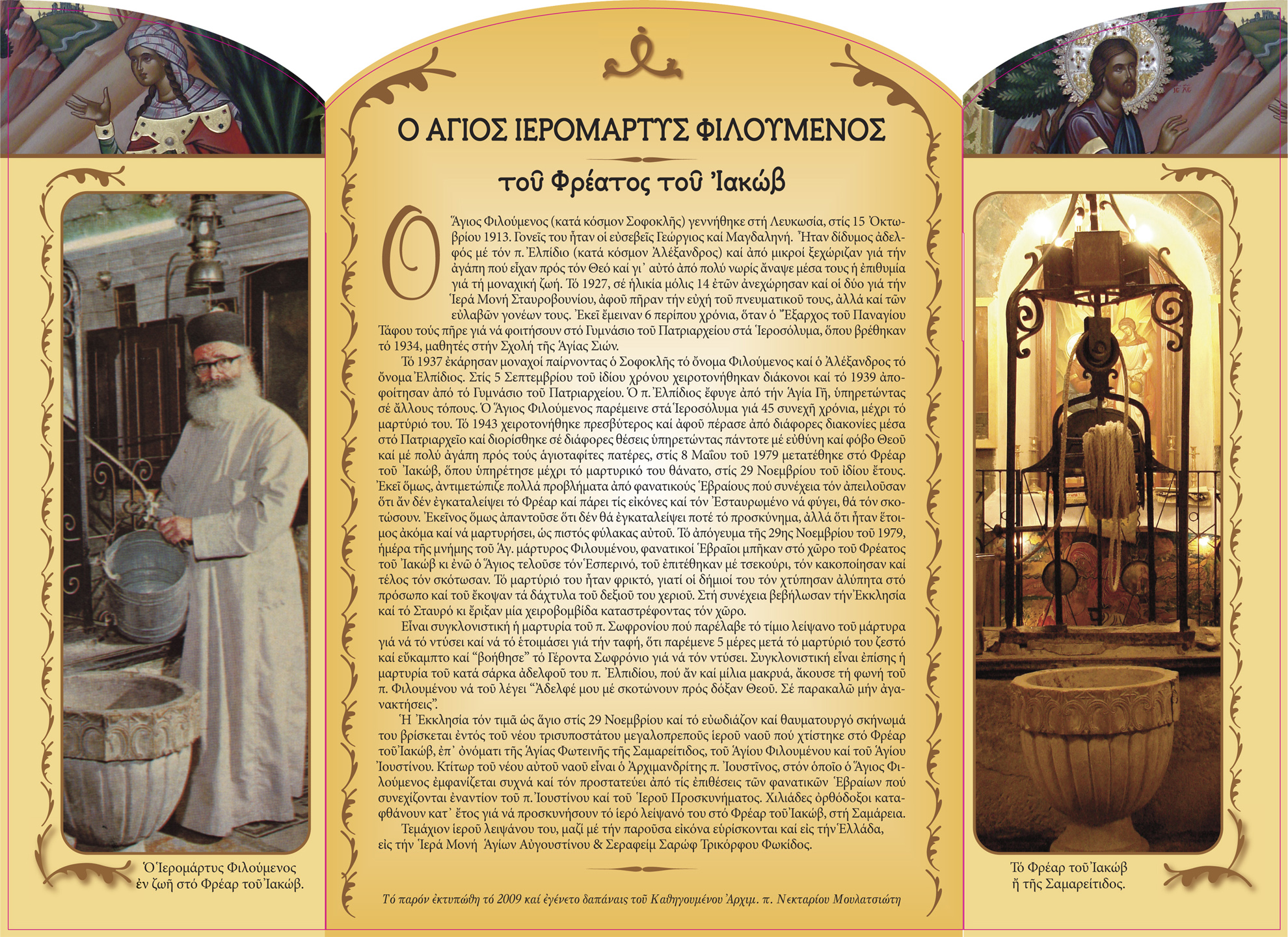
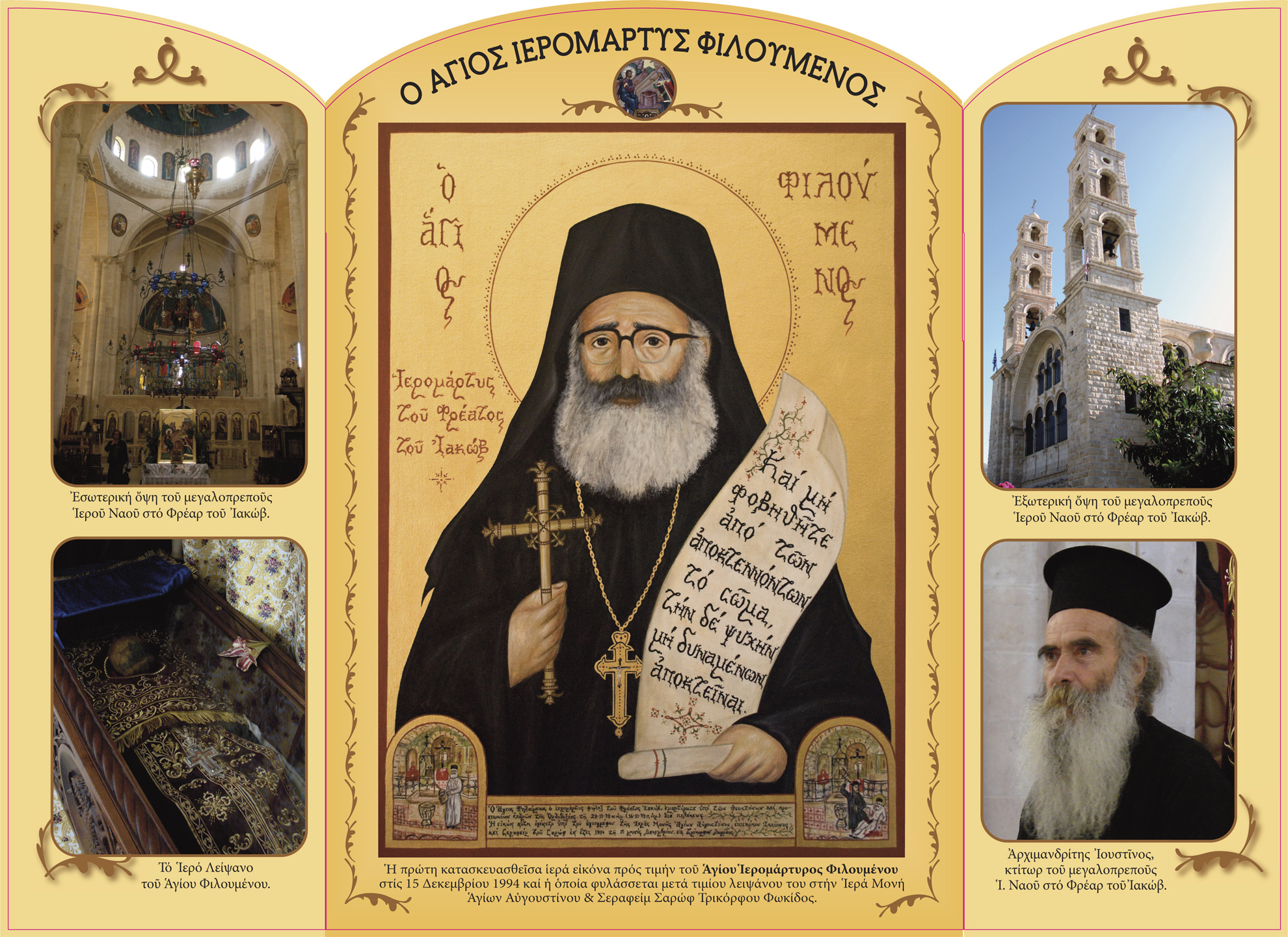
Central photograph of St. Philoumenos the New Righteous Hieromartyr, the Cypriot, at Jacob's Well where Christ spoke with St. Photini. Surrounding are other pictures and icons of St. Philoumenos and associated scenes. He was martyred on November 16th/29th 1979 (taken from: http://www.pigizois.net/agioi/sigxronoi_agioi/filoumenos.jpg; for the center picture larger see: http://misha.pblogs.gr/tags/ag-filoymenos-gr.html)
  
The Life of St. Philoumenos the New Hieromartyr
"The holy martyr of the 20th century, Philoumenos the Cypriot, came from the village of Orounta of the province of Morphou. From a young age, he along with his brother Elpidios apprenticed the sacred letters of Christ near their grandmother. They namely studied the lives of the Saints and hymns of the Church. The Saint at the time, along with his brother left for the Monastery of Stavrovouni and stayed there for five years. Afterwards, they both left for Jerusalem. Saint Philoumenos stayed in Jerusalem for 46 years. The Saint found a martyred death by fanatic Zionist Jews who massacred him in the evening while he was doing vespers at the Well of Jacob where he lived, a loyal guardian of the Holy Places and ways of centuries.
   
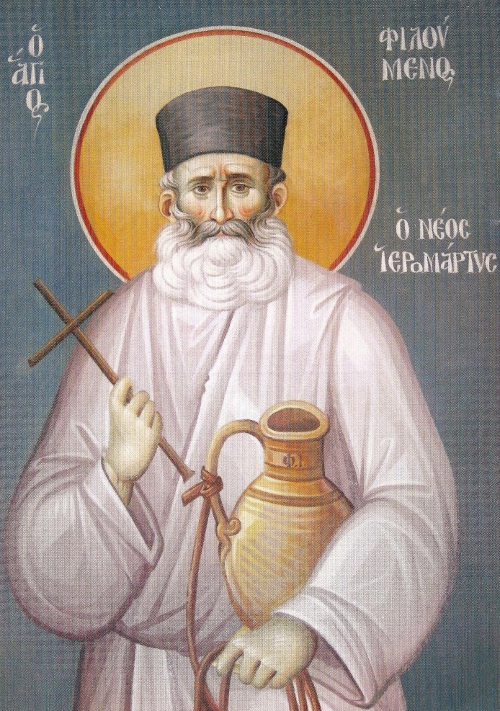
Icon of St. Philoumenos the New Hieromartyr (taken from: http://vatopaidi.files.wordpress.com/2009/12/agios-ieromartys-filoumenos-parekklision-panagoias-pantanassis-porto-lagos.jpg; more icons of new Saints and Holy Fathers available here: http://www.scribd.com/doc/16103821/)
  
The Church of Cyprus and especially the Holy Metropolis of Morphou today celebrate the memory of the martyr Saint Philoumenos the new, the Cypriot. The neomartyr was born in 1913 and was a child of George and Magdalene Hasapi or Ourountioti , and the twin brother of Archimandrite Elpidios. Even though his parents come from the village of Orounta of the metropolitan area of Morphou, they lived at the parish of St. Savvas in Nicosia, since his father had his own inn and bakery there. Together with his brother Elpidios, they showed a particular enthusiasm for prayer and read the lives of the Saints, particularly they where touched by the life of Saint John the Kalyvitis, who in some way made an impact on them, to the point of wanting to follow the life of monks. Also, apart from their mother, their grandmother Loxantra, had in particular influenced them in learning the ways of the Church and in developing a truly Orthodox conscience. At the age of 14 , the two brothers left for the Monastery of Stafrovouni and then left for Jerusalem, where they attended High School. After they finished High School in 1939, Elpidios served as a priest in different places and died on November 29th 1983. Philoumenos remained in Jerusalem and in 1979 was appointed as care taker of the Monastery of Saint Jacob's Well. While living there, on November 29, 1979 during the time when the Saint was doing vespers, he was murdered by Zionist Jews with an ax.
   
Icon of St. Philoumenos the New Hieromartyr (taken from: http://www.allsaintsofamerica.org/martyrs/images/nmphilo1.gif)
  
The week before, a group of fanatical Zionists came to the monastery at Jacob's Well, claiming it as a Jewish holy place and demanding that all crosses and icons be removed. Of course, the Saint pointed out that the floor upon which they were standing had been built by Emperor Constantine before 331 A.D. and had served as an Orthodox Christian holy place for sixteen centuries before the Israeli State was created, and had been in Samaritan hands eight centuries before that, (The rest of the original church had been destroyed by the invasion of the Shah Khosran Parvis in the seventh century, at which time the Jews had massacred all the Christians of Jerusalem.) The group left with threats, insults and obscenities of the kind which local Christians suffer regularly. After a few days, on November 29th, during a torrential downpour, a group broke into the monastery; the saint had already put on his epitrachelion for Vespers. The piecemeal chopping of the three fingers with which he made the Sign of the Cross showed that he was tortured in an attempt to make him deny his Orthodox Christian Faith. His face was cloven in the form of the Cross. The church and holy things were all defiled.The body of the Saint was handed over to the Orthodox six days after his massacre, but retained its flexibility and was buried in the cemetery of Mount Zion.

The Martyrdom of St. Philoumenos the New Hieromartyr (http://misha.pblogs.gr/files/f/427281-Filumen_ikon.jpg)
  
After four years, as is customary his body was exhumed. It was found to be substantially incorrupt and had a beautiful scent. Then, the tomb was closed and was reopened during the Christmas of 1984, when the body was found to be partially incorrupt and was placed in a glass shrine in the northern part of the sacred Holy Altar in Mount Zion. Hieromartyr Philoumenos was ranked among the Saints of the Church of Jerusalem on August 30th 2008, and hence then, his incorrupt body was transferred to the pilgrimage of Jacob's Well where he found martyrdom for the love of Christ. His memory is honored on November 29th, especially in the community of Orounta with an all night long church service." (taken from: http://noctoc-noctoc.blogspot.com/2008/11/1979-cypriot-saint-philoumenos-who-was.html)

Another icon of St. Philoumenos, inscribed in many different languages (taken from: http://www.allsaintsofamerica.org/martyrs/nmphilou.html)
  
The transfer of the Sacred Relics of the hieromartyr Philoumenos the Cypriot to Jacob’s Well
By ARISTEIDI VIKETOU
"Twenty-nine years after his death by martyrdom by fanatical Jews, Saint Philoumenos the Hieromartyr the Cypriot «returned» to Jacob’s Well, the holy pilgrimage, where he served as abbot and the guardian. Recently the Metropolitan of Morphou, Neofytos, with the blessing of His Beatitude Patriarch of Jerusalem Theophilos, transported the relics of the holy martyr Philoumenos from Holy Zion, in Jerusalem, [where he was buried originally] to the Well of Jacob in the Palestinian town Nablus (Neapoli). The transfer coincided with the consecreation by the Patriarch Theofilos of the sacred church of St. Photini the Samaritan woman. The sacred relic, which remains essentially incorrupt and fragrant, is kept in a wooden reliquary and was placed in the right chapel of the church of St. Photini, which is devoted to the Hieromartyr Philoumenos. The Metropolitan of Morphou Neophytos spoke with us with much emotion about the transfer of the relics of the Holy Hieromartyr Philoumenos, stressing that it was the most important event for him in the ten years which he has been a bishop. «The Diocese of Morphou contributed to the honor of the Saint», explained Mr Neophytos. The sacred relic is clad with the sacred vestments. The skull of the Hieromartyr remained uncovered to be visible to pilgrims. The martyred St. Philoumenos suffered a terrible death, as men beat him mercilessly with an ax. «They hit him brutally on the head, and they cut his face both horizontally and vertically, so the whole top of the skull has been removed. We have a skull divided in half», said Metropolitan of Morphou Neophytos. Before the transfer of the relics the Divine Liturgy was performed in Holy Zion, while the blessing of the holy water service occurred for the altar of St. Philoumenos’ chapel in the church of St. Photini by Neophytos of Morphou, again with blessing of Patriarch Theophilos.
   
The Church of St. Photini at Jacob's Well in Nablus as it appears today. The church has a chapel dedicated to and the holy relic of St. Philoumenos the New Hieromartyr who served there. There is also a chapel dedicated to St. Justin the Martyr, who was from Nablus. (taken from: http://upload.wikimedia.org/wikipedia/commons/b/b2/Church_of_Bir_Ya%27qub.JPG)
  
His righteous life, his martyrical end, and the miracles of the martyr Philoumenos revealed him as a true new Hieromartyr of the faith in the minds of believers. In 1999 at the initiative of Neofytou of Morphou, the service of the Hieromartyr Philoumenos was written by the hymnographer Dr. Charalambos Bousia. Iconography of the martyr is in the katholikon of the monastery of Stafrovounio, and the brotherhood of the monastery of Agios Nikolaos in Orountas compiled the life of the martyr Philoumenos. The blessed Geronda Seraphim of the monastery of St. Sava of Palestine said about the Hieromartyr Philoumenos «He was a holy man. He lived a righteous life, and that is why God made him worthy to become a martyr, giving him with the incorruption and fragrance of his body the grace of healing as an affirmation from above of his being in the land of the Righteous». The Well of Jacob, where St. Philoumenos was martyred is «a historically and spiritually important historical monument for three monotheistic religions», notes the Metropolitan Morphou Neophytos and explains: «because of the well of Jacob it is a sacred place for the Jews, and because of the Samaritan Woman and Christ it is a holy site for Christians, and Muslims consider the site holy, because Jacob is one of the prophets of Islam». The Hieromartyr Philoumenos, as related by his successor, Fr. Justin (who is from Kerkyra) «kept the Christian pilgrimage Christian, and therefore the region of Nablus did not become a Jewish settlement, which is why even Arabs consider Philoumenos as their own martyr», the Metropolitan of Morphou added that the Palestinian Authority gave permission to the inauguration of the church of St. Photini and the chapel of St. Philoumenos. Metropolitan Neophytos notes "It was the most important event for me in the ten years that I have been bishop". There was contrition at the sacred services which took place in an atmosphere of great devotion, as Bishops and priests from the Patriarchate of Jerusalem, clerics from the Metropolis of Morphou, the Monks of the Monastery of St. Nicholas Orountas who had written the life of the Holy Hieromartyr, clerics from Greece and a multitude of faithful from Greece and Cyprus all participated…"
© 2001 Ο Φιλελεύθερος Λτδ. © 2001 The Liberal Ltd. - www.phileleftheros.com - Www.phileleftheros.com (amateur translation)


The following post has a video from a Salutations service chanted to St. Philoumenos, in which his sacred relic can be seen, along with the Church of St. Photini: http://apantaortodoxias.blogspot.com/2009/09/blog-post_3975.html.

Here is another video with pictures from the Church of St. Photini and St. Philoumenos: http://www.youtube.com/watch?v=FSlQTn6LEn4.

For numerous videos from the service of the "Agiokatataxh" ("Numbering-among-the-Saints") at the Church of St. Photini, see: http://anavaseis.blogspot.com/2010/02/29.html.

For the Patriarchal Proclamation of St. Philoumenos' Sainthood (in Greek), see: http://vatopaidi.wordpress.com/2009/12/02/%cf%80%ce%b1%cf%84%cf%81%ce%b9%ce%b1%cf%81%cf%87%ce%b9%ce%ba%ce%ae-%cf%80%cf%81%ce%ac%ce%be%ce%b9%cf%82-%ce%b1%ce%b3%ce%b9%ce%bf%ce%ba%ce%b1%cf%84%ce%ac%cf%84%ce%b1%ce%be%ce%b7%cf%82-%cf%84%ce%bf/.
   
The Metropolitan of Morphou Neophytos talks here about the Saint, his life and martyrdom, his canonization, and many of his miracles (in Greek): http://apantaortodoxias.blogspot.com/2012/11/blog-post_29.html.
   
May St. Philoumenos intercede for us all and help us!

Icon of the Holy New Righteous Hieromartyr Philoumenos the Cypriot, of the Well of Jacob (http://pravicon.com/images/sv/s2162/s2162001.jpg)

 Απολυτίκιο. Ήχος α΄. Της ερήμου πολίτην.
Της Ορούντης τον γόνον, νήσου Κύπρου του βλάστημα * και ιερομάρτυρα νέον Ιακώβ θείου Φρέατος, * Φιλούμενον τιμήσωμεν, πιστοί, ως πρόμαχον της πίστεως ημών, * και αήττητον οπλίτην Χριστού της αληθείας, πόθω κράζοντες * δόξα τω σε δοξάσαντι Χριστώ, * δόξα τω σε αφθαρτίσαντι, * δόξα τω σε ημίν χειραγωγόν προς πόλον δείξαντι!

Κοντάκιο. Ήχος πλ. δ΄. Τη Υπερμάχω.

Τον ανατείλαντα ως άστρον νεαυγέστατον * τη Εκκλησία του Χριστού αρτίως μέλψωμεν, * μαρτυρίου ταις ακτίσι και θαυμασίων * ταις βολαίς νεοφανέντα ιερόαθλον, * ού ηφθάρτισε το σκήνωμα ο Ύψιστος, * πόθω κράζοντες χαίροις, μάκαρ Φιλούμενε.

Μεγαλυνάριο.
Χαίροις, της Ορούντης σεπτός βλαστός, χαίροις, νήσου Κύπρου πολυτίμητος θησαυρός, χαίροις, Εκκλησίας της Μόρφου ωραιότητης, Φιλούμενε, μαρτύρων νέων υπόδειγμα!
  
Σ υ ν α ξ ά ρ ι ο ν
Τῇ αὐτῇ ἡμέρα, ὁ Ἅγιος ἔνδοξος Νέος Ἱερομάρτυς Φιλούμενος ὁ Κύπριος, τοὐπίκλην Χασάπης, τὸ Ἱερὸν Προσκύνημα τοῦ Φρέατος Ἰακώβ διαφυλάσσων εὐλαβῶς καὶ πιστῶς ἐν Ἁγίοις Τόποις, καὶ ἑβδομήκοντα ψυχῶν ἐξ Ἑβραίων τὴν Βάπτισιν τελέσας, ἑβδομηκοντάκις διὰ πελέκεως τὴν κεφαλήν πλήττεται ὑπὸ φανατικοῦ Ἑβραίου καὶ μαρτυρικῶς τελειοῦται, ἐν ἔτει χιλιοστῷ ἐννεακοσιοστῷ ἑβδομηκοστῷ και ἐννάτῳ (1979). Τὸ δὲ ἱερὸν αὐτοῦ σκῆνος ἀνακομισθὲν εὑρέθη ἄφθορον καὶ εὐωδιάζον, διατηρούμενον ἄχρι τοῦ νῦν ἀδιαλώβητον ἐν τῇ Ἁγίᾳ Πόλει.

Στίχοι
Ὄντως Φιλούμενος ὑπὸ Χριστοῦ ἐφιλεῖτο
Καὶ πορφυρίδι περιεβλήθη λαμπρᾷ τοῦ μαρτυρίου.
Φιλούμενος ἄρτι στυγνῶς ἀπεκτάνθη
Ὡς Θεὸν φιλῶν παρ᾿ Ἰακὼβ τὸ Φρέαρ.
(http://akolouthies.files.wordpress.com/2009/11/29noe09.pdf)
  
Apolytikion of St. Philoumenos (amateur translations below)
The offspring of Orountas, and from the root of Cyprus, and new Hieromartyr of the divine Well of Jacob, O faithful let us honor Philoumenos as a defender of our faith, and an eternal soldier of Christ’s truth, we fervently cry out, glory to Christ Who glorified you, glory to Him Who kept you incorrupt, glory to Him who revealed you as our benefactor towards heaven.
  
Kontakion in the Plagal of the Fourth Tone
Let us fervently hymn he who shines as a newly-dawning star upon the Church of Christ, with the rays of martyrdom and wonders, the newly-revealed hieromartyr, whose body was kept incorrupt by the Most-high. Let us cry out in fervor: hail, O blessed Philoumenos.
  
Megalynarion
Hail sacred root of Orounta, hail very-precious treasure of the island of Cyprus, hail the beauty of the Church of Morphou, Philoumenos, new exemplar of martyrs!
  
November 16/29 Synaxarion excerpt on St. Philoumenos:
Synaxarion
On this day, we celebrate the Holy glorious New Hieromartyr Philoumenos the Cypriot, of the surname Chasapes, who preserved the Holy Pilgrimage of the Well of Jacob reverently and faithfully, and baptized seventy Jewish souls, and whose head was split seventy times with an axe by a fanatical Jew and was perfected in martyrdom, in the year 1979. His holy body was uncovered and found incorrupt and fragrant, and is kept now and ever unharmed in the Holy City.
  
Verses
Philoumenos, being befriended by Christ
Was arrayed in the radiant porphyry or martyrdom.
Philoumenos was recently slaughtered violently
As the friend of God by the Well of Jacob.
  
Additional Troparion, in the Third Tone:
Vanquisher of daemons, dispeller of the powers of darkness, by thy meekness thou hast inherited the earth and reignest in the Heavens; intercede, therefore, with our Merciful God, that our souls may be saved.


(taken from: http://www.allsaintsofamerica.org/martyrs/nmphilou.html; see the link for additional information about St. Philoumenos)

  
For the full service of St. Philoumenos the New Hieromartyr in Greek, see: http://analogion.com/forum/showthread.php?t=14309. (To download, one must register for free on the site)
  
Through the prayers of our Holy Fathers, Lord Jesus Christ our God, have mercy on us and save us! Amen!

Friday, September 4, 2009

St. Ermione (Hermione) the Daughter of St. Phillip the Deacon


St. Ermione (Hermione) the Virgin-Martyr, Unmercenary Physician, and Daughter of St. Phillip the Deacon - Commemorated on September 4 (http://christopherklitou.com/icon_4_sept_hermiona.htm)

"The Holy Martyr Hermione was a daughter of St Philip the Deacon (October 11). Wishing to see the holy Apostle John the Theologian, Hermione with her sister Eutychia went to Asia Minor in search of the saint. During their journey, they learned the saint had died. Continuing on, the sisters met a disciple of St Paul named Petronius, and imitating him in everything, they became his disciples. St Hermione, having mastered the healing arts, rendered help to many Christians and healed the sick by the power of Christ.

Icon of the Holy Unmercenary Women: Sts. Hermione, Philonella and Zenaida (taken from: http://www.owhm.org/saints.html)

During this period, the emperor Trajan (98-117) waged war against the Persians and he came with his army through the village where the saint lived. When they accused Hermione of being a Christian, he gave orders to bring her to him.

At first the emperor, with casual admonitions, sought to persuade the saint to renounce Christ. When this did not succeed, he commanded that she should be struck on the face for several hours, but she joyfully endured this suffering. Moreover, she was comforted by a vision of the Lord, in the form of Petronius, sitting upon the throne of judgment. Convincing himself that she was steadfast in her faith, Trajan sent her away. Hermione later built a hospice in which she took in the sick, treating their infirmities both of body and soul.
  
St. Ermione the Virgin Martyr, and Unmercenary Healer, depicted at the hospital in Ephesus (source)
  
Trajan's successor, Hadrian, again commanded that the saint be brought to trial for confessing the Christian Faith. At first, the emperor commanded that she be beaten mercilessly, then they pierced the soles of her feet with nails, and finally they threw her into a cauldron with boiling tar, lead and sulphurous brimstone. The saint bore everything, giving thanks to God.

And the Lord granted her His mercy: the fire went out, the lead spilled out, and the saint remained unharmed. Hadrian in surprise went up to the place of torture and touched at the cauldron, to ascertain whether it had cooled. When he touched at the cauldron, he burned the skin on his hand, but even this did not dissuade the torturer.

He gave orders to heat a sort of skillet and put the holy martyr in it naked. Here again another miracle took place. An angel of the Lord scattered the hot coals and burned many who stood by the fire. The saint stood in the skillet, as though on green grass, singing hymns of praise to the Lord.
  
St. Ermione the Virgin Martyr and Unmercenary (source)
  
When she was removed from the skillet, the holy martyr seemed to be willing to offer sacrifice to the pagan god Hercules. The delighted emperor gave orders to take her off to the temple. When the saint prayed to God, a loud thunderclap was heard, and all the idols in the pagan temple fell and shattered.

In a rage, the emperor ordered that Hermione be led out of the city and beheaded. Two servants, Theodulus and Theotimos, were entrusted to carry out the execution. Since they were in such a hurry to execute the saint, not allowing her time for prayer, their hands withered. Then they believed in Jesus Christ and with repentance they fell at the feet of St Hermione. They besought her to pray that the Lord would call them to Himself before her. This is what transpired, through her prayers. After this, she also fell asleep in the Lord."
(taken from: http://ocafs.oca.org/FeastSaintsViewer.asp?SID=4&ID=1&FSID=102492)

St. Ermione's tomb in Ephesus became a place of healing and pilgrimage. It was here that St. Myrope would visit, distributing the holy myrrh flowing from the grave for the healing of the faithful (and this was in fact the source of St. Myrope's name). For more on Sts. Isidore and Myrope the Great Martyrs, see: http://full-of-grace-and-truth.blogspot.com/2009/05/sts-isidore-and-myrope-great-martyrs.html.

Icon of St. Babylas the Hieromartyr, the Holy Prophet Moses, and St. Ermione - All celebrated on September 4th (taken from: http://ocafs.oca.org/FeastSaintsViewer.asp?SID=4&ID=1&FSID=102492)
  
Apolytikion in the Fourth Tone (amateur translations below)
O pure one, you were an untouched virgin, and were wedded to Him Who was born of a Pure Virgin, and spoke in the flesh, therefore you were granted divine grace and the struggle of piety to enlighten those in error. Therefore, O Ermione, Christ worthily glorified you.

Kontakion in the First Tone
A fruitful vine and unfading flower, O Philip the famed among the sacred Deacons, you showed forth divine grace, O all-wondrous Ermione, and struggled virginally, offering to Christ our God Who glorified you, your pleasing struggles.

Megalynarion
Let all of us praise in odes Ermione, and cry out in joy: hail the boast of virgins and martyrs, the protection and surrounding wall of the faithful.
Through the prayers of our Holy Fathers, Lord Jesus Christ our God, have mercy on us and save us! Amen!