Monday, June 21, 2010

A Brief Explanation of the Symbolism of the Analabos


A Brief Explanation of the Symbolism of the Analabos
The άνάλαβος (Analab[v]os), which is the distinctive garment of a monk or a nun Tonsured into the highest grade of Orthodox monasticism, the Great Schema, is adorned with the instruments of the Passion of Christ. It takes its name from the Greek αναλαμβάνω (“to take up”), serving as a constant reminder to the one who wears it that he or she must “take up his cross daily” (St. Luke 9:23). The ornately-plaited Crosses that cover the Analabos. the Polystavrion (πολυσταύριον, from πολύς, “many,” and σταυρός, “Cross”)—a name often, though less accurately, also applied to the Analabos—reminds the monastic that he or she is “crucified with Christ” (Galatians 2:20):

With regard to each image on the Analabos, the rooster represents “the cock [that] crew” (St. Matthew 26:74; St. Mark 14:68 Luke 22:60; St. John 18:27) after Saint Peter had “denied…thrice” (St John 13:38) Him Who lamented over Jerusalem: “How often have gathered thy children together, even as a hen gathereth her chickens under her wings, and ye would not!” (St. Matthew 23:37)

The pillar represents the column to which Pilate bound Christ “when he…scourged Him” (St. Mark 15:15) “by Whose stripes we were healed” (Isaiah 53:5; I St. Peter 2:24).

The wreath garlanding the Cross represents the “crown of thorns” (St. Matthew 27:29: St. Mark 15:17; St. John 19:2. 5) that “the soldiers platted” (St. John 19:2) and “put upon…[the]…head” (St. Matthew 27:29) of “God our King of old” (Psalm 73:13), Who freed man from having to contend against “thorns…and thistles…in the sweat of …[his]…face” (Genesis 3:18-19).

The upright post and the traverse beam represent the stipes and the patibulum that formed “the Cross of our Lord Jesus Christ” (Gala-tians 6:14), upon which “all day long…[He] stretched forth…[His]… hands unto a disobedient and gainsaying people” (Isaiah 65:2; Romans 10:21).

The four spikes at the center of the Cross and the hammer beneath its base represent the “nails” (St. John 20:25) and hammer with which “they pierced” (Psalm 21:16; St. John 19:37) “His hands and His feet” (St. Luke 24:40). when they “lifted up from the earth” (St. John 12:32) Him Who “blott[ed] out the handwriting of ordinances that was against us…[by]…nailing it to His Cross” (Colossians 2:14).

The base upon which the Cross stands represents “the place, which is called “Calvary” (St. Luke 23:33), or “Golgotha, that is to say, the Place of the Skull” (St. Matthew 27:33), “where they crucified Him” (St. John 19:18) Who “wrought salvation in the midst of the earth” (Psalm 73:13).

The skull and crossbones represent “the first man Adam” (I Corinthians 15:45), who by tradition “return[ed] unto the ground” (Genesis 3:19) at this very spot, the reason that this place of execution, “full of dead men’s bones” (St. Matthew 23:27). became the place where “the last Adam was made a quickening spirit” (I Corinthians 15:45).

The plaque on top of the Cross represents the titulus, the “title” (St. John 19:19-20), with “the superscription of His accusation” (St. Mark 15:26), which “Pilate wrote” (St. John 19:19) “and set up over His head” (St. Matthew 27:37); however, instead of “Jesus of Nazareth the king of the jews” (St. John 19:19), which “was written over Him in letters of Greek, and Latin, and Hebrew” (St. Luke 23:38). the three languages being an allusion to the Three Hypostases “of the Father, and of the Son, and of the Holy Spirit” (St. Matthew 28:19), this titulus reads, “The King of Glory” (Psalm 23:7-10), “for had they known it. they would not have crucified the Lord of glory” (I Corinthians 2:8).

The reed represents the “hyssop” (St. John 19:29) upon which was put “a sponge full of vinegar” (St. Mark 15:36), which was then “put to His mouth” (St. John 19:29) when in His “thirst they gave… [Him]…vinegar to drink” (Psalm 68:21), Him of Whom it was said that “all…wondered at the gracious words which proceeded out of His mouth” (St. Luke 4:22).

The lance represents the “spear [that] pierced His side”; “and forthwith came there out blood and water” (St. John 19:34) from Him Who “took one of…[Adam's]…ribs, and closed up the flesh instead thereof (Genesis 2:21) and Who “washed us from our sins in His Own blood” (Apocalypse 1:5).

The plaque at the bottom of the Cross represents the suppedaneum of Christ, “His footstool” (Psalm 98:5), “the place where His feet have stood” (Psalm 131:7). It is slanted because, according to one tradition, at the moment when “Jesus cried with a loud voice, and gave up the spirit” (St. Mark 15:37), He allowed a violent death spasm to convulse His legs, dislodging His footrest in such a manner that one end pointed upwards, indicating that the soul of the penitent thief, Saint Dismas, “the one on His right hand” (St. Mark 15:27). would be “carried up into Heaven” (St. Luke 24:51), while the other end, pointed downwards, indicated that the soul of the impenitent thief, Gestas, “the other on His left” (St. Mark 15:27), would “be thrust down to Hell” (St. Luke 10:15), showing that all of us, “the evil and…the good. …the just and…the unjust” (St. Matthew 5:45), “are weighed in the balance” (Ecclesiasticus 21:25) of the Cross of Christ.

The ladder and the pincers beneath the base of the Cross represent the means of deposition by which Saint Joseph of Arimatruea, “a rich man” (St. Matthew 27:57) who “begged the body of Jesus” (St. Matthew 27:58; St. Luke 23:52), “took it down” (St. Luke 23:53), so that as in body He descended from the Cross, so in soul “He also descended first into the lower parts of the earth” (Ephesians 4:9), “by which also He went and preached unto the spirits in prison” (I St.Peter 3:19).

Through these instruments, “the Cross of Christ” (I Corinthians 1:17: Galatians 6:12: Philippians 3:18) became the “Tree of Life” (Genesis 2:9; 3:22, 24; Proverbs 3:18, 11:30, 13:12. 15:4; Apocalypse 2:7; 22:2, 14), by which the Lord Jesus reified His words that, “I am the resurrection, and the life: he that believeth in Me. though he were dead, yet shall he live: and whosoever liveth and believeth in Me shall never die” (St. John 11:25-26).

The Greek letters that appear on the Analabos are abbreviations of phrases that extol the Cross as “the power of God” (I Corinthians 1:18). From top to bottom:

ΟΒΤΔ - Ό Βασιλεύς της Δόξης, - “The King of Glory”

ΙC XC NIKΑ - Ιησούς Χριστός νικά, - ”Jesus Christ conquereth”

ΤΤΔΦ - Τετιμημένον τρόπαιον δαιμόνων φρίκη, - "Honored Trophy, the dread of demons”

ΡΡΔΡ - Ρητορικοτέρα ρητόρων δακρύων ροή. - "A flow of tears more eloquent than orators” (or, more likely: Ρητορικοτέρα ρημάτων δακρύων ροή.”)

ΧΧΧΧ - Χριστός Χριστιανοίς Χαρίζει Χάριν. - "Christ bestoweth Grace upon Christians”

ξΓΘΗ - Ξύλου γεύσις θάνατον ηγαγεν, - "The tasting of the tree brought about death”

Cξζ∈ - Σταυρού Ξύλω ζωήν εύρομεν, - "Through the Tree of the Cross have we found life"

∈∈∈∈ - Ελένης εύρημα εύρηκεν Εδέμ. - "The discovery of Helen hath uncovered Eden”

ΦΧΦΠ - Φως Χριστού φαίνοι πάσι. “The light of Christ shineth for all”

ΘΘΘΘ - Θεού Θέα Θείον Θαύμα, - "The vision of God, a Divine wonder”

ΤCΔΦ - Τύπον Σταυρού δαίμονες φρίττουσιν. - "Demons dread the sign of the Cross”

ΑΔΑΜ - Αδάμ, - "Adam"

ΤΚΠΓ - Τόπος Κρανίου Παράδεισος γέγονε, - "The Place of the Skull hath become Paradise”

ξζ - Ξύλον Ζωής, - “Tree of life”

There are other items and abbreviations that may appear on the Analabos, but these are sufficient to demonstrate that this holy garment silently proclaims “the preaching of the Cross” (I Corinthians 1:18) through its mystical symbolism, declaring for its wearer, “God forbid that I should glory, save in the Cross of our Lord Jesus Christ, by Whom the world is crucified unto me, and I unto the world” (Galatians 6:14).

Source: HIEROMONK GREGORY St. Gregory Palamas Monastery; http://vatopaidi.wordpress.com/2010/06/21/a-brief-explanation-of-the-symbolism-of-the-analabos/
  
Icon of St. Seraphim of Vyritsa wearing the Analavos of the Great Schema (the more extensive version from the Russian tradition) (http://www.rel.gr/photo/displayimage.php?album=26&pos=328)
  
Through the prayers of our Holy Fathers, Lord Jesus Christ our God, have mercy on us and save us! Amen!

Saturday, June 19, 2010

The deceived disciple of St. Paisios the Great

St. Paisios the Great - Commemorated on June 19th (http://www.orthodoxphotos.com/Icons_and_Frescoes/Icons/Various_Saints/9.shtml)
  
The deceived disciple of St. Paisios the Great
"In the Life of the great Father of the Egyptian desert, St. Paisius the Great (June 19), we may see a shocking example of how easy it is to lose the grace of God. Once a disciple of his was walking to a city in Egypt to sell his handiwork. On the way he met a Jew who, seeing his simplicity, began to deceive him, saying: "O beloved, why do you believe in a simple, crucified Man, when He was not at all the awaited Messiah? Another is to come, but not He." The disciple, being weak in mind and simple in heart, began to listen to these words and allowed himself to say: "Perhaps what you say is correct." When he returned to the desert, St. Paisius turned away from him and would not speak a single word to him. Finally, after the disciple¹s long entreaty, the Saint said to him: "Who are you? I do not know you. This disciple of mine was a Christian and had upon him the grace of Baptism, but you are not such a one; if you are actually my disciple, then the grace of Baptism has left you and the image of a Christian has been removed." The disciple with tears related his conversation with the Jew, to which the Saint replied: "O wretched one! What could be worse and more foul than such words, by which you renounced Christ and His divine Baptism? Now go and weep over yourself as you wish, for you have no place with me; your name is written with those who have renounced Christ, and together with them you will receive judgment and torments." On hearing this judgment the disciple was filled with repentance, and at his entreaty the Saint shut himself up and prayed to the Lord to forgive his disciple this sin. The Lord heard the Saint¹s prayer and granted him to behold a sign of His forgiveness of the disciple. The Saint then warned the disciple: "O child, give glory and thanksgiving to Christ God together with me, for the unclean, blasphemous spirit has departed from you, and in his place the Holy Spirit has descended upon you, restoring to you the grace of Baptism. And so, guard yourself now, lest out of sloth and carelessness the nets of the enemy should fall upon you again and, having sinned, you should inherit the fire of gehenna."
(http://www.fatheralexander.org/booklets/english/charismatic_revival_s_rose_e.htm)
  
Through the prayers of our Holy Fathers, Lord Jesus Christ our God, have mercy on us and save us! Amen!

Friday, June 18, 2010

St. Jude the Apostle and Brother of God

St. Jude the Apostle and Brother of God - Commemorated on June 19 (http://christopherklitou.com/icon_19_june_jude_apostle.htm)
  
"The Holy Apostle Jude, one of the twelve apostles of Christ, is descended from King David and Solomon, and was the son of Righteous Joseph the Betrothed (Sunday after the Nativity of the Lord) by his first wife.

The Holy Apostle John the Theologian writes in his Gospel, "... neither did his brethren believe in Him" (John. 7:5). St Theophylact, Archbishop of Bulgaria, explains this passage. He says that at the beginning of the Lord Jesus Christ's earthly ministry, Joseph's sons, Jude among them, did not believe in His divine nature. Tradition says that when St Joseph returned from Egypt, he began to divide his possessions among his sons. He wanted to allot a share to Christ the Savior, born miraculously and incorruptibly from the All-Pure Virgin Mary. The brothers were opposed to this because Jesus was born of another mother. Only James, later called "The Brother of God," offered to share his portion with Him.

Jude came to believe in Christ the Savior as the awaited Messiah, and he followed Him and was chosen as one of the twelve Apostles. Mindful of his sin, the Apostle Jude considered himself unworthy to be called the Lord's brother, and in his Epistle he calls himself merely the brother of James.

The Holy Apostle Jude also had other names: the Evangelist Matthew terms him "Lebbaeus, whose surname was Thaddeus" (Mt. 10:3). The Holy Evangelist Mark also calls him Thaddeus (Mark 3:18), and in the Acts of the Holy Apostles he is called Barsabas (Acts 15: 22). This was customary at that time.

After the Ascension of the Lord Jesus Christ, St Jude traveled about preaching the Gospel. He propagated the faith in Christ at first in Judea, Galilee, Samaria and Idumaia, and later in the lands of Arabia, Syria and Mesopotamia. Finally, he went to the city of Edessa. Here he finished the work that was not completed by his predecessor, St Thaddeus, Apostle of the Seventy (August 21). There is a tradition that St Jude went to Persia, where he wrote his catholic Epistle in Greek. In the Epistle much profound truth was expressed in a few words.

St Jude's Epistle speaks about the Holy Trinity, about the Incarnation of the Lord Jesus Christ, about the good and bad angels, and about the dread Last Judgment. The Apostle urges believers to guard themselves against fleshly impurity, to be diligent in prayer, faith and love, to convert the lost to the path of salvation, and to guard themselves from the teachings of heretics. He also says that it is not enough just to be converted to Christianity, but faith must be demonstrated by good works. He cites the rebellious angels and men punished by God (verses 6 ff.) to support this.

The Holy Apostle Jude died as a martyr around the year 80 near Mt. Ararat in Armenia, where he was crucified and pierced by arrows."
(http://ocafs.oca.org/FeastSaintsViewer.asp?SID=4&ID=1&FSID=101752)
  
St. Jude the Apostle and Adelphotheos (Icon courtesy of www.eikonografos.com used with permission)
  
Troparion - Tone 1
Divinely we praise you, O Jude, as a faithful witness, knowing you to be the brother of Christ. You trampled on delusion, and so preserved the faith. Today as we celebrate your holy memory, by your intercessions we receive remission of sins.

Kontakion - Tone 2
You were chosen as a disciple for your firmness of mind: an unshakable pillar of the Church of Christ, you proclaimed His word to the Gentiles, telling them to believe in one Godhead. You were glorified by Him, receiving the grace of healing, healing the ills of all who came to you, O most praised Apostle Jude!
  
For the full Service and Paraklesis of the Saint in Greek, see: http://voutsinasilias.blogspot.com/2009/06/19_17.html.
  
Through the prayers of our Holy Fathers, Lord Jesus Christ our God, have mercy on us and save us! Amen!

Sunday, June 13, 2010

Selected hymns to St. Justin Popovich

  
Tomorrow is the first feastday following the canonization of St. Justin Popovich. The following is a beautiful hymn from the Greek service of the Saint written by Fr. Athanasios of Simonopetra along with my translation:

Ὅσιε Πάτερ θεοφόρε Ἰουστῖνε χριστοκάρδιε,


ἐκ Θεολόγου ἀπανθίσας τὸ ἐν πᾶσι μυστικόν,


ἐκ Παύλου τὸ φλογερὸν τῆς πρὸς Χριστὸν ἀγάπης,


ἐκ Βασιλείου τῶν λόγων καὶ ἔργων τὸ σαφές,


ἐκ Γρηγορίου τῆς Θεολογίας τὸ εὔχαρι καὶ ποιητικόν,


ἐκ Χρυσοστόμου τὴν ἀκοίμητον μέριμναν τῆς Ἐκκλησίας,


ἐκ Μαξίμου τὴν φιλόσοφον ὁμολογίαν,


ἐκ Δαμασκηνοῦ τῶν δογμάτων τὸ ἀναλυτικόν,


ἐκ Σάββα τὸ φιλόλαον τοῦ ποιμένος,


ἐκ Παλαμᾶ τὸ βάθος τῆς ἐν εὐχαῖς θαβωρείου ἡσυχίας,


ἐκ Σεραφεὶμ τὴν ἀδιάλειπτον ἐκζήτησιν τοῦ Παρακλήτου,


ἐδείχθης ἐν τοῖς ἐσχάτοις χρόνοις στύλος καὶ ἑδραίωμα Ὀρθοδοξίας


καὶ τοῦ κατὰ σάρκα εὐσεβοῦς Σερβικοῦ λαοῦ σου,


τῶν δὲ κατὰ πνεῦμα ἠγαπημένων τέκνων σου ἀπλανὴς καὶ φιλοστοργότατος πατὴρ καὶ ὁδηγός,


οὓς καὶ ἐν σώματι ἐν λόγοις ἐστήριξας


καὶ ἐξ οὐρανοῦ τὰ νῦν ἀοράτως ἐνισχύεις.


Πρέσβευε δεόμεθα σὺν τῷ ὁμοψύχῳ σου ἱεράρχῃ Νικολάῳ


ὑπὲρ ἡμῶν τῷ Θεανθρώπῳ Χριστῷ,


ὅπως γενώμεθα μιμηταί σου οἱ ἐκ πόθου τιμῶντες τὴν μνήμην σου.
  
     
(amateur translation)
 
O Righteous God-bearing Father Justin, O Christ-hearted one,
 
from the Theologian you collected the mystery in all things,
 
from Paul the fiery love towards Christ,
 
from Basil the wisdom of words and actions,
 
from Gregory the gracefulness of Theology and composition,
 
from Chrysostom the unsleeping care of the Church,
 
from Maximos the philosophical confession,
 
from the Damascene the analysis of dogmas,
 
from Sabba the love of the flock,
 
from Palamas the depth of Taborean hesychia in prayers,
 
from Seraphim the ceaseless entreaty of the Comforter,
 
you were shown in the last days as a pillar and support of Orthodoxy
 
and to your pious Serbian people according to the flesh,
 
the unerring and most-affectionate father and guide of your beloved spiritual children, whom you strengthened by your words while you were in the body,
 
and whom you now strengthen invisibly from heaven.
 
Intercede with your fellow-soul hierarch Nicholas
 
to the God-man Christ for us,
 
that we may become imitators of you, who out of fervor honor your memory.
 
For quotes from St. Justin Popovich on the Papacy and the Apostolicity of the Church, see: http://full-of-grace-and-truth.blogspot.com/2010/04/quotes-from-st-justin-popovich-on.html.


Apolytikion in Tone One
Let us honor with splendor the divinely inspired theologian, the wise Serb Justin, who by the scythe of the Holy Spirit hath thrashed the error of atheism and the insolence of the Latins, being a mystic of the God-man and lover of piety, crying out: Glory to Christ Who hath glorified thee, glory to Him Who hath crowned thee, glory to Him Who hath rendered thee a luminary to those who are in a state of darkness.

Kontakion in Tone One
We proclaim to the faithful the inexhaustible fount conveying the Orthodox doctrines, and an angel-like man full of divine zeal, the divine Justin, the offspring of the Serbs, who by his sound teachings and writings hath strengthened the faith of all in the Lord.
  
Through the prayers of our Holy Fathers, Lord Jesus Christ our God, have mercy on us and save us! Amen!

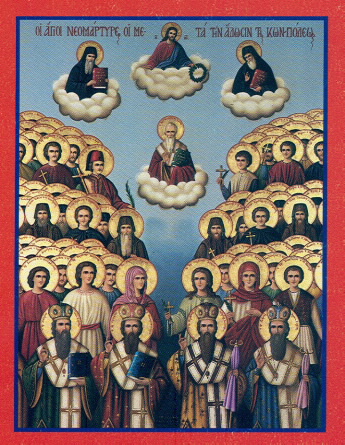
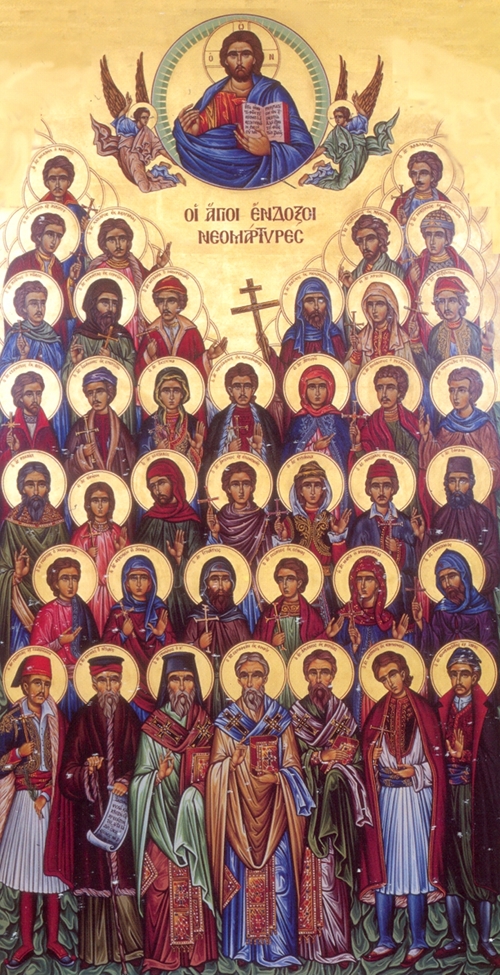
Synaxis of the Holy New Martyrs under the Turkish Yoke

Synaxis of the Holy New Martyrs under the Turkish Yoke - Commemorated on the Third Sunday after Pentecost (http://vatopaidi.files.wordpress.com/2010/06/neomartyres-ceb7-cebfcebccebfcebbcebfceb3ceb9ceb1-cf84cf89cebd-cebdceb5cebfcebcceb1cf81cf84cf85cf81cf89cebd-1.jpg)
  
St. Nikodemos of the Holy Mountain, the author of the New Martyrologion (the primary Greek anthology of the lives of Orthodox New Martyrs who suffered for Christ under the Turkish yoke), composed a service in praise of all Neomartyrs to be commemorated on the Third Sunday following Pentecost. The following are two quotes from a sermon of St. Nikodemos in praise of the Neomartyrs (Note: the following two quotes and the hymns below are all amateur translations):

“How can one not feel the need to thank God, seeing that under their heavy yoke and slavery were kept so many champions? To preserve the freedom and the people of our Christian faith, they refused riches, glory, pleasures and every bodily repose, and delivered themselves first of all to death. How is it not worthy to glorify God, seeing the fear of the coming judgment compel so many brave Martyrs? The desire for the good things of heaven to conquer them? The faith to strengthen their souls so greatly? Hope to captivate their minds? And the fire of divine love to be lit within their hearts so greatly? How did these blessed ones run towards martyrdom, as sheep to the slaughter? And how they counted their tortures as a phantasy, and their prisons as palaces, and their bonds as golden adornments, and their indignities as precious, their turmoils as rest, the flame of fire as dew and repose, swords as toys, and ultimately, the most difficult death through life eternal...”

"Some behold this and ask, for what reason was God pleased to bring about new Martyrs in these times? We note the following five things: A. that there be a renewal of the whole Orthodox faith. B. that those of other faiths be without defense on the Day of Judgment. C. that they might be the glory and the boast of the Church of the East, and the reproach and despised by the heterodox. D. that they might be an example of patience to all Orthodox Christians that are tyrannized under the heavy yoke of slavery. E. and finally, that they bravely compel through the martyrical work until death all Christians who at some point are called to martyrdom, especially those who had formerly denied the Orthodox faith."

These New Martyrs came from all walks of life, all ages, and all professions. Some were clergy and monastics, others were lay men and women. Some were faithful Christians, others had denied Christ but returned to Him, and still others had converted to Orthodoxy from islam and proceeded to suffer for Christ. Many of the most-beloved Orthodox Saints help comprise this glorious band of Neomartyrs (e.g. St. Kosmas Aitolos, Sts. Raphael, Nicholas and Irene, St. Ephraim of Nea Makri, St. George of Ioannina, St. Constantine of Hydra, St. Polydoros, St. Theodore the Byzantine, Sts. Euthemios, Akakios and Ignatios, St. Gregory V, Patriarch of Constantinople, St. Philothei of Athens, St. Seraphim Archbishop of Phanarion, St. Chryse the New of Meglin, St. Argyre, and many, many more).

For an excellent book of the lives of many Neomartyrs under the Turkish yoke, see: Witnesses for Christ by Vaporis.
  
May we all imitate their struggle till death for Christ, and may they intercede for us all!

   
Apolytikion in the Third Tone
The New Martyrs trampled upon the ancient error, and lifted up the faith of the Orthodox, and struggled valiantly. The faith of the lawless they despised, and they proclaimed Christ with boldness as perfect God. And they ever intercede unceasingly that great mercy be granted to us.

Kontakion in the First Tone
Rejoice mystically, O Church of Christ, seeing your sons, the Neomartyrs, surrounding your table and altar as olive trees, arrayed as newly-illumined stars, and to the Creator cry out: You are the strength of the Martyrs, O Christ.

Oikos
We ever, O bretheren, have need to remember and wonder at the inscrutable judgments of the providence of our man-loving God, Who even during the long period of tyrannical slavery of our people, worked a multitude of good things for our tyrannized souls. And especially, through this and from this, the glorious boasts, the friends of Christ, and the heavenly treasuries grew forth bearing fruit, Newly-revealed Martyrs. They are now worthy to be praised, for these who were brave in soul, and arrayed with the power of Christ as a breastplate, counted all things of life as refuse, and did not at all spare their flesh, and struggled bravely in the stadium, and were triumphant against the impiety of the Hagarenes, and proclaimed the faith of Christ with boldness, and because of this, suffered many forms of tortures bravely, and struggled until the end, and were granted the crown of martyrdom. To the Bestower-of-crowns let us cry out: You are the strength of the Martyrs, O Christ.

(amateur translation of the Greek service of the Synaxis of the Holy Neomartyrs (written by St. Nikodemos) available here: http://agioreitika.blogspot.com/2007/06/ako.html)
  
Through the prayers of our Holy Fathers, Lord Jesus Christ our God, have mercy on us and save us! Amen!

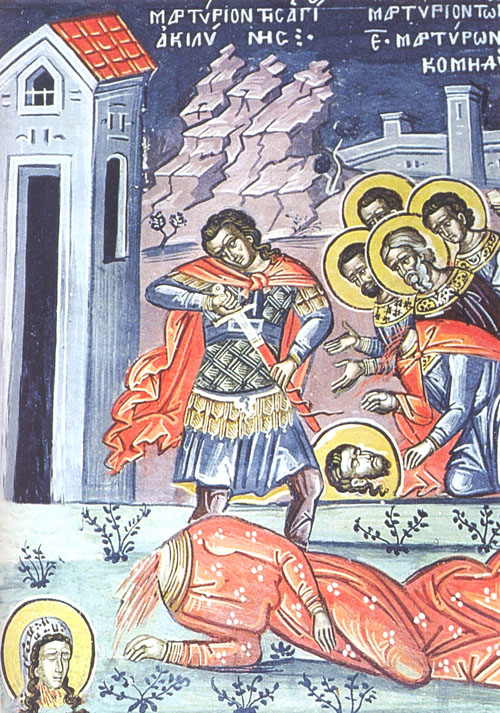
St. Akylina (Aquilina) the Virgin Martyr

St. Akylina (Aquilina) the Virgin Martyr of Byblos - Commemorated on June 13th (http://home.iprimus.com.au/xenos/akylina.html)
  
"Aquilina was born in the Palestinian town of Byblus of honorable Christian parents. At age seven, little Aquilina was already completely versed in the true Christian life and at age ten she was so filled with divine understanding and the grace of the Holy Spirit that she, with great power and zealousness, preached Christ to her female companions. When Diocletian's persecution began, someone accused Aquilina before Volusian, the imperial deputy, who was more like a beast than a man. At first, Volusian ordered that Aquilina be flogged and after that, a red hot rod be pierced through her ears and brain. Until the last moment, the virgin Aquilina freely and openly confessed Christ the Lord and when her brain and blood began to flow from her head, she fell as though dead. The deputy, thinking Aquilina was indeed dead, ordered her body to be carried outside the city and thrown upon a dung heap for the dogs to consume. But, an angel of God appeared to her at night and said to her: "Arise, and be whole!" And the virgin arose and was whole and for a long time she offered up praise of thanksgiving to God imploring Him not to deprive her to fulfill her martyr's mortification. A voice from heaven was heard: "Go, it will be to you as you pray" and Aquilina set out for the town. The gates of the town opened on their own accord before her and she entered like a spirit into the palace of the deputy and appeared before his bed. The deputy was seized with unspeakable fear, seeing the virgin alive whom he thought was dead. The following day, according to his command, the executioners led Aquilina out to behead her. Before her beheading, the virgin Aquilina prayed to God on her knees and gave up her soul. The executioner beheaded her lifeless head. Her relics gave healing to many of the sick. Aquilina was twelve years old when she suffered for the Lord: suffered and crowned with the martyr's wreath in the year 293 A.D."
(http://www.westsrbdio.org/prolog/prolog.htm)
  
  
Dismissal Hymn (Fourth Tone)
O Lord Jesus, to You Your lamb cries with a great voice, “O my Bridegroom, You I love; and seeking You, I now contest, and with Your baptism am crucified and buried. I suffer for Your sake, that I may reign with You; for Your sake I die, that I may live in You: accept me offered out of longing to You as a spotless sacrifice. Lord, save our souls through her intercessions, since You are great in mercy.

Kontakion (Third Tone)
With the sprinkling of your blood you were made pure, O fair virgin, and with crowns of martyrdom you are crowned, O Akylina; Christ your Bridegroom, Who gives life everlasting and for this reason has given you to those in afflictions, for the healing of their illness and their salvation when they in faith flee to you.
  
Through the prayers of our Holy Fathers, Lord Jesus Christ our God, have mercy on us and save us! Amen!

Wednesday, June 2, 2010

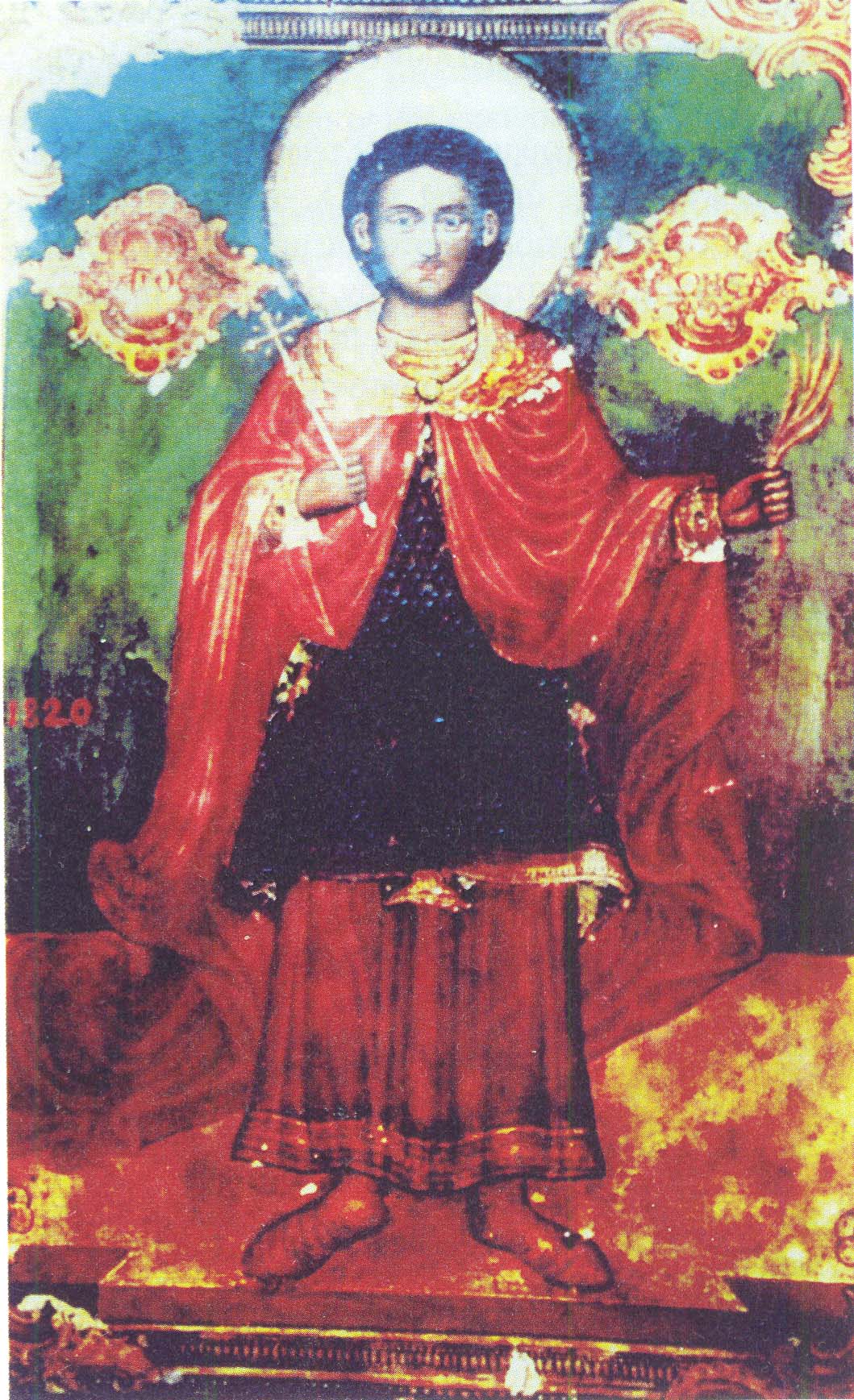
St. Constantine the New Martyr from the Hagarenes (+1819)

St. Constantine the New Martyr from the Hagarenes (+1819) - Commemorated on June 2nd (http://vatopaidi.files.wordpress.com/2010/06/agios-konstantinos-o-ex-agarinon.jpg)
  
The Holy Martyr Constantine was born upon the island of Mytilene into a [muslim] family. At the age of 15 he fell ill with smallpox, from which he completely lost his eyesight and awaited death. A certain Christian took him to church and washed him with holy water. They brought him out of the temple completely healthy.

His father died early. His mother married again, but his new father was bad and was a drunk. Because of this he moved to Smyrna with his three siblings. He would go continually to the Metropolis of Smyrna, where he heard and learned the Greek language and the Christian faith.

He decided to flee to the Holy Mountain, but no one accepted him. Then St. Gregory V, Patriarch of Constantinople (who was in exile on Athos), having tested him, baptized him as a Christian in Kavsokalyvia, with the name Konstantinos. In the Skete of the Precious Forerunner, he venerated the precious relics of the new martyrs and he was seized with the desire to imitate their deeds. Having passed time in fasting and prayer close to a spiritual father, he decided to go to Magnesia, to have his sister baptized as a Christian. After the advice of the Fathers, however, he sailed from the Holy Mountain and landed in Kydonies. There he was recognized by some Turk who led him to the Aga. He confessed Christ and then confessed his origin. He was imprisoned and terribly tortured. When they questioned him again, Konstantinos made the sign of the Cross before them, thus demonstrating his immovable faith. Then they again imprisoned him and tortured him in a terrible manner. But the leader, seeing that his efforts were in vain, sent him to Constantinople. There having suffered difficult tortures (which had begun on April 23rd), in the end he was hanged on June 2nd 1819.

(taken from: http://www.holytrinityorthodox.com/calendar/los/June/02-06.htm, with additional information from: http://vatopaidi.wordpress.com/2010/06/02/%ce%bf-%ce%ac%ce%b3%ce%b9%ce%bf%cf%82-%ce%ba%cf%89%ce%bd%cf%83%cf%84%ce%b1%ce%bd%cf%84%ce%af%ce%bd%ce%bf%cf%82-%ce%bf-%ce%b5%ce%be-%ce%b1%ce%b3%ce%b1%cf%81%ce%b7%ce%bd%cf%8e%ce%bd-1819-2/ and http://www.immyt.net/saints/martyrs8.htm)
  
For another life of the Saint, see: http://www.trueorthodoxy.info/los_stconstantine_former_muslim.shtml.
  
St. Constantine the New Martyr from the Hagarenes (http://www.immyt.net/saints/martyrs8.htm)
  
ΜΗΝ ΙΟΥΝΙΟΣ ΤΗ Β΄ (2α) ΤΟΥ ΜΗΝΟΣ ΙΟΥΝΙΟΥ
Μνήμη τοῦ Νεομάρτυρος Ἁγίου Κωνσταντίνου Ὑψηλομετώπου τοῦ ἐξ Ἀγαρηνῶν.
Ἀπολυτίκιον. Ἦχος γ’. Θείας πίστεως.
Πᾶσαν ηὔφρανας, πιστῶν χορείαν, καί κατήσχυνας, τούς Ἄγαρ γόνους, ἀνακηρύξας λαμπρῶς τήν εὐσέβειαν, καί ὑπομείνας ἀνύποιστα βάσανα, ὦ Κωνσταντῖνε Μαρτύρων ἀγλάϊσμα. Ὡς οὖν ἔτυχες, οὗπερ ἐπόθεις ἀοίδιμε, μνημόνευε ἡμῶν τῶν εὐφημούντων Σε.

Ἔτερον. Ἦχος δ΄. Ταχύ προκατάλαβε.
Φωσφόρος ἀνέτειλε, τῆ Ἐκκλησία Χριστοῦ, ἡ μνήμη τῶν ἄθλων σου, φωτός πληροῦσα αὐτήν, Μαρτύρων ἐκσφράγισμα, ἔνδοξε Κωνσταντῖνε, λύουσα τήν ἀπάτην, γόνων τῶν ἐκ τῆς Ἄγαρ, λάμπουσα δέ πλουσίως, τάς ψυχάς τῶν ἐν πίστει, τήν μνήμην σου τελούντων ἀειμακάριστε.
  
Apolytikion of St. Constantine the New Martyr of the Hagarenes in the Third Tone (amateur translation)
You gladdened the whole choir of the faithful, and despised the root of Hagar, and radiantly proclaimed piety, and suffered unspeakable tortures, O Constantine, the pride of Martyrs. Having been granted what you desired, O ever-memorable one, remember those who honor You.

Additional Apolytikion in the Fourth Tone (amateur translation)The memory of your struggles has has dawned on the Church of Christ as a bright light, and filled it with light, O seal of Martyrs, glorious Constantine, for being delivered from error, of the root of Hagar, you shone richly on the souls of those who in faith, celebrate your memory, O ever-blessed one.

Through the prayers of our Holy Fathers, Lord Jesus Christ our God, have mercy on us and save us! Amen!