Saturday, February 11, 2012
St. Cassiane the Hymnographer, the Righteous
St. Cassiane the Hymnographer, the Righteous - Commemorated September 7 (https://blogger.googleusercontent.com/img/b/R29vZ2xl/AVvXsEhstyisbNIfVIWf0B2rDA9J0A2_gdB4EuH-ZWJVN-JFwG7jRPlXeBL7K0oq_6gR8jVq-w7dXeWwkgmrG3WnDNy8Hyi9LFSw82fD0XAwA7gEnfOGHJ-2krwFFMNhgMcRXqMhJggvAVb-vMp1/s1600/IMG_4375.JPG)
The Iconoclast controversy, which vexed the Church for over a hundred years, coincided with one of the most productive periods in church hymnography. Among those who made significant contributions in this field, the names of St. Andrew of Crete (+740), Saint John Damascene (+754), and Saint Theodore the Studite (+826) are well known. Less familiar are the women hymnographers of this period-the nuns Thecla, Cassiane and Theodosia-who demonstrated considerable talent in this same field. Of these, Cassiane won lasting distinction as the only woman whose works have entered into the liturgical tradition of the Church.
Cassiane was born in Constantinople some time before 805. Her father's aristocratic status gave Cassiane the privilege of a good education. She was tutored in both secular and sacred studies, and showed such exceptional aptitude for learning as to draw the attention of the great abbot of the Studion Monastery, Saint Theodore. He remarked likewise on her pious character, and indeed, from an early age she desired to become a nun. She was at the same time a spirited young woman of strong convictions and did not hesitate to express her opinions.
Cassiane was also gifted with physical beauty. When the heir-apparent, Theophilus, was in search of a bride, he narrowed the choice to six lovely maidens. Cassiane was one of them. When they gathered for the final decision to be made, Theophilus, who had heard of Cassiane's intelligence, approached her with the statement, "From woman came corruption" (referring to the fall of Eve), to which the quick-witted Cassiane responded, respectfully but surely, "But also from woman sprang forth what is superior" (i.e., God's incarnation from the Holy Virgin). Unnerved, Theophilus passed over Cassiane and offered the golden apple, the sign of his choice, to the more demure, and silent, Theodora.
It would have been a difficult match. Theophilus was an iconoclast and harshly enforced the imperial edict-renewed after the death of Empress Irene -forbidding the veneration of sacred images. Theodora, an iconodule, did not approve of her husband's policy, but she concealed her veneration of icons and kept quiet. Cassiane, by contrast, openly professed herself in favor of the holy icons. She not only spoke her mind, but she acted on her convictions, visiting iconodule monks in prison and sending them gifts. For her defiance of the imperial edict, she suffered persecution and was beaten with a lash.
Far from being disappointed at Theophilos' rejection, Cassiane was now free to unite herself to the bridegroom of her own choosing-the King of kings, Jesus Christ. She was tonsured a nun about the year 820, and founded a convent on one of Constantinople's seven hills, where she led "an ascetic and philosophical life" pleasing to God. An energetic abbess, she not only regulated the life of the convent, but she also found time to pursue her scholarly literary interests. She combined the talents of poet, theologian and musician, writing hymns and composing musical settings for them. Originally sung by her nuns, many of her compositions proved to have enduring value; twenty-three of her works were later incorporated into the liturgical books of the Church.
One of Cassiane's most brilliant creations is her hymn, sung in the Matins service for Holy Wednesday, on the subject of the sinning woman. Based on the story from St. Luke's Gospel (7:36-50), this hymn blends dramatic and narrative elements to create a masterpiece of hymnography which manages, in a few short lines, to present the essential Christian drama of sin and salvation.
The most familiar of Cassiane's works are undoubtedly the irmoi in the Matins canon for Holy Saturday, which is repeated at the Midnight Office for Holy Pascha: "Weep not for me, O Mother, beholding in the tomb the Son Whom thou hast conceived without seed in thy womb, for I shall arise..." With these stanzas, Cassiane achieves a taut sense of anticipation, providing a marvelous momentum into the climatic celebration of Our Lord's Resurrection.
Cassiane had a forceful personality: "I hate the fool who acts the philosopher," she wrote. "I hate silence when it is time to speak." And this, combined with her many talents and keen intellect makes her an appealing model for today's woman. But it is the fact that she lived only for God, to the end of her life, that made her a saint.
"One of Cassiane’s biographer’s comments, “She lived only for God, to the end of her life.” Thus, after
dedicating her life to Christ and the Church, and adorned with the diadem of virginity and the crowns of a confessor, an ascetic, and a hymnographer, our holy mother Cassiane reposed in the Lord."
St. Cassiane the Righteous Hymnographer (http://vatopaidi.files.wordpress.com/2011/09/menu-ag-kassiani-2010.jpg?w=780)
Apolytikion in the Plagal of the Fourth Tone
That which was created in the image of God was preserved in you, O Mother; for taking up the cross you followed after Christ. By your deeds you have taught us to reject the flesh for it passes away, but to care for the soul as a thing immortal. Therefore, O venerable Cassiane, your soul rejoices with the angel
Through the prayers of our Holy Fathers, Lord Jesus Christ our God, have mercy on us and save us! Amen!
Thursday, February 9, 2012
Selected hymns to St. Charalampos the Hieromartyr
St. Charalampos the Hieromartyr of Magnesia - Commemorated February 10 (http://iconsv.ru/index.php?option=com_joomgallery&func=watermark&catid=372&id=1356&Itemid=3)
Selected hymns to St. Charalampos the Hieromartyr
Apolytikion in the Fourth Tone
A pillar unshakable are you in Christʹs holy Church, * and, as your own name denotes, an ever radiant lamp, * all‐blessed Haralambos, * shining throughout the whole world * by your feats as a martyr, * driving away the darkness of the worship of idols. * With confidence, therefore, pray to Christ, * entreating Him to save our souls.
Idiomelon from the Orthros in the Plagal of the Second Tone
Come, you fans of the Martyrs, let us honor the God‐crowned phalanx led by the radiant Martyr, that select and holy company of Hieromartyr Haralambos, which was eagerly sacrificed for Christ. Let us spiritually observe his all‐sacred memory, and call out to him: ʺFree your people, who correctly believe in God; free us from the threat of plague, and deliver us from every adversity.ʺ
Kontakion in the Fourth Tone
Since the holy Church of Christ is in possession of your highly honored skull as priceless treasure, she is glad, O Hieromartyr Haralambos. Therefore she praises the Maker of all with joy.
Oikos
Let us come together and extol Haralambos, the all‐glorious great Martyr, the steadfast warrior and soldier of Christ. He contended splendidly for Christ and the truth. He openly preached the Orthodox faith, and put an end to the error of idolatry. He rebuked the most unlawful king, and with joy and exultation he was beheaded. Therefore he received the crown from the right hand of the Most High, and he became a fellow citizen of the Angels. This is why the Orthodox Church venerates his all‐honored skull, and crowns it with praises. By it she is freed from many hardships and diseases, and she praises the Maker of all with joy.
St. Charalampos the Hieromartyr (http://ia700502.us.archive.org/13/items/Icoane/0210SfMcHaralambie04.jpg)
Synaxarion
On the tenth of this month (February) we commemorate the holy Hieromartyr Haralampus of Magnesia.
Verses
You were made worthy, O Charalampos, through swords,
Of the radiance and joy of the Martyrs.
On the tenth, Charalampos was cut by the throat.
Prosomoia of the Praises in the First Tone
Come all you children of Greece now, * and you who love the Saints, * let us give rightful honor * to the skull of the Martyr * Haralambos, saluting it with a kiss; * for he preached in the stadium * that Christ is God and Creator, and he rebuked * the deception of the impious.
Thrice‐blessed Saint, you are numbered * with the celestial hosts, * and as you stand in honor * near the Trinity, Father, * you pray for us who honor your precious skull * with devout faith and reverence. * O Hieromartyr Haralambos, we entreat * that you keep us safe from any harm.
In all of Greece has the festive * and bright memorial * of holy Hieromartyr Saint Haralambos risen * most glorious and splendid; for she is blest * to possess his most honored skull, * which had proclaimed Christ the Savior, both God and man. * Hence she celebrates it festively.
Doxastikon of the Praises in the Plagal of the First Tone
Your precious skull, O divine Saint, is like an alabaster box that is full and pouring out cures, like very costly fragrant oil. It wondrously perfumes the faithful, and it delivers from every evil those who approach it with faith. It exterminates foul‐smelling delusion, diseases of every kind, and the pandemic plague, and it grants good health to all, as well as peace and great mercy.
Through the prayers of our Holy Fathers, Lord Jesus Christ our God, have mercy on us and save us! Amen!
All Saints of Eurytania, Greece
I thought to continue a series of posts, each highlighting a region of the world and its local Saints. As is clear, the light of Christ has reached the farthest reaches of the earth, and thus, there is not one area which has not produced, as fruit of the Holy Spirit, Orthodox Saints. The following is regarding a region in central Greece called Eurytani. Also note, if you are have a preference for information about Saints from a region of your interest, please post to let me know, and I will do what I can to provide what info I can gather online. May Christ have mercy on us all and save us, through the prayers of our Holy Fathers!
The feast of the Saints of Eurytania was instituted with the permission of the Holy Synod of the Church of Greece in 1971, and is celebrated the last Sunday of August each year.
The Saints include:
(http://www.saint.gr/4098/saint.aspx)
See the following link for the website of a church of All Saints of Eurytania, with more information about each of the Saints: http://www.evrytanesagioi.gr/index.htm.
The feast of the Saints of Eurytania was instituted with the permission of the Holy Synod of the Church of Greece in 1971, and is celebrated the last Sunday of August each year.
The Saints include:
- St. Andrew the Hermit and Wonderworker - May 15
- St. Michael Mavroudes - Thursday of Bright Week
- St. Damian the Monk - February 14
- St. Seraphim the New Hieromartyr - December 4
- St. Nicholas the Grocer, the New Martyr from Karpenesi - September 23
- St. Cyprian the New Righteous Martyr - July 5
- St. Romanos the New Righteous Martyr - January 5 / February 16
- St. Akakios the New of Kavsokalyvia - April 4 / Sunday of the Myrrhbearers
- St. Gerasimos the New of Karpenesi - July 3
- St. Eugenios Aitolos - August 5
- St. Kosmas Aitolos - August 24
- St. John the New Martyr of the Hagarenes - September 23
(http://www.saint.gr/4098/saint.aspx)
See the following link for the website of a church of All Saints of Eurytania, with more information about each of the Saints: http://www.evrytanesagioi.gr/index.htm.
Through the prayers of our Holy Fathers, Lord Jesus Christ our God, have mercy on us and save us! Amen!
Labels:
Greece,
Regional Saints,
St. Akakios of Kavsokalyvia
St. Nikephoros the Martyr of Antioch
St. Nikephoros the Martyr of Antioch - Commemorated February 9 (http://pravicon.com/images/sv/s1531/s1531001.jpg)
This Martyr, who was from Antioch in Syria, contested during the reign of Gallienus, about the year 260. Through the working of the evil one, his friendship with a certain Christian priest named Sapricius was turned to bitter hatred. Nicephoros, repenting of his enmity, tried both through intermediaries and in person to be reconciled with Sapricius, but to no avail. Later, when the persecution broke out under Valerian and Gallienus, Sapricius was seized as a Christian. When Saint Nicephoros learned that Sapricius had been arrested by the pagans and was enduring torments for Christ, he sent intermediaries to Sapricius, begging his forgiveness; but Sapricius would not forgive him. Later, as Sapricius was being taken to beheading, Nicephoros, hoping that Sapricius, at his end, in such a holy hour, would at last forgive him, met him on the way, fell before him, and fervently asked his forgiveness; but Sapricius forgave him not. Wherefore, though Sapricius had passed through many sufferings, and the crown of martyrdom was now awaiting him, because he disdained the chief commandments of love and forgiveness, the grace of God, which had been strengthening him in his torments, departed from him, and he told his executioners he would sacrifice. Nicephoros immediately confessed Christ before them, and being himself beheaded, took the crown that Sapricius had cast away.
(http://www.goarch.org/chapel/saints_view?contentid=422&type=saints&date=2/9/2012&D=TH)
St. Nikephoros the Martyr (right) with an unknown martyr (http://pravicon.com/images/sv/s1531/s1531003.jpg)
Apolytikion in the Fourth Tone
Thy Martyr, O Lord, in his courageous contest for Thee received the prize of the crowns of incorruption and life from Thee, our immortal God. For since he possessed Thy strength, he cast down the tyrants and wholly destroyed the demons' strengthless presumption. O Christ God, by his prayers, save our souls, since Thou art merciful.
Kontakion in the Third Tone
Bound fast with chains of love, thou didst mightily sunder the wickedness of hatred with manifest courage, and hence, O Nicephoros, when the sword had cut off thy head, thou wast shown to be a godly Martyr of Jesus, our Incarnate Saviour; pray Him for us who honor thy glorious memory.
Additional Apolytikion in the Fourth Tone (amateur translations below)
Being illumined with the love of the Creator, you truly fulfilled the law of grace, and thus you were spiritually reborn. Therefore, having loved your neighbor as yourself, you struggled, O Nikephoros, and deposed the enemy; keep us in harmony.
Megalynarion
Full of love towards God, O blessed one, you loved your neighbor as yourself. Therefore you also struggled, and deposed the worker of hate, O Nikephoros, taking refuge in Christ.
Through the prayers of our Holy Fathers, Lord Jesus Christ our God, have mercy on us and save us! Amen!
All Saints of Lesvos (Mytilene), Greece
I thought to begin a series of posts, each highlighting a region of the world and its local Saints. As is clear, the light of Christ has reached the farthest reaches of the earth, and thus, there is not one area which has not produced, as fruit of the Holy Spirit, Orthodox Saints. Lesvos is apparently one of the largest islands of Greece, and I happened to come across much information online about the numerous Saints that have shone from it. Also note, if you are have a preference for information about Saints from a region of your interest, please post to let me know, and I will do what I can to provide what info I can gather online. May Christ have mercy on us all and save us, through the prayers of our Holy Fathers!
All Saints of Lesvos (Mytilene), Greece (amateur translation)
See the following links for hymns for the individual feasts mentioned above (http://stratisandriotis.blogspot.com/2009/05/blog-post_5072.html) and for the full service (in Greek) to All Saints of Lesvos (http://analogion.com/forum/showthread.php?t=13974).
All Saints of Lesvos (Mytilene), Greece (amateur translation)
The holy island of Lesvos, besides giving rise to men of the spirit, of the arts and of the sciences, through the blessing of God has revealed at least 40 Saints, who adorn and make radiant the Orthodox calendar of our Church. Some of them were from Lesvos, who lived godly lives and fell asleep in the Lord or were martyred on the island. Others were from other places, but came to Lesvos, where they were martyred, and hallowed the ground through their martyrical blood.
Every year, the memory of All Saints of Lesvos is celebrated the Sunday after the Sunday of All Saints with all radiance and devotion, and is proceeded by a series of festal events, in which the pious people of Lesvos and many visitors to the island, take part.
Older Saints of Lesvos (20)
- The Five Women Martyrs (+4th century) – April 5
- St. Alexander Archbishop of Methymna (+5th century) – November 30
- St. Andrew of Crete, the Author of the Great Canon (+740) – July 4
- St. David the Confessor (+795) – February 1
- St. George of Mytilene, the Worker of Signs (+821) – April 7
- St. Symeon the New Stylite of Lesvos (+844) – September 1 / February 1
- St. George of Mytilene, the Confessor (+846) – February 1 / May 16
- The Righteous Agathon of Ephesus (+9th century) – August 23 (with the finding of the wonderworking icon of the Theotokos of Agiassou)
- St. Theoktiste of Methymna (+9th century) – November 9
- St. Thomais of Lesvos (+10th century) – January 3
- St. Theophanes Sigrianes (+1000)
- St. Gregory Bishop of Assos (+1130) – July 10 / Sunday after November 10 (the uncovering of his relics)
- St. Olympia the Nun (+1235) – May 11
- St. Euphrosyne the Nun (+1235) – May 11
- St. Ignatios Bishop of Methymna (+1566) – October 14
New Martyrs of Lesvos (20)
- St. Raphael the Hieromartyr of Thermi, the Newly-revealed (+1463) – April 9 / Tuesday of Bright Week / July 3 (uncovering of his relics)
- St. Nicholas the Righteous martyr of Thermi, the Newly-revealed (+1463) – April 9 / Tuesday of Bright Week / June 13 (uncovering of his relics)
- St. Irene the Virgin Martyr of Thermi, the Newly-revealed (+1463) – April 9 / Tuesday of Bright Week / May 12 (uncovering of her relics)
- The Righteous Basileios, the Mayor of Thermi and Father of St. Irene (+1463) – April 9 / Tuesday of Bright Week
- The Righteous Maria, the Mother of St. Irene (+1463) – April 9 / Tuesday of Bright Week
- The Righteous Theodore, the teacher of Thermi, martyred after St. Raphael (+1463) – April 9 / Tuesday of Bright Week
- St. Doukas the Tailor (+1564)
- St. Parthenios Patriarch of Constantinople (+1657)
- St. George Pasgianos (+1693) – February 14
- St. George (Tzortzes) the Iberian (+1770) – January 2
- St. Nicholas of Mytilene (+1771) – January 16
- St. Theodore (Hatzi) of Mytilene (+1784) – January 30 (his martyrdom) / September 4 (uncovering of his relics)
- St. Theodore the Byzantine (+1795) – February 17 (his martyrdom) / The 4th Sunday of Pascha (Sunday of the Paralytic) (the uncovering of his relics and his miraculous deliverance of the island from the plague in 1823)
- St. Luke of Adrianoupolis (+1802) – March 23
- St. George of Chios (+1807) – November 26
- St. Demetrios from Larissa (+1809)
- St. Anastasios Paneras (+1806) – August 10
- St. Demetrios Mpegiazes (+1816) – August 10
- St. Constantine from the Hagarenes (+1819) – June 2
- St. Euthymios Bishop of Zelon (+1921) – May 29
(A total of 40 Saints)
(taken from: http://leimwnas.blogspot.com/2011/06/26-2011.html and http://www.immyt.net/saints/default.htm)
All Saints of the Island of Lesvos (https://blogger.googleusercontent.com/img/b/R29vZ2xl/AVvXsEjGNSm6mqrjeC8UFJRBDVZXDg2dCvPoBpdstTbrKFy5rSmzaYCgsQ6gLPWPX2lMYhMh3H4HvaGU_JMNRuh-QO7_sN59z7NdHCFXV-6RiHZCkmqKrzY6Pdm6_qP9E9GIKYAX_GVkrlYOW7k/s1600/258923_1919985997821_1187168542_31809743_7670300_o.jpg)
Apolytikion of All Saints of Lesvos in the Third Tone (amateur translation)
A divine assembly of noble righteous ones, and band of archpriests, and unassailable rank of martyrs, the island of Lesvos praises as it dances, for they magnified Christ in her, and they intercede that true peace and great mercy may be granted to our souls.
(http://leimwnas.blogspot.com/2011/06/26-2011.html)
See the following links for hymns for the individual feasts mentioned above (http://stratisandriotis.blogspot.com/2009/05/blog-post_5072.html) and for the full service (in Greek) to All Saints of Lesvos (http://analogion.com/forum/showthread.php?t=13974).
Through the prayers of our Holy Fathers, Lord Jesus Christ our God, have mercy on us and save us! Amen!
Wednesday, February 8, 2012
Selected hymns to St. Theodore the Great Martyr, Stratelates
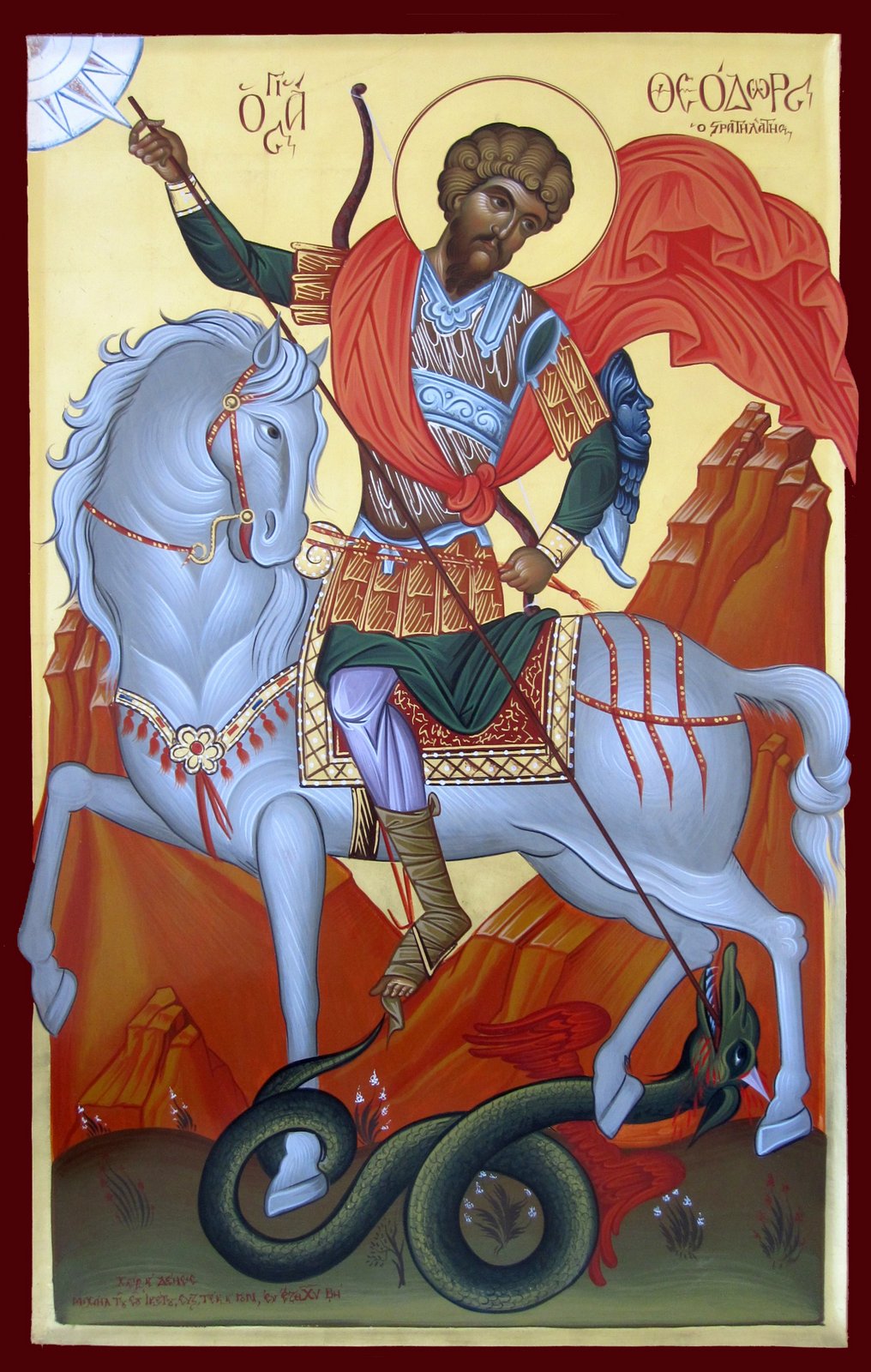
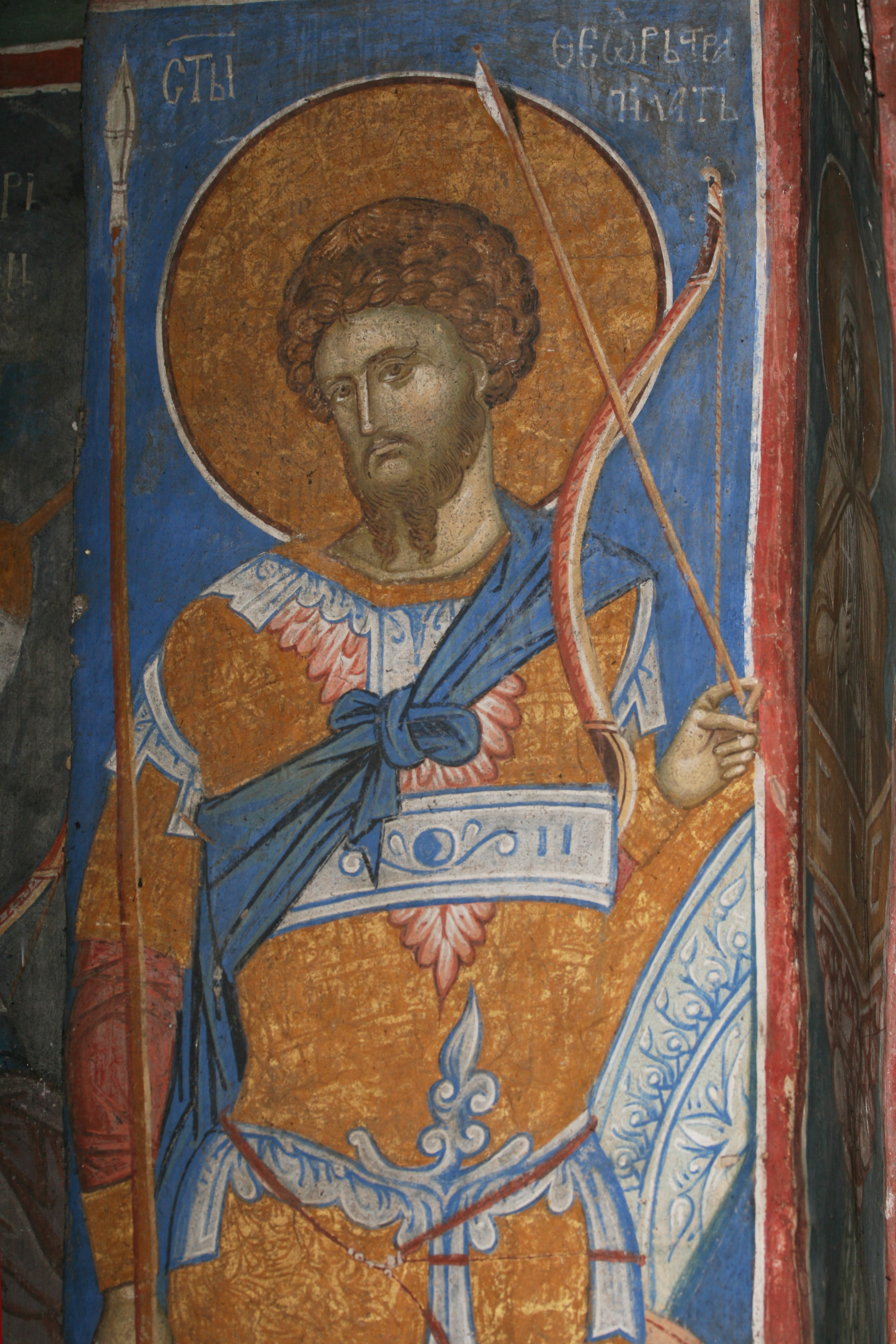
St. Theodore the Great Martyr, Stratelates ("The Commander") - Commemorated February 8 and June 8 (https://blogger.googleusercontent.com/img/b/R29vZ2xl/AVvXsEjCa_IPB79JXWs1dKt85Lrt4IL0bfiw2A9EgCnE4n6TIlNFXMm4rs5Td-2UgZMy9gm5Qfuox29BAvtJv5sMF2UdNiLfpoEVsBfbgNqF9hjoHXUzifk4XIOzrzdfMcmGBxBsEBW8MW8nHvIN/s1600/ag-Theodoros-Strat-CMYK-nef.png)
Selected hymns to St. Theodore the Great Martyr, Stratelates (amateur translations below, except where specified)
Doxastikon of the Stichera in the Plagal of the First Tone
Today the honored memory of the champion of Christ has dawned as the Morning Star, utterly enlightening the hearts of the faithful, and driving away the clouds from the soul through the power and grace of the Spirit. Let those who love the martyrs cry out to him: hail, you who were revealed a God-given grace for the faithful, being arrayed with a multitude of wonders, for those who flee to you, O blessed Theodore. Do not cease to intercede to Christ, that we be granted the eternal good things, for those who celebrate your all-sacred memory in faith.
Doxastikon of the Aposticha in the Plagal of the Fourth Tone
Bearing the name of gifts from God, and the blessedness of His inheritance, let all of us the faithful praise him, and bless as is right, Theodore, the brave great martyr, the champion of the world. Intercede therefore to Christ God for our souls.
St. Theodore Stratelates, the Great Martyr (https://vatopaidi.files.wordpress.com/2012/04/agios2btheodoros2bhorse2bwhite.jpg)
Apolytikion in the Fourth Tone
In truth enlisted with the King of the Heavens, thou didst become for Him a noble commander, O trophy-bearer and Great Martyr Theodore. With the weaponry of faith didst thou arm thyself wisely and didst utterly destroy all the hordes of the demons, as a triumphant athlete of the Lord; wherefore we ever do faithfully call thee blest.
Kontakion in the Second Tone
In courage of soul, and furnished with the arms of faith, thou tookest in hand the word of God as though a spear and didst put thy foe to flight, thou great boast of martyrs, O Theodore; now together with them, O Saint, cease not to entreat Christ our God for all of us.
Oikos
Come let all the faithful place the crowns of our hymns upon the head of Theodore, the radiant beauty of the champions. For he was shone to be a great gift from God to the world, shining with wonders. He conquered Belial the enemy through his sacred struggles, sprinkling, instead of blood, the streams of healings. In all of these Christ rejoices, and grants endless peace. Therefore we cry to him: cease not to entreat Christ our God for all of us.
Synaxarion
On the eighth of this month, the Memory of the Holy glorious Great Martyr Theodore Stratelates ("The Commander")
Verses
Being, O Theodore, a worthy Commander,
Having been cut, you became a Commander of God.
On the eighth, the mighty Theodore's neck is cut.
Doxastikon of the Praises in the Plagal of the Fourth Tone
You were piously arrayed with the manliness of champions and rational worship, O champion of Christ. And steadfastly serving in His power, you drove away the sick impiety of the idols and the terrors of the Tyrants, without being dismayed by tortures and this temporary fire. But you who are a divine gift in reality and according to your name, through your intercessions, save those who celebrate your memory from every trial.
Through the prayers of our Holy Fathers, Lord Jesus Christ our God, have mercy on us and save us! Amen!
Friday, February 3, 2012
Excerpt from the homily on Meeting of Christ in the Temple, by St. Amphilochius of Iconium
Excerpt from the homily on Meeting of Christ in the Temple, by St. Amphilochius of Iconium (amateur translation)
Wondrous therefore is virginity, true virginity, because there are differences within virginity; while some sleep and some are vigilant. Wondrous also is marriage, true and precious marriage. Many have kept it and many have violated it. Wondrous also is widowhood. Therefore, all three ranks should be commended. And, as we said, wondrous is also is widowhood, true widowhood, “winning the reward of undefiled conflicts” (Wisdom of Solomon 4:2). I see this richly demonstrated in Anna the prophetess, who aged well and was renewed like the eagle (Psalm 103:5). Do you hear the evangelist Luke richly say: “And Anna was a prophetess, a daughter of Phanuel, from the tribe of Asher, advanced in years, having lived after her husband seven years from her virginity, and as a widow till she was eighty-four, and worshpped in the temple in fasting and prayers night and day.” (Luke 2). Do you see how the widow Anna is adorned in the divine Gospels? Truly higher is Anna, having gathered through her glorious ways, the meaning of her name. Let women hear and be jealous of the glorious Anna. She ran the same race, that she might inherit the same crowns...The crown of widows is Anna; she bears the form of a woman, but the rank of a prophet. She lived in widowhood, being supported in the kingdom. She was withered in body, but was strengthened in soul. She was fearsome in appearance, but immense in spirit. She was hunched-over in age, but stood straight in knowledge. She was many-years old, with the seal of knowledge of God. She fasted, and did not consume others. She was in need, but did not wander about. She was concerned with the temple, and did not hasten to other houses. She chanted, but did not wail. She prophesied, not spinning myths. She studied the divine, and did not gather with the impure. Anna surpassed the widow that was that was blessed by the apostle. Which? Hear Paul who says: “A widow is to be put on the list only if she is not less than sixty years old...is well known for her good deeds, such as bringing up children, showing hospitality, washing the feet of the Lord’s people” (1 Timothy 5). She surpassed that which was praised by the apostle in her years and way of life, for she was made worthy of prophecy, and was a dwelling-place of the Holy Spirit, and to all those who approached her, she told of the symbols of Christ's bodily presence. And did she not surpass all that the evangelist said of her, and that you have heard at length? And it was this Anna, who was standing and speaking anthems to the Lord and speaking to all those who came to her of the deliverance of Jerusalem. Do you see the greatness of Anna? On behalf of the Lord, she defends Him to those who were against Him. O the strangeness of things! …
Anna beholds the Lord as an infant, with gifts and purification on behalf of Him and with Him offered, and she did not disdain His young age, but Anna confessed the infant as God, Physician, Deliverer, Mighty One, Remover of sin. Anna did not simply hold to these words, but she offered to all with energy regarding the Lord, and said to those who had gathered: "Do you see this child clinging to the breast, holding to the woman, resting in the arms of His mother, while her betrothed sits alone, He Who was circumcised on the eighth day? Don't you see this child? He founded the ages, He stretched out the heavens, He widened the earth, He traced the sea with sand. This Child calls forth clouds from His treasury. This Child, at the time of Noah, opened the doors of heaven for the flood...This Child works fearsome thunder. This Child spins the snow like wool. This Child freed our forefathers from Egypt through the rod of Moses. This Child divided the Red Sea, and through His strength brought them out, and rained down manna in the desert, and gave as inheritance milk and honey. This Child, through this temple and the fathers, prepared to raise us to the heights. This Child promised to Abraham: 'I will greatly multiply your seed as the stars of heaven, as the sand by the sea.' Regarding this Child, the prophetic supplication offered: 'Lord, stir up Your power, and come to save us' (Psalms 80:2). Do not disdain the Child, that He is a child. This very Child is beginningless with the Father, He shares His years, He is also beyond the ages, and this Child with a lisp, is He Who grants a mouth and wisdom. His birth was from a virgin, and thus His existence is astonishing. Because of thus, Isaiah spoke of You: 'A Child is born to us, a son is given to us.' To one He was born, to the other He is given. To one He is seen, to the other He is perceived." These are the prophecies of Anna...
Through the prayers of our Holy Fathers, Lord Jesus Christ our God, have mercy on us and save us! Amen!
Subscribe to:
Posts (Atom)