Thursday, May 2, 2013

Discourse On the Passion of the Saviour, by St. Ephraim the Syrian

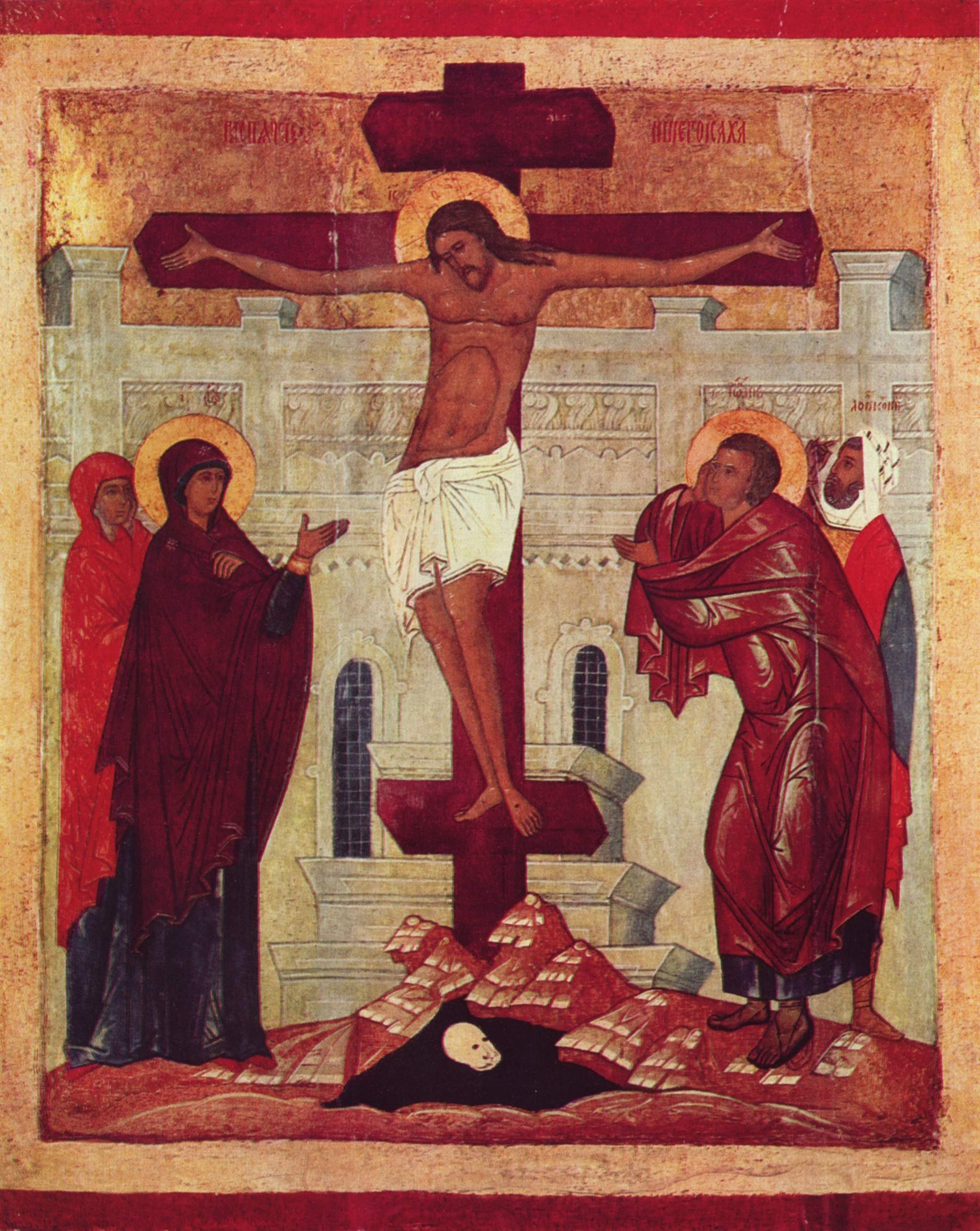
The Crucifixion of Christ (source)
  
Discourse On the Passion of the Saviour, by Our Venerable Father Ephrem the Syrian
Text copyright to Archimandrite Ephrem © (source)

  
I am afraid to speak
and touch with my tongue
this fearful narrative
concerning the Saviour.
For truly it is fearful
to narrate all this.

Our Lord
was given up today
into the hands of sinners!

For what reason then
was one who is holy
and without sin given up?

For having done no sin
he was given up today.

Come, let us examine closely
why Christ our Saviour
was given up.

For us, the ungodly,
the Master was given up.

Who would not marvel?
Who would not give glory?

When the slaves had sinned
the Master was given up.

The sons of perdition
and the children of darkness
went out in the darkness
to arrest the sun
who had the power
to consume them in an instant.

But the Master, knowing
their effrontery
and the force of their anger,
with gentleness,
by his own authority,
gave himself up
into the hands of the ungodly.

And lawless men, having bound
the most pure Master,
mocked the one
who had bound the strong one
with unbreakable bonds,
and set us free
from the bonds of sins.

They plaited a crown
of their own thorns,
the fruit borne
by the vine of the Jews.

In mockery
they called him ‘King’.
The lawless spat
in the face of the most pure,
at whose glance
all the Powers of heaven
and the ranks of Angels
quake with fear.

See, once again grief and tears
grip hold of my heart,
as I contemplate the Master
enduring outrage and insults,
scourgings, spitting
from slaves, and blows.

Come, observe well
the abundance of compassion,
the forbearance and mercy
of our sweet Master.

He had a useful slave
in the Paradise of delight,
and when he sinned
he was given to the torturers.

But when the Good One
saw his weakness of soul
he took compassion on the slave
and had mercy on him
and presented himself
to be scourged by him.

I wished to remain silent
because my mind
was utterly amazed;
but then again I was afraid
lest I reject
by my silence
my Saviour’s grace.
For my bones tremble
when I think of it.

The fashioner of all things,
our Lord himself,
was today arraigned
before Caiaphas,
like one of the condemned;
and one of the servants
struck him a blow.

My heart trembles
as I think on these things:
the slave is seated,
the Master stands,
and one full of iniquities
passes sentence
on the one who is sinless.

The heavens trembled,
earth’s foundations shuddered;
Angels and Archangels
all quailed with terror.
Gabriel and Michael
covered their faces
with their wings.

The Cherubim at the throne
were hidden beneath the wheels;
The Seraphim struck their wings
one with the other
at that moment,
when a servant gave
a blow to the Master.

How did earth’s foundations
endure the earthquake
and the tremor
at that moment,
when the Master was outraged?

I observe and I tremble
and again I am stunned,
when I see the long-suffering
of the loving Master.

For see my inward parts
tremble as I speak,
because the Creator,
who by grace fashioned
humanity from dust,
he the Fashioner is struck.

Let us fear, my brethren
and not simply listen.
The Saviour endured
all these things for us.

Wretched servant,
tell us why
you struck the Master?

All servants,
when they are set free,
receive a blow,
that they may obtain
freedom that perishes;
but you, miserable wretch,
unjustly gave a blow
to the liberator of all.

Did you perhaps expect
to receive from Caiaphas
a reward for your blow?

Had you perhaps not heard,
had you perhaps not learned
that Jesus is
the heavenly Master?

You gave a blow
to the Master of all things,
but became slave of slaves
to age on age,
a disgrace and abomination,
and condemned for ever
in unquenchable fire.

A great marvel, brethren,
it is to see the gentleness
of Christ the King!
Struck by a slave
he answered patiently,
with gentleness
and all reverence.

A servant is indignant,
the Master endures;
a servant is enraged,
the Master is kind.

At a time of anger,
who could endure
rage and disturbance?
But our Lord
submitted to all this
by his goodness.

Who can express
your long-suffering,
Master?

You that are longed for
and loved by Christ,
draw near, with compunction
and longing for the Saviour.

Come, let us learn
what took place today
in Sion, David’s city.

The longed-for and chosen
offspring of Abraham,
what did they do today?

They gave up to death
the most pure Master
on this day.

Christ our Saviour
was unjustly hanged
on the tree of the Cross
through lawless hands.

Come, let us all
wash our bodies
with tears and groans,
because our Lord,
the King of glory,
for us ungodly people
was given up to death.

If someone suddenly hears
of one truly beloved
having died,
or again, suddenly sees
the beloved himself
lying a dead corpse
before their eyes,
their appearance is altered,
and the brightness
of their sight is darkened.

So, in heaven’s height,
when it saw
the outrage to the Master
on the tree of the Cross,
the bright sun’s
appearance was altered;
it withdrew the rays
of its own brightness,
and unable to look on
the outrage to the Master,
clothed itself
in grief and darkness.

Likewise the Holy Spirit,
who is in the Father,
when he saw
the beloved Son
on the tree of the Cross,
rending the veil,
the temple’s adornment,
suddenly came forth
in the form of a dove.

All creation was
in fear and trembling
when the King of heaven,
the Saviour suffered;
while we sinners
for whom the only immortal
was given up
ever treat this with contempt.

We laugh each day
when we hear of the Saviour’s
sufferings and outrage.

We enjoy ourselves daily
filled with great zeal
to deck ourselves in fine clothing.

The sun in the sky
because of the outrage to its Master
changed its radiance
into darkness,
so that we, when we saw it,
might follow its example.

The Master on the Cross
was outraged for your sake,
while you, miserable wretch,
ever deck yourself
in splendid raiment.

Does your heart not tremble,
does your mind not quail,
when you hear such things?

The One who alone is sinless
was for you given over
to a shameful death,
to outrages and revilings,
while you hear all this
with lofty indifference.

The whole rational flock
should look intently
on its shepherd,
and ever long for him
and respect him,
because for its sake
he suffered, he
the dispassionate and all pure.

Nor should it deck itself
in corruptible garments,
nor yet indulge in pleasure
and worldly nourishment,
but should give its Maker pleasure
by ascesis and true reverence.

Let us not become
imitators of the Jews;
a people harsh and disobedient
and that ever rejects the blessings
and benefactions of God.

God Most High
for the sake of Abraham
and his covenant
from the beginning bore
the stubbornness of the people.

From heaven he gave
them Manna to eat;
but they, the unworthy,
longed for garlic,
evil-smelling foods.

Again, he gave them water
from the rock in the desert,
while they in place of these
gave him vinegar
when they hanged him on a Cross.

Let us be careful, brethren,
not to be found
as fellows of the Jews
who crucified the Master,
their own Creator.

Let us always be fearful,
keeping before our eyes
the Saviour’s sufferings.

Let us always keep in mind
his sufferings,
because it was for us he suffered,
the dispassionate Master;
for us he was crucified,
the only sinless One.

What return can we make
for all this, brethren?

Let us be attentive to ourselves
and not despise his sufferings.

Draw near all of you,
children of the Church,
bought with the precious
and holy blood
of the most pure Master.

Come, let us meditate
on his sufferings with tears,
thinking on fear,
meditating with trembling,
saying to ourselves,
‘Christ our Saviour
for us the impious
was given over to death’.

Learn well, brother,
what it is you hear:
God who is without sin,
Son of the Most High,
for you was given up.

Open your heart,
learn in detail
his sufferings
and say to yourself:
God who is without sin
today was given up,
today was mocked,
today was abused,
today was struck,
today was scourged,
today wore
a crown of thorns,
today was crucified,
he, the heavenly Lamb.

Your heart will tremble,
your soul will shudder.

Shed tears every day
by this meditation
on the Master’s sufferings.

Tears become sweet,
the soul is enlightened
that always meditates
on Christ’s sufferings.

Always meditating thus,
shedding tears every day,
giving thanks to the Master
for the sufferings
that he suffered for you,
so that in the day
of his Coming
your tears may become
your boast and exaltation
before the judgement seat.

Endure as you meditate
on the loving Master’s
sufferings,
endure temptations,
give thanks from your soul.

Blessed is the one
who has before his eyes
the heavenly Master
and his sufferings,
and has crucified himself
from all the passions
and earthly deeds,
who has become an imitator
of his own Master.

This is understanding,
this is the attitude
of servants who love God,
when they become ever
imitators of their Master
by good works.

Shameless man, do you watch
the most pure Master
hanging on the Cross,
while you pass the time
that you have to live on earth
in pleasure and laughter?

Don’t you know, miserable wretch,
that the crucified Lord
will demand an account
of all your disdainful deeds,
for which, when you hear of them, you show no concern,
and as you take your pleasure
you laugh
and enjoy yourself with indifference?

The day will come,
that fearful day,
for you to weep unceasingly
and cry out in the fire
from your pains,
and there will be no one at all
to answer
and have mercy on your soul.

I worship you, Master,
I bless you, O Good One,
I entreat you, O Holy One,
I fall down before you, Lover of humankind,
and I glorify you, O Christ,
because you, only-begotten
Master of all,
alone without sin,
for me the unworthy sinner
were given over to death,
death on a Cross,
that you might free
the sinner’s soul
from the bonds of sins.

And what shall I give you
in return for this, Master?

Glory to you, Lover of humankind!
Glory to you, O Merciful!
Glory to you, O Long-suffering!
Glory to you, who pardon
every fault!
Glory to you, who came down
to save our souls!
Glory to you, incarnate
in the Virgin’s womb!
Glory to you, who were bound!
Glory to you, who were scourged!
Glory to you, who were crucified!
Glory to you, who were buried!
Glory to you, who were raised!
Glory to you, who were proclaimed!
Glory to you, who were believed!
Glory to you, who were taken up!
Glory to you, who were enthroned
with great glory
at the Father’s right hand,
and are coming again
with the glory of the Father
and the holy Angels
to judge every soul
that has despised
your holy sufferings
in that dread
and fearful hour,
when the powers of heaven
will be shaken;
when Angels, Archangels,
Cherubim and Seraphim
will come all together
with fear and trembling
before your glory;
when all the foundations
of the earth will tremble,
and everything that has breath
will shudder at your great
and unendurable glory.

In that hour
your hand will hide me
under its wings
and my soul be delivered
from the fearful fire,
the gnashing of teeth,
the outer darkness
and unending weeping,
that blessing you, I may say,
‘Glory to the One, who wished
to save the sinner
through the many acts of pity
of his compassion.
--------------------------------------------------------------------------------  
  
The Crucifixion of Christ (source)
     
Through the prayers of our Holy Fathers, Lord Jesus Christ our God, have mercy on us and save us! Amen!

Wednesday, May 1, 2013

The Ceremony of the Washing of the Feet on the Holy Island of Patmos


Christ washing the feet of the Disciples: "I came not to be served, but to serve..." (source)
   
The Ceremony of the Washing of the Feet (The Niptir) on the Holy Island of Patmos
For the text of this beautiful service in English, see here.
For four hundred years now, on the pleasantly cool island of divine visions, holy little Patmos, on Great Thursday every year, there’s been a tradition of re-enacting the drama of the Last Supper, which neither time nor the years of subjugation to the Turks, Italians and Germans were able to expunge. 
This re-enactment, a symbolic scene, is a celebration which involves a great deal of grandeur, religious feeling and picturesqueness. It takes place to this day in other places as well, including, in the Orthodox world, Jerusalem and Antioch.
It’s an important event in the holy days of Great Week, not only for the island of Patmos, but for the other islands in the area: Samos, Ikaria, Leros, Kalymnos, and, in former times, for the  coastal towns and cities of Asia Minor on the opposite shore.
At the time of the Italian occupation, the number of pilgrims who came to the island to attend this wonderful ceremony was considerably fewer, but since the liberation, the ceremony of the Washing of the Feet has regained its former eminence so that, in the peaceful life of the island, it is, once more, a religious event of great significance.
There is evidence for this religious ceremony of the Washing of the Feet from the 4thcentury, to be precise after the synod of Elvira in about 300 A. D. It was performed in very many monasteries and bishoprics in the middle years. In particular, the Byzantine emperors in their palace, in imitation of the gentle Nazarene, washed the feet of twelve of the poor among their subjects and afterwards presented them with gifts.
The whole ceremony, or rather its symbolic re-enactment, is nothing more nor less than a recollection and replication of the practical teaching of the Lord, who wished simply, by His example of washing the feet of his disciples, to teach stark humility towards the other people who share the planet with us.
On Great Wednesday, in one of the two large squares in Hora (those of Xanthou and Patriarch Theofilos II) alternately, towards the evening, a large, wooden, squarish platform is erected by a construction team of the elders of the town. Around it, the child play wild games of hide and seek. Decorating begins in the very early hours of Great Thursday. Liturgical fans and silver crosses, at intervals, with arches of palms and myrtles and with valuable carpets on the ground make for a grand sight.
The entrance, the central arch, is made of the fragrant spring flowers of the island, dominated by the blossoms on the twigs of spikenard, with its faintest of scents. On the platform, twelve seats have been placed. Six on the right and six on the left. And in the centre, opposite the entrance a chair for the Abbot. In the centre, there’s a little table with a silver bowl on it.
The tall trees surrounding the square- Xanthou, that is- with their verdant foliage cast their protective shade on the congregation of the faithful, beneath the burning spring sun. In complete silence, with moving compunction, they follow the swift development of this religious performance by the monks, brothers of the monastery, who perform the role of the disciples in this re-enactment of the divine drama of the Last Supper.
Great Thursday. The time is eleven in the morning. In the monastery, the Divine Liturgy of Saint Basil the Great has ended, with the handing out of the antidoro, the blessed bread, the “pearl” which people on the island keep for difficult times, especially someone’s last moments. With the Abbot at their head, the monks of the monastery move down to the church of the community, that of the Great Mother of God, as if by ancient custom. All the priests are attired in the same, precious, purple and gold, Byzantine vestments, gifts to the monastery from the Byzantine era, which have survived wonderfully to this day, untouched by time.
Priests and Deacons proceeding to the town square for the service (source)
   
The great bells of the monastery toll gravely and slowly. The whole atmosphere of the island resounds sweetly to their deep peals. In the delighful natural environment of spring, everything is charming. With heightened religious emotions, with deep compunction, the island lives the holy Passion of Christ for the whole of this week in a unique way and with a special tone.
From the Great Mother of God, the priests, each one with the name of one of Jesus’ disciples, proceed in twos to the appointed square. Behind them comes the abbot in a purple robe, holding his staff- since he’s a Patriarchal Exarch- and a small, gilded Bible, flanked by four deacons. All of them, priests and Abbot, wear their monastic cowls, which lend gravity and a graphic tone to the measured proceedings. Before them walks an ordinary monk, holding a huge basin and the “water of the bowl” in a silver pot. The ecclesiarch brings up the rear. As the best chanter in the monastery, it’s his job to sing psalm 50, “Have mercy on me, God”. The disciples and the Teacher arrive at one of the two chapels- Saint Foteini or Saint George, depending on the square- where the ceremony will take place. The ecclesiarch takes his position first, opposite the platform, at a prominent point, from where he will read the appointed excerpts from the four Gospels.
The four deacons cense the approach and escort the priest-disciples, two by two, onto the platform, where they bow deeply to each other and then take their seats, beginning from the outside and working inwards. They follow that order as given in the Gospels, starting with the sons of Zebedee. And thus they continue until all twelve are seated. The last one is Judas. In former days, his role was assigned to an ordinary layman, who was rewarded with 50 small coins and a cottage cheese. Later, however, the role was given to a monk. Last comes the Abbot and the four deacons escort him onto the platform, standing at his side. In the meantime, the ecclesiarch chants the beautiful Byzantine melodies for “When the glorious disciples were enlightened at the washing of the feet at the supper” (dismissal hymn) and “United in the bond of love, the Apostles…” (katavasia, canticle five).
Once everyone is seated on the platform the whole drama of the Holy Last Supper begins to unfold.
The Abbot of the Monastery of St. John the Theologian in the role of Christ, before 12 Priests in the roles of the Disciples (source)
   
It has been divided into three parts and in the first there is a wide-ranging lesson from the great teacher of love, concerning the phrase “love one another”, which is full of incident and divinely-inspired significance. After this, there follows the second part, which is the washing of the disciples’ feet as a practical demonstration of Christ’s humility. The third part is a reconstruction of Christ’s anguish at prayer on the Mount of Olives, when He’s tested as a person, finally triumphing as God.
From his prominent position, the reader, methodically and slowly reads excerpts from the Gospels of Matthew, Mark and John, referring to the dialogue conducted between the Teacher and His disciples. The first to be read is from Saint Mark: “At that time, Jesus took his twelve disciples and began to tell them what would happen to him”. Then follows a dialogue taken from John (4, 10-11), Mathew (20, 22-9) and Mark (10, 32-45), explaining to them what was to happen and urging them warmly to love one another.
Then, after this dialogue, comes the second part, the washing of the disciples’ feet: The reader’s text is from Saint John: “Knowing that the Father had given everything into his hands, Jesus arose from the supper and removed his outer garment. He took a towel and fastened it around his waist. Then he poured water into a basin and began to wash the disciples’ feet…”. At that moment, the Abbot ties a dark red, square, velvet vestment, the “towel”, round his waist and begins to pour water from the pot into the bowl. Beginning with Judas, he washes the disciples’ feet, in fact sprinkling them on their shins with rose water through an aspergillum. This is the most impressive part of the scene, together with the role of Saint Peter, who is rebuked for his initial refusal and then goes on to request that the Lord wash “not only my feet, but also my hands and head”.
“Then Jesus came with them to a place called Gethsemane, and said to the disciples, Sit here, while I go and pray over there. And he took with him Peter and the two sons of Zebedee, and began to be sorrowful and very troubled”. At this point, the Abbot, together with the three disciples mentioned, descends from the platform and proceeds towards the edge of the square, while the disciples kneel on cushions in front of the platform, obeying His command to “wait here and keep watch”.
This is when the third part of the Last Supper is played out. It is when Christ’s soul is sick unto death and when He cries aloud “not as I wish, but you”. But at the same time, the disciples’ devotion to their teacher is also tested, at the most difficult part of the drama. At the edge of the square, the Abbot prays before the icon of “The Coming One”, a large, very old icon from an iconostas, of rare Byzantine craftsmanship, one of the treasures of the monastery. It’s a symbolic depiction of the prayer of Christ on the Mount of Olives.
A photograph of the procession in prior years. The monks are carrying the historic icon of Christ "The Coming One" (source)
   
“Father, if it is possible, let this cup pass”. And again: “Nevertheless, not as I wish, but you” (Math. 26, 40-42). Apprehension and sorrow weigh heavily on Him. And He repeats: “Is it not possible for this cup to pass?” When he turns to His disciples, He find then with drooping eyelids. He turns back to pray to His heavenly Father, strengthened now in the role He’s been ordered to shoulder for the salvation of the human race. He shouts to His disciples: “Let’s go. It’s time for the Son of Man to be betrayed in order that he may be glorified”, rousing them from their deep sleep when He approaches them for the third time.
The three get up from their knees and go back to the platform, together with the Abbot. The symbolic re-enactment of the Last Supper ends here. The Abbot takes up position near the platform and holds the Gospel and a small bunch of marjoram with which he will sprinkle the crowd with the blessed water from the basin. The laity kiss the Gospel and embrace, wishing each other “Many years”.
Finally, with the same good order and with the monastery bells tolling, the monks return to their place of abode, the grey Byzantine fortress which has been a sacred ark over many centuries.
And the people, inducted into divine matters and with souls exalted, disperse to their homes, in order to continue the rest of Great Week with the same depth of compunction, on the island of Patmos where Saint John the Evangelist had his divinely-inspired visions.
(source)
   
The Monastery of St. John the Theologian, Patmos (source)
   
Through the prayers of our Holy Fathers, Lord Jesus Christ our God, have mercy on us and save us! Amen!

Excerpt from the Homily on the Betrayal of Judas, by St. John Chrysostom

The Mystical Supper (source)
   
Excerpt from the Homily on the Betrayal of Judas, by St. John Chrysostom
Translated by Monk Moses of the St. Herman of Alaska Brotherhood from the original Greek, in Patrologia Graeca 49.373–80. See this link for the whole text of this beautiful and moving sermon.
  
Today, beloved, our Lord Jesus Christ was betrayed. It was on this approaching evening that the Jews seized him and took Him away. But do not be dejected, hearing that Jesus was betrayed; rather, be dejected and weep bitterly—not over Jesus Who was betrayed, but over the traitor, Judas. For, indeed, the One Who was betrayed saved the whole world, while the one who betrayed Him lost his own soul. And the One Who was betrayed is seated at the right hand of the Father, while the one who betrayed Him is now in hades, awaiting the inevitable punishment. Thus, weep and moan for his sake; mourn for his sake, since even our Master shed tears on his account. Seeing him, Jesus was troubled and said: One of you shall betray Me ( John 13:21). Oh, how great is our Master’s compassion! The One Who was betrayed grieved for the one who betrayed Him. Seeing him, Jesus was troubled and said: One of you shall betray Me. Why was He disheartened? In order to show His tender love and, at the same time, to teach us that it is altogether fitting to mourn, not for the one enduring evil, but for the one committing it. Committing evil is worse than enduring it; or rather, enduring evil is not evil, but committing it is evil. While enduring evil procures us the Kingdom of Heaven, committing evil results in Gehenna and punishment for us. For Blessed, says the Lord, are they which are persecuted for righteousness’ sake: for theirs is the Kingdom of Heaven (Matt 5:10). Do you see how enduring evil has as its recompense and reward the Kingdom of Heaven?

...What will ye give me and I will deliver Him unto you? Tell me, did Christ teach you that? Did He not restrain in advance your covetous intention, saying: Provide neither gold, nor silver, nor brass in your purses (Matt. 10:9)? Did He not continually advise this, and also say: If someone shall smite thee on thy right cheek, turn to him the other also (Matt. 5:39)? What will ye give me and I will deliver Him unto you? Oh, what madness! Tell me, for what? With what small or great accusation do you betray the Teacher? That He granted you power over demons? That He granted you the power to put an end to sicknesses? To cleanse lepers? To raise the dead? That He brought an end to the tyranny of death? For these benefactions you give this recompense? What will ye give me and I will deliver Him unto you? Oh, what madness! Or rather, what covetousness! For it is covetousness that produced all this evil: lusting after money, he betrayed the Teacher. Such is the root of this evil; worse than the devil, it excites to frenzy the souls it has conquered and renders them oblivious to everyone, both to themselves
and to their neighbors, as well as to the laws of nature, driving them out of their minds and making them insane. See how much it cast out from the soul of Judas: the fellowship, the intimacy, the common
table, the miracles, the instruction, the counsel, the admonitions—all of that was then cast into oblivion by covetousness. Thus Paul rightly said: The love of money is the root of all evil (I Tim. 6:10)...

...I have said all this so that no one will accuse Christ, saying: “Why did He not change Judas? Why did He not make him sensible and good?” How ought Judas to have been made good? By force or voluntarily? If by force, he would not have become better, for no one becomes good by force. But if, by his own deliberate choice, Judas had wanted to, then Christ would have used all means to amend his will and intent. But if he did not want to take the medicine, it is not the Physician Who is at fault but the one who evaded the treatment. Look at how much Christ did in order to win him over and save him: He taught him all wisdom by deeds and by words; He placed him above the demons; He prepared him to perform numerous miracles; He inspired fear in him with the threat of hell; He impelled him forward with the promise of the Kingdom; He continually censured his unspeakable plans, without making them public; He washed his feet along with the others and shared His table with him. He did not leave anything undone, either small or great, but Judas of his own free will remained uncorrected...

But it is time then to approach that fearful table. Therefore, let us all approach with fitting discretion and sobriety. And let no one be Judas any longer; let no one be wicked; let no one possess venom, bearing one thing in his mouth and another in his mind. Christ is present, and He Who set in order that meal of old also sets this one in order now. For it is not a man who causes the elements that are set forth to become the Body and Blood of Christ, but Christ Himself, Who was crucified for our sake. Fulfilling the figure, the priest stands and utters the words. But the power and the grace belong to God. This is My Body, the priest says. These words transform the elements set forth; and just as the words Increase and multiply and fill the earth (Gen. 1:28) were said once, but throughout all time they give our nature the power to beget children, so also from that time until now and until His Coming, these words that were said once accomplish the perfect Sacrifice on each altar table in the churches.
Therefore, let no one hide festering sores within; let no one be filled with wickedness; let no one have venom in his thoughts, lest he partake unto condemnation. For truly it was after Judas had received the Holy Gifts that the devil fell upon him, out of contempt not for the Body of the Lord but for Judas, on account of his shamelessness—so that you understand that the devil especially falls upon and repeatedly attacks those who partake of the Holy Mysteries unworthily, as with Judas at that time. For honors benefit those who are worthy, but honors cast into greater torment those who enjoy them unworthily. I do not say these things to frighten you, but in order to warn you. Therefore, let no one be Judas; let no one that enters have the venom of wickedness. The sacrifice is spiritual food; and just as bodily food that enters a stomach having foul juices makes the illness even worse—not because of its own nature but because of the sickness of the stomach—so also does it usually happen with the spiritual Mysteries. For they also, when they enter a soul that is full of wickedness, ruin and destroy it even more—not on account of their own nature but on account of the sickness of the soul that receives them.
Therefore, let no one have evil thoughts within, but let us purify our mind, for we are truly drawing near to the spotless sacrifice. Let us make our soul holy; it is possible for this to happen even in a single day. How, and in what way? If you have anything against your enemy, expel your anger, treat your wound, put an end to your enmity, so that you may receive healing from the holy table—for you are approaching the fearful and holy sacrifice. Stand in awe before the meaning of this sacrifice. The slain Christ is laid out before us. On what account was He slain and why? In order to make peace between heaven and the earth, in order to make you a friend of the angels, in order to reconcile you entirely to God, to make you, an enemy and opponent, into a friend. He gave His life for those who hate Him, but you continue to hate your fellow servant? And how can you come to the table of peace? He did not decline to die for you, but you cannot bear, for your own sake, to get rid of your anger toward your fellow servant? And what sort of forgiveness are you worthy of?

He abused me, you say, and hurt me a great deal. But what is this? The damage is only to property; by no means did he wound you like Judas did Christ, but nevertheless Christ gave His own Blood for the salvation of those who caused it to pour forth. What can you say is equal to that? If you do not forgive your enemy, you do not hurt him but yourself. You wound him many times in this present life, but you make yourself unpardonable at the judgment in the day to come. For God hates nothing so much as a man who remembers past wrongs, nothing so much as a puffed-up heart and a soul inflamed. Listen to what He says: When you bring your gift to the altar, and there remember, standing high-up at the altar, that your brother has something against you, leave … your gift at the altar and go … be reconciled to your brother, and then … offer your gift (Matt. 5:23–24).
What are you saying?—that I should leave my gift? Yes, for it was for the sake of peace with your brother that this sacrifice took place. Thus, if it is for the sake of peace with your brother that this sacrifice took place, but you have not accomplished that peace, then you take part in the sacrifice to no purpose, the good work is of no benefit to you. Therefore, let us first do that on account of which the sacrifice has been offered, and then we will benefit well from it. The Son of God came down in order to reconcile our nature to the Master. And not only for that did He come down, but also in order to make us who do these things sharers in His name. For He says: Blessed are the peacemakers, for they shall be called sons of God (Matt. 5:9). Do also, according to human strength, that which the only-begotten Son of God did, becoming an agent of peace both for yourself and for others. On account of this, O peacemaker, He even calls you a son of God. And therefore He did not mention any other commandment regarding the time of the sacrifice except to be reconciled with one’s brother, showing that this is the most important of all.
I had wanted to extend my discourse, but what has been said is enough for those who are attentive, if they call it to mind. Beloved ones, let us continually call to mind these words, the holy greetings, and the awe-inspiring kiss of peace with each other. For this joins our minds together and makes everyone become one Body, since we all also partake of one Body. Let us be joined together in one Body, not
mingling with the bodies of one another, but uniting our souls with each other in the bond of love. In this way we will be able to partake with boldness of the meal which is set forth. Even if we possess countless righteous deeds, if we bear remembrance of wrongs, they are all to no avail and in vain, and we will not be able to reap from them any benefit toward our salvation.
Therefore, being conscious of these things, let us bring an end to all anger, and purifying our conscience, let us approach with all meekness and gentleness the table of Christ, to Whom is all glory, honor, and power, together with the Father and the Holy Spirit, now and ever and unto the ages of ages. Amen.
   
The Betrayal of Judas (source)
  
Through the prayers of our Holy Fathers, Lord Jesus Christ our God, have mercy on us and save us! Amen!

Monday, April 29, 2013

Selected Quotes of the Fathers on the Parable of the Ten Virgins

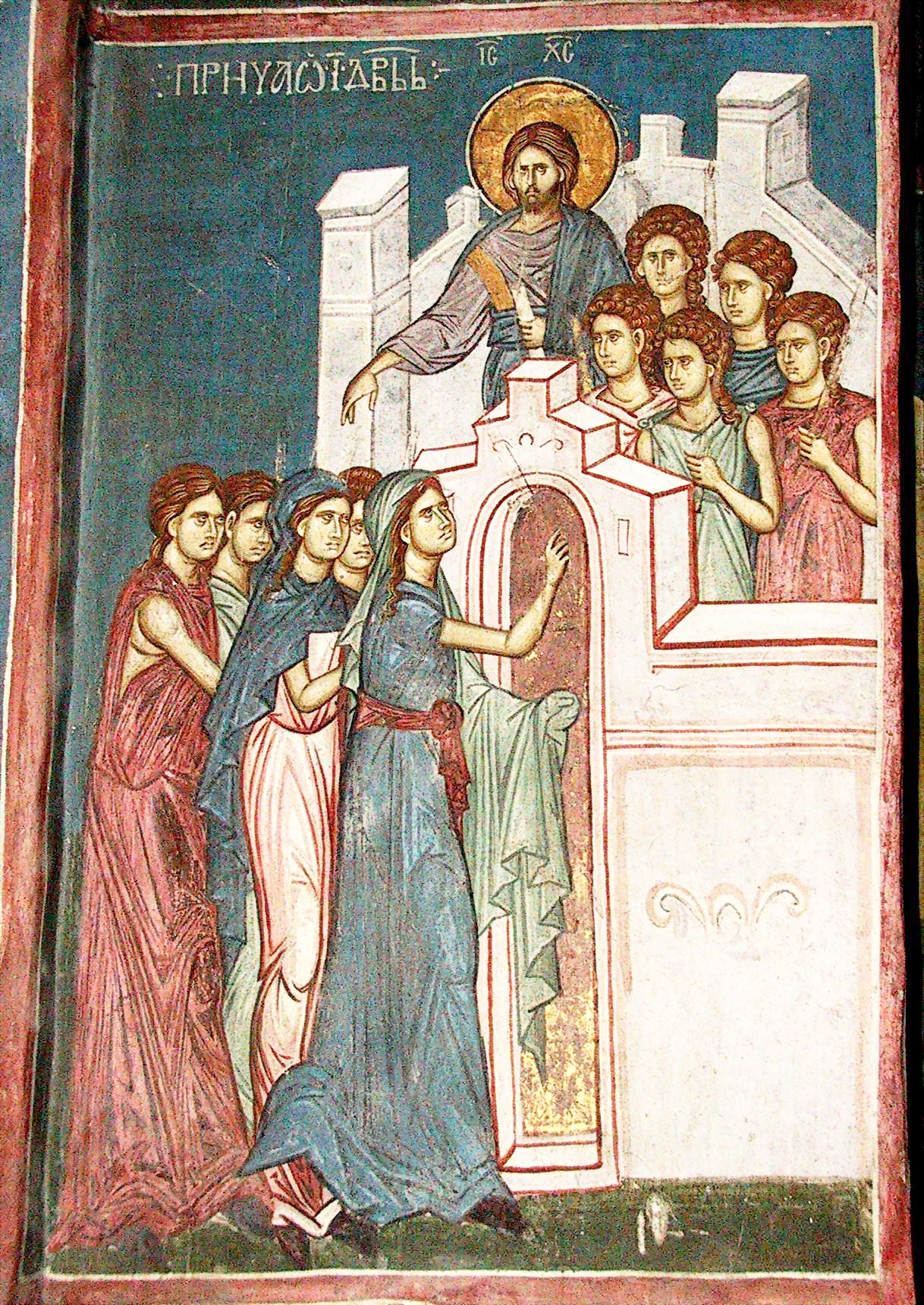
The Parable of the Ten Virgins (source)
    
Selected Quotes of the Fathers on the Parable of the Ten Virgins
The five wise virgins, watchful and alert, had taken oil in the vessels of their heart. That oil, not part of their own nature, means the grace of the Spirit. They were enabled to enter with the Bridegroom into the heavenly bridal chamber. The other five virgins, however, were content with their own nature. They neither watched nor busied themselves to receive the oil of gladness [Ps. 44:6] in their vessels, while they were yet in the flesh. Instead, they sank into sleep through carelessness, slackness, idleness, and ignorance, or even fancied righteousness. Hence, they were shut out of the bridal chamber of the Kingdom, unable to give satisfaction to the heavenly Bridegroom. Held fast by their tie to the world, and by some earthly affection, they did not give their whole love or passionate devotion to the heavenly Bridegroom; thus they were not provided with oil. Souls that seek the sanctification of the Spirit, which is outside of nature, fasten all their affection upon the Lord. It is in the Lord that they walk, pray, and employ their thoughts, turning away from all else. For this cause, they are priviledged to receive the oil of heavenly grace. This enables them to succeed in coming through without falling, giving perfect satisfaction to the spiritual Bridegroom. Those souls, however, content with what belongs to their own nature, creep upon the earth in their thoughts. Not only do they employ their thoughts upon earth, but their minds have their whole existence upon earth. In their own estimation, they appear to belong to the Bridegroom, and to be adorned with the ordinances of the flesh. Nonetheless, they have not been born of the Spirit; and they have not received the oil of gladness.
-Saint Macarios the Great (Fifty Spiritual Homilies, Homily IV)


This parable admonishes us to remain diligent in almsgiving. It counsels us to help our neighbor by every means available to us, since it is impossible to be saved in any other way....For nothing is more sullied than virginity without mercy ... What was the profit of virginity, when they saw not the Bridegroom? Even when they knocked at the door, they did not obtain; instead, they heard the fearful saying, "Depart, I know you not". When he said this, nothing else but hell is left, and that intolerable punishment....This parable was spoken with respect to mercy in almsgiving ... It is also that we might learn how close Christ is joined unto virgins that strip themselves of their possessions; for this indeed is virginity.
-Saint John Chrysostom (Homilies on the Gospel of Matthew, Homily LXXVII)


As it is written: "The day of the Lord shall come as a thief in the night" (1 Thess. 5:2). Then the virgins shall awake, because both good and wicked are roused from the sleep of death. They shall trim their lamps, that is, they shall count the number of their good works for which they hope to receive the reward of eternal happiness. However, the lamps of the foolish virgins shall fail. This is because their works, seen so clearly by men, shall wane and vanish at the coming of the Judge. From God, they shall receive no recompense, for men gave them the praise they esteemed so highly. The blessed will rejoice in their recompense, when they enjoy that vision of Him in Whose presence the elements tremble. They will then go in with Him to the marriage. As they rejoice in the nuptials of the Bridegroom, they themselves will be the bride; for in the bridal chamber of the eternal Kingdom, they are united forever to their God. Thenceforth, that vision can never be snatched from them. The door of the Kingdom will close forever upon those left outside, who then will weep. However, that same door is now open to all penitents. There will be repentance then, but it will be fruitless. When the Bridegroom comes, those that wasted time that might have be used for repentance shall not find pardon. Thus St. Paul warns us: "Behold, now is the accepted time; behold, now is the day of salvation" (2 Cor. 6:2). The Prophet Isaiah says: "Seek ye the Lord, and when ye find Him, call upon Him" (Is. 55:6).
-Saint Gregory the Great (Parables of the Gospel, "The Ten Virgins")
(source)
   

Some say that the shortage of oil of the foolish virgins signifies their shortage of good works in their lives. Such understanding is not exactly correct. How can they be short of good works if they, though foolish, are still called virgins? Chastity is a supreme virtue, the state of being equal to angels, and could itself serve as a substitute for all other virtues. I humbly think that they were actually short of the grace of God's All-Holy Spirit. These virgins did good, and out of their spiritual foolishness supposed that doing good was exactly the point of Christianity. They did good works and by this obeyed God, but they did not care in the least beforehand whether they had received or reached the grace of God's Spirit. This very gaining of the Holy Spirit is that oil which the foolish virgins lacked. They were called foolish because they forgot about the necessary fruit of virtue, the grace of the Holy Spirit, without which no one is saved and no one can be saved, for: ‘it is by the Holy Spirit that any soul is vitalized and exalted in chastity, and any soul is lit by the Trinitarian unity in holy mysteries’. The Holy Spirit moves into our souls, and this installation of the All-Mighty into our souls, and co-existence of His Trinitarian Unity with our spirit is given only through the gaining by all means, the Holy Spirit, which prepares in our soul and body the throne for God’s creative co-existence with our spirit in strict accordance with the word of God: ‘I will dwell among them and will be their God, and they will be my people’. This is the oil in the lamps of wise virgins, oil that burnt bright and long, so that the virgins with the burning lamps could wait until the Bridegroom who came at midnight, and enter with Him into the house of joy. But the foolish virgins, seeing that their lamps were going out, went to the marketplace to buy oil but would not come back in time, for the doors were already shut. The marketplace is our life; the door of the house of marriage (that was shut and did not lead to the Bridegroom) is our human death; wise and foolish virgins are Christian souls; the oil is not works but the grace of the All-Holy Spirit of God which is received through these works, and which converts things perishable into things imperishable, transforms spiritual death into spiritual life, darkness into light, the manger of our being, with passions tied like cattle and beasts, into the Divine Temple, into the glorious palace of never-ending rejoicing in Christ Jesus.
-St. Seraphim of Sarov (Conversation with Nicholas Motovilov) (source)
   

O brothers, let us love the Bridegroom, Let us make ready our lamps, Shining out with brightness and true faith, So that, like the wise virgins at the Lord's coming, We may arrive with Him at the marriage, For He, the Merciful, since He is God, Offers to all as a gift The incorruptible crown!
Thou, O God, the Bridegroom of salvation, the hope of those who hymn Thee, Grant to us who pray to Thee That we find, without stain, in Thy marriage, Just like the virgins The incorruptible crown.
-St Romanos the Melodist - Vol. II, Kontakion On the Ten Virgins I
   

My soul, now we observe these things. There are doors; let my soul not be at the doors; Let it be ready and at hand. It leaves nothing behind, Just as Christ said. As He foretold, all things will happen Famines and pestilence, And continuous earthquakes, And tribe upon tribe will be raised up. Fearful things within and without, Full of battles. It is not possible to be saved anywhere, For everywhere there is danger. Nowhere is there a refuge; there is flight by all men. The gate has been closed, Mercy has been sealed; For we were not chosen To be within the bridal chamber, we are Crying, 'Open.'
-St Romanos the Melodist - Kontakion On the Ten Virgins II
(source)
   
The Parable of the Ten Virgins (source)
    
Through the prayers of our Holy Fathers, Lord Jesus Christ our God, have mercy on us and save us! Amen!

Sunday, April 28, 2013

Kontakion on Palm Sunday by St. Romanos the Melodist

Christ entering Jerusalem before His Passion (Palm Sunday) (source)
   
FOR THE FEAST OF PALMS
Acrostic: OF ROMANOS FOR THE PALMS
Mounted on the throne in heaven, Christ God, and on the colt on earth,
You accepted the praise of the angels and the hymn of the children
Who cried to you, ‘Blessed are you
Who come to call back Adam.


Proemium 2
At first the ungrateful Jews with branches praised Christ God,
Later with staves arrested him.
But as with faith unchanging we ever honour him as Benefactor,
Let us cry to him, ‘Blessed are you
Who come to call back Adam.


1
Since you bound Hell, slew Death and raised the world,
With palms the infants praised you, O Christ, as victor,
Crying out to you to-day, ‘Hosanna to the Son of David.
For no more’, they say, ‘will infants be slaughtered because of Mary’s babe,
But for all, infants and elders, you alone are crucified.
No more against us will the sword advance,
For your side will be pierced by a lance.
Therefore we rejoice and say, ‘Blessed are you
Who come to call back Adam.’’


2
Behold our King, meek and gentle, seated on the colt
Draws near with haste to suffer and to cut off the passions;
The Word upon an irrational beast wishing to deliver rational creatures;
And it was possible to see on the back of a colt the One who rides on the shoulders of the Cherubim,
Who once took up Elias in a fiery chariot,
He who is rich by nature making himself poor by design,
And weak by intention, he who empowers
All those who cry to him, ‘Blessed are you
Who come to call back Adam’.


3
All Sion was shaken as once Egypt was. There the inanimate,
But here the animate were shaken as you came, O Saviour,
Not because you are fomenter of trouble—for you are the sower of peace—
But because you abolish, as Maker of all things, all the trickery of the foe,
Driving him from everywhere as you reign in every place.
Their idols fell down of old,
And now those who favour them are shaken
As they hear the voices of infants, ‘Blessed are you
Who come to call back Adam.


4
‘Who is this?’ they said, who deliberately did not know you. For it says they did not know
Who was the son of David who had delivered them from corruption.
They are still untying Lazarus and do they not know who raised him?
The shoulders of those who carried the widow’s son are still hurting,
And do they really not know who it was snatched him from death?
They have not yet left Jairus’s courtyard,
And do they not know who it was gave his daughter life?
They do know, but do not want to say ‘Blessed are you
Who come to call back Adam.


5
Ungrateful, lawless, they welcomed ignorance, indeed were ignorant.
The one they were plotting to kill they did not know, the sons of falsehood!
What they say is not strange. They are repeating the past.
Moses led them out of Egypt; he was immediately denied by them.
And Christ, who saved them from death, was now unknown.
They did not know Moses, those who knew the calf.
They denied Christ, the friends of Beliar.
Then it was ‘What has happened?’ But now they said, ‘Who is this
Who comes to call back Adam?


6
With palms infants sing your praise, calling you Son of David rightly, Master;
For it was you who slew the Mocker, the spiritual Goliath.
David the dancing maidens extolled after his victory,
‘Saul slew them in thousands and David in ten thousands’.
That is: the Law, and after it your Grace, my Jesu.
The Law was Saul, envying and persecuting,
But David persecuted, sprouted grace,
For you are David’s Son and Lord,
Who come to call back Adam.


7
The sun is a chariot of light, and, resplendent as a carriage, it is enslaved to you,
And it is subject to your command as Creator and God.
And now a colt was your delight. I worship your compassion,
Since once for me you were laid in a manger, wrapped in swaddling clothes,
And now you are mounted on a colt, who have the heaven as your throne.
There the angels encircled the manger,
Here disciples held the colt.
‘Glory’ you heard then, and now, ‘Blessed are you
Who come to call back Adam.


8
You showed your strength in choosing penury, since for you to be seated on a foal
Is a form of beggary. But in glory you shake Sion.
The disciples’ garments signified penury,
But the sign of your might was the hymn of the children and the gathering of the crowd
Crying ‘Hosanna’—that is ‘Save now’—’in the highest’.
Most High, save the humbled;
Have mercy on us, as you look on our branches.
Boughs that are brandished will move your compassion, O you
Who come to call back Adam.


9
Adam contracted for us the debt that we owe, by eating what he ought not,
And until to-day it is demanded of us who are descended from him.
The creditor was not satisfied with seizing the debtor,
But he attacks his children too, demanding the ancestral debt,
And empties the debtor’s house entirely, sweeping everyone away.
And so let us all flee to one who is powerful.
Knowing that we are in dire poverty,
Do you yourself pay back what we owe, for you are rich,
Who come to call back Adam.


10
You have come to deliver all, and your prophet Zachary, who once called you
Most meek, just and who save, is your witness.
We were wearied, we were worsted, we were utterly cast out;
We thought we had the law as our redeemer, and it enslaved us;
The prophets too, and they left us on our hope.
And so with infants we bow the knee to you.
Have mercy on us who have been humbled,
Be willing, be crucified, and tear up the record of our debt, you
Who come to call back Adam.


11
‘Creature fashioned by my hand’, the Fashioner answered those who shouted,
‘Knowing that the law had no strength to save you, I have come myself.
It was not for the law to save you, since it did not fashion you.
Nor was it for the prophets, because they too are my fashioning just as you are.
Mine alone was the task of releasing you from this most heavy debt.
I am being sold for your sake and I shall free you.
I am being crucified for you and you are not being made to die.
I die and I teach you to cry, ‘Blessed are you
Who come to call back Adam.


12
For was it for angels that I showed affection? It was you the pauper that I befriended. I hid my glory
And I, the Rich, have willingly become poor, for I love you greatly.
I was hungry, I was thirsty, I toiled also for your sake.
I passed by mountains, cliffs and valleys, seeking you, the lost.
I was named ‘Lamb’, that attracting you by my voice I might lead you;
‘Shepherd’, and for you I am willing to lay down my life,
That I may snatch you from the hand of the wolf.
I suffer all, wishing you to cry, ‘Blessed are you
Who come to call back Adam.’’


13
But after words he showed it by deeds, for he reached the city,
And the hymn of the children enraged all his enemies.
Raising his eyes he gazed on Sion
And wove a lament over her, crying, ‘Groan aloud, Jerusalem,
Because you have found children to be fathers, teachers your sons.
In evil and wickedness you are a youngster,
For doing good you are weighed down by old age.
Better than you are those who cry to me ‘Blessed are you
Who come to call back Adam.


14
Now I shall enter you and casting you aside reject you, not because I have hated,
But because I have understood that you have hated me and mine.
Your children have prepared a cross for me in return for what?
Because with a staff I rent the sea apart like a tunic before them?
Do they carve out a tomb because I gave them a cloud as protection?
And I rejoice, since for their sake I came,
And I long to suffer in my love for the fallen,
That those who love me may say, ‘Blessed are you
Who come to call back Adam.’’


15
So he who sees the inmost heart reproached city sluggish of heart and enters
The temple with all the infants, he the universal priest.
The Son arrived in his Father’s house.
And cast out both sellers and buyers together, saying,
‘Let nothing remain here; for we are leaving here,
I and my Father together with the Spirit.
Now we have found a court: the will of the meek,
Of those who with their voices faithfully cry to me, ‘Blessed are you
Who come to call back Adam.’’


16
All-holy Son of God, number us together with those who sing your praise,
And receive the supplication of your servants as once the children’s.
Have mercy on those you fashioned, amongst whom you dwelt in love.
Give peace to your churches, shaken by enemies,
And send down to me, O Saviour, release from my iniquities.
Grant me to speak what you will as you will
Do not let grief make my mind sluggish.
Show me to be a skilled cultivator to cry, ‘Blessed are you
Who come to call back Adam.

Copyright to Archimandrite Ephrem © (source)
   
Through the prayers of our Holy Fathers, Lord Jesus Christ our God, have mercy on us and save us! Amen!

Friday, April 26, 2013

"Six days before the Passover..."


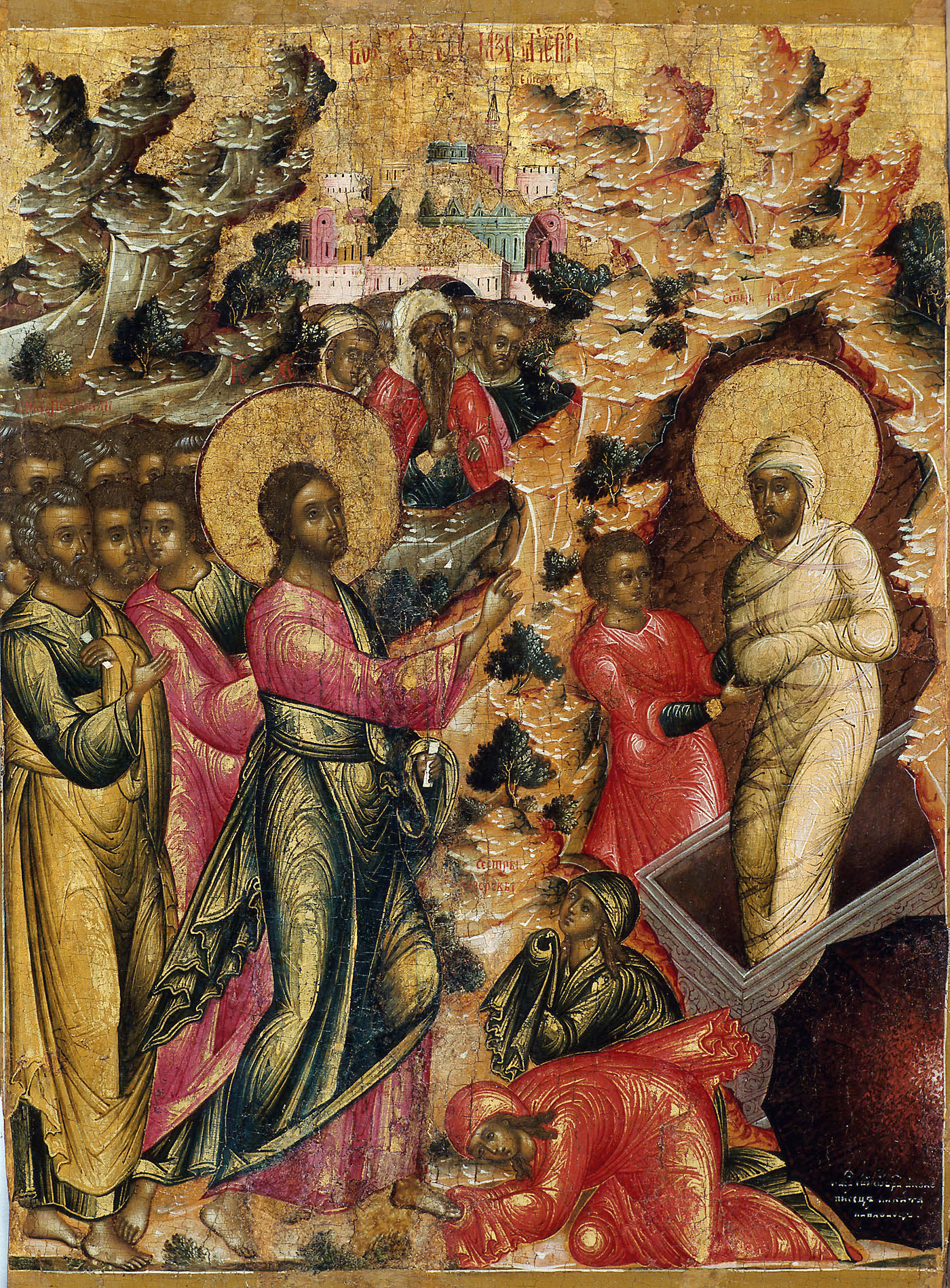
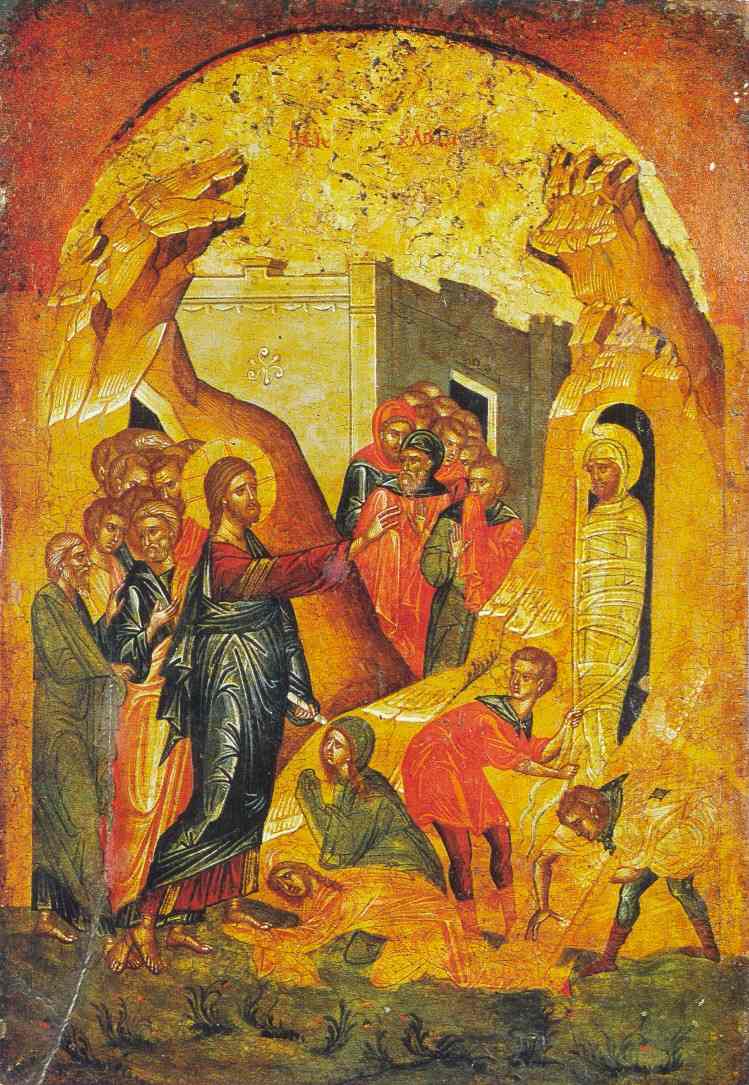
Christ raising Lazarus (source)
   
«Προ έξ ήμερων του πάσχα, διά των πέντε αισθήσεων, τον τετραήμερον ο τριήμερος, ταις δυσί τον έναν χαρίζεται».
   
«Six days before the Passover, before the five senses, the Four-days-dead, by the Third-day-risen One, to the two [sisters, Martha and Mary], He grants the one [brother, St. Lazarus]»
St. Epiphanios of Salamis
   
Through the prayers of our Holy Fathers, Lord Jesus Christ our God, have mercy on us and save us! Amen!

Excerpt from the Canon of St. Lazarus by St. Andrew of Crete

Christ raising Lazarus from the dead (source)
 
Excerpt from the Canon of St. Lazarus by St. Andrew of Crete (to be read at the Compline for the Saturday of the Raising of Lazarus)
 

Ode IX. Eirmos.
He has showed strength with His arm; He has put down the mighty from their seats and exalted the humble, for He is the God of Israel; the Dayspring from on high has visited us and guided us into the way of peace.

Glory to You, our God, glory to You.
Let Bethany sing with us in praise of the miracle, for there the Creator wept for Lazarus in accordance with the law of nature and the flesh; then, making Martha's tears to cease and changing Mary's grief to joy, Christ raised him from the dead.

Glory to You, our God, glory to You.
To confirm men's faith in Your Resurrection, Word, You have called Lazarus from the tomb and as God You have raised him up, to show the peoples that You, who raise up the temple of Your body are both God and man in very truth.


Glory to You, our God, glory to You.
Shaking the gates and iron bars, You have made Hades tremble at Your voice; Hades and death were filled with fear, Savior, seeing Lazarus their prisoner brought to life by Your word and rising from the tomb.

Glory to You, our God, glory to You.
All were dismayed to see You, Savior, weeping over dead Lazarus, and in their misery they said: "Behold how He loves him." You then straight away called him, and at Your command the dead man rose, delivered from corruption.

Glory to You, our God, glory to You.
The gates were shaken and the bars were shattered, and the bonds which held the dead man were loosed; when Christ spoke in power, Hades groaned bitterly and cried aloud: "Woe is me! What and from where is this voice that brings the dead to life!"

Glory to You, our God, glory to You.
Rise up, obedient to the voice: your friend outside is calling you; for this is He who raised the dead of old: for when Elias and Elisha brought the dead to life, it was He that spoke and acted through them.

Glory to You, our God, glory to You.
We sing the praises of Your surpassing power, Word and Savior, for by Your word, as Creator of all things, You have raised dead Lazarus from the depths with his bones and sinews, as You before raised the widow's son from the bier.

Glory to the Father, and to the Son, and to the Holy Spirit.
Most Holy Trinity, God the eternal Father, coeternal Son and Word of God, Holy Spirit of God, loving Comforter; one Light of the threefold Sun, consubstantial Essence, one God and Lord, take pity on the world.

Theotokion.
Now and ever, and to the ages of ages. Amen.
Jesus, who have made all things in wisdom, You have clothed Yourself in my whole nature, taken from the Virgin, yet You remain for ever wholly in the bosom of the Father; and as God You have sent down Your Holy Spirit on Your flock: cover us with Your shadow.
(source)
 
Through the prayers of our Holy Fathers, Lord Jesus Christ our God, have mercy on us and save us! Amen!