Friday, January 24, 2014

Prayer for the Recovery of the Relic of St. Polycarp of Smyrna

The martyrdom of St. Polycarp of Smyrna (source)
 
The following is a beautiful and moving prayer recently written by Metropolitan Ierotheos Vlachos for the return of the Holy Relic of St. Polycarp, recently stolen from the Monastery of Panagia Ampelakiotissa in his Metropolis. St. Polycarp is a great Saint and Apostolic Father of the Church, and he is a special protector and healer of the people of that region. Though the world has and will continue to go through trying times of poverty, disease, etc. the solution is to place our trust in God, not in our own passionate logic, and definitely not by defiling the holy things of Christ's Church. As the Metropolitan reminds us, unless we all turn to repentance for the evil that we have done, we all stand "self-condemned". As St. Polycarp's feast is approaching, may we all pray for his illumination, and that his Right Hand might return to console his saddened people.
   
Hierarchical Entreaty to God for the uncovering of the stolen Precious Relic of our Father among the Saints, the Hieromartyr Polycarp, Bishop of Smyrna, the Protector of the Region of Navpaktias.
written by Metropolitan Ierotheos of Navpaktos and Agiou Vlasiou.
O Lord Jesus Christ our God, Who sanctifies those who love You and rests within them, Who sets Your servants as vessels of Your Holy Name, precious members of Your Holy Body, temples of the Holy Spirit, Who loved Your servant and healer Polycarp, Bishop of Smyrna, granting him the rank of the Archpriesthood and the holy work of martyrdom, Who led the Holy Relic of Your Saint to this Holy Monastery of the Panagia named Ampelakiotissa, for the sanctification of Your people, and has shown this to be a dwelling place of glory and a spring of unemptying wonders, we thank You today, for the Divine Liturgy which we have celebrated, and we glorify Your holy and greatly-hymned Name.

You are the giver of good things and the source of life. You are He Who knows the depths of our hearts. You are He Who enriches us with every spiritual wisdom. You are He Who blesses us, through the intercessions of Your Saint, and placed within this Monastery an inexhaustible treasure, and made us inheritors of the holy Relics of this Apostolic Father. Therefore we hymn You, we bless You, we glorify You, our true God, Who works great, wondrous, glorious and magnificent deeds.

We take confidence, O Master of all, Lord of Heaven and earth, and all creation seen and unseen, that You know the pain of our hearts and our sorrow at the theft that took place in this holy place, for unclean hearts and unholy hands have defiled this Holy Temple, bursting through the doors, and seizing with impudence and deadly heart the all-holy Relic of the most-holy Father, who himself was honored even by the fire [in martyrdom], along with other nations and other faiths throughout the ages. Our heart is made grave at this profane and impious act and deed, truly filled with satanic inbreathing and to please the passions, we have been greatly wounded and vexed. We question in curiosity: What  satanic mind [literally "mind of the morning star"] planned this senseless deed? What purpose was there in defiling the holy dwelling-place of Your glory, of this sanctified relic? What brash hand stole this blessed right hand in insolence and impudence? Who was angry at the love of the people?

Truly, we are aghast before this act of cruelty, mute before this unholy deed and speechless before this satanic activity. Just a few days before, this blessed place, which is sanctified by the presence of Your Holy Mother, the Panagia Ampelakiotissa, and by the grace-bearing right hand of Your holy healer, Polycarp the wondrous, was defiled by wild impulses and barbaric acts, of senseless, thoughtless, impassioned, unholy and deluded men.

Therefore, cast a glance upon this, Your troubled people, and hearken to this prayer. Behold our sorrow and the tears for the loss of the sacred and greatly-loved treasure of our Protector of this Eparchy. Our eyes look upon You, our prayers pour forth from our hearts and rise to You as a sacrifice. Do not despise our prayer and the groaning of our heart.

We entreat You, O Lord our God, to open those unclean hearts and enlighten the darkened and [satanic] mind that worked this defiled and hideous act, that they might awake from the cloud of evil, and return the holy and sacred Relic to its home, in this Holy Monastery. Grant to them to come to know that this act inevitably brings to them to the pit of evil, to sickness of soul and body, and to the tartarus of Hades, to the place of desolation and torture. For it is fitting for those who work such deeds naturally and ethically, to be given to curses and anathemas, because through such a defiling deed they stand self-condemned, unless they repent bitterly, as Your Apostle Peter did upon his betrayal.

Grant to us, O Master of all, O Lord our God, the power to entreat Your healer, the Hieromartyr Polycarp the wondrous.

O Saint Polycarp, the protector of our hearts, come speedily near us, free the precious member of your body from the hands of the unrighteous, lawless, wicked and impious, and dwell newly among us, who love you with our whole heart. You, after God, are our Father and we are your children. We behold your dwelling-place empty, but adorned with our love and washed with our tears. Come, our consolation, our trainer and our benefactor.

O Lord Jesus Christ, the Son of the Living God, through the intercessions of Your Most-Holy Mother, and the entreaties of the holy Hieromartyr Polycarp, soften the pains of our soul, take away our pain and fulfill our desire, that we might newly behold the right hand of Your Saint, awesome in battle and gladsome to his friends.

For Yours is the glory and the honor and the worship, together with Your Beginningless Father, and Your All-Holy and Good and Life-giving Spirit, now and ever and to the ages of ages. Amen.

Sunday March 17th, the Holy Monastery of Ampelakiotissa.
(amateur translation from source)
 
Through the prayers of our Holy Fathers, Lord Jesus Christ our God, have mercy on us and save us! Amen!

Thursday, January 23, 2014

St. Paisios on the Prayer Rope

St. Paisios preaching to people outside his cell on the Holy Mountain (source)
 
-Elder, what meaning does the prayer rope (komboschoini) have?
-The prayer rope is an inheritance, a blessing, which was left to us by the Holy Fathers. And for this alone, it has great worth. You see, when someone's grandfather leaves him a meaningless object as an inheritance, he keeps it like a talisman, how much more should we keep the prayer rope as an inheritance of the Holy Fathers!

In olden times, when there were no clocks, monks counted the time with prayer with the prayer rope, but the knots of the prayer rope were simple. Once, an ascetic was doing great struggles, many prostrations, etc. and the devil went and broke the knots of his prayer rope. The poor man then did prostrations after prostrations, because he couldn't count them, as the devil broke his prayer rope to further continue his struggle. Then, an Angel of the Lord appeared to him and taught him how to weave the knots, so that each knot might contain nine crosses. The devil afterwards, who trembles at the cross, could not break them. Thus the knots of the prayer rope have nine crosses, which symbolize the nine ranks of the Angels.

-Elder, what do the 33, 50, 100 and 300 knots mean on prayer ropes?
-Only the number 33 is symbolic, for it symbolizes the 33 years that Christ lived upon the earth. The other numbers simply help us count the prostrations that we do or how many times we say the prayer.

Some machines have a rope with a grip in its side so that if you want it to go forward, you pull the rope strongly, until it warms it up with oil. Thus, the prayer rope is the rope which we pull one, two, five, ten times to warm up with spiritual oil and to move the spiritual machine forward of unceasing prayer, which afterwards, functions on its own. However, when the heart is going forward with the prayer, we still should not remove the prayer rope, so that others might not remove it, whose hearts have not moved forward with prayer.

-Elder, when I hold my prayer rope, and say the prayer mechanically, is there a danger of vainglory [ανθρωπαρέσκειας]?
-If you use the prayer rope externally, out of vainglory, even though your hands start to peel, it does not benefit you at all. It will only bring you fatigue, and the illusion that you are supposedly pursuing noetic prayer.

-Elder, I'm not used to carrying the prayer rope.
-You should carry the prayer rope, so that you might not forget the prayer, which should work internally, within the heart. When of course you exit your cell, you should remember that the enemy is ready to fight you. Thus, imitate the good soldier, who exits the barracks always with his automatic weapon “at hand”. The prayer rope has a great power, and is the weapon of the monk, and its knots are bullets, which [when fired at the feet of the demons] make their sandals dance.
(“On Prayer”, Words VII. Amateur translation of text from here.)
   
Through the prayers of our Holy Fathers, Lord Jesus Christ our God, have mercy on us and save us! Amen!

Tuesday, January 21, 2014

Elder Eliseus (Elisha) of Simonopetra on Sacrifice in Marriage and Monasticism

Sts. Joachim and Anna the Ancestors of God, holding the All-pure Theotokos (source)

Elder Eliseus (Elisha) of Simonopetra on Sacrifice in Marriage and Monasticism
Therefore, don't think that you don't aren't praying. You pray daily, if for the sole reason that you have decided to offer yourselves to God, and to live apart, against the worldly mindset. Thus you should know that this constitutes prayer. This is prayer. Prayer is when I become a monk, to offer myself to God. This is prayer.

You pray when you offer yourself to the church and as a sacrifice towards each other within marriage. One who gets married, therefore, in his married life, is a prototype. Marriage is a return to the former state in Paradise, in other words. It is to offer yourself in the married life, for what does it do? To offer myself to someone else is to sacrifice myself for the other.

No one can distinguish the lay person from the monk, for what are they? Being a monk is a return to a former state, in other words, that of Paradise, without compromises.

We sell our freedom to God, because God is our freedom.
(amateur translation of text from here)
   
Through the prayers of our Holy Fathers, Lord Jesus Christ our God, have mercy on us and save us! Amen!

Prayers for Holy Confession, by St. Nikodemos of the Holy Mountain

The Holy and Saving Mystery of Confession (source)
 
Prayers for Holy Confession, by St. Nikodemos of the Holy Mountain
A prayer before Holy Confession
O Father of mercies before the ages, and God of all entreaty, I the wretched one, desiring to try my conscience regarding my offenses, fear greatly and tremble, because the condition of my life is so utterly clear, where no deed or single thought could be hidden from before Your eyes. Therefore, I ask with all my lowliness, through the mercies of Your Only-begotten Son, that you grant me the grace to come to know well, and to hate and to correct all of my sins. Give to me, O Father of lights, Your All-holy Spirit, to bring to me the remembrance of sins that I have forgotten, and to crush my heart towards contrition, and to bring repentance over these, that I might come to hate them, and to distance myself from every sin that comes. And you, O Virgin Theotokos, the Mother of mercy, and Refuge of sinners, nourish me, I entreat you, and help me at the Judgment seat of the compassion and righteousness of God, that I might come to know, and hate from my heart and to confess all of my sins. And similarly, O Holy Angel, the guardian of my soul, I entreat you to help me in this work, which is so necessary for my eternal salvation. Amen.

A prayer following Holy Confession
I thank You greatly, my Redeemer, and Most-philanthropic Physician of the human race, for with the most-precious balsam of Your life-creating Blood, You heal the wounds of my soul, and You cleans me from the leprosy of my sins. I know Your divine compassion, with which you brought me to repentance, I, the thrice-wretched sinner, while so many others are being tortured currently in the wrath of Your righteousness in Hades. Receive, therefore, I entreat You, my Lord, through the intercessions of Your Ever-virgin Mother and Theotokos Mary, and all of Your Saints, this my confession, and if anything stands missing or incomplete in any instance, complete this through Your divine compassion and love for man, and through this I entreat You that I be totally forgiven, and correct my moral life, bringing forth worthy fruits of repentance, and thus, remaining steadfast in goodness in this present life, may I be made worthy to partake of the glory of Your divine glory in Heaven. Amen.
(Amateur translation of texts from here and here)
 
The Parable of the Prodigal Son (source)
   
Through the prayers of our Holy Fathers, Lord Jesus Christ our God, have mercy on us and save us! Amen!

Saturday, January 18, 2014

Nun Mary Magdalene (+2014)

Nun Mary Magdalene (+2014) (source)
   
Nun Mary Magdalene reposed in the Lord. She was a rich woman from France, who spoke with St. Porphyrios of Kavsokalyvia without her knowing English, nor his knowing Greek!

She experienced the miracle!

She left for the desert. She lived in asceticism near the Monastery of St. Catherine, near the ascetical place on Sinai where St. John Klimakos (of the Ladder) lived in asceticism, and where she built a small chapel in his honor.

May we have her blessing! May she have a blessed Paradise.
   
Through the prayers of our Holy Fathers, Lord Jesus Christ our God, have mercy on us and save us! Amen!

Friday, January 17, 2014

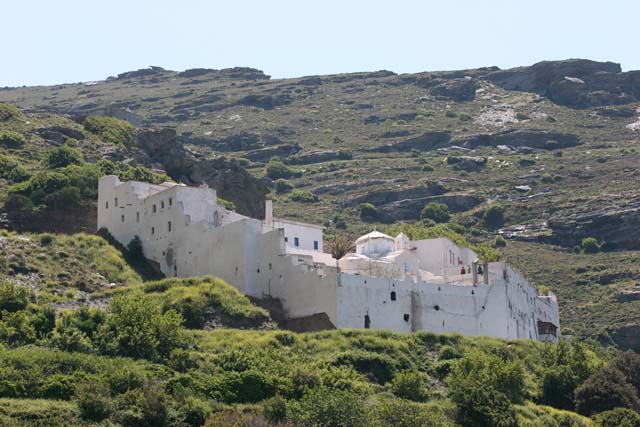
The Holy Monastery of Panagia Panachrantos, Andros


The Holy Monastery of Panagia Panachrantos, Andros (source)
  
This monastery appears to be literally clinging to the top of the mountain, surrounded by large rock formations, where the air, with the passage of the ages, has carved hundreds of small caves, the largest of which were used as hermitages for ancient monks.

The monastery is designed, according to the form of Byzantine monasteries, with the appearance of a fortress, and the land which it occupies is significantly large, with its buildings designed in a rectangular shape, having a much larger length than width. Because of the steep landscape, and the monastery’s long and narrow design, it gives the impression of a labirynth, since other than the narrow central road, there are only narrow alleys that lead to the rest of the cells.

When you reach her highest point, the panoramic view rewards you, giving you a true sense that you are hanging in the air.
  
The view from the pinnacle of the Monastery (source)
  
Regarding the historical beginning of the monastery, unfortunately, we do not have many details, and this gives us uncertainty as to what conditions were like then. We base the history on two documents, which are preserved to this day, and in the local tradition, where we see that the history begins as follows: Before 960 AD, two monks, who lived in asceticism on the opposing mountain, saw a light every night at the place near where the monastery today is built.

Seeing such a wonder, after a long while they decided to go investigate the phenomenon.
  
Fresco from the monastery showing the monks finding the wondrous icon (source)
  
Having looked for a while, they were made worthy by the grace of God, to find the sacred icon of the Panagia “Panachrantou” (“The Immaculate One”) below a cave, near the place where today is found the Church of the “Photodoti” ([Christ] “The Giver-of-Light”), (the name which was given most likely by the light which was revealed here).
  
The wondrous icon of Panagia Panachrantou (The Immaculate One), Andros (source)
   
After waiting a significant time there, in case another monk lived there in asceticism, and praying towards the icon, having not found anyone, they took the icon back with them to their cell at the opposing mountain. That night, the light which they saw, did not reappear, which confirmed to them that this was due to the grace of the Panagia. When the new day dawned, the icon had disappeared from the place where they placed it, and to their greater astonishment, the light appeared again on the opposing mountain.

Returning to the place where they had found the icon, they saw that it had wondrously returned there!

Having entreated with tears to the Panagia that they might take her icon, they took it, but the following night, the Panagia returned again to her same place.

This occurred several times again, until they ultimately were enlightened to move their dwelling to near the cave, where they built a small hermitage.

Their fame spread quickly, and thus other monks came there and founded the first brotherhood. Later, in 961 AD, the Emperor Nikephoros Phokas, was battling the Cretans who had apostatized, but due to the wind being against him, he decided to stop on the island of Andros.
  
The Roman Emperor Nikephoros Phokas (source)
  
Desiring to pray somewhere for the difficult task that he had undertaken, the inhabitants of the island showed to him the hermitage, which the monks mentioned above had built. Thus, Phokas visited the place, and having venerated the Panagia, promised that he would help the monks build the monastery, which he would protect from possible attacks, if ultimately he would be victorious in war.

Phokas, in the end, liberated Crete, and returned to Andros, where he left a lot of money, which the monks used to build the first buildings of the monastery, which from then on was named the Holy Monastery of Panachrantou, in honor of the Panagia. From the foundation of the Monastery until 1590, unfortunately, not a single document survives from the archives of the Monastery, but most likely it played an important role during the long period of Frankish rule on Andros (1200-1566).
  
Panachrantou Monastery, Andros (source)
  
From 1590 and on, however, when Andros passed into the hands of the Turks, the monastery went through a great period, through the efforts of the then Metropolitan of Andros and Keas, Gabriel.

During this period, the Katholikon of the Monastery was founded (1602-1608), and took the form which exists to this day. Slowly, the strength of the monastery began to grow, and it reached the point where there were around 360 enrolled monks and large tracts of land throughout the largest portion of Andros, but also metochia (dependencies) in Constantinople, Chios, Mytilene, Rhodes and Smyrna.
  
The Katholikon of the Monastery (source)
  
In order to support this property, the monks traveled greatly, which likely played a role in the gathering in the Monastery of very many artifacts, along with a multitude of Holy Relics.

The most important of the Holy Relics treasured here is [a portion of] the precious Skull of St. Panteleimon, which was transferred here from Constantinople in 1705, with the consent of the then Patriarch Kosmas III, while furthermore there are preserved portions from the relics of Sts. Aethalas, Averkios, Charalampos, Tryphon, etc.
   
Fr. Eudokimos, the Abbot of Panachrantou Monastery, carrying the Relic of St. Panteleimon in a recent visit to Piraeus (source)
 
[At the following link is a recording (in Greek) of Fr. Evdokimos, the Abbot of Panachrantou Monastery, Andros, in which he discusses various spiritual topics, as well as miracles that have occurred through St. Panteleimon. It is interesting to note that at first Fr. Evdokimos was uneasy hearing that the Skull of St. Panteleimon was on Andros, as he had previously venerated it on Mount Athos. However, the Saint appeared to him and reassuringly showed him the part of his Skull which was on Mount Athos, and the other part, including some of his teeth, which was at Panachrantou Monastery of Andros. Fr. Evdokimos sought permission to open the Saint's reliquary, and confirmed that it was the same portion that the Saint had revealed to him in a dream.]
 
The great progress of the Monastery reached the Ecumenical Patriarchate, where the monastery was proclaimed to be “Stavropegial” in 1683, which gave greater independence to the Monastery, and privileges.
  
A portion of the Holy Skull of St. Panteleimon the Great Martyr and Unmercenary, treasured by the Holy Monastery of Panagia Panachrantou, Andros (source)
  
Monks of the Monastery extended to many places outside of Andros, and were then poised to place an important role in the historic events which marked our fatherland.
  
Panachrantou Monastery, Andros (source)
  
Before the period of the National Independence, first the monks of Panachrantou preached the revolution on the islands and historical places, granting energy to the first revolutionary endeavors. Furthermore, the monk of Panachrantou, Metropolitan Nicholas Roussos of TZias and Thermion, blessed the weapons of the revolutionary force of Moldovlachia, under Alexandros Ypsilantes, in February 1821.

We know, based on documents, in what manner and with what funds the Monastery helped, according to its strength, the Fatherland during that difficult period. Later, when Otto was King of Greece, the Monastery numbered many monks further, and for this reason it was not shut down, according to the order of Mauer, which shut down the majority of the monasteries, totaling five monks or less, along with all the convents with less than three nuns. During that period, the exiled monk Christophoros Panagiotopoulos, later known to us as “Papoulakos”, was sent to the Monastery.

This grace-filled monk lived here the final seven and half years of his life, where he reposed on January 18th, 1861.
  
A photograph of the blessed Christophoros Papoulakos (+1861), honored by many as a Saint, though he has yet to be officially canonized by the Ecumenical Patriarchate (source)
  
The life of the Greek Monasteries is always woven together with the history of our nations, with a tender and loving relationship, though some people today do not wish to accept this. Regarding the Monastery of Panachrantou, the following two events show the truth/

The first is with the influx of refugees from Asia Minor. The Holy Synod of the Church of Greece accepted at that time the large portions from the land holdings of the monasteries, in order to strengthen these men. From the Monastery of Panachrantos, they took all of the lands outside of Andros, along with roughly the half of that which it had on Andros.

The second event occurred during the period of the German occupation. Together with witnesses of men who are still living, the then Abbot of the Monastery appeared without fear before the German administrator, and entreated him to allow him to feed the children from the villages of Andros, which occurred. Thus, in many ways they showed their thanks to the Monastery, as the many animals which they had and the untiring offerings of the monks helped many of them not to starve.

In later years, the Monastery began to decline in man power, with the result being that only a few years ago, there only remained one monk. Despite all of this, the Grace of God, appeared to have other plans for the Monastery, and thus, instead of falling into decline, it was totally renovated by a monk, together of course with the help of many people of Andros, who did all the work in order to not loose the traditional icon of the monastery. This monk was Archimandrite Eudokimos Frangoulakes, who is the Abbot of the Monastery today. Today there are five monks enrolled at the monastery, who continue their hospitality, and their work of offering of the Monastery, including Fr. Aetios and Fr. Philaretos.

The Monastery can be visited throughout the year from sunrise to sunset, and one might be allowed to stay at the monastery for a few days.
  
The Bishop with the Fathers of the Monastery, and a multitude of the faithful celebrate the great feast of St. Panteleimon, where his Holy Relics are treasured (source)
  
The largest feasts of the Monastery are those of St. Panteleimon (July 27), when a great multitude from all over Greece come to celebrate together, along with August 15th, the feast of Panagia Panachrantou.

The other days, the services are celebrated very early, according to the monastic typikon, by the light of candles, in a compunctionate environment.

The Monastery is very large for its number of monks, and thus the visitor feels that this is a deserted place. It is, however, most sure that within the mountains of documents (of which there are many), the ancient Holy Vessels (which today stand “eaten” due to their great use in the Monastery’s museum), the ornate polyeleoi, and the silver vigil lamps, the lofts emptied of monks, and the ancient chapels which fill the Monastery, you will hear the souls of all those who consumed themselves upon this rock, in order to, with their offering, and more importantly with their prayers, to appease God, to have compassion on men, and especially sinners.
(amateur translation of text from here)
  
For an amazing account of the recent revelation of many Myrrhstreaming Skulls of Holy Fathers of the Monastery, see here.
 
For another spiritual treasure of the island of Andros, see the following article on the Monastery of St. Nicholas.
 
Panachrantou Monastery, Andros (source)
 
Through the prayers of our Holy Fathers, Lord Jesus Christ our God, have mercy on us and save us! Amen!

Tuesday, January 14, 2014

St. Porphyrios heals an AIDS patient spiritually

St. Porphyrios of Kavsokalyvia (source)
 
St. Porphyrios heals an AIDS patient spiritually
At one time, I took a sick person to him who was diagnosed with AIDS. Some of my friends who knew that I was friendly with the Elder asked me to help this sick person who was extremely depressed. The AIDS victim was in really bad shape and he wanted to commit suicide. When I heard that he wanted to commit suicide, I sent him to another priest who was also a doctor. His name is Fr. Stamatis. The sick person went to this priest but the priest advised him to go and see Elder Porphyrios.
I took him to the Elder. He was a person who did not appear to look like a Christian. He had a very worldly look about him. I left him in the cell with the Elder. The Elder kept him there for a long time. When he finished, he came out of the cell crying but he was very serene with a prayer rope in his hand that the Elder had given him. He was crying but not in a way that made him appear helpless. His eyes were filled with light. The Elder called me into his cell. “Come in here so that I can speak to you. What was that soul that you brought to me? What a marvelous soul that was!”
The person from that encounter repented and he truly lives in a spirit of penance. I have seen him many times since then as a doctor. I see that he has been reborn. He visits monasteries. He goes to confession. He receives Holy Communion and he thanks Christ for AIDS because this has become for him the reason for his true salvation. 
From the book: “Miraculous Occurences and Counsels of Elder Porphyrios, source.

   
St. Porphyrios of Kavsokalyvia (source)  
Through the prrayers of our Holy Fathers, Lord Jesus Christ our God, have mercy on us and save us! Amen!