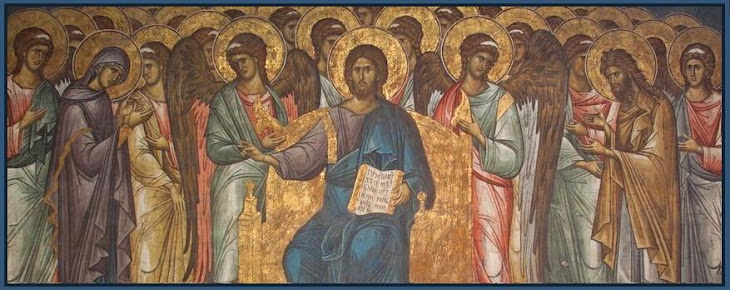
The Crucifixion of Christ (source)
St. Symeon the New Theologian: In Praise of those who have Love in their Hearts
Let us therefore follow one and the same path, Christ’s commandments, which elevate us to heaven and to God. Even though the word shows us many paths and many ways for people to reach the kingdom of heaven, these paths are not, in fact, many, but one, though they’re divided into many, according to each person’s ability and disposition. While we may begin from many and varied works and actions, just as travelers depart from different places and many cities, the destination we are attempting to reach is the same: the kingdom of heaven.
The actions and ways of godly men must be understood as spiritual virtues. Those who begin to walk in them must head towards one goal, just as those who come from various countries and places come together, as we have said, to one city, the kingdom of heaven, where, together, they will become worthy to reign with Christ and become subjects of one King, our God and Father. By this city, which is one, not many, you should understand the holy and undivided trinity of virtues, faith, hope and love, especially that virtue which comes before the others but is also mentioned as the last, since it is the goal of all good things and greater than them all- love.
All faith comes from it and is built on its foundation; on it, hope is based. Without love no thing has ever taken shape, nor ever will. Its names and actions are numerous. Even more so are its distinctive features; its properties are divine and innumerable. Yet it is one in nature, wholly beyond the ken of angels or men or any other creatures, even those which are unknown to us. Reason cannot tell of it; its glory is inaccessible; its counsels unsearchable. It is eternal and beyond time, and beyond sight, though it may be perceived. How many are the delights of this Holy Zion not made by human hand. Those who have begun to see it no longer take any pleasure in perceptible, earthly objects; they become indifferent to the glory of this world.
Permit me, for a short time, to address myself to this love, to fulfill my desire for it, insofar as I can.
When I recalled the beauty of undefiled love, its light suddenly appeared in my heart. I was ravished with its sweetness and lost my senses; I lost all perception of this life and forgot all the things of this world. But then- I don’t know how- it departed from me and left me to lament my weakness.
Love desired, how fortunate are those who have embraced you, for they will no longer have a yearning to embrace any human beauty. How fortunate are they who are moved by divine love to cling to you: they’ll deny the whole world, and, to whatever degree they associate with others, they won’t be spoiled. How fortunate are those who caress your beauty and delight in it with great desire, for their souls will be sanctified by the undefiled blood and water which issue from you. How fortunate are those who passionately embrace you, for they will be altered for the better in spirit and will exult in their souls, because you are inexpressible joy.
How fortunate are they who gain possession of you, for they will count the treasures of the world as nothing, for you are indeed wealth “beyond the dreams of avarice”. How blessed and thrice-blessed are they whom you accept, for though they be apparently without any glory, they will be more glorious than those who are glorious, more honoured than those who are honoured. How worthy of praise are those who pursue you; even more so those who have found you. Most blessed are those who are loved by you, received by you, taught by you, those who have dwelt in you and been fed by you with immortal food, that is the Lord, Jesus Christ.
Love divine, where are you holding Christ? Where are you concealing Him? Why have you taken the Redeemer of the world and departed from us? Open a wicket gate for us, so that we also may see Christ Who suffered for us, and so hope in His mercy that we’ll die no more when we once have seen Him. Open up to us, you who became the door allowing Him to be made manifest in the flesh. Love, you who’ve forced the unforced and abundant compassion of our Master to bear the sins and infirmities of all people, do not reject us by saying, “I do not know you”.
Be with us, so that you may come to know us, for we are not known to you. Dwell in us, so that, for your sake, the Master may visit even us, who are lowly; go before us to meet Him, since we are wholly unworthy. So that He will pause on His way, to converse with you and will permit even us sinners to fall at His unblemished feet. You’ll intercede on our behalf and plead with Him to forgive the debt of our sins, so that through you we may again be found worthy to serve Him, our Master, and be sustained and nourished by Him. Because even those who owe nothing are still at risk of dying from starvation and poverty and are punished and chastised, just as those who do owe.
Holy Love may we then be pardoned through you and may we enter into the enjoyment of the good things of our Master, since no-one will taste their sweetness except through you. Those who don’t love you as they ought and are not, as they should be, the object of your love, may well run, but haven’t yet reached the goal. It’s far from certain that somebody who is running will actually complete the race. But for those who have laid hold on you, or on whom you have laid hold, [victory] is certain, since you are the end of the Law. It is you who surround me and inflame me, you who, by the pangs of my heart, kindle me with boundless desire for God and for others. You’re the teacher of the prophets, the companion of the apostles, the power of the martyrs, the inspiration of the fathers and teachers, the perfection of all the saints, and the commission for my own, present task of obedience.
Forgive me, brethren, for digressing somewhat from the subject of my discourse, but my longing for love moved me to do so. When I recalled it, my heart rejoiced, as holy David says, and I hastened to sing the praise of its marvels. I therefore entreat you, of your goodness, to pursue it with all your strength and to run after it with faith so that you may lay hold on it. You will not be disappointed in your hopes. Because any zeal and any ascetic effort is in vain and with no useful outcome, unless they end in love, with a contrite spirit. By no other virtue, by no other observance of the Lord’s commandment, can anyone be known as a disciple of Christ, for He says, “If you have love for one another, by this will everyone know that you are my disciples,”.
It’s for this reason that “the Word became flesh and dwelt among us”. It was for love that He became flesh and dwelt among us; for love, He willingly endured His life-giving passion, in order that He might deliver us from the bonds of hell and lead us up to heaven; for love, the apostles ran that unceasing race and used the fish-hook and net of the word to drag the world out of the depths of idolatry and bring it into the haven of the kingdom of heaven; for love, the martyrs shed their blood, so that they might not lose Christ; for love, our God-bearing Fathers and teachers of the world eagerly laid down their lives for the Catholic and Apostolic Church; for love, I, who am of no account at all, have embarked on your protection and am struggling to teach you about the divine words, so that I can imitate those teachers of the Church, insofar as I am able, and suffer and endure for your sake and do everything I can for your edification and profit, so that I may present you as perfect sacrifices, burnt-offerings endowed with intellect, on the altar of Christ. For you are God’s children, whom He has given to me; you are my very heart, my eyes, my pride and the seal of my teaching, as Saint Paul says.
My dear brethren in Christ, let us then strive, as we serve Christ with the other virtues, to serve Him also with love, which should dwell among us, so that God may rejoice at your harmony and perfection. Then, in my lowliness, I will also rejoice as I see your progress in the life that is in accordance with God, as you increase in faith, purity, in the fear of God, reverence, in compunction and tears. By these the soul is purified and is filled with divine light, and the Holy Spirit. My joy will be a blessing for you and an increase of the eternal and blessed life in Christ Jesus our Lord, to Whom be glory forever. Amen
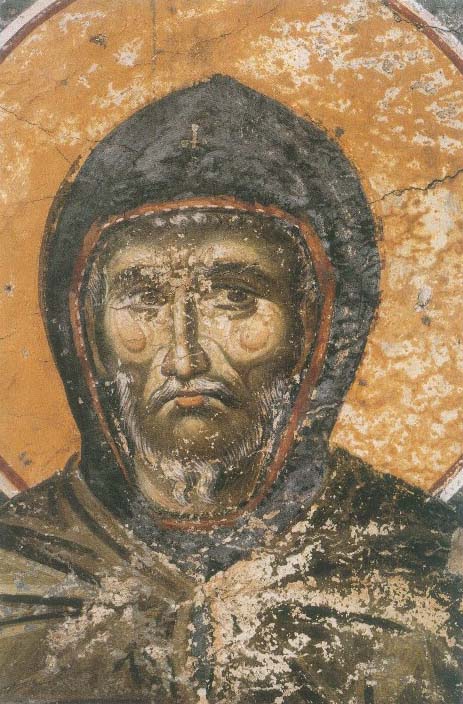
St. Symeon the New Theologian (source)
Through the prayers of our Holy Fathers, Lord Jesus Christ our God, have mercy on us and save us! Amen!