Sunday, March 16, 2014

St. Gregory Palamas, Archbishop of Thessalonica

St. Gregory Palamas, Archbishop of Thessalonica - Commemorated November 14 and the Second Sunday of Great Lent (source)
 

This Sunday was originally dedicated to St Polycarp of Smyrna (February 23). After his glorification in 1368, a second commemoration of St Gregory Palamas (November 14) was appointed for the Second Sunday of Great Lent as a second “Triumph of Orthodoxy.”
Saint Gregory Palamas, Archbishop of Thessalonica, was born in the year 1296 in Constantinople. St Gregory’s father became a prominent dignitiary at the court of Andronicus II Paleologos (1282-1328), but he soon died, and Andronicus himself took part in the raising and education of the fatherless boy. Endowed with fine abilities and great diligence, Gregory mastered all the subjects which then comprised the full course of medieval higher education. The emperor hoped that the youth would devote himself to government work. But Gregory, barely twenty years old, withdrew to Mount Athos in the year 1316 (other sources say 1318) and became a novice in the Vatopedi monastery under the guidance of the monastic Elder St Nicodemus of Vatopedi (July 11). There he was tonsured and began on the path of asceticism. A year later, the holy Evangelist John the Theologian appeared to him in a vision and promised him his spiritual protection. Gregory’s mother and sisters also became monastics.
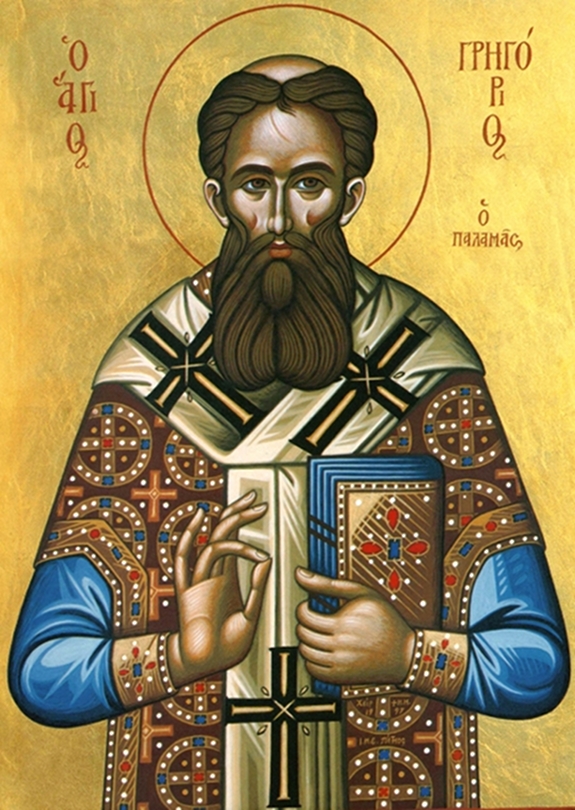
St. Gregory Palamas with his family (who have been also canonized) (source)
   
After the demise of the Elder Nicodemus, St Gregory spent eight years of spiritual struggle under the guidance of the Elder Nicephorus, and after the latter’s death, Gregory transferred to the Lavra of St Athanasius (July 5). Here he served in the trapeza, and then became a church singer. But after three years, he resettled in the small skete of Glossia, striving for a greater degree of spiritual perfection. The head of this monastery began to teach the young man the method of unceasing prayer and mental activity, which had been cultivated by monastics, beginning with the great desert ascetics of the fourth century: Evagrius Pontikos and St Macarius of Egypt (January 19).
Later on, in the eleventh century St Simeon the New Theologian (March 12) provided detailed instruction in mental activity for those praying in an outward manner, and the ascetics of Athos put it into practice. The experienced use of mental prayer (or prayer of the heart), requiring solitude and quiet, is called “Hesychasm” (from the Greek “hesychia” meaning calm, silence), and those practicing it were called “hesychasts.”
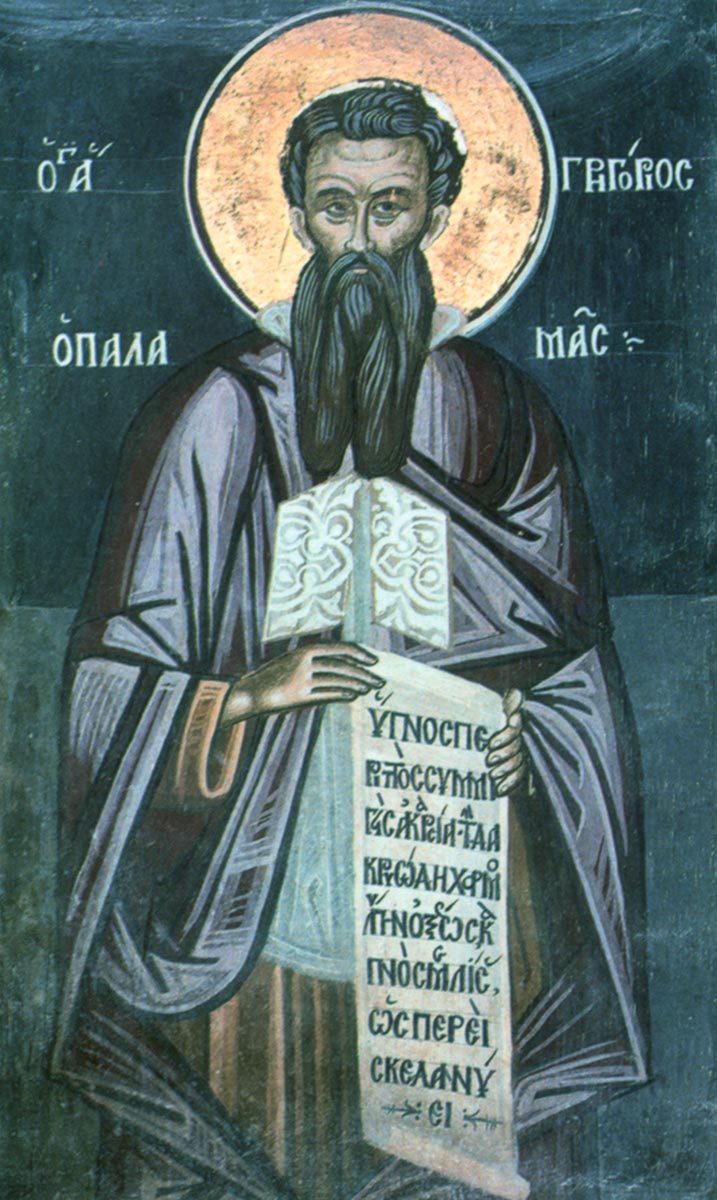
St. Gregory Palamas, depicted as a monastic (source)
   
During his stay at Glossia the future hierarch Gregory became fully embued with the spirit of hesychasm and adopted it as an essential part of his life. In the year 1326, because of the threat of Turkish invasions, he and the brethren retreated to Thessalonica, where he was then ordained to the holy priesthood.
St Gregory combined his priestly duties with the life of a hermit. Five days of the week he spent in silence and prayer, and only on Saturday and Sunday did he come out to his people. He celebrated divine services and preached sermons. For those present in church, his teaching often evoked both tenderness and tears. Sometimes he visited theological gatherings of the city’s educated youth, headed by the future patriarch, Isidore. After he returned from a visit to Constantinople, he found a place suitable for solitary life near Thessalonica the region of Bereia. Soon he gathered here a small community of solitary monks and guided it for five years.
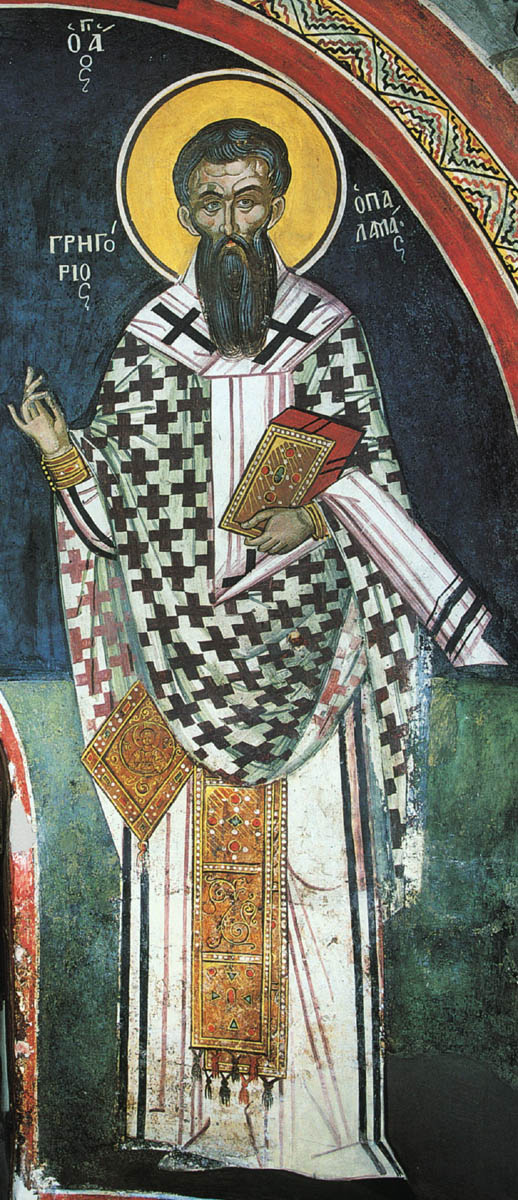
St. Gregory Palamas, depicted as a bishop (source)
   

In 1331 the saint withdrew to Mt. Athos and lived in solitude at the skete of St Sava, near the Lavra of St Athanasius. In 1333 he was appointed Igumen of the Esphigmenou monastery in the northern part of the Holy Mountain. In 1336 the saint returned to the skete of St Sava, where he devoted himself to theological works, continuing with this until the end of his life.
In the 1330s events took place in the life of the Eastern Church which put St Gregory among the most significant universal apologists of Orthodoxy, and brought him great renown as a teacher of hesychasm.
About the year 1330 the learned monk Barlaam had arrived in Constantinople from Calabria, in Italy. He was the author of treatises on logic and astronomy, a skilled and sharp-witted orator, and he received a university chair in the capital city and began to expound on the works of St Dionysius the Areopagite (October 3), whose “apophatic” (“negative”, in contrast to “kataphatic” or “positive”) theology was acclaimed in equal measure in both the Eastern and the Western Churches. Soon Barlaam journeyed to Mt. Athos, where he became acquainted with the spiritual life of the hesychasts. Saying that it was impossible to know the essence of God, he declared mental prayer a heretical error. Journeying from Mount Athos to Thessalonica, and from there to Constantinople, and later again to Thessalonica, Barlaam entered into disputes with the monks and attempted to demonstrate the created, material nature of the light of Tabor (i.e. at the Transfiguration). He ridiculed the teachings of the monks about the methods of prayer and about the uncreated light seen by the hesychasts.
St. Gregory Palamas (source)
   
St Gregory, at the request of the Athonite monks, replied with verbal admonitions at first. But seeing the futility of such efforts, he put his theological arguments in writing. Thus appeared the “Triads in Defense of the Holy Hesychasts” (1338). Towards the year 1340 the Athonite ascetics, with the assistance of the saint, compiled a general response to the attacks of Barlaam, the so-called “Hagiorite Tome.” At the Constantinople Council of 1341 in the church of Hagia Sophia St Gregory Palamas debated with Barlaam, focusing upon the nature of the light of Mount Tabor. On May 27, 1341 the Council accepted the position of St Gregory Palamas, that God, unapproachable in His Essence, reveals Himself through His energies, which are directed towards the world and are able to be perceived, like the light of Tabor, but which are neither material nor created. The teachings of Barlaam were condemned as heresy, and he himself was anathemized and fled to Calabria.
But the dispute between the Palamites and the Barlaamites was far from over. To these latter belonged Barlaam’s disciple, the Bulgarian monk Akyndinos, and also Patriarch John XIV Kalekos (1341-1347); the emperor Andronicus III Paleologos (1328-1341) was also inclined toward their opinion. Akyndinos, whose name means “one who inflicts no harm,” actually caused great harm by his heretical teaching. Akyndinos wrote a series of tracts in which he declared St Gregory and the Athonite monks guilty of causing church disorders. The saint, in turn, wrote a detailed refutation of Akyndinos’ errors. The patriarch supported Akyndinos and called St Gregory the cause of all disorders and disturbances in the Church (1344) and had him locked up in prison for four years. In 1347, when John the XIV was replaced on the patriarchal throne by Isidore (1347-1349), St Gregory Palamas was set free and was made Archbishop of Thessalonica.
In 1351 the Council of Blachernae solemnly upheld the Orthodoxy of his teachings. But the people of Thessalonica did not immediately accept St Gregory, and he was compelled to live in various places. On one of his travels to Constantinople the Byzantine ship fell into the hands of the Turks. Even in captivity, St Gregory preached to Christian prisoners and even to his Moslem captors. The Hagarenes were astonished by the wisdom of his words. Some of the Moslems were unable to endure this, so they beat him and would have killed him if they had not expected to obtain a large ransom for him. A year later, St Gregory was ransomed and returned to Thessalonica.
St Gregory performed many miracles in the three years before his death, healing those afflicted with illness. On the eve of his repose, St John Chrysostom appeared to him in a vision. With the words “To the heights! To the heights!” St Gregory Palamas fell asleep in the Lord on November 14, 1359. In 1368 he was canonized at a Constantinople Council under Patriarch Philotheus (1354-1355, 1364-1376), who compiled the Life and Services to the saint.
The oldest depiction of St. Gregory Palamas, from Vatopedi Monastery, Mount Athos (source)
   

Troparion — Tone 8

O light of Orthodoxy, teacher of the Church, its confirmation, / O ideal of monks and invincible champion of theologians, / O wonder-working Gregory, glory of Thessalonica and preacher of grace, / al-ways intercede before the Lord that our souls may be saved.

Kontakion — Tone 8

Holy and divine instrument of wisdom, / joyful trumpet of theology, / together we sing your praises, O God-inspired Gregory. / Since you now stand before the Original Mind, guide our minds to Him, O Father, / so that we may sing to you: “Rejoice, preacher of grace.”

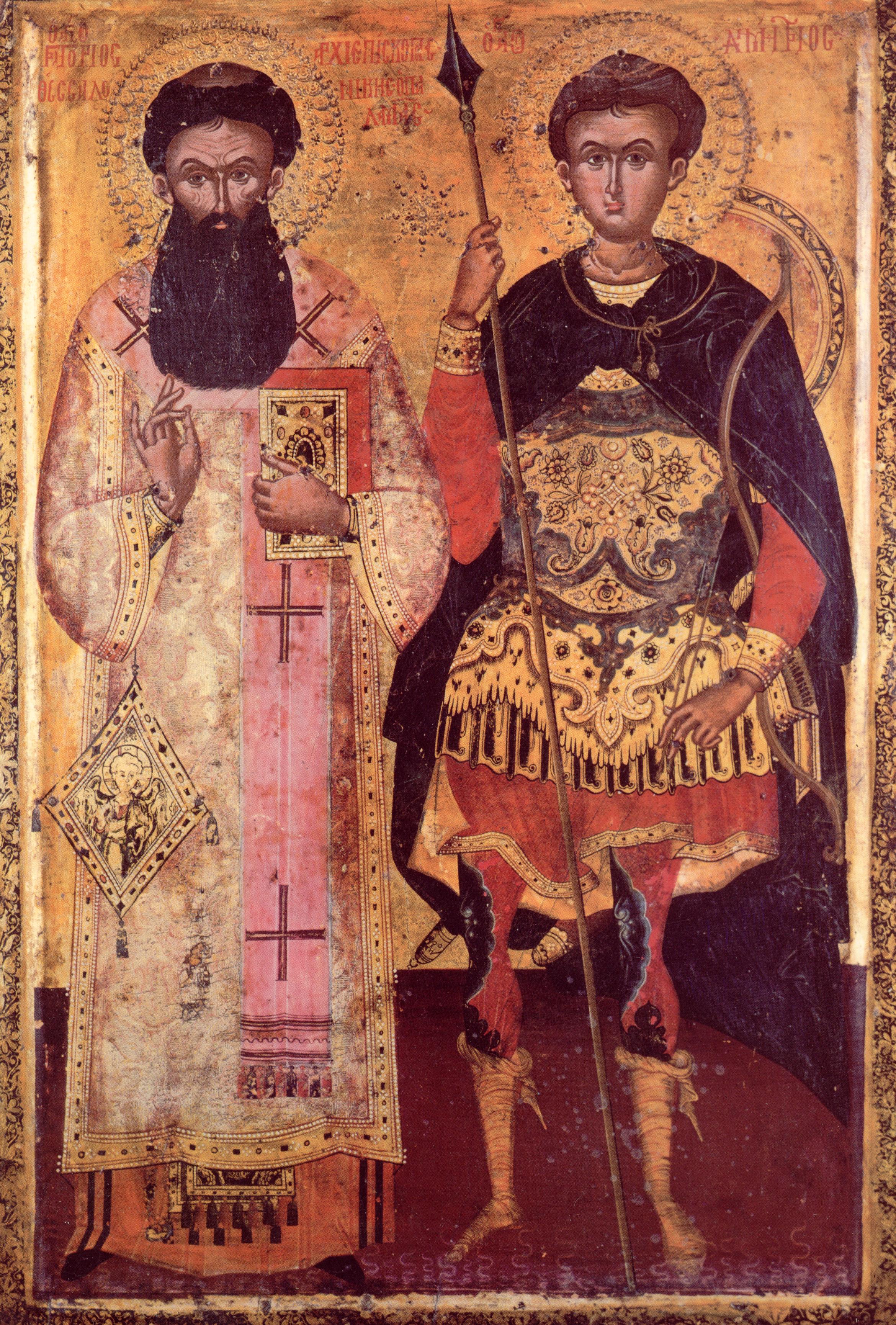
Sts. Gregory Palamas and Demetrios the Myrrhstreaming, patrons and protectors of the city of Thessaloniki (source)
   
Through the prayers of our Holy Fathers, Lord Jesus Christ our God, have mercy on us and save us! Amen!

Thursday, March 13, 2014

St. Ephraim the Syrian: "I cannot Manage My own self; Grant me the spirit of repentance"

Christ embracing the Prodigal Son (source)
 

St. Ephraim the Syrian: "I cannot Manage My own self; Grant me the spirit of repentance" 
Before thy glory, O Christ my Savior, I will announce all my misconduct and confess the infinitude of Thy mercies,which thou pourest out upon me according to Thy kindness.
 
From my mother's womb i began to grieve Thee,and utterly have I disregarded Thy Grace,for I have neglected my soul.Thou,O my Master,according to the multitude of Thy mercies,hast regarded all my wickedness with patience and kindness.Thy grace has lifted up my head,but daily it is brought low by my sins.
 
Bad habits entangle me like snares,and I rejoice at being thus bound.I sink to the very depths of evil,and this delights me.Daily the enemy gives me new shackles,for he sees how this variety of bonds pleases me.
 
The Fact that I am bound by my own desires should provoke weeping and lamentation,shame and disgrace.and yet more terrible is the fact that I bind myself with the shackles that the enemy places upon me,and I slay myself with the passions that give him pleasure.
 
Although I know how dreadful these shackles are,I hide them behind a noble appearance from all who might see.I appear to be robed in the beautiful clothes of reverence,but my soul is entangled with shameless thoughts.Before all who might see,I am reverent,but inside I am filled with all manner of indecency.
 
My conscience accuses me of all this,and i act as if I wish to be freed  of my shackles.Everyday I worry and sigh over this,yet I ever remain bound by the same snares.
 
How pitiful am I;and how pitiful is my daily repentance,for it has no firm foundation.Everyday I lay a foundation for the building,and again with my own hands I demolish it.
 
My repentance has not even made a good beginning as yet;yet there is no end to my wicked negligence.I have become a slave to passions and to the evil will of the enemy who destroys me.
 
Who will give the water to my head,and the founts to my eyes for tears,so that I may ever weep before Thee,O merciful God,that Thou mightest send Thy grace and draw me,a sinner,out of the sea,furious with the waves of sin,that hourly convulses my soul?For my desires are worst than wounds that cannot be bandaged.
 
I wait hoping for repentance and deceive myself with this vain promise until my death.Ever do I say,"I will repent," but never do I repent.My words give the appearance of heartfelt repentance,but in deed I am always far from repentance.
 
What will happen to me in the day of the trial,when God unveils all things at His court!

Certainly I shall be sentenced to torment,if here I have not moved Thee to mercy,O my Judge,by my tears.
 
I hope on Thy mercies,O Lord;I fall at Thy feet and beseech Thee:Grant me the spirit of repentance and lead my soul out of the dungeon of iniquity!May a ray of light shine in my mind before I go to the terrible judgement which awaits me,where there is no opportunity to repent of one's wicked deeds.
Source: "A SPIRITUAL PSALTER" BY  SAINT EPHRAIM THE SYRIAN.
   
Through the prayers of our Holy Fathers, Lord Jesus Christ our God, have mercy on us and save us! Amen!

Wednesday, March 12, 2014

Elder Joseph of Vatopedi on Repentance

The Crucifixion of Christ (source)
   
The greatest benefit which God has granted our fallen nature is none other than repentance. Without it no man would ever secure his salvation no matter how perfect God’s plan to save the world is. Because man’s “every inclination of his heart is evil from childhood”( Genesis 9:21). Given that our inclination towards sin is therefore natural, no one is able to remain without sin, “even if his life is only one day”. Repentance is dual in essence and both of its forms are beneficial to our lives. Its initial stage takes the form of regret for our past sins, followed by the rectification of the wrong deed which brought about the sin.

            According to the spiritual judgement of our Fathers, the whole human activity originates in the mind. This is where every thought is captured as an image and it is gradually being acted out. This is what our most discreet of our fathers, Saint Maximos the Confessor says: “Do not misuse the thoughts, so that you do not abuse things with your actions out of necessity. Because, if one does not sin in his thoughts he will never sin with deeds”. «Μὴ παραχρῶ τοῖς νοήμασιν, ἵνα μὴ ἐξ ἀνάγκης καὶ τοῖς πράγμασι παραχρήσῃ. Ἐὰν γὰρ μή τις πρῶτον κατὰ διάνοιαν ἁμαρτάνῃ, οὐκ ἂν ἁμάρτῃ ποτὲ κατ᾿ ἐνέργειαν»(( Μαξίμου Ὁμολογητοῦ, Τετρακόσια Κεφάλαια περὶ ἀγάπης,Ἑκατοντὰς Β΄, §78.))..( Saint Maximos The Confessor, Four Hundred Chapters on Love, Second Hundred, paragraph 78) When one misuses the thoughts,  the abuse of things will follow. Repentance means: literally recalling the mind to its former position, whereby things are properly ranked. In our generation however, repentance takes more the form of begging God for forgiveness.

                        When one describes our sinful nature, using humble words, one truly expresses  the pitiful and miserable state to which we have been drawn into because of the perversion of the law of sin. Therefore as Paul says: we constitute a hideous “body of death”( Romans 7:24) since we are “wretched because of the law of sin at work within our members”  ( Romans 7:24). This is as far as we are concerned. However, “ Praise be to the God and Father of our Lord Jesus Christ, who has blessed us in the heavenly realms with every spiritual blessing in Christ. For he chose us in him before the creation of the world to be holy and blameless in his sight. In love he predestined us to be adopted as his sons through Jesus Christ, in accordance with his pleasure and will- to the praise of his glorious grace, which he has freely given us in the One he loves”. We brag about this selection and we experience our Father as “ He who lives in unapproachable light” ( A Timothy 6:16). However, this secret mystery remains with us untouched, not just when we find ourselves in a state of contemplation but even when we are inundated with its proximity. Is it not, however, our initial value as created beings in “ his image and likeness”  another mystery? We must therefore, quickly endeavor  to increase our thirst and dwell deeper and deeper unto Himself through our struggle and into the magnificence of our predestination since the  beginning of time.

Who is He, after all? Isn't He the absolute “ Being”, the beginning of everything, the One who has revealed Himself as a person and as an existence “I Am”? We have just now come to know Him through his only co-substantial Son. “No one has ever seen God, but God the only Son, who is at the Father’s side, has made him known”.( John, 1:18) We have also come to know God the Father through the Holy Spirit. “But the Comforter, the Holy Spirit, whom the Father will send in my name, will teach you all things and will remind you of everything that I have said to you”(John 14,26) The incarnate Word of God, who is  a joint ruler and co eternal with the Father and the Holy Spirit, began his gospel saying: “Repent. The kingdom of Heaven is at hand”.(Mathew 4,17) Our sweetest Jesus, our Saviour, the Path, has become our path towards the Father and the Spirit. And They have also connected us with Him. Therefore, the ultimate in the knowledge of God is our true faith and our hope. Many psalms of  David constitute a confession of repentance. “My God, my God why have you forsaken me? Why are you so far from saving me? So far from the words of my groaning? Oh  my God I cry out by day, but you do not answer, by night and I am no silent.Yet you are enthroned as the Holy One; you are the praise of Israel. In you our fathers put their trust; they trusted and you delivered them. They cried to you and were saved; in you they trusted and were not disappointed” ( Psalms 22,1-6)

            Our fathers, next to whom we have studied and whose mouths we have heard speaking the truth, have described as much as possible and as much as we could grasp, the depth, the breadth and the stature of comprehensive repentance. From all these explanations we cite just a few. Repentance, or rather the person who repents, begins with asking God to forgive him his trespasses. As long as he does not repeat the deeds for which he repents, he reaches unto “Third heaven” through the grace of Christ and the meticulous application of the rules of repentance. There, he hears and learns unutterable and unfathonable expressions and contemplations, which he cannot speak of or explain to those who are not familiar with this grace. “Whether it was in the body or our of the body I do not know”. ( B Corinthians 12,2) This state of affairs belongs not just to Paul but to anyone who ardently repents.The crashed and humiliated spirit of man, which thirsts for the wholesome love of Christ, is captured by Him and is lifted up to where the Lord takes him without being able to comprehend where, how and how much is the measure of this.

As our unforgettable elder used to say, the human senses are not functioning  during this state, neither is the mind thinking  but it is just admiring. Only when it returns to its normal state can it express, or vaguely describe if at all, that which it has experienced. Paul was writing to the Corinthians that he was “caught up to paradise and heard inexpressible things which man is not permitted to tell” ( B Corinthians12, 4) Because “No eye has seen, no ear has heard, no mind has conceived what God has prepared for those who love him” ( A Corinthians: 2,9). We only partly conceive  and partly comprehend what is beyond the physical world.

            Our Fathers tell us that recognizing one’s corrupt nature is a great gift of God, even greater than the contemplation of deep theories. When we recognize the internal darkness and when the infernal and dreadful nature of sin is being revealed to us, provoking our repugnance, then the divine grace perceptively grants us its own consolation.

            Saint Isaac refers to various types of consolation and perception of the divine grace, especially  at times when one has to endure long lasting trials. «When I stand in prayer, I can only utter one praise. From there on, even if I stand up in prayer for three days, I remain in awe of God and I have no sense of the effort required”.( Saint Isaac, Third Ascetic Treatise “ On the departure”) And he goes on to say: “I stood outside in the yard of my cell, in bright sunlight. As soon as I started to utter one praise, I was conscious of  my spiritual task, but nevertheless, I was captured, without realizing where I was. I remained captivated in this state all night until the next day when the sun burnt my face again. Then I came to my senses and I immediately realized that it was the next day”. Let no one ever think that those were achievements of the early Fathers.  Since the Lord  “who is the same yesterday, and today, and forever” will grant His grace today to those who are willing to begin the struggle.

            Blessed Elder Joseph, the Hesychast, was telling us that the divine grace presents in itself perceptively at the end of exhausting endurance.“Even to me”, he said, “when trials would increase so that they would exceed my endurance, then out of the blue I would have a comprehension, which according to the Psalms, was relevant to the pressing burden”. “When anxiety was great within me, your consolation brought joy to my soul” ( Psalms 94, 19)”. Once an angel of God gave me the holy communion, another time the Lord, seen hanging on the Cross, reminded me of the love for hard work. Our sweetest Lady has also consoled me several times, appearing to me in person in accordance with her motherly providence, which she especially demonstrates to us, the residents of the Holy Mount Athos. Oh, how pleasing it was to hear her voice, which was as sweet as honey,  guaranteeing my salvation!”

            The divine grace which appears because of repentance, tosses the soul towards God, whose light attracts it. In the beginning, this is not so obvious, but His warmth, which is love, begins to soften the heart. Then surprisingly, a dispute shows up. On the one hand, one is consumed with fear, or rather horror, realizing his own awful guilt. On the other hand, he is swamped with the grace of the presence of God with which he has not been familiar so far. The division of fear is excessive, since the presence of grace opens up one’s eyes and he consciously experiences his own filthiness. The perceived presence of the grace consoles him but he cannot contain his tears, which indicate his honest repentance and his return from the “far away land” where he had spent his “father’s possessions”. Several times the intensity of the horror of the personal sin becomes so strong that hatred against oneself is aroused as well as positive revulsion towards the passions which cause his separation from the beloved God.

            “If anyone comes to me and does not hate… even his own life, he cannot be my disciple” ( Luke 14, 26).  This real intensity of loathing, which is caused by “ the experience of God”, increases the fervor of prayer and becomes like flame. Then, the soul conceives the darkness of death as well as the hope to our Saviour Christ. Such conditions do not come about through human effort but are the results of the philanthropy of the heavenly goodness. I recall how our blessed Elder Joseph was describing this kind of prayer. He had a peaceful look and was expressing, to the extend which we could comprehend,  the tranquility of his thoughts. After this meeting, because it is indeed a divine meeting, a wonderful peace descends on the soul and the perception of the full presence of God reigns in everything.

            “Give blood and take spirit”, says Saint Peter of Damascus. While Saint Maximos the Confessor says: “He who believes is afraid; he who is afraid is humbled; he who is humbled becomes peaceful; he who is peaceful observes the commandments; he who observes the commandments is cleansed; he who is cleansed is illuminated and he who is illuminated by the coffer of mysteries becomes bed-fellow with the groom Word” ( Saint Maximos the Confessor, Four Hundred Chapters on Love, One hundred, paragraph 16). “Small is the gate and narrow the road that leads to life” ( Mathew 7,14). Therefore, the struggle which delivers us from the passions which prevent our illumination, is painful. The long experience of our Fathers has proven this beyond doubt. “God will not enter a body full of sin” (Wisdom of Solomon 1, 4). “The source of all passions is self love and the end result is pride. Self–love constitues the irrational love towards one’s body. He who has uprooted it, has detroyed with it all other passions” ( Saint Maixums the Confessor, Four Hundred chapters on Love, Three Hundred, paragraph 57). Both the source and the final result of this calamity are deadly, but they are especially harmful to prayer. The divine grace only approaches the humble. Both the early and the present day holy fathers, illuminated by grace, have given our super- substantial God, various names, either in accordance with His divine atributes, or in accordance with the way He appears: as the light, the truth, the all- goodness etc. One more attribute which He Himself has testified is: “learn from me, for I am gentle and humble at heart” ( Mathew 11:29) This attribute is particularly significant and that’s why the warriors of all times have not conceived it as a simple virtue but as an indication of His divine character, which has a special referrence to His personality. “Those who belong to Christ” ought to resemble their Father’s character, so that their entry into the kingdom of God is safeguarded and are not sent away as illegitimate children and hear the horrifying saying: “ I do not know you”( Mathew 25, 12) since “ God opposes the proud but gives grace to the humble” ( James 4:6). Pride is a horrible darkness. It is the opposite of the divine goοdness; it is the source of every evil, the root of every tragedy, the sower of hatred, the body of vice whence the disastrous individualism arises. Christ “is the light, the truth and the life”. When this true light embraces us, we feel its love, its wisdom, we perceive Him as the self truth. We obtain with indescribable pleasure discerning knowledge as a state of our spirit. He has said of Himself: “ I am the truth” ( Mathew 14: 6). The Father and the Holy Spirit testified on this. However, one cannot attain a cognitive perception of this theological reality only by hearing about it. “Not everyone who says to me ‘Lord, Lord’ will enter the kigdom of heaven, but only he who does the will of my Father who is in heaven” ( Mathew 7:21). A comprehension of this truth and the discovery of God Word, who is found concealed in His commandments, is only attained to through prolonged and long perseverence in prayer and repentance. The more one perseveres in the observance of the commandments the more illumination and expansion one receives in his mind. “ You have led down precepts that are to be fully obeyed”.( Psalms 119 ,4) “ How sweet are your promises to my taste, sweeter than honey to my mouth!” ( Psalms 118, 103) “The Lord is a lamp to my feet and a light for my path.( Psalms 119, 105)

            The meaning of the cross is distinguished by obedience to the commandments and perseverance in the face of tribulation. Blessed is he who willingly carries his cross. He who generally accepts this burden for the rest of his life, perseveres in a different way. He accepts it as a call by the Heavenly Father. The Christian mission is completed on the cross and through the cross the created being convenes with the uncreated divine Being. Hard pressed by the violence of the lowly passions and the evil spirits, our only safeguard is to take shelter under the One who is able to save us. We therefore, endlessly call out: “ Awaken your might; come and save us.”( psalms 80,2) Our Lord’s uncreated divine grace takes the place of a mother. It comes to our assistance and not only does it rescue us from the symptoms and the hardships, but it also consoles our spirit through its sweet presence and inspires us to have courage in the face of new defenses and assaults. Our spirit broadens and our spiritual cognition is enhanced in the face of trials and of various hardships in general. “Through trials Thou have broaden my spirit” ( Psalms 4,1).  When the valuable habit of perseverance in hardships is formed, then the Lord permits harder tests so that we become perfect. This is the meaning of these words: “Blessed is the man you discipline Oh Lord, the man you teach from your law”( Psalms 94:12).  Our Fathers say: “ It is not possible for one who has sinned to escape the future judgement if he does not persevere willingly in the face of hardships or of the undesirable tribulations”( Saint Maxiums as above, two hundred chapters, paragraph 66)

            Humility is the greatest benefit derived from the onslaught of temptations. The awful beast of pride is crashed and divine knowledge approaches the mind. It is not inappropriate to metaphorically describe the idol of egocentrism as “the abonination that causes desolation which stands in the holy place” ( Mathew 24:15) Nothing is more effective to steer the mind towards humility than the various hardships which befall man, whether willingly or unwillingly. The weakness to free himself by his own efforts, teaches him practically how worthless and vile one is. Then the Lord’s saying : “without me you can do nothing” ( John 25, 5) becomes absolutely true and thus the mind is shifted to the true world of the kingdom of heaven through the divine grace.

            The second point regarding the usefulness of trials is the deeper knowledge of the unknowable designs (κρίματα) of God’s providence which govern the universe. Various events, usually painful and intensive, are the proper therapeutic tools through which τηε divine goodness maintains the equilibrium of our rebellious, fallen nature.

            “If we judged ourselves we would not come under judgement. When we are judged by the Lord we are being disciplined so that we will not be condemned with the world”( A Corinthians 11:31-32)  Once we realize that it is necessary to go through  “fire and water” ( Psalms  66.12) in the face of various temptations, so that they shape the sympathetic image of the wounded man in us and of other human beings, then the real meaning of our fallen nature is formed inside us and the truth of our resurrection follows. God’s philanthropy, which is the result of his fatherly affection and providence, introduces us to the cognition of the divine love. It is true that “The Lord disciplines those he loves, and he punishes everyone he accepts as a son” ( Hebrews 12: 6). As a result, the devout become merciful to their fellow human beings in accordance with the law of influence since “their father is merciful”! (Luke 6,36)

            The Holy Spirit as an educator conveys through Its descend the pain of mankind inside the souls of the devout, since these souls are communicating with the uncreated divine grace, which comprehensively embraces the entire pain of mankind. Let us just stress that we are explaining the meaning of the cross, about which Paul was boasting. He was only relying  on the cross for his spiritual existence; he was believing in it, was hoping in it and was boasting about. All those who have  “crucified their sinful nature with its passions and desires”( Galatians 5, 24) have followed in his footsteps. The reason for God’s emptying of himself was to tackle the wrongful preference towards hedonism- whence came the fall- with its antidote: love for hard work.

            The Word God emptying himself just once because of His all consuming love for us, renders unnecessary all comment and questions. Peter, the best of the disciples, emphasizes that “since Christ suffered in his body, arm yourselves also with the same attitude” ( A Peter 4,1). This begs the question: Is any logical being’s foremost duty to love God totally as Divine and therefore, as his Lord and Creator? This God becomes a reformer and a re-generator and raises the fallen higher than his first position and value and not just higher  but “far above all rule and authority, power and dominion and every title that can be given” ( Ephesians 1,20). Is n’t He worthy of our honour and respect? Our sweetest Jesus, our Lord, by becoming dual in His nature because of the enormity of His self sacrifice, has taken away any pretext that we may have about the so-called freedom of choice or of any other alternative. We have now become spoils of His love. We ought to love him absolutely ( κατά πάντα)  since “ he loved us first”( A John 4,19). If therefore, we recognize none other than our one and only crucified Lord Jesus Christ, is n’t it our absolute duty to practice our love for hard work( φιλοπονία- philoponia)? This is the reason why all those who belong to Christ, during  the three major periods of the life of the Church, have been crucifying themselves because they “want to know Christ and the power of his resurrection and the fellowship of sharing in his sufferings, becoming like Him in his death and so, somehow, to attain to the resurrection from the dead” ( Philippians 3:10-11). It is for this reason that we have been constantly underlying the need to bear one’s cross and practice the comprehesive love for hard work. The Triadic essence of the divine Being rests at the centre of the knowledge of God.  “The Father, the Word Son and the Holy Spirit, are one”( A john 5:7) and each one testifies for the other. This testimony extends towards our own nature. The Lord has entrusted His disciples with the task of bearing witness about Himself. “When the Cousellor comes, whom I will send to you from the Father, the Spirit of the truth who goes out from the Father, he will testify about me; but you must also testify, for you have been with me from the beginning” ( John 15, 26-26) The relationships between people as persons are of the same kind. The testimony, as true life, is forever spinning inside love and creates communion. A person, by nature, cannot live isolated but behaves lovingly towards other fellow human beings and through the virtue of solidarity responds to the others and testifies for them. It is for this reason that our Creator has said that “It is not good for the man to be alone” ( Gen 2,18). The more we adhere to divine precepts through faith and obedience, the more the divine illumination is amplified inside us. True repentance, with all its components, but especially through deep prayer, leads us towards communion and assosiation with the uncreated divine grace, which explains the form of the divine reality. Why is it suprising that we find in Him the comprehension of ourselves through His grace, since we have been initially created in His image and likeness? It is this comprehension which reforms our existence in accordance with the divine attributes, since to all those who “received him, he gave the right to become children of God” ( John 1,12).  Is there anything more natural than children exhibiting their father’s character? By ‘character’ I mean the most crucial of the divine attributes, that of love, which is immediately manifested inside the soul of the person who has received the divine illumination. It is through love that the faithful communicates with his fellow human beings and completes his testimony. Here is a testimony of our fathers who “did not fail to confess, but confessed freely”( John 1,20 )about the truth and the divine promises and about the entire divine revelation. They did not hide from their children nor their brothers, that which they have heard and seen, so that their testimony represents unambiguous evidence and becomes our whole expectation.

Source: Translated by Olga Konari Kokkinou from the Greek edition: Γέροντος Ιωσήφ Βατοπαιδινού, Αθωνική Μαρτυρία, Ψυχοφελή Βατοπαιδινά 2, Έκδοσις β΄, Ιερά Μεγίστη Μονή Βατοπαιδίου, Άγιον Όρος 2008. Taken from here, see for the full quote.
   
Icon of Elder Joseph the Hesychast (source)  
Through the prayers of our Holy Fathers, Lord Jesus Christ our God, have mercy on us and save us! Amen!

Sunday, March 2, 2014

Homily of St. Tikhon of Moscow on Forgiveness (Cheesefare) Sunday

Jesus Christ, as He was seen by Elder Paisios of the Holy Mountain (source)

Homily of St. Tikhon of Moscow on Forgiveness (Cheesefare) Sunday

Today is called "Forgiveness Sunday." It received this name from the pious Orthodox Christian custom at Vespers of asking each other's forgiveness for discourtesy and disrespect. We do so, since in the forthcoming fast we will approach the sacrament of Penance and ask the Lord to forgive our sins, which forgiveness will be granted us only if we ourselves forgive each other. "If ye forgive men their trespasses, your heavenly Father will also forgive you. But if ye forgive not men their trespasses, neither will your Father forgive your trespasses."(Matt. 6. 14, 15)
 
Yet it is said to be extremely difficult to forgive discourtesy and to forget disrespect. Perhaps our selfish nature finds it truly difficult to forgive disrespect, even though in the words of the Holy Fathers it is easier to forgive than to seek revenge. (St. Tikhon of Zadonsk after St. John Chrysostom) Yet everything in us that is good is not accomplished easily, but with difficulty, compulsion and effort. "The Kingdom of Heaven suffereth violence, and the violent take it by force."(Matt. 11. 12) For this reason we should not be discouraged at the difficulty of this pious act, but should rather seek the means to its fulfillment. The Holy Church offers many means towards this end, and of them we will dwell on the one which most corresponds to the forthcoming season of repentance.
 
"Yea, O Lord and King, grant me to see my own transgressions and not to judge my brother." The source of forgiving our neighbors, of not judging them, is included in seeing (acknowledging) our sins. "Imagine," says a great pastor, who knows the heart of man, Father John of Kronstadt, "picture the multitude of your sins and imagine how tolerant of them is the Master of your life, while you are unwilling to forgive your neighbor even the smallest offense. Moan and bewail your foolishness, and that obstruction within you will vanish like smoke, you will think more clearly, your heart will grow calm, and through this you will learn goodness, as if not you yourself had heard the reproaches and indignities, but some other person entirely, or a shadow of yourself." (Lessons on a Life of Grace, p. 149) He who admits his sinfulness, who through experience knows the weakness of human nature and its inclination toward evil, will forgive his neighbor the more swiftly, dismissing transgressions and refraining from a haughty judgment of others' sins. Let us remember that even the scribes and Pharisees who brought the woman caught in adultery to Christ were forced to depart, when their conscience spoke out, accusing them of their own sins. (John 8. 9)
 
Unfortunately, brethren, we do not like to acknowledge our transgressions. It would seem natural and easy for a person to know his own self, his own soul and his shortcomings. This, however, is actually not so. We are ready to attend to anything but a deeper understanding of ourselves, an in vestigation of our sins. We examine various things with curiosity, we attentively study friends and strangers, but when faced with solitude without extraneous preoccupation even for a short while, we immediately become bored and attempt to seek amusement. For example, do we spend much time examining our own conscience even before confession? Perhaps a few minutes, and once a year at that. Casting a cursory glance at our soul, correcting some of its more glaring faults, we immediately cover it over with the veil of oblivion until next year, until our next uncomfortable exercise in boredom.
 
Yet we love to observe the sins of others. Not considering the beam in our own eye, we take notice of the mote in our brother's eye. (Matt. 7. 3) Speaking idly to our neighbor's detriment, mocking and criticizing him are not even often considered sins but rather an innocent and amusing pastime. As if our own sins were so few! As if we had been appointed to judge others! "There is one Lawgiver, who is able to save and to destroy" ? God. (James 4. 12) "Who art thou to judge another's servant? It is before his own master that he stands or falls." (Rom. 14. 4) "Thou hast no excuse, O man, whoever thou art who judgest. For wherein thou judgest another, thou dost condemn thyself. For thou who judgest dost the same things thyself." (Rom. 2. 1) "Examine yourselves, whether you are in the faith; put yourselves to the test." (2 Cor. 13. 5) The pious ascetics provide a good example of this. They turned their minds to themselves, meditated on their own sins and avoided judging their neighbors at all costs.
 
One pious starets, noticing that his brother had committed a sin, sighed and said, "Woe is me! As he sinned today, so will I tomorrow." And the following is a story about another ascetic, Abba Moisei. A monk committed a sin. The brethren, who had assembled to decide his case, sent for Abba Moisei, but the humble starets refused to attend the council. When the rector sent for him a second time, he appeared, but in quite a striking manner. He had taken an old basket, filled it with sand and was carrying it on his back. "What does this mean?" asked the monks, catching sight of him. "See how many sins I bear behind me?" answered Moisei, pointing to the heap of sand. "I don't see them, yet I have come to pass judgment upon another."
 
So therefore, brethren, following the example of the ascetics, upon observing others' sins, we should consider our own sins, regard our own transgressions and not judge our brother. And should we hold anything against him, let us pardon and forgive him, that our merciful Lord may forgive us also.
 
St. Tikhon (Bellavin), Then Bishop of Alaska and the Aleutian Islands, Later - Patriarch of Moscow and all Russia, 1901, Translated from Russian and published in Holy Trinity Cathedral's Bulletin on February 28, 1993. (source)
   
I ask you all to forgive me, the sinner, and may God grant us all forgiveness! May we all have a blessed Great Lent!

Through the prayers of our Holy Fathers, Lord Jesus Christ our God, have mercy on us and save us! Amen!

Saturday, March 1, 2014

Elder Ephraim of Arizona: How easily God forgives!

Jesus Christ, on His Gospel is written: "I am the Good Shepherd..." (source)
 
How easily God forgives! The only thing that must occur is to open the door of your souls to Him. God does not wait for any reward for that which He gives to men. And even if your sins are millions or billions, for God this is counted as nothing. What is the worth of a small amount of sand to the ocean?  All the sins of the world are like a virus to the ocean.

There is no sin which conquers the mercy on God. Thus, the sins of man are zero. When the child returns to the bosom of the Lord, all things cease before His mercy.
-Elder Ephraim of Arizona
 
(amateur translation of text from here)
 
Jesus Christ, the "Good Shepherd, Who lays down His life for the sheep" (source)
 
Through the prayers of our Holy Fathers, Lord Jesus Christ our God, have mercy on us and save us! Amen!

An Orthodox Prayer for Peace in the World

Jesus Christ "O Yperagathos" ("The Surpassing Good One") (source)

ΕΥΧΉ ΥΠΈΡ ΕΙΡΉΝΗΣ ΤΟΥ ΚΌΣΜΟΥ
Δέσποτα Θεέ, Πάτερ Παντοκράτορ, Κύριε του ουρανού και της γης, ο διά την ημετέραν σωτηρίαν εκ Παρθένου τεχθείς και διδάξας τοις ανθρώποις αγάπην και ειρήνην έχειν προς αλλήλους, κατάπεμψον την χάριν σου την επουράνιον και ελέησον ημάς, κατά το μέγα σου έλεος, πάσης ανάγκης ρυόμενος.

Παύσον τα φρυάγματα των εθνών, ειρήνευσον ημών την ζωήν, λύτρωσαι ημάς και τον κόσμον σου από πάσης απειλής εναντίας και δίδαξον τοις ηγέταις των εθνών εν ειρήνη επιλύειν τας διαφοράς αυτών και εν παντί ειρηνεύειν, υπόταξον δε πάντα τα βάρβαρα έθνη τα τους πολέμους θέλοντα.

Εξαπόστειλον περιστεράν, κλάδον ελαίας έχουσαν επί του στόματος, καταλλαγής σύμβολον, τους εν αιγμαλωσία αδελφούς ημών ανάρρυσαι, τους άρχοντας ημών εν ειρήνη και ομονοία διατήρησον, δώρησαι δε ημίνβαθείαν και αναφαίρετον ειρήνην, την πάντα νούν υπερέχουσαν, ίνα ήρεμον και ησύχιον βίον διάγωμεν, σου δεόμενοι υπέρ ειρήνης του σύμπαντος κόσμου και του ευσεβούς ημών έθνους, την συμμαχίαν έχοντες την σήν, όπλον ειρήνης, αήττητον τρόπαιον.

Συ γαρ ει ο Βασιλεύς της ειρήνης και Σωτήρ των ψυχών ημών και σοι την δόξαν αναπέμπομεν, τω Πατρί και τω Υιώ και τω αγίω Πνεύματι, νυν και αει και εις τους αιώνας των αιώνων. Αμήν

(source)
   
An Orthodox Prayer for Peace in the World (amateur translation)
O God and Master, Almighty Father, Lord of heaven and earth, Who for our salvation was born of a Virgin, and taught men to have love and peace among each other, send down Your heavenly grace and have mercy on us, according to Your great mercy, and deliver us from every want.

Cease the fragmentation of the nations, grant peace to our lives, deliver us and Your world from every danger that faces us, and teach the leaders of the nations to resolve their differences in peace and to be in all ways peace-makers, deposing all barbarian nations who desire war.

Send down the dove, bearing the olive branch in its mouth, as a symbol of reconciliation, deliver our brothers in captivity, keep our rulers in peace and harmony, and grant to us deep and inalienable peace, which surpasses all understanding, that we might live our life in peace and silence, praying to You for the peace of the whole world, and for our pious nation, having your alliance as a weapon of peace, and invincible standard.

For You are the King of peace, and the Savior of our souls, and to You we offer up glory, to the Father and to the Son and to the Holy Spirit, now and ever and unto the ages of ages. Amen.
   
Through the prayers of our Holy Fathers, Lord Jesus Christ our God, have mercy on us and save us! Amen!

Wednesday, February 19, 2014

The complaint of St. Nektarios

St. Nektarios the Wonderworker (source)
 
St. Nektarios once appeared to a most-pious cleric and complained:
"It's as if we Saints are in retirement...The people don't pray to us, don't entreat us, don't ask us for anything, don't give us any handiwork to do. They don't give us the opportunity to pray to God for them..."
 
(source: God is with us, are we with Him?, puublication of Orthodox Kypseli)
   
Through the prayers of our Holy Fathers, Lord Jesus Christ our God, have mercy on us and save us! Amen!