Tuesday, April 20, 2010

Revelation of St. Anthony the Great on the Monastic grace

Christ is risen! Truly He is risen!

Icon of the Holy Angelic Hosts (Icon courtesy of www.eikonografos.com used with permission)

Revelation of St. Anthony the Great on the Monastic grace (amateur translation)
St. Anthony said: “I entreated God to show me what help the Monk is granted for his monastic grace, and He showed me a large fiery candle and a multitude of armed Angels, who surrounded the Monk who tried to help save him. And I heard a voice from the Holy Spirit which told the Angels: 'Do not depart from him throughout his life.'

“When I saw such great help, I sighed and said to myself: 'Woe to you, Anthony! How much help God has sent you to protect you, and you are negligent!'

“Again I prayed and said: 'Lord, how does the Devil cheat and mislead the Monk, when he is surrounded with such help?' And I heard again that voice say to me: 'You should know that the Devil does not have power to conquer the Monk because with my incarnation I chopped-up his power, but each is conquered by his negligence and inadequate care.'

“And I said: 'Lord, I wonder, are all Monks granted this help?'

“And the Lord showed me a great mass of Monks, and each of them had his own personal help which I had seen the first time, in other words, a great fiery candle and around it an army of Angels. When I saw these I said: 'Blessed and favored is the race of the Christians and especially blessed are the Monks who have as a help such a good Master, lover-of-man and merciful. Therefore, let us, O brothers, tend to the salvation of the soul without negligence, that we be made worthy of the Kingdom of the Heavens, through the grace and love for man of our Lord Jesus Christ, to Whom belong all glory together with the Father and the Holy Spirit unto the ages of ages. Amen”
(amateur translation of Greek text from: http://orthodoxi-pisti.blogspot.com/2010/04/blog-post_4029.html)

Christ is risen from the dead, by death, trampling down upon death, and to those in the tombs, bestowing life!
Truly the Lord is risen!
"I went to Christouli and Panagitsa high in heaven"

Christ is risen! Truly He is risen!
  
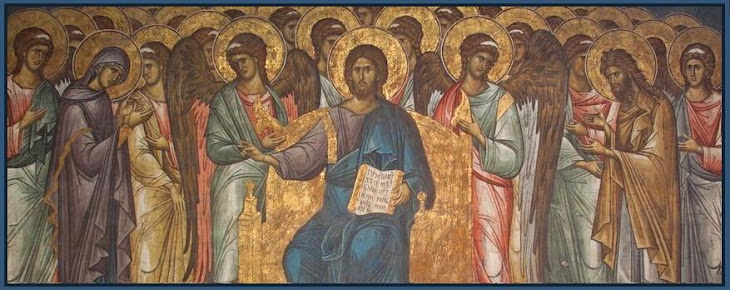
Christ enthroned upon the Cherubim and Seraphim (Icon courtesy of www.eikonografos.com used with permission)

"I went to Christouli and Panagitsa high in heaven" (amateur translation)
E. and T. T., from Drosato N. Kilkis, are the parents of three children. They relate the following:
"On March 30th 2001 we took our M., four and a half years old, to the Hospital in Thessaloniki because of an unbearable stomach pain. With the appropriate tests they diagnosed him with obstructive ileus, and operated on him for three and a half hours, removing half a meter of necrotic gut. Our doctors said that the child passed a very difficult situation, but was not out of danger yet. Monday evening he had a 40 degree (Celsius) fever. Tuesday he was transferred to the ICU with sepsis and acute respiratory shock. His hopes of living were only 10%.

St. Raphael the Hieromartyr of Lesvos - Commemorated Bright Tuesday (http://www.agiosrafael.org/)

In the mean time, without us knowing anything, a neighbor of ours saw St. Raphael in a vision who told her: “Antonina, I'm leaving, because you don't need me any more. I will go to E., he has need of me now!” The woman later learned about our son. A friend of our family from Goumenissa, Mr. P. S., went to St. Raphael in Griva and knelt with the priest reading the paraklesis for the salvation of our child. Our brother A. went in the evening to our empty house to chant the Paraklesis to St. George for the health of M.. At one point the room started to shine, so much that he was shaken. Where did this much light come from? Most likely it was the Grace of the Saint.

After these, the child's situation began to improve, until the Saturday of Lazarus, when he opened his eyes. On Holy Monday he was totally well and exited the hospital. After being sick for 23 days, we left the hospital.

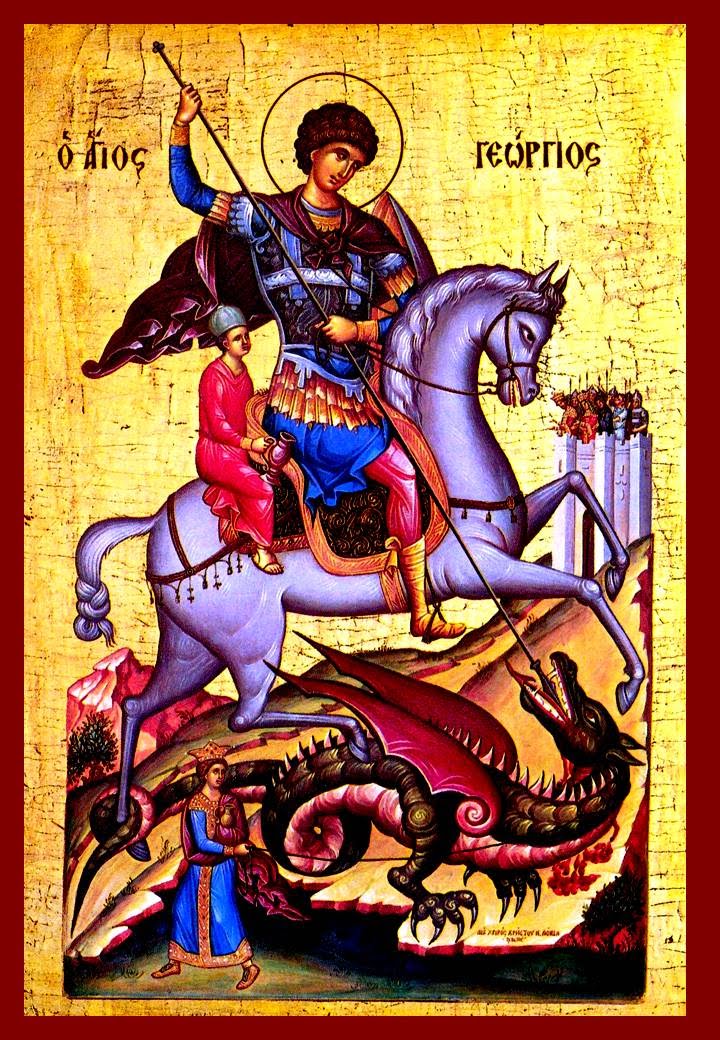
St. George the Trophy-bearer - Commemorated on April 23rd (Icon courtesy of www.eikonografos.com used with permission)

When we returned, he began to tell us different things: “I went to Christouli and to Panagitsa*** high in heaven, where there are a lot of clouds, with the white horse of St. George. I saw uncle Fani (our neighbor who died eight months before) and Despoula (a little girl who died three years before), there were many people I didn't know there and they wore golden angel's clothes and everyone was singing...Christouli and Panagitsa asked me if I have any brothers and what are they called, and told me not to worry, you will go back to Mama and to your brothers.
'I don't know how to get back there.'
'With my horse', said St. George.
'I'm scared, I don't know how to drive the horse.'
'Don't worry, I will drive you.'
M. is near us, a strong child as he was before, and every day we glorify God, Panagia and all the Saints who gave him back to us."
(amateur translation of Greek text from: http://www.imgap.gr/file1/sthavmata.html)

***diminutive terms of endearment for Christ and the Theotokos

Christ is risen from the dead, by death, trampling down upon death, and to those in the tombs, bestowing life!
Truly the Lord is risen!

Sunday, April 18, 2010

Epithets of St. George the Great Martyr

Christ is risen! Truly He is risen!

St. George the Trophy-bearer, the Great Martyr - Commemorated on April 23rd (http://www.rel.gr/photo/displayimage.php?album=26&pos=129)
  
Epithets of St. George the Great Martyr (amateur translation)
We have the practice of giving various epithets to our Saints, from reverence or from some miracle, or from some other reason. The Most-Holy Theotokos surpasses all the Saints in the epithetics which the faithful give Her. Here we compile and describe some of the epithets of St. George from various places.

In Ofi of Pontos, in olden times they called the Saint “St. Aeris”. Also, in Pontos, the Turks called him “Aerts O Zanton”, in other words, St. George “O Trellos” [the crazy person], because he would torture them by afflicting their minds.

In Thrace they call him “Arape” or “Arakleiano” (“Herakleiano”), because his miraculous icon is in Herakleia of Propontidos. “Arape” because the Saint appears black in this icon, which is carved from black rock or hard wood.

In Theseio, they called him St. George “Akamate”, because the Turks did not allow them to serve Divine Liturgy in the church except for on his feast, April 23rd.

The older generations would refer to him as “Afente” [Master or Boss] St. George.

In Kastoria especially, but also in other places, he is known as St. George “O Gorgos” [The Speedy]. This is because he is a very fast Saint to help those who call upon him, as he is called in his hymns: the most-speedy help, the speedy visitation, O speedy protector.

In Crete he is very well known as St. George “O Diasoritis” and he is associated with the former worship of Dia (“Dios-ierou”, or priest of Dia)

["As in the case of the above mentioned Cypriot icon, this epithet is probably of toponymic character and derives from the antique name of Ortaköy, or, according to another version, from the name of the monastery on Amorgos Island within the Cyclades. The expression Diasoritis is usually linked to the composition modelled on the image from the monastery, where the saint is presented frontally, from the waist up, with a lance in his right hand and a round shield in his left." (http://www.icon-art.info/book_contents.php?lng=en&book_id=84)]

Another eponym of his is “Dysouritis”, because he heals dysuria. A fresco from the Monastery of Xenophontos bears the inscription St. George the “Dysourite”.

On Imbros we have St. George “ton Zouro”, because he heals zoura, tuberculosis, and marasmus, to those who leave their rags in his chapel.

St. George is often called “Wonderworker”, “Trophy-bearer”, or “The Great”. He is called thus from his unspeakable miracles which he works for those who call upon him in faith. Furthermore, because he won many trophies, in other words victories and triumphs in the Roman Emperor as an officer. But chiefly in the Church of Christ he triumphs against every evil and conquered the devil. And he is called “The Great” because he is perceived as the greatest and chief of the champions and Martyrs.

In Kaso he is named “St. Kallares”, and elsewhere “St. Kavalares”, because he is a Saint that rides a horse.Others call him St. George “Kappadoke”, because Cappadocia was the home of his father. He is also called “Palaistinos”, from his mother's homeland of Palestine. In Chios and Limne there is a church of St. George “Katadote”. There the Christians gathered to plan for the revolution againt the Genoans. Someone, however, betrayed them and they were all slaughtered.

In Pringkipo he is called “Koudounas”, because on his icon people hang bells, symbols of insanity, which all believe he will heal them of. And there if one wants to say that someone is not well, he says: “he is for the Bell.”

On his feast on November 3rd [The dedication on the church of the Saint in Lydda] he is named “tou Krasa”, or “tou Methyste”, because on that day they open the new bottles of wine.

On Cyprus he is called St. George “tou Sporou”, or elsewhere “tou Sporare”, because from that day begins the sowing of seeds or weed by the farmers.

In Psomathia of the City [of Constantinople] there is a church on the Saint, and in the outer courtyard there is a great cypress which burned in 1782. From this they called the Saint “Kyparissa”. In 1882 because of this story, Patriarch Constantine planted a new cypress.

In many areas the Saint is perceived as the protector of fishermen and they continually call on him to help them in fishing. And it doesn't go well, they call him “Paximadoklefte” [Bread-stealer].

In an area of Messenias called Giannitsa, near the Saint's church it appears that there are traces of horse footprints which people believe are from his horse, and because of this they call him “Petalote”.

In various places he is called St. “Stratego” [Soldier] for the position which it appears he had. In Crete when at one point they built a church to him, some went to fish to pay the workers. And they caught so many fish that they named his church St. George “tou Psaropiaste” [The Fish-catcher].

On the Holy Mountain there is a kelli named St. George “tou Phaneromenou” [The Revealed-one]. It is a kelli far from Karyes. 200 years ago, one night, pirates went to rob the two old monks who were staying there. A young man opened to them in kindness and brought them to the archontariki, and said that he would call the Elder. The robbers waited for a while, and because they didn't see anyone they began to steal. However, they then felt that they were invisibly bound. From they shouts, they awoke the Elders who saw them. When they learned what had occurred, they brought the icon of St. George from the church and the thieves recognized the young man. And immediately they fell down and venerated the Saint in repentance. One of them went and lived in asceticism in Karoulia, where he built a chapel of St. George. After this miracle the kelli took the name: St. George “Phaneromenos”.

Many times they give the Saint the name of the founders of the church, e.g. St. George “O Machairas”, or St. George “O Trachys”, and both of these churches are in Naxos. The one was opened by the Machairadon family, the other by a family named Trachy. In Constantinople there is a church of St. George “O Agridianos”, while on Chios they call him “Pezostrato” or “Ketoktono”.

And places have given him many other eponymns. These are just a few examples.
(amateur translation of Greek text from: http://voutsinasilias.blogspot.com/2010/04/23_18.html)

"In the medieval romances, the lance with which St George slew the dragon was called Ascalon, named after the city of Ashkelon in Israel...

It is singular that the Moslem Arabs share this veneration for St. George, and send their mad people to be cured by him, as well as the Christians. But they commonly call him El Khudder —The Green—according to their favorite manner of using epithets instead of names. Why he should be called green, however, I cannot tell—unless it is from the colour of his horse. Gray horses are called green in Arabic." [St. George is typically depicted on a light colored horse, while St. Demetrios is depicted on a red horse.] A possible explanation for this colour reference is Al Khidr, the erstwhile tutor of Moses, gained his name from having sat in a barren desert, turning it into a lush green paradise."
(http://en.wikipedia.org/wiki/Saint_George)

It is clear that St. George is one of the most beloved Saints of the Church, and as mentioned above, he hastens to help whoever calls upon him in faith. In closing this post about some of the epithets which the faithful have applied to this great Saint out of devotion and thanks to God, I would add that the Apolytikion of the Saint could be viewed as a series of praises or epithets of the Saint:

As the liberator of captives,
and the defender of the poor,
physician of the sick
and champion of kings,
O Trophy-bearer, Great Martyr George,
intercede with Christ God to save our souls.

For the life of St. George with many icons from the Saint's life, see the previous post here: http://full-of-grace-and-truth.blogspot.com/2009/04/st-george-great-martyr-trophy-bearer.html.

For more on St. George as the protector of the Monasteries of Zographou and Xenophontos of the Holy Mountain, see: http://full-of-grace-and-truth.blogspot.com/2009/04/st-george-protector-of-holy-monasteries.html.

Icon St. George the Great Martyr holding his sacred head; the inscription by St. George roughly reads: "Behold what the lawless have done, behold my head cut-off for You", while Christ's scroll reads: "I see it, O Martyr, and bestow on you a crown". (http://www.rel.gr/photo/displayimage.php?album=26&pos=55)

Kontakion of St. George the Trophy-bearer
When you were tilled by God, you proved yourself clearly to be a very worthy tiller of piety, for you had gathered in the sheaves of virtues for yourself. Having sowed the seeds of tears, you now reap the rejoicing; contending to the point of blood, you won Christ as your trophy. And by your intercessions you, O Saint, provide forgiveness of trespasses unto all.
 
Oikos
Longing to be with Christ the King who had laid down His life for the life of the world, George the soldier, the Great, hastens to die for Him. With divine zeal in his heart, he presents himself voluntarily. Let us with faith therefore extol him, as our fervent protector, as a glorious servant of Christ, as one who clearly imitates his Master and entreats Him to provide forgiveness of trespasses unto all.
  
St. George the Great Martyr and Trophy-bearer (http://vogdanos.com/2008/07/02/%cf%83%ce%ac%cf%81%cf%84%ce%b7/)
  
Christ is risen from the dead, by death, trampling down upon death, and to those in the tombs, bestowing life!
Truly the Lord is risen!

Saturday, April 17, 2010

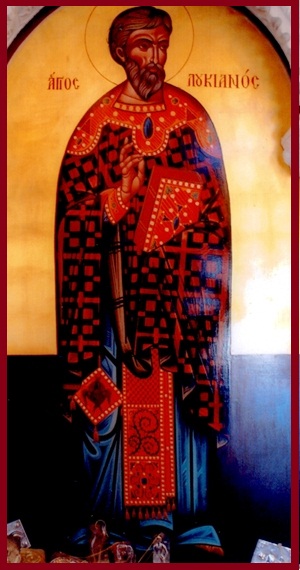
St. Loukianos (Lucian) the Hieromartyr of Antioch, and his miraculous church in Crete

Christ is risen! Truly He is risen!

St. Loukianos (Lucian) the Hieromartyr of Antioch - Commemorated on October 15 (http://misha.pblogs.gr/files/f/319335-36650.JPG)

"The Hieromartyr Lucian, Presbyter of Antioch, was born in the Syrian city of Samosata. At twelve years of age he was left orphaned. Lucian distributed his possessions to the poor, and went to the city of Edessa to the confessor Macarius, under the guidance of whom he diligently read Holy Scripture and learned the ascetic life. For his pious and zealous spreading of Christianity among the Jews and pagans, Lucian was made a presbyter.

In Antioch St Lucian opened a school where many students gathered. He taught them how to understand the Holy Scriptures, and how to live a virtuous life. St Lucian occupied himself with teaching, and he corrected the Greek text of the Septuagint, which had been corrupted in many places by copyists and by heretics who deliberately distorted it in order to support their false teachings. The entire Greek text of the Bible which he corrected was hidden in a wall at the time of his confession of Christ, and it was found during the lifetime of St Constantine the Great.

During the persecution of Diocletian, St Lucian was arrested and was sent to prison in Nicomedia, where for nine years he encouraged other Christians with him to remain steadfast in their confession of Christ, urging them not to fear tortures or death.

["The persecution was horrible and not even young children were spared. Two boys who did not want to eat food sacrificed to idols were thrown into a boiling bath, where in torments they gave up their holy souls to God. A disciple of Lucian named Pelagia (October 8) preserved her virginal purity from dissolute attackers by praying to God on her roof-top: she gave up her soul to Him, and her body fell from the roof...

St. John Chrysostom writes of St. Lucian: ``He scorned hunger: let us also scorn luxury and destroy the power of the stomach that we may, when the time that requires such courage comes for us, be prepared in advance by the help of a lesser ascesis, to show ourselves glorious at the time of battle. (http://www.westsrbdio.org/prolog/prolog.htm)"]

The Martyrdom of St. Loukianos (Icon courtesy of www.eikonografos.com used with permission)
  
St Lucian died in prison from many terrible tortures and from hunger. Before his death, he wished to partake of the Holy Mysteries of Christ on the Feast of Theophany. Certain Christians who visited him brought bread and wine for the Eucharist. The hieromartyr, bound by chains and lying on a bed of sharp potsherds, was compelled to offer the Bloodless Sacrifice upon his chest, and all the Christians there in prison received Communion.(***See below for more details) The next day the emperor sent people to see if the saint was still alive. St Lucian said three times, "I am a Christian," then surrendered his soul to God. The body of the holy martyr was thrown into the sea, but after thirty days dolphins brought it to shore. Believers reverently buried the body of the much-suffering St Lucian.

St Lucian was originally commemorated on January 7, the day of his death. Later, when the celebration of the Synaxis of St John the Baptist was appointed for this day, the feast of St Lucian was transferred to October 15. The October date may be associated with the dedication of a church which was built in Antioch by St Helen (May 21) over St Lucian's holy relics.

Although he was only a priest, sometimes St Lucian is depicted in the vestments of a bishop. The Stroganov Guide for Iconographers was published in Russia in 1869, based on a 1606 manuscript. There St Lucian is depicted wearing a phelonion and holding a Gospel. He does not wear the omophorion of a bishop, however. Another handbook, the Litsevoy Podlinnik, states that St Lucian is to be depicted with the omophorion.

It may be that the Russians thought of St Lucian as a bishop because of his importance to the Church, and so that is how they depicted him. Similarly, St Charalampus (February 10) is depicted as a priest in Greek icons, and as a bishop in Russian icons."
(http://ocafs.oca.org/FeastSaintsViewer.asp?SID=4&ID=1&FSID=102973)


***St. Loukianos and the Holy Mysteries (by St. Nikolai Velimirovic)
"The saints of God place great importance on receiving Holy Communion before their death. Even though they were sacrificing their lives for Christ the Lord and washing away all their sins by the blood of martyrdom, the martyrs longingly received the Holy Mysteries whenever it was possible. St. Lucian was in prison with several of his disciples and other Christians. On the eve of Theophany, Lucian longed, on such a great Christian feast, to partake of the Body and Blood of Christ, for he knew that his death was imminent. Seeing the sincere desire of His sufferer, God Almighty arranged that some Christians pass bread and wine into the prison. When the Feast of Theophany dawned, Lucian called all the Christian prisoners to stand in a circle around him and said to them: ``Surround me and be the Church.'' He had no table, chair, stone or wood in the prison upon which to celebrate the Divine Liturgy. ``Holy Father, where shall we place the bread and wine?'' they asked Lucian. He lay down in their midst and said: ``Place them on my chest, let it be a living altar for the Living God!'' And thus the Liturgy was celebrated correctly and prayerfully on the chest of the martyr, and all received Holy Communion. The next day, the emperor sent soldiers to bring Lucian out for torture. When the soldiers opened the door of the prison, St. Lucian cried out three times: ``I am a Christian! I am a Christian! I am a Christian!'' and with that, he gave up his soul to his God."
(http://www.westsrbdio.org/prolog/prolog.htm)

For more on St. Loukianos, see: http://www.johnsanidopoulos.com/2009/10/orthodoxy-of-lucian-of-antioch.html.
  

The miracles and historical church of St. Loukianos on Crete (amateur translation)
“For a long period of time St. Loukianos was appearing in a vision before me and asked me to build a church dedicated to his name and his grace.” Thus astonishing confession was made to “Espresso” by Fr. Demetrios Marakes (80 years old currently), who in the beginning of the 1990's made the great decision to begin procedures for the creation of the one and only church of our area which is dedicated to St. Loukianos.

The miraculous church is in Loukia, in a small village on the south shore of Crete and roughly 47 kilometers from the city of Heraklion. “At the time when I decided to build a new church together with the faithful of the village, I wanted the name that we would give to fit in with the village somehow. Thus, reading the synaxaristes, I found that which I was searching for so much: St. Loukianos – Loukia. Of course, this was before St. Loukianos had begun to appear to me in my sleep and to come in a vision. Thus without a second thought we made this decision.”

As Papa-Demetris relates to us, the faithful in the beginning might not have known the life and the great work of St. Loukianos, but because the church with such a rare name was going to be the only in the village, they immediately supported his decision. The Saint of course had worked many miracles for the inhabitants and because of this on his feast day, October 15th, faithful from all parts of Crete would visit. Many did not know of him, Papa-Demetris and his work, but he tried to make St. Loukianos known all over Crete.

“In Jerusalem today there is a ruined church of St. Loukianos, but here we have made a new church. We are very proud of this and of course the Saint helped us very much in the completion of these works. We never remained without money. Whenever I sought some help there was always someone to give it. I call this a miracle, as the Saint has worked very many miracles for the faithful.

A blind man again receives his sight, and a worker is saved having fallen from the dome...

From 1994 when we had the Thyranoixia of the church until today, St. Loukianos has offered his blessing to many parishoners, as Papa-Demetris reveals to us. “A faithful person who is of course known to many here in the village, a blind man from the village of Zaros, came here and venerated and shortly received his sight. And outside the church there was a terrible accident and the driver was not hurt at all. There are a lot of thinks that I have to remember and also more from the people who don't keep it a secret.”

Many other stories happened during the period when the church was still being built. “The contractor had asked me to get the soil after we had done the digging. I gave it to him to my great joy. As soon as the workers loaded the soil in the cart and the contractor was ready to leave, then very horrible happened, the car which until then worked normally died and wouldn't go forward. As soon as we unloaded the material, then it began to work again.

Later I learned that we don't remove even the dirt from the church. Thus the Saint wanted nothing to leave from that place. A worker fell from the dome when he was plastering it. The height was very great, but the Saint is good, the man didn't suffer anything.”

Architecturally the church is Cross-shaped with a dome and internally it isn't missing anything from any of the other churches of large cities. Internally it holds at least 500 people, while from the day it was built many couples chose to have their weddings there.
(amateur translation of the Greek text from: http://misha.pblogs.gr/2010/04/o-agios-loykianos-o-neofanhs-sto-rethymno.html)
  
  
Troparion - Tone 3
Radiant with the Spirit, you taught true knowledge of the true faith; a trainer of martyrs, O Lucian, you were glorified in contest. Intercede with Christ our God that he may grant us great mercy!

Another Troparion - Tone 4
Your holy martyr Lucian, O Lord, through his suffering has received an incorruptible crown from You, our God. For having Your strength, he laid low low his adversaries, and shattered the powerless boldness of demons. Through his intercessions, save our souls!

Kontakion - Tone 2
We honor you with hymns of glory, Lucian, the radiant star. You first became radiant by your detachment from the things of this world; then you were raised up by your struggle. Unceasingly pray for us all.


Christ is risen from the dead, by death, trampling down upon death, and to those in the tombs, bestowing life!
Truly the Lord is risen!

Thursday, April 15, 2010

St. Makarios of Corinth, the island of Patmos, and his miraculous Icon

Christ is risen! Truly He is risen!

St. Makarios Archbishop of Corinth - Commemorated on April 17th (http://www.chiosnews.com/cn1542010648330.asp)

In a few days is the feast of St. Makarios Notaras, Archbishop of Corinth, and he is greatly honored throughout the world. His virtuous life is very instructive and moving (see the following link for a good overview of his life: http://logismoitouaaron.blogspot.com/2009/05/shepherd-of-corinth-really-blessed.html). His role as one of the leaders of the famed "Kollyvades" movement that has involved so many contemporary Saints is also honorable (see: http://full-of-grace-and-truth.blogspot.com/2009/04/synaxis-of-holy-kollyvades-fathers.html). His work with St. Nikodemos of compiling the Philokalia is awe-inspiring, as it has helped thousands spiritually throught the world. And his spiritual guidance of no less than three Neomartyr Saints of our Church (St. Polydoros (http://full-of-grace-and-truth.blogspot.com/2009/09/st-polydoros-new-martyr-of-cyprus-and.html), St. Theodore the Byzantine (http://full-of-grace-and-truth.blogspot.com/2009/02/holy-neomartyr-st-theodore-byzantine.html), and St. Demetrios of Peloponnesos (http://full-of-grace-and-truth.blogspot.com/2010/04/st-demetrios-new-martyr-of-peloponnesus.html)) reveals to us what a virtuous, humble and loving person he was, and how he has and continues to guide many to Christ. And he and his Holy Relics continue to work many miracles, as he is honored by the Church in Chios (the place of his repose), Corinth (his former see), Patmos, and many other places.

The following is an amateur translation and summary from an interesting page about St. Makarios and the island of Patmos, including a miraculous icon of him. May we all have his blessing!


St. Makarios and the Island of Patmos
On the Holy island of the Apocalypse St. Makarios remained a total of ten years, from 1782-1793 (with short trips to Corinth, Ikaria, the Holy Mountain, etc.) and lived in asceticism without his Hierarchical duties.

During the period which St. Makarios was on the island, the Ecumenical Patriarch Neophytos VII, with a Patriarchal sigil of 1793, removed the then Abbot and Patriarchal Ecarch of Patmos, and until his replacement was elected, installed Hieromonk Daniel (friend and fellow ascetic of Gregorios Gravano, to whom the Patriarch Neophytos himself confessed).

He visited Smyrna, Chios, and later the monasteries founded by the Kollyvades on Ikaria. He then returned to Patmos, and after the election of the new Abbot-Exarch, he left satisfied for Chios, where he remained until his death.

In the treasury of the Holy Monastery is preserved (in excellent condition) his Hierarchical robe, one of his pastoral staffs, a red phelonion, a censer with bells, an antimension, along with many codeces in the Monastery library. During the first months of his stay on Patmos, the Saint inhabited a small ascetic hut at the foot of the Aipos mountain, in the area of Vrontades, today called Agiasma.


The history of the miraculous icon of the Saint
In 1922, George Photeinos and his family were among the many Greeks forced to flee their home in Kokkinia of Asia Minor. He set off with whatever belongings and people he could loaded into his cart. However, after a few meters, the horse pulling the cart began to bray and pull back, risking overturning the cart. George tried without success to pull it along with the help of others, but it continued in the same way. After enough time in this situation, the horse began to walk with his foot in a hidden place and after a short time it appeared to uncover a rectangular object from the water. At this point, the horse neighed, and having lifted its foot, it began to move as normal as if nothing had happened.

All the people ran to see what this rectangular piece of wood was that was uncovered, and they found that it wasn't a simple board, but it was painted on top. George took it and tried to clean it with whatever he could find. Slowly he cleaned the face and revealed that it was an icon of a monastic priest, and he read the epigraph which said: St. Makarios of Corinth, with the date written as November 10th 1850.

Immediately everyone crossed themselves and venerated the holy icon with faith, amazed by the miracle of its finding and being saved from the rainstorm. Then George asked those standing around if anyone had had this icon (thinking that it fell from one of their carts), but no one had seen it before. Thus, with fear of God he took it to his home and placed it in his icon corner. He tried for many days to find someone who had lost it, but he was unable. Thus, according to everyone's suggestions (clergy and people) he decided to keep it.

The years passed until 1940, when World War II left many sick and hungry, with many selling all that they had for a bit of bread. George and his wife faced the same problem. They sold almost everything they had to survive, with the exception of their icons. Unfortunately they did not survive this tribulations, and passed away in 1942. Their few belongings the left to their relatives, with the icon of St. Makarios being taken by George's sister.

After years it passed to the hands of her daughter, Despina Delle, who after a trip to Patmos between 1988 and 1990, visited the Monastery, and there came to know the former Abbot of the Holy Monastery of St. John and Exarch of Patmos (1961-1963) and head of the Patmias School Fr. Paul Niketara (+1999) (the uncle of the current God-protected Abbot and Patriarchal Exarch of Patmos, Fr. Antipas Niketara), and on her next trip, she brought with her the icon which from that point on was treasured by the Monastery, where it is especially honored.

The year 2005 completed 200 years since the death of the Saint, and the Exarchy of Patmos (with the blessing of the Ecumenical Patriarch), decided to dedicate its calendar to St. Makarios Archbishop of Corinth.
(amateur translation of Greek text from: http://syndesmosklchi.blogspot.com/2009/04/blog-post_25.html)


Apolytikion of St. Makarios of Corinth in the First Tone
Let us faithful praise the shepherd of Corinth, the really Blessed one, who by God’s providence, for reasons ineffable became Chios’ great spiritual leader—him who shone through deeds, words, and prayers; for truly he received from God grace for healing the sick and driving away unclean spirits. Glory to the Father Who destined him, glory to the Son Who elevated him, glory to the Spirit who acts through him.
(http://logismoitouaaron.blogspot.com/2009/05/shepherd-of-corinth-really-blessed.html
)

The full life and service of the Saint (in Greek), respectively, are available here (though I'm not sure if they could be used liturgically or not): http://analogion.net/music/Akolou0iaiAgiwn/0417_BiosAgiouMakariouKorin0ou.pdf, http://analogion.net/music/Akolou0iaiAgiwn/0417_Akolou0iaAgiouMakariouKorin0ou.pdf.
  

Christ is risen from the dead, by death, trampling down upon death, and to those in the tombs, bestowing life!
Truly the Lord is risen!
St. Demetrios the New Martyr of Peloponnesus (+1803)

Christ is risen! Truly He is risen!

St. Demetrios the New Martyr of Peloponnesos - Martyred in Tripoli on April 14th 1803 (and also commemorated on May 22nd) (http://vatopaidi.files.wordpress.com/2010/04/ceacceb3ceb9cebfcf82-cebdceb5cebfcebcceaccf81cf84cf85cf82-ceb4ceb7cebcceaecf84cf81ceb9cebfcf821-e1271194579161.jpg)
Life and Martyrdom of the Saint (amateur translation)


The Saint was from the town of Ligouditsa of Arkadia. When he was still a child he was orphaned with another brother, and his father, Elias, married a second woman. Their step mother treated the two brothers poorly, and therefore as soon as they were older they left home. The older brother went to Tripolitsa and became a servant in a Turkish house, the younger brother, Demetrios, became affiliated with some builders who took him from place to place to build things. One time they went to Tripolo and there Demetrios consorted with a Turkish boy. One day, because of a disagreement over money, he left the builders and went to be a servant in a Turkish house. Slowly, however, childhood attachments convinced him to abandon his people and to embrace islam. When his older brother learned this, he went to meet with him, and tried to convince him of the great evil which he suffered, for he had also converted to islam.

As soon as their father learned this, he came to Tripoli to find them. What happened to the older brother, we do not know. The younger boy, Demetrios, as soon as he heard that his father was coming, did not dare appear before him, either from shame or fear. Thus the father left without seeing his son. However, his presence had an effect, because Demetrios began to think how he saddened his father and what a great evil he committed, that his father would go to such an effort to come from his town to meet him. He began to regret his decision, and to berate himself, and within him was born words of repentance and return to Christ.

At the first opportunity, he left the Turk's house with goal of returning to his hom. However, he did not know the way, so he managed to each Stemnitsa. There a Christian woman housed him, who told him that he took the wrong road and that he would have to return and set-off with a guide. He returned and waited for a chance to leave. In the meantime, he tried learning the skill of hair-cutting, as the master of his house was a barber, but he was not content in his efforts.

One day he met some Christians, who were going to Smyrna. Thus he decided to change plans and to follow them. From Smyrna he headed to Magnesia of Asia Minor, where he knew some people. There he confessed to a spiritual father, however, because of the presence of many Turks, his spiritual father wanted to send him to a safer place. There was also a plague in that region, so he decided to leave.

With God's illumination and the help of some Christians, he traveled to the Monastery of the Precious Forerunner, which was on a small island of the gulf between Aivali and Moschonisia. There in the safe environment of the Monastery, he confessed to the Abbot and returned to the Church, together with Church order by the Mystery of Holy Chrismation.

Because his conscience calmed, he left the Monastery and worked in Moschonisia for a year in a coffee shop and then in Kydonies as a barber, and made a lot of money. He also donated a beautiful vigil lamp to the icon of the Precious Forerunner in the Monastery.

With the passage of time, however, the love of Christ and the desire for martyrdom was lit within his heart. Then he of course heard of the New Martyrologion by St. Nikodemos, and learned about the Neomartyrs, and the desire for confession and martyrdom grew within him. He went therefore to the Abbot of the Precious Forerunner and confessed his desire, and asked him to guide him, that his desire might come to pass.

The Abbot sent him with a letter to Chios, where St. Makarios Notaras (http://logismoitouaaron.blogspot.com/2009/05/shepherd-of-corinth-really-blessed.html), the former Metropolitan of Corinth (and trainer of other Neomartyrs: Sts. Polydoros (http://full-of-grace-and-truth.blogspot.com/2009/09/st-polydoros-new-martyr-of-cyprus-and.html) and Theodore of Byzantium (http://full-of-grace-and-truth.blogspot.com/2009/02/holy-neomartyr-st-theodore-byzantine.html)), was living. The Saint received him with much love, consoled him, and praised his love for Christ and his desire for confession. He stressed to him, however, that with repentance man can be saved from whatever great sins he had committed. He urged him to abandon the idea of martyrdom, because of his young age in case he would not be able to bear the tortures and fall into the same serious sin and deny Christ a second time. With many arguments he tried to dissuade him from martyrdom. The Saint listened to what St. Makarios told him without responding, however within his heart the love for Christ was like a fire. Thus he began to struggle spiritually with unceasing prayer, vigil roughly the whole night, countless prostrations, Parakleses to the Most-Holy Theotokos and continuous tears. He cried bitterly as another Apostle Peter for his denial, as if all of these did very little to redeem him. For further ascesis, he went to a narrow cave, despite the cold of winter, where there was a spring, and continued his ascesis, as much as he could.

As he prepared spiritually according to the judgment of his trainer, St. Makarios, and having confessed cleanly all of his sins that he could remember, his spiritual father again counseled him to abandon his goal of martyrdom. Though he was silent externally, his heart however skipped at the idea of confessing his Faith. Thus, not being able to restrain it any longer, he sought permission of his Elder to go to the place where he had denied Christ, to find his brother, to teach him about his fall and also to confess and suffer for Christ. St. Makarios, seeing his steadfastness, having admonished him, prayed and let him go with his blessing, giving him a letter to give to a certain learned spiritual father in Argos, to support him. Traveling to Argos, he did not find this spiritual father, for he was absent. He stayed therefore near a virtuous Christian, waiting the return of the teacher, continuing his spiritual struggle with prayer, vigil, fasting and tears. As the days passed and the teacher was delayed, Demetrios, unable to hold back the flame in his heart, left for Tripoli with a God-fearing Christian. The priests who had learned of the reason of his traveling to Tripoli, because of fear of reprisals by the Turks, tried to convince him to return. The Saint, however, with great humility, calmed their fears.

Having communed the Immaculate Mysteries, he went to the agora of Tripolitsa to see if anyone recognized him, but no one did. In the end, with the blessing of the most-pious priest Anthony he went to his former master's barber ship, and greeted him with: “Christ is risen!”. It was the week after the Sunday of St. Thomas. When he asked him who he was, he answered:

“I am the Demetrios, who in this wretched work place denied Christ, and I have come now to shed my blood for Him”

The Christians, as soon as they heard this, left immediately.

A helper of the master who was a Turk, told tim:

“What's this, Mehmet, come to your senses, don't you pity your life? The Turks will kill you.”

“I've come because of this” the Saint said.

“Eh, come in the yard, I'll cut your throat with the razor.”

Immediately the Saint ran and put forth his neck, but the Turk, however, went outside, telling him to find someone else.

In the meantime, his former master began to try to get him to return with threats and flatteries, but to no avail. He offered him money to go far away and live as a Christian. But he did not even give in to this.

He only said: “I am a Christian, I'm not leaving. I have come to confess my Faith and to shed my blood for my Christ.”

In the meantime, these events were becoming known, and the Christians, wherever they were, prayed for the grace of God to strengthen him, that he complete his struggle in a God-pleasing way, while the Turks seized him and took him initially to the commissioner of the pasha. He asked him who he was and why he left his faith.

The Saint responded in Greek: “I was and am a Christian and I worship my Christ as true God.”

Because the judge didn't speak Greek, he asked what he was saying, and some Turk told him: “I was a and am a Turk” in order for the Saint to avoid martyrdom.

Then the Saint responded in Turkish with his correct homily. The judge ordered him to be imprisoned until he could be seen by the pasha. When he later appeared before the pasha and many high-profile Turks, the pasha tempted him with flatteries, the others with positions, and then terrible threats of tortures.

The Saint again confessed his faith in Christ, at which point the pasha ordered him to be beheaded. The saint was led joyfully bound to the center of the agora There having stood and prayed, thanking God Who made him worthy of martyrdom, he knelt willingly, however the executioner got him up and led him to his master's barber shop, where he did the same to scare him.

He lifted him up again and hit him and led him to the fish marked, where he beheaded him with three strokes, while the Saint said: Remember me, O Lord, when You come into Your Kingdom.:

And though he was turned towards the west, his body turned towards the east after it was beheaded. After a short time later, the martyrs eyes opened and the separated head appeared as if it were alive, to the amazement of the faithful and the shame of the faithless.

The Saints hastened with gladness to take from his blood, his clothes, or from his martyred relic, which bore an incredible fragrance.

After three days the decision was made to burn the holy relic. However, in the end, with a lot of money, they threw it outside of the walls, from it was gathered by the Christians and buried with reverence. Many miracles followed and many miraculous cures were worked with the grace which was granted to the blessed Demetrios by the Lord Who grants struggles.

The precious relic is today found in the Holy Monastery of St. Nicholas Varson, and his holy skull in the Holy Church of St. Basil in Tripoli.
(amateur translation of Greek text from: http://vatopaidi.wordpress.com/2010/04/14/%ce%bf-%ce%ac%ce%b3%ce%b9%ce%bf%cf%82-%ce%bd%ce%b5%ce%bf%ce%bc%ce%ac%cf%81%cf%84%cf%85%cf%82-%ce%b4%ce%b7%ce%bc%ce%ae%cf%84%cf%81%ce%b9%ce%bf%cf%82-%ce%bf-%cf%80%ce%b5%ce%bb%ce%bf%cf%80%ce%bf%ce%bd/)
 
  
St. Demetrios is honored along with St. Paul the New Martyr as a Patron Saint of the city of Tripoli in the Peloponnese. On May 22nd (the day of St. Paul's martyrdom), both of their Holy Relics are processed through the city and are honored in various Church services. See the following Greek site for more information and pictures: http://www.inarcadia.gr/culture/ekd/ekd-padim.htm. May Sts. Paul and Demetrios the New Martyrs intercede for us all and help us! Amen!

Sts. Paul and Demetrios the New Martyrs, Patron Saints of Tripoli (http://www.inarcadia.gr/culture/ekd/padim/neom1-500.htm)

Απολυτίκιον - Ήχος α'
Της Τριπόλεως δόξα και θερμοί αντιλήπτορες, αθλήσαντες εν ταύτη Νεομάρτυρες ώφθητε, Δημήτριε γενναίε αθλητά και Παύλε των Μαρτύρων μιμητά δια τούτο την αγίαν μνήμην υμών τιμώντες, ανακράζομεν. Δόξα τω ενισχύσαντι υμάς, δόξα τω στεφανώσαντι, δόξα τω ενεργούντι δι' υμών πάσιν ιάματα.

Apolytikion of Sts. Demetrios and Paul the New Martyrs in the First Tone (amateur translation)
The glory and fervent protectors of Tripoli, you were shone to be Neomartyrs by struggling in her, Demetrios O brave champion and Paul the imitator of the Martyrs, because of this we honor your holy memory, crying out: Glory to Him Who strengthened you, glory to Him Who crowned you, glory to Him Who grants healings of all through you.


Christ is risen from the dead, by death, trampling down upon death, and to those in the tombs, bestowing life!
Truly the Lord is risen!

Wednesday, April 14, 2010

Selected miracles of St. Onouphrios the Great

Christ is risen! Truly He is risen!

St. Onouphrios the Great - Commemorated on June 12th (Icon courtesy of www.eikonografos.com used with permission)

Selected miracles of St. Onouphrios the Great
1. A miracle performed to a Turk forester.
"This event was conveyed to me by elder Christodoulos, when I was at the Saint Onoufrios Seat and was helping father Ierotheos, who was a gardener, on June 12th, 1944. Father Christodoulos remembered this event, which took place during the Turkish occupation of Greece around 1910, and passed it on to honor the memory of Saint Onoufrios.

“During those days, when I was younger and while I was protecting the forest of the monastery, I met with a Turk forester on my way up to Panayia. He was a government official. After we have been walking around the forest for hours and showing him the boundaries of the monastery, we finally settled here to rest and eat something. The Turk, who was of a strong build, had gotten very tired from our wonders and went down to the fountain to drink water. He was drinking so much, I do not even know how much he drank, and was very pleased. He was telling me: “A! Massialla, massialla, this is cold, this is good” and continued drinking… Not long after, he felt this strong pain and his belly bloated. The swelling was reaching up to his chest and he started crying and asking for help. But I did not know what to do. “I will burst, I will burst!!

Ah! What an ordeal! I turned and toldl Father Joachim, the Crete, you remember him, don’t you?

-Father he will die and we will be in trouble.

- E, so what! Do you feel sorry for the Turk? Let him die.

- But it is not like this. They will find us guilty, they will drag us to Thessaloniki and God knows how much the monastery will have to pay.

- Ok. What kind of medicine do we have here in the mountain? Do whatever you want. I do not want to get involved. Why did he drink so much, to burst?

Then in my despair I remembered Saint Onoufrios. He is the only one who can save him if he wants to.

The Turk was lying down; was moaning, crying and was screaming for help. I went to the Saint’s icon and bowed down three times. Saint Onoufrie, please help us, so that we do not get into trouble”.

I took the container with Ayiasmos and prayed in front of the icon with my knotted cord, asking faithfully for his help. I picked up the Turk, took him inside the church, placed him in front of the Saint’s icon and told him: “This Saint is the landlord of this house. Only if you ask him, with all your heart, he can save you from death. Bow to him three times, kiss his feet and drink from this holy water and you will be cured”.

Whether he was scared or because of his need, he did as I told him willingly. He bowed three times, his kissed his legs and drunk from the holy water. Afterwards I told him: “Do not be scared. The Saint will cure you. Take a walk to the fountain and you will feel better”. He was listening carefully and did as I told him showing perfect faith. And Lo and behold, my brothers! The miracle was performed!

Fifteen minutes later, he came back totally healthy, while a few minutes ago he was half dead. He then happily and loudly thanked the Saint for the cure and bowed to him many times.

This is what Father Christodoulos told us and we marveled at how the Saint performed wonders even to the unbelievers when they devotedly ask for his help. That is the reason I thought I should recall this event to honor the memory of Saint Onoufrios, the Egyptian.

2. Father Theodoulos recalls a miracle performed by Saint Onoufrios
Father Theodoulos recalled an incredible miracle performed by Saint Onoufrios which took place two years ago, in August 1956.

“ I was planting onions at our farm devoted to Saint Onoufrios, with Anastasios, a labourer from Sykia Xalkidikis. When the time came to leave, we loaded two big sacks of onions on the donkey and started on our way. I felt that something bad was going to happen to us. I told him to lead the donkey, walking in front of it until we reached the monastery because the road was rough and narrow. He didn’t pay attention to my words and said that the animal knew his way better than us. As soon as we passed the two benches and were heading towards the third, one of the sacks which were very heavy, hit the rock on the side of the narrow strip and pulled the donkey downwards towards the other bench. The donkey was trying to get up, but because it was carrying a very heavy load, did not manage and instead it fell into the void. He fell down more than 30-40 feet to the bottom of the river. Oh what a disaster! I thought the donkey had been killed. What was I going to say to the fathers at the monastery?

Then, I remembered the landlord of the farm and from the bottom of my heart I prayed:” Saint Onoufrie, please help us; show us your love and perform a miracle so that the donkey is not killed”. I continued praying with great grief and sorrow while we were very carefully descending towards the river bed. And what do I see? Glory be to my Lord for His astonishing wonders! Saint Onoufrios heard my prayers and appealed to the Lord Almighty and did not permit the animal to die. We found the animal well and healthy, standing on its feet while all the sacks had been were thrown down.

When I saw this wonderful paradox I thanked Saint Onoufrios, who is the protector of this farm and who performs wonders to those who call for his help with love and devotion, for his intervention to our Lord. May also his appeal to the Lord help us secure eternal life and the happiness of the Kingdom of Heaven. Amen”.
(Source: Λαζάρου Μοναχού Διονυσιάτου, Διονυσιάτικες Διηγήσεις, Έκδοσις Ιεράς Μονής Αγίου Διονυσίου Αγίου Όρους, β’ έκδοσις, 1988; Monk Lazaros of Dionysiou, Stories of Dionysiou, Second Edition, Holy Monastery of Saint Dionysios, Holy Mount Athos), Translation from Greek by Olga Kokkinos, journalist - http://vatopaidi.wordpress.com/2010/04/14/miracles-by-saint-onoufrios/)

For the life of St. Onouphrios, see: http://ocafs.oca.org/FeastSaintsViewer.asp?SID=4&ID=1&FSID=107799.

Christ is risen from the dead, by death, trampling down upon death, and to those in the tombs, bestowing life!
Truly the Lord is risen!