Sunday, April 24, 2011

Additional Quotes of the Fathers on the Resurrection of Christ

Christ is risen! Truly He is risen!
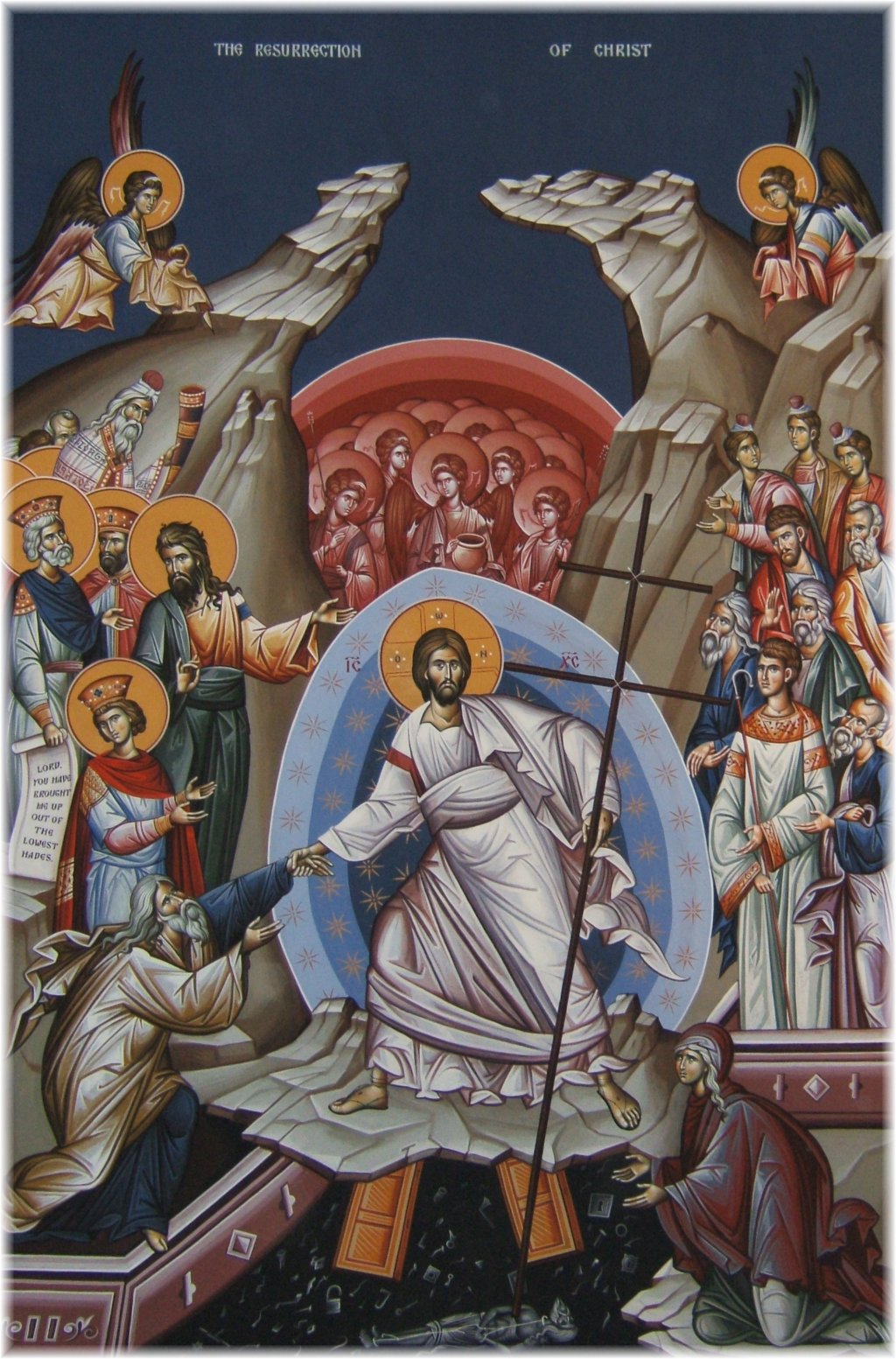
Christ descending to Hades to raise the dead (http://iconreader.files.wordpress.com/2011/01/resurrection2.jpg)
   
Additional Quotes of the Fathers on the Resurrection of Christ
"That light which far outshines the day and sun, first pledge of resurrection, and renovation of bodies long since dissolved, the divine token of promise, the path which leads to everlasting life — in a word, the day of the Passion — is arrived, best beloved doctors; and ye, my friends who are assembled here, ye blessed multitudes who worship Him who is the author of all worship and praise Him continually with heart and voice, according to the precepts of His holy word.

But thou, Nature, parent of all things: what blessing like to this hast thou ever accomplished for mankind? Nay rather, what is in any sense thy workmanship, since He who formed the universe is Himself the author of thy being? For it is He who has arrayed thee in thy beauty; and the beauty of Nature is life according to Nature’s laws.
But principles quite opposed to Nature have mightily prevailed, in that men have agreed in withholding His rightful worship from the Lord of all, believing that the order of the universe depended, not on His providence, but on the blind uncertainty of chance. And this they did, notwithstanding the clearest announcement of the truth by His inspired prophets, whose words should have claimed belief, but were in every way resisted by that impious wickedness which hates the light of truth and loves the obscure mazes of darkness.

Nor was this error unaccompanied by violence and cruelty, especially in that the will of princes encouraged the blind impetuosity of the multitude, or rather itself led the way in the career of reckless folly.

Such principles as these, confirmed by the practice of many generations, became the source of terrible evils in those early times: but no sooner had the radiance of the Saviour’s presence appeared, than justice took the place of wrong, a calm succeeded the confusion of the storm, and the predictions of the prophets were all fulfilled.

For after He had enlightened the world by the glorious discretion and purity of His character, and had ascended to the mansions of His Father’s house, He founded His Church on earth, as a holy temple of virtue, an immortal, imperishable temple, wherein the worship due to the Supreme Father and to Himself should be piously performed."
St. Constantine the Great
"Brethren, how fine a thing it is to move from festival to festival, from prayer to prayer, from holy day to holy day. The time is now at hand when we enter on a new beginning: the proclamation of the blessed Passover, in which the Lord was sacrificed. We feed as on the food of life, we constantly refresh our souls with his precious blood, as from a fountain. Yet we are always thirsting, burning to be satisfied. But he himself is present for those who thirst and in his goodness invites them to the feast day. Our Savior repeats his words:

'If anyone thirsts, let him come to me and drink.'

He quenched the thirst not only of those who came to him then. Whenever anyone seeks him he is freely admitted to the presence of the Saviour. The grace of the feast is not restricted to one occasion. Its rays of glory never set. It is always at hand to enlighten the mind of those who desire it.

Its power is always there for those whose minds have been enlightened and who meditate day and night on the holy Scriptures, like the one who is called blessed in the holy psalm:

'Blessed is the man who has not followed the counsel of the wicked, or stood where sinners stand, or sat in the seat of the scornful, but whose delight is in the law of the Lord, and who meditates on his law day and night.'

Moreover, my friends, the God who first established this feast for us allows us to celebrate it each year. He who gave up his Son to death for our salvation, from the same motive gives us this feast, which is commemorated every year. This feast guides us through the trials that meet us in this world.

God now gives us the joy of salvation that shines out from this feast, as he brings us together to form one assembly, uniting us all in spirit in every place, allowing us to pray together and to offer common thanksgiving, as is our duty on the feast. Such is the wonder of his love: he gathers to this feast those who are far apart, and brings together in unity of faith those who may be physically separated from each other.
St. Athanasios the Great

"The Lord, having put on human nature, and having suffered for him who suffered, having been bound for him who was bound, and having been buried for him who was buried, is risen from the dead, and loudly proclaims this message:
'Who will contend against me? Let him stand before me. It is I who delivered the condemned. It is I who gave life to the dead. It is I who raised up the buried. Who will argue with me? It is I, says Christ, who destroyed death. It is I who triumphed over the enemy, and having trod down Hades, and bound the Strong Man, and have snatched mankind up to the heights of heaven. It is I, says Christ. So then, come here all you families of men, weighed down by your sins and recieve pardon for your misdeeds. For I am your pardon. I am the Passover which brings salvation. I am the Lamb slain for you. I am your lustral bath. I am your life. I am your resurrection. I am your light, I am your salvation, I am your King. It is I who brings you up to the heights of heaven. It is I who will give you the resurrection there. I will show you the Eternal Father. I will raise you up with my own right hand.'"
St. Melito Bishop of Sardis
"Most men believe in the resurrection of Christ, but very few have a clear vision of it. …That most sacred formula which is daily on our lips does not say,
'Having believed in Christ’s resurrection,'
but,
'Having beheld Christ’s resurrection, let us worship the Holy Lord Jesus, who alone is without sin.'
How then does the Holy Spirit urge us to say,
'Having beheld Christ’s resurrection',
which we have not seen as though we had seen it, when Christ has risen once for all a thousand years ago, and even then without anybody’s seeing it? Surely Holy Scripture does not wish us to lie? Far from it! Rather, it urges us to speak the truth, that the resurrection of Christ takes place in each of us who believes, and that not once, but every hour, so to speak, when Christ the Master arises in us, resplendent in array and flashing with the lightnings of incorruption and Deity.

For the light-bringing coming of the Spirit shows forth to us, as in early morning, the Master’s resurrection, or, rather, it grants us to see the Risen One Himself. Therefore we say,
'The Lord is God, and He has given us light' (Ps. 118:27)
and we allude to His second Coming and add these words,
'Blessed is He that cometh in the Name of the Lord' (Ps. 118:26).
Those to whom Christ has given light as He has risen, to them He has appeared spiritually, He has been shown to their spiritual eyes. When this happens to us through the Spirit He raises us up from the dead and gives us life. He grants us to see Him, who is immortal and indestructible. More than that, He grants clearly to know Him who raises us up (Eph. 2:6) and glorifies us (Rom. 8:17) with Himself, as all the divine Scripture testifies.
These, then, are the divine mysteries of Christians. This is the hidden power of our faith, which unbelievers, or those who believe with difficulty, or rather believe in part, do not see nor are able at all to see.
St. Symeon the New Theologian
   
   
Christ is risen from the dead, by death, trampling down upon death, and to those in the tombs, bestowing life!


Truly the Lord is risen!

Saturday, April 23, 2011

St. Epiphanios of Salamis on the Lord's Descent into Hades

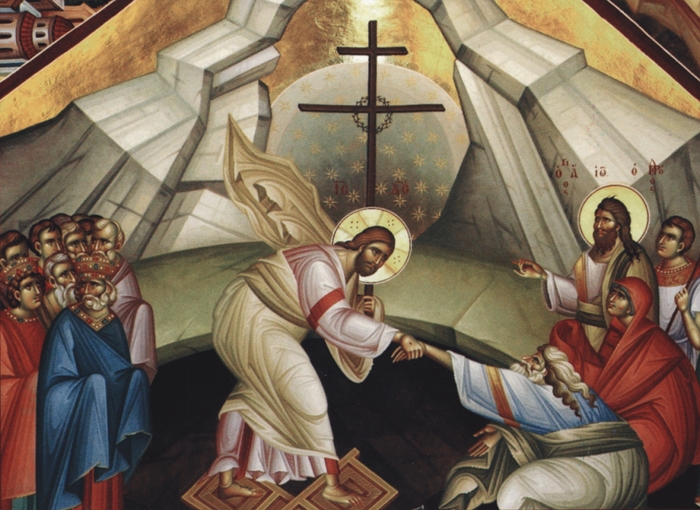
Christ's descent into Hades to raise the dead of all ages (http://vatopaidi.files.wordpress.com/2011/04/anastasi-kyriou-02.jpg)
   
Note: The following is a short excerpt from this incredible homily of St. Epiphanios. The entire homily is available here in text form, and read by the brotherhood of Holy Cross Monastery here.
  
St. Epiphanios of Salamis on the Lord's Descent into Hades
Something strange is happening - there is a great silence on earth today, a great silence and stillness.

The whole earth keeps silence because the King is asleep.

The earth trembled and is still because God has fallen asleep in the flesh and He has raised up all who have slept ever since the world began.

God has died in the flesh and hell trembles with fear.

He has gone to search for our first parent, as for a lost sheep.

Greatly desiring to visit those who live in darkness and in the shadow of death, He has gone to free from sorrow the captives Adam and Eve, He who is both God and the son of Eve.

The Lord approached them bearing the Cross, the weapon that had won Him the victory.

At the sight of Him Adam, the first man He had created, struck his breast in terror and cried out to everyone: "My Lord be with you all." Christ answered him: "And with your spirit."

He took him by the hand and raised him up, saying: "'Awake, O sleeper, and rise from the dead, and Christ will give you light.'

I am your God, who for your sake have become your son. Out of love for you and for your descendants I now by My own authority command all who are held in bondage to come forth, all who are in darkness to be enlightened, all who are sleeping to arise. I order you, O sleeper, to awake.

I did not create you to be held a prisoner in hell. Rise from the dead, for I am the life of the dead. Rise up, work of My hands, you who were created in My image.

Rise, let us leave this place, for you are in Me and I am in you; together we form only one person and we cannot be separated.

For your sake I, your God, became your son; I, the Lord, took the form of a slave; I, whose home is above the heavens, descended to the earth and beneath the earth. For your sake, for the sake of man, I became like a man without help, free among the dead. For the sake of you, who left a garden, I was betrayed to the Jews in a garden, and I was crucified in a garden.

See on My face the spittle I received in order to restore to you the life I once breathed into you.

See there the marks of the blows I received in order to refashion your warped nature in My image.

On my back see the marks of the scourging I endured to remove the burden of sin that weighs upon your back.

See My hands, nailed firmly to a tree, for you who once wickedly stretched out your hand to a tree.

I slept on the Cross and a sword pierced My side for you who slept in paradise and brought forth Eve from your side. My side has healed the pain in yours. My sleep will rouse you from your sleep in hell. The sword that pierced Me has sheathed the sword that was turned against you.

Rise, let us leave this place. The enemy led you out of the earthly paradise.

I will not restore you to that paradise, but I will enthrone you in heaven.

I forbade you the tree that was only a symbol of life, but see, I who am life itself am now one with you. I appointed cherubim to guard you as slaves are guarded, but now I make them venerate you as a god.

The throne formed by cherubim awaits you, its bearers swift and eager.

The bridal chamber is adorned, the banquet is ready, the eternal dwelling places are prepared, the treasure houses of all good things lie open.

The kingdom of heaven has been prepared for you from all eternity.
(http://www.johnsanidopoulos.com/2011/04/st-epiphanios-of-salamis-lords-descent.html)
   
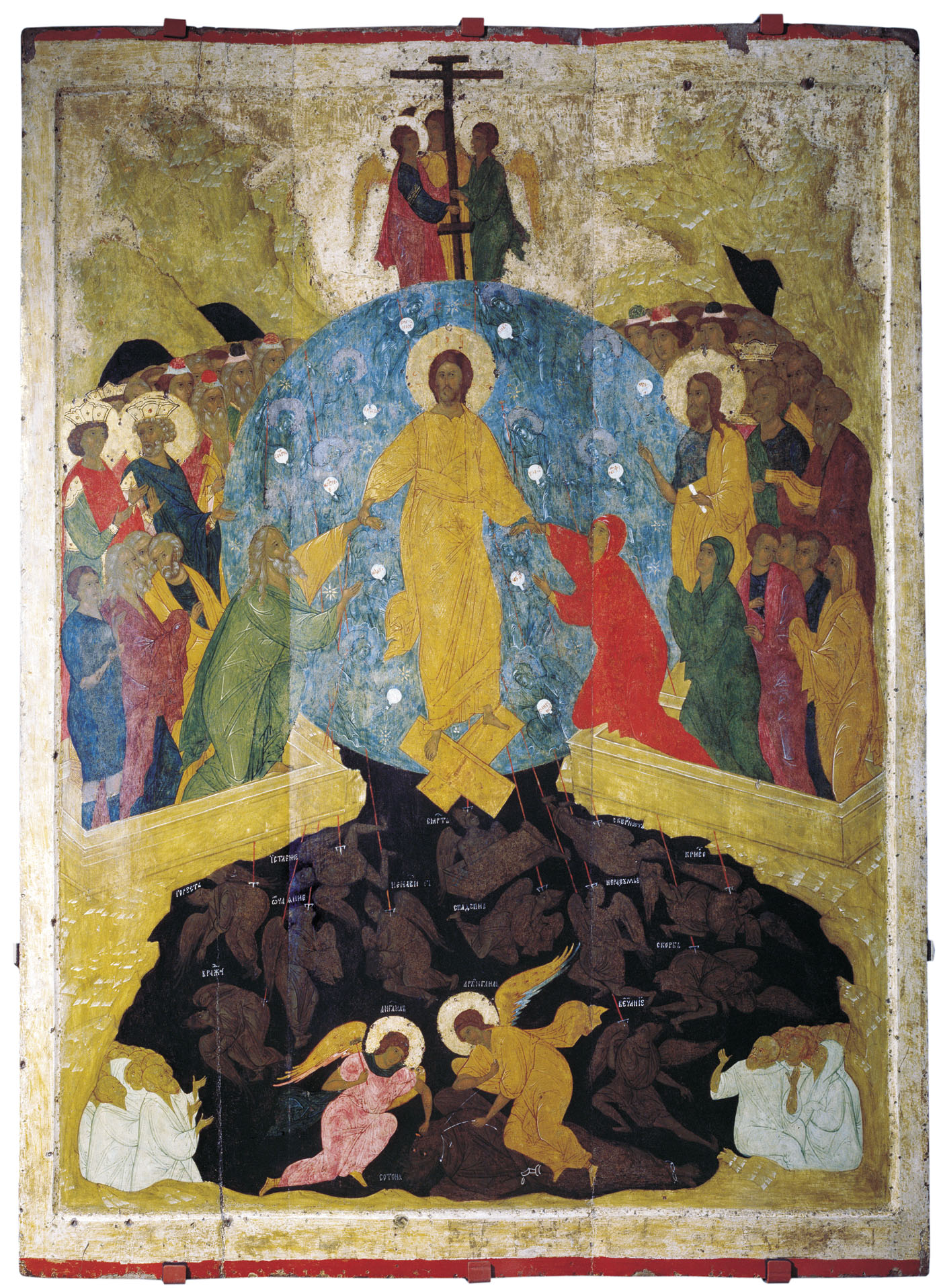
Christ's descent into Hades to raise the dead (http://www.belygorod.ru/img2/Ikona/Used/244nisiy_SoshestvieVoAdGRM.jpg)
   
Through the prayers of our Holy Fathers, Lord Jesus Christ our God, have mercy on us and save us! Amen!

Sunday, April 17, 2011

Behold the Bridegroom...


Apolytikion in the Plagal of the Fourth Tone
See! The Bridegroom sets forth in the dead of night. And blessed is that servant whom he shall find on watch; unworthy the one he shall come upon lazing. See to it, soul, that sleep does not overtake you, lest you be given up to death and be shut out of the kingdom. Bestir yourself, then, and sing out: "Holy, holy, holy are You, our God; through the [Theotokos], save us."
Through the prayers of our Holy Fathers, Lord Jesus Christ our God, have mercy on us and save us! Amen!

Saturday, April 16, 2011

Kontakion on the Raising of Lazarus, by St. Romanos the Melodist

   
Kontakion on the Raising of Lazarus
by St. Romanos the Melodist
O Christ, Thou who knowest all things,
Thou hast asked to learn where the tomb of Lazarus is,
And arriving there, Thou hast raised him up on the fourth day,
O All-powerful One,
Taking pity, Merciful One,
On the tears of Mary and Martha.
The Master, checking the lamentations of Mary and Martha,
Immediately stilled them when He raised up their brother.
It was possible, then, to see marvel of marvels,
How the lifeless suddenly was seen to be alive.
For when His voice descended,
It caused the bolts of the gate of Hades
To shake; and it broke down the bars of the door of Death;
And on the fourth day, He raised up the dead; as the Merciful One,
He took pity on
The tears of Mary and Martha.
Let us all, with love, hurry to Bethany to see Christ there,
Weeping for his friend.
For wishing all things to be ordained by law,
He controls all things in His dual nature.
He suffers as son of David; as Son of God,
He redeems the whole world from all the evil of the serpent,
And on the fourth day, He raised up Lazarus, taking pity on
The tears of Mary and Martha.
Together sustained by faith,
The two announced to Christ and God the death
Of their brother, saying,
"Hasten, come, Thou who art always present in all places,
For Lazarus whom Thou dost love is ill: if Thou come near,
Death will vanish, and Thy friend will be saved from corruption,
And the Jews will see that Thou, the Merciful One,
Hast taken pity on
The tears of May and Martha."
The Creator of all spoke on behalf of the disciples, saying:
"Friends and companions, our friend has fallen asleep."
He was secretly teaching them in advance,
Because He knows and care for all things,
"Let us go, then, let us advance and see the unusual tomb,
And let us cause the mourning of Mary and Martha to cease
As I raise up Lazarus from the tomb,
And as the Merciful One take pity on
The tears of Mary and Martha."
When the heard these words, the apostles
As with one voice cried out to the Lord,
"Sleep exists for man for his safety
And not at all for his destruction."
And so He spoke to them openly: "He is dead.
As mortal I am away from him; but as God, I know all things.
If we truly arrive at the opportune time,
I shall resurrect the dead, and cause to cease
The tears of Mary and Martha."
They all, then, arrived together,
When Mary and her sister came to meet them, crying bitterly,
"Lord, where wert Thou? For he whom Thou lovest has departed,
And lo, he is not here."
As they cried out these words, He, himself, wept.
But he asked, "Where is the tomb of my friend? Now
I am going to release him from the chains of Hades,
Since as the only lover of mankind, I take pity on
The tears of Mary and Martha."
When they arrived at the tomb,
He who is in the bosom of His Father, called out:
"Thou hast sent me into the world
That I might bring life to the dead.
I have come, then, to raise up Lazarus
And to reveal to the Jews that I am going to arise from my tomb
On the third day, I who after the fourth day resurrect my friend And now
take pity on
The tears of Mary and Martha."
In order that He might bring an end to the mourning of Martha,
The Savior of all spoke to her and addressed
These divine words to her:
"I exist as the Light of the world
And the resurrection of all from the dead;
It was for this end that I appeared in order to resurrect Adam
And the descendants of Adam
And on the fourth day to resurrect Lazarus
Taking pity, as a Merciful One, on
The tears of Mary and Martha."
When the command was given with a nod of His head,
Hades was made to totter,
And also the power of Death and the arrogance of the Devil.
With the sound of His voice,
He raised up from the depths of the earth
The one who was four days dead.
When they saw this, Abraham and all the righteous cried out:
"Now, take courage, since the resurrection of all has come.
He has delivered from the bonds of death
The one whom He loves, as He, the Merciful One, takes pity on
The tears of Mary and Martha."
Hades, now a prisoner, sees himself despoiled of this Lazarus,
Whom a short time ago he held enchained below;
For when the King of angels came against him,
The strength of demons was destroyed;
And the serpent who trails over the earth on his stomach,
Now, pierced in the mouth by the Wooden Spear, appears as dead.
But Adam rejoices when he sees Christ,
In His goodness, take pity on
The tears of Mary and Martha.
Rising from the tomb, the friend reveals his eyes
And hands bound by a cloth;
They release him — those who have their hearts
Bound by the ill will of slander,
Those who, as they plug up their ears like the adder,
Prepare their hands for most wicked slaughter,
That they may pour out
The harmless and innocent blood of the One
Who raises up the dead, and checks
The tears of Mary and Martha.
Having heard the words of the children,
Which came from pure hearts and innocent lips,
They were all filled with fear
Saying to one another, "Who is this man?"
O madness and complete stupidity!
A short time ago they saw raised from the dead
A corpse who had become fetid,
And they do not know who resurrected him,
And who destroyed with His voice the power of Hades,
And in accord with His merciful nature checked
The tears of Mary and Martha!
O Thy unspeakable compassion, all merciful Jesus!
Who didst consent to come for me and to me,
How didst Thou calmly ride upon the ass
And advance into the city of God-slayers?
Foreseeing their terrible lack of faith, Thou didst command them
To release the bonds of Lazarus, that they might see
The One whom in a short time they wish to put to death
With no pity for
The tears of Mary and Martha.
O Savior, all came with palms on the occasion of Thy arrival,
Crying, "Hosanna!" to Thee,
Now all of us bring hymns to Thee out of piteous mouths,
As we wave the branches of our spirit and cry out:
"O Thou, truly among those on high, save the world
Which Thou hast created, Lord,
And blot out our sins, just as formerly Thou hast dried
The tears of Mary and Martha.
O Lover of mankind, the Holy Church holds a high festival,
Faithfully calling together her children;
It meets Thee with palms and spreads out garments of joy
So that, with Thy disciples and with Thy friend,
Thou mayest advance and legislate a deep peace for Thy servants,
And release them from oppression, as formerly Thou hast checked
The tears of Mary and Martha.
Incline Thy ear, O God of the universe, and hear our prayers,
And snatch us from the bonds of death,
For our enemies who always surround us, visibly and invisibly,
Threaten to have us put to death, and besides,
To deprive us of our faith.
Arise, and quickly let all be destroyed and let them know
That Thou art our God and dost pity us as Thou didst have pity on
The tears of Mary and Martha.
Let us, who are dead because of our sins, and who dwell in the tomb
Because of our knowledge of evil,
Imitate the sisters of faithful Lazarus as we cry to Christ
With tears, in faith and in love:
"Save us, Thou who didst will to become man.
And resurrect us from the tomb of our sins, Thou, alone immortal,
Through the prayers of Thy friend, Lazarus,
Whom Thou didst raise up, O Lord, in checking
The tears of Mary and Martha."
Let us depart the mere material world, which is always in a state of flux,
And hasten to meet Christ the Savior in Bethany.
Let us then dine with Him
And with his friend Lazarus and the apostles
So that we may, by their prayers, be delivered from our past sins.
If we cleanse every stain from our hearts, we shall see perfectly
His divine resurrection, which He offered to us when He took away
The tears of Mary and Martha.

(http://www.monachos.net/content/patristics/patristictexts/206-romanos-lazarus)
   
Through the prayers of our Holy Fathers, Lord Jesus Christ our God, have mercy on us and save us! Amen!

Saturday, March 12, 2011

Miracles of St. Nektarios to a Wife and Mother

St. Nektarios the Wonderworker, Bishop of Pentapolis (http://www.groca.org/?category_name=orthodox-faith)
  
Note: the following is an excerpt from the book: Traveling the Walls of the City, by Nun Porphyria. She was a disciple of Elder Porphyrios, and as she would drive her taxi throughout Athens, she would meet many different people, help them with their problems, and often hear of their experiences and miracles that happened in their lives.

Miracles of St. Nektarios to a Wife and Mother (Amateur translation)
11AM on a Friday, I was driving through an area of Athens. I ascended Marne Road, when a brother of mine called from the Airport.
“Rania, where are you?”
“In Marne.”
“Come to the Airport, because there’s a lot of work here.”
“I’m coming, thank you.”
I hung up and was thinking to try and pick up a passenger, so I wouldn’t be traveling so many kilometers empty. As I ascended Alexandra Highway, a lady holding a large travel bag raised her hand. I stopped.
“Can you take me to the Airport?”
“Of course I can, I was trying to find you, sweetheart!”

“I stopped, loaded the bag, and we set off. The lady sat next to me.
“Oh! How beautiful are your icons! [i.e. on the dashboard of her taxi]” she told me.
“Yes! They are my family, I worship them!” I replied.
“And I believe greatly; I especially love St. Nektarios.”
“Did he work some miracle for you, to believe in him so?”
“Of course! Do you want me to tell you?”

...The Lady laughed. “I have cancer,” she told me briskly, “and they removed both my breasts. From the day that I was married I got sick, I suffered grave sadness.”
“Why? Don’t you have a good husband?”
“On the contrary, my husband is very good. He takes very good care of me, and economically we are very well off.”
“Then why did you get sick?”

“I don’t know! Straightaway, I fell into deep depression without reason. A neighbor of mine said that someone cast a spell on me. ‘But I don’t have enemies’, I told her. She replied: ‘I believe that Panagiota did something to you, because she very much wanted your husband.’”

“Three years passed from the day of my wedding and my sickness, when I decided to tell my mother about it. She, as soon as she heard it, took me to a priest. He read a prayer for me and told me to go to Aegina, to St. Nektarios. Aegina was very far from our island, but my husband said that we should go. And the three of us left together for St. Nektarios.”

“When we reached there, having venerated and prayed, I wanted to meet the Abbess. I didn’t know why. I asked a nun to take us to her, and this is what occurred. The Abbess received us with all her heart, as if she were waiting for us. She removed a prayer rope from her pocket, and gave it to me to wear on my hand. I put it on while my mother related what I had. Right away, I stood up and told them:

“Let’s go to the cell of St. Nektarios, for he’s waiting for us!”

“I opened the door and exited towards the cell of the Saint. The Abess asked me: ‘Do you know where you are going? Have you been here before?’”

“No, but he is leading me there.”

“We reached his cell, and entering, I sat on his bed. St. Nektarios sat next to me, and spoke to me while I responded.”

“Do you want to tell us what he said?”

“No! The only thing I’ll say is that he told me not to be afraid, and that I would become well. From then, the sadness that I felt left, and was replaced by joy. Very quickly I became pregnant, and gave birth to a baby boy, whom I named Nektarios. I also bore a girl, and I named her Maria, the name of our Panagia. Later I got sick from cancer, and as I said, they removed my breasts. I suffered greatly, but St. Nektarios is always next to me. Since then it’s been twenty years. The Saint has never abandoned me. Every year on his feast, we are all there. My faith has strengthened me greatly, so that I don’t care what happens to me. I am prepared to face everything.”

Wishing to test her faith, I played devil’s advocate: “What if God takes one of your children? What would you do? Would you distance yourself from Him? Would that shake your faith?”

“Look,” she replied, “my children are His [God's]. He gave them to me, and if he wants them back, let Him take them. I would feel great pain, but my faith is unshakable. No one can do anything to shake it.”

“Is this true what you’re saying?”

“Of course! I have seen many miracles in these twenty years. That which I told you, was the first with St. Nektarios. Many more followed. The Saint is constantly next to me, and I sense him very close to me. Don’t think that I don’t love my children, because I said that He can take them. They are His, He gave them to me simply to raise them with Him. I feel proud, because He gave me very good children. With His help, of course.”

I rejoiced greatly when I heard this, and was jealous of the faith of this woman!
Amateur translation of an excert from: Traveling the Walls of the City (Taxidevontas sta Teixh ths Polhs), by Nun Porphyria (http://apantaortodoxias.blogspot.com/2011/03/blog-post_6811.html).

Through the prayers of our Holy Fathers, Lord Jesus Christ our God, have mercy on us and save us! Amen!

Monday, March 7, 2011

Selected Quotes of the Fathers on Great Lent


Selected Quotes of the Fathers on Great Lent

"As we are therefore beginning this sacred season, dedicated to the purification of the soul, let us be careful to fulfill the Apostolic command that we cleanse ourselves from all defilement of the flesh and of the spirit (IICor. 7:11), so that restraining the conflict that exists between the one and the other substance, the soul, which in the Providence of God is meant to be the ruler of the body, may regain the dignity of its rightful authority, so that, giving offense to no man, we may not incur the contumely of evil mongers. With just contempt shall we be tormented by those who have no faith, and from our wickedness evil tongues will draw weapons to wound religion, if the way of life of those who fast be not in accord with what is needed in true self-denial. For the sum total of our fasting does not consist in merely abstaining from food. In vain do we deny our body food if we do not withhold our heart from iniquity, and restrain our lips that they speak no evil." - St. Leo the Great - 'Lent the Season of Purification
"Blessed is the mind that passes the time of its pilgrimage in chaste sobriety, and loiters not in the things through which it has to walk, so that, as a stranger rather than the possessor of its earthly abode, it may not be wanting in human affections, and yet rest on the Divine promises." - St. Leo the Great - 'Homily 49: On Great Lent
"...We must then so moderate our rightful use of food that our other desires may be subject to the same rule. For this is also a time of peace and serenity, in which having put away all stains of evil doing we strive after steadfastness in what is good. Now is the time when generous Christian souls forgive offences, pay no heed to insults, and wipe out the memory of past injuries. Now let the Christian soul exercise itself in the armour of justice, on the right hand and on the left, so that amid honour and dishonour, evil report and good, the praise of men will not make proud the virtue that is well rooted, the conscience that has peace, nor dishonour cast it down. The moderation of those who worship God is not melancholy, but blameless." - St. Leo the Great - "Lent the Season of Purification (The Sunday Sermons of the Great Fathers)
"When He had fasted for forty days and forty nights, and afterwards was hungry, He gave an opportunity to the devil to draw near, so that He might teach us through this encounter how we are to overcome and defeat him. This a wrestler also does. For in order to teach his pupils how to win he himself engages in contests with others, demonstrating on the actual bodies of others that they may learn how to gain the mastery. This is what took place here. For, desiring to draw the devil into contest, He made His hunger known to him. He met him as he approached, and meeting him, with the skill which He alone possessed, He once, twice, and a third time, threw His enemy to the ground." - St. John Chrysostom - The Sunday Sermons of the Great Fathers
"Special services, special foods, continence, not going to dances and events, all this awakes one to piety and reflection on our present purpose, on the past and on eternity. Seeing in ourselves a falling away from the commandments of God, we try to reconcile ourselves to God through repentance and communion of the most pure and life-giving Mysteries of Christ, which burn the thorns of our sins. You, when you have not fulfilled this duty during the year, of course will fulfill it during the Fast. The most merciful Lord loved us so much, that He gave us, through food and drink, His most pure Body and life-giving Blood, as a token of life eternal and the incorrupt future feast. Let us offer Him thanksgiving with pure hearts, lips and acts!" - St. Macarius of Optina (Letters...)
"And though every day a man lives may rightly be a day of repentance, yet is it in these days more becoming, more appropriate, to confess our sins, to fast, and to give alms to the poor; since in these days you may wash clean the sins of the whole year." - St. John Chrysostom - "The Sunday Sermons of the Great Fathers"
(http://scienceofsalvation.blogspot.com/)
"Brethren and Fathers, our good God who gives us life and brings us from year to year, has brought us also with love for mankind to this present time of fasting, in which each of the eager, as their choice directs, enters the contest; one devoting himself to self-mastery, eating only every two or three days, another to vigil, keeping vigil for so long or so long, another spending even longer in prostrations, and others in other ascetic actions. Quite simply during these holy days it is possible to see great zeal and attention. But the true subject behaves with obedience not at any particular time, but keeps up the struggle always. What is the struggle? Not to walk according to one’s own will, but to let oneself be ruled by the disposition of the superior. This is better than the other works of zeal and is a crown of martyrdom; except that for you there is also change of diet, multiplication of prostrations and increase of psalmody are in accord with the established tradition from of old. And so I ask, let us welcome gladly the gift of the fast, not making ourselves miserable, as we are taught, but let us advance with cheerfulness of heart, innocent, not slandering, not angry, not evil, not envying; rather peaceable towards each other, and loving, fair, compliant, full of mercy and good fruits; breathing in seasonable stillness, since hubbub is damaging in a community; speaking suitable words, since too unreasonable stillness is profitless; yet above all unsleepingly keeping watch over our thoughts, not opening the door to the passions, not giving place to the devil. If the spirit of the powerful one, it says, rise up against you, do not let it find your place. So that the enemy has power to suggest, but in no way to enter. We are lords of ourselves; let us not open our door to the devil; rather let us keep guard over our soul as a bride of Christ, not set about with tumult, unwounded by the arrows of the thoughts; for thus we are able to become a dwelling of God in Spirit. Thus we may be made worthy to hear, "Blessed are the pure in heart, for they shall see God." Quite simply, Whatever is true, whatever noble, whatever just, whatever pure, whatever lovely, whatever of good report, if there is anything virtuous, if there is anything praiseworthy, to speak like the Apostle, do it; and the God of peace will be with you all, in Christ Jesus, our Lord, to whom be the glory and the might, with the Father and the Holy Spirit, now and for ever, and to the ages of ages. Amen." - St. Theodore the Studite - Catechesis 53 "On fasting; and that the true fast of the obedient and the subject is the cutting off of one’s will. Given on Cheesefare Sunday."
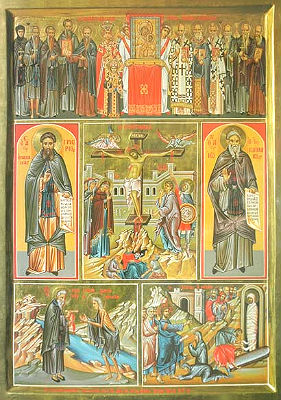
The Feasts of Great Lent: the Sunday of Orthodoxy, Sts. Gregory Palamas and John Klimakos, the Crucifixion of Christ, St. Mary of Egypt, and the raising of St. Lazarus (http://happy-school.ru/Ikona/put_posta.jpg)

Forgive me, and may God forgive us all!
Through the prayers of our Holy Fathers, Lord Jesus Christ our God, have mercy on us and save us! Amen!

Saturday, February 26, 2011

Commentary of St. John Chrysostom on Matthew 25 (Gospel reading for Meatfare Sunday)


Commentary of St. John Chrysostom on Matthew 25 (Gospel reading for Meatfare Sunday / Sunday of the Last Judgment)
"And do not account the saying to be rash. For the Lord is loving to man, and the gift cometh of His goodness. It is rash to have a mouth like the devil, to have a tongue resembling that of an evil demon, especially for him that partakes of such mysteries, and communicates of the very flesh of the Lord. Reflecting then on these things, become like Him, to the utmost of thy power. No longer then will the devil be able so much as to look thee in the face, when thou art become such a one as this. For indeed he recognizes the image of the King, he knows the weapons of Christ, whereby he was worsted. And what are these? Gentleness and meekness. For when on the mountain Christ overthrew and laid low the devil who was assaulting him, it was not by making it known that He was Christ, but He entrapped him by these sayings, He took him by gentleness, he turned him to flight by meekness. Thou also must do this; shouldest thou see a man become a devil, and coming against thee, even so do thou likewise overcome. Christ gave thee also power to become like Him, so far as thy ability extends. Be not afraid at hearing this. The fear is not to be like Him. Speak then after His manner, and thou art become in this respect such as He, so far as it is possible for one who is a man to become so.

Wherefore greater is he that thus speaks, than he that prophecies. For this is entirely a gift, but in the other is also thy labor and toil. Teach thy soul to frame thee a mouth like to Christ’s mouth. For it can create such things, if it will; it knows the art, if it be not remiss. And how is such a mouth made? one may ask. By what kind of colorings? by what kind of material? By no colorings, indeed, or material; but by virtue only, and meekness, and humility.
Let us see also how a devil’s mouth is made; that we may never frame that. How then is it made? By curses, by insults, by envy, by perjury. For when any one speaks his words, he takes his tongue. What kind of excuse then shall we have; or rather, what manner of punishment shall we not undergo; when this our tongue, wherewith we are allowed to taste of the Lord’s flesh, when this, I say, we overlook, speaking the devil’s words?
Let us not overlook it, but let us use all diligence, in order to train it to imitate its Lord. For if we train it to this, it will place us with great confidence at Christ’s judgment seat. Unless any one know how to speak thus, the judge will not so much as hear him. For like as when the judge chances to be a Roman, he will not hear the defense of one who knows not how to speak thus; so likewise Christ, unless thou speak after His fashion, will not hear thee, nor give heed.
Let us learn therefore to speak in such wise as our Judge is wont to hear; let it be 456our endeavor to imitate that tongue. And shouldest thou fall into grief, take heed lest the tyranny of despondency pervert thy tongue, but that thou speak like Christ. For He too mourned for Lazarus and Judas. Shouldest thou fall into fear, seek again to speak even as He. For He Himself fell into fear for thy sake, with regard to His manhood. the other sheep, that He might indicate the unfruitfulness of the one, for no fruit will come from kids; and the great profit from the other, for indeed from sheep great is the profit, as well from the milk, as from the wool, and from the young, of all which things the kid is destitute.
But while the brutes have from nature their unfruitfulness, and fruitfulness, these have it from choice, wherefore some are punished, and the others crowned. And He doth not punish them, until He hath pleaded with them; wherefore also, when He hath put them in their place, He mentions the charges against them. And they speak with meekness, but they have no advantage from it now; and very reasonably, because they passed by a work so much to be desired. For indeed the prophets are everywhere saying this, “I will have mercy and not sacrifice,” and the lawgiver by all means urged them to this, both by words, and by works; and nature herself taught it.
But mark them, how they are destitute not of one or two things only, but of all. For not only did they fail to feed the hungry, or clothe the naked; but not even did they visit the sick, which was an easier thing.
And mark how easy are His injunctions. He said not, “I was in prison, and ye set me free; I was sick, and ye raised me up again;” but, “ye visited me,” and, “ye came unto me.” And neither in hunger is the thing commanded grievous. For no costly table did He seek, but what is needful only, and His necessary food, and He sought in a suppliant’s garb, so that all things were enough to bring punishment on them; the easiness of the request, for it was bread; the pitiable character of Him that requesteth, for He was poor; the sympathy of nature, for He was a man; the desirableness of the promise, for He promised a kingdom; the fearfulness of the punishment, for He threatened hell. The dignity of the one receiving, for it was God, who was receiving by the poor; the surpassing nature of the honor, that He vouchsafed to condescend so far; His just claim for what they bestowed, for of His own was He receiving. But against all these things covetousness once for all blinded them that were seized by it; and this though so great a threat was set against it.
For further back also He saith, that they who receive not such as these shall suffer more grievous things than Sodom; and here He saith, “Inasmuch as ye did it not unto one of the least of these my brethren, ye did it not unto me.”
 What sayest Thou? they are Thy brethren; and how dost Thou call them least. Why, for this reason they are brethren, because they are lowly, because they are poor, because they are outcast. For such doth He most invite to brotherhood, the unknown, the contemptible, not meaning by these the monks only, and them that have occupied the mountains, but every believer; though he be a secular person, yet if he be hungry, and famishing, and naked, and a stranger, His will is he should have the benefit of all this care. For baptism renders a man a brother, and the partaking of the divine mysteries.
2. Then, in order that thou mayest see in another way also the justice of the sentence, He first praises them that have done right, and saith, “Come, ye blessed of my Father, inherit the kingdom prepared for you before 457the foundation of the world. For I was an hungered, and ye gave me meat,” and all that follows.
 For that they may not say, we had it not, He condemns them by their fellow-servants; like as the virgins by the virgins, and the servant that was drunken and gluttonous by the faithful servant, and him that buried his talent, by them that brought the two, and each one of them that continue in sin, by them that have done right.
And this comparison is sometimes made in the case of an equal, as here, and in the instance of the virgins, sometimes of him that hath advantage, as when he said, “The men of Nineveh shall rise up and shall condemn this generation, because they believed at the preaching of Jonas; and, behold, a greater than Jonas is here;” and, “The queen of the south shall condemn this generation, because she came to hear the wisdom of Solomon;” and of an equal again, “They shall be your judges;” and again of one at advantage, “Know ye not, that we shall judge angels, how much more things that pertain to this life?”
And here, however, it is of an equal; for he compares rich with rich, and poor with poor. And not in this way only doth He show the sentence justly passed, by their fellow-servants having done what was right when in the same circumstances, but also by their not being obedient so much as in these things in which poverty was no hindrance; as, for instance, in giving drink to the thirsty, in looking upon him that is in bonds, in visiting the sick. And when He had commended them that had done right, He shows how great was originally His bond of love towards them. For, “Come,” saith He, “ye blessed of my Father, inherit the kingdom prepared for you from the foundation of the world.” To how many good things is this same equivalent, to be blessed, and blessed of the Father? And wherefore were they counted worthy of such great honors? What is the cause? “I was an hungered, and ye gave me meat; I was thirsty, and ye gave me drink;” and what follows.
Of what honor, of what blessedness are these words? And He said not, Take, but, “Inherit,” as one’s own, as your Father’s, as yours, as due to you from the first. For, before you were, saith He, these things had been prepared, and made ready for you, forasmuch as I knew you would be such as you are.
And in return for what do they receive such things? For the covering of a roof, for a garment, for bread, for cold water, for visiting, for going into the prison. For indeed in every case it is for what is needed; and sometimes not even for that. For surely, as I have said, the sick and he that is in bonds seeks not for this only, but the one to be loosed, the other to be delivered from his infirmity. But He, being gracious, requires only what is within our power, or rather even less than what is within our power, leaving to us to exert our generosity in doing more.
But to the others He saith, “Depart from me, ye cursed,” (no longer of the Father; for not He laid the curse upon them, but their own works), “into the everlasting fire, prepared,” not for you, but “for the devil and his angels.” For concerning the kingdom indeed, when He had said, “Come, inherit the kingdom,” He added, “prepared for you before the foundation of the world;” but concerning the fire, no longer so, but, “prepared for the devil.” I, saith He, prepared the kingdom for you, but the fire no more for you, but “for the devil and his angels;” but since ye cast yourselves therein, impute it to yourselves. And not in this way only, but by what follows also, like as though He were excusing Himself to them, He sets forth the causes.
“For I was an hungered, and ye gave me no meat.” For though He that came to thee had been thine enemy, were not His sufferings enough to have overcome and subdued even the merciless? hunger, and cold, and bonds, and nakedness, and sickness, and to wander everywhere houseless? These things are sufficient even to destroy enmity. But ye did not these things even to a friend, being at once friend, and benefactor, and Lord. Though it be a dog we see hungry, often we are overcome; and though we behold a wild beast, we are subdued; but seeing the Lord, art thou not subdued? And wherein are these things worthy of defense?
For if it were this only, were it not sufficient for a recompense? (I speak not of hearing such a voice, in the presence of the world, from Him that sitteth on the Father’s throne, and of obtaining the kingdom), but were not the very doing it sufficient for a reward? But now even in the presence of the world, and at the appearing of that unspeakable glory, He proclaims and crowns thee, and acknowledges thee as His sustainer and host, and is not ashamed of saying such things, that He may make the crown brighter for thee.
So for this cause, while the one are punished justly, the others are crowned by grace. For though they had done ten thousand 458things, the munificence were of grace, that in return for services so small and cheap, such a heaven, and a kingdom, and so great honor, should be given them."
(http://www.ccel.org/ccel/schaff/npnf110.iii.LXXV.html; note: a non-Orthodox source site)
Through the prayers of our Holy Fathers, Lord Jesus Christ our God, have mercy on us and save us! Amen!