Monday, June 20, 2011

Commentary of St. John Chrysostom on the Epistle of the Sunday of All Saints, Part II

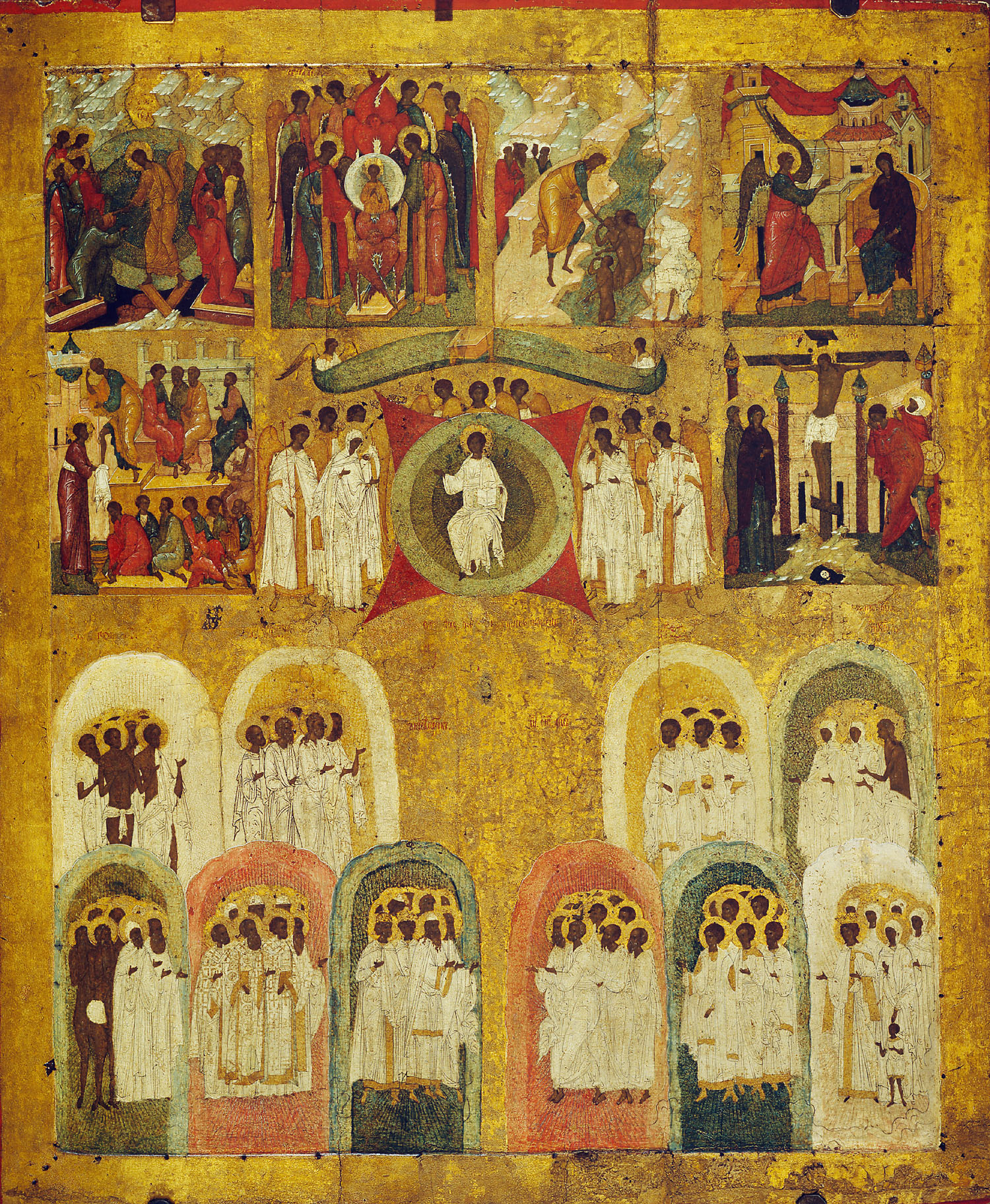
16th Century Russian icon of All Saints, with other feasts along the top (http://www.belygorod.ru/img2/Ikona/Used/0DionisiyShestodnevGTG.jpg)
  
Commentary of St. John Chrysostom on the Epistle of the Sunday of All Saints, Part II (Hebrews 11:37-12:2)
“They wandered about in sheep-skins, and goat-skins, being destitute, afflicted, tormented (of whom this world was not worthy); wandering in deserts, and in mountains, and in dens, and caves of the earth.”
[1.] At all times indeed, but especially then when I reflect upon the achievements of the saints, it comes over me to feel despondency concerning my own condition, because we have not even in dreams experienced the things among which those men spent their whole lives, not paying the penalty of sins, but always doing rightly and yet always afflicted.

For consider, I beseech you, Elijah, to whom our discourse has come round to-day, for he speaks of him in this passage, and in him his examples end: which [example] was appropriate to their case. And having spoken of what befell the Apostles, that “they were slain with the sword, were stoned,” he goes back again to Elijah, who suffered the same things with them. (See 2 Kings i. 8.) For since it was probable that they would not as yet hold the Apostles in so great estimation, he brings his exhortation and consolation from him who had been taken up [into Heaven] and who was held in special admiration.

For “they wandered about” (he says) “in sheep-skins, and goat-skins, being destitute, afflicted, tormented, of whom this world was not worthy.”

They had not even raiment, he says, through the excess of affliction, no city, no house, no lodging-place; the same which Christ said, “but the Son of Man hath not where to lay His head.” ( Matt. viii. 20.) Why do I say “no lodging-place”? No standing-place: for not even when they had gained the wilderness, were they at rest. For he said not, They sat down in the wilderness, but even when they were there, they fled, and were driven thence, not out of the inhabited world only, but even out of that which was uninhabitable. And he reminds them of the places where they were set, and of things which there befell [them].

Then next, he says, they bring accusations against you for Christ’s sake. What accusation had they against Elijah, when they drove him out, and persecuted him, and compelled him to struggle with famine? Which these [Hebrews] were then suffering. At least, the brethren, it is said, decided to send [relief] to those of the disciples who were afflicted. “Every man according to his ability, determined to send relief unto the brethren that dwelt in Judea” ( Acts xi. 29 ), which was [the case] of these also.

“Tormented” [or “ill-treated”], he says; that is, suffering distress, in journeyings, in dangers.

But “They wandered about,” what is this? “Wandering,” he says, “in deserts and in mountains and in dens and caves of the earth,” like exiles and outcasts, as persons taken in the basest [of crimes], as those not worthy to see the sun, they found no refuge from the wilderness, but must always be flying, must be seeking hiding-places, must bury themselves alive in the earth, always be in terror.

[2.] What then is the reward of so great a change? What is the recompense?

They have not yet received it, but are still waiting; and after thus dying in so great tribulation, they have not yet received it. They gained their victory so many ages ago, and have not yet received [their reward]. And you who are yet in the conflict, are you vexed?

Do you also consider what a thing it is, and how great, that Abraham should be sitting, and the Apostle Paul, waiting till thou hast been perfected, that then they may be able to receive their reward. For the Saviour has told them before that unless we also are present, He will not give it them. As an affectionate father might say to sons who were well approved, and had accomplished their work, that he would not give them to eat, unless their brethren came. And art thou vexed, that thou hast not yet received the reward? What then shall Abel do, who was victor before all, and is sitting uncrowned? And what Noah? And what, they who lived in those [early] times: seeing that they wait for thee and those after thee?

Dost thou see that we have the advantage of them? For “God” (he says) “has provided some better thing for us.” In order that they might not seem to have the advantage of us from being crowned before us, He appointed one time of crowning for all; and he that gained the victory so many years before, receives his crown with thee. Seest thou His tender carefulness?

And he did not say, “that they without us might not be crowned,” but “that they without us might not be made perfect”; so that at that time they appear perfect also. They were before us as regards the conflicts, but are not before us as regards the crowns. He wronged not them, but He honored us. For they also wait for the brethren. For if we are “all one body,” the pleasure becomes greater to this body, when it is crowned altogether, and not part by part. For the righteous are also worthy of admiration in this, that they rejoice in the welfare of their brethren, as in their own. So that for themselves also, this is according to their wish, to be crowned along with their own members. To be glorified all together, is a great delight.

[3.] ( C. xii. 1 ) “Wherefore” (he says) “we also being compassed about with so great a cloud of witnesses.” In many places the Scripture derives its consolation in evils from corresponding things. As when the prophet says, “From burning heat, and from storm, and rain.” ( Isa. iv. 6.) This at least he says here also, that the memory of those holy men, reestablishes and recovers the soul which had been weighed down by woes, as a cloud does him who is burnt by the too hot rays [of the sun.]

And he did not say, “lifted on high above us,” but, “compassing us about,” which was more than the other; so that we are in greater security.

What sort of “cloud”? “A load of witnesses.” With good reason he calls not those in the New [Testament] only, but those in the Old also, “witnesses” [or “martyrs”]. For they also were witnesses to the greatness of God, as for instance, the Three Children, those with Elijah, all the prophets.

“Laying aside all things.” “All”: what? That is, slumber, indifference, mean reasonings, all human things.

“And the sin which doth [so] easily beset us”; [εὐπερίστατον], that is either, “which easily circumvents us,” or “what can easily be circumvented,” but rather this latter. For it is easy, if we will, to overcome sin.

“Let us run with patience” (he says) “the race that is set before us.” He did not say, Let us contend as boxers, nor, Let us wrestle, nor, Let us do battle: but, what was lightest of all, the [contest] of the foot-race, this has he brought forward. Nor yet did he say, Let us add to the length of the course; but, Let us continue patiently in this, let us not faint. “Let us run” (he says) “the race that is set before us.”

[4.] In the next place as the sum and substance of his exhortation, which he puts both first and last, even Christ. ( Ver. 2 ) “Looking” (he says) “unto Jesus the Author and Finisher of our Faith”; The very thing which Christ Himself also continually said to His disciples, “If they have called the Master of the house

493 Beelzebub, how much more them of His household?” ( Matt. x. 25.) And again, “The disciple is not above his Master, nor the servant above his Lord.” ( Matt. x. 24.)

“Looking” (he says), that is, that we may learn to run. For as in all arts and games, we impress the art upon our mind by looking to our masters, receiving certain rules through our sight, so here also, if we wish to run, and to learn to run well, let us look to Christ, even to Jesus “the author and finisher of our faith.” What is this? He has put the Faith within us. For He said to His disciples, “Ye have not chosen Me, but I have chosen you” ( John xv. 16 ); and Paul too says, “But then shall I know, even as also I have been known.” ( 1 Cor. xiii. 12.) He put the Beginning into us, He will also put on the End.
(Hosted on non-Orthodox site: http://www.ccel.org/ccel/schaff/npnf114.v.xxxii.html)
  
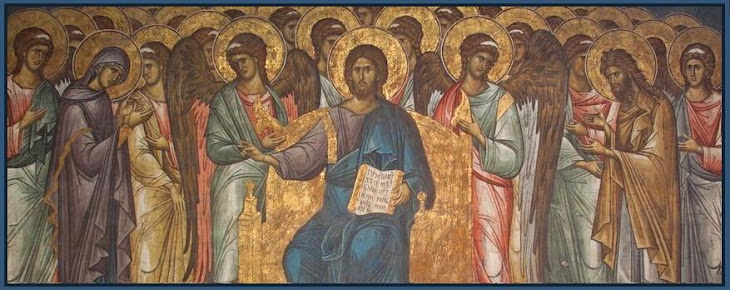
The Righteous depicted in the Boosm of Abraham, in Paradise (http://www.srpskoblago.org/Archives/Gracanica/exhibits/digital/w1-n1s1/large/w1-n1s1-21.jpg)
  
Through the prayers of our Holy Fathers, Lord Jesus Christ our God, have mercy on us and save us! Amen!

Sunday, June 19, 2011

Commentary of St. John Chrysostom on the Epistle of the Sunday of All Saints, Part I

   
Commentary of St. John Chrysostom on the Epistle of the Sunday of All Saints, Part I (Hebrews 11:33-36)
“By faith,” he says, “they subdued kingdoms;” those with Gideon. “Wrought righteousness;” who? The same. Plainly he means here, kindness.
I think it is of David that he says “they obtained promises.” But of what sort were these? Those in which He said that his “seed should sit upon” his “throne.” ( Ps. cxxxii. 12.)
“Stopped the mouths of lions,” ( ver. 34 ) “quenched the violence of fire, escaped the edge of the sword.” See how they were in death itself, Daniel encompassed by the lions, the three children abiding in the furnace, the Israelites, Abraham, Isaac, Jacob, in divers temptations; and yet not even so did they despair. For this is Faith; when things are turning out adversely, then we ought to believe that nothing adverse is done, but all things in due order.
“Escaped the edge of the sword.” I think that he is again speaking of the three children.
“Out of weakness were made strong.” Here he alludes to what took place at their return from Babylon. For “out of weakness,” is out of captivity. When the condition of the Jews had now become desperate, when they were no better than dead bones, who could have expected that they would return from Babylon, and not return only; but also “wax valiant” and “turn to flight armies of aliens”? ‘But to us,’ some one says, ‘no such thing has happened.’ But these are figures of “the things to come.” ( Ver. 35 ) “Women received their dead raised to life again.” He here speaks of what occurred in regard to the prophets, Elisha, [and] Elijah; for they raised the dead.
[5.] ( Ver. 35 ) “And others were tortured, not accepting deliverance, that they might obtain a better resurrection.” But we have not obtained a Resurrection. I am able however, he means, to show that they also were cut off, and did “not accept [deliverance], that they might obtain a better resurrection.” For why, tell me, when it was open to them to live, did they not choose it? Were they not evidently looking for a better life? And they who had raised up others, themselves chose to die; in order “to obtain a better resurrection,” not such as the children of those women.
Here I think he alludes both to John and to James. For beheading is called “torturing.” It was in their power still to behold the sun. It was in their power to abstain from reproving [sinners], and yet they chose to die; even they who had raised others chose to die themselves, “that they might obtain a better resurrection.”
( Ver. 36 ) “And others had trial of cruel mockings and scourgings, yea moreover of bonds and imprisonment.” He ends with these; with things that come nearer home. For these [ex 489amples] especially bring consolation, when the distress is from the same cause, since even if you mention something more extreme, yet unless it arise from the same cause, you have effected nothing. Therefore he concluded his discourse with this, mentioning “bonds, imprisonments, scourges, stonings,” alluding to the case of Stephen, also to that of Zacharias.
Wherefore he added, “They were slain with the sword.” What sayest thou? Some “escaped the edge of the sword,” and some “were slain by the sword.” ( Ver. 34.) What is this? Which dost thou praise? Which dost thou admire? The latter or the former? Nay, he says: the former indeed, is appropriate to you, and the latter, because Faith was strong even unto death itself, and it is a type of things to come. For the wonderful qualities of Faith are two, that it both accomplishes great things, and suffers great things, and counts itself to suffer nothing.
And thou canst not say (he says) that these were sinners and worthless. For even if you put the whole world against them, I find that they weigh down the beam and are of greater value. What then were they to receive in this life? Here he raises up their thoughts, teaching them not to be riveted to things present, but to mind things greater than all that are in this present life, since the “world is not worthy” of them. What then dost thou wish to receive here? For it were an insult to thee, shouldst thou receive thy reward here.
[6.] Let us not then mind worldly things, nor seek our recompense here, nor be so beggarly. For if “the” whole “world is not worthy of” them, why dost thou seek after a part of it? And with good reason; for they are friends of God.
Now by “the world” does he mean here the people, or the creation itself? Both: for the Scripture is wont to use the word of both. If the whole creation, he would say, with the human beings that belong to it, were put in the balance, they yet would not be of equal value with these; and with reason. For as ten thousand measures of chaff and hay would not be of equal value to ten pearls, so neither they; for “better is one that doeth the will of the Lord, than ten thousand transgressors” ( Ecclus. xvi. 3 ); meaning by “ten thousand” not [merely] many, but an infinite multitude.
Consider of how great value is the righteous man. Joshua the son of Nun said, “Let the sun stand still at Gibeon, the moon at the valley of Elom” ( Josh. x. 12 ), and it was so. Let then the whole world come, or rather two or three, or four, or ten, or twenty worlds, and let them say and do this; yet shall they not be able. But the friend of God commanded the creatures of his Friend, or rather he besought his Friend, and the servants yielded, and he below gave command to those above. Seest thou that these things are for service fulfilling their appointed course?
This was greater than the [miracles] of Moses. Why (I ask)? Because it is not a like thing to command the sea and the heavenly [bodies]. For that indeed was also a great thing, yea very great, nevertheless it was not at all equal [to the other].
Why was this? The name of Joshua [Jesus], was a type. For this reason then, and because of the very name, the creation reverenced him. What then! Was no other person called Jesus? [Yes]; but this man was on this account so called in type; for he used to be called Hoshea. Therefore the name was changed: for it was a prediction and a prophecy. He brought in the people into the promised land, as Jesus [does] into heaven; not the Law; since neither did Moses [bring them in], but remained without. The Law has not power to bring in, but grace. Seest thou the types which have been before sketched out from the beginning? He laid his commands on the creation, or rather, on the chief part of the creation, on the very head itself as he stood below; that so when thou seest Jesus in the form of Man saying the same, thou mayest not be disturbed, nor think it strange. He, even while Moses was living, turned back wars. Thus, even while the Law is living, He directs all things; but not openly.
[7.] But let us consider how great is the virtue of the saints. If here they work such things, if here they do such things, as the angels do, what then above? How great is the splendor they have?
Perhaps each of you might wish to be such as to be able to command the sun and moon. (At this point what would they say who assert that the heaven is a sphere? For why did he not [merely] say, “Let the sun stand still,” but added “Let the sun stand still at the valley of Elom,” that is, he will make the day longer? This was done also in the time of Hezekiah. The sun went back. This again is more wonderful than the other, to go the contrary way, not having yet gone round his course.)
We shall attain to greater things than these if we will. For what has Christ promised us? Not that we shall make the sun stand still, or the moon, nor that the sun shall retrace his steps, but what? “I and the Father will come unto him,” He says, “and We will make our abode with him.” ( John xiv. 23.) What need have I 490of the sun and the moon, and of these wonders, when the Lord of all Himself comes down and abides with me? I need these not. For what need I any of these things? He Himself shall be to me for Sun and for Light. For, tell me, if thou hadst entered into a palace, which wouldst thou choose, to be able to rearrange some of the things which have been fixed there, or so to make the king a familiar friend, as to persuade him to take up his abode with thee? Much rather the latter than the former.
[8.] But what wonder is it, says some one, that what a man commands, Christ should also? But Christ (you say) needs not the Father, but acts of His own authority, you say. Well. Therefore first confess and say, that he needs not the Father, and acts of His own authority: and then I will ask thee, whether His prayer is not in the way of condescension and arrangement (for surely Christ was not inferior to Joshua the son of Nun), and that He might teach us? For as when thou hearest a teacher lisping, and saying over the alphabet, thou dost not say that he is ignorant; and when he asks, Where is such a letter? thou knowest that he does not ask in ignorance, but because he wishes to lead on the scholar; in like manner Christ also did not make His prayer as needing prayer, but desiring to lead thee on, that thou mayest continually apply thyself to prayer, that thou mayest do it without ceasing, soberly, and with great watchfulness.
And by watching, I do not mean, merely the rising at night, but also the being sober in our prayers during the day. For such an one is called watchful. Since it is possible both in praying by night to be asleep, and in praying by day to be awake, when the soul is stretched out towards God, when it considers with whom it holds converse, to whom its words are addressed, when it has in mind that angels stand by with fear and trembling, while he approaches gaping and scratching himself.
[9.] Prayer is a mighty weapon if it be made with suitable mind. And that thou mayest learn its strength, continued entreaty has overcome shamelessness, and injustice, and savage cruelty, and overbearing rashness. For He says, “Hear what the unjust judge saith.” ( Luke xviii. 6.) Again it has overcome sloth also, and what friendship did not effect, this continued entreaty did: and “although he will not give him because he is his friend” (He says), “yet because of his importunity he will rise and give to him.” ( Luke xi. 8 ) And continued assiduity made her worthy who was unworthy. “It is not meet” (He says) “to take the children’s bread and to cast it to the dogs. Yea! Lord!” she says, “for even the dogs eat [the crumbs] from their master’s table.” ( Matt. xv. 26, 27.) Let us apply ourselves to Prayer. It is a mighty weapon if it be offered with earnestness, if without vainglory, if with a sincere mind. It has turned back wars, it has benefited an entire nation though undeserving. “I have heard their groaning” (He says) “and am come down to deliver them.” (Acts vii. 34.) It is itself a saving medicine, and has power to prevent sins, and to heal misdeeds. In this the desolate widow was assiduous. ( 1 Tim. v. 5.)
If then we pray with humility, smiting our breast as the publican, if we utter what he did, if we say, “Be merciful to me a sinner” (Luke xviii. 13 ), we shall obtain all. For though we be not publicans, yet have we other sins not less than his.
For do not tell me, that thou hast gone wrong in some small matter [only], since the thing has the same nature. For as a man is equally called a homicide whether he has killed a child or a man, so also is he called overreaching whether he be overreaching in much or in little. Yea and to remember injuries too, is no small matter, but even a great sin. For it is said, “the ways of those who remember injuries [tend] to death.” ( Prov. xii. 28 , LXX.) And “He that is angry with his brother without a cause, shall be in danger of hell,” and he that “calleth his brother a fool” ( Matt. v. 22 ), and senseless, and numberless such things.
But we partake even of the tremendous mysteries unworthily, and we envy, and we revile. And some of us have even oftentimes been drunk. But each one of these things, even itself by itself, is enough to cast us out of the kingdom, and when they even come all together, what comfort shall we have? We need much penitence, beloved, much prayer, much endurance, much perseverance, that we may be enabled to attain the good things which have been promised to us.
[10.] Let us then say, even we, “Be merciful to me a sinner,” nay rather, let us not say it only, but let us also be thus minded; and should another call us so, let us not be angry. He heard the words, “I am not as this Publican” ( Luke xviii. 11 ), and was not provoked thereby, but filled with compunction. He accepted the reproach, and he put away the reproach. The other spoke of the wound, and he sought the medicine. Let us say then, “Be merciful to me a sinner” ( Luke xviii. 13 ); but even if another should so call us, let us not be indignant.
But if we say ten thousand evil things of ourselves, and are vexed when we hear them from others, then there is no longer humility, nor confession, but ostentation and vainglory. Is it ostentation (you say) to call one’s self a sinner? Yes; for we obtain the credit of humility, 491we are admired, we are commended; whereas if we say the contrary of ourselves, we are despised. So that we do this too for the sake of credit. But what is humility? It is when another reviles us, to bear it, to acknowledge our fault, to endure evil speakings. And yet even this would not be [a mark] of humility but of candor. But now we call ourselves sinners, unworthy, and ten thousand other such names, but if another apply one of them to us, we are vexed, we become savage. Seest thou that this is not confession, nor even candor? Thou saidst of thyself that thou art such an one: be not indignant if thou hearest it also said by others, and art reproved.
In this way thy sins are made lighter for thee, when others reproach thee: for they lay a burden on themselves indeed, but thee they lead onwards into philosophy. Hear what the blessed David says, when Shimei cursed him, “Let him alone” (he says) “the Lord hath bidden him, that He might look on my humiliation” (he says): “And the Lord will requite me good for his cursing on this day.” ( 2 Sam. xvi. 11, 12.)
But thou while saying evil things of thyself, even in excess, if thou hearest not from others the commendations that are due to the most righteous, art enraged. Seest thou that thou art trifling with things that are no subjects for trifling? For we even repudiate praises in our desire for other praises, that we may obtain yet higher panegyrics, that we may be more admired. So that when we decline to accept commendations, we do it that we may augment them. And all things are done by us for credit, not for truth. Therefore all things are hollow, all impracticable. Wherefore I beseech you now at any rate to withdraw from this mother of evils, vainglory, and to live according to what is approved by God, that so you may attain to the good things to come, in Christ Jesus our Lord, with whom to the Father be glory, together with His Holy and good Spirit, now and ever and world without end. Amen.
   
Russian "Menaion" icon with all saints and feasts of the entire year (http://www.icon-art.info/hires.php?lng=ru&type=1&id=3303)
   
Through the prayers of our Holy Fathers, Lord Jesus Christ our God, have mercy on us and save us! Amen!

Monday, June 13, 2011

St. Symeon the New Theologian's Invocation to the God, the Holy Spirit

  
St. Symeon the New Theologian's Invocation to the God, the Holy Spirit
Come, true light.
Come, life eternal.
Come, hidden mystery.
Come, treasure without name.
Come, reality beyond all words.
Come, person beyond all understanding.
Come, rejoicing without end.
Come, light that knows no evening.
Come, unfailing expectation of the saved.
Come, raising of the fallen.
Come, resurrection of the dead.
Come, all-powerful, for unceasingly you create, refashion and change all things by your will alone.
Come, invisible whom none may touch and handle.
Come, for you continue always unmoved, yet at every instant you are wholly in movement; you draw near to us who lie in hell, yet you remain higher than the heavens.
Come, for your name fills our hearts with longing and is ever on our lips; yet who you are and what your nature is, we cannot say or know.
Come, Alone to the alone.
Come, for you are yourself the desire that is within me.
Come, my breath and my life.
Come, the consolation of my humble soul.
Come, my joy, my glory, my endless delight.
 
God, the Holy Spirit, before the Holy Saints, and depictions of His celebration of the Seven Sacraments (fresco from the Dining Hall of the Paracletos Monastery, Attica (source)
 
Through the prayers of our Holy Fathers, Lord Jesus Christ our God, have mercy on us and save us! Amen!

Sunday, May 8, 2011

Excerpt from the Encomium on St. John the Theologian by St. Theodore the Studite

Christ is risen! Truly, He is risen!
   
The following is an excerpt from an encomium by St. Theodore the Studite on St. John the Theologian. It is a truly beautiful homily, and I have yet to find it translated, so I have started by translating a small piece. May the Theologian (along with St. Theodore) intercede for us all!

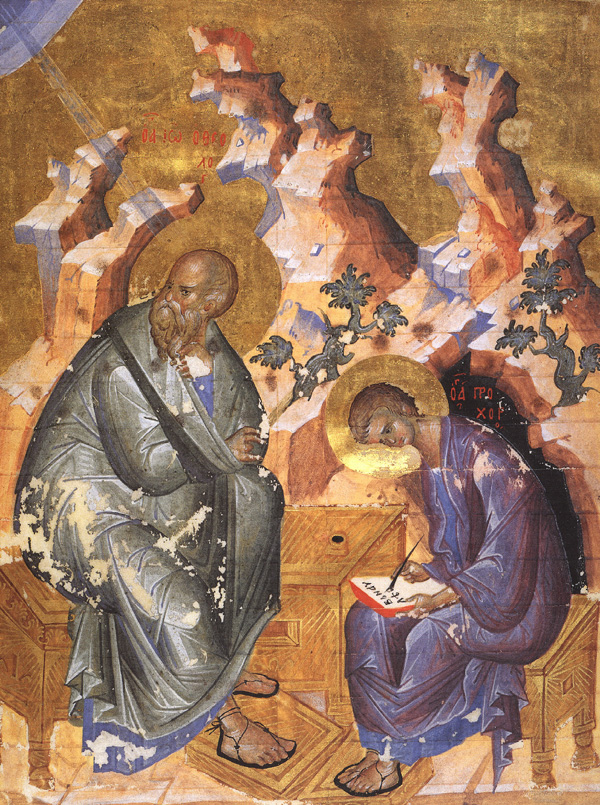
St. John the Theologian, and his disciple, St. Prochoros (http://ia600102.us.archive.org/13/items/Icoane/IoanEvanghelistul06.jpg)
   

Θεοδώρου Στουδίτου, “Εγκώµιον εις τον µέγαν Ιωάννην τον απόστολον και ευαγγελιστήν του Χριστού.” Migne J.P. Patrologia Graeca, 99, 771-788
   

The Theotokos "Kataphygi" ("Refuge"), and St. John the Theologian (http://upload.wikimedia.org/wikipedia/commons/9/9b/Avers_Poganovo_Icon.JPG)
   
Excerpt from an Encomium on St. John the Theologian, by St. Theodore the Studite (Amateur translation)
And do you wish to learn who was this great man? John, O men, the very early apostle, the pronounced of the evangelists, the great and golden-winged eagle of God, the one who studied the unapproachable depths of heaven, the man who was beyond the cherubim and unequalled in theoria, the presence of the beginningless Word, and angel among angels, the most greatly-worded preacher of truth, the most highly-seen nous, the fiery tongue, the godly-phrased mouth, the endless gulf of wisdom, the unapproachable in depth of dogmas, the great container of knowledge, the lightning of the Spirit that appears to the world, the thunder of grace of the universe, the firm pillar of the Church, the confirming foundation of God, the net capturing the wildness of the human nature, the fisher of souls with the heavenly-lengthed rod, the one who ever moves to saw apart heresies, the one who cuts the weeds of impiety with a sharp knife, the one who locks out the armies of atheism with a heavenly key, the one who removes the teeth of the noetic beasts that corrupt the mind, the one who sails the waves of the river of the wisdom of God, the most-pure temple of virginity, the very early beloved one and recliner-on-the-boosm of the [One Who] is desired, the great and beautiful-roaded sun on the Gospel, and what else could you say? For this dusky catalogue of a thousand [praises] cannot do justice even if the abyss were filled with encomiums. Bring them, bring all that can be said, for though this is poor, and I have no tongue to speak, a power from above will work the greatness of a miracle, for the height of heaven cannot be counted. And if we be granted to praise him, let us as a foundation take from the honey-like flowers of his evangelical words, and beholding this,  from this honey let us rationally make wax, and as those called to the apostolic feast as to a king, as an assistant where the word is received, approach himself and take courage.


Christ is risen from the dead, by death, trampling down upon death, and to those in the tombs, bestowing life!
Truly the Lord is risen!

Wednesday, May 4, 2011

Selected hymns for St. Ephraim of Nea Makri

Christ is risen! Truly He is risen!

St. Ephraim the New Righteous Martyr of Nea Makri, the Wonderworker - Commemorated May 5th and January 3rd (http://www.romiosini.org.gr/DA9A0DD2.el.aspx)
   
Selected hymns from the service to St. Ephraim the New Righteous Martyr of Nea Makri (all hymns below for the Saint are amateur translations from the Greek) available here: http://analogion.gr/glt/texts/May/05c.uni.htm.
   
Idiomelon of the Litia in the First Tone
Beholding you, O righteous-martyr Ephraim, the words of David are fulfilled*, and we brightly praise you, for on the Amomon mountain, working virtue, as on the mountain of the Lord, innocent you were shown in hands and pure in heart, arrayed in righteousness, and you watered the flowers of dispassion with the streams of your martyrical blood, and bore fruit in struggles, and you pour forth the sweetness of wonders, by which the bitter passions are withered, and leading towards salvation those who cry: O Lord, glory be to You. [*Psalm 24:3-4]
  
Doxastikon of the Aposticha in the Plagal of the Fourth Tone
Glory to the Father and the Son and the Holy Spirit.
Shining with the light of grace, O Father, your soul manfully endured the attacks of the princes of darkness, as if another were suffering, and you approached Christ totally, not at all lamenting having your members eviscerated by murderous hands, but you cried to the Lord: receive my spirit, O Savior, Who for me voluntarily endured the passion, and poured forth to me eternal life. And therefore, O blessed Ephraim, ceaselessly pray, that those who bless you may be saved.
  
Apolytikion in the First Tone
On Amomon Mountain, you shown forth like the sun, and O God-bearer, you left for God by martyrdom, you endured barbarians’ attacks, Ephraim O righteous-martyr of Christ, because of this you ever pour forth grace, to those who piously cry out to you, glory to Him who gave you strength, glory to Him you made you wondrous, glory to Him who grants through you, healings for all!
  
   
Kontakion in the Third Tone.
You struggled on Amomon mountain in asceticism, O godly-one, and there you completed the road of martyrdom. Therefore, the Giver-of-life has rightly crowned you with dual crowns, O righteous-martyr Ephraim, fervently entreat Him to have mercy on those who praise you.
  
Oikos
O Father, you followed Christ from youth, and in all ways you denied the wordly way and the pleasures of the flesh, and were filled with divine love, shining with an angelic life on mount Amomon, and you became a dwelling-place of divine energy, purifying your body and soul from the soul-corrupting passions with ascetical sweat, and were seized by the murderous hands of barbarians, and showed forth steadfastness in martyrdom, enduring many forms of injuries and tortures, and were violently put to death for Christ. Therefore, the Giver-of-life has crowned you with dual crowns, O righteous-martyr Ephraim, fervently entreat Him to have mercy on those who praise you.
  
Synaxarion
On the fifth of this month (May), we celebrate the memory of the struggle of the holy, glorious, righteous-martyr Ephraim, the newly-revealed and wonderworker, who struggled in asceticism on the mount of Amomon and struggled in martyrdom in the 15th century.
  
Verses
Seized by the struggle of asceticism, Ephraim
you were rightly glorified by the Lord.
On the fifth, Ephraim was horribly found on a mulberry tree by murderous hands.


  Megalynarion

Shining with an ascetical life, on mount Amomon, you struggled martyrically and were granted the grace of wonders by God, O Righteous-martyr Ephraim, who dwell with the Angels.
   
Icon of St. Ephraim of Nea Makri, and the spring of holy water in his monastery (http://www.romiosini.org.gr/DA9A0DD2.el.aspx)

Christ is risen from the dead, by death, trampling down upon death, and to those in the tombs, bestowing life!


Truly the Lord is risen!

Sunday, April 24, 2011

Additional Quotes of the Fathers on the Resurrection of Christ

Christ is risen! Truly He is risen!
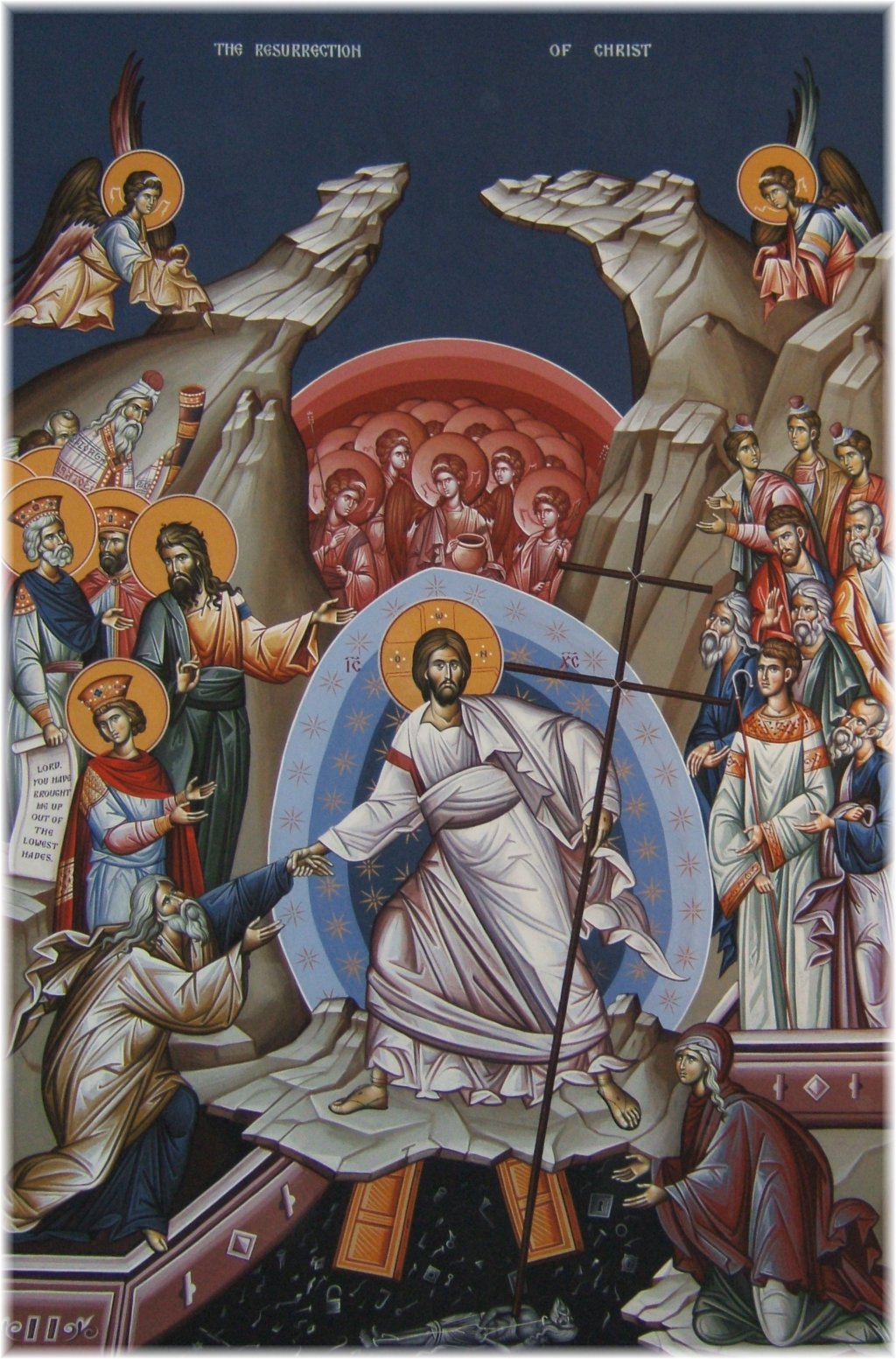
Christ descending to Hades to raise the dead (http://iconreader.files.wordpress.com/2011/01/resurrection2.jpg)
   
Additional Quotes of the Fathers on the Resurrection of Christ
"That light which far outshines the day and sun, first pledge of resurrection, and renovation of bodies long since dissolved, the divine token of promise, the path which leads to everlasting life — in a word, the day of the Passion — is arrived, best beloved doctors; and ye, my friends who are assembled here, ye blessed multitudes who worship Him who is the author of all worship and praise Him continually with heart and voice, according to the precepts of His holy word.

But thou, Nature, parent of all things: what blessing like to this hast thou ever accomplished for mankind? Nay rather, what is in any sense thy workmanship, since He who formed the universe is Himself the author of thy being? For it is He who has arrayed thee in thy beauty; and the beauty of Nature is life according to Nature’s laws.
But principles quite opposed to Nature have mightily prevailed, in that men have agreed in withholding His rightful worship from the Lord of all, believing that the order of the universe depended, not on His providence, but on the blind uncertainty of chance. And this they did, notwithstanding the clearest announcement of the truth by His inspired prophets, whose words should have claimed belief, but were in every way resisted by that impious wickedness which hates the light of truth and loves the obscure mazes of darkness.

Nor was this error unaccompanied by violence and cruelty, especially in that the will of princes encouraged the blind impetuosity of the multitude, or rather itself led the way in the career of reckless folly.

Such principles as these, confirmed by the practice of many generations, became the source of terrible evils in those early times: but no sooner had the radiance of the Saviour’s presence appeared, than justice took the place of wrong, a calm succeeded the confusion of the storm, and the predictions of the prophets were all fulfilled.

For after He had enlightened the world by the glorious discretion and purity of His character, and had ascended to the mansions of His Father’s house, He founded His Church on earth, as a holy temple of virtue, an immortal, imperishable temple, wherein the worship due to the Supreme Father and to Himself should be piously performed."
St. Constantine the Great
"Brethren, how fine a thing it is to move from festival to festival, from prayer to prayer, from holy day to holy day. The time is now at hand when we enter on a new beginning: the proclamation of the blessed Passover, in which the Lord was sacrificed. We feed as on the food of life, we constantly refresh our souls with his precious blood, as from a fountain. Yet we are always thirsting, burning to be satisfied. But he himself is present for those who thirst and in his goodness invites them to the feast day. Our Savior repeats his words:

'If anyone thirsts, let him come to me and drink.'

He quenched the thirst not only of those who came to him then. Whenever anyone seeks him he is freely admitted to the presence of the Saviour. The grace of the feast is not restricted to one occasion. Its rays of glory never set. It is always at hand to enlighten the mind of those who desire it.

Its power is always there for those whose minds have been enlightened and who meditate day and night on the holy Scriptures, like the one who is called blessed in the holy psalm:

'Blessed is the man who has not followed the counsel of the wicked, or stood where sinners stand, or sat in the seat of the scornful, but whose delight is in the law of the Lord, and who meditates on his law day and night.'

Moreover, my friends, the God who first established this feast for us allows us to celebrate it each year. He who gave up his Son to death for our salvation, from the same motive gives us this feast, which is commemorated every year. This feast guides us through the trials that meet us in this world.

God now gives us the joy of salvation that shines out from this feast, as he brings us together to form one assembly, uniting us all in spirit in every place, allowing us to pray together and to offer common thanksgiving, as is our duty on the feast. Such is the wonder of his love: he gathers to this feast those who are far apart, and brings together in unity of faith those who may be physically separated from each other.
St. Athanasios the Great

"The Lord, having put on human nature, and having suffered for him who suffered, having been bound for him who was bound, and having been buried for him who was buried, is risen from the dead, and loudly proclaims this message:
'Who will contend against me? Let him stand before me. It is I who delivered the condemned. It is I who gave life to the dead. It is I who raised up the buried. Who will argue with me? It is I, says Christ, who destroyed death. It is I who triumphed over the enemy, and having trod down Hades, and bound the Strong Man, and have snatched mankind up to the heights of heaven. It is I, says Christ. So then, come here all you families of men, weighed down by your sins and recieve pardon for your misdeeds. For I am your pardon. I am the Passover which brings salvation. I am the Lamb slain for you. I am your lustral bath. I am your life. I am your resurrection. I am your light, I am your salvation, I am your King. It is I who brings you up to the heights of heaven. It is I who will give you the resurrection there. I will show you the Eternal Father. I will raise you up with my own right hand.'"
St. Melito Bishop of Sardis
"Most men believe in the resurrection of Christ, but very few have a clear vision of it. …That most sacred formula which is daily on our lips does not say,
'Having believed in Christ’s resurrection,'
but,
'Having beheld Christ’s resurrection, let us worship the Holy Lord Jesus, who alone is without sin.'
How then does the Holy Spirit urge us to say,
'Having beheld Christ’s resurrection',
which we have not seen as though we had seen it, when Christ has risen once for all a thousand years ago, and even then without anybody’s seeing it? Surely Holy Scripture does not wish us to lie? Far from it! Rather, it urges us to speak the truth, that the resurrection of Christ takes place in each of us who believes, and that not once, but every hour, so to speak, when Christ the Master arises in us, resplendent in array and flashing with the lightnings of incorruption and Deity.

For the light-bringing coming of the Spirit shows forth to us, as in early morning, the Master’s resurrection, or, rather, it grants us to see the Risen One Himself. Therefore we say,
'The Lord is God, and He has given us light' (Ps. 118:27)
and we allude to His second Coming and add these words,
'Blessed is He that cometh in the Name of the Lord' (Ps. 118:26).
Those to whom Christ has given light as He has risen, to them He has appeared spiritually, He has been shown to their spiritual eyes. When this happens to us through the Spirit He raises us up from the dead and gives us life. He grants us to see Him, who is immortal and indestructible. More than that, He grants clearly to know Him who raises us up (Eph. 2:6) and glorifies us (Rom. 8:17) with Himself, as all the divine Scripture testifies.
These, then, are the divine mysteries of Christians. This is the hidden power of our faith, which unbelievers, or those who believe with difficulty, or rather believe in part, do not see nor are able at all to see.
St. Symeon the New Theologian
   
   
Christ is risen from the dead, by death, trampling down upon death, and to those in the tombs, bestowing life!


Truly the Lord is risen!

Saturday, April 23, 2011

St. Epiphanios of Salamis on the Lord's Descent into Hades

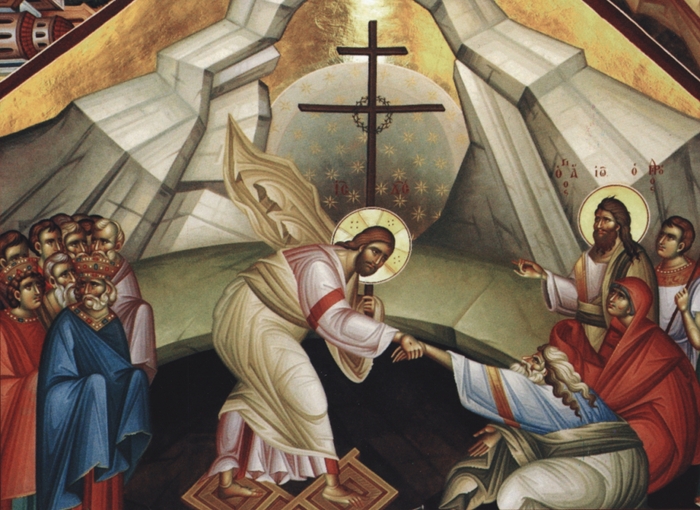
Christ's descent into Hades to raise the dead of all ages (http://vatopaidi.files.wordpress.com/2011/04/anastasi-kyriou-02.jpg)
   
Note: The following is a short excerpt from this incredible homily of St. Epiphanios. The entire homily is available here in text form, and read by the brotherhood of Holy Cross Monastery here.
  
St. Epiphanios of Salamis on the Lord's Descent into Hades
Something strange is happening - there is a great silence on earth today, a great silence and stillness.

The whole earth keeps silence because the King is asleep.

The earth trembled and is still because God has fallen asleep in the flesh and He has raised up all who have slept ever since the world began.

God has died in the flesh and hell trembles with fear.

He has gone to search for our first parent, as for a lost sheep.

Greatly desiring to visit those who live in darkness and in the shadow of death, He has gone to free from sorrow the captives Adam and Eve, He who is both God and the son of Eve.

The Lord approached them bearing the Cross, the weapon that had won Him the victory.

At the sight of Him Adam, the first man He had created, struck his breast in terror and cried out to everyone: "My Lord be with you all." Christ answered him: "And with your spirit."

He took him by the hand and raised him up, saying: "'Awake, O sleeper, and rise from the dead, and Christ will give you light.'

I am your God, who for your sake have become your son. Out of love for you and for your descendants I now by My own authority command all who are held in bondage to come forth, all who are in darkness to be enlightened, all who are sleeping to arise. I order you, O sleeper, to awake.

I did not create you to be held a prisoner in hell. Rise from the dead, for I am the life of the dead. Rise up, work of My hands, you who were created in My image.

Rise, let us leave this place, for you are in Me and I am in you; together we form only one person and we cannot be separated.

For your sake I, your God, became your son; I, the Lord, took the form of a slave; I, whose home is above the heavens, descended to the earth and beneath the earth. For your sake, for the sake of man, I became like a man without help, free among the dead. For the sake of you, who left a garden, I was betrayed to the Jews in a garden, and I was crucified in a garden.

See on My face the spittle I received in order to restore to you the life I once breathed into you.

See there the marks of the blows I received in order to refashion your warped nature in My image.

On my back see the marks of the scourging I endured to remove the burden of sin that weighs upon your back.

See My hands, nailed firmly to a tree, for you who once wickedly stretched out your hand to a tree.

I slept on the Cross and a sword pierced My side for you who slept in paradise and brought forth Eve from your side. My side has healed the pain in yours. My sleep will rouse you from your sleep in hell. The sword that pierced Me has sheathed the sword that was turned against you.

Rise, let us leave this place. The enemy led you out of the earthly paradise.

I will not restore you to that paradise, but I will enthrone you in heaven.

I forbade you the tree that was only a symbol of life, but see, I who am life itself am now one with you. I appointed cherubim to guard you as slaves are guarded, but now I make them venerate you as a god.

The throne formed by cherubim awaits you, its bearers swift and eager.

The bridal chamber is adorned, the banquet is ready, the eternal dwelling places are prepared, the treasure houses of all good things lie open.

The kingdom of heaven has been prepared for you from all eternity.
(http://www.johnsanidopoulos.com/2011/04/st-epiphanios-of-salamis-lords-descent.html)
   
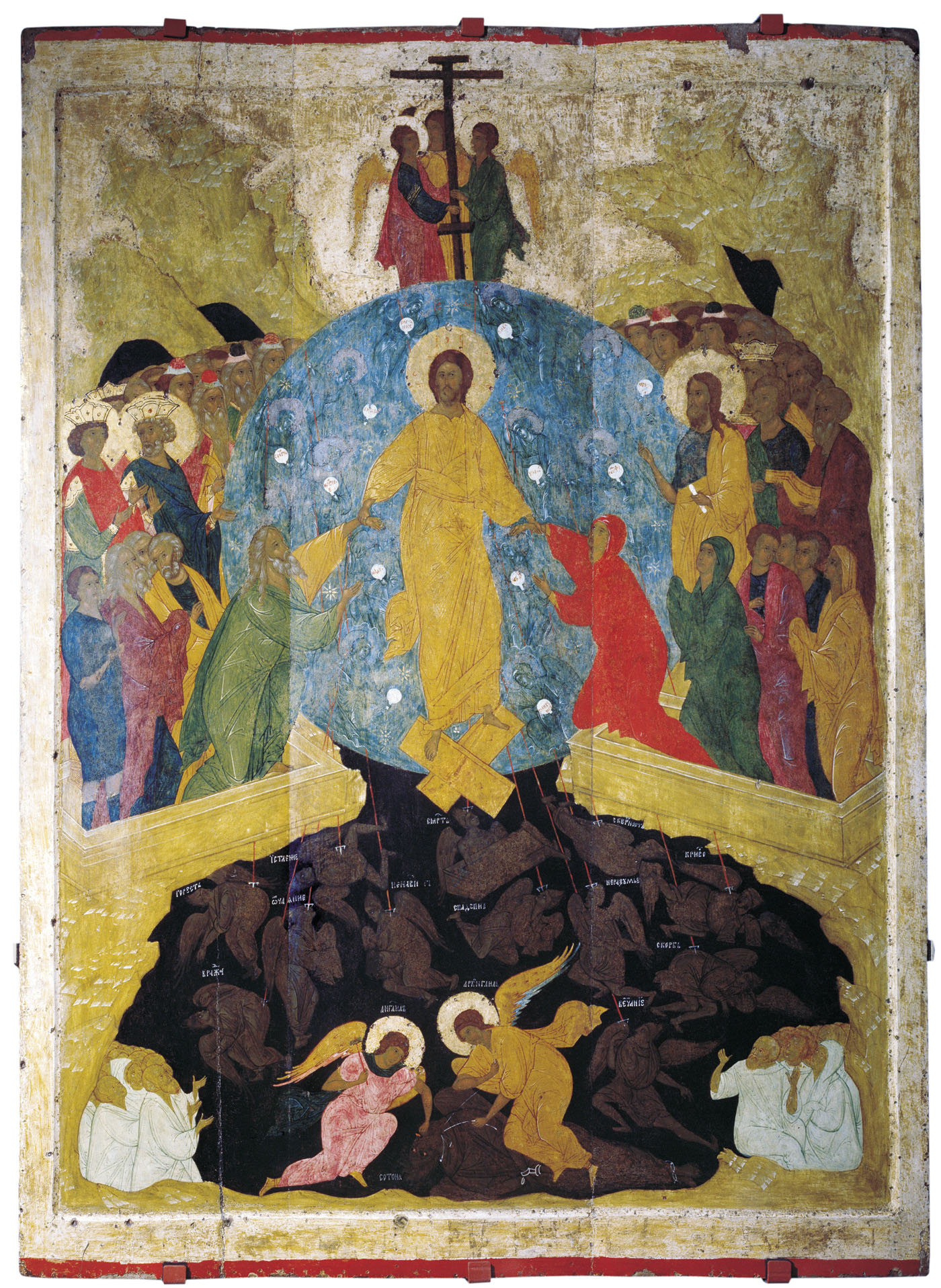
Christ's descent into Hades to raise the dead (http://www.belygorod.ru/img2/Ikona/Used/244nisiy_SoshestvieVoAdGRM.jpg)
   
Through the prayers of our Holy Fathers, Lord Jesus Christ our God, have mercy on us and save us! Amen!