Thursday, February 9, 2012

All Saints of Lesvos (Mytilene), Greece

I thought to begin a series of posts, each highlighting a region of the world and its local Saints. As is clear, the light of Christ has reached the farthest reaches of the earth, and thus, there is not one area which has not produced, as fruit of the Holy Spirit, Orthodox Saints. Lesvos is apparently one of the largest islands of Greece, and I happened to come across much information online about the numerous Saints that have shone from it. Also note, if you are have a preference for information about Saints from a region of your interest, please post to let me know, and I will do what I can to provide what info I can gather online. May Christ have mercy on us all and save us, through the prayers of our Holy Fathers!
  
  
All Saints of Lesvos (Mytilene), Greece (amateur translation)
The holy island of Lesvos, besides giving rise to men of the spirit, of the arts and of the sciences, through the blessing of God has revealed at least 40 Saints, who adorn and make radiant the Orthodox calendar of our Church. Some of them were from Lesvos, who lived godly lives and fell asleep in the Lord or were martyred on the island. Others were from other places, but came to Lesvos, where they were martyred, and hallowed the ground through their martyrical blood.
  
Every year, the memory of All Saints of Lesvos is celebrated the Sunday after the Sunday of All Saints with all radiance and devotion, and is proceeded by a series of festal events, in which the pious people of Lesvos and many visitors to the island, take part.
  
Older Saints of Lesvos (20)
New Martyrs of Lesvos (20)
  • St. Raphael the Hieromartyr of Thermi, the Newly-revealed (+1463) – April 9 / Tuesday of Bright Week / July 3 (uncovering of his relics)
  • St. Nicholas the Righteous martyr of Thermi, the Newly-revealed (+1463) – April 9 / Tuesday of Bright Week / June 13 (uncovering of his relics)
  • St. Irene the Virgin Martyr of Thermi, the Newly-revealed (+1463) – April 9 / Tuesday of Bright Week / May 12 (uncovering of her relics)
  • The Righteous Basileios, the Mayor of Thermi and Father of St. Irene (+1463) – April 9 / Tuesday of Bright Week
  • The Righteous Maria, the Mother of St. Irene (+1463) – April 9 / Tuesday of Bright Week
  • The Righteous Theodore, the teacher of Thermi, martyred after St. Raphael (+1463) – April 9 / Tuesday of Bright Week
  • St. Doukas the Tailor (+1564)
  • St. Parthenios Patriarch of Constantinople (+1657)
  • St. George Pasgianos (+1693) – February 14
  • St. George (Tzortzes) the Iberian (+1770) – January 2
  • St. Nicholas of Mytilene (+1771) – January 16
  • St. Theodore (Hatzi) of Mytilene (+1784) – January 30 (his martyrdom) / September 4 (uncovering of his relics)
  • St. Theodore the Byzantine (+1795) – February 17 (his martyrdom) / The 4th Sunday of Pascha (Sunday of the Paralytic) (the uncovering of his relics and his miraculous deliverance of the island from the plague in 1823)
  • St. Luke of Adrianoupolis (+1802) – March 23
  • St. George of Chios (+1807) – November 26
  • St. Demetrios from Larissa (+1809)
  • St. Anastasios Paneras (+1806) – August 10
  • St. Demetrios Mpegiazes (+1816) – August 10
  • St. Euthymios Bishop of Zelon (+1921) – May 29
(A total of 40 Saints)
  
  
Apolytikion of All Saints of Lesvos in the Third Tone (amateur translation)
A divine assembly of noble righteous ones, and band of archpriests, and unassailable rank of martyrs, the island of Lesvos praises as it dances, for they magnified Christ in her, and they intercede that true peace and great mercy may be granted to our souls.
(http://leimwnas.blogspot.com/2011/06/26-2011.html)
  
See the following links for hymns for the individual feasts mentioned above (http://stratisandriotis.blogspot.com/2009/05/blog-post_5072.html) and for the full service (in Greek) to All Saints of Lesvos (http://analogion.com/forum/showthread.php?t=13974).
  
Through the prayers of our Holy Fathers, Lord Jesus Christ our God, have mercy on us and save us! Amen!
Wednesday, February 8, 2012

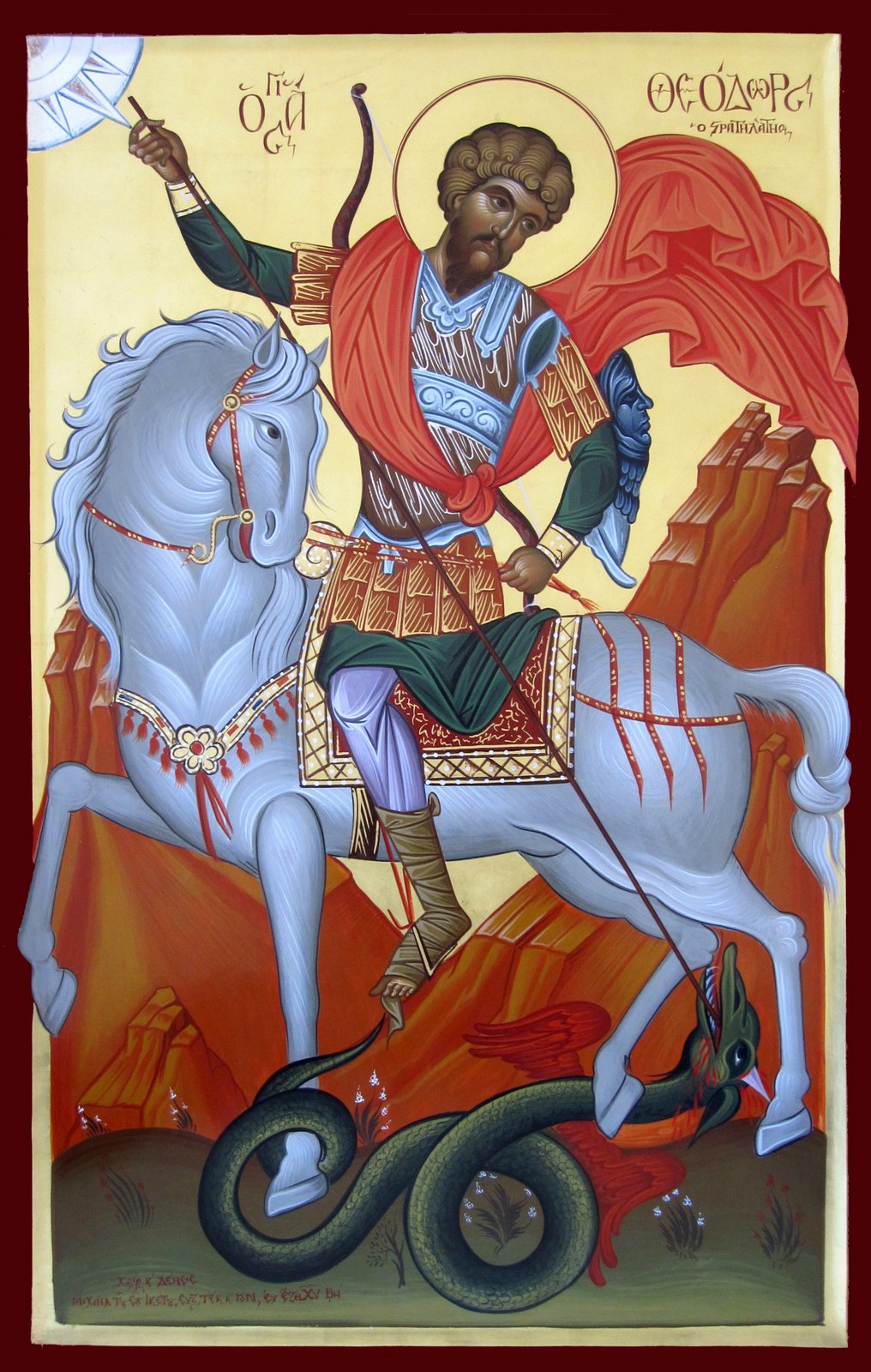
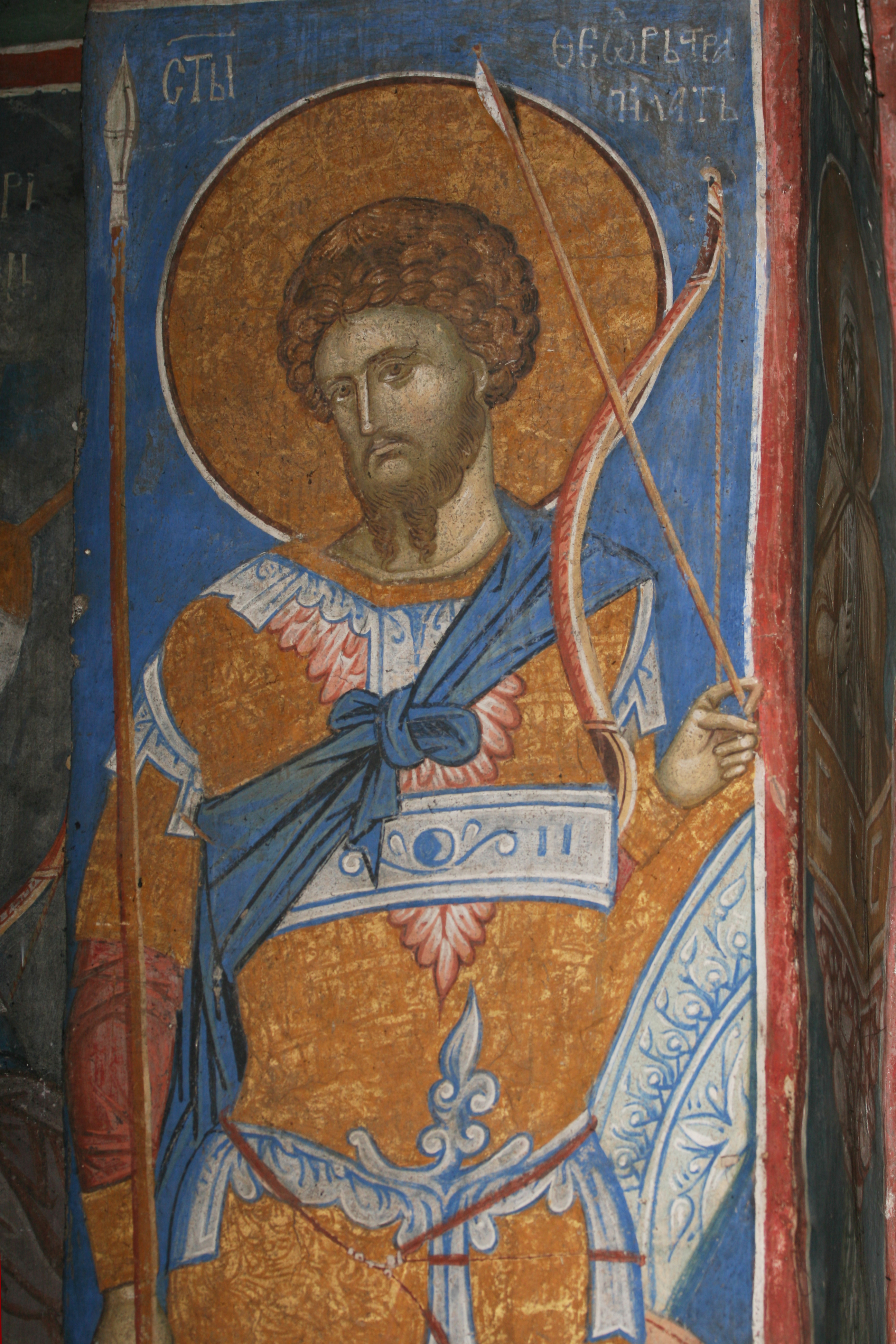
Selected hymns to St. Theodore the Great Martyr, Stratelates

  
Selected hymns to St. Theodore the Great Martyr, Stratelates (amateur translations below, except where specified)

Doxastikon of the Stichera in the Plagal of the First Tone
Today the honored memory of the champion of Christ has dawned as the Morning Star, utterly enlightening the hearts of the faithful, and driving away the clouds from the soul through the power and grace of the Spirit. Let those who love the martyrs cry out to him: hail, you who were revealed a God-given grace for the faithful, being arrayed with a multitude of wonders, for those who flee to you, O blessed Theodore. Do not cease to intercede to Christ, that we be granted the eternal good things, for those who celebrate your all-sacred memory in faith.
  
Doxastikon of the Aposticha in the Plagal of the Fourth Tone
Bearing the name of gifts from God, and the blessedness of His inheritance, let all of us the faithful praise him, and bless as is right, Theodore, the brave great martyr, the champion of the world. Intercede therefore to Christ God for our souls.

  
Apolytikion in the Fourth Tone
In truth enlisted with the King of the Heavens, thou didst become for Him a noble commander, O trophy-bearer and Great Martyr Theodore. With the weaponry of faith didst thou arm thyself wisely and didst utterly destroy all the hordes of the demons, as a triumphant athlete of the Lord; wherefore we ever do faithfully call thee blest.
  
Kontakion in the Second Tone
In courage of soul, and furnished with the arms of faith, thou tookest in hand the word of God as though a spear and didst put thy foe to flight, thou great boast of martyrs, O Theodore; now together with them, O Saint, cease not to entreat Christ our God for all of us.
  
  
Oikos
Come let all the faithful place the crowns of our hymns upon the head of Theodore, the radiant beauty of the champions. For he was shone to be a great gift from God to the world, shining with wonders. He conquered Belial the enemy through his sacred struggles, sprinkling, instead of blood, the streams of healings. In all of these Christ rejoices, and grants endless peace. Therefore we cry to him: cease not to entreat Christ our God for all of us.
  
Synaxarion
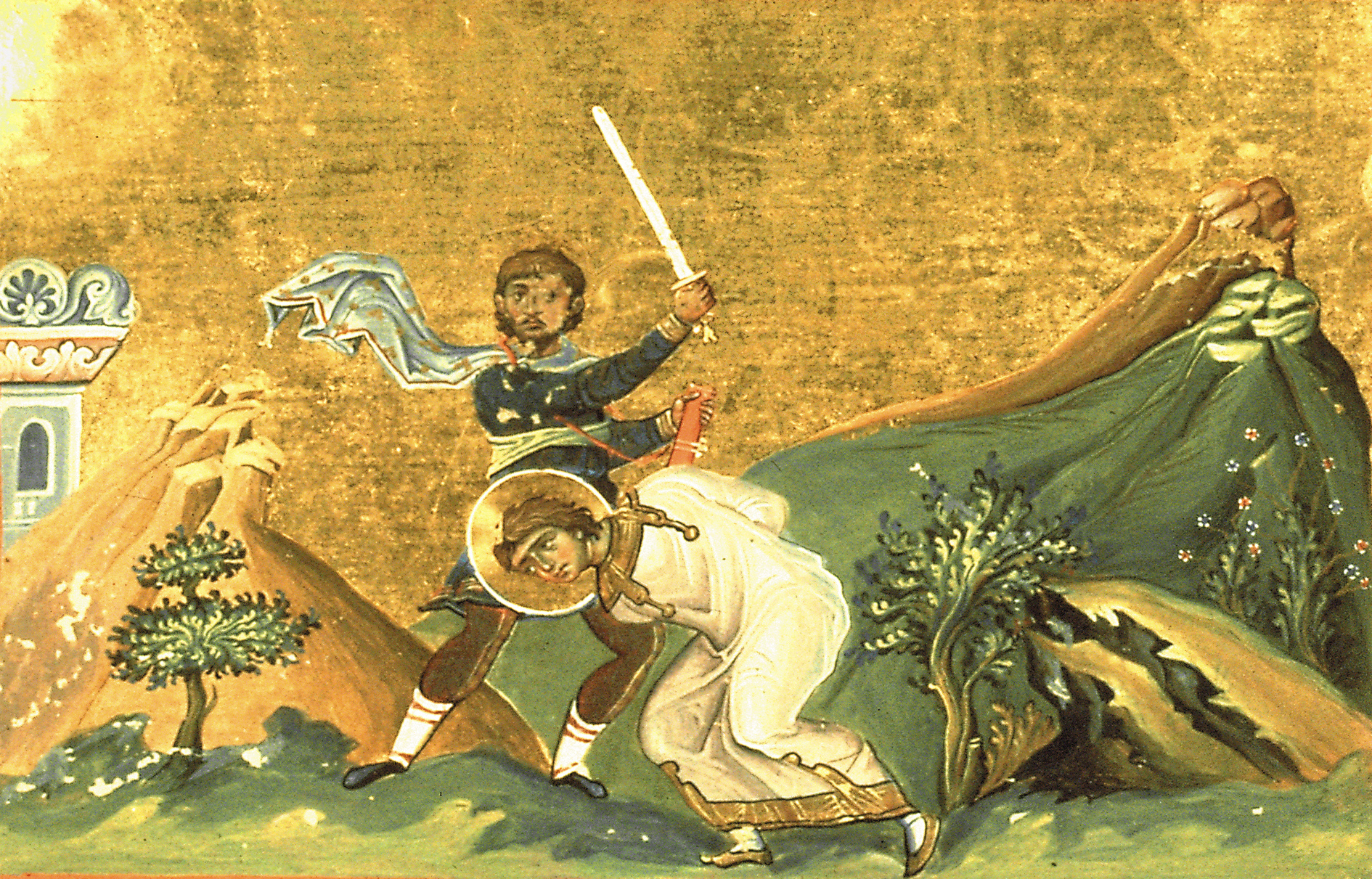
On the eighth of this month, the Memory of the Holy glorious Great Martyr Theodore Stratelates ("The Commander")
  
Verses
Being, O Theodore, a worthy Commander,
Having been cut, you became a Commander of God.
On the eighth, the mighty Theodore's neck is cut.
  
Doxastikon of the Praises in the Plagal of the Fourth Tone
You were piously arrayed with the manliness of champions and rational worship, O champion of Christ. And steadfastly serving in His power, you drove away the sick impiety of the idols and the terrors of the Tyrants, without being dismayed by tortures and this temporary fire. But you who are a divine gift in reality and according to your name, through your intercessions, save those who celebrate your memory from every trial.
      
  
Through the prayers of our Holy Fathers, Lord Jesus Christ our God, have mercy on us and save us! Amen!

Friday, February 3, 2012

Excerpt from the homily on Meeting of Christ in the Temple, by St. Amphilochius of Iconium

  
Excerpt from the homily on Meeting of Christ in the Temple, by St. Amphilochius of Iconium (amateur translation)
Wondrous therefore is virginity, true virginity, because there are differences within virginity; while some sleep and some are vigilant. Wondrous also is marriage, true and precious marriage. Many have kept it and many have violated it. Wondrous also is widowhood. Therefore, all three ranks should be commended. And, as we said, wondrous is also is widowhood, true widowhood, “winning the reward of undefiled conflicts” (Wisdom of Solomon 4:2). I see this richly demonstrated in Anna the prophetess, who aged well and was renewed like the eagle (Psalm 103:5). Do you hear the evangelist Luke richly say: “And Anna was a prophetess, a daughter of Phanuel, from the tribe of Asher, advanced in years, having lived after her husband seven years from her virginity, and as a widow till she was eighty-four, and worshpped in the temple in fasting and prayers night and day.” (Luke 2). Do you see how the widow Anna is adorned in the divine Gospels? Truly higher is Anna, having gathered through her glorious ways, the meaning of her name. Let women hear and be jealous of the glorious Anna. She ran the same race, that she might inherit the same crowns...The crown of widows is Anna; she bears the form of a woman, but the rank of a prophet. She lived in widowhood, being supported in the kingdom. She was withered in body, but was strengthened in soul. She was fearsome in appearance, but immense in spirit. She was hunched-over in age, but stood straight in knowledge. She was many-years old, with the seal of knowledge of God. She fasted, and did not consume others. She was in need, but did not wander about. She was concerned with the temple, and did not hasten to other houses. She chanted, but did not wail. She prophesied, not spinning myths. She studied the divine, and did not gather with the impure. Anna surpassed the widow that was that was blessed by the apostle. Which? Hear Paul who says: “A widow is to be put on the list only if she is not less than sixty years old...is well known for her good deeds, such as bringing up children, showing hospitality, washing the feet of the Lord’s people” (1 Timothy 5). She surpassed that which was praised by the apostle in her years and way of life, for she was made worthy of prophecy, and was a dwelling-place of the Holy Spirit, and to all those who approached her, she told of the symbols of Christ's bodily presence. And did she not surpass all that the evangelist said of her, and that you have heard at length? And it was this Anna, who was standing and speaking anthems to the Lord and speaking to all those who came to her of the deliverance of Jerusalem. Do you see the greatness of Anna? On behalf of the Lord, she defends Him to those who were against Him. O the strangeness of things! …
  
Anna beholds the Lord as an infant, with gifts and purification on behalf of Him and with Him offered, and she did not disdain His young age, but Anna confessed the infant as God, Physician, Deliverer, Mighty One, Remover of sin. Anna did not simply hold to these words, but she offered to all with energy regarding the Lord, and said to those who had gathered: "Do you see this child clinging to the breast, holding to the woman, resting in the arms of His mother, while her betrothed sits alone, He Who was circumcised on the eighth day? Don't you see this child? He founded the ages, He stretched out the heavens, He widened the earth, He traced the sea with sand. This Child calls forth clouds from His treasury. This Child, at the time of Noah, opened the doors of heaven for the flood...This Child works fearsome thunder. This Child spins the snow like wool. This Child freed our forefathers from Egypt through the rod of Moses. This Child divided the Red Sea, and through His strength brought them out, and rained down manna in the desert, and gave as inheritance milk and honey. This Child, through this temple and the fathers, prepared to raise us to the heights. This Child promised to Abraham: 'I will greatly multiply your seed as the stars of heaven, as the sand by the sea.' Regarding this Child, the prophetic supplication offered: 'Lord, stir up Your power, and come to save us' (Psalms 80:2). Do not disdain the Child, that He is a child. This very Child is beginningless with the Father, He shares His years, He is also beyond the ages, and this Child with a lisp, is He Who grants a mouth and wisdom. His birth was from a virgin, and thus His existence is astonishing. Because of thus, Isaiah spoke of You: 'A Child is born to us, a son is given to us.' To one He was born, to the other He is given. To one He is seen, to the other He is perceived." These are the prophecies of Anna...
(http://khazarzar.skeptik.net/pgm/PG_Migne/Amphilochius%20Iconiensis_PG%2039/In%20occursum%20domini.pdf)
  
  
Through the prayers of our Holy Fathers, Lord Jesus Christ our God, have mercy on us and save us! Amen!

Tuesday, January 31, 2012

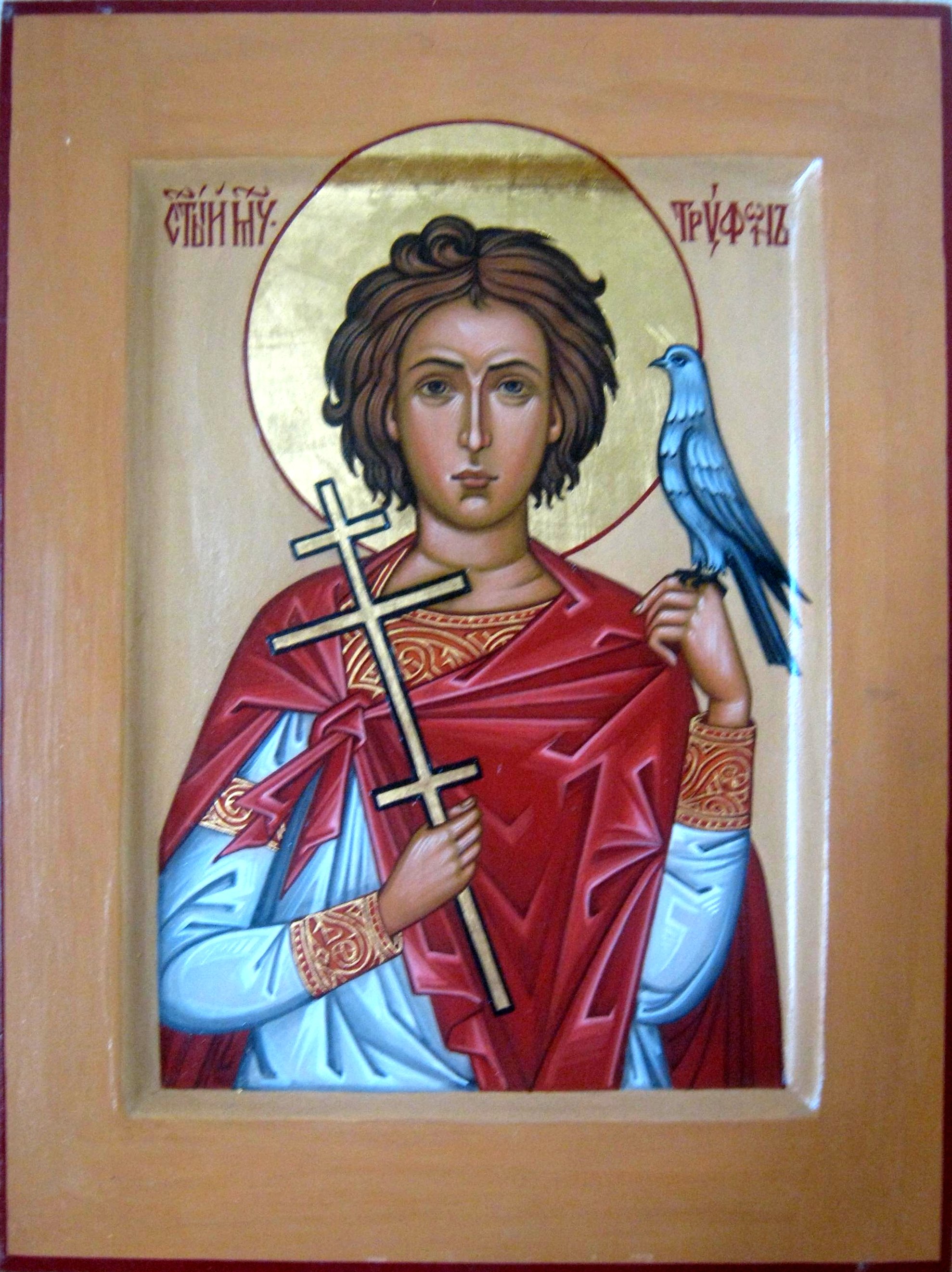
Selected hymns to St. Tryphon the Great Martyr and Unmercenary

St. Tryphon the Great Martyr and Unmercenary - Commemorated February 1 (http://hram-dimitria.ru/sait/Icon/39.jpg)
  
Selected hymns to St. Tryphon the Great Martyr and Unmercenary (amateur translations below, unless specified)

Idiomelon of the Litia in the First Tone
Arraying yourself with strength of mind, O glorious one, you counted the tortures of the godless as nothing, and you stood steadfast to the end. Being enlightened in mind through the divine Spirit, you reproached the most-lawless Akylinos, and proclaimed Christ as God with boldness, and kept His Orthodox Faith, and now in the heavens, you receive the prayers and doxologies that your servants offer ceaselessly to the Holy Trinity, and you intercede on behalf of those who honor your sacred memory with faith and fervor.
  
Doxastikon of the Litia in the Plagal of the First Tone
Come, all those who love the martyrs, let us rejoice in the all-pure feast of the Champion, and let us feast spiritually. Today this honored festival of the Great Martyr Tryphon calls us to a table that is set by his struggles, and to the all-praised treasury of his relics, which pour forth healings as waves, to those who faithfully approach them, and from them flow healing of souls and bodies, and deliverance from dangers, and the great mercy.
  
Doxastikon of the Aposticha in the Plagal of the First Tone
Today the honored feast of the Champion of Christ has dawned, enlightening the hearts of the faithful, and driving away the dark clouds of the demons. Through the grace and energy of the Spirit, let all who love martyrs cry out: Hail, you who were shown for the faithful to be a God-given and inexhaustible food. Hail, shield of the King, that has deposed the demons through the healing operation of the Spirit. Therefore, deliver us from our enemies from Hagar, those terrible tyrants, through your fervent and constant prayer to God Who loves man, O all-blessed Tryphon. As you now stand before Him, do not cease to intercede that we be delivered from dangers, and that we be granted the good things of life, for those who honor your all-sacred memory in faith.
  
Apolytikion in the First Tone
You endured the pains of torturers, having truly inherited the life without pain, O all-honored Tryphon, the foundation of Champions. Therefore, today the Church of Christ celebrates your all-holy memory, and rejoices in a godly manner.
  
The Martyrdom of St. Tryphon (http://days.pravoslavie.ru/jpg/im4001.jpg)
  
Kontakion - Tone 8
By the power of the Trinity you destroyed polytheism to the ends of the earth, and you were honored by Christ, all-glorious Tryphon; having conquered tyrants through Christ the Savior, you received your crown of martyrdom and the gift of divine healing, for you are invincible.
Oikos
A holy table is prepared today, all who love feasts, bringing the Pre-festal symbols, of the Lord forty-days old from His awesome birth from the Virgin, and He is held in the arms of the righteous Presbyter [Symeon], along with the memorial of the sacred Champion, for on behalf of him, Christ made him victorious, as the invincible.
  
Synaxarion
On the first of this month, the Memory of St. Tryphon the Great Martyr.
Verses
What of you Tryphon? You have reached death by sword.
Is this the time of your end? Not at all.
On the first of February, Tryphon dies by beheading.
  
Doxastikon of the Praises in the Plagal of the Second Tone
You truly showed to all, O all-famed Martyr Tryphon, that you were prudent with the height of humility, (and the demon flees meekness) and you heal every sickness and infirmity, as you raise to heaven without a ladder, imparting the immortal food that is your namesake. And the shepherd of geese has become an athlete of the heavenly mansions, as he now stands before the throne of Christ God. Do not cease to shepherd our lives, and ceaselessly entreat Him, that we be delivered from dangers, and from the godless tyrants that arm themselves against us, and bring down everyone's sword, for those who hymn in fervor your holy and all-honored memory.
  
Megalynarion
Let us the faithful praise Tryphon, the Great Martyr of Christ, that through his intercessions to the Lord, we be delivered from every evil.
  
St. Tryphon the Great Martyr and Unmercenary (http://sobor-shop.ru/UserFiles/Image/img336_67317_big.jpg)
  
Through the prayers of our Holy Fathers, Lord Jesus Christ our God, have mercy on us and save us! Amen!

Excerpt from the Encomium to Sts. Cyrus and John by St. Sophronios Patriarch of Jerusalem

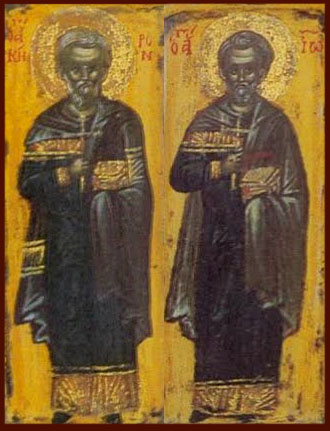
Sts. Cyrus and John the Holy Unmercenaries and Martyrs (http://pravicon.com/sv-1149, http://pravicon.com/sv-928)
  
Excerpt from the Encomium to Sts. Cyrus and John by St. Sophronios Patriarch of Jerusalem (amateur translation)
Others have praised other saints, triumphing in their gifts for many days, and in many ways preaching their works. They have raised exalted churches, they have adorned them with different forms of marble, while others have formed golden mosaics, and others have painted joyous icons, and others have gilded with gold and silver...and all have done so to honor and praise the martyrs in a thousand ways, as each is able and desires. They wish to offer to them their victories through them, and to show the care that they feel towards them, and they partook of unfading things instead of corruptible, instead of the things of this life, the things that have no end; the people praise these glorious ones whom they love, and offer them gifts out of habit. We, however, find that the word is more precious than natural materials, for it comes from the natural tongue, but proceeds from the spirit, which therefore flows as a stream unspoken; let us praise the saints in this way. He who therefore rejoices in the martyrs, takes refuge in the Word of God, Who made them martyrs. So it is worthy to celebrate their feast, we who have been greatly benefited from their grace, entreating them to open our mouth, that they might receive from us our gift offered to them...
  
Let us therefore praise the perfect among martyrs, and offer words of joy to those who listen. The faithful skip, seeing the ways of Cyrus being praised, and the mass of the pious ones praise John, learning of his encomium. From the Gospels and from the words of the Lord, which were first offered to the apostles, comes the praise of the martyrs Cyrus and John, and we say to them: You are the light of the world, and the salt of the earth, O thrice-blessed ones, and the light to those in darkness and the salt that does not loose its potency, and the light that is not extinguished and the salt that is not thrown out, the sleepless light and the salt that is not trampled upon, the light that is ever seen and the salt that is ever effective, the light of everything sweet and the salt beloved by all things...the light of godly-knowledge and salt fashioned from love of God, light that dissolves the darkness and salt that gives flavoring to food, light that illumines the dark things and salt that makes pleasant unpleasant things, light that reveals things that were lost and salt which seasons things. O holy band, through whom the Divine works wonders! For truly “God is wondrous among His saints”. O band of martyrs, through whom the world rejoices! O band of righteous ones, through whom life is renewed! O band of holy ones, through whom the faith is preserved! O band of praised ones, through whom the faithful are magnified! O band of zealous ones, through whom error is destroyed! O band of powerful ones, through whom we are delivered from the devil! O band of soldiers, through whom the demons are banished to perdition! O band of pious ones, through whom the idols are drowned! Hail, O band truly holy, and presence of God, who confirm the age to come to men. Hail, O precious band, you who were heavenly without leaving the earth. Hail O holy band, you who rejoice with the angels and give help to men. You are truly worthy to hear from the Savior, Who praises and cries out with a great voice: “You are the light of the world and the salt of the earth,” light illuminating from the true light, and salt from that true spring of salt, and light that illumines those who take refuge in you, and spring that continuously flows for those who praise you.
(http://books.google.com/books?id=CMHUAAAAMAAJ&printsec=frontcover&source=gbs_ge_summary_r&cad=0#v=onepage&q&f=false)
  
  
Through the prayers of our Holy Fathers, Lord Jesus Christ our God, have mercy on us and save us! Amen!

Friday, January 27, 2012

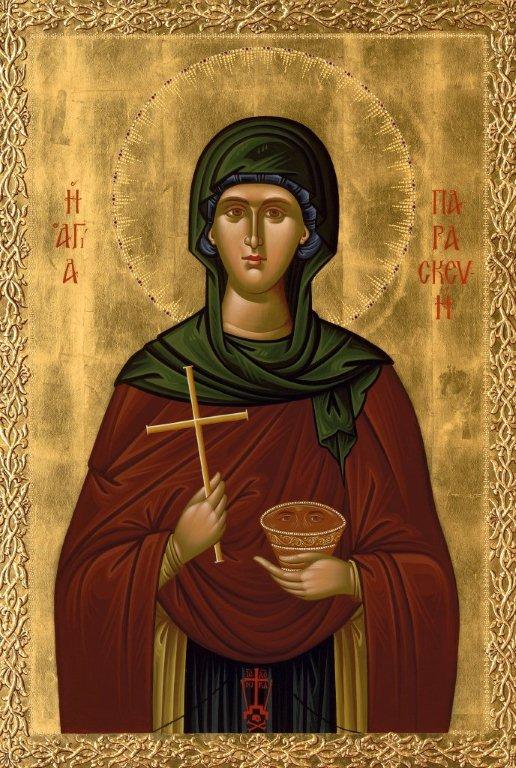
Akathist to St. Paraskevi the Great Martyr of Rome

Jesus Christ, depicted with St. Paraskevi the Great Righteous Virgin Martyr of Rome (July 26) (http://www.mlahanas.de/Greece/Arts/AngelosAkotantos/ChristParaskevi.jpg)
     
Please note that the meter of this translation is not set to match the original music.
For the life of St. Paraskevi, see: http://full-of-grace-and-truth.blogspot.com/2009/07/st-paraskevi-great-martyr-of-rome.html.
  
Akathist to St. Paraskevi the Great Righteous Virgin Martyr of Rome
  
Kontakion in the Plagal of the Fourth Tone
As the Lord’s grace-flowing nun, and His fervent apostle and Martyr, we praise you with triumphant hymns, and we praise your memory most tunefully, sprinkling flowers and crying:
Rejoice, Paraskevi, O comely virgin.
  
Hymns I offer to you the beauty of virgins, O chaste Paraskevi, martyr of Christ (3). For you struggled boldly, and you enlighten and shine with the rays of wonders on those who hymn you, and we offer you hymns with fervor:
Rejoice, child of pious faithful,
Rejoice, dear throne of God.
Rejoice, beautiful-voiced trumpet of love,
Rejoice, pure servant of the Virgin.
Rejoice, for from above you cover the Orthodox from blows,
Rejoice, you who cease the tears and groans of mortals.
Rejoice, for you are the protection of eyes,
Rejoice, for you rejoiced in the monastic path.
Rejoice, for you deposed the boasting of the enemy,
Rejoice, you who were victorious through Christ’s power.
Rejoice, divine adornment of Rome,
Rejoice, speedy healer of wounds.
Rejoice, Paraskevi, O comely virgin.

Being the root from the divine prayer of your parents, Agathon and Politia watered you with the streams of piety. And you, O comely Virgin, flourished as a tree, as those who gave birth to you rejoiced in your grace, and chanted to the Lord: Alleluia.

St. Paraskevi the Great Martyr (http://www.sakketosaggelos.gr/Article/800/)
  
Laughter and boldness, the streams of perdition, did not come near your soul, O Godly-minded one, but you spoke with the sacred virgins, and spent your time studying the Scriptures, becoming for us an example, for those who piously cry out:
Rejoice, most grace-endowed soul,
Rejoice, our most beloved righteous one.
Rejoice, nourishment of Orthodox asceticism,
Rejoice, heroism and worth of the calling.
Rejoice, divine seal of sacred missions,
Rejoice, boast and seal of the angelic life.
Rejoice, youth honored by God,
Rejoice, the ceasing of idol worship.
Rejoice, you who takes the honor from the false god,
Rejoice, joy of those who every cry out:
Rejoice, Paraskevi, O comely virgin.

You were not at all conquered by the glories of this life, O pure Christ-bearer Paraskevi, but taking hope in the life above, you perceived the things of life as refuse joyfully, and were enriched with divine things, and cried out to God in fervor: Alleluia.

St. Paraskevi the Great Martyr, holding her head that was severed for Christ (http://apantaortodoxias.blogspot.com/2012/02/blog-post_7613.html)


Following the words of your Incorruptible Bridegroom, the divine passing of your parents you perceived as a divine call, and you distributed your wealth to the poor, who praise your philanthropy, and cry out with all reverence:
Rejoice, you who were filled with the wisdom from above,
Rejoice, soul of godly monasticism.
Rejoice, nightingale singing praise of the Most-high,
Rejoice, you who bestow grace on monastics.
Rejoice, you who imparted your joy upon your brethren,
Rejoice, you who possess incorruptible treasuries in the Heavens.
Rejoice, for you showed manliness in trials,
Rejoice, for you dissipate the cloud of error.
Rejoice, greatly-victorious one on the road of the Martyrs,
Rejoice, lamp which shines with light of purity.
Rejoice, container that leads towards the Lord,
Rejoice, rays of the supernatural life.
Rejoice, Paraskevi, O comely virgin.

Being zealous for the things of Heaven, you locked yourself in a Convent, O most noble champion Paraskevi, for you submitted your wise mind, and joyfully struggled with ascetical pains, worshiping the Lord, and crying out with bitter hymns: Alleluia.

St. Paraskevi the Great Martyr of Rome (http://www.saintparaskevi.com/images/icon.jpg)
  
You were raised by divine grace to the heights of love, desiring the crown of martyrdom, and having sought the blessing of your Superior, you spoke the word of the Lord and dispelled error for many people, who now hymn you:
Rejoice, dawn of consolation,
Rejoice, harp of divine knowledge.
Rejoice, you who shared the name of the Wise Virgins (Matthew 25:1-13),
Rejoice, you who spoke with the spotless Angels.
Rejoice, you who embraced the angelic Schema with fervor,
Rejoice, protection and foundation of those who honor you with faith.
Rejoice, you who heard unspeakable voices,
Rejoice, you who were made worthy of the honor of the age to come.
Rejoice, all-fragrant lyre of the faithful,
Rejoice, salve for our eyes.
Rejoice, music of divine love,
Rejoice, breath of unsleeping worship.
Rejoice, Paraskevi, O comely virgin.

You walked the God-traced path of the Apostles, as another Protomartyr Thekla, and passed through the land of the Romans, and the cities of the Greeks, as an all-precious doe, preaching Christ fervently, and crying out with longing: Alleluia.
  
  
When Antoninos learned of your way Equal-to-the-Apostles, he placed a flaming helmet upon you, but through the will of the Lord, you were preserved utterly unharmed and remained pure, while all the faithful who beheld this, cried out victoriously words such as these:
Rejoice, divine doe of the flock of Christ,
Rejoice, for your fragrance was as pure nard (John 12:3).
Rejoice, teacher of blessing and mindfulness,
Rejoice, sweetest apostle of the Savior.
Rejoice, for your words were preached by pure lips,
Rejoice, for you imparted your experience to ascetics.
Rejoice, for you are the worker of peace,
Rejoice, for you are the protector of those endangered.
Rejoice, catechesis of the holy faithful,
Rejoice, disappearance of the false gods.
Rejoice, aloe of Orthodox manliness,
Rejoice, reproach of the evil heart.
Rejoice, Paraskevi, O comely virgin.

Demonic waves and unbearable blows, you endured, O much-suffering Lady, for the tyrants sought to burn you, and to break the chain of your faith, but you stood as an unshakable divine statue of Christ, saying: Alleluia.

  
Shining with your wonders, the choir of those who believed through you were brought to the flock of Christ, enraging the Emperor, who became short of breath through his many tortures, and now these radiant Dwelling-places cry out these in gratitude:
Rejoice, pure and comely martyr of Christ,
Rejoice, our map and canon.
Rejoice, you who ridiculed the false gods,
Rejoice, you who shattered the faces of idols.
Rejoice, all-sacred nun, humble and dedicated,
Rejoice, all-fragrant rose, and seal of the soul.
Rejoice, for you endured ascetical pains,
Rejoice, for you also trouble the swarms of the demons.
Rejoice, dowry to Christ of many talents,
Rejoice, chosen ode of the God of all.
Rejoice, root of the presbyter Rome,
Rejoice, protector of every town and place.
Hail, Paraskevi, O comely virgin.

Dwelling, as Paul, in prison alone, you were made worthy of the vision of an Angel, who showed you the honored symbols of the passion of Christ, in order to give you courage, O all-wise one, that we might cry unto the ages: Alleluia.

St. Paraskevi the Great Martyr of Rome (Source: www.eikonografos.com)
  
You are as a precious coin of the church, O Mother, bearing the seal of your Master, for you were tried by fire, and many tortures, O thrice-glorious one, and were not at all altered, as you hear from all these:
Rejoice, seal of sacred graces,
Rejoice, key of uncreated gifts.
Rejoice, for you endured the stretching of your flesh,
Rejoice, for you were steadfast manfully as you were being raked.
Rejoice, for your struggles reached the impassible peak,
Rejoice, Martyr who also shelters desert ascetics.
Rejoice, for you were placed in boiling tar,
Rejoice,for you were divinely kept unharmed.
Rejoice, savior for many in sickness,
Rejoice, you who grant light to the blind.
Rejoice, through whom goodness has come,
Rejoice, through whom magic has disappeared.
Rejoice, Paraskevi, O comely virgin.

You were tortured mercilessly, and brutally hung, without your steadfast mind wavering at all, but you cried out to the tyrant: Christ can deliver me from any of your tortures, to Whom I chant fearlessly: Alleluia.

  
Antoninos' eyes were burned from oil and tar, having asked it of you, but filled with great compassion, you straightaway granted him healing, O Paraskevi, therefore, the ruler who then espoused your faith, cried out:
Rejoice, spring of gifts,
Rejoice, well of healings.
Rejoice, for you won the spoils of the Romans,
Rejoice, for you preached the Sun of love.
Rejoice, divinely-breathed organ that makes glad the faithful,
Rejoice, purest eye that looks against the enemies.
Rejoice, you who bless those who hymn your many blessings,
Rejoice, you who conquer the opposing swarms.
Rejoice, sacred and genuine personage,
Rejoice, soul arrayed in light.
Rejoice, faithful honor and worth,
Rejoice, fragrance to men from Heaven.
Rejoice, Paraskevi, O comely virgin.

Before your end, they placed a heavy stone upon your chest, O Martyr Paraskevi, while Jesus appeared to you at night, surrounded by light and the radiant ranks of the Angels, and totally healed you. Thus you cried in joy: Alleluia.
  
  
With the strength of the Master, you bravely surpassed the weakness of other women. Through the divine Cross and your prayer, you tore apart a fearsome dragon, while all were astonished and cried out triumphantly:
Rejoice, light-bearing nun,
Rejoice, crown-bearing Martyr.
Rejoice, you who were steadfast of soul in terrible dangers,
Rejoice, you who were victorious in beatings and asceticism.
Rejoice, repository of grace, and dwelling of love,
Rejoice, meekness of spirit, and giver of peace.
Rejoice, for you are the trainer of monastics,
Rejoice, for you are the intercessor to the Trinity.
Rejoice, chain of chaste virgins,
Rejoice, deliverer from sinister spirits.
Rejoice, you through whom the dragon was torn apart,
Rejoice, you through whom the governor was astounded.
Rejoice, Paraskevi, O comely virgin.

You were worthily granted from Heaven an incorruptible crown, O lady, and the grace of wonders, which were founded upon your virtues, and your many struggles and terrible tortures, from which you blossomed forth and were glorified, as your fellow struggles cried out: Alleluia.
  
  
Your all-sacred Skull, O godly-minded one, rests in the Monastery of the Bodiless Powers Petraki, to which we take refuge, Paraskevi, as we all entreat that we find mercy, and healing of vision, as we cry out with fear:
Rejoice, healing of the eyes,
Rejoice, divine stream of wonders.
Rejoice, foundress of the churches that bear your name,
Rejoice, plantress of rose-beds of monastics.
Rejoice, seven-towered castle of those who hope in God,
Rejoice, dew of Hermon that burns up dangers.
Rejoice, for your prayer leads towards harmony,
Rejoice, for your hand heals those in pain.
Rejoice, help for those fervent in faith,
Rejoice, providence that you give to the poor.
Rejoice, vessel of the blessings of God,
Rejoice, flower of joyous fragrance.
Rejoice, Paraskevi, O comely virgin.

Water of incorruption is your Holy Water, O Mother, which heals ever sickness. Therefore, we who praise you, hasten to your protection, O Paraskevi, entreating for purification of soul, for those who ceaselessly cry to you: Alleluia.

  
We are are delivered from the bitter assaults of the demons, O Mother, through the hyssop of your intercessions, and from the visages of false gods, which you threw down to the earth through your unshakable hand, utterly shaming them. In joy we hymn you saying:
Rejoice, moon of those living in nepsis,
Rejoice, trauma of the demons.
Rejoice, astonishment of Orthodox asceticism,
Rejoice, guide of catechesis of the faithful.
Rejoice, for you were offered as a sacred seal,
Rejoice, for you were hung from a peg by your hair.
Rejoice, you who were nailed, for the love of the Lord,
Rejoice, you who bore the weight from the evil doers.
Rejoice, apostle among ascetics,
Rejoice,, all-wondrous one among apostles.
Rejoice, for your members bore indignities,
Rejoice, firewood that accepted burnings.
Rejoice, Paraskevi, O comely virgin.

Rejoicing with good cheer, you entered the Bridal Chamber above, O sacred martyr, and fell at the feet of Christ, which you embraced fervently, O all-precious Paraskevi. He placed a crown upon your head, and you cried out: Alleluia.
  
  
Nourish me, O Martyr, from your Heavenly Mansions, with the manna of your divine love, that I may cry out with my whole heart the sweet and sacred name of Jesus, and proclaiming your grace, O pure one, I cry out in compunction:
Rejoice, outer wall of the faithful,
Rejoice, shield of those who bear your name.
Rejoice, you who saves the inhabitants of Krokou [Kozani],
Rejoice,you who drove back the Germans.
Rejoice, chosen woman of the vale of Tempe,
Rejoice, Martyr who makes the desires of the Bridal chamber disappear.
Rejoice, for you work a multitude of wonders in Rodolivo,
Rejoice, for you deliver from the chaos of the faithless through your intercessions.
Rejoice, surrounding wall of Meteora,
Rejoice, terror to the demons.
Rejoice, you who were enriched with the boldness of Christ,
Rejoice, you who are the protection of those who hymn you.
Rejoice, Paraskevi, O comely virgin.

O divine nun, great prize of pious virgins to the Most-high (3) receive this as wild flowers, which we have gathered for you simply, and entreat the divine Trinity for salvation of those who cry with you: Alleluia.

Again, the Kontakion in the Plagal of the Fourth Tone
As the Lord’s grace-flowing nun, and His fervent apostle and Martyr, we praise you with triumphant hymns, and we praise your memory most tunefully, sprinkling flowers and crying:
Rejoice, Paraskevi, O comely virgin.

St. Paraskevi the Great Martyr of Rome (Source: www.eikonografos.com)
  
Through the prayers of our Holy Fathers, Lord Jesus Christ our God, have mercy on us and save us! Amen!

Thursday, January 26, 2012

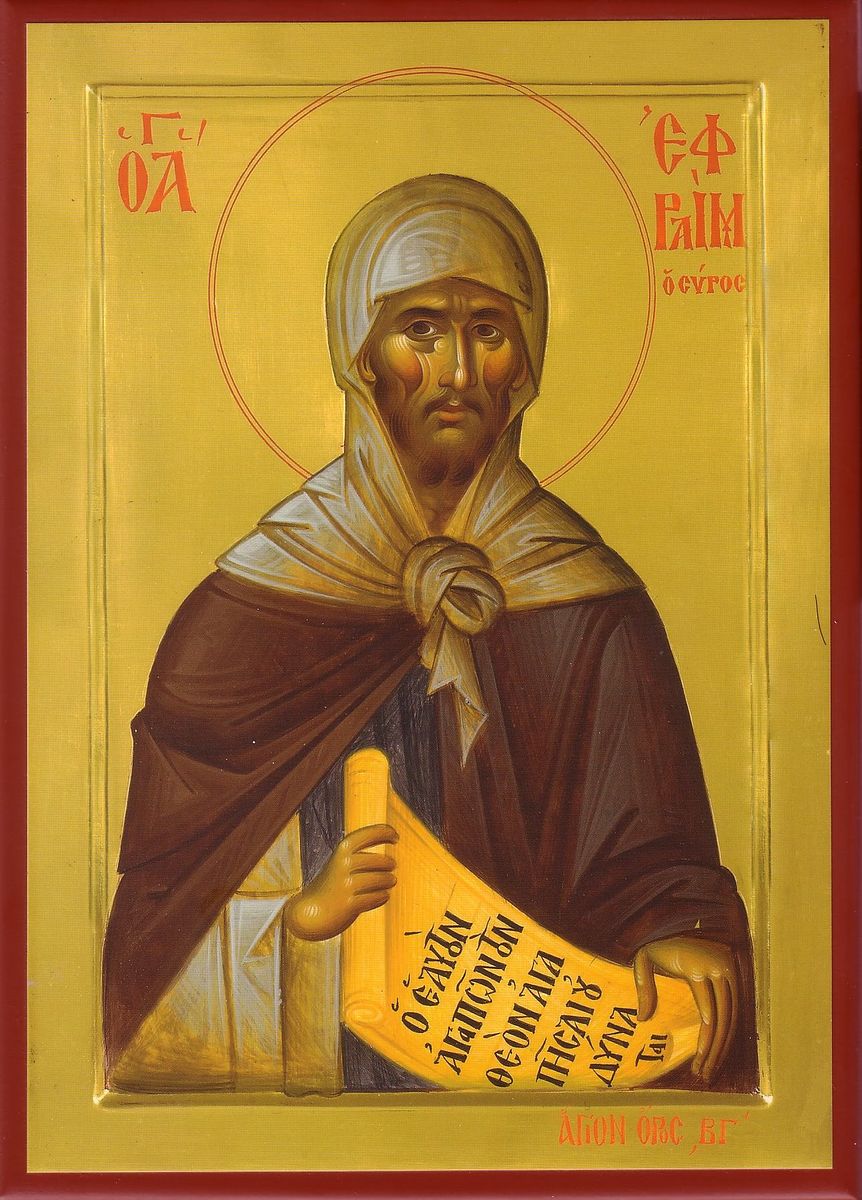
St. Ephraim the Syrian

St. Ephraim the Syrian - Commemorated on January 28 (http://pravicon.com/images/sv/s0815/s0815007.jpg)
  
Saint Ephraim the Syrian, a teacher of repentance, was born at the beginning of the fourth century in the city of Nisibis (Mesopotamia) into the family of impoverished toilers of the soil. His parents raised their son in piety, but from his childhood he was known for his quick temper and impetuous character. He often had fights, acted thoughtlessly, and even doubted God's Providence. He finally recovered his senses by the grace of God, and embarked on the path of repentance and salvation.

Once, he was unjustly accused of stealing a sheep and was thrown into prison. He heard a voice in a dream calling him to repent and correct his life. After this, he was acquitted of the charges and set free.

The young man ran off to the mountains to join the hermits. This form of Christian asceticism had been introduced by a disciple of St Anthony the Great, the Egyptian desert dweller Eugenius.

St James of Nisibis (January 13) was a noted ascetic, a preacher of Christianity and denouncer of the Arians. St Ephraim became one of his disciples. Under the direction of the holy hierarch, St Ephraim attained Christian meekness, humility, submission to God's will, and the strength to undergo various temptations without complaint.

St James transformed the wayward youth into a humble and conrite monk. Realizing the great worth of his disciple, he made use of his talents. He trusted him to preach sermons, to instruct children in school, and he took Ephraim with him to the First Ecumenical Council at Nicea (in the year 325). St Ephraim was in obedience to St James for fourteen years, until the bishop's death in 338.

After the capture of Nisibis by the Persians in 363, St Ephraim went to a monastery near the city of Edessa. Here he saw many great ascetics, passing their lives in prayer and psalmody. Their caves were solitary shelters, and they fed themselves with a certain plant.

  
He became especially close to the ascetic Julian (October 18), who was of one mind with him. St Ephraim combined asceticism with a ceaseless study of the Word of God, taking from it both solace and wisdom for his soul. The Lord gave him a gift of teaching, and people began to come to him, wanting to hear his counsel, which produced compunction in the soul, since he began with self-accusation. Both verbally and in writing, St Ephraim instructed everyone in repentance, faith and piety, and he denounced the Arian heresy, which at that time was causing great turmoil. Pagans who heard the preaching of the saint were converted to Christianity.

He also wrote the first Syriac commentary on the Pentateuch (i.e. "Five Books") of Moses. He wrote many prayers and hymns, thereby enriching the Church's liturgical services. Famous prayers of St Ephraim are to the Most Holy Trinity, to the Son of God, and to the Most Holy Theotokos. He composed hymns for the Twelve Great Feasts of the Lord (the Nativity of Christ, the Baptism, the Resurrection), and funeral hymns. St Ephraim's Prayer of Repentance, "O Lord and Master of my life...", is recited during Great Lent, and it summons Christians to spiritual renewal.

From ancient times the Church has valued the works of St Ephraim. His works were read publicly in certain churches after the Holy Scripture, as St Jerome tells us. At present, the Church Typikon prescribes certain of his instructions to be read on the days of Lent. Among the prophets, St David is the preeminent psalmodist; among the Fathers of the Church, St Ephraim the Syrian is the preeminent man of prayer. His spiritual experience made him a guide for monastics and a help to the pastors of Edessa. St Ephraim wrote in Syriac, but his works were very early translated into Greek and Armenian. Translations into Latin and Slavonic were made from the Greek text.

  
In many of St Ephraim's works we catch glimpses of the life of the Syrian ascetics, which was centered on prayer and working in various obediences for the common good of the brethren. The outlook of all the Syrian ascetics was the same. The monks believed that the goal of their efforts was communion with God and the acquisition of divine grace. For them, the present life was a time of tears, fasting and toil.

"If the Son of God is within you, then His Kingdom is also within you. Thus, the Kingdom of God is within you, a sinner. Enter into yourself, search diligently and without toil you shall find it. Outside of you is death, and the door to it is sin. Enter into yourself, dwell within your heart, for God is there."

Constant spiritual sobriety, the developing of good within man's soul gives him the possibility to take upon himself a task like blessedness, and a self-constraint like sanctity. The requital is presupposed in the earthly life of man, it is an undertaking of spiritual perfection by degrees. Whoever grows himself wings upon the earth, says St Ephraim, is one who soars up into the heights; whoever purifies his mind here below, there glimpses the Glory of God. In whatever measure each one loves God, he is, by God's love, satiated to fullness according to that measure. Man, cleansing himself and attaining the grace of the Holy Spirit while still here on earth, has a foretaste of the Kingdom of Heaven. To attain to life eternal, in the teachings of St Ephraim, does not mean to pass over from one realm of being into another, but rather to discover "the heavenly," spiritual condition of being. Eternal life is not bestown on man through God's one-sided efforts, but rather, it constantly grows like a seed within him by his efforts, toils and struggles.

The pledge within us of "theosis" (or "deification") is the Baptism of Christ, and the main force that drives the Christian life is repentance. St Ephraim was a great teacher of repentance. The forgiveness of sins in the Mystery of Repentance, according to his teaching, is not an external exoneration, not a forgetting of the sins, but rather their complete undoing, their annihilation. The tears of repentance wash away and burn away the sin. Moreover, they (i.e. the tears) enliven, they transfigure sinful nature, they give the strength "to walk in the way of the the Lord's commandments," encouraging hope in God. In the fiery font of repentance, the saint wrote, "you sail yourself across, O sinner, you resurrect yourself from the dead."

St Ephraim, accounting himself as the least and worst of all, went to Egypt at the end of his life to see the efforts of the great ascetics. He was accepted there as a welcome guest and received great solace from conversing with them. On his return journey he visited at Caesarea in Cappadocia with St Basil the Great (January 1), who wanted to ordain him a priest, but he considered himself unworthy of the priesthood. At the insistence of St Basil, he consented only to be ordained as a deacon, in which rank he remained until his death. Later on, St Basil invited St Ephraim to accept a bishop's throne, but the saint feigned madness in order to avoid this honor, humbly regarding himself as unworthy of it.

After his return to his own Edessa wilderness, St Ephraim hoped to spend the rest of his life in solitude, but divine Providence again summoned him to serve his neighbor. The inhabitants of Edessa were suffering from a devastating famine. By the influence of his word, the saint persuaded the wealthy to render aid to those in need. From the offerings of believers he built a poor-house for the poor and sick. St Ephraim then withdrew to a cave near Edessa, where he remained to the end of his days.
(http://ocafs.oca.org/FeastSaintsViewer.asp?SID=4&ID=1&FSID=100328)
  
The Dormition of St. Ephraim the Syrian (http://pravicon.com/images/sv/s0815/s0815009.jpg)
  
Troparion - Tone 8
By a flood of tears you made the desert fertile, and your longing for God brought forth fruits in abundance. By the radiance of miracles you illumined the whole universe! Our Father Ephraim, pray to Christ God to save our souls!

Kontakion - Tone 2
Ever anticipating the hour of Judgment, you lamented bitterly, venerable Ephraim. Through your deeds you were a teacher by example; therefore, universal Father, you rouse the slothful to repentance.
(
http://oca.org/FStropars.asp?SID=13&ID=100328)
  
Apolytikion in the Third Tone (amateur translation)
Bearing the life-giving stream in your soul, you were enriched with fear [of God], and were shown a treasury of compunction, therefore you lead us towards perfect virtues through the great number of your teachings. O Righteous Father Ephraim, entreat Christ God that we be granted the great mercy.
  
Through the prayers of our Holy Fathers, Lord Jesus Christ our God, have mercy on us and save us! Amen!