Saturday, February 26, 2011

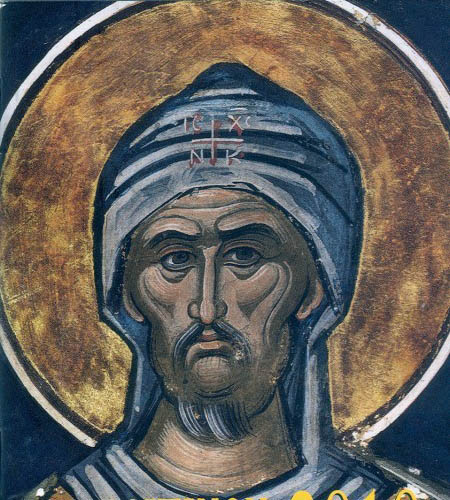
Commentary of St. John Chrysostom on Matthew 25 (Gospel reading for Meatfare Sunday)


Commentary of St. John Chrysostom on Matthew 25 (Gospel reading for Meatfare Sunday / Sunday of the Last Judgment)
"And do not account the saying to be rash. For the Lord is loving to man, and the gift cometh of His goodness. It is rash to have a mouth like the devil, to have a tongue resembling that of an evil demon, especially for him that partakes of such mysteries, and communicates of the very flesh of the Lord. Reflecting then on these things, become like Him, to the utmost of thy power. No longer then will the devil be able so much as to look thee in the face, when thou art become such a one as this. For indeed he recognizes the image of the King, he knows the weapons of Christ, whereby he was worsted. And what are these? Gentleness and meekness. For when on the mountain Christ overthrew and laid low the devil who was assaulting him, it was not by making it known that He was Christ, but He entrapped him by these sayings, He took him by gentleness, he turned him to flight by meekness. Thou also must do this; shouldest thou see a man become a devil, and coming against thee, even so do thou likewise overcome. Christ gave thee also power to become like Him, so far as thy ability extends. Be not afraid at hearing this. The fear is not to be like Him. Speak then after His manner, and thou art become in this respect such as He, so far as it is possible for one who is a man to become so.

Wherefore greater is he that thus speaks, than he that prophecies. For this is entirely a gift, but in the other is also thy labor and toil. Teach thy soul to frame thee a mouth like to Christ’s mouth. For it can create such things, if it will; it knows the art, if it be not remiss. And how is such a mouth made? one may ask. By what kind of colorings? by what kind of material? By no colorings, indeed, or material; but by virtue only, and meekness, and humility.
Let us see also how a devil’s mouth is made; that we may never frame that. How then is it made? By curses, by insults, by envy, by perjury. For when any one speaks his words, he takes his tongue. What kind of excuse then shall we have; or rather, what manner of punishment shall we not undergo; when this our tongue, wherewith we are allowed to taste of the Lord’s flesh, when this, I say, we overlook, speaking the devil’s words?
Let us not overlook it, but let us use all diligence, in order to train it to imitate its Lord. For if we train it to this, it will place us with great confidence at Christ’s judgment seat. Unless any one know how to speak thus, the judge will not so much as hear him. For like as when the judge chances to be a Roman, he will not hear the defense of one who knows not how to speak thus; so likewise Christ, unless thou speak after His fashion, will not hear thee, nor give heed.
Let us learn therefore to speak in such wise as our Judge is wont to hear; let it be 456our endeavor to imitate that tongue. And shouldest thou fall into grief, take heed lest the tyranny of despondency pervert thy tongue, but that thou speak like Christ. For He too mourned for Lazarus and Judas. Shouldest thou fall into fear, seek again to speak even as He. For He Himself fell into fear for thy sake, with regard to His manhood. the other sheep, that He might indicate the unfruitfulness of the one, for no fruit will come from kids; and the great profit from the other, for indeed from sheep great is the profit, as well from the milk, as from the wool, and from the young, of all which things the kid is destitute.
But while the brutes have from nature their unfruitfulness, and fruitfulness, these have it from choice, wherefore some are punished, and the others crowned. And He doth not punish them, until He hath pleaded with them; wherefore also, when He hath put them in their place, He mentions the charges against them. And they speak with meekness, but they have no advantage from it now; and very reasonably, because they passed by a work so much to be desired. For indeed the prophets are everywhere saying this, “I will have mercy and not sacrifice,” and the lawgiver by all means urged them to this, both by words, and by works; and nature herself taught it.
But mark them, how they are destitute not of one or two things only, but of all. For not only did they fail to feed the hungry, or clothe the naked; but not even did they visit the sick, which was an easier thing.
And mark how easy are His injunctions. He said not, “I was in prison, and ye set me free; I was sick, and ye raised me up again;” but, “ye visited me,” and, “ye came unto me.” And neither in hunger is the thing commanded grievous. For no costly table did He seek, but what is needful only, and His necessary food, and He sought in a suppliant’s garb, so that all things were enough to bring punishment on them; the easiness of the request, for it was bread; the pitiable character of Him that requesteth, for He was poor; the sympathy of nature, for He was a man; the desirableness of the promise, for He promised a kingdom; the fearfulness of the punishment, for He threatened hell. The dignity of the one receiving, for it was God, who was receiving by the poor; the surpassing nature of the honor, that He vouchsafed to condescend so far; His just claim for what they bestowed, for of His own was He receiving. But against all these things covetousness once for all blinded them that were seized by it; and this though so great a threat was set against it.
For further back also He saith, that they who receive not such as these shall suffer more grievous things than Sodom; and here He saith, “Inasmuch as ye did it not unto one of the least of these my brethren, ye did it not unto me.”
 What sayest Thou? they are Thy brethren; and how dost Thou call them least. Why, for this reason they are brethren, because they are lowly, because they are poor, because they are outcast. For such doth He most invite to brotherhood, the unknown, the contemptible, not meaning by these the monks only, and them that have occupied the mountains, but every believer; though he be a secular person, yet if he be hungry, and famishing, and naked, and a stranger, His will is he should have the benefit of all this care. For baptism renders a man a brother, and the partaking of the divine mysteries.
2. Then, in order that thou mayest see in another way also the justice of the sentence, He first praises them that have done right, and saith, “Come, ye blessed of my Father, inherit the kingdom prepared for you before 457the foundation of the world. For I was an hungered, and ye gave me meat,” and all that follows.
 For that they may not say, we had it not, He condemns them by their fellow-servants; like as the virgins by the virgins, and the servant that was drunken and gluttonous by the faithful servant, and him that buried his talent, by them that brought the two, and each one of them that continue in sin, by them that have done right.
And this comparison is sometimes made in the case of an equal, as here, and in the instance of the virgins, sometimes of him that hath advantage, as when he said, “The men of Nineveh shall rise up and shall condemn this generation, because they believed at the preaching of Jonas; and, behold, a greater than Jonas is here;” and, “The queen of the south shall condemn this generation, because she came to hear the wisdom of Solomon;” and of an equal again, “They shall be your judges;” and again of one at advantage, “Know ye not, that we shall judge angels, how much more things that pertain to this life?”
And here, however, it is of an equal; for he compares rich with rich, and poor with poor. And not in this way only doth He show the sentence justly passed, by their fellow-servants having done what was right when in the same circumstances, but also by their not being obedient so much as in these things in which poverty was no hindrance; as, for instance, in giving drink to the thirsty, in looking upon him that is in bonds, in visiting the sick. And when He had commended them that had done right, He shows how great was originally His bond of love towards them. For, “Come,” saith He, “ye blessed of my Father, inherit the kingdom prepared for you from the foundation of the world.” To how many good things is this same equivalent, to be blessed, and blessed of the Father? And wherefore were they counted worthy of such great honors? What is the cause? “I was an hungered, and ye gave me meat; I was thirsty, and ye gave me drink;” and what follows.
Of what honor, of what blessedness are these words? And He said not, Take, but, “Inherit,” as one’s own, as your Father’s, as yours, as due to you from the first. For, before you were, saith He, these things had been prepared, and made ready for you, forasmuch as I knew you would be such as you are.
And in return for what do they receive such things? For the covering of a roof, for a garment, for bread, for cold water, for visiting, for going into the prison. For indeed in every case it is for what is needed; and sometimes not even for that. For surely, as I have said, the sick and he that is in bonds seeks not for this only, but the one to be loosed, the other to be delivered from his infirmity. But He, being gracious, requires only what is within our power, or rather even less than what is within our power, leaving to us to exert our generosity in doing more.
But to the others He saith, “Depart from me, ye cursed,” (no longer of the Father; for not He laid the curse upon them, but their own works), “into the everlasting fire, prepared,” not for you, but “for the devil and his angels.” For concerning the kingdom indeed, when He had said, “Come, inherit the kingdom,” He added, “prepared for you before the foundation of the world;” but concerning the fire, no longer so, but, “prepared for the devil.” I, saith He, prepared the kingdom for you, but the fire no more for you, but “for the devil and his angels;” but since ye cast yourselves therein, impute it to yourselves. And not in this way only, but by what follows also, like as though He were excusing Himself to them, He sets forth the causes.
“For I was an hungered, and ye gave me no meat.” For though He that came to thee had been thine enemy, were not His sufferings enough to have overcome and subdued even the merciless? hunger, and cold, and bonds, and nakedness, and sickness, and to wander everywhere houseless? These things are sufficient even to destroy enmity. But ye did not these things even to a friend, being at once friend, and benefactor, and Lord. Though it be a dog we see hungry, often we are overcome; and though we behold a wild beast, we are subdued; but seeing the Lord, art thou not subdued? And wherein are these things worthy of defense?
For if it were this only, were it not sufficient for a recompense? (I speak not of hearing such a voice, in the presence of the world, from Him that sitteth on the Father’s throne, and of obtaining the kingdom), but were not the very doing it sufficient for a reward? But now even in the presence of the world, and at the appearing of that unspeakable glory, He proclaims and crowns thee, and acknowledges thee as His sustainer and host, and is not ashamed of saying such things, that He may make the crown brighter for thee.
So for this cause, while the one are punished justly, the others are crowned by grace. For though they had done ten thousand 458things, the munificence were of grace, that in return for services so small and cheap, such a heaven, and a kingdom, and so great honor, should be given them."
(http://www.ccel.org/ccel/schaff/npnf110.iii.LXXV.html; note: a non-Orthodox source site)
Through the prayers of our Holy Fathers, Lord Jesus Christ our God, have mercy on us and save us! Amen!
Thursday, February 24, 2011

Commentary by St. John Chrysostom on Matthew 11:7-15

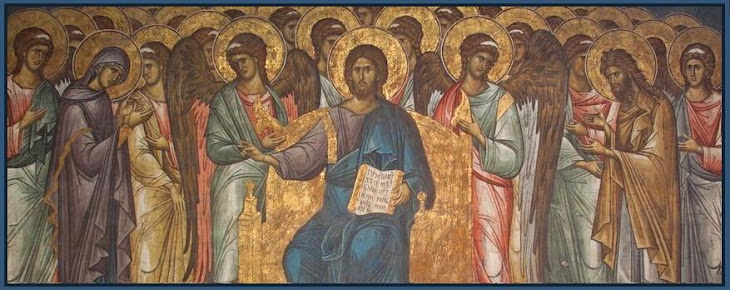
St. John the Forerunner before Christ with his precious severed Head (http://ia700102.us.archive.org/13/items/Icoane/IoanBotezatorul01_2.jpg)
  
Commentary by St. John Chrysostom on Matthew 11:7-15
“And as they departed, Jesus began to say unto the multitudes concerning John, What went ye out into the wilderness to see? A reed shaken with the wind? But what went ye out for to see? A man clothed in soft raiment; behold, they that wear soft clothing are in kings’ houses. But what went ye out for to see? A prophet? yea, I say unto you, and more than a prophet.”

For the matter indeed of John’s disciples had been ordered well, and they were gone away assured by the miracles which had just been performed; but there was need after that of remedy as regarded the people. For although they could not suspect anything of the kind of their own master, the common people might from the inquiry of John’s disciples form many strange suspicions, not knowing the mind with which he sent his disciples. And it was natural for them to reason with themselves, and say, “He that bore such abundant witness, hath he now changed his persuasion, and doth he doubt whether this or another be He that should come? Can it be, that in dissension with Jesus he saith this? that the prison hath made him more timid? that his former words were spoken vainly, and at random?” It being then natural for them to suspect many such things, see how He corrects their weakness, and removes these their suspicions. For “as they departed, He began to say to the multitudes.” Why, “as they departed?” That He might not seem to be flattering the man.

And in correcting the people, He doth not publish their suspicion, but adds only the solution of the thoughts that were mentally disturbing them: signifying that He knew the secrets of all men. For He saith not, as unto the Jews, “Wherefore think ye evil?”(Matt. ix. 4.) Because if they had it in their minds, not of wickedness did they so reason, but of ignorance on the points that had been spoken of. Wherefore neither doth He discourse unto them in the way of rebuke, but merely sets right their understanding, and defends John, and signifies that he is not fallen away from his former opinion, neither is he changed, not being at all a man easily swayed and fickle, but steadfast and sure, and far from being such as to betray the things committed unto him.

And in establishing this, He employs not at first his own sentence, but their former testimony, pointing out how they bare record of his firmness, not by their words only, but also by their deeds.

Wherefore He saith, “What went ye out into the wilderness to see?” as though He had said, Wherefore did ye leave your cities, and your houses, and come together all of you into the wilderness? To see a pitiful and flexible kind of person? Nay, this were out of all reason, this is not what is indicated by that earnestness, and the concourse of all men unto the wilderness. So much people and so many cities would not have poured themselves out with so great zeal towards the wilderness and the river Jordan at that time, had ye not expected to see some great and marvellous one, one firmer than any rock. Yea, it was not “a reed” surely, that “ye went out to see shaken by the wind:” for the flexible and such as are lightly brought round, and now say one thing, now another, and stand firm in nothing, are most like that.

And see how He omits all wickedness, and mentions this, which then especially haunted (ὑφορμοσαν) them; and removes the suspicion of lightness.

“But what went ye out for to see? a man clothed in soft raiment? Behold, they that wear soft clothing are in kings’ houses.” (Matt. xi. 8.)

Now His meaning is like this: He was not of himself a waverer; and this ye yourselves showed by your earnestness. Much less could any one say this, that he was indeed firm, but having made himself a slave to luxury, he afterwards became languid. For among men, some are such as they are of themselves, others become so; for instance, one man is passionate by nature, and another from having fallen into a long illness gets this infirmity. Again, some men are flexible and fickle by nature, while others become so by being slaves to luxury, and by living effeminately. “But John,” saith He, “neither was such a character by nature, for neither was it a reed that ye went out to see; nor by giving himself to luxury did he lose the advantage he possessed.” For that he did not make himself a slave to luxury, his garb shows, and the wilderness, and the prison. Since, had he been minded to wear soft raiment, he would not have lived in the wilderness, nor in the prison, but in the king’s courts: it being in his power, merely by keeping silence, to have enjoyed honor without limit. For since Herod so reverenced him, even when he had rebuked him, and was in chains, much more would he have courted him, had he held his peace. You see, he had indeed given proof of his firmness and fortitude; and how could he justly incur suspicions of that kind?

2. When therefore as well by the place, as by his garments, and by their concourse unto Him, He had delineated his character, He proceeds to bring in the prophet. For having said, “Why went ye out? To see a prophet? Yea I say unto you, and more than a prophet;” (Matt. xi. 9.) He goes on, “For this is he of whom it is written, (See Mal. iii. 1.) Behold, I send my messenger before Thy face, which shall prepare Thy way before Thee.” (Matt. xi. 10.) Having before set down the testimony of the Jews, He then applies that of the prophets; or rather, He puts in the first place the sentence of the Jews, which must have been a very strong demonstration, the witness being borne by his enemies; secondly, the man’s life; thirdly, His own judgment; fourthly, the prophet; by all means stopping their mouths.

Then lest they should say, “But what if at that time indeed he were such an one, but now is changed?” He added also what follows; his garments, his prison, and together with these the prophecy.

Then having said, that he is greater than a prophet, He signifies also in what he is greater. And in what is he greater? In being near Him that was come. For, “I send,” saith He, “my messenger before Thy face;” that is, nigh Thee. For as with kings, they who ride near the chariot, these are more illustrious than the rest, just so John also appears in his course near the advent itself. See how He signified John’s excellency by this also; and not even here doth He stop, but adds afterwards His own suffrage as well, saying, “Verily I say unto you, among them that are born of women, there hath not arisen a greater than John the Baptist.” (Matt. xi. 11.)

Now what He said is like this: “woman hath not borne a greater than this man.” And His very sentence is indeed sufficient; but if thou art minded to learn from facts also, consider his table, his manner of life, the height of his soul. For he so lived as though he were in heaven: and having got above the necessities of nature, he travelled as it were a new way, spending all his time in hymns and prayers, and holding intercourse with none among men, but with God alone continually. For he did not so much as see any of his fellow-servants, neither was he seen by any one of them; he fed not on milk, he enjoyed not the comfort of bed, or roof, or market, or any other of the things of men; and yet he was at once mild and earnest. Hear, for example, how considerately he reasons with his own disciples, courageously with the people of the Jews, how openly with the king. For this cause He said also, “There hath not risen among them that are born of women a greater than John the Baptist.”

3. But lest the exceeding greatness of His praises should produce a sort of extravagant feeling, the Jews honoring John above Christ; mark how He corrects this also. For as the things which edified His own disciples did harm to the multitudes, they supposing Him an easy kind of person; so again the remedies employed for the multitudes might have proved more mischievous, they deriving from Christ’s words a more reverential opinion of John than of Himself.

Wherefore this also, in an unsuspected way, He corrects by saying, “He that is less, in the kingdom of Heaven is greater than he.” Less in age, and according to the opinion of the multitude, since they even called Him “a gluttonous man and a winebibber;” (Matt. xi. 19.) and, “Is not this the carpenter’s son?” (Matt. xiii. 55.) and on every occasion they used to make light of Him.

“What then?” it may be said, “is it by comparison that He is greater than John?” Far from it. For neither when John saith, “He is mightier than I,” (Matt. iii. 11.)doth he say it as comparing them; nor Paul, when remembering Moses he writes, “For this man was counted worthy of more glory than Moses,” (Heb. iii. 3.) doth he so write by way of comparison; and He Himself too, in saying, “Behold, a greater than 240 Solomon is here,” (Matt. xii. 42.) speaks not as making a comparison.

Or if we should even grant that this was said by Him in the way of comparison, this was done in condescension, Or, “by way of economy;” (οκονομικ.) because of the weakness of the hearers. For the men really had their gaze very much fixed upon John; and then he was rendered the more illustrious both by his imprisonment, and by his plainness of speech to the king; and it was a great point for the present, that even so much should be received among the multitude. And so too, the Old Testament uses in the same way to correct the souls of the erring, by putting together in a way of comparison things that cannot be compared; as when it saith, “Among the gods there is none like unto Thee, O Lord:” (Ps. lxxxvi. 8.) and again, “There is no god like our God.” (Ps. lxxvii. 13.)
Now some affirm, that Christ said this of the apostles, others again, of angels. Thus, when any have turned aside from the truth, they are wont to wander many ways. For what sort of connexion hath it, to speak either of angels or of apostles? And besides, if He were speaking of the apostles, what hindered his bringing them forward by name? whereas, when He is speaking of Himself, He naturally conceals His person, because of the still prevailing suspicion, and that He may not seem to say anything great of Himself; yea, and we often find Him doing so.

But what is, “In the kingdom of heaven?” Among spiritual beings, and all them that are in heaven.

And moreover His saying, “There hath not risen among them that are born of women a greater than John,” suited one contrasting John with Himself, and thus tacitly excepting Himself. For though He too were born of a woman, yet not as John, for He was not a mere man, neither was He born in like manner as a man, but by a strange and wondrous kind of birth.

4. “And from the days of John the Baptist,” saith He, “until now, the kingdom of heaven suffereth violence, and the violent take it by force.” (Matt. xi. 12.)

And what sort of connexion may this have with what was said before? Much, assuredly, and in full accordance therewith. Yea, by this topic also He proceeds to urge and press them into the faith of Himself; and at the same time likewise, He is speaking in agreement with what had been before said by John. “For if all things are fulfilled even down to John, I am “He that should come.”

“For all the prophets,” saith He, “and the law prophesied until John.” (Matt. xi. 13.)

For the prophets would not have ceased, unless I were come. Expect therefore nothing further, neither wait for any one else. For that I am He is manifest both from the prophets ceasing, and from those that every day “take by force” the faith that is in me. For so manifest is it and certain, that many even take it by force. Why, who hath so taken it? tell me. All who approach it with earnestness of mind.

Then He states also another infallible sign, saying, “If ye will receive it, he is Elias, which was for to come.” For “I will send you,” it is said, “Elias the Tishbite, who shall turn the heart of the father to the children.” (Mal. iv. 5, 6) This man then is Elias, if ye attend exactly, saith He. For “I will send,” saith He, “my messenger before Thy face.” (Mal. iii. 1.)

And well hath He said, “If ye will receive it,” to show the absence of force. For I do not constrain, saith He. And this He said, as requiring a candid mind, and showing that John is Elias, and Elias John. For both of them received one ministry, and both of them became forerunners. Wherefore neither did He simply say, “This is Elias,” but, “If ye are willing to receive it, this is he,” that is, if with a candid mind ye give heed to what is going on. And He did not stop even at this, but to the words, “This is Elias, which was for to come,” He added, to show that understanding is needed, He that hath ears to hear, let him hear.” (Matt. xi. 15.)

Now He used so many dark sayings, to stir them up to inquiry. And if not even so were they awakened, much more, had all been plain and clear. For this surely no man could say, that they dared not ask Him, and that He was difficult of approach. For they that were asking him questions, and tempting Him about common matters, and whose mouths were stopped a thousand times, yet they did not withdraw from Him; how should they but have inquired of Him, and besought Him touching the indispensable things, had they indeed been desirous to learn? For if concerning the matters of the law they asked, “Which is the first commandment,” and all such questions, although there was of course no need of His telling them that; how should they but ask the meaning of what He Himself said, for which also He was bound to give account in His answers? And especially when it was He Himself that was encouraging and drawing them on to do this. For by saying, “The violent take it by force,” He stirs them up to earnestness of mind; and by saying, “He that hath ears to hear, let him hear,” He doth just the same thing.
(Taken from: http://www.ccel.org/ccel/schaff/npnf110.iii.XXXVII.html, note: a non-Orthodox source site)
  
St. John the Forerunner with scenes from his life (http://ia700102.us.archive.org/13/items/Icoane/IoanBotezatorul05.jpg)
  
Through the prayers of our Holy Fathers, Lord Jesus Christ our God, have mercy on us and save us! Amen!

Wednesday, February 23, 2011

St. Lazarus the New Hieromartyr of Tripoli (+1605)

St. Lazarus the New Hieromartyr of Tripoli (+1605) - Commemorated on February 23 (http://vatopaidi.files.wordpress.com/2010/01/agios-neos-ieromartys-lazaros-ek-tripoleos.jpg)

Brief life of the Saint (amateur translation)
The first written record that we have of the martyrdom of the Holy new hieromartyr Lazarus is that from Codex no. 797 of the Holy Monastery of Vatopedi, which preserves the service and the life of the Saint....

Who in reality remains unmoved when he hears of his life? He astonished the whole city with his enthusiasm, with the purity of his thoughts and his fiery faith, with his self-denial and sacrifice. He was a priest from the region of Tripoli. His pious parents, Nicholas and Alexandra, raised him with care and education in the Lord, leading him to perfect measures of virtue.

When he was ordained a priest, he taught the pious people of the area, others he instructed to not be unjust to the poor. Someone from the city named Seletos, committed daily injustices. To him, truly righteous priest Lazarus constantly advised to not be unjust to others. When Seletos was condemned to death for the crimes he had done, he denied Christ to escape punishment. Then, having become a muslem and escaped danger, with the other Turks he desired to seize St. Lazarus and to make him convert. They slandered him many times and led him to the place of judgment, telling him that if he would convert, they would give him many good things, and otherwise, they would kill him. The Saint denied the evil offer of the faithless, who decided to torture him in many ways common to the other neomartyrs, such as beatings, disfiguring limbs, cutting off body parts, injuries and many other things. In the end, seeing the unyieldingness of the martyr, they threw him into the fire, where the Saint surrendered his blessed soul in prayer.

It is worthy to note that his mother strengthened him, telling him to endure the temporary pain of the fire, that he might inherit the eternal Kingdom and rejoice with the other martyrs, the angels, archangels, prophets, and all of the Saints.

In this way the holy new hieromartyr Lazarus completed his life. As for those faithful and unfaithful standing by, they were astonished, and with fear confirmed how light from heaven shone at the place of martyrdom of the Saint for three days straight. Later, some pious Christians collected the relics and the rope of the Saint, which heal those who call upon the Saint in faith.

Apolytikion of the Saint in the Plagal of the First Tone (amateur translations below)
Righteous-athlete and martyr of the Most-High, O Lazarus, who quenched the fire of the furnace with streams of your precious tears, in this last days, as the bright light of Mantineias, and the super-bright lamp of Tripoli, and he seek your grace, we who are burning with the fire of passions.

Kontakion in the Second Tone
From the dogmas of your words, O Lazarus, utterly conquer those against us, for rule was give to you by God, and you confirm the faith in all things, for he was truly the support.

Megalynarion
Hail O wondrous righteous-athlete, who in Tripoli quenched fire precipitously and the faithless were crowned with shame by your steadfastness, O boast of martyrs, Lazarus.


Through the prayers of our Holy Fathers, Lord Jesus Christ our God, have mercy on us and save us! Amen!

Sunday, February 13, 2011

Additional Quotes of the Fathers on Humility

  
Additional Quotes of the Fathers on Humility
An [Elder] was asked, "What is humility?" and he said in reply, "Humility is a great work, and a work of God. The way of humility is to undertake bodily labour and believe yourself a sinner and make yourself subject to all." Then a brother said, "What does it mean, to be subject to all?" The [Elder] answered, "To be subject to all is not to give your attention to the sins of others but always to give your attention to your own sins and to pray without ceasing to God."

An [Elder] said, "Every time a thought of superiority or vanity moves you, examine your conscience to see if you have kept all the commandments, whether you love your enemies, whether you consider yourself to be an unprofitable servant and the greatest sinner of all. Even so, do not pretend to great ideas as though you were perfectly right, for that thought destroys everything."

As Abba Macarius was returning to his cell from the marsh carrying palm-leaves, the devil met him with a sharp sickle and would have struck him but he could not. He cried out, "Great is the violence I suffer from you, Macarius, for when I want to hurt you, I cannot. But whatever you do, I do and more also. You fast now and then, but I am never refreshed by any food; you often keep vigil, but I never fall asleep. Only in one thing are you better than I am and I acknowledge that." Macarius said to him, "What is that?" and he replied, "It is because of your humility alone that I cannot overcome you."

The [Elders] used to say, "When we do not experience warfare, we ought so much the more to humiliate ourselves. For God seeing our weakness, protects us; when we glorify ourselves, he withdraws his protection and we are lost."

"...true humility does not say humble words, nor does it assume humble looks, it does not force oneself either to think humbly of oneself, or to abuse oneself in self-belittlement. Although all such things are the beginning, the manifestations and the various aspects of humility, humility itself is grace, given from above. There are two kinds of humility, as the holy fathers teach: to deem oneself the lowest of all beings and to ascribe to God all one's good actions. The first is the beginning, the second the end."
St. Gregory of Sinai
(Texts on Commandments and Dogmas no. 115)

"...we have never achieved anything good on our own, but all good things are ours from God by grace, and come as it were from nothingness into being. For 'what do you have which you did not receive?' asks St. Paul - receive, that is, freely from God; 'and if you received it, why do you boast as if you had not received it' (I Cor. 4:7), but had achieved it by yourself? Yet by yourself you cannot achieve anything, for the Lord has said: 'Without Me, you can do nothing' (John 15:5)."
St. Peter of Damascus
(Book 1: A Treasury of Divine Knowledge, The Philokalia Vol. 3 pg. 176)

"A characteristic of those who are still progressing in blessed mourning is temperance and silence of the lips; and of those who have made progress – freedom from anger and patient endurance of injuries; and of the perfect – humility, thirst for dishonors, voluntary craving for involuntary afflictions, non- condemnation of sinners, compassion even beyond one’s strength. The first are acceptable, the second laudable; but blessed are those who hunger for hardship and thirst for dishonor, for they shall be filled with the food whereof there can be no satiety."
St. John Climacus
“The Ladder of Divine Ascent,” (Boston: Holy Transfiguration Monastery, 1978), Step 7: On Joy-Making Mourning

"A man who is truly humble is not troubled when he is wronged and he says nothing to justify himself against the injustice, but he accepts slander as truth; he does not attempt to persuade men that he is calumniated, but he begs forgiveness."
St. Isaac the Syrian - The Ascetical Homilies

"A person who suffers bitterly when slighted or insulted should recognize from this that he still harbors the ancient serpent in his breast. If he quietly endures the insult or responds with great humility, he weakens the serpent and lessens its hold. But if he replies acrimoniously or brazenly, he gives it strength to pour its venom into his heart and to feed mercilessly on his guts. In this way the serpent becomes increasingly powerful; it destroys his soul's strength and his attempts to set himself right, compelling him to live for sin and to be completely dead to righteousness."
St. Symeon the New Theologian
(Practical and Theological Texts no. 31)

"Abba John [the Dwarf] said, "Who sold Joseph" A brother replied saying, "It was his brethren." The old man said to him, "No, it was his humility which sold him, because he could have said, "I am their brother" and have objected, but, because he kept silence, he sold himself by his humility. It is also his humility which set him up as chief in Egypt."
The Desert Fathers

"Abba Poemen said, "As the breath which comes out of his nostrils, so does a man need humility and the fear of God."
The Desert Fathers

"An angel fell from heaven without any other passion except pride, and so we may ask whether it is possible to ascend to Heaven by humility alone, without any other of the virtues."
St. John Climacus
"The Ladder of Divine Ascent," (Boston: Holy Transfiguration Monastery, 1978),STEP 23: On Mad Pride, and, in the Same Step, on Unclean Blasphemous Thoughts

"At the Last Judgment the righteous will be recognized only by their humility and their considering themselves worthless, and not by good deeds, even if they have done them. This is the true attitude."
St. Peter of Damascus

"Behold, this is the true and the Christian humility. In this you will be able to achieve victory over every vice, by attributing to God rather than to yourself the fact that you have won."
St. John of the Ladder

"Consider well, brethren, how great is the power of humility. Consider how great is the spiritual energy behind saying, `Pardon me.' Why is the devil called not only `enemy,' but also `adversary'? He is called `enemy' because he is a hater of man, one who hates what is good, a traitor; and `adversary,' because he always puts obstacles in the way of good. If someone wants to pray he puts obstacles in the way through evil suspicions, shameful thoughts, and spiritual torpor. If a man wants to give alms he obstructs it through avarice or procrastination. If a man wants to keep vigil he obstructs it with hesitations or laziness. In every single thing he is against us when we desire to do good. This is why he is called the enemy and the adversary and why, by lowliness, all his attacks and devices are brought to nothing."
St. Dorotheos of Gaza - Discourses and Sayings

"Extirpate two thoughts within thyself: do not consider thyself worthy of anything great, and do not think that any other man is much lower than thou in worthiness. Learn humblemindedness beforehand, which the Lord commanded in word and showed forth in deed. Hence, do not expect obedience from others, but be ready for obedience thyself."
St. Basil the Great

"For this reason the Lord calls blessed those who are opposed to worldly possessions, saying: `Blessed are the poor in spirit, for theirs is the kingdom of heaven.' Why to the words, `Blessed are the poor,' does He add, `in spirit'? So that by this would be shown that He considers blessedness to be the humility of the soul. Why did He not say, blessed are the poor-spirited - and thus would be demonstrated the humility of thinking - but rather He says, `poor in spirit'? By this He wants to teach us that bodily poverty is also a blessedness, in that through this one can receive the kingdom of heaven, when it is done for the sake of the humility of the soul. This is the case when bodily poverty is united with the humility of the soul and when it is for the person the principle of the humility of the soul. Having called blessed `those poor in spirit,' He demonstrated in a wonderful way what are the root and cause of the visible poverty of the saints - that is, their spirit."
St. Gregory Palamas - Treatise on the Spiritual Life

"God descends to the humble as waters flow down from the hills into the valleys."
St. John of Kronstadt

"What made our Lord Jesus Christ lay aside his garments, gird himself with a towel, and, pouring water into a basin, begin to wash the feet of those who were below Him (John 13:4, etc.), if not to teach us humility? For it was humility He showed us by example of what He then did. And indeed those who want to be accepted into the foremost rank cannot achieve this otherwise than through humility; for in the beginning the thing that caused downfall from heaven was a movement of pride. So, if a man lacks extreme humility, if he is not humble with all his heart, all his mind, all his spirit, all his soul and body - he will not inherit the kingdom of God."
St Anthony the Great
"Early Fathers From the Philokalia," by E. Kadloubovsky and G.E.H. Palmer, (London: Faber and Faber, 1954), pp. 45-46

"Let all who are led by the spirit of God enter with us into this spiritual and wise assembly, holding in their spiritual hands the God-inscribed tablets of knowledge. We have come together, we have investigated, and we have probed the meaning of this precious inscription. And one man said: “It (humility) means constant oblivion of one’s achievements.” Another: “It is the acknowledgement of oneself as the last of all and the greatest sinner of all.” And another: “The mind’s recognition of one’s weakness and impotence.” Another again: “In fits of rage, it means to forestall one’s neighbor and be first to stop the quarrel.” And again another: “Recognition of Divine grace and divine compassion.” And again another: “The feeling of a contrite soul, and the renunciation of one’s own will.” But when I had listened to all this and had attentively and soberly investigated it, I found that I had not been able to attain to the blessed perception of that virtue from what had been said. Therefore, last of all, having gathered what fell from the lips of those learned and blessed fathers as a dog gathers the crumbs that fall from the table, I too gave my definition of it and said: “Humility is a nameless grace in the soul, its name known only to those who have learned it by experience. It is unspeakable wealth, a name and gift from God, for it is said: “learn not from an angel, nor from man, nor from a book, but from Me, that is, from My indwelling, from My illumination and action in you; for I am meek and humble in heart and in thought and in spirit, and your soul shall find rest from conflicts and relief from thoughts.” (Matthew 11:29)"
St. John Climacus
"The Ladder of Divine Ascent," (Boston: Holy Transfiguration Monastery, 1978), Step25: On the Destroyer of the Passions, Most Sublime Humility, Which is rooted in Spiritual Perception

"Make account that thou hast done nothing, and then thou hast done all. For if, being sinners, when we account ourselves to be what we are, we become righteous, as indeed the Publican did; how much more, when being righteous we account ourselves to be sinners."
St John Chrysostom
HOMILY III., MATT. I. 1
Through the prayers of our Holy Fathers, Lord Jesus Christ our God. have mercy on us and save us! Amen!

Wednesday, February 9, 2011

A miracle of St. Charalampos in Athens

St. Charalampos the Hieromartyr - Commemorated February 10th (Icon courtesy of www.eikonografos.com used with permission)
  
Miracle of St. Charalampos at the Polyclinic of Athens (amateur translation)
This occurred to Konstantinos Livadan, an official of the Election Council [υπάλληλον του Ελεγκτικού Συνεδρίου], when he was young. He himself relates:

“January 1931 I was hospitalized in the Polyclinic of Athens with a liver abscess. For four weeks I was tortured by a fever. Day and night I had a 38-40 degree (Celsius) fever and terrible pains. It was decided that I should have surgery.

It was the day before the feast of St. Charalampos: February 9th 1931. That night, as I was in a terrible condition with a great fever and lethargy, I saw a magnificent priest come to me with a long beard. He approached me, and not the sick person across from me, who was at death’s door with peritonitis. He touched my head and said:

‘Don’t be afraid…Tomorrow you will be totally well. You are a good boy.’

I asked my nearby nurse, Nun Evanthia: ‘Who was that Priest who came?’

‘There was no Priest,’ she responded.

I related to her what occurred. She crossed herself and told me: ‘Tomorrow is the feast of St. Charalampos; you will be well.’

I then fell into a deep sleep. The fever began to decline from that instant. In the morning I was afebrile, totally well and without pains in the liver. In the morning the surgeon-professor N. Alivizatos and his brother Andreas (a pathologist) tested me, to get ready for the surgery. They studied and searched to find the liver abscess, but they couldn’t find it, neither did they find sclerosis or other disease of the liver (eight finger). [ούτε την σκλήρυνσιν και την διόγκωσιν (οκτώ δακτύλων) του ήπατος] The liver was normal!

The Nun related to the Professor what happened at night. She also showed me the Icon of St. Charalampos, whom I recognized. It was he that I saw. The professors related in astonishment:

‘We put up our hands, and put down our knives. Today a miracle of St. Charalampos occurred at the Polyclinic!’

Later I learned that St. Charalampos is especially a physician of infectious diseases, which is what I had.”
(http://www.impantokratoros.gr/agios-charalampos.el.aspx)

For the life of the Saint, see: http://full-of-grace-and-truth.blogspot.com/2010/02/st-charalambos-hieromartyr-of-magnesia.html.

For two additional posts with miracles of the Saint, see: http://full-of-grace-and-truth.blogspot.com/2010/02/modern-miracles-of-st-charalambos-in.html and http://full-of-grace-and-truth.blogspot.com/2010/02/miracle-of-st-charalampos-in-filiatra.html.

Doxastikon of the Praises in the Plagal of the First Tone
Glory to the Father and to the Son and to the Holy Spirit
Your precious skull, O divine Saint, is like an alabaster box that is full and pouring out cures, like very costly fragrant oil. It wondrously perfumes the faithful, and it delivers from every evil those who approach it with faith. It exterminates foul‐smelling delusion, diseases of every kind, and the pandemic plague, and it grants good health to all, as well as peace and great mercy.
 
Through the prayers of our Holy Fathers, Lord Jesus Christ our God, have mercy on us and save us! Amen!

Saturday, January 29, 2011

"The Pearl", by St. Ephraim the Syrian

Jesus Christ, the Pearl of Great Price (http://www.uncutmountainsupply.com/proddetail.asp?prod=11S20)
   
THE PEARL: SEVEN HYMNS ON THE FAITH
by St. Ephraim of Syria
Translated by J.B. Morris, re-edited by John Gwynn


HYMN I.

1. On a certain day a pearl did I take up, my brethren; 
I saw in it mysteries pertaining to the Kingdom; 
Semblances and types of the Majesty; 
It became a fountain, and I drank out of it mysteries of the Son.
I put it, my brethren, upon the palm of my hand,
That I might examine it:
I went to look at it on one side,
And it proved faces on all sides.
I found out that the Son was incomprehensible,
Since He is wholly Light.
In its brightness I beheld the Bright One Who cannot be clouded,
And in its pureness a great mystery,
Even the Body of Our Lord which is well-refined:
In its undivideness I saw the Truth
Which is undivided.
It was so that I saw there its pure conception,
The Church, and the Son within her.
The cloud was the likeness of her that bare Him,
And her type the heaven,
Since there shone forth from her His gracious Shining.
I saw therein his Trophies, and His victories, and His crowns.
I saw His helpful and overflowing graces,
And His hidden things with His revealed things.

2. It was greater to me than the ark, 
For I was astonied thereat: 
I saw therein folds without shadow to them 
Because it was a daughter of light, 
Types vocal without tongues, 
Utterances of mystery without lips, 
A silent harp that without voice gave out melodies.
The trumpet falters and the thunder mutters;
Be not thou daring then;
Leave things hidden, take things revealed.
Thou hast seen in the clear sky a second shower;
The clefts of thine ears,
As from the clouds,
They are filled with interpretations.
And as that manna which alone filled the people,
In the place of pleasant meats,
With its pleasantnesses,
So does this pearl fill me in the place of books,
And the reading thereof,
And the explanations thereof.
And when I asked if there were yet other mysteries,
It had no mouth for me that I might hear from,
Neither any ears wherewith it might hear me.
O Thou thing without senses, whence I have gained new senses!


3. It answered me and said, 
"The daughter of the sea am I, the illimitable sea! 
And from that sea whence I came up it is 
That there is a mighty treasury of mysteries in my bosom! 
Search thou out the sea, but search not out the Lord of the sea!
"I have seen the divers who came down after me, when astonied,
So that from the midst of the sea they returned to the dry ground;
For a few moments they sustained it not.
Who would linger and be searching on into the depths of the Godhead?
"The waves of the Son are full of blessing,
And with mischiefs too.
Have ye not seen, then, the waves of the sea,
Which if a ship should struggle with them would break her to pieces,
And if she yield herself to them, and rebel not against them,
Then she is preserved?
In the sea all the Egyptians were choked, though they scrutinised it not,
And, without prying, the Hebrews too were overcome upon the dry land,
And how shall ye be kept alive?
And the men of Sodom were licked up by the fire,
And how shall ye prevail?
"At these uproars the fish in the sea were moved,
And Leviathan also.
Have ye then a heart of stone
That ye read these things and run into these errors?
O great fear that justice also should be so long silent!"


4. "Searching is mingled with thanksgiving, 
And whether of the two will prevail? 
From the tongue 
The incense of praise riseth
Along with the fume of disputation 
And unto which shall we hearken? 
Prayer and prying from one mouth, 
And which shall we listen to?
"For three days was Jonah a neighbour in the sea:
The living things that were in the sea were affrighted,
Saying, 'Who shall flee from God?
Jonah fled,
And ye are obstinate at your scrutiny of Him!'"

The Theotokos and Christ, "the Wealth of Mankind" (http://www.uncutmountainsupply.com/proddetail.asp?prod=12G56)
   

HYMN II.

1. Whereunto art thou like?
Let thy stillness speak to one that hears;
With silent mouth speak with us:
For whoso hears the stammerings of thy silence,
to him thy type utters its silent cry concerning our Redeemer.
Thy mother is a virgin of the sea, though he took her not:
She fell into his bosom, though he knew her not;
She conceived thee near him, though he did not know her.
Do thou, that art a type, reporach the Jewish women
That have thee hung upon them.
Thou art the only progeny of all forms
Which art like to the Word on High,
Whom singly the Most High begot.
The engraven forms seem to be the type of created things above.
This visible offspring of the invisible womb
Is a type of great things.
Thy goodly conception was without seed,
And without wedlock was thy pure generation,
And without brethren was thy single birth.
Our Lord had brethren and yet not brethren,
Since He was an Only-Begotten.
O solitary one, thou type exact of the Only-Begotten!
There is a type of thine in the crown of kings,
Wherein thou hast brothers and sisters.
Goodly gems are thy brethren,
With beryls and unions as thy companions:
May gold be as it were thy kinsman,
May there be unto the King of kings
A crown from thy well-beloved ones!
When thou camest up from the sea, that living tomb,
Thou didst cry out,
Let me have a goodly assmblage of brethren, relatives and kinsmen.
As the wheat is in the stalk,
So thou art in the crown with princes:
And it is a just restoration to thee, as if of a pledge,
That from the depth thou shouldest be exalted to a goodly eminence.
Wheat the stalk bears in the field;
Thee the head of the king upon his chariot carries about.
O daughter of the water,
Who hast left the sea, wherein thou wert born,
And art gone up to the dry land, wherein thou art beloved:
For men have loved and seized and adorned themselves with thee,
Like as they did that Offspring Whom the Gentiles loved
And crowned themselves withal.
It is by the mystery of truth that Leviathan is trodden down of mortals:
The divers put him off, and put on Christ.
In the sacrament of oil did the Apostles steal Thee away, and came up.
They snatched their souls from his mouth, bitter as it was.
Thy Nature is like a silent lamb in its sweetness,
Of which if a man is to lay hold,
He lifts it in a crucial form by its ears, as it was on Golgotha.
He cast out abundantly all His gleams upon them that looked upon Him.

2. Shadowed forth in thy beauty is the beauty of the Son,
Who clothed Himself with suffering when the nails passed through Him.
The awl passed in thee since they handled thee roughly,
As they did His hands;
And because He suffered He reigned,
As by they sufferings thy beauty increased.
And if they showed no pity upon thee,
Neither did they love thee:
Still suffer as thou mightest,
Thou has come to reign! Simon Peter showed pity on the Rock;
Whoso hath smitten it, is himself thereby overcome;
It is by reason of Its suffering
That Its beauty hath adorned the height and the depth.

   
HYMN III.

1. Thou dost not hide thyself in thy bareness, O pearl!
With the love of thee is the merchant ravished also,
For he strips off his garments;
Not to cover thee --
(thy clothing is thy light, thy garment is thy brightness,
O thou that art bared!)
Thou art like Eve who was clothed with nakedness.
Cursed be he that deceived her and stripped her and left her.
The serpent cannot strip off thy glory.
In the mysteries whose type thou art,
Women are clothed with Light in Eden.


2. Very glistening are the pearls of Ethiopia, as it is written,
Who gave thee to Ethiopia of black men.
He that gave light to the Gentiles,
Both to the Ethiopians and unto the Indians did His bright beams reach.
The eunuch of Ethiopia upon his chariot saw Philip:
The Lamb of Light met the dark man from out of the water.
While he was reading, the Ethiopian was baptised
And shone with joy, and journeyed on!
He made disciples and taught,
And out of black men he made men white.
And the dark Ethiopic women became pearls for the Son;
He offered them up to the Father, as a glistening crown from the
Ethiopians.


3. The Queen of Sheba
Was a sheep that had come into the place of wolves;
The lamp of truth did Solomon give her,
Who also married her when he fell away.
She was enlightened and went away,
But they were dark, as their manner was.
The bright spark which went down home with that blessed [Queen],
Held on its shining amid the darkness,
Till the new Day-spring came.
The bright spark met with this shining,
And illumined the place.


4. There are in the sea divers fishes of many cubits,
And with all their greatness they are very small;
But by thy littleness the crown is made great,
Like as the Son, by whose littleness Adam was made great.
For the head is thy crown intended:
For the eye thy beauty,
For the ear thy goodliness.
Come up from the sea, thou neighbour to the dry land,
And come and sojourn by the [seat of] hearing.
Let the ear love the word of life as it loveth thee!
In the ear is the word,
And without it is the pearl.
Let it as being warned by thee,
By thee get wisdom, and be warned by the word of truth.
Be thou its mirror:
The beauty of the Word in thine own beauty shall it see:
In thee it shall learn how precious is the Word on High!
The ear is the leaf:
The flesh is the tree,
And thou in the midst of it are a fruit of light,
And to the womb that brings forth Light,
Thou art a type that points.
Thee He used as a parable of that kingdom, O pearl!
As He did the virgins that entered into it, five in number,
Clothed with the light of their lamps!
To thee are those bright ones like, thou that art clad in light!

5. Who would give a pearl to the daughter of the poor?
For when it hangs on her, it becomes her not.
Gain without price that faith, all of which becomes all the limbs of men.
But for no gold would a lady exchange her pearl.
It were a great disgrace
If thou shouldst throw thy pearl away into the mire for nought!
In the pearl of time
Let us behold that of eternity;
For it is in the purse, or in the seal, or in the treasury.
Within the gate there are other gates with their locks and keys.
Thy pearl hath the High One sealed up as taking account of all.


HYMN IV.

1. The thief gained the faith which gained him,
And brought him up and placed him in paradise.
He saw in the Cross a tree of life;
That was the fruit,
He was the eater in Adam's stead.
The fool, who goes astray,
Grazes the faith, as it were an eye,
By all manner of questions.
The probing of the finger blinds the eye,
And much more doth that prying blind the faith.
For even the diver pries not into his pearl.
In it do all merchants rejoice
Without prying into whence it came ;
Even the king who is crowned therewith
Does not explore it.

2. Because Balaam was foolish,
A foolish beast in the ass spoke with him,
Because he despised God Who spoke with him.
Thee too let the pearl reprove
In the ass's stead.
The people that had a heart of stone,
By a Stone He set at nought,
For lo, a stone hears words.
Witness its work that has reproved them ;
And you, ye deaf ones,
Let the pearl reprove to-day.
With the swallow and the crow did He put men to shame ;
With the ox, yea with the ass, did He put them to shame ;
Let the pearl reprove now,
O ye birds and things on earth and things below.

3. Not as the moon does thy light fill or wane ;
The Sun whose light is greater than all,
Lo! of Him it is that a type is shadowed out in thy little compass.
O type of the Son,
One spark of Whom is greater than the sun!
The pearl itself is full,
for its light is full ;
Neither is there any cunning worker who can steal from it ;
For its wall is its own beauty,
Yea, its guard also!
It lacks not,
since it is entirely perfect.
And if a man would break thee
To take a part from thee,
Thou art like the faith which with the heretics perishes,
Seeing they have broken it in pieces and spoiled it :
For is it any better than this
To have the faith scrutinized?
The faith is an entire nature
That may not be corrupted.
The spoiler gets himself mischief by it:
The heretic brings ruin on himself thereby.
He that chases the light from his pupils
Blinds himself.
Fire and air are divided when sundered.
Light alone, of all creatures,
As its Creator, is not divided;
It is not barren, for that it also begets
Without losing thereby.

4. And if a man thinks that thou art framed [by art]
He errs greatly;
Thy nature proclaims that thou, as all stones,
Art not the framing of art;
and so thou art a type of the Generation
Which no making framed.
Thy stone flees
From a comparison with the Stone [which is] the Son.
For thy own generation is from the midst of the deep,
That of the Son of thy Creator is from the highest height;
He is not like thee,
In that He is like His Father.
And as they tell,
Two wombs bare thee also.
Thou camest down from on high a fluid nature;
Thou camest up from the sea a solid body.
By means of thy second birth
Thou didst show thy loveliness to the children of men.
Hands fixed thee, when thou wast embodied,
Into thy receptacles ;
For thou art in the crown as upon the cross,
And in a coronet as in a victory ;
Thou art upon the ears, as if to fill up what was lacking ;
Thou extendest over all.

Christ appearing to His Disciples after His Resurrection at the Sea of Tiberias (http://www.srpskoblago.org/Archives/Gracanica/exhibits/digital/n1-w1e5/large/n1-w1e5-24.jpg)


HYMN V.

1. O gift that camest up without price for the diver!
Thou laidest hold upon this visible light,
That without price rises for the children of men:
A parable of the hidden One 
That without price gives the hidden Dayspring!
And the painter too paints a likeness of thee with colours.
Yet by thee is faith painted in types and emblems for colours,
And in the place of the image
By thee and thy colours is thy Creator painted.
O thou frankincense without smell,
Who breathest types from out of thee!
Though art not to be eaten,
Yet thou givest a sweet smell unto them that hear thee!
Though art not to be drunk,
Yet by thy story, a fountain of types art thou made unto the ears!

2. It is thou which art great in thy littleness, O pearl!
Small is thy measure and little thy compass with thy weight;
But great is thy glory:
To that crown alone in which thou art placed, there is none like.
And Who hath not percieved of thy littleness, how great it is;
If one despises thee and throws thee away,
He would blame himself for his clownishness,
For when he saw thee in a king's crown he would be attracted to thee.

3. Men stripped their clothes off and dived and drew thee out, O pearl!
It was not kings that put thee before men,
But those naked ones who were a type of the poor
And the fishers and the Galileans.
For clothed bodies were not able to come to thee;
They came that were stript as children;
They plunged their bodies and came down to thee;
And thou didst much desire them,
And thou didst aid them who thus loved thee.
Glad tidings did they give for thee:
Their tongues before their bosoms did the poor [fishers] open,
And produced and showed the new riches among the merchants:
Upon the wrists of men they put thee as a medicine for life.

4. The naked ones in a type saw thy rising again by the sea-shore;
And by the side of the lake they,
The Apostles of a truth, 
Saw the rising again of the Son of thy Creator.
By thee and by thy Lord the sea and the lake were beautified.
The diver came up from the sea and put on his clothing;
And from the lake too Simon Peter came up swimming on his coat;
Clad as with coats, with the love of both of you, were these two.

5. And since I have wandered in thee, pearl,
I will gather up my mind
And by having contemplated thee,
Would become like thee,
In that thou art all gathered up into thyself;
And as thou in all times art one,
One let me become by thee!

Pearls have I gathered together that I might make a crown for the Son
In the place of stains which are in my members.
Receive my offering, not that Thou art shortcoming;
It is because of mine own shortcoming that I have offered it to Thee.
Whiten my stains!
This crown is all spiritual pearls,
Which instead of gold are set in love,
And instead of ouches in faith;
And instead of hands, let praise offer it up to the highest!

   
HYMN VI.

1. Would that the memory of the fathers would exhale from the tombs;
Who were very simple as being wise;
And reverend as believing.
They without cavilling searched for, and came to the right path.
He gave the law;
The mountains melted away;
Fools broke through it.
By unclean ravens He fed Elijah at the desert stream;
And moreover gave from the skelton honey unto Samson.
They judged not, nor inquired why it was unclean,
Why clean.

2. And when He made void the sabbaths,
The feeble Gentiles were clothed with health.
Samson took the daughter of the aliens,
And there was no disputing among the righteous;
The prophet also took a harlot,
And the just held their peace.
He blamed the righteous,
And He held up and lifted up their delinquencies:
He pitied sinners,
And restored them without cost:
And made low the mountains of their sins:
He proved God is not to be arraigned by men,
And as Lord of Truth.
That His servants were His shadow;
And whatsoever way His will looked,
They directed also their own wills;
And because Light was in Him,
Their shadows were enlightened.

3. How stangely perplexed are all the heretics by simple things!
For when He plainly foreshadowed this New Testment
By that of the Prophets,
Those pitiable men rose, as though from sleep,
And shouted out and made a disturbance.
And the Way, wherein the righteous held straight on,
And by their truths had gone forth therein,
That [Way] have these broken up, because they were besotted:
This they left and went out of;
Because they pried into it, it fell, and was lost.
Of the pearl they made a stone, that they might stumble upon it.


4. O Gift, which fools have made a poison!
The People were for separating Thy beauteous root from Thy fountain,
Though they separated it not:
Teachings estranged Thy beauty also from the stock thereof.
By Thee did they get themselves estranged,
Who wished to estrange Thee.
By Thee the tribes were cut off,
And scattered abroad from out of Sion,
And also the teachings of the seceders.
Bring Thyself within the compass of our littleness,
O Thou Gift of ours.
For if love cannot find Thee out on all sides,
It cannot be still and at rest.
Make Thyself small,
Thou Who art too great for all,
Who comest unto all!

5. By this would those who wrangle against our Pearl be reproved;
Because instead of love,
Strife has come in and dared to essay to unveil thy beauty.
It was not graven,
Since it is a progeny which cannot be interpreted.
Thou didst show thy beauty among the abjects
To show whereto thou are like,
Thou Pearl that art all faces.
The beholders were astonied and perplexed at thee.
The separatists separated thee in two,
And were separated in two by thee,
Thou are of one substance throughout.
They saw not thy beauty,
Because there was not in them the eye of truth.
For the veil of prophecy,
Full as it was of the mysteries,
To them was a covering of thy glistering faces:
They thought that thou wast other [than thou art],
O thou mirror of ours!
And therefore these blind schismatics defiled thy fair beauty.

6. Since they have extolled thee too much,
Or have lowered thee too much,
Bring them to an even level.
Come down,
Descend a little that height of infidelity and heathendom;
And come up from the depth of Judaism, though thou art in Heaven.
Let our Lord be set between God and men!
Let the Prophets be as it were His heralds!
Let the Just One, as being His Father, rejoice!
That Word it is which conquered both Jews and Heathen!

7. Come, Thou Gift of Holy Church, stay, rest in the midst of Her!
The circumsized have troubled Thee,
In that they are vain babblers,
And so have the [false] doctrines in that they are contentious.
Blessed be He that gave Thee a good company which bears Thee about!
In the covenant of Moses is Thy brightness shadowed forth:
In the new covenant Thou dartest forth:
From those first Thy light shineth forth unto those last.
Blessed be He that gave us Thy gleam
As well as Thy bright rays.

Christ carrying His Cross to Golgotha (http://www.srpskoblago.org/Archives/Decani/exhibits/Collections/PassionChrist/CX4K2756_l.html)

  
HYMN VII.

1. As in a race saw I the disputers,
The children of strife,
[Trying] 
To taste fire,
To see the air,
To handle the light:
They were troubled at the gleaming,
And struggled to make divisions.
The Son,
Who is too subtle for the mind,
Did they seek to feel:
And the Holy Ghost
Who cannot be explored,
They sought to explore with their questionings.
The Father,
Who never at any time was searched out,
Have they explained and disputed of.
The sound form of our faith is from Abraham,
And our repentance is from Nineveh and the house of Rahab,
And ours are the expectations of the Prophets,
Ours of the Apostles.

2. And envy is from Satan:
The evil usage of the evil calf is from the Egyptians.
The hateful sight of the hateful image of four faces is from the Hittites.
Accursed disputation, that hidden moth, is from the Greeks.
The bitter one read and saw orthodox teachings,
And subverted them;
He saw hateful things,
And sowed them;
He saw hope,
And he turned it upside down and cut it off.
The disputation that he planted,
Lo! it has yielded a fruit bitter to the tooth.

3. Satan saw that the Truth strangled him,
And united himself to the tares,
And secreted his frauds,
And spread his snares for the faith,
And cast upon the priests the darts of the love of pre-eminence.
They made contests for the throne,
To see which should first obtain it.
There was that meditated in secret and kept it close:
There was that openly combated for it:
And there was that with a bribe crept up to it:
And there was that with fraud dealt wisely to obtain it.
The paths differed,
Ths scope was one,
And they were alike.
Him that was young, and could not even think of it,
Because it was not time for him;
And him that was hoary and shaped out dreams
For time beyond;
All of them by his craftiness did the wicked one persuade and subdue.
Old men, youths, and even striplings, aim at rank!

4. His former books did Satan put aside,
And put on others:
The People who was grown old
Had the moth and the worm devoured and eaten and left and deserted:
The moth came into the new garment
Of the new peoples:
He saw the crucifiers who were rejected and cast forth as strangers:
He made of those of the household, pryers;
And of worshippers, they became disputants.
From that garment
The moth gendered
And wound it up and deposited it.
The worm gendered in the storehouse of wheat,
And sat and looked on:
And lo! the pure wheat was mildewed,
And devoured were the garments of glory!
He made a mockery of us,
And we of ourselves, since we were besotted!
He sowed tares,
And the bramble shot up in the pure vinyard!
He infected the flock,
And the leprosy broke out,
And the sheep became hired servants of his!
He began in the People,
And came unto the Gentiles, that he might finish.

5. Instead of the reed which the former people made the Son hold,
Others have dared with their reed to write in their tracts
That He is only a Son of man.
Reed for reed does the wicked one exchange against our Redeemer,
And instead of the coat of many colours, wherewith they clothed Him,
Titles has he dyed craftily.
With diversity of names he clothed Him;
Either that of creature or of a thing made, when He was the Maker.
And as he plaited for Him by silent men speechless thorns that cry out,
Thorns from the mind has he plaited [now] by the voice, as hymns;
And concealed the spikes amid melodies
That they might not be perceived.

6. When Satan saw that he was detected in his former [frauds];
That the spitting was discovered, and vinegar,
And thorns, nails and wood,
Garments and reed and spear,
Which smote him, and were hated and openly known;
He changed his frauds.
Instead of the blow with the hand, by which our Lord was overcome,
He brought in distractions;
And instead of the spitting,
Cavilling entered in;
And instead of garments,
Secret divisions;
And instead of the reed,
Came in strife to smite us on the face.
Haughtiness called for rage its sister,
And there answered and came envy,
And wrath, and pride, and fraud.
They have taken counsel against our Redeemer
As on that day when they took counsels at His Passion.
And instead of the cross,
A hidden wood hath strife become;
And instead of the nails,
Questionings have come in;
And instead of hell, apostasy:
The pattern of both Satan would renew again.
Instead of the sponge which was cankered with vinegar and wormwood,
He gave prying, the whole of which is cankered with death.
The gall which they gave Him did our Lord put away from Him;
The subtle questionings, which the rebellious one hath given,
To fools is sweet.

7. And at that time there were judges against them,
Lo, the judges are, as it were, against us,
And instead of a handwriting are their commands.
Priests that consecrate crowns,
Set snares for kings.
Instead of the priesthood praying for royalty
That wars may cease from among men,
They teach wars of overthrow,
Which set kings to combat with those round about.
O Lord, make the priests and kings peaceful;
That in one Church priests may pray for their kings,
And kings spare those round about them;
And may the peace which is within Thee become ours, Lord,
Thou that art within and without all things!

(The St. Pachomius Orthodox Library, May 1995: http://www.voskrese.info/spl/pearl.html)
   
St. Ephraim the Syrian (Commemorated January 28th) (http://vatopaidi.files.wordpress.com/2010/01/efraim5.jpg?w=450&h=500)
   
Through the prayers of our Holy Fathers, Lord Jesus Christ our God, have mercy on us and save us! Amen!