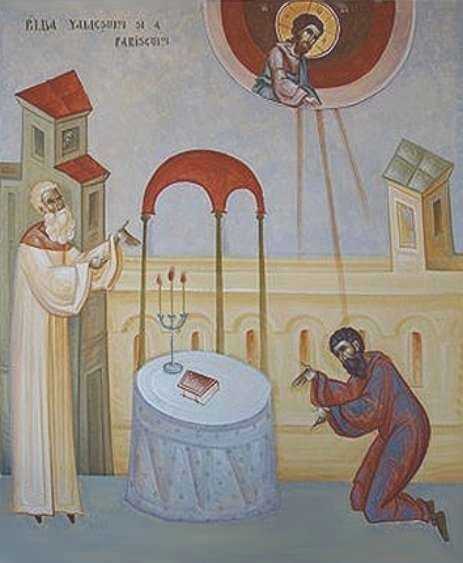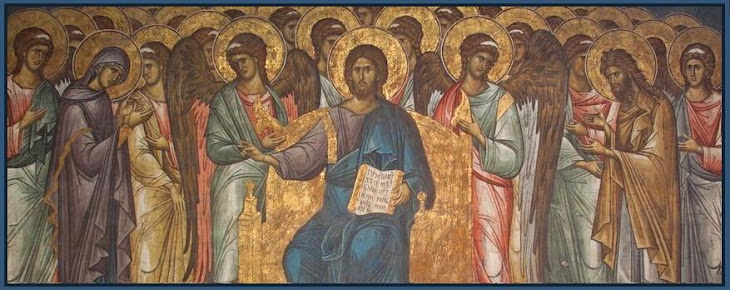

Christ and the Holy Angels serving the Divine Liturgy (source)
The Splendor of the Divine Liturgy, by Elder Ephraim of Arizona
The Divine Liturgy, what a splendor indeed! Man has been honored by God in such a way that He Himself comes down to earth with His Angelic Orders every time there is a Liturgy, in order to nurture man with His Most Holy Body and His Most Precious Blood! For He has given us everything. Is there anything physical or spiritual, perishable or everlasting, that has not been offered to us? None! Is there anything superior to His Most Holy Body and Blood, which is given to us on a daily basis? There is certainly not. God has enabled man, who is full of soil and dirt, to serve the Divine Liturgy. So priceless is the Divine Love that just a tiny drop exceeds any earthly, physical and secular love.
Adam and Eve's sin was the starting point of all the distressing events that have occurred to this day and of those that will occur until the end of time. Disobedience, like a sperm inside Eve's womb, gave birth to and transmitted physical and spiritual death to all of humanity. Poor Eve, could there have been a way for her to see that "the split second" taste of the fruit would cause such turmoil, thus compelling the Holy Trinity to have a "co-entreaty" so that the one Person of the Life-Giving Trinity would be sent to the world and endure, by the works of His hands, the blows, insults, whipping, spitting as well as all kinds of obscenity and ultimately be hung on the Cross as a curse! "Cursed is everyone that hangeth on a tree" (Gal. 3:13).
The sweet redemption of our Jesus, the light of our troubled souls, His Passion and Life-Giving Resurrection, are re-enacted in every Divine Liturgy through which every sinful soul is delivered. Great indeed is Jesus' love for us! For He took on our human nature and was hung on the Cross, giving us freedom and thus wiping clean all our debts towards our Heavenly Father. And as our beloved Brother He makes us worthy of His co-inheritance which consists of the infinite riches of His Heavenly Father. And if during the time when the Law, which existed before Christ, had overshadowed things, and the blood of oxen and goats as well as a calf's embers purified those who had partaken of them, how much more will Christ's Most Holy Blood, which is partaken from the Holy Altar of the Holy Churches of God, cleanse us from sin and warm up our souls in order to receive the divine love of our most sweet Jesus. The Lamb which was slaughtered for our personal salvation will rinse us with His Most Precious Blood from the filth of our sins and give us eternal rest.
In any case, we owe it to ourselves to become partakers of this heavenly banquet which offers us this most wonderful Mystery of the Holy Altar. Once inside the church, we should stand in fear and devoutness, since our Lord Jesus Christ and His holy angels are present. Those who are attentive and devout are filled with grace and blessings; however, those who are inattentive are condemned, being unworthy.
On the one hand, the Angels serve the Divine Liturgy, and on the other, the faithful come to church in order to partake of the Body and Blood of Christ - "Receive the Body of Christ and taste the Fountain of Immortality" - so that they will live in Christ and not perish in sin. Thus, "let a man examine himself, and so let him eat of that Bread and drink of that Cup, for he that eateth and drinketh unworthily eateth and drinketh damnation to himself" (1 Cor. 11:28-29). For instance, when someone wants to appear before a king, it takes him days to get ready, in terms of general preparation, cleanliness, speech, manner, ethos, etc., so that he would succeed in drawing the king's compassion and, in this way, have his desirable request granted. Even though there is no comparison as far as the two different kings are concerned, each believer should prior to Holy Communion prepare oneself in order to obtain divine mercy and forgiveness. Those who appear before a secular king are, most of the time, adorned by iniquity, flattery, pretence as well as deceit, in order to obtain that which is desired; nevertheless, the Christian believer who appears before the King of kings who in turn keeps an eye on the inner person must be adorned by holiness, humility and the sheer ethos of the soul that is more precious than lost gold.
The Lord created His Church on earth as a Bride, so that She would intercede for His children. He left us the Great Mystery of the Holy Eucharist, in order to be cleansed, become holy and thus become one with God. He has invited us all; some in their childhood, others in their middle as well as old age. As He is Good, He took hold of us like a hen gathers her chicks under her wings, in order to make us partakers of His divine Kingdom. Nothing repelled Him - no ulcer, no wound, no illness, not even the deformity of spiritual phenomena which may characterize our soul. As a father He accepted us, as a mother He breast-fed us, and as an unmercenery doctor He took care of us and clothed us in the garment of adoption, with grace ignoring the heavy debt of our trespasses. We thus owe Him infinite love and worship. Love should remain in the heart like a life-giving source, gushing forth springs of communion wine and streams of divine eros.
We should be partakers of the Sacrifice of the Slaughtered Lamb as often as we can, and as long as we are free to do so, since Holy Communion is a great aid for the believer which in turn helps him to fight sin. Also, we should approach this divine Mystery in a spirit of compunction, crushed hearts, and a good sense of our sins. Great is the mercy of God Who condescends to enter into us; not abhorring the multitude of our sins. Nonetheless, due to His infinite love and affection, we are sanctified, and in this way we are made worthy to become His children and co-heirs of His Kingdom. Hence, let us prepare with a pure conscience aiming at the fortification of our senses, and in chastity let us enter along with the Holy Apostles to the Mystical Supper and partake of our sweet Jesus so that He should dwell with us unto the infinite ages of ages.
Unworthy as I am, I serve my Lord. A ministry rendered that is holy and mighty. Everyday I offer God a well-pleasing sacrifice, the Lamb of God, Immaculate to His Immaculate Father and God, in order that He might be merciful for the things with which we sadden the most good God. He whom we cause grief and Who sacrificed His only begotten Son. My God, Your most beloved Son for our sake! And who are we to deserve this ultimate sacrifice! "For being enemies, we were reconciled to God by the death of His Son" (Rom. 5:10).
It is a fact that numerous interpretations of the Divine Liturgy which were mainly based on the illumination and grace of the Holy Spirit were handed down to us by the Church Fathers. What makes this current analysis of the Divine Liturgy of my spiritual child Father Stephanos Anagnastopoulos noteworthy and beneficial, is the fact that it is offered through the experiences and revelations of worthy Liturgists of the Most High, older and more recent ones.
I, as well as its author, wish that this book will lead us all to the genuine liturgical conscience and life in order to urge us in a spirited way, as grateful servants, to try to rest the heart of His feelings so that He will be comforted, according to the Psalter: "...and because of His servants shall He be comforted" (Psalm 134:14). May we sense that which God offered us and thus rejoice in the beauty of His eros. Amen.
The most unworthy of all
+ Father Ephraim
Adam and Eve's sin was the starting point of all the distressing events that have occurred to this day and of those that will occur until the end of time. Disobedience, like a sperm inside Eve's womb, gave birth to and transmitted physical and spiritual death to all of humanity. Poor Eve, could there have been a way for her to see that "the split second" taste of the fruit would cause such turmoil, thus compelling the Holy Trinity to have a "co-entreaty" so that the one Person of the Life-Giving Trinity would be sent to the world and endure, by the works of His hands, the blows, insults, whipping, spitting as well as all kinds of obscenity and ultimately be hung on the Cross as a curse! "Cursed is everyone that hangeth on a tree" (Gal. 3:13).
The sweet redemption of our Jesus, the light of our troubled souls, His Passion and Life-Giving Resurrection, are re-enacted in every Divine Liturgy through which every sinful soul is delivered. Great indeed is Jesus' love for us! For He took on our human nature and was hung on the Cross, giving us freedom and thus wiping clean all our debts towards our Heavenly Father. And as our beloved Brother He makes us worthy of His co-inheritance which consists of the infinite riches of His Heavenly Father. And if during the time when the Law, which existed before Christ, had overshadowed things, and the blood of oxen and goats as well as a calf's embers purified those who had partaken of them, how much more will Christ's Most Holy Blood, which is partaken from the Holy Altar of the Holy Churches of God, cleanse us from sin and warm up our souls in order to receive the divine love of our most sweet Jesus. The Lamb which was slaughtered for our personal salvation will rinse us with His Most Precious Blood from the filth of our sins and give us eternal rest.
In any case, we owe it to ourselves to become partakers of this heavenly banquet which offers us this most wonderful Mystery of the Holy Altar. Once inside the church, we should stand in fear and devoutness, since our Lord Jesus Christ and His holy angels are present. Those who are attentive and devout are filled with grace and blessings; however, those who are inattentive are condemned, being unworthy.
On the one hand, the Angels serve the Divine Liturgy, and on the other, the faithful come to church in order to partake of the Body and Blood of Christ - "Receive the Body of Christ and taste the Fountain of Immortality" - so that they will live in Christ and not perish in sin. Thus, "let a man examine himself, and so let him eat of that Bread and drink of that Cup, for he that eateth and drinketh unworthily eateth and drinketh damnation to himself" (1 Cor. 11:28-29). For instance, when someone wants to appear before a king, it takes him days to get ready, in terms of general preparation, cleanliness, speech, manner, ethos, etc., so that he would succeed in drawing the king's compassion and, in this way, have his desirable request granted. Even though there is no comparison as far as the two different kings are concerned, each believer should prior to Holy Communion prepare oneself in order to obtain divine mercy and forgiveness. Those who appear before a secular king are, most of the time, adorned by iniquity, flattery, pretence as well as deceit, in order to obtain that which is desired; nevertheless, the Christian believer who appears before the King of kings who in turn keeps an eye on the inner person must be adorned by holiness, humility and the sheer ethos of the soul that is more precious than lost gold.
The Lord created His Church on earth as a Bride, so that She would intercede for His children. He left us the Great Mystery of the Holy Eucharist, in order to be cleansed, become holy and thus become one with God. He has invited us all; some in their childhood, others in their middle as well as old age. As He is Good, He took hold of us like a hen gathers her chicks under her wings, in order to make us partakers of His divine Kingdom. Nothing repelled Him - no ulcer, no wound, no illness, not even the deformity of spiritual phenomena which may characterize our soul. As a father He accepted us, as a mother He breast-fed us, and as an unmercenery doctor He took care of us and clothed us in the garment of adoption, with grace ignoring the heavy debt of our trespasses. We thus owe Him infinite love and worship. Love should remain in the heart like a life-giving source, gushing forth springs of communion wine and streams of divine eros.
We should be partakers of the Sacrifice of the Slaughtered Lamb as often as we can, and as long as we are free to do so, since Holy Communion is a great aid for the believer which in turn helps him to fight sin. Also, we should approach this divine Mystery in a spirit of compunction, crushed hearts, and a good sense of our sins. Great is the mercy of God Who condescends to enter into us; not abhorring the multitude of our sins. Nonetheless, due to His infinite love and affection, we are sanctified, and in this way we are made worthy to become His children and co-heirs of His Kingdom. Hence, let us prepare with a pure conscience aiming at the fortification of our senses, and in chastity let us enter along with the Holy Apostles to the Mystical Supper and partake of our sweet Jesus so that He should dwell with us unto the infinite ages of ages.
Unworthy as I am, I serve my Lord. A ministry rendered that is holy and mighty. Everyday I offer God a well-pleasing sacrifice, the Lamb of God, Immaculate to His Immaculate Father and God, in order that He might be merciful for the things with which we sadden the most good God. He whom we cause grief and Who sacrificed His only begotten Son. My God, Your most beloved Son for our sake! And who are we to deserve this ultimate sacrifice! "For being enemies, we were reconciled to God by the death of His Son" (Rom. 5:10).
It is a fact that numerous interpretations of the Divine Liturgy which were mainly based on the illumination and grace of the Holy Spirit were handed down to us by the Church Fathers. What makes this current analysis of the Divine Liturgy of my spiritual child Father Stephanos Anagnastopoulos noteworthy and beneficial, is the fact that it is offered through the experiences and revelations of worthy Liturgists of the Most High, older and more recent ones.
I, as well as its author, wish that this book will lead us all to the genuine liturgical conscience and life in order to urge us in a spirited way, as grateful servants, to try to rest the heart of His feelings so that He will be comforted, according to the Psalter: "...and because of His servants shall He be comforted" (Psalm 134:14). May we sense that which God offered us and thus rejoice in the beauty of His eros. Amen.
The most unworthy of all
+ Father Ephraim
(source)
Through the prayers of our Holy Fathers, Lord Jesus Christ our God, have mercy on us and save us! Amen!