Thursday, May 20, 2010

Selected Quotes of the Fathers on Pentecost and the Holy Spirit

Icon depicting the Comforter, the Holy Spirit (http://www.pigizois.net/galery/diafores/paraklitos.jpg)
  
Selected Quotes of the Fathers on Pentecost
"'And my Father will love him, and we will come to him and make our home with him.' My friends, consider the greatness of this solemn feast that commemorates God's coming as a guest into our hearts! If some rich and influential friend were to come to your home, you would promptly put it all in order for fear something there might offend your friend's eyes when he came in. Let all of us then who are preparing our inner homes for God cleanse them of anything our wrongdoing has brought into them."
St. Gregory Dialogos, on Pentecost in Be Friends of God

"'And there appeared unto them cloven tongues like as of fire, and it sat upon each of them; and they were all filled with the Holy Spirit' (Acts 2:3-4). They partook of fire, not of burning but of saving fire; of fire which consumes the thorns of sins, but gives luster to the soul. This is now coming upon you also, and that to strip away and consume your sins which are like thorns, and to brighten yet more that precious possession of your souls, and to give you grace; for He gave it then to the Apostles. And He sat upon them in the form of fiery tongues, that they might crown themselves with new and spiritual diadems by fiery tongues upon their heads. A fiery sword barred of old the gates of Paradise; a fiery tongue which brought salvation restored the gift."
St. Cyril of Jerusalem (Catechetical Lectures: Lecture 17 no. 15)

"Brothers, we shall hymn with praise the tongues of the disciples, because, not with elegant speech, But in divine power they have revived all men. Because they took up His Cross as a reed, So that they might again use words as fishing lines and fish for the world Since they had speech as a sharp fishhook, Since the flesh of the Master of all Has become for them a bait, it has not sought to kill But it attracts to life those who worship and praise The All-Holy Spirit."
St Romanos the Melodist - On Pentecost

"But as the old Confusion of tongues was laudable, when men who were of one language in wickedness and impiety, even as some now venture to be, were building the Tower; for by the confusion of their language the unity of their intention was broken up, and their undertaking destroyed; so much more worthy of praise is the present miraculous one. For being poured from One Spirit upon many men, it brings them again into harmony. And there is a diversity of Gifts, which stands in need of yet another Gift to discern which is the best, where all are praiseworthy."
St. Gregory Nazianzen, Oration on Pentecost

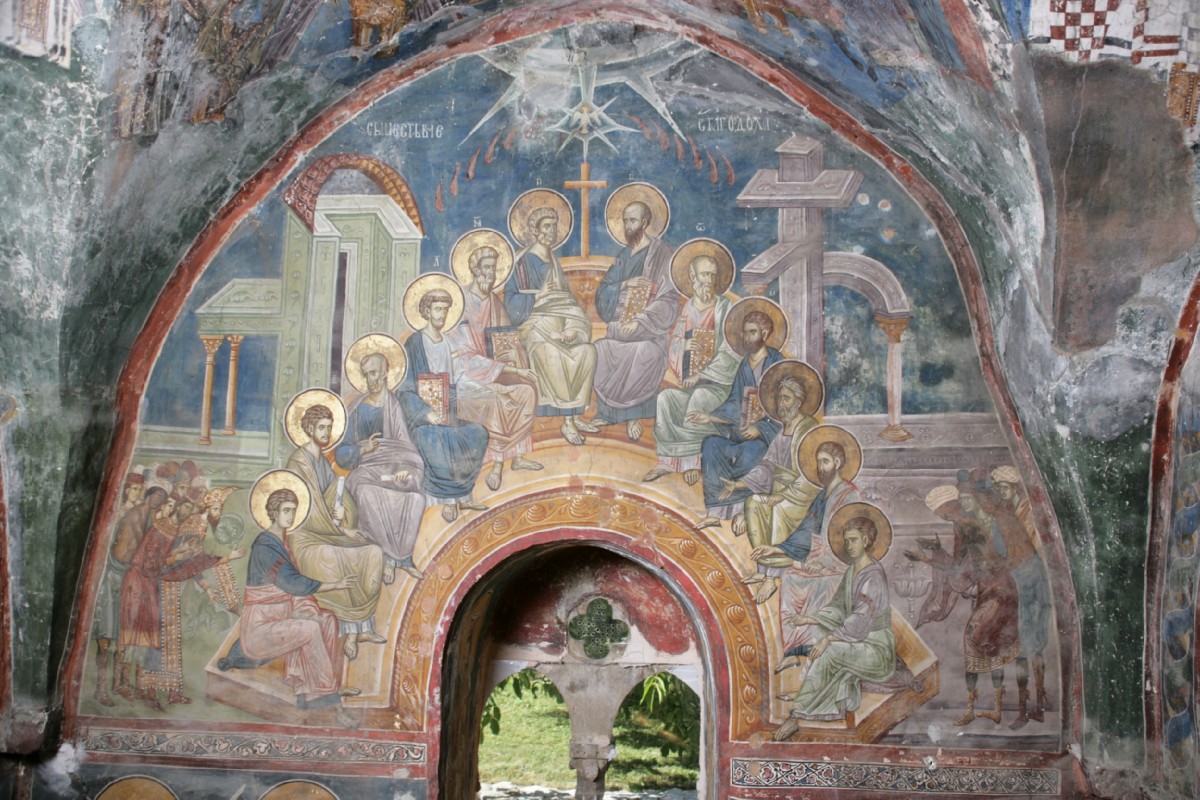
"Regarding the manner in which the Holy Spirit descended upon the disciples, Saint Symeon the New Theologian makes a remark that is most helpful for properly understanding this event. He says that this mode of acting of the Holy Spirit - by means of a loud noise as of a rushing mighty wind, and with tongues of fire - was something unique. The Holy Spirit, he observes, comes very calmly, in the form of spiritual light, and evokes joy. The passage in which he touches upon this point is this:

The power of the Holy Spirit, which is bestowed upon him who loves God and keeps His commandments, does not appear visibly in the form of fire, nor does it come with a loud sound like a violent wind - for this happened only in the time of the Apostles for the sake of the unbelievers. Instead, it is seen spiritually in the form of spiritual light, and comes with all calm and joy."
Guide to Byzantine Iconography, Vol. 1, by Constantine Cavarnos

"The holy mystery of the day of the Holy Spirit, Pentecost, is to be understood in the following manner: the spirit of man must be completed and perfected by the Holy Spirit, that is, it must be sanctified, illuminated, and divinized by the Holy Spirit. This holy mystery is realized continually in the Church of Christ and because of this the Church is really a continuous Pentecost.... From Holy Pentecost, the day of the Holy Spirit, every God-like soul in the Church of Christ is an incombustible bush which continuously burns and is inflamed with God and has a fiery tongue within it."
St. Justin Popovich, Orthodox Faith and Life in Christ

"The power to bear Mysteries, which the humble man has received, which makes him perfect in every virtue without toil, this is the very power which the blessed apostles received in the form of fire. For its sake the Saviour commanded them not to leave Jerusalem until they should receive power from on high, that is to say, the Paraclete, which, being interpreted, is the Spirit of consolation. And this is the Spirit of divine visions. Concerning this it is said in divine Scripture: 'Mysteries are revealed to the humble' [Ecclus ]. The humble are accounted worthy of receiving in themselves this Spirit of revelations Who teaches mysteries."
St. Isaac the Syrian, Ascetical Homily 77

"Was it upon the twelve that it [the Holy Spirit] came? Not so; but upon the hundred and twenty. For Peter would not have quoted to no purpose the testimony of the prophet, saying, 'And it shall come to pass in the last days, saith the Lord God, I will pour out of My Spirit upon all flesh: and your sons and your daughters shall prophesy, and your young men shall see visions, and your old men shall dream dreams' (Joel 2:28). 'And they were all filled with the Holy Spirit.' For, that the effect may not be to frighten only, therefore it is both 'with the Holy Spirit, and with fire. And began to speak with other tongues, as the Spirit gave them utterance' (Mt. )."
St. John Chrysostom, Homilies on the Acts of the Apostles
   
"If from one burning lamp someone lights another, then another from that one, and so on in succession, he has light continuously. In the same way, through the Apostles ordaining their successors, and these successors ordaining others, and so on, the grace of the Holy Spirit is handed down through all generations and enlightens all who obey their shepherds and teachers.”
St. Gregory Palamas, “On how the Holy Spirit was manifested and shared out at Pentecost”

"What is the aim of the incarnate dispensation of God's Word, preached in all the Holy Scriptures but which we, who read them, do not know? The only aim is that, having entered into what is our own, we should participate in what is His. The Son of God has become Son of Man in order to make us, men, sons of God, raising our race by grace to what He is Himself by nature, granting us birth from above through the grace of the Holy Spirit and leading us straightway to the kingdom of heaven, or rather, granting us this kingdom of heaven within us (Luke 17:21), in order that we should not merely be fed by the hope of entering it, but entering into full possession thereof should cry: our 'life is hid with Christ in God' (Col. 3:3).
St. Simeon the New Theologian, “Practical and Theological Precepts” (The Philokalia)
  
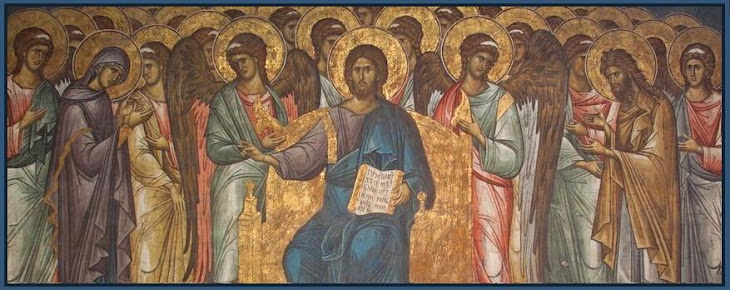
The Preparation of the Throne, with the Holy Spirit depicted (source)
  
"...One must clean the royal house from every impurity and adorn it with every beauty, then the king may enter into it. In a similar way one must first cleanse the earth of the heart and uproot the weeds of sin and the passionate deeds and soften it with sorrows and the narrow way of life, sow in it the seed of virtue, water it with lamentation and tears, and only then does the fruit of dispassion and eternal life grow. For the Holy Spirit does not dwell in a man until he has been cleansed from passions of the soul and body.”
St. Paisius Velichkovsky, “Field Flowers"

"If the Lord has left us ignorant of the ordering of many things in this world, then it means it is not necessary for us to know: we cannot compass all creation with our minds. But the Creator Himself of heaven and earth and every created thing gives us to know Him in the Holy Sprit.
St. Silouan the Athonite, “Wisdom from Mount Athos

"Whatever the soul may think fit to do itself, whatever care and pains it may take, relying only upon its own power, and thinking to be able to effect a perfect success by itself, without the co-operation of the Spirit, it is greatly mistaken. It is of no use for the heavenly places; it is of no use for the kingdom - that soul, which supposes that it can achieve perfect purity of itself, and by itself alone, without the Spirit. Unless the man who is under the influence of the passions will come to God, denying the world, and will believe with patience and hope to receive a good thing foreign to his own nature, namely the power of the Holy Spirit, and unless the Lord shall drop upon the soul from on high the life of the Godhead, such a man will never experience true life, will never recover from the drunkenness of materialism; the enlightenment of the Spirit will never shine in that benighted soul, or kindle in it a holy daytime; it will never awake out of that deepest sleep of ignorance, and so come to know God of a truth through God's power and the efficacy of grace.”
St. Macarius the Great, “Spiritual Homilies (Homily 24)"

“The aim of all those who live in God is to please our Lord Jesus Christ and become reconciled with God the Father through receiving the Holy Spirit, thus securing their salvation, for in this consists the salvation of every soul. If this aim and this activity is lacking, all other labour is useless and all other striving is in vain. Every path of life which does not lead to this is without profit.”
St. Simeon the New Theologian, "Writings from the Philokalia"

“Everything that breathes, breathes by air and cannot live without air; similarly all reasonable free creatures live by the Holy Spirit, as though by air, and cannot live without Him. "Every soul is quickened by the Holy Spirit." Recognise that the Holy Spirit stands in the same relation to your soul as air stands in relation to your body.”
St. John of Kronstadt, My Life in Christ

“The Saviour and the Comforter, two Persons of the Godhead: the One ever saves from sins, and the Other comforts him who is saved. Their very names are taken from their deeds, and are always actually justified. He comforts! The Holy Spirit comforts the believing soul, as a mother comforts her child.”
St. John of Kronstadt, My Life in Christ

“...In proportion to your humility you are given patience in your woes; and in proportion to your patience the burden of your afflictions is made lighter and you will find consolation; in proportion to your consolation, your love of God increases; and in proportion to your love, your joy in the Holy Spirit is magnified. Once men have truly become His sons, our tenderly compassionate Father does not take away their temptations from them when it is His pleasure to 'make for them a way to escape' (1 Cor. ), but instead He gives His sons patience in their trials. All these good things are given into the hand of their patience for the perfecting of their souls.”
St. Isaac the Syrian, "Ascetical Homilies" (Homily Forty-Two)

“Jesus tells us that His holy Disciples will be more courageous and more understanding when they would be, as the Scripture says, Endowed with power from on high (Luke 24:49), and that when their minds would be illuminated by the torch of the Spirit they would be able to see into all things, even though no longer able to question Him bodily present among them. The Saviour does not say that they would no longer as before need the light of His guidance, but that when they received His Spirit, when He was dwelling in their hearts, they would not be wanting in any good thing, and their minds would be filled with most perfect knowledge.”
St. Cyril of Alexandria

“The Saints in Heaven through the Holy Spirit behold the glory of God and the beauty of the Lord's Countenance. But in this same Holy Spirit they see our lives too, and our deeds. They know our sorrows and hear our burning prayers. When they were living on earth they learned of the love of God from the Holy Spirit; and he who knows love on earth takes it with him into eternal life in the kingdom of Heaven, where love grows and becomes perfect. And if love makes one unable to forget a brother here, how much more must the Saints remember and pray for us!”
St. Silouan the Athonite, "Wisdom from Mount Athos"

“As the Lord put on the body, leaving behind all principality and power, so Christians put on the Holy Spirit, and are at rest.”
St. Macarius the Great, "Spiritual Homilies" (Homily 26)

“...Filled with love, the holy Apostles went into the world, preaching salvation to mankind and fearing nothing, for the Spirit of God was their strength. When St. Andrew was threatened with death upon the cross if he did not stay his preaching he answered: 'If I feared the cross I should not be preaching the Cross." In this manner all the other Apostles, and after them the martyrs and holy men who wrestled against evil, went forward with joy to meet pain and suffering. For the Holy Spirit, sweet and gracious, draws the soul to love the Lord, and in the sweetness of the Holy Spirit the soul loses her fear of suffering.”
St. Silouan the Athonite, "Wisdom from Mt. Athos"

“The true aim of our Christian life consists in the acquisition of the Holy Spirit of God.”
St. Seraphim of Sarov, "A Wonderful Revelation to the World"

“...For as of old on the fiftieth day after the Sacrifice of the Lamb, the Law was given on Mount Sinai to the Hebrew people, now delivered from the Egyptians, so, after the Passion of Christ, in which the True Lamb of God was slain, on the fiftieth day after His Resurrection, the Holy Spirit descended upon the Apostles and upon the people who believed (Acts ii.3); so that an earnest Christian might know beyond any uncertainty, that the sacred rites of the Old Testament had served as foundations for the Gospel, and that by this same Spirit was the Second Covenant laid down, by Whom the first had been established.”
St. Leo the Great, “The Work of the Holy Spirit"

“The Comforter, the Holy Spirit, who fills the whole universe, passes through all believing, meek, humble, good, and simple human souls, dwelling in them, vivifying and strengthening them. He becomes one spirit with them and everything to them - light, strength, peace, joy, success in their undertakings, especially in a pious life, and everything good - "going through all understanding, pure and most subtle spirits" (Wisdom of Solomon vii, 23). "We have been all made to drink into one Spirit" (I Cor. xii.13). All pious people are filled with the Spirit of God similarly as a sponge is filled with water.”
St. John of Kronstadt, "My Life in Christ"

“Through the Holy Spirit comes our restoration to paradise, our ascension into the kingdom of heaven, our return to the adoption of sons, our liberty to call God our Father, our being made partakers of the grace of Christ, our being called children of light, our sharing in eternal glory, and, in a word, our being brought into a state of all "fulness of blessing," both in this world and in the world to come, of all the good gifts that are in store for us, by promise hereof, through faith, beholding the reflection of their grace as though they were already present, we await the full enjoyment.”
St. Basil the Great, "On the Holy Spirit"
  
The descent of the Holy Spirit at Pentecost (source)
   
Through the prayers of our Holy Fathers, Lord Jesus Christ our God, have mercy on us and save us! Amen!

Tuesday, May 11, 2010

Sts. Cyril and Methodius the Equal-to-the-Apostles and Enlighteners of the Slavs

Christ is risen! Truly He is risen!
  
Sts. Cyril and Methodius the Equal-to-the-Apostles and Enlighteners of the Slavs - Commemorated on May 11 (http://christopherklitou.com/icon_11_may_cyril_methodius_enlighteners_of_the_slavs.htm)
  
"Saints Cyril and Methodius, Equals of the Apostles, and Enlighteners of the Slavs came from an illustrious and pious family living in the Greek city of Thessalonica. St Methodius was the oldest of seven brothers, St Constantine [Cyril was his monastic name] was the youngest. At first St Methodius was in the military and was governor in one of the Slavic principalities dependent on the Byzantine Empire, probably Bulgaria, which made it possible for him to learn the Slavic language. After living there for about ten years, St Methodius later received monastic tonsure at one of the monasteries on Mount Olympus (Asia Minor).

St Constantine distinguished himself by his great aptitude, and he studied with the emperor Michael under the finest teachers in Constantinople, including St Photius, the future Patriarch of Constantinople (February 6).

St Constantine studied all the sciences of his time, and also knew several languages. He also studied the works of St Gregory the Theologian. Because of his keen mind and penetrating intellect, St Constantine was called "Philosopher" (wise). Upon the completion of his education, St Constantine was ordained to the holy priesthood and was appointed curator of the patriarchal library at the church of Hagia Sophia. He soon left the capital and went secretly to a monastery.

Discovered there, he returned to Constantinople, where he was appointed as instructor in philosophy. The young Constantine's wisdom and faith were so great that he won a debate with Ananias, the leader of the heretical iconclasts . After this victory Constantine was sent by the emperor to discuss the Holy Trinity with the Saracens, and again he gained the victory. When he returned, St Constantine went to his brother St Methodius on Olympus, spending his time in unceasing prayer and reading the works of the holy Fathers.

The emperor soon summoned both of the holy brothers from the monastery and sent them to preach the Gospel to the Khazars. Along the way they stayed in the city of Korsun, making preparations for their missionary activity. There the holy brothers miraculously discovered the relics of the hieromartyr Clement, Pope of Rome (November 25).

Sts. Cyril and Methodius, the Equals-to-the-Apostles (http://pravicon.com/images/sv/s1441/s1441005.jpg)
  
There in Korsun St Constantine found a Gospel and Psalter written in Russian letters [i.e. Slavonic], and a man speaking the Slavic tongue, and he learned from this man how to read and speak this language. After this, the holy brothers went to the Khazars, where they won a debate with Jews and Moslems by preaching the Gospel. On the way home, the brothers again visited Korsun and, taking up the relics of St Clement, they returned to Constantinople. St Constantine remained in the capital, but St Methodius was made igumen of the small Polychronion monastery near Mount Olympus, where he lived a life of asceticism as before.

Soon messengers came to the emperor from the Moravian prince Rostislav, who was under pressure from German bishops, with a request to send teachers to Moravia who would be able to preach in the Slavic tongue. The emperor summoned St Constantine and said to him, "You must go there, but it would be better if no one knows about this."

St Constantine prepared for the new task with fasting and prayer. With the help of his brother St Methodius and the disciples Gorazd, Clement, Sava, Naum and Angelyar, he devised a Slavonic alphabet and translated the books which were necessary for the celebration of the divine services: the Gospel, Epistles, Psalter, and collected services, into the Slavic tongue. This occurred in the year 863.
After completing the translation, the holy brothers went to Moravia, where they were received with great honor, and they began to teach the services in the Slavic language. This aroused the malice of the German bishops, who celebrated divine services in the Moravian churches in Latin. They rose up against the holy brothers, convinced that divine services must be done in one of three languages: Hebrew, Greek or Latin.
 
Sts. Cyril and Methodius granting the Cyrillic alphabet to the Slavs (source)
 
St Constantine said, "You only recognize three languages in which God may be glorified. But David sang, 'Praise the Lord, all nations, praise the Lord all peoples (Ps 116/117:1).' And the Gospel of St Matthew (28:18) says, 'Go and teach all nations....'" The German bishops were humiliated, but they became bitter and complained to Rome.

The holy brothers were summoned to Rome for a decision on this matter. Taking with them the relics of St Clement, Sts Constantine and Methodius set off to Rome. Knowing that the holy brothers were bringing these relics with them, Pope Adrian met them along the way with his clergy. The holy brothers were greeted with honor, the Pope gave permission to have divine services in the Slavonic language, and he ordered the books translated by the brothers to be placed in the Latin churches, and to serve the Liturgy in the Slavonic language.

At Rome St Constantine fell ill, and the Lord revealed to him his approaching death. He was tonsured into the monastic schema with the name of Cyril. On February 14, 869, fifty days after receiving the schema, St Cyril died at the age of forty-two.

St Cyril commanded his brother St Methodius to continue with their task of enlightening the Slavic peoples with the light of the true Faith. St Methodius entreated the Pope to send the body of his brother for burial in their native land, but the Pope ordered the relics of St Cyril to be placed in the church of St Clement, where miracles began to occur from them.

Sts. Cyril and Methodius the Equals-to-the-Apostles (http://pravicon.com/images/sv/s1441/s1441008.jpg)
  
After the death of St Cyril, the Pope sent St Methodius to Pannonia, after consecrating him as Archbishop of Moravia and Pannonia, on the ancient throne of St Andronicus (July 30). In Pannonia St Methodius and his disciples continued to distribute services books written in the Slavonic language. This again aroused the wrath of the German bishops. They arrested and tried St Methodius, who was sent in chains to Swabia, where he endured many sufferings for two and a half years.

After being set free by order of Pope John VIII of Rome, and restored to his archdiocese, St Methodius continued to preach the Gospel among the Slavs. He baptized the Czech prince Borivoi and his wife Ludmilla (September 16; see: http://full-of-grace-and-truth.blogspot.com/2009/09/st-ludmilla-martyr-grandmother-of-st.html), and also one of the Polish princes. The German bishops began to persecute the saint for a third time, because he did not accept the erroneous teaching about the procession of the Holy Spirit from both the Father and the Son. St Methodius was summoned to Rome, but he justified himself before the Pope, and preserved the Orthodox teaching in its purity, and was sent again to the capital of Moravia, Velehrad.

Here in the remaining years of his life St Methodius, assisted by two of his former pupils, translated the entire Old Testament into Slavonic, except for the Book of Maccabbees, and even the Nomocanon (Rule of the holy Fathers) and Paterikon (book of the holy Fathers).

Sensing the nearness of death, St Methodius designated one of his students, Gorazd, as a worthy successor to himself. The holy bishop predicted the day of his death and died on April 6, 885 when he was about sixty years old. The saint's burial service was chanted in three languages, Slavonic, Greek, and Latin. He was buried in the cathedral church of Velehrad."
(http://ocafs.oca.org/FeastSaintsViewer.asp?SID=4&ID=1&FSID=101350)
  
Sts. Cyril and Methodius the Equal-to-the-Apostles (http://days.pravoslavie.ru/Images/ii1525&97.htm)
  
Stichera Prosomia in the Second Tone "With what crowns of praise..."
With what crowns of praise shall we adorn the divinely-wise teachers: the voices of wisdom sounding amid clouds of darkness, enlightening those in the shadow of death with the light of the Gospel, the great preachers of the undivided Trinity, who grafted barren unbelievers as branches into the fruitful tree of the Orthodox Church, that they might obtain from Christ our God peace and great mercy?
 
With what songs of praise shall we glorify the divinely-wise teachers: the golden-mouthed Cyril, who reached the heights of wisdom through his sweet preaching, humbling the fierce pride of Islam; and Methodius, the lover of solitude, who in silence received the fruits of the Spirit? Through their prayers, O Christ our God, grant us great mercy!
 
With what hymns of praise shall we magnify the divinely-wise teachers: Cyril, who chose to live with wisdom in his youth, and multiplied his talents to the glory of God; and Methodius who renounced the things of this world for love of Christ? He strove like an angel for the Kingdom of heaven. Through them, we have come to know God, the eternal Trinity, Father, Son and Holy Spirit, receiving from Christ our God great mercy.
 
With what spiritual songs shall we magnify you, O most blessed teachers? For the sake of the salvation of the Slavs you became Equals-to-the-Apostles. You labored to enlighten them by the lamp of the Word of God, opening for them the door of the written word. As we enter, we understand the blessed teaching of Christ, receiving from Him peace and great mercy.
 
Apolytikion of Sts. Cyril and Methodios in the Fourth Tone
Cyril and Methodius, inspired by God, you became Equals-to-the-Apostles by your life. As you were teachers of the Slavs, intercede with the Master of all, that He may strengthen all Orthodox peoples in the true faith; that He may grant peace to the world and great mercy to our souls!
 
Sts. Cyril and Methodius, the Equals-to-the-Apostles (http://pravicon.com/images/sv/s1441/s1441003.jpg)
  
Christ is Risen from the dead, by death, trampling down upon death, and to those in the tombs, bestowing life!
Truly the Lord is risen!

Tuesday, May 4, 2010

Selected miracles of St. Ephraim of Nea Makri

Christ is risen! Truly He is risen!

St. Ephraim the Great Martyr and Wonder-worker of Nea Makri, the Newly-revealed (Icon courtesy of www.eikonografos.com used with permission)
  
Selected miracles of St. Ephraim of Nea Makri (amateur translations and summaries from various Greek sources)

A couple of Notes:
These are just a few of the countless miracles that people attest to through the intercessions of St. Ephraim, the Newly-revealed Hieromartyr and Wonder-worker of Nea Makri. St. Ephraim is greatly beloved throughout the world, and continues to inspire and work endless healings of soul and body for the faithful.

These are some accounts from pious laypeople, who simply and honestly express the presence of Christ and His Saints in their lives. Though there might be some things mentioned that we have to be cautious about in general, including dreams, miracles, disdain for medicine, etc., one can sense both the humility and gratitude of these people who have clearly suffered so much, and the reality of Christ the God-man, Who is visiting and healing His creation through one of His great and beloved servants: St. Ephraim. May he intercede for us all and help us!

A dream of St. Ephraim
It was January of 1996, Sunday morning, when I saw in my sleep that I was in a great church richly adorned with gold and full of light and a great crowd was gathered inside and out. My one girl said that we should go venerate because the mother of one of our friends passed away. We waited in line and when I arrived in front I saw that instead of a coffin there was an upright reliquary made of glass and inside was a tall man, of a young age with a black beard, thin, with vestments and [engolpia] that Metropolitans wear. He wore a black archpriestly hat with a red cross on top, and he appeared alive as if he were sleeping. I venerated once puzzled and waited to see my mother's friend, while on the glass I saw a small card attached which said: “Ephraim”. The next morning I awoke puzzled and questioned who it was that I saw, for I had never heard that name before and it seemed odd. I asked my Grandmother if there is a Saint Ephraim and she replied pompously: “Ephraim? Of course there is.” I felt goosebumps, how he appeared though I had never heard of him before.

Over the next few days I talked with a friend of mine who was very religious and went to church on Sunday at monasteries. He told me where the relic of the Saint was and began to tell me details about his life, and with great astonishment I found that the characteristics were the same as I had seen in my dream. My friend mentioned that I should go to the monastery, but because of work, I neglected it for two months.

Two months later, one Sunday, I was waiting for the bus to go to my Grandmother, and I remembered that I had neglected to go to St. Ephraim. Straightaway I saw a taxi which I stopped so that I could go faster. When I looked around inside the taxi, I saw a small icon of a Saint that the taxi driver had that I had never seen before. However, his face looked familiar. I asked the taxi driver: “Is that Saint there St. Ephraim?” The taxi driver responded affirmitively, and began to tell me how good and wonder-working the Saint is. After another month of not having visited the monastery, I left work and decided to walk instead of taking the bus. On the road I found a small church which was open around noon for a later funeral, and I again remembered the Saint, and regretted my negligence, and went inside to light a candle. Guess which icon they had in front: St. Ephraim!

After a few days I was made worthy to go to the monastery. My joy was indescribable. My heart was beating as if it were crazy. When I entered the courtyard a calmness filled my soul. I had the great fortune to thank the Saint, and I managed to meet and speak for the first (and unfortunately last) time with Gerontissa Makaria, an astonishing woman who, as soon as I told her these events, cried, but also laughed like a child. I rejoiced that my Saint had revealed himself. When I asked her why he appeared to me though I didn't know him, and that I had great love towards the Panagia, she replied that St. Ephraim is one of her [the Panagia's] most beloved Saints.

From then I have visited the monastery many times and I pray to him. I thank him, for many times he has appeared to me in my sleep to warn me of something evil approaching. I will never forget the following. One morning I was taking a taxi to go to work, and inside there was an icon of St. Ephraim, and I started a conversation with the taxi driver. I was upset with some things that had occurred, and straightaway the taxi driver's voice changed and he began to tell me the story of one of his friends and some advice exactly about my problem (I hadn't shared any of my details with him). I looked at him and smiled: “Were you saying this or the Saint?” And he replied very seriously “The Saint”. I froze; he did the same, and then the tone of his voice changed and he became as he was in the beginning.

"From now on, your brother has St. Ephraim as a protector"
Five years ago, I don't remember exactly when, I saw a dream that seemed so real, that I will never forget it until I die. I have three brothers, but to my youngest I have a special weakness, because I grew up with him. I should relate from the beginning that on the topic of religion, church, saints, etc., I was distant and indifferent, I would say.

Thus, in that dream that I saw, my brother G. and I were in a place outside the house and straightaway there was a great earthquake. The earth was split in two and took my younger brother. I looked at him and couldn't do anything. I called on our Panagia and said: “My Panagia, bring back my brother, please”. And there where my brother was lost from my eyes in the earth, in front of me a white woman appeared like a shadow (it was Panagia) and she told me: “I won't bring your brother back myself, but others will”, and she stretched out her hand and showed me a tall monk with a black beard and a dark (not black) raso who was holding something in his hand that shined. I was surprised and asked her: “Who is that, my Panagia?” and she replied: “It is St. Ephraim.” I had never heard his name before. I turned to St. Ephraim and told him: “My Saint Ephraim, bring back my brother, and whatever you ask from me I will bring you.” I assumed that because the object in his hand was shining, he wanted something gold, and so I told him: “Gold you want, my Saint? I will bring it to you, I will bring it to you when you bring back my brother.” Then immediately I heard a great sound and from the bowels of the earth, in a cloud of dust, appeared my brother G., full of dirt which he shook off with his hand. He was alive. Then I awoke from the dream which was like a nightmare, but strangely it didn't scare me.

During the day I thought hard about this dream, and talking to my friends at the office, I learned about St. Ephraim and his monastery in Nea Makri. I discussed this with my family who live outside of Athens and we decided that at their first visit to Athens, we would all go together to this monastery. And this is what occurred. When we arrived at the monastery, there were so many people, but all of us felt an awe and peace in the nous which we will never forget. As soon as I saw the icon of St. Ephraim for the first time, I was struck, because this is how I saw him in my dream: tall, thin, with a dark raso and something which he held in his hand that shone. The second shock happened a few minutes later when from among the crowd, a priest asked me and my brother G. what made us come to St. Ephraim. I related my dream with feeling, and I asked him what I should give the Saint. Then the priest told me: “The Saint doesn't want gold or silver, he wants you to honor him with your presence. From now on, your brother has St. Ephraim as a protector", and looking at my brother, he crossed him with the oil of the Saint. He told us to call upon the name of the Saint in any of our difficult times, and he will protect us always. Since then we go to the monastery of St. Ephraim every year, and personally after that which I have experienced, I am sure that something there exists...”
(http://orthodox-world.pblogs.gr/2008/02/thaymata-kai-emfaniseis-toy-agioy-efraim-neas-makrhs.html)
  
The Saint helped me pass my Teaching Exams
Honored Abbess,
I had written to you and asked you in my letter to pray to our Saint for me and my friend who were taking exams in January, that they would go well. Indeed, I had a lot of stress and fear and I had decided to not go to the final lessen and that I would quit and leave. However, something happened. One of our friends had brought holy oil from the church of St. Ephraim to Athens a few days back and we had it in our room. Furthermore, she gave us a small icon of the Saint. She didn't give me an icon, but a book of St. Ephraim with His miracles. That day I smelled something strange, but beautiful.

A short time before the tests I decided in the end to go. I had a lot of stress and fear, however. I don't know why. Before leaving the house, we crossed ourselves with the oil of our Saint and we sensed that the holy myrrh of our Saint was fragrant all day. Before I got to the University, I began to cry, because I was very stressed and because I was not very well prepared. I took with me, however, the book of St. Ephraim and I put it in front of me on my desk, and I asked Him to be with me. Immediately I felt peaceful. I did not feel stress or fear, I stopped crying, and I didn't have any more headache. In reality, something strange had occurred. Immediately after they gave us the questions, I could tell that they were from that which I had studied! And I began to write, to write continually, as if someone were telling it to me.

I understook that the Saint was with me and having His book in front of me, I took greater courage. An overseer took my book automatically, because he thought that I had notes inside, but in the end he apologized for this.

Anyways, the next day I returned to my town and I had this hidden hope that the Saint would help me pass. And in reality, after two months the results were out and I had passed my teaching exams. And all of this I owe to St. Ephraim.
 
St. Ephraim of Nea Makri, with scenes from his life, martyrdom, and miracles (source)
 
My son found peace and tranquility which no psychologist could give him
Holy Abess, bless.
I work in a regional hospital. Outside there is a small chapel of Spyridon. Because the faithful have filled it with icons of various Saints, the priest tried to hand them out to others. One of these icons I received; it was the icon of St. Ephraim, who was totally unknown to me. I was impressed that the icon smelled of incense for many hours. Then I thought to give It to my son who is a police officer. When my son saw the icon of St. Ephraim, he told me that His body is in Nea Makri. I decided that some day I would visit the monastery, but for various reasons, we never were able to make it.

After four years my son faced a very serious personal problem. We immediately headed to Athens and the next day we came to the monastery of St. Ephraim. My son said that the whole monastery smelled like incense. I didn't experience this gift, neither did his father. My son would visit the Saint continuously and always would return home peaceful. Slowly he began to overcome his problem, with the great help which he received from St. Ephraim. In the meantime he had to take tests for promotion. Because of his problem, he couldn't study his lessons. St. Ephraim, however, gave him some help. He took his tests two months later. Because he wrote well, he had a good result and his grades improved...

I thank St. Ephraim for this, for my oldest son near Him found peace and tranquility, which no psychologist could give him in such a short period of time. Furthermore I should say that when I came to our Saint I bought some books. One evening I read His paraklesis. Afterwards I went to sleep. Near 3:30AM I woke up and sensed that in the house incense was burning, as if someone had burned incense at that instant. I thank St. Ephraim very much, who came to my house and gave such a great honor to me who am such a sinner.

“You should go light a big candle!”
Holy Abbess, your blessing.
I wanted to thank St. Ephraim for the miracle which he worked for my husband. On October 18th 2001 my husband, 54 years old, suffered a heart attack. We brought him immediately to the hospital of K...When the doctors made the diagnosis, they said—it was Friday—that my husband wouldn't pass the weekend, he would die. I was in the hospital, with my brother-in-law. Imagine that moment, the ground fell beneath my feet, I lost my whole world. I choked my pain and went into my husband's room. He was in a terrible condition. Then, for an instant, my eye gazed upon an icon which was in the ICU. It was up high and I couldn't reach it. I asked a girl to bring it down for me. I read: SAINT EPHRAIM. I took it in my arms and with tears in my eyes I said: “My Saint Ephraim, I don't know who you are. It is the first time I've heard your name...” I entreated him with a lot of faith, me the sinner, to make my husband well.

After two hours, as I was in the hall crying so my husband wouldn't understand anything, I see the doctor go again into my husband and after a short time come out again. As soon as he saw me crying, he said: “Why are you crying? I just saw your husband and he's on the way up!”

My joy could not be described, because he was the one who said that my husband would die, for his heart was in very bad shape. Then I understood how St. Ephraim worked His miracle. From that day forward he started to recover, as the doctor said (without knowing that I entreated the Saint): “You should go light a big candle [in gratitude for your husband.]”

The evening of the same day, a woman came to see her brother who also had a heart attach. I saw her holding in her hands a book and I asked her what she was reading. She told me: “from St. Ephraim, do you want to read it?”. Then I understood how the Saint again sent me His message to get to know Him. “Tomorrow I will bring you holy oil to cross your husband with”, she said, as I related to her what had happened.

In ten days, my husband left the hospital. I glorified the Saint and told all my friends. Two months later, the doctors said that we should go to Athens for an angioplasty. I was in the hospital for eight to ten hours. It was the day before Christmas. In the waiting room a priest came to confess people. My husband—who had never gone to confession before—and I confessed. The next morning I woke up, and without knowing anything about Athens, I took a taxi to the monastery. I venerated and thanked the Saint, and I returned relieved.

After one year, my husband was found to have prostate cancer...We again traveled to Athens, but this time to the S. hospital. The doctors were afraid to do the surgery because of his heart. In the end he went to surgery with my signature (his chances were 50-50). The whole time I entreated Panagia and St. Ephraim. Everything went well. The surgery was a success. I thank the Saint.

He healed me of vertigo
My name is K. K. From a young age, for about nine to ten years, I suffered from terrible dizziness and vertigo. Five years ago I woke up, and like many times in my life, I experienced vertigo. It was 4AM and I said: “My Saint Ephraim, take away this dizziness, I can't take it any more”, and then a miracle happened for me. It was the morning of May 5th. I didn't know it was the feast of the Saint. From then on I was never bothered with dizziness and much less by vertigo. Whenever I call upon the name of the Saint, he takes away everything [bad] from me. I many times wanted to mention this event to you...
 
“Didn't I tell you that I would help you?”
6/20/1996
Holy Abbess, I kiss your hand.
I am a mother of two children, and 16 years ago, as I was a girl full of life (25), I felt as if had a heart attack and I said that my life would end. My husband immediately took me to the Hospital, they did a cardiogram and the doctors told me that it was not my heart, but my nerves. From then on I couldn't go out, because I would be afraid that something would happen to me. I would be afraid in closed spaces, I never used a bus, because it felt as if something was choking me. My life was very difficult. Imagine how I was living a nightmare, thinking that something would happen to me. I went to the doctor again and he said that I had a problem with my thyroid...and that all of this could be attributed to my thyroid. On September 23rd 1983 I had thyroid surgery, and everything went well. However, for 24 hours I strongly felt as if I was still all nerves and felt as if I was choking in my throat and had a weight on my chest. I again went to the pathologist, and told him this. He said: “I will give you an anxiolytic to take”...I took it thus for years with side effects.

One day I felt dizzy, as if I were falling. I go, they performed tests, and found that I was severely anemic. I took iron, I took tests, and eventually my hematocrit would fall again. This happened for 13 years, and I felt as if I would have to live on pills and every day be sick. My stomach was like a pharmacy. I took these all for years and I was worrying during the whole situation. My children told me: “Throw the pills away, Mama.” I, however, had the notion that if I didn't take my medicines, I would get sicker.

In February 1996, I asked our physician, St. Ephraim, to help me stop my medications, which I had become accustomed to, but despised. I entreated him and asked our Saint to help me, and I would go venerate Him, and as soon as I leave I wouldn't take another pill again. I cried and entreated him. One day that month my parents, my brother and I decided to come venerate. As we were taking a trip, I took the pills from my purse. We came, venerated with reverence, and you received us, Holy Mother, with love. You crossed us with the Holy relic of our much-beloved Saint, and when you crossed us, O! The divine fragrance! I looked and venerated again. The fragrance was clear and sweet. I told you: “Holy mother, what fragrance is this?” “The Saint”, you told me. With tears, with joy I venerated and entreated the Saint that we might have our health and to help my young girl with her tests that year. My joy, my exultation cannot be described.

With joy we left that Holy place for our home. I forgot to throw away the pills, however, and returning I thought and said to myself: “Let it go, it doesn't matter”. Whenever I would take the pill however, I would feel nauseous. Regardless, I continued to take my pills as before.

One night, I saw in my sleep a young man tell me: “Stop the pills! Didn't I tell you that I would help you? Stop!” In the morning I woke up and told the dream to my children. From that day I stopped the pills...

Let His name be glorified! I glorify Him and thank Him. I threw away my pills and took blood tests and everything was fine. I don't want to see pills again in my life.

I glorify Him and thank Him...because now I live a new life, full of energy, without fear or dizziness, thanks to the help of our Saint.

Let His name be glorified, may he have a thousand glories. I thank you, my Saint, I thank You and I glorify You.
(http://el-gr.facebook.com/notes.php?id=238838011183)

For the life of St. Ephraim, see: http://full-of-grace-and-truth.blogspot.com/2009/05/st-ephraim-great-martyr-of-nea-makri.html.
  
For a post on the Uncovering of St. Ephraim's Relics, and another miracle, see: http://full-of-grace-and-truth.blogspot.com/2009/01/uncovering-of-holy-relics-of-st-ephraim.html.
  
Icon of St. Ephraim of Nea Makri (http://www.kazanmonastery.org/stephraim.htm)
  
ΑΠΟΛΥΤΙΚΙΟN Ἦχος α’ Τῆς ἐρήμου πολίτης
Ἐν ὄρει τῶν Ἀμῶμων ὥσπερ ἥλιος ἐλάμψας καί μαρτυρικῶς, Θεοφόρε, πρός Θεόν ἐξεδήμησας, βαρβάρων ὑποστάς ἐπιδρομάς, Ἐφραίμ Μεγαλομάρτυς τοῦ Χριστοῦ , διά τοῦτο ἀναβλύζεις χάριν ἀεί, τοῖς εὐλαβῶς βοῶσι σοι, δόξα τῷ δεδωκότι σοι ἰσχύν, δόξα τῷ σέ θαυμαστώσαντι, δόξα τῷ ἐνεργοῦντι διά Σοῦ, πᾶσιν ἰάματα.

Apolytikion of St. Ephraim the Great-martyr of Nea Makri in the First Tone (amateur translation)
On Amomon Mountain, you shown forth like the sun, and O God-bearer, you left for God by martyrdom, you endured barbarians’ attacks, Ephraim O Great-martyr of Christ, because of this you ever pour forth grace, to those who piously cry out to you, glory to Him who gave you strength, glory to Him you made you wondrous, glory to Him who grants through you, healings for all!

Christ is Risen from the dead, by death, trampling down upon death, and to those in the tombs, bestowing life!
Truly the Lord is risen!

Sunday, May 2, 2010

A contemporary miracle of St. Matrona of Moscow


Christ is risen! Truly He is risen!

St. Matrona the Righteous of Moscow - Commemorated on April 19th / May 2nd (http://apantaortodoxias.blogspot.com/)

A contemporary miracle of St. Matrona of Moscow (amateur translation)
One Sunday in the Spring of 2008, our family was in the church of Christ somewhere in Attica.

Before me was sitting my 8-year-old daughter. The priest was entoning the Gospel, and I was translating it into Modern Greek into my little one’s ear, so she could understand and learn.

After a short while my little girl asked me: “Mama, who is that Saint above there?”

She showed my an icon on the right side of the left side of the church. I looked there where she showed me, but I couldn’t discern the letters on the icon.

“I don’t know” I replied, but she insisted. “Wait” I told her, “When Liturgy is over we’ll go look.”

At the end we went closer and read: Saint Matrona! I didn’t know this Saint. I had never seen her before. I noticed that the iconographer didn’t depict her eyes at all, as if she were blind.

Therefore I asked my little girl: “My child, why did you insist so much on showing me this icon?”

She replied: “Because during the Liturgy she shook my hand as if to greet me and told me ‘Come here!’”

In the beginning I didn’t pay attention to it. Children at that age have vivid imaginations, I thought. However our little girl ran, found her father, and brought him to this icon we uncovered and told him the same thing.

In the evening we returned home. What she said really made an impression on us, because she is a serious child, very bright, mature and fairly wise. My husband went on the internet to learn more.

We found St. Matrona of Chios, and another names St. Matrona the Blind from Russia! We searched for when she celebrates, and we saw May 2nd.

We were amazed, seeing the date. Immediately I remembered!

Precisely on May 2nd, one year before, our little girl was undergoing a serious surgery in her chest. That day and all while our girl was in surgery, knowing the severity of it—especially because I’m in the medical field—I prayed: “O Saints who celebrate today help my child.” Again and again, until the child came out of the operating room.

Everything went unbelievably well! The surgery was completed unexpectedly fast and with great success!

After a while I looked at the calendar and was gracious to St. Athanasios [the Great]. The uncovering of his relics is celebrated on May 2nd. However, after this incident with our daughter, I am more sure that St. Matrona the Blind from Russia had helped us! Until then I didn’t know her. Our Greek calendar didn’t include her. There was no other way for us to know that St. Matrona had received our supplication and therefore contributed so much towards the success of her surgery, and our child’s health in general. This Righteous Matrona herself, in such a simple, sweet and beautiful way made herself known and showed that she is with us, though I called upon her, even in my ignorance.

Up till today our little girl is robust and strong, in opposition to every medical prognosis.

As a family we glorify God and His Saints who had mercy on us so generously, and granted bestowed health on our beloved girl.

These are the facts. Let us pray that the Lord make us worthy to venerate St. Matrona the Blind from Russia up close.
Athens 4/2/2010
(http://www.agiooros.net/forum/viewtopic.php?f=45&t=12899&sid=2d1d6c58760e50757c0d3ab239116282)

For more on St. Matrona of Moscow, see: http://full-of-grace-and-truth.blogspot.com/2009/05/st-matrona-of-moscow.html.
  
  
Troparion of St. Matrona of Moscow
Chosen by the Holy Spirit from thy swaddling clothes O blessed eldress Matrona, / Thou didst receive bodily weakness and blindness from God for spiritual cleansing, / Thou wast enriched with the gift of foresight and wonderworking and hast been adorned with an incorruptible crown from the Lord. / Wherefore, we offer thee crowns of praise, in gratitude crying out: / Rejoice O righteous mother Matrona, fervent intercessor before God for us!

Απολυτίκιον. Ήχος πλ. α΄. Τον συνάναρχον Λόγον.
Αδιάσειστον στύλον Ρωσίας όγδοον, την στερουμένην ομμάτων εκ γενετής, ευλαβώς ανυμνήσωμεν Ματρώναν την αοίδιμον, ως σκεύος θείων δωρεών και αγάπης ακραιφνούς προς πάντας εμπεριστάτους βοώντες σκέδασον ζόφον παθών ημών φωτί Σης χάριτος.
(
http://www.agiooros.net/forum/viewtopic.php?f=50&t=5031
)
  
Apolytikion in the Plagal of the First Tone (amateur translation)
Unassailable eighth pillar of Russia, who was blind from birth, we reverently praise Matrona the ever-memorable, as a treasury of divine gifts and fervent love towards all those in danger, crying out scatter the darkness of our passions with the light of Your grace.
  
St. Matrona of Moscow (source)  
Christ is Risen from the dead, by death, trampling down upon death, and to those in the tombs, bestowing life!
Truly the Lord is risen!

Saturday, May 1, 2010

Sts. Euthemios, Ignatios and Akakios the New Righteous Martyrs

Christ is risen! Truly He is risen!

The Holy Mountain has for centuries been a source of Repentance and Salvation for thousands. During the difficult years of the Turkish yoke, many turned to the Monasteries for spiritual direction. This was most evident in the numerous Neomartyrs, many of whom converted to islam, but having realized the gravity of their sin, repented, and sought a way to prove their love for Christ. Three of these New Martyrs, Sts. Euthemios, Ignatios and Akakios are commemorated together on May 1st, likely because they lived in similar times, abandoned Christ for islam, but repented and lived in asceticism on the Holy Mountain (specifically the Skete of the Precious Forerunner of Iviron Monastery), and finally witnessed for Christ in martyrdom. Their lives are included below and are taken from the OCA website. May Sts. Euthemios, Ignatios and Akakios intercede for us all and help us! Amen!

Icon of Sts. Euthemios, Ignatios and Akakios the New Righteous Martyrs of the Holy Mountain (Commemorated together on May 1st), with scenes from their lives (http://christopherklitou.com/icon_1_may_acacius_ignatius_euthymius_new_asceticmartyrs.htm)

St. Euthemios the New Righteous Martyr
"This holy New Martyr of Christ was born in Demitsana in the Peloponnesos. His parents were Panagiotes and Maria, and he was given the name Eleutherius in Baptism. Eleutherius was the youngest of five children (the others were George, Christos, John, and Katerina).

After attending school in Demetsana, Eleutherius and John traveled to Constantinople to enroll in the Patriarchal Academy. Later, they went to Jassy, Romania where their father and brothers were in business. Some time afterwards, Eleutherius decided to go to Mt. Athos to become a monk. Because of a war between Russia and Turkey, he was able to travel only as far as Bucharest. There he stayed with the French consul, then with an employee of the Russian consul.

Eleutherius began to pursue a life of pleasure, putting aside his thoughts of monasticism. When hostilities ceased, Eleutherius made his way to Constantinople in the company of some Moslems. On the way, he turned from Orthodoxy and embraced Islam. He was circumcised and given the name Reschid. Soon his conscience began to torment him for his denial of Christ. The other Moslems began to notice a change in his attitude, so they restricted his movements and kept a close watch on him.

One day Eleutherius was seen wearing a cross, so the others reported him to the master of the house, Rais Efendi. The master favored Eleutherius, which made the others jealous. He told them it was still too early for Eleutherius to give up all his Christian ways.

Rais Efendi and his household journeyed to Adrianople, arriving on a Saturday. Metropolitan Cyril, who later became Patriarch of Constantinople, was serving Vespers in one of the city's churches. Eleutherius pretended to have letters for Metropolitan Cyril, but he send someone else to receive them. When Eleutherius told this man that he wanted Christian clothes, he became suspicious and sent him away.

Back in Constantinople, Rais Efendi gave Eleutherius costly presents, hoping to influence him to remain a Moslem. Eleutherius, however, prayed that God would permit him to escape. He ran off at the first opportunity, seeking out a priest from the Peloponnesos who lived near the Patriarchate. After relating his story, Eleutherius asked the priest to help him get away. The priest refused to assist him, fearing reprisals if he should be caught. He gave Eleutherius some advice, then sent him away.

With some assistance from the Russian embassy, Eleutherius boarded a ship and sailed to Mt. Athos. At the Great Lavra Eleutherius was chrismated and received back into the Orthodox Church, and also became a monk with the name Euthymius.

Euthymius read the NEW MARTYROLOGION of St Nicodemus (July 14), and was inspired by the example of the New Martyrs. He then became consumed with a desire to wipe out his apostasy with the blood of martyrdom.

St Euthymius went to Constantinople with a monk named Gregory, arriving on March 19, 1814. A few days later, on Palm Sunday, he received Holy Communion. Removing his monastic garb, he dressed himself as a Moslem and went to the palace of the Grand Vizier, Rusud Pasha. St Euthymius, holding palms in his hand, confessed that he was an Orthodox Christian, and wished to die for Christ. He denounced Mohammed and the Moslem religion, then trampled upon the turban he had worn on his head, which led the Vizier to believe that he was either drunk or crazy.

The valiant warrior of Christ assured the Vizier that he was in his right mind, and was not drunk. Euthymius was thrown into a dark cell and bound with chains. After an hour or so, they brought him out again. With flattery and promises of wealth, the Vizier tried to convince Euthymius to return to the Moslem faith. The saint boldly declared that Islam was a religion based on fables and falsehood, and that he would not deny Christ again even if he were to be tortured and slain.

The Grand Vizier ordered the saint to be beaten and returned to prison. After three hours, St Euthymius was brought before Rusud Pasha, who said to him, "Have you reconsidered, or do you remain stubborn?"

Euthymius replied, "There is only one true Faith, that of the Orthodox Christians. How can I believe in your false prophet Mohammed?"

Now the Vizier realized that he would never convince Euthymius to return to Islam, so he ordered him to be put to death by the sword. When the executioner attempted to tie the saint's hands he said, "I came here voluntarily, so there is no need to bind my hands.Allow me to meet my death untied."

St Euthymius was allowed to walk to the place of execution unbound. He went joyfully and unafraid, holding a cross in his right hand, and palms in his left. When they arrived at the site, Euthymius faced east and began to pray. He thanked God for making him worthy of martyrdom for His sake. He also prayed for his family and friends, asking God to grant all their petitions which are unto salvation.

Then St Euthymius kissed the cross he was holding, then knelt and bent his neck. The executioner struck a fierce blow with the sword, but this did not behead him. He struck again, and failed to kill him. Finally, he took a knife and slit the martyr's throat.

St Euthymius was killed about noon on March 22, 1814 in Constantinople, thereby earning a place in the heavenly Kingdom where he glorifies the holy, consubstantial, and life-creating Trinity, the Father, the Son, and the Holy Spirit, forevermore.

The head of St Euthymius is in the Monastery of St Panteleimon on Mt. Athos."
(http://ocafs.oca.org/FeastSaintsViewer.asp?SID=4&ID=1&FSID=101263)
  
St. Ignatios the New Righteous Martyr
"The holy New Martyr Ignatius was born in the village of Eski Zagora in the Trnovo region of Bulgaria, and was named John in Baptism. While he was still a young child, his parents George and Maria moved to the city of Philippopolis and enrolled him in a school there.

Although he did well at school, he had a strong desire for the monastic life. Upon reaching adulthood, he entered the Rila monastery in western Bulgaria. There he was assigned to an Elder, with whom he lived in obedience for six years. When the Elder's strictness became unbearable, John returned home.

About that time the Serbs rose in revolt against the Moslem government. John's father was asked to take command of an Ottoman brigade, but he refused to fight against other Orthodox Christians.

The Moslems attacked George with furious anger. He was stabbed and then beheaded. John's mother and sisters were also taken by the Hagarenes, and they ultimately agreed to convert to Islam.

John fled and hid in the home of an elderly Orthodox woman. His mother and sisters learned where he was hiding, and they told the Moslems. Those sent to capture him did not know what he looked like, so the old woman told them she did not know him. The woman helped him escape to Bucharest, Romania, where he became acquainted with St Euthymius, who would also endure martyrdom.

John did not wish to stay in Bucharest, however, and so he left for Mt. Athos. On the way he visited the village of Soumla, where he ran into his friend Fr Euthymius again. Learning that Euthymius had denied Christ and beome a Moslem, John became very sad and left the village.

He had not gotten very far when Turkish soldiers stopped him and took all his possessions. They demanded that he convert to Islam, and in his fright he told them that he would do so. Satisfied with this reply, they let him go.

John reached the village of Eski Zagora, where he met an Athonite monk from the monastery of Grigoriou. They journeyed to the Holy Mountain together, and John settled in the Skete of St Anna. There he met Fr Basil.

One day John and Fr Basil traveled to Thessalonica on monastery business. While they were there the monks David and Euthymius of Demetsana suffered martyrdom because they were Christians. John was inflamed with the desire for martyrdom. Fr Basil, however, urged him to postpone his intention, and so they returned to the Holy Mountain. A short time after this, Fr Basil died.

When a monk from the Skete of St Anna told him of the martyrdom of the New Martyr Euthymius (March 22), John was once more filled with zeal for martyrdom. He was placed under the spiritual direction of the Elder Acacius, who prescribed for him prayer, prostrations, and reading the Gospel.

In time, John was found worthy of monastic tonsure, and was given the new name Ignatius. The Elder Acacius blessed him to travel to Constantinople with the monk Gregory in order to bear witness to Christ. After receiving the Holy Mysteries in Constantinople, Ignatius felt he was ready for his ordeal.

Dressed in Moslem garb, Ignatius went before the kadi and proclaimed his faith in Christ. He told him how he had promised to become a Moslem when he was younger, but now he threw his turban at the kadi's feet and said that he would never deny Christ.

Thinking that Ignatius was insane, the kadi warned him that if he did not come to his senses he would endure horrible torments before being put to death. On the other hand, if he embraced Islam, he would receive rich gifts and great honor from them.

The courageous martyr told the kadi to keep his gifts, for they were merely temporal gifts. "Your threats of torture and death are nothing new," he said, "and I knew of them before I came here. In fact, I came here because of them, so that I might die for my Christ."

St Ignatius went on to call Mohammed "a false prophet, a teacher of perdition, and a friend of the devil." Then he invited the Moslems to believe in Christ, the only true God.

The kadi then became so angry he could not speak, so he motioned for a servant to lead St Ignatius out of the room. Ignatius turned and struck the servant, then knelt before the kadi and bent his neck, as if inviting him to behead him then and there. Other servants entered the room, however, and dragged him off to prison.

Later, Ignatius was brought before the kadi for questioning. When asked who had brought him to Constantinople, he replied, "My Lord Jesus Christ brought me here."

Again the kadi urged him to reconsider, for he was about to experience unimaginable tortures. "Do not expect to be beheaded so that the Christians can collect your blood as a blessing," he said, "for I intend to hang you."

Ignatius replied, "You will be doing me a great service whether you hang me or put me to the sword. I accept everything for the love of Christ."

Seeing that he could not turn Ignatius from his Christian Faith, the kadi ordered him to be hanged. He was taken to a place called Daktyloporta, where the sentence was carried out. The martyr's body remained hanging there for three days, then some pious Christians paid a ransom for it and took it to the island of Prote for burial.

St Ignatius gave his life for Christ on October, 1814. He is also commemorated on May 1 together with Sts Acacius and Euthymius.

The head of St Ignatius is in the Monastery of St Panteleimon on Mt Athos."
(http://ocafs.oca.org/FeastSaintsViewer.asp?FSID=101264)
  
Picture of the Skete of the Precious Forerunner, Iveron Monastery (http://www.imma.edu.gr/macher/subjects/athos/monasteries/29.html)
  
St. Akakios the New Righteous Martyr
"The holy New Martyr Acacius was born at Neochorion, Macedonia near Thessalonica in the eighteenth century. The oldest son of Bulgarian peasants, he was named Athanasius at his baptism. When he was nine years old, his family moved to the city of Serres. Athanasius was apprenticed to a cobbler, who frequently beat him. On the night of Holy Friday, after a particularly severe beating, he wandered onto the street and two Moslem women comforted him, brought him home and fed him. Pretending sympathy, they urged him to deny Christ, the bread which came down from heaven (John 6:41). They took the boy to Yusuf Bey, who adopted him, gave him a Moslem name, and had him circumcised. He lived in that home for nine years.

At first, the wife of Yusuf Bey treated Athanasius with maternal love, but this later turned into a lustful passion. Just as the righteous Joseph (March 31) rejected the advances of Potiphar's wife (Genesis 39:8-10), so did Athanasius spurn the advances of the Moslem woman. So she told her husband that Athanasius had tried to force himself on her. His Turkish father threw him out of the house, and the young man returned to Thessalonica to find his real parents. His mother told him it was too dangerous for him to stay with them, and so he went to Mt Athos.

At first he lived at the Hilandar Monastery for a while, but he spent time in other monasteries as well. He confessed his apostasy to Fr Nicholas at the Xenophontos Monastery, who read the prescribed prayers and received him back into the Church through Chrismation. Athanasius returned to Hilandar for about a year, then went to Iveron. While at the skete at Iveron he heard of Sts Euthymius and Ignatius, and desired to imitate their feat of martyrdom. He became filled with the desire to wipe out his sin by shedding his blood for Christ in the same place where he had denied Him. Athanasius revealed all this to Fr Nikephorus, who had been the spiritual Father of Sts Ignatius and Euthymius. He was placed under the direction of the monk Acacius, who was to prepare him for his difficult struggle. Athanasius spent his time in ceaseless prayer, vigil, and fasting. This, of course, aroused the hatred of the devil, who sowed the seeds of doubt and uncertainty in his soul. After thirty-five days Athanasius became faint-hearted and ran away in the middle of the night.

Athanasius went to Simonopetra Monastery, but found no peace there. He returned to Hilandar Monastery, but as a penance he had to live in the vineyard rather than in a cell. He soon became ill and was taken to Karyes, the capital of the Holy Mountain, but he refused medical treatment. Those who had brought him there were upset by this, and they said that he was neither a Christian nor a Moslem. Stung by their rebuke, Athanasius went into seclusion for forty days.

At the end of that time, Athanasius returned to Fr Nikephorus at Iveron and Elder Acacius was assigned to look after him again. He entered upon an intense program of prayer, prostrations, and vigil, and was granted the gift of tears. On the Fourth Sunday of Great Lent, seeing his repentance and progress in virtue, the Elder Acacius tonsured him with the name Acacius.

Soon he left for Constantinople with the Elder Gregory, who had also accompanied Sts Ignatius and Euthymius on their way to martyrdom. They left Mt Athos on a ship, arriving in Constantinople thirteen days later. On April 22, St Acacius received Holy Communion at a church in Galata, then returned to the ship. He changed into Moslem clothing and went with Fr Gregory to the Porte, where a doorkeeper asked them what they wanted.

St Acacius related his story, saying that he had been deceived into renouncing Christianity and accepting Islam, but now he had come to his senses. Denouncing Mohammed as a false prophet, he loudly proclaimed that he was a Christian. Then he threw his turban on the floor, trampled it under his feet, and spit on it.

St Acacius was seized, beaten, and thrown into prison. That night he was promised wealth and high position if he would return to Islam. When he refused, they began to beat him again.

The next day, St Acacius was brought before the vizier and repeated his story, then was returned to prison. Fr Gregory was able to send a messenger to bring Acacius a pyx containing the Holy Gifts, and he partook of the life-giving Mysteries of Christ.

Soon after this, the holy martyr was led to a place called Parmak Kapi, where he was beheaded. St Acacius gave his life for Christ on May 1, 1816 at six o'clock in the evening. Some pious Christians ransomed the saint's body from the Turks, and Fr Gregory brought it back to Mt Athos. The holy relics were brought to Iveron and buried in a church dedicated to Sts Ignatius and Euthymius.

Although some sources give the year of the saint's martyrdom as 1815, there is a letter from St Acacius to a certain spiritual Father on Mt Athos dated April 27, 1816 which states that he is on his way to martyrdom. Thus, the year is 1816.

The heads of Sts Acacius, Euthymius, and Ignatius are in the Russian monastery of St Panteleimon on the Holy Mountain."
(http://ocafs.oca.org/FeastSaintsViewer.asp?FSID=101265)
  
For the full service of the Saints in Greek, see: http://voutsinasilias.blogspot.com/2009/04/1_29.html.
  
  
Martyrs Euthymius, Ignatius, and Acacius, Troparion, in Tone I
Equal in number with the uncreated Trin­ity, O wise ones, with the choirs of angels and the ranks of martyrs ye stand, rejoicing, before the throne of the Godhead; wherefore, receiving effulgence from thence through communion, ye impart to the faithful a well-spring of healings and divine enlightenment. O Euphemius, mar­tyr of Christ, wise Ignatius and godly Acacius, pray ye ever in our behalf.

Kontakion, in Tone IV
The new celebration of the three passion-bearers hath today been shown forth to the Church, illumining the fullness of the Orthodox like beacons, O Christ.
     
Oikos
(amateur translation)
All those living in asceticism on Athos, come gather in the holy Skete of the Forerunner, and together let us witness strange wonders worked through divine power. We find there three new Righteous Martyrs, Euthemios, Ignatios and Akakios, who denied Christ the Savior of all at a point in their lives (flee from this!), but later gave themselves up in asceticism, in the city of Constantine, bearing palms and branches as the former Three Youths of Abraham [in the Furnace], and fought the error. And despised the false prophet and antichrist from Hagar, and strengthened and confirmed the Orthodox Faith with their own blood, proclaiming Christ the Savior God and man. And having passed the deep pit unharmed, this holy church has inherited, their very tombs, and the treasury of their relics, which ever pour forth healings to those who approach in faith, illuminating the fullness of the Orthodox.
(http://voutsinasilias.blogspot.com/2009/04/1_29.html)
  
Christ is risen from the dead, by death, trampling down upon death, and to those in the tombs, bestowing life!
Truly the Lord is risen!