Friday, December 14, 2012

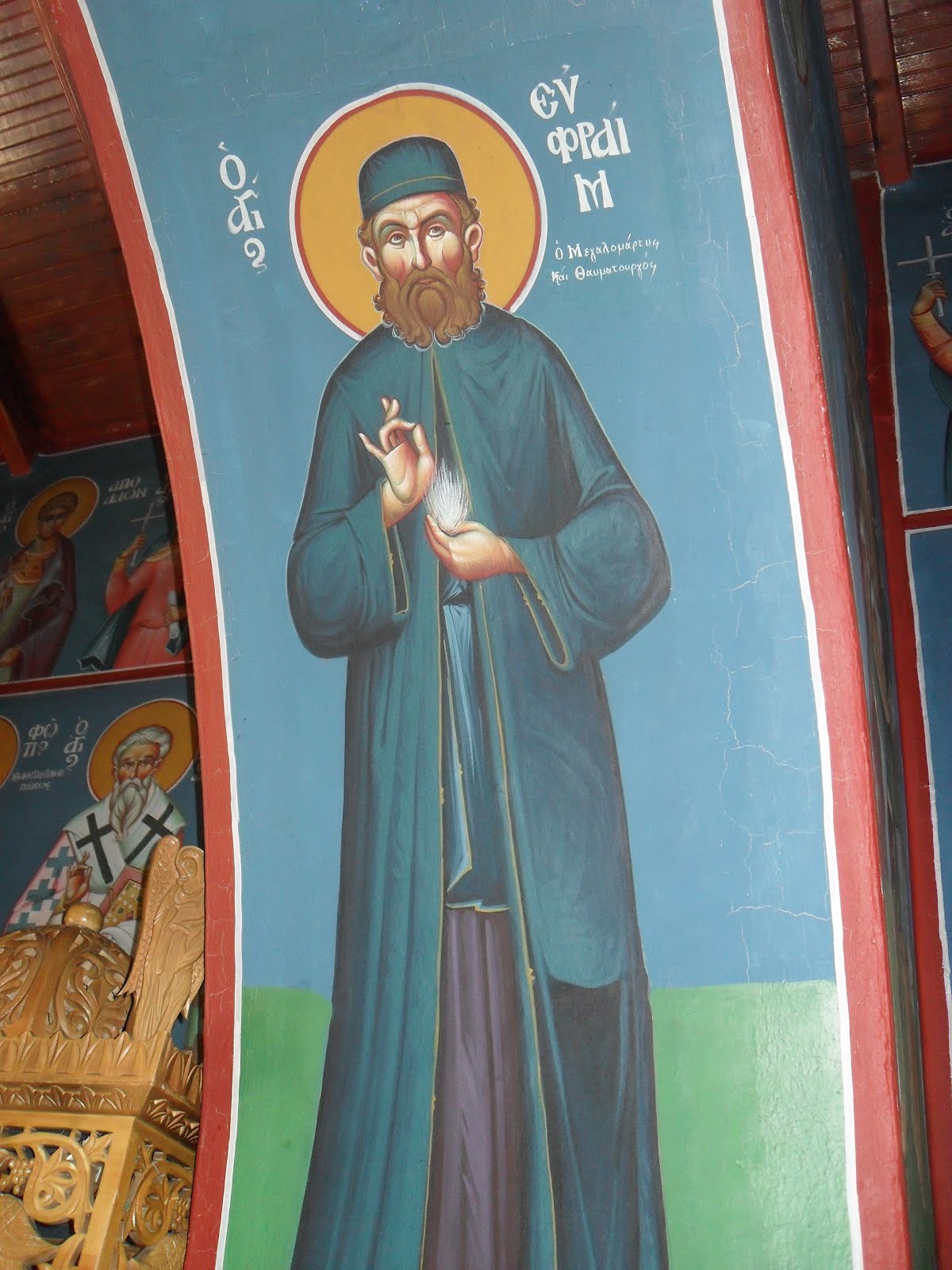
A miracle for a newborn from St. Ephraim of Nea Makri

St. Ephraim of Nea Makri (source)
 

An astonishing miracle for a newborn from St. Ephraim of Nea Makri (amateur translation)
I wish, in my own manner, to thank God and St. Ephraim for the miracle which I was made worthy to experience.

I was pregnant, and 12/29/01 was my given due date. When that date came, and I still was not in labor, my doctor gave me another week. On the morning of January 2nd 2002 I began to experience strong pains, and I went to the Hospital. I was checked, and told that my Obstetrician would be called, because I was most likely in labor.

In a short time, the next day (January 3rd), the day of St. Ephraim, I gave birth. The child was born with a dark color, however, due to the lack of Oxygen, and began to cry after 30 minutes. This had occurred within me (as my labor was delayed), and I was in immediate danger also. The child was suffering from apnea, and they did not remove him from the incubator, so that they could support him with Oxygen, with the result being suffering continuous seizures. They took him that evening to the Children's Hospital “Agia Sophia”, and the physicians there diagnosed that the child was suffering from cerebral edema. The ground fell from beneath my feet, and the doctors did not give us much hope...They told us to pray that he leave this life (the child would either die, or we would receive him as a vegetable, for the seizures had destroyed his internal organs, and my baby's beating heart was weak). His situation remained critical, and our only hope was God and St. Ephraim, both of whom we entreated daily.

In 13 days, there was a second encephalogram, when the doctors did not want to tell us to results, so that we not be given hope. After two days, they announced the new results, that our child was totally well, and they did not understand how this occurred, as they thought he was doomed. Here I should say that during these 13 days, St. Ephraim revealed himself to us many ways.

My one aunt saw a dream: she was within a Church of St. Ephraim, and there was a little boy who was crying continuously. She picked him up to calm him down, and she got up and walked. When my aunt told us this, she went with my mother to the same Church. On the road, my mother asked St. Ephraim to show her some sign. As she was lighting her vigil lamp, it went out, and she thought that this was a sign that my child had died. When she went to light it again, before she could get the lighter out, it lit itself again alone. Then she understood that my child was alive, and that the very powerful St. Ephraim would help him. In my house, we heard knocking from our icons, and the odor of incense filled all of our rooms.

My baby stayed 17 days in the NICU. After all that I related above, he remained another 13 days in a normal room, where they began to slowly feed him some milk. After this, we were able to bring him home.

Time passed, and we had to go for follow-up in two months. A few days before, my other aunt saw a dream: she was in my house for a visit, and there was a young man with her with a white shirt and black pants. The young man came for the first time to my house, and I began to welcome him. Before I could show him his bedroom, he entered my room by himself, where I had the baby, and began to unbutton his cufflinks. When I prepared something to treat him, my aunt called him, and he told her: “Go ahead, I will stay to watch over the child.”

Then I felt at ease, because I knew that my child would have a protector throughout his life. At his first check-up, we saw a very good professor at the Hospital, and when she read his history, she called her co-workers, saying: “Come see the miracle of the century.”

The whole episode which my child endured left him only with damage to his auditory nerve, for which he wears a hearing aid. I thank the All-powerful God from the depths of my heart, for He is always with us, and grants His might to the Saints to work wonders, and to protect us during the difficult times of our lives.
 
St. Ephraim of Nea Makri (source)
   
Through the prayers of our Holy Fathers, Lord Jesus Christ our God, have mercy on us and save us! Amen!

Thursday, December 13, 2012

Elder Ephraim of Katounakia on the Priesthood

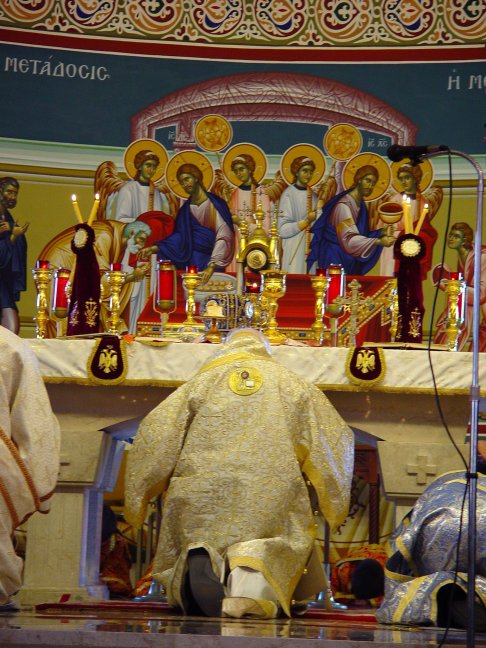
The Divine Liturgy (source)
 

Elder Ephraim of Katounakia on the Priesthood
When you liturgize, have in mind that you are a mediator. You receive from the world pain, tears, sickness, and supplications and you offer them above to the throne of the Godhead. Then you transfer to the world comfort, therapy, and whatever need someone may have. God has made you worthy of a great office, my child. Cultivate it. The ear of God is at the mouth of the priest.

The stole has great power. The stole is an arbiter of fallen man with the Father, with his Creator. This is why, as much as you can, commemorate more names.

During the time of the Turkish occupation there were many priests circulating around, but one priest circulated and gathered names to be commemorated during the Liturgy. The Turkish officer said to him: "Hey, he is raising a revolution of the people." He took the priest and brought him in. In his sleep all of those the priest had commemorated appeared to him and said: "Listen, either you release the priest, because he commemorated us and consoled us, or we will take your first child." The Turk became fearful. This was during the Turkish occupation. "Come priest, go and be well", he said, "go, for will I lose my child?"

The stole has great power, my child, great power. As much as you can, commemorate more names.

Yes, years ago I was given by Fr. Arsenios, spiritual brother of Elder Joseph, some names from the time he was an immigrant from Russia and came to Greece. I commemorated them. Later he told me: "You know, Elder, what I saw? I saw in my sleep that those names I gave you, well I went to one of their homes. I asked how they were doing here. 'Well,' they said, 'somewhat good, but Papa-Ephraim comes and consoles us.'" It was because I was commemorating his name. Yes. Later he asked another: "How are you doing?" They said: "So so, but it's raining a bit and we're cold, but Papa-Ephraim comes and consoles us." I said to him: "It is, my brother, the names I commemorate."

Why did Papa-Planas become a saint? He commemorated whole papers. Once I remembered some names and I posted them at the Proskomide. There at the clipboard. So in my sleep I saw that certain elderly came, with old clothes, as I heard from the mother of my father, and they said: "You, my child, wrote us down, but the Elder, my child, does not commemorate us."

"Come on," I said to the Elder, "why don't you commemorate them?"

"I could not see them clearly," he said.

"Elder, I saw this and that, and they said that the Elder does not commemorate us," I said.

From that time I received the desire to commemorate as many more names. The more the names, the more the wages you receive. But this is the greatest charity: to unite man with God. This is the greatest charity. And you can do this. As many more names, my child, that you commemorate, so much more the wages do you receive. Yes.
   
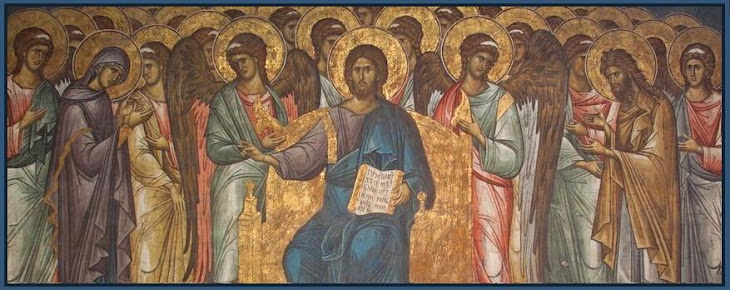
Icon depicting Christ the Great High Priest in the center, surrounded by His Holy Priests that are serving the Holy Sacraments (e.g. Baptisms, Weddings, Holy Confession, etc.) and other pastoral activities (e.g. Catechism, visiting the sick, etc.) as His representatives (source)
  
Through the prayers of our Holy Fathers, Lord Jesus Christ our God, have mercy on us and save us! Amen!

St. Lucia (Lucy) the Virgin Martyr of Syracuse


St. Lucy the Virgin Martyr of Syracuse - Commemorated December 13 (http://pravicon.com/images/sv/s1305/s1305005.jpg)
   
Saint Lucy the Virgin-Martyr (283-304), also known as Saint Lucia, was born in Syracuse, Sicily and was martyred for the Christian faith in the persecution of Emperor Diocletian around the year 304 AD. Her feast day is celebrated on December 13.
There is no doubt of the great veneration that was shown to St. Lucy by the early church. She is one of those few female saints whose names occur in the canon of Pope Gregory the Great, and there are special prayers and antiphons for her in his Sacramentary. She is also commemorated in the ancient Roman Martyrology. At the beginning of the 8th century the Bishop Aldhelm of Sherborne included a brief account of her life among the virgins praised in De Laude Virginitatis, and following him, the Venerable Bede inserted the story in his Martyrology.
Lucy was born of rich and noble parents about the year 283. Her father was of Roman origin, but his early death left her dependent upon her mother, whose name, Eutychia, seems to indicate that she came of Greek stock.
  
St. Agatha appearing to St. Lucy who had come to venerate at her tomb (source)
  
Her mother, Eutychia, had suffered four years with dysentery but Lucy had heard the renown of Saint Agatha of Palermo, the patroness of Catania; when they were at a Liturgy, the gospel was read that made mention of a woman who was healed of the dysentery by touching of the hem of the garment of Jesus Christ, which convinced her mother to pray together at Saint Agatha's tomb. They stayed up all night praying, until they fell asleep, exhausted. Saint Agatha then appeared in a vision to Lucy and said, "Soon you shall be the glory of Syracuse, as I am of Catania." At that instant Eutychia was cured.
Lucy secretly consecrated her virginity to God, and distributed her wealth to the poor. Since she refused to marry a pagan, the rejected suitor denounced her to the prefect Paschasius as a Christian, and she was arrested.
    
St. Lucy before the Governor Paschasius (http://pravicon.com/images/sv/s1305/s1305003.jpg)
   
She was first of all condemned to suffer the shame of prostitution; but in the strength of God she stood immovable, so that they could not drag her away to the place of shame, and thus she preserved her purity. Then the pagans attempted to burn her alive, and heaped bundles of wood about her and set them on fire, and again God saved her. Finally, she was killed by a sword thrust to the throat, and so she gave her spirit up to God. Holy Martyr Lucy, pray to God for us!
  
St. Lucy, unharmed amidst the flames (http://pravicon.com/images/sv/s1305/s1305003.jpg)
   
Lucy's name is derived from the Latin word lux or lucis meaning "light", and since there is a late tradition that she was blinded by her torturers, she is regarded as the patron saint of eyesight, of the blind, and of lucidity.[note 1] She should not be confused with St Lucy of Campania (July 6).
With regard to her relics, Sigebert (1030-1112), a monk of Gembloux, wrote that the body lay undisturbed in Sicily for around 400 years. But in 878, as marauding Islamic Saracens threatened Syracuse, the relics were transferred to a secret place.
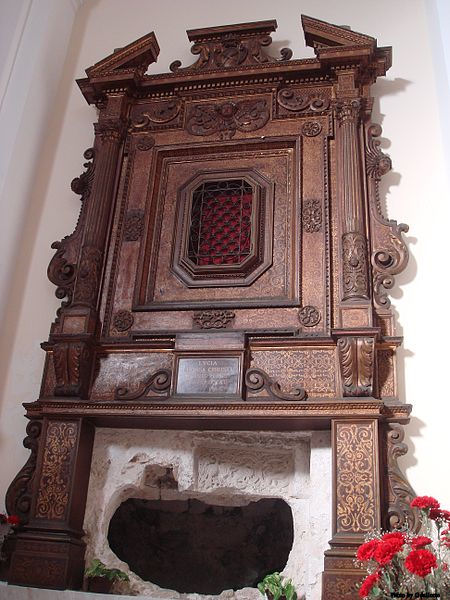
The empty tomb of St. Lucy in Syracuse, Sicily (source)
   
In 1039 the Byzantine general George Maniakes took them and removed them to Constantinople. On their capture of Constantinople in 1204, the French found some of the relics in that city, and the Doge of Venice secured them for the monastery of San Giorgio at Venice. In 1313 they were moved within Venice to the city church named in her honour. In 1513 the Venetians presented to Louis XII of France the head of the saint, which he deposited in the cathedral church of Bourges.
  
The incorrupt relics of St. Lucy, in the church of San Geremia, Venice (source)
   
Until 1861 the remainder of her relics were venerated in the church dedicated to her in Venice. After its demolition to make way for the new railway terminus, they were transferred to the church of San Geremia (Venice).   


Troparion (Tone 5)
Wearing the radiant cloak of virginity, and being betrothed to the Lifegiver Christ, you forsook the love of your earthly betrothed, O Lucy Virgin-Martyr, therefore as a bridal gift, you have brought to Christ the outpouring of your blood. You also intercede to Him for us all!


Through the prayers of our Holy Fathers, Lord Jesus Christ our God, have mercy on us and save us! Amen!

Tuesday, December 11, 2012

St. Paisios on the incorrupt Relics of the Ionian

Sts. Spyridon of Corfu, Gerasimos of Cephalonia and Dionysios of Zakynthos, three great wonderworker of Christ  whose incorrupt Holy Bodies bless and protect the peoples of the Ionian (source)
   
Elder, could St. Spyridon have asked from God that his Relic remain incorrupt?

-No, how could that have happened? The Saints don't ask for such things. God willed that his Relic remain incorrupt in order to help people. And behold how God arranges things! Because Kerkyra (Corfu), Cephalonia and Zakynthos are near Italy, and that it would be easy for people to be seduced by Catholicism, He placed a great barrier there: St. Spyridon, St. Gerasimos and St. Dionysios.
 
Amateur translation from Source: Elder Paisios of the Holy Mountain, Words VI, On Prayer. The Holy Hesychasterion "St. John the Theologian", Souroti, Thessaloniki (http://vatopaidi.wordpress.com/2012/12/12/ο-γέροντας-παΐσιος-για-τον-άγιο-σπυρίδ/)
   
Sts. Spyridon, Gerasimos and Dionysios the Wonderworker (source)
      
Through the prayers of our Holy Fathers, Lord Jesus Christ our God, have mercy on us and save us! Amen!

Saturday, December 8, 2012

St. Parthenios of Chios (+1883)

St. Parthenios of Chios (+ December 8th, 1883) (source)
   
Brief life of the Saint (amateur translation)
Desiring to behold his dead fiancee with his own eyes (when he was a young man), he went to the tomb at night, uncovered her, and took her in his arms. He philosophized, as is said in the hymns from the Funeral Service: “We went out and saw in the tombs that the naked bones of man are worms and filth and stench”, and without telling anyone, he left the cares of this vain world, and became a monk in Nea Moni of Chios, and was noted for his ascetical feats.

With the blessing of his elder, he ascended the peak of Mount Penthodous, and lit the vigil lamp, and cared in general for the abandoned church there of the Holy Apostle and Evangelist Mark. At one point, at the will of God, he uncovered a cave at the Southeast side of the mountain, where he decided to live in asceticism. There he lived with fasting, vigil and prayer day and night.

The Lord, beholding his spiritual feats, bestowed on him many spiritual gifts, among which was clairvoyance. He foretold the great and terrible earthquake of Chios in 1881. Soon, his fame grew, and the abandoned church of St. Mark was transformed into a Skete, where St. Parthenios and his disciples performed their monastic duties.

All the people gathered from the various parts of the island to hear his sweet word and to seek his prayer and his blessing. Lazarios Zanaras the teacher relates that, without the will of the Saint, St. Parthenios performed many miracles in his life.

He reposed in faith on December 8th 1883.
   
St. Parthenios of Chios on the Spiritual Struggle
This is how it is, brother of Christ by adoption: We step on earth and we look towards heaven. This will be repeated till the grace of God covers you and you come out as victor. Nevertheless, know the voice of God which says: "Did you fall? Arise." To fall is human. To remain fallen is satanic.

Our life is a battle, a struggle, and do not despair, no one comes out a victor if the struggle does not finish. The believer's despair is the demon's joy, and repentance is the angel's joy. Struggle as much as you can to gain the crown of life. Do not give up the weapons when you fall; attack again. Struggle to make the angels joyous. 

(http://frbenedict.blogspot.com/2011/03/st-parthenios-of-chios-on-spiritual.html)
   
Note: St. Parthenios is missing from many Synaxaria, and I have been unable to officially confirm if he has been canonized, but may we all have his blessing, and may we emulate his example!
   
St. Parthenios of Chios (source)
   
Through the prayers of our Holy Fathers, Lord Jesus Christ our God, have mercy on us and save us! Amen!

Friday, December 7, 2012

St. Silouan the Athonite on the Saints and Monastics

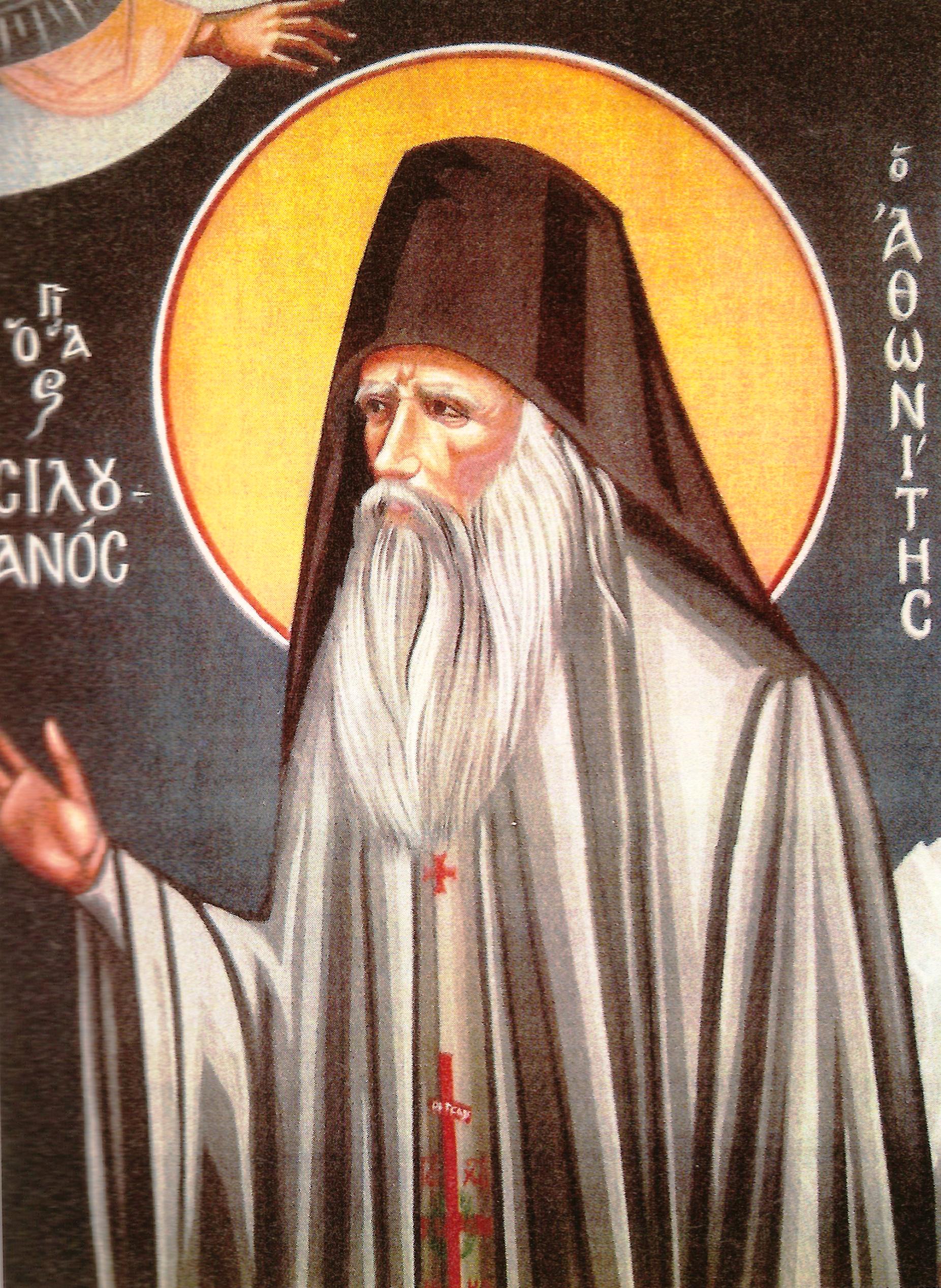
St. Silouan the Athonite (source)
 
St. Silouan the Athonite on the Saints and Monastics (amateur translation)
The world is upheld through the prayers of the Saints. And the monk is called, that he might pray on behalf of the world, for this is his whole being. In this resides his service, and because of this he should not be burdened by worldly cares. The monk must live in continuous continence. If, however, he is occupied by worldly cares, then he is forced to eat more, and from this comes injury in general, for he who eats as is appropriate cannot pray in a befitting manner. Grace loves us to live in a body withered through asceticism.
(http://agioritikoslogos.blogspot.com/2012/12/blog-post.html)
 
Through the prayers of our Holy Fathers, Lord Jesus Christ our God, have mercy on us and save us! Amen!

Thursday, December 6, 2012

The 1907 Miracle of St. Nicholas in Pennsylvania at Darr Mine


St. Nicholas the Wonderworker, who saved hundreds of Orthodox faithful who honored his feast (source)


The 1907 Miracle of St. Nicholas in Pennsylvania at Darr Mine

On 20 December 1907 The New York Times front page reported details of a mining disaster in Pennsylvania. Although hundreds of coal miners had lost their lives, the newspaper carried the unusual headline of The Pittsburgh Press: ‘St Nicholas Feast Saves the Russians’. And other headline captions at the time included: Pittsburgh Gazette Times: "Majority of Victims Americans - Foreign Workers Lay Off to Go to Church and Escape Death"; Pittsburgh Dispatch: "Many of the victims are English-speaking men. Foreigners escape owing to religious holiday." What was the story behind these headlines?

On 19 December 1907, at least 239 coal miners were killed in an explosion at the Darr Mine in Van Meter, in the south-western corner of Pennsylvania. This remains the fourth worst coal mining disaster in U.S. history and everyone inside the mine was killed. However, it could have been much worse - the number of victims could have been double. The death toll was not some 500, because 19 December is St Nicholas’ Day [Old Calendar] and some 250 faithful Carpatho-Russian immigrant coal miners had taken an unpaid day off work to celebrate his memory. For even the greedy coal mine owners, who otherwise had virtually complete control over the miners with their threats of dismissal, knew that they could not force Carpatho-Russians to work on 19 December, St Nicholas Day. For St Nicholas is the patron saint of shepherds, one reason why he has been the Carpatho-Russian patron saint for centuries, and thanks to his intercession, men and boys, some perhaps as young as ten, survived to become fathers of hundreds and grandfathers of thousands. Had it not been for this miracle, more than a thousand would have been widowed and orphaned, which in 1907 would have meant financial destitution, for there would have been no assistance from companies or government agencies in those days.

Newspaper reports of the 11:30 am explosion that took place in the middle of the church service record that there was a terrible noise and the ground shook, as if there were an earthquake. Immediately everyone realized that there had been an explosion in the mine and they rushed to help find survivors. Although it was against the few regulations that did exist at the time, the mining company had allegedly interconnected more than one mine, which devastated a large area of the mine on both sides of the river. In the end, many bodies could not be identified and were placed in a mass grave, and although probably higher, the official death toll was 239.

Life was very harsh for the Carpatho-Russian miners. They were worked like animals in the bowels of the earth, exploited by ‘the English’ - anglophone American businessmen and coal barons, and often worked seven days a week. At that time the Carpatho-Russians were supported in their labour struggles by a priest, Fr (now St) Alexis Toth (1854-1909). Fr Alexis not only supported every labour struggle and won the respect of the people, but supported the immigrants in other ways too. For, having been forced into outward Uniatism in their homeland by the threat of starvation in the seventeenth and eighteenth centuries, from the 1880s on the Carpatho-Russians had been forced into emigrating by the cruel Hungarian Roman Catholic authorities in their homeland. In America they struggled to retain their identity and traditions. However, as a result of the religious freedom they found in North America, many of their priests and tens of thousands of people had since 1892 been returning to Orthodoxy to become part of the Orthodox Church in North America. And it had been St Alexis who had led the way. Indeed, the Roman Catholic Uniats were as a rule anti-labour and supported their Irish masters. The Carpatho-Russian miners remained close to the Church and many later revered the memory of the Russian Tsar-Martyr, Nicholas II, under whom all Orthodox in North America had been united.

In response to the return to Orthodoxy of the exploited and misled Carpatho-Russians, in 1907 the Pope of Rome was so worried that he appointed a Bishop Soter Ortinsky as ‘Greek Catholic’ bishop for America. It is notable that Rome had never made any similar effort to provide for a specific nationality that had emigrated to America. However, Ortinsky was not even Carpatho-Russian, but a Polish Galician, and he had virtually no authority. In reality, relatively few Uniat churches and priests remained under the authority of their local Roman Catholic bishop, who typically had limited knowledge of the Orthodox rite, let alone Orthodox teaching, and refused to recognize married priests. The 1907 miracle in Pennsylvania, which took place according to the Orthodox calendar date of St Nicholas Day, only served to hearten the exploited Carpatho-Russian immigrants who had returned to Orthodoxy, confirming them in their choice of Faith and encouraging others to do likewise in later years.

19 December 2007 was the centenary of the Miracle of St Nicholas at the Darr Mine and at 7 pm an Akathist to St Nicholas was celebrated at the St Nicholas Orthodox Church at Jacobs Creek close by. A new troparion and kontakion were composed for the occasion and new content describing the miracle of the saving of the coal miners were added to the service.
Source
This was the second miracle of St. Nicholas and miners in 1907. Earlier on December 6, Nicholas' feast day in the Gregorian Calendar, the worst mining disaster in United States history took place in Monongah, West Virginia. Nearly 400 men lost their lives that day. However, 60–100 Italian Roman Catholic and Carpatho-Rusyn Greek Catholic miners were spared as they attended a Roman Catholic St. Nicholas feast day observance. American mines were more dangerous than European mines. Practices outlawed in Europe were still allowed in the US where minors were three to four times more likely to die on the job.
Source

   
St. Nicholas the Wonderworker (source)
   
Apolytikion in the Fourth Tone
Protected by your prayers, O Holy Father Nicholas we children of those saved offer praise to you. Beneath your holy omofor you covered your people as they labored beneath the hills of a new land. Cease not to intercede that our souls may be saved.
   
Kontakion in Tone Three
You were truly the protector of your people, O Holy Nicholas for those who zealously celebrated your holy feast. You preserved them from danger and death as they labored beneath the earth. Therefore with one voice we ask you to continually pray for us that we may obtain mercy from Christ our God.
   
Through the prayers of our Holy Fathers, Lord Jesus Christ our God, have mercy on us and save us! Amen!