Sunday, January 11, 2009

"You will have afflictions, but in Me you will have joy": A quote from St. Issac the Syrian

This is a quote selected by St. John the Hozevite (see: http://www.orthodoxphotos.com/Holy_Relics/St._John_Iacob_the_Hozevite/index.shtml) as being particularly beneficial for struggling Christians. It is quite sobering to me and my fellow sinners, and even if we are far from this state of the Saints, may we struggle to our end to reach the Kingdom of Heaven.

Icon of Jesus Christ "the Bridegroom" (Icon courtesy of http://www.eikonografos.com/ used with permission)

From Homily 36 of St. Isaac the Syrian
"This is the will of the Holy Spirit, to be His beloved in continual reality. The Spirit of God does not dwell in those who live in rest because the Most-Good God wished that His beloved servants should not have rest in this life, but rather live in suffering, difficul
ties, worries, poverty, and nakedness, in solitude and debts, in sicknesses and defamations, in battles and crushing of heart, with sickly body and image detested by others, in a state which does not compare to other people's, and a lonely, peaceful, and quiet dwelling, completely invisible to men and free of anything that produces earthly consolation. Therefore, these people weep, and the world laughs; these sigh, but the world enjoys; these fast, but the world amuses itself. During the day, they wear themselves out; and, during the night, they prepare for deprivation. There are some who offer themselves to weariness voluntarily and also submit to afflictions; some are persecuted, while others were killed, and some hid in cellars. In them was fulfilled the word that says, "You will have afflictions, but in Me you will have joy," because the Lord knows that the ones who live in rest cannot remain in His love. Therefore, Christ the Saviour has prevented these from rest and satisfaction. He Whose love is more powerful than death of the body wanted to show also in us the power of His love. Amen."

St. Isaac the Syrian (his scroll reads: "Above all, love silence") (Icon courtesy of http://www.eikonografos.com/ used with permission)

Through the prayers of our Holy Fathers, Lord Jesus Christ our God, have mercy on us and save us! Amen!

St. Theodosios the Cenobiarch

Greetings!

Today (January 11th) we celebrate the memory of St. Theodosios the Righteous, the Cenobiarch. Besides being a great ascetic and wonderworker, he was the first to organize the so-called Cenobitic monasticism, or a large monastic community living together under one elder (as opposed to lone hermits or small groups of monastics). The life below was taken from: http://www.stirene.org/archives/january/0111_sttheodosios.html .

St. Theodosios the Cenobiarch (Icon courtesy of http://www.eikonografos.com/ used with permission)

"RIGHTEOUS THEODOSIOS THE CENOBIARCH
January 11th
Του Οσίου Πατρός Ημών Θεοδοσίου του Κοινοβιάρχου

He lived during the fifth-sixth centuries, and was the founder of cenobitic monasticism. He was born in Cappadocia of pious parents. Endowed with a splendid voice, he zealously toiled at church reading and singing. St. Theodosios prayed fervently that the Lord would guide him on the way to salvation. In his early years he visited the Holy Land and met with St. Symeon the Stylite, who blessed him and predicted future pastoral service for him.

Yearning for the solitary life, Saint Theodosios settled in Palestine into a desolate cave, in which, according to Tradition, the three Magi had spent the night, having come to worship the Savior after His Nativity. He lived there for thirty years in great abstinence and unceasing prayer. People flocked to the ascetic, wishing to live under his guidance. When the cave could no longer hold all the monks, St. Theodosios prayed that the Lord Himself would indicate a place for the monks. Taking a censer with cold charcoal and incense, the monk started walking into the desert.

At a certain spot the charcoal ignited by itself and the incense smoke began to rise. Here the monk established the first cenobitic monastery, or Lavra (meaning "broad" or populous"). Soon the Lavra of St. Theodosios became reknowned, and up to 700 monks gathered at it. According to the final testament of St. Theodosios, the Lavra rendered service to neighbor, giving aid to the poor and providing shelter for wanderers.

St. Theodosios was extremely compassionate. Once, when there was a famine in Palestine and a multitude of people gathered at the monastery, the monk gave orders to allow everyone into the monastery enclosure. His disciples were annoyed, knowing that the monastery did not have the means to feed all those who had come. But when they went into the bakery, they saw that through the prayers of the abba, it was filled with bread. This miracle was repeated every time St. Theodosios wanted to help the destitute.

Photograph of the Holy Monastery of St. Theodosios (taken from: http://www.impantokratoros.gr/8299EA31.en.aspx)

At the monastery St. Theodosios built an home for taking in strangers, separate infirmaries for monks and laymen, and also a shelter for the dying. Seeing that people from various lands gathered at the Lavra, the saint arranged for services in the various languages: Greek, Georgian and Armenian. All gathered to receive the Holy Mysteries in the large church, where divine services were chanted in Greek.

During the reign of the Byzantine Emperor Anastasios (491-518) there arose the heresy of Eutychios and Severus, which recognized neither the sacraments nor the clergy. The emperor accepted the false teaching, and the Orthodox began to suffer persecution. St. Theodosios stood firmly in defense of Orthodoxy and wrote a letter to the emperor on behalf of the monks, in which they denounced him and refuted the heresy with the teachings of the Ecumenical Councils. He affirmed moreover, that the desert-dwellers and monks would firmly support the Orthodox teaching. The emperor showed restraint for a short while, but then he renewed his persecution of the Orthodox. The holy Elder then showed great zeal for the truth. Leaving the monastery, he came to Jerusalem and in the church, he stood at the high place and cried out for all to hear: "Whoever does not honor the four Ecumenical Councils, let him be anathema!" For this bold deed the monk was sent to prison, but soon returned after the death of the emperor.

St. Theodosios accomplished many healings and other miracles during his life, coming to the aid of the needy. Through his prayers he once destroyed the locusts devastating the fields in Palestine. Also by his intercession, soldiers were saved from death, and he also saved those perishing in shipwrecks and those lost in the desert.

Once, the saint gave orders to strike the semandron (a piece of wood hit with a mallet), so that the brethren would gather at prayer. He told them, "The wrath of God draws near the East." After several days it became known that a strong earthquake had destroyed the city of Antioch at the very hour when the saint had summoned the brethren to prayer.

Before his death, St. Theodosios summoned to him three beloved bishops and revealed to them that he would soon depart to the Lord. After three days, he died at the age of 105. The saint's body was buried with reverence in the cave in which he lived at the beginning of his ascetic deeds."


St. Theodosios the Cenobiarch (Icon courtesy of http://www.eikonografos.com/ used with permission)
Apolytikion of St. Theodosios in the Fourth Tone
With the rivers of your tears, you have made the barren desert fertile. Through sighs of sorrow from deep within you, your labors have borne fruit a hundred-fold. By your miracles you have become a light, shining upon the world. O Theodosius, our Holy Father, pray to Christ our God, to save our souls.

Kontakion in the Plagal of the Fourth Tone
As being planted in the courts of Christ thy Lord and God, with holy virtues thou delightfully didst blossom forth and didst multiply thy children amid the desert, who were watered with the showers of thy fervent tears, O chief shepherd of the godly sheepfold of our God. Hence we cry to thee: Rejoice, O Father Theodosius.
(taken from: http://goarch.org/chapel/saints_view?contentid=381&type=saints)
Through the prayers of our Holy Fathers, Lord Jesus Christ our God, have mercy on us and save us! Amen!
Friday, January 9, 2009

St. Polyeuktos the Martyr

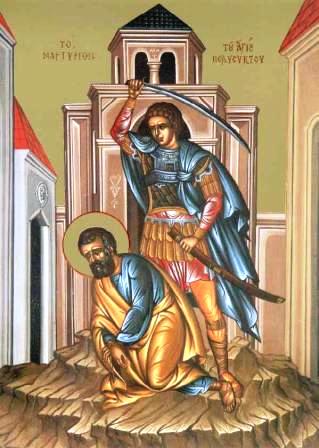
Icon of St. Polyeuktos the Martyr (http://christopherklitou.com/icon_9_jan_polyeuctus.htm)

"The Holy Martyr Polyeuctus.
The Armenian town of Melitene was soaked in Christian blood, as was all the land of Armenia. The first blood shed for Christ in that town was that of St Polyeuctus, spilled in about the year 259, during the reign of Valerian. There were in the town two friends who were officers: Nearchus and Polyeuctus, the former baptised and the latter unbaptised. When a decree went out from the Emperor that all Christians were to be killed, Nearchus prepared himself for death, though with great sorrow at not having brought his friend Polyeuctus to the true Faith.

Icon of St. Nerchos the Martyr, whose feast is April 22nd (http://christopherklitou.com/icon_22_april_nearchus.htm)
When Polyeuctus became aware of Nearchus' sorrow, he promised to become a believer. On the following day, he related to Nearchus a dream that he had: the Lord Himself had appeared to him in light, stripped his old clothing from him, clothed him in new and shining raiment and set him upon the saddle of a winged horse. After relating this dream, Polyeuctus went off to the town, tore up the royal decree on the persecution of Christians and smashed many statues of idols. He was tortured and condemned to death. On the way to the place of execution, he caught sight of Nearchus in the crowd and called joyfully to him: 'Save your soul, my dear soul-friend! Remember the vow of love confirmed between us!' And St Nearchus later ended a martyr for Christ in the fire. His feast is on April 22nd." (taken from the Prologue of St. Nikolai: http://www.pomog.org/prologue/January/22.htm)

Icon of the Martyrdom of St. Polyeuktos (http://www.photosled.com/data/1185/0109_Polyeyktos11.jpg)
Kontakion of St. Polyeuktos in the Fourth Tone
When the Saviour bowed His head within the Jordan, there He crushed the dragons' heads; as for His trophy-bearing Saint, when Polyeuctus's head was cut off, he put to shame the deceiver and wily foe.
(taken from: http://goarch.org/chapel/saints_view?contentid=378&type=saints)
Through the prayers of our Holy Fathers, Lord Jesus Christ our God, have mercy on us and save us! Amen!

Thursday, January 8, 2009

Patron Saints - January

Greetings!

Here are some common Patron Saints for the month of January (and again, this is by no means a comprehensive list). The sources are http://oasigr.5.forumer.com/a/_post1688.html and http://orthodoxwiki.org/Patron_saint primarily.

Menaion Icon of the Saints and Feasts of the Month of January (icon taken from Holy Transfiguration Monastery: http://www.thehtm.org/catalog/images/A421.jpg )

January
1 – St. Basil the Great - protects against heresy, scourges, protector of philanthropy

2 - Saint Seraphim of Sarov – protector of forests, and for spiritual help, consolation, and compunction

2 – St. Mark the Deaf - the protector of the deaf

2 – St. Silvester Pope of Rome – protector of poor clergy and abandoned women

2 - St. Juliana Lazarevskaya – protector of the kitchen and home

3 – St. Thomaïs the Righteous of Lesvos - protector of spouses and family

4 – The Righteous Nikephoros the Leper - the protector against leprosy

8 – St. Domniki (Domnica) the Righteous – protector of midwives

8 – St. Abo the Perfumer of Georgia – protector of perfumers

8 – St. Gregory the Wonderworker of Kievo-Pechersk - For protection against thieves

10 – St. Marcian the Righteous, the Priest and Steward? (οικονόμος, also being a rank of the priesthood) – protector of patients and poor, helping in the reconstruction of churches

14 – St. Agne the Martyr – protector of chastity and virginity

16 – St. Danax the Righteous Martyr, the Reader – protector of Readers, Altar servers (and possibly also priests' children?), and those studying to be priests? (Ιεροσπουδαστών)

16 - Sts. Speusippus, Eleusippus, and Meleusippus - protectors of animals and livestock, especially horses

21 – St. Maximos the Greek - the protector of editors? (διορθωτών) and translators

24 – St. Xenia the Righteous - protector against heart disease, neurologic disease, protector of children, and for success in work

24 – St. Xenia the Righteous of Petroupolis (St. Petersburg) – the Fool-for- Christ helps alcoholics, protects against marital arguments because of alcohol, and helps in finding employment

26 – St. Xenofon (Xenophon) with his wife St. Mary and their children Sts. John and Arkadios - protectors of farmers

28 – St. Ephraim the Syrian - For spiritual help, consolation, and compunction [St. Issac the Syrian also celebrates the same day]

30 – The Three Hierarchs (Sts. Basil the Great, Gregory the Theologian and John Chrysostom) - protectors of education and letters (or learning? των γραμμάτων)

31 – Sts. Cyrus and John the Anargyroi (Unmercenaries) - protectors against all sickness and soul-corrupting passions, and for help in meeting a difficult situation

31 – St. Elias Ardounis the Neomartyr - the protector of barbers and hairdressers

Through the prayers of our Holy Fathers, Lord Jesus Christ our God, have mercy on us and save us! Amen!

Wednesday, January 7, 2009

Synaxis of St. John the Holy Glorious Prophet, Baptist, & Forerunner


Greetings!

On January 7th, the day after Theophany, we commemorate St. John the Forerunner for his role in Christ's Baptism. First, here is the Gospel reading for today's feast (taken from: http://www.goarch.org/chapel/lectionary_view?type=gospel&code=352&event=375&date=1/7/2009)

Detail of Fresco of Holy Theophany, from Decani Monastery (taken from: http://www.srpskoblago.org/Archives/Decani/exhibits/Collections/GreatFeasts/CX4K1728_l.html)

"The Reading is from John 1:29-34

At that time, John saw Jesus coming toward him, and said, "Behold, the Lamb of God, who takes away the sin of the world! This is he of whom I said, 'After me comes a man who ranks before me, for he was before me.' I myself did not know him; but for this I came baptizing with water, that he might be revealed to Israel." And John bore witness, "I saw the Spirit descend as a dove from heaven, and it remained on him. I myself did not know him; but he who sent me to baptize with water said to me, 'He on whom you see the Spirit descend and remain, this is he who baptizes with the Holy Spirit.' And I have seen and have borne witness that this is the Son of God."
  
Fresco of St. John the Forerunner preaching to the people about Christ at the Jordan River, and Christ with his "winnowing fork in hand", from Decani Monastery (taken from: http://www.srpskoblago.org/Archives/Decani/exhibits/Collections/SermonsStJohnBaptist/CX4K2587_l.html)

Here is the reading from the Prologue of St. Nikolai for today's feast (from: http://holyascensionofchrist.org/prologue/January/20.htm):

"John's greatest role during his life was enacted on the day of the Theophany, and because of this the Church has, from the earliest times, dedicated the day following that feast to his memory. This day is also connected with an event involving the hand of the Forerunner. The Evangelist Luke desired to take John's body from Sebaste, where the great prophet had been beheaded by Herod, to Antioch, his own birthplace. He succeeded, though, in acquiring and taking only one hand, which was kept in Antioch till the tenth century. It was then moved to Constantinople, whence it disappeared during the Turkish occupation.
  
St John is commemorated several times during the year, but his greatest feast is on this day, January 7th. Among the Gospel-figures surrounding the Saviour,the person of John the Baptist holds a very special place, by the manner of his birth in this world and of his earthly life, by his role of baptiser of men to repentance and his baptism of the Messiah, and, lastly, by the tragic manner of his departure from this world. He was of such moral purity that he indeed deserved the name 'angel'*, as he was named in the Scriptures, rather than being thought of as just a mortal man. John differs from all the other prophets in that he had the joy of showing forth to the world the One Whom he had foretold.
About the hand of St John: it is related that each year, on his feast-day, the archbishop would bring it out before the people. Sometimes the hand appeared open, and sometimes clenched. In the first case it indicated that it would be a fertile year, and in the second that it would be a year of famine.
(*The word 'messenger' is, in Greek, 'angelos'. See Malachi 3:1, Matt. 11-10-Tr.)"


St. John the Forerunner as traditionally depicted with angelic wings (see above for explanation), from Simonopetra Monastery, Mount Athos (Icon courtesy of http://www.eikonografos.com/ used with permission)

St. John the Forerunner is very beloved by the Orthodox throughout the world. In fact, every Tuesday, the Orthodox church commemorates him with corresponding hymns in the Parakletiki (the Holy Angels are commemorated on Mondays, the Holy Apostles and St. Nicholas commemorated on Thursdays, etc.) Also, the Forerunner is especially honored by monastics, as St. John was a prototype for the monastic life in the desert.
  
Finally, as mentioned above, the Hand of the Forerunner was a great help and blessing for the Church for centuries, working endless miracles for the faithful. According to tradition, the Right Hand of St. John today is protected by the Monastery of Dionysiou on Mount Athos (for more info about the Monastery, see: http://mountathos.gr/active.aspx?mode=en%7B0cfcbcfb-623d-46fc-ac88-88de218eb78a%7DView and http://www.johnsanidopoulos.com/2010/04/miracles-of-right-hand-of-st-john.html). 
  
Note: another tradition holds that the Arm of the Forerunner was translated to Russia after being taken by the Crusader Knights of the Order of St. John. See: http://ocafs.oca.org/FeastSaintsViewer.asp?SID=4&ID=1&FSID=102952 for more info on this feast. (And I do not mean to imply that the two treasures are not compatible with each other).
  
Through his Relics and Holy Icons, and at the prayers of the faithful, the Forerunner continues to work endless miracles and healings of soul and body to those who ask of him. May St. John the Forerunner intercede to Christ for all of us and help us! Amen!
  
The Right Arm of St. John the Forerunner, kept in the Monastery of Dionysiou on Mount Athos (taken from: http://www.rel.gr/photo/displayimage.php?album=9&pos=45)
   
Apolytikion of St. John the Forerunner in the Second Tone
The memory of the just is celebrated with hymns of praise, but the Lord's testimony is sufficient for thee, O Forerunner; for thou hast proved to be truly even more venerable than the Prophets, since thou was granted to baptize in the running waters Him Whom they proclaimed. Wherefore, having contested for the truth, thou didst rejoice to announce the good tidings even to those in Hades: that God hath appeared in the flesh, taking away the sin of the world and granting us great mercy.


Kontakion in the Plagal of the Second Tone
The Jordan accepted Your presence in the flesh and reversed its course in fear. John, fulfilling the spiritual ministry, fell back in awe. The ranks of Angels, seeing You in the flesh, baptized in the river, were amazed, and all who were in darkness were filled with light, praising You who appeared and enlightened all.
(taken from: http://www.goarch.org/chapel/saints_view?contentid=375&type=saints)
 
 
Through the prayers of our Holy Fathers, Lord Jesus Christ our God, have mercy on us and save us! Amen!

Tuesday, January 6, 2009

Holy Theophany: A Prayer from the Great Blessing of the Waters

Greetings!

January 6th we celebrate the Holy Theophany. Here is the reading from the Prologue of St. Nikolai for the Feast (taken from: http://www.pomog.org/prologue/January/19.htm):

Fresco of the Holy Feast of Theophany, from Decani Monastery (taken from: http://www.srpskoblago.org/Archives/Decani/exhibits/Collections/GreatFeasts/CX4K1545_l.html)

"When the Lord Jesus had lived for thirty years from His birth in the flesh, He began His teaching and saving work. He marked this very beginning of the beginning by His Baptism in the Jordan. St Cyril of Jerusalem says: 'The beginning of the world - water; the beginning of the Gospel - the Jordan.' At the Baptism of the Lord in the water, that mystery was revealed to the world that was predicted in the Old Testament and fabled in ancient Egypt and India - the mystery of the Holy Trinity of God. The Father revealed Himself to the sense of hearing, the Spirit to the sense of sight and the Son, further beyond these, to the sense of touch. The Father gave His testimony of the Son, the Son was baptized in the waters and the Holy Spirit, in the form of a dove, hovered over the waters. And when John the Baptist bore witness of Christ and said: 'Behold the Lamb of God, which taketh away the sin of the world' (Jn. 1:29), and when he immersed the Lord in the Jordan and baptized Him, there were thus revealed both the mission of Christ in the world and the path of our salvation. That is to say: Christ takes upon Himself the sin of the whole human race. He dies under it (the immersion) and rises again (the coming up out of the water), and we must die to the old, sinful man and rise again, cleansed, renewed and re-born. Here is the Saviour and here is the way of salvation. The Feast of the Theophany is also called the Illuminating, for in the Jordan there is given to us an illumining, revealing God to us as Trinity, consubstantial and undivided. That is one thing. And the other is that each of us baptized in the water is illumined by the Father of lights, through the merits of the Son and in the power of the Holy Spirit."

Below is one of the beautiful, moving prayers that the priest reads during the Great Blessing of the Waters service (translated by Fr. Ephraim Lash, taken from: http://www.anastasis.org.uk/megagiasm.htm):

Detail of Fresco from Holy Theophany (Icon courtesy of http://www.eikonografos.com/ used with permission)
"A Composition of Patriarch Sophronios of Jerusalem.

Trinity beyond all being, beyond all goodness, beyond all godhead, all-powerful, all-vigilant, invisible, incomprehensible; Creator of the spiritual beings and rational natures, innate goodness, unapproachable Light that enlightens everyone coming into the world, shine also in me your unworthy servant. Enlighten the eyes of my mind that I may dare to sing the praise of your measureless benevolence and power. May my supplication for the people here present be acceptable, so that my offences may not prevent the Holy Spirit from being present here; but permit me now without condemnation to cry out to you and say, Master, lover of mankind, beyond all goodness, Almighty, eternal King. We glorify you, the Creator and Fashioner of the universe. We glorify you, only-begotten Son of God, without father from your Mother, without mother from your Father. For in the preceding feast we saw you as a babe, but in the present one we see you full and perfect man, our God, made manifest as perfect God from perfect God. For today the moment of the feast is here for us and the choir of saints assembles here with us, and Angels keep festival with mortals. Today the grace of the Holy Spirit in the form of a dove dwelt upon the waters. Today the Sun that never sets has dawned and the world is made radiant with the light of the Lord. Today the Moon with its radiant beams sheds light on the world. Today the stars formed of light make the inhabited world lovely with the brightness of their splendour. Today the clouds rain down from heaven the shower of justice for mankind. Today the Uncreated by his own will accepts the laying on of hands by his own creature. Today the Prophet and Forerunner draws near, but stands by with fear seeing God’s condescension towards us. Today the streams of Jordan are changed into healing by the presence of the Lord. Today all creation is watered by mystical streams. Today the failings of mankind are being washed away by the waters of Jordan. Today Paradise is opened for mortals and the Sun of justice shines down on us. Today the bitter water as once for Moses’ people is changed to sweetness by the presence of the Lord. Today we have been delivered from the ancient grief, and saved as the new Israel. Today we have been redeemed from darkness and are filled with radiance by the light of the knowledge of God. Today the gloomy fog of the world is cleansed by the manifestation of our God. Today all creation shines with light from on high. Today error has been destroyed and the coming of the Master makes for us a way of salvation. Today things on high keep festival with those below, and those below commune with those on high. Today the sacred and triumphant festal assembly of the Orthodox exults. Today the Master hastens towards baptism, that he may lead humanity to the heights. Today the One who does not bow bows down to his own servant, that he may free us from servitude. Today we have purchased the Kingdom of heaven, for the Kingdom of the Lord will have no end. Today earth and sea share the joy of the world, and the world has been filled with gladness. The waters saw you, O God, the waters saw you and were afraid. The Jordan turned back when it saw the fire of the godhead descending in bodily form and entering it. The Jordan turned back as it contemplated the Holy Spirit in the form of a dove, descending and flying about you. The Jordan turned back as it saw the Invisible made visible, the Creator made flesh, the Master in the form of a servant. The Jordan turned back and the mountains leapt as they saw God in the flesh, and the clouds uttered their voice, marvelling at what had come to pass, seeing Light from Light, true God from true God, the Master’s festival today in Jordan; seeing him drowning the death from disobedience, the goad of error and the bond of Hell in Jordan and granting the Baptism of salvation to the world. Therefore I too, a sinner and your unworthy servant, recount the greatness of your wonders and, seized with fear, in compunction cry out to you:

After completing this, he says in a more powerful voice,

Great are you, O Lord, and wonderful your works, and no word is adequate to sing the praise of your wonders (x3). People: Glory to you, Lord, glory to you!"

Saturday, January 3, 2009

The Uncovering of the Holy Relics of St. Ephraim of Nea Makri, and the Healing of an Addict

St. Ephraim the New Hieromartyr of Nea Makri, the Wonderworker (Icon courtesy of http://www.eikonografos.com/ used with permission)
  
Greetings!
January 3rd we remember the finding of the Relics of St. Ephraim, the newly-revealed Hieromartyr of Nea Makri, Greece. Below is an account taken from: http://www.stirene.org/archives/may/0505_stefraim.html.
  
Mother Makaria holding an icon of St. Ephraim of Nea Makri (taken from: http://profile.myspace.com/index.cfm?fuseaction=user.viewProfile&friendID=241574386)
  
On January 3, 1950, Abbess Makaria (+ April 23, 1999) was wandering through the ruins of the newly re-formed monastery on Amomos Mountain, thinking of the martyrs whose bones had been scattered over that ground, and whose blood had watered the tree of Orthodoxy. She realized that this was a holy place, and she prayed that God would permit her to behold one of the Fathers who had lived there.

After some time, she seemed to sense an inner voice telling her to dig in a certain spot. She indicated the place to a workman whom she had hired to make repairs at the old monastery. The man was unwilling to dig there, for he wanted to dig somewhere else. Because the man was so insistent, Mother Makaria let him go where he wished. She prayed that the man would not be able to dig there, and so he struck rock. Although he tried to dig in three or four places, he met with the same results. Finally, he agreed to dig where the abbess had first indicated.

In the ruins of an old cell, he cleared away the rubble and began to dig in an angry manner. The abbess told him to slow down, for she did not want him to damage the body that she expected to find there. He mocked her because she expected to find the relics of a saint. When he reached the depth of six feet, however, he unearthed the head of the man of God. At that moment an ineffable fragrance filled the air. The workman turned pale and was unable to speak. Mother Makaria told him to go and leave her there by herself. She knelt and reverently kissed the body. As she cleared away more earth, she saw the sleeves of the saint's rasson. The cloth was thick and appeared to have been woven on the loom of an earlier time. She uncovered the rest of the body and began to remove the bones, which appeared to be those of a martyr.

Abbess Makaria miraculously finding the Holy Relics of St. Ephraim of Nea Makri (source)
   
Mother Makaria was still in that holy place when evening fell, so she read the service of Vespers. Suddenly she heard footsteps coming from the grave, moving across the courtyard toward the door of the church. The footsteps were strong and steady, like those of a man of strong character. The nun was afraid to turn around and look, but then she heard a voice say, "How long are you going to leave me here?"


She saw a tall monk with small, round eyes, whose beard reached his chest. In his left hand was a bright light, and he gave a blessing with his right hand. Mother Makaria was filled with joy and her fear disappeared. "Forgive me," she said, "I will take care of you tomorrow as soon as God makes the day dawn." The saint disappeared, and the abbess continued to read Vespers. 

Icon of  Blessed Makaria from the Monastery of St. Ephraim in Nea Makri (source)
   
In the morning after Matins, Mother Makaria cleaned the bones and placed them in a niche in the altar area of the church, lighting a candle before them. That night St Ephraim appeared to her in a dream. He thanked her for caring for his relics, then he said, "My name is St Ephraim." From his own lips, she heard the story of his life and martyrdom.


Since St Ephraim glorified God in his life and by his death, the Lord granted him the grace of working miracles. Those who venerate his holy relics with faith and love have been healed of all kinds of illnesses and infirmities, and he is quick to answer the prayers of those who call upon him."
(http://www.stirene.org/archives/may/0505_stefraim.html)
  

The Mulberry Tree on which St. Ephraim was martyred (taken from: http://agiosefraim.netfirms.com/bio1.html)
  
The Monastery of the Annunciation, where Saint Efraim is to this day, is at Nea Makri in the Attica region, about 30 km outside Athens. You can visit it or by a car or by bus from the center of Athens. When you will arrive at the center of the town, there are cabs who can take you to the Monastery. Open hours are 8 am - 12pm and 5 pm - 7 pm. A great place to visit, full or trees and magnificent view. (from: http://agiosefraim.netfirms.com/monastery1.html, see for some more info about the Saint)

You can read a slightly fuller account with some more miracles about St. Ephraim at: http://www.roadtoemmaus.net/back_issue_articles/RTE_04/Ephraim_of_Nea_Makri.pdf.
  
For the life and Martyrdom of St. Ephraim, see the above link, and: http://full-of-grace-and-truth.blogspot.com/2009/05/st-ephraim-great-martyr-of-nea-makri.html.

For more miracles of the Saint, see: http://full-of-grace-and-truth.blogspot.com/2010/05/selected-miracles-of-st-ephraim-of-nea.html
        
The Relics of St. Ephraim the Great-martyr of Nea Makri (image taken from: http://www.stinnocent.com/seraphim/dtw/dtw4/overdose.htm)
  

St. Ephraim works many miracles throughout the world. He is apparently especially helpful to the youth and to drug and other addicts. Below is a story about the wondrous healing of an addict by St. Ephraim (taken from: http://www.stinnocent.com/seraphim/dtw/dtw4/overdose.htm)
  
"Some years later an American teenager in the Midwest was grappling with his own life. He was heavily using drugs (cocaine and heroin) and was quickly sliding to destruction. He had neither a stable family life nor a religious upbringing, and though still young was in serious trouble.

One night an ugly old man appeared to him and said, "I am your friend, I want to make an appointment with you to meet me." He directed him to get into his car and drive as quickly as he could down a certain road which had a hairpin turn at the end with a sheer cliff at the bend. The young man did as he was told, got into his car and drove as fast as he could down the road. Losing his nerve at the last minute he managed to slam on his brakes and barely made the turn. He arrived home shaken.

Icon depicting St. Ephraim and Blessed Makaria before Christ and the Most-Holy Theotokos (source)
   
Two nights later, the old man appeared again and said with anger and indignation, "I am very disappointed that you didn't meet me. Get into your car again and drive as fast as you can and this time don't put on the brakes." The young man felt strangely compelled to do this. Once again he got into his car, drove as fast as he could and this time didn't stop but drove at high speed off the cliff. The car was demolished but, surprisingly, he escaped with only cuts and bruises, and with a concussion.

A few weeks after he was out of the hospital, the ugly man appeared to him once again and said, "I am furious with you for not keeping our appointment. Tonight without fail you will meet me! Put a double dose of the drug in your needle." Again the boy felt compelled to do this, and after injecting himself went into a coma from the overdose. He was taken to the hospital where doctors told his family that he probably wouldn't live. And if by chance he did live he would only be semi-conscious - in a vegetative state. There was almost no chance of recovery. In two weeks, however, the young man did awake, fully conscious. He told those around him that he had seen a man which looked like some sort of radiant monk. He came to him and said, "I have been praying for you.... God has given you another chance. You will live, but you must correct your life. You are to go to Greece so as to visit the resting place of my bones, giving thanks to God for your salvation. My name is Ephraim."

May St. Ephraim intercede for all of us and help us!
  

Icon of St. Ephraim the Great-martyr of Nea Makri (Icon courtesy of http://www.eikonografos.com/ used with permission)
  
ΑΠΟΛΥΤΙΚΙΟN Ἦχος α’ Τῆς ἐρήμου πολίτης
Ἐν ὄρει τῶν Ἀμῶμων ὥσπερ ἥλιος ἐλάμψας καί μαρτυρικῶς, Θεοφόρε, πρός Θεόν ἐξεδήμησας, βαρβάρων ὑποστάς ἐπιδρομάς, Ἐφραίμ Μεγαλομάρτυς τοῦ Χριστοῦ , διά τοῦτο ἀναβλύζεις χάριν ἀεί, τοῖς εὐλαβῶς βοῶσι σοι, δόξα τῷ δεδωκότι σοι ἰσχύν, δόξα τῷ σέ θαυμαστώσαντι, δόξα τῷ ἐνεργοῦντι διά Σοῦ, πᾶσιν ἰάματα.

For the full service to St. Ephraim (in Greek), see: http://analogion.gr/glt/texts/May/05c.uni.htm.
  
Apolytikion of St. Ephraim the Great-martyr of Nea Makri in the First Tone (amateur translation)
On Amomon Mountain, you shown forth like the sun, and O God-bearer, you left for God by martyrdom, you endured barbarians’ attacks, Ephraim O Great-martyr of Christ, because of this you ever pour forth grace, to those who piously cry out to you, glory to Him who gave you strength, glory to Him you made you wondrous, glory to Him who grants through you, healings for all!
  
St. Ephraim of Nea Makri, depicted before his holy monastery, and blessing and working miracles for people throughout the world (source)
   
Through the prayers of our Holy Fathers, Lord Jesus Christ our God, have mercy on us and save us! Amen!