Showing posts with label Writings of the Saints. Show all posts

Wednesday, January 6, 2021

Homily on Theophany by St. Luke of Simferopol

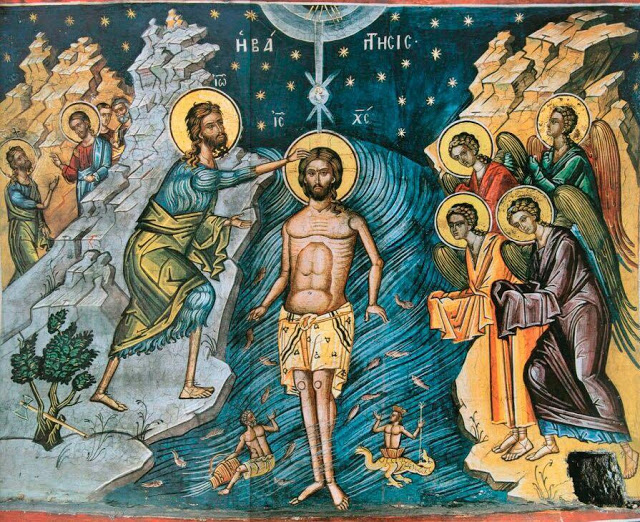
The Baptism of Christ, the Great Feast of Theophany (Source)

Homily on Theophany by St. Luke of Simferopol

The Gospel reading of Theophany provides a word of Christ of great importance. And on this I wish now to turn your attention for a bit.

This great event of the Theophany of the Lord was preceded by the preaching on the banks of the Jordan River by John, the Forerunner of the Lord, the greatest among those born of women. His fiery preaching of repentance, for which he prepared beforehand for twenty years in the desert of Judea, attracted to him a great multitude of people. The fiery word of his preaching set ablaze the hearts of men, whom he baptized in the waters of the Jordan to purify their sins.

But on that great day, to his great astonishment, among the others who were coming to be baptized was Him Who he had never seen, but was Him Whom he revealed would come to baptize him with the Holy Spirit. And having fallen at His feet, he told Him with reverence: "I have need to be baptized by You, and You come to me?" (Matthew 3:14)

We, hope are truly baptized by the Holy Spirit and fire, could not understand why the sinless Son of God went to His servant John and asked to be baptized by him with the baptism of repentance, in order for Him to be loosened from sins that He did not possess, if Christ had not responded to the question of the Forerunner in this way: "Let it be so, for thus we will fulfill all righteousness." (Matthew 3:15)

O, our Lord! We venerate You and Your Forerunner, and we thank You from the depths of our hearts for teaching us to respect and honor "all righteousness", and to hate any type of injustice, for this comes from the devil. Every righteousness, even the most insignificant righteous act, is blessed by God. You received baptism from John in the Jordan River for the remission of sins, because You wished to fulfill whatever was seen beforehand in the plan of God. The descent into the waters of the Jordan served as a seal of repentance for those who were coming to be baptized. For repentance from one's whole heart in those who received the baptism of John, received from God remission of their sins...

Therefore, the baptism of John was righteous. Our Savior was not speaking only about this righteousness to John, however, in order to silence him and to answer his question, but He was speaking about every righteousness, in other words, regarding the plan of God. With His Divine Word, He sanctified and blessed every truth and simultaneously condemned every injustice.

Think, my beloved, people of the spirit as myself, communicants of the little flock of Christ, how much injustice exists in the word! What a great sin is war, when the faithful, and especially Christian people kill each other! If the murder even of one person is punished by death in many peoples, then, how much will our Lord punish those who have led the murder of tens of millions of people?! Any sin is injustice, and war is the greatest injustice, which we all must despise...

The Baptism of our Lord has for us an exalted meaning as well, for we have the revelation of the Holy Trinity. At the instant when the Lord stood up from the water, from Heaven was heard the voice of God the Father, Which bore witness to the Son, saying: "This is my beloved Son, in Whom I am well-pleased." (Matthew 3:17) And the Holy Spirit "in the form of a dove", descended from Heaven upon the head of the Pre-eternal Son of God. This Theophany has great importance, as it is also called besides the Baptism of the Lord. He Himself, the tri-hypostatic God, revealed the divinity of His Second Person, of the incarnate Word of God. God--Father and Holy Spirit as well--were revealed as well to mankind together with the Savior of the race of men...

O, Son of God! O, our Savior, Lord Jesus Christ! To Your works of love, to Your countless wonders, please do another wonder: draw close with Your right hand to my stony heart and turn it to a "heart of flesh". Amen.

-From the Words and Homilies of St. Luke of Simferopol, Vol. II., Published by Orthodox Kypseli

(source)

   
Through the prayers of our Holy Fathers, Lord Jesus Christ our God, have mercy on us and save us! Amen!
Thursday, June 11, 2020

St. Luke of Crimea: The Meaning of Sorrows

Christ healing the Ten Lepers (source)
 
St. Luke of Crimea: The Meaning of Sorrows
Continuously, people ask why the Lord God sends them sorrows and many times very great trials. It is very important for every Christian to understand that our sorrows are sent according to the will of God, Who is always good and saving. Most of the time, they are not sent to us as punishments for our sins, but in order for us re-orient our paths and our hearts, or they are sent as a response to requests that we offer to God. People many times expect God to accomplish what they ask in prayers to Him in the manner that they think is best. God, however, continuously responds to our prayers in a totally different manner, and not according to how they wished or could imagine.

If they would ask, for example, for God to give them humility, they might imagine that slowly, day by day, humility would grow within their hearts under the beneficial affection of God. The Lord, however, continuously works in a different way: He sends them an unexpectedly harsh blow, which wounds their pride and their ego and which humbles them. Frequently, our God sends afflictions, and we complain and in no way think that, the majority of the times, this is a great beneficence of God, and most likely is the response of God to our prayers, with which we entreated Him to strengthen our faith.

Do you know recognize that, many times, our Lord sends us terrible bodily afflictions and wounds our body in order to strengthen us spiritually? This occurred with the Venerable Pimen the Much-suffering, who lived in asceticism in the Monastery of the [Kiev] Caves, and whose whole life was found on the bed of pain, enduring an incurable sickness, and through this manner, he reached sanctity. Other people, who give great significance to earthly goods, seek from the Lord to increase their wealth. And the Lord responds to them with the destruction of their properties with fires, and in this manner, He helps to turn them away from their attachment to earthly things and from their greed, and to correct their deviations from the correct path, which is taught to us by the Lord's Beatitudes.
  
God treats us like His true sons, whom He chastens for their good. The sorrows that are sent to us by the Lord, we must receive as St. Peter says: "Humble yourselves therefore under the mighty hand of God, that in due time He may exalt you." (I Peter 5:6). If we cannot, despite all our efforts, come to understand the reason that God sends us sorrows, then at least let us humble ourselves below the mighty hand of God, and He will lift us up at the proper time, in order for us to understand His paths, with which He is leading us for this reason. We must, with great humility and without the smallest complaining, accept all the trials and sorrows that are sent to us from God, having the humble conviction that, with these, God is guiding us, and not that He is pouring His wrath upon us. (Isaiah 27:4) We usually think that the Lord is angry with us, and this is why He is sending us sorrows. No. Never think that God is angry. "God is love." (I John 4:8). And perfect love is foreign to any form of injustice.
 
But many times, when our God gives us a harsh blow, through which He humbles us and then later exalts us, we complain against God. Do you understand, however, what a serious sin is complaining against God? When we complain against God, it means that we perceive Him as unjust, we perceive that He has not treated us properly and that He must act towards us in a different manner. However, is it not a serious sin to condemn God for injustice and to slander Him? See, therefore, how great a sin is complaining against God. Because of this: "Conduct yourselves with fear throughout the time of your exile." (I Peter 1:17). We must pray greatly for our mistakes and for our impediments on our path to the Kingdom of the Heavens. But even more than that, we must have fear to break that great commandment of Christ: "Judge not, that you might not be judged." (Matthew 7:1). And complaining against God is not only judging God, but also condemning Him.
  
Let us lay aside judging those unfortunate people who willingly destroy themselves, whom our Lord Jesus Christ does not correct nor chasten, because they are not able to be corrected and are incurable. We only seek His help on our path towards salvation, that we might glorify Him and ever honor Him, together with His beginningless Father and the Lord Spirit. Amen.
(source) 
  
St. Luke the Blessed Surgeon, Archbishop of Simferopol and Crimea (source)


Through the prayers of our Holy Fathers, Lord Jesus Christ our God, have mercy on us and save us! Amen!

Thursday, April 9, 2020

St. John Chrysostom on Job's Suffering as Consolation

Holy Prophet Job (source)
  
St. John Chrysostom on Job's Suffering as Consolation
On both sides, beloved, reap the utmost gain, and avoid the imitation of Adam knowing how many ills are begotten of laziness and imitate the piety of Job, learning how many glorious things spring from earnestness. Consider him, the conqueror throughout, and you shall have much consolation in all pain and peril. For as it were in the common theatre of the world that blessed and noble man stands forth, and by means of the sufferings which happened to him, discourses to all to bear all things which befall them nobly and never give in to the troubles which come upon them. For verily, there is no human suffering which cannot receive consolation as a result. For the sufferings which are scattered over the whole world, these came together, and bore down upon one body, that of Job. What pardon then shall there be for him who is unable to bear with thankfulness his share of the troubles which are brought upon him? Since he appears not bearing a part only, but the entire ills of all men, and in order that you may not condemn the extravagance of my words, come, and let us take in hand severally the ills that came upon him, and bring forward this fulfillment of them.
  
And if you wish, let us first bring forward that which seems to be the most unendurable of all, I mean poverty, and the pain which arises from it. For everywhere all men bewail this. Who was poorer, then, than Job, who was poorer than the outcasts at the baths and those who sleep in the ashes of the furnace, poorer in fact than all men? For these, indeed, have one ragged garment, but he sat naked, and had only the garment which nature supplies, the clothing of the flesh, and this the Devil destroyed on all sides with a distressing kind of decay. Again, these poor folk are at least under the roof of the porches at the baths and are covered with a shelter, but he continued always to pass his nights in the open air, not having even the consolation of a bare roof. And what is still greater, the fact that these are conscious of many terrible evils within themselves, but he was conscious of nothing against himself. For this is to be noticed in each of the things which happened to him, a thing which caused him greater pain, and produced more perplexity; the ignorance of the reason of what took place. These persons, then, as I said, would have many things with which to reproach themselves. And this contributes much to consolation in calamity; to be conscious in oneself of being punished justly. But he was deprived of this consolation, and while exhibiting a conversation full of virtue, endured the fate of those who had dared to do extreme wickedness. And these folk who are with us, are poor from the outset, and from the beginning are experienced in calamity. But he endured calamity in which he was unexperienced, undergoing the immense change from wealth. As then the knowledge of the cause of what takes place, is the greatest consolation; so it is not less than this, to have been experienced in poverty from the beginning and so to continue in it. Of both these consolations that man was deprived, and not even then, did he fall away. Do you see him indeed come to extreme poverty, even in comparison with which it is impossible to find a fellow? For what could be poorer than the naked who has not even a roof over him? Yes rather not even was it in his power to enjoy the bare ground, but he sat upon the dunghill. Therefore whenever you see yourself come to poverty, consider the suffering of the just one, and straightway you shall rise up, and shake off every thought of despondency. This one calamity therefore seems to men to be the groundwork of all sufferings together.
  
And the second after it, yes rather before it, is the affliction of the body. Who then was even so disabled? Who endured such disease? Who received or saw any one else receive so great an affliction? No one. Little by little, his body was wasted, and a stream of worms on every side issued from his limbs; the running was constant; the evil smell which surrounded him was strong, the body being destroyed little by little, and decaying with such putrefaction, used to make food distasteful; and hunger was to him strange and unusual. For not even was he able to enjoy the nourishment which was given to him. For he says, “I see my food to be loathsome” (Job 6:7). Whenever, then, you fall into weakness, O man, remember that body and that saintly flesh, for it was saintly and pure, even when it had so many wounds. And if any one belong to the army, and then unjustly and without any reasonable pretext, be hanged upon the pillory2, and has his sides rasped to pieces, let him not think the matter to be a reproach, nor let him give way to the pain when he thinks upon this saint. But this man, says one, has much comfort and consolation in knowing that God was bringing these sufferings upon him. This indeed especially troubled and disturbed him, to think that the just God Who had in every way been served by him was at war with him. And he was not able to find any reasonable pretext for what took place, since, when at least he afterwards learned the cause, see what piety he showed, for when God said to him “Do you think that I have had dealings with you in order that you might appear righteous?” (Job 40:8), he says while conscious-stricken, “I will lay my hand upon my mouth, once have I spoken but to a second word I will not proceed,” (Job 40:4, 5), and again “as far as the hearing of the ear I have heard you before, but now mine eye has seen you, wherefore I have held myself to be vile, and am wasted away, and I consider myself to be earth and ashes” (Job 42:5, 6).
  
But if you think that this is sufficient for consolation, you will yourself also be able to experience this comfort. And even if you do not suffer any of these misfortunes at the hands of God, but owing to the insolence of men — and yet give thanks and do not blaspheme Him Who is able to prevent them indeed, but Who permits them for the sake of testing you — just as they who suffer at the hands of God are crowned, so also you shall obtain the same reward, because you have borne nobly the calamities which were brought upon you from men and did give thanks to Him Who was able indeed to hinder them, but not willing.
  
Behold, then! You have seen poverty and disease, and both in the extremest degree brought upon this just man. Do you wish that I should show you the warfare at nature’s hands, in such excessive degree waged then against this noble man? He lost ten children, the ten at one fell swoop, the ten in the very bloom of youth, ten who displayed much virtue, and that not by the common law of nature, but by a violent and pitiable death. Who could be able to recount so great a calamity? No one. Whenever, therefore, you lose son and daughter together, have recourse to this just man, and you shall find altogether much comfort for yourself. Were these, then, the only misfortunes which happened to him? The desertion and treachery of his friends, the gibes, raillery, mockery and derision, and the tearing in pieces by all was something intolerable. For the character of calamities is not of such a kind, that they who reproach us about our calamities are inclined to vex our soul. Not only was there no one to soothe him, but many from all sides troubled him with taunts. And you see him lamenting this bitterly and saying, “but even you, too, fell upon me” (Job 19:5). He calls them pitiless and says, “My neighbors have rejected me, and my servants spoke against me, and I called the sons of my concubines, and they turned away from me” (Job 19:14, 16). “And others,” he says, “sport upon me, and I became the common talk of all (Job 19:9, 10). And my very raiment,” he says, “abhorred me” (Job 9:31). These things at least are unbearable to hear, still more to endure in their reality, extreme poverty, and intolerable disease new and strange, the loss of children so many and so good, and in such a manner, reproaches and gibes, and insults from men. Some indeed mocked, some reproached, and others despised; not only enemies, but even friends; not only friends, but even servants, and they not only mock and reproach, but even abhorred him, and this not for two or three, or ten days, but for many months; and (a circumstance which happened in that man’s case alone) not even did he have comfort by night, but the delusions of terrors by night were a greater aggravation of his misfortunes by day. For that he endured more grievous things in his sleep, hear what he says “why do you frighten me in sleep, and terrify me in visions?” (Job 7:14). What man of iron, what heart of steel could have endured so many misfortunes? For if each of these was unbearable in itself, consider what a tumult their simultaneous approach excited. But nevertheless he bore all these, and in all that happened to him he sinned not, nor was there guile in his lips.
  
Let the sufferings of that man then be the medicines for our ills, and his grievous surging sea the harbor of our sufferings, and in each of the accidents which befall us, let us consider this saint, and seeing one person exhausting the misfortunes of the universe, we shall conduct ourselves bravely in those which fall to our share, and as to some affectionate mother, stretching forth her hands on all sides, and receiving and reviving her terrified children, so let us always flee to this book, and even if the pitiable troubles of all men assail us, let us take sufficient comfort for all and so depart. And if you sayest, he was Job, and for this reason bore all this, but I am not like him; you supply me with a greater accusation against yourself and fresh praise of him. For it is more likely that you should be able to bear all this than he. Why, you ask? Because he indeed was before the day of grace and of the law, when there was not much strictness of life, when the grace of the Spirit was not so great, when sin was hard to fight against, when the curse prevailed and when death was terrible. But now our wrestlings have become easier, all these things being removed after the coming of Christ; so that we have no excuse, when we are unable to reach the same standard as he, after so long a time, and such advantage, and so many gifts given to us by God. Considering therefore all these things, that misfortunes were greater for him, and that when the conflict was more grievous, then he stripped for the contest; let us bear all that comes upon us nobly, and with much thankfulness, in order that we may be able to obtain the same crown as he, by the grace and lovingkindness of Jesus Christ our Lord, with whom be glory to the Father together with the Holy Spirit, now and always and for ever and ever. Amen.
(source)
  
Excerpt from a 12th century illuminated manuscript of the Book of Job from Great Lavra, Mount Athos, depicting the Pre-incarnate Logos speaking to Job "through the whirlwind and clouds" (Job 38:1), coming to console and vindicate him (source)
  
Through the prayers of our Holy Fathers, Lord Jesus Christ our God, have mercy on us and save us! Amen!

Friday, March 20, 2020

St. John Maximovitch: Nothing is Fearful for the Person Whose Hope is in God

Jesus Christ the Son of God the Savior of the world (source)
  
Note: This beautiful talk from St. John the Wonderworker highlights the beauty of a life without fear as long as one has hope in our Lord. May we obey our medical, civic and spiritual leaders, and pray with trust and hope in our Lord, as we weather this storm.
  
"Where can I go from Thy Spirit, and where can I escape from Thy presence? If I go up into heaven, Thou art there; if I go down into hades, Thou art present there. If I take up my wings toward the dawn, and make mine abode in the uttermost parts of the sea, even there shall Thy hand guide me, and Thy right hand shall hold me.” (Psalm 138: 7-10) 

These divinely inspired words of the Psalmist David should be particularly in our thoughts during these days, when the entire world is literally quaking, and from every direction comes news of all kinds of distress, shocks and calamities.

Before you can concentrate on what is occurring in one country, you are distracted by even more threatening events which have unexpectedly erupted someplace else; and before you can get a grasp on them, yet other news distracts your attention to still some other location, forcing you to lose track of the previous ones, even though they have by no means reached their conclusion. 
 
In vain do “the representatives of the nations consult in order to find a remedy for the common affliction. They encourage one another and others, saying, 'peace, peace,' when there is no peace." (Jeremiah 6:14; 8:11)
 
Calamities in the lands where they are unfolding do not come to an end, when suddenly new ones begin in places which had been considered safe and calm. 
 
Those who flee from troubles in one place find themselves amid troubles elsewhere that are even worse. "As if a man fled from a lion, and a bear met him; or went into his house and leaned with his hand against the wall, and a serpent bit him.” (Amos 5:19) Or, as another prophet says, "He who flees at the sound of the terror shall fall into the pit; and he who climbs out of the pit shall be caught in the snare. For the windows of heaven are opened, and the foundations of the earth tremble." (Isaiah 24: 18)
 
This is what we see happening in our days.
 
A person sets out for his peaceful occupation and suddenly falls the victim of military action which erupted in a place where no one had expected it. 
 
The person who escapes danger from military action, finds himself amid the horrors of natural catastrophes, of an earthquake or typhoon. 
 
Many meet their death where some had escaped it, while other people are prepared to risk their lives rather than waste away in places considered to be secure, because they anticipate other catastrophes which could soon come upon those areas.
 
It would seem that there is no place on the globe in recent times that remains a peaceful and calm haven from troubles in the world. 
 
Everything has become complicated: politically, economically, socially. "Danger from rivers, danger from robbers, danger from my own people, danger from Gentiles, danger in the city, danger in the wilderness, danger at sea, danger from false brethren," as the Apostle Paul wrote (2 Corinthians 11: 26). And to these dangers in our days we must add also, "danger in the air and danger from the sky," which are especially frightful. 
 
But when all the dangers listed by the Apostle Paul were endured by this glorious Chief of the Apostles, he had a great consolation. He knew that he was suffering for Christ and that Christ would reward him for these sufferings. "For I know Whom I have believed, and I am sure that He is able to guard until that Day what has been entrusted to me" (2 Timothy 1: 12).  He knew that the Lord would grant him the strength necessary to endure even greater tribulations, and for this reason he boldly says, "I can do all things in Jesus Christ Who strengthens me" (Philippians 4: 13).
 
These current catastrophes are so terrible for us, because they have come upon us because we are not firm in the Faith, and because we are not enduring them for the sake of Christ. For that reason, we have no hope of receiving crowns for them. 
 
And what is even worse, and leaves us powerless in our efforts to counteract our misfortunes, is that we do not strengthen ourselves with the power of Christ.  We put our hope, not in God, but in human powers and means.  We forget the words of the Sacred Scriptures: "Put not your hope in princes, in the sons of men, in whom there is no salvation. Blessed is he whose hope is the God of Jacob, whose hope is in the Lord his God" Psalm 145: 3, 5). And again: "Unless the Lord builds the house, the builders labor in vain; unless the Lord guards the city, the watchman keeps awake in vain" (Psalm 126: 1).
   
We keep trying to find a firm foundation apart from God. And so, we suffer what was foretold by the prophet: "This sin will become for you like the sudden collapse of the wall of a strong city under siege," and which is then immediately vanquished (Isaiah 30: 13). Woe to those who are leaning against those walls! Just as a collapsing wall crushes those who are leaning on it, in the same way, with the destruction of false hopes, all those who placed their trust in them will perish. Their hope will be like a "staff of reed." "When they grasped you with the hand, you broke, and pierced their shoulders; and when they leaned upon you, you broke, and injured their loins" (Ezekiel 29: 7).
 
It is entirely different with those who seek the help of God.  "God is our refuge and strength, our helper in the troubles that grievously befall us. So we will not fear though the earth should rock and mountains be hurled into the heart of the sea" (Psalm 45: 2-3).
 
Nothing is fearful for the person whose hope is in God. He does not fear men who work evil.  "The Lord is my light and my Savior: whom shall I fear? The Lord is the guard of my life; from whom shall I shrink?" (Psalm 26: 1). The horrors of war are not fearful for him. "Though an army encamp against me, my heart shall not fear; though war rise against me, my hope is in Him" (Psalm 26: 3). He is calm when he lives at home. "He who dwells in the help of the Most High, will live in the protection of the God of Heaven" (Psalm 90: 1). He is ready to sail across the sea. "Thy ways are in the sea, and Thy paths in many waters" (Psalm 76: 20).  Boldly, literally on wings, he flies through the sky to distant lands, saying, "Even there Thy hand will guide me and Thy right hand will hold me" (Psalm 138: 10). He knows that if it pleases God to protect his life, "A thousand may fall at your side and ten thousand at your right hand: but it will not come near you" (Psalm 90: 7).  
 
Even death is not fearful for him, because, for the person whose life is Christ, death is gain (Philippians 1: 21). “Who shall separate us from the love of Christ? Shall tribulation, or distress, or persecution, or famine, or nakedness, or peril, or sword? As it is written, 'For Thy sake we are being killed all the day long; we are regarded as sheep to be slaughtered.' No, in all these things we are more than conquerors through Him Who loved us. For I am sure that neither death, nor life, nor angels, nor principalities, nor things present, nor things to come, nor powers, nor height, nor depth, nor anything else in all creation, will be able to separate us from the love of God in Christ Jesus our Lord" (Romans 8: 35-39). "Since we have these promises, beloved, let us cleanse ourselves from every defilement of body and spirit, and make holiness perfect in the fear of God" (2 Corinthians 7: 1).  
 
This is what the Lord says: "Loose the bonds of wickedness; forgive unjust debts; let the oppressed go free; tear up every unjust agreement. Share your bread with the hungry, and bring the homeless poor into your house.  When you see the naked, cover him, and do not mistreat your own people. Then shall your light break forth like the dawn, and your healing shall spring up speedily; your righteousness shall go before you, the glory of the Lord shall be your rearguard. Then you shall call, and the Lord will answer; you shall cry, and He will say, Here I am” (Isaiah 58: 6-9).  
 
Lord, teach me to do Thy will and hear me on the day that I call upon Thee! 
May Thy mercy, O Lord, be upon us, for we have placed our hope in Thee.
Humble John, Bishop of Shanghai
August 30, 1937
St. Alexander Nevsky
@ 2020 "Russkiy Pastyr": English translation of the article "To the Orthodox Flock of Shanghai" 
  
St. John Maximovitch (source)
  
Through the prayers of our Holy Fathers, Lord Jesus Christ our God, have mercy on us and save us! Amen!

Friday, January 24, 2020

Excerpt from the Third Theological Oration of St. Gregory the Theologian

Jesus Christ the Son of God the Savior of the world (source)
  
For He Whom you now treat with contempt was once above you. He Who is now Man was once the Uncompounded. What He was He continued to be; what He was not He took to Himself. In the beginning He was, uncaused; for what is the Cause of God? But afterwards for a cause He was born. And that cause was that you might be saved, who insult Him and despise His Godhead, because of this, that He took upon Him your denser nature, having converse with Flesh by means of Mind. While His inferior Nature, the Humanity, became God, because it was united to God, and became One Person because the Higher Nature prevailed in order that I too might be made God so far as He is made Man. He was born — but He had been begotten: He was born of a woman— but she was a Virgin. The first is human, the second Divine. In His Human nature He had no Father, but also in His Divine Nature no Mother. Both these belong to Godhead. He dwelt in the womb — but He was recognized by the Prophet, himself still in the womb, leaping before the Word, for Whose sake He came into being. He was wrapped in swaddling clothes Luke 2:41 — but He took off the swathing bands of the grave by His rising again. He was laid in a manger— but He was glorified by Angels, and proclaimed by a star, and worshipped by the Magi. Why are you offended by that which is presented to your sight, because you will not look at that which is presented to your mind? He was driven into exile into Egypt— but He drove away the Egyptian idols. He had no form nor comeliness in the eyes of the Jews Isaiah 53:2 — but to David He is fairer than the children of men. And on the Mountain He was bright as the lightning, and became more luminous than the sun, Matthew 17:2 initiating us into the mystery of the future.
XX. He was baptized as Man — but He remitted sins as God — not because He needed purificatory rites Himself, but that He might sanctify the element of water. He was tempted as Man, but He conquered as God; yea, He bids us be of good cheer, for He has overcome the world. John 16:33 He hungered — but He fed thousands; yea, He is the Bread that gives life, and That is of heaven. He thirsted — but He cried, If any man thirst, let him come unto Me and drink. Yea, He promised that fountains should flow from them that believe. He was wearied, but He is the Rest of them that are weary and heavy laden. Matthew 11:28 He was heavy with sleep, but He walked lightly over the sea. He rebuked the winds, He made Peter light as he began to sink. He pays tribute, but it is out of a fish; yea, He is the King of those who demanded it. John 19:19 He is called a Samaritan and a demoniac; — but He saves him that came down from Jerusalem and fell among thieves; the demons acknowledge Him, and He drives out demons and sinks in the sea legions of foul spirits, Luke 8:28-33 and sees the Prince of the demons falling like lightning. He is stoned, but is not taken. He prays, but He hears prayer. He weeps, but He causes tears to cease. He asks where Lazarus was laid, for He was Man; but He raises Lazarus, for He was God. John 11:43 He is sold, and very cheap, for it is only for thirty pieces of silver; Matthew 26:15 but He redeems the world, and that at a great price, for the Price was His own blood. 1 Peter 1:19 As a sheep He is led to the slaughter, Isaiah 53:7 but He is the Shepherd of Israel, and now of the whole world also. As a Lamb He is silent, yet He is the Word, and is proclaimed by the Voice of one crying in the wilderness. John 1:23 He is bruised and wounded, but He heals every disease and every infirmity. Isaiah 53:23 He is lifted up and nailed to the Tree, but by the Tree of Life He restores us; yea, He saves even the Robber crucified with Him; Luke 23:43 yea, He wrapped the visible world in darkness. He is given vinegar to drink mingled with gall. Who? He who turned the water into wine John 2:1-11, who is the destroyer of the bitter taste, who is Sweetness and altogether desire. Song of Songs 5:16 He lays down His life, but He has power to take it again; John 10:18 and the veil is rent, for the mysterious doors of Heaven are opened; the rocks are cleft, the dead arise. Matthew 27:51 He dies, but He gives life, and by His death destroys death. He is buried, but He rises again; He goes down into Hell, but He brings up the souls; He ascends to Heaven, and shall come again to judge the quick and the dead, and to put to the test such words as yours. If the one give you a starting point for your error, let the others put an end to it.
-St. Gregory the Theologian, Excerpt from his Third Theological Oration
(source)
  
St. Gregory the Theologian (source)
  
Through the prayers of our Holy Fathers, Lord Jesus Christ our God, have mercy on us and save us! Amen!

Saturday, February 9, 2019

St. Luke of Simferopol on the Raising of Children

Christ blessing the Children (source)
 
"Truly I tell you,” Jesus replied, “no one who has left home or brothers or sisters or mother or father or children or fields for me and the gospel will fail to receive a hundred times as much in this present age: homes, brothers, sisters, mothers, children and fields—along with persecutions—and in the age to come eternal life."
(Mark 10:29-30)

This word of the Lord is not a lie. I confirm to you that, when I left my children and entrusted them to God, He took care of them.*** My children grew up well and I think that even I couldn't raise them so well. And my Lord granted me a hundred-times more children. He gave me all of you. He gave me your hearts, because I know how much you love me and I return your love with my own fervent love. So many children has God given to me!


And your own children must be educated. But do not only make plans for their education in outward wisdom, in the wisdom of this world.  They should learn at the same time the wisdom from above, and the highest truth. They should learn the law of God and the commandments of Christ, to learn with reverence how to always have the memory of God and the true Christian path. Only then will your children not be lost on the ways of human wisdom. Only then, above all else, they will have Christian wisdom, the knowledge of God. In this way, therefore, we must educate our children.


You will have to give an account before God for the evil examples that you give to your children, for the arguments that occur before their eyes, for the chatter that they hear you say. If you yourselves do this, then what will your children learn from you?

  
Christ blessing the children (source)
  
We must begin this effort from the beginning, because only very small children easily receive our advice and suggestions. Their soul is like a soft candle, which every one of your words or deeds make an indelible impression on, whether good or evil.

"A small plant, wherever you train it, that shape it will take, and a new container will bring forth either fragrance or stench based on what you fill it with, placing in it either perfumes or filth." (St. Tikhon of Zadonsk)


Mother, the most beloved person for the child, the source of tenderness and nourishment, stands in prayer before the icon of Christ. The child looks at her then at the icon and does not need long explanations about what is happening. Here is the first and silent lesson of godly knowledge. This is the first and most significant lesson of piety. This lesson you can and you must give to your children.


There is no greater responsibility for the mother, no holier work, for which you will have a responsibility before God, than the raising of your children. To God you will have to give a word if you are negligent before this work. And from now you will begin your tortures and you will shed bitter tears and you will groan seeing your children.


Therefore: "Do not neglect one of these little ones." (Matthew 18:10) You must take care of your children, that you might be for them an example of the true Christian life, and then the blessing of the Lord will be with all of you and with your children unto the ages of ages.

(source)
 
***Note: St. Luke was forced to leave his children when he was exiled and tortured on behalf of Christ.
 
Icon of St. Luke the Blessed Surgeon of Simferopol and Crimea, from the newly-built and beautiful Church of Sretensky Monastery (source)
 
Through the prayers of our Holy Fathers, Lord Jesus Christ our God, have mercy on us and save us! Amen!

Tuesday, January 1, 2019

Excerpt from the Encomium on St. Basil the Great by St. Gregory the Theologian

St. Basil the Great (source)
 
The following is an excerpt from the lengthy and moving encomium that St. Gregory the Theologian wrote in honor and memory of his close friend, St. Basil the Great. May we have their blessings and witness throughout the world!

"But what are these to his renown for eloquence, and his powers of instruction, which have won the favour of the ends of the world? As yet we have been compassing the foot of the mountain, to the neglect of its summit, as yet we have been crossing a strait, paying no heed to the mighty and deep ocean. For I think that if any one ever has become, or can become, a trumpet, in his far sounding resonance, or a voice of God, embracing the universe, or an earthquake of the world, by some unheard of miracle, it is his voice and intellect which deserve these titles, for surpassing and excelling all men as much as we surpass the irrational creatures. Who, more than he, cleansed himself by the Spirit, and made himself worthy to set forth divine things? Who was more enlightened by the light of knowledge, and had a closer insight into the depths of the Spirit, and by the aid of God beheld the things of God? Whose language could better express intellectual truth, without, as most men do, limping on one foot, by either failing to express his ideas, or allowing his eloquence to outstrip his reasoning powers? In both respects he won a like distinction, and showed himself to be his own equal, and absolutely perfect. To search all things, yea, the deep things of God (1 Corinthians 2:10) is, according to the testimony of St. Paul, the office of the Spirit, not because He is ignorant of them, but because He takes delight in their contemplation. Now all the things of the Spirit Basil had fully investigated, and hence he drew his instructions for every kind of character, his lessons in the sublime, and his exhortations to quit things present, and adapt ourselves to things to come.
"The sun is extolled by David for its beauty, its greatness, its swift course, and its power, splendid as a bridegroom, majestic as a giant; while, from the extent of its circuit, it has such power that it equally sheds its light from one end of heaven to the other, and the heat thereof is in no wise lessened by distance. Basil's beauty was virtue, his greatness theology, his course the perpetual motion reaching even to God by its ascents, and his power the sowing and distribution of the Word. So that I will not hesitate to say even this, his utterance went out into all lands, and the power of his words to the ends of the world: as St. Paul says of the Apostles, (Romans 10:18) borrowing the words from David. What other charm is there in any gathering today? What pleasure in banquets, in the courts, in the churches? What delight in those in authority, and those beneath them? What in the hermits, or the cenobites? What in the leisured classes, or those busied in affairs? What in profane schools of philosophy or in our own? There is one, which runs through all, and is the greatest — his writings and labours. Nor do writers require any supply of matter besides his teaching or writings. All the laborious studies of old days in the Divine oracles are silent, while the new ones are in everybody's mouth, and he is the best teacher among us who has the deepest acquaintance with his works, and speaks of them and explains them in our ears. For he alone more than supplies the place of all others to those who are specially eager for instruction.
"I will only say this of him. Whenever I handle his Hexaemeron, and take its words on my lips, I am brought into the presence of the Creator, and understand the words of creation, and admire the Creator more than before, using my teacher as my only means of sight. Whenever I take up his polemical works, I see the fire of Sodom, (Genesis 19:24) by which the wicked and rebellious tongues are reduced to ashes, or the tower of Chalane, impiously built, (Genesis 11:4) and righteously destroyed. Whenever I read his writings on the Spirit, I find the God Whom I possess, and grow bold in my utterance of the truth, from the support of his theology and contemplation. His other treatises, in which he gives explanations for those who are shortsighted, by a threefold inscription on the solid tablets of his heart, lead me on from a mere literal or symbolic interpretation to a still wider view, as I proceed from one depth to another, calling upon deep after deep, and finding light after light, until I attain the highest pinnacle. When I study his panegyrics on our athletes, I despise the body, and enjoy the society of those whom he is praising, and rouse myself to the struggle. His moral and practical discourses purify soul and body, making me a temple fit for God, and an instrument struck by the Spirit, to celebrate by its strains the glory and power of God. In fact, he reduces me to harmony and order, and changes me by a Divine transformation...
"This is my offering to you, Basil, uttered by the tongue which once was the sweetest of all to you, of him who was your fellow in age and rank. If it have approached your deserts, thanks are due to you, for it was from confidence in you that I undertook to speak of you. But if it fall far short of your expectations, what must be our feelings, who are worn out with age and disease and regret for you? Yet God is pleased, when we do what we can. Yet may thou gaze upon us from above, thou divine and sacred person; either stay by your entreaties our thorn in the flesh, (2 Corinthians 12:7) given to us by God for our discipline, or prevail upon us to bear it boldly, and guide all our life towards that which is most for our profit. And if we be translated, do thou receive us there also in your own tabernacle, that, as we dwell together, and gaze together more clearly and more perfectly upon the holy and blessed Trinity, of Which we have now in some degree received the image, our longing may at last be satisfied, by gaining this recompense for all the battles we have fought and the assaults we have endured. Such are our words on your behalf: who will there be to praise us, since we leave this life after you, even if we offer any topic worthy of words or praise in Christ Jesus our Lord, to Whom be glory forever? Amen."
St. Gregory the Theologian (source)
   
Through the prayers of our Holy Fathers, Lord Jesus Christ our God, have mercy on us and save us! Amen!