Showing posts with label Baptism. Show all posts

Wednesday, January 6, 2021

Homily on Theophany by St. Luke of Simferopol

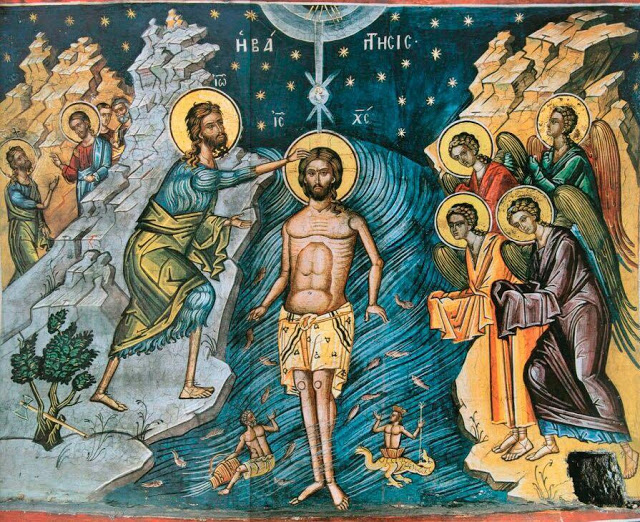
The Baptism of Christ, the Great Feast of Theophany (Source)

Homily on Theophany by St. Luke of Simferopol

The Gospel reading of Theophany provides a word of Christ of great importance. And on this I wish now to turn your attention for a bit.

This great event of the Theophany of the Lord was preceded by the preaching on the banks of the Jordan River by John, the Forerunner of the Lord, the greatest among those born of women. His fiery preaching of repentance, for which he prepared beforehand for twenty years in the desert of Judea, attracted to him a great multitude of people. The fiery word of his preaching set ablaze the hearts of men, whom he baptized in the waters of the Jordan to purify their sins.

But on that great day, to his great astonishment, among the others who were coming to be baptized was Him Who he had never seen, but was Him Whom he revealed would come to baptize him with the Holy Spirit. And having fallen at His feet, he told Him with reverence: "I have need to be baptized by You, and You come to me?" (Matthew 3:14)

We, hope are truly baptized by the Holy Spirit and fire, could not understand why the sinless Son of God went to His servant John and asked to be baptized by him with the baptism of repentance, in order for Him to be loosened from sins that He did not possess, if Christ had not responded to the question of the Forerunner in this way: "Let it be so, for thus we will fulfill all righteousness." (Matthew 3:15)

O, our Lord! We venerate You and Your Forerunner, and we thank You from the depths of our hearts for teaching us to respect and honor "all righteousness", and to hate any type of injustice, for this comes from the devil. Every righteousness, even the most insignificant righteous act, is blessed by God. You received baptism from John in the Jordan River for the remission of sins, because You wished to fulfill whatever was seen beforehand in the plan of God. The descent into the waters of the Jordan served as a seal of repentance for those who were coming to be baptized. For repentance from one's whole heart in those who received the baptism of John, received from God remission of their sins...

Therefore, the baptism of John was righteous. Our Savior was not speaking only about this righteousness to John, however, in order to silence him and to answer his question, but He was speaking about every righteousness, in other words, regarding the plan of God. With His Divine Word, He sanctified and blessed every truth and simultaneously condemned every injustice.

Think, my beloved, people of the spirit as myself, communicants of the little flock of Christ, how much injustice exists in the word! What a great sin is war, when the faithful, and especially Christian people kill each other! If the murder even of one person is punished by death in many peoples, then, how much will our Lord punish those who have led the murder of tens of millions of people?! Any sin is injustice, and war is the greatest injustice, which we all must despise...

The Baptism of our Lord has for us an exalted meaning as well, for we have the revelation of the Holy Trinity. At the instant when the Lord stood up from the water, from Heaven was heard the voice of God the Father, Which bore witness to the Son, saying: "This is my beloved Son, in Whom I am well-pleased." (Matthew 3:17) And the Holy Spirit "in the form of a dove", descended from Heaven upon the head of the Pre-eternal Son of God. This Theophany has great importance, as it is also called besides the Baptism of the Lord. He Himself, the tri-hypostatic God, revealed the divinity of His Second Person, of the incarnate Word of God. God--Father and Holy Spirit as well--were revealed as well to mankind together with the Savior of the race of men...

O, Son of God! O, our Savior, Lord Jesus Christ! To Your works of love, to Your countless wonders, please do another wonder: draw close with Your right hand to my stony heart and turn it to a "heart of flesh". Amen.

-From the Words and Homilies of St. Luke of Simferopol, Vol. II., Published by Orthodox Kypseli

(source)

   
Through the prayers of our Holy Fathers, Lord Jesus Christ our God, have mercy on us and save us! Amen!
Friday, July 12, 2019

Elder Aimilianos: How does the Holy Trinity create a person?

The Holy Trinity creating Adam (Source)
  
Elder Aimilianos of Simonopetra: How does the Holy Trinity create a person?
‘At one exceptional and unique moment in history, the heavenly Father wished to create the material world. Once this had been done, He then went on to make the human body, in collaboration with the other two Persons of the Holy Trinity, and breathed the ‘breath of life’ into it. So God’s creation became ‘a living being’ [2]. God then ceased merely to hover above the waters [3] and entered into the created and material elements and living things. He dwelt in a unique, supreme being who became the king and the reason for the creation. Now the reason for the creation is God Himself. From that moment, the conjunction, the path towards identification and union with God became inevitable, and it’s now impossible to conceive of the human person, the image of the invisible God, without the Holy Spirit.
  
 So the Holy Spirit, as one of the Persons of the Holy Trinity, collaborates in the birth of every person. Together with the Father and the Son, He gives to the maternal womb the material which is taken from the father and mother, and the embryo thus conceived is flesh, dust. We people give birth to dust: we’re dust and return to dust [4]. To this dust, the parents give all the capacities and characteristics of their personalities, they give themselves, the image of their flesh.
  
What the heavenly Father did to the first human person, He also does at the birth of every one of us, the difference being that then He first created the dust and afterwards breathed into it the Holy Spirit, whereas now the Holy Spirit enters the person as soon as conception occurs. So from the very first moment, the embryo is alive and is a person, because it’s received the inspiration of the Holy Spirit. It has rational control, is a complete image of the divinity and, until its last moments, bears the features of divine and human nature, unfailingly and unabatedly. There is also internal communication within the person between the human and divine nature, as there is in Christ.
  
It follows, then, that at everyone’s birth there are, on the one hand, divine actions and, on the other, a human contribution, in accordance with the ancient saying and will of the Godhead: ‘increase and multiply’[5]. The husband and wife, one flesh- ‘you shall be one flesh’ [6]- communicate with the Holy Spirit, and the all-powerful Son brings everything together, puts everything into the womb of the woman and in this way we have a complete person, both God and human. The new persons, created by God and created for God, are endowed, at baptism, with divinity, with the charismatic life, at which point the Holy Spirit becomes the inheritance of their existence. From then on, they’re constantly being challenged internally by the Holy Spirit and also project from themselves the sparks, the light of the divinity. In this way, the dust of the earth becomes a radiant life, through vigilance’.
 
The Creation of Adam (source)
  
Through the prayers of our Holy Fathers, Lord Jesus Christ our God, have mercy on us and save us! Amen!

Saturday, May 2, 2015

"At Christ’s Rising let us dance with faith today..."

Christ is risen! Truly, He is risen!
Christ healing the Paralytic at the Pool of Bethesda (source)
  
At Christ’s Rising let us dance with faith today, O peoples: Hell has been despoiled; rapidly he gave up the prisoners he held, as they hymned the wonderful works of God.
  
O Christ, who once with divine power braced the limbs of the paralytic by your word and ordered him who had been weak for many years to take up his bed, heal my fearsomely sick soul.
  
Once the Angel would come down into the Sheep Pool and cure one person each year; but now by divine Baptism Christ cleanses unnumbered multitudes.
-Excerpt from the Canon for the Sunday of the Paralytic
(source)
  
Christ is risen from the dead, by death, trampling down upon death, and to those in the tombs, He has granted life!
Truly, the Lord is risen!

Saturday, January 4, 2014

Homily on the Holy Lights (Theophany) by St. Gregory the Theologian

The Baptism of Christ, and Holy Theophany: the Revelation of the Holy Trinity (source)
 
Homily on the Holy Lights (Theophany) by St. Gregory the Theologian

I. Again My Jesus, and again a mystery; not deceitful nor disorderly, nor belonging to Greek error or drunkenness (for so I call their solemnities, and so I think will every man of sound sense); but a mystery lofty and divine, and allied to the Glory above.
For the Holy Day of the Lights (Theophany), to which we have come, and which we are celebrating today, has for its origin the Baptism of my Christ, the True Light That lightens every man that comes into the world, and effects my purification, and assists that light which we received from the beginning from Him from above, but which we darkened and confused by sin.
II. Therefore listen to the Voice of God, which sounds so exceeding clearly to me, who am both disciple and master of these mysteries, as would to God it may sound to you; I Am The Light Of The World. Therefore approach ye to Him and be enlightened, and let not your faces be ashamed, being signed with the true Light. It is a season of new birth, let us be born again. It is a time of reformation, let us receive again the first Adam. Let us not remain what we are, but let us become what we once were. The Light Shines In The Darkness,(in this life and in the flesh, and is chased by the darkness, but is not overtaken by it:–I mean the adverse power leaping up in its shamelessness against the visible Adam, but encountering God and being defeated;–in order that we, putting away the darkness, may draw near to the Light, and may then become perfect Light, the children of perfect Light. See the grace of this Day; see the power of this mystery. Are you not lifted up from the earth? Are you not clearly placed on high, being exalted by our voice and meditation? and you will be placed much higher when the Word shall have prospered the course of my words.
III. Is there any such among the shadowy purifications of the Law, aiding as it did with temporary sprinklings, and the ashes of an heifer sprinkling the unclean; or do the gentiles celebrate any such thing in their mysteries, every ceremony and mystery of which to me is nonsense, and a dark invention of demons, and a figment of an unhappy mind, aided by time, and hidden by fable? For what they worship as true, they veil as mythical. But if these things are true, they ought not to be called myths, but to be proved not to be shameful; and if they are false, they ought not to be objects of wonder; nor ought people so inconsiderately to hold the most contrary opinions about the same thing, as if they were playing in the market-place with boys or really ill-disposed men, not engaged in discussion with men of sense, and worshipers of the Word, though despisers of this artificial plausibility.
IV. We are not concerned in these mysteries with birth of Zeus and thefts of the Cretan Tyrant (though the Greeks may be displeased at such a title for him), nor with the name of Curetes, and the armed dances, which were to hide the wailings of a weeping god, that he might escape from his father’s hate. For indeed it would be a strange thing that he who was swallowed as a stone should be made to weep as a child.
Nor are we concerned with Phrygian mutilations and flutes and Corybantes, and all the ravings of men concerning Rhea, consecrating people to the mother of the gods, and being initiated into such ceremonies as befit the mother of such gods as these. Nor have we any carrying away of the Maiden, nor wandering of Demeter, nor her intimacy with Celei and Triptolemi and Dragons; nor her doings and sufferings … for I am ashamed to bring into daylight that ceremony of the night, and to make a sacred mystery of obscenity. Eleusis knows these things, and so do those who are eyewitnesses of what is there guarded by silence, and well worthy of it. Nor is our commemoration one of Dionysus, and the thigh that travailed with an incomplete birth, as before a head had travailed with another; nor of the hermaphrodite god, nor a chorus of the drunken and enervated host; nor of the folly of the Thebans which honors him; nor the thunderbolt of Semele which they adore.
Nor is it the harlot mysteries of Aphrodite, who, as they themselves admit, was basely born and basely honored; nor have we here Phalli and Ithyphalli, shameful both in form and action; nor Taurian massacres of strangers; nor blood of Laconian youths shed upon the altars, as they scourged themselves with the whips; and in this case alone use their courage badly, who honor a goddess, and her a virgin. For these same people both honor effeminacy, and worship boldness.
V. And where will you place the butchery of Pelops, which feasted hungry gods, that bitter and inhuman hospitality? Where the horrible and dark specters of Hecate, and the underground puerilities and sorceries of Trophonius, or the babblings of the Dodonaean Oak, or the trickeries of the Delphian tripod, or the prophetic draught of Castalia, which could prophesy anything, except their own being brought to silence?
Nor is it the sacrificial art of Magi, and their entrail forebodings, nor the Chaldaean astronomy and horoscopes, comparing our lives with the movements of the heavenly bodies, which cannot know even what they are themselves, or shall be. Nor are these Thracian orgies, from which the word Worship  is said to be derived; nor rites and mysteries of Orpheus, whom the Greeks admired so much for his wisdom that they devised for him a lyre which draws all things by its music.
Nor the tortures of Mithras which it is just that those who can endure to be initiated into such things should suffer; nor the manglings of Osiris, another calamity honoured by the Egyptians; nor the ill-fortunes of Isis and the goats more venerable than the Mendesians, and the stall of Apis, the calf that luxuriated in the folly of the Memphites, nor all those honors with which they outrage the Nile, while themselves proclaiming it in song to be the Giver of fruits and corn, and the measurer of happiness by its cubits.
VI. I pass over the honors they pay to reptiles, and their worship of vile things, each of which has its peculiar cultus and festival, and all share in a common devilishness; so that, if they were absolutely bound to be ungodly, and to fall away from honoring God, and to be led astray to idols and works of art and things made with hands, men of sense could not imprecate anything worse upon themselves than that they might worship just such things, and honor them in just such a way; that, as Paul says, they might receive in themselves that recompense of their error which was meet, in the very objects of their worship; not so much honoring them as suffering dishonor by them; abominable because of their error, and yet more abominable from the vileness of the objects of their adoration and worship; so that they should be even more without understanding than the objects of their worship; being as excessively foolish as the latter are vile.
VII. Well, let these things be the amusement of the children of the Greeks and of the demons to whom their folly is due, who turn aside the honor of God to themselves, and divide men in various ways in pursuit of shameful thoughts and fancies, ever since they drove us away from the Tree of Life, by means of the Tree of Knowledge unseasonably and improperly imparted to us, and then assailed us as now weaker than before; carrying clean away the mind, which is the ruling power in us, and opening a door to the passions.
For, being of a nature envious and man-hating, or rather having become so by their own wickedness, they could neither endure that we who were below should attain to that which is above, having themselves fallen from above upon the earth; nor that such a change in their glory and their first natures should have taken place. This is the meaning of their persecution of the creature.
For this God’s Image was outraged; and as we did not like to keep the Commandments, we were given over to the independence of our error. And as we erred we were disgraced by the objects of our worship. For there was not only this calamity, that we who were made for good works to the glory and praise of our Maker, and to imitate God as far as might be, were turned into a den of all sorts of passions, which cruelly devour and consume the inner man; but there was this further evil, that man actually made gods the advocates of his passions, so that sin might be reckoned not only irresponsible, but even divine, taking refuge in the objects of his worship as his apology.
VIII. But since to us grace has been given to flee from superstitious error and to be joined to the truth and to serve the living and true God, and to rise above creation, passing by all that is subject to time and to first motion; let us look at and reason upon God and things divine in a manner corresponding to this Grace given us. But let us begin our discussion of them from the most fitting point. And the most fitting is, as Solomon laid down for us; us; The beginning of wisdom, he says, is to get wisdom.
And what this is he tells us; the beginning of wisdom is fear. For we must not begin with contemplation and leave off with fear (for an unbridled contemplation would perhaps push us over a precipice), but we must be grounded and purified and so to say made light by fear, and thus be raised to the height. For where fear is there is keeping of commandments; and where there is keeping of commandments there is purifying of the flesh, that cloud which covers the soul and suffers it not to see the Divine Ray. And where them is purifying there is Illumination; and Illumination is the satisfying of desire to those who long for the greatest things, or the Greatest Thing, or That Which surpasses all greatness.
IX. Wherefore we must purify ourselves first, and then approach this converse with the Pure; unless we would have the same experience as Israel,who could not endure the glory of the face of Moses, and therefore asked for a veil; or else would feel and say with Manoah
“We are undone O wife, we have seen God,”
although it was God only in his fancy; or like Peter would send Jesus out of the boat, as being ourselves unworthy of such a visit; and when I say Peter, I am speaking of the man who walked upon the waves; or like Paul would be stricken in eyes, as he was before he was cleansed from the guilt of his persecution, when he conversed with Him Whom he was persecuting–or rather with a short flash of That great Light; or like the Centurion would seek for healing, but would not, through a praiseworthy fear, receive the Healer into his house. Let each one of us also speak so, as long as he is still uncleansed, and is a Centurion still, commanding many in wickedness, and serving in the army of Caesar, the World-ruler of those who are being dragged down;
“I am not worthy that you should come under my roof.”
But when he shall have looked upon Jesus, though he be little of stature like Zaccheus of old, and climb up on the top of the sycamore tree by mortifying his members which are upon the earth, and having risen above the body of humiliation, then he shall receive the Word, and it shall be said to him, This day is salvation come to this house. Then let him lay hold on the salvation, and bring forth fruit more perfectly, scattering and pouring forth rightly that which as a publican he wrongly gathered.
X. For the same Word is on the one hand terrible through its nature to those who are unworthy, and on the other through its loving kindness can be received by those who are thus prepared, who have driven out the unclean and worldly spirit from their souls, and have swept and adorned their own souls by self-examination, and have not left them idle or without employment, so as again to be occupied with greater armament by the seven spirits of wickedness … the same number as are reckoned of virtue (for that which is hardest to fight against calls for the sternest efforts) … but besides fleeing from evil, practice virtue, making Christ entirely, or at any rate to the greatest extent possible, to dwell within them, so that the power of evil cannot meet with any empty place to fill it again with himself, and make the last state of that man worse than the first, by the greater energy of his assault, and the greater strength and impregnability of the fortress.
But when, having guarded our soul with every care, and having appointed goings up in our heart, and broken up our fallow ground, and sown unto righteousness, as David and Solomon and Jeremiah bid us, let us enlighten ourselves with the light of knowledge, and then let us speak of the Wisdom of God that hath been hid in a mystery, and enlighten others. Meanwhile let us purify ourselves, and receive the elementary initiation of the Word, that we may do ourselves the utmost good, making ourselves godlike, and receiving the Word at His coming; and not only so, but holding Him fast and shewing Him to others.
The Baptism of Christ, and Holy Theophany (source)
    
XI. And now, having purified the theater by what has been said, let us discourse a little about the Festival, and join in celebrating this Feast with festal and pious souls. And, since the chief point of the Festival is the remembrance of God, let us call God to mind. For I think that the sound of those who keep Festival There, where is the dwelling of all the Blissful, is nothing else than this, the hymns and praises of God, sung by all who are counted worthy of that City. Let none be astonished if what I have to say contains some things that I have said before; for not only will I utter the same words, but I shall speak of the same subjects, trembling both in tongue and mind and thought when I speak of God for you too, that you may share this laudable and blessed feeling.
And when I speak of God you must be illumined at once by one flash of light and by three. Three in Individualities or Hypostases, if any prefer so to call them, or persons, for we will not quarrel about names so long as the syllables amount to the same meaning; but One in respect of the Substance–that is, the Godhead. For they are divided without division, if I may so say; and they are united in division. For the Godhead is one in three, and the three are one, in whom the Godhead is, or to speak more accurately, Who are the Godhead. Excesses and defects we will omit, neither making the Unity a confusion, nor the division a separation.
We would keep equally far from the confusion of Sabellius and from the division of Arius, which are evils diametrically opposed, yet equal in their wickedness. For what need is there heretically to fuse God together, or to cut Him up into inequality?
XII. For to us there is but One God, the Father, of Whom are all things, and One Lord Jesus Christ, by Whom are all things; and One Holy Spirit, in Whom are all things; yet these words, of, by, in, whom, do not denote a difference of nature (for if this were the case, the three prepositions, or the order of the three names would never be altered), but they characterize the personalities of a nature which is one and unconfused. And this is proved by the fact that They are again collected into one, if you will read–not carelessly–this other passage of the same Apostle,
“Of Him and through Him and to Him are all things; to Him be glory forever, Amen.”
The Father is Father, and is Unoriginate, for He is of no one; the Son is Son, and is not unoriginate, for He is of the Father. But if you take the word Origin in a temporal sense, He too is Unoriginate, for He is the Maker of Time, and is not subject to Time. The Holy Spirit is truly Spirit, coming forth from the Father indeed, but not after the manner of the Son, for it is not by Generation but by Procession (since I must coin a word for the sake of clearness); for neither did the Father cease to be Unbegotten because of His begetting something, nor the Son to be begotten because He is of the Unbegotten (how could that be?), nor is the Spirit changed into Father or Son because He proceeds, or because He is God–though the ungodly do not believe it. For Personality is unchangeable; else how could Personality remain, if it were changeable, and could be removed from one to another?
But they who make “Unbegotten” and “Begotten” natures of equivocal gods would perhaps make Adam and Seth differ in nature, since the former was not born of flesh (for he was created), but the latter was born of Adam and Eve. There is then One God in Three, and These Three are One, as we have said.
XIII. Since then these things are so, or rather since This is so; and His Adoration ought not to be rendered only by Beings above, but there ought to be also worshipers on earth, that all things may be filled with the glory of God (forasmuch as they are filled with God Himself); therefore man was created and honored with the hand(a) and Image of God. But to despise man, when by the envy of the Devil and the bitter taste of sin he was pitiably severed from God his Maker–this was not in the Nature of God. What then was done, and what is the great Mystery that concerns us? An innovation is made upon nature, and God is made Man.
“He that rides upon the Heaven of Heavens in the East”
of His own glory and Majesty, is glorified in the West of our meanness and lowliness. And the Son of God deigns to become and to be called Son of Man; not changing what He was (for It is unchangeable); but assuming what He was not (for He is full of love to man), that the Incomprehensible might be comprehended, conversing with us through the mediation of the Flesh as through a veil; since it was not possible for that nature which is subject to birth and decay to endure His unveiled Godhead.
Therefore the Unmingled is mingled; and not only is God mingled with birth and Spirit with flesh, and the Eternal with time, and the Uncircumscribed with measure; but also Generation with Virginity, and dishonor with Him who is higher than all honor; He who is impassible with Suffering, and the Immortal with the corruptible.
For since that Deceiver thought that he was unconquerable in his malice, after he had cheated us with the hope of becoming gods, he was himself cheated by God’s assumption of our nature; so that in attacking Adam as he thought, he should really meet with God, and thus the new Adam should save the old, and the condemnation of the flesh should be abolished, death being slain by flesh.
XIV. At His birth we duly kept Festival, both I, the leader of the Feast, and you, and all that is in the world and above the world.
With the Star we ran, and with the Magi we worshiped, and with the Shepherds we were illuminated, and with the Angels we glorified Him, and with Simeon we took Him up in our arms, and with Anna the aged and chaste we made our responsive confession. And thanks be to Him who came to His own in the guise of a stranger, because He glorified the stranger.
Now, we come to another action of Christ, and another mystery. I cannot restrain my pleasure; I am rapt into God.
Almost like John I proclaim good tidings; for though I be not a Forerunner, yet am I from the desert. Christ is illumined, let us shine forth with Him. Christ is baptized, let us descend with Him that we may also ascend with Him. Jesus is baptized; but we must attentively consider not only this but also some other points. Who is He, and by whom is He baptized, and at what time?
He is the All-pure; and He is baptized by John; and the time is the beginning of His miracles. What are we to learn and to be taught by this? To purify ourselves first; to be lowly minded; and to preach only in maturity both of spiritual and bodily stature.
The first has a word especially for those who rush to Baptism off hand, and without due preparation, or providing for the stability of the Baptismal Grace by the disposition of their minds to good. For since Grace contains remission of the past (for it is a grace), it is on that account more worthy of reverence, that we return not to the same vomit again. The second speaks to those who rebel against the Stewards of this Mystery, if they are their superiors in rank. The third is for those who are confident in their youth, and think that any time is the right one to teach or to preside.
Jesus is purified, and dost thou despise purification? … and by John, and dost thou rise up against thy herald? … and at thirty years of age, and dost thou before thy beard has grown presume to teach the aged, or believe that thou teaches them, though thou be not reverend on account of thine age, or even perhaps for thy character? But here it may be said, Daniel, and this or that other, were judges in their youth, and examples are on your tongues; for every wrongdoer is prepared to defend himself. But I reply that that which is rare is not the law of the Church.
For one swallow does not make a summer, nor one line a geometrician, nor one voyage a sailor.
XV. But John baptizes, Jesus comes to Him … perhaps to sanctify the Baptist himself, but certainly to bury the whole of the old Adam in the water; and before this and for the sake of this, to sanctify Jordan; for as He is Spirit and Flesh, so He consecrates us by Spirit and water. John will not receive Him; Jesus contends.
“I have need to be baptized of Thee”
says the Voice to the Word, the Friend to the Bridegroom; he that is above all among them that are born of women, to Him Who is the Firstborn of every creature; he that leaped in the womb, to Him Who was adored in the womb; he who was and is to be the Forerunner to Him Who was and is to be manifested.
“I have need to be baptized of Thee;”
add to this
“and for Thee;”
for he knew that he would be baptized by Martyrdom, or, like Peter, that he would be cleansed not only as to his feet. “And comest Thou to me?” This also was prophetic; for he knew that after Herod would come the madness of Pilate, and so that when he had gone before Christ would follow him. But what saith Jesus? “Suffer it to be so now,” for this is the time of His Incarnation; for He knew that yet a little while and He should baptize the Baptist. And what is the “Fan?” The Purification. And what is the “Fire?” The consuming of the chaff, and the heat of the Spirit. And what the “Axe?”
The excision of the soul which is incurable even after the dung. And what the Sword? The cutting of the Word, which separates the worse from the better, and makes a division between the faithful and the unbeliever; and stirs up the son and the daughter and the bride against the father and the mother and the mother in law, the young and fresh against the old and shadowy. And what is the Latchet of the shoe, which thou John who baptizes Jesus may not loose?  You who are of the desert, and have no food, the new Elijah, the more than Prophet, inasmuch as you saw Him of Whom you did prophesy, you Mediator of the Old and New Testaments.
What is this? Perhaps the Message of the Advent, and the Incarnation, of which not the least point may be loosed, I say not by those who are yet carnal and babes in Christ, but not even by those who are like John in spirit.
XVI. But further–Jesus goes up out of the water … for with Himself He car ties up the world … and sees the heaven opened which Adam had shut against himself and all his posterity, as the gates of Paradise by the flaming sword. And the Spirit bears witness to His Godhead, for he descends upon One that is like Him, as does the Voice from Heaven (for He to Whom the witness is borne came from thence), and like a Dove, for He honors the Body (for this also was God, through its union with God) by being seen in a bodily form; and moreover, the Dove has from distant ages been wont to proclaim the end of the Deluge.
But if you are to judge of Godhead by bulk and weight, and the Spirit seems to you a small thing because He came in the form of a Dove, O man of contemptible littleness of thought concerning the greatest of things, you must also to be consistent despise the Kingdom of Heaven, because it is compared to a grain of mustard seed; and you must exalt the adversary above the Majesty of Jesus, because he is called a great Mountain, and Leviathan and King of that which lives in the water, whereas Christ is called the Lamb, and the Pearl, and the Drop and similar names.
XVII. Now, since our Festival is of Baptism, and we must endure a little hardness with Him Who for our sake took form, and was baptized, and was crucified; let us speak about the different kinds of Baptism, that we may come out thence purified. Moses baptized but it was in water, and before that in the cloud and in the sea. This was typical as Paul saith;the Sea of the water, and the Cloud of the Spirit; the Manna, of the Bread of Life; the Drink, of the Divine Drink. John also baptized; but this was not like the baptism of the Jews, for it was not only in water, but also
“unto repentance.”
Still it was not wholly spiritual, for he does not add
“And in the Spirit.”
Jesus also baptized, but in the Spirit. This is the perfect Baptism. And how is He not God, if I may digress a little, by whom you too are made God? I know also a Fourth Baptism–that by Martyrdom and blood, which also Christ himself underwent:–and this one is far more august than all the others, inasmuch as it cannot be defiled by after-stains. Yes, and I know of a Fifth also, which is that of tears, and is much more laborious, received by him who washes his bed every night and his couch with tears; whose bruises stink through his wickedness; and who goes mourning and of a sad countenance; who imitates the repentance of Manasseh and the humiliation of the Ninevites upon which God had mercy; who utters the words of the Publican in the Temple, and is justified rather than the stiff-necked Pharisee; who like the Canaanite woman bends down and asks for mercy and crumbs, the food of a dog that is very hungry.
XVIII. I, however, for I confess myself to be a man,–that is to say, an animal shifty and of a changeable nature,–both eagerly receive this Baptism, and worship Him Who has given it me, and impart it to others; and by shewing mercy make provision for mercy. For I know that I too am compassed with infirmity, and that with what measure I mete it shall be measured to me again. But what do you say, O new Pharisee pure in title but not in intention, who discharges upon us the sentiments of Novatus, though thou shares the same infirmities? Will you not give any place to weeping? Will you shed no tear? Mayest thou not meet with a Judge like thyself? Are you not ashamed by the mercy of Jesus, Who took our infirmities and bare our sicknesses; Who came not to call the righteous but sinners to repentance; Who will have mercy rather than sacrifice; who forgives sins till seventy times seven.
How blessed would your exaltation be if it really were purity, not pride, making laws above the reach of men, and destroying improvement by despair. For both are alike evil, indulgence not regulated by prudence, and condemnation that will never forgive; the one because it relaxes all reins, the other because it strangles by its severity. Shew me your purity, and I will approve your boldness. But as it is, I fear that being full of sores you will render them incurable.
Will you not admit even David’s repentance, to whom his penitence preserved even the gift of prophecy? nor the great Peter himself, who fell into human weakness at the Passion of our Savior? Yet Jesus received him, and by the threefold question and confession healed the threefold denial. Or will you even refuse to admit that he was made perfect by blood (for your folly goes even as far as that)? Or the transgressor at Corinth? But Paul confirmed love towards him when he saw his amendment, and gives the reason,
“that such an one be not swallowed up by overmuch sorrow,”
being overwhelmed by the excess of the punishment. And will you refuse to grant liberty of marriage to young widows on account of the liability of their age to fall? Paul ventured to do so; but of course you can teach him; for you have been caught up to the Fourth heaven, and to another Paradise, and have heard words more unspeakable, and comprehend a larger circle in your Gospel.
XIX. But these sins were not after Baptism, you will say. Where is your proof? Either prove it–or refrain from condemning; and if there be any doubt, let charity prevail. But Novatus, you say, would not receive those who lapsed in the persecution. What do you mean by this? If they were unrepentant he was right; I too would refuse to receive those who either would not stoop at all or not sufficiently, and who would refuse to make their amendment counterbalance their sin; and when I do receive them, I will assign them their proper place;(a) but if he refused those who wore themselves away with weeping, I will not imitate him.
And why should Novatus’s want of charity be a rule for me? He never punished covetousness, which is a second idolatry; but he condemned fornication as though he himself were not flesh and body. What say you? Are we convincing you by these words? Come and stand here on our side, that is, on the side of humanity. Let us magnify the Lord together. Let none of you, even though he has much confidence in himself, dare to say, Touch me not for I am pure, and who is so pure as I?
Give us too a share in your brightness. But perhaps we are not convincing you? Then we will weep for you. Let these men then if they will, follow our way, which is Christ’s way; but if they will not, let them go their own. Perhaps in it they will be baptized with Fire, in that last Baptism which is more painful and longer, which devours wood like grass, and consumes the stubble of every evil.
XX. But let us venerate today the Baptism of Christ; and let us keep the feast well, not in pampering the belly, but rejoicing in spirit. And how shall we luxuriate?
“Wash you, make you clean.”
If you be scarlet with sin and less bloody, be made white as snow; if ye be red, and men bathed in blood, yet be ye brought to the whiteness of wool. Anyhow be purified, and you shall be clean (for God rejoices in nothing so much as in the amendment and salvation of man, on whose behalf is every discourse and every Sacrament), that you may be like lights in the world, a quickening force to all other men; that you may stand as perfect lights beside That great Light, and may learn the mystery of the illumination of Heaven, enlightened by the Trinity more purely and clearly, of Which even now you are receiving in a measure the One Ray from the One Godhead in Christ Jesus our Lord; to Whom be the glory and the might for ever and ever. Amen.
(sources 1 and 2)
The Baptism of Christ, and Holy Theophany (source)
   
Through the prayers of our Holy Fathers, Lord Jesus Christ our God, have mercy on us and save us! Amen!

Sunday, January 6, 2013

Discourse on the Holy Theophany, by St. Hippolytus of Rome


Holy Theophany (source)
   
Discourse on the Holy Theophany, by St. Hippolytus of Rome
1. Good, yea, very good, are all the works of our God and Saviour— all of them that eye sees and mind perceives, all that reason interprets and hand handles, all that intellect comprehends and human nature understands. For what richer beauty can there be than that of the circle of heaven? And what form of more blooming fairness than that of earth's surface? And what is there swifter in the course than the chariot of the sun? And what more graceful car than the lunar orb? And what work more wonderful than the compact mosaic of the stars? And what more productive of supplies than the seasonable winds? And what more spotless mirror than the light of day? And what creature more excellent than man? Very good, then, are all the works of our God and Saviour. And what more requisite gift, again, is there than the element of water? For with water all things are washed and nourished, and cleansed and bedewed. Water bears the earth, water produces the dew, water exhilarates the vine; water matures the grain in the ear, water ripens the grapecluster, water softens the olive, water sweetens the palm-date, water reddens the rose and decks the violet, water makes the lily bloom with its brilliant cups. And why should I speak at length? Without the element of water, none of the present order of things can subsist. So necessary is the element of water; for the other elements took their places beneath the highest vault of the heavens, but the nature of water obtained a seat also above the heavens. And to this the prophet himself is a witness, when he exclaims, "Praise the Lord, you heavens of heavens, and the water that is above the heavens."

2. Nor is this the only thing that proves the dignity of the water. But there is also that which is more honourable than all— the fact that Christ, the Maker of all, came down as the rain, and was known as a spring, and diffused Himself as a river, and was baptized in the Jordan. For you have just heard how Jesus came to John, and was baptized by him in the Jordan. Oh things strange beyond compare! How should the boundless River that makes glad the city of God have been dipped in a little water! The illimitable Spring that bears life to all men, and has no end, was covered by poor and temporary waters! He who is present everywhere, and absent nowhere— who is incomprehensible to angels and invisible to men— comes to the baptism according to His own good pleasure. When you hear these things, beloved, take them not as if spoken literally, but accept them as presented in a figure. Whence also the Lord was not unnoticed by the watery element in what He did in secret, in the kindness of His condescension to man. "For the waters saw Him, and were afraid." They wellnigh broke from their place, and burst away from their boundary. Hence the prophet, having this in his view many generations ago, puts the question, "What ails you, O sea, that you reddest; and you, Jordan, that you were driven back?" And they in reply said, We have seen the Creator of all things in the "form of a servant", and being ignorant of the mystery of the economy, we were lashed with fear.

3. But we, who know the economy, adore His mercy, because He has come to save and not to judge the world. Wherefore John, the forerunner of the Lord, who before knew not this mystery, on learning that He is Lord in truth, cried out, and spoke to those who came to be baptized of him, "O generation of vipers, why do you look so earnestly at me? I am not the Christ; I am the servant, and not the lord; I am the subject, and not the king; I am the sheep, and not the shepherd; I am a man, and not God. By my birth I loosed the barrenness of my mother; I did not make virginity barren. I was brought up from beneath; I did not come down from above. I bound the tongue of my father; I did not unfold divine grace. I was known by my mother, and I was not announced by a star. I am worthless, and the least; but after me there comes One who is before me — after me, indeed, in time, but before me by reason of the inaccessible and unutterable light of divinity. There comes One mightier than I, whose shoes I am not worthy to bear: He shall baptize you with the Holy [Spirit], and with fire. I am subject to authority, but He has authority in Himself. I am bound by sins, but He is the Remover of sins. apply the law, but He brings grace to light. teach as a slave, but He judges as the Master. I have the earth as my couch, but He possesses heaven. I baptize with the baptism of repentance, but He confers the gift of adoption: He shall baptize you with the Holy [Spirit], and with fire. Why do you give attention to me? I am not the Christ."

4. As John says these things to the multitude, and as the people watch in eager expectation of seeing some strange spectacle with their bodily eyes, and the devil is struck with amazement at such a testimony from John, lo, the Lord appears, plain, solitary, uncovered, without escort, having on Him the body of man like a garment, and hiding the dignity of the Divinity, that He may elude the snares of the dragon. And not only did He approach John as Lord without royal retinue; but even like a mere man, and one involved in sin, He bent His head to be baptized by John. Wherefore John, on seeing so great a humbling of Himself, was struck with astonishment at the affair, and began to prevent Him, saying, as you have just heard, "I have need to be baptized by You, and You come to me? What are you doing, O Lord? You teach things not according to rule. I have preached one thing (regarding You), and You perform another; the devil has heard one thing, and perceives another. Baptize me with the fire of Divinity; why do you wait for water? Enlighten me with the Spirit; why do You attend upon a creature? Baptize me, the Baptist, that Your pre-eminence may be known. I, O Lord, baptize with the baptism of repentance, and I cannot baptize those who come to me unless they first confess fully their sins. Be it so then that I baptize You, what have You to confess? You are the Remover of sins, and will You be baptized with the baptism of repentance? Though I should venture to baptize You, the Jordan dares not to come near You. I have need to be baptized by You, and You come to me?"

5. And what says the Lord to him? "Suffer it to be so now, for thus it becomes us to fulfil all righteousness. Suffer it to be so now, John; you are not wiser than I. You see as man; I foreknow as God. It becomes me to do this first, and thus to teach. I engage in nothing unbecoming, for I am invested with honour. Do you marvel, O John, that I am not come in my dignity? The purple robe of kings suits not one in private station, but military splendour suits a king: am I come to a prince, and not to a friend? Suffer it to be so now for thus it becomes us to fulfil all righteousness: I am the Fulfiller of the law; I seek to leave nothing wanting to its whole fulfilment, that so after me Paul may exclaim, Christ is the fulfilling of the law for righteousness to every one that believes. Suffer it to be so now, for thus it becomes us to fulfil all righteousness. Baptize me, John, in order that no one may despise baptism. I am baptized by you, the servant, that no one among kings or dignitaries may scorn to be baptized by the hand of a poor priest. Allow me to go down into the Jordan, in order that they may hear my Father's testimony, and recognise the power of the Son. Suffer it to be so now, for thus it becomes us to fulfil all righteousness." Then at length John suffers Him. "And Jesus, when He was baptized, went up straightway out of the water: and the heavens were opened unto Him; and, lo, the Spirit of God descended like a dove, and rested upon Him. And a voice (came) from heaven, saying, This is my beloved Son, in whom I am well pleased."

6. Do you see, beloved, how many and how great blessings we would have lost, if the Lord had yielded to the exhortation of John, and declined baptism? For the heavens were shut before this; the region above was inaccessible. We would in that case descend to the lower parts, but we would not ascend to the upper. But was it only that the Lord was baptized? He also renewed the old man, and committed to him again the sceptre of adoption. For straightway "the heavens were opened to Him". A reconciliation took place of the visible with the invisible; the celestial orders were filled with joy; the diseases of earth were healed; secret things were made known; those at enmity were restored to amity. For you have heard the word of the evangelist, saying, The heavens were opened to Him, on account of three wonders. For when Christ the Bridegroom was baptized, it was meet that the bridal-chamber of heaven should open its brilliant gates. And in like manner also, when the Holy Spirit descended in the form of a dove, and the Father's voice spread everywhere, it was meet that the gates of heaven should be lifted up. And, lo, the heavens were opened to Him; and a voice was heard, saying, "This is my beloved Son, in whom I am well pleased."

7. The beloved generates love, and the light immaterial the light inaccessible. This is my beloved Son, He who, being manifested on earth and yet unseparated from the Father's bosom, was manifested, and yet did not appear. For the appearing is a different thing, since in appearance the baptizer here is superior to the baptized. For this reason did the Father send down the Holy Spirit from heaven upon Him who was baptized. For as in the ark of Noah the love of God toward man is signified by the dove, so also now the Spirit, descending in the form of a dove, bearing as it were the fruit of the olive, rested on Him to whom the witness was borne. For what reason? That the faithfulness of the Father's voice might be made known, and that the prophetic utterance of a long time past might be ratified. And what utterance is this? "The voice of the Lord (is) on the waters, the God of glory thundered; the Lord (is) upon many waters." And what voice? "This is my beloved Son, in whom I am well pleased." This is He who is named the son of Joseph, and (who is) according to the divine essence my Only-begotten. "This is my beloved Son"— He who is hungry, and yet maintains myriads; who is weary, and yet gives rest to the weary; who has not where to lay His head, and yet bears up all things in His hand; who suffers, and yet heals sufferings; who is smitten, and yet confers liberty on the world; who is pierced in the side, and yet repairs the side of Adam.

8. But give me now your best attention, I pray you, for I wish to go back to the fountain of life, and to view the fountain that gushes with healing. The Father of immortality sent the immortal Son and Word into the world, who came to man in order to wash him with water and the Spirit; and He, begetting us again to incorruption of soul and body, breathed into us the breath (spirit) of life, and endued us with an incorruptible panoply. If, therefore, man has become immortal, he will also be God. And if he is made God by water and the Holy Spirit after the regeneration of the layer he is found to be also joint-heir with Christ after the resurrection from the dead. Wherefore I preach to this effect: Come, all you kindreds of the nations, to the immortality of the baptism. I bring good tidings of life to you who tarry in the darkness of ignorance. Come into liberty from slavery, into a kingdom from tyranny, into incorruption from corruption. And how, says one, shall we come? How? By water and the Holy [Spirit]. This is the water in conjunction with the Spirit, by which paradise is watered, by which the earth is enriched, by which plants grow, by which animals multiply, and (to sum up the whole in a single word) by which man is begotten again and endued with life, in which also Christ was baptized, and in which the Spirit descended in the form of a dove.

9. This is the Spirit that at the beginning "moved upon the waters"; by whom the world moves; by whom creation consists, and all things have life; who also wrought mightily in the prophets, and descended in flight upon Christ. This is the Spirit that was given to the apostles in the form of fiery tongues. This is the Spirit that David sought when he said, "Create in me a clean heart, O God, and renew a right spirit within me." Of this Spirit Gabriel also spoke to the Virgin, "The Holy [Spirit] shall come upon you, and the power of the Highest shall overshadow you." By this Spirit Peter spoke that blessed word, "You are the Christ, the Son of the living God." By this Spirit the rock of the Church was established. This is the Spirit, the Comforter, that is sent because of you, that He may show you to be the Son of God.

10. Come then, be begotten again, O man, into the adoption of God. And how? Says one. If you practise adultery no more, and commit not murder, and serve not idols; if you are not overmastered by pleasure; if you do not suffer the feeling of pride to rule you; if you clean off the filthiness of impurity, and put off the burden of sin; if you cast off the armour of the devil, and put on the breastplate of faith, even as Isaiah says, "Wash, and seek judgment, relieve the oppressed, judge the fatherless, and plead for the widow. And come and let us reason together, says the Lord. Though your sins be as scarlet, I shall make them white as snow; and though they be like crimson, I shall make them white as wool. And if you be willing, and hear my voice, you shall eat the good of the land." Do you see, beloved, how the prophet spoke beforetime of the purifying power of baptism? For he who comes down in faith to the layer of regeneration, and renounces the devil, and joins himself to Christ; who denies the enemy, and makes the confession that Christ is God; who puts off the bondage, and puts on the adoption,— he comes up from the baptism brilliant as the sun, flashing forth the beams of righteousness, and, which is indeed the chief thing, he returns a son of God and joint-heir with Christ. To Him be the glory and the power, together with His most holy, and good, and quickening Spirit, now and ever, and to all the ages of the ages. Amen.
   
Through the prayers of our Holy Fathers, Lord Jesus Christ our God, have mercy on us and save us! Amen!

Thursday, January 3, 2013

Hymn XIV on Theophany by St. Ephraim the Syrian


Christ talking with the Precious Forerunner before His Baptism (source)
   
Hymn XIV on Theophany by St. Ephraim the Syrian.
Hymn concerning our Lord and John.
[i.e. Hymn written as a conversation between Christ and the Forerunner]
(Resp.-Glory to Thee, my Lord, for Thee-with joy Heaven and earth worship!)
1. My thought bore me to Jordan,-and I saw a marvel when there was revealed-the glorious Bridegroom who to the Bride-shall bring freedom and holiness.
2. I saw John filled with wonder,-and the multitudes standing about him,-and the glorious Bridegroom bowed down-to the Son of the barren that he might baptize Him.
3. At the Word and the Voice my thought marvelled:-for lo! John was the Voice; -our Lord was manifested as the Word, that what was hidden should become revealed.
4. The Bride was espoused but knew not-who was the Bridegroom on whom she gazed:-the guests were assembled, the desert was filled,-and our Lord was hidden among them.
5. Then the Bridegroom revealed Himself;-and to John at the voice He drew near:-and the Forerunner was moved and said of Him-"This is the Bridegroom Whom I proclaimed."
6. He came to baptism Who baptizes all,-and He showed Himself at Jordan.-John saw Him and drew back,-deprecating, and thus he spake:-
7. "How, my Lord, willest Thou to be baptized,-Thou Who in Thy baptism atonest all?-Baptism looks unto Thee;-shed Thou on it holiness and perfection?"
8. Our Lord said "I will it so;-draw near, baptize Me that My Will may be done.-Resist My Will thou canst not:-I shall be baptized of thee, for thus I will it."
9. "I entreat, my Lord, that I be not compelled,-for this is hard that Thou hast said to me,-'I have need that thou shouldst baptize Me;'-for it is Thou that with Thy hyssop purifiest all."
10. "I have asked it, and it pleases Me that thus it should be;-and thou, John, why gainsayest thou?-Suffer righteousness to be fulfilled,-and come, baptize Me; why standest Thou?"
11. "How can one openly grasp-in his hands the fire that burns?-O Thou that art fire have mercy on me,-and bid me not come near Thee, for it is hard for me!"
12. "I have revealed to Thee My Will; what questionest thou?-Draw near, baptize Me, and thou shalt not be burned.-The bridechamber is ready; keep Me not back-from the wedding-feast that has been made ready."
13. "The Watchers fear and dare not-gaze on Thee lest they be blinded;-and I, how, O my Lord, shall I baptize Thee?-I am too weak to draw near; blame me not!"
14. "Thou fearest; therefore gainsay not-against My Will in what I desire:-and Baptism has respect unto Me.-Accomplish the work to which thou hast been called!"
15. "Lo! I proclaimed Thee at Jordan-in the ears of the people that believed not and if they shall see Thee baptized of me,-they will doubt that Thou art the Lord."
16. "Lo! I am to be baptized in their sight,-and the Father Who sent Me bears witness of Me-that I am His Son and in Me He is well pleased,-to reconcile Adam who was under His wrath."
17. "It becomes, me. O my Lord, to know my nature-that I am moulded out of the ground,-and Thou the moulder Who formest all things:-I, then, why should I baptize Thee in water?"
18. "It becomes thee to know wherefore I am come,-and for what cause I have desired that thou shouldst baptize Me.-It is the middle of the way wherein I have walked;-withhold thou not Baptism."
19. "Small is the river whereto Thou art come,-that Thou shouldst lodge therein and it should cleanse Thee.-The heavens suffice not for Thy mightiness;-how much less shall Baptism contain Thee!"
20. "The womb is smaller than Jordan;-yet was I willing to lodge in the Virgin:-and as I was born from woman,-so too am I to be baptized in Jordan."
21. "Lo! the hosts are standing!-the ranks of Watchers, lo! they worship And if I draw near, my Lord, to baptize Thee,-I tremble for myself with quaking."
22. "The hosts and multitudes call thee happy,-all of them, for that thou baptizest Me.-For this I have chosen thee from the womb:-fear thou not, for I have willed it
23. "I have prepared the way as I was sent:-I have betrothed the Bride as I was commanded.-May Thy Epiphany be spread over the world-now that Thou art come, and let me not baptize Thee!"
24. "This is My preparation, for so have I willed;-I will go down and be baptized in Jordan,-and make bright the armour for them that are baptized,-that they may be white in Me and I not be conquered."
25. "Son of the Father, why should I baptize Thee?-for lo! Thou art in Thy Father and Thy Father in Thee.-Holiness unto the priests Thou givest;-water that is common wherefore askest Thou?"
26. "The children of Adam look unto Me,-that I should work for them the new birth.-A way in the waters I will search out for them,-and if I be not baptized this cannot be."
27. "Pontiffs of Thee are consecrated,-priests by Thy hyssop are purified;-the anointed and the kings Thou makest.-Baptism, how shall it profitThee?"
28. "The Bride thou betrothedst to Me awaits Me,-that I should go down, be baptized, and sanctify her.-Friend of the Bridegroom withhold Me not-from the washing that awaits Me."
29. "I am not able, for I am weak,-Thy blaze in my hands to grasp.-Lo! Thy legions are as flame;-bid one of the Watchers baptize Thee!"
30. "Not from the Watchers was My Body assumed,-that I should summon a Watcher to baptize Me.-The body of Adam, lo! I have put on,-and thou, son of Adam, art to baptize Me."
31. "The waters saw Thee, and greatly feared ;-the waters saw Thee, and lo! they tremble!-The river foams in its terror;-and I that am weak, how shall I baptize Thee?"
32. "The waters in My Baptism are sanctified,-and fire and the Spirit from Me shall they receive;-and if I be not baptized they are not made perfect-to be fruitful of children that shall not die."
33. "Fire, if to Thy fire it draw near,-shall be burnt up of it as stubble.-The mountains of Sinai endured Thee not,-and I that am weak, wherein shall I baptize Thee?"
34. "I am the flaming fire;-yet for man's sake I became a babe-in the virgin womb of the maiden.-And now I am to be baptized in Jordan."
35. "It is very meet that Thou shouldst baptize me,-for Thou hast holiness to purify all.-In Thee it is that the defiled are made holy; but Thouthat art holy, why art Thou to be baptized?"
36. "It is very right that thou shouldst baptize Me,-as I bid, and shouldst not gainsay.-Lo! I baptized thee within the womb;-baptize thou me in Jordan!"
37. "I am a bondman and I am weak.-Thou that freest all have mercy on me! Thy latchets to unloose I am not able;-Thy exalted head who will make me worthy to touch?"
38. "Bondmen in My Baptism are set free;-handwritings in My washing are blotted out ;-manumissions in the water are sealed ;-and if I be not baptized all these come to nought."
39. "A mantle of fire the air wears,-and waits for Thee, above Jordan;-and if Thou consentest to it and willest to be baptized,-Thou shall baptize Thyself and fulfil all."
40. "This is meet, that thou shouldst baptize Me,-that none may err and say concerning Me,-'Had He not been alien from the Father's house,-why feared the Levite to baptize Him?' "
41. "The prayer, then, when Thou art baptized,-how shall I complete over Jordan?-When the Father and the Spirit are seen over Thee,-Whom shall I call on, as priest?"
42. "The prayer in silence is to be completed:-come, thy hand alone lay thou on Me.-and the Father shall utter in the priest's stead-that which is meet concerning His Son."
43. "They that are bidden, lo! all of them stand;-the Bridegroom's guests, lo! they bear witness-that day by day I said among them,-'I am the Voice and not the Word.' "
44. "Voice of him that cries in the wilderness,-fulfil thou the work for which thou camest,-that the desert whereunto thou wentest out may resound-with the mighty peace thou preachedst therein."
45. "The shout of the Watchers has come to my ears;-lo! I hear from the Father's house-the hosts that sound forth the cry,-'In Thy Epiphany, O Bridegroom, the worlds have life.' "
46. "The time hastes on, and the marriage guests-look to Me to see what is doing.-Come, baptize Me, that they may give praise-to the Voice of the Father when it is heard!"
47. "I hearken, my Lord, according to Thy Word:-come to Baptism as Thy love constrains Thee!-The dust worships that whereunto he has attained,-that on Him Who fashioned him he should lay his hand."
48. The heavenly ranks were silent as they stood,-and the Bridegroom went down into Jordan;-the Holy One was baptized and straightway went up,-and His Light shone forth on the world.
49. The doors of the highest were opened above,-and the voice of the Father was heard,-" This is my Beloved in Whom I am well pleased."-All ye peoples, come and worship Him.
50. They that saw were amazed as they stood, at the Spirit Who came down and bare witness to Him.-Praise to Thy Epiphany that gladdens all,-Thou in Whose revelation the worlds are lightened!
   
Through the prayers of our Holy Fathers, Lord Jesus Christ our God, have mercy on us and save us! Amen!