Greetings! The following is a translation of a text published by the Orthodox Press of the All-Holy Tomb of Christ in Jerusalem in 1859 from the original Greek (http://voutsinasilias.blogspot.com/2010/02/blog-post_28.html). I believe these are sets of hymns, readings and prayers that can be used by pilgrims as they venerate the various chapels and sites within the Holy Sepulcher in Jerusalem. Hopefully it will be useful for pilgrims to the Holy Land, but as we all approach Christ's Divine Passion, we can also ponder the very great things that our Savior Jesus Christ endured for us all as He "worked our salvation".
Note, many of the hymns and readings have been translated previously into English, and so I began with them citing where I found them. If you see a set of hymns below without a link following, note that they are most likely amateur translations from myself, and so it might be advisable to confirm those translations before use.
The Hymnal of Sion [Hymns for Pilgrims to the Holy Sepulcher]
The Melodies and Divine Hymns that one chants while going around to all-holy Church of the Resurrection and the all-sacred Pilgrimages and divine Chapels
In Jerusalem. From the Press of the All-holy Tomb [of Christ], 1859.
I. At the holy Kouvouklion and the All-holy Tomb [of Christ]
The order of the holy litany.
The most-pious pilgrims gather in the all-holy Church of the Resurrection, and embrace the Life-giving Tomb of our Lord...while the choirs standing before the holy Kouvouklion chant the following resurrectional troparia.
First Tone
Go around Sion, you peoples, and encompass her, and give glory in her to him who rose from the dead; for he is our God, who has redeemed us from our iniquities.
As we the unworthy stand at your tomb which received life, we offer a hymn of glory to your ineffable compassion, Christ our God; because you accepted Cross and death, O sinless one, that you might give resurrection to the world, as you love mankind.
The soldiers watching your grave became as dead men at the lightning flash of the Angel who appeared and proclaimed to the Women the Resurrection. We glorify you, the destroyer of corruption; we fall down before you, risen from the grave and alone our God.
Second Tone
Rejoice you peoples and be glad: An Angel sat upon the grave stone; he gave us good tidings saying: Christ has risen from the dead and filled the universe with sweet fragrance. Rejoice you peoples and be glad!
The women sprinkled sweet spices with their tears upon your grave, and their mouths were filled with joy as they said, ‘The Lord has risen!’
Let nations and peoples praise Christ our God, who willingly endured the Cross for us and spent three days in hell; and let them worship his Resurrection from the dead, through which all the ends of the world have been filled with light.
Fourth Tone
How life-giving, how much more beautiful than Paradise, and truly more resplendent than any royal palace was Thy tomb shown to be, O Christ, the source of our resurrection.
Plagal of the Second Tone
O happy tomb! For having received in itself the Creator as one asleep, it has been revealed as a treasure house of life for the salvation of us who sing, ‘God, our Redeemer, blessed are you!’
On the third day you rose from the tomb, O Christ, as it is written, and you raised our Forefather with you; therefore the human race both glorifies you and hymns your Resurrection.
Grave Tone
Christ has risen from the dead, loosing the bonds of death; earth proclaim the good tidings of great joy; heavens sing out the glory of God.
Having seen the Resurrection of Christ, let us worship holy Lord Jesus, the only sinless one.
We do not cease to worship Christ's Resurrection, for he has saved us from our iniquities, holy is Lord Jesus who showed forth the Resurrection.
Plagal of the Fourth Tone
Hail holy Sion, Mother of the Churches, dwelling-place of God; for it was you who first received forgiveness of sins through the Resurrection.
When you had truly risen from the tomb you ordered the holy women to proclaim the Resurrection to the Apostles, as it is written; and Peter, coming at full speed, stood by the grave and seeing the light in the tomb was struck with amazement. And so he both saw the grave clothes lying there alone, without the divine body, and he believed and cried out: Glory to you Christ God, because you save us all, our Saviour, for you are the brightness of the Father.
Christ appearing to St. Mary Magdalene after His Resurrection, and telling her: "Do not hold Me" (Icon courtesy of www.eikonografos.com used with permission)
II. The Chapel: "Do not touch Me"
With the Priest and Deacon going before with the priestly stole, we go to the Holy Pilgrimage named “Do not touch Me”, chanting the following Megalynarion.
Megalynarion
Mary Magdalene, approached the tomb, and seeing Christ as a gardener, questioned [Him].
Exapostilarion
Beholding two angels within the tomb, Mary was amazed; and not recognizing Christ, she questioned Him, assuming that He was the gardener, saying: “Sir, where have thy laid the body of my Jesus?” But recognizing Him as the Savior Himself from the sound of His voice, she heard Him say: “Touch me not, for I shall depart unto the Father! Tell this to My brethren.”
III. The Chapel of the Scourging of Christ
And going out we reach the Chapel of the flogging of our Lord
Troparia in Plagal of the Second
Above are You enthroned with the Father, and below You are scourged on a pillar in the flesh, creation seeing this was struck with fear, glorifying Your divine condescension.
Glory to You our God, glory to You.
O the depth of Your judgments, O Savior, having given Your back to be scourged O Good One, Adam and Eve as You delivered from scourging, in fear hymning Your compassion.
Glory to the Father and to the Son and to the Holy Spirit.
Naked on the pillar, You Who filled the whole earth with flowers, You are scourged Who before, scourged the land of Egypt, O Savior. We glorify Your divine forbearance.
Both now and ever, and unto the ages of ages. Amen.
He Who led the nation of the Hebrews before by a pillar of fire and a cloud, is bound upon the pillar, and is flogged upon the back. Glory O Christ to Your utter love for man.
And the Priest censes, while the Deacon says the following litany of supplication.
Have mercy on us O God according to Your great mercy, we pray You, hearken and have mercy.
Lord have mercy (x3 after every petition)
Again we pray for the pious and orthodox Christians.
Again we pray for our Father and Patriarch...(name)
Again we pray for our brothers, Hierarchs, Priests, Hieromonks, Hierodeacons and Monks, and all of our brotherhood in Christ.
Again we pray for mercy, life, peace, health, salvation, visitation and pardon of the sins of the servants of God..., all the pious and orthodox pilgrims, members and trustees of the all-holy and life-giving Tomb...
[Ἔτι δεόμεθα καὶ ὑπὲρ τῶν ἀδελφῶν ἡμῶν, τῶν ἐν ταῖς διακονίαις καὶ ἐν ἀποδημίαις ὄντων, καὶ ὑπὲρ πάντων τῶν ἐλεούντων, ἐλεησάντων, διακονούντων τε καὶ διακονησάντων ἡμῖν ἐν τῇ Ἁγίᾳ Μονῇ ταύτῃ.]
Priest: For You are a merciful God Who loves mankind...
Amen.
Priest: Peace be unto you.
And to your spirit.
Deacon: Let us bow our heads to the Lord.
To you O Lord.
And the priest entones the following hymn:
Lord Jesus Christ, only-begotten Son and Word of God, beyond all goodness, most-compassionate, glory to Your condescension that surpasses the mind, glory to Your utter compassion, glory to Your unspeakable love for man, glory to Your ineffable forbearance, for while we were the apostates, and you the sinless One, You were judged by Pilate, while we were the fallen, and You the righteous one were condemned, we were the scoffers, and You Who were not at fault accepted to be scourged on the pillar. O the unspeakable goodness, O the incomprehensible love for man, He Who sits upon the cherubim, is flogged on the back, He Who scourged Egypt with plagues, accepts scourging. But O Lord beyond all goodness, send Your compassions, You Who were wounded for us, heal the wounds of our souls, You Who suffered for us, free us from soul-corrupting passions, that we may in thanksgiving glorify You the dispassionate in Godhead unto the ages. Amen.
IV.The Chapel of the Klapon
[
To the north-west of the chapel of St. Logginus, there is "the chapel of the Klapes" which belongs to the Greek orthodox. Klapes is a (hinged double) board with two holes used as an instrument of torture. The erection of the chapel is due to a very ancient tradition, according which Christ's torturers before the Crucifixion, immobilized His feet in the holes of the klapes. The board of klapes was earlier in the council room, but the Christians transported it to this chapel after the capture of Jerusalem by the Ottoman. The board was placed under a small Holy Altar and is protected with a railing. In the rear wall of the chapel, an icon was mounted depicting the event. (http://www.jerusalem-patriarchate.info/en/pareklisia.htm)]
Next, as approach the Chapel of the Klapon, and of the Theotokos, we chant the following Troparia:
Plagal of the Second Tone
Willingly long-suffering Jesus, You accepted the passion, that dispassion may be granted to mortals, my Son, to those who with faith venerate, and with fervor hymn Your compassion.
Venomously gazing with dangerous wrath, the Hebrew nation hastens to deprive of life You Who are the life of the world, my forbearing Son, but I hymn your condescension with fervor.
The Theotokos weeping at the Crucifixion with St. John and the women disciples (Icon courtesy of www.eikonografos.com used with permission)
At the Fainting of the Theotokos:
Plagal of the Second Tone
You willingly approached the passion my Son, to deliver from the passions Adam and those from Adam, and with the lawless You were numbered O merciful one, that You might save man from sin.
Glory to You our God, glory to You.
The Pure One was struck wailing, Your Mother seeing You, Who willingly approached the passion O Redeemer, as an innocent lamb, through her intercessions deliver me from the passions.
The priest censes, and the Deacon entones the entreaty and the Priest entones the following prayer:
O Spotless, undefiled, incorrupt, most-pure, blameless, all-holy, bride of God, Theotokos, Ever-virgin Mariam [Mary], Lady of the world, our hope, look down upon us sinners at this hour, and may Jesus Christ Who was born from your pure blood without man, be merciful to us hearkening to your motherly intercessions, and you beholding Him condemned, and you whose heart was pierced with the sword of sorrow, pierce our souls with divine fervor, you who wept bitterly on behalf of His bonds and being made a spectable, grant to us tears of compunction, you who upon His imprisonment towards death was greatly embittered in soul, deliver us from the bitterness of our inglorious passions, that we may glorify you who are truly glorified unto the ages. Amen.
St. Longinos the Centurion at the Crucifixion confessing: "Truly this was the Son of God" (Icon courtesy of www.eikonografos.com used with permission)
V.The Chapel of St. Longinos
As we approach the Chapel of St. Longinos, we chant the following Troparia:
Plagal of the Second Tone
Longinos, beholding the awesome and wondrous events of Your passion, came to know You as the Son of God in truth, and clearly confessed and proclaimed You.
Glory to You our God, glory to You.
Hanging on the Cross, O Son of glory, the sun beholding You hid its light, and all were illumined with the light of divine knowledge, Longinos came to know You God and man.
Glory to the Father and to the Son and to the Holy Spirit.
The skull of Longinos, which was cut off for You, the deceitful Hebrews formerly hid in the ding, but that blind woman, having found it could see and glorified You.
Both now and ever and unto the ages of ages. Amen.
O forbearing Savior Son of God, the divine Longinos, beholding You on the cross, was illumined O Merciful One, towards Your godly knowledge, and by his prayers may we be enlightened.
The Priest censes, and the Deacon says the entreaty prayers, and then the Priest entones the following prayer:
Christ our God, the sweetest love of mankind, our light, our way, our life and our salvation, we thank Your unspeakable mercy, and Your inexpressible compassion and goodness, for by Your death by being nailed to the Cross, You wished to give life to us who were dead O Immortal One. And now most-compassionate Lord, receive the hymns of us Your unworthy servants entreating Your goodness, Who while upon the Cross was confessed by the righteous Longinos, we offer You this, saying: Truly, You are the Son of God. You, Lord, are the Son and Logos of God and God, You are the King of all. You are the King of kings, and Lord of lords. You are the Good Shepherd, Who sought out and found the lost sheep, and placed it upon Your shoulders, and brought it back again to Your beginningless Father. You, Lord, Who are glorified by all and in all, make us lowly and unworthy ones worthy to praise and glorify You always. You, the only pure and all-holy Lord, cleanse us from every filth of flesh and spirit. You, Who for the incorruptibility of men willingly drank the cup of death, water us with the wine of compunction, and grant to us remission of our offenses, through the intercessions of Your Ever-virgin Mother, of the Holy Great Martyr Longinos the Centurion, and all of Your Saints. Amen.

Plagal of the Second Tone
The veil of the Temple, O Jesus, was divided in two, soldiers divided your garments, revealing to the whole world, that the Hebrews are divided as lawless ones.
Glory to You our God, glory to You.
Strangely the soldiers, O Savior, Your seamless robe and that was woven above, did not split totally, but took it, O Compassionate One, that through this the Prophets of the Scriptures might be fulfilled.
Glory to the Father and to the Son and to the Holy Spirit.
Those who before inherited, O Redeemer, the promise of this earth, the thankless and wretched ones divided Your garment, and cast lots for Your vesture.
Both now and ever, and unto the ages of ages. Amen.
The lawless ones worked every surpassing evil, O Savior, behaving unseemly instead of desiring You, and dividing Your garments.
The Priest censes, and the Deacon entones the entreaty, and the Priest entones the following prayer:
Holy King, compassionate and greatly-merciful, Son and Word of the living God, our Lord Jesus Christ, glory to Your dispensation for us, glory to Your utter compassion. You, Lord, choosing to suffer for the world, were stripped naked by the soldiers, Who clothes the whole earth with flowers, and Your garments were divided there by the soldiers, Who before set aside the land of promise for the Hebrews. And those who had been the inheritors of Your great gifts and graces, cast lots for Your garment woven above, the ungrateful and thankless ones. But You, O long-suffering Lord, Who for us was stripped naked and accepted to transfixed naked upon the Cross, cloth us with the garment of salvation, vest us with the garment woven above of Your divine grace, and show us worthy to be inheritors of Your kingdom, that we may praise You in gratitude, and glorify You in thanksgiving unto the ages. Amen.
VII. The Cave and Chapel of the Finding of the Precious Cross, and Sts. Constantine and Helen
Going out to the church of the God-crowned Kings, or the Holy Cave of the finding of the Precious Cross, we chant the following Troparia:
Plagal of the Second Tone
Receiving Rome from on high, Constantine before, the God-crowned King, asked his Mother with fervor, to hasten to seek out the Cross of the Lord.
Glory to You our God, glory to You.
You, O life-giving Cross of Christ, which before the Hebrews in wrath hid in the earth, were found by the divine queen Helen, in this cave, and she embraced it with fervor.
Glory to the Father and to the Son and to the Holy Spirit.
This cave, O Savior Christ, was shone to be blessed, for in it was received Your divine Cross, which before the lawless nation of Hebrews hid in it out of wrath.
Both now and ever, and unto the ages of ages. Amen.
Your Cross was hid below the earth, as the sun, but shone clearly through the Rising, from this cave, which we the faithful standing by magnify.
The Priest censes, and the Deacon entones the entreaty, and the Priest entones the following prayer:
Our Lord Jesus Christ, the only-begotten Son and Word of Your pre-beginningless [προανάρχου] and co-eternal Father, Holy King, All-compassionate and Greatly-merciful One, at Whose name every knee bends in heaven, on earth and below the earth, and Who is confessed by every tongue, that Jesus Christ is Lord, to the glory of God the Father. You, O Lord, became like us, with the exception of sin, and through Your Precious Cross tore asunder the handwriting of our sins, look down upon us who are standing in this Holy and venerated cave, where Your Life-giving and precious Cross, which your crucifiers hid in wrath, was found by the divine queen Helen, who was seeking it with fervor, and which she venerated in fear, look down upon us and be gracious to us, O Lord. Guide our lives, make good our ways, direct our actions, and strengthen us against visible and invisible foes by Your precious Cross. And though the prince of this world, seeing You raised upon the Cross, was driven out, deliver us from his traps, and make us worthy of that joy, which the blessed Helen had when she found Your Precious and Life-giving Cross. Grant, O Lord, Your church harmony and unity, kings rule and peace, rulers unity-of-mind, and all Your people an untroubled and peaceful life. Those who take up the light weight of Your Cross, O Lord, make worthy to follow You in a good and pure life. And for those who follow You the Way and the Truth in obedience and to be crucified with You, deaden the pleasures of life. Through the intercessions of Your All-spotless Mother, by the power of Your Precious and Life-giving Cross, through the intercessions of the glorious and Godly-crowned great rulers Constantine and Helen, and all Your Saints. Amen.

Plagal of the Second Tone
You wore the crimson robe in shame, O Jesus, which You were willingly arrayed in, O Savior, King of the Angels. We glorify Your utter condescension.
Glory to You our God, glory to You.
The scarlet robe and the crown of thorns, my Savor, You were arrayed with, mocked as a king, O Word, by the lawless, You Who are the Most-high King of kings.
Glory to the Father and to the Son and to the Holy Spirit.
The crimson robe You accepted, O Jesus, and endured spittings and blows, the reed as a scepter, slaps and wretchedness, willingly bearing shame, for man.
Both now and ever, and unto the ages of ages. Amen.
O Your acceptance and forbearance, Son of God, for You suffered the terrible passion, My Savior, for those who hymn You; transform all our inglorious passions.
And the Priest censes.
Deacon: And that we may be deemed worthy to hear the Holy Gospel [let us entreat the Lord our God.
Lord have mercy. (x3)
Deacon: Wisdom, arise, let us hear the Holy Gospel...]
Priest: Peace be unto all. The reading is from the Gospel of St. Matthew (27:27-32).
Deacon: Let us be attentive.
Then the governor's soldiers took Jesus into the Praetorium and gathered the whole company of soldiers around him. They stripped him and put a scarlet robe on him, and then twisted together a crown of thorns and set it on his head. They put a staff in his right hand and knelt in front of him and mocked him. "Hail, king of the Jews!" they said. They spit on him, and took the staff and struck him on the head again and again. After they had mocked him, they took off the robe and put his own clothes on him. Then they led him away to crucify him. As they were going out, they met a man from Cyrene, named Simon, and they forced him to carry the cross.
(http://www.biblegateway.com/)
Glory to Your forbearance, O Lord, glory to You.
And the Deacon entones the entreaty, and the Priest entones the following prayer:
Lover of man, lover of goodness, All-holy, Most-compassionate Lord Jesus Christ our God, our ransom and mercy, our salvation and re-creation, Who passively accepted the passion, Who are dispassionate in Godhead, deliver us from the influences of the enemy, and drive away from us the wrath of Your anger, You Who forbore for us the ridicule of wearing the scarlet robe, cloth us in the stole of incorruption, You Who accepted the crown of thorns upon Your all-holy head, the head of the body of the Church, crown us with Your compassions, and bless the crown of the year, You Who took the reed in Your right hand as a scepter, the King of all, raise us from the vanity of the world with the reed of Your grace, You Who endured spittings and slaps for us, show us worthy to endure every influence and the evil one. Through the intercessions of Your All-holy and Most-pure Mother, and all Your Saints. Amen.
IX. Holy Golgotha, The Chapel of the Crucifixion of Christ
Coming to the All-holy and awesome Golgotha, we chant the following hymns:
Third Tone. “O Apostles from afar.”
O Word beginningless from the Father, and light from before the ages, enlighten my mind, that I may fervently entreat you, and that I may be strengthened to hymn Your passion and Your Cross.
Being defiled as I am by unknown darkness, O my Christ, I fall below Your feet, You Who make darkness Your hiding place. Having made Yourself known to us, we behold You, and we glorify Your passion.
You were nailed to the tree naked, O my Redeemer, that You might array me in the garment of incorruption, of which I the wretched one was stripped of, for the former disobedience.
You thirsted, O Savior of mankind, to bestow salvation, for on earth, You were not parted from the Father's bosom, and You voluntarily suffered the passion, to deliver all from the passions.
You descended to earth, O Savor, that You might raise me up. You ascended the Cross, that I might be exalted. And You descended to hades, that You might deliver me.
You wished to give life, O Merciful One, to him who was formerly put to death through the council of the evil one, along with all mortal nature. You were put to death on the Cross, and through this granted life.
Being utterly dispassionate in Godhead, O my Christ, the Hebrews in wrath condemned You to death in the flesh, and crucified You senselessly in this place, O Savior.
Son and Word of God, creation, beholding You stretched out upon the Cross, and suffering on behalf of Your servants, was struck with fear, and suffered with You, the Creator.
That You might seek us out who are lost, O Merciful One, You emptied Yourself, taking the form of a servant willingly, and having found the lost sheep, placed it upon Your shoulders, offering it to Your Father.
You Who created this world, and adorned it supernaturally, were unadorned therefore upon the Corss, not having any beauty that we might look upon. You were nailed, O Live-giver, that You might deliver the world.
Your divine side was pierced by the lance by the Judeans, and ineffably poured forth from them blood and water, O my Savior: two streams of incorruption, for those who faithfully hymn You.
The middle curtain of the Temple was rent, O Savior, as were the rocks, and the sun was darkened, and all the earth shook, as You were lifted upon the cross.
You were seen dead upon the tree of Your own will, O my Redeemer, being immortal in nature, that You might grant immortal life to we who are dead.
O my forbearing Jesus, You were nailed to the Cross, that we might be delivered from the bitter taste of that former tree. We glorify Your passion, and we honor Your Cross.
They who once drank sweet water from the rock, offered You bitter drink, O forbearing Word of God. Glory to Your passion, O Savior, and to Your Holy Crucifixion.
The children of those who had killed the prophets, in wrath placed You between two thieves, O Savior, condemning You as a criminal. We glorify Your passion, and Your utter compassion in fervor.
Having not understood the Prophets, the Judeans nailed You to the tree, O Savior, lawlessly. We glorify Your passion, and we venerate Your Cross.
You Who suspended the earth amidst the waters, O Word, were hung upon the tree by the murderers of the righteous ones, who offered You scorn, wagging their heads.
Not being able to bear the sight of Your unjust crucifixion, the earth wished to swallow-up Your crucifiers. But at Your command, O Forbearing One, it was held back.
You were lifted up upon the tree, O Savior, between two criminals: one who blasphemed You, and was justly condemned, while the other confessed You, and was saved through the “Remember me.”
All creation was struck with fear, seeing You outstretched upon the tree, dead and breathless, and suffering on behalf of Your servants, You Who are dispassionate according to Your nature.
You tasted gall and vinegar, O Forbearing One, to water us with the sweet rivers of incorruption. Glory to Your passion, O Savior, and Your holy Crucifixion.
Your life, O Savior, was willingly given up as a ransom, and You willed to die, Who are immortal in nature, deliver us from death by Your death, O Compassionate One.
O inexpressible condescension! O utter love for man! You O Savior Who once fashioned man with Your own hand, how do you willingly suffer for him, and forbear and withstand?
O greatly-compassionate Savior, we who honor Your passion, with Your righteous Thief number us, and save us, O Compassionate one, through the intercessions of the Theotokos, and all Your Saints.
And the Priest censes.
The Deacon: That we may we deemed worthy to hear the Holy Gospel, let us entreat the Lord our God.
The People: Lord have mercy.(3)...
Gospel according to St. Matthew (27:33-55).
They came to a place called Golgotha (which means “the place of the skull”). There they offered Jesus wine to drink, mixed with gall; but after tasting it, he refused to drink it. When they had crucified him, they divided up his clothes by casting lots. And sitting down, they kept watch over him there. Above his head they placed the written charge against him: THIS IS JESUS, THE KING OF THE JEWS. Two rebels were crucified with him, one on his right and one on his left. Those who passed by hurled insults at him, shaking their heads and saying, “You who are going to destroy the temple and build it in three days, save yourself! Come down from the cross, if you are the Son of God!” In the same way the chief priests, the teachers of the law and the elders mocked him. “He saved others,” they said, “but he can’t save himself! He’s the king of Israel! Let him come down now from the cross, and we will believe in him. He trusts in God. Let God rescue him now if he wants him, for he said, ‘I am the Son of God.’” In the same way the rebels who were crucified with him also heaped insults on him. From noon until three in the afternoon darkness came over all the land. About three in the afternoon Jesus cried out in a loud voice, “Eli, Eli, lema sabachthani?” (which means “My God, my God, why have you forsaken me?”). When some of those standing there heard this, they said, “He’s calling Elijah.” Immediately one of them ran and got a sponge. He filled it with wine vinegar, put it on a staff, and offered it to Jesus to drink. The rest said, “Now leave him alone. Let’s see if Elijah comes to save him.” And when Jesus had cried out again in a loud voice, he gave up his spirit. At that moment the curtain of the temple was torn in two from top to bottom. The earth shook, the rocks split and the tombs broke open. The bodies of many holy people who had died were raised to life. They came out of the tombs after Jesus’ resurrection and went into the holy city and appeared to many people. When the centurion and those with him who were guarding Jesus saw the earthquake and all that had happened, they were terrified, and exclaimed, “Surely he was the Son of God!”
(http://www.biblegateway.com/)
The People: Glory to Your forbearance, O Lord, glory to You!
Then the Deacon offers the petitions, and the Priest offer exclaims the following prayer:
O Master Lord Jesus Christ our God, the only forbearing one and lover of man, it is meet and right to hymn You truly, to bless You, to thank You, and to worship Your utter lover for man and goodness. For You inexpressibly took on our nature from the pure and virgin blood of You Ever-virgin Mother, thus taking on our shame, and You endured all things by Your awesome Passion upon this awesome and holy place of salvation, where You were crucified, and died willingly, in order to raise us who are dead in our sins. And now, O Christ our immortal king, send down upon us the riches of Your compassions, and look upon us according to Your great mercy. And cleanse us from every defilement of flesh and spirit. With the grateful thief, we cry to You the “Remember me” as he did, and make us worthy of Your heavenly kingdom. Remember, Lord, in Your kingdom, all the pious and Orthodox Christians, pilgrims, benefactors and supporters of the All-Holy pilgrimages, in which were Your spotless feet. And make them worthy with us, until our last breath, to partake uncondemned of Your blessings, through the intercessions of Your All-spotless Mother, through the power and grace of Your precious and life-giving Cross, through the intercessions of Your beloved Disciple John the Theologian, and all Your Saints. Amen.

During the veneration by the people of the Holy Golgotha, we chant the following hymns slowly and melodiously.
First Tone
Come, peoples, let us worship the place on which stood Christ’s immaculate feet, and where his divine, life-giving palms were stretched out on a tree for the salvation of all mortals; and we circle the tomb of life let us raise the song, Let all creation bless the Lord, and highly exalt him to all the ages.
(http://anastasis.org.uk/sun1mc.htm)
Plagal of the Second Tone
Today the words of the Prophet have been fulfilled: for see, we worship at the place on which your feet have stood, Lord; and tasting from the Tree of salvation, we have been delivered from our sinful passions at the prayers of the Mother of God, only lover of humankind.
(http://anastasis.org.uk/matins.htm)
Second Tone
Come, O faithful, let us venerate the life-giving Cross, on which Christ, the King of Glory, willingly stretched out His hands, to raise us to the former blessedness, from which the enemy formerly stripped us through pleasure. Therefore, we were made worthy to crush the heads of our invisible enemies. Come, all people of the nations, let us honor the Cross of our Lord. Hail, O Cross, the utter redemption of fallen Adam, in you our most-pious rulers boast, that through your power we may conquer the Ishmaelite people. You, therefore, the Christians venerate, as we glorify the God Who suffered upon you, saying: O Lord Who suffered on the Cross for us, make us worthy of Your Kingdom.
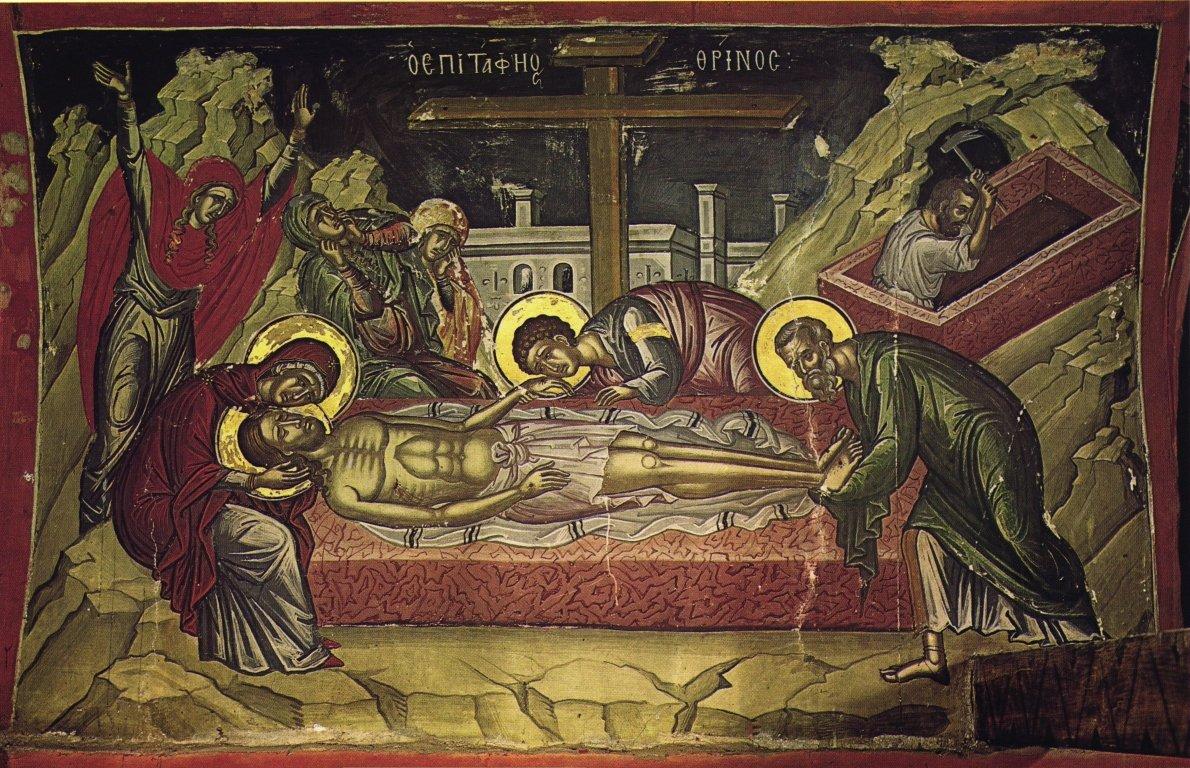
X. The Chapel of the Descent from the Cross
Proceeding to the Chapel of the Descent from the Cross, we chant the following hymns.
Third Tone, in the manner of “O Theotokos, the help of all Christians...”
The Theotokos
Inexplicable is, to Angels and to mortals, the mystery, my Son, of Your unspeakable burial.
Mary Magdalene
You wished, O Fashioner, to save life. Thus, You willingly suffered, O Jesus, immortal life.
Mary of Klopa
Sharing the nature of all mortals, You put sin to death, and were ever shown the Giver-of-life, giving life through Your death.
The Theotokos
Come, all the earth, mourn with me bitterly, as the source of life, is beheld as dead.
Mary Magdalene
Joseph, Your formerly secret disciple, wisely revealed himself, that he might hide the light of the Sun.
Mary of Klopa
O Jesus, Giver-of-life, the sweetness of life, how were you hated, You Who are the illumination of men?
Salome
The life of all life was exiled from life, while You granted life to every generation of mortals through Your death.
All the Myrrhbearers
O God-receiver Joseph, the pinnacle of the faithful, give us Jesus Christ, that we might venerate Him.
John, who reclined on His boosm
Behold your disciple and friend, and Your Mother, O Jesus. Give us another word from Your mouth.
Joseph and Nikodemos
Being the world of the world, You were seen dead and other-worldly, but You will fill the world with the godly joy of Your arising.
The Theotokos
A lance pierced Your side, O my sweetest Son, as You pour forth life, O Word of God and God.
Nikodemos
Being the true myrrh, pouring forth the fragrance of myrrh, I offer myrrh to You; annoint me, O Jesus.
Joseph
Now the noetic armies all gather in fear. How could I, the wretched one, dare to touch You?
The Theotokos
To lead the estranged Adam back to life, You were estranged, O Fashioner, my Son and God.
Mary Magdalene
O treasury of life, and killer of death, how are you now seen lying dead, O Redeemer?
Mary of Klopa
Where has gone the beauty of Your face, which surpasses all the words of the Scripture?
Salome
You pour forth rivers, O Jesus, from Your divine side, cleansing mortals from the bitterness of sin.
All the Myrrhbearers
When You were on the Cross, the sun hid itself. How is the creator of the sun hidden in the grave as dead?
Joseph
You Who array Yourself with life as a garment, O Jesus, how can I wrap you in a burial cloth in the flesh?
Nikodemos
You Who poured forth water from Your side as fragrance, I will annoint with my myrrh and aloe.
The Theotokos
You Who I once beheld wrapped in swaddling clothes in the manger, I now see in grave clothes: O woe, what more fearsome clothes?
All the Myrrhbearers
You Who hold earth and heaven in the palm of Your hand, are now buried by Joseph and Nikodemos in the flesh.
The Theotokos
O my Son and Soul-saver, protect the multitude of those who faithfully hymn Your willing burial.
The Faithful
O God-man Christ, protect us who praise Your willing burial, and who offer You hymns.
And the Priest censes.
Then the Deacon: That we may be found worthy to hear the Holy Gospel...
The Gospel according to John
At that time, Joseph of Arimathea asked Pilate for the body of Jesus. Now Joseph was a disciple of Jesus, but secretly because he feared the Jewish leaders. With Pilate’s permission, he came and took the body away. He was accompanied by Nicodemus, the man who earlier had visited Jesus at night. Nicodemus brought a mixture of myrrh and aloes, about seventy-five pounds. Taking Jesus’ body, the two of them wrapped it, with the spices, in strips of linen. This was in accordance with Jewish burial customs. At the place where Jesus was crucified, there was a garden, and in the garden a new tomb, in which no one had ever been laid. Because it was the Jewish day of Preparation and since the tomb was nearby, they laid Jesus there.
The People: Glory to Your forbearance O Lord, glory to You.
Then the Deacon entones the petitions, as mentioned before, and the Priest entones the following prayer:
O God-man Lord Jesus Christ, the sweetest and saving name, Son and Word of the Father, pre-eternal and immortal, Who was impassible in Your Godhead, Who was obedient to Your Father Himself until death, even death on the Cross, Who alone was free among the dead. To You we offer our souls and bodies. In You we place our life and all our hope. You, O Lord, for us were put to death in the flesh, to put to death the passions of our souls. You, Who in this holy place were annointed by Joseph and Nikodemos, fill our souls with the fragrance of the grace of Your divine Spirit, and make us Your fragrance. You, Who were wrapped in a clean linen shroud, clothe our hearts with the linen of Your divine fear. And as You accepted the myrrh and aloe of Nikodemos, accept the hymns that we offer to You in Your kindness. Accept, O Lord, those who with fervor and faith have come to venerate these all-holy places, and divine pilgrimages, the pious and Orthodox Christians, and sail with these who sail, travel with those who travel, and keep them unharmed and out of danger day and night. And as You have made us worthy of Your earthly Jerusalem, make us worthy of the heavenly Jerusalem. And we who visit these holy churches and your beloved dwelling-places, make into churches and dwelling-places of Your All-Holy Spirit, through the intercessions of Your Spotless Mother, of the Holy and righteous Joseph and Nikodemos, of the Holy Myrrhbearing Women, and all Your Saints. Amen.

Proceeding from there towards the All-Holy and Life-giving Tomb, processing around it three times, we chant the Troparia below.
Tone Four. Desiring tears.
Adam the Forefather, who was once put to death through his disobedience, O Master, was granted life, O Immortal One. Through Your death, You put death to death, O All-powerful One. Therefore, O Savior, raise me who am dead. Glory, O Lord, to Your burial and to Your resurrection.
Glory to You, our God, glory to You.
Your judgments are an ineffable abyss, O Word, for You willingly submitted to death, to bring to life me who am dead, through the disobedience of the Forefather. And You Who became the New Adam, renew me who cries to You: glory, O Lord, to Your burial and to Your resurrection.
Glory to You, our God, glory to You.
Partaking of the race of mortals, You, O Greatly-compassionate One, brought salvation in truth. And You bore the signs of the passion, O Savior, willingly dying to grant life to those who sing: glory, O Lord, to Your burial and to Your resurrection.
Glory to You, our God, glory to You.
O Giver-of-life, Joseph and Nikodemos shed tears as they carried You, O Lord, upon their shoulders as one dead, to place the Immortal One in the tomb. You Who put hades to death, O Savior, put to death also my passions. Glory, O Lord, to Your burial and to Your resurrection.
Glory to You, our God, glory to You.
You were placed in a tomb, the noetic Sun from before the ages, Who ordered and fashioned all things, and You made this place light-bearing as the All-powerful One, which we venerate, as we cry to You: glory, O Lord, to Your burial and to Your resurrection.
Glory to You, our God, glory to You.
Cloud and storm, mist and darkness, the eyes of the Hebrews were terribly darkness, and not knowing what they were doing, they stretched out Life upon the cross, and consigned Him to the tomb, slandering Him as a deceiver. Glory, O Lord, to Your burial and to Your resurrection.
Glory to You, our God, glory to You.
You desired in Your compassion, O Christ, to be struck for us, O Compassionate One. And You, the life of all, accepted the Cross and death, and to be placed in a tomb, which was made light-bearing and which I call joyous. Glory, O Lord, to Your burial and to Your resurrection.
Glory to You, our God, glory to You.
You willingly suffered death, O Savior, and You descended to hades, O Master. Your body was placed within a new tomb by Joseph and Nikodemos; bury my dangerous desires, that I might cry: glory, O Lord, to Your burial and to Your resurrection.
Glory to You, our God, glory to You.
Your blood that poured forth from Your side became healing to men, O Savior, and Life and resurrection to the dead through Your death, O Savior. Therefore we encircle Your tomb, and cry to You in faith: glory, O Lord, to Your burial and to Your resurrection.
Glory to You, our God, glory to You.
Joseph and Nikodemos placed You in a new tomb in fear, that You might recreate the corrupted nature of mortals, O Savior. Those who have been deified through You, sing to You out of need: glory, O Lord, to Your burial and to Your resurrection.
Glory to You, our God, glory to You.
A rock covers the Rock of life, and a tomb hides Him Who cannot be held. A seal was affixed to Your grave, protecting Him Who cannot be circumscribed. Soldiers guarded Your tomb, but we cry out with fervor: glory, O Lord, to Your burial and to Your resurrection.
Glory to You, our God, glory to You.
The Myrrhbearers came to annoint the Immortal One as dead. They heard a voice from the Angel, proclaiming His arising from the tomb. Their lamentation was transformed, and joyously they cried out: glory, O Lord, to Your burial and to Your resurrection.
Glory to You, our God, glory to You.
Hades was put to death through the death that You willingly endured, O Savior, piercing the ancient dragon that once deceived Eve. Adam dances together, being delivered from the vaults of hades. Glory, O Lord, to Your burial and to Your resurrection.
Glory to You, our God, glory to You.
The soldiers that guarded you beheld the strange form of the Archangel, appearing strangely in white garments like lightening, who rolled away the great stone from the tomb, and through the awesome earthquake, they became like dead men. Glory, O Lord, to Your burial and to Your resurrection.
Glory to You, our God, glory to You.
O Giver-of-life, You showed forth Your tomb as joyous and light-bestowing, for You, the life of all and the endless light, were placed within it, which we encircle, as we cry to You out of fervor: glory, O Lord, to Your burial and to Your resurrection.
Glory to You, our God, glory to You.
On the morning of the first of Sabbaths, the Myrrhbearers hastened with myrrh to anoint You, O inexhaustible Savior, but the Angel appeared to them, saying: the Lord is risen. Glory, O Lord, to Your burial and to Your resurrection.
Glory to You, our God, glory to You.
A rod of power and strength, grant to those who hymn You and your chosen ones, O Lord Who rose from the grave, and peace, that being saved in faith, we might cry our in thanksgiving: glory, O Lord, to Your burial and to Your resurrection.
Glory to You, our God, glory to You.
Your tomb, O Savior, the disciples saw open, and the grave clothes and the napkin laid in their own place, and they thus believed that You rose, and cried out to You with fervor: glory, O Lord, to Your burial and to Your resurrection.
Glory to You, our God, glory to You.
Having risen from the grace, O Savior, the disciples who saw You were filled with joy. You sent them out to the nations to preach Your resurrection, O Word, through whom we have been enlightened, and we chant to You in thanksgiving: glory, O Lord, to Your burial and to Your resurrection.
Glory to You, our God, glory to You.
We praise Your resurrection, O Savior, we venerate Your life-giving tomb, through which we have been granted the promise of Your kingdom, O Merciful One. We now surround it in fear and cry out in hymn: glory, O Lord, to Your burial and to Your resurrection.
Glory to You, our God, glory to You.
Your tomb, O Lord, was shown to be radiant as the sun, for it received You, the sun of glory, sleeping within it for three days, O Savior, and it wondrously shines upon those who faithfully chant: glory, O Lord, to Your burial and to Your resurrection.
Glory to You, our God, glory to You.
Your tomb pours forth a Godly-given eternal spring of goodness, O Christ, through Your life-bearing resurrection; come let us partake of it and cry out: O You Who rose from the grace, save us who cry out to You: glory, O Lord, to Your burial and to Your resurrection.
Glory.
Receive us who chant to You, O Merciful One, and glorify Your tomb, granting deliverance from bonds for all who approach Your life-giving tomb with faith, and who cry out with fear: glory, O Lord, to Your burial and to Your resurrection.
Both now.
O Greatly-Compassionate and Merciful One, through the grace of Your life-bearing tomb, grant healing of soul and body to those who venerate Your, and grant Your peace, through the intercessions of Your Mother, with whom we cry out with fervor: glory, O Lord, to Your burial and to Your resurrection.
And the Priest censes.
The Deacon: That we may be found worthy to hear the Holy Gospel...
Gospel according to St. Matthew (27:63-28:20)
The next day, the one after Preparation Day, the chief priests and the Pharisees went to Pilate. “Sir,” they said, “we remember that while he was still alive that deceiver said, ‘After three days I will rise again.’ So give the order for the tomb to be made secure until the third day. Otherwise, his disciples may come and steal the body and tell the people that he has been raised from the dead. This last deception will be worse than the first.” “Take a guard,” Pilate answered. “Go, make the tomb as secure as you know how.” So they went and made the tomb secure by putting a seal on the stone and posting the guard. After the Sabbath, at dawn on the first day of the week, Mary Magdalene and the other Mary went to look at the tomb. There was a violent earthquake, for an angel of the Lord came down from heaven and, going to the tomb, rolled back the stone and sat on it. His appearance was like lightning, and his clothes were white as snow. The guards were so afraid of him that they shook and became like dead men. The angel said to the women, “Do not be afraid, for I know that you are looking for Jesus, who was crucified. He is not here; he has risen, just as he said. Come and see the place where he lay. Then go quickly and tell his disciples: ‘He has risen from the dead and is going ahead of you into Galilee. There you will see him.’ Now I have told you.” So the women hurried away from the tomb, afraid yet filled with joy, and ran to tell his disciples. Suddenly Jesus met them. “Greetings,” he said. They came to him, clasped his feet and worshiped him. Then Jesus said to them, “Do not be afraid. Go and tell my brothers to go to Galilee; there they will see me.” While the women were on their way, some of the guards went into the city and reported to the chief priests everything that had happened. When the chief priests had met with the elders and devised a plan, they gave the soldiers a large sum of money, telling them, “You are to say, ‘His disciples came during the night and stole him away while we were asleep.’ If this report gets to the governor, we will satisfy him and keep you out of trouble.” So the soldiers took the money and did as they were instructed. And this story has been widely circulated among the Jews to this very day. Then the eleven disciples went to Galilee, to the mountain where Jesus had told them to go. When they saw him, they worshiped him; but some doubted. Then Jesus came to them and said, “All authority in heaven and on earth has been given to me. Therefore go and make disciples of all nations, baptizing them in the name of the Father and of the Son and of the Holy Spirit, and teaching them to obey everything I have commanded you. And surely I am with you always, to the very end of the age.”
Glory to Your forbearance, O Lord, glory to You.
Then the Deacon entones the petitions as before, after which the Priest says the following prayer aloud:
O Master Lord Jesus Christ Who loves mankind, the true light that illumines every man who comes into the world, Who for our salvation willingly suffered the passion, and in this all-holy Tomb was buried by Joseph and Nikodemos in the flesh as a dead man, put to death the soul-corrupting passions of our flesh, and bury through good thoughts evil schemes, Who through Your third-day and glorious resurrection raised the fallen race of Adam, raise us who were buried by sin, and set before us the ways of repentance, Who filled Your disciples with unspeakable joy through Your resurrection, fill our hearts with spiritual joy, and dissipate the sorrow of sin, Who granted to Your disciples and Apostles peace, grant it to us as well. You Who through Your resurrection filled heaven, and earth, and deeps with light, enlighten us with the light of Your face. You Who raised the dead from all ages, raise us also in the general resurrection in glory, and make us worthy to meet You in the clouds with Your Saints. You Who made this house of Yours a place of honor and glory through Your most-glorious Resurrection, and showed it to be a heaven of many lights, confirm it unto the ages of ages, and receive the prayers that we ceaselessly offer to You within it, through the intercessions of Your All-spotless Mother, the grace of Your All-Holy and life-giving Tomb, through the intercessions of the all-powerful Taxiarchs Michael and Gabriel, through the intercessions of Your Disciples and Apostles, of the Holy Myrrhbearers, and all Your Saints. Amen.
Returning to the Katholikon (The Church of the Resurrection), we chant the following hymns:
Apolytikion in the Fourth Tone
Thou hast shown the earthly beauty of the holy tabernacle of Thy glory to be like unto the splendour of the heavenly firmament, O Lord. Strengthen it for ever and ever, and accept our prayers which we unceasingly offer therein unto Thee, through the Theotokos, O Thou Who art the Life and Resurrection of all.
Kontakion in the Fourth Tone
The Church is shown to be a many-lighted heaven that doth shine a guiding light upon all them that do believe; wherein while standing we cry aloud: Do Thou Thyself now establish this house, O Lord.
(http://goarch.org/chapel/saints_view?contentid=596)
Then the following apolysis:
Glory to You, O Christ our God, glory to You. He Who suffered His willing and three-day burial in the flesh, and rose from the dead, Christ our true God, through the intercessions of Your All-spotless Mother, through the grace of Your all-holy and life-giving Tomb, and all Your Saints, have mercy on us and save us, as a good and merciful God Who loves mankind.
Through the prayers of our Holy Fathers, Lord Jesus Christ our God, have mercy on us and save us! Amen!



 Picture of the edicule, containing the All-Holy Tomb of Christ, Jerusalem


