Showing posts with label Prayers. Show all posts

Thursday, November 12, 2020

From the Blessing - Psalter of St. Arsenios, "So that God saves the world when plague comes..."

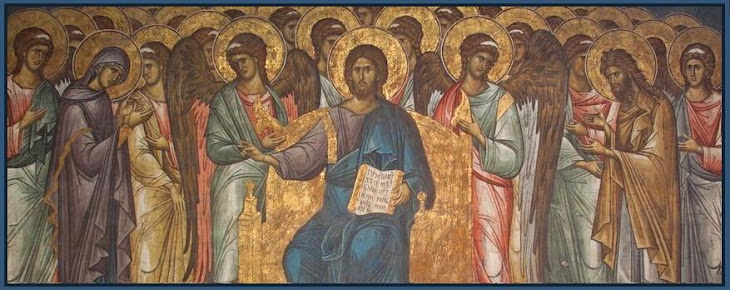
Jesus Christ "The Good Shepherd" (source)

From the Blessing - Psalter of St. Arsenios of Cappadocia:

"85 (86) So that God saves the world when plague comes and people die."

O Lord, incline thine ear, and hearken to me; for I am poor and needy. 2Preserve my soul, for I am holy; save thy servant, O God, who hopes in thee. 3Pity me, O Lord: for to thee will I cry all the day. 4Rejoice the sold of thy servant: for to thee, O Lord, have I lifted up my soul. 5For thou, O Lord, art kind, and gentle; and plenteous in mercy to all that call upon thee. 6Give ear to my prayer, o Lord; and attend to the voice of my supplication. 7In the day of my trouble I cried to thee: for thou didst hear me. 8There is none like to thee, O Lord, among the god; and there are no works like to thy works. 9All nations whom thou hast made shall come, and shall worship before thee, O Lord; and shall glorify thy name. 10For thou art great, and doest wonders: thou art the only and the great God. 11Guide me, O Lord, in thy way, and I will walk in thy truth: let my heart rejoice, that I may fear thy name. 12I will give thee thanks, O Lord my God, with all my heart; and I will glorify thy name for ever. 13For thy mercy is great toward me; and thou hast delivered my soul from the lowest hell. 14O God, transgressors have risen up against me, and an assembly of violent men have sought my life; and have not set thee before them. 15But thou, O Lord God, art compassionate and merciful, long-suffering, and abundant in mercy and true. 16Look thou upon me, and have mercy upon me: give thy strength to thy servant, and save the son of thine handmaid. 17Establish with me a token for good; and let them that hate me see it and be ashamed; because thou, O Lord, hast helped me, and comforted me.

(source)

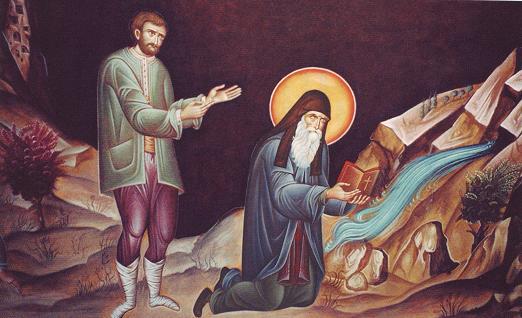
St. Arsenios of Cappadocia, in prayer (source)

Through the prayers of our Holy Fathers, Lord Jesus Christ our God, have mercy on us and save us! Amen!
Friday, November 6, 2020

A vision of Elder Ephraim, and a picture of his purported to be weeping

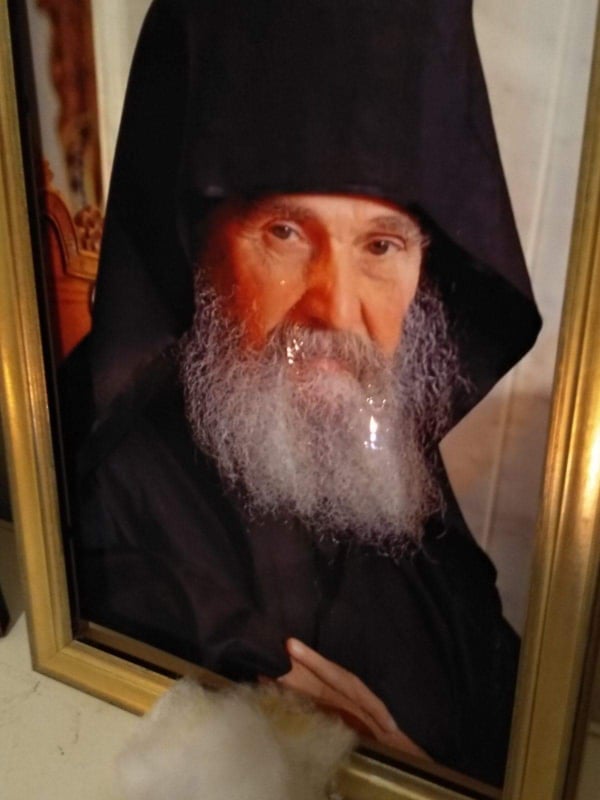
Picture of Elder Ephraim of Arizona purported to be weeping (source)

"I just communicated with Gerontissa Thekla from Montreal, and she told me that our holy Elder appeared to someone living in Crete. He lives ascetically, and would go to visit the Elder at St. Anthony's [in Arizona].

He has this picture of our holy Elder with a constant vigil lamp before it. The Elder told him that God is greatly saddened by the Greeks***, because they are not praying.

On November 3rd, the picture began to weep, not just tears, but it became soaked.

The Elder is praying for all of us."

-Maria

(source)

***Note: By no means are the Greeks the only people that might not be praying as they should, but all people throughout the world, young and old, clergy, laity and monastics, should be repenting and praying as we should, entreating the Lord to save the world.

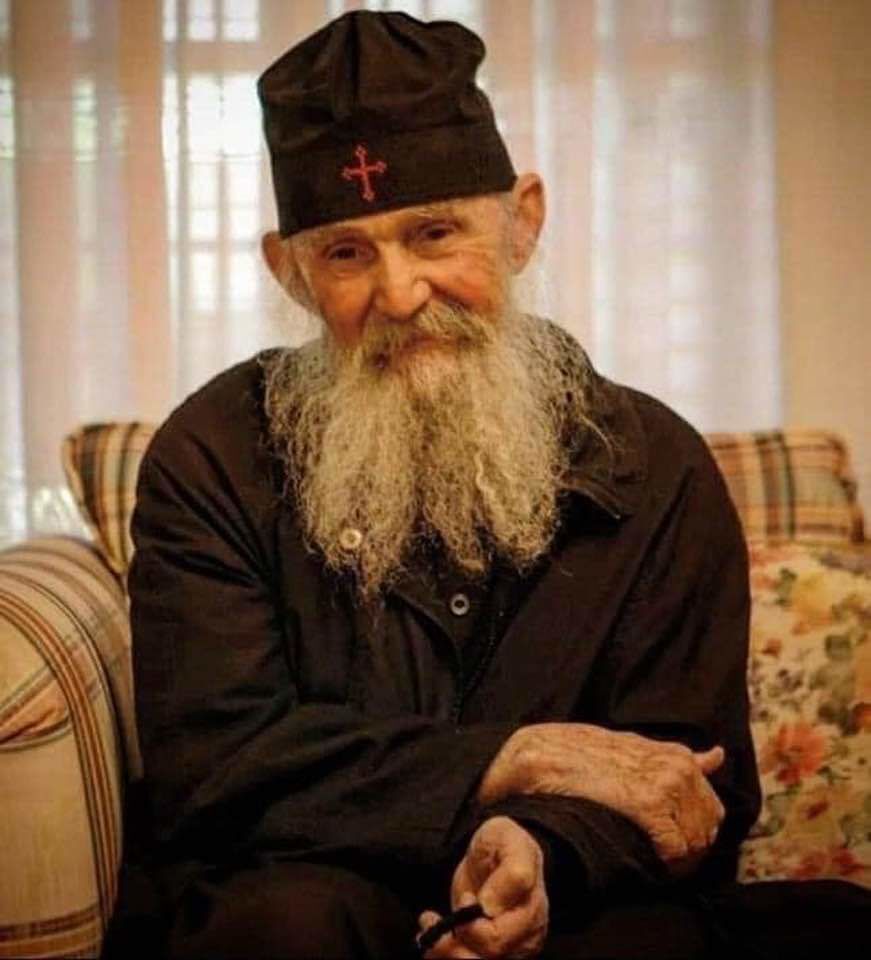
Elder Ephraim of Arizona (source)

“Elder Ephraim of Philotheou, who lived as an ascetic in Arizona, appeared to a woman in Northern Greece, a long-time spiritual daughter of the elder. At the time of the appearance she was with her daughter-in-law; she was not asleep but actually in a state of alertness. At one point the woman was unresponsive, as if in ecstasy,* and this lasted for about 10 minutes, according to her daughter-in-law who was watching her. She did not realize or comprehend the time duration — i.e., for how long the vision lasted. It was something new for her (the content of the conversation) because she has seen the Elder before, after his repose, both in her sleep as well while she was awake. Due to all this (her shock), she contacted her spiritual father and asked whether this experience was real or a deception by the evil one.

She saw Elder Ephraim and he was very sad and was imploring Christ that the ongoing [direction of] events be averted (all this, of course, is in agreement with what the elder said to many while he was alive).

And he told her:

‘Repentance repentance repentance. Christ is very angry...
We people today should not be in this spiritual state we are in...
Huge tribulations are coming, you can not imagine how bad these will be...
Alas to all of you for what awaits you; you must repent as long as there is time...
You need to kneel and cry, to shed tears of repentance, that Christ soften...
This has to do with what is happening in America as well.
Many people will depart through all that is to come, many people will depart (they will die).
You have no mercy among you. You show no mercy to each other.
You are tough towards each other, you stand ready to eat (consume-destroy) each other ....
Tell all of this to your spiritual father and to others ....’

The woman who saw this was a spiritual daughter of Elder Ephraim and was in communication with him often up until his repose.

- f. I.

*Translator’s note: The Greek term here is χάθηκε. It was not immediately clear to us if this meant literally or spiritually. We received clarification that it was the latter and have made the change. We have also made other minor changes to improve the English translation and correct typos in the Greek version.

(source)

Elder Ephraim of Arizona (source)

Through the prayers of our Holy Fathers, Lord Jesus Christ our God, have mercy on us and save us! Amen!

Monday, October 12, 2020

St. Paisios on Prayer and Lighting Candles

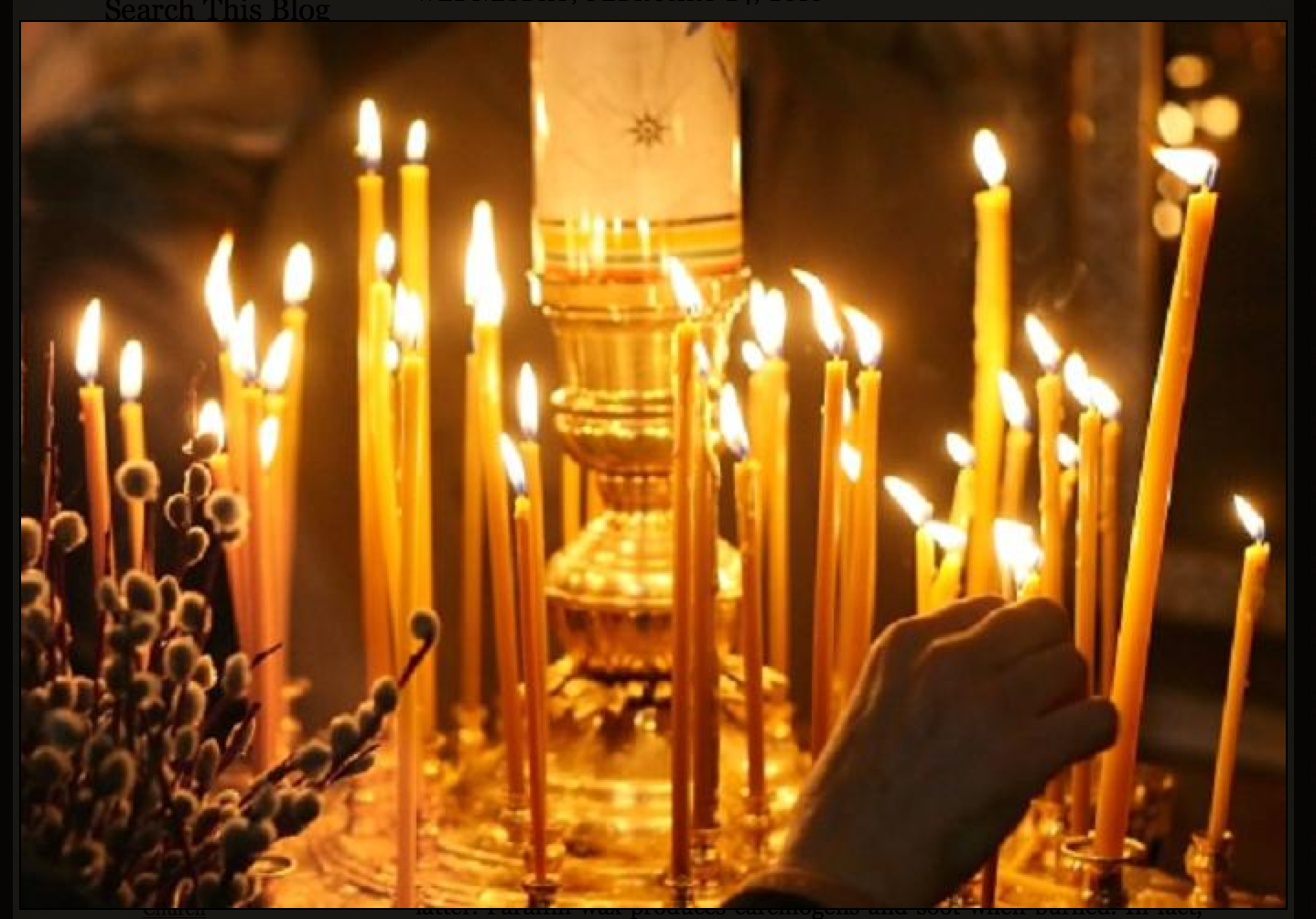
Lighting candles (source)

St. Paisios the Athonite on Prayer and Lighting Candles

Elder, when we light a candle, do we say that it is for some purpose?

-You are lighting it, but where do you send it? Aren't you sending it somewhere?

With a candle, we are seeking something from God. When you light it, you should say: "For those who are suffering in body and soul", "for those who have the greatest need", and among them is also the living and the reposed.

Do you know how much rest the departed sense when we light a candle for them? Thus, one has spiritual communication with the living and with the reposed.

The candle, in a few words, is an antenna*** that brings us into communication with God, with the sick, with the departed, etc.

***Note: St. Paisios is cleverly showing the resemblance of the words "κεράκι" and "κεραία" ("Candle" and "antenna") in Greek.

  
Through the prayers of our Holy Fathers, Lord Jesus Christ our God, have mercy on us and save us! Amen!

Thursday, August 20, 2020

A Prayer of Confession, by Blessed Father Nicholas Pekatoros

An Orthodox Priest and Penitent during Holy Confession (source)
  
A Prayer of Confession,
by the Blessed Father Nicholas Pekatoros, for use by his spiritual children:
“I confess to the Lord my God and before you, Holy Father, all my innumerable sins, which I have committed to the present day and hour, in deed, word and thought. Daily and hourly I commit the sin of ingratitude toward the Lord for his great and innumerable blessings and gracious providence toward me, a sinner. These are my sins: empty, foolish words; criticizing and verbally abusing others; defiance; pride; lack of mercy; envy; vengeful anger; slander against others; inattention; neglect where my salvation is concerned; carelessness; a carefree attitude; rudeness; irritability; despondency; returning evil for evil; hardness of heart; disobedience; complaining; self-righteousness; contradictoriness; willfulness; conduct that is blameworthy or disgraceful; speaking evil; lying; excessive laughter; yielding to temptation; love of self; ambition; gluttony; drunkenness; vanity; laziness; thinking impure thoughts; heaping up worldly goods; lusting after others; missing Divine Liturgy and other church services because of laziness and carelessness; wandering of mind during prayer in church and at home; sins of deed; sins of word; sins of thought; and sins of sight, hearing, smell, taste, touch and my other senses, both physical and spiritual. I repent of all my sins and I ask forgiveness. (State here other sins that may be on one’s soul.) I also repent and ask forgiveness for sins I did not confess because of their multitude or because of my forgetfulness. Forgive and release me, Holy Father, and give me your blessing to partake of Christ’s Holy and Life-Giving Mysteries, to the renunciation of sin and the receiving of Life Eternal. Amen.
(source)
  
Through the prayers of our Holy Fathers, Lord Jesus Christ our God, have mercy on us and save us! Amen!

Thursday, April 23, 2020

The Final Prayer of St. George before his Martyrdom

Christ is risen! Truly He is risen!
St. George the Great Martyr and Trophy-bearer, in prayer to Christ (source)
  
The Martyr of Christ, George, when he had reached the place of his execution, entreated the guards to give him a short time to himself. This is the gift that the Saint asked of the enemies of his Faith. They fulfilled his request. Then, the Great Martyr gathered himself together for prayer, and lifted up his eyes to Heaven, and prayed from the depth of his heart:

St. George the Great Martyr and Trophybearer (source)
   
"O Lord my God, to Whom I belong from birth, and to Whom I have placed my hopes, You Who gave me boldness and prepared me for this struggle, You Who are my sweet hope, the unerring promise, the unalterable eros of sacred souls, You Who look down with care upon the intentions of our hearts and fulfill our requests, and to Whom we address our requests in prayer, I ask of You: help me to complete this struggle well, which I have taken on in confession of Your name, and receive my soul, and having preserved my from the evil spirits, do number me with those who have pleased You throughout the ages. Forgive, O Master, the people who out of ignorance have worked this grave things against me, and make them worthy to truly come to know You, for You are blessed unto the ages of ages."
(source)
  
Sts. George and Demetrios the Great Martyrs (source)
  
Christ is risen from the dead, by death, trampling down upon death, and to those in the tombs, He has granted life!
Truly, the Lord has risen!

Saturday, April 18, 2020

The Book of Jonah and Great and Holy Saturday

The Prophet Jonah (source)
  
The Sign of Jonah, by Fr. John Breck
Of the fifteen Old Testament passages read in Orthodox practice at the vesperal Divine Liturgy of Holy Saturday, the fourth consists of the entire, brief book of Jonah. Although the book is numbered among the “Minor Prophets,” it is unique: rather than offer a compilation of prophetic utterances, it recounts a spiritual pilgrimage. However we may assess its “historicity,” the work is preserved in the Church’s canon of Scripture because of its timeless proclamation of God’s universal saving grace and love. It is a story of rebellion and redemption, of God’s forgiveness and mercy extended alike to Jew and Gentile, saint and sinner, you and me.
  
To the Fathers of the Church, Jonah is a “type,” a prophetic image that points forward to and is fulfilled by Jesus Christ, the eternal Son of God. The blessed Augustine declares, “as Jonah went from the [wooden] ship into the belly of the whale, so Christ went from the tree [of the cross] into the tomb, or into the abyss of death. As Jonah was sacrificed for those endangered by the storm, so Christ was offered for those who are drowning in the storm of this world” (Letter 102). St Cyril of Jerusalem compares Jonah and Jesus in the following way. Both were sent by God to preach repentance; both were able to calm the tempestuous sea; both sojourned in a place of death and emerged by the will and power of God. “As Jonah was in the belly of the fish three days and three nights, so will the Son of Man be three days and three nights in the heart of the earth” (Catechetical Lectures, on Mt. 12:40). In the case of Jonah, however, the calming of the sea and his “resurrection” from the belly of the great fish are works wrought by God, whereas in the case of Jesus the miraculous power is His own as One of the Holy Trinity.
  
More specifically, Jonah is an image of the Jewish people in the time of their reconstruction following the Exile into Babylon. The prophet is identified as “Jonah, son of Amittai,” who lived under the reign of King Jeroboam II (ca.786-746; 2 Ki. 14:25). Most commentators, however, date the book during the post-Exilic period (from the late 6th century BC). At that time, the great figures of Ezra, Nehemiah and the prophet Obadiah were struggling to preserve Jewish tradition over against the religious syncretism and idolatry of surrounding pagan countries. The result was to lead Israel into a period of strict isolation, expressed as a rejection and even a despising of heathen nations. Jonah, by this reading, is a didactic figure, who finally, if reluctantly, proclaims God’s pardon to the repentant people of Nineveh. Thereby he serves to prepare for the coming of Christ, the Messiah, whose life, death and resurrection will work redemption not only for the chosen people of Israel, but for the world as a whole.
  
Twice in His recorded teachings Jesus speaks of “the sign of Jonah” (Mt 12:39; Lk 11:29). These are parallel passages, although each evangelist has shaped the received tradition in such a way as to drive home a particular theological point. If the Church has retained the prophecy of Jonah in its Holy Saturday lectionary, it is primarily because of the parallel between Jonah and Jesus presented in images of death, burial and resurrection. The prophet, having been cast into the sea (an image of chaos and death), is swallowed by a “great fish” or “whale,” symbol of the tomb; after three days and nights he is expelled onto the shore, in order to continue his mission to call the Ninevites to repentance. The Lord Jesus is crucified, then buried in Joseph’s tomb, to rise “on the third day,” in order to pursue His own mission to call the world to repentance and salvation. The message of Holy Saturday, with the reading of the prophecy of Jonah, is the message of victory over death, of Christ’s resurrection and the destruction of the power of Sheol. It is the paschal message that proclaims God’s universal love, offered freely and without limit to both Hebrew and Ninevite, to Jew and Gentile alike, that is, to all those who seek their salvation through the person and work of the Son of God.
The sign of Jonah, though, is not limited to a prophetic announcement of Christ’s resurrection. In St Luke’s version of Jesus’ saying (11:29-32), there is no allusion to resurrection at all. Here Jesus declares, “This generation is an evil generation. It seeks a sign, but no sign shall be given to it except the sign of Jonah. For as Jonah became a sign to the men of Nineveh, so will the Son of Man be to this generation.” If Jonah is not a “sign,” a wondrous portent, of Christ’s victory over death in this Gospel, then in what sense is he a sign? To the evangelist Luke, the sign is Jonah’s proclamation, his fervent appeal to the Ninevites to repent of their sinful ways, to abandon their idolatry, and to commit their lives to the God of Israel, the unique Lord of heaven and earth. Jesus, like Jonah, comes from afar (may we see here an allusion to His “preexistence,” His eternal presence with the Father?). He comes, like his predecessor, as a prophetic witness to God’s work of salvation that seeks to embrace all of humankind. And like that earlier message, Jesus’ words summon an “evil generation”—which signifies every generation, including our own—to repent: to turn from and reject the deception of idolatry and the lure of sinful and corrupting behavior, in order to welcome and embrace the One who comes to proclaim and to offer salvation to all.
  
On Holy Saturday the Church announces the good news of Christ’s resurrection, and it does so in part by recalling the story of the reluctant prophet Jonah. Together with his story, however, there goes a summons that takes its final shape in these words of Jesus, that resurrection from death and salvation to eternal life are offered to those—to all those, but only to those—who hear the prophetic call to repentance, heed that call, and embrace, with faith and with love, the One God and Author of Life.
Christ is risen!
(source)
  
The Holy Prophet Jonah (source)
  
The Book of Jonah
1Now the word of the Lord came to Jonas the son of Amathi, saying, 2Rise, and go to Nineve, the great city, and preach in it; for the cry of its wickedness is come up to me. 3But Jonas rose up to flee to Tharsis from the presence of the Lord. And he went down to Joppa, and found a ship going to Tharsis: and he paid his fare, and went up into it, to sail with them to Tharsis from the presence of the Lord.

4And the Lord raised up a wind on the sea; and there was a great storm on the sea, and the ship was in danger of being broken. 5And the sailors were alarmed, and cried every one to his god, and cast out the wares that were in the ship into the sea, that it might be lightened of them. But Jonas was gone down into the hold of the ship, and was asleep, and snored. 6And the shipmaster came to him, and said to him, Why snorest thou? arise, and call upon thy God, that God may save us, and we perish not.
7And each man said to his neighbour, Come, let us cast lots, and find out for whose sake this mischief is upon us. So they cast lots, and the lot fell upon Jonas. 8And they said to him, Tell us what is thine occupation, and whence comest thou, and of what country and what people art thou? 9And he said to them, I am a servant of the Lord; and I worship the Lord God of heaven, who made the sea, and the dry land.
10Then the men feared exceedingly, and said to him, What is this that thou hast done? for the men knew that he was fleeing from the face of the Lord, because he had told them.
11And they said to him, What shall we do to thee, that the sea may be calm to us? for the sea rose, and lifted its wave exceedingly. 12And Jonas said to them, Take me up, and cast me into the sea, and the sea shall be calm to you: for I know that for my sake this great tempest is upon you. 13And the men tried hard to return to the land, and were not able: for the sea rose and grew more and more tempestuous against them. 14And they cried to the Lord, and said, Forbid it, Lord: let us not perish for the sake of this man's life, and bring not righteous blood upon us: for thou, Lord, hast done as thou wouldest.
15So they took Jonas, and cast him out into the sea: and the sea ceased from its raging. 16And the men feared the Lord very greatly, and offered a sacrifice to the Lord, and vowed vows.
17Now the Lord had commanded a great whale to swallow up Jonas: and Jonas was in the belly of the whale three days and three nights.
Icon depicting the Book of Jonah (source)
  
1And Jonas prayed to the Lord his God out of the belly of the whale,
2and said, I cried in my affliction to the Lord my God, and he hearkened to me, even to my cry out of the belly of hell: thou heardest my voice.
3Thou didst cast me into the depths of the heart of the sea, and the floods compassed me: all thy billows and thy waves have passed upon me.
4And I said, I am cast out of thy presence: shall I indeed look again toward thy holy temple?
5Water was poured around me to the soul: the lowest deep compassed me, my head went down
6to the clefts of the mountains; I went down into the earth, whose bars are the everlasting barriers: yet, O Lord my God, let my ruined life be restored.
7When my soul was failing me, I remembered the Lord; and may my prayer come to thee into thy holy temple.
8They that observe vanities and lies have forsaken their own mercy.
9But I will sacrifice to thee with the voice of praise and thanksgiving: all that I have vowed I will pay to thee, the Lord of my salvation.
10And the whale was commanded by the Lord, and it cast up Jonas on the dry land.
The Prophet Jonah from the Menologion of Basil (source)
  
1And the word of the Lord came to Jonas the second time, saying, 2Rise, go to Nineve, the great city, and preach in it according to the former preaching which I spoke to thee of. 3And Jonas arose, and went to Nineve, as the Lord had spoken. Now Nineve was an exceeding great city, of about three days' journey. 4And Jonas began to enter into the city about a day's journey, and he proclaimed, and said, Yet three days, and Nineve shall be overthrown.
5And the men of Nineve believed God, and proclaimed a fast, and put on sackcloths, from the greatest of them to the least of them. 6And the word reached the king of Nineve, and he arose from off his throne, and took off his raiment from him, and put on sackcloth, and sat on ashes. 7And proclamation was made, and it was commanded in Nineve by the king an by his great men, saying, Let not men, or cattle, or oxen, or sheep, taste any thing, nor feed, nor drink water. 8So men and cattle were clothed with sackcloths, and cried earnestly to God; and they turned every one from their evil way, and from the iniquity that was in their hands, saying, 9Who knows if God will repent, and turn from his fierce anger, and so we shall not perish?
10And God saw their works, that they turned from their evil ways; and God repented of the evil which he had said he would do to them; and he did it not.
The Prophet Jonah from the Paris Psalter (source)
  
1But Jonas was very deeply grieved, and he was confounded. 2And he prayed to the Lord, and said, O Lord, were not these my words when I was yet in my land? therefore I made haste to flee to Tharsis; because I knew that thou are merciful and compassionate, long-suffering, and abundant in kindness, and repentest of evil. 3And now, Lord God, take my life from me; for it is better for me to die than to live. 4And the Lord said to Jonas, Art thou very much grieved?
5And Jonas went out from the city, and sat over against the city; and he made for himself there a booth, and he sat under it, until he should perceive what would become of the city. 6And the Lord God commanded a gourd, and it came up over the head of Jonas, to be a shadow over his head, to shade him from his calamities: and Jonas rejoiced with great joy for the gourd. 7And God commanded a worm the next morning, and it smote the gourd, and it withered away. 8And it came to pass at the rising of the sun, that God commanded a burning east wind; and the sun smote on the head of Jonas, and he fainted, and despaired of his life, and said, It is better for me to die than to live.
9And God said to Jonas, Art thou very much grieved for the gourd? And he said, I am very much grieved, even to death. 10And the Lord said, Thou hadst pity on the gourd, for which thou has not suffered, neither didst thou rear it; which came up before night, and perished before another night: 11and shall not I spare Nineve, the great city, in which dwell more than twelve myriads of human beings, who do not know their right hand or their left hand; and also much cattle?
-The Book of Jonah, read at Vesperal Liturgy on Great Saturday
  
The Prophet Jonah (source)
  
Through the prayers of our Holy Fathers, Lord Jesus Christ our God, have mercy on us and save us! Amen!

Friday, April 3, 2020

"O Champion General, I your City now inscribe to you..."

The Theotokos appearing and delivering Constantinople from the siege (source)
  
Deceased have been quickened through your power, * for pregnant were you with life hypostasized. * They who once were speechless now * speak with newfound eloquence. * Diseases are exterminated, lepers purified. * The legions of * the aerial spirits, * O Virgin, are defeated, for you are man’s salvation.
-from the Canon of the Akathist, by St. Joseph the Hymnographer
 
Tone Eight (Pl. IV). Original Melody.
O Champion General, I your City now inscribe to you
 Triumphant anthems as the tokens of my gratitude,
Being rescued from the terrors, O Theotokos.
Inasmuch as you have power unassailable,
From all kinds of perils free me so that unto you
I may cry aloud: Rejoice, O unwedded Bride.
(source)


The wondrous Icon of the Theotokos and Christ "Of the Akathist", treasured to this day by Dionysiou Monastery on Mount Athos. This was the icon carried by Patriarch Sergios in procession and prayer along the walls of Constantinople when she was being sieged by a seemingly invincible foreign army. The Theotokos later appeared and wondrously defended the Christians, and may she ever hearken to our prayers to defend us from our enemies, visible and invisible! (source)
  
Most-holy Theotokos save us!

Tuesday, March 17, 2020

Prayer for Deliverance from COVID-19

Icon of Jesus Christ Pantocrator (source)
  
An Orthodox Prayer for Deliverance from COVID-19
     
Priest: Let us pray to the Lord.
Choir: Lord, have mercy.
O God Almighty, Lord of heaven and earth, and of all creation visible and invisible, in thine ineffable goodness, look down upon us, thy people gathered in thy Holy Name. Be our helper and defender in this day of affliction. Thou knowest our weakness. Thou hearest our cry in repentance and contrition of heart. O Lord who lovest mankind, deliver us from the impending threat of the Corona Virus. Send thine angel to watch over us and protect us. Grant health and recovery to those suffering from this virus. Guide the hands of physicians and preserve those who are healthy. Enable us to continue to serve our suffering brothers and sisters in peace that together we may glorify thy most honorable and majestic name of the Father and of the Son and of the Holy Spirit, now and ever and unto ages of ages.
Choir: Amen.
  
Through the prayers of our Holy Fathers, Lord Jesus Christ our God, have mercy on us and save us! Amen!

Thursday, February 20, 2020

A Prayer for Cancer Patients

Icon of the Theotokos "Pantanassa" ("Queen of All"), also known as "The Healer of Cancer" (source)
  
An Orthodox Prayer for Cancer Patients,
from the Cell of Elder Gabriel the Athonite,
Approved by the Orthodox Church of Greece
  
Our Lord Jesus Christ, Who rules over the spirits of affliction and health for those who call upon You with fervor of heart, and who with faith in You have emptied themselves, hearken to us sinners, along with those afflicted with the dangerous illness of cancer, and who have been seized from among us, and who persist in longstanding and painful illness, our fathers, brethren and children, full of deep sorrows and pains, and who, unable to flee from their death, entreat everyone [to pray for them]. O Lord, through Your illumining and sanctifying Spirit, guide in medical science those who are seeking to discover and use the good medicine and revealing therapy. Grant strength to those who are suffering, and patience and relief from their pains, bestowing on them every healing of soul and body, through the intercessions of our Most-blessed Lady the Theotokos and Ever-Virgin Mary, the Life-giving Spring, whose waters in the queen of cities [Constantinople] healed the passion of cancer, of our Father among the Saints Parthenios, Bishop of Lampsakos, of the holy, glorious and wonderworking Unmercenaries, of the holy, glorious Great Martyr Panteleimon, [of St. Nektarios of Pentapolis, or other Saints desired to be commemorated, etc.] and of all Your Saints. Amen.
(source)
  
St. Parthenios of Lampsakos, among the Saints whose prayers especially help cancer patients (source)
   
Picture documenting "Great Helpers Against Cancer", or wonderworking Saints whose prayers especially help those suffering from this affliction, including: The Most-Holy Theotokos Pantanassa ("The Healer of Cancer"), Sts. Nektarios of Aegina, Ephraim of Nea Makri, Parthenios of Lampsakos, Patapios of Thebes, John Maximovitch, Anastasia of Rome and John the Russian (source)
   
Icon depicting the Holy Hierarchs and Wonderworkers: Sts. Luke of Simferopol, Nektarios of Pentapolis, and John of San Francisco (source)
   
Through the prayers of our Holy Fathers, Lord Jesus Christ our God, have mercy on us and save us! Amen!

Tuesday, July 9, 2019

Saint Sophrony of Essex (+ July 11, 1993)

Elder Sophrony of Essex (1886 - July 11th, 1993) (source)
  
Archimandrite Sophrony was born in 1886, to Orthodox parents in Tsarist Russia. From childhood he showed a rare capacity for prayer and as a young boy would ponder questions heavy with centuries of theological debate. A sense of exile in this world spoke of an infinite always embracing our finitude. Prayer entails the idea of eternity with God. In prayer the reality of the living God is yoked with the concrete reality of earthly life. If we know what a man reverences, we know the most important thing about him- what it is that determines his character and behavior. The author of His Life is Mine was early possessed by an urgent longing to penetrate to the heart of divine eternity through contemplation of the visible world. This craving, like a flame in the heart, irradiated his student days at the State School of Fine Arts in Moscow. This was the period when a parallel speculative interest in Buddhism and the whole arena of Indian culture changed the clef of his inner life. Eastern mysticism now seemed to him more profound than Christianity, the concept of a supra-personal Absolute more convincing than that of a Personal God. The Eastern mystic’s notion of Being imparted overwhelming majesty to the transcendental. With the advent of the First World War and the subsequent Revolution in Russia he began to think of existence itself as the cause of all suffering and so strove, through meditation, to divest himself of all visual and mental images.
  
His studio was at the top of a tall house in a quiet part of Moscow. There he would labour for hours on end, straining every nerve to depict his subject dispassionately, to convey its temporal significance, yet at the same time to use it as a spring-board for exploring the infinite. He was tortured by conflicting arguments: if life was generated by the eternal, why did his body need to breathe, eat, sleep, and so on? Why did it react to every variation in the physical atmosphere? In an effort to break out of the narrow framework of existence he took up yoga and applied himself to meditation. But he never lost his keen awareness of the beauty of nature.
  
Saint Sophrony of Essex (source)
  
    Daily life now flowed on the periphery, as it were, of external events. The one thing needful was to discover the purport of our appearance on this planet; to revert to the moment before creation and be merged with our original source. He continued oblivious to social and political affairs- utterly preoccupied by the thought that if man dies without the possibility of returning to the sphere of Absolute Being, then life held no meaning. Occasionally, meditation would bring respite with an illusion of some unending quietude which had been his fountain-head.

The turmoil of the post- Revolutionary period made it increasingly difficult for artists to work in Russia, and in 1921 the author started to search for ways and means of emigrating to Europe- to France, in particular, as the centre of the world for painters. En route he managed to travel through Italy, looking long at the great masterpieces of the Renaissance. After a brief stay in Berlin he finally reached Paris and flung head, heart and soul into painting. His career made a satisfactory start: the Salon d’ Automne accepted his first canvas and the Salon des Tuileries, the elite of the Salon d’ Automne, invited him to exhibit with them. But on another level all was not going as he had expected. Art began to lose its significance as a means to liberation and immortality for the spirit. Even lasting fame would be but a ludicrous caricature of genuine immortality. The finest artifact is worthless when considered against the background of infinity.

Little by little it dawned on him that pure intellection, an activity of the brain only, could not advance one far in the search for reality. Then suddenly he remembered Christ’s injunction to love God ‘with all thy heart, and with all thy mind’. This unexpected insight was as portentous as that earlier moment when the Eastern vision of a supra-personal Being had beguiled him into dismissing the Gospel message as a call to the emotions. Only that earlier moment had struck dark as a thunderclap, while now revelation illuminated like lightning. Intellection without love was not enough. Actual knowledge could only come through community of being, which meant love. And so Christ conquered: His teaching appealed to his mind with different undertones, acquired other dimensions. Prayer to the Personal God was restored to his heart- directed, first and foremost, to Christ.
  
Elder Sophrony (rear), depicted with his spiritual father, St. Silouan the Athonite (source)
  
    He must decide on a new way of living. He enrolled in the then recently opened Paris Orthodox Theological Institute, in the hope of being taught how to pray, and the right attitude towards God; how to overcome one’s passions and attain divine eternity. But formal theology produced no key to the kingdom of heaven. He left Paris and made his way to Mount Athos where men seek union with God through prayer. Setting foot on the Holy Mountain, he kissed the ground and besought God to accept and further him in this new life. Next, he looked for a mentor who would help extricate him from a series of apparently insoluble problems. He threw himself into prayer as fervently as he previously had in France. It was crystal-clear that if he really wanted to know God and be with Him entirely, he must dedicate himself to just that- and still more entirely than he had to painting in the old days. Prayer became both garment and breath to him, unceasing even when he slept. Despair combined with a feeling of resurrection in his soul: despair over the peoples of earth who had forsaken God and were expiring in their ignorance. At times while praying for them he would be driven to wrestle with God as their Creator. This oscillation between the two extremes of hell on the one side and Divine Light on the other made it urgent that someone should spell out the point of what was happening to him. But another four years were to pass before the first encounter with the Staretz Silouan which he quickly recognised as the most precious gift Providence ever made to him. He would not have dared dream of a such a miracle, though he had long hungered and thirsted after a counselor who would hold out a strong hand and explain the laws of spiritual life. For eight years or so he sat at the feet of his Gamaliel, until the Staretz’ death when he begged for the blessing of the Monastery Superior and Council to depart into the ‘desert’. Soon after, the Second World War broke out, rumours of which (no actual news filtered through to the wilderness) intensified his prayer for all humanity. He would spend the night hours prone on the earth floor of his cave, imploring God to intervene in the crazy blood-path. He prayed for those who were being killed, for those who were killing, for all in torment. And he prayed that God would not allow the more evil side to win.
  
Elder Sophrony with various pilgrims to his Monastery, including Elder Joseph of Vatopedi, Metropolitan Athanasios of Lemesou, Elder Zacharias of Essex, and Elder Kirill (source)
  
During the war years the desert felt remarkably more silent and withdrawn than of wont, since the German occupation of Greece bared all traffic on the sea around the Athonite peninsula. But the author’s total seclusion ended when he was urged to become confessor and spiritual father to the brethren of the Monastery of St Paul. Staretz Silouan had predicted that he would one day be a confessor and had extorted him not to shrink from this crucial form of service to people- service which necessitates giving one-self to the supplicant, accepting him into one’s own life, sharing with him one’s deepest feelings. Before long he was called to other monasteries, and monks from the small hermitages of Athos, anchorites and solitaries turned to him. It was a difficult and heavily responsible mission but he reasoned to himself that it was his duty to try and repay the succour which he had received from his fathers in God, who had so lovingly shared with him the knowledge granted to them from on High. He could not keep their teaching to himself. He must give freely of what he had freely received. But to be a spiritual counselor is no easy task: it involves transferring to others attention hitherto destined for oneself, looking with imaginative sympathy into other hearts and minds, contending with my neighbour’s problems instead of my own.
  
Elder Sophrony as a young monk on Mount Athos (source)
  
    After four years spent in a remote spot surrounded by mountain crags and rocks, with little water and almost no vegetation, the author assented to a suggestion from the Monastery of St Paul to move into a grotto one their land. This new cave had many advantages for an anchorite-priest. There were many hermits in the desert and they tended to settle close to one another, though hidden from sight by bounders and cliffs. Here, besides being completely isolated, there was a tiny chapel, some ten feet by seven, hewn out of the rock-face. But winter was a trying time. The first downpour would flood the previously dry cave and then every day for perhaps six months he was obliged to scoop up and throw outside some hundred buckets of water soaking his cough. Only the little chapel stayed dry. There he could pray, and keep his books. Everywhere else was wet. Impossible to light a fire and warm up something to eat. In the end, after the third winter, failing health compelled him to abandon the grotto which had afforded the rare privilege of living detached from the world.

It was now that the idea came to him of writing a book about Staretz Silouan, to record the precepts which had so helped him to find his bearings in the wide expanses of the spirit by instructing him in the ways of spiritual combat. To carry out this project he would have to go back to the West- to France, where he had felt more at home than in any other country in Europe. His first intention was to stay for a year but then he found that he would need more time. Working in difficult conditions, he fell dangerously ill and a serious operation left him an invalid, causing him to lay aside all thought of returning to a desert cave on Mount Athos.

The preliminary edition of his book concerning Staretz Silouan he roneo-typed himself. A printed edition followed in 1952. Thereafter the translations began: first into English (The Undistorted Image), then German, Greek, French, Serbian, with excerpts in still other languages. The reaction of the ascetics of the Holy Mountain was of extreme importance to the author. They confirmed the book as a true reflection of the ancient traditions of Eastern monasticism, and recognised the Staretz as spiritual heir to the great Fathers of Egypt, Palestine, Sinai and other historic schools of asceticism dating back to the beginning of the Christian era.
  
Elder Sophrony of Essex (source)
  
    Archimandrite Sophrony felt convinced that Christ’s injunction, ‘keep thy mind in hell, and despair not’, was directed through Staretz Silouan to our century especially, drowned as it is in despair. (Are not the ‘perilous times’ come, ‘when men shall be lovers of their own selves…unthankful, unholy…trucebreakers, false accusers…despisers of those that are good…lovers of pleasures more than lovers of God; having a form of godliness but denying the power thereof…ever learning, and never able to come to knowledge of the truth?). He believed, too, that as Staretz had prayed for decades with such extraordinary love for the human race, entreating God to grant all mankind to know Him in the Holy Spirit, so men would love the Staretz in return. The Russian poet Pushkin claimed that no monument would be necessary to keep alive remembrance of him- his fellow countrymen would no long cherish his memory for he had sung of freedom in a cruel age, of mercy to the fallen. Had not the Staretz in his humility rendered a still nobler service to humanity? He taught us how to drive away despair, explaining what lay at the back of this terrible spiritual state. He revealed to us the Living God and His Love for the sons of Adam. He taught us how to interpret the Gospel in its eternal aspects. And for many he made the word of Christ real, part of everyday life. Above all, he restored to our souls a firm hope of blessed eternity in the Divine Light.    

Throughout the book “His Life is Mine”, Archimandrite Sophrony reflects the teaching of his spiritual father. Not all of it will be intelligible at first perusal- in fact, it is not easy reading on any reckoning. Form must be sacrificed to content when the translator is caught in the uncomfortable limbo between languages; and in a work of this kind the author is so often speaking across a semantic chasm. Few of us have any inkling of the life described in these pages. But close study will make us familiar with the Athonite ascetic’s manner of living, and then we can with profit try to apply some of the lessons learned to our own case. Grace, which is God’s gift of holiness, depends upon man’s attempt at holiness.
  
The Katholikon of the Monastery of St. John the Baptist founded by Elder Sophrony in England. Many of the icons were painted by Elder Sophrony's own hands (source)
  
    In 1959, accompanied by his disciples, he left for England, where he founded the Monastery of Saint John the Baptist. Having been a coenobitic monk and a hermit, he was now ‘a witness to the light’ (cf. John 1:7,8) at the heart of the world. In 1993, 11th July, Elder Sophrony humbly and peacefully rendered his soul to God.

[There are a number of possible reasons as to why Elder Sophrony left Mt Athos. It may have been due to his deteriorating health, or to publish St Silouan's works, or to complete his theological education; it may simply have been due to the problems of being a non-Greek on Mt Athos after the close of World War II. Nonetheless, Elder Sophrony felt compelled to move to Paris, where Balfour helped him gain a passport. The faculty of St Sergius Institute allowed Elder Sophrony to sit the examinations of the whole course and provided for his needs; however, upon his arrival, the faculty insisted that Elder Sophrony deny, by silence, the grace present in the Moscow Patriarchate. Elder Sophrony refused to do so and therefore did not reenter the Institute. Elder Sophrony settled in Russian House, an old-age home, in St Genevieve-des-Bois, where he assisted the local priest and acted as the father confessor. He had a major operation on a stomach ulcer.
  
Elder Sophrony of Essex (source)
  
The next year, Elder Sophrony produced the first mimeographed edition of Staretz Silouan on hand-roneo. Within this text, Elder Sophrony outlines St Silouan's principles of theology, and he explains many fundamental concepts, among them prayer for the whole world, God-forsakenness and the idea of all humanity being interconnected.

1950 sees Elder Sophrony working with Vladimir Lossky on the Messager de l’Exarchat du Patriarche Russe en Europe Occidentale, which he did until 1957. Lossky influenced Elder Sophrony's thought on many contemporary issues while complementing Elder Sophrony's work on Trinitarian thought and its application to the Church and humanity; however, Lossky would not talk about a deified human nature, nor about the idea of God-forsakenness in a positive view, as Elder Sophrony did.

In 1952, Elder Sophrony produced a second edition, professionally done, of Staretz Silouan, bringing much fame to both St Silouan and Elder Sophrony. Based on Lossky's criticism that he could find no theological value in the saint's works, Elder Sophrony included a theological introduction to St Silouan's writings.

By 1958, Elder Sophrony had a number of people living near him, seeking the monastic life. A property at Tolleshunt Knights, Maldon, Essex, England was inspected, and the next year the Community of St John the Baptist was formed at this site, under the omophorion of Metropolitan Anthony (Bloom) of Sourozh. The monastery had both monks and nuns, something that has continued to the present, and originally had six members. In 1965, the monastery would move under the omophorion of the Ecumenical Patriarchate, adding the title 'Patriarchal' to its name. Later, the Ecumenical Patriarchate elevated the monastery to 'Stavropegic'.
  
Elder Sophrony of Essex (source)
  
In 1973, a more complete translation of the life of St Silouan, under the title Monk of Mt Athos, was published, followed by the publication of Wisdom of Mt Athos, the writings of St Silouan. Elder Sophrony seemed to move to his own works after this, publishing His Life is Mine in 1977 and We Shall see Him As He Is in 1985. This last book, a very frank, open spiritual autobiography, was published to mixed reviews: where the West generally enjoyed the book, the Russians generally criticized it. Some of the criticism was so stinging that it, along with increasing illness, discouraged Elder Sophrony from writing again.

In 1987, the Ecumenical Patriarchate glorified St Silouan the Athonite, no doubt assisted by his fame from Elder Sophrony's works.

The monastery had been informed that the only way that it could bury people on its property was to build an underground crypt, which it proceeded to build, and to which Elder Sophrony said that he would not repose until the crypt was ready. Then, having been told of the expected completion date of July 12, Elder Sophrony stated that he "would be ready". On the 11th, Elder Sophrony reposed; and on the 14th was his funeral and burial, attended by monastics from around the world. At the time of Fr Sophrony's repose, there are 25 monastics in the monastery, a number that has remained steady since then.
  
Icons of St. Silouan the Athonite and Elder Sophrony of Essex (source)
  
Mother Elizabeth, the eldest nun, reposed soon after, on the 24th. This was in accordance with Elder Sophrony's words that he would repose first, and she would repose soon after.
On Prayer, a book containing Elder Sophrony's writings on prayer, particularly the Jesus Prayer, was published posthumously. (source)]

Today, the Monastery of Saint John the Baptist is a place where hundreds of pilgrims from all over the world are welcomed; it is not only one of the main centres from which Orthodoxy is radiated in the West, but also one of the strongest affirmations of the universality of Orthodoxy.
 
The grave of Elder Sophrony in the Monastery of St. John (source)
     
Archimandrite Sophrony Sakharov (2001) (2nd ed.) His Life is Mine. Introduction. New York: St Vladimir’s Seminary Press.

Archimandrite Sophrony Sakharov (1998) Words of Life- preface. Essex: Stavropegic Monastery of St. John the Baptist.
Saints Sophrony of Essex and Silouan the Athonite (source)

Selected Quotes of Elder Sophrony
"No one on this earth can avoid affliction; and although the afflictions which the Lord sends are not great men imagine them beyond their strength and are crushed by them. This is because they will not humble their souls and commit themselves to the will of God. But the Lord Himself guides with His grace those who are given over to God's will, and they bear all things with fortitude for the sake of God Whom they have so loved and with Whom they are glorified for ever. It is impossible to escape tribulation in this world but the man who is giver over to the will of God bears tribulation easily, seeing it but putting his trust in the Lord, and so his tribulations pass."
  
"There are three things I cannot take in: nondogmatic faith, nonecclesiological Christianity and nonascetic Christianity. These three - the church, dogma, and asceticism - constitute one single life for me." - Letter to D. Balfour, August 21, 1945.
  
"If one rejects the Orthodox creed and the eastern ascetic experience of life in Christ, which has been acquired throughout the centuries, then Orthodox culture would be left with nothing but the Greek minor [key] and Russian tetraphony." - Letter to D. Balfour.
  
"There are known instances when Blessed Staretz Silouan in prayer beheld something remote as though it were happening close by; when he saw into someone's future, or when profound secrets of the human soul were revealed to him. There are many people still alive who can bear witness to this in their own case but he himself never aspired to it and never accorded much significance to it. His soul was totally engulfed in compassion for the world. He concentrated himself utterly on prayer for the world, and in his spiritual life prized this love above all else." -- St Silouan the Athonite, p.228.

Additional Quotes of Elder Sophrony from his book His Life is Mine

Elder Sophrony of Essex (source)
  
"In Christ and the coming of the Holy Spirit God gave us the full and final revelation of Himself.  His Being now for us is the First Reality, incomparably more evident than all the transient phenomena of this world.  We sense His divine presence both within us and without: in the supreme majesty of the universe, in the human face, in the lightning flash of thought.  He opens our eyes that we may behold and delight in the beauty of His creation.  He fill our souls with love towards all mankind.  He indescribably gentle touch pierces our heart.  And in the hours when His imperishable Light illumines our heart we know that we shall not die.  We know this with a knowledge to prove in the ordinary way, but which for us requires no proof, since the Spirit Himself bears witness within us.
"For us, Christians, Jesus Christ is the measure of all things, divine and human.  "In Him dwelleth the fulness of the Godhead" (Col 2:9) and of mankind.  He is our most perfect ideal.  In Him we find the answer to al our problems, which without Him would be insoluble.  He is n truth the mystical axis of the universe.  If Christ were not the Son of God, then Salvation through the adoption of man by God the Father would be totally incomprehesible.  With Christ man steps forward into divine eternity."
  
Elder Sophrony of Essex (source)
  
"We Christians accept the wondrous gift of life with thanksgiving.  Called by Christ, we strive for the fullest possible knowledge of the Primary source of all that exists.  From our birth onwards we gradually grow and enter into possession of being.  Christ is for us "the way, the truth, and the life" (John 14:6).  With Him our path lies through a great and intricate spiritual culture: we traverse cosmic chasms, more often with much suffering but not seldom win rapture as understanding increases.  For a while the growing process is bound up with our physical body; but the time soon comes when, liberated from terrestrial chains, mind and spirit can continue their progress towards the Heavenly Father.  We know  that He loves us and because of this love reveals Himself to us without limit.  It may still be only partly, but we know that in Him is our immortality; in Him we shall arrive at everlasting Truth.  He will grant us with indescribably joy of sharing in the very Act of the Divine creation of the world.  We hunger for complete unity in Him.  He is Light, Beauty, Wisdom, Love.  He gives the noblest meaning to our life and the bliss of boundless gnosis.
 
"...true contemplation begins the moment we become aware of sin in us... To apprehend sin in oneself is a spiritual act, impossible without grace, without the drawing near to us of Divine Light.The initial effect of the approach of this mysterious Light is that we see where we stand "spiritually" at the particular moment.  The first manifestations of the Uncreated Light do not allow us to experience it as light.  It shines in a secret way,  illuminating the black darkness of our inner world to disclose a spectacle that is far from joyous for us in our normal state of fallen being... We become acutely conscious of sin as a sundering from the ontological source of our being.  Our spirit is eternal but now we see ourselves as  prisoners of death.  With death waiting at the end, another thousand years of life would seem but a deceptive flash.  
 
"Live-giving faith consists in unquestionaling belief in Christ as God.   Only when Christ is accepted as perfect God and perfect Man does the plentitude of spiritual experience described by the apostles and fathers become possible.
 
"Of all approaches to God prayer is the best and in the last analysis the only means."
  
Elder Sophrony of Essex (source)
  
Elder Sophrony (+1993) of Essex, spiritual child of St Silouan the Athonite, gave this prayer to his own spiritual children, to be said ‘on rising from sleep.’ This version of the prayer is adapted from Hesychia and Theology by Metropolitan Hierotheos of Nafpaktos, who writes, ‘If someone reads this prayer in the morning with contrition and attention, the whole day will be blessed.’
  
Prayer at Daybreak
to be said each day on rising from sleep
Eternal King without beginning, You who are before all worlds, my Maker, Who have summoned all things from non-being into this life: bless this day that You, in Your inscrutable goodness, give to me. By the power of Your blessing enable me at all times in this coming day to speak and act for You, to Your glory, in Your fear, according to Your will, with a pure spirit, with humility, patience, love, gentleness, peace, courage, wisdom and prayer, aware everywhere of Your presence.
Yes, Lord, in Your immense mercy, lead me by Your Holy Spirit into every good work and word, and grant me to walk all my life long in Your sight without stumbling, according to Your righteousness that You have revealed to us, that I may not add to my transgressions.
O Lord, great in mercy, spare me who am perishing in wickedness; do not hide Your face from me. And when my perverted will would lead me down other paths, do not forsake me, my Savior, but force me back to Your holy path.
O You Who are good, to Whom all hearts are open, You know my poverty and my foolishness, my blindness and my uselessness, but the sufferings of my soul are also before You. Wherefore I beseech You: hear me in my affliction and fill me with Your strength from above. Raise me up who am paralyzed with sin, and deliver me who am enslaved to the passions. Heal me from every hidden wound. Purify me from all taint of flesh and spirit. Preserve me from every inward and outward impulse that is unpleasing in Your sight and hurtful to my brother.
I beseech You: establish me in the path of Your commandments and to my last breath do not let me stray from the light of Your ordinances, so that Your commandments may become the sole law of my being in this life and in all eternity.
O God, my God, I plead with You for many and great things: do not disregard me. Do not cast me away from Your presence because of my presumption and boldness, but by the power of Your love lead me in the path of Your will. Grant me to love You as You have commanded, with all my heart, and with all my soul, and with all my mind, and with all my strength: with my whole being.
For You alone are the holy protection and all-powerful defender of my life, and to You I ascribe glory and offer my prayer.
Grant me to know Your truth before I depart this life. Maintain my life in this world until I may offer You true repentance. Do not take me away in the midst of my days, and when You are pleased to bring my life to an end, forewarn me of my death, so that I may prepare my soul to come before You.
Be with me then, O Lord, on my great and sacred day, and grant me the joy of Your salvation. Cleanse me from manifest and secret sins, from all iniquity hidden in me; and give me a right answer before Your dread judgment-seat.
Amen.
(source)
  
Here one can find many books written by and about Elder Sophrony.
  
Saint Sophrony of Essex (source)
 
Hymns to Saint Sophrony

Apolytikion in the First Tone. The three great lights.
O pure rose from your Mother Russia, O Father Sophrony, the protector of your British Garden of love and grace, who wisely moves those pure in heart like babes against the darkness, illumining them with fiery stylus of the Spirit, the great theologian and standing first with good deeds, teaching and writing divine and universal translations. As he is a friend of the Lord, let us honor him, as His holy disciple and Saint, that he might protect those who love him as an offering.

Kontakion in the First Tone. Your tomb, O Savior.
As a queen bee, O Father, you gave birth to the rational bees gathered around you into the honeycomb of Light, O Father, and gathered the honey of incorruption and the pure beeswax fashioned by your God, exalting the isle of Britain, O Venerable Sophrony.

Megalynarion.
O universal Father Silouan, come and teach the Truth to the people, together with Sophrony, and intercede on behalf of all and together with all the Saints of Athos.

Taken from a Greek devotional Paraklesis to Elder Sophrony here.

Icon of The Mystical Supper painted by Elder Sophrony in his Monastery in Essex (Source)
  
Through the prayers of our Holy Fathers, Lord Jesus Christ our God, have mercy on us and save us! Amen!