Showing posts with label St. Cyril of Alexandria. Show all posts

Thursday, July 11, 2019

Metropolitan Avgoustinos Kantiotes on the Miracle of St. Euphemia

St. Euphemia the Great Martyr and All-praised (source)
  
Metropolitan Avgoustinos Kantiotes on the Miracle of St. Euphemia
Today, my brethren, the Church honors the holy Great Martyr Euphemia. Her memory of course is honored in September. One is astonished at how she struggled against Diocletian, against the idolaters. One is astonished at how she was martyred. Her struggles do not end there, however. Years later, she made another struggle and again was victorious. She worked a great wonder, and that is what we honor today.

My beloved, 170 years passed from the martyrdom of St. Euphemia. The persecutions had largely ceased. The Church however was then found in a dogmatic struggle, which led to the recording of her teaching. The great issue which the faithful were facing during that period was the teaching on the God-man person of our Lord Jesus Christ.

The Church preached that Christ is God and man. But many, and even today, do not want to understand this. They receive Christ like a poet, like a philosopher, like a community-organizer, like a rebel. They lift Him up very high, but they do not want to confess that Christ is God. This therefore exactly is the dogma of the Godhead of Christ which the Church preaches, and is the rock of scandal around which our Holy Fathers fought great battles.

Against this dogma appeared three great beasts, three great heretics, who wanted to shake this truth. The first was Arias, who did not accept the Godhead of Christ and said, that there was a time when Christ did not exist, and that Christ was not God. Afterwards appeared another heretic, Nestorius, did not accept the union of the Godhead and humanity, and sharply divided the humanity and the Godhead. And later appeared Eutyches, who was an archimandrite and an abbot of a monastery. He preached that the divine nature of Christ swallowed up the human, that within Christ there was only the Godhead, and that the Body of Christ was different from our own. This was a blasphemy, which diminished the God-man person of our Lord Jesus Christ.
  
St. Euphemia the Great Martyr and All-praised (source)
  
I am tiring you a bit, but you will see that the new heresies as well which are appearing now with great conquests in the world, if we analyze them, we will see that within them is Arias, Nestorius and Eutyches, and every ancient heretic.

Against the heresy of Eutyches the Fathers struggled. In Chalcedon, where there was the magnificent Church of St. Euphemia, during the reign of Pulcheria the Empress, the Fourth Ecumenical Council gathered. There gathered 630 Holy Fathers, whose memory we honor every year during the month of July on the Sunday of the Holy Fathers. There was recorded the dogma of the two natures of Jesus Christ. There, the Fathers put forward the healthy teaching and condemned the phronema of delusion. What did they say? I will give you an example, which St. Cyril of Alexandra offered, who was one of the defenders of Orthodox dogma.

If one takes a piece of iron and places it in the furnace, you will see that it becomes totally red. But even though the iron is united with the flames, it does not cease to be iron. The black has simply become red. And the fire, however, even though it is united with the iron, and cannot be separated from it, despite this, it does not cease to be fire. In this way somewhat, my beloved, is the person of Christ. The iron is the human nature, the fire is the Godhead. The two are united, and thus Christ appeared as the God-man. The natural is united with the spirit, the man is mystically united with God.

My brethren, I do not wish to tire you with dogmatic homilies. It would be good for the preacher to speak about dogmas, in order to analyze the Symbol of our Father. But unfortunately, our Christians desire easy foods, and they have need of the alphabet of our faith.

I will return to our topic therefore and say: In Chalcedon there were two groups. The one was of St. Cyril the Patriarch of Alexandria together with the Orthodox, and the other with the heretic Eutyches. The very faithful and simple people could not understand these meanings. They were confused and their faith was endangered. Then, the difference of this faith was solved by St. Euphemia. How?

In that place was preserved the Holy Relic of St. Euphemia. 170 years it rested in her Church in Chalcedon. The two groups, therefore, agreed to write their teachings into two books, one with the ideas of the Orthodox and the other of the heretics. The two books were placed within the reliquary which held her Holy Relic, upon her holy chest. Then, they proceeded to prayer and vigil for three days and nights together with all of the people of Chalcedon with fasting. They entreated St. Euphemia to respond. Clerics of the two groups guarded the Holy Relic as well. And when the third day came, they opened the reliquary, and then they saw the wonder. The book of the heretics was below the Saint's feet, and the book of the Orthodox was in her hands upon her chest, above the Saint's heart! Thus, wondrously, she showed that the faith of the Orthodox is true.

But what thing is this? What are you saying now? Those things are only from books...

St. Euphemia the Great Martyr and All-praised (source)
  
Books? Here it is written. The apolytikion of the Saint says: "You greatly gladdened the Orthodox, and deposed those of evil faith, and with this wonder you confirmed what the Fathers of the Fourth Synod dogmatized well", you sealed what the Holy Fathers said with wisdom.

Thus this miracle confirms our Holy Church and this is described in the Saint's apolytikion. I do not know what will occur. At least I will never become a modern preacher and theologian. I will continue to believe and I will not teach anything other than that which our Holy Church teaches. If you do not believe and do not receive the teaching of the Church, I will keep the things of our homeland together with all of the faithful and we will believe the lives of the Saints, their miracles, their Holy Relics, and [take refuge] in the shadows of the Saints and in their memories.

I will say two more words and close. Unfortunately, this heresy of monophysitism (thus it is named the heresy of Eutyches which the Church condemns to this day), has not been abandoned totally. A relic of this great heresy which shook the ship of the Church exists to this day. And there are around 15 million Armenians, Abyssinians, and Copts of Egypt [i.e. the Oriental orthodox]. They have even their own patriarchates. They not receive the decisions of the Fourth Ecumenical Synod and why were they cut off from the Church. All of the rest until the Fourth Ecumenical Council...they accept, and they also are a martyred nation. Among these there is one difference only. They agree with everything until then, but from then on they cease. And to this day, they do not wish to accept the Fourth and the other Ecumenical Synods. Behold our disagreement.

Therefore, this day brings to our mind the Copts of Egypt, the Armenians and the Abyssinians. And I will greatly entreat today, that it is the memory of St. Euphemia, who wondrously confirmed the Fourth Ecumenical Synod, that we all might pray that the Saint might work another great wonder, that they all might return to Orthodoxy and agree on the tome of the Orthodox dogma, that they might come to agree with our Holy Church, in a manner that they might not be separated from their noble nations--for they are truly noble nations--and that we might pray to God "on behalf of the union of all". It is our holy duty, to try to bring these nations, who fled due to the heresy of Eutyches, to return to the bosom of our Holy and Great Mother Church.
  
(+) Bishop Avgoustinos.
Recorded from a homily that occurred in the Holy Church of St. Euphemia, New Chalcedon, Athens, on 7/10/1960 during the festal Great Vespers of the Saint.
  
St. Euphemia the Great Martyr and All-praised (source)
  
Through the prayers of our Holy Fathers, Lord Jesus Christ our God, have mercy on us and save us! Amen!

Friday, July 23, 2010

Patristic Commentary on the Song of Solomon - Part II

For Part I covering the spirituality and DIVINE eros of the Song of Songs, along with a passage on the Resurrection, see: http://full-of-grace-and-truth.blogspot.com/2010/04/patristic-commentary-on-song-of-solomon.html.
  
A Myrrhbearer (likely St. Mary Magdalene) with Christ at His Tomb after His Resurrection (http://stage.srpskoblago.org/Archives/Decani/exhibits/Collections/AfterResurrection/CX4K3249_l.html)
  
"By night on my bed I sought him whom my soul loveth: I sought him, but I found him not.

I will rise now, and go about the city in the streets, and in the broad ways I will seek him whom my soul loveth: I sought him, but I found him not.

The watchmen that go about the city found me: to whom I said, Saw ye him whom my soul loveth?

It was but a little that I passed from them, but I found him whom my soul loveth: I held him, and would not let him go, until I had brought him into my mother's house, and into the chamber of her that conceived me."
Song of Solomon 3:1-4
 
St. Mary Magdalene beholding the risen Christ (source)
  
"And because we see the heavenly mysteries represented allegorically on earth through the gospel, let us come to Mary Magdalene and to the other Mary. Let us meditate upon how they sought Christ at night in the bed of his body, in which he lay dead, when the angel said to them, "You seek Jesus, who was crucified. He is not here, for he has risen. Why then do you seek in the tomb him who is now in heaven? Why do you seek in the bonds of the tomb him who frees all men of their bonds? The tomb is not his dwelling, but heaven is. And so one of them says, 'I sought him and I did not find him'."
-St. Ambrose of Milan, "On Isaac, of the Soul"

"'In my chamber by night I sought him." This refers to the women who came at the beginning of the morning on the sabbath to the tomb of Jesus and did not find him. He is in the chamber, therefore, or away from the chamber. Or perhaps they call their chamber the Lord's tomb because we are buried together with him. But when they did not find him, they heard at once: 'He is not here, for he has been raised.' And they discovered guardian angels, whom they asked, 'Where have you laid the Lord?' Then, when they had left the angels whom they were questioning, the Lord met them and said, 'Rejoice.' For this reason, it says, 'When I had passed by them for a little while, I found him whom I will not let go.' She grasped his feet and heard, 'Don't hold me.' Finally, he called the gathering of the apostles the house of the mother, to whom he announced the resurrection of Christ.
-St. Cyril of Alexandria, "Fragments in the Commentary on the Song of Songs"

Christ appearing to the Myrrhbearers after His Resurrection, and their announcing the Resurrection to the Apostles (http://www.srpskoblago.org/Archives/Pec/exhibits/ChurchoftheVirginHodegetria/Nave/WestArmoftheCross/NorthWall/282N2402_l.html)
  
"Let us follow him by day, the present day of the church, which Abraham saw and was glad. This is why we follow Christ during the day; for he will not be found by night. 'Upon my bed,' Scripture says, 'by night I sought him whom my soul loves. I called him, but he gave no answer.'"
-St. Ambrose of Milan, "On Virginity"

"We seek the one we love upon our beds when we sigh with longing for our Redeemer during our short period of rest during the present life. We seek him during the night, because even though our hearts are already watchful for him, our eyes are still darkened. But it remains for the person who does not find the one he loves to rise and go about the city, that is, he must travel about the holy church of the elect with an inquiring heart. He must seek her through its streets and squares, making his way, that is, through narrow and broad places, on the watch to make inquiries if any traces of her can be found in them, because there are some, even of those leading worldly lives, who have something worth imitating of virtue in their actions. The watchment who guard the city find us as we search, because the holy fathers who guard the church's orthodoxy come to meet our good efforts, to teach us, by their words of their writings. Scarcely have we passed them by when we find him whom we love. Although in his humility our Redeemer was a human being in the midst of human beings, in his divinity he was above human beings. Therefore once the watchmen have been passed by, the beloved is found."
-St. Gregory Dialogos, "Forty Gospel Homilies 25"

"Happy the person in whose heart Jesus sets his feet every day! If only he would set his feet in my heart! If only his footsteps would cling to my heart forever! If only I may say with the spouse, 'I took hold of him and would not let him go.'"
-St. Jerome, "Homilies on the Psalms 26"

 (http://books.google.com/books?id=cMxzdmLEL8UC&printsec=frontcover&dq=Proverbs,+Ecclesiastes,+Song+of+Solomon+By+John+Robert+Wright,+Thomas+C.+Oden&source=bl&ots=pgC37hCnZH&sig=V5CMm7dbQylCtrYaYdHu_9acqS0&hl=en&ei=Mb_YS-_iHpCS8gTh0KGoBw&sa=X&oi=book_result&ct=result&resnum=1&ved=0CAYQ6AEwAA#v=onepage&q=where&f=false)

Christ greeting the Most-Holy Theotokos, and St. Mary Magdalene after His Holy Resurrection (http://uncutmountainsupply.com/proddetail.asp?prod=11L16)
  
Through the prayers of our Holy Fathers, Lord Jesus Christ our God, have mercy on us and save us! Amen!

Monday, February 1, 2010

St. Cyril of Alexandria's Commentary on St. Luke 2:25-35: On the Meeting of Christ in the Temple

The Presentation of Christ in the Temple, detail from Decani Monastery (http://stage.srpskoblago.org/Archives/Decani/exhibits/Collections/GreatFeasts/CX4K1739_l.html)

St. Cyril of Alexandria Commentary on St. Luke 2:25-35 (Sermon IV): On the Meeting of Christ in the Temple

"The prophet Isaiah says, "Beautiful are the feet of them that bring good tidings of good:" and what could there be so sweet to learn as that God has saved the world by the mediation of the Son, in that He was made like unto us? For it is written, "that there is one God, and one Mediator of God and men, the Man Jesus Christ, Who gave Himself a ransom for us." For of His own accord He descended to our poverty, that He might make us rich by our gaining what is His. Behold Him therefore as one in our estate presented unto the Father, and obedient to the shadows of the law, offering sacrifice moreover according to what was customary, true though it be that these things were done by the instrumentality of His mother according to the flesh. Was He then unrecognised by all at Jerusalem, and known to none dwelling there? How could this be the case? For God the Father had before proclaimed by the holy prophets, that in due season the Son would be manifested to save them that were lost, and to give light to them that were in darkness. By one too of the holy prophets He said, "My righteousness approacheth quickly, and My mercy to be revealed, and My salvation shall burn as a torch. But the mercy and righteousness is Christ: for through Him have we obtained mercy and righteousness, having washed away our filthy vileness by faith that is in Him. And that which a torch going before them is to those in night and darkness, this has Christ become for those who are in mental gloom and darkness, implanting in them the divine light. For this reason also the blessed prophets prayed to be made partakers of His great grace, saying, "Shew us Thy mercy, O Lord, and grant us Thy salvation."

Christ therefore was carried into the temple, being yet a little child at the breast: and the blessed Symeon being endowed with the grace of prophecy, takes Him in his arms, and filled with the highest joy, blessed God, and said; "Lord, now lettest Thou Thy servant depart in peace according to Thy Word, for mine eyes have seen Thy Salvation, Which Thou hast prepared before the face of all the nations, the Gentiles' light for revelation, and a glory of Thy people Israel." For the mystery of Christ had been prepared even before the very foundation of the world, but was manifested in the last ages of time, and became a light for those who in darkness and error had fallen under the devil's hand. These were they "who serve the creation instead of the Creator," worshipping moreover the dragon, the author of evil, and the impure throng of devils, to whom they attach the honour due unto God: yet were they called by God the Father to the acknowledgment of the Son Who is the true light. Of them in sooth He said by the voice of Isaiah, "I will make signs unto them, and receive them, because I will ransom them, and they shall be multiplied, as they were many: and I will sow them among the nations, and they who are afar off shall remember Me." For very many were they that were astray, but were called through Christ: and again they are many as they were before; for they have been received and ransomed, having obtained as the token of peace from God the Father, the adoption into His family and the grace that is by faith in Jesus Christ. And the divine disciples were sown widely among the nations: and what is the consequence? Those who in disposition were far from God, have been made near. To whom also the divine Paul sends an epistle, saying, "Now ye who some time were afar off have been made near in the blood of Christ." And having been brought near, they make Christ their glorying: for again, God the Father has said of them, "And I will strengthen them in the Lord their God, and in His Name shall they glory, saith the Lord." This also the blessed Psalmist teaches, speaking as it were unto Christ the Saviour of all, and saying, "Lord, they shall walk in the light of Thy countenance, and in Thy Name shall they exult all the day, and in Thy righteousness shall they be exalted: for Thou art the glorying of their strength." And we shall find also the prophet Jeremiah calling out unto God, "Lord, my strength and my help, and my refuge in the day of my evils, to Thee shall the heathen come from the end of the earth, and say, Our fathers took unto themselves false idols, in which there is no help."

Christ therefore became the Gentiles' light for revelation: but also for the glory of Israel. For even granting that some of them proved insolent, and disobedient, and with minds void of understanding, yet is there a remnant saved, and admitted unto glory through Christ. And the firstfruits of these were the divine disciples, the brightness of whose renown lightens the whole world.

And in another sense Christ is the glory of Israel, for He came of them according to the flesh, though He be "God over all, and blessed for evermore, Amen."

And Symeon blesseth also the holy Virgin as the handmaid of the divine counsel, and the instrument of the birth that submitted not itself to the laws of human nature. For being a virgin she brought forth, and that not by man, but by the power of the Holy [Spirit] having come upon her.

And what does the prophet Symeon say of Christ? "Behold This child is set for the fall and rising again of many in Israel, and for a sign that shall be spoken against." For the Emmanuel is set by God the Father for the foundations of Sion, "being a stone elect, chief of the corner, and honourable." Those then that trusted in Him were not ashamed: but those who were unbelieving and ignorant, and unable to perceive the mystery regarding Him, fell, and were broken in pieces. For God the Father again has somewhere said, "Behold I lay in Sion a stone of stumbling and a rock of offence, and He that believeth on It shall not be ashamed; but on whomsoever It shall fall, It will winnow him." But the prophet bade the Israelites be secure, saying, "Sanctify the Lord Himself, and He shall be thy fear: and if thou trust upon Him, He shall be thy sanctification, nor shall ye strike against Him as on a stone of stumbling, and a rock of offence." Because however Israel did not sanctify the Emmanuel Who is Lord and God, nor was willing to trust in Him, having stumbled as upon a stone because of unbelief, it was broken in pieces and fell. But many rose again, those, namely, who embraced faith in Him. For they changed from a legal to a spiritual service: from having in them a slavish spirit, they were enriched with That Spirit Which maketh free, even the Holy [Spirit]: they were made partakers of the divine nature: they were counted worthy of the adoption of sons: and live in hope of gaining the city that is above, even the citizenship, to wit, the kingdom of heaven.

And by the sign that is spoken against, he means the precious Cross, for as the most wise Paul writes, "to the Jews it is a stumbling-block, and foolishness to the heathen." And again, "To them that are perishing it is foolishness: but to us who are being saved, it is the power of God unto salvation." The sign therefore is spoken against, if to those that perish it seem to be folly; while to those who acknowledge its power it is salvation and life.

And Symeon further said to the holy Virgin, "Yea, a sword shall go through thy own soul also," meaning by the sword the pain which she suffered for Christ, in seeing Him Whom she brought forth crucified; and not knowing at all that He would be more mighty than death, and rise again from the grave. Nor mayest thou wonder that the Virgin knew this not, when we shall find even the holy Apostles themselves with little faith thereupon: for verily the blessed Thomas, had he not thrust his hands into His side after the resurrection, and felt also the prints of the nails, would have disbelieved the other disciples telling him, that Christ was risen, and had shewed Himself unto them.

The very wise Evangelist therefore for our benefit teaches us all things whatsoever the Son, when He was made flesh, and consented to bear our poverty, endured for our sakes and in our behalf, that so we may glorify Him as our Redeemer, as our Lord, as our Saviour, and our God: by Whom and with Whom to God the Father and the Holy [Spirit] be the glory and the power for ever and ever, Amen."
(http://www.ccel.org/ccel/pearse/morefathers/files/cyril_on_luke_01_sermons_01_11.htm)

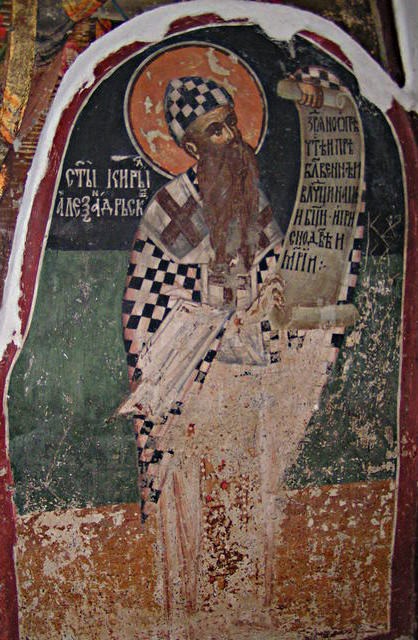
St. Cyril of Alexandria (June 9th and January 18th) (http://commons.orthodoxwiki.org/images/c/cc/Chiril-al-alexandriei-rasca.JPG)

Through the prayers of our Holy Fathers, Lord Jesus Christ our God, have mercy on us and save us! Amen!

Sunday, January 18, 2009

Sts. Athanasios and Cyril, Patriarchs of Alexandria

Icon of Sts. Athansios and Cyril, Patriarchs of Alexandria (taken from: http://ocafs.oca.org/FeastSaintsViewer.asp?FSID=100219)

"Commemorated on January 18

Saints Athanasius and Cyril were Archbishops of Alexandria. These wise teachers of truth and defenders of Christ's Church share a joint Feast in recognition of their dogmatic writings which affirm the truth of the Orthodox Faith, correctly interpret the Holy Scripture, and censure the delusions of the heretics.

St Athanasius took part in the First Ecumenical Council when he was still a deacon. He surpassed everyone there in his zeal to uphold the teaching that Christ is consubstantial (homoousios) with the Father, and not merely a creature, as the Arians proclaimed. This radiant beacon of Orthodoxy spent most of his life in exile from his See, because of the plotting of his enemies. He returned to his flock as he was approaching the end of his life. Like an evening star, he illumined the Orthodox faithful with his words for a little while, then reposed in 373. He is also commemorated on May 2 (the transfer of his holy relics).

St Cyril was the nephew of Patriarch Theophilus of Alexandria, who educated him from his youth. He succeeded to his uncle's position in 412, but was deposed through the intrigues of the Nestorian heretics. He later resumed his See, however. St Cyril presided at the Third Ecumenical Council in 441, which censured the Nestorian blasphemy against the Most Holy Theotokos. His wise words demonstrated the error of their false doctrine. St Cyril departed to the Lord in the year 444, and is also commemorated on June 9 (the day of his repose)." (taken from: http://ocafs.oca.org/FeastSaintsViewer.asp?FSID=100220)


Icon of Sts. Athansios and Cyril, Patriarchs of Alexandria (Icon courtesy of www.eikonografos.com used with permission)

Apolytikion of Sts. Athanasios and Cyril, Patriarchs of Alexandria in the Third ToneShining forth with works of Orthodoxy, ye quenched every false belief and teaching and became trophy-bearers and conquerors. And since ye made all things rich and with true piety, greatly adorning the Church with magnificence, Athanasius and wise Cyril, ye both have worthily found Christ God, Who doth grant great mercy unto all.

Kontakion in the Fourth ToneO great Hierarchs of piety and brave champions of the Church of Christ, you watch over all who sing, "Save us who in faith honor you, O Compassionate."


Through the prayers of our Holy Fathers, Lord Jesus Christ our God, have mercy on us and save us! Amen!