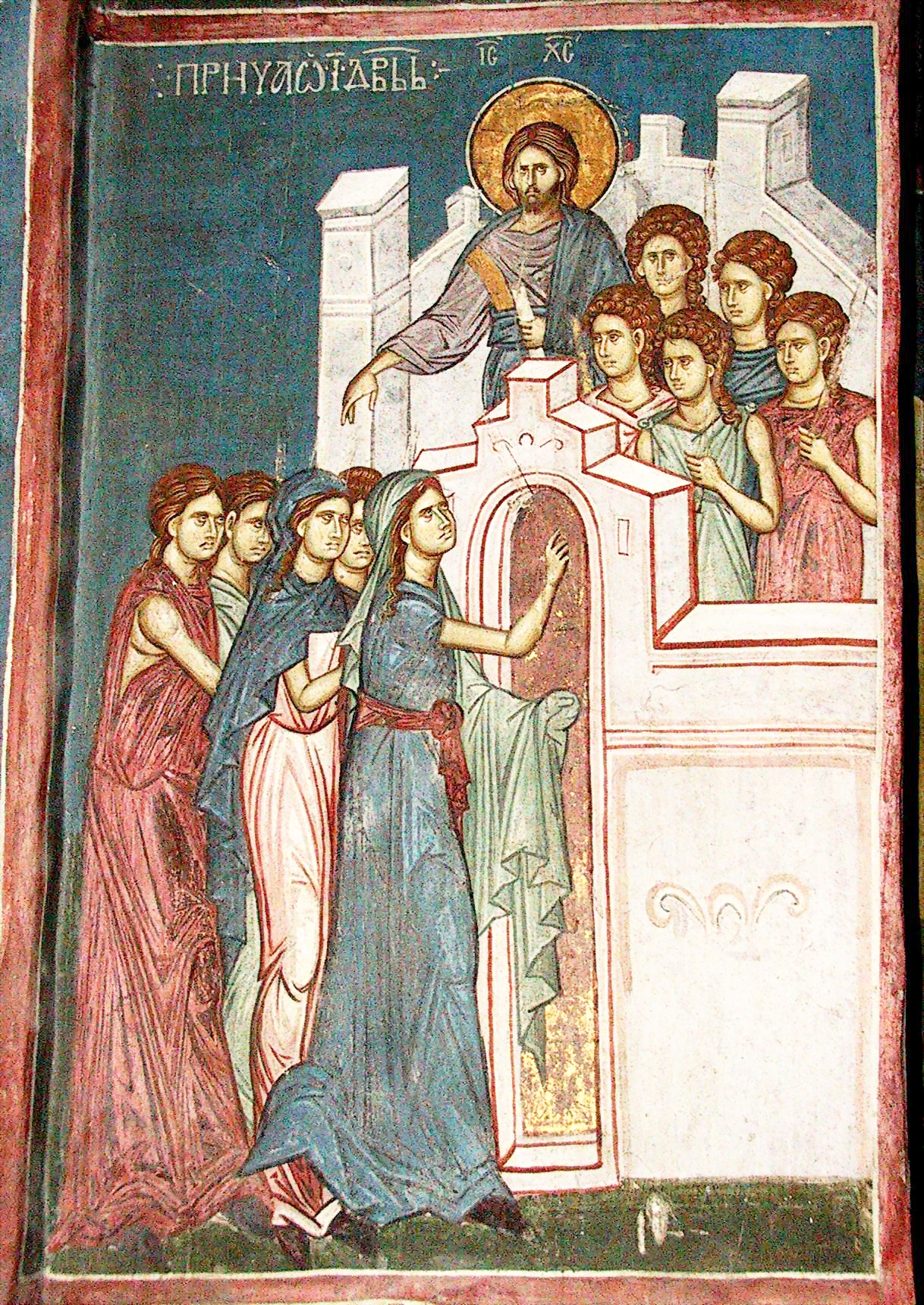
Selected Quotes of the Fathers on the Parable of the Ten Virgins The five wise virgins, watchful and alert, had taken oil in the vessels of their heart. That oil, not part of their own nature, means the grace of the Spirit. They were enabled to enter with the Bridegroom into the heavenly bridal chamber. The other five virgins, however, were content with their own nature. They neither watched nor busied themselves to receive the oil of gladness [Ps. 44:6] in their vessels, while they were yet in the flesh. Instead, they sank into sleep through carelessness, slackness, idleness, and ignorance, or even fancied righteousness. Hence, they were shut out of the bridal chamber of the Kingdom, unable to give satisfaction to the heavenly Bridegroom. Held fast by their tie to the world, and by some earthly affection, they did not give their whole love or passionate devotion to the heavenly Bridegroom; thus they were not provided with oil. Souls that seek the sanctification of the Spirit, which is outside of nature, fasten all their affection upon the Lord. It is in the Lord that they walk, pray, and employ their thoughts, turning away from all else. For this cause, they are priviledged to receive the oil of heavenly grace. This enables them to succeed in coming through without falling, giving perfect satisfaction to the spiritual Bridegroom. Those souls, however, content with what belongs to their own nature, creep upon the earth in their thoughts. Not only do they employ their thoughts upon earth, but their minds have their whole existence upon earth. In their own estimation, they appear to belong to the Bridegroom, and to be adorned with the ordinances of the flesh. Nonetheless, they have not been born of the Spirit; and they have not received the oil of gladness. -Saint Macarios the Great (Fifty Spiritual Homilies, Homily IV) This parable admonishes us to remain diligent in almsgiving. It counsels us to help our neighbor by every means available to us, since it is impossible to be saved in any other way....For nothing is more sullied than virginity without mercy ... What was the profit of virginity, when they saw not the Bridegroom? Even when they knocked at the door, they did not obtain; instead, they heard the fearful saying, "Depart, I know you not". When he said this, nothing else but hell is left, and that intolerable punishment....This parable was spoken with respect to mercy in almsgiving ... It is also that we might learn how close Christ is joined unto virgins that strip themselves of their possessions; for this indeed is virginity. -Saint John Chrysostom (Homilies on the Gospel of Matthew, Homily LXXVII) As it is written: "The day of the Lord shall come as a thief in the night" (1 Thess. 5:2). Then the virgins shall awake, because both good and wicked are roused from the sleep of death. They shall trim their lamps, that is, they shall count the number of their good works for which they hope to receive the reward of eternal happiness. However, the lamps of the foolish virgins shall fail. This is because their works, seen so clearly by men, shall wane and vanish at the coming of the Judge. From God, they shall receive no recompense, for men gave them the praise they esteemed so highly. The blessed will rejoice in their recompense, when they enjoy that vision of Him in Whose presence the elements tremble. They will then go in with Him to the marriage. As they rejoice in the nuptials of the Bridegroom, they themselves will be the bride; for in the bridal chamber of the eternal Kingdom, they are united forever to their God. Thenceforth, that vision can never be snatched from them. The door of the Kingdom will close forever upon those left outside, who then will weep. However, that same door is now open to all penitents. There will be repentance then, but it will be fruitless. When the Bridegroom comes, those that wasted time that might have be used for repentance shall not find pardon. Thus St. Paul warns us: "Behold, now is the accepted time; behold, now is the day of salvation" (2 Cor. 6:2). The Prophet Isaiah says: "Seek ye the Lord, and when ye find Him, call upon Him" (Is. 55:6). -Saint Gregory the Great (Parables of the Gospel, "The Ten Virgins") (source) Some say that the shortage of oil of the foolish virgins signifies their shortage of good works in their lives. Such understanding is not exactly correct. How can they be short of good works if they, though foolish, are still called virgins? Chastity is a supreme virtue, the state of being equal to angels, and could itself serve as a substitute for all other virtues. I humbly think that they were actually short of the grace of God's All-Holy Spirit. These virgins did good, and out of their spiritual foolishness supposed that doing good was exactly the point of Christianity. They did good works and by this obeyed God, but they did not care in the least beforehand whether they had received or reached the grace of God's Spirit. This very gaining of the Holy Spirit is that oil which the foolish virgins lacked. They were called foolish because they forgot about the necessary fruit of virtue, the grace of the Holy Spirit, without which no one is saved and no one can be saved, for: ‘it is by the Holy Spirit that any soul is vitalized and exalted in chastity, and any soul is lit by the Trinitarian unity in holy mysteries’. The Holy Spirit moves into our souls, and this installation of the All-Mighty into our souls, and co-existence of His Trinitarian Unity with our spirit is given only through the gaining by all means, the Holy Spirit, which prepares in our soul and body the throne for God’s creative co-existence with our spirit in strict accordance with the word of God: ‘I will dwell among them and will be their God, and they will be my people’. This is the oil in the lamps of wise virgins, oil that burnt bright and long, so that the virgins with the burning lamps could wait until the Bridegroom who came at midnight, and enter with Him into the house of joy. But the foolish virgins, seeing that their lamps were going out, went to the marketplace to buy oil but would not come back in time, for the doors were already shut. The marketplace is our life; the door of the house of marriage (that was shut and did not lead to the Bridegroom) is our human death; wise and foolish virgins are Christian souls; the oil is not works but the grace of the All-Holy Spirit of God which is received through these works, and which converts things perishable into things imperishable, transforms spiritual death into spiritual life, darkness into light, the manger of our being, with passions tied like cattle and beasts, into the Divine Temple, into the glorious palace of never-ending rejoicing in Christ Jesus. -St. Seraphim of Sarov(Conversation with Nicholas Motovilov)(source) O brothers, let us love the Bridegroom, Let us make ready our lamps, Shining out with brightness and true faith, So that, like the wise virgins at the Lord's coming, We may arrive with Him at the marriage, For He, the Merciful, since He is God, Offers to all as a gift The incorruptible crown!
Thou, O God, the Bridegroom of salvation, the hope of those who hymn Thee, Grant to us who pray to Thee That we find, without stain, in Thy marriage, Just like the virgins The incorruptible crown.
-St Romanos the Melodist - Vol. II, Kontakion On the Ten Virgins I
My soul, now we observe these things. There are doors; let my soul not be at the doors; Let it be ready and at hand. It leaves nothing behind, Just as Christ said. As He foretold, all things will happen Famines and pestilence, And continuous earthquakes, And tribe upon tribe will be raised up. Fearful things within and without, Full of battles. It is not possible to be saved anywhere, For everywhere there is danger. Nowhere is there a refuge; there is flight by all men. The gate has been closed, Mercy has been sealed; For we were not chosen To be within the bridal chamber, we are Crying, 'Open.' -St Romanos the Melodist - Kontakion On the Ten Virgins II (source)
St. Makarios the Great on Christians and the World (from HOMILY 4)
1. THE world of Christians, and their way of life, and their mind, and discourse, and practice, is one thing; and that of the men of this world, another. And the difference between them is very wide. For the children of this world are tossed to and fro by unsettled seasonings, by earthly desires, and a variety of gross imaginations, whereby SATAN is continually sifting the whole sinful race of men. 2. For the word that was spoken to Cain by his Maker, “You shall go mourning and trembling, and be tossed about upon' the earth," is a type and image of all sinners, as to their inward state. For thus is the race of Adam tossed about with the incessant suggestions of fear and dread, and every kind of disturbance, the prince of this world tossing to and fro the soul that is not born of God; and variously disturbing the thoughts of mankind, as corn that is continually shifted about in a sieve; and shaking and ensnaring them all in worldly deceits, and the lusts of the flesh, with fears and troubles. 3. As from one Adam the whole race of mankind was spread over the earth,-so one taint in the affections was derived down into the sinful stock of men; and the prince of malice is sufficiently able to shift them all in restless, and gross, and vain, and troublesome reflections. For as one and the same wind is enough to stir, and shake all plants and seeds whatever,-so the prince of wickedness, as an hidden and blustering wind, tosseth to and fro all the race of men upon earth, and, carries them about with unsettled thoughts, and enticing them with the lusts of the world, fills every soul with ignorance, blindness, and oblivion, if it is not born from above. 4. For in this do true Christians differ from the whole race of mankind besides. They have their heart and mind constantly taken up with the thoughts of heaven; and, through the presence and participation of the Holy Spirit, do behold, as in a glass, the good things which are eternal, being born of GOD from above, and thought worthy to become the children of GOD in truth and power; and being arrived, through many conflicts and labors, to a settled and fixed state, to an exemption from trouble, to perfect rest, are never sifted more by unsettled and vain thoughts.Herein are they greater and better than the world; their mind and the desire of their soul are in the peace of CHRIST, and the love of the Spirit; a they have passed from death to life." Wherefore the alteration peculiar to Christians does not consist in any outward fashions, but in the renovation of the mind, and the peace of the thoughts, and the love of the Lord, even the heavenly love. Herein Christians differ from all men besides. The Lord has given them truly to believe on him, and to be worthy of those spiritual good things. For the glory, and the beauty, and the heavenly riches of Christians are inexpressible, and purchased only with labor, and pains, and trials, and many conflicts. But the whole is owing to the grace of God.
5. Now if the sight of. even an earthly king is desired by all men, (except those persons that are spiritual, who look upon all his glory as nothing, through their having experimentally known another heavenly glory;) if, I say, the men of this world are so desirous to behold an earthly king, with his splendor and glory-how much more are those upon whom that dew of the Spirit of life has dropped, and wounded their hearts with love for CHRIST; bound fast to that beauty, and the unspeakable glory, and the inconceivable riches of the true and eternal King; with desire and long- suffering after whom they are captivated, turning wholly to him, to obtain those unspeakable good things, which through the Spirit they actually behold already; and for whose sake they esteem all the glories, and honors, and riches of earthly kings as nothing?
6. For they arc wounded with the Divine beauty; their desire is towards the heavenly King; and placing him only before their eyes in the abundance of their affection, they, for his sake, disengage themselves from all love of the world, and draw back from every earthly clog, that so they may be able ever to retain in their hearts that only desire. And they that are Christians in truth and power, rejoice at their departure out of the flesh, because they have " that house which is not made with hands." And therefore, if the house of the body be destroyed, they are in no fear; for they have the heavenly "house of the Spirit," and that "glory which is incorruptible."
7. Let us therefore strive by faith to be possessed of that clothing, that when we resume the body, there be nothing wanting which may glorify our flesh in that day. For every one, so far as he has been thought worthy by faith to be made partaker of the Holy Spirit, in the same proportion shall his body also be glorified in that day. For that which the soul has treasured up within, in this present life, shall then be made manifest outwardly in the body. 8. For as the trees that have got over the winter do, by an invisible power, put forth from within, and shoot out leaves., and flowers, and fruits, as their clothing.and in like manner, as the flowers of the grass come out of the bosom of the earth, and the earth is covered and clothed-so, in the, day of the resurrection, and through the power of the a Sun of Righteousness," there shooteth out from within the glory of the Holy Spirit, covering the bodies of the saints, which glory they had before, within hidden in their souls. For whatever (the soul) has at present, the same comes forth at that time outwardly in the body. 9. Therefore ought every -one of us to strive, and be diligent in all virtue, and to believe and to seek it of the Lord; that the inward man may be made partaker of that glory in this present life, and have that holiness of the Spirit, that we may have at the resurrection wherewith to cover our naked bodies, and refresh us to all eternity in the kingdom of heaven. For CHRIST will come down from heaven, and raise to life all the kindred of Adam that have slept from the beginning of the world and he shall separate them all into two divisions; and them that have his own mark, that is, the seal of the Spirit, he shall place on his right hand. And then shall the bodies of these -be surrounded with a Divine glory from their good works, and themselves shall be full of the glory of the Spirit, which they had in their souls in this present life. So that, being thus glorified in the Divine light, and snatched away to " meet the Lord in the air, we," as it is- written, "shall ever be with the Lord," reigning with him world without end. Amen.
A revelation on the torments of hell to St. Makarios the Great (amateur translation)
This icon is from the cemetary church of All Saints in the town of Perama, Rethymna, the seat of the municipality of Mylopotamou, by the iconographer Emmanuel Sephake.
St. Makarios of Egypt once was traveling through the desert, and accidentally uncovered a skull with his staff. He bent down, buried it with respect, and prayed for the man to whom it belonged. Then, the man's soul appeared to him, and informed him that, while he was alive, he was a worshiper of the devils (a priest of Isis), and now he was in hell. “And how is it there?” the Saint asked. “All are found amidst flames” the soul responded, “and we are bound back-to-back. However, when you pray for us, we see each other for the short time that you are praying.” We know from our holy Christian teachers that the fire which the soul mentioned is the Fire of God, which bathes all in the other world. Those with an attitude of egotism experience this as the “fire of hell”.
"For Lazarus also, whom the Lord raised up, exuded so fetid an odor that no one could approach his tomb, as a symbol of Adam whose soul exuded such a great stench and was full of blackness and darkness. But you, when you hear about Adam and the wounded traveler and Lazarus, do not let your mind wander as it were into the mountains, but remain inside within your soul, because you also carry the same wounds, the same smell, the same darkness.
We are all his sons and we all inherit the same stench. Therefore, the passions that he suffered, all of us, who are of Adam's seed, suffer also. For such a suffering has hit us, as Isaiah says: It is not a wound, nor a bruise, nor an inflamed sore. It is impossible to apply a soothing salve or oil or to make bandages. (Is 1:6). Thus we were wounded with an incurable wound. Only the Lord could heal it. For this He came in His own person because no one of the ancients nor the Law itself nor the prophets were able to heal it. He alone, when He came, healed that sore, the incurable sore of the soulLet us, therefore, receive God the Lord, the true Healer, Who alone can come to heal our souls, after He has borne so much on our behalf. For He is always knocking at the doors of our hearts in order that we may open up to Him and that He may enter in and take His rest in our souls, and that we may wash His feet and He may take up His abode with us. For this purpose He endured many sufferings, giving His body over to death and buying our ransom from slavery so that He, coming to our soul, might makeHis abode there." St. Macarius the Great
"'And my Father will love him, and we will come to him and make our home with him.' My friends, consider the greatness of this solemn feast that commemorates God's coming as a guest into our hearts! If some rich and influential friend were to come to your home, you would promptly put it all in order for fear something there might offend your friend's eyes when he came in. Let all of us then who are preparing our inner homes for God cleanse them of anything our wrongdoing has brought into them."
St. Gregory Dialogos, on Pentecost in Be Friends of God
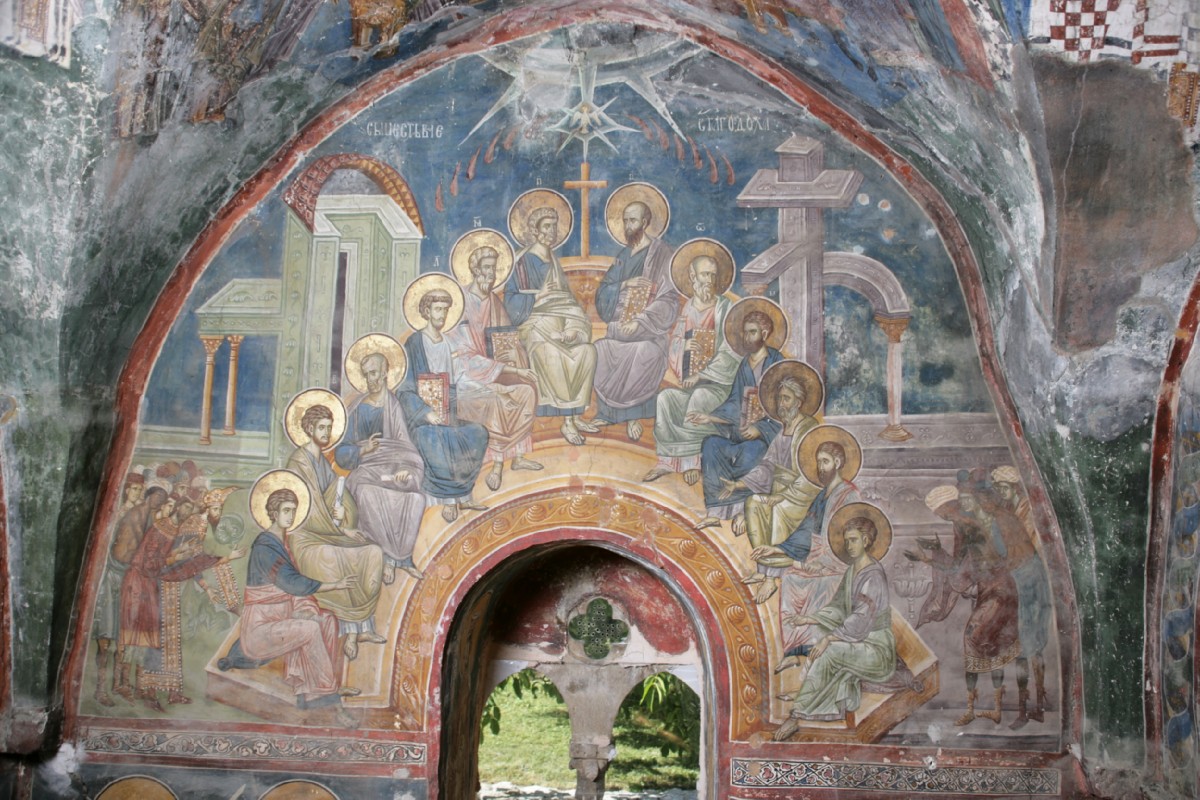
"'And there appeared unto them cloven tongues like as of fire, and it sat upon each of them; and they were all filled with the Holy Spirit' (Acts 2:3-4). They partook of fire, not of burning but of saving fire; of fire which consumes the thorns of sins, but gives luster to the soul. This is now coming upon you also, and that to strip away and consume your sins which are like thorns, and to brighten yet more that precious possession of your souls, and to give you grace; for He gave it then to the Apostles. And He sat upon them in the form of fiery tongues, that they might crown themselves with new and spiritual diadems by fiery tongues upon their heads. A fiery sword barred of old the gates of Paradise; a fiery tongue which brought salvation restored the gift."
St. Cyril of Jerusalem (Catechetical Lectures: Lecture 17 no. 15)
"Brothers, we shall hymn with praise the tongues of the disciples, because, not with elegant speech, But in divine power they have revived all men. Because they took up His Cross as a reed, So that they might again use words as fishing lines and fish for the world Since they had speech as a sharp fishhook, Since the flesh of the Master of all Has become for them a bait, it has not sought to kill But it attracts to life those who worship and praise The All-Holy Spirit."
St Romanos the Melodist - On Pentecost
"But as the old Confusion of tongues was laudable, when men who were of one language in wickedness and impiety, even as some now venture to be, were building the Tower; for by the confusion of their language the unity of their intention was broken up, and their undertaking destroyed; so much more worthy of praise is the present miraculous one. For being poured from One Spirit upon many men, it brings them again into harmony. And there is a diversity of Gifts, which stands in need of yet another Gift to discern which is the best, where all are praiseworthy."
St. Gregory Nazianzen, Oration on Pentecost
"Regarding the manner in which the Holy Spirit descended upon the disciples, Saint Symeon the New Theologian makes a remark that is most helpful for properly understanding this event. He says that this mode of acting of the Holy Spirit - by means of a loud noise as of a rushing mighty wind, and with tongues of fire - was something unique. The Holy Spirit, he observes, comes very calmly, in the form of spiritual light, and evokes joy. The passage in which he touches upon this point is this:
The power of the Holy Spirit, which is bestowed upon him who loves God and keeps His commandments, does not appear visibly in the form of fire, nor does it come with a loud sound like a violent wind - for this happened only in the time of the Apostles for the sake of the unbelievers. Instead, it is seen spiritually in the form of spiritual light, and comes with all calm and joy."
Guide to Byzantine Iconography, Vol. 1, by Constantine Cavarnos
"The holy mystery of the day of the Holy Spirit, Pentecost, is to be understood in the following manner: the spirit of man must be completed and perfected by the Holy Spirit, that is, it must be sanctified, illuminated, and divinized by the Holy Spirit. This holy mystery is realized continually in the Church of Christ and because of this the Church is really a continuous Pentecost.... From Holy Pentecost, the day of the Holy Spirit, every God-like soul in the Church of Christ is an incombustible bush which continuously burns and is inflamed with God and has a fiery tongue within it."
St. Justin Popovich, Orthodox Faith and Life in Christ
"The power to bear Mysteries, which the humble man has received, which makes him perfect in every virtue without toil, this is the very power which the blessed apostles received in the form of fire. For its sake the Saviour commanded them not to leave Jerusalem until they should receive power from on high, that is to say, the Paraclete, which, being interpreted, is the Spirit of consolation. And this is the Spirit of divine visions. Concerning this it is said in divine Scripture: 'Mysteries are revealed to the humble' [Ecclus ]. The humble are accounted worthy of receiving in themselves this Spirit of revelations Who teaches mysteries."
St. Isaac the Syrian, Ascetical Homily 77
"Was it upon the twelve that it [the Holy Spirit] came? Not so; but upon the hundred and twenty. For Peter would not have quoted to no purpose the testimony of the prophet, saying, 'And it shall come to pass in the last days, saith the Lord God, I will pour out of My Spirit upon all flesh: and your sons and your daughters shall prophesy, and your young men shall see visions, and your old men shall dream dreams' (Joel 2:28). 'And they were all filled with the Holy Spirit.' For, that the effect may not be to frighten only, therefore it is both 'with the Holy Spirit, and with fire. And began to speak with other tongues, as the Spirit gave them utterance' (Mt. )."
St. John Chrysostom, Homilies on the Acts of the Apostles
"If from one burning lamp someone lights another, then another from that one, and so on in succession, he has light continuously. In the same way, through the Apostles ordaining their successors, and these successors ordaining others, and so on, the grace of the Holy Spirit is handed down through all generations and enlightens all who obey their shepherds and teachers.”
St. Gregory Palamas, “On how the Holy Spirit was manifested and shared out at Pentecost”
"What is the aim of the incarnate dispensation of God's Word, preached in all the Holy Scriptures but which we, who read them, do not know? The only aim is that, having entered into what is our own, we should participate in what is His. The Son of God has become Son of Man in order to make us, men, sons of God, raising our race by grace to what He is Himself by nature, granting us birth from above through the grace of the Holy Spirit and leading us straightway to the kingdom of heaven, or rather, granting us this kingdom of heaven within us (Luke 17:21), in order that we should not merely be fed by the hope of entering it, but entering into full possession thereof should cry: our 'life is hid with Christ in God' (Col. 3:3).
St. Simeon the New Theologian, “Practical and Theological Precepts” (The Philokalia)
The Preparation of the Throne, with the Holy Spirit depicted (source)
"...One must clean the royal house from every impurity and adorn it with every beauty, then the king may enter into it. In a similar way one must first cleanse the earth of the heart and uproot the weeds of sin and the passionate deeds and soften it with sorrows and the narrow way of life, sow in it the seed of virtue, water it with lamentation and tears, and only then does the fruit of dispassion and eternal life grow. For the Holy Spirit does not dwell in a man until he has been cleansed from passions of the soul and body.”
St. Paisius Velichkovsky, “Field Flowers"
"If the Lord has left us ignorant of the ordering of many things in this world, then it means it is not necessary for us to know: we cannot compass all creation with our minds. But the Creator Himself of heaven and earth and every created thing gives us to know Him in the Holy Sprit.
St. Silouan the Athonite, “Wisdom from Mount Athos”
"Whatever the soul may think fit to do itself, whatever care and pains it may take, relying only upon its own power, and thinking to be able to effect a perfect success by itself, without the co-operation of the Spirit, it is greatly mistaken. It is of no use for the heavenly places; it is of no use for the kingdom - that soul, which supposes that it can achieve perfect purity of itself, and by itself alone, without the Spirit. Unless the man who is under the influence of the passions will come to God, denying the world, and will believe with patience and hope to receive a good thing foreign to his own nature, namely the power of the Holy Spirit, and unless the Lord shall drop upon the soul from on high the life of the Godhead, such a man will never experience true life, will never recover from the drunkenness of materialism; the enlightenment of the Spirit will never shine in that benighted soul, or kindle in it a holy daytime; it will never awake out of that deepest sleep of ignorance, and so come to know God of a truth through God's power and the efficacy of grace.”
St. Macarius the Great, “Spiritual Homilies (Homily 24)"
“The aim of all those who live in God is to please our Lord Jesus Christ and become reconciled with God the Father through receiving the Holy Spirit, thus securing their salvation, for in this consists the salvation of every soul. If this aim and this activity is lacking, all other labour is useless and all other striving is in vain. Every path of life which does not lead to this is without profit.”
St. Simeon the New Theologian, "Writings from the Philokalia"
“Everything that breathes, breathes by air and cannot live without air; similarly all reasonable free creatures live by the Holy Spirit, as though by air, and cannot live without Him. "Every soul is quickened by the Holy Spirit." Recognise that the Holy Spirit stands in the same relation to your soul as air stands in relation to your body.”
St. John of Kronstadt, My Life in Christ
“The Saviour and the Comforter, two Persons of the Godhead: the One ever saves from sins, and the Other comforts him who is saved. Their very names are taken from their deeds, and are always actually justified. He comforts! The Holy Spirit comforts the believing soul, as a mother comforts her child.”
St. John of Kronstadt, My Life in Christ
“...In proportion to your humility you are given patience in your woes; and in proportion to your patience the burden of your afflictions is made lighter and you will find consolation; in proportion to your consolation, your love of God increases; and in proportion to your love, your joy in the Holy Spirit is magnified. Once men have truly become His sons, our tenderly compassionate Father does not take away their temptations from them when it is His pleasure to 'make for them a way to escape' (1 Cor. ), but instead He gives His sons patience in their trials. All these good things are given into the hand of their patience for the perfecting of their souls.”
St. Isaac the Syrian, "Ascetical Homilies" (Homily Forty-Two)
“Jesus tells us that His holy Disciples will be more courageous and more understanding when they would be, as the Scripture says, Endowed with power from on high (Luke 24:49), and that when their minds would be illuminated by the torch of the Spirit they would be able to see into all things, even though no longer able to question Him bodily present among them. The Saviour does not say that they would no longer as before need the light of His guidance, but that when they received His Spirit, when He was dwelling in their hearts, they would not be wanting in any good thing, and their minds would be filled with most perfect knowledge.”
St. Cyril of Alexandria
“The Saints in Heaven through the Holy Spirit behold the glory of God and the beauty of the Lord's Countenance. But in this same Holy Spirit they see our lives too, and our deeds. They know our sorrows and hear our burning prayers. When they were living on earth they learned of the love of God from the Holy Spirit; and he who knows love on earth takes it with him into eternal life in the kingdom of Heaven, where love grows and becomes perfect. And if love makes one unable to forget a brother here, how much more must the Saints remember and pray for us!”
St. Silouan the Athonite, "Wisdom from Mount Athos"
“As the Lord put on the body, leaving behind all principality and power, so Christians put on the Holy Spirit, and are at rest.”
St. Macarius the Great, "Spiritual Homilies" (Homily 26)
“...Filled with love, the holy Apostles went into the world, preaching salvation to mankind and fearing nothing, for the Spirit of God was their strength. When St. Andrew was threatened with death upon the cross if he did not stay his preaching he answered: 'If I feared the cross I should not be preaching the Cross." In this manner all the other Apostles, and after them the martyrs and holy men who wrestled against evil, went forward with joy to meet pain and suffering. For the Holy Spirit, sweet and gracious, draws the soul to love the Lord, and in the sweetness of the Holy Spirit the soul loses her fear of suffering.”
St. Silouan the Athonite, "Wisdom from Mt.Athos"
“The true aim of our Christian life consists in the acquisition of the Holy Spirit of God.”
St. Seraphim of Sarov, "A Wonderful Revelation to the World"
“...For as of old on the fiftieth day after the Sacrifice of the Lamb, the Law was given on Mount Sinai to the Hebrew people, now delivered from the Egyptians, so, after the Passion of Christ, in which the True Lamb of God was slain, on the fiftieth day after His Resurrection, the Holy Spirit descended upon the Apostles and upon the people who believed (Acts ii.3); so that an earnest Christian might know beyond any uncertainty, that the sacred rites of the Old Testament had served as foundations for the Gospel, and that by this same Spirit was the Second Covenant laid down, by Whom the first had been established.”
St. Leo the Great, “The Work of the Holy Spirit"
“The Comforter, the Holy Spirit, who fills the whole universe, passes through all believing, meek, humble, good, and simple human souls, dwelling in them, vivifying and strengthening them. He becomes one spirit with them and everything to them - light, strength, peace, joy, success in their undertakings, especially in a pious life, and everything good - "going through all understanding, pure and most subtle spirits" (Wisdom of Solomon vii, 23). "We have been all made to drink into one Spirit" (I Cor. xii.13). All pious people are filled with the Spirit of God similarly as a sponge is filled with water.”
St. John of Kronstadt, "My Life in Christ"
“Through the Holy Spirit comes our restoration to paradise, our ascension into the kingdom of heaven, our return to the adoption of sons, our liberty to call God our Father, our being made partakers of the grace of Christ, our being called children of light, our sharing in eternal glory, and, in a word, our being brought into a state of all "fulness of blessing," both in this world and in the world to come, of all the good gifts that are in store for us, by promise hereof, through faith, beholding the reflection of their grace as though they were already present, we await the full enjoyment.”
"And the Word was made flesh, and dwelt among us, (and we beheld his glory, the glory as of the only begotten of the Father,) full of grace and truth...And of his fulness have all we received, and grace for grace. For the law was given by Moses, but grace and truth came by Jesus Christ." John 1: 14, 16-17
Introduction
Glory to the Father and to the Son and to the Holy Spirit, now and forever, and to the ages of ages! Amen!
"As the Prophets saw, as the Apostles taught, as the Church has received, as the Teachers express in dogma, as the inhabited world understands together with them, as grace illumines, as the truth makes clear, as error has been banished, as wisdom makes bold to declare, as Christ has assured, so we think, so we speak, so we preach, honouring Christ our true God, and his Saints, in words, in writings, in thoughts, in sacrifices, in churches, in icons, worshipping and revering the One as God and Lord, and honouring them because of their common Lord as those who are close to him and serve him, and making to them relative veneration.This is the faith of the Apostles; this is the faith of the Fathers; this is the faith of the Orthodox; this faith makes fast the inhabited world." Excerpt from the Synodikon of the Sunday of Orthodoxy (http://www.anastasis.org.uk/synodikon.htm)
By the Grace of God, here are presented a few true stories of the Saints, sayings of the Holy Fathers, sacred icons, and many other things so that, maybe in a small way, we may remind ourselves that (though we might not be ready to accept it) Jesus Christ is the WAY, the TRUTH, and the LIFE, and that the Holy Orthodox Church is full of Christ's GRACE and TRUTH, and is no less than the Kingdom of God on earth.
I must say that I am not a part of the clergy, so I hope to primarily put forth quotations from the Gospel, Saints and Holy Fathers, and not my own opinions. But if you see my own words or opinions, keep in mind that they are my opinions or comments and they have little weight, as opposed to the quotations from Christ, the Saints and the Fathers which do.
I ask forgiveness if in this site any of my passions are acting, hindering the Grace of the Holy Spirit because of my sins. I apologize for any errors of mine, mistakes, problems with translations, etc. due to my ignorance and conceit. If anyone notices any mistakes or can suggest a better translation, please let me know. I try to post all of my sources. Please also let me know if I am violating any copyrights or other laws, and I will do my best to comply.
Through the prayers of our Holy Fathers, Lord Jesus Christ our God, have mercy on us and save us! Amen!
-I try to update this site fairly regularly. If you are looking for a specific subject, feel free to search for an earlier post that might cover it. I habitually go back and update previous posts too, so though there may not be new info at the top of the site(e.g. for some saint or feast), it's possible that I've updated a previous post with more information, images, etc.
-Please consider the sources for all materials presented. I try to only post reliable information, but I can't be held responsible for every inconsistency or incorrect fact. If you notice an error, please post a comment and let me know. Please keep in perspective material presented without a source, or amateur translations from me.
-Though I don't have explicit permission to reproduce all the material I use on this blog, if I am made aware of some copyright or usage issues, I am very willing to remove the materials in question. If you quote or use material from my blog, please cite the sources where I took it from. If you use some of my amateur translations, please make it clear somehow that it was not a professional translation (unless you can verify my translation).
-Please do not make comments to a post that are irrelevant to the topic being discussed. If there are general comments / questions about the blog, feel free to search for and comment on one of the posts titled "Blog Info / Updates / Suggestions". Comments that are irrelevant to the topic of the post will be deleted.
-If you have a question or a comment about the topic of sources of a post, feel free to comment. However, I ask you to avoid being argumentative, accusatory, combative or bickering. This was not envisioned as a forum for debates, but as another venue to present the stories, writings and miracles of the Holy Fathers and the Church.