Showing posts with label Obedience. Show all posts
Saturday, February 27, 2021
St. Ephraim of Katounakia: The Martyr of Obedience
Here is a video with English subtitles of a talk of Metropolitan Athanasios of Lemesou on the newly-canonized St. Ephraim of Katounakia, including video clips of the Saint himself, who is celebrated today as his first feast day. May we have his prayers and blessings! (source)
Selected hymns from the service to St. Ephraim of Katounakia (Commemorated February 27th), written by Dr. Charalampos Bousias, Hymnographer of the Patriarchate of Alexandria
Apolytikion in the Plagal of the First Tone. Let us worship the Word.
O newly-shining lamp-lighter of noetic prayer, as a dweller of Katounakia and a light of the Holy Mountain, who illumined all with the light of your virtues, O most-divine Ephraim, who proceeded to the heights of theosis, dispassion and nepsis: Do not cease to entreat Christ for us.
Kontakion in the Plagal of the Fourth Tone.
Let us praise the hard-working, prayerful and neptic ascetic of Katounakia, who was lifted up from every baseness of the nous towards the virtues through purification, as one equal to the Angels, let us mortals praise him with psalms and divine hymns, crying out: Rejoice, O most-divine Father.
Oikos
The Angels were astonished, beholding your feats in Katounakia, O Ephraim, and the chaste citizens of Athos beheld the grace that dwelt in you through your monastic way of life, and they cry out these things with compunction in soul:
Rejoice, bodiless one bearing flesh,
Rejoice, inheritor of Heaven.
Rejoice, defender of dispassion and nepsis,
Rejoice, fellow-dweller with non-possessiveness and grace.
Rejoice, unassailable foundation of prayer of the heart,
Rejoice, greatly-varied stream of perfect obedience.
Rejoice, you who were a disciple at the feet of Joseph,
Rejoice, you who showed to all the virtue of your heart.
Rejoice, godly offspring of Thebes,
Rejoice, goodness by canon and knowledge.
Rejoice, dweller of Katounakia,
Rejoice, protector of those who approach you.
Rejoice, O all-venerable Father.
Synaxarion
On this day (February 27th), the memory of our Venerable and God-bearing Father Ephraim, who lately lived in asceticism in Katounakia.
Verses
Obedience, prayer and a harsh way of life
You lived, O Ephraim, in Katounakia.
Through the prayers of our Holy Fathers, Lord Jesus Christ our God, have mercy on us and save us! Amen!
Thursday, August 13, 2020
Homily II on the Dormition of the Theotokos by Metropolitan Avgoustinos
The Dormition of the Theotokos (source)
Homily II on the Dormition of the Theotokos by Metropolitan Avgoustinos Kantiotes (+2010): "The Glorious Dormition"
"Your glorious Dormition caused the Heavens to rejoice, along with the ranks of the Angels, while the whole earth is glad..." (Sticheron from the Praises of the Feast of the Dormition of the Theotokos
Panagia was a poor girl from Nazareth, from unassuming parents. She did not have anything that would bespeak of glory. Her nativity passed by unnoticed [by the world]. Humble was her entrance into the world, and humble was her life.
But while her entrance was humble, her exit was glorious, and righteous. For she passed throughout her whole life in purity, humility, and utter obedience to the will of God. Which other woman has a calling that could be reckoned with hers? Every [woman] gives birth to mortals, but she was made worthy to become the Mother of the Son of God. As St. Kosmas Aitolos preached: "There were thousands of thousands of women in the world, but none could be found to fill the side of Adam, except our Lady the Theotokos."
When Panagia gave up her spirit to her Son and God, the earth and Heaven were astonished. The burial of her sacred body had a unique grandeur. The Apostles were brought from the ends of the earth to Gethsemane upon the clouds. Myrrh-bearing women and the faithful people followed. An impious Judean tried to defile the sacred body, but was repulsed...
The earth, with her most chosen children gathered to bury the King's Mother. But what were the honors of the earth before the honors of Heaven? As she ascended to the Kingdom on high, she was given an exceptional reception.
The leaders of the Angels knelt to venerate. The Son received the Mother. And she stood and continues to remain at His right hand, interceding on behalf of sinners.
Humble was her entrance, glorious, all-glorious, was her exit. Are these a phantasy, are these a myth? No, a thousand times, no. Our holy Church confirms this, who ordained that today the Dormition of the Most-Holy Theotokos be celebrated. Today, most-beautiful hymns are chanted, with which the greatness of Panagia is praised, and especially, the event of her repose, of her Dormition.
Detail from the icon of the Dormition of the Theotokos (source)
Many, my beloved, are the lessons of this feast. We will limit ourselves to one thing only, one lesson, which is contained in the word which the Church uses to characterize the event of the repose of the Virgin. Her repose is not called "death", but "dormition". Why? Please pay attention.
In the language of the Holy Scriptures, death does not mean the disappearance of the human existence. No. At death there is a separation. The soul is separated from the body. The soul leaves towards the things above, towards the heavenly world of the spirits. This path is not fantastical, but is a reality, which is confirmed by the word of God. Then, what does the soul meet, how many tollhouses does it pass through, what censures does it undergo, we do not know in detail. The words of holy people, who saw the souls of the reposed pass towards the verdant meadows of Paradise, or towards the dark places of hell, shine some light on this, but this light is dim, and unable to satisfy people's curiosity. To man, through the Scriptures, it has been revealed that the soul that leaves the body does not die (see Luke 12:20, 16:23-26, 23:42-43). This is a fact and the Christian cannot deny this.
But while the soul of man, which has finished this station of his life, ascends as a spirit to the other world, the body, as physical creation is given away to corruption, to temporary corruption. For from this corrupted body, during the universal Resurrection [at the Last Judgment], there will come a renewed and incorrupt body, which will be united with the soul and they will live together unto the ages of ages.
Yes! The body will be raised. In anticipation of the Resurrection, death according to the Scriptures is called "dormition". The Prophet David "slept" (Acts 13:36). The Protomartyr Stephen "slept" (Acts 7:60). The Apostle Paul, when he speaks of those who have left for the other life, does not say that they "died", but he calls them "those who are sleep". "I do not want you to be ignorant, my brethren, concerning those who are asleep, that you might not grieve as the others do who have no hope." (I Thessalonians 4:13). Our Lord Jesus Himself called death "sleep". When He entered the house of Jairus and saw them weeping for the dead girl, He told them: "Do not weep. She has not died, but is only sleeping." (Luke 8:52, Mark 5:39) And regarding Lazarus He said that he had "fallen asleep" (John 11:11-15). And He proceeded to resurrect him, with such ease as if he were waking him from sleep.
Dormition! This word of the Scriptures should be sufficient to teach, console and strengthen Christians, at least those who hasten to churches to celebrate and feast at the "glorious", "all-sacred", and "dormition transcending death", of the Most-Holy Theotokos. Do you hear this, O you who celebrate? Panagia has not died, but has fallen asleep! Her body was buried, placed within the grave, but as the Church chants: "the grave and death could not hold her, for as the Mother of Life, she has proceeded to Life, Who dwelt within the womb of the Ever-Virgin." (Kontakion of the Feast of the Dormition) Panagia, shining forth with all the light of the virtues, "as arrayed in gold" (Psalm 44:10) has proceeded towards the Heavens. "Who", cry out the Angels, "is this that appears like the dawn, fair as the moon, bright as the sun
The Dormition of the Theotokos (source)
Panagia, from the height of her glory, is heard to say to all Christians who are tempted here: "Faithful children of the heavenly Father, have strength. What do you fear? Death? But death is the gateway to the new life. Here on high where I am there is a new life, which no one on earth could even begin to imagine. This life is preordained for those who will live with faith and virtue. Here there is no partiality. My Son is the just Judge. When I was below on the earth, I heard voices that blessed me, for I was made worthy to become His Mother, and He said that, in the cycle of blessedness, it would not be me alone who gives Him birth, but for all those who hear Him and keep His word. For Christ is born spiritually in every soul who believes in Him and worships Him as the only Savior. 'Yea of a truth, blessed are those who hear the word of God and keep it.' (Luke 11:28) Therefore, I invite you all to the glory of Heaven."
As the Church chants, truly glorious was the Dormition of the Most-Holy Theotokos. Glorious was also the dormition of all the Righteous, who faithfully completed their missions. Each of them, as they left from this world, could say like the Psalm: "In peace I will lie down and sleep, and I awoke, for You, O Lord, have made me to dwell in hope." (Psalm 4:9) The antithesis occurs with those who did not love God and their neighbor, and did not fulfill their holy duties, and did not complete their mission, but were conquered by evils and passions, and trampled upon divine gifts, walling themselves off and making themselves unworthy of their holy calling, betraying the faith. Their dormition was not radiant, but dark, not glorious, but inglorious. Not radiant Angels, but dark demons were their fellow travelers during the exodus of their souls to the other world. For mourning and cutting are heard during the exodus of the unrepentant sinner. Who would not weep?
O Christians! Panagia had a glorious dormition. But we also must have a glorious dormition. Glorious through faith and virtue. May we receive even one laurel leaf from that glory! May the Lord, through the intercessions of the Most-Holy Theotokos, who proceeds to the Heavens, grant us an end like this. May the prayer of the Church be fulfilled for each of us: "For a Christian ending to our life: painless, blameless, peaceful, and a good defense before the dread Judgment Seat of Christ, let us pray."
(+) Bishop Avgoustinos
(source)
The Dormition of the Theotokos (source)
Most-Holy Theotokos, save us!
Tuesday, April 7, 2020
Bishop Alexis of Bethesda on the Current Crisis
An ascetic in private prayer for the world (source)
3/25/2020 - "Some Thoughts on the Crisis and the Call of the Corona Virus"
by Bishop Alexis of Bethesda (OCA)
The Bishops of the Holy Orthodox Church love their flocks and ever strive to lead them to well-watered and rich pastures. They care for them, body and soul. In so doing, they are following their Master Christ who not only “cast out unclean spirits,” but also healed “all manner of sickness and all manner of disease among the people.” (Matthew 10:1). In the Gospels, we see that Christ sometimes treated the soul first and the body second; at other times, the body first and the soul second. In the presence of the highly contagious and potentially lethal corona virus, the Bishops’ concern is for the bodily welfare of their people lest even a single lamb be needlessly lost. This is not from a lack of faith or dearth of compassion, but from unwavering faith and an abundance of compassion.
Compassion is expressed in giving each sinner the time necessary to repent, for in “hell there is no repentance” (Saint John of Damascus). Faith is expressed in the certainty that our Lord can always be in our midst, that He can always be by our side, for the Psalmist proclaims, “If I ascend up into heaven, Thou art there: if I make my bed in hell, behold, Thou art there” (Psalm 139:8). And if I am shut up in my home away from Church, “Thou art there,” even as the Lord was there for and with the Apostle Peter when he was locked up in prison, so He is there for and with us.
During times of uncertainty, anxiety, and fear, we naturally turn to God for refuge, peace, and courage. This is our birthright as baptized Orthodox Christians. Indeed, “God is our refuge and strength, a very present help in trouble. Therefore, we will not fear though the earth should change” (Psalm 46:1-2). With the corona virus, the earth has changed, but we do not fear. The faithful are isolated in their homes, physically separated from loved ones, and even unable to gather together as the Church for the celebration of the mysteries, but we do not fear, for God remains our refuge, our peace, and source of courage. Many are understandably discouraged and downcast about the decision to ban eucharistic gatherings in Church for the sake of the health of our neighbor whom we love. Yet, God remains our refuge, our peace, and our source of courage. Within this trial, this threat to so much that we hold so very dear, there is a call that is given and a promise that beckons. But to hear that call and see the fulfilment of that promise, we need to approach our Savior as His faithful children have always approached Him, not with self-righteous indignation or self-pitying despondency, but with humble, patient hope.
The call is to prayer of the heart. The promise is the purifying and illumining grace of the Holy Spirit. In the emphasis on more frequent communion over the past forty years, we might be tempted to neglect the necessary ongoing moment-to-moment inner communion with Christ by prayer, that talking with Him and walking with Him that characterized most of the lives of the Apostles before and after the institution of the Mystical Supper. Many of our greatest saints were deprived of Holy Communion for periods of time that for us would be unbearable to contemplate, but that for them were periods of continued growth from glory to glory, because they were never without Holy Communion with Christ through prayer. Prayer is not easy; it requires concentration, dedication, and love, but through the gates of prayer, we can touch Christ, Christ can touch us, and we can be healed. It is imperative for us all to learn to serve Liturgy at the Altar of the heart and the time is now at hand.
During this crisis of the corona virus, we are given the opportunity to become men and women of deep prayer. We are given the occasion to “enter into our closet, and when we have shut the door, pray to our Father which is in secret” (Matthew 6:6), offering Him our repentance, our gratitude, and our love. We can come to understand that “prayer is a safe fortress, a sheltered harbor, a protector of the virtues, a destroyer of passions. It brings vigor to the soul, purifies the mind, gives rest to those who suffer, consoles those who mourn. Prayer is converse with God, contemplation of the invisible, the angelic mode of life, a stimulus towards the divine, the assurance of things longed for, ‘making real the things for which we hope’” (Theodore, the Great Ascetic, Century 1:61). As Saint Sophrony of Essex puts it, “prayer is infinite creation, far superior to any form of art or science. Through prayer we enter into communion with Him that was before all worlds…Prayer is delight for the Spirit.” (On Prayer, 9).
The Elder Aimlianos whose love for the Divine Liturgy was incomparable once said, “It is pointless to go to Church, unnecessary to attend Liturgy, and useless to commune, when I am not constantly praying” (The Church at Prayer, 14). A spiritual life of private prayer is not a monastic prerogative, but the common inheritance of all the faithful. The saintly elder further notes, “The harm that befalls us if we do not know how to pray is incalculable. Incalculable? It is the only harm from which we suffer. There is no catastrophe that can compare to it. If all the stars and all the planets were to collide with one another, and the universe to shatter into smithereens, the damage would be far less than that which befalls us if we don’t know how to pray” (The Church at Prayer, 10). The threat of the virus perhaps can open our eyes to the threat of not knowing how to pray to God in our heart. The threat of the virus may turn into a blessing that can enliven our spiritual life.
The temptation before us is to deafen our ears to this call to active, arduous prayer to approach God and instead to prefer more passive, easier ways for God to approach us. Now is not the time to try to devise any means to avoid this prayer in private, but it is the time to heed the call to prayer in our heart to the God of our heart. There is a rich, inner world beckoning to us, a world where God is all in God. Let’s take the gift of this time to enter into that world. And if we do so, when we come together for the Divine Liturgy with a yearning magnified by distance apart, that Liturgy will be more radiant and more angelic than anything we have known before. Through a deep life of inner prayer, we will indeed learn how to set aside all earthly cares, that we may receive the King of all.
(source)
The Holy Prophet Jonah (source)
4/3/2020 - "The Sign of the Prophet Jonah in our days"
by Bishop Alexis of Bethesda (OCA)
“For those with eyes to see and ears to hear,” these days of being in the belly of the whale, physically separated not only from one another, but also from our beloved Churches and places of prayer, we have a rare opportunity for spiritual growth. In this crisis that has overcome the entire inhabited world, we are given the sign of Jonah that calls forth a response from us all. Saint Ephraim the Syrian writes, “the sign of Jonah served the Ninevites in two ways. If they would have rejected it, they would have gone down to Sheol alive like Jonah, but they were raised from the dead like him because they repented.” The sign of Jonah that is given to us in our forced isolation out of love for our neighbor is a call to repentance, a call to change the way we look at the world around us, the world within us, and the world beyond us. As I suggested in an earlier reflection, it is an opportunity to become men and women of deep prayer who have learned to serve the Divine Liturgy on the altar of their hearts.
There are many books about how to pray from which believers can learn the art of prayer. There are many prayer books that have morning prayers, evening prayers, services of supplication, and akathists that the faithful can read on a daily basis. There are the Psalms of David that we can chant throughout the day enabling us to pour out our entire heart before God. And of course, there is the Jesus Prayer, “Lord Jesus Christ have mercy on me,” that every God-loving soul can say, again and again and again, so that it falls like a droplet of pure water upon our stony hearts refashioning them into hearts of flesh that can welcome the King of glory. But all these beautiful, holy words will enable us to touch the hem of Christ’s garment and to become more Christlike in the process only if we say them with the proper disposition of the heart, a heart that is humble, a heart that yields, a heart that can effortlessly utter the words of the Most Pure Virgin, “Behold the handmaid of the Lord; be it unto me according to thy word” (Luke 1:38).
This Holy Week and Pascha, the Covid-19 pandemic has given the faithful a hard saying. They will be deprived of celebrating these high and holy days in their parishes. They will be deprived of receiving holy communion. Nevertheless, they need not, now or ever, be deprived of Christ, for nothing, neither death nor life, neither things present nor things to come, can ever “separate us from the love of God, which is in Christ Jesus our Lord” (Romans 8:39). It may be tempting to become angry or despondent, but neither of these states will enable us to pray to God or permit God to approach us. Neither of these responses will help us to receive the sign of Jonah given to our generation. What will enable us to pray is a humble acceptance of our condition in which we make peace with this world as it is, a willingness to yield before that which we cannot control, and then even further to give thanks for the fact that our own will, no matter how good and holy it may seem to us, is being cut off by the severe sanctions now in place. This may sound strange to those unfamiliar with our monastic tradition, but truly when the will is cut off, “the holy soul steadily ascends to heaven as upon golden wings” (Saint John of the Ladder) by virtue of holy obedience. In other words, gently, graciously, and gratefully yielding to this situation with humble acceptance will enable us to pray as we have never prayed before.
Obedience is not easy. It is “the tomb of the will,” but it is also “the resurrection of humility,” (Saint John of the Ladder), humility, which is “the very raiment of the Godhead” (Saint Isaac the Syrian). In humble obedience, we are following not only the path of the holy fathers of old, we are walking not only in the footsteps of the Apostles who strove to be obedient to every commandment of their beloved Lord, but we are also imitating our Lord Himself, who “as a man, he humbled himself, and became obedient unto death, even the death of the cross” (Phillipians 2:8). But death is never the last word with respect to obedience, the final word is always life, abundant life, life everlasting. “Wherefore God also hath highly exalted him, and given him a name which is above every name: That at the name of Jesus every knee should bow, of things in heaven, and things in earth, and things under the earth; And that every tongue should confess that Jesus Christ is Lord, to the glory of God the Father” (Phillipians 2:9-11).
Let us receive humbly the sign of the Prophet Jonah in a way that leads to the light and life that are ours in Christ Jesus. This Pascha, let’s sanctify our homes and lives in wonderful ways. Let’s humbly do whatever is necessary to make one room in our home into a Church. If we don’t have an oil lamp burning before the icon of the Most Pure Virgin Theotokos, let’s try to acquire one. If we don’t have a hand censer, charcoal, and incense, let’s decide to order them. And then with a humble, but grateful heart, let’s worship the holy Lord Jesus Christ, the only sinless One. Let’s venerate the icons in our homes, let’s light our vigil light, let’s cense our icons, let’s make our prostrations, and let’s make the words of whatever prayers we offer our own. Let’s mean what we say. Let’s trust in the Lord. Saint Isaac the Syrian once wrote, “The prayer of a humble man is like a word spoken from the mouth into an ear.” Let’s speak to God now as his humbled children, for in this time of trial, He will surely “hearken unto the voice of our cry” (Psalm 5:2) and in turn make our peace as a river and our righteousness as the waves of the sea (Isaiah 48:18).
(source)
Christ in prayer in the Garden of Gethsemane before His Passion (source)
Through the prayers of our Holy Fathers, Lord Jesus Christ our God, have mercy on us and save us! Amen!
Tuesday, August 13, 2019
Elder Ephraim of Arizona on the Dormition of the Theotokos
The Dormition of the Theotokos (source)
A Transition to Life: The Dormition of the Mother of God
by Elder Ephraim of Arizona
Every time we celebrate the Dormition of the Mother of God, it’s as if we’re having Easter – the Easter of the summer. Our Lady the Mother of God prepares Easter for us. A glorious crossing “from death to life”. A second Easter, holy spotless, life-giving for the human race, because today “the laws of nature are overcome”.
“How the source of life goes towards life, passing through death”, says Saint John the Damascene. The death of the life-giving Mother of the Lord transcends the concept of death, so that it’s not even called death, but “dormition” and “divine transition” and an emigration and immigration towards the Lord. And even if it’s called death, it’s a life-bringing death, since it transports to a celestial and immortal life.
The transition of the Mother of God, as an indisputable fact preserved by sacred Tradition, has been incorporated into the teaching of the Orthodox Church and has nothing to do with the pietistic beliefs of the Westerners concerning the conception without seed and life without death of the Virgin Mary.
The Virgin was the particular creation of God who surpassed all people and the angels. She is the only mortal ever to have lived a spotless life and to have become what is beyond the understanding of all reasoning beings- the Mother of God. Because she never sinned, never gave in to sensuous thoughts, it was proper that she lived on earth without the pains of the flesh, or illnesses. Even though she had a life-giving body, still, as a human being she was subject to the sickness of death and she did, in fact, die. But her body and soul were not separated from God. For a short time, the connection binding them together was loosed, as was the case with Christ.
After her death, her soul was united immediately with Christ. Because at the time of the Dormition of His Mother, attended by the celestial ranks of the angels and the saints, He took her holy soul, not merely to heaven, but “to His royal throne, to the heavenly Holy of Holies”, as John the Damascene tells us. And the life-giving and God-receiving* body of Our Most Holy Lady, after three days, was transported to the celestial realms, uncorrupt, to her Only-Begotten and beloved Son. In other words, we can speak of the resurrection of the Mother of God in the flesh. But this resurrection was not activated by Our Lady herself, but by her Son and God.
One witness of this resurrection/transportation of the Mother of God was the Apostle Thomas, who had not been present at her interment. He arrived late, as usual- three days late, in fact- and requested the other apostles to open the grave, only to find that the God-glorified body was not there. They did, however, see the Mother of God ascending into the heavens and giving the Apostle Thomas her Precious and Holy Belt, as proof of her ascension, rather in the same way as Christ allowed the same apostle to touch His wounds after the Resurrection.
The body of Our Lady – like that of her Son – did not undergo any corruption in the grave, that is it was not altered, it did decompose into the material elements that constituted it. In any case, since Christ’s resurrection, the bodies of many of His saints have not decayed and have become, in part, undecomposed relics. How much more reasonable it is that the God-receiving body of the Mother of God would not decay.
Saint Andrew of Crete says that the fact that the Mother of God did not lose her virginity at Christ’s birth had, as its natural concomitant, that her body did not decompose at the time of death. “The birth avoided despoilment and the grave did not accept decomposition”.
After her Dormition, Our Lady the Mother of God became the mother of the new creation, the Church of Christ. Because she had the central position in the dispensation of salvation, since it was from her that the Head of the Church, the Lord, took His human flesh. Now, in the celestial Church, she has the fullness of Grace and glory and boldness. She has become the benefactress of the whole of nature and creation, which is why all creation venerates her as Lady and Maiden and Queen and Mother of God.
Through the Mother of God and because of her, the history of the whole world entered another orbit, incomparably more magnificent and superior to what had existed before her. No creature could have or could ever be more perfect than her, nor could she have been more perfect than she was. According to the Fathers, there are three things that Almighty God could not have made more perfect: the incarnation of the Divine Word, the Virgin Mother of God and the bliss that the saved will enjoy.
After the resurrection of Christ, Our Lady was the support of the apostles and of the newly-founded Church of Christ. She taught the new Christians, guided them and consoled them in their sorrows. In the expanded version of her Life, we read that the Archangel Gabriel visited her three days before her Dormition, as he had done at the Annunciation, and told her of her glorious transition from death to life. The Holy Spirit, in miraculous wise, then gathered all the apostles in Gethsemane, in the house of the Mother of God, so that they could be present at her interment and take her blessing. After they had lauded the greatly-praised Mother of God, they asked her to pass on to them a final teaching, as a legacy. The Mother of God then told them a parable, in which this world was compared with a trade fair at which whoever does best at trading will be the who gains the greatest profit. She went on to explain that so it is also in matters of the spirit. Whoever observes Christ’s commandments with the greatest zeal and heed will gain the greatest profit and will be glorified more greatly in the kingdom of heaven. And she urged them to persist in the “good fight”.
And, indeed, how greatly pleased Our Lady is when she sees us struggling for our salvation. What satisfaction this brings her! And she herself, while on earth, how hard she struggled in her quiet way- though, since she was sinless, there was no need for her to do so- so as to leave us with an example of perfect asceticism. After her dormition, they found in Gethsemane where she lived, slabs where had preformed her prostrations and they were deeply indented from all the wear and tear she had subjected them to.
Let us also imitate her direct obedience, her endearing humility, her secret, internal, spiritual effort, her ardent prayer, the constant watchfulness which she showed, her divine love, and the spiritual pain she felt as a knife at the Cross of her Son.
To those who struggle, she becomes a “supportive ally”, even if they have previously lived prodigal lives. Let’s remember that the Mother of God “stood bail” for Mary the Egyptian after the latter’s repentance. And when Saint Mary retreated into the desert to take on her relentless struggle, Our Lady herself consoled her with her divine appearances.
As novice-mistress of monastics, the Mother of God is also the provider of divine gifts to them, especially those on the Holy Mountain. It was she who gave the gift of the prayer of the heart to Saint Maximos Kavoskalivis, Gregory Palamas, Silouan the Athonite and also to the late Elder Iosif the Hesychast, who is directly linked to our brotherhood. Another reason why today is of particular importance to us who are the spiritual grandchildren of Elder Iosif the Hesychast is that it was on this day, in 1959, that he fell asleep in the Lord. He loved Our Lady very much- our sweet little mother, as he called her- and he received so many insights, divine appearances and gifts from her. And, indeed, one particular characteristic of the blessed Athonite Fathers is their love of the Mother of God. At the sound of her name, they were unable to restrain their tears which came from pure love for the Virgin Mother. Merely on hearing her name, a soul that loves God is moved to wonder, gratitude and thankfulness. So even the recollection of the Mother of God, that is recalling the person of Our Lady to the mind, sanctifies the person who does this. The late Fr. Athanasios Iviritis used to say that love of the Mother of God saved people, even if they didn’t have any works to show.
People today have to use the mediation of the Mother of God, which is for our salvation. In every one of our sorrows and problems we mustn’t forget “the help of the saddened, the protectress, defender, comfort of the faint-hearted”, to whom we can have recourse and find consolation, immediate release and response. We pray that Our Lady the Mother of God, who has been “transported to Life”, will always give her blessing to all of us, so that we may spend the present life as safe and sound as possible from the deceits and wiles of the Evil One, and that she will make us worthy of the heavenly kingdom of her Son. Amen.
* The first Friday after Easter, a feast of the Mother of God, is often referred to in English, as that of the Life-Giving Spring. In fact this should be, Life-Receiving Spring. The most likely explanation, perhaps is a lapsus calami on the part of a translator, who read ζωοδότος for ζωοδόχος.
(source)
Wednesday, July 10, 2019
St. Paisios the Athonite on the Condition of the Modern World
This is a short but poignant audio recording of St. Paisios the Athonite with English subtitles in which he discusses the condition of modern man with regards to faith, works, thoughts, etc., and how to receive the true joy and peace of God. May he intercede to the Lord for us all and for all who are sick, suffering and distressed throughout the whole world! (source)
St. Paisios the Athonite (source)
Through the prayers of our Holy Fathers, Lord Jesus Christ our God, have mercy on us and save us! Amen!
Labels:
Evil Thoughts,
Faith,
God,
Good Thoughts,
Good Works,
Joy,
Obedience,
On prayer,
Peace,
Pleasure,
St. Paisios of the Holy Mountain,
Videos
Thursday, January 17, 2019
38 Beneficial Sayings of St. Anthony the Great
Thanks to the blog Ora Et Labora for this wonderful post on the famous and spiritually-beneficial 38 sayings of St. Anthony the Great.
"In his 2007 Commencement Address at St Vladimir's Orthodox Seminary, Fr Thomas Hopko had this to say:
I urge you, and, if I could, I would command you, to read St. Anthony’s thirty-eight sayings in the Sayings of the Desert Fathers. Everything we need to know in order to live is there for us in its simplest and clearest form.Heeding his command, I reproduce below these thirty-eight sayings, as translated by the late Sr Benedicta Ward SLG in her collection The Sayings of the Desert Fathers:
1. When the holy Abba Anthony lived in the desert he was beset by accidie, and attacked by many sinful thoughts. He said to God, "Lord, I wand to be saved but these thoughts do not leave me alone; what shall I do in my affliction? How can I be saved?" A short while afterwards, when he got up to go out, Anthony say a man like himself sitting at his work, getting up from his work to pray, then sitting down again and plaiting a rope, then getting up again to pray. It was an angel of the Lord sent to correct and reassure him. He heard the angel saying to him, "Do this and you will be saved." At these words, Anthony was filled with joy and courage. He did this, and he was saved.
2. When the same Abba Anthony thought about the depth of the judgments of God, he asked, "Lord, how is it that some die when they are young, while others drag on to extreme old age? Why are there those who are poor and those who are rich? Why do wicked men proper and why are the just in need? He heard a voice answering him, "Anthony, keep your attention on yourself; these things are according to the judgment of God, and it is not to your advantage to known anything about them."
3. Someone asked Abba Anthony, "What must one do in order to please God?" The old man replied, "Pay attention to what I tell you: whoever you may be, always have God before your eyes, whatever you do, do it according to the testimony of the holy Scriptures; in whatever place you live, do not easily leave it. Keep these three precepts and you will be saved."
4. Abba Anthony said to Abba Poemen, "This is the great work of man: always to take the blame for his own sins before God and to expect temptation to his last breath.
5. He also said, "Whoever has not experienced temptation cannot enter into the Kingdom of Heaven." He even added, "Without temptations no-one can be saved."
6. Abba Pambo asked Abba Anthony, "What ought I to do?" and the old man said to him, "Do not trust in your own righteousness, do not worry about the past, but control your tongue and your stomach."
7. Abba Anthony said, "I saw the snares that the enemy spreads out over the world and I said groaning, "What can get through from such snares?" Then I heard a voice saying to me, 'Humility.'"
8. He also said, "Some have afflicted their bodies by asceticism, but they lack discernment, and so they are far from God."
9. He said also, "Our life and our death is with our neighbor. If we gain our brother, we have gained God, but if we scandalize our brother, we have sinned against Christ."
10. He also said, "Just as fish die if they stay too long out of water, so the monks who loiter outside their cells or pass their time with men of the world lose the intensity of inner peace. SO like a fish going towards the sea, we must hurry to reach our cell, for fear that if we delay outside we will lost our interior watchfulness."
11. He said also, "He who wishes to live in solitude in the desert is delivered from three conflicts: hearing, speech, and sight; there is only one conflict for him and that is with fornication."
12. Some brothers came to find Abba Anthony to tell him about the visions they were having, and to find out from him if they were true or if they came from the demons. They had a donkey which died on the way. When they reached the place where the old man was, he said to them before they could ask him anything, "How was is that the little donkey died on the way here?" They said, "How do you know about that, Father?" And he told them, "The demons shewed me what happened." So they said, "That was what we came to question you about, for fear we were being deceived, for we have visions which often turn out to be true." Thus the old man convinced them, by the example of the donkey, that their visions came from the demons.
13. A hunter in the desert saw Abba Anthony enjoying himself with the brethren and he was shocked. Wanting to show him that it was necessary sometimes to meet the needs of the brethren, the old man said to him, "Put an arrow in your bow and shoot it." So he did. The old man then said, "Shoot another," and he did so. Then the old man said, 'Shoot yet again," and the hunter replied "If I bend my bow so much I will break it." Then the old man said to him, "It is the same with the work of God. If we stretch the brethren beyond measure they will soon break. Sometimes it is necessary to come down to meet their needs." When he heard these words the hunter was pierced by compunction and, greatly edified by the old man, he went away. As for the brethren, they went home strengthened.
14. Abba Anthony heard of a very young monk who had performed a miracle on the road. Seeing the old man walking with difficulty along the road, he ordered the wild asses to come and carry them until they reached Abba Anthony. He said to them, "This monk seems to me to a ship loaded with goods but I do not know if he will reach harbor." After a while, Anthony suddenly began to weep, to tear his hair and lament. His disciples said to him, "Why are you weeping, Father?" and the old man replied, "A great pillar of the Church has just fallen (he meant the young monk) but go to him and see what has happened." So the disciples went and found the monk sitting on a mat and weeping for the sin he had committed. Seeing the disciples of the old man he said, "Tell the old man to pray that God will give me just ten days and I hope I will have made satisfaction." But in the space of five days he died.
15. The brothers praised a monk before Abba Anthony. When the monk came to see him, Anthony wanted to know how he would bear insults; and seeing that he could not bear them at all, he said to him, "You are like a village magnificently decorated on the outside, but destroyed from within by robbers."
16. A brother said to Abba Anthony, "Pray for me." The old man said to him, " I will have no mercy upon you, nor will God have any, if you yourself do not make an effort and if you do not pray to God.
17. One day some old men came to see Abba Anthony. In the midst of them was Abba Joseph. Wanting to test them, the old man suggested a text from the Scriptures, and, beginning with the youngest, he asked them what it meant. Each gave his opinion as he was able. But to each one the old man said, "You have not understood it." Last of all he said to Abba Joseph, "How would you explain this saying?" and he replied, "I do not know." Then Abba Anthony said, "Indeed, Abba Joseph has found the way, for he has said: 'I do not know.'"
18. Some brothers were coming from Scetis to see Abba Anthony. When they were getting into a boat to go there, they found an old man who also wanted to go there. The brothers did not know him. They sat in the boat, occupied by turns with the words of the Fathers, Scripture and their manual work. As for the old man, he remained silent. When they arrived on shore they found that the old man was going to the cell of Abba Anthony too. When they reached the place, Anthony said to them, "You found this old man a good companion for the journey?" Then he said to the old man, " You have brought many good brethren with you, father." The old man said, "No doubt they are good, but they do not have a door to their house and anyone who wishes can enter the stable and loose the ass." He meant that the brethren said whatever came into their mouths.
19. The brethren came to the Abba Anthony and said to him, "Speak a word; how are we to be saved?" The old man said to them, "You have heard the Scriptures. That should teach you how." But they said, "We want to hear from you too, Father." Then the old man said to them, "The Gospel says, 'if anyone strikes you on one cheek, turn to him the other also.'" (Matt. 5.39) They said, "We cannot do that." The old man said, "If you cannot offer the other cheek, at least allow one cheek to be struck." "We cannot do that either," they said. So he said, "If you are not able to do that, do not return evil for evil," and they said, "We cannot do that either." Then the old man said to his disciples, "Prepare a little brew of corn for these invalids. If you cannot do this, or that, what can I do for you? What you need is prayers."
20. A brother renounced the world and gave his goods to the poor, but he kept back a little for his personal expenses. He went to see Abba Anthony. When he told him this, the old man said to him, "If you want to be a monk, go into the village, buy some meat, cover your naked body with it and come here like that." The brother did so, and the dogs and birds tore at his flesh. When he came back the old man asked him whether he had followed his advice. He showed him his wounded body, and Saint Anthony said, "Those who renounce the world but want to keep something for themselves are torn in this way by the demons who make war on them."(source)
21. It happened one day that one of the brethren in the monastery of Abba Elias was tempted. Cast out of the monastery, he went over the mountain to Abba Anthony. The brother lived hear him for a while and then Anthony sent him back to the monastery from which he had been expelled. When the brothers saw him they cast him out yet again, and he went back to Abba Anthony saying, "My Father, they will not receive me." Then the old man sent them a message saying, "A boat was shipwrecked at sea and lost its cargo; with great difficulty it reached the shore; but you want to throw into the sea that which has found a safe harbor on the shore." When the brothers understood that it was Abba Anthony who had sent them this monk, they received him at once.
22. Abba Anthony said, "I believe that the body possesses a natural movement, to which it is adapted, but which it cannot follow without the consent of the soul; it only signifies in the body a movement without passion. There is another movement, which comes from the nourishment and warming of the body by eating and drinking, and this causes the heat of the blood to stir up the body to work. That is why the apostle said, 'Do not get drunk with win for that is debauchery.' (Ephes. 5.18) And in the Gospel the Lord also recommends this to his disciples: 'Take heed to yourselves lest your hearts be weighed down with dissipation and drunkenness.' (Luke 21.34) But there is yet another movement which afflicts those who fight, and that comes from the wiles and jealousy of the demons. You must understand what these three bodily movements are: one is natural, one comes from too much to eat, the third is caused by the demons."
23. He also said, "God does not allow the same warfare and temptations to this generation as he did formerly, for men are weaker now and cannot bear so much."
24. It was revealed to Abba Anthony in his desert that there was one who was his equal in the city. He was a doctor by profession and whatever he had beyond his needs he gave to the poor, and every day he sang the Sanctus with the angels.
25. Abba Anthony said, "A time is coming when men will go mad, and when they see someone who is not mad, they will attack him saying, 'You are mad, you are not like us.'"
26. The brethren came to Abba Anthony and laid before him a passage from Leviticus. The old man went out into the desert, secretly followed by Abba Ammonas, who knew that this was his custom. Abba Anthony went a long way off and stood there praying, crying in a loud voice, "God, send Moses, to make me understand this saying," Then there came a voice speaking with him. Abba Ammonas said that although he heard the voice speaking with him, he could not understand what it said.
27. Three Fathers used to go and visit blessed Anthony every year and two of them used to discuss their thoughts and the salvation of their souls with him, but the third always remained silent and did not ask him anything. After a long time, Abba Anthony said to him, "You often come here to see me, but you never ask me anything," and the other replied, "It is enough fo rme to see you, Father."
28. They said that a certain old man asked God to let him see the Fathers and he saw them all except Abba Anthony. So he asked his guide, "Where is Abba Anthony?" He told him in reply that in the place where God is, there Anthony would be.
29. A brother in a monastery was falsely accused of fornication and he arose and went to Abba Anthony. The brethren also came from the monastery to correct him and bring him back. They set about proving that he had done this thing, but he defended himself and denied that he had done anything of the kind. Now Abba Paphnutius, who is called Cephalus, happened to be there, and he told them this parable: "I have seen a man on the bank of the river buried up to his knees in mud and some men came to give him a hand to help him out, but they pushed him further in up to his neck." Then Abba Anthony said this about Abba Paphnutius: "Here is a real man, who can care for souls and save them." All those present were pierced to the heart by the words of the old man and they asked forgiveness of the brother. So, admonished by the Fathers, they took the brother back to the monastery.
30. Some say of Saint Anthony that he was "Spirit-borne," that is, carried along by the Holy Spirit, but he would never speak of this to men. Such men see what is happening in the world, as well as knowing what is going to happen.
31. One day Abba Anthony received a letter from the Emperor Constantius, asking him to come to Constantinople and he wondered whether he ought to go. So he said to Abba Paul, his disciple, "Ought I to go?" He replied, "If you go, you will be called Anthony; but if you stay here, you will be called Abba Anthony."
32. Abba Anthony said, "I no longer fear God, but I love Him. For love casts out fear." (John 4.18)
33. He also said, "Always have the fear of God before your eyes. Remember him who gives death and life. Hate the world and all that is in it. Hate all peace that comes from the flesh. Renounce this life, so that you may be alive to God. Remember what you have promised God, for it will be required of you on the day of judgment. Suffer hunger, thirst, nakedness, be watchful and sorrowful; weep, and groan in your heart; test yourselves, to see if you are worthy of God; despise the flesh, so that you may preserve your souls.
34. Abba Anthony once went to visit Abba Amoun in Mount Nitria and when they met, Abba Amoun said, "By your prayers, the number of the brethren increases, and some of them want to build more cells where they may live in peace. How far away from here do you think we should build the cells?" Abba Anthony said, "Let us eat at the ninth hour and then let us go out for a walk in the desert and explore the country." So they went out into the desert and they walked until sunset and then Abba Anthony said, "Let us pray and plant the cross here, so that those who wish to do so may build here. Then when those who remain there want to visit those who have come here, they can take a little food at the ninth hour and then come. If they do this, they will be able to keep in touch with each other without distraction of mind." The distance is twelve miles.
35. Abba Anthony said, "Whoever hammers a lump of iron, first decides what he is going to make of it, a scythe, a sword, or an axe. Even so we ought to make up our minds what kind of virute we want to forge or we labor in vain."
36. He also said, "Obedience with abstinence gives men power over wild beasts."
37. He also said, "Nine monks fell away after many labors and were obsessed with spiritual pride, for they put their trust in their own works and being deceived they did not give due heed to the commandment that says, 'Ask your father and he will tell you.'" (Deut. 32.7)
38. And he said this, "If he is able to, a monk ought to tell his elders confidently how many steps he takes and how many drops of water he drinks in his cell, in case he is in error about it."
Through the prayers of our Holy Fathers, Lord Jesus Christ our God, have mercy on us and save us! Amen!
Thursday, November 8, 2018
Excerpt from a homily on the Holy Archangel Michael, by St. Neophytos the Recluse of Cyprus
Holy Archangel and Taxiarch Michael (source)
Excerpt from a Homily on the Holy Archangel Michael, by St. Neophytos the Recluse of Cyprus
Michael, the almighty and great Taxiarch, Michael the one radiant like a torch and wholly-shining like the sun, Michael the Taxiarch of the heavens, the helper of men, I have desired to hymn, as much as is possible, he who is the head and leader of the bodiless powers, the great glory of men and the muzzling of demons, the blooming and shady tree of the vault of the heaven, the most-sacred and great healer of earthly evils, the great and most-speedy eagle of the "Great King", who with faith hastens speedily throughout the world, the wondrous and fiery pillar that reaches heaven, the highest and heavy-laden branch of the cedar, the unfading and chosen branch, the divine bush, which surpasses every fragrance, he who drives away demonic stench from those who are suffering, the sheltering branch and God-planted root, who makes to disappear immediately the burning of the demons, the divine cypress and the tall plane tree, which, for those under its shade, heals those from various afflictions and incurable passions. Now, let us praise him, praises from we who are small for him who is almighty, and having offered a few words of praise, we will offer up salutations. The divine, holy and honored temple which resembles a harbor of salvation and the sky with many stars, a dwelling-place of divine angels, and an ax and sword which rends all forms of passions and a perfect hospital, which ceases the pains of various forms of afflictions...
We know that the nous that writes an encomium such as this must become angelic and heavenly. We know, however, that fervor moves us many times to speak about God. And if God, the Creator of the Angels and all creation, moves us to speak thusly with divine eros, why should it be paradoxical to speak a few things about the divine General, whom I entreat to grant us the grace of God? And before, thus, I seek divine grace and the life-creating Spirit to richly enlighten my poor thoughts. For without Him, no man can speak of heavenly things. This heavenly fervor moves me to praise the heavenly General, but my earthly mind and my corrupted flesh pulls me down.
Holy Archangel Michael (source)
But you, O great Archangel, raise me upwards, "cleanse my tongue", strengthen my hand, and grant grace to my nous, that I might be able to praise and salute your grandeur, that my desire might be granted to finish this word. I think that it is better to begin salutations, from Him Who granted to you existence and authority.
Rejoice, O Tachiarch, creation of the Beginningless Light and the second light, together with your fellow Angels.
Rejoice, O Taxiarch, creation of the eternal and radiant and fire-bearing Light, together with the other heavenly powers.
Rejoice, O Taxiarch, who never thought of yourself more than is right, not of the height of glory that was granted to you, but you always think of Him Who created you, and honored you and glorified you. And with thanksgiving you keep faith in Him unshaken, and with humility you serve Him with obedience, as befits the Creator and Almighty God Who holds all things. Well done, well done, almighty one, for your decision worthy of praise, and who to him who was high-minded and prideful, who thought of evil things and perceived disastrous things, and desired to place heaven as his throne, and to place in submission his ranks, desiring to be life the Most-high One. He [Satan], rightly was rewarded and became from an Archangel into an Arch-demon, from radiant to dark, instead of an exalted throne and heavenly clouds, he became one below and inherited the mansions beneath, and instead of becoming like God, became the lawless one among His creations. This is the result of vainglory and prideful thoughts. Because when one seeks and desires more than the honor which he things he has, he looses it. This is what the devil suffered and which the man [Adam], who desired to be god and immortal, became mortal. And even to this day, many men suffer from this, desiring to inherit greater honor, they loose what they have.
Holy Archangel Michael (source)
Rejoice, O Taxiarch, who was pleased with your God-given rank, and never sought to inherit more glory or position that that which was granted to you.
Rejoice, O Taxiarch, leader of the heavenly powers and great helper of men, who once disputed for the body of the Prophet Moses, responding to the enemy. You did not respond with your own authority, but on behalf of God, as a lover of God and a lover of the Lord, saying: "The Lord rebukes you, O devil". In this manner, therefore, I entreat you, O head General, to cease not to rebuke the tyrant, until, though your right direction and intercessions, O one graced by God, we might meet God Who is full of mercy.
Rejoice, O most-radiant Taxiarch, who stands on the right side of the divine throne, which cannot be described.
Rejoice, O Taxiarch, radiant servant of the Source of light and Thrice-holy God.
Rejoice, O Taxiarch and fire-bearing pillar, which formerly led the people of Israel, when they were fleeing Egypt.
Rejoice, O Taxiarch, you who formerly were sent by God as a defender for the ancient peoples.
Rejoice, O Taxiarch, speedy soldier of God the King, and all-glorious hoplite.
Rejoice, O Taxiarch, the famed General of the heavenly army, and mighty defender of earthly soldiers.
Rejoice, O Taxiarch, the great glory of the radiant angels and the incurable wounding of the dark demons.
Rejoice, O Taxiarch, the supporter of kings and helper of rulers.
Rejoice, O Taxiarch, who are a hoplite and head General and great fellow fighter with soldiers.
Rejoice, O Taxiarch, servant of God and precious boast of His servants.
Rejoice, O Taxiarch, you who are a defender of Christians and dissolver and destroyer of enemies of the faith, for, as the Scriptures say, "A punishing Angel came forth from God, and put to death the Assyrian army 185,000 men."
Rejoice, O Taxiarch, protector of the faithful and destruction of the faithless.
Rejoice, O good Archangel, most-glorious soldier of the Good King, for you hasten from the east to the west, performing with exactness the commandments of God, and you speedily reach the ends of the earth, the sea and the ends of the world.
Rejoice, O Taxiarch, whose light is much greater than the sun, the moon, and the various stars. They were created "to keep the proper changing and discernment of the ages, days and years and to enlighten the earth", but you [were created], to glorify God, to direct the Angels, for the salvation of men, enlighten and to guide us, who are upon the earth. You will exist, not for a few "ages, days and years", but you have a portion of immortality, which was granted to us by the Immortal God, and you are a General of the Angels eternally, in order to chant together with all the ranks of the Angels, Archangels, Rulers, Powers, Principalities, the Seraphim and the Cherubim, the divine Thrones,, the Thrice-holy hymn to the Thrice-holy God...
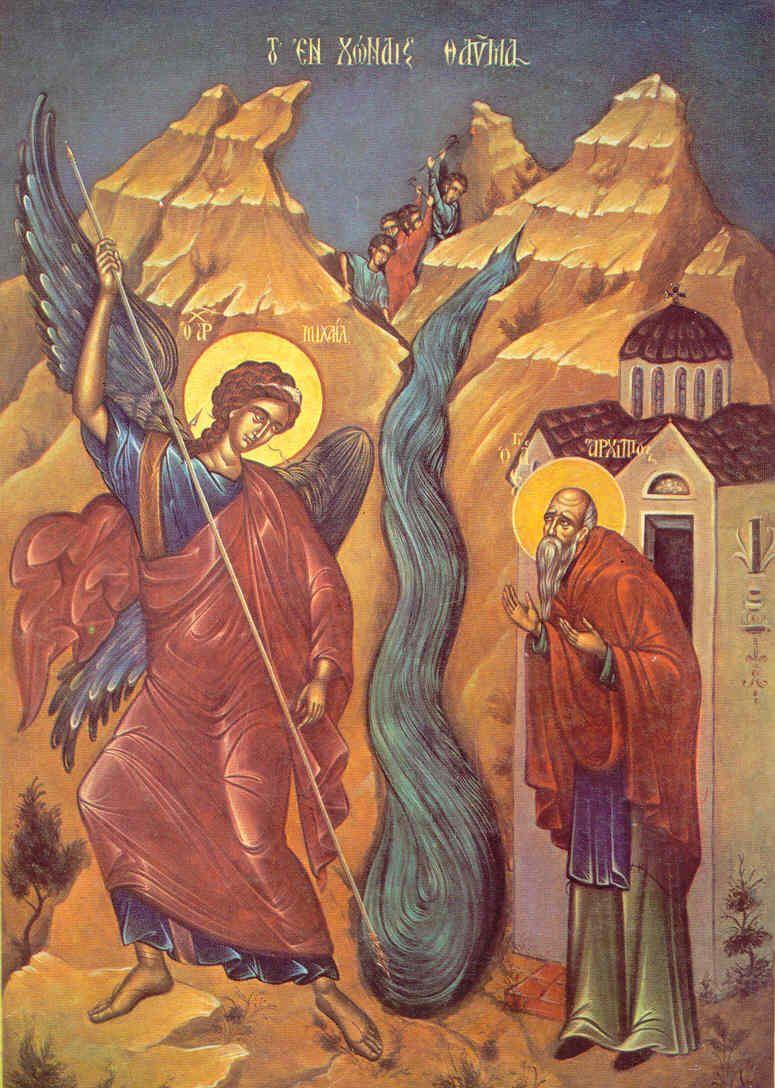
The great miracle of the Archangel Michael at Chonais (source)
Rejoice, O Taxiarch of the divine bodiless powers, who preserved your divine church in Chonais unscathed from the raging of two rivers, Lykou and Lykokamprou, which the lawless idolaters desired to destroy your spring of holy water and your holy church and your servant, Archippos. But you, O fiery torch and fire-bearer, appeared as a pillar of fire reaching from earth to heaven, and you advised him to not be afraid of the raging of the rivers, but you stood firm so that the unconquerable power of God might be seen. And having struck the hard rock with the staff you were holding in your hand, you divided it in two, moving the flow of the two rivers into the abyss which stands to this day. And your servant, together with the holy spring of your sacred church were saved and exist to this day. This area, which formerly was named Kolasses, was renamed Chonais, on behalf of this great miracle, and the funneling downward of the waters.
Rejoice, O good Taxiarch, the all-glorious General of the Good King, and the final consolation of His servants. Those who at the hour of their death are made worthy of your radiant presence, are delivered from the bitter darkness of the devil, as the darkness is dissolved by the light. This, do not cease to do for us, O all-perfect one, but now and then, "protect us underneath the shadow of your wings", and enlighten us with the light of your face.
Rejoice, O Taxiarch, defender of the righteous and guide of the venerable, monastics, hermits, and dwellers in monasteries.
Rejoice, O Taxiarch, who covers the modest and teaches those unlearned.
Rejoice, O Taxiarch, with a voice like a trumpet, who will proclaim the Second Coming of Christ our God, proclaiming to "heaven, the earth and under the earth", and awakening the dead who have slept for ages, to tell them mightily: "Behold the Bridegroom is coming, come forth to meet Him".
Then, as the Scriptures say, the Son of Man "will send His angels to proclaim loudly and to gather thr chosen from the four corners of the world, from one end of the earth to the other". Then, O all-great Archangel of God, do not forget me, I entreat you, do not separate me, the unworthy one, from that gathering, even if it is something great which I seek, do not pass over me, I entreat you, on behalf of your speedy path.
Holy Archangel Michael (source)
Rejoice, O Taxiarch, who is found with your fellow Angels round about God serving Him and offering Him as gifts the pure souls of the righteous. "For", as the Psalm says, "those around Him will offer gifts". Among which, O first-called by God and all-great one, entreat Him that I might be among them, together with your great and all-radiant helper and fellow-worker, the forerunner of new grace that is worthy of praise, the true divine apostle, who revealed the mystery to the Virgin [Mary], as I perceive him to be a Taxiarch like you and fellow-partaker in glory, Gabriel, the divine and most-glorious and most-perfect arch-deacon of our salvation, who is a perfect and true witness, which the scriptures bear witness to, "there is no one else to help me in these deeds, but only the leader of your nation, the Archangel Michael".
O divine Michael, head General of the angelic powers, him whom I sent to you, do heal, for your divine pharmacy is always full of medicines which relieve pains. And this encomium, like the mites which the Lord received from the widow, do you receive, and make us worthy to remain in your divine church, even though we are poor spiritually and we cannot offer to you something richer or more honorable, for the height of your glory is great and granted by God. Because, we cannot honor you as is right, with our human nous, you who were hyperbolically glorified by God and honored with the command of the choir of the Angels and Archangels. Because of this, as the Lord received the two mites, you too, do receive this encomium, O one graced by God, and because you hearken speedily, and fulfill our entreaties, send him back healthy whom I sent you, that we might all, together with all who are suffering, glorify you and Him Who glorified you, for to the Thrice-holy God belongs all glory, honor and worship, unto the ages. Amen.
(from the writings of St. Neophytos the Recluse, published by his Royal and Stavropegial Holy Monastery, Paphos, source)
Archangel Michael the Taxiarch (source)
Through the prayers of our Holy Fathers, Lord Jesus Christ our God, have mercy on us and save us! Amen!
Subscribe to:
Posts (Atom)