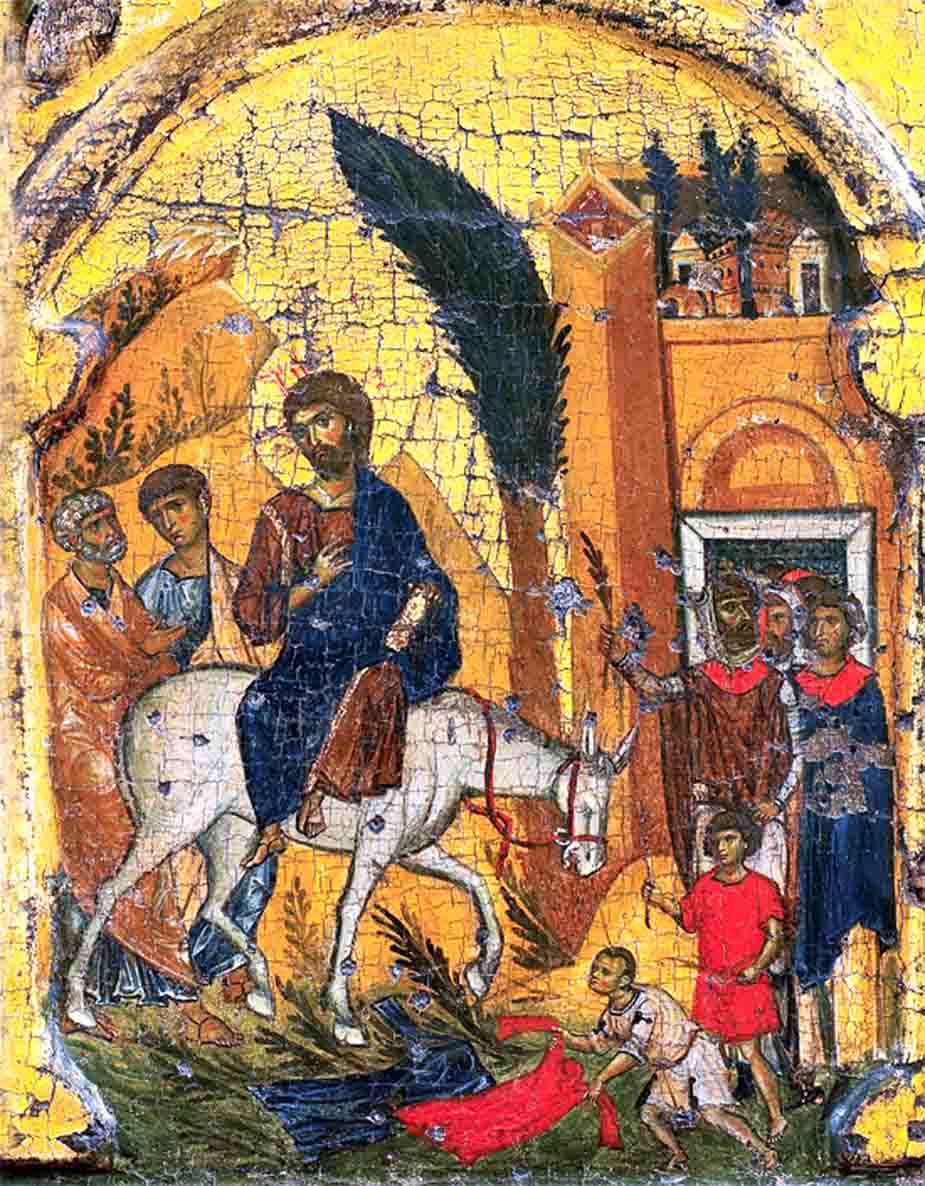
Showing posts with label Peace. Show all posts

Sunday, May 2, 2021

Quote from Elder Ephraim of Arizona on Holy Pascha

Christ is risen! Truly He is risen!
The Resurrection of Christ (source)

March 24th, 1980. Holy Pascha.

Today is the Resurrection of Christ.

"Come, receive the light, from the never-setting light..."

O, never-setting, perfect light that never sets, surpassingly bright and surpassingly white, O how you magnetize my nous, my soul, my heart! I desire you endlessly, with love and eros unending. When will I be made worthy of the gift of the compassion of my Most-Holy God the Father, to partake of You unto the ages of ages!

My unworthiness troubles me, that I am not worthy of such a place among the saved, but I am worthy of hell and of eternal punishment.

The Resurrection, the eternal Pascha, attracts me terribly. It draws me above the state of things. Above heaven. Above to the sure desire, which I greatly desire to find. But, when will this occur?

O Pascha, together with the Angels, with the Saints, dressed in white, who so greatly desire me and attract me! New songs and unspeakable words are chanted and praised to God, with an awesome, but also unspeakable peace and serenity.

O Pascha, without end, and transformation of the unspeakable joy and Festival! My Father and my God, preserve me from every evil that I myself might be made worthy, I the refuse, one day to be found at that Pascha which cannot be described in human words, nor expressed and spoken of.

Rejoice and exalt, you to as well, O my Lady Theotokos, at the arising of Your Son and God. In the divine beauty of your Son and God, remember me, the wretched one, that I might be found together with you in the eternal Pascha!

...It is the day of Resurrection, let us brilliantly shine forth, O people, Pascha, the Lord's Pascha.

I greet you this year, my Pascha.

(source)

Elder Ephraim at Pascha at St. Anthony's Monastery, Arizona (source)

Christ is risen from the dead, by death, trampling down upon death, and to those in the tombs, He has granted life!

Truly He is risen!

Friday, November 27, 2020

St. Porphyrios: "Unquestionably the higher state is love."

St. Porphyrios of Kavsokalyvia, with scenes from his life (source)

"Which is better? To be meek, humble, peaceful and to be filled with love, or to be irritable, depressed, and to quarrel with everyone? Unquestionably the higher state is love."

-St. Porphyrios of Kavsokalyvia

(source)

Through the prayers of our Holy Fathers, Lord Jesus Christ our God, have mercy on us and save us! Amen!
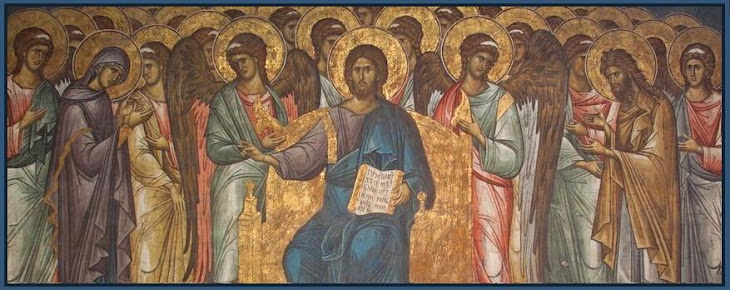
Wednesday, July 29, 2020

" for behold, she stands among us at the annual feast of her memory, granting the gifts of peace..."

St. Irene Chrysovalantou (source)

Come, all the faithful, let us hasten with diligence to Irene the God-bearer, for behold, she stands among us at the annual feast of her memory, granting the gifts of peace, distributing to each as they are worthy, as we have all been blessed by her gifts, and we behold the grace-filled mind with which she was rightly made worthy of. The lamp of virginity, the treasury of dispassion, the overflowing vessel of mystical fragrances, for in the house of God, she received this anointing, having the honor of rest. Therefore, she was adorned like the Angels with the angelic glory with which she was made worthy, and she ceaselessly intercedes with God, the Bestower of Peace, to grant peace to the world, and to save our souls.
-Doxastikon of the Aposticha for St. Irene Chrysovalantou

(source)
  
Through the prayers of our Holy Fathers, Lord Jesus Christ our God, have mercy on us and save us! Amen!

Tuesday, June 9, 2020

"And He opened His mouth and taught them..."

Icon of the Hospitality of Abraham, and type the Holy Trinity (source)
  
Seeing the crowds, he went up on the mountain, and when he sat down his disciples came to him. And he opened his mouth and taught them, saying:
"Blessed are the poor in spirit, for theirs is the kingdom of heaven.
"Blessed are those who mourn, for they shall be comforted.
"Blessed are the meek, for they shall inherit the earth.
"Blessed are those who hunger and thirst for righteousness, for they shall be satisfied.
"Blessed are the merciful, for they shall obtain mercy.
"Blessed are the pure in heart, for they shall see God.
"Blessed are the peacemakers, for they shall be called sons of God.
"Blessed are those who are persecuted for righteousness' sake, for theirs is the kingdom of heaven.
"Blessed are you when men revile you and persecute you and utter all kinds of evil against you falsely on my account. Rejoice and be glad, for your reward is great in heaven, for so men persecuted the prophets who were before you.
-Matthew 5:1-12
 
Through the prayers of our Holy Fathers, Lord Jesus Christ our God, have mercy on us and save us! Amen!

Thursday, April 23, 2020

St. Ephraim of Katounakia: "How very, very sweet Jesus is!"

Christ is risen! Truly He is risen!
Christ appearing to St. Mary Magdalene after His Resurrection (source)
  
"How very, very sweet Jesus is! Full of joy, full of love, full of peace, full of serenity, full of rejoicing, full of elation. How very, very sweet Jesus is."
--St. Ephraim of Katanoukia

(source)


Christ is risen from the dead, by death, trampling down upon death, and to those in the tombs, He has granted life!
Truly, the Lord has risen!

Friday, April 10, 2020

Photios Kontoglou: "Blessed is He Who comes in the name of the Lord"

Christ raising Lazarus, by Photios Kontoglou (source)
  
Photios Kontoglou: "Blessed is He Who comes in the name of the Lord"
He Whose throne is heaven, and Whose footstool is the earth, the Son of God and His Logos, Who is eternal with Him, today humbles Himself, and comes to Bethany on a little donkey.

And the children of the Hebrews received Him, crying out: "Hosanna in the highest, blessed is He Who comes, the King of Israel."

The warlords of the world, when they would finish a war and threw down their enemies, they would return glorified, and sitting on golden chariots to enter their city. Before them would go the trumpets and flags and brave generals and a multitude of soldiers, covered with iron armor and bearing weapons around a chariot that was filled with many pieces of armor and swords and spears that remained from the conquered nation.

Similar things like these were the great nails that they used in the Crucifixion of our Savior Jesus Christ!

All of these warriors were iron-clad like wild beasts, their heads locked within fearsome helmets, their spears and hairy hands were bloodied from war, their strong legs walked proudly and stretched, like a lion that tore apart a deer with its claws and stretches with roars and frightens the world.

Later would come the golden chariot of the warlord, where he would sit on a throne, adorned with precious stones, proud, haughty, fearsome, who could not be looked upon in the eye without averting one's gaze, carrying his terrible scepter, whose every movement of his command was an order, without opening the mouth of the one holding it.

Horses on that day, were harnessed to that chariot, with gold-embroidered straps with carousels and they also walked pompously and proudly like the humans. A beautiful girl, like a fairy, was decorated, holding a golden crown above the head of the champion, and other girls and boys tossed incense and other spices in great censers shaped like candelabras.

Behind them came the men and women who were taken as slaves, who were sick and wounded, and they were being dragged by the soldiers who struck them.

As much glory as the people had in front, so much disdain and misfortune had those who followed behind. They were bound with ropes and chains, many were pierced, tattered, wounded, jaundiced and half-dead, from their martyrdoms and from their vigils. Many were half-naked and their backs were darkened from the whips. Among them were women, ashamed virgins, stolen mothers with their innocent children in their hands, elderly who were holding on to their grandchildren by the hand, all traumatized like lamps going to the marketplace. Around them, the world grew insane and cried out, glorifying the victor, with many mouths foaming. A cry rose like smoke above the whole city. This scene, they called a "triumph."

One such triumph is performed today by Christ, the Price of Peace and of Love. However, He has changed all the rest and turned it upside down from what men were used to, and thus, His triumph is the triumph of poverty and humility.

The Roman ruler was seated upon a throne and golden chariot, but Christ is seated on a little donkey, possibly among the most humble and disdained among the animals.

And He Himself was humble, meek, silent, poorly-dressed, as the Prophecy which says: "Say to the daughter of Zion: Behold your King is coming, meek and having salvation is He, humble and mounted on a donkey, on a colt, the foal of a donkey." (Zachariah 9:9) His hand had never held a scepter, but blessed the world. He Himself is returning from war, but a war much more difficult to win, a war against evil and falsehood and hypocrisy and love of money.

And He was not going to rest from that war, but was going to begin another, even harder, to be crowned with a crown of thorns, and to be beaten and to mocked, and in the end, to be nailed upon a Cross like an evil-doer.

He was not surrounded by wild servants, but by innocent fishermen, who were disdained like Him. And He neither carried behind Him slaves that He tyrannized, but men whom He freed from the slavery of the Devil, and the dead whom He had raised through His voice.

They did not blare trumpets and drums to glorify Him, but innocent children, which symbolized the simplicity which Christians have, cried out: "Blessed is He Who comes", and instead of holding flags waved the green branches of trees. Verdant branches and clothes strewn on the road for the donkey to walk over.

And this blessed donkey, with a bowed head, humble, ignorant, bore Christ Who was sitting on its back, Whom the fiery six-winged Seraphim stand about with fear. He was not carried by a golden chariot, nor a prized stallion, nor even a seat held by others, but by a little donkey. What eye does not shed a tear and is not astonished by this mystery!

Christ overturned what sinful man saw regarding what is right and true. Who, however, is in the position to sense the freedom which He brings us, and would follow the donkey, and not the fine horses that glow proudly, which enter Rome with many idols, instead of entering together into the kingdom of Peace, the Jerusalem on high?

Many "serious" people, one could say, did not understand this, saying that the children where childish, and the men were manly. The same was said by the high priests, men of authority: But when the chief priests and the scribes saw the wonderful things that he did, and the children crying out in the temple, “Hosanna to the Son of David!” they were indignant;  and they said to him, “Do you hear what these are saying?” And Jesus said to them, “Yes; have you never read, ‘Out of the mouth of babes and sucklings thou hast brought perfect praise’?” And leaving them, he went out of the city to Bethany and lodged there." (Matthew 21:15-17)

The chief priests and the scribes had read the Psalm of David which said how the Christ would be met by the babes and they did not believe Him Whom they hymned. And if we have read today's Gospel and the Psalm and what Christ said to the Hebrews, would we not be judged more strictly than if we had not believed Him? Our vanity and our pride prevent us from going along His poor path, and we are ashamed to follow a leader Who is riding upon a donkey. We don't want the humble, the poor. Can one become a Christian who does not love that which Christ loved?

Yesterday, Saturday, He raised a dead man, Lazaros. Who was this Lazaros? Was he a notable, famous person? Lazaros was a poor villager, but as the Gospel says, he was a friend of Christ, Who would have all men as His friends.

The Gospel notes that Christ had a friend in the world, and that he was poor and unlearned. But who among us loves this rich poverty of Christ? Where Christ is missing, there is the true poverty, because where Christ is missing, there is also missing true life and death rules. This you would understand well if you look around you and ponder. Where are those almighty Roman leaders who made their triumphant entry, as we described above?  What happened to them, and the myriads that worshiped them and knelt before them like the reeds before the north wind? Who brings to mind those who wrote the history of that time?


Bodies, souls, thrones, diamonds, horses, pride, horrors, voices, all fell into a pit and were lost and extinguished as if they had never been drunk. And what is left of all this in people's hearts? Nothing and even less than nothing.
But man is unfaithful even to what he sees and what he grasps with his hands, and he pulls the path that they have taken, and he happily drags Nero's chariot, because "his neck is iron." His ears are pricked by Him Who says: "I am God, the first and the last, I am. I nourish my sheep and I will give them rest." He Who was sitting upon the donkey, it is He Who remains alive within simple souls unto the ages, and is for them a source of nourishment, a source of immortality, joy and delight, according to the words that say: "The heart of those who seek the Lord shall rejoice."

Yes, whoever senses the joy of Christ, is like that dead man [Lazaros] who was raised. There are many kinds of pain in the world. Those who suffer in body and soul, their pain cleanses them and takes them to God, and these are the beloved ones of Christ and walk in His army with His consoling light. The others suffer futily. That is why the Apostle Paul wrote to the Corinthians: "Now I rejoice, not because you were grieved, but because you were grieved into repenting; for you felt a godly grief, so that you suffered no loss through us.  For godly grief produces a repentance that leads to salvation and brings no regret, but worldly grief produces death." (2 Corinthians 7:9-10).

For those who hope in God, Christ transforms their futile sweat into sweat of salvation "a refreshing sweat", but we mourn and are pained in every way like the idolaters, slaughtered by the knives of fate. They did not allow their sweat of agony to become transformed into sweat of prayer and hope.

Whoever does not believe in Christ and in the Gospel is dead, as no true life exists within him. Because life does not mean to breath and to walk and to eat and drink, but to sense the grace of immortality. Then, one can chant together with that exceptional hymn that is the Apolytikion:

"By raising Lazarus from the dead before Your passion, You did confirm the universal Resurrection, O Christ God! Like the children with the palms of victory,  we cry out to You, O Vanquisher of death; Hosanna in the Highest! Blessed is He that comes in the Name of the Lord!
(source)
  
Christ entering Jerusalem on Palm Sunday (source)
  
Through the prayers of our Holy Fathers, Lord Jesus Christ our God, have mercy on us and save us! Amen!

Tuesday, April 7, 2020

Bishop Alexis of Bethesda on the Current Crisis

An ascetic in private prayer for the world (source)
  
3/25/2020 - "Some Thoughts on the Crisis and the Call of the Corona Virus"
by Bishop Alexis of Bethesda (OCA)
The Bishops of the Holy Orthodox Church love their flocks and ever strive to lead them to well-watered and rich pastures. They care for them, body and soul. In so doing, they are following their Master Christ who not only “cast out unclean spirits,” but also healed “all manner of sickness and all manner of disease among the people.” (Matthew 10:1). In the Gospels, we see that Christ sometimes treated the soul first and the body second; at other times, the body first and the soul second. In the presence of the highly contagious and potentially lethal corona virus, the Bishops’ concern is for the bodily welfare of their people lest even a single lamb be needlessly lost. This is not from a lack of faith or dearth of compassion, but from unwavering faith and an abundance of compassion.
  
Compassion is expressed in giving each sinner the time necessary to repent, for in “hell there is no repentance” (Saint John of Damascus). Faith is expressed in the certainty that our Lord can always be in our midst, that He can always be by our side, for the Psalmist proclaims, “If I ascend up into heaven, Thou art there: if I make my bed in hell, behold, Thou art there” (Psalm 139:8). And if I am shut up in my home away from Church, “Thou art there,” even as the Lord was there for and with the Apostle Peter when he was locked up in prison, so He is there for and with us.
  
During times of uncertainty, anxiety, and fear, we naturally turn to God for refuge, peace, and courage. This is our birthright as baptized Orthodox Christians. Indeed, “God is our refuge and strength, a very present help in trouble. Therefore, we will not fear though the earth should change” (Psalm 46:1-2). With the corona virus, the earth has changed, but we do not fear. The faithful are isolated in their homes, physically separated from loved ones, and even unable to gather together as the Church for the celebration of the mysteries, but we do not fear, for God remains our refuge, our peace, and source of courage. Many are understandably discouraged and downcast about the decision to ban eucharistic gatherings in Church for the sake of the health of our neighbor whom we love. Yet, God remains our refuge, our peace, and our source of courage. Within this trial, this threat to so much that we hold so very dear, there is a call that is given and a promise that beckons. But to hear that call and see the fulfilment of that promise, we need to approach our Savior as His faithful children have always approached Him, not with self-righteous indignation or self-pitying despondency, but with humble, patient hope.
  
The call is to prayer of the heart. The promise is the purifying and illumining grace of the Holy Spirit. In the emphasis on more frequent communion over the past forty years, we might be tempted to neglect the necessary ongoing moment-to-moment inner communion with Christ by prayer, that talking with Him and walking with Him that characterized most of the lives of the Apostles before and after the institution of the Mystical Supper. Many of our greatest saints were deprived of Holy Communion for periods of time that for us would be unbearable to contemplate, but that for them were periods of continued growth from glory to glory, because they were never without Holy Communion with Christ through prayer. Prayer is not easy; it requires concentration, dedication, and love, but through the gates of prayer, we can touch Christ, Christ can touch us, and we can be healed. It is imperative for us all to learn to serve Liturgy at the Altar of the heart and the time is now at hand.
  
During this crisis of the corona virus, we are given the opportunity to become men and women of deep prayer. We are given the occasion to “enter into our closet, and when we have shut the door, pray to our Father which is in secret” (Matthew 6:6), offering Him our repentance, our gratitude, and our love. We can come to understand that “prayer is a safe fortress, a sheltered harbor, a protector of the virtues, a destroyer of passions. It brings vigor to the soul, purifies the mind, gives rest to those who suffer, consoles those who mourn. Prayer is converse with God, contemplation of the invisible, the angelic mode of life, a stimulus towards the divine, the assurance of things longed for, ‘making real the things for which we hope’” (Theodore, the Great Ascetic, Century 1:61).  As Saint Sophrony of Essex puts it, “prayer is infinite creation, far superior to any form of art or science. Through prayer we enter into communion with Him that was before all worlds…Prayer is delight for the Spirit.” (On Prayer, 9).
  
The Elder Aimlianos whose love for the Divine Liturgy was incomparable once said, “It is pointless to go to Church, unnecessary to attend Liturgy, and useless to commune, when I am not constantly praying” (The Church at Prayer, 14).  A spiritual life of private prayer is not a monastic prerogative, but the common inheritance of all the faithful. The saintly elder further notes, “The harm that befalls us if we do not know how to pray is incalculable. Incalculable? It is the only harm from which we suffer. There is no catastrophe that can compare to it. If all the stars and all the planets were to collide with one another, and the universe to shatter into smithereens, the damage would be far less than that which befalls us if we don’t know how to pray”  (The Church at Prayer, 10). The threat of the virus perhaps can open our eyes to the threat of not knowing how to pray to God in our heart. The threat of the virus may turn into a blessing that can enliven our spiritual life.
  
The temptation before us is to deafen our ears to this call to active, arduous prayer to approach God and instead to prefer more passive, easier ways for God to approach us. Now is not the time to try to devise any means to avoid this prayer in private, but it is the time to heed the call to prayer in our heart to the God of our heart. There is a rich, inner world beckoning to us, a world where God is all in God. Let’s take the gift of this time to enter into that world.  And if we do so, when we come together for the Divine Liturgy with a yearning magnified by distance apart, that Liturgy will be more radiant and more angelic than anything we have known before. Through a deep life of inner prayer, we will indeed learn how to set aside all earthly cares, that we may receive the King of all.
(source)
  
The Holy Prophet Jonah (source)
  
4/3/2020 - "The Sign of the Prophet Jonah in our days"
by Bishop Alexis of Bethesda (OCA)
“For those with eyes to see and ears to hear,” these days of being in the belly of the whale, physically separated not only from one another, but also from our beloved Churches and places of prayer, we have a rare opportunity for spiritual growth. In this crisis that has overcome the entire inhabited world, we are given the sign of Jonah that calls forth a response from us all. Saint Ephraim the Syrian writes, “the sign of Jonah served the Ninevites in two ways. If they would have rejected it, they would have gone down to Sheol alive like Jonah, but they were raised from the dead like him because they repented.” The sign of Jonah that is given to us in our forced isolation out of love for our neighbor is a call to repentance, a call to change the way we look at the world around us, the world within us, and the world beyond us. As I suggested in an earlier reflection, it is an opportunity to become men and women of deep prayer who have learned to serve the Divine Liturgy on the altar of their hearts.
  
There are many books about how to pray from which believers can learn the art of prayer. There are many prayer books that have morning prayers, evening prayers, services of supplication, and akathists that the faithful can read on a daily basis. There are the Psalms of David that we can chant throughout the day enabling us to pour out our entire heart before God. And of course, there is the Jesus Prayer, “Lord Jesus Christ have mercy on me,” that every God-loving soul can say, again and again and again, so that it falls like a droplet of pure water upon our stony hearts refashioning them into hearts of flesh that can welcome the King of glory. But all these beautiful, holy words will enable us to touch the hem of Christ’s garment and to become more Christlike in the process only if we say them with the proper disposition of the heart, a heart that is humble, a heart that yields, a heart that can effortlessly utter the words of the Most Pure Virgin, “Behold the handmaid of the Lord; be it unto me according to thy word” (Luke 1:38).
  
This Holy Week and Pascha, the Covid-19 pandemic has given the faithful a hard saying. They will be deprived of celebrating these high and holy days in their parishes. They will be deprived of receiving holy communion. Nevertheless, they need not, now or ever, be deprived of Christ, for nothing, neither death nor life, neither things present nor things to come, can ever “separate us from the love of God, which is in Christ Jesus our Lord” (Romans 8:39). It may be tempting to become angry or despondent, but neither of these states will enable us to pray to God or permit God to approach us. Neither of these responses will help us to receive the sign of Jonah given to our generation. What will enable us to pray is a humble acceptance of our condition in which we make peace with this world as it is, a willingness to yield before that which we cannot control, and then even further to give thanks for the fact that our own will, no matter how good and holy it may seem to us, is being cut off by the severe sanctions now in place. This may sound strange to those unfamiliar with our monastic tradition, but truly when the will is cut off, “the holy soul steadily ascends to heaven as upon golden wings” (Saint John of the Ladder) by virtue of holy obedience. In other words, gently, graciously, and gratefully yielding to this situation with humble acceptance will enable us to pray as we have never prayed before.
  
Obedience is not easy. It is “the tomb of the will,” but it is also “the resurrection of humility,” (Saint John of the Ladder), humility, which is “the very raiment of the Godhead” (Saint Isaac the Syrian). In humble obedience, we are following not only the path of the holy fathers of old, we are walking not only in the footsteps of the Apostles who strove to be obedient to every commandment of their beloved Lord, but we are also imitating our Lord Himself, who “as a man, he humbled himself, and became obedient unto death, even the death of the cross” (Phillipians 2:8). But death is never the last word with respect to obedience, the final word is always life, abundant life, life everlasting. “Wherefore God also hath highly exalted him, and given him a name which is above every name:  That at the name of Jesus every knee should bow, of things in heaven, and things in earth, and things under the earth; And that every tongue should confess that Jesus Christ is Lord, to the glory of God the Father” (Phillipians 2:9-11).
  
Let us receive humbly the sign of the Prophet Jonah in a way that leads to the light and life that are ours in Christ Jesus. This Pascha, let’s sanctify our homes and lives in wonderful ways. Let’s humbly do whatever is necessary to make one room in our home into a Church. If we don’t have an oil lamp burning before the icon of the Most Pure Virgin Theotokos, let’s try to acquire one. If we don’t have a hand censer, charcoal, and incense, let’s decide to order them. And then with a humble, but grateful heart, let’s worship the holy Lord Jesus Christ, the only sinless One. Let’s venerate the icons in our homes, let’s light our vigil light, let’s cense our icons, let’s make our prostrations, and let’s make the words of whatever prayers we offer our own. Let’s mean what we say. Let’s trust in the Lord. Saint Isaac the Syrian once wrote, “The prayer of a humble man is like a word spoken from the mouth into an ear.” Let’s speak to God now as his humbled children, for in this time of trial, He will surely “hearken unto the voice of our cry” (Psalm 5:2) and in turn make our peace as a river and our righteousness as the waves of the sea (Isaiah 48:18).
(source)
  
Christ in prayer in the Garden of Gethsemane before His Passion (source)
  
Through the prayers of our Holy Fathers, Lord Jesus Christ our God, have mercy on us and save us! Amen!

Friday, March 20, 2020

St. John Maximovitch: Nothing is Fearful for the Person Whose Hope is in God

Jesus Christ the Son of God the Savior of the world (source)
  
Note: This beautiful talk from St. John the Wonderworker highlights the beauty of a life without fear as long as one has hope in our Lord. May we obey our medical, civic and spiritual leaders, and pray with trust and hope in our Lord, as we weather this storm.
  
"Where can I go from Thy Spirit, and where can I escape from Thy presence? If I go up into heaven, Thou art there; if I go down into hades, Thou art present there. If I take up my wings toward the dawn, and make mine abode in the uttermost parts of the sea, even there shall Thy hand guide me, and Thy right hand shall hold me.” (Psalm 138: 7-10) 

These divinely inspired words of the Psalmist David should be particularly in our thoughts during these days, when the entire world is literally quaking, and from every direction comes news of all kinds of distress, shocks and calamities.

Before you can concentrate on what is occurring in one country, you are distracted by even more threatening events which have unexpectedly erupted someplace else; and before you can get a grasp on them, yet other news distracts your attention to still some other location, forcing you to lose track of the previous ones, even though they have by no means reached their conclusion. 
 
In vain do “the representatives of the nations consult in order to find a remedy for the common affliction. They encourage one another and others, saying, 'peace, peace,' when there is no peace." (Jeremiah 6:14; 8:11)
 
Calamities in the lands where they are unfolding do not come to an end, when suddenly new ones begin in places which had been considered safe and calm. 
 
Those who flee from troubles in one place find themselves amid troubles elsewhere that are even worse. "As if a man fled from a lion, and a bear met him; or went into his house and leaned with his hand against the wall, and a serpent bit him.” (Amos 5:19) Or, as another prophet says, "He who flees at the sound of the terror shall fall into the pit; and he who climbs out of the pit shall be caught in the snare. For the windows of heaven are opened, and the foundations of the earth tremble." (Isaiah 24: 18)
 
This is what we see happening in our days.
 
A person sets out for his peaceful occupation and suddenly falls the victim of military action which erupted in a place where no one had expected it. 
 
The person who escapes danger from military action, finds himself amid the horrors of natural catastrophes, of an earthquake or typhoon. 
 
Many meet their death where some had escaped it, while other people are prepared to risk their lives rather than waste away in places considered to be secure, because they anticipate other catastrophes which could soon come upon those areas.
 
It would seem that there is no place on the globe in recent times that remains a peaceful and calm haven from troubles in the world. 
 
Everything has become complicated: politically, economically, socially. "Danger from rivers, danger from robbers, danger from my own people, danger from Gentiles, danger in the city, danger in the wilderness, danger at sea, danger from false brethren," as the Apostle Paul wrote (2 Corinthians 11: 26). And to these dangers in our days we must add also, "danger in the air and danger from the sky," which are especially frightful. 
 
But when all the dangers listed by the Apostle Paul were endured by this glorious Chief of the Apostles, he had a great consolation. He knew that he was suffering for Christ and that Christ would reward him for these sufferings. "For I know Whom I have believed, and I am sure that He is able to guard until that Day what has been entrusted to me" (2 Timothy 1: 12).  He knew that the Lord would grant him the strength necessary to endure even greater tribulations, and for this reason he boldly says, "I can do all things in Jesus Christ Who strengthens me" (Philippians 4: 13).
 
These current catastrophes are so terrible for us, because they have come upon us because we are not firm in the Faith, and because we are not enduring them for the sake of Christ. For that reason, we have no hope of receiving crowns for them. 
 
And what is even worse, and leaves us powerless in our efforts to counteract our misfortunes, is that we do not strengthen ourselves with the power of Christ.  We put our hope, not in God, but in human powers and means.  We forget the words of the Sacred Scriptures: "Put not your hope in princes, in the sons of men, in whom there is no salvation. Blessed is he whose hope is the God of Jacob, whose hope is in the Lord his God" Psalm 145: 3, 5). And again: "Unless the Lord builds the house, the builders labor in vain; unless the Lord guards the city, the watchman keeps awake in vain" (Psalm 126: 1).
   
We keep trying to find a firm foundation apart from God. And so, we suffer what was foretold by the prophet: "This sin will become for you like the sudden collapse of the wall of a strong city under siege," and which is then immediately vanquished (Isaiah 30: 13). Woe to those who are leaning against those walls! Just as a collapsing wall crushes those who are leaning on it, in the same way, with the destruction of false hopes, all those who placed their trust in them will perish. Their hope will be like a "staff of reed." "When they grasped you with the hand, you broke, and pierced their shoulders; and when they leaned upon you, you broke, and injured their loins" (Ezekiel 29: 7).
 
It is entirely different with those who seek the help of God.  "God is our refuge and strength, our helper in the troubles that grievously befall us. So we will not fear though the earth should rock and mountains be hurled into the heart of the sea" (Psalm 45: 2-3).
 
Nothing is fearful for the person whose hope is in God. He does not fear men who work evil.  "The Lord is my light and my Savior: whom shall I fear? The Lord is the guard of my life; from whom shall I shrink?" (Psalm 26: 1). The horrors of war are not fearful for him. "Though an army encamp against me, my heart shall not fear; though war rise against me, my hope is in Him" (Psalm 26: 3). He is calm when he lives at home. "He who dwells in the help of the Most High, will live in the protection of the God of Heaven" (Psalm 90: 1). He is ready to sail across the sea. "Thy ways are in the sea, and Thy paths in many waters" (Psalm 76: 20).  Boldly, literally on wings, he flies through the sky to distant lands, saying, "Even there Thy hand will guide me and Thy right hand will hold me" (Psalm 138: 10). He knows that if it pleases God to protect his life, "A thousand may fall at your side and ten thousand at your right hand: but it will not come near you" (Psalm 90: 7).  
 
Even death is not fearful for him, because, for the person whose life is Christ, death is gain (Philippians 1: 21). “Who shall separate us from the love of Christ? Shall tribulation, or distress, or persecution, or famine, or nakedness, or peril, or sword? As it is written, 'For Thy sake we are being killed all the day long; we are regarded as sheep to be slaughtered.' No, in all these things we are more than conquerors through Him Who loved us. For I am sure that neither death, nor life, nor angels, nor principalities, nor things present, nor things to come, nor powers, nor height, nor depth, nor anything else in all creation, will be able to separate us from the love of God in Christ Jesus our Lord" (Romans 8: 35-39). "Since we have these promises, beloved, let us cleanse ourselves from every defilement of body and spirit, and make holiness perfect in the fear of God" (2 Corinthians 7: 1).  
 
This is what the Lord says: "Loose the bonds of wickedness; forgive unjust debts; let the oppressed go free; tear up every unjust agreement. Share your bread with the hungry, and bring the homeless poor into your house.  When you see the naked, cover him, and do not mistreat your own people. Then shall your light break forth like the dawn, and your healing shall spring up speedily; your righteousness shall go before you, the glory of the Lord shall be your rearguard. Then you shall call, and the Lord will answer; you shall cry, and He will say, Here I am” (Isaiah 58: 6-9).  
 
Lord, teach me to do Thy will and hear me on the day that I call upon Thee! 
May Thy mercy, O Lord, be upon us, for we have placed our hope in Thee.
Humble John, Bishop of Shanghai
August 30, 1937
St. Alexander Nevsky
@ 2020 "Russkiy Pastyr": English translation of the article "To the Orthodox Flock of Shanghai" 
  
St. John Maximovitch (source)
  
Through the prayers of our Holy Fathers, Lord Jesus Christ our God, have mercy on us and save us! Amen!

Thursday, February 6, 2020

Elder Aimilianos: "If I am not joyous, then I am nothing!"

The Parable of the Prodigal Son (source)
  
"The lack of joy is a pathological state of man, a willing closure within one's self. And whatever he wishes to do he will not be successful.

First, one must clean his field, to find out what is going on and why he is not joyous. Then, he must pursue joy within himself, and then the peace of God will take the place of joy. Thus, man should keep his relationship with God and with his Elder [or Spiritual Father], and should seek a true life.

Am I good, faithful, perfect, holy?
Am I a teacher?
If I am not joyous, then I am nothing.

It is important when they tell me: "Physician, heal thyself, and then, offer him to God." God cannot enter into a heart that is not joyful, He cannot find a place of contact, because He is peace, He is the fulfillment of joy.

Only like things can unite, and because of this, God can only unite with a joyous soul. For the monk who is not joyous, the Elder cannot do anything at all, his hands are totally tied.

Whoever thinks that he is approaching to reach "the measure of the stature of the fullness of Christ", but is not joyous, can understand that he is totally deluded. Joy is the criterion, the thermometer.
Joy is something external, but it is also something internal.

Ultimately, it is a necessary presupposition, because the lack of joy makes man study things differently and to become changed. For example, if one puts even one drop of nitric oxide into pure water, immediately he changes its essence. Thus, exactly, one drop of bitterness, depression, sadness transforms the whole atmosphere of a person, and extinguishes God.

But joy must also exist in a brotherhood [or a family], because it is an element both of one's personal life and of the brotherhood.

I cannot be joyous if all those around me do not have the tendency and the atmosphere of joy, neither, however, can I have any benefit if I do not take on this joy from the brotherhood.

Only when I take it on can I say that I have a relationship with the Elder, and then I can take in God, because God is the life that exists within man, and the life which is transmitted through man."
-Elder Aimilianos of Simonopetra, from the book Neptic Life and the Ascetical Canons
(source)
  
Elder Aimilianos of Simonopetra (+2019) (source)
  
Through the prayers of our Holy Fathers, Lord Jesus Christ our God, have mercy on us and save us! Amen!