St. Maximos the Confessor: from the Chapters on Knowledge
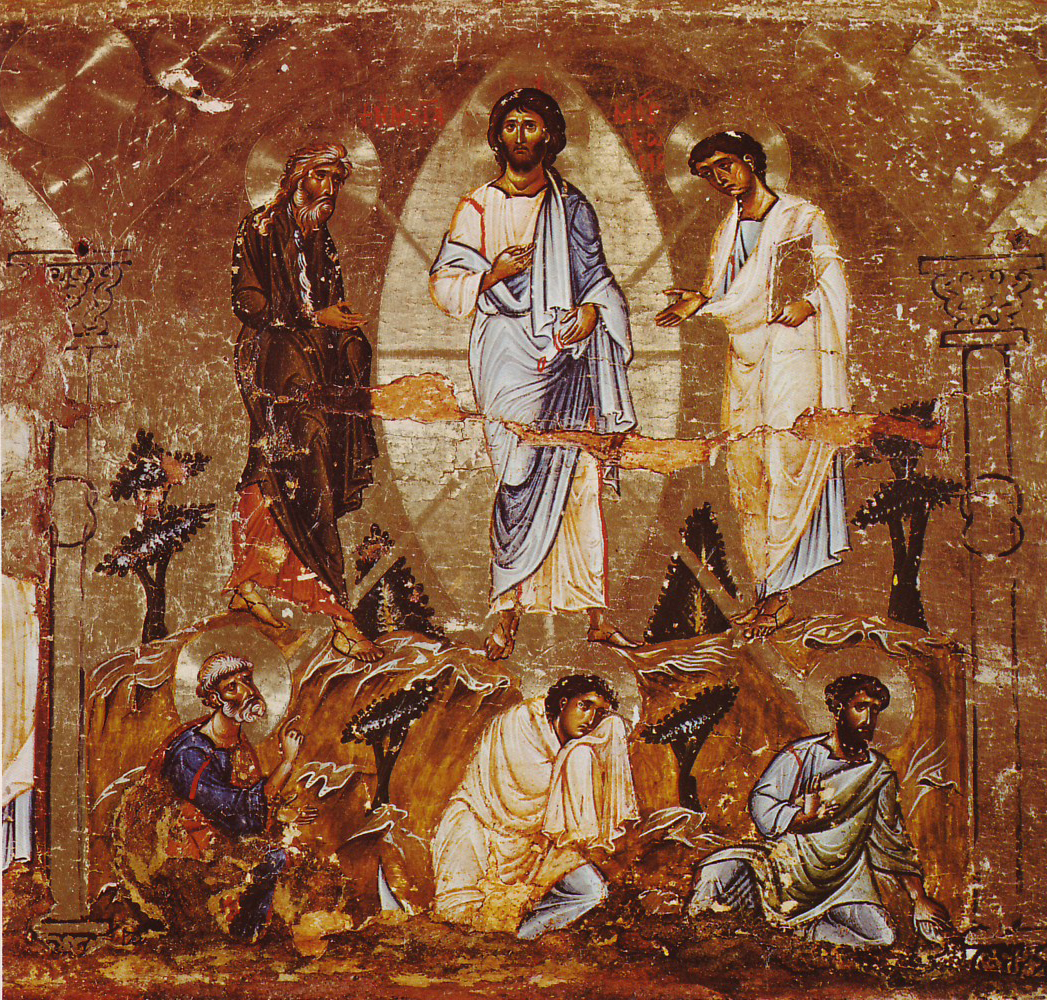
"14. When the Word of God becomes bright and shining in us, and His face is dazzling as the sun, then also will His clothes be radiant, that is, the clear and distinct words of the Holy Scripture of the Gospels now no longer veiled. Then Moses and Elijah shall stand beside Him (cp. Mt 17.3), that is, the more spiritual meanings of the Law and the Prophets.
18. The one who prays ought never to halt his movement of sublime ascent toward God. Fur just as we should understand the ascent ‘from strength to strength’ as the progress in the practice of the virtues, ‘from glory to glory’ (2 Cor 3.18) as the advance in the spiritual knowledge of contemplation, and the transfer from the letter of sacred writing to its spirit, so in the same way the one who is settled in the place of prayer should lift his mind from human matters and the attention of the soul to more divine realities. This will enable him to follow the one who has ‘passed through the heavens, Jesus the Son of God’ (Heb 1.14), who is everywhere and who in His incarnation passes through all things on our account. If we follow Him, we also pass through all things with Him and come beside Him if we know Him not in the limited condition of His descent in the incarnation, but in the majestic spleandour of his natural infinitude.
21. In Christ who is God and the Word of the Father there dwells in bodily form the complete fullness of deity by essence; in us the fullness of deity dwells by grace whenever we have formed in ourselves every virtue and wisdom, lacking in no way which is possible to man in the faithful reproduction of the archetype. For it is not unnatural thereby that the fullness of deity dwell also in us by adoption (cp. Eph 1.5, Rom 8.15) expressed in the various spiritual ideas.
22. Just as the human word which proceeds naturally from the mind is messenger of the secret movements of the mind, so does the Word of God, who knows the father by essence as Word knows the Mind which has begotten it (since no created being can approach the Father without Him), reveal the Father whom He knows. As the Word of God by nature, He is spoken of as the ‘messenger of the great plan of God.’
23. The great plan of God the Father is the secret and unknown mystery of the dispensation which the only begotten Son revealed by fulfilling in the incarnation, thus becoming a messenger of the great plan of God the eternal Father. The one who knows the meaning of the mystery and who is so incessantly lifted up both in work and in word through all things until he acquires what is sent down to him is likewise a messenger of the great plan of God.
24. If it was for us that the Word of God in His incarnation descended into the lower parts of the earth and ascended above all the heavens; while being Himself perfectly unmoved, he underwent in Himself through the incarnation as man our future destiny. Let the one who is moved by a love of knowledge mystically rejoice in learning of the great destiny which He has promised to those who love the Lord.
25. If the Word of God and God the Son of the Father became son of man and man Himself for this reason, to make men gods and sons of God, then we must believe that we shall be where Christ is now as head of the whole body having become in His human nature a forerunner to the Father on our behalf. For God will be in the ‘assembly of the gods’ (Ps 82.1), that is, of those who are saved, standing in their midst and apportioning there the ranks of blessedness without any spatial distance separating Him from the elect.
33. The one who engages in a pursuit of wisdom out of devotion and stands prepared against the invisible forces should pray that both the natural discernment (with its proportionate light) and the illuminating grace of the Spirit remain with him. The former trains the flesh in the acquisition of virtue through asceticism while the latter illuminates the mind to select the companionship of wisdom before all others, according to the Scripture, ‘He works the destruction of the strongholds of evil and of every pretension which raises itself up against the knowledge of God’ (2 Cor 10.5). Joshua the son of Nun clearly shows this by asking in prayer, ‘Stand still, O sun, at Gibeon’ (Josh 10.12), that is, that the light of the knowledge of God be kept secure for him in the mountain of spiritual contemplation, ‘and the moon in the valley,’ that is, that the natural discernment which lies in the frailty of the flesh remain steadfast through virtue.
34. Gibeon is the higher mind, and the valley is the flesh which is weighed down by death. And the sun is the Word who illuminates the mind and inspires it with the power of contemplative experience and delivers it from every ignorance. The moon is the law of nature which persuades the flesh to subject itself lawfully to the spirit by accepting the yoke of the commandments. The moon is symbolic of nature in that it is changeable; but in the saints it remains unchanging through the unchangeable habit of virtue.
37. In the active person the Word grows fat by the practice of virtue and becomes flesh. In the contemplative it grows lean by spiritual understanding and becomes as it was in the beginning, God the Word.
38. The one who is involved in the moral teaching of the Word through rather earthly examples and words out of consideration for his hearers is making the Word flesh. On the other hand, the one who expounds mystical theology using the sublimest contemplative experiences is making the Word spirit.
39. The one who speaks of God in positive affirmations is making the Word flesh. Making use only of what can be seen and felt he knows God as their cause. But the one who speaks of God negatively through negations is making the Word spirit, as in the beginning He was God and with God. Using absolutely nothing which can be known, he knows in a better way the utterly Unknowable.
40. The one who through asceticism and contemplation has known how to dig in himself the wells of virtue and knowledge as did the patriarchs will find Christ within as the spring of life. Wisdom bids us to drink from it, saying, ‘Drink waters from your own vessels and from your own springs’ (2 Ki 18.31). If we do this we shall discover that His treasures are present within us.
73. So long as we see the Word of God take flesh in the letter of holy writings in a variety of figures, we have not yet spiritually seen the incorporeal and simple and singular and only Father as in the incorporeal and simple and singular and only Son. As the Scripture says, ‘The one who has seen Me has seen the Father’ (Jn 14.9), and also, ‘I am in the Father and the Father is in Me’ (Jn 14.10). It is, therefore, very necessary for a deep knowledge that we first study the veils of the statements regarding the Word and so behold with the naked mind the pure Word as He exists in Himself, who clearly shows the Father in Himself, as far as it is possible for men to grasp. Thus it is necessary that the one who seeks after God in a religious way never holds fast to the letter lest he mistakenly understand things said about God for God Himself. In this case we unwisely are satisfied with the words of Scripture in the place of the Word, and the Word slips out of the mind while we thought by holding onto this garment we could possess the incorporeal Word. In a similar way did the Egyptian woman lay hold not of Joseph but of his clothing, and the men of old who remained permanently in the beauty of visible things and mistakenly worshipped the creature instead of the Creator.
74. The meaning of holy writings reveals itself gradually to the more discerning mind in loftier senses when it has put off the complex whole of the words formed in it bodily, as in the sound of a gentle breeze. Through a supreme abandonment of natural activities, such a mind has been able to perceive sense only in a simplicity which reveals the Word, the way that the great Elijah was granted the vision in the cave at Horeb (cp. 1 Ki 19). For Horeb means ‘newness,’ which is the virtuous condition in the new spirit of grace. The cave is the hiddenness of spiritual wisdom in which one who enters will mystically experience the knowledge which goes beyond the senses and in which God is found. therefore, anyone who truly seeks God as did the great Elijah will come upon Him not only on Horeb, that is, as an ascetic in the practice of the virtues, but also in the cave of Horeb, that is, as a contemplative in the hidden place of wisdom which can exist only in the habit of the virtues.
76. The divine Apostle Paul said that he knew in part the knowledge of the Word (cp. 1 Cor 13.9). But the great Evangelist John said that he saw His glory: ‘We have seen His glory, the glory as the Only Begotten of the Father, full of grace and truth’ (Jn 1.14). And why did St Paul say that he knew in part the knowledge of the divine Word? For He is known only to a certain extent through His activities. The knowledge of Himself in His essence and personhood remains inaccessible to all angels and men alike, and He can in no way be known by anyone. Bt St John, initiated as perfectly as humanly possible into the meaning of the Word’s incarnation, claims that he has seen the glory of the Word as flesh, that is, he saw the reason or the plan for which God became man, full of grace and truth. For it was not as God by essence, consubstantial to God the Father, that the Only Begotten Son gave this grace, but as having in the incarnation become man by nature, and consubstantial to us, that He bestows grace on all who have need of it. This grace we receive from His fullness always in proportion to our progress. Therefore, the one who keeps sacred the whole meaning of the Word of God’s become incarnate for our sake will acquire the glory full of grace and truth of the One who for our sake glorifies and consecrates Himself in us by His coming: ‘When He appears we shall be like Him’ (1 Jn 3.2)."
(taken from: http://hagioipateres.wordpress.com/2005/01/21/st-maximos-the-confessor-from-the-chapters-on-knowledge/)
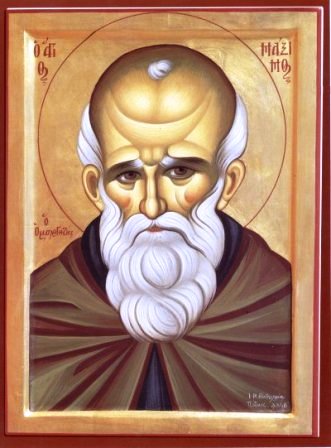
Apolytikion of St. Maximos the Confessor in the Plagal of the Fourth Tone
You are a guide of Orthodoxy, a teacher of piety and modesty, a luminary of the world, the God inspired pride of monastics. O wise Maximos, you have enlightened everyone by your teachings. You are the harp of the Spirit. Intercede to Christ our God for the salvation of our souls.
Through the prayers of our Holy Fathers, Lord Jesus Christ our God, have mercy on us and save us! Amen!