Showing posts with label The Raising of Lazarus. Show all posts

Friday, April 10, 2020

Photios Kontoglou: "Blessed is He Who comes in the name of the Lord"

Christ raising Lazarus, by Photios Kontoglou (source)
  
Photios Kontoglou: "Blessed is He Who comes in the name of the Lord"
He Whose throne is heaven, and Whose footstool is the earth, the Son of God and His Logos, Who is eternal with Him, today humbles Himself, and comes to Bethany on a little donkey.

And the children of the Hebrews received Him, crying out: "Hosanna in the highest, blessed is He Who comes, the King of Israel."

The warlords of the world, when they would finish a war and threw down their enemies, they would return glorified, and sitting on golden chariots to enter their city. Before them would go the trumpets and flags and brave generals and a multitude of soldiers, covered with iron armor and bearing weapons around a chariot that was filled with many pieces of armor and swords and spears that remained from the conquered nation.

Similar things like these were the great nails that they used in the Crucifixion of our Savior Jesus Christ!

All of these warriors were iron-clad like wild beasts, their heads locked within fearsome helmets, their spears and hairy hands were bloodied from war, their strong legs walked proudly and stretched, like a lion that tore apart a deer with its claws and stretches with roars and frightens the world.

Later would come the golden chariot of the warlord, where he would sit on a throne, adorned with precious stones, proud, haughty, fearsome, who could not be looked upon in the eye without averting one's gaze, carrying his terrible scepter, whose every movement of his command was an order, without opening the mouth of the one holding it.

Horses on that day, were harnessed to that chariot, with gold-embroidered straps with carousels and they also walked pompously and proudly like the humans. A beautiful girl, like a fairy, was decorated, holding a golden crown above the head of the champion, and other girls and boys tossed incense and other spices in great censers shaped like candelabras.

Behind them came the men and women who were taken as slaves, who were sick and wounded, and they were being dragged by the soldiers who struck them.

As much glory as the people had in front, so much disdain and misfortune had those who followed behind. They were bound with ropes and chains, many were pierced, tattered, wounded, jaundiced and half-dead, from their martyrdoms and from their vigils. Many were half-naked and their backs were darkened from the whips. Among them were women, ashamed virgins, stolen mothers with their innocent children in their hands, elderly who were holding on to their grandchildren by the hand, all traumatized like lamps going to the marketplace. Around them, the world grew insane and cried out, glorifying the victor, with many mouths foaming. A cry rose like smoke above the whole city. This scene, they called a "triumph."

One such triumph is performed today by Christ, the Price of Peace and of Love. However, He has changed all the rest and turned it upside down from what men were used to, and thus, His triumph is the triumph of poverty and humility.

The Roman ruler was seated upon a throne and golden chariot, but Christ is seated on a little donkey, possibly among the most humble and disdained among the animals.

And He Himself was humble, meek, silent, poorly-dressed, as the Prophecy which says: "Say to the daughter of Zion: Behold your King is coming, meek and having salvation is He, humble and mounted on a donkey, on a colt, the foal of a donkey." (Zachariah 9:9) His hand had never held a scepter, but blessed the world. He Himself is returning from war, but a war much more difficult to win, a war against evil and falsehood and hypocrisy and love of money.

And He was not going to rest from that war, but was going to begin another, even harder, to be crowned with a crown of thorns, and to be beaten and to mocked, and in the end, to be nailed upon a Cross like an evil-doer.

He was not surrounded by wild servants, but by innocent fishermen, who were disdained like Him. And He neither carried behind Him slaves that He tyrannized, but men whom He freed from the slavery of the Devil, and the dead whom He had raised through His voice.

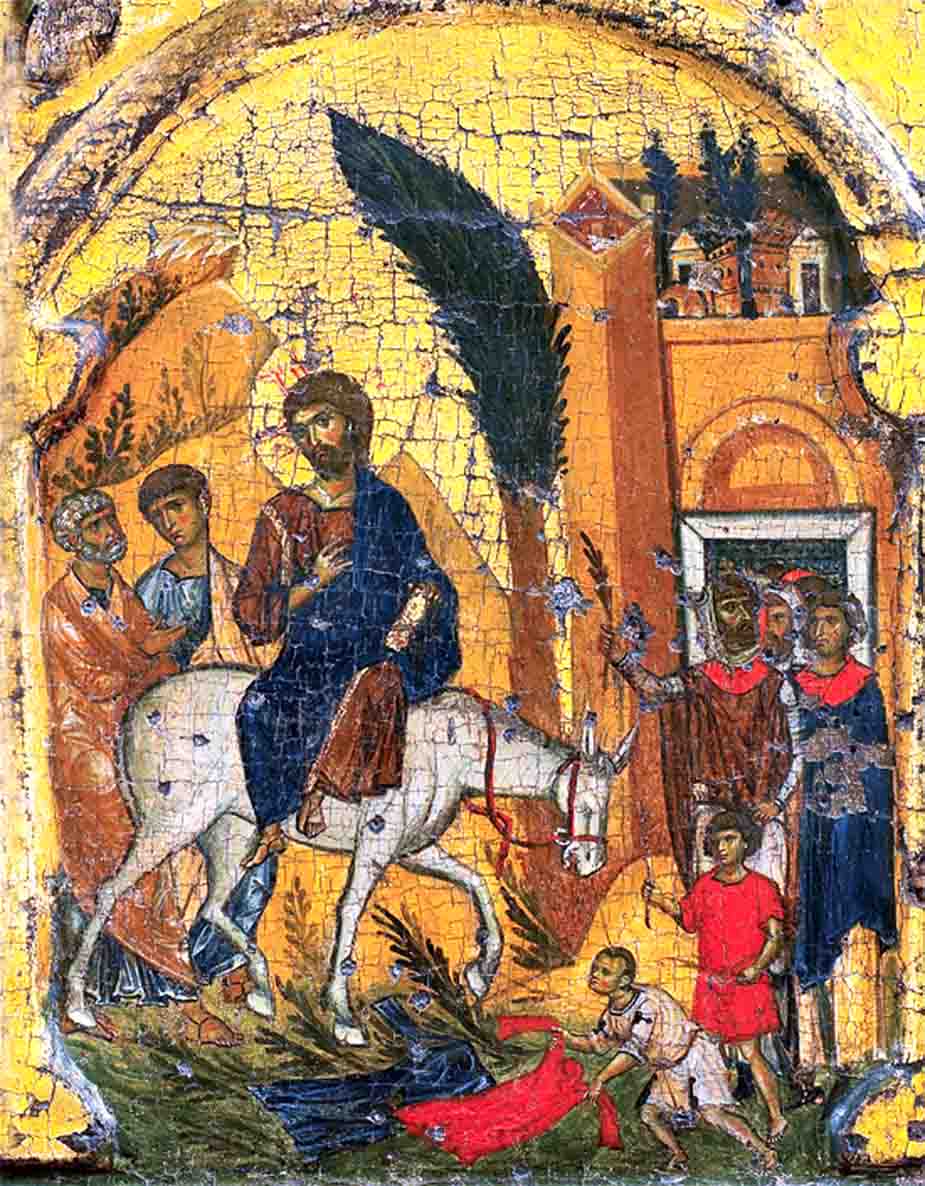
They did not blare trumpets and drums to glorify Him, but innocent children, which symbolized the simplicity which Christians have, cried out: "Blessed is He Who comes", and instead of holding flags waved the green branches of trees. Verdant branches and clothes strewn on the road for the donkey to walk over.

And this blessed donkey, with a bowed head, humble, ignorant, bore Christ Who was sitting on its back, Whom the fiery six-winged Seraphim stand about with fear. He was not carried by a golden chariot, nor a prized stallion, nor even a seat held by others, but by a little donkey. What eye does not shed a tear and is not astonished by this mystery!

Christ overturned what sinful man saw regarding what is right and true. Who, however, is in the position to sense the freedom which He brings us, and would follow the donkey, and not the fine horses that glow proudly, which enter Rome with many idols, instead of entering together into the kingdom of Peace, the Jerusalem on high?

Many "serious" people, one could say, did not understand this, saying that the children where childish, and the men were manly. The same was said by the high priests, men of authority: But when the chief priests and the scribes saw the wonderful things that he did, and the children crying out in the temple, “Hosanna to the Son of David!” they were indignant;  and they said to him, “Do you hear what these are saying?” And Jesus said to them, “Yes; have you never read, ‘Out of the mouth of babes and sucklings thou hast brought perfect praise’?” And leaving them, he went out of the city to Bethany and lodged there." (Matthew 21:15-17)

The chief priests and the scribes had read the Psalm of David which said how the Christ would be met by the babes and they did not believe Him Whom they hymned. And if we have read today's Gospel and the Psalm and what Christ said to the Hebrews, would we not be judged more strictly than if we had not believed Him? Our vanity and our pride prevent us from going along His poor path, and we are ashamed to follow a leader Who is riding upon a donkey. We don't want the humble, the poor. Can one become a Christian who does not love that which Christ loved?

Yesterday, Saturday, He raised a dead man, Lazaros. Who was this Lazaros? Was he a notable, famous person? Lazaros was a poor villager, but as the Gospel says, he was a friend of Christ, Who would have all men as His friends.

The Gospel notes that Christ had a friend in the world, and that he was poor and unlearned. But who among us loves this rich poverty of Christ? Where Christ is missing, there is the true poverty, because where Christ is missing, there is also missing true life and death rules. This you would understand well if you look around you and ponder. Where are those almighty Roman leaders who made their triumphant entry, as we described above?  What happened to them, and the myriads that worshiped them and knelt before them like the reeds before the north wind? Who brings to mind those who wrote the history of that time?


Bodies, souls, thrones, diamonds, horses, pride, horrors, voices, all fell into a pit and were lost and extinguished as if they had never been drunk. And what is left of all this in people's hearts? Nothing and even less than nothing.
But man is unfaithful even to what he sees and what he grasps with his hands, and he pulls the path that they have taken, and he happily drags Nero's chariot, because "his neck is iron." His ears are pricked by Him Who says: "I am God, the first and the last, I am. I nourish my sheep and I will give them rest." He Who was sitting upon the donkey, it is He Who remains alive within simple souls unto the ages, and is for them a source of nourishment, a source of immortality, joy and delight, according to the words that say: "The heart of those who seek the Lord shall rejoice."

Yes, whoever senses the joy of Christ, is like that dead man [Lazaros] who was raised. There are many kinds of pain in the world. Those who suffer in body and soul, their pain cleanses them and takes them to God, and these are the beloved ones of Christ and walk in His army with His consoling light. The others suffer futily. That is why the Apostle Paul wrote to the Corinthians: "Now I rejoice, not because you were grieved, but because you were grieved into repenting; for you felt a godly grief, so that you suffered no loss through us.  For godly grief produces a repentance that leads to salvation and brings no regret, but worldly grief produces death." (2 Corinthians 7:9-10).

For those who hope in God, Christ transforms their futile sweat into sweat of salvation "a refreshing sweat", but we mourn and are pained in every way like the idolaters, slaughtered by the knives of fate. They did not allow their sweat of agony to become transformed into sweat of prayer and hope.

Whoever does not believe in Christ and in the Gospel is dead, as no true life exists within him. Because life does not mean to breath and to walk and to eat and drink, but to sense the grace of immortality. Then, one can chant together with that exceptional hymn that is the Apolytikion:

"By raising Lazarus from the dead before Your passion, You did confirm the universal Resurrection, O Christ God! Like the children with the palms of victory,  we cry out to You, O Vanquisher of death; Hosanna in the Highest! Blessed is He that comes in the Name of the Lord!
(source)
  
Christ entering Jerusalem on Palm Sunday (source)
  
Through the prayers of our Holy Fathers, Lord Jesus Christ our God, have mercy on us and save us! Amen!
Thursday, April 18, 2019

"O Lord, Your voice destroyed the kingdom of Hades..."

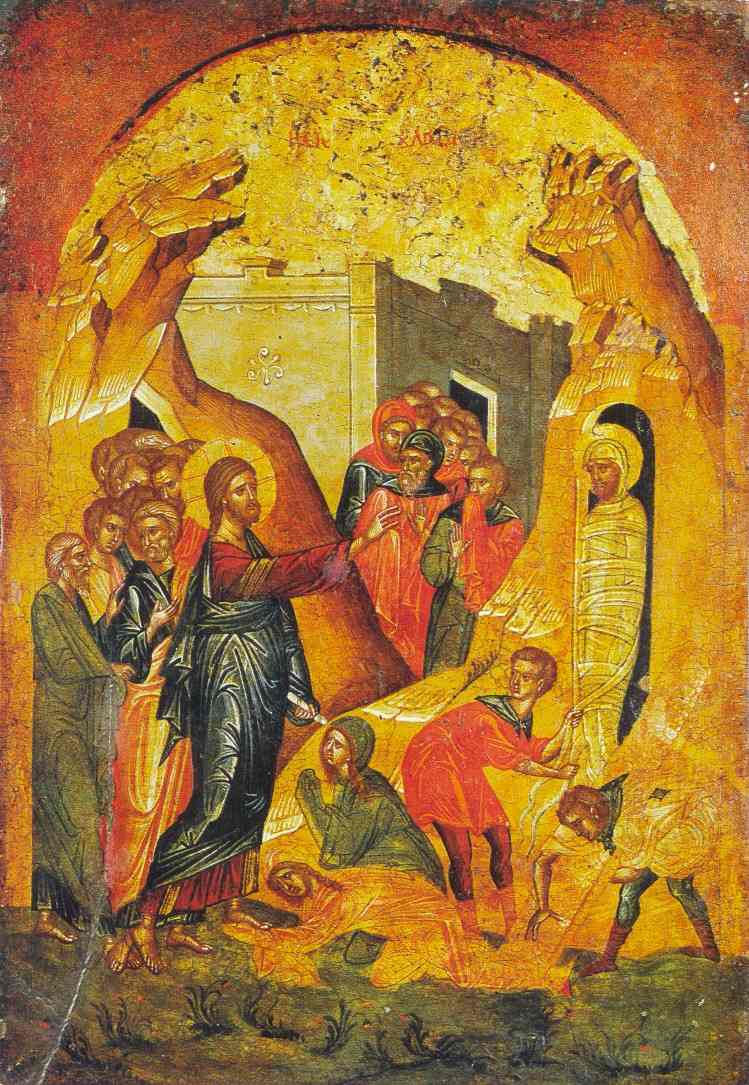
Christ raising Lazarus from the dead (source)
  
O Lord, Your voice destroyed the kingdom of Hades, and the word of Your authority raised up a man four-days-dead from the tomb. And Lazarus became a foretaste of regeneration and salvation, for all things are possible for You, O Master and King of All. Grant your servants forgiveness of sins and great mercy.
-from the Vespers Stichera for the Raising of Lazarus, written by Leo the King
  
(source)
  
Through the prayers of our Holy Fathers, Lord Jesus Christ our God, have mercy on us and save us! Amen!
Wednesday, March 28, 2018

"O woe, truly I am being destroyed!", cries out Hades..."

Christ raising Lazarus from the dead (source)
  
"O woe, truly I am being destroyed!", cries out Hades, which speaks to Death saying: "Behold, the Nazarene makes the things below tremble, and rents apart my belly, raising the speechless dead man with His voice."
-from the Compline Canon of St. Andrew of Crete for the Saturday of Lazarus
  
(source)
  
Through the prayers of our Holy Fathers, Lord Jesus Christ our God, have mercy on us and save us! Amen!

Friday, April 22, 2016

"The abysses are afraid before You O Lord..."

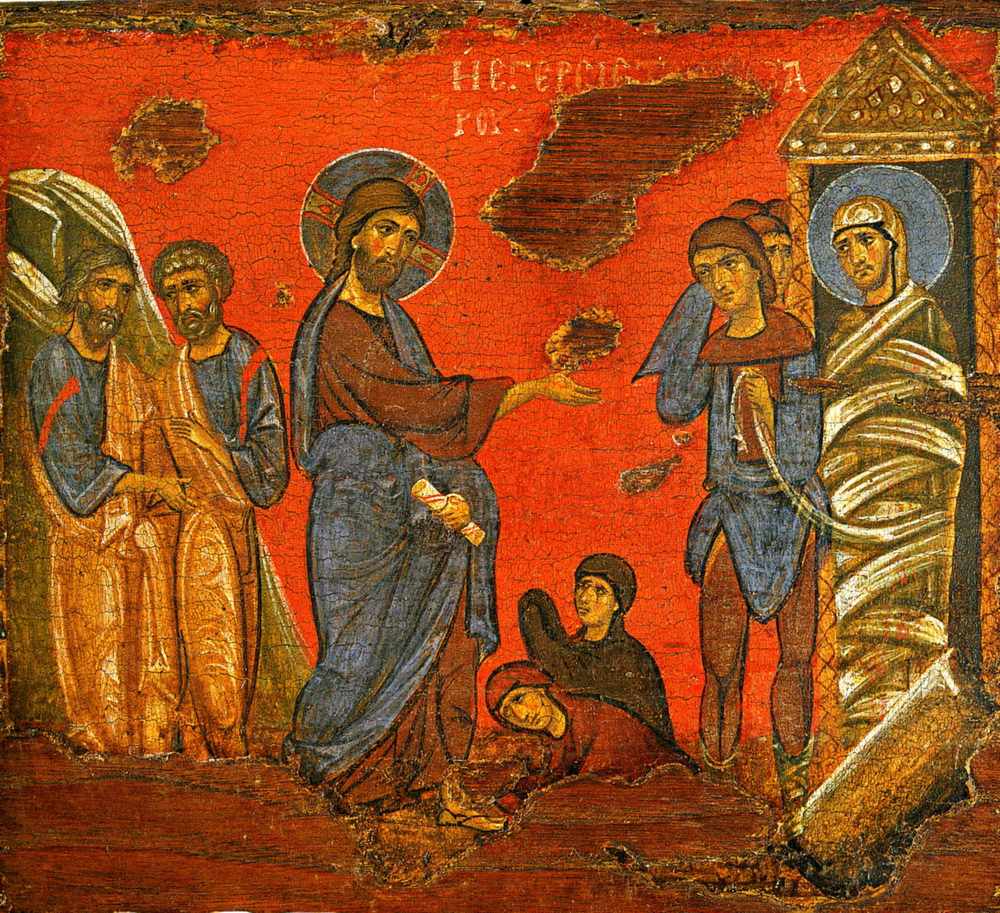
Christ raising Lazarus from the dead (source)
  
The abysses are afraid before You O Lord, the Source [of life], all the waters serve You, and the gates of hades tremble before You, O Christ, and their bars are broken through Your might, as You raised Lazarus from the dead through Your voice, O Almighty Savior, Who loves mankind.
-from Canon II of the Orthros on the Saturday of Lazarus
  
(source)
  
Through the prayers of our Holy Fathers, Lord, Jesus Christ our God, have mercy on us and save us! Amen!

Saturday, April 4, 2015

Excerpt from the Homily on the Raising of Lazarus by St. Amphilochius of Iconium

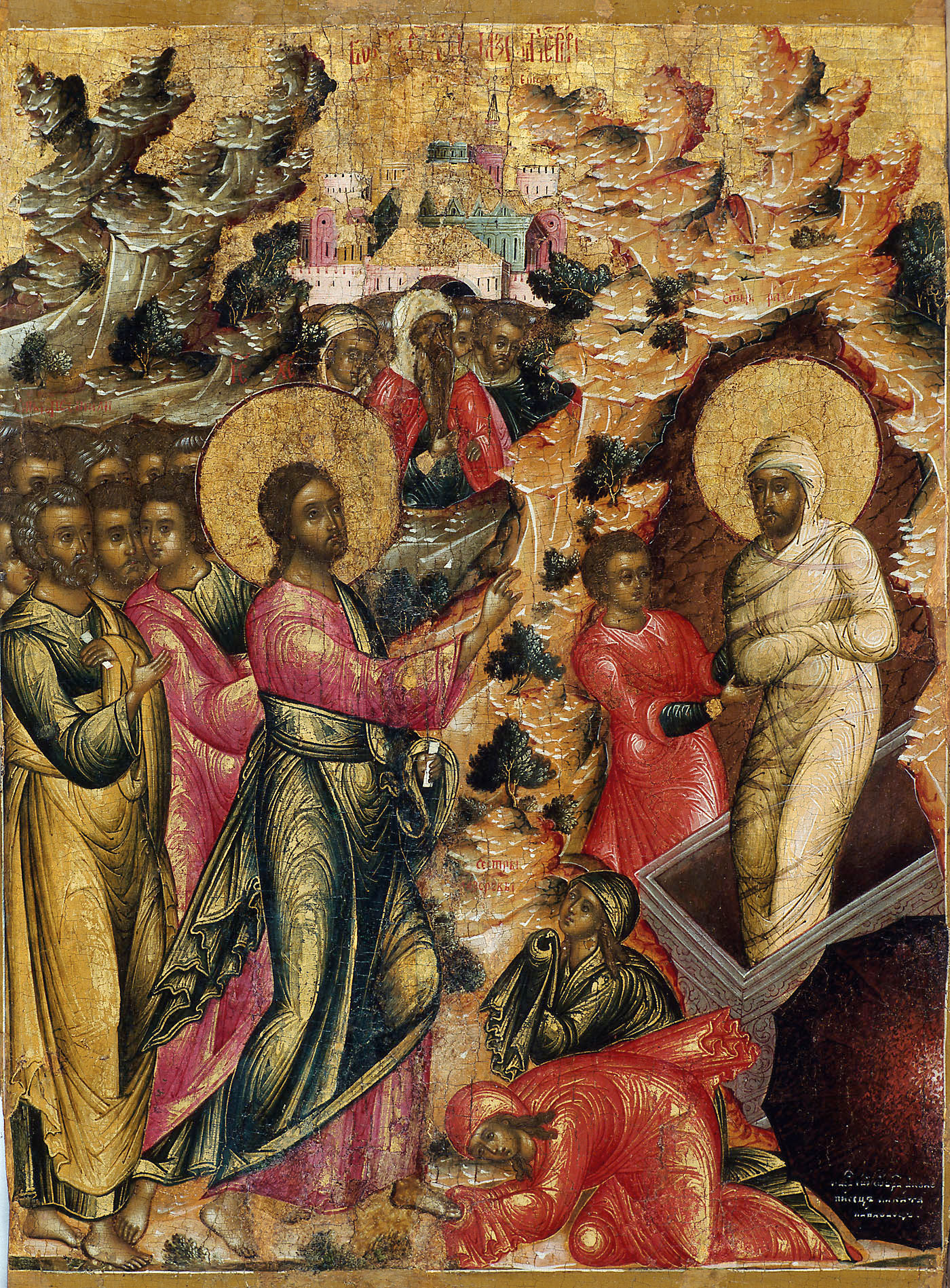
The Raising of Lazarus (source)
  
Excerpt from the Homily on the Raising of Lazarus by St. Amphilochius of Iconium (amateur translation)
Bring the Evangelist John once again into our midst,
For it is good to relate of the beginning of the Resurrection.
For you heard when he perfectly said:
“Six days before the Passover, Jesus came to Bethany, where Lazarus was, whom He raised from the dead.”
Do you see that the beginning of the Resurrection is depicted before-hand with Lazarus, whom the whole multitudes of the faithful knew?
The multitudes knew him, and the chief priests reviled the wondrous work, transforming it into guile. Truly, they reviled the resurrection of Lazarus, because after his resurrection, as you have heard, they took counsel together to put him to death.
Do you see this utter guile?
He whom the Lord raised, him they thought to put to death, not understanding that even if they would put him to death, again the Lord could have resurrected His friend.
They took counsel together to put Lazarus to death.
Nothing had astonished the Judeans like the resurrection of Lazarus. This wonder alone they were unable to slander.
They slandered the sight of the man born blind, saying that it wasn't him, but it was someone like him.
They slandered the raising of the daughter of Jairus, saying that she was passed out, not totally dead.
They slandered the resurrection of the son of the widow [of Nain] saying that he appeared to be dead, not that He had taken him from the tyranny of death.
They slandered the withered fig tree, saying that it was picked clean, and not that the word of the Master had withered it.
They slandered the transformation of the water into wine, saying that those at the dinner were drunk, and did not see that they were joking.
Only the resurrection of Lazarus were they unable to slander.
They knew who Lazarus the man was. They followed in his funeral, they saw his tomb sealed, they and they talked about him at supper with Martha and Mary, the sisters of Lazarus.
They knew that he laid in the tomb for exactly four days, and that a person four-days-dead always began to have his flesh decompose, his bones rot, his nervous system dissolve, his internal organs separate, and his belly to become bloated.
This they kept in mind when they saw that Lazarus had been resurrected, and was complete, perfect as if from a lathe, standing in his former biological state, and they were astonished...
(source)
  
Through the prayers of our Holy Fathers, Lord Jesus Christ our God, have mercy on us and save us! Amen!

Monday, October 13, 2014

Homily of St. Basil the Great on Thanksgiving and Mourning

Christ communing His Disciples with the Holy Eucharist (meaning Thanksgiving), His All-Precious Body and Blood (source)
  
You have heard the words of the Apostle, in which he addresses the Thessalonians, prescribing rules of conduct for every kind of person. His teaching, to be sure, was directed towards particular audiences; but the benefit to be derived therefrom is relevant to every generation of mankind. Rejoice evermore, he says; Pray without ceasing. In everything give thanks (I Thessalonians 5:16-18). Now, we shall explain a little later on, as far as we are able, what it means to rejoice, what benefit we receive from it, and how it is possible to achieve unceasing prayer and give thanks to God in all things.
  
However, it is necessary to anticipate the objections that we encounter from our adversaries, who criticize the Apostles injunctions as unattainable. For what is the virtue, they say, in passing ones life in gladness of soul, in joy and good cheer night and day? And how is it possible to achieve this, when we are beset by countless unexpected evils, which create unavoidable dejection in the soul, on account of which it is no more feasible for us to rejoice and be of good cheer than for one who is being roasted on a gridiron not to feel agony or for one who is being goaded not to suffer pain?
  
And perhaps there is someone among those who are standing among us here who is ailing with this sickness of the mind and makes excuses in sins (Psalm 140:4, Septuaginta), and who, through his own negligence in observing the commandments, attempts to transfer the blame to the law-giver for laying down things that are unattainable. How is it possible for me always to rejoice, he may ask, when I have no grounds for being joyous? For the factors that cause rejoicing are external and do not reside within us: the arrival of a friend, long-term contact with parents, finding money, honors bestowed on us by other people, restoration to health after a serious illness, and everything else that makes for a prosperous life: a house replete with goods of all kinds, an abundant table, close friends to share ones gladness, pleasant sounds and sights, the good health of our nearest and dearest, and whatever else gives them happiness in life. For it is not only the pains that befall us which cause us distress, but also those that afflict our friends and relatives. It is from all of these sources, therefore, that we must garner joy and cheerfulness of soul.
  
In addition to these things, when we have occasion to see the downfall of our enemies, wounds inflicted on those who plot against us, recompense for our benefactors, and, in general, if no unpleasant circumstance whatsoever that would disturb our life is either at hand or expected, only then is it possible for joy to exist in our souls. How is it, therefore, that a commandment has been given to us that cannot be accomplished by our own choice, but depends on other antecedent factors? How am I to pray without ceasing, when the needs of the body necessarily attract the attention of the soul to themselves, given that the mind cannot attend to two concerns at the same time?
  
And yet, I have been commanded to give thanks in everything. Am I to give thanks when I am strapped to a rack, tortured, stretched out on a wheel, and having my eyes gouged out? Am I to give thanks when I am beaten with humiliating blows by one who hates me? When I am stiff from the cold, perishing from hunger, tied to a tree, suddenly bereft of my children, or deprived even of my very wife? If I lose my wealth as a result of a sudden shipwreck? If I run into pirates on the sea, or brigands on the mainland? If I am wounded, slandered, wander around, or dwell in a dungeon?
  
Raising these objections, and more besides, our adversaries find fault with the lawgiver, thinking that, by slandering the precepts that we have been given as impossible to fulfill, they furnish themselves with a defense for their own sins. What, therefore, shall we say in response to them?
  
That, while the Apostle is looking elsewhere and attempting to elevate our souls from the earth to the heights and to transport us to a heavenly way of life, they, unable to attain to the loftiness of the lawgivers mind, and preoccupied with the earth and the flesh, crawl around in the passions of the body like worms in a swamp and demand that the Apostle issue precepts which are capable of being fulfilled. For his part, the Apostle summons not just anyone, but one who is as he was to rejoice always, no longer living in the flesh, but having Christ living in himself, since union with the highest good does not in any way allow sympathy for the demands of the flesh (cf. Galatians 2:20). And even if an incision is made in the flesh, the disintegration occasioned by its continued presence remains in the part of the body that suffers it, since the pain is unable to spread to the noetic part of the soul. For, if, in accordance with the Apostles precept, we have mortified our members which are upon the earth (Colossians 3:5) and we bear in the body the dying of the Lord Jesus (II Corinthians 4:10), necessarily the injury suffered by the mortified body will not reach the soul which has been freed from contact with the body. Dishonor, losses, and deaths of our nearest and dearest will not rise up to the mind, nor will they incline the sublimity of the mind to sympathy with things below. For, if those who fall into difficulties have the same attitude as the virtuous man, they will not cause annoyance to anyone, seeing that not even they themselves endure sorrowfully what befalls them; but if they live according to the flesh (Romans 8:13), not even in this way will they annoy anyone, but will be reckoned pitiable, not so much because of their circumstances, as because they do not choose to react properly.
  
In short, a soul which has once and for all been held fast by the desire for its Creator and is accustomed to delighting in the beauties of the heavenly realm will not alter its great joy and cheerfulness under the influence of carnal feelings, which are varying and unstable; but things which distress other people it will regard as increasing its own gladness. Such was the Apostle, who took pleasure in infirmities, in afflictions, in persecutions, and in necessities, counting his needs an occasion for glorying (II Corinthians 12:9-10); in hunger and thirst, in cold and nakedness, in persecutions and distresses (II Corinthians 12:10; 11:27), conditions in which others endure only with difficulty, bidding farewell to life: in these he rejoiced. Therefore, those who are ignorant of what the Apostle has in mind, and do not understand that he is calling us to the evangelical way of life, dare to accuse St. Paul of laying down things that are impossible for us. Well then, let them learn how many legitimate occasions for rejoicing are made available to us through Gods munificence. We were brought from non-being into being; we were made in the image of the Creator (Genesis 1:27); we have the mind and reason to perfect our nature, and through them we have knowledge of God. And perceiving the beauties of nature carefully, we thereby recognize, as if through letters, God's great providence and wisdom concerning all things. We are capable of discerning good and evil; we are taught by nature itself to choose what is beneficial and to avoid what is harmful. Having been estranged from God through sin, we have been called back to kinship with Him, being released from ignominious slavery by the blood of His Only-begotten Son. We have the hope of resurrection, the enjoyment of Angelic goods, the Kingdom of Heaven, and promised goods, which transcend the grasp of mind and reason.
  
How is it not proper to think that these things are sufficient reasons for unending joy and unceasing gladness? How is it proper to suppose that one who is a glutton, who delights in hearing flute-playing, and who lies on a soft bed and snores, is living a life worthy of joy? I would say that such people are worthy of lamentation on the part of those who are endowed with intelligence, whereas we should call blessed those who endure the present life in the hope of the age to come and who exchange present joys for eternal joys. Whether they stand amid flames, as did the three Youths in Babylon, who were united with God (Daniel 3:21), or are shut up with lions (Daniel 6:16-23), or swallowed by a whale (Jonah 2:1), we should call them blessed, and they should pass their lives in joy, not being distressed over present sufferings, but rejoicing in the hope of what is in store for us in the next life. For, in my opinion, a good athlete, once he has stripped down for the arena of piety, should valiantly endure the blows of his adversaries in hope of the glory that comes from crowns of victory. Indeed, in gymnastic contests, those who have become inured to pain in wrestling schools are not depressed at the prospect of suffering pain from blows, but advance to close quarters with their foes, disdaining momentary pains in their desire to be publicly proclaimed victors. Thus, even if some misfortune befalls a virtuous man, it will not cast a shadow over his joy. For tribulation worketh patience, and patience, experience, and experience, hope; and hope maketh not ashamed (Romans 5:3-5). Hence, in another place, Saint Paul enjoins us to be patient in tribulation and to rejoice in hope (Romans 12:12). It is hope, therefore, that makes joy to dwell within the soul of a virtuous man. But the same Apostle bids us weep with those who weep (Romans 12:15); and, writing to the Galatians, he wept over the enemies of the Cross of Christ (Philippians 3:18). And what need have I to speak of the tears of Jeremiah (Lamentations), of Ezekiel writing lamentations over the rulers of Israel, at Gods command (Ezekiel 2:9), or of many other Saints who mourned? Alas, my mother, that thou hast borne me (Jeremiah 15:10); Woe is me, for the godly man hath perished from the earth, and there is none among men that ordereth his way aright (Micah 7:2); Woe is me, for I am become as one gathering straw in the harvest (Micah 7:1).
   
So, in a word, scrutinize the sayings of the righteous, and when anywhere you find one of them emitting a rather doleful expression, you will be convinced that all who are of this world bemoan the misery of the life that is led therein. Woe is me, for my sojourning is prolonged (Psalm 119:5, Septuaginta). For the Apostle has a desire to depart, and to be with Christ (Philippians 1:23). He is, therefore, vexed at the prolongation of this earthly sojourn as an impediment to his joy. David, too, bequeathed to us a lamentation in song for his friend Jonathan, in which he also mourned for his enemy: I am grieved for thee, my brother Jonathan (II Kings 1:26); and: O daughters of Israel, weep for Saul (II Kings 1:24). He mourns for Saul, as one who died in sin, but for Jonathan, as one who shared his life in every respect. Why should I speak of the other examples? And yet, the Lord wept over Lazarus (St. John 11:35) and He wept over Jerusalem (St. Luke 19:41), and He calls blessed those who mourn (St. Matthew 5:4) and likewise those who weep (St. Luke 6:21).
  
But how, you say, are these things to be reconciled with the words: Rejoice always? For weeping and joy do not derive from the same source. Weeping, for example, is naturally engendered as a result of some blow, in which the involuntary impact strikes and constricts the soul, while the spirit surrounding the heart is depressed; but joy is like a leap of the soul, as it were, which rejoices at things that are under its control. Hence, the physical symptoms are different. For, in the case of those who are distressed, their bodies are sallow, livid, and cold, whereas in the case of those who feel joyous, the condition of their bodies is efflorescent and reddish, while their souls all but leap outwards, propelled by delight.
  
To this we will say that the Saints lamented and wept on account of their love for God. And so, ever beholding Him Whom they loved and increasing the gladness that they themselves derived from Him, they provided for the needs of their fellow-servants, mourning for those who sinned and correcting them through their tears. Just as people who stand on the shore and feel sympathy for those who are drowning in the sea do not jettison their own security in their concern for those in peril, so also, those who are distressed at the sins of their neighbors do not efface their own gladness; on the contrary, they increase it, being vouchsafed the joy of the Lord by virtue of the tears that they shed for their brothers. This is why those who weep and those who mourn are blessed, for they themselves will be comforted and they themselves will laugh. By laughter, one means not the sound which is emitted through the cheeks when the blood boils, but the cheerfulness which is pure and unmixed with any sadness. Therefore, the Apostle allows us to weep with those who weep, because tears of this kind are like the seed and pledge of eternal joy. Ascend with me in mind, please, and behold the Angelic estate and consider whether any other condition befits them than that of rejoicing and gladness; for they are vouchsafed to stand before God and enjoy the ineffable beauty of the glory of Him Who created us. And so, it is to that life that the Apostle urges us on, bidding us always to rejoice.
  
Now, as for the fact that the Lord wept over Lazarus and the city, we have this to say: He ate and drank, not because He needed these things Himself, but so as to leave you with measures and limits by which to control the unavoidable emotions of the soul. Thus, He wept in order to correct the propensity to excessive emotion and dejection among those given to mourning and lamentation. For if there is anything that needs to be moderated by reason, it is weeping: that is, over what things, to what extent, when, and how it is proper to weep. For that the Lord's weeping was not emotional, but didactic, is clear from this verse: Our friend Lazarus sleepeth; but I go, that I may awake him out of sleep (St. John 11:11). Who among us mourns for a sleeping friend, whom he expects to awake after a short while? Lazarus, come forth (St. John 11:43). And the dead man was brought back to life; he who was bound walked. This is a miracle within a miracle: that his feet were bound with grave-clothes and yet were not prevented from moving. That which strengthened him was greater than that which impeded him.
  
Why, therefore, did the Lord, Who was about to accomplish such things, judge the incident worthy of tears? Is it not clear that, disregarding our infirmity in every way, He contained the necessary emotions within certain measures and limits, avoiding a lack of sympathy, on the one hand, as something appropriate to wild beasts, and, on the other hand, refusing to give way to excessive grief and lamentation as something ignoble? Hence, in weeping over His friend, He both displayed that He Himself shared in our human nature, and freed us from either kind of extreme, allowing us neither to indulge our emotions nor to be unfeeling in the face of sorrows.
  
Therefore, just as the Lord accepted hunger, after digesting solid food, submitted to thirst, after the moisture in His body was consumed, and felt weary, when His muscles and nerves were strained from travel-ling—although it was not that His Divinity succumbed to weariness, but that His body accepted its natural attributes; so also, He accepted weeping, permitting a natural property of the flesh to supervene. This occurs when the hollow parts of the brain, filled with vapors arising from grief, discharge the burden of moisture through the opening of the eyes as through some kind of duct. Hence, one experiences a certain ringing in the ears, dizziness, and darkening of the eyes when he hears about unexpected sorrows, and ones head is set in a whirl by vapors which are emitted by compressed heat deep inside him. Then, in my opinion, just as a cloud dissolves into raindrops, so also the thickness of vapors dissolves into tears. Hence, those who grieve feel a certain pleasure when they lament, because the burden that weighs on them is secretly evacuated through weeping. Experience of events proves the truth of this account. For we know many people who, in desperate straits, forcibly restrain themselves from weeping; then, in some cases, they fall into incurable sufferings, either apoplexy or paralysis, while in other cases, they completely faint, their strength having been broken down, like a weak support, by the weight of sorrow. For, what is observable in the case of fire, that it is stifled by its own smoke if it does not escape, but rolls around it—this, it is said, occurs also in the case of the faculty that governs a living creature; that is, it wastes away and is extinguished if there is no way for it to ex-hale.
  
Therefore, let those who are given to mourning not adduce the Lords tears in support of their own weakness. For, just as the food which the Lord ate is not an occasion of pleasure for us, but, on the contrary, the highest criterion of restraint and sufficiency, so also, His weeping is not an ordinance prescribing lamentation, but is a most fitting measure and an exact standard whereby we may, with proper dignity and decorum, endure sorrows while remaining within the limits of our nature. Thus, neither women nor men are permitted to indulge in mourning and excessive weeping, but only to the extent that it is fitting to grieve over sorrows; they are permitted to shed a few tears, but this must be done calmly, without bellowing or wailing, without rending ones tunic or sprinkling oneself with dust, or committing any of the other improprieties that are typical of those who are ignorant of heavenly things. For one who has been purified by Divine doctrine must be fenced around by right reason, as by a strong wall, and must manfully and strenuously ward off the onslaughts of such emotions; he must not accept any crowd of emotions that flows in, as it were, to some low-lying place, with a submissive and compliant soul.
  
It is the mark of a craven soul, and one that is lacking in the vigor that comes from hope in God, that it utterly collapses and succumbs to adversities. For, just as worms are particularly inclined to breed on more tender pieces of wood, so also sorrows grow in men of lesser moral fiber. Was not Job adamantine in heart? Were his inward parts not made of stone? His ten children fell dead in one brief moment of time, overwhelmed by a calamity in the house of their gladness at a time of enjoyment, when the Devil brought down their dwelling upon them. He saw the table drenched with blood; he saw his children, who had been born at different times, but who had ended their lives together. He did not wail aloud; he did not pluck his hair out; he did not let out a degenerate cry; but he uttered that thanksgiving which is renowned and acclaimed by all: the Lord gave, the Lord hath taken away; as it seemed good to the Lord, so hath it come to pass; blessed be the name of the Lord (Job 1:21). Was this man not lacking in sympathy? How could this be so? For about himself, at any rate, he says: I wept over every man who was afflicted (Job 30:25). But was he not lying when he said this? But here, too, the truth bears witness to him that, in addition to his other virtues, he was also truthful: ...That man was blameless, righteous, godly, and truthful (Job 1:1).
  
Yet many of you keep on wailing in dirges that are designed to express dejection, and you deliberately waste away your soul with mournful melodies; and, just like the make-believe and paraphernalia with which they adorn theatres to typify tragedies, so, also, you suppose that the proper outfit for a mourner consists of black clothing, squalid hair, dirt, and dust, complete with a darkened house and lugubrious chanting, which preserves the wound of grief ever fresh in the soul. Let those who have no hope do these things. You, however, have been taught, concerning those who repose in Christ, that it [the body] is sown in corruption; it is raised in incorruption; it is sown in dishonor; it is raised in glory; it is sown in weakness; it is raised in power; it is sown a natural body; it is raised a spiritual body (I Corinthians 15:42-44). Why, then, do you weep for one who has gone to change his vesture? Neither mourn for yourself, as one who has been deprived of a helper in this life; for it is better to trust in the Lord than to trust in man (Psalm 117:8-9, Septuaginta). Nor lament for this helper, as one who has suffered a terrible calamity. For, a little later, the trumpet sounding from Heaven will awaken him, and you will see him standing before the judgment-seat of Christ. So, dismiss these dejected and ignorant cries: Alas, these unexpected woes! Who would have thought that this would happen? Could I have ever anticipated that I would cover this dearest friend of mine with earth? If we should hear someone else saying such things, it behooves us to blush, since we have been taught from both past memories and present experience that these natural occurrences are inevitable.
  
Therefore, neither untimely deaths nor other misfortunes that unexpectedly befall us will ever cause consternation in us who have been educated by the doctrine of piety. For example, let us say that I had a son who was a young man—the sole heir of my estate, the comfort of my old age, the adornment of his family, the flower of his peers, the support of his household, and at that time of life which is most charming—, this lad having been carried off by death, he becoming earth and dust who, a short while ago, uttered sweet sounds and was a most pleasing sight in the eyes of his father. What, then, am I to do? Shall I rend my clothing? Shall I consent to roll around on the ground, scream in vexation, and act in front of those present like a child crying out in pain and having convulsions? Rather, paying heed to the inevitability of events, that the law of death is inexorable and affects every age-group alike, dissolving all compound things in order, surely I should not be surprised at what has happened. Surely I should not be upset in my mind, as if I had been devastated by some unexpected blow, since I have been taught beforehand that, being mortal, I had a mortal son, that there is no constancy in human affairs, and that nothing wholly abides for those who possess it.
  
Why, even great cities, which were renowned for the elegance of their buildings and the abilities of their inhabitants, and conspicuous for their prosperity both in the countryside and in the marketplace, now display tokens of their erstwhile dignity only in ruins. A ship which has frequently been preserved from the sea, and which has made countless speedy voyages and conveyed innumerable amounts of merchandise for traders, vanishes with a single gust of wind. Armies which have many times defeated their foes in battle have, on suffering a reversal of fortune, become a pitiful sight and one pitiful to relate. Entire nations and islands, which have attained great power, and have raised many trophies both by land and by sea, and have gathered much wealth from booty, have either been consumed by the passage of time or been taken captive and exchanged their liberty for enslavement. Indeed, in short, whatever great and unbearable evil you care to mention, life already has prior examples of it.
  
Therefore, just as we determine weights by a turn of the scale and assay gold by rubbing it with a touchstone, so also, if we were to remember the limits revealed to us by the Lord, we would never exceed the bounds of prudence. Whenever, therefore, any involuntary adversity befalls you, by virtue of being mentally prepared, you will avoid confusion, and you will make light of present afflictions by your hope for the future. For, just as those whose eyes are weak divert their gaze from things that are excessively bright and give them rest by looking at flowers and grass, so, also, the soul must not constantly behold that which causes grief or be fixated on present sorrows, but must direct its gaze towards what is truly good. In this way will it be feasible for you always to rejoice, if your life always looks towards God and if hope of recompense alleviates life's colors.
  
Have you been dishonored? Then have regard for the glory which is laid up in Heaven through patient endurance. Have you suffered a loss? Then contemplate the heavenly wealth and treasure which you have laid up for yourself through your good deeds. Have you been expelled from your homeland? Then you have Jerusalem as your heavenly homeland. Have you lost a child? Then you have Angels, with whom you will dance around the Throne of God, rejoicing eternally. By thus opposing anticipated good things to present sorrows, you will keep your soul in the cheerfulness and tranquillity to which the Apostles precept summons us. Neither let the joys of human affairs create immoderate and excessive gladness in your soul, nor let sorrows diminish its exultation and sublimity by feelings of dejection and abasement. Unless you have previously trained yourself in this way regarding the eventualities of life, you will never have a calm and tranquil life. But you will easily achieve this if you have dwelling within you the commandment which advises you always to rejoice, dismissing the vexations of the flesh and gathering that which gladdens the soul, transcending the sensation of present realities and extending your mind to the hope of eternal realities, the mere thought of which is sufficient to fill the soul with rejoicing and to make Angelic exultation reside in our hearts; in Christ Jesus our Lord, to Whom be the glory and the dominion, unto the ages. Amen.
  
Through the prayers of our Holy Fathers, Lord Jesus Christ our God, have mercy on us and save us! Amen!

Thursday, April 10, 2014

Excerpt from Homily III of St. John Chrysostom on the Raising of Lazarus

The Raising of Lazarus (source)
 
Excerpt from Homily III of St. John Chrysostom on the Raising of Lazarus (amateur translation)
The light of Lazarus was dissolved, and they were called to hasten to show the road towards him who was in burial clothes, who after four days was rotting in the tombs, whose bowels were largely consumed by the worms, whose harmony of the body was utterly dissolved, and who was a witness of decay, being placed foul-smelling in a tomb. But, [Christ,] the Breathing of life, and the Fragrance of the dead, provided a solution from the bowels [of His compassion]. The tomb became a womb, and as a womb giving birth, thus from the tomb arose the newly-formed Lazarus.

O new working of a wonder! A man returns to us in life, being carried out of the tomb in burial clothes, like a child wrapped in swaddling clothes. For the voice of the Master was recognized by the dead man, Who called him out of the grave with his burial clothes. “Lazarus,” He said, “come out.” And speedily the voice was heard by the dead man, and all the members quickened in the grave. To his own eyes returned order again, his own nose took its place, to the place where there was formerly the sign of his mouth, his tongue was placed, and his head breathed, and his pair of hands joyously began to move, as the harmonious number of his fingers took their order, and his nerves were reattached, and his bones were recreated, and his veins began to fill, his marrow was reformed, his tissue was rewoven, his hair was replaced. Slowly I traced the path of the members. But as a horse from the starting gate, thus the voice of the Master roused the dead man to leap up. “Lazarus, come forth.” Before He said, "arise", He provided an exit out towards the road, so that when He later resurrected him, then the resurrected one might then run straightaway.

Why did you proclaim the exit before the resurrection, O Master? I prepared the way, He says, that the dead man might not be engaged twice, wasting time at the exit. I did not tell him, "arise, and come out", but with greater haste, he receives resurrection and a path with one command. Then, Lazarus burst forth from the tomb, as protected under the wing, the dead man who was laid in the tomb.

Hades below, beholding the dead man being given up, cried out: “Who is this voice, which raises the dead from the tombs as if awakening from sleep? Who is this who dissolves the former laws of the dead? Who is this who preaches such a revolt, preferring that the dead be returned? Who is this who hastens to bring the dead towards life? Who is this who easily dissolves my bonds on the dead? Who is this, who tramples upon the writ of my dead? As I see, I hold the scepter of tyranny over men, but my unsound prison of death has gone from me. Elias raised the dead man to the joy of that woman. Elissaeus seized from me double the number of dead. But this is more bitter to me, because he has returned one of the dead, stealing one of the rotting dead, and therefore there is the danger that He will have authority over [all] the rotting dead. I am deprived, therefore of the dead man which I obtained. He conquered me, as the four-days-dead body with its burial clothes is beheld by those still living. I am trampled upon, therefore, together with the burial clothes, as a dead man is seized from me. Who, therefore, will be moved by that which I said, by the rotting dead man who conquered me, as I became like one simply standing by, guarding the dead?"
(source)
 
Through the prayers of our Holy Fathers, Lord Jesus Christ our God, have mercy on us and save us! Amen!

Friday, April 26, 2013

"Six days before the Passover..."


Christ raising Lazarus (source)
   
«Προ έξ ήμερων του πάσχα, διά των πέντε αισθήσεων, τον τετραήμερον ο τριήμερος, ταις δυσί τον έναν χαρίζεται».
   
«Six days before the Passover, before the five senses, the Four-days-dead, by the Third-day-risen One, to the two [sisters, Martha and Mary], He grants the one [brother, St. Lazarus]»
St. Epiphanios of Salamis
   
Through the prayers of our Holy Fathers, Lord Jesus Christ our God, have mercy on us and save us! Amen!

Excerpt from the Canon of St. Lazarus by St. Andrew of Crete

Christ raising Lazarus from the dead (source)
 
Excerpt from the Canon of St. Lazarus by St. Andrew of Crete (to be read at the Compline for the Saturday of the Raising of Lazarus)
 

Ode IX. Eirmos.
He has showed strength with His arm; He has put down the mighty from their seats and exalted the humble, for He is the God of Israel; the Dayspring from on high has visited us and guided us into the way of peace.

Glory to You, our God, glory to You.
Let Bethany sing with us in praise of the miracle, for there the Creator wept for Lazarus in accordance with the law of nature and the flesh; then, making Martha's tears to cease and changing Mary's grief to joy, Christ raised him from the dead.

Glory to You, our God, glory to You.
To confirm men's faith in Your Resurrection, Word, You have called Lazarus from the tomb and as God You have raised him up, to show the peoples that You, who raise up the temple of Your body are both God and man in very truth.


Glory to You, our God, glory to You.
Shaking the gates and iron bars, You have made Hades tremble at Your voice; Hades and death were filled with fear, Savior, seeing Lazarus their prisoner brought to life by Your word and rising from the tomb.

Glory to You, our God, glory to You.
All were dismayed to see You, Savior, weeping over dead Lazarus, and in their misery they said: "Behold how He loves him." You then straight away called him, and at Your command the dead man rose, delivered from corruption.

Glory to You, our God, glory to You.
The gates were shaken and the bars were shattered, and the bonds which held the dead man were loosed; when Christ spoke in power, Hades groaned bitterly and cried aloud: "Woe is me! What and from where is this voice that brings the dead to life!"

Glory to You, our God, glory to You.
Rise up, obedient to the voice: your friend outside is calling you; for this is He who raised the dead of old: for when Elias and Elisha brought the dead to life, it was He that spoke and acted through them.

Glory to You, our God, glory to You.
We sing the praises of Your surpassing power, Word and Savior, for by Your word, as Creator of all things, You have raised dead Lazarus from the depths with his bones and sinews, as You before raised the widow's son from the bier.

Glory to the Father, and to the Son, and to the Holy Spirit.
Most Holy Trinity, God the eternal Father, coeternal Son and Word of God, Holy Spirit of God, loving Comforter; one Light of the threefold Sun, consubstantial Essence, one God and Lord, take pity on the world.

Theotokion.
Now and ever, and to the ages of ages. Amen.
Jesus, who have made all things in wisdom, You have clothed Yourself in my whole nature, taken from the Virgin, yet You remain for ever wholly in the bosom of the Father; and as God You have sent down Your Holy Spirit on Your flock: cover us with Your shadow.
(source)
 
Through the prayers of our Holy Fathers, Lord Jesus Christ our God, have mercy on us and save us! Amen!

Friday, April 6, 2012

Excerpt from the Commentary on the Raising of Lazarus by St. John Chrysostom

  
Excerpt from the Commentary on the Raising of Lazarus by St. John Chrysostom (John 11)
“Jesus lifted up His eyes, and said, Father, I thank Thee that Thou hast heard Me; and I knew that Thou hearest Me always, but because of the people which stand by, I said it.” And what follows.
[1.] What I have often said, I will now say, that Christ looketh not so much to His own honor as to our salvation; not how He may utter some sublime saying, but how something able to draw us to Him. On which account His sublime and mighty sayings are few, and those also hidden, but the humble and lowly are many, and abound through His discourses. For since by these men were the rather brought over, in these He continueth; and He doth not on the one hand utter these universally, lest the men that should come after should receive damage, nor, on the other hand, doth He entirely withhold those, lest the men of that time should be offended. Since they who have passed from lowmindedness unto perfection, will be able from even a single sublime doctrine to discern the whole, but those who were ever lowminded, unless they had often heard these lowly sayings, would not have come to Him at all. In fact, even after so many such sayings they do not remain firm, but even stone and persecute Him, and try to kill Him, and call Him blasphemer. And when He maketh Himself equal with God, they say, “This man blasphemeth” ( Matt. ix. 3 ); and when He saith, “Thy sins be forgiven thee” ( c. x. 20 ), they moreover call Him a demoniac. So when He saith that the man who heareth His words is stronger than death, or, “I am in the Father and the Father in Me” ( c. viii. 51 ), they leave Him; and again, they are offended when He saith that He came down from heaven. ( c. vi. 33, 60.) If now they could not bear these sayings, though seldom uttered, scarcely, had His discourse been always sublime, had it been of this texture, would they have given heed to Him? When therefore He saith, “As the Father commanded Me, so I speak” ( c. xiv. 31 ); and, “I am not come of Myself” ( c. vii. 28 ), then they believe. That they did believe then is clear, from the Evangelist signifying this besides, and saying, “As He spake these words, many believed on Him.” ( c. v. 30.) If then lowly speaking drew men to faith, and high speaking scared them away, must it not be a mark of extreme folly not to see at a glance how to reckon the sole reason of those lowly sayings, namely, that they were uttered because of the hearers. Since in another place when He had desired to say some high thing, He withheld it, adding this reason, and saying, “Lest we should offend them, cast a hook into the sea.” ( Matt. xvii. 27.) Which also He doth here; for after saying, “I know that Thou hearest Me always,” He addeth, “but because of the multitude which standeth around I said it, that they might believe.” Are these words ours? Is this a human conjecture? When then a man will not endure to be persuaded by what is written, that they were offended at sublime things, how, when he heareth Christ saying that He spake in a lowly manner that they might not be offended, how, after that, shall he suspect that the mean sayings belonged to His nature, not to His condescension? So in another place, when a voice came down from heaven, He said, “This voice came not because of Me, but for your sakes.” ( c. xii. 30.) He who is exalted may be allowed to speak lowly things of himself, but it is not lawful for the humble to utter concerning himself anything grand or sublime. For the former ariseth from condescension, and has for its cause the weakness of the hearers; or rather (it has for its cause) the leading them to humblemindedness, and His being clothed in flesh, and the teaching the hearers to say nothing great concerning themselves, and His being deemed an enemy of God, and not being believed to have come from God, His being suspected of breaking the Law, and the fact that the hearers looked on Him with an evil eye, and were ill disposed towards Him, because He said that He was equal to God. But that a lowly man should say any great thing of Himself, hath no cause either reasonable or unreasonable; it can only be folly, impudence, and unpardonable boldness. Wherefore then doth Christ speak humbly, being of that ineffable and great Substance? For the reasons mentioned, and that He might not be deemed unbegotten; for Paul seems to have 235 feared some such thing as this; wherefore he saith, “Except Him who did put all things under Him.” ( 1 Cor. xv. 27.) This it is impious even to think of. Since if being less than Him who begat Him, and of a different Substance, He had been deemed equal, would He not have used every means that this might not be thought? But now He doth the contrary, saying, “If I do not the works of Him that sent Me, believe Me not.” ( c. x. 37.) Indeed His saying, that “I am in the Father and the Father in Me” ( c. xiv. 10 ), intimateth to us the equality. It would have behooved, if He had been inferior, to refute this opinion with much vehemence, and not at all to have said, “I am in the Father and the Father in me” ( c. x. 30 ), or that, “We are One,” or that, “He that hath seen Me, hath seen the Father.” ( c. xiv. 9.) Thus also, when His discourse was concerning power, He said, “I and the Father are One”; and when His discourse was concerning authority, He said again, “For as the Father raiseth up the dead and quickeneth them, even so the Son quickeneth whom He wilt” ( c. v. 21 ); which it would be impossible that He should do were He of a different substance; or even allowing that it were possible, yet it would not have behooved to say this, lest they should suspect that the substance was one and the same. Since if in order that they may not suppose Him to be an enemy of God, He often even uttereth words unsuited to Him, much more should He then have done so; but now, His saying, “That they should honor the Son even as they honor the Father” ( c. v. 23 ); His saying, “The works which He doeth, I do also” ( c. v. 19 ); His saying that He is “the Resurrection, and the Life, and the Light of the world” ( c. xi. 25; c. viii. 12 ), are the expressions of One making Himself equal to Him who begat Him, and confirming the suspicion which they entertained. Seest thou how He maketh this speech and defense, to show that He broke not the Law, and that He not only doth not remove, but even confirmeth the opinion of His equality with the Father? So also when they said, “Thou blasphemest, because thou makest thyself God” ( c. x. 33 ), from equality of works He established this thing.
  
[2.] And why say I that the Son did this, when the Father also who took not the flesh doeth the same thing? For He also endured that many lowly things should be said concerning Him for the salvation of the hearers. For the, “Adam, where art thou?” ( Gen. iii. 9 ), and, “That I may know whether they have done altogether according to the cry of it” ( Gen. xviii. 21 ); and, “Now I know that thou fearest God” ( Gen. xxii. 12 ); and, “If they will hear” ( Ezek. iii. 11 ); and, “If they will understand” ( Deut. v. 29 ); and, “Who shall give the heart of this people to be so?” and the expression, “There is none like unto Thee among the gods, O Lord” ( Ps. lxxx. 29 ); these and many other like sentences in the Old Testament, if a man should pick them out, he will find to be unworthy of the dignity of God. In the case of Ahab it is said, “Who shall entice Ahab for Me?” ( 2 Chron. xviii. 19.) And the continually preferring Himself to the gods of the heathen in the way of comparison, all these things are unworthy of God. Yet in another way they are made worthy of Him, for He is so kind, that for our salvation He careth not for expressions which become His dignity. Indeed, the becoming man is unworthy of Him, and the taking the form of a servant, and the speaking humble words, and the being clothed in humble (garments), unworthy if one looks to His dignity, but worthy if one consider the unspeakable riches of His lovingkindness. And there is another cause of the humility of His words. What is that? It is that they knew and confessed the Father, but Him they knew not. Wherefore He continually betaketh Himself to the Father as being confessed by them, because He Himself was not as yet deemed worthy of credit; not on account of any inferiority of His own, but because of the folly and infirmity of the hearers. On this account He prayeth, and saith, “Father, I thank Thee that Thou hast heard Me.” For if He quickeneth whom He will, and quickeneth in like manner as doth the Father, wherefore doth He call upon Him?
  
But it is time now to go through the passage from the beginning. “Then they took up the stone where the dead man lay. And Jesus lifted up His eyes, and said, Father, I thank Thee that Thou hast heard Me. And I knew that Thou hearest Me always, but because of the people that stand by I said it, that they might believe that Thou hast sent Me.” Let us then ask the heretic, Did He receive an impulse from the prayer, and so raise the dead man? How then did He work other miracles without prayer? saying, “Thou evil spirit, I charge thee, come out of him” ( Mark ix. 25 ); and, “I will, be thou clean” ( Mark i. 41 ); and, “Arise, take up thy bed” ( c. v. 8 ); and, “Thy sins be forgiven thee” ( Matt. ix. 2 ); and to the sea, “Peace, be still.” ( Mark iv. 39.) In short, what hath He more than the Apostles, if so be that He also worketh by prayer? Or rather I should say, that neither did they work all with prayer, but often they wrought without prayer, calling upon the Name of Jesus. Now, if His Name had such great power, how could He have needed prayer? Had He needed prayer, His Name would not have availed. When He wholly made man, what manner of prayer did He need? was there not then great equality of honor? “Let Us make,” It saith, “man.” ( Gen. i. 26 .) What could be greater sign of weakness, if He needed prayer? But let us see what the prayer was; “I thank Thee that Thou hast heard Me.” Who now ever prayed in this manner? Before uttering any prayer, He saith, “I thank Thee,” showing that He needed not prayer. “And I knew that Thou hearest Me always.” This He said not as though He Himself were powerless, but to show that His will and the Father’s is one. But why did He assume the form of prayer? Hear, not me, but Himself, saying, “For the sake of the people which stand by, that they may believe that Thou hast sent Me.” He said not, "That they may believe that I am inferior, that I have need of an impulse from above, that without prayer I cannot do anything; but, “That Thou hast sent Me.” For all these things the prayer declareth, if we take it simply. He said not, “Thou hast sent me weak, acknowledging servitude, and doing nothing of Myself”; but dismissing all these things, that thou mayest have no such suspicions, He putteth the real cause of the prayer, “That they may not deem Me an enemy of God; that they may not say, He is not of God, that I may show them that the work hath been done according to Thy will.” All but saying, “Had I been an enemy of God, what is done would not have succeeded,” but the, “Thou heardest Me,” is said in the case of friends and equals. “And I knew that Thou hearest Me always,” that is, “in order that My will be done I need no prayer, except to persuade men that to Thee and Me belongeth one will.” “Why then prayest Thou?” For the sake of the weak and grosser sort.
  
Ver. 43. “And when He had thus spoken, He cried with a loud voice.”
Why said He not, “In the name of My Father come forth”? Or why said He not, “Father, raise him up”? Why did he omit all these expressions, and after assuming the attitude of one praying, show by His actions His independent authority? Because this also was a part of His wisdom, to show condescension by words, but by His deeds, power. For since they had nothing else to charge Him with except that He was not of God, and since in this way they deceived many, He on this account most abundantly proveth this very point by what He saith, and in the way that their infirmity required. For it was in His power by other means to show at once His agreement with the Father and His own dignity, but the multitude could not ascend so far. And He saith,
  
“Lazarus, come forth.”
[3.] This is that of which He spake, “The hour is coming, when the dead shall hear the voice of the Son of God, and they that hear shall live.” ( c. v. 28.) For, that thou mightest not think that He received the power of working from another, He taught thee this before, and gave proof by deeds, and said not, Arise, but, “Come forth,” conversing with the dead man as though living. What can be equal to this authority? And if He doth it not by His own strength, what shall He have more than the Apostles, who say, “Why look ye so earnestly on us as though by our own power or holiness we had made this man to walk?” ( Acts iii. 12.) For if, not working by His own power, He did not add what the Apostles said concerning themselves, they will in a manner be more truly wise than He, because they refused the glory. And in another place, “Why do ye these things? We also are men of like passions as you.” ( Acts xiv. 15.) The Apostles since they did nothing of themselves, spoke in this way to persuade men of this; but He when the like opinion was formed concerning Him, would He not have removed the suspicion, if at least He did not act by His own authority? Who would assert this? But in truth Christ doeth the contrary, when He saith, “Because of the people which stand by I said it, that they might believe”; so that had they believed, there would have been no need of prayer. Now if prayer were not beneath His dignity, why should He account them the cause of His praying? Why said He not, “I do it in order that they may believe that I am not equal to Thee”; for He ought on account of the suspicion to have come to this point. When He was suspected of breaking the Law, He used the very expression, even when they had not said anything, “Think not that I am come to destroy the Law” ( Matt. v. 17 ); but in this place He establisheth their suspicion. In fact, what need was there at all of going such a round, and of using such dark sayings? It had been enough to say, “I am not equal,” and to be rid of the matter. “But what,” saith some one, “did He not say that, I do not My own will?” Even this He did in a covert way, and one suited to their infirmity, and from the same cause through which the prayer was made. But what meaneth “That Thou hast heard Me”? It meaneth, “That there is nothing on My part opposed to Thee.” As then the, “That Thou hast heard Me,” is not the saying of one declaring, that of Himself He had not the power, (for were this the case, it would be not only impotence but ignorance, if before praying He did not know that God would grant the prayer; and if He knew not, how was it that He said, “I go that I may awake him,” instead of, “I go to pray My Father to awake him?”) As then this expression is a sign, not of weakness, but of identity of will, so also is the, “Thou hearest Me always.” We must then either say this, or else that it was addressed to their suspicions. If now He was neither ignorant nor weak, it is clear that He uttereth these lowly words, that thou mayest be persuaded by their very excess, and mayest be compelled to confess, that they suit not His dignity, but are from condescension. What then say the enemies of truth? “He spake not those words, Thou hast heard me,” saith some one, “to the infirmity of the hearers, but in order to show a superiority.” Yet this was not to show a superiority, but to humble Himself greatly, and to show Himself as having nothing more than man. For to pray is not proper to God, nor to the sharer of the Throne. Seest thou then that He came to this from no other cause than their unbelief? Observe at least that the action beareth witness to His authority.
  
“He called, and the dead man came forth wrapped.” Then that the matter might not seem to be an appearance, (for his coming forth bound did not seem to be less marvelous than his resurrection,) Jesus commanded to loose him, in order that having touched and having been near him, they might see that it was really he. And He saith,
“Let him go.”
Seest thou His freedom from boastfulness? He doth not lead him on, nor bid him go about1814 with Him, lest He should seem to any to be showing him; so well knew He how to observe moderation.
  
When the sign had been wrought, some wondered, others went and told it to the Pharisees.1815 What then did they? When they ought to have been astonished and to have admired Him, they took counsel to kill Him who had raised the dead. What folly! They thought to give up to death Him who had overcome death in the bodies of others.
  
Ver. 47. “And they said, What do we? for this man doeth many miracles.”
They still call Him “man,” these who had received such proof of His divinity. “What do we?” They ought to have believed, and served, and bowed down to Him, and no longer to have deemed Him a man...
(Note: hosted by a non-Orthodox site: http://www.ccel.org/ccel/schaff/npnf114.iv.lxvi.html)
  
  
Through the prayers of our Holy Fathers, Lord Jesus Christ our God, have mercy on us and save us! Amen!

Friday, July 1, 2011

"For Lazarus also, whom the Lord raised up..."

Christ raising Lazarus from the dead (http://vogdanos.com/2008/07/02/ανατολικό/)
   
"For Lazarus also, whom the Lord raised up, exuded so fetid an odor that no one could approach his tomb, as a symbol of Adam whose soul exuded such a great stench and was full of blackness and darkness. But you, when you hear about Adam and the wounded traveler and Lazarus, do not let your mind wander as it were into the mountains, but remain inside within your soul, because you also carry the same wounds, the same smell, the same darkness.
We are all his sons and we all inherit the same stench. Therefore, the passions that he suffered, all of us, who are of Adam's seed, suffer also. For such a suffering has hit us, as Isaiah says: It is not a wound, nor a bruise, nor an inflamed sore. It is impossible to apply a soothing salve or oil or to make bandages. (Is 1:6). Thus we were wounded with an incurable wound. Only the Lord could heal it. For this He came in His own person because no one of the ancients nor the Law itself nor the prophets were able to heal it. He alone, when He came, healed that sore, the incurable sore of the soul Let us, therefore, receive God the Lord, the true Healer, Who alone can come to heal our souls, after He has borne so much on our behalf. For He is always knocking at the doors of our hearts in order that we may open up to Him and that He may enter in and take His rest in our souls, and that we may wash His feet and He may take up His abode with us. For this purpose He endured many sufferings, giving His body over to death and buying our ransom from slavery so that He, coming to our soul, might make His abode there."
St. Macarius the Great


Through the prayers of our Holy Fathers, Lord Jesus Christ our God, have mercy on us and save us! Amen!

Saturday, April 16, 2011

Kontakion on the Raising of Lazarus, by St. Romanos the Melodist

   
Kontakion on the Raising of Lazarus
by St. Romanos the Melodist
O Christ, Thou who knowest all things,
Thou hast asked to learn where the tomb of Lazarus is,
And arriving there, Thou hast raised him up on the fourth day,
O All-powerful One,
Taking pity, Merciful One,
On the tears of Mary and Martha.
The Master, checking the lamentations of Mary and Martha,
Immediately stilled them when He raised up their brother.
It was possible, then, to see marvel of marvels,
How the lifeless suddenly was seen to be alive.
For when His voice descended,
It caused the bolts of the gate of Hades
To shake; and it broke down the bars of the door of Death;
And on the fourth day, He raised up the dead; as the Merciful One,
He took pity on
The tears of Mary and Martha.
Let us all, with love, hurry to Bethany to see Christ there,
Weeping for his friend.
For wishing all things to be ordained by law,
He controls all things in His dual nature.
He suffers as son of David; as Son of God,
He redeems the whole world from all the evil of the serpent,
And on the fourth day, He raised up Lazarus, taking pity on
The tears of Mary and Martha.
Together sustained by faith,
The two announced to Christ and God the death
Of their brother, saying,
"Hasten, come, Thou who art always present in all places,
For Lazarus whom Thou dost love is ill: if Thou come near,
Death will vanish, and Thy friend will be saved from corruption,
And the Jews will see that Thou, the Merciful One,
Hast taken pity on
The tears of May and Martha."
The Creator of all spoke on behalf of the disciples, saying:
"Friends and companions, our friend has fallen asleep."
He was secretly teaching them in advance,
Because He knows and care for all things,
"Let us go, then, let us advance and see the unusual tomb,
And let us cause the mourning of Mary and Martha to cease
As I raise up Lazarus from the tomb,
And as the Merciful One take pity on
The tears of Mary and Martha."
When the heard these words, the apostles
As with one voice cried out to the Lord,
"Sleep exists for man for his safety
And not at all for his destruction."
And so He spoke to them openly: "He is dead.
As mortal I am away from him; but as God, I know all things.
If we truly arrive at the opportune time,
I shall resurrect the dead, and cause to cease
The tears of Mary and Martha."
They all, then, arrived together,
When Mary and her sister came to meet them, crying bitterly,
"Lord, where wert Thou? For he whom Thou lovest has departed,
And lo, he is not here."
As they cried out these words, He, himself, wept.
But he asked, "Where is the tomb of my friend? Now
I am going to release him from the chains of Hades,
Since as the only lover of mankind, I take pity on
The tears of Mary and Martha."
When they arrived at the tomb,
He who is in the bosom of His Father, called out:
"Thou hast sent me into the world
That I might bring life to the dead.
I have come, then, to raise up Lazarus
And to reveal to the Jews that I am going to arise from my tomb
On the third day, I who after the fourth day resurrect my friend And now
take pity on
The tears of Mary and Martha."
In order that He might bring an end to the mourning of Martha,
The Savior of all spoke to her and addressed
These divine words to her:
"I exist as the Light of the world
And the resurrection of all from the dead;
It was for this end that I appeared in order to resurrect Adam
And the descendants of Adam
And on the fourth day to resurrect Lazarus
Taking pity, as a Merciful One, on
The tears of Mary and Martha."
When the command was given with a nod of His head,
Hades was made to totter,
And also the power of Death and the arrogance of the Devil.
With the sound of His voice,
He raised up from the depths of the earth
The one who was four days dead.
When they saw this, Abraham and all the righteous cried out:
"Now, take courage, since the resurrection of all has come.
He has delivered from the bonds of death
The one whom He loves, as He, the Merciful One, takes pity on
The tears of Mary and Martha."
Hades, now a prisoner, sees himself despoiled of this Lazarus,
Whom a short time ago he held enchained below;
For when the King of angels came against him,
The strength of demons was destroyed;
And the serpent who trails over the earth on his stomach,
Now, pierced in the mouth by the Wooden Spear, appears as dead.
But Adam rejoices when he sees Christ,
In His goodness, take pity on
The tears of Mary and Martha.
Rising from the tomb, the friend reveals his eyes
And hands bound by a cloth;
They release him — those who have their hearts
Bound by the ill will of slander,
Those who, as they plug up their ears like the adder,
Prepare their hands for most wicked slaughter,
That they may pour out
The harmless and innocent blood of the One
Who raises up the dead, and checks
The tears of Mary and Martha.
Having heard the words of the children,
Which came from pure hearts and innocent lips,
They were all filled with fear
Saying to one another, "Who is this man?"
O madness and complete stupidity!
A short time ago they saw raised from the dead
A corpse who had become fetid,
And they do not know who resurrected him,
And who destroyed with His voice the power of Hades,
And in accord with His merciful nature checked
The tears of Mary and Martha!
O Thy unspeakable compassion, all merciful Jesus!
Who didst consent to come for me and to me,
How didst Thou calmly ride upon the ass
And advance into the city of God-slayers?
Foreseeing their terrible lack of faith, Thou didst command them
To release the bonds of Lazarus, that they might see
The One whom in a short time they wish to put to death
With no pity for
The tears of Mary and Martha.
O Savior, all came with palms on the occasion of Thy arrival,
Crying, "Hosanna!" to Thee,
Now all of us bring hymns to Thee out of piteous mouths,
As we wave the branches of our spirit and cry out:
"O Thou, truly among those on high, save the world
Which Thou hast created, Lord,
And blot out our sins, just as formerly Thou hast dried
The tears of Mary and Martha.
O Lover of mankind, the Holy Church holds a high festival,
Faithfully calling together her children;
It meets Thee with palms and spreads out garments of joy
So that, with Thy disciples and with Thy friend,
Thou mayest advance and legislate a deep peace for Thy servants,
And release them from oppression, as formerly Thou hast checked
The tears of Mary and Martha.
Incline Thy ear, O God of the universe, and hear our prayers,
And snatch us from the bonds of death,
For our enemies who always surround us, visibly and invisibly,
Threaten to have us put to death, and besides,
To deprive us of our faith.
Arise, and quickly let all be destroyed and let them know
That Thou art our God and dost pity us as Thou didst have pity on
The tears of Mary and Martha.
Let us, who are dead because of our sins, and who dwell in the tomb
Because of our knowledge of evil,
Imitate the sisters of faithful Lazarus as we cry to Christ
With tears, in faith and in love:
"Save us, Thou who didst will to become man.
And resurrect us from the tomb of our sins, Thou, alone immortal,
Through the prayers of Thy friend, Lazarus,
Whom Thou didst raise up, O Lord, in checking
The tears of Mary and Martha."
Let us depart the mere material world, which is always in a state of flux,
And hasten to meet Christ the Savior in Bethany.
Let us then dine with Him
And with his friend Lazarus and the apostles
So that we may, by their prayers, be delivered from our past sins.
If we cleanse every stain from our hearts, we shall see perfectly
His divine resurrection, which He offered to us when He took away
The tears of Mary and Martha.

(http://www.monachos.net/content/patristics/patristictexts/206-romanos-lazarus)
   
Through the prayers of our Holy Fathers, Lord Jesus Christ our God, have mercy on us and save us! Amen!