Showing posts with label Elder Daniel of Katounakia. Show all posts

Tuesday, March 10, 2020

Selected hymns to the Newly-Canonized Athonite Elders Joseph the Hesychast and Ephraim and Daniel of Katounakia

St. Joseph the Hesychast - Commemorated August 16 / 28th (source)
 
Excerpts from the service to the Saint Joseph the Hesychast, written by his spiritual son, Elder Joseph of Vatopedi (official translations likely to be offered from his spiritual children at a later date)

Apolytikion in the Fourth Tone. O speedily hearken.
The offspring of Athos and the great adornment of Monks, * defender of ascesis, haven of silence and prayer, * our Father you were revealed to be, * through your life you showed us, Grace's ways of salvation, * saving through your entreaties those who faithfully pray to you. * And therefore intercede with the Lord, * O Righteous Father Joseph.
  
Kontakion in the Plagal of the Fourth Tone. O Champion General.
O Father, through the rivers of your tears were purified, * and through your vigilant prayers to God you were filled with light, * and adorned by your Bridegroom, with the soul's pure raiment, * and you lived life incorruptible while on the earth, * having imitated lives of the Monastic Saints, and with them you pray * for salvation for those hon'ring you.

St. Joseph the Hesychast, depicted with his spiritual sons (source)
   
Oikos
The offspring of Athos you appeared to be, and the boast of Monastics, having shown forth in the latter years, in which faithlessness and carelessness have multiplied, while you in no way were swayed by delusion or laziness. Come, therefore, let us imitate his zeal and God-loving fervor, for he loved God with his whole being, and cleaved to Him alone throughout his life. But, our most-compassionate Father Joseph, we entreat you, together along with the Choir of Venerable Saints with whom you rejoice; intercede for salvation for those honoring you.
  
Synaxarion
On this day (August 16th or 28th), we celebrate the memory of our Venerable and God-bearing Father Joseph, the student of hesychasm throughout his life with martyrical endurance, till he departed to the Lord on August 15th. His feast is translated to this day due to the Feast of the Theotokos.
  
Verses
You hasten from the earth to the vault of heaven,
In which you were previously, through theoria.
  
Saint Joseph the Hesychast and Cave-dweller (source)  


Brief biography of St. Joseph the Hesychast from the website of St. Anthony's Monastery in Arizona
Francis Kottis (Saint Joseph’s name before his monastic tonsure) was born in Paros1 on February 12, 1897, the fourth of seven children to the simple but pious couple George and Maria Kottis. Because of their extreme poverty, Francis left home at the age of seventeen to work in Piraeus2 as a merchant to support his large family. When he was twenty-three years old he was engaged to a pious girl and lived in exemplary chastity, never touching his fiancee for fear of coming to the point of kissing her.
One day he beheld a wondrous vision of two angels in the form of palace guards, leading him to serve the heavenly king. After this vision, he became pensive and lost all interest in worldly things; he spent his time reading the lives of saints, especially those of the great ascetic Fathers, which ignited in his heart the desire to become a monk. He then called off his engagement, and in preparation for his life on the Holy Mountain,3 he started conditioning himself to ascetic struggles by fasting and praying in the countryside of Athens. In 1921, after two years of living ascetically in the world, he finally made his way to the Holy Mountain, his heart longing for a God-bearing spiritual guide to teach him the art of noetic prayer, and he began traversing the crags and caves in search of one. After searching for sometime without success, he decided to join the brotherhood of Saint Daniel of Katounakia.4 Renowned for his discernment and exalted spiritual life, Saint Daniel chose a moderate ascetical program for his brotherhood. Francis, however, was inclined to a more austere spiritual life and total dedication to unceasing prayer of the heart, which requires great silence and humility, and thus he stood out from the rest of the brotherhood. Saint Daniel knew he could not stay with his brotherhood, but he also knew that Francis needed a companion, a fellow ascetic, in order to avoid delusion. So he told him that until a co-struggler could be found for him, he should cultivate the Jesus Prayer alone in some remote cave, coming to him occasionally for spiritual guidance. One day, after suffering many temptations, he was granted a vision of the uncreated light, and he received the gift of ceaseless prayer. From that point on until his death, the prayer was said in his heart unceasingly, granting him exalted spiritual states and divine visions. Eventually, a suitable co-struggler, Father Arsenios, was sent to him by Saint Daniel. These two spiritual warriors would be inseparable companions for the rest of their lives, leading an austere ascetical life together. In the beginning Father Arsenios regarded Francis as his geronda,5 even though Father Arsenios had already been tonsured a monk and Francis was still a layman. However, on the Holy Mountain, to be a geronda, you have to be obedient to a geronda until his death. Therefore, following Saint Daniel’s advice they became disciples of two humble old gerondas in Katounakia named Joseph and Ephraim. It was not long before one of them, Saint Joseph, reposed in the Lord. Geronda Ephraim, now their sole geronda, was soon convinced by the exceptional lifestyle of young Francis that this spiritual warrior should be officially enrolled in the angelic monastic order. Thus, the day of his monastic tonsure was set for Sunday, August 31, 1925, the commemoration day of the deposition of the precious sash of the Theotokos. His tonsure took place in the cave of Saint Athanasios the Athonite,6 and he received the name Joseph, after his reposed geronda. After some years, Geronda Ephraim also fell asleep in the Lord, and the young Father Joseph became a proper geronda. Soon he began attracting monastic aspirants, but few of them were able to endure his severe ascetic program. Eventually, the nucleus of his brotherhood would consist of five disciples: his co-ascetic Father Arsenios; Father Athanasios, his brother in the flesh; Father Joseph the Cypriot, who would later become the geronda of the Holy Monastery of Vatopaidi;7 Father Ephraim, later abbot of the Holy Monastery of Philotheou8 and future geronda of thirty-three monasteries in Greece, the US, and Canada, including Saint Anthony’s Monastery in Arizona; and Father Haralambos, later abbot of the Holy Monastery of Dionysiou.9 Also, it is noteworthy to mention Saint Ephraim of Katounakia;10 although he belonged to a different brotherhood, he was guided spiritually by Saint Joseph, and thus is also considered one of his disciples. In 1938, seeking greater solitude, Saint Joseph and his community moved from Saint Basil’s Skete to a cave at Little Saint Anne’s,11 but after 15 years of living in the harsh conditions of Little Saint Anne’s, the fathers’ health started to deteriorate, and so in 1953, Saint Joseph decided to move the community farther down the mountain, near the sea, to New Skete,12 where he would spend the last six years of his life. A few months before his death, he was visited by the Virgin Mary, whom he held in special reverence, and was promised by her, that she would take him on her feast day. Thus the saint fell asleep in the Lord, on August 15, 1959, the day the Orthodox Church celebrates the Dormition of the Most Holy Mother of God. Saint Joseph’s legacy has been carried on by his disciples, who have reestablished the practice of noetic prayer and watchfulness on the Holy Mountain, brought Athonite monasticism to the United States and Canada, and encouraged many Orthodox faithful through the publishing of his life and letters. Today the spiritual grandchildren of Saint Joseph, who endearingly refer to him as “Pappou Iosif” (Grandfather Joseph in Greek), call upon him to help them in their spiritual life, and he in turn stands before the throne of God and intercedes for his spiritual children and grandchildren, and all those who call upon him.
 
Megalynarion
The boast of Mount Athos did you become, * and the famed pinnacle of the perfect hesychasts, * O rejoice, O Joseph, and mystic like Palamas, * of the uncreated grace, which shines upon us all.
  
The New Choir of Athonite Fathers: Saints Joseph the Hesychast, Ephraim of Katounakia, Porphyrios of Kavsokalyvia and Paisios the Athonite (source)
 
Selected hymns from the service to St. Ephraim of Katounakia (Commemorated February 27th), written by Dr. Charalampos Bousias, Hymnographer of the Patriarchate of Alexandria
 
Apolytikion in the Plagal of the First Tone. Let us worship the Word.
O newly-shining lamp-lighter of noetic prayer, as a dweller of Katounakia and a light of the Holy Mountain, who illumined all with the light of your virtues, O most-divine Ephraim, who proceeded to the heights of theosis, dispassion and nepsis: Do not cease to entreat Christ for us.
 
Kontakion in the Plagal of the Fourth Tone.
Let us praise the hard-working, prayerful and neptic ascetic of Katounakia, who was lifted up from every baseness of the nous towards the virtues through purification, as one equal to the Angels, let us mortals praise him with psalms and divine hymns, crying out: Rejoice, O most-divine Father.
 
Oikos
The Angels were astonished, beholding your feats in Katounakia, O Ephraim, and the chaste citizens of Athos beheld the grace that dwelt in you through your monastic way of life, and they cry out these things with compunction in soul:
Rejoice, bodiless one bearing flesh,
Rejoice, inheritor of Heaven.
Rejoice, defender of dispassion and nepsis,
Rejoice, fellow-dweller with non-possessiveness and grace.
Rejoice, unassailable foundation of prayer of the heart,
Rejoice, greatly-varied stream of perfect obedience.
Rejoice, you who were a disciple at the feet of Joseph,
Rejoice, you who showed to all the virtue of your heart.
Rejoice, godly offspring of Thebes,
Rejoice, goodness by canon and knowledge.
Rejoice, dweller of Katounakia,
Rejoice, protector of those who approach you.
Rejoice, O all-venerable Father.
 
Synaxarion
On this day (February 27th), the memory of our Venerable and God-bearing Father Ephraim, who lately lived in asceticism in Katounakia.
 
Verses
Obedience, prayer and a harsh way of life
You lived, O Ephraim, in Katounakia.
   
Sts. Joseph the Hesychast and Ephraim of Katounakia (source)
  
Brief life of Saint Ephraim of Katounakia
Our Venerable and God-bearing Father Ephraim, who lived in asceticism in Katounakia of Athos in a God-pleasing manner, was born on December 6th, 1912 in Ampelochorio of Thebes. A child of parents with four children, John and Victoria Papanikita, he received in holy baptism the name Evangelos. From childhood, he loved Christ and was raised beside monks and nuns, desiring to imitate their way of life equal to the Angels. In Thebes he came to know his later spiritual fathers Ephraim and Nikephoros, and he became their grace-filled novice in the cell of the Venerable Ephraim the Syrian in Katounakia. He struggled from childhood spiritually with ceaseless prayer of the heart, the bending of the knees, fasting and utter obedience, towards the perfection of virtue and theosis. On September 14th 1933, the youth Evangelos left the world and proceeded to the holy Mount Athos to life the angelic way of life besides his spiritual fathers Nikephoros and Ephraim. After six months he was tonsured a monk of the little schema with the name Longinos. In 1935 he was tonsured a great-schema monk with the name Ephraim, and was later ordained a Priest of the Most-high God. Through divine grace and the blessing of his Elder, he was spiritually united with the Venerable Joseph the Hesychast, who helped him on his ascetical path. After the repose of Elder Nikephoros in 1973, who was truly harsh in his training, while the Venerable Ephraim was obedient to him willingly and without grumbling, he continued in his synodeia. This teaches us that, all things come from utter and true obedience to spiritual guides out of love for Christ, and is the only way to escape the assaults of Belial. He was made worthy of revelations of God in ecstasy during the Divine Liturgy, beholding unspeakable states. He richly received from God the grace of discernment, and was shown to be a preserver of the traditions of the Fathers, having a true Orthodox mindset, and having fled the honors and glory of men. Venerable Ephraim, from youth had the thorn in his flesh of vision problems, and needed stronger corrective lenses over time. After a stroke in 1996, he remained bed-bound until his repose on February 14/27th 1998, and he was buried in the cemetery of his cell. His precious and myrrh-streaming Relics were uncovered and are treasured in his cell named after the Venerable Ephraim the Syrian, and have been shown to be a spring of healings.
 
Megalynarion.
Rejoice, you who lived the life surpassing nature in asceticism in Katounakia, and approached Heaven through your vigils, prayers and nepsis, O spirit-bearing Ephraim, the pride of Athos.
  
Icon depicting Deisis with Christ, the Theotokos, and Sts. Panteleimon, Athanasios and Peter of Athos above. Below are depicted Saints Nektarios the Wonderworker, Arsenios of Paros and Daniel of Katounakia (source)
 
Selected hymns from the service to St. Daniel of Katounakia (Commemorated the Monday after the Sunday of the Athonite Fathers, or the Second Sunday of Matthew after Pentecost), written by Dr. Charalampos Bousias, Hymnographer of the Patriarchate of Alexandria
 
Apolytikion in the Plagal of the First Tone. Let us worship the Word.
You lived a chaste way of life on Athos, O adornment of Katounakia, and Daniel, who became like God, as you tirelessly gathered sweet honey from the crags like a bee, O wise one. Therefore, we who have all been nourished by your graces partake of your favor.
 
Kontakion in the Plagal of the Fourth Tone. O Champion General.
The follower of the virtue and discernment of the Venerable Athonite Fathers let us praise, who shown forth with wisdom and self-control, as an unerring guide to the faithful in mind, who became all things to everyone. Let us cry out to Daniel, who is beloved of Christ: Rejoice, O venerable one.

St. Joseph the Hesychast, depicted with his spiritual sons (source)
 
Oikos
Desiring the things of Heaven, O Daniel, you wisely lived your life, and therefore, you despised all things that pass away, and in Katounakia, inclined your nous towards the Lord, rousing the choirs of ascetics to cry out to you:
Rejoice, pearl of Athos,
Rejoice, director towards wisdom.
Rejoice, sweetly-singing swallow of self-control,
Rejoice, fellow dweller with the noetic armies [of the Angels].
Rejoice, precious offspring of Smyrna, who was deified through asceticism,
Rejoice, sweet and refreshing drink from the divine spring.
Rejoice, radiance of those who live in asceticism on Athos,
Rejoice, joy of the sacred Fathers of the desert.
Rejoice, ever-radiant light-house of purity,
Rejoice, golden tower of estrangement [from the world].
Rejoice, friend of the sacred Nektarios,
Rejoice, lamp of the choir of ascetics.
Rejoice, O venerable Daniel.
 
Synaxarion
On this day, the memory of our Venerable and God-bearing Father Daniel, who lately lived in the desert of Katounakia on Athos.
 
Verses.
Christ, Whom you hymned in asceticism on Athos,
You now hymn with your lips, O Daniel, in Heaven.
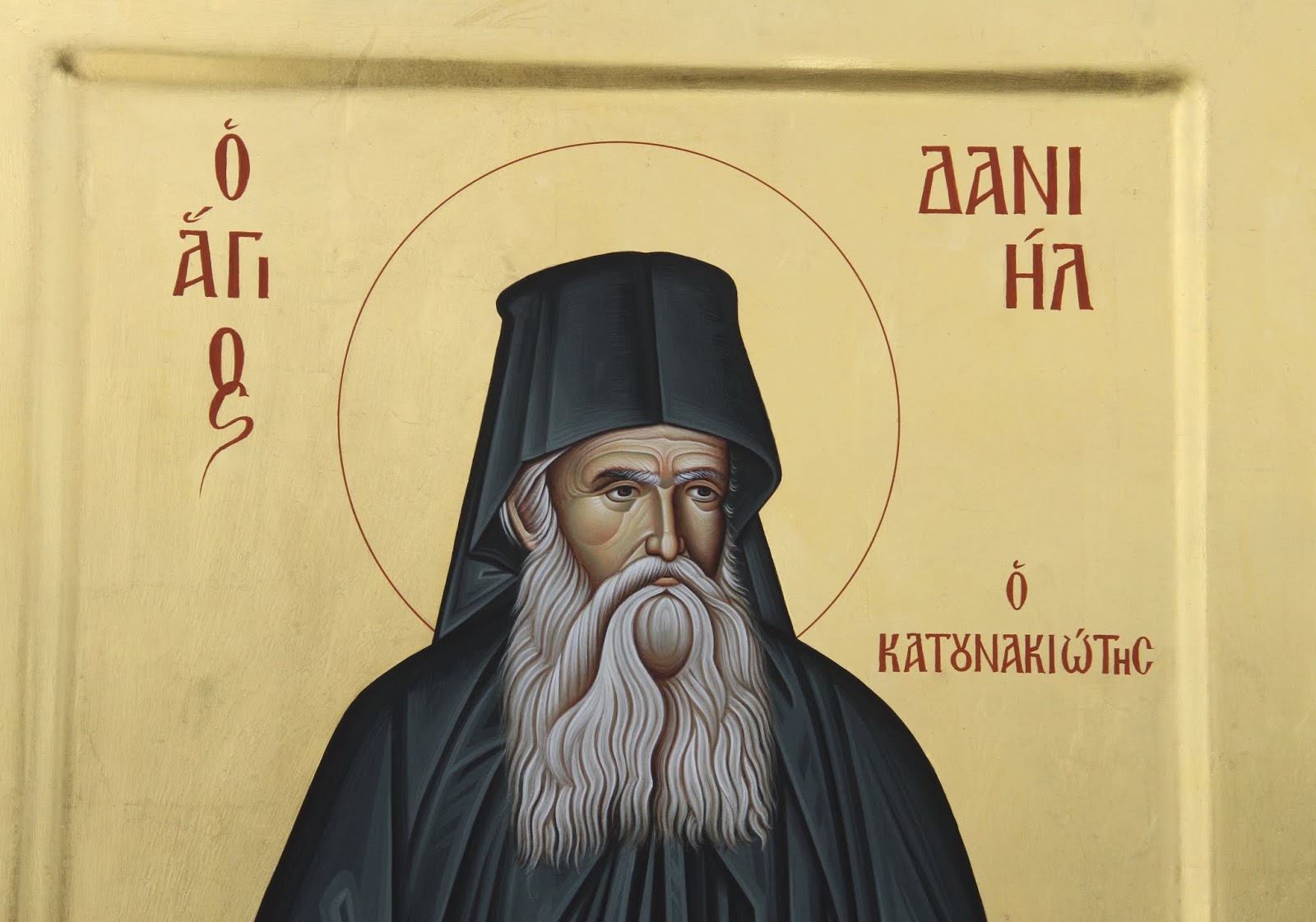
St. Daniel of Katounakia (source)
  
Brief life of St. Daniel of Katounakia
The founder of the monastic brotherhood of the Danielaioi, in Katounakia of Athos, our Venerable Father Daniel lately shown forth with the rays of the ascetical way of life, and illumined all the people bearing the name of Christ through his unerring guidance, and wise teachings. He was from Smyrna, from a large family, and from childhood desired to please Christ and to offer his life to Him.  To this end, and through the blessing of St. Arsenios of Paros and of his mother, he left for Athos. He lived in asceticism in obedience and humility in the Monasteries of St. Panteleimon and Vatopedi, and later in the desert of Katounakia, as desert-loving sparrow. There, he lived a way of life equal to the Angels, and through his written teachings, he guided towards theosis a multitude of piously-minded people and monastics, including the nuns of Kehrovouniou Monastery of Tinos, and the Monastery of the Holy Trinity [and St. Nektarios] on Aegina. He was united with a close friendship with the Venerable Nektarios, and greatly gave rest to the friend of Greek letters, Alexandros Moraitis. He was discerned by his ceaseless prayer and his estrangement from all things of this life, and was numbered together with the ranks of the Angels. In the cell of the Holy Athonite Fathers in Katounakia, he founded his synodeia, which is known for its hospitality like its Elder and Founder, and is also known for its musical education and beautiful chanting, and there is treasured the Saint's precious and grace-flowing Relics.
 
Megalynarion
Rejoice, the canon of discernment, O Daniel, the newly-shining adornment of the Fathers. Rejoice, you who ceaselessly lived the monastic life, and guided to the life to come, O Athonite of godly mind.
 
The Newly-canonized Athonite Fathers: Saints Joseph the Hesychast, Ephraim and Daniel of Katounakia (source)
 
Through the prayers of our Holy Fathers, Lord Jesus Christ our God, have mercy on us and save us! Amen!

Monday, March 9, 2020

The Canonization of Elders Joseph the Hesychast and Ephraim and Daniel of Katounakia

Icon of Elder Joseph the Hesychast (source)

Today, the Synod of the Ecumenical Patriarchate moved to officially canonize the Athonite Elders Joseph the Hesychast and Ephraim and Daniel of Katounakia. May we have their blessing!
   
Sts. Joseph the Hesychast and Ephraim of Katounakia (source)
  
St. Daniel of Katounakia (source)
  
Through the prayers of our Holy Fathers, Lord Jesus Christ our God, have mercy on us and save us! Amen!

Friday, October 25, 2019

A joyous reflection on the Newly-canonized Saints

Icon of our Venerable Father Sophrony of Essex (source)
  
Note: This is a pious reflection by a layman on the joy being experienced at the newly-announced upcoming canonization of new Saints of our Church. In a world with so much pain, sorrow, suffering and hatred (along with painful divisions among Orthodox Christians), we are thankful for these tokens of joy given by our Lord. We pray that these new Saints will entreat Him that peace be granted to the whole world, and especially that all hatred, divisions and animosity be dissolved between Orthodox Christians, and that we all might be granted love, humility, peace and unity in the Holy Trinity!
  
A joyous reflection on the Newly-canonized Saints
It feels like this is a festival without end--the joy of Pascha--which was given to us as a"mouth" and "voice" and expression of the Church by our Ecumenical Patriarch Bartholomew!
These announcements allow us to see a bit of heaven through the pure eyes and sweet hearts of our new Saints!
And this vision full of fruit is not from an individual!
It is in common, it is of the Church!
Many years to you, All-holiness! Fervent thanks!
Another spiritual father of ours, another radiant and true seeker of the truth, a delicate and gracious character, a cultivator of the spiritual life, a poet of the Divine Spirit, a universal and ecumenical rector of the teaching of Orthodox spirituality, the Athonite (cenobite, ascetic, confessor and spiritual father), the Russian, the Patron of Essex as the founder of the Holy Monastery of the Precious Forerunner, the Hieromonk, the Archimandrite Father Sophrony (Sakharov) is "consecrated" formally as a Saint of our Church!
We confess that we are experiencing unique moments!
"It is good for us to be here!"
Within this resurrectional atmosphere and joy!
The Saints show us and reveal to us how death was conquered!
They lived the Resurrection, during this life! Not [only] after their dormitions!
We are truly experiencing a Pascha--more properly, many together--in the face of every Saint of ours, as a victor over death!
And of course, this is occurring before the Autumn Pascha, the feast of St. Demetrios, which his hometown of Thessaloniki celebrates together with the Most-holy Theotokos!
Thus, with those eternal Children--"those to whom belongs the Kingdom of Heaven", our new Saints, from the Garden of Panagia, will shine especially this year within this Pascha and festal atmosphere. (We sense that our new Saints will stand beside us at the procession of the Holy Relics and the Icon of the Great Martyr and Myrrhstreamer St. Demetrios, throughout the radiant streets of Thessaloniki, together with those who are celebrating together, this year along the Panagia Soumela of Pontos.)
Because of this, amidst the autumn we could say:
"Today it smells of springtime, and new creation dances!"
The heaves are rejoicing together with us!
The heavens and the earth are united through our new Saints!
It seems like everything is occurring easily and speedily, beautifully, very spacious and beautiful!
And let beauty save the world! Our Saints!
The stars that illumine our darkness--internally and externally--with the Uncreated Light, which they experienced, tasted, lived!
They are our neighbors, who approach and stand in heaven!
Our fathers, our inspirers, and our guides!
Our mediators and intercessors!
And we don't know if they are gifts from Heaven to the earth, or from earth to Heaven! They may be both!
Once again, let us remember the names of our new Saints, mentioned previously, and how even this serves as a guide of noetic prayer:
The Venerable Daniel of Katounakia, Monk
The Venerable Joseph the Hesychast, Monk
The Venerable Ieronymos of Simonopetra, Hieromonk,
The Venerable Ephraim of Katounakia, Hieromonk,
The Venerable Sophrony of Essex, Hieromonk!

A beautiful icon depicting the five Athonote Fathers that were canonized together at the same time by the Ecumenical Patriarchate: (left to right) Sts. Ieronymos of Simonopetra, Daniel of Katounakia, Joseph the Hesychast, Ephraim of Katounakia, and Sophrony of Essex (source)

And we will not shy away at this time from remembering those other newly-canonized Saints:
The Venerable Porphyrios of Kavsokalyvia, Hieromonk
The Venerable Paisios, Monk!
In reality, we sense that we are partaking of a surpassingly radiant Athonite festival, with all of the polyeleoi of the Monasteries, Sketes, Kathismas, Cells, Kalyves encircling with joy and illumines, while the Fathers, full of rejoicing, chanting together and harmoniously:
"It is meet and right", "It is meet and right", "It is meet and right!"
And of course, they are celebrating full of light and with heavenly thoughts and good works lightning with grace even the Athonite dens and caves,  the makeshift, temporary and insignificant dwelling-places and adornments of ascetics and hermits...
And this occur with the unseen ranks of naked hermits, adorned, extraordinarily, with raiment shining with light!
The Light of Christ illumines all!
New Saints of the Church!
Fathers, teachers, and preservers of the World!
We owe them very much!
Our lives!
Intercede for us!
Or, another way: Stand besides us!
And note:
The dark and inhumane and criminal 20th century seems to become more humane from the light of so many auspicious Saints of the Orthodox Church!
Most likely, all of these Saints of the 20th Century serve as confirmation that: "where sin abounds, grace super abounds!"
And we live this fullness of grace through our Saints in our days!
Christ is risen!
-by Stelios Koukos
(source)
  
Icon of the New Choir of Venerable Athonite Fathers: Joseph the Hesychast, Ephraim of Katounakia, Porphyrios of Kavsokalyvia and Paisios the Athonite (source)
  
Through the prayers of our Holy Fathers, Lord Jesus Christ our God, have mercy on us and save us! Amen!

Sunday, October 20, 2019

Four New Athonite Saints (and likely a fifth) soon to be Canonized by the Ecumenical Patriarchate

Four New Athonite Saints Canonized (source)
 
The numbering very soon among the Saints of the Church of the Athonite Fathers Daniel of Katounakia, Ieronymos of Simonopetra, Joseph the Hesychast and Ephraim of Katounakia was officially announced today on October 20th, 2019 by Ecumenical Patriarch Bartholomew on his trip to Mount Athos. The Athonite Fathers in attendance received this news with tears in their eyes, and received this as a great blessing from the Patriarch.
(source)
  
And as a "final surprise" from Patriarch Bartholomew was the likely upcoming canonization of Elder Sophrony of Essex, though this was only reported by one source.
   Two of these Saints have biographies previously posted on this site and linked to above. For the other two I include brief biographies below:
   
Elder Ieronymos of Simonopetra (source)
   
Elder Ieronymos of Simonopetra was born John Diakogiorgis in 1871 in Reis-Dere of Asia Minor (near Cesme). He entered the Holy Monastery of Simonopetra on Mount Athos on October 28th, 1888 and was tonsured a monk on March 21st, 1893, on Palm Sunday. On April 11th, 1920 he was ordained a deacon, and on April 12th the same year a priest. On April 20th, 1920, the Sunday of the Holy Myrrhbearers, he was enthroned as the Abbot of the Monastery of his repentance (Simonopetra). On June 15th 1931 he was exiled to the Holy Monastery of Koutloumousiou and in three months he was sent to the "Metochion" ("Dependency") of Simonopetra in Athens named after the Holy Ascension of Christ. In 1937 he was re-elected Abbot of Simonopetra, but he declined this, and he remained at Holy Ascension for twenty more years, until he reposed on January 7th 1957 (the feast of Christmas on the Old Calendar). Therefore, he lived 17 years in his homeland of Asia Minor, 43 years in the Monastery of Simonopetra and 26 years at Holy Ascension in Athens.
(source)
   
A more extensive biography of Elder Ieronymos in Greek is available here.
  
Elder Daniel of Katounakia (source)
   
Elder Daniel of Katounakia, known in the world as Dimitrios Dimitriadis, was a monk, the founder of Danielaioi brotherhood at Mount Athos.

Born in 1846 in a family of a armourer in Smyrna, he was the youngest child in the family and was characterized by outstanding abilities. In his teenage years Dimitrios knew by heart almost all Philokalia. At the island of Paros, he met Saint Arsenius of Paros who blessed Dimitrios to go to St. Panteleimon monastery at Mt. Athos. 
In St. Panteleimon monastery, he was tonsured a monk with the name of Daniel. Later he lived in Vatopaidi monastery. For 10 years he suffered with nephritis and on August 31, when the Vatopaidi monastery celebrated the feast of Holy Belt of the Mother of God, he was suddenly healed. After 5 years in Vatopaidi he moved to Katounakia where lived alone for 3.5 years. Starting from 1883, other monks started to settle there, so that Danielaioi brotherhood was formed. Elder Daniel was offered to be a bishop but considered himself to be unworthy of it.
Elder Daniel had a gift of spiritual counsel and consolation in sorrows. He guarded or cured many monks and lay persons. He was in spiritual friendship with St. Nectarios of Pentapolis. Also he was in correspondence with Philotheos (Zervakos) of Paros and other monks from the monastery of Longovarda at the island of Paros. Elder Daniel guarded them from the heresy of theologian A. Makrakis. About 200 letters to the abbess Theodosia from the monastery at the island of Tinos and 70 other writings of elder Daniel are available until now.
Kostis Marmaras, a lay person, was interested in spiritualism. He wanted to know whether it comes from the electric forces of from the spiritual forces. Then he found out that it was from the spirit and in his opinion, from the Holy Spirit. So Kostis practiced spiritualism for 30 years, reading thoughts, speaking with "saints", "spirits of reposed people" etc. After that he found a book of elder Daniel against spiritualism and started to doubt about holiness of the participating spirit. He started to write letters to the elder asking about it. The elder succeeded in convincing Kostis that spiritualism was a delusion. But it took a very long time for Kostis to be healed completely. When Kostis started to read the prayers of exorcism of St. Basil the Great, the demons beat him unmercifully in the night. Then he started to see demonic visions and thought that it comes from grace. In the end, Kostis managed to get out of the net of demonic tricks, but that happened only with help of Divinely wise elder Daniel. 
Fr. Callistratus in the end of his life fell into prelest. During the Divine service, he started trembling and was thinking that this is an action of grace. But he was not absolutely certain and decided to write to elder Daniel. The elder replied with an extensive letter "On noetic prayer. Letter of elder Daniel to Callistratus" (1916, In: "Angelic Living"). Elder Daniel analyses in detail the actions of grace and the trembling that comes from God and the one that comes from the evil side. He writes that no one of the Saints was trembling as Fr. Callistratus. He also tells about another similar case of trembling that was coming from the evil forces with monk Alipius who did not notice that was praying with unnoticeable vainglory. And the elder showed with convincing arguments that the trembling for Fr. Callistratus was coming from the same force. In a reply, Fr. Callistratus is amazed at the action of the elder Daniel's letter, the meekness of the elder and the way how he showed the delusion.
In a letter "Reply of monk Daniel to Markianus, a monk of Iveron skete, about rejection of dreams" (1918, In: "Angelic Living"), elder Daniel writes about a man of great learning by the name of Nicolaus who thought of himself that he had received a gift of unceasing heart prayer from the icon of the Mother of God and then started to see visions. He asked God to receive the same visions as the Prophets of the Old Testament. Then the Devil offered him many other heretic superstitions: at the feast day of St. Spyridon, this "saint" appeared in front of Nicolaus and told him to "sacrifice" his hand to Christ and to burn it with candle; the man even took baptism for the second time from the protestants because the demons told him that only protestants keep proper baptism from the times of Apostles. When elder Daniel asked whether this man confessed everything, he replied that "Christ" told him that it is not necessary and there are no true confessors now. After listening for 6 hours about different delusions, it took elder Daniel 2 hours to bring that person to reason based on many places in the Divine Scriptures and reasonable arguments. The man was convinced and started to resist the visions, though the traces of delusion were seen to the end of his life.
In September of 1929, the elder fell ill with a cold. He was foreboding his death and asked to take the Holy Communion. On September 8 (21), 1929, on the day of the Nativity of the Mother of God, after the Divine Liturgy and the Sacrament of Anointment of the Sick, elder Daniel reposed.

The New Choir of Athonite Fathers, including left to right: Saints Joseph the Hesychast, Ephraim of Katounakia, Porphyrios of Kavsokalyvia and Paisios the Athonite (source)
   
Apolytikion of the Holy Fathers in the Fourth Tone
O God of our Fathers, always act with kindness towards us; take not Your mercy from us, but guide our lives in peace through their prayers.
   
Through the prayers of our Holy Fathers, Lord Jesus Christ our God, have mercy on us and save us! Amen!

Wednesday, November 14, 2012

The Holy Forty Divine Liturgies

Christ communing His Holy Apostles (source)
 
The Holy Forty Divine Liturgies ("Sarantoleitourgo")
During the forty day period prior to the celebration of the Nativity of our Lord*** it is a tradition for priests to celebrate daily the Divine Liturgy. The Forty Liturgies celebrated during this time are a great blessing not only for those who participate, but also for those commemorated among both the living and reposed. As St. Ignatius of Antioch writes: "Take heed, then, often to come together to give thanks to God, and show forth His praise. For when you assemble frequently in the same place, the powers of Satan are destroyed, and the destruction at which he aims is prevented by the unity of your faith" (Eph. 13). The power of the Divine Liturgy isn't magical, but it is a manifestation of love and unity in Christ. It teaches us to forgive, to have love for one another, and to be united in Christ as one body. In such an assembly, where the living and reposed are commemorated, great blessings follow for all.

The Divine Forty Day Liturgies of the Nativity season on behalf of the living and reposed are a manifestation of the love we should have for one another as members of the Church. Nothing makes more real and present the love of Christ for mankind, who took on flesh for the salvation of sinners, then the daily offering of the Divine Eucharist for the forgiveness of sins and life everlasting of the living and reposed.


As St. John of Kronstadt writes: "In the Divine Liturgy is celebrated the Mystery of Love...[O perfect love! O love which embraces all! O strongest love! What can we offer in thanksgiving to God for His love for us? This love is found in the sacrifice of Christ, which is offered for the liberation of all from every evil...]"

And Elder Paisios advised regarding the need to pray for the departed: "Leave in your prayers room for the reposed. The dead can do nothing for themselves. The living can. Bring to the church prosphoro, and give the names of the reposed to be commemorated by the priest in the proskomede. Do also memorials and trisagia. But the trisagion without the Divine Liturgy is nothing. The greatest thing we can do for someone is Forty Liturgies. It would be good to tie it in together with almsgiving."

St. Symeon of Thessaloniki writes of the commemoration of the reposed during the Divine Liturgy: "During the Liturgy their portion which is placed on the diskos invisibly partakes of God, they are cleansed through the Sacred Blood and commune,...and they are consoled...and they rejoice in Christ." 

And St. John Chrysostom writes: "You should not have any doubt whatsoever that the dead will benefit spiritually. The priest does not plead in vain in the Holy Prothesis or at the Holy Table for the reposed in Christ, with faith in the God-man Lord."
(http://www.johnsanidopoulos.com/2011/11/divine-forty-liturgies-and-nativity.html)
   
***Note: There are many places which also celebrate the Forty Divine Liturgies at other periods of the year (e.g. during the forty days after Pascha), while there are other places which, through the grace of God, celebrate the Divine Liturgy every day, for the healing, forgiveness and sanctification of the faithful.
   
On the benefit of the Forty Liturgies for the Departed
Elder Daniel of Katounakia (+1929) was originally from Smyrna, and at one point while he was a monk on Mount Athos he lived at Vatopaidi Monastery. One of his obediences was to travel on business for Vatopaidi to Smyrna where he stayed for nine months.

When Elder Daniel was a young boy in Smyrna, there was a simple Christian named Demetrios, who was known for his great virtue and piety, that would counsel and admonish him with heavenly wisdom. Upon his return to Smyrna the elder had heard that Demetrios was dead and he wished to meet with Demetrios' son George to ask him about it. He writes: "As soon as I arrived, I considered it my inviolable duty to first of all visit George, the son of the ever-memorable Demetrios. I questioned him minutely about the death of his father, of whose repose I had heard from many people."

George described the details of his virtuous father's death to Elder Daniel with tears in his eyes, yet one event was so remarkable that Elder Daniel decided to record it for our spiritual benefit.

Archimandrite Cherubim, in his book Contemporary Ascetics of Mount Athos (vol. 1, pp. 241-245), describes the event as follows:

Reaching the sunset of his earthly life, the divinely-enlightened Demetrios knew beforehand, by the grace of God, the day of his death. On that day he asked a certain devout, guileless, and saintly priest, Fr. Demetrios, to come to him.

"I will die today, my father," he said to him. "I beg you, tell me what I must do at this critical time."

The priest knew of his virtuous life; he knew that he had confessed, received Holy Unction, and had Holy Communion several times. Seeing his desire, however, it came to him to suggest the following:

"If you wish, give a command that after your death forty Liturgies should be served for you in a country chapel."

The dying man accepted the priest's suggestion with joy. A little while later he called his son.

"My son, I ask one favor. I ask that after my death you arrange to have forty Liturgies served for me in some church far away from the city."

"Give me your blessing, Father, and I will promise you to fulfill your wish," was the reply.

After two hours the man of God gave up his spirit. Without delay, his good son addressed Fr. Demetrios, not knowing it was he who had suggested the forty Liturgies.

"Fr. Demetrios, my father left me a command to have forty Liturgies served for him somewhere outside the city. As you sometimes stay at the Chapel of the Holy Apostles, i beg you to take on the labor of serving them. I will take care of your work and the expenses of the church."

With tears the priest replied: "My dear George, I myself gave this advice to your father, and I will always commemorate him as long as I live. I cannot serve a regular forty Liturgies, however, because right now my presvytera is a little sick. You will have to entrust them to another priest."

George, however, knowing Fr. Demetrios' great piety and his father's devotion to him, persisted until he persuaded him. The priest returned to his home and said to his presvytera and his daughters:

"I must serve forty Liturgies for the soul of the good Christian Demetrios. Therefore don't expect me home for forty days. I will be at the Holy Apostles the whole time."

He began willingly to serve the Liturgies. Thirty-nine went by without hindrance, and the last was to fall on a Sunday. On Saturday evening, however, he was seized by a terrible toothache which forced him to return home. He was moaning from the pain. His presvytera suggested that they call someone to extract the painful tooth.

"No," he answered, "I have to serve the last Liturgy tomorrow."

In the middle of the night, however, the pain grew so great that they were forced to summon a specialist to pull the decayed tooth. As he was bleeding, he decided to serve the last Liturgy on Monday.

On Saturday afternoon, George got some money ready to repay the labor of the priest, which he would give him the next day. In the middle of the night, as Sunday was approaching, he arose to pray. The absolute silence of the night was conducive to compunction. Later, growing tired, he sat on his bed and began to recall to his mind the virtues, gifts and wise words of his blessed father. The thought also passed through his mind: "Do the forty Liturgies really benefit the soul of the reposed, or does the Church mainly recommend them for the consolation of the living?" Just at that moment he fell into a light sleep.

He saw himself in a beautiful plain, of an indescribable loveliness one does not see the earth. He felt himself unworthy to be in such a holy paradisiacal place, however, and was overcome by fear, afraid that because of his unworthiness he would be cast out from there and thrust into the depth of hades. But the thought strengthened him: "Since the All-Good God deigned to bring me here, He will have mercy on me and lead me to repentance, for since I am still in my body I must still be living."

After this consoling thought he saw from afar a most pure and clear light, shining much brighter than the sun. He ran towards it and saw with unspeakable surprise a sight of indescribable beauty. Before him stretched a vast forest-garden, all wooded, fragrant with a wonderful and unutterable aroma. He said within himself: "This must be Paradise! Oh, what blessedness awaits those who live virtuously on the earth!"

Examining this other-worldly beauty with astonishment and delight, he saw a most beautiful palace of exceeding brightness and excelling architectural grace, whose walls shone more than gold and diamonds. It was impossible to describe it beauty in human terms, and he was speechless and amazed. Drawing closer - oh joy! He saw his father, light-bearing and shining, before the door of the palace.

"How did you come here, my child?" his father asked him with gentleness and love.

"I don't know either, Father. I realize that I am not worthy of this place. But tell me, how are you here? How did you come here? Whose palace is this?"

"The goodness of our Savior Christ, by the intercession of the Mother of God, whom I especially revere, vouchsafed me this place. I was to have entered into the palace today, but since the builder who is constructing it is suffering from bad health - he had his tooth extracted today - the forty days of its building have not been completed. Therefore I will enter it tomorrow."

After those words George awoke, full of tears and wonder, but also with some perplexities. For the remainder of the night he did not sleep, but sent up continuous praise and glorification to the All-Good God. In the morning he went to attend Liturgy at the Cathedral of St. Photini. Afterwards he took with him prosphora, blessed wine, and an unburnt candle and set out for the region of Mirtakia, where the Chapel of the Holy Apostles was located. He found Fr. Demetrios sitting in a chair inside his cell.

The priest welcomed him with joy, saying: "I also have just come from Divine Liturgy. Now the forty Liturgies are finished."

This he said so as not to grieve George.

George then began to describe in detail the vision he had in the night. When he came to the account of his father's entering was delayed because of the builder's toothache, the priest was overcome with fear, but also by wonder and joy. Standing upright, he said:

"My dear George, I am the builder who worked at constructing the palace. Today I did not serve Liturgy because I had my tooth extracted. See, the handkerchief in my hand is stained with blood. I told you a falsehood because I didn't want to sadden you."

Elder Daniel was deeply moved by this blessed narrative. At the end, George urged him to visit Fr. Demetrios, who at that time was working as a priest in the district of St. John the Theologian. The priest told him exactly the same story, and begged him to record such a profitable tale. This is what happened, as we found it among his manuscripts. At the end of it, Elder Daniel noted with his pen: "The above account I heard in the year 1875, in the month of October. This ever-memorable Demetrios reposed in 1869."

(http://www.johnsanidopoulos.com/2010/09/on-benefits-of-forty-liturgies-for.html)
   
St. George Karslides on the Forty Liturgies
1. When he would Liturgize he would become another man. Those attending church would hear various sounds from the Holy Altar from his heavenly visitors. They would kneel and chant "Lord have mercy".

2. One day the Saint said to his chanter: "I had so many saints today that I didn't have enough room to fit them. We put Saint Panteleimon in one corner, because there was no room."

3. At one time demons bothered the Saint and would not allow him to do the proskomede. After the Liturgy he said: "I began these Forty Liturgies with stress. The demons would yell out the names so that I would not be able to commemorate them, and thus not allow them to be forgiven."

4. After a period of Forty Liturgies he was asked:

"Elder, were you tired to finish them?"

"No my child. It was a pleasure for me, as if I did one Vespers, because they were very good people. Your father had a rich table like Abraham."

Then the man thought: "We were so poor, to the point we were hungry, so where did our father find such a rich table?"

"Don't see things like that," the Saint corrected. "Maybe he did not have to give, but his soul wanted to give much, and God accounted it to him as if he did give it. Your mother is a servant of your father, because she was very tiresome and would sadden him, always complaining to him. But your father always wore a smile with much goodness. Among your relatives you had a blind girl, whom you forgot to write. She was pure and very good."

"But how did you know this?" asked the man in wonder.

"When I commemorate, she also comes to the kollyva, but she comes as a guest, and does not unite with the others. Now everyone went to their place and opened the road for you."
Source: Athonite Flowers (vol. 14). Translated by John Sanidopoulos. (http://www.johnsanidopoulos.com/2011/11/saint-george-karslidis-on-forty.html)

   
Through the prayers of our Holy Fathers, Lord Jesus Christ our God, have mercy on us and save us! Amen!