Showing posts with label St. Gregory the Dialogist. Show all posts

Sunday, April 12, 2015

St. Gregory Dialogos on the Mystery of the Resurrection

Christ is risen! Truly He is risen!
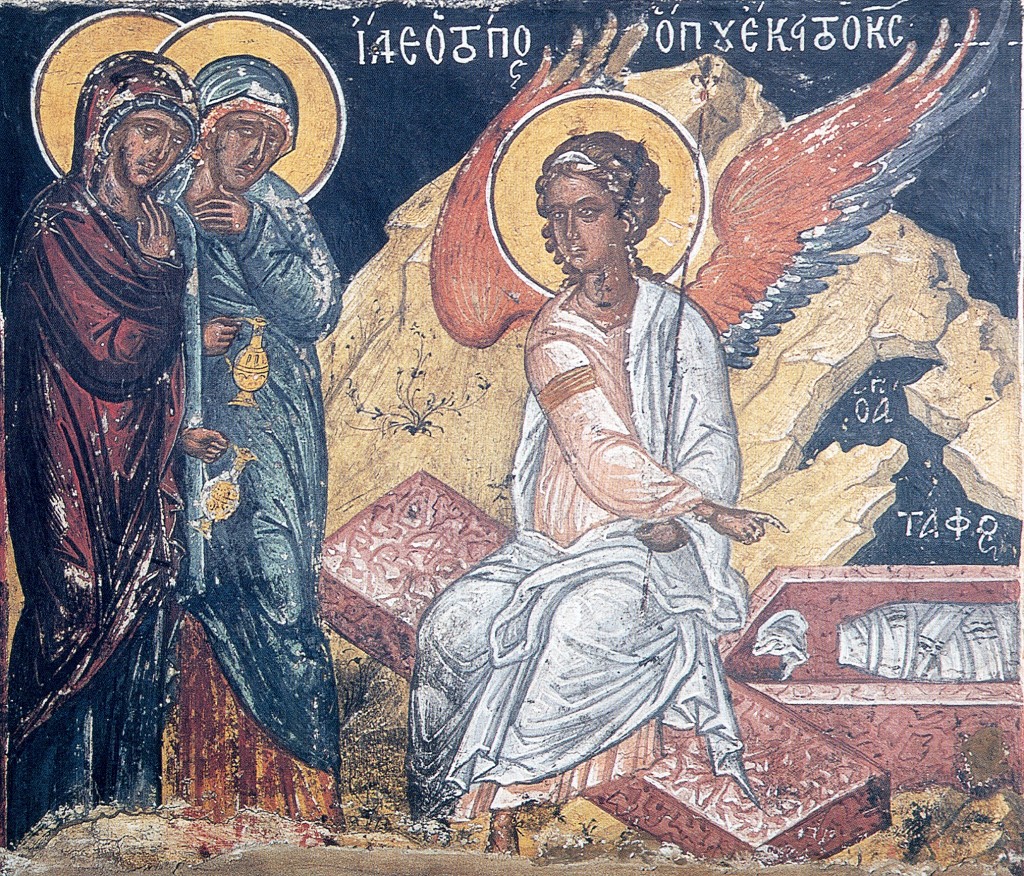
The Holy Myrrhbearers at the empty Tomb of Christ (source)
  
St. Gregory Dialogos on the Mystery of the Resurrection
Given to the People in the Basilica of the Blessed Virgin Mary, on the Holy Day of the Resurrection
1. It has been my custom, beloved brethren, to speak to you on many of the Gospel readings, by means of a sermon I had already dictated for you. But since I have been unable, because of the weakness of my throat, to read to you myself what I had prepared, I notice that some among you listen somewhat indifferently. So, contrary to my usual practice, I shall for the future make the effort during the sacred solemnities of the Mass to explain the Gospel, not through a sermon I have dictated, but by speaking directly to you myself.
  
So for the future it shall be the rule for me to speak to you in this way. For the words which are spoken directly to sluggish souls awaken them more readily than a sermon that is read to them; moving them by that touch as it were of authority, so that they listen with more attention. I am not, as I well know, competent to fulfill this office: but let your charity make good what my ignorance denies me. For I have in mind Him Who has said: Open thy mouth wide, and I will fill it (Ps. lxxx. ii). We all have in mind a good work , and it will be perfected by His divine assistance (II Tim. iii. 17). And also, this great solemnity of the Sunday of the Resurrection gives us a fitting occasion for speaking to you: for it would indeed be unfitting that the tongue of our body should be silent in the praises that are clue this day; that day on which the Body of our Author rose again from the dead.
  
2. You have heard, Beloved, how the holy women who had followed the Lord came to His tomb, bringing with them sweet spices, so that with tender affection they might tend Him in death Whom they had loved in life. And this tells us something which we should observe in the life of our holy Church. And it is important we give attention to what here took place: to see what we mint do to imitate them. And we also, who believe in Him Who died, truly come with sweet spices to His tomb, when we come seeking the Lord, bringing with us the sweet odour of virtue, and the credit of good works.
But these women who came bringing sweet spices beheld angels. And this signifies that those souls who, because of their holy love, come seeking the Lord, bearing the sweet spices of virtue, shall also see the citizens of heaven. And let us also take note of what it means that the angel is seen sitting on the right side. For what does the left side mean but this present life; and the right hand side, if not life eternal? Because of this it is written in the Canticle of Canticles: His left hand is under my head, and his right hand shall embrace me (Cant. ii. 6).
  
And so, since Our Redeemer has now passed over beyond the mortality of this present life, tightly does the Angel, who had come to announce His entry into eternal life, sit at the right side . And he came clothed in white: for he was announcing the joy of this our present solemnity. For the whiteness of his garments signifies the glory of our great Feast. Should we say ours 0t His? That we may speak truly let us say that it is both ours and His. For this day of our Redeemer’s Resurrection is also our day of great joy; for it has restored m to immortality. It is also a day of joy for the angels: for restoring us to heaven, it has filled up again the number of its citizens. On this our festival day, and His, an angel appeared, clothed in white robes, because they are rejoicing that because we are restored to heaven the losses their heavenly home had suffered are now made good.
  
3. But let us hear what is said to the women who came? Be not affrighted! As though he said to them: Let them fear who love not the coming of the heavenly citizens. Let them fear who, steeped in bodily desires, have no hope of belonging to them. But you, why should you fear, meeting your own? Matthew also, describing the appearance of the Angel, says of him: And his countenance was as lightning, and his raiment as snow (Mt. xxviii. 3). Lightning awakens dread and fear, the white radiance of snow is soothing. For Almighty God is both terrifying to sinners, and comforting to those who are good. Rightly then is the Angel, the Witness of the Resurrection, revealed to us with countenance like the lightning, and his garments white as snow: so that even by his appearance he might awaken fear in the reprobate, and bring consolation to the just.
  
And rightly also, for the same reason, there went before the Lord’s People in the desert, a column of fire by night, and a column of smoke by day (Ex. xiii: 21, 22). For in fire there is fear; but in the cloud of smoke the comforting assurance of what we can see: day also meaning the life of the just, and night the life of sinners. Because of this Paul, speaking to converted sinners, says: For you were heretofore darkness, but now light in the Lord (Eph. v. 8). So a pillar of cloud was set before them by day, and a pillar of fire by night: because Almighty God shall appear mild of countenance to the just, but fearful to the wicked. Coming to judge us, He shall comfort the one by the mildness of His countenance, and terrify the other with the severity of His justice.
  
4. Now let us hear what the angel says. You seek Jesus of Nazareth .  Jesus, in the Latin tongue, is saving ; that is, Saviour . Then however many were called Jesus, by name, not because of the reality it means. So the place is added, to make clear of what Jesus he is speaking: Of Nazareth . And to this he adds the reason they seek Him: Who was crucified . And then he goes on: He is risen, he is not here . That He was not there was said only of His Bodily Presence; for nowhere is He absent in the power of His divinity. But go , he continues, tell his disciples and Peter, that he goeth before you into Galilee .
  
Now we have to ask ourselves, why did he, speaking of the Disciples, single out Peter by name? But, had the Angel not referred to him in this way, Peter would never have dared to appear again among the Apostles. He is bidden then by name to come, so that he will not despair because of his denial of Christ. And here we must ask ourselves, why did Almighty God permit the one He had placed over the whole Church to be frightened by the voice of a maid servant, and even to deny Christ Himself? This we know was a great dispensation of the divine mercy, so that he who was to be the shepherd of the Church might learn, through his own fall, to have compassion on others. God therefore first shows him to himself, and then places him over others: to learn through his own weakness how to bear mercifully with the weakness of others.
  
5. And well did he say of Our Redeemer that: He goeth before you into Galilee; there you shall see him, as he told you . For Galilee means, passing-over . And now our Redeemer has passed over from His suffering to His Resurrection, from death to life, from punishment to glory, from mortality to immortality. And, after His Resurrection, His Disciples first see Him in Galilee; as afterwards, filled with joy, we also shall see the glory of the Resurrection, if we now pass over from the ways of sin to the heights of holy living. He therefore Who is announced to us from the tomb is shown to us by crossing over: for He Whom we acknowledge in the denial of our flesh is seen in the passing over of our soul. Because of the solemnity of the day, we have gone briefly over these points in our explanation of the Gospel. Let us now speak in more detail of this same solemnity.
  
6. There are two lives; one of which we knew, the other we did not know of. The one is mortal, the other immortal; the one linked with human infirmity, the other to incorruption; one is marked for death, the other for resurrection. The Mediator between God and man, the Man Jesus Christ, came, and took upon Himself the one, and revealed to us the other. The one He endured by dying; the other He revealed when He rose from the dead. Had He then foretold to us, who knew His mortal life, the Resurrection of His Body, and had not visibly shown it to us, who would believe in His promises? So, becoming Man, He shows Himself in our flesh; of His own will He suffered death; by His own power He rose from the dead; and by this proof He showed us that which He promises as a reward.
But perhaps some one will say: Of course He rose: for being God He could not be held in death. So, to give light to our understanding, to strengthen our weakness, He willed to give us proof, and not of His Resurrection only. In that hour He died alone; but He did not rise alone from the dead. For it is written: And many bodies of the saints that had slept arose (Mt. xxvii. 52). He has therefore taken away the argument of those who do not believe.
  
And let no one say: No man can hope that that will happen to him which the God-man proved to us in His Body; for here we learn that men did rise again with God, and we do not doubt that these were truly men. If then we are the members of our Redeemer, let us look forward to that which we know was fulfilled in our Head. Even if we should be diffident, we ought to hope that what we have heard of His worthier members will be fulfilled also in us His meanest members.
  
7. And here there comes to mind what the Jews, insulting the Crucified Son of God, cried out: If he be the king of Israel, let him come down from the cross, and we will believe him . Had He, yielding to their insults, then come down from the Cross, He would not have proved to us the power of patience. He waited for the little time left, He bore with their insults, He submitted to their mockery, He continued patient, and evoked our admiration; and He Who refused to descend from the Cross, rose again from the sepulchre. More did it matter so to rise from the sepulchre than to descend from the Cross. A far greater thing was it to overcome death by rising from the sepulchre, than to preserve life by descending from the Cross.
  
And when the Jews saw that despite their insults He would not descend from the Cross, and when they saw Him dying, they rejoiced; thinking they had overcome Him and caused His Name to be forgotten. But now through all the world His Name has grown in honour, because of the death whereby this faithless people thought they had caused Him to be forgotten. And He Whom they rejoiced over as slain, they grieved over when He was dead: for they know it was through death He had come to His glory.
The deeds of Samson, related in the Book of Judges, foreshadowed this Day (Judges xvi. 1-3). For when Samson went into Gaza, the city of the Philistines, they, learning he had come in, immediately surrounded the city and placed guards before the gates; and they rejoiced because they had Samuel in their power. What Samson did we know. At midnight he took the gates of the city, and carried them to the top of a hill outside. Whom does Samson symbolize, Beloved, in this, if not our Redeemer? What does Gaza symbolize, if not the gates of hell? And what the Philistines, if not the perfidy of the Jews, who seeing the Lord dead, and His Body in the sepulchre, placed guards before it; rejoicing that they had Him in their power, and that He Whom the Author of life had glorified was now enclosed by the gates of hell: as they had rejoiced when they thought they had captured Samson in Gaza.
  
But in the middle of the night Samson, not alone went forth from the city, but also bore off its gates, as our Redeemer, rising before day, not alone went forth free from hell, but also destroyed the very gates of hell. He took away the gates, and mounted with them to the top of a hill; for by His Resurrection He bore off the gates of hell, and by His Ascension He mounted to the kingdom of heaven.
  
Let us, Beloved, love with all our hearts this glorious Resurrection, which was first made known to us by a Figure, and then made known in deed; and for love of it let us be prepared to die. See how in the Resurrection of our Author we have come to know His ministering angels as our own fellow citizens. Let us hasten on to that great assembly of these fellow citizens. Let us, since we cannot see them face to face, join ourselves to them in heart and desire. Let us cross over from evildoing to virtue, that we may merit to see our Redeemer in Galilee. May Almighty God help us to that life which is our desire: He Who for us delivered His only Son to death, Jesus Christ our Lord, Who with Him reigns One with the Holy Ghost, for ever and ever. Amen.
  
(non-Orthodox host site)
  
Christ is risen from the dead, by dead, trampling down upon death, and to those in the tombs, He has granted life! Truly the Lord is risen!

Sunday, May 12, 2013

St. Gregory the Great on St. Thomas Sunday

Christ is risen! Truly He is risen!
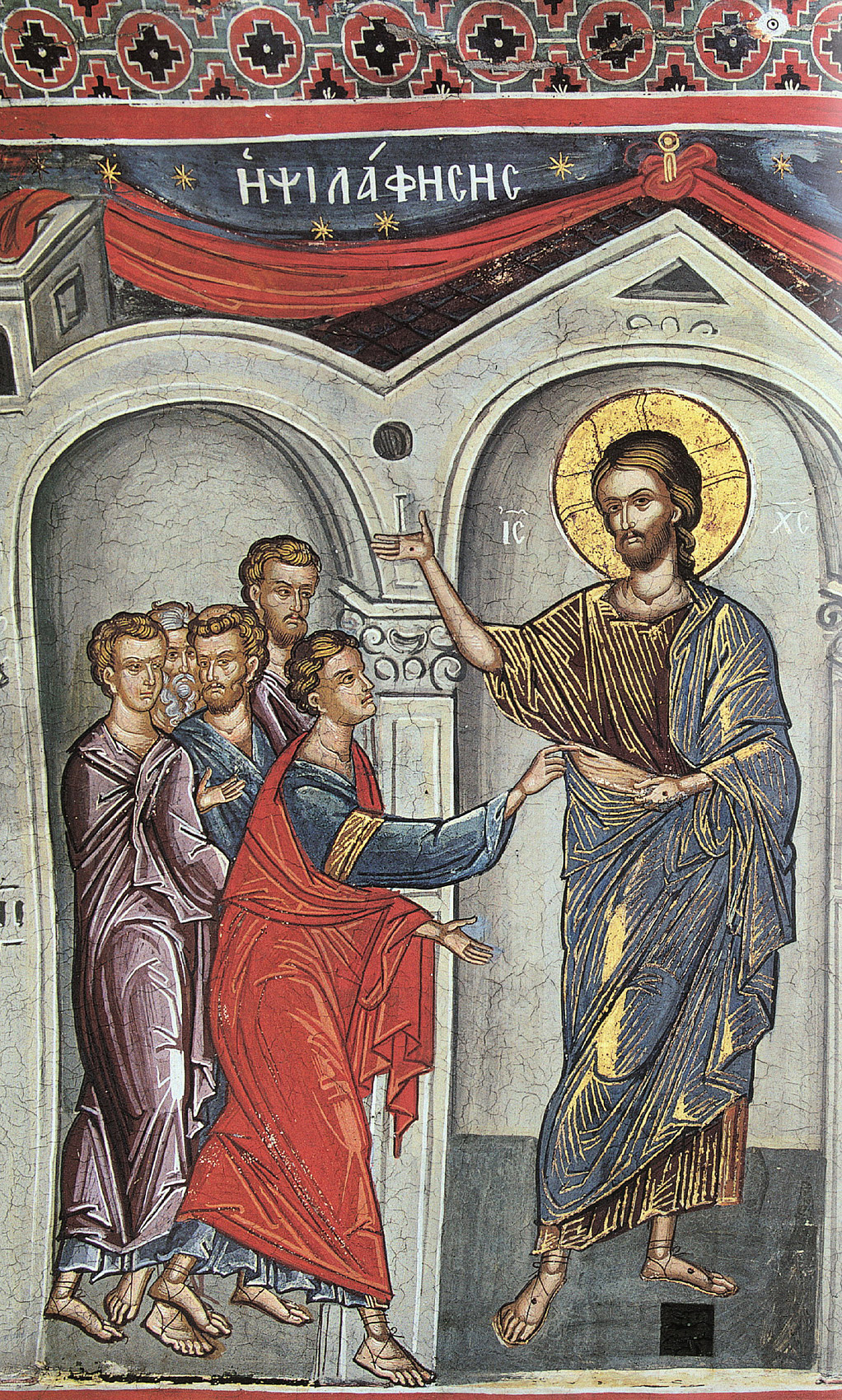
St. Thomas touching the risen Christ (source)
   
Thomas, one of the twelve, called the Twin, was not with them when Jesus came. He was the only disciple absent; on his return he heard what had happened but refused to believe it. The Lord came a second time; He offered His side for the disbelieving disciple to touch, held out His hands, and showing the scars of His wounds, healed the wound of his disbelief.

Dearly beloved, what do you see in these events? Do you really believe that it was by chance that this chosen disciple was absent, then came and heard, heard and doubted, doubted and touched, touched and believed? It was not by chance but in God’s providence. In a marvelous way God’s mercy arranged that the disbelieving disciple, in touching the wounds of his Master’s body, should heal our wounds of disbelief.

The disbelief of Thomas has done more for our faith than the faith of the other disciples. As he touches Christ and is won over to belief, every doubt is cast aside and our faith is strengthened. So the disciple who doubted, then felt Christ’s wounds, becomes a witness to the reality of the resurrection.

Touching Christ, he cried out: "My Lord and my God."

Jesus said to him: "Because you have seen me, Thomas, you have believed."

Paul said: "Faith is the guarantee of things hoped for, the evidence of things unseen."

It is clear, then, that faith is the proof of what can not be seen. What is seen gives knowledge, not faith. When Thomas saw and touched, why was he told: "You have believed because you have seen me?"

Because what he saw and what he believed were different things. God cannot be seen by mortal man. Thomas saw a human being, whom he acknowledged to be God, and said: "My Lord and my God."

Seeing, he believed; looking at one who was true man, he cried out that this was God, the God he could not see.

What follows is reason for great joy: "Blessed are those who have not seen and have believed."

There is here a particular reference to ourselves; we hold in our hearts One we have not seen in the flesh. We are included in these words, but only if we follow up our faith with good works. The true believer practices what he believes. But of those who pay only lip service to faith, Paul has this to say: "They profess to know God, but they deny him in their works."

Therefore James says: "Faith without works is dead."

(source)
   
Christ has risen from the dead, by death he has trampled on death, and to those in the graves given life!
Truly the Lord is risen!

Monday, April 29, 2013

Selected Quotes of the Fathers on the Parable of the Ten Virgins

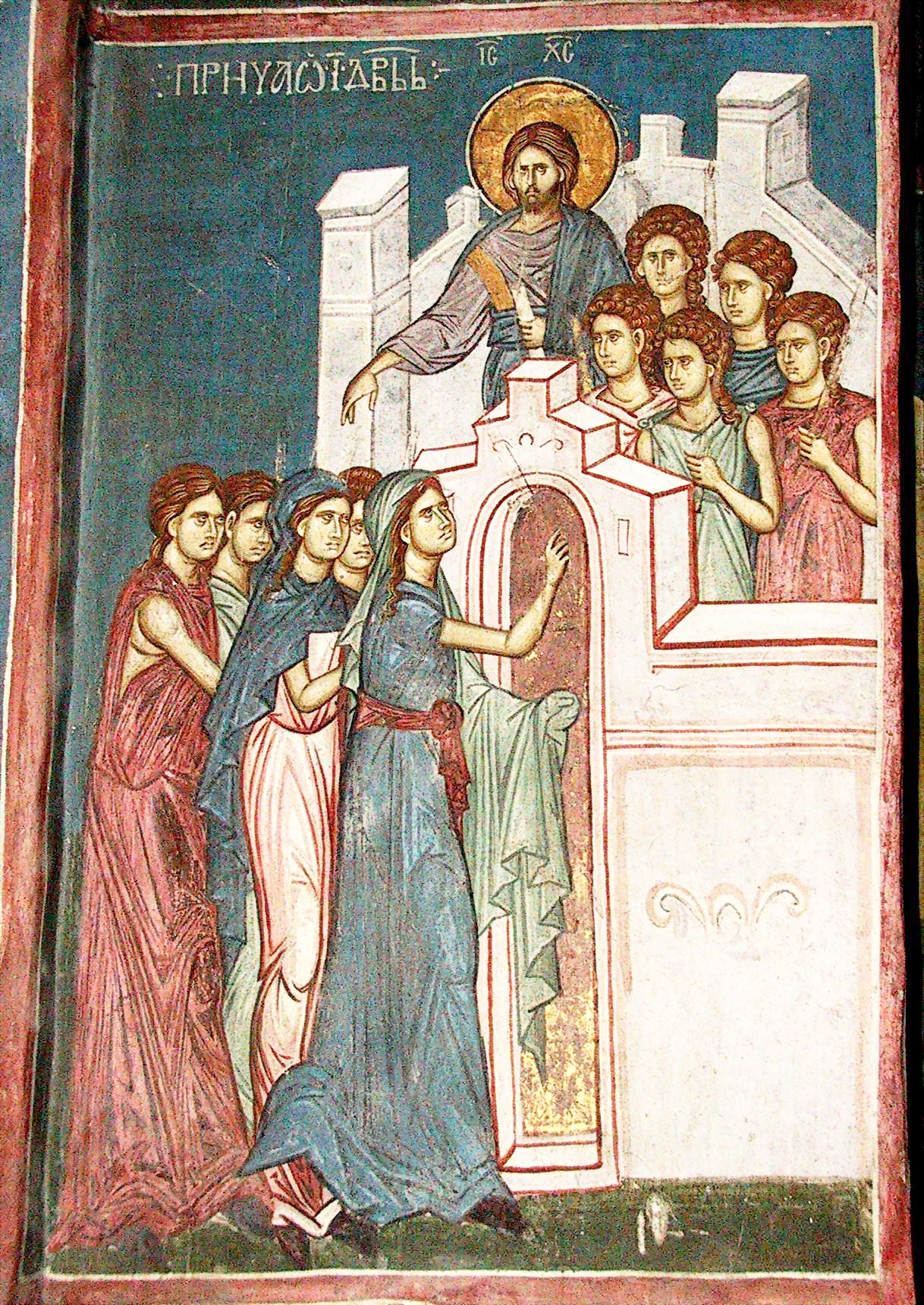
The Parable of the Ten Virgins (source)
    
Selected Quotes of the Fathers on the Parable of the Ten Virgins
The five wise virgins, watchful and alert, had taken oil in the vessels of their heart. That oil, not part of their own nature, means the grace of the Spirit. They were enabled to enter with the Bridegroom into the heavenly bridal chamber. The other five virgins, however, were content with their own nature. They neither watched nor busied themselves to receive the oil of gladness [Ps. 44:6] in their vessels, while they were yet in the flesh. Instead, they sank into sleep through carelessness, slackness, idleness, and ignorance, or even fancied righteousness. Hence, they were shut out of the bridal chamber of the Kingdom, unable to give satisfaction to the heavenly Bridegroom. Held fast by their tie to the world, and by some earthly affection, they did not give their whole love or passionate devotion to the heavenly Bridegroom; thus they were not provided with oil. Souls that seek the sanctification of the Spirit, which is outside of nature, fasten all their affection upon the Lord. It is in the Lord that they walk, pray, and employ their thoughts, turning away from all else. For this cause, they are priviledged to receive the oil of heavenly grace. This enables them to succeed in coming through without falling, giving perfect satisfaction to the spiritual Bridegroom. Those souls, however, content with what belongs to their own nature, creep upon the earth in their thoughts. Not only do they employ their thoughts upon earth, but their minds have their whole existence upon earth. In their own estimation, they appear to belong to the Bridegroom, and to be adorned with the ordinances of the flesh. Nonetheless, they have not been born of the Spirit; and they have not received the oil of gladness.
-Saint Macarios the Great (Fifty Spiritual Homilies, Homily IV)


This parable admonishes us to remain diligent in almsgiving. It counsels us to help our neighbor by every means available to us, since it is impossible to be saved in any other way....For nothing is more sullied than virginity without mercy ... What was the profit of virginity, when they saw not the Bridegroom? Even when they knocked at the door, they did not obtain; instead, they heard the fearful saying, "Depart, I know you not". When he said this, nothing else but hell is left, and that intolerable punishment....This parable was spoken with respect to mercy in almsgiving ... It is also that we might learn how close Christ is joined unto virgins that strip themselves of their possessions; for this indeed is virginity.
-Saint John Chrysostom (Homilies on the Gospel of Matthew, Homily LXXVII)


As it is written: "The day of the Lord shall come as a thief in the night" (1 Thess. 5:2). Then the virgins shall awake, because both good and wicked are roused from the sleep of death. They shall trim their lamps, that is, they shall count the number of their good works for which they hope to receive the reward of eternal happiness. However, the lamps of the foolish virgins shall fail. This is because their works, seen so clearly by men, shall wane and vanish at the coming of the Judge. From God, they shall receive no recompense, for men gave them the praise they esteemed so highly. The blessed will rejoice in their recompense, when they enjoy that vision of Him in Whose presence the elements tremble. They will then go in with Him to the marriage. As they rejoice in the nuptials of the Bridegroom, they themselves will be the bride; for in the bridal chamber of the eternal Kingdom, they are united forever to their God. Thenceforth, that vision can never be snatched from them. The door of the Kingdom will close forever upon those left outside, who then will weep. However, that same door is now open to all penitents. There will be repentance then, but it will be fruitless. When the Bridegroom comes, those that wasted time that might have be used for repentance shall not find pardon. Thus St. Paul warns us: "Behold, now is the accepted time; behold, now is the day of salvation" (2 Cor. 6:2). The Prophet Isaiah says: "Seek ye the Lord, and when ye find Him, call upon Him" (Is. 55:6).
-Saint Gregory the Great (Parables of the Gospel, "The Ten Virgins")
(source)
   

Some say that the shortage of oil of the foolish virgins signifies their shortage of good works in their lives. Such understanding is not exactly correct. How can they be short of good works if they, though foolish, are still called virgins? Chastity is a supreme virtue, the state of being equal to angels, and could itself serve as a substitute for all other virtues. I humbly think that they were actually short of the grace of God's All-Holy Spirit. These virgins did good, and out of their spiritual foolishness supposed that doing good was exactly the point of Christianity. They did good works and by this obeyed God, but they did not care in the least beforehand whether they had received or reached the grace of God's Spirit. This very gaining of the Holy Spirit is that oil which the foolish virgins lacked. They were called foolish because they forgot about the necessary fruit of virtue, the grace of the Holy Spirit, without which no one is saved and no one can be saved, for: ‘it is by the Holy Spirit that any soul is vitalized and exalted in chastity, and any soul is lit by the Trinitarian unity in holy mysteries’. The Holy Spirit moves into our souls, and this installation of the All-Mighty into our souls, and co-existence of His Trinitarian Unity with our spirit is given only through the gaining by all means, the Holy Spirit, which prepares in our soul and body the throne for God’s creative co-existence with our spirit in strict accordance with the word of God: ‘I will dwell among them and will be their God, and they will be my people’. This is the oil in the lamps of wise virgins, oil that burnt bright and long, so that the virgins with the burning lamps could wait until the Bridegroom who came at midnight, and enter with Him into the house of joy. But the foolish virgins, seeing that their lamps were going out, went to the marketplace to buy oil but would not come back in time, for the doors were already shut. The marketplace is our life; the door of the house of marriage (that was shut and did not lead to the Bridegroom) is our human death; wise and foolish virgins are Christian souls; the oil is not works but the grace of the All-Holy Spirit of God which is received through these works, and which converts things perishable into things imperishable, transforms spiritual death into spiritual life, darkness into light, the manger of our being, with passions tied like cattle and beasts, into the Divine Temple, into the glorious palace of never-ending rejoicing in Christ Jesus.
-St. Seraphim of Sarov (Conversation with Nicholas Motovilov) (source)
   

O brothers, let us love the Bridegroom, Let us make ready our lamps, Shining out with brightness and true faith, So that, like the wise virgins at the Lord's coming, We may arrive with Him at the marriage, For He, the Merciful, since He is God, Offers to all as a gift The incorruptible crown!
Thou, O God, the Bridegroom of salvation, the hope of those who hymn Thee, Grant to us who pray to Thee That we find, without stain, in Thy marriage, Just like the virgins The incorruptible crown.
-St Romanos the Melodist - Vol. II, Kontakion On the Ten Virgins I
   

My soul, now we observe these things. There are doors; let my soul not be at the doors; Let it be ready and at hand. It leaves nothing behind, Just as Christ said. As He foretold, all things will happen Famines and pestilence, And continuous earthquakes, And tribe upon tribe will be raised up. Fearful things within and without, Full of battles. It is not possible to be saved anywhere, For everywhere there is danger. Nowhere is there a refuge; there is flight by all men. The gate has been closed, Mercy has been sealed; For we were not chosen To be within the bridal chamber, we are Crying, 'Open.'
-St Romanos the Melodist - Kontakion On the Ten Virgins II
(source)
   
The Parable of the Ten Virgins (source)
    
Through the prayers of our Holy Fathers, Lord Jesus Christ our God, have mercy on us and save us! Amen!

Sunday, October 30, 2011

Selected Quotes of the Fathers on the Parable of the Rich Man and Lazarus

The Rich Man at banquet, and the poor Lazarus, whose sores are being licked by the dogs (http://www.srpskoblago.org/Archives/Decani/exhibits/Collections/PublicMinistry/CX4K2408_l.html)

Selected Quotes of the Fathers on the Parable of the Rich Man and Lazarus (Luke 16:19-31)
"We must observe also, that among the heathen the names of poor men are more likely to be known than of rich. Now our Lord mentions the name of the poor, but not the name of the rich, because God knows and approves the humble, but not the proud."
St Gregory the Great, Pope of Rome

"Lazarus is interpreted, "one who was assisted." For he was poor, and the Lord helped him.
St John Chrysostom

"This discourse concerning the rich man and Lazarus was written after the manner of a comparison in a parable, to declare that they who abound in earthly riches, unless they will relieve the necessities of the poor, shall meet with a heavy condemnation. But the tradition of the Jews relates that there was at that time in Jerusalem a certain Lazarus who was afflicted with extreme poverty and sickness, whom our Lord remembering, introduces him into the example for the sake of adding greater point to His words."
St Cyril of Jerusalem

But the insolence and pride of the wealthy is manifested afterwards by the clearest tokens, for it follows, and no one gave to him. For so unmindful are they of the condition of mankind, that as if placed above nature they derive from the wretchedness of the poor an incitement to their own pleasure, they laugh at the destitute, they mock the needy, and rob those whom they ought to pity."
St Ambrose, Bishop of Milan


"Now if the wearing of fine and precious robes were not a fault, word of God would never have so carefully expressed this. For no one seeks costly garments except for vainglory, that he may seem more honorable than others; for no one wishes to be clothed with such, where he cannot be seen by others."

"And here we must narrowly watch ourselves, seeing that banquets can scarcely be celebrated blamelessly, for almost always luxury accompanies feasting; and when the body is swallowed up in the delight of refreshing itself, the heart relaxes to empty joys."

"But what means it, that when in torments he desires his tongue to be cooled, except that at his feasts having sinned in talking, now by the justice of retribution, his tongue was in fierce flame; for talkativeness is generally rife at the banquet. "
St. Gregory the Great, Pope of Rome


"It may here be observed, that all who are offended by us are exposed to our view. But the rich man sees Lazarus not with any other righteous man, but in Abraham's bosom. For Abraham was full of love, but the man is convicted of cruelty. Abraham sitting before his door followed after those that passed by, and brought them into his house, the other turned away even them that abode within his gate."

"He [the rich man] died then indeed in body, but his soul was dead before. For he did none of the works of the soul. All that warmth which issues from the love of our neighbor had fled, and he was more dead than his body. But no one is spoken of as having ministered to the rich man's burial as to that of Lazarus. Because when he lived pleasantly in the broad road, he had many busy flatterers; when he came to his end, all forsook him. For it simply follows, and was buried in hell. But his soul also when living was buried, enshrined in its body as it were in a tomb."
St John Chrysostom


"And here we must remark what fearful sufferings are heaped upon the rich man in flames. For in addition to his punishment, his knowledge and memory are preserved. He knew Lazarus whom he despised, he remembered his brethren whom he left. For that sinners in punishment may be still more punished, they both see the glory of those whom they had despised, and are harassed about the punishment of those whom they have unprofitably loved."
St Gregory the Great, Pope of Rome

"All this then is said to Him because he chose the happiness of the world, and loved no other life but that in which he proudly boasted; but he says, Lazarus received evil things, because he knew that the perishableness of this life, its labors, sorrows, and sickness, are the penalty of sin, for we all die in Adam who by transgression was made liable to death."
Blessed Augustine

"He says, You received good things in your life, (as if your due;) as though he said, If you have done any good thing for which a reward might be due, you have received all things in that world, living luxuriously, abounding in riches, enjoying the pleasure of prosperous undertakings; but he if he committed any evil has received all, afflicted with poverty, hunger, and the depths of wretchedness. And each of you came hither naked; Lazarus indeed of sin, wherefore he receives his consolation; you of righteous wherefore you endure your inconsolable punishment; and hence it follows, But now he is comforted, and you are tormented. "
St John Chrysostom

"Whatsoever then you have well in this world, when you recollect to have done any thing good, be very fearful about it, lest the prosperity granted you be your recompense for the same good. And when you behold poor men doing any thing blameably, fear not, seeing that perhaps those whom the remains of the slightest iniquity defiles, the fire of honesty cleanses."
 

"Whom does this rich man represent, this man so richly dressed, who enjoyed all those daily banquets? Is it not the Jewish people [or in another sense, hypocritical, false "Christians", for that matter], who made a cult of exterior things, using the delights of the law which they had received, for vain motives, not for true profit? And whom does Lazarus signify, covered in wounds, if not the Gentile peoples? These, when converted to God, were not ashamed to confess their sins, that is to say, they had many wounds and open sores. As when some infection comes from within the body to ulcers of the skin, so showing itself exteriorly, so when we confess our sins, it is in a sense an outbreak of our sores. In confession we manifest in a very profitable way the virus of sin which had concealed its venom within the soul. Exterior wounds bring to the surface the festering sore beneath, and when we confess our sins, we uncover this hidden sore. But the unfortunate Lazarus wished only to eat of the crumbs that fell from the rich man's table, and no one would give him any, because those proud people disdained to admit the Gentiles to the k
nowledge of their law.
St. Gregory the great, Pope of Rome

(http://www.orthodox.net/questions/luke_16_19-31_parable_rich_man_lazarus_22sunape.html)

  
Russian icon depicting the Parable of the Rich Man and Lazarus (source)
  
Through the prayers of our Holy Fathers, Lord Jesus Christ our God, have mercy on us and save us! Amen!

Friday, July 23, 2010

Patristic Commentary on the Song of Solomon - Part II

For Part I covering the spirituality and DIVINE eros of the Song of Songs, along with a passage on the Resurrection, see: http://full-of-grace-and-truth.blogspot.com/2010/04/patristic-commentary-on-song-of-solomon.html.
  
A Myrrhbearer (likely St. Mary Magdalene) with Christ at His Tomb after His Resurrection (http://stage.srpskoblago.org/Archives/Decani/exhibits/Collections/AfterResurrection/CX4K3249_l.html)
  
"By night on my bed I sought him whom my soul loveth: I sought him, but I found him not.

I will rise now, and go about the city in the streets, and in the broad ways I will seek him whom my soul loveth: I sought him, but I found him not.

The watchmen that go about the city found me: to whom I said, Saw ye him whom my soul loveth?

It was but a little that I passed from them, but I found him whom my soul loveth: I held him, and would not let him go, until I had brought him into my mother's house, and into the chamber of her that conceived me."
Song of Solomon 3:1-4
 
St. Mary Magdalene beholding the risen Christ (source)
  
"And because we see the heavenly mysteries represented allegorically on earth through the gospel, let us come to Mary Magdalene and to the other Mary. Let us meditate upon how they sought Christ at night in the bed of his body, in which he lay dead, when the angel said to them, "You seek Jesus, who was crucified. He is not here, for he has risen. Why then do you seek in the tomb him who is now in heaven? Why do you seek in the bonds of the tomb him who frees all men of their bonds? The tomb is not his dwelling, but heaven is. And so one of them says, 'I sought him and I did not find him'."
-St. Ambrose of Milan, "On Isaac, of the Soul"

"'In my chamber by night I sought him." This refers to the women who came at the beginning of the morning on the sabbath to the tomb of Jesus and did not find him. He is in the chamber, therefore, or away from the chamber. Or perhaps they call their chamber the Lord's tomb because we are buried together with him. But when they did not find him, they heard at once: 'He is not here, for he has been raised.' And they discovered guardian angels, whom they asked, 'Where have you laid the Lord?' Then, when they had left the angels whom they were questioning, the Lord met them and said, 'Rejoice.' For this reason, it says, 'When I had passed by them for a little while, I found him whom I will not let go.' She grasped his feet and heard, 'Don't hold me.' Finally, he called the gathering of the apostles the house of the mother, to whom he announced the resurrection of Christ.
-St. Cyril of Alexandria, "Fragments in the Commentary on the Song of Songs"

Christ appearing to the Myrrhbearers after His Resurrection, and their announcing the Resurrection to the Apostles (http://www.srpskoblago.org/Archives/Pec/exhibits/ChurchoftheVirginHodegetria/Nave/WestArmoftheCross/NorthWall/282N2402_l.html)
  
"Let us follow him by day, the present day of the church, which Abraham saw and was glad. This is why we follow Christ during the day; for he will not be found by night. 'Upon my bed,' Scripture says, 'by night I sought him whom my soul loves. I called him, but he gave no answer.'"
-St. Ambrose of Milan, "On Virginity"

"We seek the one we love upon our beds when we sigh with longing for our Redeemer during our short period of rest during the present life. We seek him during the night, because even though our hearts are already watchful for him, our eyes are still darkened. But it remains for the person who does not find the one he loves to rise and go about the city, that is, he must travel about the holy church of the elect with an inquiring heart. He must seek her through its streets and squares, making his way, that is, through narrow and broad places, on the watch to make inquiries if any traces of her can be found in them, because there are some, even of those leading worldly lives, who have something worth imitating of virtue in their actions. The watchment who guard the city find us as we search, because the holy fathers who guard the church's orthodoxy come to meet our good efforts, to teach us, by their words of their writings. Scarcely have we passed them by when we find him whom we love. Although in his humility our Redeemer was a human being in the midst of human beings, in his divinity he was above human beings. Therefore once the watchmen have been passed by, the beloved is found."
-St. Gregory Dialogos, "Forty Gospel Homilies 25"

"Happy the person in whose heart Jesus sets his feet every day! If only he would set his feet in my heart! If only his footsteps would cling to my heart forever! If only I may say with the spouse, 'I took hold of him and would not let him go.'"
-St. Jerome, "Homilies on the Psalms 26"

 (http://books.google.com/books?id=cMxzdmLEL8UC&printsec=frontcover&dq=Proverbs,+Ecclesiastes,+Song+of+Solomon+By+John+Robert+Wright,+Thomas+C.+Oden&source=bl&ots=pgC37hCnZH&sig=V5CMm7dbQylCtrYaYdHu_9acqS0&hl=en&ei=Mb_YS-_iHpCS8gTh0KGoBw&sa=X&oi=book_result&ct=result&resnum=1&ved=0CAYQ6AEwAA#v=onepage&q=where&f=false)

Christ greeting the Most-Holy Theotokos, and St. Mary Magdalene after His Holy Resurrection (http://uncutmountainsupply.com/proddetail.asp?prod=11L16)
  
Through the prayers of our Holy Fathers, Lord Jesus Christ our God, have mercy on us and save us! Amen!

Thursday, May 20, 2010

Selected Quotes of the Fathers on Pentecost and the Holy Spirit

Icon depicting the Comforter, the Holy Spirit (http://www.pigizois.net/galery/diafores/paraklitos.jpg)
  
Selected Quotes of the Fathers on Pentecost
"'And my Father will love him, and we will come to him and make our home with him.' My friends, consider the greatness of this solemn feast that commemorates God's coming as a guest into our hearts! If some rich and influential friend were to come to your home, you would promptly put it all in order for fear something there might offend your friend's eyes when he came in. Let all of us then who are preparing our inner homes for God cleanse them of anything our wrongdoing has brought into them."
St. Gregory Dialogos, on Pentecost in Be Friends of God

"'And there appeared unto them cloven tongues like as of fire, and it sat upon each of them; and they were all filled with the Holy Spirit' (Acts 2:3-4). They partook of fire, not of burning but of saving fire; of fire which consumes the thorns of sins, but gives luster to the soul. This is now coming upon you also, and that to strip away and consume your sins which are like thorns, and to brighten yet more that precious possession of your souls, and to give you grace; for He gave it then to the Apostles. And He sat upon them in the form of fiery tongues, that they might crown themselves with new and spiritual diadems by fiery tongues upon their heads. A fiery sword barred of old the gates of Paradise; a fiery tongue which brought salvation restored the gift."
St. Cyril of Jerusalem (Catechetical Lectures: Lecture 17 no. 15)

"Brothers, we shall hymn with praise the tongues of the disciples, because, not with elegant speech, But in divine power they have revived all men. Because they took up His Cross as a reed, So that they might again use words as fishing lines and fish for the world Since they had speech as a sharp fishhook, Since the flesh of the Master of all Has become for them a bait, it has not sought to kill But it attracts to life those who worship and praise The All-Holy Spirit."
St Romanos the Melodist - On Pentecost

"But as the old Confusion of tongues was laudable, when men who were of one language in wickedness and impiety, even as some now venture to be, were building the Tower; for by the confusion of their language the unity of their intention was broken up, and their undertaking destroyed; so much more worthy of praise is the present miraculous one. For being poured from One Spirit upon many men, it brings them again into harmony. And there is a diversity of Gifts, which stands in need of yet another Gift to discern which is the best, where all are praiseworthy."
St. Gregory Nazianzen, Oration on Pentecost

"Regarding the manner in which the Holy Spirit descended upon the disciples, Saint Symeon the New Theologian makes a remark that is most helpful for properly understanding this event. He says that this mode of acting of the Holy Spirit - by means of a loud noise as of a rushing mighty wind, and with tongues of fire - was something unique. The Holy Spirit, he observes, comes very calmly, in the form of spiritual light, and evokes joy. The passage in which he touches upon this point is this:

The power of the Holy Spirit, which is bestowed upon him who loves God and keeps His commandments, does not appear visibly in the form of fire, nor does it come with a loud sound like a violent wind - for this happened only in the time of the Apostles for the sake of the unbelievers. Instead, it is seen spiritually in the form of spiritual light, and comes with all calm and joy."
Guide to Byzantine Iconography, Vol. 1, by Constantine Cavarnos

"The holy mystery of the day of the Holy Spirit, Pentecost, is to be understood in the following manner: the spirit of man must be completed and perfected by the Holy Spirit, that is, it must be sanctified, illuminated, and divinized by the Holy Spirit. This holy mystery is realized continually in the Church of Christ and because of this the Church is really a continuous Pentecost.... From Holy Pentecost, the day of the Holy Spirit, every God-like soul in the Church of Christ is an incombustible bush which continuously burns and is inflamed with God and has a fiery tongue within it."
St. Justin Popovich, Orthodox Faith and Life in Christ

"The power to bear Mysteries, which the humble man has received, which makes him perfect in every virtue without toil, this is the very power which the blessed apostles received in the form of fire. For its sake the Saviour commanded them not to leave Jerusalem until they should receive power from on high, that is to say, the Paraclete, which, being interpreted, is the Spirit of consolation. And this is the Spirit of divine visions. Concerning this it is said in divine Scripture: 'Mysteries are revealed to the humble' [Ecclus ]. The humble are accounted worthy of receiving in themselves this Spirit of revelations Who teaches mysteries."
St. Isaac the Syrian, Ascetical Homily 77

"Was it upon the twelve that it [the Holy Spirit] came? Not so; but upon the hundred and twenty. For Peter would not have quoted to no purpose the testimony of the prophet, saying, 'And it shall come to pass in the last days, saith the Lord God, I will pour out of My Spirit upon all flesh: and your sons and your daughters shall prophesy, and your young men shall see visions, and your old men shall dream dreams' (Joel 2:28). 'And they were all filled with the Holy Spirit.' For, that the effect may not be to frighten only, therefore it is both 'with the Holy Spirit, and with fire. And began to speak with other tongues, as the Spirit gave them utterance' (Mt. )."
St. John Chrysostom, Homilies on the Acts of the Apostles
   
"If from one burning lamp someone lights another, then another from that one, and so on in succession, he has light continuously. In the same way, through the Apostles ordaining their successors, and these successors ordaining others, and so on, the grace of the Holy Spirit is handed down through all generations and enlightens all who obey their shepherds and teachers.”
St. Gregory Palamas, “On how the Holy Spirit was manifested and shared out at Pentecost”

"What is the aim of the incarnate dispensation of God's Word, preached in all the Holy Scriptures but which we, who read them, do not know? The only aim is that, having entered into what is our own, we should participate in what is His. The Son of God has become Son of Man in order to make us, men, sons of God, raising our race by grace to what He is Himself by nature, granting us birth from above through the grace of the Holy Spirit and leading us straightway to the kingdom of heaven, or rather, granting us this kingdom of heaven within us (Luke 17:21), in order that we should not merely be fed by the hope of entering it, but entering into full possession thereof should cry: our 'life is hid with Christ in God' (Col. 3:3).
St. Simeon the New Theologian, “Practical and Theological Precepts” (The Philokalia)
  
The Preparation of the Throne, with the Holy Spirit depicted (source)
  
"...One must clean the royal house from every impurity and adorn it with every beauty, then the king may enter into it. In a similar way one must first cleanse the earth of the heart and uproot the weeds of sin and the passionate deeds and soften it with sorrows and the narrow way of life, sow in it the seed of virtue, water it with lamentation and tears, and only then does the fruit of dispassion and eternal life grow. For the Holy Spirit does not dwell in a man until he has been cleansed from passions of the soul and body.”
St. Paisius Velichkovsky, “Field Flowers"

"If the Lord has left us ignorant of the ordering of many things in this world, then it means it is not necessary for us to know: we cannot compass all creation with our minds. But the Creator Himself of heaven and earth and every created thing gives us to know Him in the Holy Sprit.
St. Silouan the Athonite, “Wisdom from Mount Athos

"Whatever the soul may think fit to do itself, whatever care and pains it may take, relying only upon its own power, and thinking to be able to effect a perfect success by itself, without the co-operation of the Spirit, it is greatly mistaken. It is of no use for the heavenly places; it is of no use for the kingdom - that soul, which supposes that it can achieve perfect purity of itself, and by itself alone, without the Spirit. Unless the man who is under the influence of the passions will come to God, denying the world, and will believe with patience and hope to receive a good thing foreign to his own nature, namely the power of the Holy Spirit, and unless the Lord shall drop upon the soul from on high the life of the Godhead, such a man will never experience true life, will never recover from the drunkenness of materialism; the enlightenment of the Spirit will never shine in that benighted soul, or kindle in it a holy daytime; it will never awake out of that deepest sleep of ignorance, and so come to know God of a truth through God's power and the efficacy of grace.”
St. Macarius the Great, “Spiritual Homilies (Homily 24)"

“The aim of all those who live in God is to please our Lord Jesus Christ and become reconciled with God the Father through receiving the Holy Spirit, thus securing their salvation, for in this consists the salvation of every soul. If this aim and this activity is lacking, all other labour is useless and all other striving is in vain. Every path of life which does not lead to this is without profit.”
St. Simeon the New Theologian, "Writings from the Philokalia"

“Everything that breathes, breathes by air and cannot live without air; similarly all reasonable free creatures live by the Holy Spirit, as though by air, and cannot live without Him. "Every soul is quickened by the Holy Spirit." Recognise that the Holy Spirit stands in the same relation to your soul as air stands in relation to your body.”
St. John of Kronstadt, My Life in Christ

“The Saviour and the Comforter, two Persons of the Godhead: the One ever saves from sins, and the Other comforts him who is saved. Their very names are taken from their deeds, and are always actually justified. He comforts! The Holy Spirit comforts the believing soul, as a mother comforts her child.”
St. John of Kronstadt, My Life in Christ

“...In proportion to your humility you are given patience in your woes; and in proportion to your patience the burden of your afflictions is made lighter and you will find consolation; in proportion to your consolation, your love of God increases; and in proportion to your love, your joy in the Holy Spirit is magnified. Once men have truly become His sons, our tenderly compassionate Father does not take away their temptations from them when it is His pleasure to 'make for them a way to escape' (1 Cor. ), but instead He gives His sons patience in their trials. All these good things are given into the hand of their patience for the perfecting of their souls.”
St. Isaac the Syrian, "Ascetical Homilies" (Homily Forty-Two)

“Jesus tells us that His holy Disciples will be more courageous and more understanding when they would be, as the Scripture says, Endowed with power from on high (Luke 24:49), and that when their minds would be illuminated by the torch of the Spirit they would be able to see into all things, even though no longer able to question Him bodily present among them. The Saviour does not say that they would no longer as before need the light of His guidance, but that when they received His Spirit, when He was dwelling in their hearts, they would not be wanting in any good thing, and their minds would be filled with most perfect knowledge.”
St. Cyril of Alexandria

“The Saints in Heaven through the Holy Spirit behold the glory of God and the beauty of the Lord's Countenance. But in this same Holy Spirit they see our lives too, and our deeds. They know our sorrows and hear our burning prayers. When they were living on earth they learned of the love of God from the Holy Spirit; and he who knows love on earth takes it with him into eternal life in the kingdom of Heaven, where love grows and becomes perfect. And if love makes one unable to forget a brother here, how much more must the Saints remember and pray for us!”
St. Silouan the Athonite, "Wisdom from Mount Athos"

“As the Lord put on the body, leaving behind all principality and power, so Christians put on the Holy Spirit, and are at rest.”
St. Macarius the Great, "Spiritual Homilies" (Homily 26)

“...Filled with love, the holy Apostles went into the world, preaching salvation to mankind and fearing nothing, for the Spirit of God was their strength. When St. Andrew was threatened with death upon the cross if he did not stay his preaching he answered: 'If I feared the cross I should not be preaching the Cross." In this manner all the other Apostles, and after them the martyrs and holy men who wrestled against evil, went forward with joy to meet pain and suffering. For the Holy Spirit, sweet and gracious, draws the soul to love the Lord, and in the sweetness of the Holy Spirit the soul loses her fear of suffering.”
St. Silouan the Athonite, "Wisdom from Mt. Athos"

“The true aim of our Christian life consists in the acquisition of the Holy Spirit of God.”
St. Seraphim of Sarov, "A Wonderful Revelation to the World"

“...For as of old on the fiftieth day after the Sacrifice of the Lamb, the Law was given on Mount Sinai to the Hebrew people, now delivered from the Egyptians, so, after the Passion of Christ, in which the True Lamb of God was slain, on the fiftieth day after His Resurrection, the Holy Spirit descended upon the Apostles and upon the people who believed (Acts ii.3); so that an earnest Christian might know beyond any uncertainty, that the sacred rites of the Old Testament had served as foundations for the Gospel, and that by this same Spirit was the Second Covenant laid down, by Whom the first had been established.”
St. Leo the Great, “The Work of the Holy Spirit"

“The Comforter, the Holy Spirit, who fills the whole universe, passes through all believing, meek, humble, good, and simple human souls, dwelling in them, vivifying and strengthening them. He becomes one spirit with them and everything to them - light, strength, peace, joy, success in their undertakings, especially in a pious life, and everything good - "going through all understanding, pure and most subtle spirits" (Wisdom of Solomon vii, 23). "We have been all made to drink into one Spirit" (I Cor. xii.13). All pious people are filled with the Spirit of God similarly as a sponge is filled with water.”
St. John of Kronstadt, "My Life in Christ"

“Through the Holy Spirit comes our restoration to paradise, our ascension into the kingdom of heaven, our return to the adoption of sons, our liberty to call God our Father, our being made partakers of the grace of Christ, our being called children of light, our sharing in eternal glory, and, in a word, our being brought into a state of all "fulness of blessing," both in this world and in the world to come, of all the good gifts that are in store for us, by promise hereof, through faith, beholding the reflection of their grace as though they were already present, we await the full enjoyment.”
St. Basil the Great, "On the Holy Spirit"
  
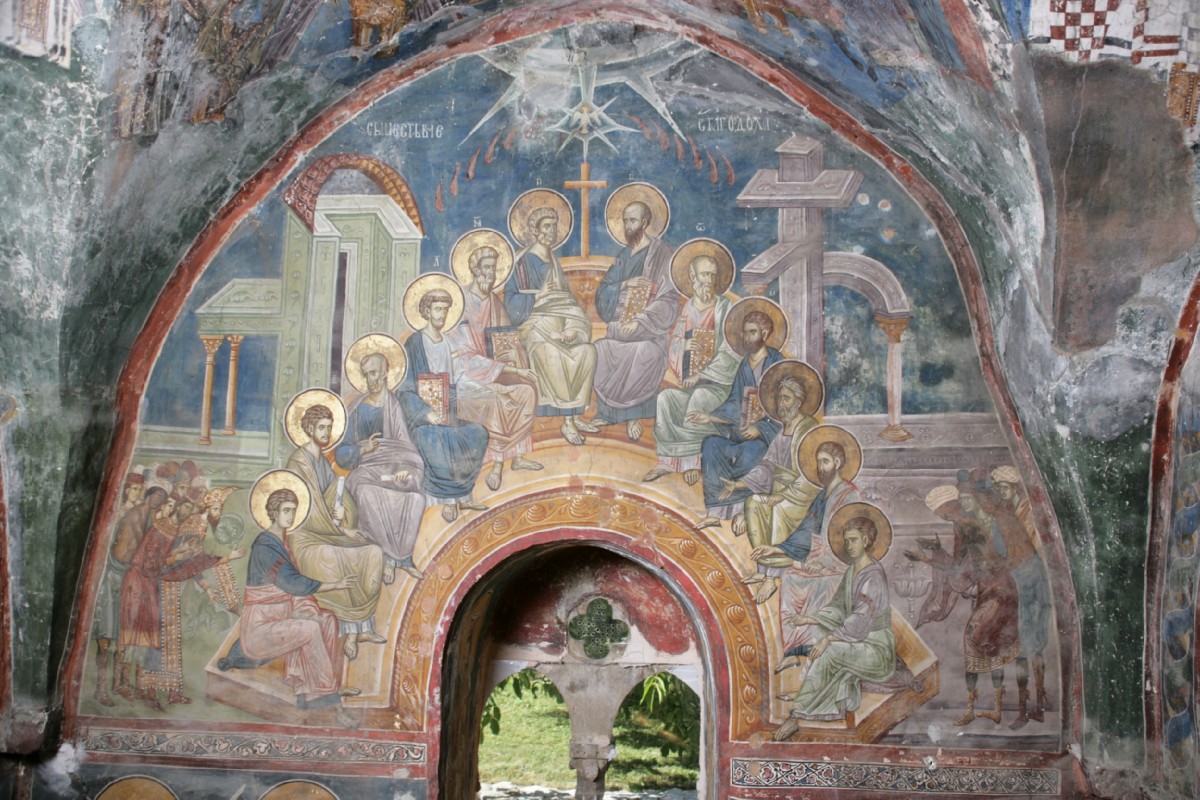
The descent of the Holy Spirit at Pentecost (source)
   
Through the prayers of our Holy Fathers, Lord Jesus Christ our God, have mercy on us and save us! Amen!

Wednesday, April 28, 2010

Patristic Commentary on the Song of Solomon - Part I

Christ is risen! Truly He is risen!

The Risen Christ greeting St. Mary Magdalene, telling her: "Do not hold me" (Icon courtesy of www.eikonografos.com used with permission)
  
The Song of Songs, or Song of Solomon is an incredible book that is often unappreciated or misinterpreted. I hope to have a series of posts (though not necessarily in order) including some interpretations of the Fathers on this grace-filled, prophetic and spiritually uplifting book.

St. Gregory Dialogos, in his lengthy introduction to this great book, makes it evidently clear that though most of the book utilizes very vivid imagery, all of it is only meant to express divine eros and truth; this has nothing to do with carnal love:

"We must transcend this language that is typical of the passions so as to realize that virtuous state in which we are unable to be influenced by the passions. As the sacred writings employ words and meanings, so a picture employs colors and subject matter; it is excessively foolish to cling to the colors of the picture in such a way that the subject painted is ignored. Now if we embrace the words that are expressed in exterior terms and ignore their deeper meanings, it is like ignoring the subject depicted while focusing upon the colors alone...

When we listen to language belonging to the human way of life, we must distance ourselves from ordinary men lest by listening to what is said in a human way, we perceive nothing about the divinity that we ought to be hearing. Paul did not desire his disciples to be ordinary men when he said to them, "For when envy and contention are among you, are you not ordinary men?" (1 Cor 3:3-4) The Lord as well did not consider his disciples to be ordinary men when he said, "Who do men say that the Son of Man is?" (Mt 16:13) When they told him what ordinary men had said, he immediately added, "Who do you say that I am?" (Mt 16:15) Now by saying "men" first and then adding "you," he distinguished between ordinary men and his disciples; to be sure, by teaching them divine things he was making them superior to ordinary men. The apostle states, "Therefore if anyone is in Christ, he is a new creation, the old has passed away." (2 Cor 5:17) We are aware that in our resurrection the body is joined to the spirit in such a way that everything which was controlled by the passions is taken up into the power of the spirit. And so it is fitting for someone who follows God to imitate his own resurrection every day. At the time of anyone's resurrection there will be nothing that is able to be influenced by the passions in his body. And so, let such a one at the present time have nothing that is able to influenced by the passions in his heart. Let such a one also be a new creation according to the interior man and trample whatever is uttered from the past, examining the language of former times solely for the fuel of his renewal."

As we are in the Paschal season, I include with a short quote from St. Ambrose of Milan in which he interprets the following verses in the light of Christ's Resurrection:

"Arise, my darling,
my beautiful one, and come with me.

See! The winter is past;
the rains are over and gone.

Flowers appear on the earth;
the season of singing has come,
the cooing of doves
is heard in our land."
(Song of Songs 2:10-12)


“Arise, come, my dearest one.” that is, arise from the pleasures of the world, arise from earthly things and come to me, you who still labor and are burdened, because you are anxious about worldly things.

Come over the world, come to me, because I have overcome the world. Come near, for now you are fair with the beauty of eternal life, now you are a dove, that is, you are gentle and mild, now you are filled entirely with spiritual grace...

“Winter is now past”; that is, [Pascha] has come, pardon has come, the forgiveness of sins has arrived, temptation has ceased, the rain is gone, the storm is gone, and the affliction. Before the coming of Christ it is winter. After his coming there are flowers. On this account he says, “The flowers appear on earth.” Where before there were thorns, now flowers are there. “The time of pruning has come.” Where before there was desert, the harvest is there. “The voice of the dove is heard in our land.”
-St. Ambrose of Milan, "On Isaac, of The Soul"
(http://books.google.com/books?id=cMxzdmLEL8UC&printsec=frontcover&dq=Proverbs,+Ecclesiastes,+Song+of+Solomon+By+John+Robert+Wright,+Thomas+C.+Oden&source=bl&ots=pgC37hCnZH&sig=V5CMm7dbQylCtrYaYdHu_9acqS0&hl=en&ei=Mb_YS-_iHpCS8gTh0KGoBw&sa=X&oi=book_result&ct=result&resnum=1&ved=0CAYQ6AEwAA#v=onepage&q&f=false)

Christ is risen from the dead, by death, trampling down upon death, and to those in the tombs, bestowing life!
Truly the Lord is risen!