Showing posts with label Eternal life. Show all posts

Tuesday, December 1, 2020

St. Porphyrios: God will say to me, "What are you doing here?"


Video with a recording of St. Porphyrios speaking, with English subtitles (source)
   
Through the prayers of our Holy Fathers, Lord Jesus Christ our God, have mercy on us and save us! Amen!

Thursday, August 13, 2020

Homily II on the Dormition of the Theotokos by Metropolitan Avgoustinos

The Dormition of the Theotokos (source)
  
Homily II on the Dormition of the Theotokos by Metropolitan Avgoustinos Kantiotes (+2010): "The Glorious Dormition"

"Your glorious Dormition caused the Heavens to rejoice, along with the ranks of the Angels, while the whole earth is glad..." (Sticheron from the Praises of the Feast of the Dormition of the Theotokos

Panagia was a poor girl from Nazareth, from unassuming parents. She did not have anything that would bespeak of glory. Her nativity passed by unnoticed [by the world]. Humble was her entrance into the world, and humble was her life.

But while her entrance was humble, her exit was glorious, and righteous. For she passed throughout her whole life in purity, humility, and utter obedience to the will of God. Which other woman has a calling that could be reckoned with hers? Every [woman] gives birth to mortals, but she was made worthy to become the Mother of the Son of God. As St. Kosmas Aitolos preached: "There were thousands of thousands of women in the world, but none could be found to fill the side of Adam, except our Lady the Theotokos."

When Panagia gave up her spirit to her Son and God, the earth and Heaven were astonished. The burial of her sacred body had a unique grandeur. The Apostles were brought from the ends of the earth to Gethsemane upon the clouds. Myrrh-bearing women and the faithful people followed. An impious Judean tried to defile the sacred body, but was repulsed...

The earth, with her most chosen children gathered to bury the King's Mother. But what were the honors of the earth before the honors of Heaven? As she ascended to the Kingdom on high, she was given an exceptional reception.

The leaders of the Angels knelt to venerate. The Son received the Mother. And she stood and continues to remain at His right hand, interceding on behalf of sinners.

Humble was her entrance, glorious, all-glorious, was her exit. Are these a phantasy, are these a myth? No, a thousand times, no. Our holy Church confirms this, who ordained that today the Dormition of the Most-Holy Theotokos be celebrated. Today, most-beautiful hymns are chanted, with which the greatness of Panagia is praised, and especially, the event of her repose, of her Dormition.
  
Detail from the icon of the Dormition of the Theotokos (source)
  
Many, my beloved, are the lessons of this feast. We will limit ourselves to one thing only, one lesson, which is contained in the word which the Church uses to characterize the event of the repose of the Virgin. Her repose is not called "death", but "dormition". Why? Please pay attention.

In the language of the Holy Scriptures, death does not mean the disappearance of the human existence. No. At death there is a separation. The soul is separated from the body. The soul leaves towards the things above, towards the heavenly world of the spirits. This path is not fantastical, but is a reality, which is confirmed by the word of God. Then, what does the soul meet, how many tollhouses does it pass through, what censures does it undergo, we do not know in detail. The words of holy people, who saw the souls of the reposed pass towards the verdant meadows of Paradise, or towards the dark places of hell, shine some light on this, but this light is dim, and unable to satisfy people's curiosity. To man, through the Scriptures, it has been revealed that the soul that leaves the body does not die (see Luke 12:20, 16:23-26, 23:42-43). This is a fact and the Christian cannot deny this.

But while the soul of man, which has finished this station of his life, ascends as a spirit to the other world, the body, as physical creation is given away to corruption, to temporary corruption. For from this corrupted body, during the universal Resurrection [at the Last Judgment], there will come a renewed and incorrupt body, which will be united with the soul and they will live together unto the ages of ages.

Yes! The body will be raised. In anticipation of the Resurrection, death according to the Scriptures is called "dormition". The Prophet David "slept" (Acts 13:36). The Protomartyr Stephen "slept" (Acts 7:60). The Apostle Paul, when he speaks of those who have left for the other life, does not say that they "died", but he calls them "those who are sleep". "I do not want you to be ignorant, my brethren, concerning those who are asleep, that you might not grieve as the others do who have no hope." (I Thessalonians 4:13). Our Lord Jesus Himself called death "sleep". When He entered the house of Jairus and saw them weeping for the dead girl, He told them: "Do not weep. She has not died, but is only sleeping." (Luke 8:52, Mark 5:39) And regarding Lazarus He said that he had "fallen asleep" (John 11:11-15). And He proceeded to resurrect him, with such ease as if he were waking him from sleep.

Dormition! This word of the Scriptures should be sufficient to teach, console and strengthen Christians, at least those who hasten to churches to celebrate and feast at the "glorious", "all-sacred", and "dormition transcending death", of the Most-Holy Theotokos. Do you hear this, O you who celebrate? Panagia has not died, but has fallen asleep! Her body was buried, placed within the grave, but as the Church chants: "the grave and death could not hold her, for as the Mother of Life, she has proceeded to Life, Who dwelt within the womb of the Ever-Virgin." (Kontakion of the Feast of the Dormition) Panagia, shining forth with all the light of the virtues, "as arrayed in gold" (Psalm 44:10) has proceeded towards the Heavens. "Who", cry out the Angels, "is this that appears like the dawn, fair as the moon, bright as the sun, majestic as the stars in procession?" (Song of Songs 6:10)
  
The Dormition of the Theotokos (source)
  
Panagia, from the height of her glory, is heard to say to all Christians who are tempted here: "Faithful children of the heavenly Father, have strength. What do you fear? Death? But death is the gateway to the new life. Here on high where I am there is a new life, which no one on earth could even begin to imagine. This life is preordained for those who will live with faith and virtue. Here there is no partiality. My Son is the just Judge. When I was below on the earth, I heard voices that blessed me, for I was made worthy to become His Mother, and He said that, in the cycle of blessedness, it would not be me alone who gives Him birth, but for all those who hear Him and keep His word. For Christ is born spiritually in every soul who believes in Him and worships Him as the only Savior. 'Yea of a truth, blessed are those who hear the word of God and keep it.' (Luke 11:28) Therefore, I invite you all to the glory of Heaven."

As the Church chants, truly glorious was the Dormition of the Most-Holy Theotokos. Glorious was also the dormition of all the Righteous, who faithfully completed their missions. Each of them, as they left from this world, could say like the Psalm: "In peace I will lie down and sleep, and I awoke, for You, O Lord, have made me to dwell in hope." (Psalm 4:9) The antithesis occurs with those who did not love God and their neighbor, and did not fulfill their holy duties, and did not complete their mission, but were conquered by evils and passions, and trampled upon divine gifts, walling themselves off and making themselves unworthy of their holy calling, betraying the faith. Their dormition was not radiant, but dark, not glorious, but inglorious. Not radiant Angels, but dark demons were their fellow travelers during the exodus of their souls to the other world. For mourning and cutting are heard during the exodus of the unrepentant sinner. Who would not weep?

O Christians! Panagia had a glorious dormition. But we also must have a glorious dormition. Glorious through faith and virtue. May we receive even one laurel leaf from that glory! May the Lord, through the intercessions of the Most-Holy Theotokos, who proceeds to the Heavens, grant us an end like this. May the prayer of the Church be fulfilled for each of us: "For a Christian ending to our life: painless, blameless, peaceful, and a good defense before the dread Judgment Seat of Christ, let us pray."
(+) Bishop Avgoustinos 
(source)
  
The Dormition of the Theotokos (source)
  
Most-Holy Theotokos, save us!

Wednesday, June 17, 2020

Elder Aimilianos on Life as a Spider's Web

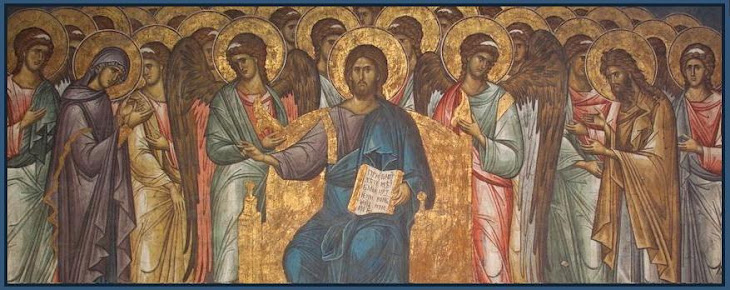
Jesus Christ Deisis with the Theotokos and the Precious Forerunner (source)
  
"When all our days are past, and passed in your wrath, our years will be seen like a spider. Day and night [the spider] works. She rises in the morning, and cleans her corner. She works until the night, and again, the next morning, she is in her same corner. Her web was destroyed. In the morning, she must weave it again. Days and nights of agony, and she sweats and suffers, without, ultimately, her work being completed.

"Whatever I might do, no matter how good it is, is like the work of a spider.

"A work has essential meaning, and is not like a spider's web, but is eternal, only when it is a search for You, when we turn to You, when it occurs for You, when it brings me, not to a desert place, not into a foreign land, not to this temporary earth, but to the true Chanaan, where You are, in Heaven.

"Thus, O Lord, was my life. I should have come to work for You. But I separated myself from You. For me, You no longer did exist, You Who exist from the ages and unto the ages. I thought, would my life be like this? A spider's corner, which would be gone tomorrow. Was I born for this, therefore?

"We have created something which has no worth before You, O Lord, it is nothing. I worked, thought, lived, thinking that I was progressing, that I was going towards the Promised Land. Because, however, I sinned, in reality, my life had no meaning to You. All things which have worth to You are those things that objectively have importance and meaning. Therefore, that which I thought was my success, that which I saw as my joy, that which for me was an object of enthusiasm and shouting for joy, this was something away from which You wished to turn away.

"Eternal life near our sweetest Jesus Christ exists, and You call us towards You, my God!"
-Elder Aimilianos of Simonopetra (+2019)
(source)
  
Elder Aimilianos of Simonopetra (+2019) (source)
  
Through the prayers of our Holy Fathers, Lord Jesus Christ our God, have mercy on us and save us! Amen!

Thursday, April 23, 2020

The Final Prayer of St. George before his Martyrdom

Christ is risen! Truly He is risen!
St. George the Great Martyr and Trophy-bearer, in prayer to Christ (source)
  
The Martyr of Christ, George, when he had reached the place of his execution, entreated the guards to give him a short time to himself. This is the gift that the Saint asked of the enemies of his Faith. They fulfilled his request. Then, the Great Martyr gathered himself together for prayer, and lifted up his eyes to Heaven, and prayed from the depth of his heart:

St. George the Great Martyr and Trophybearer (source)
   
"O Lord my God, to Whom I belong from birth, and to Whom I have placed my hopes, You Who gave me boldness and prepared me for this struggle, You Who are my sweet hope, the unerring promise, the unalterable eros of sacred souls, You Who look down with care upon the intentions of our hearts and fulfill our requests, and to Whom we address our requests in prayer, I ask of You: help me to complete this struggle well, which I have taken on in confession of Your name, and receive my soul, and having preserved my from the evil spirits, do number me with those who have pleased You throughout the ages. Forgive, O Master, the people who out of ignorance have worked this grave things against me, and make them worthy to truly come to know You, for You are blessed unto the ages of ages."
(source)
  
Sts. George and Demetrios the Great Martyrs (source)
  
Christ is risen from the dead, by death, trampling down upon death, and to those in the tombs, He has granted life!
Truly, the Lord has risen!

Wednesday, April 22, 2020

Elder Vasilios of Iveron on Pascha 2020

Christ is risen! Truly He is risen!
The Resurrection of Christ (source)

"This year, the Resurrection tells us many things. If it is true what we believe, and if we are living that which we chant, that "we celebrate the death of death, the deposition of Hades, and the beginning of another, eternal life" (Canon of Pascha), then we would fear for nothing. And every single threat increases the power of the presence of the risen Lord.

"That which occurred this year with the Coronavirus is a temptation, but all temptations are transformed into blessings. We chant "let us say, O brethren, even to those who hate us." (Doxastikon of Pascha) And those who hate us are waiting for our love, and those who do not believe are waiting for the power of our faith. Therefore, if one believes, through this trial he has celebrated the best Pascha this year. In order to have the best Pascha at the time when you cannot celebrate Pascha, one must sense the power of the Risen One, and thus have community with all men.

"And while a temptation such as an illness can create problems, it can reveal the presence of the risen Lord. Amidst the messages and from within the souls of all men comes forth a consolation. The hymn of Kassiane says: "Who can recount the multitude of my sins, and the abysses of Your judgments, my soul-saving Savior?" On the one hand, there is the totality of sins and weaknesses. And on the other hand, there is an abyss of compassions, a bottomless ocean, where storms occur not just to clean out the debris that has accumulated in the lakes, but also to pour forth the element of healing.

"Therefore, the Church rejoices even more at the presence of the Risen One through this trial. And at the same time is also tested the material strength of our faith, and reveals the weakness of him who does not believe, but also, he who believes in himself and in his virtue. Therefore we have this current phenomenon. Some of the faithful--I don't know how to name them--trying to give consolation, condemn. They condemn the Church, and in essence, they reveal their own weakness. Therefore, let us thank the risen Christ, His Mother the Most-Holy Theotokos, and all the Saints who hold within them the Paradise of life.

"Let us entreat Christ to strengthen the truth of our humility, in other words, for us to sense our own weakness until our whole self is Christ. And then we can say together with the Apostle Paul: "For whether we live or die, we are with the Lord." Either we are living, or we are dead in the flesh, but our life is Christ. Therefore, "Christ is risen, and life reigns, Christ is risen, and not one dead remains in the tomb." (Paschal Homily of St. John Chrysostom) To Him belongs the glory and the might unto the ages of ages. Amen."
-Elder Vasilios (Gontikakis), former Abbot of Iveron Monastery, Mount Athos
(source)
  
Christ is risen from the death, by death, trampling down upon death, and to those in the tombs, He has granted life!
Truly the Lord is risen!

Friday, January 17, 2020

Excerpt from St. Athanasios the Great's "On the Incarnation"

The Nativity of Christ (source)
  
"For this purpose, then, the incorporeal and incorruptible and immaterial Word of God entered our world. In one sense, indeed, He was not far from it before, for no part of creation had ever been without Him Who, while ever abiding in union with the Father, yet fills all things that are. But now He entered the world in a new way, stooping to our level in His love and Self-revealing to us. He saw the reasonable race, the race of men that, like Himself, expressed the Father's Mind, wasting out of existence, and death reigning over all in corruption. He saw that corruption held us all the closer, because it was the penalty for the Transgression; He saw, too, how unthinkable it would be for the law to be repealed before it was fulfilled. He saw how unseemly it was that the very things of which He Himself was the Artificer should be disappearing. He saw how the surpassing wickedness of men was mounting up against them; He saw also their universal liability to death.

"All this He saw and, pitying our race, moved with compassion for our limitation, unable to endure that death should have the mastery, rather than that His creatures should perish and the work of His Father for us men come to nought, He took to Himself a body, a human body even as our own. Nor did He will merely to become embodied or merely to appear; had that been so, He could have revealed His divine majesty in some other and better way. No, He took our body, and not only so, but He took it directly from a spotless, stainless virgin, without the agency of human father—a pure body, untainted by intercourse with man. He, the Mighty One, the Artificer of all, Himself prepared this body in the virgin as a temple for Himself, and took it for His very own, as the instrument through which He was known and in which He dwelt.

"Thus, taking a body like our own, because all our bodies were liable to the corruption of death, He surrendered His body to death instead of all, and offered it to the Father. This He did out of sheer love for us, so that in His death all might die, and the law of death thereby be abolished because, having fulfilled in His body that for which it was appointed, it was thereafter voided of its power for men. This He did that He might turn again to incorruption men who had turned back to corruption, and make them alive through death by the appropriation of His body and by the grace of His resurrection. Thus He would make death to disappear from them as utterly as straw from fire."
-St. Athanasios the Great, excerpt from "On the Incarnation"
(source)
  
The Resurrection of Christ (source)
  
Through the prayers of our Holy Fathers, Lord Jesus Christ our God, have mercy on us and save us! Amen!

Tuesday, January 14, 2020

St. John of Damascus on Eternity and God's Goodness

Jesus Christ the Son of God, the Savior (source)
  
"In eternity, God gives good things to everyone, because He is the source of good things. Every person, therefore, partakes of the goodness of God according to the manner that he formed himself in this life, receptive to this goodness...God even continuously gives good things to the Devil, but he does not want to receive them."
-St. John of Damascus
  
(Source)
  
Through the prayers of our Holy Fathers, Lord Jesus Christ our God, have mercy on us and save us! Amen!

Friday, November 22, 2019

St. Iakovos of Evia on the Eternal Soul

St. Iakovos of Evia (source)
  
"I have a heart, and I have many afflictions. But "the afflictions of the present time lead to glory in the age to come", and so I don't reckon them as anything. Daily I see my grave, that I am a dead man. But within this dead flesh dwells an eternal soul. I care for my soul which is something eternal. Because of this, my child, you also should care for your soul, near the Fathers of the Church."
-St. Iakovos of Evia

(source)

Through the prayers of our Holy Fathers, Lord Jesus Christ our God, have mercy on us and save us! Amen!

Tuesday, September 24, 2019

St. John Maximovitch: "To partake of the Body and Blood of Christ is to receive in oneself the Risen Christ..."

The Communion of the Apostles (source)
  
To partake of the Body and Blood of Christ is to receive in oneself the Risen Christ, the Victor over death, granting to those with Him victory over sin and death. Preserving in ourselves the grace-filled gift of Communion, we have a guarantee and foretaste of the blessed, eternal life of the soul and body.
-St. John Maximovitch
  
  
Through the prayers of our Holy Fathers, Lord Jesus Christ our God, have mercy on us and save us! Amen!

Wednesday, September 11, 2019

"She is a tree of life to all that lay hold upon her..."

Christ Crucified and His Precious Cross as the Tree of Life, mosaic from San Clemente in Rome (1118) (source)
  
My son, despise not the chastening of the Lord; nor faint when thou art rebuked of him: for whom the Lord loves, he rebukes, and scourges every son whom he receives. Blessed is He who Finds Wisdom Blessed is the man who has found wisdom, and the mortal who knows prudence. For it is better to traffic for her, than for treasures of gold and silver. And she is more valuable than precious stones: no evil thing shall resist her: she is well known to all that approach her, and no precious thing is equal to her in value. For length of existence and years of life are in her right hand; and in her left hand are wealth and glory: out of her mouth proceeds righteousness, and she carries law and mercy upon her tongue. Her ways are good ways, and all her paths are peaceful. She is a tree of life to all that lay hold upon her; and she is a secure help to all that stay themselves on her, as on the Lord.
-Proverbs 3:11-18, read at the Great Vespers for the Feast of the Precious Cross
 
 
Through the prayers of our Holy Fathers, Lord Jesus Christ our God, have mercy on us and save us! Amen!

Thursday, August 29, 2019

Elder Epiphanios Theodoropoulos: "Only with Christ can everything be explained..."

Jesus Christ the Son of God the Savior (source)
  
Without Christ, the world is a theater of the absurd. Without Christ, we can't explain anything!
Why is there so much sadness, injustice, failures, why do illnesses come, why? Why? Why?
A thousand "whys?"
Understand this. No man can explain this infinite logic, the answer to all of these "whys?"
Only with Christ can everything be explained...
They prepare us for eternity. Most likely, there He will explain to us some of these "whys".
-Elder Epiphanios Theodoropoulos

(source)
  
Christ, the Good Samaritan (source)
  
Through the prayers of our Holy Fathers, Lord Jesus Christ our God, have mercy on us and save us! Amen!

Tuesday, August 13, 2019

Elder Ephraim of Arizona on the Dormition of the Theotokos

The Dormition of the Theotokos (source)
  
A Transition to Life: The Dormition of the Mother of God
by Elder Ephraim of Arizona
Every time we celebrate the Dormition of the Mother of God, it’s as if we’re having Easter – the Easter of the summer. Our Lady the Mother of God prepares Easter for us. A glorious crossing “from death to life”. A second Easter, holy spotless, life-giving for the human race, because today “the laws of nature are overcome”.
  
“How the source of life goes towards life, passing through death”, says Saint John the Damascene. The death of the life-giving Mother of the Lord transcends the concept of death, so that it’s not even called death, but “dormition” and “divine transition” and an emigration and immigration towards the Lord. And even if it’s called death, it’s a life-bringing death, since it transports to a celestial and immortal life.
  
The transition of the Mother of God, as an indisputable fact preserved by sacred Tradition, has been incorporated into the teaching of the Orthodox Church and has nothing to do with the ­­­­­pietistic beliefs of the Westerners concerning the conception without seed and life without death of the Virgin Mary.
  
The Virgin was the particular creation of God who surpassed all people and the angels. She is the only mortal ever to have lived a spotless life and to have become what is beyond the understanding of all reasoning beings- the Mother of God. Because she never sinned, never gave in to sensuous thoughts, it was proper that she lived on earth without the pains of the flesh, or illnesses. Even though she had a life-giving body, still, as a human being she was subject to the sickness of death and she did, in fact, die. But her body and soul were not separated from God. For a short time, the connection binding them together was loosed, as was the case with Christ.
  
After her death, her soul was united immediately with Christ. Because at the time of the Dormition of His Mother, attended by the celestial ranks of the angels and the saints, He took her holy soul, not merely to heaven, but “to His royal throne, to the heavenly Holy of Holies”, as John the Damascene tells us. And the life-giving and God-receiving* body of Our Most Holy Lady, after three days, was transported to the celestial realms, uncorrupt, to her Only-Begotten and beloved Son. In other words, we can speak of the resurrection of the Mother of God in the flesh. But this resurrection was not activated by Our Lady herself, but by her Son and God.
  
One witness of this resurrection/transportation of the Mother of God was the Apostle Thomas, who had not been present at her interment. He arrived late, as usual- three days late, in fact- and requested the other apostles to open the grave, only to find that the God-glorified body was not there. They did, however, see the Mother of God ascending into the heavens and giving the Apostle Thomas her Precious and Holy Belt, as proof of her ascension, rather in the same way as Christ allowed the same apostle to touch His wounds after the Resurrection.
  
The body of Our Lady – like that of her Son – did not undergo any corruption in the grave, that is it was not altered, it did decompose into the material elements that constituted it. In any case, since Christ’s resurrection, the bodies of many of His saints have not decayed and have become, in part, undecomposed relics. How much more reasonable it is that the God-receiving body of the Mother of God would not decay.
  
Saint Andrew of Crete says that the fact that the Mother of God did not lose her virginity at Christ’s birth had, as its natural concomitant, that her body did not decompose at the time of death. “The birth avoided despoilment and the grave did not accept decomposition”.
  
After her Dormition, Our Lady the Mother of God became the mother of the new creation, the Church of Christ. Because she had the central position in the dispensation of salvation, since it was from her that the Head of the Church, the Lord, took His human flesh. Now, in the celestial Church, she has the fullness of Grace and glory and boldness. She has become the benefactress of the whole of nature and creation, which is why all creation venerates her as Lady and Maiden and Queen and Mother of God.
  
Through the Mother of God and because of her, the history of the whole world entered another orbit, incomparably more magnificent and superior to what had existed before her. No creature could have or could ever be more perfect than her, nor could she have been more perfect than she was. According to the Fathers, there are three things that Almighty God could not have made more perfect: the incarnation of the Divine Word, the Virgin Mother of God and the bliss that the saved will enjoy.
  
After the resurrection of Christ, Our Lady was the support of the apostles and of the newly-founded Church of Christ. She taught the new Christians, guided them and consoled them in their sorrows. In the expanded version of her Life, we read that the Archangel Gabriel visited her three days before her Dormition, as he had done at the Annunciation, and told her of her glorious transition from death to life. The Holy Spirit, in miraculous wise, then gathered all the apostles in Gethsemane, in the house of the Mother of God, so that they could be present at her interment and take her blessing. After they had lauded the greatly-praised Mother of God, they asked her to pass on to them a final teaching, as a legacy. The Mother of God then told them a parable, in which this world was compared with a trade fair at which whoever does best at trading will be the who gains the greatest profit. She went on to explain that so it is also in matters of the spirit. Whoever observes Christ’s commandments with the greatest zeal and heed will gain the greatest profit and will be glorified more greatly in the kingdom of heaven. And she urged them to persist in the “good fight”.
  
And, indeed, how greatly pleased Our Lady is when she sees us struggling for our salvation. What satisfaction this brings her! And she herself, while on earth, how hard she struggled in her quiet way- though, since she was sinless, there was no need for her to do so- so as to leave us with an example of perfect asceticism. After her dormition, they found in Gethsemane where she lived, slabs where had preformed her prostrations and they were deeply indented from all the wear and tear she had subjected them to.
  
Let us also imitate her direct obedience, her endearing humility, her secret, internal, spiritual effort, her ardent prayer, the constant watchfulness which she showed, her divine love, and the spiritual pain she felt as a knife at the Cross of her Son.
  
To those who struggle, she becomes a “supportive ally”, even if they have previously lived prodigal lives. Let’s remember that the Mother of God “stood bail” for Mary the Egyptian after the latter’s repentance. And when Saint Mary retreated into the desert to take on her relentless struggle, Our Lady herself consoled her with her divine appearances.
  
As novice-mistress of monastics, the Mother of God is also the provider of divine gifts to them, especially those on the Holy Mountain. It was she who gave the gift of the prayer of the heart to Saint Maximos Kavoskalivis, Gregory Palamas, Silouan the Athonite and also to the late Elder Iosif the Hesychast, who is directly linked to our brotherhood. Another reason why today is of particular importance to us who are the spiritual grandchildren of Elder Iosif the Hesychast is that it was on this day, in 1959, that he fell asleep in the Lord. He loved Our Lady very much- our sweet little mother, as he called her- and he received so many insights, divine appearances and gifts from her. And, indeed, one particular characteristic of the blessed Athonite Fathers is their love of the Mother of God. At the sound of her name, they were unable to restrain their tears which came from pure love for the Virgin Mother. Merely on hearing her name, a soul that loves God is moved to wonder, gratitude and  thankfulness. So even the recollection of the Mother of God, that is recalling the person of Our Lady to the mind, sanctifies the person who does this. The late Fr. Athanasios Iviritis used to say that love of the Mother of God saved people, even if they didn’t have any works to show.
  
People today have to use the mediation of the Mother of God, which is for our salvation. In every one of our sorrows and problems we mustn’t forget “the help of the saddened, the protectress, defender, comfort of the faint-hearted”, to whom we can have recourse and find consolation, immediate release and response. We pray that Our Lady the Mother of God, who has been “transported to Life”, will always give her blessing to all of us, so that we may spend the present life as safe and sound as possible from the deceits and wiles of the Evil One, and that she will make us worthy of the heavenly kingdom of her Son. Amen.
  

* The first Friday after Easter, a feast of the Mother of God, is often referred to in English, as that of the Life-Giving Spring. In fact this should be, Life-Receiving Spring. The most likely explanation, perhaps is a lapsus calami on the part of a translator, who read Î¶Ï‰Î¿Î´ÏŒÏ„ος for Î¶Ï‰Î¿Î´ÏŒÏ‡Î¿Ï‚.
  
  
The Dormition of the Theotokos (source)
  
Most-Holy Theotokos save us!

Friday, May 24, 2019

"Being Life itself, and the spring of incorruption..."

Christ is risen! Truly He is risen!
Christ speaking to the Samaritan Woman St. Photini (Source)
  
Being Life itself, and the spring of incorruption, You sat beside the spring, O Compassionate One, and for the Samaritan Woman who asked of You, You filled her with the waters of all wisdom, as she hymned You.

The life of all that live, the spring of all good things, the Lord richly rains down His teachings [for all], and cries to the Woman: Give me water to drink, that I might grant you water to dry up the springs of your sins.

O Lord, you are the river of eternal life, and the abyss of mercy, O Good One, and while You were traveling, You sat by the Well of the Oath, and cried out to the Samaritan Woman: Give me water to drink, that you might receive the waters of forgiveness.
-from the Canon for the Sunday of the Samaritan Woman St. Photini
  
(source)
  
Christ has risen from the dead, by death trampling down upon death, and to those in the tombs He has granted life!
Truly the Lord is risen!

Thursday, May 23, 2019

"Christ God has brought us from death to life, and from earth to heaven..."

Christ is risen! Truly He is risen!
Moses praying and striking the waters of the Red Sea, while the Lord divided the waters and saved the Israelites (source)
  
1And the Lord spoke to Moses, saying, 2Speak to the children of Israel, and let them turn and encamp before the village, between Magdol and the sea, opposite Beel-sepphon: before them shalt thou encamp by the sea. 3And Pharao will say to his people, As for these children of Israel, they are wandering in the land, for the wilderness has shut them in. 4And I will harden the heart of Pharao, and he shall pursue after them; and I will be glorified in Pharao, and in all his host, and all the Egyptians shall know that I am the Lord. And they did so.
5And it was reported to the king of the Egyptians that the people had fled: and the heart of Pharao was turned, and that of his servants against the people; and they said, What is this that we have done, to let the children of Israel go, so that they should not serve us? 6So Pharao yoked his chariots, and led off all his people with himself: 7having also taken six hundred chosen chariots, and all the cavalry of the Egyptians, and rulers over all. 8And the Lord hardened the heart of Pharao king of Egypt, and of his servants, and he pursued after the children of Israel; and the children of Israel went forth with a high hand. 9And the Egyptians pursued after them, and found them encamped by the sea; and all the cavalry and the chariots of Pharao, and the horsemen, and his host were before the village, over against Beel-sepphon.
10And Pharao approached, and the children of Israel having looked up, beheld, and the Egyptians encamped behind them: and they were very greatly terrified, and the children of Israel cried to the Lord; 11and said to Moses, Because there were no graves in the land of Egypt, hast thou brought us forth to slay us in the wilderness? What is this that thou hast done to us, having brought us out of Egypt? 12Is not this the word which we spoke to thee in Egypt, saying, Let us alone that we may serve the Egyptians? for it is better for us to serve the Egyptians than to die in this wilderness.
13And Moses said to the people, Be of good courage: stand and see the salvation which is from the Lord, which he will work for us this day; for as ye have seen the Egyptians to-day, ye shall see them again no more for ever. 14The Lord shall fight for you, and ye shall hold your peace.

Moses parting the Red Sea (Source)
    
15and the Lord said to Moses, Why criest thou to me? speak to the children of Israel, and let them proceed. 16And do thou lift up thy rod, and stretch forth thy hand over the sea, and divide it, and let the children of Israel enter into the midst of the sea on the dry land. 17And lo! I will harden the heart of Pharao and of all the Egyptians, and they shall go in after them; and I will be glorified upon Pharao, and on all his host, and on his chariots and his horses. 18And all the Egyptians shall know that I am the Lord, when I am glorified upon Pharao and upon his chariots and his horses.
19And the angel of God that went before the camp of the children of Israel removed and went behind, and the pillar of the cloud also removed from before them and stood behind them. 20And it went between the camp of the Egyptians and the camp of Israel, and stood; and there was darkness and blackness; and the night passed, and they came not near to one another during the whole night.
21And Moses stretched forth his hand over the sea, and the Lord carried back the sea with a strong south wind all the night, and made the sea dry, and the water was divided. 22And the children of Israel went into the midst of the sea on the dry land, and the water of it was a wall on the right hand and a wall on the left. 23And the Egyptians pursued them and went in after them, and every horse of Pharao, and his chariots, and his horsemen, into the midst of the sea. 24And it came to pass in the morning watch that the Lord looked forth on the camp of the Egyptians through the pillar of fire and cloud, and troubled the camp of the Egyptians, 25and bound the axle-trees of their chariots, and caused them to go with difficulty; and the Egyptians said, Let us flee from the face of Israel, for the Lord fights for them against the Egyptians.
 
Moses and the Israelites being led by the pillar of fire (source)
   
26And the Lord said to Moses, Stretch forth tine hand over the sea, and let the water be turned back to its place, and let it cover the Egyptians coming both upon the chariots and the riders. 27And Moses stretched forth his hand over the sea, and the water returned to its place toward day; and the Egyptians fled from the water, and the Lord shook off the Egyptians in the midst of the sea. 28and the water returned and covered the chariots and the riders, and all the forces of Pharao, who entered after them into the sea: and there was not left of them even one. 29But the children of Israel went along dry land in the midst of the sea, and the water was to them a wall on the right hand, and a wall on the left.
30So the Lord delivered Israel in that day from the hand of the Egyptians, and Israel saw the Egyptians dead by the shore of the sea. 31And Israel saw the mighty hand, the things which the Lord did to the Egyptians; and the people feared the Lord, and they believed God and Moses his servant.
  
Moses parting the Red Sea through the power of God (source)
  
1Then sang Moses and the children of Israel this song to God, and spoke, saying, Let us sing to the Lord, for he is very greatly glorified: horse and rider he has thrown into the sea.
2He was to me a helper and protector for salvation: this is my God and I will glorify him; my father's God, and I will exalt him.
3The Lord bringing wars to nought, the Lord is his name.
4He has cast the chariots of Pharao and his host into the sea, the chosen mounted captains: they were swallowed up in the Red Sea.
5He covered them with the sea: they sank to the depth like a stone.
6Thy right hand, O God, has been glorified in strength; thy right hand, O God, has broken the enemies.
7And in the abundance of thy glory thou hast broken the adversaries to pieces: thou sentest forth thy wrath, it devoured them as stubble.
8And by the breath of thine anger the water parted asunder; the waters were congealed as a wall, the waves were congealed in the midst of the sea.
9The enemy said, I will pursue, I will overtake, I will divide the spoils; I will satisfy my soul, I will destroy with my sword, my hand shall have dominion.
10Thou sentest forth thy wind, the sea covered them; they sank like lead in the mighty water.
11Who is like to thee among the gods, O Lord? who is like to thee? glorified in holiness, marvellous in glories, doing wonders.

Moses leading out the Israelites (source)
   
12Thou stretchedst forth thy right hand, the earth swallowed them up.
13Thou hast guided in thy righteousness this thy people whom thou hast redeemed, by thy strength thou hast called them into thy holy resting-place.
14The nations heard and were angry, pangs have seized on the dwellers among the Phylistines.
15Then the princes of Edom, and the chiefs of the Moabites hasted; trembling took hold upon them, all the inhabitants of Chanaan melted away.
16Let trembling and fear fall upon them; by the greatness of thine arm, let them become as stone; till thy people pass over, O Lord, till this thy people pass over, whom thou hast purchased.
17Bring them in and plant them in the mountain of their inheritance, in thy prepared habitation, which thou, O Lord, hast prepared; the sanctuary, O Lord, which thine hands have made ready.
18The Lord reigns for ever and ever and ever.
19For the horse of Pharao went in with the chariots and horsemen into the sea, and the Lord brought upon them the water of the sea, but the children of Israel walked through dry land in the midst of the sea.
20And Mariam the prophetess, the sister of Aaron, having taken a timbrel in her hand—then there went forth all the women after her with timbrels and dances.
21And Mariam led them, saying, Let us sing to the Lord, for he has been very greatly glorified: the horse and rider has he cast into the sea.
-Exodus 14-15,
read during the Vesperal Liturgy of St. Basil on Great Saturday
  

The Resurrection of Christ, foreshadowed by the passing of Israel through the Red Sea, which brought humanity not out of physical bondage, but "from death to life, and from earth to heaven" (source)
  
The day of Resurrection, let us be radiant, O peoples! Pascha, the Lord’s Pascha; for Christ God has brought us from death to life, and from earth to heaven, as we sing the triumphal song.
  
Christ has risen from the dead, by death he has trampled on death, and to those in the graves given life!
Truly the Lord is risen!

Thursday, February 28, 2019

St. Paisios the Athonite on Death, Prayer for the Departed and the Last Judgment

The classic iconographic type depicting the dormition of St. Ephraim the Syrian, with the choirs of his beloved fellow monastics coming from afar to venerate him and pray for him (source)
  
LIFE AFTER DEATH
by Saint Paisios of Mount Athos
  
--Geronda [Elder], when a person dies, does he become immediately aware of his spiritual condition?
--Yes, he does, and says to himself, "What have I done?" But the result in fayda yok, [An expression in the Turkish language, which means: "There is no benefit, there is no progress or success".) that is, this awareness is of no benefit. This can be likened to a drunk man who kills his mother and goes on singing and laughing, but who, upon becoming sober and realizing what he has done, will wail and lament and say, "What have I done?" In much the same way, those who commit wrongdoings in this life are like drunken men. They don't understand what they're doing; they don't have a sense of their guilt. But when they die, this "drunkenness" disappears and they become aware of their real condition. The eyes of their soul are opened and they realize their guilt, because the soul, when separated from the body, moves, sees and perceives with an inconceivable speed.
  
Some people ask when the Second Coming will take place. But for the person who dies, the Second Coming is, in a way, taking place, because he is judged on the basis of the state in which he is found at the time of death.
  
--Geronda [Elder], in what state are the souls of the tormented found at this time?
--They are indicted, imprisoned, and suffer in accordance with the sins they had committed; and they await the final trial, the future Judgment. There are those who have been indicted, facing heavy sentences, and those who have been indicted, facing lighter sentences.
  
--What about the Saints and the thief? (St. Luke 23:32-33 and 39-43)
--The Saints and the thief are in Paradise; but they have not received the final glory, just as those who have been indicted are in hell but have not received the final sentence. Even though God has taught us from centuries ago: "Repent ye, for the Kingdom of Heaven is at hand?" (St. Matthew 3:2 and 4:17) He extends the time more and more, because He waits for us (with the pronoun "us", the Elder means all of humanity) to correct ourselves. But we, by remaining in our (unrepentant) misery, are unjust to the Saints because they cannot receive the final glory, which they are to receive after the future judgment.
  
St. Paisios the Athonite (source)
  
PRAYER AND MEMORIALS FOR THE DEPARTED
  
--Geronda [Elder], can the indicted souls who await trial pray?
--They are aware of their condition and seek help, but they cannot help themselves. Those who are in Hades desire only one thing from Christ: to live for five minutes in order to repent. We, who live, still have time for repentance, but those unfortunate ones who have fallen asleep cannot improve their condition on their own; they await help from us. This is the reason why we have an obligation to help them with our prayer.
  
--It is my belief that only about ten percent of the indicted dead awaiting trial are, as the demons do. They don't seek any help, and they also reject all help. For what can God do for them? It's like a child who has alienated himself from his father, squanders all of his property, and on top of that, curses him. What can his father do for him? But the other indicted ones, who still have a little philotimo, are aware of their guilt. They repent and are tormented because of their sins. They ask to be helped and are helped through the prayers of the faithful. [Saint Nectarios, in his study, A Treatise on the Immortality of the Soul and on the Sacred Memorials, ed. Basil Regopoulos, Thessaloniki 1973, p. 202, writes as a conclusion to what he developed on the basis of the witness of the Holy Fathers: "On the basis of all the above, it becomes clear that the soul after death is unable to do any solitary deed and be relieved from the indissoluble bonds of Hades. Only the Divine Liturgies, the prayers of family members, of the just, which are offered for them, including charity, become instrumental agents of deliverance and freedom from the bonds of Hades."] In other words, God provides an opportunity for them, now that they are awaiting trial, to be helped until the Second Coming takes place. And just as in this life when one who's a friend of the king can intercede and request help for someone awaiting trial, so, too, if one is "a friend" of God, he can intercede with prayer to God, and He can transfer the indicted souls of the dead from one "prison" to another, better one, from one "detention-cell" to another, better one. Or God may transfer them to a "room" or to an "apartment".
Just as we provide some comfort to the imprisoned with the refreshments and other material goods we bring to them, so are the dead refreshed by the prayers and the charity we execute for their souls. The prayers and the sacred memorial offered by the living for the dead are the final chance that God gives to the dead to be helped until the Final Judgment takes place. After the Judgment, there will no longer be any possibility for help.
  
God wants to help those who have fallen asleep because He cares about their ultimate salvation; but He does not help because He has a noble spirit. He does not want to give the devil the right to say: "How can you save him, since he did not labor to achieve it?" But when we pray for those who have fallen asleep, we give God the right to intervene. God is moved more by our prayers for the dead than by those for the living.
  
Kollyva offered for memorial services on the Saturday of the Souls as a symbol of the Resurrection, and out of love and compassion for our departed brethren (source)
  
This is the reason why our Church has the sacred memorials with the kollyva. [Kollyva (κόλλυβα): boiled wheat kernels. The wheat kernels express belief in everlasting life, according to what Jesus said, "Except a grain of wheat fall into the ground and die, it abideth alone; but if it die, it bringeth forth much fruit" (St. John 12:24). It is a tradition among Orthodox Christians to bring a tray of boiled wheat kernels to church for the Memorial Service.] Memorials serve as the best attorney on behalf of the souls of those fallen asleep. They even have the power to bring a soul out of hell. At every Divine Liturgy, we should pray with kollyva for those who have fallen asleep. The wheat has a symbolic meaning: "It is sown in corruption; it is raided in incorruption" (1 Cor. 15:42) according to Sacred Scripture. Some people can't be bothered to boil some wheat and instead bring raisins, cookies or other pastries so that the priest may bless those things. Up on the Holy Mountain, there are some elderly monks who will prepare kollyva for every Divine Liturgy for those who have fallen asleep in the hope of the Resurrection and for the Saint commemorated that day, in order to have his blessing.
  
THE FUTURE JUDGMENT
  
--Geronda [Elder], how is the soul purified?
--When a person observes the Commandments of God, working to be cleansed of one's own passions, then the mind is enlightened; it attains spiritual vision, and the soul becomes as resplendent as it was before the Fall of man. This is the condition he will be in after the resurrection of the dead. But one can see the resurrection of his soul before the General Resurrection only if he is cleansed entirely from the passions. Then, his body will be Angelic, incorporeal, and will not be concerned with material nourishment.
  
--Geronda [Elder], how will the future Judgment take place?
--In the future Judgment, the condition of each person will be revealed in an instant, and each person on his own will proceed to where he belongs. Each person will recognize, as if on a television screen, his own wretchedness, as well as the spiritual condition of others. He will reflect himself upon the other, and he will bow his head, and proceed to the place where he belongs. For example, a daughter-in-law who sat comfortably with her legs crossed in front of her mother-in-law, who with a broken leg took care of the grandchild, will not be able to say, "My Christ, why are you putting my mother-in-law into Paradise without including me?" because that scene will come before her to condemn her..." (Note: Saint of Damascus writes: "For no one should imagine that there will be no recognition of one person by another on that fearful Day of the Judgment. Yes, truly each person will recognize his neighbor, not through the shape of the body, but by means of the vision of the eye of the soul.")
  
The Good Thief in Paradise (source)
  
THE FUTURE LIFE
  
--Geronda [Elder], I have brought some sweets for you to offer to your guests.
--Look how happy they are with that! In the other life we will be saying to ourselves, "In what foolish things we found joy! What things inspired us then!" While now our heart flutters over such things.
  
--Geronda [Elder], how can we understand this at this point in time?
--If you understand this from now, you will not say it in the next life. In any case, those who are to be found up there will be faring well. Have you any idea what handicraft they do there in Heaven? They constantly glorify God. (Note: Saint Symeon the New Theologian writes: "On the fearful Day of Judgment each sinful person will simply see, standing opposite them in the eternal life and in that inexpressible light, their fellow human beings; and they will be judged by them." On Repentance, Logos 5)
  
--Geronda [Elder}, in the other life will those in Hell see those in Paradise?
--Look, just as those who are out at night in the dark can see those who are in a lit room, so will those who will be in Hell see those in Paradise. And this will be an even greater hell for them. So, too, just as those who are in a lit room at night can't see those who are out in the dark, so will those who are in Paradise not see those in Hell. For if the saved were to see those who are condemned in Hell, they would be pained and grieved over their suffering, and would not enjoy Paradise, where "there is no pain..." And not only will they not see them, but they won't even remember if they had a brother or a father or a mother, if they, too are not in Paradise". The Psalmist says, "On that very day his thoughts perish" (Psalm 146:4). For if they are to be remembered, how can it be Paradise? Moreover, those in Paradise will have no awareness of that existence of others, nor will they remember the sins they had committed. For, if they were to remember their sins, they would not be able to bear, out of philotimo, the thought of ever having grieved God. (Source: The Family Life by Saint Paisios of Mount Athos, Spiritual Counsels IV)
(source)
  
Icon of the Second Coming of Christ and the Last Judgment (source)
  
Through the prayers of our Holy Fathers, Lord Jesus Christ our God, have mercy on us and save us! Amen!