Showing posts with label St. Gregory of Nyssa. Show all posts

Friday, January 10, 2020

St. Gregory of Nyssa: "Which faith we guard as we received it, word for word, in purity..."

Christ Pantocrator (source)
  
” …and that we might receive the teaching concerning the transcendent nature of the Deity which is given to us, as it were, ‘through a glass darkly’ from the older Scriptures,—from the Law, and the Prophets, and the Sapiential Books, as an evidence of the truth fully revealed to us, reverently accepting the meaning of the things which have been spoken, so as to accord in the faith set forth by the Lord of the whole Scripture, which faith we guard as we received it, word for word, in purity, without falsification, judging even a slight divergence from the words delivered to us an extreme blasphemy and impiety.”
— St. Gregory of Nyssa, Against Eunomius
  
(source)
  
Through the prayers of our Holy Fathers, Lord Jesus Christ our God, have mercy on us and save us! Amen!

Tuesday, December 31, 2013

An Encomium to St. Basil the Great by St. Gregory of Nyssa

St. Basil the Great (source)
  
An Encomium to St. Basil the Great by St. Gregory of Nyssa (his brother according to the flesh, and the spirit)
[M.788 & J.109] In a wonder manner God has established an order [taxis] and sequence [akolouthia] by the feasts we commemorate each year. For example, today we have already celebrated a feast and will mark this same observance at a later time. Our order of spiritual feasts which the great Paul has taught consists in having a knowledge of heavenly reality [cf. 1Cor 12.28, Eph 4.11]. He says that at the beginning the Apostles enjoyed an order which formed [M.789] prophets together with shepherds and teachers. The order of yearly celebrations concurs with this apostolic sequence. However, the first [order] does not concur with the others because the Only-Begotten Son's theophany through his birth from a virgin is instituted in the world not simply as a holy feast but as the holy of holies and feast of feasts. Therefore let us number those who follow this order which for us begins with the assembly of apostles and prophets. Indeed people like Stephen, Peter, James, John and Paul possess the apostolic and prophetic spirit after whom comes the pastor and teacher [didaskalos, Basil] who belongs to their order [J.110] which marks our present celebration. What, then, is this festival? Shall I speak of the name or the grace which suffices to reveal the man instead of the name? You know that there is a teacher and shepherd among the Apostles and comprehend the meaning of such titles. I am speaking about Basil, the vessel of election [cf. Acts 9.15], noted for his honorable life and preaching; from birth he was pleasing to God, possessed a venerable demeanor from youth, was instructed like Moses in all wisdom [cf. Acts 7.20 & 22], was nourished in sacred letters from his adolescence to manhood and continued to flourish and blossom. He instructed everyone in both divine and secular wisdom. As a brave, experienced man armed against adversaries with every kind of training, he defeated them through both disciplines, was victorious in each, confronted those who resisted the truth and who put forth writings of a heretical nature from Scripture, that is, a blending of Greek teaching with their own. Victory against such adversaries did not bring about their downfall but the resurrection; those vanquished by the truth are victorious and crowned against falsehood.
  
We are enjoying this present celebration which honors a genuine interpreter of the Spirit, a brave soldier of Christ [cf. 2Tim 2.3]. He who enjoys only second place with the Apostles loudly proclaims salvation and his forthright manner of speech contests on Christ's behalf. If Basil lived at the same time as Paul he would enjoy the same eminence as Sylvanus and Timothy. Furthermore, the following observation would not be far from the truth as we [J.111] understand it: the blessing of the saints is present in time. Time admits no distinction whether it is past or future when it is a question of virtue and evil; neither is it the same nor different because the good consists [M.792] in choice, not in time. But let us seek what belong to matters of faith and as well as reason. When the just man compares those wonders set before him, he will find one gift in both which belongs to the same spirit according to the analogy of faith [cf. Rom 12.6]. If we honor Paul who lived in the past and and Basil who lived many generations later, you can say that God's providence on our behalf is responsible and that both are not inferior in the order of virtue. For example, we have Moses, and much later Abraham; Samuel followed Moses and then Elias; next we have John [cf. Mt 11.11], Paul and finally Basil. Just as in former times there is no room for second place when it is a question of the saints who gave glory to God, so now let us be silent when it is question of virtue and a privileged place in time.
  
Our words bear testimony that God shows his providence on our behalf. As the prophet says, he [God] knew all things before they came into existence [Dan 13.43] and took into consideration the devil's wickedness which took root in the human race. [God] offered a remedy for illness in each and every age so that mens' sickness might not go unhealed and that this remedy might not be absent by which he wishes to support the human race. For example, when Chaldean philosophy prevailed, persons who determined the cause of beings by the stars' movement did not take into consideration the creative power of beings which transcended them [J.112]. Then Abraham, by using discipline as though it were a ladder, inquired into that which lies behind visible reality. By faith he contemplated the true God, directed his attention by forsaking his false native country [cf. Gen 12.1] and the relationship of sensible things to visible creation. I believe that we should consider the spirit and knowledge of Egyptians wizardry which cleverly deceived souls; Moses was certainly familiar with it yet his superior wisdom was able to destroy the Egyptians' false wisdom. Indeed Moses knew their cunning to which Scripture testifies because his power surpassed their treacherous witchcraft, and he destroyed the Egyptian cavalry by divine signs which came from above. You are acquainted with this through other examples and by the symbol of the rod [cf. Ex 7.9-12,15,17,19]. With the advance of time the Israelites were leaderless and committed a grievous error by uniting themselves with the local population. When Samuel was alive, he remained obedient and warded off any transaction with alien tribes. In the confused situation of that time the people opted for a king and he assembled the tribes with the intention of electing one.
  
[M.793] After many years Ahab and his wife [Jezebel] who had been taken captive, abolished the patriarchal decrees [cf. 1Kg 16.29+]; he was under his wife's control, fond of luxury, captive to her fraudulent practice of idolatry and caused the Israelites to apostatize. At this time God manifested Elijah who offered an antidote for their great illness. He neglected [J.113] to care for his body, kept his face unwashed and had a full head of unkempt hair which was in accord with his lifestyle. His countenance was venerable yet gloomy; he had thick eyelids and a cloak made of goatskin which was more becoming in that it offered bodily protection and provided shelter from heat and cold. When famine afflicted the people, [Elijah] used the opportunity to chastise Israel by striking their insolence, as it were, with a staff after which he cured the disease of idolatry by divine fire at the sacrifice.
  
Considerably later there appeared "in the spirit and power of Elijah" [Lk 1.17] through Zachary and Elizabeth one [John the Baptist] dwelling alone who summed all people in the desert through his proclamation. At that time the entire population was subject to judgment because they had shed the prophets' blood, a despicable act replete with every kind of defilement. [John] abolished this by preaching repentance and showered them with water of the Jordan by which he showed the way and confirmed divine power in them by an abundance of virtue.
  
At a later time what hindered Paul from attaining the highest degree of advancement [prokope] with regard to God [cf. Acts 9.18]? Did he not immediately become a lover of divine beauty once the scales fell off his eyes, a symbol of an enshrouded heart which cloaked and blinded the Jews' souls, and prepared the truth for them? Was it not a mystical cleansing which washed away his ignorance and filth of deception, having at once transformed him to a more divine state? [Paul] then put off this [J.114] crass, fleshly covering and was received into the heavenly chambers. Not being hindered by the body's weight and planted within that celestial paradise where he underwent an unutterable initiation by truth, [Paul] received the ability to speak about "the obedience of faith among the nations" [Rom 1.5]. In a short time he became a father of the entire world through spiritual afflictions, having been formed according to Christ into piety [cf. 1Cor 4.15]. If the progress of other holy persons in the spiritual sphere transcends time, then grace is clearly at work here. Perhaps we should now pay attention to a man of our own race, a great vessel of election, Basil, who is numbered among the saints. The passage of time has nothing to do with that sublime desire for God nor does it hinder the perfection of divine grace; time does not sabotage the goal of God's dispensation but contributes to an understanding of the mystery. Indeed no one is unfamiliar with the protection our teacher shows us at this time.
  
The preaching of Christ quenches mankind's vain idolatry and the proclamation of true religion enters the entire world which had already fallen into ruin so that Christ's name banishes from the world human deception which has held sway everywhere. The cunning inventor of evil [J.115] does not lack wicked intent by subjecting humanity to himself through his craftiness. Under the pretense of Christianity his own duplicity imperceptibly re-introduces through persuasive words accomplices who look to him that they might not reject creation; rather, they worship and honor it and consider God a created thing who assumed the name of a son. But if creation sprang from things which did not exist and the divine essence is alien to it, no one can correct this mistaken opinion except the name of Christ which creation adores [cf. Heb 11.3], serves, has salvation through hope and awaits judgment.
  
All human apostasy allows for evil, and people certainly have it in abundance. By this I mean Arius, Aetius and Eudoxius who induced many others to engage in idolatrous worship. As it is said, they are set against Christianity and afflict men with ailments who worship creation instead of the Creator [cf. Rom 1.25]. By the help of rulers their fraud is confirmed and every respectable leader is won over by such a disease. When people had fallen under the sway of such changes, a short time later God reveals the great Basil in the same way as Elijah with regard to Ahab; the priesthood had already collapsed but was taken up again as a light which illumined the faith through indwelling grace. Just as a torch shines at night for those wandering lost on the sea, so does the entire Church turn [J.116] to the right way and becomes united with her leaders, struggles with military commanders, speaks boldly [M.797] before rulers, cries out to the churches which are far off in imitation of Paul who is present by his letters and who flees conflict when he is not equal to the strength of his adversaries. He publically declared his hope for the kingdom which was far superior than what was proclaimed and obtained through his banishment one fatherland for his people while considering the entire earth as a form of banishment. Should he who died daily and always expended himself freely through death then fear death as destruction wrought by enemies? He whose misfortune cannot always imitate the martyrs' struggles on behalf of the truth has been united to one and the same death. His heart [literally, "liver"] began to erupt from his intestines when overcome with fright at some threat and scoffed it by saying "I give thanks to you whose will I am doing." For not without good reason is the heart located in the intestines; when you cast it out in a threatening situation, you are liberated from the contemptible body.
  
Is there anything which detracts from such a repute with regard to divine matters when compared with the other saints? Is the celebration inferior in comparison with the rest of the saints' festivals? Compare, if you will, one life with those who are holy. Paul loved God. Love is certainly the highest good from which is derived faith, hope, patient expectation, stability in every type of splendor and abundance in every spiritual gift [cf. Rom 8.25]. But let us examine Paul's measure with regard to love of God. Indeed you [J.117] ask whether it involves one's entire heart, soul and mind; it is a law equal only to God's unbounded love [cf. Dt 6.5; Mt 22.37-8]. Therefore he who fixes one's entire heart, soul and mind upon God and seeks nothing with regard to this life focuses his attention upon the unlimited bound of love. If anyone points out that the teacher concerns himself with anything of this world, that is, wealth, power, desire for empty glory (it is inappropriate to attribute such servile tendencies of pleasure to him), and should anyone discover such inclinations, they pose a clear threaten to love for God because the measure of desire has now been reduced from God to material things. But the enemy makes war against these and similar qualities; he banishes all feeling with regard to them and anything a person may hold as primary in one's life; [Basil] then [M.800] purifies the life we all hold in common by his teaching and personal example.
  
Clearly the best advantage for [human] nature is to have the measure of love for God in oneself. How can a person who loves God with his whole heart, soul and mind achieve a greater love? He simply cannot do it. If we have taught that love has one goal, namely, to love God with one's whole heart, Paul and Basil had loved God with their whole hearts, and one measure of love common to both would certainly not be a departure from the truth [cf. 1Cor 13.1-13]. But the Apostle says that love is greater than all good things, a fact which concurs with the admirable words of the Gospel; [J.118] he also says [love] is superior to prophecy and knowledge, firmer than faith, more durable than hope and always constant without which all our striving towards the good would be meaningless. The Lord says that every law and prophecy concerning the divine mystery hangs upon love and that it enjoys primacy among every benefit [cf. Mt 22.35-40]. If the great Paul is not inferior with regard to the excellence and preeminence of what has been established, then love directs and gives birth to everything else and by no means should be considered as inferior. Just as human nature shares in everything proper to its nature, so perfect love in oneself comprehends and sees everything; it has the shape of good qualities conformed to this prototype. Whether faith saves or whether we are saved through faith or await grace through patience, "love believes all things and hopes all things" as the Apostle says [1Cor 13.7]. We lack the time to examine every detail, but the fruit of love which is also the root is love itself which hastens to virtue, and nothing is lacking when in when we possess it.
  
The great Basil possessed this and lacked no good; if he has everything, indeed he is inferior to nothing. But another [Paul] speaks of when he was in the third heaven, was snatched away into paradise and heard unutterable things which no man could speak [cf. 2Cor 12.2-4]. Clearly flesh could not [J.119] receive such a favor, and [Paul] does not conceal his doubt: "I do not know whether I was in the body or outside the body; God knows." Should anyone dare to speak of this because he knows nothing according to the body, the invisible does not admit any such statement by reason of a contemplation which is incorporeal and [M.801] intellectual. [Paul's] writings were a testimony to these occurances. He had travelled from Jerusalem to Illyricum while preaching the Gospel in their midst [Rom 15.19] because it is necessary that Paul's message for which he was so zealous to be proclaimed throughout the entire world. We can omit further details about his life, that is, when he was crucified to the world and was powerful in weakness [cf. Gal 6.14]. Christ was the life of both men and death was their gain; to be dissolved in the Lord was more honorable than a fraudulent type of life [cf. 2Cor 12.9].
  
Can we compare John to the master [Basil]? He was first among those born of women and was endowed with something more excellent than prophecy, a fact which would be considered insane and impious should we compare his life with another person [Mt 11.9 & 11]. But [J.120] consideration of one man with another demonstrates a form of supreme blessedness. In this light, let us then continue with our remarks. John was not clothed in soft garments nor was the reed shaken by the wind; he prefers the desert to inhabited places and prefers to frequent such regions [cf. Mt 11.7-8]. If truth bears witness to our teacher, should we not consider him inferior to the great John when taking this observation into consideration? Who is unfamiliar of how he railed against every type of delicate, soft manner of life? In all things he pursued more difficult, strenuous work instead of pleasures: the sun's heat, cold, corporeal discipline by fasts and self-control, dwelling in cities as in a desert (nothing of life's circumstances has caused him harm) and making cities out of deserts. He did not allow his circumspect, stable mode of life to be disturbed nor on those occasions when he withdrew into solitude, was he stripped of what is considered necessary so that just as with Baptist's life, the desert became a city and attracted many people. He was not a reed easily inclined to contrary opinions but his life demonstrated that opinions did not move him. Right from the beginning he delighted in poverty, and his judgement became an unshakable rock. He desired to draw near to God through purity; his desire was a mountain, not a reed never bent to the hostile winds of temptations.
  
The Apostle alone was constant in [J.121] the love of God through his own words because neither life, death, anything present or to come, let alone anything created, could separate his heart from love of God [cf. Rom 8.38-9]. He evaluated himself in many ways according to virtue and in no way was his mind like an unstable reed; rather, it always remained immovable in what was beautiful. John freely spoke [M.804] to Herod, and [Basil] to Valens. Let us now compare each man's dignity. [John] lived in Palestine which was under Roman rule whose domain extended from the beginning of the sun's course in Persia to Britain and reached the furthest expanse of Oceanus(26). [John's] courage before Herod was not directed at his transgression against a certain woman but he chastised his desire as unlawful [Mt 14.4]. On the other hand, what was essence of the teacher's boldness with regard to Valens? If the faith is safe and not polluted, the transgression shows that the entire earth is guilty. Therefore by close examination let the just man rebut the authority of deeds by his own authority and the object of boldness with his own boldness. In this light the abomination girding Herod's body is a transgression of faith which offends human nature in its entirety. He persevered in boldness unto death and was banished because of it when the emperor imposed the punishment of a death sentence. However, John was believed to live after death, and Basil's enemies [J.122] allowed him to return from exile once the threat levelled against him was retracted.
  
Do we dare to proceed further by speaking of the exalted Elijah and to show that our teacher resembles him? But [Elijah] was whisked away in a fiery chariot, conduced by fiery horses and transported to the transcendent realm above [cf. 2Kg 2.11]. Let no one demand that human nature (it cannot remain unharmed in the midst of fire; divine power transports it above to that weightless realm from what is both heavy and earthly) can shut out by its own words heavenly support and close it again by its authority when it appears the right thing to do. For a considerable period of time he went without food except rye baked in ashes and conserved his strength for forty days [cf. 1Kg 19.6-8]. Let us move on from this example because it transcends human strength and human nature finds it difficult to imitate. Let us be silent about that small jar of flour and jug of oil, surmising only that it is crucial for sustenance; it supplied food throughout the famine which continued for three years and six months [cf. 1Kg 12-16, 18.1]. Power from above performs wonders according to its own way, and no one should attribute such wonders to human nature.
  
[M.805] What do the prophet's miracles and those of our teacher have in common? Both were zealous for the faith, abhorred [J.123] those who act contemptuously, loved God, desired Him who truly exists--not material things--and scrutinized everything. [Basil] also had a countenance which revealed his soul's intensity, possessed a simple dignity, had a silence more efficacious than words, esteemed everyone whether impressive in dignity or humble and manifested indifference to everyone. By such qualities the teacher imitated Elijah's miracles. Should anyone offer the example of a forty days fast, we can say that our teacher fasted throughout his entire life. His abstinence from food which lasted for a short time resembles [Basil's] which extended his entire life. On the other hand, that rye baked in ashes fortified the prophet for awhile whereas [Basil's] constitution could subsist on food which he had consumed beforehand. This is a sign because no person related to him can prepare food; rather, he is nourished by angels who bestowed satiety to the body by the food they provided. Thus when no innovation intervenes reason manages the measure of food and allows it to nourish the body; it does not follow the whim's of nature but the law of temperance.
  
The teacher's priesthood imitates in a mysterious fashion the prophet's in a three-fold [J.124] manner by faith when the heavenly fire illumines the sacrifices: Scripture has taught us in many places that fire is the Holy Spirit's power. The teacher neither relieved the earth from famine nor caused it. The great prophet called down a plague of drought upon the earth, and the cure of this wound was equal to the plague's grief by having banished it by a cure [cf. 1Kg 17.1, 18.1]. Should it be necessary to present any miracle of Elijah, then consider that the divine will threatened to bring misfortune, the drought lasted throughout the winter and fruit failed to blossom. The master supplicated God while the fear of threat remained and besought God with prayers; he implored relief from drought in order to ease sorrow. Although the great Elijah brought comfort in famine for one widow, our own age has a similar example in the teacher. When the famine was severe in the city in which [Basil] happened to be present and the entire region was afflicted, he sold his possessions and [M.808] exchanged money for food which was scare. Having prepared a great amount of food and set a table, [Basil] took into consideration the people who came from everywhere during the time of famine; this included the young people of the city and the Jews who equally shared his generosity. Indeed the only requirement was to fill the divine commandment through the jar or through any other occasion. He did not inquire into the source of consolation for those in need [J.125] but attended to the situation at hand. Elijah's ascent by means of fire transcends anything we can say. However, he did not disdain the other earthly form which was taken on high when it was glorified by heaven's lofty citizenship which the Spirit opens up by the chariot of virtues. Everything which the teacher has done well concurs with our remarks.
  
Is it necessary to speak boldly about Samuel? Yet in all things we attribute primacy to the prophet when mentioning two traits which also pertain to our teacher. The divine favor was present at both their births [cf. 1Kg 1.11, 20], for just as the mother of each was essential in this regard, so were their respective fathers. When a deadly illness gripped [Basil] during childhood, his father saw in a vision during sleep the Lord who in the Gospel bestowed the child to his care by saying "Go, your son lives" [Jn 4.50]. Imitating such faith, he perceived the fruit by faith which enabled his son to receive salvation from the Lord's love. Not only do we attribute one miracle to Samuel but another when both men zealously pursued the priesthood; both offered sacrifices of reconciliation to God for their enemies who sought destruction and for the defeat of heresies which alien tribes had adopted.
  
We have the example of the great Moses for every person [J.126] fond of virtue, and not would be wrong to consider his example as a lawgiver which was directed to this end. Therefore no one should show any trace of jealousy with regard to our teacher whose life imitated the lawgiver's. What do we mean? An Egyptian princess adopted Moses and raised him; she did not refuse her breasts for nourishment until [M.809] he attained childhood [cf. Ex 2.5-11]. This truth also pertains to the teacher: having been nursed by pagan wisdom, he he always grasped the Church's breast which enabled his soul to grow by doctrine and to keep it secure. Like Moses, he did not adhere to his mother's false teaching with which he was raised, nor did he pay this much consideration due his ashamed by it. Having shaken off the glory of all pagan learning, [Basil] was like a king; he adopted a humble life in the same way Moses preferred the Hebrews to Egyptian treasures. Although human nature in each man acted according to its respective role (for the flesh of each lusted against the Spirit, cf. Gal 5.17), [Moses] was not expert at the rational combat of the Egyptian whom he killed; rather, by fighting for something better he put to death that which was evil for the Hebrew. The Hebrew reasoning power had been purified and is uncontaminated. By mortifying his members on earth [Basil] imitates in soul the valor of Moses' combat which was effective against the Egyptian. We must pass over much of the historical account and not faithfully explain every detail which [J.127] pertains to Moses; the same applies to the teacher. Moses left Egypt after the Egyptian's death and dwelt alone for a long time [cf. Ex 2.11-15]. He forsook the city's tumult and the clamor of material attractions and engaged in divine philosophy in solitude. [Moses] was illumined by the bush [cf. Ex 3.2-5]. We may draw a comparison with his vision: at night [Basil] was illumined while at prayer in his house; an immaterial light filled the house by divine power which had no material source. Moses saves the people from the tyrant; this people testifies on our teacher's behalf who lead them through his priesthood to God's promise.
  
What need is there to speak of each detail, for example, when [Moses] lead the people through water, carried the torch of a column of fire by his words to many, saved them by the cloud of the Spirit and nourished them with heavenly food? How did he open the water with wood, a figure of the cross, when he touched it with his mouth? How did he give water to drink, imitating by its abundance the abyss' torrents, the tent of witness and the space in front of it which he had designed? [Moses] presented a fine teaching to the poor by his body, the poor in spirit [cf. Mt 5.3], that they might obtain [J.128] blessed poverty which bestows the grace of the true kingdom. For each soul he made as dwelling [M.812] the true tent inhabited by God by preaching and prepared in himself certain pillars (I mean rational pillars which support virtue's labor) and lavers to wash the soul of defilements and to cleanse the filth in their eyes. How many lampstands did he place in each soul by his preaching which illumined the darkness? He arranged thuribles for prayer and altars from pure, genuine gold, that is, from a true, pure disposition whose splendor the heavy, vain lead has dimmed. Why should I speak of the mystical ark whose tablets of the covenant the divine finger has written on each soul? I believe that careful attention to these matters shows that [God] made each person's heart an ark bearing the spiritual mysteries and has the law written through deeds by the Spirit's work (for this is the meaning of God's finger). It contains the ark of the priesthood which always brings forth fruit through participation in sacrifices and the jar which never lacks manna. The vessel of the soul did not contain heavenly food when sin hindered the flow of manna (manna is the heavenly bread). What need is there to speak in detail of the priestly stole [J.129] by which he adorned other persons through his own example? He always bore on his breast the ornament on which was written a name, inscription, manifestation and truth.
  
All these examples allow for a more careful exploration which figuratively signify how the teacher [Basil] was adorned and shared this same adornment with others. We know that he often entered the darkness where God resided [cf. Ex 20.21]. To other persons the mystagogy of the Spirit was made visible which was unseen and appeared within the darkness' embrace which concealed the word concerning God. Often he opposed the Amelekites by the shield of prayer. The true Jesus [Joshua] defeated the enemy by extending his hands [cf. Ex 17.8-14]. He abolished Balaam's numerous divinizations [cf. Num 22-4] which were not in accord with the true word; rather, persuaded by the empty teaching of demons, they were ineffectual against evil once the teacher's prayer changed a curse into blessing. We hastily mention these examples by way of recapitulation. The person unfamiliar with the saint's life accommodated to the truth his individual deeds and the effects of the enchantments; the teacher's faith brought an end to the evil wrought by sorcery because they were ineffective against persons who did not subscribe to them. But leaving aside all the accomplishments which each man had done, allow me to recall both. Each departed life and did not leave behind [M.813] a memorial of his bodily existence. Neither was Moses' tomb found nor was he encompassed by material wealth; [J.130] rather, upon his death he left behind no evidence of wealth which is usually the custom such as a burial mound, a sign of prosperity. History bears witness to this with regard to Moses, and his grave cannot be found even in our day [cf. Dt 34.5-6].
  
If we apply these observations to the distinguished Basil so that his life might not be distant when compared with persons of greatness, the sequence of feasts wonderfully now makes his festival present. It would be fitting to recall the noteworthy comments made concerning each man and to see how the appropriate arrangement of the saint's feastday allows us to celebrate it. Who can attribute the most suitable type of praise and tribute to him? I mean his fatherland, race, parental training, the education which made him grow in every area and strengthened him, thereby making him notable and renowned. But the greatness of all his visible attributes is to be spurned because such achievement results in the opposite; his strength does not consist in words which laud his great achievement and dignity. In order not to reject the inability to sing his praises and not to diminish his glory by praise, it would be better to remain silent rather to increase [J.131] admiration than to diminish praise through speech. What words can bestow more honor upon him? Who now is not familiar with this great man's physical integrity? He resisted it as though he had taken someone captive and always kept it chained by thoughts, was not beaten down by evil passions, whipped into mastery and tortured that servile body like a relentless master who gives no rest to a prisoner. In light of this it would be absurd to glorify anything related to the flesh through a noble birth. How can it bestow honor when [his] manner of life brings shame upon it? In the same way memory of one's genealogy is spurned together with lineage. Every type of sensible element constricts the person who exalts himself above the entire world because it prevents his elevation above heaven; instead, his attention is focused upon the soul and transcending the sensible world; he always strives to possess divine virtues with his thoughts and to be familiar with them, allowing his mind to be unimpeded by anything corporeal.
  
When would he have the time to name a [M.816] part of the earth after himself and be affiliated with honor through a particular location's value? He would be arrogant and undeserving of true praise if consumed by water, plants and clods of earth instead of true virtue which alone is the object of admiration. Truly every asset is not a result of free choice; even if such an attribute is especially lovely it bestows [J.132] no honor in accord with its nature. Therefore let us be silent with regard to ancestry, descent and similar things which pertain to natural circumstances. Should anyone bring to mind his ancestry and noble descent, this persons does so by his own free consent. What is the nature of Basil's nobility and ancestry? His race, familiarity with God and virtue are his fatherland. As the Gospel says [cf. Jn 1.12], the person who has received God also has the power to become a child of God. What more noble birthright is there with regard to God? He who is in virtue and has accrued it indeed makes it his own ancestry in which he flourishes. Discretion was his home, wisdom his possession, righteousness and truth and purity his lamp, and an conspicuous beauty which adorns the house proclaims the inhabitant instead of those persons who take pride in homes adorned with marble and gold. Should anyone honor such an ancestry and celebrate this descent, he will transform into praise anything which had been bestowed upon him. Earth, blood, flesh, wealth, dynasty and those wishing to testify by such splendors belong [literally, "are friends"] to the earth.
  
Should there be no room to accommodate praise to our remarks, [Basil] would decline such matters of attention and reject our skill. How can we recall him--if anyone should ask--if we do not mention his praises? How is the law [J.133] fulfilled which, as Moses says, obliges us to praise the just man [cf. Prov 10.7] if true praises are inadequate and are insulting and quite unremarkable? However, he lacks no praise even if our is unfruitful. What, then, is our intent? Who does not realize that any mention of deeds yoked to vanity is completely useless? Since deeds spoken are manifest in substance and truth, praise of speech which is fulfilled through deeds would be more honorable. What do I mean? That recalling his life improves our [M.817] mode of living. For just as a carving instrument used by the hand manifests a certain beautiful form, a seal impressed upon wax transforms its innate beauty through sculpting; it alters the seal's character, having received the impression by its own form (no one could represent through speech the attractive beauty of carving which shows the beauty formed in wax). Similarly, if anyone praises the teacher's virtue by mere words while another adorns his life through imitation, the latter would be certainly much more effective.
  
Brethren, having imitated his discretion by appropriating it, let us praise virtue according to his worthiness and fulfill all his wonderful deeds by sharing his wisdom. By praising poverty we become poor with regard to material wealth. [J.134] No one should speak of contempt for this world simply because it is laudable and glorious; rather, let one's life testify to such contempt with regard to what the world values. Do not merely say that he is dedicated but dedicate yourselves to God, and not only that he possessed the hoped for rest but that you treasure up this wealth like him. It certainly lies within your power. [Basil] stored up his own wealth in the treasure house of heaven, so imitate the teacher in this way [cf. Lk 6.40]. The disciple will be perfect when he resembles the master. In other occupations one is a disciple to a physician, geometrician, and a person studying rhetoric will be not be worthy of his master's art unless he admires this skill by speech, for he has not yet shown himself worthy of such respect. Allow someone to say to him, "How can you say that a physician is a master when he has no knowledge of his skill? How you say one is a geometrician when he has no knowledge of his craft?" But if anyone demonstrates expertise in what he has learned, his own knowledge will honor his master's instruction. Thus we who magnify the teacher Basil should reveal his teaching by our lives because his name honored God and men in Christ Jesus our Lord, to whom be glory and power forever and ever. Amen.
(source)
  
Sts. Gregory of Nyssa, Athanasios the Great, and Ambrose of Milan (source)
  
Through the prayers of our Holy Fathers, Lord Jesus Christ our God, have mercy on us and save us! Amen!

Wednesday, July 18, 2012

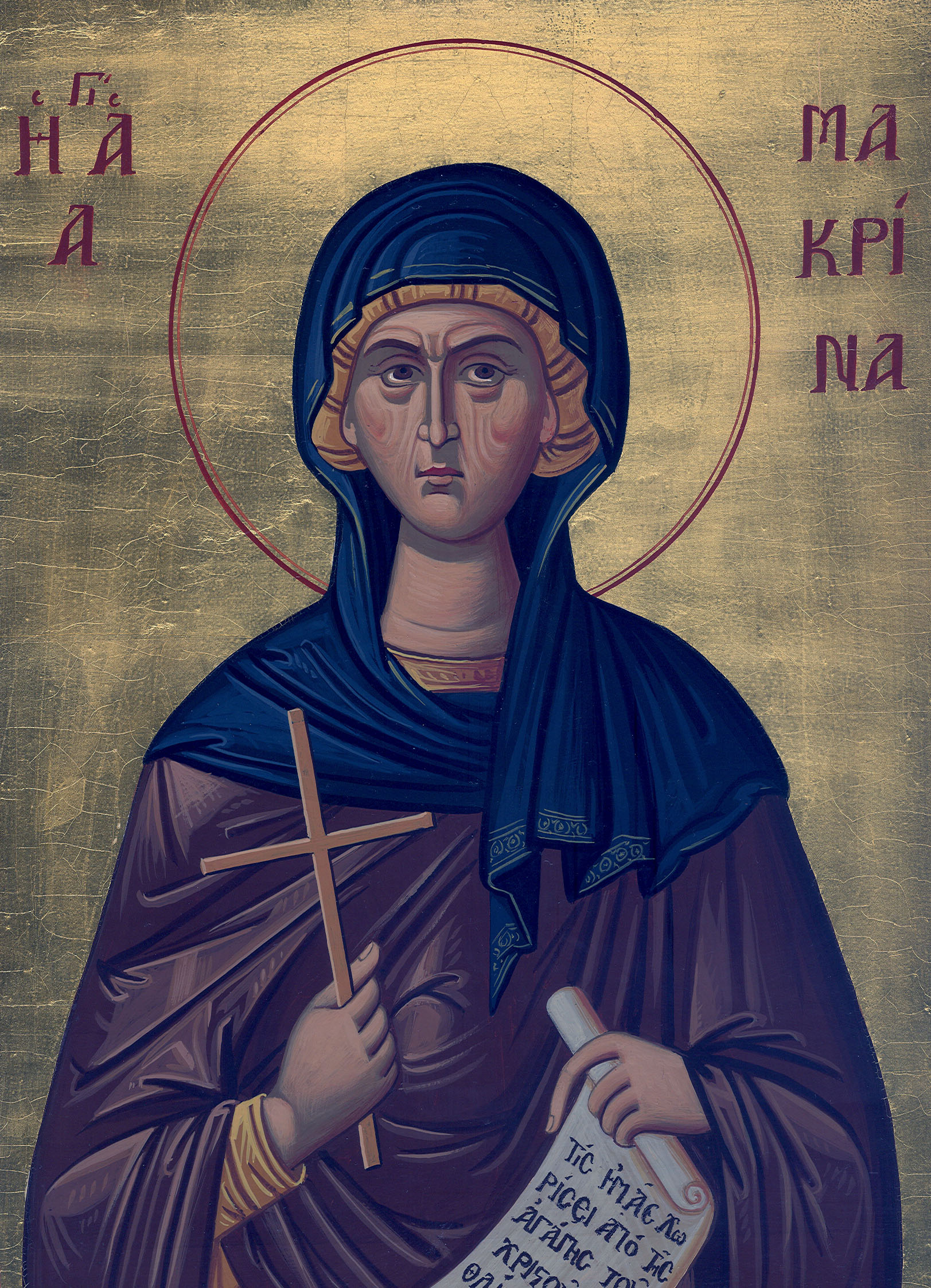
St. Macrina the Righteous, the Sister of St. Basil the Great

St. Macrina the Righteous, the Sister of St. Basil the Great - Commemorated on July 19 (http://vatopaidi.files.wordpress.com/2009/07/0032_11.jpg)
  
Saint Macrina was the sister of the holy hierarchs Basil the Great and Gregory of Nyssa, and was born in Cappadocia at the beginning of the fourth century. Her mother, Emilia, saw an angel in a dream, naming her unborn child Thekla, in honor of the holy Protomartyr Thekla. St Emilia (January 1) fulfilled the will of God and named her daughter Thekla. Another daughter was named Macrina, in honor of a grandmother, who suffered during the time of persecution under the emperor Maximian Galerius.

Besides Macrina, family there were nine other children. St Emila herself guided the upbringing and education of her elder daughter. She taught her reading and writing in the Scriptural books and Psalms of David, selecting examples from the sacred books which spoke of a pious and God-pleasing life. St Emilia taught her daughter to pray and to attend church services. Macrina was also taught the proper knowledge of domestic governance and various handicrafts. She was never left idle and did not participate in childish games or amusements.

The Holy Family of St. Basil: (left to right, first row) St. Peter of Sebaste, St. Basil the Great, St. Basil, St. Gregory, (second row) St. Theosevia, St. Naukratios, St. Emmelia, (top) St. Macrina (source) 
  
When Macrina grew up, her parents betrothed her to a certain pious youth, but the bridegroom soon died. Many young men sought marriage with her, but Macrina refused them all, having chosen the life of a virgin and not wanting to be unfaithful to the memory of her dead fiancé. St Macrina lived in the home of her parents, helping them fulfill the household tasks as an overseer together with the servants, and she helped with the upbringing of her younger brothers and sisters. After the death of her father she became the chief support for the family.

When all the children grew up and left the parental home, St Macrina convinced her mother, St Emilia, to leave the world, to set their slaves free, and to settle in a women's monastery. Several of their servants followed their example. Having taken monastic vows, they lived together as one family, they prayed together, they worked together, they possessed everything in common, and in this manner of life nothing distinguished one from another.

St. Gregory, St. Macrina, St. Emmelia, St. Peter of Sebaste, St. Basil the Great (http://pravicon.com/images/sv/s1335/s1335003.jpg)
  
After the death of her mother, St Macrina guided the sisters of the monastery. She enjoyed the deep respect of all who knew her. Strictness towards herself and temperance in everything were characteristic of the saint all her life. She slept on boards and had no possessions. St Macrina was granted the gift of wonderworking. There was an instance (told by the sisters of the monastery to St Gregory of Nyssa after the death of St Macrina), when she healed a girl of an eye-affliction. Through the prayers of the saint, there was no shortage of wheat at her monastery in times of famine.

St Macrina died in the year 380, after a final prayer of thanks to the Lord for having received His blessings over all the course of her life. She was buried in the same grave with her parents.
(http://oca.org/FeastSaintsViewer.asp?SID=4&ID=1&FSID=102055)
   
  
Troparion - Tone 8
The image of God was truly preserved in you, O Mother, For you took up the Cross and followed Christ. By so doing, you taught us to disregard the flesh, for it passes away, But to care instead for the soul, since it is immortal. Therefore your spirit, O Holy Mother Macrina, rejoices with the Angels!
(http://oca.org/FStropars.asp?SID=13&ID=102055)
  
Through the prayers of our Holy Fathers, Lord Jesus Christ our God, have mercy on us and save us! Amen!

Friday, December 23, 2011

Homily on the Nativity of Christ, by St. Gregory of Nyssa

Christ is born! Glorify Him!
  
Homily on the Nativity of Christ by our Father among the Saints Gregory, Bishop of Nyssa
“SOUND THE TRUMPET at the new moon,” says David, “even in the notable day of your feast.” The commandments of Divinely-inspired teaching are assuredly a law for those who hear them. Therefore, since the notable day of our feast is at hand, let us, too, fulfill the law and become heralds of the solemnity. The trumpet of the law, as the Apostle bids us understand, is the word. For the sound of the trumpet, he says, should not be uncertain, but its notes should be distinct so that the hearers may clearly perceive it. So let us produce a clear and audible sound, brethren, one that is no less noble than that of the trumpet. For the Law, prefiguring the truth in the shadowy types, enjoined the sounding of the trumpet at the Feast of Tabernacles. Now, the theme of the present Feast is the mystery of the true Tabernacle. For on this day did He Who vested Himself with humanity for our sake pitch His human tabernacle; on this day our tabernacles, which had disintegrated through death, are reconstituted by Him Who constructed our habitation from the very beginning. Let us utter the words of the Psalm, joining in chorus with the loud-voiced David: “Blessed is he that cometh in the name of the Lord.” How does He come? He crosses over into human life, not by boat or by chariot, but through the incorruption of a Virgin. This is our God, this is our Lord, Who appeared to us to ordain a Feast with thick branches, even unto the horns of the altar.
  
We are assuredly not unaware, brethren, of the mystery contained in these words: that all of creation is a single temple of the Master of creation. But since, when sin intervened, the mouths of those overcome by evil were stopped, the voice of rejoicing fell silent and the harmony of those who keep festival was interrupted, as human creation no longer celebrated with celestial Angel-kind, for this reason there came the trumpets of the Prophets and the Apostles, whom the Law calls horns, because they are formed from the true Unicorn (Numbers 23:22). By the power of the Spirit they made the word of truth resound with piercing clarity, so that the ears of those who had been made deaf by sin might be opened up and so that there might be one harmonious celebration, echoing in unison through the thick covering of the tabernacle of the lower creation with the sublime and preëminent Hosts that stand around the Heavenly Altar. For the horns of the noetic Altar are the sublime and preëminent Powers of the noetic nature, the Principalities, Authorities, Thrones, and Dominions, to which human nature is joined by participation in the Feast through its resurrected tabernacle, which is “thickly covered” by the renewal of our bodies. For “to be thickly covered” means the same as “to be adorned” and “to be encompassed,” as those who understand these matters interpret it. Come, then, let us rouse our souls to spiritual rejoicing, and let us appoint David the head and leader of our chorus; and let us say with him that sweet verse which we have just chanted.
  
Let us repeat it yet again: “This is the day which the Lord hath made; let us rejoice and be glad in it.” On this day darkness begins to diminish, and the duration of the night is contracted by the waxing of the sun’s rays. Not fortuitously or arbitrarily did God ordain, in connection with this Feast, that the Divine life should now be made manifest in human life. For those who are more discerning, the creation describes a certain mystery through natural phenomena, well nigh giving utterance and teaching those capable of hearing what is meant by the waxing of the day and the waning of the night at the advent of the Master. For it seems to me that I hear the creation setting forth an explanation of this kind: “When you see these phenomena, O man, understand that hidden mysteries are disclosed to you through things that are apparent. Do you see the night advancing to its greatest length, stopping in its course, and again receding? Reflect that the evil night of sin, having increased as much as it could and having reached the utmost magnitude of wickedness through the contrivance of every kind of vice, is today prevented from spreading any further, and is henceforth driven to eclipse and extinction.
  
Do you see how the light shines more clearly and how the sun sits higher in the sky than usual? Ponder on the Advent of the true Light, Who illumines the entire inhabited earth with the rays of the Gospel. One might perhaps reasonably suppose that the reason why the Lord did not manifest Himself at the outset of creation, but bestowed the revelation of His Divinity upon human life in the latter times, is that He Who was going to unite Himself to human life in order to cleanse it of evil was bound to await the blossoming of all the sin planted by the enemy. Thus, it was then that He laid the axe to the root, as the Gospel says. For those physicians who are eminent in their art, while the fever is still consuming the body from within and gradually being aggravated by those factors that cause the disease, yield to the malady, until the suffering has reached its acme, giving no relief to the sufferer by way of food. But when the evil comes to a halt, when the entire disease has been exposed, then they bring their skill to bear. Thus, He Who heals those who are ill in soul waited for the evil from the disease which held the human race in its grip to become manifest in its entirety, lest any hidden evil remain unhealed, which would be the case if the doctor cured only what was visible. For this reason neither in the times of Noah, when all flesh had become corrupted by unrighteousness, did He apply the remedy of His own appearing, because the shoot of Sodomite vice had not yet budded, nor did the Lord reveal Himself in the time of the destruction of Sodom, for many other evils were still lurking in human nature. Indeed, where was the God-fighting Pharaoh? Where was the indomitable wickedness of the Egyptians?
  
Not even then—in the era of the Egyptian wickedness, I mean—was it opportune for the Corrector of all things to associate with our life. No, for it was necessary for the iniquity of the Israelites to be exposed. It was still necessary for both the kingdom of the Assyrians and the smouldering arrogance of Nabucodonosor to be made manifest in human life. It was necessary for the foul murder of the righteous ones to spring up like some wicked and thorny plant from the Devil’s evil root. It was necessary for the raging fury of the Jews against the Saints of God to be revealed: they slew the Prophets and stoned those sent by God, and finally perpetrated the murder of Zacharias between the Temple and the altar. Add to this list of enormities the slaughter of the children by Herod. When, therefore, the full force of evil had emerged from its wicked root and had proliferated, running riot in a variety of ways in the behavior of those in every generation notorious for their depravity, it was then, as Paul says to the Athenians, that God, overlooking the times of ignorance, came in the latter days, when there was no one who understood Him or sought after Him, when all had gone astray and had alike become good for nothing, when all things had been enveloped in sin; when iniquity had multiplied, and when the darkness of evil had increased to the highest degree. Then did Grace appear, then did the radiance of the true Light dawn. Then did the Sun of righteousness appear to those sitting in darkness and the shadow of death; then did He crush the many heads of the dragon, stepping on him with His foot, through His human flesh, dashing him to the earth and trampling on him. Let no one, looking at the present state of the world, suppose that we are speaking falsely when we say that the Lord has shone upon our life in the latter times.
   
Perhaps someone will say, by way of objection, that it is natural for one who waits some years for evil to manifest itself, so that he can pull it up by the roots once it is fully developed, to destroy it completely, so that no remnant of it will survive. Now, however, people dare to commit murders, thefts, adulteries, and all manner of villainy. But let him who observes this state of affairs dispel his doubt with a familiar example. For, just as when we kill a snake, we can see that the hinder part of its coil is not immediately deadened along with its head, but whereas the head is dead, the tail still pulsates with its own life and is not deprived of vital movement, so also He Who slew the dragon, when the beast had become large enough, increasing in size with each generation of mankind, destroyed its head, that is, its power to ruin what is good—which itself possesses many heads—, but took no account of the rest of its body, allowing the motion that lingered in the dead beast to serve as a means of training for future generations. What, then, is the head that is crushed? The head that brought death into the world by an evil counsel, injecting deadly venom into man through its bite.
  
Therefore, He Who destroyed the might of death, crushed the power contained in the serpent’s head, as the Prophet says. The rest of the beast’s body, dispersed in human life, as long as mankind is motivated by evil, always roughens life with the scales of sin. The serpent’s power is now dead, since its head has been rendered useless, but as time passes and things endowed with motion come a standstill at the awaited consummation of this life, then the tail, the enemy’s last remaining part, that is, death, is annulled. In this way evil will completely disappear, when all are recalled to life through the resurrection: the righteous will immediately be transported to celestial bliss, while those held in the grip of sins will be consigned to the fire of Gehenna.
   
But let us return to the present joy, which the Angels proclaim to the shepherds, which the heavens declare to the Magi, which the spirit of prophecy announces through many and sundry utterances, so that the Magi become heralds of Grace. For He Who makes the sun rise on the just and on the unjust, Who sends rain on the evil and on the good, has brought the ray of knowledge and the dew of the Spirit even to the mouths of foreigners, so that the truth is confirmed all the more for us by the testimony of our adversaries. You hear the soothsayer Balaam declaring to the foreigners by a higher inspiration that “a Star shall rise out of Jacob.” You see the Magi, who derive their ancestry from him, observing, according to the prediction of their forefather, the rising of the novel star, which, contrary to the nature of all other stars, alone partook of motion and rest, proceeding according as it had need of either of these states. For whereas, among the other stars, some stand fast once and for all in the sphere of the fixed stars, having obtained an immovable position, while others never cease from moving, this one both moved, preceding the Magi, and stood still, indicating the place.
  
You hear Esaias exclaiming that “unto us a Child is born, unto us a Son is given.” Learn from the Prophet himself how the Child was born, how the Son was given. Now, was it in accordance with the law of nature? No, says the Prophet. The Master of nature is not a slave to the laws of nature. But how was the Child born? Tell us. “Behold,” says the Prophet, “a Virgin shall conceive in the womb, and shall bring forth a Son, and they shall call his name Emmanuel, which being interpreted is, God with us.” O the wonder! The Virgin becomes a mother, and yet remains a virgin. You see the innovation in nature. Among other women, as long as one is a virgin, she is not a mother. But when she becomes a mother, she no longer possesses virginity. But in this case, the two names coincide. For the same woman is both a mother and a virgin; and neither did her virginity prevent her childbirth nor did her maternity annul her virginity. For it behooved Him Who was to enter human life in order to make all things incorrupt that He should receive His beginning from the incorruption that served His birth. Men are in the habit of calling one who has no experience of wedlock incorrupt. It seems to me that the great Moses understood this in advance through the light wherein God appeared to him, when the fire touched the bush and the bush was not consumed: “I will pass over and see this great sight.” By “pass over,” he means, I think, not a local movement, but the passage of time; for that which was then prefigured in the flame and the bush was, with the passage of intervening time, clearly revealed in the mystery of the Virgin. For, just as there was a bush there, and the fire touched it and it was not burned, so here, too, there is a Virgin, who gives birth to the Light and suffers no corruption. If a bush prefigures the God-bearing body of the Virgin, do not be ashamed of the type. For all flesh, on account of our acceptance of sin, by the very fact that it is only flesh, is sin; and sin in Scripture is called by the name “thorn.” Now, provided we do not digress too far from our subject, it is perhaps not inopportune to adduce Zacharias, who was slain between the temple and the altar, as a witness to the incorruption of the Mother of God. This Zacharias was a priest; and not only was he a priest, but he was also endowed with the gift of prophecy, his power of prophecy being declared expressly in the Book of the Gospel. When the Grace of God was preparing the way for men not to think that birth from a Virgin is incredible, it set the stage for the assent of unbelievers by means of lesser miracles: a child was born of a barren woman advanced in years. This was a prelude to the miracle of the Virgin Birth. For, just as Elizabeth became a mother not by the power of nature—for she had grown old in barrenness—but the birth of her child is ascribed to the Will of God; so also, the incredibility of a virginal parturition gains credibility with reference to the Divine.
  
Since, therefore, he who was born of the barren woman preceded Him Who was born of the Virgin, and, in response to the salutation of her who was carrying the Lord, leaped in his mother’s womb before he saw the light of day, as soon as the Forerunner of the Word was born, the silence of Zacharias was thereupon loosed by prophetic inspiration. All that Zacharias recounted was a prophecy of the future. Therefore, guided to the knowledge of hidden things by the spirit of prophecy, and perceiving the mystery of virginity in the incorrupt birth, he did not exclude the unwedded Mother from that place in the Temple allotted by the Law to virgins, thereby teaching the Jews that the Creator of existing things and King of all creation has human nature subject to Himself, along with everything else, guiding it by His own Will as He sees fit, not being Himself mastered by it, so that it is in His power to create a new birth, which will not prevent her who has become a mother from remaining a virgin. For this reason, he did not exclude her, in the Temple, from the place of the virgins; this place was the space between the Temple and the altar. When the Jews heard that the King of creation, by Divine OEconomy, was about to undergo human birth, fearing lest they become subject to a king, they murdered the priest who bore witness to this birth as he was serving at the altar itself.
  
We have, however, wandered far from our subject, and must return to Bethlehem in the Gospel account. For if we are truly shepherds and keeping watch over our flocks, the voice of the Angels which proclaims these good tidings of great joy is assuredly directed to us. Let us, therefore, look up to the heavenly host, behold the choir of Angels, and hear their Divine hymnody. What is the sound of these who keep feast? “Glory to God in the highest,” they cry. Why do the Angelic voices glorify the Divinity beheld in the highest? Because they say “and on earth peace.” The Angels have become exceedingly joyful at the spectacle: “and on earth peace.” That which was previously accursed, which brought forth thorns and thistles, the place of conflict, the exile of the condemned, has received peace. Oh, the wonder! “Truth is sprung out of the earth, and righteousness hath looked down from heaven.” Such is the fruit that the earth of men yielded. And these things come to pass for the sake of God’s good will towards men. God is mingled with human nature, in order that humanity might be raised up to the height of God. Having heard these tidings, let us go to Bethlehem and behold the new spectacle, how the Virgin exults in childbirth, how she who knew not wedlock suckles her infant. But let us first hear from the stories related about her who she was and whence she came.
 
Icon of Jesus Christ "Emmanuel", which means "God with us" (source)
     
I have heard a certain apocryphal account, which presents the following narratives concerning her. Her father was distinguished for his scrupulous observance of the Law and was well known for his virtues. However, he had reached old age without having sired any offspring, for his wife was unable to bear children. Now, there was a certain honor ascribed to mothers on the basis of the Law, an honor in which barren women had no share. His wife replicated the story of the mother of Samuel. Having entered the Holy of Holies, she besought God that she not be deprived of the blessing that comes from the laws, since she not sinned against the Law in any way, but that she become a mother and dedicate to God the child that she would bear. Strengthened by Divine assent to the favor that she requested, she conceived. When she brought forth the child, she named her “Mary,” so that through the similarity of the name it might be indicated that the favor was granted by God. When the little girl was sufficiently mature, so that she no longer needed to cling to the breast, her mother made haste to give her back to God, in fulfillment of her promise, and conduct her to the Temple. The priests brought up the child in the Holy place for some time, just like Samuel, but when she was grown up, they took counsel as to what they could do about that holy body without sinning against God. To subjugate her to the law of nature and enslave her through marriage to one who would take her to wife was utterly unacceptable. Indeed, it was regarded as absolute sacrilege for a man to be master of something consecrated to God, for it was decreed by the law that a man should be master of his spouse. However, it was not lawful for a woman to consort with priests in the Temple or to be seen in the Holy place, and besides, such a thing was improper.
  
As they were deliberating on these matters, they received advice from God that they should betroth her nominally to such a man as would be apt to guard her virginity. Joseph, the kind of man they were looking for, since he was of the same tribe and family as the Virgin, was found, and on the advice of the priests he was betrothed to the girl. Their affinity extended only as far as betrothal. The Virgin was then initiated into the mystery of the Divine Will by Gabriel, the words of his mystagogy being themselves a blessing. “Rejoice, thou that art full of Grace,” he said, “the Lord is with thee.” The words now addressed to the Virgin are the antithesis of those addressed to the first woman. The latter was condemned to the pangs of childbirth on account of sin; in the case of the former, sorrow is expelled through joy. In the latter case, sorrows precede parturition; in the former case, joy is the midwife of parturition. “Fear not,” says Gabriel. Since the expectation of travail arouses fear in every woman, that fear is banished by the promise of an agreeable childbirth. “Thou shalt conceive in thy womb,” he says, “and bring forth a son, and shalt call His name Jesus. For He shall save His people from their sins.” What does Mary say? Hear the voice of a pure Virgin. The Angel proclaims the glad tidings of the birth; but she cleaves to virginity, judging incorruption to be preferable to the appearance of the Angel, and neither does she disbelieve the Angel nor will she relinquish her resolve. “I have refrained from knowing any man,” she says: “How shall this be, seeing I know not a man?” This utterance of Mary is proof of the narrative that I have drawn from the aforementioned apocryphal work. For if she had been taken in marriage by Joseph, how would she have been surprised by him who announced that she was to bear a child, for in that case she would surely have expected to become a mother according the law of nature? “Since it behooved me to preserve inviolate, as a holy offering, the flesh that I have consecrated to God, for this reason,” she says, “although thou art an Angel, although thou hast come from Heaven, and although this phenomenon surpasseth human nature, it is nonetheless impossible for me to know a man. How am I to be a mother without a man? For I know Joseph as my betrothed, but do not know him as a husband.” Now, what does the bridal escort Gabriel say to this? What manner of bridal chamber does he present for a pure and undefiled marriage? “The Holy Spirit,” he says, “shall come upon thee, and the power of the Highest shall overshadow thee.”
  
Oh, that blessed womb, which on account of its exceeding purity attracted to itself the good things of the soul! For in the case of all other human beings, a pure soul would with difficulty receive the presence of the Holy Spirit; but in this case, the flesh becomes a vessel of the Spirit. “And the power of the Highest shall overshadow thee.” Now, what do these ineffable words mean? “Christ” is “the power of God, and the wisdom of God.” Thus, the Wisdom of the Most High God, which is Christ, takes form in her virginity through the coming of the Holy Spirit. For, just as a shadow assumes the same shape as the body that precedes it, so also the character and the traits of the Divinity of the Son will be manifested in the power of Him Who is to be born, the image, seal, adumbration, and effulgence of the Prototype being shown through His display of miracle-working.
  
But the glad tidings of the Angels exhort us to bring our discourse back to Bethlehem and to behold the mysteries in the cave. What is this? A Child wrapped in swaddling clothes and lying in a manger; and she who remains a Virgin after giving birth, the incorrupt Mother, cares for her offspring. Let us, the shepherds, utter the cry of the Prophet: “As we have heard, so have we seen in the city of the Lord of hosts, in the city of our God.” Surely these things that are related about Christ did not happen fortuitously or accidentally, and surely there is some reason behind this story. What does it mean for the Master that He dwells in a cave and lies in a manger? That He became involved with our life at the time of the whole world was being registered for taxation? Is it not clear that, just as He delivers us from the curse of the Law, becoming a curse for our sake, and transfers our stripes to Himself, so that by His stripes we might be healed, so also He submits to taxation in order to free us from the evil fetters of the tax which death has been exacting from humanity? When you see the cave in which the Master is born, understand the lightless and subterraneous life of mankind, into which He enters, appearing to those sitting in darkness and the shadow of death. He is bound in swaddling clothes Who wraps Himself in the bands of our sins. The manger is the abode of irrational animals, in which the Word is born, that the ox may know his Owner and the ass his Master’s crib; the ox stands for him who is subject to the Law, while the ass, that beast of burden, stands for him who is weighed down with the sin of idolatry. But whereas the food and sustenance suitable for irrational animals is grass—“He causeth the grass to grow for the cattle,” as the Prophet says—the rational animal is nourished with bread. For this reason, therefore, the Bread of Life, which descended from Heaven, is set forth in the manger, which is the dwelling- place of irrational animals, so that those irrational animals might partake of rational food and become rational. Thus, the Lord of both mediates, in the manger, between the ox and the ass, in order that, having “broken down the middle wall of partition,” He might “make in Himself of twain one new man,” both removing the heavy yoke of the Law from the former and relieving the latter of the burden of idolatry.
  
But let us now gaze upon the celestial wonders. For behold, not only do Prophets and Angels announce the glad tidings of this joy to us; the heavens, too, proclaim the glory of the Gospel through their own marvels. Christ “sprang out of Juda” for us, as the Apostle says, but the Jews are not illumined by Him Who thus sprang forth. The Magi were strangers to the promise of the Covenants and without a share in the blessing of the Fathers; yet they surpass the people of Israel in knowledge, for they recognized the heavenly luminary and were not ignorant of the King in the cave. The Magi bring Him gifts, but the Jews plot against Him. The former worship Him, but the latter persecute Him. The former rejoice at finding Him Whom they were seeking. The latter are perturbed at the birth of Him Who was announced. For, when the Magi “saw the star” over the place where the Child was,” “they rejoiced with exceeding great joy.” “When Herod...had heard” the report, “he was troubled, and all Jerusalem with him.” The Magi offer frankincense to Him as God, honor His regal dignity with gold, and through myrrh, by prophetic Grace, allude to the OEconomy of His suffering. The Jews [Herod and his soldiers], however, condemn the entire infant population to slaughter, which, it seems to me, convicts them not only of cruelty, but also of the utmost folly. For what did they intend by this act of infanticide? And to what end did the murderers dare to perpetrate such a heinous crime? A certain new and marvellous celestial sign, it says, indicated to the Magi the appearance of the King.
  
What, then? Do you believe in the truth of the sign that announces Him, or do you suspect that what is rumored about Him is groundless? For if He is such a nature as to have the heavens under His control, is He not obviously above your control? But if He makes His living or dying dependent on you, in vain do you fear such a one. For what purpose do you plot against one who acts in such a way as to be under your control? Why do you issue that dire mandate, your wicked decree against the infants, that hapless babes be slaughtered? What wrong did they do? What cause of punishment and death did they bring upon themselves? Their sole crime is that they were born and saw the light of day. Because of this it was necessary that the city be filled with executioners and that a throng of mothers and infants be assembled, with people accompanying them and parents and all their kinsfolk gathering together, as one might expect, to witness their plight. Who could describe this calamity in words? Who could bring before our eyes through narratives their torments? their mingled lamentation? the mournful dirge of children, mothers, relatives, and fathers crying out piteously at the threats of the executioners? How could one portray the executioner standing beside the infant with bared sword, with a grim and murderous look on his face, uttering words to match his expression, dragging the infant towards him with one hand, and stretching out his sword with the other, and the mother on the other side pulling the child towards herself and holding out her own neck under the edge of the sword, so as not to see with her own eyes the hapless child being destroyed by the hands of the executioner? How could one recount the reactions of the fathers? their exclamations, their lamentations, their final embraces of their sons, and many other such things that occurred at the same time as these? Who could set forth the various kinds of torment, the twofold pangs of the mothers who have recently given birth? The bitter searing of their feminine nature? how the hapless babe clave to its mother’s breast and at the same time received the mortal blow through its vitals? how the unfortunate mother held out her breast to the mouth of the infant and received the blood of her child on her bosom? At times, with the swing of his hand, by a single stroke of his sword, the executioner would thrust through both mother and child, and a single stream of blood would flow, mingled together from the wound of the mother and the mortal blow dealt to the child. And since, by Herod’s abominable decree, not only was the death sentence to be meted out to newborn infants, but also any child who had reached his second year was to be carried off and slain (as Scripture says, “from two years old and under”), the account quite naturally foresees yet another predicament: that the intervening time had made the same woman mother of two children. What a spectacle it was in such situations, with two executioners busying themselves with one mother! The one would be dragging towards him the child that was running back to his mother, while the other would be tearing the suckling away from his mother’s bosom. What suffering the poor mother must have undergone in these cases! Her instincts are split between two children, each of whom kindles the flames of maternal affection in equal measure, for she does not know which of the wicked executioners to follow: the one dragging her infant off to slaughter from one side, or the other doing the same thing from the other side. Is she to run to her newborn, who is emitting what are as yet indistinct and inarticulate laments? But she hears the other, who is already able to speak, tearfully calling out to his mother in a faltering voice. What is she to do? Who is it to be? To whose cry will she respond? In response to whose lamentation will she lament in turn? Which death will she mourn, being stung by the goads of her maternal nature equally for each?
  
But let us avert our hearing from threnodies for the children and direct our minds to themes more cheerful and more suitable for the Feast, even though Rachel, in accordance with the prophecy, bewails the slaughter of the children with loud cries. For on a day of celebration, as the wise Solomon says, it is fitting to forget evils. What could be more auspicious for us than this Feast, whereon the Sun of Righteousness, having scattered the evil darkness of the Devil, shines upon creation through this our nature, whereon that which was fallen is raised up, that which had become hostile is brought to reconciliation, that which had been outlawed is recalled, that which had fallen away from life returns to life, that which had become enslaved to captivity is restored to the dignity of the Kingdom, and that which had been bound by the fetters of death and runs back, liberated, to the land of the living? Now, according to the prophecy, the brazen gates of death are crushed and the iron bars are shattered, whereby the human race was formerly confined in the dungeon of death. Now, as David says, the gate of righteousness is opened. Now the sound of those who keep festival is heard in unanimity throughout the inhabited earth. Through man came death, and through man salvation. The first man fell into sin, but the second raised up him who was fallen. A woman came to the defense of a woman: the former afforded an entrance to sin; the latter ministered to the entrance of righteousness. The former accepted the counsel of the serpent; the latter brought forth the Destroyer of the serpent and gave birth to the Author of light. The former introduced sin through a tree; through a tree the latter introduced good in its place. By “tree” I mean the Cross; the fruit of this tree is evergreen and amaranthine life for those who taste thereof. And let no one suppose that such thanksgiving belongs only to the mystery of Pascha. Let him reflect that Pascha is the end of the Divine OEconomy. How could the end come about if the beginning had not preceded it? Which is prior to the other? The Nativity of Christ, of course, is prior to the OEconomy of His Passion.
  
The glories of Pascha, therefore, belong to the laudations of His Nativity. If one enumerates the benefactions recorded in the Gospels and reviews the miraculous healings, the provision of food amid scarcity, the return of the dead from the tombs, the extemporaneous production of wine, the expulsion of demons, the transmutation of various illnesses into health, the saltations of the lame, the fashioning of eyes from clay, the Divine teachings, the ordinances of the new Law, the mystagogy, through parables, towards higher things—all of these are a gift of the present day. Therefore, “let us rejoice and be glad in it,” not fearing the reproach of men, as the prophet exhorts, nor being overcome by the contempt of those who deride the rationale of the OEconomy, saying that it is not seemly that the Lord should assume bodily nature and mingle with human life through birth, ignorant, it seems, of the mystery involved in this matter, how the Wisdom of God wrought our salvation. We had voluntarily sold ourselves to our sins and were in bondage to the enemy of our life like bought slaves. What, indeed, would you like the Master to have done? Is it not to have delivered you from calamity? Why do you quibble about the manner of your deliverance? Why do you lay down the law for your Benefactor, as if you receive no benefit from Him? It is as if one were to spurn his doctor and reprove him for doing good, because he effected the cure not in this way, but in another way. If you inquire, out of curiosity, into the magnitude of the Divine OEconomy, it is sufficient for you to realize that the Divinity is not just one good thing among others, but is whatever good we can conceive: powerful, just, good, and wise, whatever names and concepts possess a meaning that befits God. Consider, therefore, whether all the attributes that I have mentioned—goodness, wisdom, power, and justice—coincide in the benefaction wrought for us. As good, He loved the apostate; as wise, He devised a means for the return of those in bondage. As just, He did not coerce him who had enslaved mankind, who had justly acquired him by purchase; rather, He gave Himself in exchange for those held fast, in order that, transferring the debt to Himself like a guarantor, He might set the detainee free from those detaining him. As powerful, He was not held fast by Hades, nor did His flesh see corruption. For it was not possible that the Author of life should be held fast by corruption. But was it not disgraceful for Him to undergo human birth and undergo the experience of sufferings in the flesh? You are speaking of His exceeding beneficence. For since it was not possible for humanity to be delivered from so many evils in any other way, the King of all dispassion suffered to exchange His own glory for our life. His purity descended to our filth; but our filth had no effect on His purity, as the Gospel says: “And the light shone in darkness; and the darkness comprehended it not.” Darkness is disappeared by the presence of light; the sun is not dimmed by darkness. Mortality is swallowed up by life, as the Apostle says; life is not consumed by death. That which is corrupted is saved along with what is incorrupt. Corruption does not affect incorruption. For this reason, there is a common symphony of all creation, all things sending up unanimous doxology to the Master of creation, every tongue of those in Heaven, on earth, and under the earth crying that the Lord Jesus Christ, in the glory of God the Father, is blessed unto the ages of ages. Amen.
(Note: hosted by an old calendar site: http://www.saintedwardbrotherhood.org/1211.pdf)
  
  
Through the prayers of our Holy Fathers, Lord Jesus Christ our God, have mercy on us and save us! Amen!
Monday, December 27, 2010

Homily I on St. Stephen the Protomartyr, by St. Gregory of Nyssa

Christ is born! Glorify Him!

   
Homily I on St. Stephen the Protomartyr, by St. Gregory of Nyssa
How lovely is the inspiration exhibited by those who are good, and how sweet is the joy which they disclose! See, we acquire a feast from a feast and grace from grace. Yesterday the Lord of the universe welcomed us whereas today it is the imitator [Stephen] of the Lord. How are they related to each other? One assumed human nature on our behalf while the other shed it for his Lord. One accepted the cave of this life for us, and the other left it for him. One was wrapped in swaddling clothes for us, and the other was stoned for him. One destroyed death, and the other scorned it.

Brethren, let us hasten to the stadium where the great athlete contends against the wicked adversary of human life by stripping himself in the arena by his confession [of faith] [cf. 1Cor 4.9]. Indeed, as Paul has said [Heb 12.4], Stephen [Stephanos] has become a spectacle to the world, angels and to men. He was the first to have received the crown [stephanos] of martyrdom, the first to have paved the way for the chorus of martyrs and the first to have resisted sin to the point of shedding blood. It seems to me that the entire host of transcendent powers, angels, and myriads both assist and accompany them [i.e., the martyrs]. If we hear anything honorable in the heavens from among the principalities, powers, thrones, ruling forces and the entire heavenly assembly, their words provide an athletic spectacle by contending with an opponent [cf. Col 1.16 & Eph 1.21].

Let human life resemble a stadium for the contestants where one person contends against another. That antagonist which showed himself hostile to human life from the fall of our first parents until the time of Stephen strove to be victorious over men, yet the great athlete of faith considered his assaults as nothing [cf. Wis 2.24]. Both took up arms against each other: the inventor of death confronted a threat to death, whereas the disciple of life confessed his faith. For who could not help but admire this new type of struggle when truth judged between life and death chronicled the truth? For while the herald of a life hidden [in God] remained unknown, he nevertheless divulged it to men. At once he forsook this life and rightly judged it better to exchange a more honorable life for the present one.

It would be beneficial to accurately record his contest in order to disclose the order of our method by a series of miracles. Recently a powerful wind from heaven scattered every airy, deceptive power of the demons and filled the Apostles' house. Tongues of fire resided in each man corresponding with the number of those who received the grace of the Spirit. All were overcome by shock and confusion with the widely diverse languages immediately which the disciples spoke according to the sound and wonder of tongues and to the astonishment of those from every nation who were dwelling in Jerusalem [cf. Acts 2.2-5]. This was not a result of training and study but was a gift in the form of speaking which suddenly came from the Spirit's [J.705] inspiration. Those engaged in constructing an earthly tower must speak the [J.78] same language when building the church's spiritual dwelling. And so, the Holy Spirit's wonderful dispensation introduced grace in order to diffuse it, thereby providing a common benefit for everyone through the medium of the human voice. In this way the preaching of piety might not be limited to one tongue and remain unprofitable for those persons who spoke various tongues.

Even at this early point the Pharisees did not believe with their own ears and concocted to trip up persons astonished by these miraculous events as though new wine had made them [the Apostles] insane [cf. Acts 2.13]. Then Peter's solitary defense captured three thousand souls for Christ [cf. Acts 2.41], after which the church grew in the number of those who had been delivered. Those who were saved opened the temple's Beautiful Gate for the man born lame [cf. Acts 3.2ff] because his miraculous healing both increased and led to the faith persons lame in soul. As a result, many flocked when the faith was preached and sought help from the diverse profusion of grace at which point Stephen, who was wealthy in wisdom and grace by the Spirit, was summoned to assist the Apostles [cf. Acts 6.5]. Let no one think that the name of minister [diakonia] made him inferior to the dignity of the Apostles. Since Paul realized that he was a minister of the mysteries of Christ [cf. 1 Cor 4.1] and the Lord of the universe brought salvation by assuming human , he was not ashamed to be called a minister. As the Apostle says, he was in their midst as one who serves [cf. Lk 22.27] and as one who provides a variety of ministries [cf. 1 Cor 12.5-6].

Just as fire consumes useful material and bright flames rise on high, so did the Holy Spirit make the rays of grace shine brighter through Stephen's nobility. Similarly, all turned to him because he was gifted with knowledge and training. Those few persons who gathered together seemed to be a dense crowd much like a phalanx which attempted to assail Stephen who was equally serene whether in the company of many or few persons. Then certain persons under the guise of Alexandrians, Libertinians, Cyrenians and men from every place engaged the athlete in a debate regarding the truth. The father of lies assumed a human form and rose against truth which Stephen had spoken [cf. Jn 8.44]. However, the truth brought forth trophies against such lies, and its excellence wonderfully put to flight every assault of deception. The minister of truth sought the truth about the enemy who concealed his substance; rather, he made the truth appear as something which lacks substance.

How does this ruse affect the preacher? I believe that it comes from the devil. If any of you shares his strength, the truth destroys it in Stephen. But if that truth is loftier than your machinations, why are you deceitfully planning evil against the vessel of truth in order to destroy what remains of it? Dogs do this when they open their mouths for stones cast to them, yet they cannot touch the person whom threw them. Since true facts repulsed such a lie and could no longer find another champion of deception, all who looked squarely at the manifest truth remembered his own struggle. Stephen directed his energy against his accusers who passed judgment upon him, for they brought false accusations against him while being marked by rage and slander. The Jews brought various accusers against Stephen including judges who were either elected or who were subservient to death and did not know the impact of a ruinous vote levelled against Stephen. For just as experienced athletes bring down their more formidable opponents through vigorous training and thereby make them fall, so did the great Stephen who lay prostrate upon the ground overcome his adversary with difficultly.

From this point began the Apostles' journey throughout the entire world and their preaching. If it were not for [Stephen's] murder and the Jews' rage against the Apostles, perhaps the grace of the Gospel would have been confined to the inhabitants of Jerusalem. Having been driven out by the Jews to another nation, the teaching of the [Christian] mysteries expelled the devil from the world. Thus Samaria received the preaching [cf. Acts 8.14]; salvation reached the eunuch through Philip [Acts 8.26ff]; Paul was a great vessel of election armed against the devil's wrath and his threats against whose arrows he raised a shield [Acts 9.15], thereby abolishing him from the entire earth and making all places accessible to the faith of Christ. As a result, Egyptians, Syrians, Parthians, Mesopotamians, Galatians, Illurians, Macedonians as well as nations from everywhere hastened to hear the preaching. Do you see Stephen's athletic prowess and how the adversary was brought down to ruin although he appeared more excellent than his adversary by making false accusations?

But let us return again to the stadium. How do the calumniators enflame the people? They say, "He does not cease to speak words against this holy place and the Law. For we have heard him say that this Jesus of Nazareth will destroy this place and will change the customs which Moses handed down to us" [Acts 6.13-14]. Such is the allegation presented by the devil's speech, but who pays attention to such rubbish? Against whom do they rage so vehemently and what evil can they detect in his words? They even brought forth another indictment against [Stephen] claiming that he boasted that this place would be destroyed and that the institutes of Moses would be changed. What outrage doe these words contain whether they happen to be true or false? If false, there is no cause for alarm; if true, what unjust ground is there for denunciation? For what had transpired will indeed happen again whether or not we remain silent. Can the murder of him who was denounced earlier relieve persons who are grieving? For example, Jesus the Nazarene was condemned by the same vote of reprisal levelled against Stephen. If he who is unjust vents his wrath, gives place to injustice and alters customs, Stephen is not responsible for these acts but it is Jesus, as the accuser says, and the court is compelled to pass judgement against him who is accused. Oh, what an unfair verdict for those who are listening! Since Jesus, says the judge, changes the laws, Stephen should then [J.83] be stoned. How did Jesus abrogate the Law when he affirmed its antiquity by saying, "I did not come to abolish the Law but to fulfill it" [Mt 5.17]? Who strengthened his disciples according to the Law? He forbade them to become angry and to commit murder [cf. Mt 5.21-22], rejected adultery out of desire [cf. Mt 5.39], ordered that grief not be repaid since unjust hands cannot lay hold of you [cf. Mt 6.19ff] and wiped out passion, a result of greed, and taught mastery over it. Why were these neither mentioned nor examined when judgement was passed? I do not wish the crowd of those bloodstained judges to be present and do not want to know about places associated with such malevolent persons, the celebrated temple's location, the huge amount of stones, the gold left over which equalled the small amount left in the temple, the sacrifices according to the Law such as the ram, calf, lamb, heifer, dove, turtle-dove and he-goat for averting evil [cf. Lev 16.20ff]. Therefore if they condemn Stephen to death in order to deflect their sadness, they reveal their fruits through that terrible murder. If nothing is left, they claim that the vote counts, not the murder.

But let us see in the succeeding struggles how he who was covered by stones as if they were snow had warded off his murderers and how he returned a variety of thunderbolts against those who cast stones. The Jews knew the Christians' weapons which the great Stephen used to ward off their attacks and who made it the law of life. They were all fierce, standing in a circle, looked at him with a hysterical gaze and brandished a weapon against Stephen in their hands. However, he resembled a priest according to the spiritual law, was a pure sacrifice, submissive, and offered his own body instead of an offering of sprinkled blood. He saw God in the celestial sanctuary, made petition on behalf of those who mistreated him, exchanged their bloodthirstiness for a good deed and cried out in their ears, "Lord, do not hold this sin against them" [Acts 7.60]. By this prayer he expiated their sin which the murderers committed by their transgression and who were exasperated at his prayer. However, this did not prevent them from casting stones until the great Stephen fell into a sweet, blessed sleep as though he were surrounded by tender flowers or by gentle dew.


The athletes have achieved victory before we see those crowned who had engaged in fierce struggles since before seeing the contest, we have attained the goal of their struggles. I believe that we must not neglect them without mentioning the outstanding nature of their witness. This gathering of murderers was so filled with rage that they resorted to bloodshed; their evil was so strong that it restricted their breathing; their glance, appearance and passion was manifested by their teeth as divine Scripture says concerning enraged hearts which gnashed their teeth against him [cf. Acts 7.54]. Being in their midst, he girded himself against their hostile, murderous intent, surmounted their contemptuous intentions, resisted their wrath with patience and their threats with disdain, the fear of death with contempt, hatred with love, ill-will with benevolence and slander with truth.

Not only did the true athlete reveal one type of victory but combatted by countless virtues every form of evil which the Jews devised, thereby resulting in victory. I hear about various contests of strength in gymnasiums when athletes strip themselves naked in the arena and achieve victory against their contenders. Such martyrs are sovereign in the stadium, resisting with their own power every adversary and are as a beacon of triumph for all to see. The false wisdom of the Libertinians, Cyreninas and sages [J.86] from Alexandria [Acts 6.9] contend against him who is triumphant through true wisdom: courage overcomes fear, disdain conquers threats, charity subdues savagery and truth is victorious over falsehood. They sought to murder him, and their hands were already armed with stones; their glance and breathing through their teeth [M.713] held tightly together revealed their brutality. Nevertheless, he saw them as brothers and greeted them as fathers saying, "Men, brothers and fathers, listen [Acts 7.2]!"

They persuasively devised all sorts of calumny by convening a council of murderers against the truth. [Stephen] neither reproved them out of fear, was unconcerned with impending dangers nor did he consider death; rather, having his soul raised on high and appearing as though her were senseless to everyone gazing upon him, he taught them as though they were foolish children and demonstrated the error of their doctrines with regard to faith. In their presence [Stephen] briefly recounted the story of Abraham as well as the saints who followed him [cf. Acts 7.2-7]. He also added Moses, his birth, upbringing, education, initiation on the mountain, smiting the Egyptians, service to the Israelites and prophesy concerning the mystery of the Lord [cf. Acts 7.20-22, 30, 34, 36-37]. What especially incited this group and [J.87] fomented their illness was that Moses to whom they were especially devoted was a mentor for their teaching. They rose up against him in order to quiet him, something which Stephen desired in order to end his bitterness. He exited human nature and before he left the body, with pure eyes gazed upon heaven's gates and the temple's interior, the revelation of divine glory and the effulgence of his glory [cf. Acts 7.55-56]. The stamp of the Father's glory [cf. Heb 1.3] could not be described, and the athlete saw his brilliance among men which accommodated itself to human nature. Thus being outside human nature, he shared the angelic nature which seemed like a miracle to these murderers. His face was changed to assume that of the angels and seeing invisible reality, he proclaimed the grace he had beheld [cf. Acts 7.56]. But they blocked their ears and did not wish to see this with their eyes, preferring their own self-righteous since they were not capable of hearing this divine report. However, he shared the grace with those present although he alone was worthy of it: "I see the heavens open and the Son of Man standing at God's right hand" [Acts 7.57]. They exclaimed with a great voice, blocked their ears and unanimously rushed upon him. History recounts a similar uproar in order to show how their actions coincide with the Sodomites, for the judge [God] hears their wicked cry when he says, "The cry of the inhabitants of Sodom and Gomorrah have reached me" [Gen 18.20-21]. Therefore they shouted out in order that the cry against Stephen might be heard.

The athlete fully realized the benefit hidden beneath the murderers' bitterness because they who stood in a circle ready to stone him provided him with a crown much like a victor's crown plaited at enemy hands. Therefore [Stephen] warded off their murderous intent by a blessing and being fully aware of their plan to slay him, was prepared to suffer death at their hands. Furthermore, he believed that his enemies had the opportunity of conferring a benefit upon him. For this reason the person who knows Christ wishes to bring his enemies into submission. [Stephen] knew that the Lawgiver was patient, recalled his command to love one's enemies, to do good to those who bear hatred and to pray for one's enemies [cf. Mt 5.44]. But the athlete's goal does not consider human glory; rather, he seeks to overcome the entire world by the magnificence of his triumph and to outstrip human endurance, thereby rejecting every type of praise.

Although [Stephen] acquires victory in accord with every human manner of praise, we should pay attention to the narrative which pertains to the salvation of souls. Just as there are some athletes who have ceased their activity and train youths for athletic competitions through skillful technical maneuvers to vanquish their adversaries, so I think we should be trained by the great Stephen in piety that we might escape the grips of spiritual adversaries [pneumatomachoi]. For those who are mad with rage detract from the Spirit's glory claiming that Stephen is an advocate of their error when he gazed intently at heaven and saw God's glory and Jesus standing at his right hand [Acts 7.55]. They claimed that he perverted the teachings of piety when, if the Spirit should be included along with the Father and Son, why did not Stephen see in his vision the Spirit with the Son? Therefore how did Stephen cause such distress by uttering these words with his hands outstretched? How does his reasonable tactics counteract such distressing words since he countered the incredulity of his adversaries at that very spot? Do you seek, oh pneumatichos, when the Father's glory appears and the Son stands at his right, the location of the Spirit? If the Spirit were present within you, you would not fail to notice what is proposed [of the Spirit] much like those with defective vision who are ignorant of gold lying at their feet. At any rate I have now gotten wind of this and [desire] that you do not subscribe to the rumor devised by the Jews.

How did Stephen see transcendent glory? Who laid bare heaven's gates for him? Was this the work of men? Which of the angels enabled inferior [human] nature soar to that height? Stephen was not alone when he was generously filled with power coming from the angels which enabled him to see what he saw. What was recorded? "Stephen was filled with the Holy Spirit and saw the glory of God and his Only-Begotten Son" [Acts 7.55]. As the Prophet says, light cannot be seen unless one is filled with light: "In your light we shall see light" [Ps 35.10] (If observation of the light does not share this same light, how can anyone deprived of the sun's rays see it?). Since the Father's light makes this possible, the Only Begotten [Son's] light emanates through the Holy Spirit which makes it visible. Therefore the Spirit's glory enables us to perceive the glory of both the Father and Son. But can we say that the Gospel is true which says that "No man has ever seen God" [Jn 1.18]? How do the Apostle's words agree with the following, "No man has seen nor can see [God]" [1Tm 6.16]? If human nature and power can perceive the glory of the Father and Son, their vision must indeed be mistaken. However, history is true and cannot lie. The evil deed of the pneumatomachoi is indeed made clear because Scripture bears witness to similar situations. For Stephen beholds God not in human nature and power but is united by grace to the Holy Spirit who elevates him in order to comprehend God. Therefore, one cannot say that Jesus is Lord apart from the Spirit, as the Apostle says [cf. 1 Tm 6.16, 1Cor 12.3]. One cannot contemplate the Father's glory because where the Spirit is the Son is seen and is grasped the Father's glory.

But history presents us with another problem, namely, the weapon of impiety coming from the Christomachoi who condemn the Only Begotten [Son], for they consider the One present in the Father's glory to be inferior to his authority. What about Paul? How shall I answer them? What does the prophet David who lived earlier say when he explained the glory of the Only Begotten [Son] by the teaching of the Spirit? David says, "The Lord said to my Lord, `Sit at my right hand'" [Ps 109.1]. The Apostle says that the Lord is seated at the right hand of God's throne [Col 3.1, Heb 1.3]. If this represents either a place of inferiority or a seat of honor, testimony concerning [J.92] its magnificence is added in order to signify the loftiness of honor and the reception of true piety. For the Spirit's grace teaches all these things. Stephen, being filled with the Holy Spirit, saw everything and spoke about what he knew. While in the Spirit, David calls "Lord" as the Gospel says [Mt 22.43]; when Paul, speaks of him, he mentions mysteries in the Spirit [1 Cor 14.2]. Therefore if there is one teacher who is in complete harmony, the teaching is the Spirit of truth which was present in divinely inspired persons. Then how can any dissonance be present in teachings? But there is another seat and position which I can easily point out and will now mention it. Instead of showing concern for the body, these words should refer to what is incorporeal. With regard to man, the seat signifies that part of the body's hips which enables it not to continuously bear strain and thereby become weighed down and crooked. On the other hand, an upright position upon one's knees signifies that a person does not rest upon his hips when seated. But when it comes to transcendent nature, sitting and standing have no place with such concepts since each is separate and should be understood respectively. We neither subscribe to a bent position regarding incorporeal nature nor a sitting down with regard to what is formless; rather, we devoutly understand that each represents stability and being unmoved in every good. For standing and sitting apply to God and do not pertain to a difference of words concerning concepts which teach that God is firmly standing and sitting unmoved in the good. The prophet David and the apostle Paul do not comprehend the sitting of the Only Begotten [Son] in the same manner because the Father is standing and the Son is sitting. Indeed, by mentioning only the fact that the Son is sitting, Scripture tells us about the standing of the Son and no longer suggests the sitting of the Father. For just as Paul and David both confessed the Father sitting through the Son's standing at his right, indeed nothing is taught beforehand concerning the Father which is also true regarding Stephen where the Son is standing and revealed in the Father's glory. Thus this image is valid if it appears to be a satisfactory archetype. Goodness is present in what is good, light is present in the light it reflects and primeval beauty is present in everything supported by an appropriate image. Thus we should clearly understand the image of the Son's sitting, the Father's sitting and the standing in the standing which differs from the archetype's properties.

Brothers, you should ponder our words and thoughts and hold them as introductory remarks since Stephen's vision provokes reflection. We are not only spectators of Stephen's contest but since we are full of the Holy Spirit, we share his grace and eradicate adversaries for the glory of our Lord Jesus Christ to whom be glory and power forever and ever. Amen.
(http://www.johnsanidopoulos.com/2010/12/homily-one-st-gregory-of-nyssa-on-st.html)
   
For Homily II on St. Stephen by St. Gregory of Nyssa, see: http://www.johnsanidopoulos.com/2010/12/homily-two-st-gregory-of-nyssa-on-st.html.
  
St. Stephen the Archdeacon and Protomartyr (Icon courtesy of www.eikonografos.com used with permission)
   
Through the prayers of our Holy Fathers, Lord Jesus Christ our God, have mercy on us and save us! Amen!