Showing posts with label St. Andrew the Fool-for-Christ. Show all posts

Sunday, September 27, 2015

St. Andrew the Fool-for-Christ's Vision of St. John the Theologian

St. John the Apostle, Evangelist and Theologian (source)
  
This is an excerpt from the life of St. Andrew the Fool-for-Christ (see the Great Synaxaristes for the full life of the Saint in English). When he began to act like a fool after God's call, his master thought that he had become possessed, so he had him bound with chains, and placed in the holy church of St. Anastasia the Deliverer-from-Potions in Constantinople, which was known for its many miracles and healings. What is moving about this passage is the speedy help of St. John the Evangelist and Theologian, and the vivid depiction of spiritual warfare. St. John is not physically "flogging" the bodiless demons, but the demons experience this punishment when coming into contact with the great love, purity and humility of the Triune God and of His Saints. May the Lord protect and defend us all from the demons, through the prayers of His Holy Ones!
  
St. Andrew the Fool-for-Christ's Vision of St. John the Theologian
All of that day, bound as he was, [the Blessed Andrew] did not eat anything. That night, at midnight, as he was praying mystically to God and to the Martyr [St. Anastasia], the devil appeared to him visibly, appearing as a [dark being]. Together with him was a multitude of demons. Some were carrying pickaxes, others knives, others sticks and clubs, swords and spears, and others ropes. That dragon was the general. Because of this, many demons had come with him, in order to darken the blessed one. The [dark being], therefore, was foaming at the mouth. In this manner, the demons charged against him.
 
Then, the blessed Andrew lifted up his hands and cried out with tears to God: “Lord, do not cast to the beasts the soul that confesses You!"
 
And immediately, he added: “O St. John, Apostle and Evangelist, Beloved Theologian, help me.”
  
At that instant, from on high was heard the roaring of thunder*. And an Elder with large eyes appeared, whose face shown like the sun! Many were following him. He made the sign of the Cross in the air, and told those with him: “Lock the doors, so that none might escape!”
  
Those with him [i.e. the Angels] speedily seized all the demons. As they were all locked within the church, the demons cried to each other: “How dark is the hour that we are experiencing! John is strict and will torture us terribly.”
  
That precious Elder gave a command to his attendants to take the chain from the neck of the blessed Andrew. He took it, and stood outside the door and cried out: “Bring each of them to me.”
  
And they brought him the first one. “Lay him down,” he said.
  
Then, he folded the chain of the blessed one in three, and gave around 100 strikes to the demon, who cried out like a man: “Mercy, mercy, have mercy on me!”
  
Later they laid out and terribly flogged the second, followed by each of the demons. When the blessed Andrew heard the word “mercy”, he began to laugh. It appeared to him that the demons were bound and flogged perceptibly just like men. In reality, however, God was flogging them. And he was flogging them with such an astonishing beating, such that human nature couldn't bear it.
  
He who was flogging them cried out: “Go now to your father, to satan, and show him the predicament that you are in and see if it pleases him...”
  
When all of the [dark beings] disappeared, that precious Elder approached the servant of God, and put the chain back on his neck, telling him: “Do you see how quickly I came to help you? I greatly care about you, because God commanded me to care for your salvation. Have patience, so that you might everywhere appear to be worthy. Soon, your master will remove you from your bonds, so that you might go free where you will.”
  
“Tell me, O Lord,” the blessed Andrew asked, “who are you? I don't recognize you.”
  
“I am John,” he replied, “I reclined upon the spotless and life-giving bosom of our Lord, God and Savior Jesus Christ.”
  
As he said this, he disappeared like lightning from before his eyes. He remained ecstatic, and glorified God, because He helped him and delivered him from those evil demons that had surrounded him. He prayed, therefore, and said:
“O Lord Jesus Christ, great and unsurpassing is Your power, and greatly glorified is Your compassion, for strangely and wondrously did you have mercy on and take care of your humble servant. O exalted and almighty Lord, ever protect me on Your true way, and make me worthy, O greatly-merciful Master, O awesome and incomprehensible One, to find grace near You.”
  
*Note: St. John the Theologian and his brother St. James were called the "Sons of Thunder" by Christ.
  
(amateur translation of excerpt from the full life of the Saint in Greek, published by Parakletos Monastery, Oropos)
  
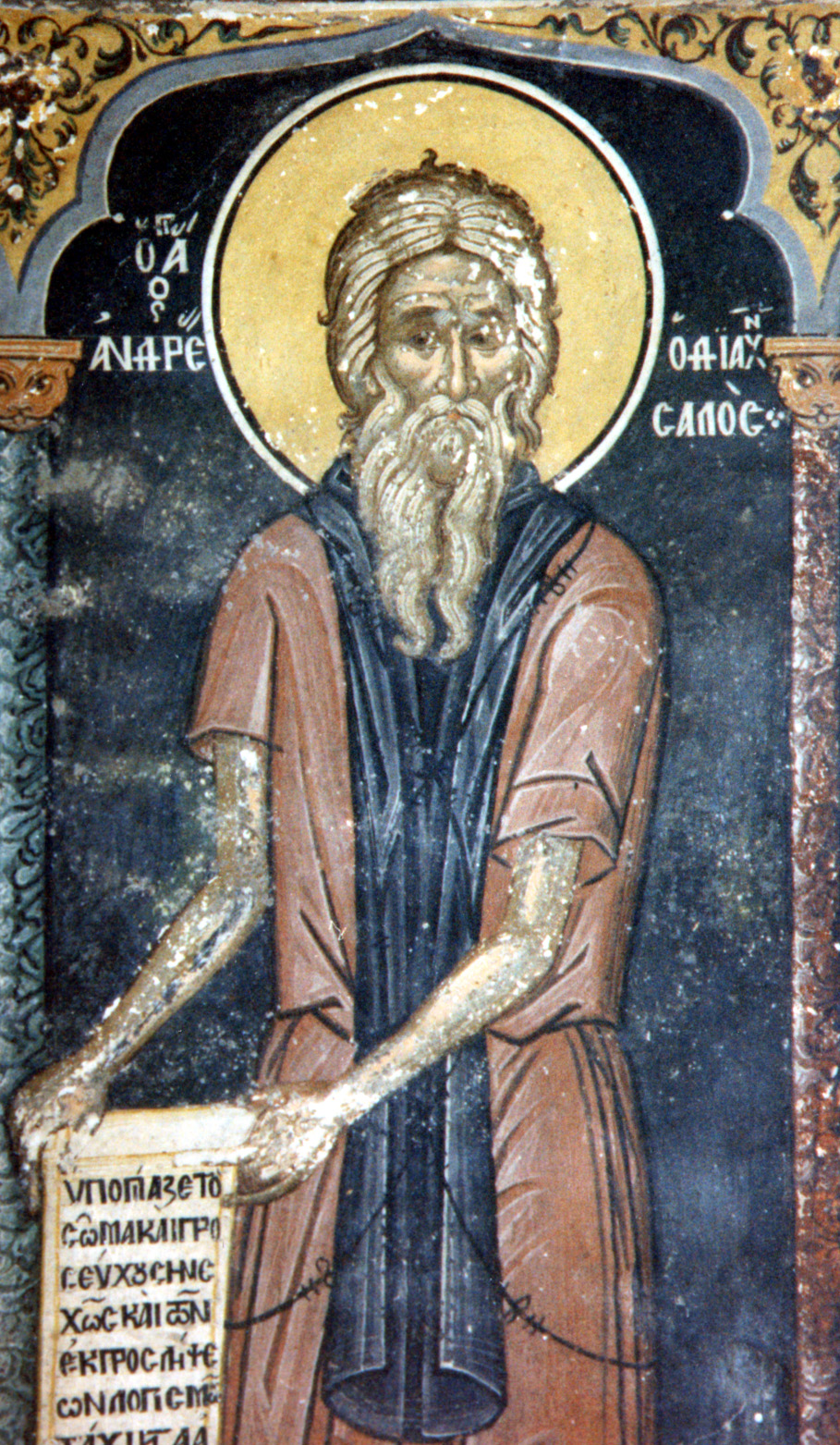
St. Andrew of Constantinople, the Fool-for-Christ (source)
  
Through the prayers of our Holy Fathers, Lord Jesus Christ our God, have mercy on us and save us! Amen!

Monday, May 28, 2012

St. Andrew the Fool-for-Christ


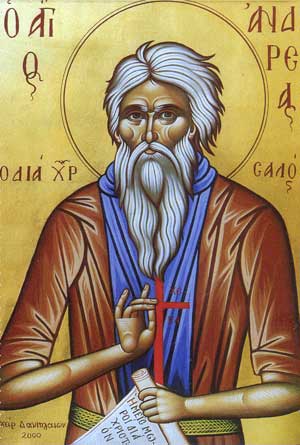
St. Andrew the Fool for Christ (Feast Day - October 2 in the Slavic Churches and May 28 in the Greek Churches) (http://pravicon.com/images/sv/s0181/s0181001.jpg)
   
The brief life of the Saint by St. Nikolai Velimirovich
Andrew was a Slav by birth. As a young man, he was enslaved; and was bought by Theognostus, a wealthy man in Constantinople, during the reign of Emperor Leo the Wise (son of Emperor Basil the Macedonian).

Andrew was handsome in body and soul. Theognostus took a liking to Andrew, and allowed him to become literate. Andrew fervently prayed to God, and with love attended church services.

Obeying a heavenly revelation, he adopted the ascesis of foolishness for Christ.

Once, when he went to the well for water, he tore off his clothes, and slashed them with a knife, feigning insanity. Saddened by this, his master Theognostus bound him in chains and brought him to the Church of St. Anastasia the Deliverer from Potions, so that prayers would be read for him. But Andrew did not improve, and his master freed him as mentally ill.

Andrew pretended insanity by day, but prayed to God all night long. He lived without shelter of any kind. He even spent the nights outside, walked around half-naked in a single tattered garment, and ate only a little bread when good men would give it to him. He shared all that he received with the beggars, and would mock them-to avoid being be thanked by them-for holy Andrew wanted all his reward to come from God. Therefore, the great grace of God entered into him and he was able to discern the secrets of men, perceive angels and demons, exorcize demons from men, and correct men from their sins.
   
St. Andrew and his disciple Ephiphanios behold the vision of the Theotokos (http://pravicon.com/images/sv/s0181/s0181002.jpg)
   
Andrew had a most beautiful vision of Paradise and the exalted powers of heaven. He also saw the Lord Christ on His throne of glory; and he, with his disciple Epiphanius, saw the Most-holy Theotokos in the Church of Blachernae as she covered the Christian people with her omophorion. This occurence is celebrated as the Feast of the Protection of the Most-Holy Theotokos (October 1). In a vision he also heard ineffable, heavenly words that he dared not repeat to men.

After a life of almost unparalleled harshness of ascesis, Andrew entered into rest in the eternal glory of his Lord in 911.
   
St. Andrew the Fool-for-Christ (http://days.pravoslavie.ru/jpg/ih4290.jpg)
 
A Vision of St. Andrew the Fool-for-Christ (1)

A monk in Constantinople was distinguished as an ascetic and spiritual father, and many people came to him for prayers. But this monk had the secret vice of avarice. He collected money and gave it to no one. St. Andrew met him on the street one day, and saw a terrible snake coiled around his neck. St. Andrew took pity on him, approached him, and began to counsel him: "Brother, why have you lost your soul? Why have you bound yourself with the demon of avarice? Why have you given him a resting place within yourself? Why are you amassing gold as though it will go to the grave with you, and not into the hands of others? Why are you strangling yourself by stinginess? While others hunger and thirst and perish from cold, you rejoice looking at your heap of gold! Is this the path of repentance? Is this the monastic rank? Do you see your demon?" At that, the spiritual eyes of the monk were opened, and he saw the dark demon and was greatly horrified. The demon dropped away from the monk and fled, driven by Andrew's power. Then a most radiant angel of God appeared to the monk, for his heart was changed for the good. Immediately, he went about distributing his hoarded gold to the poor and needy. From then on, he pleased God in everything and was more greatly glorified than before.
   
St. Andrew the Fool-for-Christ, with the demons fleeing him (http://i259.photobucket.com/albums/hh319/antonios13/antonios11/st-andrew-fool-for-christ.jpg)
   
A Vision of St. Andrew the Fool-for-Christ (2)
Once, St. Andrew was sitting with his disciple Epiphanius, talking about the salvation of the soul. Just then, a demon approached Epiphanius and began setting traps to distract his thoughts, but did not dare to approach Andrew. Andrew cried out: "Depart from here, impure adversary!" The devil drew back and replied maliciously: "You are my adversary, such as no other in all of Constantinople!" Andrew did not drive him away immediately, but permitted him to speak. And the devil began: "I feel that the time is coming when my work will be finished. At that time, men will be worse than I, as children will be even more wicked than adults. Then I will rest and will not teach men anything anymore, since they themselves will carry out my will in everything." Andrew asked him: "In what sins do your kind rejoice the most?" The devil replied: "The service of idols, slander, malice against one's neighbor, the sodomite sin, drunkenness and avarice-in this we rejoice the most." Andrew further asked him: "And how do you tolerate it when someone who first served you rejects you and your works?" The devil replied: "You know that better than I do; we find it difficult to tolerate, but we are comforted by this: we will probably bring them back to us-for many who have rejected us and turned to God have come back to us again." After the evil spirit had said this and much more, St. Andrew breathed on him and he disappeared.


A Vision of St. Andrew the Fool-for-Christ (3)

Holy Andrew, walking one day along the streets of Constantinople, saw a great and splendid funeral. A rich man had died, and his cortege was magnificent. But when he looked more closely, Andrew saw a host of little black men capering merrily around the corpse, one grinning like a prostitute, another barking like a dog, a third grunting like a pig, a fourth pouring something filthy over the body. And they were mocking the singers and saying: "You're singing over a dog!" Andrew, marveling, wondered what this man had done. Turning round, he saw a handsome youth standing weeping behind a wall. "For the sake of the God of heaven and earth, tell me the reason for your tears", said Andrew. The young man then told him that he had been the dead man's guardian angel, but that the man had, by his sins, greatly offended God, casting his angel's counsel from him and giving himself over utterly to the black demons. And the angel said that this man was a great and unrepentant sinner: a liar, a hater of men, a miser, a shedder of blood and a dissolute man who had turned three hundred souls to immorality. In vain was he honoured by the Emperor and respected by the people. In vain was this great funeral. Death had caught him unrepentant, and the harvest had come without warning.
   
   
A Vision of St. Andrew the Fool-for-Christ (4)
St. Paul was not the only one to be caught up into Paradise and hear "unspeakable words" (II Cor. 12:4). Over eight hundred and fifty years after St. Paul, this happened to St. Andrew. One winter night, holy Andrew was lying among the dogs on a dunghill, to warm his frozen body. An angel appeared to him and caught him up to Paradise (whether in the body or out of the body, Andrew himself was unable to explain) and kept him for two weeks in the heavenly world, bearing him to the third heaven. "I saw myself clad in shining garments like lightning, with a wreath of flowers on my head and girt with a kingly girdle, and I rejoiced greatly at this beauty, and marveled in mind and heart at the unspeakable loveliness of God's Paradise, and I walked around it with great gladness."

After that, Andrew writes of how he saw Christ the Lord: "And when a flaming hand drew aside the curtain, I saw my Lord as the Prophet Isaiah saw Him aforetime, sitting upon a throne, high and lifted up and surrounded by seraphim. He was clad in a red garment, His face shone and His eyes rested on me with great kindness. Seeing Him, I fell down before Him, worshipping before the awesome throne of His glory. I have no words for the joy that gripped me at the sight of His face; and now, remembering this vision, I am filled with unspeakable joy. And I heard my most merciful Creator speak three words to me with His most sweet and pure lips, which so sweetened my heart and inflamed it with love for Him that I melted as wax at such spiritual warmth." When St. Andrew asked also after this if it would be possible to see the Most-Holy Mother of God, it was said to him that she was for the moment not in heaven, but had gone down to earth to be of help to the poor and needy.
   
St. Andrew the Fool-for-Christ (http://pravicon.com/images/sv/s0181/s0181005.jpg)
   
HYMN OF PRAISE:
Saint Andrew the Fool-for-Christ
Fool-for-Christ Andrew stood at night
Under the starry firmament, praying:
"O Most-High God, three Persons in one Essence,
Salvation and Revival of souls that slumber!
O sweet Jesus, sweeter than life,
Treasury of joy and eternal beauty,
Cleanse the shepherds, enlighten the kings,
Console the troubled and sanctify the whole world.
Do not separate even me, the sinner, Andrew the Fool-for-Christ,
From Thy holy people, O Lord!"
O Saint Andrew, full of God's wisdom,
You who taught the world by words of foolishness-
With the language of the world you spoke to the world,
And by feigned foolishness you glorified Christ.
Men despised you for your foolishness,
And their dogs rose up from their lairs and chased you!
You were God's altar on the rubbish heap of the world.
You censed the world with your prayers-
And the world is not worthy of this marvel.
Glory to you, Andrew, holy Fool-for-Christ!
   
St. Andrew the Fool-for-Christ (http://days.pravoslavie.ru/Images/ii180&204.htm)
   
Apolytikion in the Fourth Tone

Thou didst choose foolishness for the sake of Christ and didst make the crafty one foolish. Thou didst persevere with thy struggle in the midst of turmoil, and Christ has brought thee to paradise. Intercede with Him, O Andrew for those who honor thee.
Apolytikion in the Second Tone
For Thy sake, O Christ, Thy servant Andrew became a fool on earth. He heard the Apostle Paul proclaiming, 'We are fools for the sake of Christ.' As we now honor his memory we pray Thee to save our souls.
Kontakion in the First Tone
Thou didst finish thy life in piety, O godly-minded Andrew, thou wast a pure vessel of the Trinity and a companion of the Angels. May peace and forgiveness be granted, through thine intercession, to those who honor thee.
Kontakion in the Fourth Tone
Of thine own free will thou didst become a Fool, O Andrew, and utterly hate the lures of this world. Thou didst deaden carnal wisdom through hunger and thirst, through heat and bitter frost. By never avoiding the hardships of weather thou didst purify thyself as gold in the furnace.
   
The full service to St. Andrew the Fool-for-Christ (in Greek) is available here: http://voutsinasilias.blogspot.com/2009/05/28.html.
   
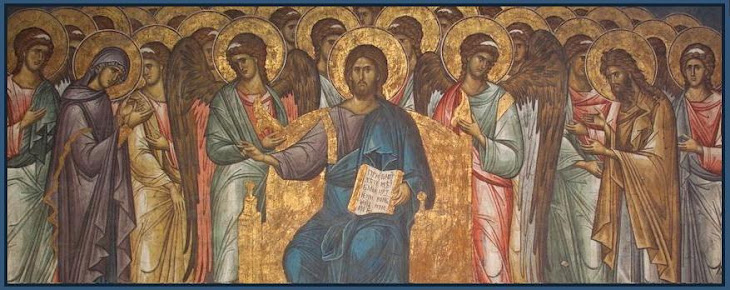
The Most-holy Theotokos and Christ watching over Hagia Sophia and Constantinople (source)

Through the prayers of our Holy Fathers, Lord Jesus Christ our God, have mercy on us and save us! Amen!
Wednesday, September 30, 2009

The Feast of the Holy Protection of the Theotokos

The Feast of the Holy Protection ("Agia Skepi") of the Theotokos - Commemorated on October 1st (Icon courtesy of www.eikonografos.com used with permission)
   
"From time immemorial, the Church has celebrated the Most-holy Theotokos as the patroness and protectress of the Christian people, who, by her intercessory prayers, implores God's mercy for us sinners. The help of the Most-holy Mother of God has been clearly shown numerous times, to individuals and to nations, in peace and in war, in monastic deserts and in densely populated cities. The event that the Church commemorates and celebrates today confirms the Theotokos' consistent protection of Christian people. On October 1, 911, during the reign of Emperor Leo the Wise, there was an All-night Vigil in the Blachernae Church of the Mother of God in Constantinople. The church was full of people. St. Andrew the Fool-for-Christ was standing in the rear of the church with his disciple Epiphanius.

Icon of St. Andrew the Fool-for-Christ (taken from: http://christopherklitou.com/icon_28_may_andrew_fool_for_christ.htm)

At four o'clock in the morning, the Most-holy Theotokos appeared above the people, holding her omophorion outstretched as a protective covering for the faithful. She was clothed in gold-encrusted purple, and shone with an ineffable radiance, surrounded by apostles, saints, martyrs and virgins. St. Andrew said to Blessed Epiphanius: ``Do you see, brother, the Queen and Lady of all praying for the whole world?'' Epiphanius replied: ``I see, Father, and am struck with amazement!'' The Feast of the Protection was instituted to commemorate this event, and to remind us that we can prayerfully receive the unceasing protection of the Most-holy Theotokos in any time of difficulty." (taken from: http://www.westsrbdio.org/prolog/prolog.htm)


Some additional information about this feast and the Russian Church:

"In the PROLOGUE, a Russian book of the twelfth century, a description of the establishment of the special Feast marking this event states, "For when we heard, we realized how wondrous and merciful was the vision... and it transpired that Your holy Protection should not remain without festal celebration, O Ever-Blessed One!"

Therefore, in the festal celebration of the Protection of the Mother of God, the Russian Church sings, "With the choirs of the Angels, O Sovereign Lady, with the venerable and glorious prophets, with the First-Ranked Apostles and with the Hieromartyrs and Hierarchs, pray for us sinners, glorifying the Feast of your Protection in the Russian Land." Moreover, it would seem that St Andrew, contemplating the miraculous vision was a Slav, was taken captive, and became the slave of the local inhabitant of Constantinople named Theognostus.

  
Churches in honor of the Protection of the Mother of God began to appear in Russia in the twelfth century. Widely known for its architectural merit is the temple of the Protection at Nerl, which was built in the year 1165 by holy Prince Andrew Bogoliubsky. The efforts of this holy prince also established in the Russian Church the Feast of the Protection of the Mother of God, about the year 1164.
At Novgorod in the twelfth century there was a monastery of the Protection of the Most Holy Theotokos (the so-called Zverin monastery) In Moscow also under Tsar Ivan the Terrible the cathedral of the Protection of the Mother of God was built at the church of the Holy Trinity (known as the church of St Basil the Blessed).

On the Feast of the Protection of the Most Holy Theotokos we implore the defense and assistance of the Queen of Heaven, "Remember us in your prayers, O Lady Virgin Mother of God, that we not perish by the increase of our sins. Protect us from every evil and from grievous woes, for in you do we hope, and venerating the Feast of your Protection, we magnify you." (taken from: http://ocafs.oca.org/FeastSaintsViewer.asp?SID=4&ID=1&FSID=102824)

Icon of the Holy Protection of the Theotokos (Icon courtesy of www.eikonografos.com used with permission)

Note: the Church of Greece has moved the celebration of Agia Skepi to the 28th of October ("Oxi Day": http://en.wikipedia.org/wiki/Ohi_Day) in commemoration of the great help and protection of the Theotokos to the Greek nation throughout its history, and especially during World War II:

"The role of faith in Virgin Mary in Epirus is also outstanding during the Second World War. Her role was catalytic not only because she constituted the basis of people’s faith, but also because, with her miraculous interventions, she proved to have been the greatest ally of the Greek army on the snowy and rough mountains of Epirus.

Of course, miracles and apparitions were reported in many regions of Greece during the war, but at the front, at the Greek – Albanian borders and on Pindus, Virgin Mary was the protector and the leader of those who fought for their country under difficult circumstances. Their faith was so strong that they could see her encouraging them and “covering” them protectively, while they were fighting on the snowy mountains of Pindus and Albania.

The account given by Vassililki Bouri, niece of Spyridon Houliaras, who fought at the borders, is characteristic. According to it, Spyridon Houliaras used to narrate incidents of the war to his relatives before he died. The one that affected him the most, however, was a miracle of Virgin Mary. While the soldiers were fighting under really adverse conditions, Virgin Mary appeared in front of them and as a protector “covered” them with her mantle and led them towards their enemy, ready to confront them.

This miracle is also corroborated by the accounts of other soldiers of that time who fought on the mountains of Pindus. At the front, Greek soldiers saw the same vision everywhere: at nights, they could see a tall, slim woman figure walking with her kerchief resting on her shoulders. For the soldiers she was no other than Virgin Mary, the defender general of Greeks.

Tasos Rigopoulos, a soldier in 1940, reports from the front: I’m writing from an eagle’s nest 400 metres higher than the top of Parnitha. Everything around me is snowwhite. The reason I’m writing […] is to share with you what I’ve experienced, what I saw with my own eyes; something that I’m afraid you won’t believe if you hear it from others. A few moments before dashing against the blockhouses of Morova we saw a tall woman dressed in black standing still some 13 metres away. The guard yelled: “Identify yourself”. There was no answer. He yelled angrily once more. At that moment, as if struck by electricity, we all whispered: “Panaghia!”. She hurled herself at the enemy as if she had eagle wings. We followed her. We could constantly sense the bravery she was transmitting to us. We fought hard for a whole week until we finally took the Ivan-Morova blockhouses. […] She was always dashing forth. And when, victorious at last, we were advancing to defenseless Koritsa, our Defender turned into steam, smooth smoke, and vanished into thin air”. [11] On the mountain ridge of Ronteni, the soldiers of the 51st independent battalion, under the commands of major Petrakis also witnessed a miracle. From the 22nd of January and on, every evening at half past nine the enemy’s heavy artillery commenced fire against the battalion and the road that was used by transport vehicles. There was a lot of nervousness and heavy casualties. The daring scouts were unable to locate the enemy’s artillery. Apparently, the enemy was changing its position every evening. The situation was really desperate. It was an evening in February when the enemy artillery was heard firing once again. “Panaghia, help us, save us”, shouted the major spontaneously. Suddenly, a bright cloud came into sight from a distance, something like a halo was formed and the image of Virgin Mary appeared. She started bending towards the ground and stopped right over a ravine. Everybody in the battalion shivered as they witnessed the miracle. “Miracle!”, they shouted and they prayed. Immediately, they sent a message to the Greek artillery, the Greek canons fired, and right after that there was a silence. The Greek bombs had achieved a perfect strike. [11]

“No matter how faith is expressed during war, it is certain that it offers assistance to the soldier who is tested. And the image of the protector makes him hopeful and optimistic. …People from Arta, fighting at the front, were afraid neither of mortars nor of enemy bullets, as long as they had the image of Panaghia in front of them…”. [12] Yiannis Tsarouchis, after having painted “The Virgin of Victory” on the cap of a box of herring, having in mind a badly painted picture of the Virgin that was going around the camp, he was on his way to the commander of the battalion in order to present his work. The painting had already acquired a fame of being miraculous and on his way to the commander some soldiers from Arta “being in a state of religious excitement, demanded that the miraculous icon spend at least one night at their camp. All the soldiers were shouting: “The Virgin, the Virgin. Leave it here for one night”. Suddenly, the alarm sounded. […] we lied down, according to the orders we had. None of the soldiers from Arta did the same. “Hey! Comrade! How can you be scared when you hold the Virgin in your hands?”, one said”. [12]

It was also characteristic that on the military identification cards, right next to the personal details there was a picture of Virgin Mary. And just moments before they attacked, they would pray, shout “Panaghia mou!” (my Virgin) three times, and dash forth9.

The importance of Virgin Mary’s miraculous interventions was acknowledged right after the end of the Second World War. For this reason, the celebration of Agias Skepis, which in 626 A.D., when Her miraculous intervention saved Constantinople from the Avaroi (Turkish-Mongolian Nomads), was officially established to be celebrated on October 1st, was transferred in 1952 on the 28th of October to remind them of her miraculous intervention during the most difficult period for Greek people." (taken from: http://www.womanway.eu/studies/files/panaghia_teiep_en.pdf)

Another icon of the Holy Protection of the Theotokos (taken from: http://www.rel.gr/photo/displayimage.php?album=34&pos=58%29)

Apolytikion in the First Tone
O Virgin, we extol the great grace of thy Protection, which thou didst spread out like a bright cloud beyond all understanding; for thou dost invisibly protect thy people from the foe's every assault. Since we have thee as our shelter and certain help, we cry to thee with our whole soul: Glory to thy great deeds, O most pure Maid. Glory to thy shelter most divine. Glory to thy care and providence for us, O spotless one.

Kontakion in the Plagal of the Fourth Tone
Let us the faithful hasten to the Theotokos now and venerate her sacred veil, as we chant unto her, singing hymns to praise and honour her, as is fitting; for she shelt'reth with her shelter and all her faithful flock and preserveth them unharmed from all calamities, as they cry to her: Rejoice, Protection most radiant.
   
Most-Holy Theotokos, save us!