Showing posts with label Orthodoxy. Show all posts

Thursday, January 30, 2020

St. Justin Popovich: "Every Holy Church is a piece of Heaven..."

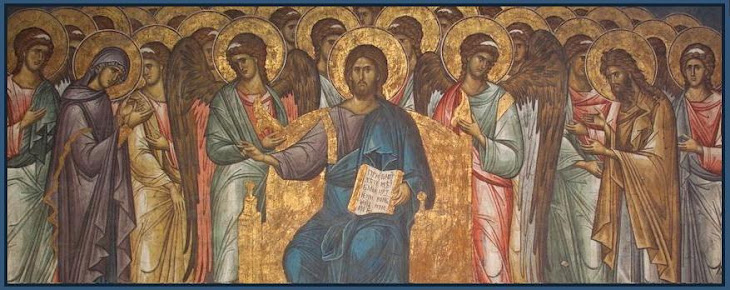
Interior of an Orthodox Church (source)
  
"Every Holy Church is a piece of Heaven upon the earth. And when you are in Church, you are truly in Heaven. Thus, when the earth crushes you with its hell, run to Church, enter within, and behold, you are within Paradise! If people bother you with their evil, take refuge in Church, and kneel before God, and He will take you under His sweet and all-powerful protection."
-St. Justin Popovich
  
(source)
  
Through the prayers of our Holy Fathers, Lord Jesus Christ our God, have mercy on us and save us! Amen!

Tuesday, September 24, 2019

Fr. Seraphim Rose: "The devil will use every opportunity to pit the true Orthodox Christians against each other..."

St. Anthony the Great being tempted by the demons (source)
  
In the coming years, the devil will use every opportunity to pit the true Orthodox Christians against each other, sometimes with issues great and other times (more commonly) small. We must try with steadfastness to not get caught by the bait.

-Fr. Seraphim Rose (+1982)
  
  
Through the prayers of our Holy Fathers, Lord Jesus Christ our God, have mercy on us and save us! Amen!

Monday, April 29, 2019

Christ's Holy Light that Recreates, Gives Light and Sanctifies

Christ is risen! Truly He is risen!
The Holy Light from the Sepulcher of Christ, Jerusalem (source)
  
The greatest miracle* in the world is the Holy Light in Jerusalem, which springs forth every year from the All-holy Tomb [of Christ] on Great Saturday (between noon and 2pm).

It descends from heaven and everyone sees it, Orthodox and non-Orthodox. It is the Uncreated Light, which for a few minutes (4-10) does not burn! No one on earth can make fire that does not burn.

The Holy Light does not burn, it does not corrupt because it is in essence a spiritual Light, which recreates, gives light and sanctifies! Many take the Holy Light with candles and lamps, and whatever sick part of their body is crossed is healed!

After a few minutes, the Holy Light transforms from something Uncreated to something created and it begins to burn. And if this did not occur, the candles and lamps would never burn out and evil people would play "games" with the Holy Light and we would have blasphemies and perversions.

At some point, however, the Holy Light will cease to come. It will be the time of the antichrist. The Holy Light is the resounding confirmation that Orthodoxy is the only Truth, the only true religion...
-Elder Ephraim of St. Andrew Skete.
  
(source)
  
*Elder Ephraim of course is not minimizing the astounding miracles that occur on a daily basis, such as the transformation into the Body and Blood of Christ in every Divine Liturgy. He is referring to extraordinary, overt and external miracles.
  
Christ is risen from the dead, by death, trampling down upon death, and to those in the tombs, He has granted life!
Truly, the Lord is risen!

Monday, September 18, 2017

A Doxology by St. Nektarios

The Vision of the Three Angels, symbolizing the Holy, Consubstantial, Life-giving and Undivided Trinity (source)
 
A Doxology by St. Nektarios
"God, to me, is glory and wealth and boast. He is the sweetest and most pleasant thing. He is my care and my nourishment. Me soul is a creation of the breath of God. My body is the fashioning of God. By divine grace, I am one of God's generation. From God I received my being, and also the ability to move and breathe and to speak.

To God I daily entrust my spirit. To God I pray. I live with God, I serve and find myself with God.

I am so happy with the great, mighty and living God, Who is the provider of assistance and the worker of good things. He follows whatever I think, say and do. I receive God as the awesome judge of whatever I have done. I have God Who is calm and forgiving, forbearing and greatly merciful, savior and redeemer.

I know God Who is the beginning of all things, Who gives good things, Who is the fore-knower, overseer, all-wise, all-knowing, Who knows both the future and the present and the past. I hymn, I glorify, I bless and I supremely exalt the good, holy, righteous and true God.

I venerate and worship God Who loves mankind. I believe in God, I hope in God, I love God, Who is the spring of love. My soul and my mind exalt God and find rest. My heart desires God greatly.

I confess one Three-sun and Tri-hypostatic God. I proclaim one God: beginningless, everlasting, simple, surpassing-essence and undivided. This Unity and Trinity. These I confess, believe and proclaim.

The end, and to the Three-sun Godhead, be kingdom, praise and glory unto the ages of ages. Amen."
-St. Nektarios of Pentapolis, the Wonderworker
   
(amateur translation of text from source)
 
Through the prayers of our Holy Fathers, Lord Jesus Christ our God, have mercy on us and save us! Amen!

Wednesday, January 23, 2013

St. Makarios the Great on Christians and the World


St. Makarios the Great (source)
 
St. Makarios the Great on Christians and the World (from HOMILY 4)
 1. THE world of Christians, and their way of life, and their mind, and discourse, and practice, is one thing; and that of the men of this world, another. And the difference between them is very wide. For the children of this world are tossed to and fro by unsettled seasonings, by earthly desires, and a variety of gross imaginations, whereby SATAN is continually sifting the whole sinful race of men.
2. For the word that was spoken to Cain by his Maker, “You shall go mourning and trembling, and be tossed about upon' the earth," is a type and image of all sinners, as to their inward state. For thus is the race of Adam tossed about with the incessant suggestions of fear and dread, and every kind of disturbance, the prince of this world tossing to and fro the soul that is not born of God; and variously disturbing the thoughts of mankind, as corn that is continually shifted about in a sieve; and shaking and ensnaring them all in worldly deceits, and the lusts of the flesh, with fears and troubles.
3. As from one Adam the whole race of mankind was spread over the earth,-so one taint in the affections was derived down into the sinful stock of men; and the prince of malice is sufficiently able to shift them all in restless, and gross, and vain, and troublesome reflections. For as one and the same wind is enough to stir, and shake all plants and seeds whatever,-so the prince of wickedness, as an hidden and blustering wind, tosseth to and fro all the race of men upon earth, and, carries them about with unsettled thoughts, and enticing them with the lusts of the world, fills every soul with ignorance, blindness, and oblivion, if it is not born from above.
4. For in this do true Christians differ from the whole race of mankind besides. They have their heart and mind constantly taken up with the thoughts of heaven; and, through the presence and participation of the Holy Spirit, do behold, as in a glass, the good things which are eternal, being born of GOD from above, and thought worthy to become the children of GOD in truth and power; and being arrived, through many conflicts and labors, to a settled and fixed state, to an exemption from trouble, to perfect rest, are never sifted more by unsettled and vain thoughts.Herein are they greater and better than the world; their mind and the desire of their soul are in the peace of CHRIST, and the love of the Spirit; a they have passed from death to life." Wherefore the alteration peculiar to Christians does not consist in any outward fashions, but in the renovation of the mind, and the peace of the thoughts, and the love of the Lord, even the heavenly love. Herein Christians differ from all men besides. The Lord has given them truly to believe on him, and to be worthy of those spiritual good things. For the glory, and the beauty, and the heavenly riches of Christians are inexpressible, and purchased only with labor, and pains, and trials, and many conflicts. But the whole is owing to the grace of God.

 5. Now if the sight of. even an earthly king is desired by all men, (except those persons that are spiritual, who look upon all his glory as nothing, through their having experimentally known another heavenly glory;) if, I say, the men of this world are so desirous to behold an earthly king, with his splendor and glory-how much more are those upon whom that dew of the Spirit of life has dropped, and wounded their hearts with love for CHRIST; bound fast to that beauty, and the unspeakable glory, and the inconceivable riches of the true and eternal King; with desire and long- suffering after whom they are captivated, turning wholly to him, to obtain those unspeakable good things, which through the Spirit they actually behold already; and for whose sake they esteem all the glories, and honors, and riches of earthly kings as nothing? 
6. For they arc wounded with the Divine beauty; their desire is towards the heavenly King; and placing him only before their eyes in the abundance of their affection, they, for his sake, disengage themselves from all love of the world, and draw back from every earthly clog, that so they may be able ever to retain in their hearts that only desire. And they that are Christians in truth and power, rejoice at their departure out of the flesh, because they have " that house which is not made with hands." And therefore, if the house of the body be destroyed, they are in no fear; for they have the heavenly "house of the Spirit," and that "glory which is incorruptible." 
7. Let us therefore strive by faith to be possessed of that clothing, that when we resume the body, there be nothing wanting which may glorify our flesh in that day. For every one, so far as he has been thought worthy by faith to be made partaker of the Holy Spirit, in the same proportion shall his body also be glorified in that day. For that which the soul has treasured up within, in this present life, shall then be made manifest outwardly in the body.
8. For as the trees that have got over the winter do, by an invisible power, put forth from within, and shoot out leaves., and flowers, and fruits, as their clothing.and in like manner, as the flowers of the grass come out of the bosom of the earth, and the earth is covered and clothed-so, in the, day of the resurrection, and through the power of the a Sun of Righteousness," there shooteth out from within the glory of the Holy Spirit, covering the bodies of the saints, which glory they had before, within hidden in their souls. For whatever (the soul) has at present, the same comes forth at that time outwardly in the body.
9. Therefore ought every -one of us to strive, and be diligent in all virtue, and to believe and to seek it of the Lord; that the inward man may be made partaker of that glory in this present life, and have that holiness of the Spirit, that we may have at the resurrection wherewith to cover our naked bodies, and refresh us to all eternity in the kingdom of heaven. For CHRIST will come down from heaven, and raise to life all the kindred of Adam that have slept from the beginning of the world and he shall separate them all into two divisions; and them that have his own mark, that is, the seal of the Spirit, he shall place on his right hand. And then shall the bodies of these -be surrounded with a Divine glory from their good works, and themselves shall be full of the glory of the Spirit, which they had in their souls in this present life. So that, being thus glorified in the Divine light, and snatched away to " meet the Lord in the air, we," as it is- written, "shall ever be with the Lord," reigning with him world without end. Amen.
   
Through the prayers of our Holy Fathers, Lord Jesus Christ our God, have mercy on us and save us! Amen!

Friday, July 13, 2012

What Orthodox Iconography Is, by Photios Kontoglou

The Holy Transfiguration of Christ, through the hand of Photios Kontoglou (+July 13, 1965) (http://www.hellenicnews.com/media/k2/items/cache/47b9371a5ec847a6416d19e09506ac86_XL.jpg)
  
What Orthodox Iconography Is, by Photios Kontoglou
The religion of Christ is the revelation, by Him, of the truth. And this truth is the knowledge of the true God and of the spiritual world. But the spiritual world is not what men used to—and still do—call "spiritual."
Christ calls His religion "new wine" and "bread that cometh down from Heaven." The Apostle Paul says, "Therefore, if any man be in Christ, he is a new creation. The old things have passed away: behold, all things have become new."

In a religion like this, one that makes the believer into a "new man," everything is "new." So, too, the art that gradually took form out of the spirit of this religion, and which it invented to express its Mystery, is a "new" art, one not like any other, just as the religion of Christ is not like any other, in spite of what some may say who have eyes only for certain meaningless externals.

The architecture of this religion, its music, its painting, its sacred poetry, insofar as they make use of material media, nourish the souls of the faithful with spirit. The works produced in these media are like steps that lead them from earth up to heaven, from this earthly and temporary state to that which is heavenly and eternal: This takes place so far as is possible with human nature.

For this reason, the arts of the Church are anagogical, that is, they elevate natural phenomena and submit them to "the beautiful transformation." They are also called "liturgical" arts, because through them man tastes the essence of the liturgy by which God is worshipped and through which man becomes like unto the Heavenly Hosts and perceives immortal life.

Ecclesiastical liturgical painting, the painting of worship, took its form above all from Byzantium, where it remained the mystical Ark of Christ’s religion and was called hagiographia or sacred painting. As with the other arts of the Church, the purpose of hagiographia is not to give pleasure to our carnal sense of sight, but to transform it into a spiritual sense, so that in the visible things of this world we may see what surpasses this world.

Hence this art is not theatrically illusionistic. Illusionistic art came into being in Italy during the so-called Renaissance, because this art was the expression of a Christianity which, deformed by philosophy, had become a materialistic, worldly form of knowledge, and of the Western Church, which had become a worldly system. And just as theology followed along behind the philosophy of the ancients—so, too, the painting which expressed this theology followed along behind the art of the ancient idolators. The period is well named Renaissance, since, to tell the truth, it was no more than a rebirth of the ancient carnal mode of thought that had been the pagan world’s.

But just as those theologians were wading around in the slimy swamp waters of philosophy, and were in no position to taste and understand the clear fresh water of the Gospel, "drawn up to life eternal," so, too, the painters who brought about the Renaissance were in no position to understand the mystical profundity of Eastern liturgical iconography, the sacred art of Byzantium. And just as the theologians thought that they could perfect Christ’s religion with philosophy, since for them it seemed too simple, they being in no position to penetrate into the depths of that divine simplicity: just so, the painters thought that they were perfecting liturgical art, more simply called Byzantine, by making it "more natural."

So they set to work, copying what was natural—faces, clothes, buildings, landscapes, all as they appear naturally—making an iconography with the same rationalism that the theologians wanted to make theology with. But the kind of theology you can get out of rationalism is exactly the kind of religious iconography you can get out of copying nature.

This is why their works have no Mystery, nor any real spiritual character. You understand that you have before you some men masquerading as saints—not real saints. Look at the various pictures of the Mother of God. "Madonnas" who pose hypocritically, and those in tears, weeping, which are even falser yet! Corpses and idols for shallow men! Our people, who for centuries have received a great and profound nurture from Christ’s religion, even though outwardly they seem uneducated, call a woman who pretends to be respectable but who is really not, a Frankopanayhia, a "Frankish Virgin," thus making a clear distinction between the "Frankish Virgin" and the true Virgin, the Mother of Christ our God, the austere Odogitria, Her "more precious than the Cherubim, and beyond compare more glorious than the Seraphim". In other words, in the simplest way possible they make a neat, sharp distinction between the art of the world and the art belonging to worship.

Western religious painters who wanted to depict the supernatural visions of religion took as models certain natural phenomena—clouds, sunsets, the moon, the sun with its beams. With these they tried to portray the heavenly glory and the world of immortality, calling certain things "spiritual" which are merely sentimental, emotional, not spiritual at all.

In vain, however. Because the blessedness of the other life is not a continuation of the emotional happiness of this world, neither does it have any relation to the satisfaction the senses enjoy in this life. The Apostle Paul, talking about the good things of the blessedness to come, says that they are such that "eye hath not seen, and ear hath not heard, neither have entered into the heart of man."
How, then, can that world, which lies beyond everything a man can grasp with his senses—how can that world be portrayed by an art that is "natural" and that appeals to the senses? How can you paint "what surpasses nature and surpasses sense"?

Certainly, man will take elements from the perceptible world, "for the senses’ sake," but to be able to express "what surpasses sense" he must dematerialize these elements, he must lift them to a higher plane, he must transmute them from what is carnal into what is spiritual, just as faith transmutes man’s feelings, making them, from carnal, into spiritual. "I saw," says St. John of the Ladder, "some men given over with passion to carnal love, and when they received the Light and took the way of Christ, this fierce carnal passion was changed inside them, with divine grace. into a great love for the Lord."

Thus, even the material elements which Byzantine iconography took from the world of sense were supernaturally transmuted into spiritualities, and since they had passed through the pure soul of a man who lived according to Christ, like gold through a refiner’s fire, they express, as far as is possible for a man who wears a material body, that which the Apostle Paul spoke of, "which eye hath not seen, neither hath entered into the heart of man."

The beauty of liturgical art is not a carnal beauty, but a spiritual beauty. That is why whoever judges this art by worldly standards says that the figures in Byzantine sacred painting are ugly and repellent, while for one of the faithful they possess the beauty of the spirit, which is called "the beautiful transformation."

The Apostle Paul says. "We (who preach the Gospel and live according to Christ ) are ... a sweet savour of Christ unto them that are saved and unto them that perish. Unto them that have within them the small of death (of flesh), we smell of death; and unto them that have within them the smell of life, we smell of life."

And the blessed and hallowed St. John of the Ladder says, "There was an ascetic who, whenever he happened to see a beautiful person, whether man or woman, would glorify the Creator of that person with all his heart, and from a mere glance his love for God would spring afresh and he would pour out on his account a fountain of tears. And one marveled, seeing this happen, that for this man what would cause the soul of another to stink had become a reason for crowns and an ascent above nature. Whoever perceives beauty in this fashion is already incorruptible, even before the dead shall rise in the common Resurrection,"
"Be ye not conformed to this world, but be ye transformed by the renewing of your mind . . ." (Rom. xii. 2)
From Word Magazine
Publication of the Antiochian Orthodox Christian Archdiocese of North America
September 1964
pp. 5-6
  
Through the prayers of our Holy Fathers, Lord Jesus Christ our God, have mercy on us and save us! Amen!

Sunday, June 3, 2012

Excerpt from Homily I on Pentecost by St. John Chrysostom

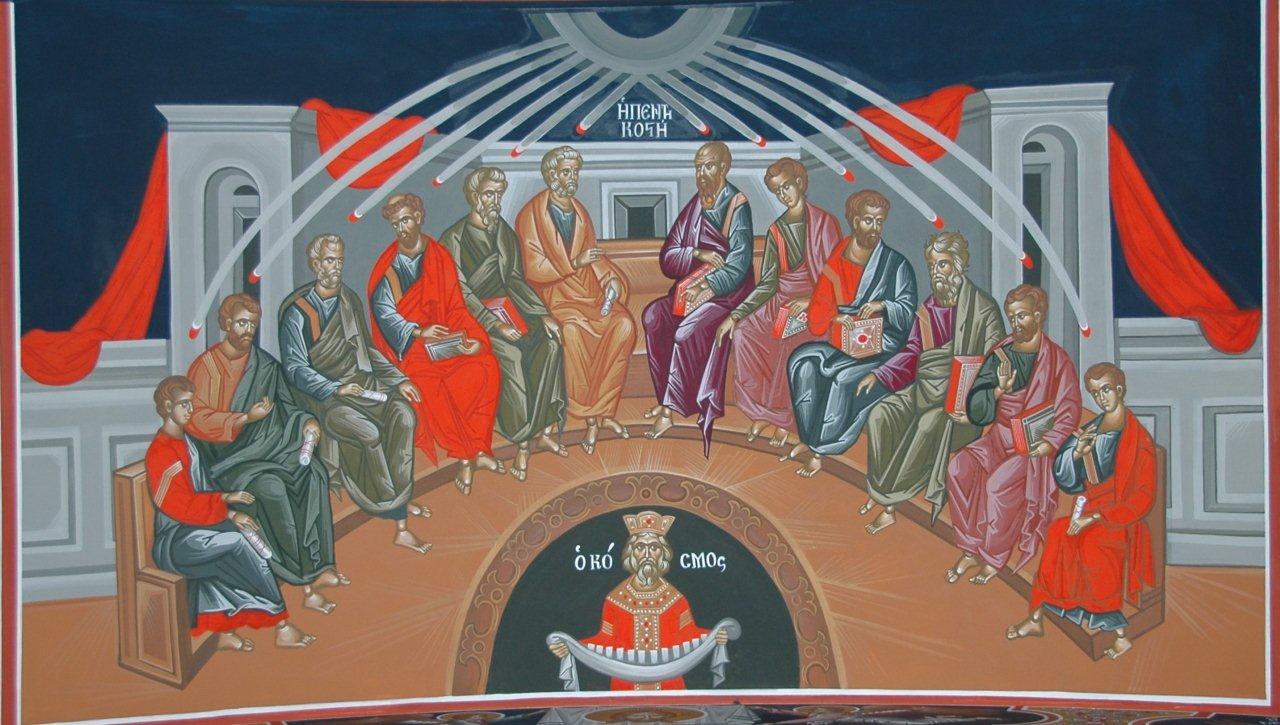
The Descent of the Holy Spirit at Pentecost (http://images.icon-art.info/main/01300-01399/01318_hires.jpg)
  
Excerpt from Homily I on Pentecost by St. John Chrysostom (amateur translation)
Earth has become heaven for us today, not that the stars have descended to earth, but the apostles have ascended above the heavens, as the grace of the Spirit is poured forth. He made the world heaven, not by changing nature, but through correcting the choice. He found a publican, and prepared him to be an evangelist. He found a blasphemer, and made him an apostle. He found a thief, and brought him to Paradise. He found a harlot, and made her more chaste than a virgin. He found magi, and made them into evangelists. He cast out evil, and brought in virtue, which was provided for by the grace of God. Earth has become heaven. How is it, therefore, that I behold the apostles like stars? Stars in heaven, apostles above heaven. Think on things above, therefore, where Christ is seated on the right hand of God. Stars from sensible fire, apostles from spiritual fire. Stars appear at night, but hide during the day; the apostles, however, night and day shine with their rays. Stars do not appear when the sun is shining; the apostles, however, at the shining of the Sun of righteousness, shine with their own lamps as a result. The stars will fall like leaves at the resurrection [at the Second Coming of Christ]; the apostles will be seized by the clouds in the resurrection. Among the stars there are some dimmer, others brighter; with the apostles, however, none is dimmer, but all are bright.
  
By seeing that these apostles are brighter than the stars, and lights of the world, as we said, we see that this is not just when they lived, but ever after they have died. For the grace of the saints is not cut short by death, nor is it lessened by one's end, nor is it dissolved in the earth, but bears witness to the reality. They were fishermen, and died fishermen. They worked with their nets, and the multitude that were saved by them bear witness. They were workers in the vineyard, and they left it, and the vine brought forth its leaves, and made fruit. For they were vine-workers, and fishermen, and pillars, and physicians, and soldiers, and teachers. They are pillars, for they held up the floor of the faith. They are harbors, for they drove back the waves of impiety. They are guides, for they lead the world from earth to heaven. They are shepherds, for they drove back the wolves, and saved the cattle. They were vine-workers, for they uprooted the thorns, and sowed the seeds of piety. They are physicians, for they cured our wounds. And that you might learn that these words are not folly, I offer all that Paul has done. Do you wish to see him as a planter? “I planted, Apollos watered”. (1 Corinthians 3:6) Do you wish to see a builder? “As a wise architect, I laid a foundation.” (1 Corinthians 3:10) Do you wish to see him as a wrestler? “Therefore I fight, not as one beating the air.” (1 Corinthians 9:26) Do you wish to see him as an athlete? “For we are not fighting against blood and flesh.” (Ephesians 6:12) Do you wish to see him as a traveler? “Proceeding from Jerusalem all the way around to Illyricum did I preach the Gospel of God. (Romans 15:19) We were girded with the breastplate of the faith. Do you wish to see him as a struggler? “I fought the good fight.” (2 Timothy 4:7) Do you wish to see him as one who gains a crown? “Therefore is laid for me the crown of righteousness.” (2 Timothy 4:8) In all things, he truly made himself an imitator of his Master. And his Master, in essence, planned all things thus.
  
Why is this so? For our salvation. “Become a vine, and there was made a root. I am the vine, you are the branches. (John 15:5) You wished to walk, and I became for you the road. (John 14:6) You may enter and exit through me, and find pasture. Become a sheep, for I became the shepherd for you. I am the good shepherd, the good shepherd gives his life for the sheep. (John 10:9-11) Become a sinner, and I become for you the Lamb of God who takes away the sin of the world. (John 1:29) Do you wish to eat? I become a table for you. Do you wish to drink? I become a cup for you. He who eats my flesh and drinks my blood, dwells in me, and I in him. (John 6:56) Do you wish to be clothed? I become a garment for you. All those who have been baptized into Christ, have put on Christ. (Galatians 3:27) Do you desire a bride born to you? I become your Bridegroom. He who has the bride, is the bridegroom. You desired, and I became man for you." For the pure virgin was betrothed to a man, while Christ stood by. The harlot was, and became a virgin. O new and strange things! From outside marriage virginity is dissolved, but spiritually the harlot received, and was made more chaste than a virgin. Study, O heretic, how the harlot is a virgin. I am unable to explain it, but I hold to the faith. All this has been worked by the grace of the Spirit. The grace was poured out, and appeared to them divided as tongues as of fire...
  
Greatly sought after therefore is the Church of Christ, not made safe with walls, but with walls of the faith. Through the Church the heaven is made to stand, and the sea is poured forth, and the air is extended, and the earth is founded, paradise is planted, the law is given, the prophets were sent forth, miracles are worked, the abyss is rent and afflicted, the rocks are separated, and again come together, manna is granted, and they plan to prepare a table. Through the Church the prophets, through the Church the apostles. And what more can I say? Through the Church the only-begotten Son of God became man, as Paul said: “He Who did not spare His own Son.” (Romans 8:32) The Son is not spared, that the Church might be spared. The blood of the Son is poured forth through the Church. It is watered through this blood. Therefore, it is impossible for the plants to wither, but to give forth leaves. It does not depend upon the needs of the seasons, nor is it a servant of the times, in summer bringing forth leaves, and in winter being naked. It does not have need of seasons, but it is planted by the Spirit...
  
Why, therefore, do temptations that approach the Church not hinder her? Is it not that her power might be shown? If none warred against her, some could say: “If she were warred against, she would be defeated.” Because of this she is left to be warred against, that she might not be deserted of battles and be ascribed victory. And the gates of hades, as He said, will not prevail of her, will not overtake her. (Matthew 16:18) They will fight her, but will not conquer her. The Church is battered by storms, but does not drown. She faces storms, but does not sink. She receives arrows, but does not receive wounds. She receives machinations, but does not catch fire. What therefore can I call the Church? One word transformed the fisherman, and made him as unquenchable fire. How many tyrants wished to conquer and make this word disappear, but were unable? For she is founded upon a rock. Think of how many tyrants, kings, rulers, drawn swords, teeth of beasts, dangerous deaths, cauldrons, furnaces [the Church endured]. And though the devil emptied his quiver, the Church was not hurt. Why? Because the Gates of hades will not overtake her. How many rulers fought the Church? Where are those who fought her? They have become silent and forgotten. The Church blossoms. Where is Claudius? Where is Augustus? Where is Nero? Where is Tiberius? Their names are small. And none of these is commemorated. Because they fought the Church, their memory is lost. The Church, however, shines brighter than the sun. Wherever she proceeds, to the Indians, to the Africans, to the Britains, to the world, you find “In the beginning was the Word” (John 1:1), and a virtuous life. Before this, however, cities were filled with impiety, and now the desert is filled with piety. Before this princesses danced, as the daughter of Herodias danced for Herod. Today, handmaidens do not shame themselves through doing this. Before this, mothers would dissolve their marriage at the throw of a dice. Today, virginity is worked ascetically. Before this, the fathers of the Goths shed blood; today they desire to shed their blood for the faith. Before this were the impious idiots. Today, pious kings and people. The king to be receives a crown, and receives a cross, in a timeless age, arrayed with the signs of wisdom, while inside the church one's kingdom is not recognized. Outside are spears, and inside are mysteries. Outside are shields, and inside mystagogies, Theodosios is the son, and the father is Theodosios. Above these, however, we thank God, to Whom belong the glory and the kingdom unto the ages of ages. Amen.
  
For another homily of St. John Chrysostom on Pentecost, see: http://preachersinstitute.com/2010/05/20/sermon-on-the-feast-of-pentecost/.

  
Through the prayers of our Holy Fathers, Lord Jesus Christ our God, have mercy on us and save us! Amen!

Monday, August 29, 2011

A modern miracle of the Theotokos in the Congo

Icon of the Theotokos "Odigitria" ("Directress"), painted by the Fathers of Vatopedi Monastery, Mount Athos (http://www.orthodoxquintessence.net/wp-content/uploads/2011/05/CustomName0007350.TIF-07350.jpg)

A modern miracle of the Theotokos in the Congo (amateur translation)
Nina, a 10-year-old girl, was the third child of a family which lived in Western Kasai (Congo). Her two previous siblings, two boys, died early, making Nina an only child.


Nina was born from a mother with strong religious interests, to such an extent that she had embraced a Protestant heresy and become a “Pastoress” (woman priest).

Nina followed her mother to Protestant gathering. However, the good reputation of the Orthodox Missionary School brought the little girl to the Orthodox school. From then on she underwent a series of internal and external changes.

As time passed, Nina began to become reluctant and unwilling to follow her mother to the Protestant gatherings. She perfectly followed—even though she wasn’t baptized—the Orthodox church gatherings. Not much time passed before the girl sought to be baptized [Orthodox]!

Her parents, and much more so her grandmother, didn’t want to hear of this. This increased Nina’s desire to receive Holy Baptism.

Her father ultimately accepted his daughter’s request, and came to the following decision: “my first two children died, one at age two and the other at age one. My little girl has turned ten. Let her be baptized, as she wants so much, because maybe she might die too!” The rest of the family complied and received his decision with sadness.

Nina thanked her heavenly and earthly father with all her heart. She went through catechism for a short time, and was found ready for baptism. She of course continues to go to her religious studies constantly, and she never missed the Divine Liturgy and Holy Communion on Sundays and Feasts.

Nina’s soul felt a deep and mystical connection with the All-Holy Person of the Most-Holy Theotokos Mary, and she went around her house and placed Her holy icon on the highest cabinet of the dining room, causing several negative reactions by the rest of the family. She withstood, however, and managed to have the holy icon of the Theotokos stay where she placed it.

On Sundays, the “Pastoress” mother of Nina received many Protestants in her house. As soon as the Protestants saw the icon of the Theotokos, they protested, and sought the dethronement of the Theotokos from the place where Nina put it. Nina’s desire again proved superior to the protestants’ wishes. Her parents said that it was their daughter’s demand, and they didn’t want to upset her, though to them the paper icon was not something meaningful. The protestants left upset and troubled and asked to change the meeting house from that of the “pastoress”.

The next Sunday, a Pastor above the others, wanted to see this fact with his own eyes, and led by others, knocked on the door to Nina’s house. The “Pastoress” opened and greeted him. Then the great Pastor told her:
“I won’t go inside, because there above is a WEAPON!”

The Pastoress was troubled and replied:
“What are you saying? There is no weapon in our house!”

The Pastor continued:
“There up high, is a WEAPON!” and pointed to the cabinet with the holy icon, waiting outside the door.

The housewife told him that there is a small paper icon that her daughter got from Sunday school, but he was insistent that there was a WEAPON!

In the end their group left bitter and disparaged, taking care to hide their fear…

This confession of the Pastor and his fear before the holy icon of the Most-Holy Theotokos was a message from God to the soul of the “Pastoress”. A holy unease took root in her heart:
“How is it possible that such a small paper icon could be a 'weapon'? Why were the pastors afraid?” Her questions which received an immediate answer.

She therefore managed to pass by the door of the Orthodox Mission that time, with a different attitude and with open eyes and ears. She had “ears to hear”, to the unspeakable joy of Nina.

In the Mission she asked many questions, received answers, experienced the environment of the holy church, was moved standing before the holy icon of the Theotokos, and sought forgiveness for the false beliefs that she had, which she many times tried to force on her Nina. She however had this complaint: “How many times you saw me come to the school with my daughter, why didn’t you say anything to me? Why are you keeping such a treasure a secret?”

The answer was simple: “You were a pastoress in a heretical group and believed that you were teaching the truth. With difficulty you accepted that your daughter would be baptized. How could we tempt you? What we couldn’t do ourselves, the Holy Spirit did, through the cooperation of the innocent and pure soul of your child! Let us glorify our Lord and Savior, and the His All-Holy Mother and our Mother for the great gift that she gave you.”

After all of this, she went to the Protestants and confessed that she no longer believed their teachings, and threw down before their feet her priest’s robe—a black dress—and ran to be enrolled with the catechumens of the Orthodox Church. One of the priests of the church mentioned in a Byzantine manner: “Strange and marvelous things are accomplished today…”
Hieromonk Antonios of Gregoriou, Kinsasa 8/5/2004, Periodical “All the Nations” 2004. (http://ampelonas-trygetes.blogspot.com/2011/08/blog-post_28.html)

Through the prayers of our Holy Fathers, Lord Jesus Christ our God, have mercy on us and save us! Amen!

Sunday, February 21, 2010

The Triumph of the Church, by St. John Chrysostom

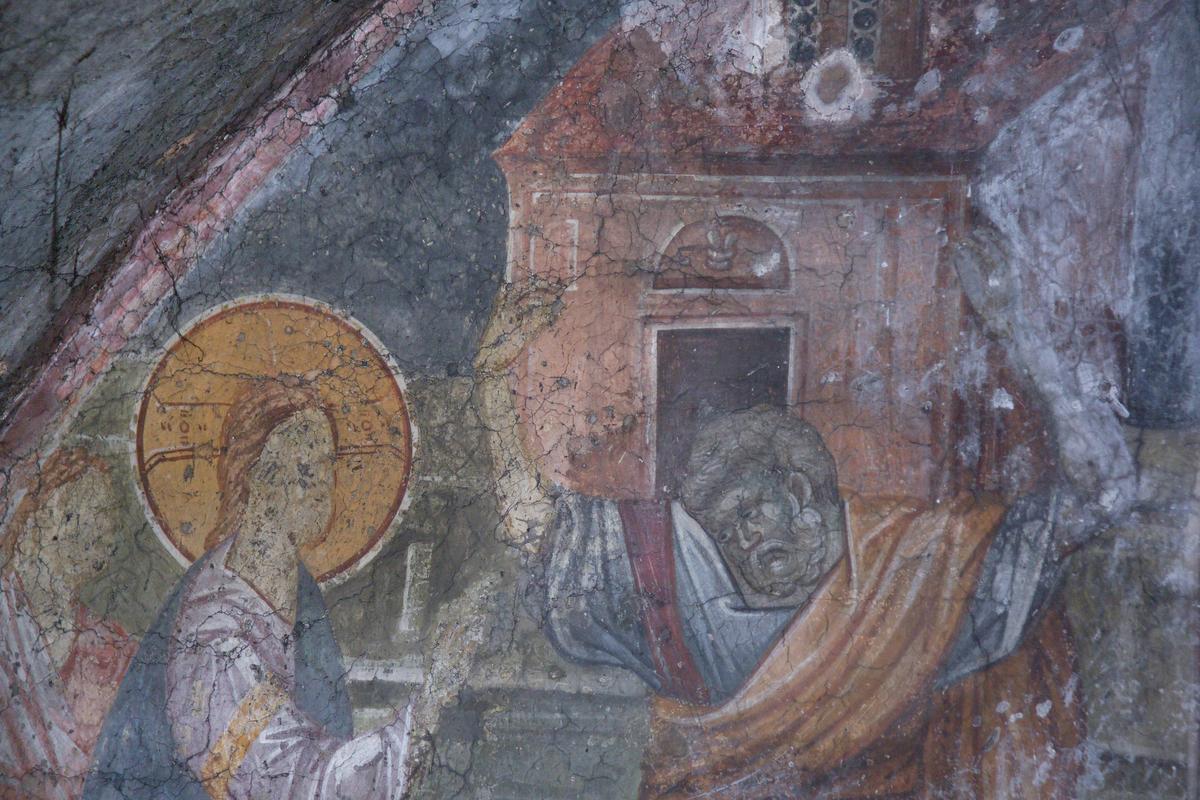
Fresco from Gracanica Monastery depicting Christ's words: “On this stone (i.e. on Peter’s confession of faith) I will build my Church, and the powers of Hades will not prevail against it” (Matthew 16:18). (http://www.srpskoblago.org/Archives/Gracanica/exhibits/digital/n3-w5e5/large/n3-w5e5-2.jpg)

The Triumph of the Church, by St. John Chrysostom
"How does one prove that Christ is God? We should not try to answer this question by using the argument of the creation of heaven and earth, because the unbeliever will not accept it. If we tell him that He raised the dead, healed the blind, expelled demons, he still will not agree. If we tell him that He promised us resurrection from the dead, the kingdom of heaven, and ineffable goods, not only he will not agree, but also he will laugh at us.

How then shall we lead him to the faith, especially when he is not spiritually developed? Surely, we shall do this by resting on truths which are acceptable both to us and to him without any dispute or shadow of doubt.

We shall start from the fact that Christ planted the Church in the world. What is the point then that we absolutely agree upon? It is the fact that Christ planted the Church. It is by this means that we shall reveal the power and prove the divinity of Christ. We shall see that it is impossible to regard the dissemination of Christianity in the whole wide world in such a short period of time as a human work. And indeed, when Christian ethics invites people who have bad habits and are slaves to sin to a higher life. And yet, the Lord managed to liberate from such things not only us, but the entire human species.

Christ’s superbly wondrous achievement is the Church. He achieved this without using arms, without spending money, without mobilizing armies, without causing wars. He achieved it by starting only with twelve disciples, who were insignificant, uneducated, poor, naked, unarmed… It was with such human resource that He succeeded in persuading the nations to think correctly, not only in the present life, but also in the life which is to come. He managed to nullify the ancestral laws, to uproot ancient customs, and to plant new ones. He managed to detach man from an easy way of life and to lead him to a difficult one. He managed all these things, although all fought against Him, and He had to endure a degrading crucifixion and an ignominious death!

This superbly wondrous achievement is not human. Surely, such things do not occur to human beings. What occurs is the exact opposite. In other words, as long as they are alive and prosper their work progresses. When, however, they die, what they created is destroyed along with them. This is endured not only by the rich or the leading ones, but also by the chief governors. This is so, because their laws are abolished, their memory is obliterated, and their names are forgotten, while their intimate associates are pushed aside. These things occur to those who originally governed the nations by a mere nod, and led to war grand armies; to those who condemned to death and recalled the exiled. To the Lord, however, it was the exact opposite that occurred.

It is superbly wondrous because it was achieved by the Crucified Christ. Before the crucifixion the state of his work looked pitiful. Judas betrayed Him. Peter denied Him. The rest of the Disciples fled in order to save their lives, while many believers abandoned Him. He was left alone among enemies. And yet, after the slaughter and the death, so that you may learn that the Crucified Christ was not a mere man, all things became brighter, jollier, and glorious. Peter, the head Apostle, who before the crucifixion did not bear the threat of a maidservant, but after so many heavenly teachings and his participation in the divine mysteries said that he does not know the Lord, the same one after the crucifixion preached Him to the ends of the world. Innumerable martyrs were sacrificed, because they preferred to be put to death than to deny Christ, as the head Apostle had denied Him after being intimidated by a young maiden.

The amazing submission of the world to the Crucified Christ and His Apostles: Now, all the lands, all the cities, the deserted and the inhabited places, confess the Crucified Lord. On Him faith is placed by kings and generals, archons and consuls, slaves and freemen, unlettered and educated, the barbarians and the various nations of humanity. Even that small and insignificant tomb that received the blood stained and tortured body of the Lord is more valued than a thousand royal palaces and more venerable even to kings. What is even a greater paradox is the fact that what happened to the Lord also happened to His disciples. Because, those who were despised and imprisoned, those who were atrociously tortured and underwent innumerable martyrdoms, the very same ones, after their death, were more honored than the kings. Where do we see this? In Rome, the emperors, the consuls and the generals put aside all things and run to venerate the tombs of Peter the fisherman and Paul the tent maker. In Constantinople, those who bear diadems on their heads, wish to be buried next not close to the tombs of the Apostles but at the entrance of their temples. And so the kings become the doormen of the fishermen! Indeed, they are not ashamed for this, but boast about it, not only themselves but also their descendants.

Christ’s prophesy about the Church and its speedy fulfillment. When Christ’s disciples were only twelve and the Church was not in any one’s thought, when the Jewish synagogue was still flourishing and the impious idolatry dominated almost the entire world, the Lord had prophesied: “On this stone (i.e. on Peter’s confession of faith) I will build my Church, and the powers of Hades will not prevail against it” (Matthew 16:18). Do you realize the truth of this prophesy? Do you see its fulfillment? Think how important a fact is the spreading of the Church almost to the entire earth in a very brief span of time. Think how the life of so many nations changed and led to the faith so many peoples, how it abolished ancestral customs, how it liberated from age-long habits, how it scattered like dust the domination of pleasure and the power of sin, how it extinguished like smoke the foul smell of the sacrifices, the idolatrous ceremonies, the abominable feasts, the idols, the pagan altars and temples, how it erected sacred altars everywhere, in our land and in the lands of the Persians, the Scythians, the Africans and the Indians. What I say? Even in the British Isles, which are beyond the Mediterranean, in the ocean, the Church was spread and erected altars.

The superbly wondrous liberation and change that the Church induced in the world: The work of liberation of so many peoples from age-long shameful habits, as well as the change in the manner of life from an easier to a more difficult one, is indeed wondrous, or rather superbly wondrous. It is a proof of divine operation (energy), even if no one had opposed it, even if peace had prevailed and many had assisted. Because this spreading of the Church did not only come into collision with ancient habit, but also with pleasure, the happy manner of life. In other words, it had two powerful opponents, which tyrannized humanity: habit and pleasure. Whatsoever people had received, from centuries ago, from their fathers, their grandfathers and their ancient ancestors, even what they had received from the philosophers and the rhetoricians, all these things they agreed to despise, an attitude extremely difficult. Besides, they had to accept a new manner of life, which was indeed much more difficult; because she removed them from luxury and attached them to fasting. She removed them from avarice and led them to lack of property. She removed them from profanity and led them to chastity. She removed them from aggressiveness and led them to gentleness. She removed them from envy and led them to friendship. She removed them from an easygoing and pleasurable life and led them to a life of difficulties, hardships, and full of sorrows. Indeed she led to this life those who had been accustomed to the life of luxuries. Surely, those who became Christians were not people who lived in some other worlds and did not have sinful habits, but were those who had rotted in them and had become more flexible than clay. It was them that she called to follow the hard and ragged road. And it persuaded them to follow it!

The superbly wondrous work of the Twelve Apostles in the spreading of the Church. How many were persuaded? Not two, not ten, not twenty, not a hundred, but an innumerable crowd. And how many did she use to persuade them? She used two men, uneducated, uncultured, unknown, poor, without property, without bodily strength, without glory, without illustrious ancestry, without rhetorical eloquence. She used twelve men who were fishermen, tent makers, whose mother tongue was foreign; because, they did not speak the same tongue with the idolaters. They spoke Hebrew, which was different from all other languages. It was with them that the Church was built up and spread to the ends of the world. This is not the only wondrous fact, but there is also the fact that these few, these poor, these uneducated and despised men, who set out to change humanity, did not pursue their work without disturbance. They were confronted with innumerable wars from every side. They were opposed by every nation and in every city. But why do I speak of nations and cities? War was raised against them even on every house. Their teaching separated on many occasions the child from the father, the daughter in law from the mother in law, the brother from the brother, the servant from the master, the citizen from the ruler, the man from the woman, and the woman from the man. In every family not all believed simultaneously,, and so the Christians suffered daily harassments, ceaseless enmities, a myriad of deaths. All fought them as common opponents and enemies. They were pursued by kings, governors, citizens, freemen, slaves, crowds, cities. They did not pursue only them, but –how terrible– even the neophyte catechumens, i.e. those who just believed.

The victory of the Apostles and the Church is due to the power of the Crucified but also Risen Lord. It caused horror and wrath to the idolaters the thought of abandoning their pagan altars, of despising their bloody sacrifices, which all their fathers and ancestors practiced, and of believing in the Lord; of believing in Him who took flesh from the Virgin Mary, and stood trial before Pilate, and suffered numberless tribulations and degradations, underwent a dishonorable death, was buried and rose again. It is indeed a paradox, that, while the sufferings of the Lord were indisputable, -inasmuch as many had seen the lashings, the biting, the spitting, the slapping, the cross, the mocking, the entombment– it was not the same with the resurrection. The Lord, after his resurrection, manifested Himself only to the disciples. In spite of this fact, they spoke about the resurrection and persuaded the peoples and built up the Church. How did they do it? They did it with the power of the Lord, who sent them to preach his Gospel to the nations. It was He who opened to them the way. It was He who facilitated their difficult task. Had they not been assisted by the divine power, the spreading of Christianity would not have even begun.

The persecutions against the Church did not inhibit its expansion. The reason was that while the tyrants were forearmed against the Church, while the soldiers interposed their arms, while the mobs raged like a wild fire, while the bad habit was lined up in opposition, while orators, sophists, the rich people, ordinary citizens and leaders were aroused in enmity, the word of God, being stronger than the flame, turned the thistles into ashes, cleansed the fields and sowed the word of the preaching. Some of the believers were thrown into the prisons, others were exiled, others had their property confiscated, others were assassinated, and others were torn to pieces. In spite of the fact that Christians were treated as common criminals, suffering patiently every kind of punishment, humiliation and persecution, more and more people joined the Church. Indeed, the new believers not only were not discouraged by the tortures which they saw the older believers undergoing, but became more eager! They run by themselves, without constraint, showing gratitude to their torturers. They became more fervent in the faith, seeing the torrents of the blood of the believers.

The expansion of the Church in spite of the persecutions proves the incomparable and unconquerable power of Christ. Did you see the incomparable power of Him who achieved all these wonders? How is it possible that people who are undergoing such horrid martyrdoms feel no sorrow? And yet, they rejoiced, and were elated! This is what St. Luke the Evangelist adduces as an example, when he says about the Apostles that “they left from the council rejoicing, because they were proved worthy to be ill-treated for the shake of Christ” (Acts 5:41). While no one can build even a wall with stones and plaster when is persecuted, the Apostles built up the Church throughout the world while sufferings persecutions, imprisonments, exiles and deaths as martyrs. They did not build her up with stones, but with souls –which is much more difficult; since it is not the same to build a wall as to persuade perverted souls to change their manner of life, to abandon their demonic madness and to follow the life of virtue. They achieved this, because they had with them the unconquerable power of the Lord, who had prophesied; “I will build up my Church, and the powers of Hell will not prevail against her” (Matthew 16:18).

Consider how many tyrants fought the Church and how many persecutions they raised against it… Augustus, Tiberius, Gaius, Nero, Vespasian, Titus and their successors right down to Constantine, were all idolaters. All of them –some more moderately, and some more harshly– fought the Church. Even if some of them did not raise persecutions, nevertheless, their attachment to idolatry motivated those who wanted to flatter them to oppose the Church. In spite of all this, the evil schemes and attacks of the idolaters were dissolved as cobwebs, scattered like dust, vanished like smoke. Besides, what were planned against the Church became the occasion of great benefits for the Christians. The reason was that such plans created choruses of martyrs, who constitute the treasure, the pillars, and towers of the Church.

The wondrous fulfillment of what Christ prophesied about the Church reveals most clearly his true Godhead. Do you see the wondrous fulfillment of this prophesy? Indeed, “the powers of Hell cannot prevail against her.” Looking at what came to pass, believe what is to come. No one in the future will be able to prevail against the Church. If they did not manage to crush her when she numbered but a few members, when her teaching seemed novel and strange, when so many terrible wars and so many persecutions were raised against her from everywhere, much more they will not manage to injure her today, when she has spread in the whole world, and increased her dominion among all nations, abolishing their pagan altars and idols, their festivals and celebrations, the smoke and the smell of their abominable sacrifices. How did the Apostles achieve such a great, such an important task, after so many obstacles? Surely, it was by the divine and unconquerable power of Him, who prophesied about the creation and triumph of His Church. No one can deny this, unless he is mindless and completely unable to think."
(Translated and edited by Protopresbyter George Dion. Dragas, PhD, DD, DTh; This article represents selections from St. John Chrysostom’s treatise To Jews and Greeks, a demonstration, that Christ is God… (PG 48, 813-838); http://www.johnsanidopoulos.com/2009/10/triumph-of-church.html)

St. John Chrysostom, Archbishop of Constantinople (Icon courtesy of www.eikonografos.com used with permission)

Through the prayers of our Holy Fathers, Lord Jesus Christ our God, have mercy on us and save us! Amen!

Sermon given on the First Sunday of Lent by St. Luke Archbishop of Simferopol

The Raising of the Holy Icons, and the Sunday of Orthodoxy (Icons courtesy of www.eikonografos.com used with permission)

Sermon given on the First Sunday of Lent (The Sunday of Orthodoxy) by St. Luke Archbishop of Simferopol
"On the first Sunday of Lent, our Holy Church celebrates the Triumph of Orthodoxy, of true faith, which trampled down all heresies and was established. For this reason this Sunday is called the Sunday of Orthodoxy. Heresies showed up even at the very beginning of of Christianity. The Apostles of Christ themselves warned their contemporaries, and with them us too, about the danger of false teachers.

The Holy Apostle Peter writes the following in his Second General Epistle: “But there were also false prophets among the people, even as there will be false teachers among you, who will secretly bring in destructive heresies, even denying the Lord who bought them, and bring on themselves swift destruction. 2 And many will follow their destructive ways, because of whom the way of truth will be blasphemed.”(II Pet. 2: 1-2).

St. Paul, returning to Palestine from Greece, made a stop in Ephesus. To the the Christian inhabitants of the town there he said: “For I know this, that after my departure savage wolves will come in among you, not sparing the flock. Also from among yourselves men will rise up, speaking perverse things, to draw away the disciples after themselves.” (Acts 20: 29 -30).

Many such false teachers and schismatics existed in the first centuries of Christianity. Some heresies troubled the Church for centuries, such as the heresies of Arius, of Macedonius, Eutyches, Dioscorus, of Nestorius and also the heresy of iconoclasm. These heresies caused much disturbance in the Church and afflicted the Church greatly. There were many confessors and martyrs who shed their blood defending the true faith in the fight against false teachers and heretics.

There were also many great prelates, who also suffered under persecution and were often exiled. Saint Flavian, Patriarch of Constantinople, for example, in a council chaired by Dioscorus, called the Robber Synod was “beaten so savagely that he died three days later.”

The last in the line-up of heresies, the heresy of iconoclasm, was the one that tormented our Orthodox Church the most. This heresy first appeared during the reign of Emperor Leo the Isaurian, who came to the throne in 717. He ascended the throne with the help of the army, which had many opponents of those who venerate holy icons, within its ranks. Because he wanted to please the army he started a harsh persecution against iconophiles.

This persecution continued on into the reign of Emperor Constantine Copronymus, who succeeded Leo to the throne. The name Copronymus (“dung-named”) comes from coprus meaning manure, i.e. faeces. He was called Copronymus because he defecated in his baptismal font. These two emperors were in power for many years and brought great affliction upon the Church. Following these, there were other iconoclast emperors, who continued the work of their predecessors and tormented the Church for years.

We can not begin to describe the suffering endured by the Church during the years of iconoclasm, and especially the monks who were in the frontline in the battle for holy icons. The iconoclast emperors closed many monasteries and turned many churches which had icons into shells. The monks, were savagely beaten: they took out their eyes, noses were cut off, icons were broken on their heads. They burnt the fingers of icon-painters hagiographers with burning irons.

The persecution only stopped when Empress Irene came to the throne of the Byzantine Empire, but this was not yet final. In 787 Irene convened the Seventh Ecumenical Council, which set down Orthodox teaching on the veneration of holy icons. But even after this Council iconoclast emperors still existed, for example, Michael and others. The heresy was crushed only under the God-fearing Augusta, Theodora, when a local council was convened in Constantinople in 842, which upheld the Orthodox teaching. The council pronounced an anathema on all those who dare to say that the veneration of holy icons is idolatry and that Orthodox Christians are idolaters.

And here various sects still tell us exactly this thing. They dare to call our icons idols and call us idolaters. And with what nerve? I will tell you of an incident that took place recently in a city in Siberia. During the Liturgy two Baptists walked into the church and started shouting that the Orthodox are pagans idol-worshippers and that the icons are idols. What nonsense!

How dare they open their mouths and say these words dripping with venom, calling us pagans and our icons idols? This shows that they have understood correctly the second commandment of Mosaic Law: “You shall not make for yourself a carved image—any likeness of anything that is in heaven above, or that is in the earth beneath, or that is in the water under the earth;”(Ex. 20.4).

What does this commandment mean? I think the meaning is clear. The commandment prohibits the building of idols for worship, instead of worshipping the One, Unique and True God -as did ancient peoples: the Assyrians, the Babylonians, Egyptians, Greeks, Romans and others- instead of worshipping the One, Unique and True God.That is idolatry. But is our veneration of holy icons anything like idolatry? Certainly not. Idols represented something that does not really exist, something that is a product of imagination. Our own icons depict reality. Really, did the Lord Jesus Christ, who we glorify amd who we venerate in icons, not live among us? Did the Virgin Mary, who was painted by the apostle and evangelist Saint Luke not live among us? This icon was blessed by the very Theotokos herself, saying that grace would always be with this icon. Do you know how many miracles happen from icons of the Virgin Mary?

  
And the other icons don’t they show real saints of God who lived here on Earth? These icons are their portraits and in no way are idols. Only impious and filthy mouth dares to say that our icons are idols and that we are idolaters. Let the ungodly be silent as the Ecumenical Council has pronunced anathema upon them.

You should know this, and remember this and not keep company with heretics.

Do not leave the Church, do not rip the robe of Christ. Remember that Christ in his prayer at Gethsemane, the hierarchical prayer, begged his father, saying: “that they all may be one, as You, Father, are in Me, and I in You; that they also may be one in Us, that the world may believe that You sent Me ” (John 17: 21). The Lord wants unity of the Church. The dissenters, the schismatics, who find errors in the teaching of the Church, are removed from it and believe they will find salvation in their heretical organizations.

But do you know what the great saints said about people who tear the tunic of Christ? Saint Cyprian, bishop of Carthage, said that people who leave the church and do not have communion with it even if they become martyrs, even with their blood, will not be cleansed of their sin because this grievous sin of dividing the Church cannot even be cleaned with shedding of blood. And the holy martyr Ignatius the God-bearer said that he who causes schism in the Church will not inherit the kingdom of God.

All heretics, however, are preachers of schism. While the apostle says: “Now I urge you, brethren, note those who cause divisions and offenses, contrary to the doctrine which you learned, and avoid them.” (Rom. 16: 17). And in another letter says this: “If anyone preaches any other gospel to you than what you have received, let him be accursed” (Gal. 1: 9). And all the heretics do not preach what the Orthodox Church, which gave us spiritual birth, preaches.

Remember also, the word of Lord Jesus Christ, Who told the apostles, and through them us, their successors: “He who hears you hears Me, he who rejects you rejects Me, and he who rejects Me rejects Him who sent Me” (Lk. 10 : 16). These words of the Lord are awesome. Remember them always. Do not forget this day, the day of the Triumph of the Orthodox faith. The faith that was set down by the Seventh Ecumenical Council which established Orthodoxy and trampled down all heresies and schisms.

Over a thousand years have passed since the time of the Seventh Ecumenical Council and such Ecumenical Councils [have not] been convened since.*** Why? The reasons are political. It was impossible to call them. But we should not be sorry that others did not take place and that there are no Ecumenical Councils today. These Seven that we have, sorted out all questions and solved all the problems that the Church had with heresies and established the Orthodox faith.

You will say that there are many new heresies and schisms today. Yes, you are right. But we should know that the new heresies are not saying anything new but repeating what the old heretics have already said. All of these heresies were anathematized by the Seventh Ecumenical Council. So the decisions of seven Ecumenical Councils are enough for us, especially the Seventh Ecumenical Council. This is why we rejoice today and celebrate the Triumph of Orthodoxy, which was expressed and fixed by the Seventh Ecumenical Council.

It was precisely for this reason that it was appointed that a doxology should be chanted on this day, as a thanksgiving to God for securing the Orthodox faith. Let us chant this doxology now."
(http://ypseni.wordpress.com/2010/02/19/on-the-sunday-of-orthodoxy/; Greek text available here: http://vatopaidi.wordpress.com/2010/02/21/%ce%bb%cf%8c%ce%b3%ce%bf%cf%82-%ce%b5%ce%b9%cf%82-%cf%84%ce%b7%ce%bd-%ce%b1-%ce%ba%cf%85%cf%81%ce%b9%ce%b1%ce%ba%ce%ae-%cf%84%cf%89%ce%bd-%ce%bd%ce%b7%cf%83%cf%84%ce%b5%ce%b9%cf%8e%ce%bd-2/)

***It should be noted that two additional councils (under St. Photios the Great and St. Gregory Palamas), while not universally held as "Ecumenical", are reaffirmed as being Orthodox, and I believe are mentioned in the Synodikon of the Triodion (http://www.johnsanidopoulos.com/2010/02/synodicon-of-orthodoxy.html). Also see: http://orthodoxwiki.org/Ecumenical_Councils/. The Greek text above notes that the Saint does not diminish or ignore these, but stresses the importance of the Seventh.

St. Luke Archbishop of Simferopol (http://www.agiosloukas.org/)

Through the prayers of our Holy Fathers, Lord Jesus Christ our God, have mercy on us and save us! Amen!

Monday, December 14, 2009

The Illness of Religion, by Metropolitan Hierotheos (Vlachos) of Nafpaktos

(Picture courtesy of www.eikonografos.com used with permission)

The Illness of Religion, by Metropolitan Hierotheos (Vlachos) of Nafpaktos
"The greatest problem of Western Christianity - and of many Orthodox also – is that they have 'religionized' Christianity and have turned the Church into a religion. In this way, they cultivated fundamentalisms, hatreds, divisions, a magical perception and relationship with God, also a competitive disposition of one towards another, a self-centered view of life, a utilitarian and self-benefiting perception of society, an imaginary interpretation of everything, the sentimental approach to living and generally the opinion that the others comprise – and are - a threat to our existence.

Thus, in these circumstances, the brightly-lit Christmas trees, the sentimental melodies, the moral-building analyses, all criminally conceal existential nakedness and make man a tragic being.

The feast of the Birth of Christ cannot be confined to a few sentimental situations: a festive décor, an intellectual, rationalistic interpretation of events, a moralistic framework; it has a very profound meaning and existential significance. If one remains at an external level, then he is leaving himself hungry and thirsty, deprived of a life of meaning and existential freedom.

The incarnation of Christ was considered and was celebrated by the Fathers of the Church and the worshipping ecclesiastical community as the abolishing of religion and its transformation into a Church. In fact, the memorable father John Romanides had said in the most categorical way that Christ became human, in order to free us of the illness of religion.

The word 'religion' is mention in Homer's epics; it is also used by Herodotus to express the worship and the honor that a person has to offer God. Etymologically, the (Greek) word for 'religion' is derived from the ancient word that implies 'ascend', and therefore, with the term 'religion', the ascent of man towards God is implied. But even the (Greek) word for "human" is etymologically derived from the expression "upwards looking", again implying an ascent.

But, it appears at a first glance, that an ascent presupposes the acceptance of the essence of metaphysics, according to which, a person's soul that has fallen from the immortal and impersonal world of ideas and is encased in a body, has to rid itself of the body [the prison of the soul] and return to the world of ideas. But even the Latin word religio – which is used to denote the word religion – signifies, according to dictionaries, the bond-unity-union of man with God; it also denotes the same fact, i.e., the essence and the content of metaphysics. In fact, it also presupposes – if we seek it in eastern religions – a faceless expression of mankind, since man has to disappear like a drop of water in the ocean of the Supreme Being, and thus eliminating the persona.

As the late Father John Romanides had taught, the term 'religion' implies the relating of the uncreated to the created, and actually the relating of the representations of the uncreated with the notions and the words of human thought, and this kind of relating is of course the foundation of the religion and the worship of idols. Therefore, in this case, the face of God is lost, and so is the person's face; man becomes gravely ill, since his vices and his imagination are cultivated even more; and more than this, we can say that the so-called irreproachable-natural vices (hunger, thirst, etc.) become reproachable vices; causes of social anomalies because of unlimited ambition, unjust craving for acquisition and unleashed debauchery.

It is well-known that Feuerbach at first, then Marx, had said that "religion was the opium of the people". We can accept this viewpoint, that religion – as we see it in the East and in the religionized views of western Christianity – is the opium of the people, since it benumbs the people, it mortifies societies and leads them to such a degree of deactivation, that it becomes exploitable material for the institution of a tyranny that deprives mankind of his unalienable right to freedom.

I would like to submit two characteristic examples of religious expression here below.

The first example comes from the Buddhist religion. We know that according to Buddhism, that which preoccupies mankind is the problem of the pain that originates from the desire to live. Hence, the ultimate goal of the "enlightened" one is the discarding of this passion to live. The mortifying of the desire for life is achieved through a special method called Yoga with its different variations, such as Hatha Yoga (uniting with the Brahma through physical exercises), Karma Yoga (uniting with the Brahma through deeds and ritual acts), Mantra Yoga (uniting with the Brahma through chants and magic syllables), Bhakti Yoga (uniting with the Brahma through the absolute worship of one deity or the Guru himself), Jnana Yoga (uniting with the Brahma through mystical knowledge), Kundalini Yoga (uniting with the Brahma through demonic activities), Tantra Yoga (uniting with the Brahma through unbridled sexual acts). With these methods, man is supposed to attain absolute Nirvana, which is the extinguishing of his existence and the riddance of one' desire for life, the ultimate purpose being the avoidance of Samsara – the recycling of life, or, reincarnation. Thus, the personal Atman is united to the overall Brahma, just like a drop entering the ocean.

It is obvious that in a religious life such as this, there is no personality; man is merely considered a unit, as there is also no such thing as society; no social life is encouraged, since every lifetime is considered a beginning of grief.

The second example originates from the theories of Anselm of Canterbury, a scholastic theologian, who founded a Christian system that prevailed in the West, having in mind the feudal system of organizing society. But the feudal lord had absolute value and honor that could not be violated, because every violation of his honor and every disturbance of the feudal system that was considered a work of God, entailed the punishment of the violator; thus God is the highest form of justice, He has honor, and has instituted order within creation, therefore, the violator must either satisfy God's sense of justice or be punished. Thus, Anselm interpreted the crucifixion sacrifice of Christ, not as an expression of love for mankind, but as the atonement of justice by God the Father. This system, with the assistance of the absolute destination, led to enormous problems in the western world; problems both personal and social, as analyzed by Max Weber in his book The Protestant Ethic and the Spirit of Capitalism.

These two examples, one from the east and the other from the west, indicate how Feuerbach arrived at his motto "religion is the opium of the people". Naturally, we Orthodox also believe that if we give religion this definition, the metaphysical definition, then it can indeed become the opium of the people, because it will destroy every personal life, eliminate personal freedom, and even disintegrate social life, and turn man from a person into a unit.

Christianity however appeared in the history of mankind as the end of religion, and the experience of the Church. The term "Church" is an ancient Greek term and indicates a community, the congregation of the populace – the municipality – that would solve its problems. Naturally, with the term 'Church' we do not imply something external; we are implying the personal communion of mankind with God and its fellow-man, as seen in the Prophets of the Old Testament, in the Apostles of the New Testament, in the Acts of the Apostles, where "all those who believed were of one mind, and had everything common to all; they sold the lands and the belongings and shared them amongst everyone, if they had needs... (Acts,2:44-45). We see it in the communities of monks, in the teaching of the major Fathers of the Church and it extends into our time, as seen in the ecclesiastical communities narrated by Papadiamantis and the Memoirs of Makriyannis. And we know full well, from various studies, that both Papadiamantis and Makriyannis were not religious people; they were ecclesiastical, not inspired by western Puritanism, but by the hesychastic-neptic Orthodox tradition.

The greatest problem of western Christianity, and many Orthodox, is that – according to Christos Yannaras – they have religionized Christianity, and transformed the Church into a religion. In this way, they cultivated fundamentalisms, hatreds, divisions, a magical perception and relationship with God, also a competitive disposition of one towards another, a self-centered view of life, a utilitarian and self-benefiting perception of society, an imaginary interpretation of everything, the sentimental approach to living and generally the opinion that the others comprise – and are - a threat to our existence.

Thus, in these circumstances, the brightly-lit Christmas trees, the sentimental melodies, the moral-building analyses, all criminally conceal existential nakedness and make man a tragic being.

If contemporary, speculating people looked for a meaning behind the Birth of Christ, it would be that with His Birth, Christ abolished the illness of religion and transformed it into a living Church – with whatever its authentic meaning entails. This is the need of contemporary man who is suffering from the tragic trinity as Victor Frankl would have said, that is: suffering, guilt and death, inasmuch as he feels his life is a pre-death experience, an existential and eternal death, and not only seeks the experience of pleasure, but perhaps through pleasure, is seeking the survival of existence."
(taken from: Newspaper "Eleftherotypia" December 23, 2001; http://www.johnsanidopoulos.com/2009/12/illness-of-religion.html)

Doxastikon of the Stichera from the Great Vespers of the Feast of Christ's Nativity
Glory. Both now. Second Tone.
By Kasia.
When Augustus reigned alone on the earth, the many kingdoms of mankind came to an end; and when you became man from the pure Virgin, the many gods of idolatry were destroyed; the cities of the world passed under one single rule; and the nations came to believe in one single Godhead; the peoples were enrolled by decree of Caesar; we the faithful were enrolled in the name of the Godhead, when you became man, O our God. Great is your mercy, Lord; glory to you!

Through the prayers of our Holy Fathers, Lord Jesus Christ our God, have mercy on us and save us! Amen!

Tuesday, August 4, 2009

"Why I Abandoned Papism" by Bishop Paul Ballaster-Convolier

Icon of the holy, glorious and all-praised Princes of the Apostles, Sts. Peter and Paul (Icon courtesy of www.eikonografos.com used with permission)
Why I abandoned Papism.
By Hierodeacon [later Bishop of Nazianzus, based in Mexico] Paul Ballaster-Convolier.

A horrible dilemma.
"My conversion to Orthodoxy began one day while I was reordering the Library catalogues of the monastery I belong to. This monastery belonged to the Franciscan order, founded in my country of Spain. While I was classifying different old articles concerning the Holy Inquisition, I happened to come across an article that was truly impressive, dating back to 1647. This article described a decision of the Holy Inquisition that anathematized as heretic any Christian who dared believe, accept or preach to others that he supported the apostolic validity of the Apostle Paul.

It was about a horrible finding that my mind could not comprehend. I immediately thought to calm my soul that perhaps it was due to a typographical error or due to some forgery, which was not so uncommon in the western Church of that time when the articles were written. However, my disturbance and my surprise became greater after researching and confirming that the decision of the Holy Inquisition that was referred to in the article was authentic. In fact already during two earlier occasions, namely in 1327 and 1331, the Popes John 22nd and Clemens 6th had condemned and anathematized any one who dared deny that the Apostle Paul during his entire apostolic life, was totally subordinate to the ecclesiastic monarchal authority of the first Pope and king of the Church, namely the Apostle Peter. And a lot later Pope Pius 10th, in 1907 and Benedict 15th, in 1920, had repeated the same anathemas and the same condemnations.

I had therefore to dismiss any possibility of it being due to an inadvertent misquoting or forgery. So I was thus confronted with a serious problem of conscience.

Personally it was impossible for me to accept that the Apostle Paul was disposed off under whatever Papal command. The independence of his apostolic work among nations, against that which characterized the apostolic work of Peter among the circumcised, for me was the unshakeable event that shouted from the Holy Bible.

The thing was totally clear to me who he was, as the explaining works of the Fathers on this issue do not leave the slightest doubt. "Paul- writes St Chrysostom- declares his equality with the rest of the apostles and should be compared not only with all the others but with the first one of them, to prove that each one had the same authority". Truly, together all the Fathers agree that "all the rest of the apostles were the same like Peter, namely they were endowed with the same honour and authority". It was impossible for who ever of them, to exercise higher authority from the rest, for the apostolic title that each had was the "highest authority, the peak of authorities". They were all shepherds, while the flock was one. And the flock was shepherded by the apostles in conformity by all".

The matter was therefore crystal clear. Despite this, the Roman teaching was against the situation. This way for the first time in my life, I experienced a frightful dilemma. What could I say? On one side the Bible and the Holy Tradition and on the other side the teaching of the Church? According to the Roman theology it is essential for our salvation to believe that the Church is a pure monarchy, whose monarch is the Pope. This way, the synod of the Vatican, voting together all the earlier convictions, it declared officially that "if any one says ....... that Peter (who is assumed to be the first Pope) was not ordained by Christ as the leader of the Apostles and visible Head of all the Church .......... is under anathema".

I am addressing my confessor.
Within this psychological disturbance I addressed my confessor and naively described the situation. He was one of the most famous priests of the monastery. He heard me with sadness, aware that it involved a very difficult problem. Having thought for a few minutes while looking in vain for an acceptable resolution, he finally told me the following that I confess I did not expect.

The Bible and the Fathers have harmed you, my child. Set it and them aside and confine yourself to following the infallible teachings of the Church and do not let yourself become victim of such thoughts. Never allow creatures of God whoever they may be, to scandalize your faith in God and the Church.

This answer he gave very explicitly, caused my confusion to grow. I always held that especially the Word of God is the only thing that one cannot set aside.

Without allowing me any time to respond, my confessor added: "In exchange, I shall give you a list of prominent authors in whose works your faith will relax and be supported". And asking me if I had something else "more interesting" to ask, he terminated our conversation.

Few days later, my confessor departed from the monastery for a preaching tour of Churches of the monastic order. He left me the list of authors, recommending that I read them. And he asked me to inform him of my progress in this reading by writing him.

Even though his words did not convince me in the least, I collected these books and started to read them as objectively and attentively as possible.

The majority of the books were theological texts and manuals of papal decisions as well as of ecumenical synods. I threw myself to the study with genuine interest, having only the Bible as my guide, "Thy law is a lamp unto my feet and a light unto my paths". (Ps 118:105).

As I progressed in my study of those books, I would understand more and more, that I was unaware of the nature of my Church. Having been proselytized in Christianity and baptized as soon as I completed my encyclical studies, I continued with philosophical studies and then as I speak to you I was just at the beginning of the theological studies. It concerned of a science totally new to me. Until then Christianity and the Roman Church was for me an amalgam, something absolutely indivisible. In my monastic life I was only concerned with their exterior view and I was given no reason to examine in depth the bases and reasons of the organic structure of my Church.

The preposterous Teaching about the Pope.
Exactly then, within the bouquet of articles, that wisely my spiritual leader had put together, the true nature of this monarchal system, known as the Roman Church, started to unravel. I suppose a summary of her characteristics would not be superfluous.

First of all, to the Roman Catholics, the Christian Church "is nothing more than an absolute monarchy" whose monarch is the Pope who functions in all her facets as such. On this papist monarchy "all the power and stability of the Church is found" which otherwise "would not have been possible". The same Christianity is supported completely by Papism. And still some more, "Papism is the most significant agent of Christianity", "it is its zenith and its essence".
The monarchic authority of the Pope as supreme leader and the visible head of the Church, cornerstone, Universal Infallible Teacher of the Faith, Representative (Vicar) of God on earth, shepherd of shepherds and Supreme Hierarch, `is totally dynamic and dominant and embraces all the teachings and legal rights that the Church has. "Divine right " is extended on all and individually on each baptized man across the whole world. This dictatorial authority can be exercised at any time, over anything and on any Christian across the world, whether lay or clergy, and in any church of any denomination and language it may be, in consideration of the Pope being the supreme bishop of every ecclesiastical diocese in the world.

People who refuse to recognize all this authority and do not submit blindly, are schismatic, heretic, impious and sacrilegious and their souls are already destined to eternal damnation, for it is essential for our salvation that we believe in the institution of Papism and submit to it and its representatives. This way the Pope incarnates that imaginary Leader, prophesied by Cicero, writing that all must recognize him to be holy.

Always in the roman teaching, "accepting that the Pope has the right to intervene and judge all spiritual issues of everyone and each Christian separately, that much more does he have the right to do the same in their worldly affairs. He cannot be limited to judging only through spiritual penalties, denying the eternal salvation to those who do not submit to him, but also he has the right to exercise authority over the faithful. For the Church has two knives, symbol of her spiritual and worldly power. The first of these is in the hands of the clergy, the other in the hands of Kings and soldiers, who though they too are under the will and service of the clergy".
The Pope, maintaining that he is the representative of Him whose "kingdom is not of this world", of Him who forbade the Apostles to imitate the kings of the world who "conquer the nations" and nominates himself as a worldly king, thus continuing the imperialism of Rome. At different periods he in fact had become lord over great expanses, he declared bloody wars against other Christian kings, to acquire other land expanses, or even to satisfy his thirst for more wealth and power. He owned a great number of slaves. He played a central role and many times a decisive role in political history. The duty of the Christian lords is to retreat in the face "of the divine right king" surrendering to him their kingdom and their politico-ecclesiastic throne, "that was created to ennoble and anchor all the other thrones of the world". To day the worldly capital of the pope is confined to the Vatican City. It concerns an autonomous nation with diplomatic representations in the governments of both hemispheres, with army, weapons police, jails, currency etc.

And as crown and peak of the almightiness of the Pope, he has one more faithful privilege that even the most ignoble idolaters could not even imagine- the infallible divine right, according to the dogmatic rule of the Vatican Synod that took place on 1870. Since then on "humanity ought to address to him whatever it addresses to the Lord: you have words of eternal life". From now on, there is no need of the Holy Spirit to guide the Church "to all the truth". There is no more need of the Holy Bible nor of the Sacred Tradition for thus there is a god on earth, based on the infallible, the Pope is the only canon of Truth who can even express things contrary to the judgment of all the Church, declare new dogmas, which the faithful ought to accept if they do not wish to be cut off from their salvation. "It depends only on his will and intention to deem whatever he wishes, as sacred and holy within the Church" and the decratalian letters must be deemed, believed and obeyed "as canonical epistles". Since he is an infallible Pope, he must receive blind obedience. Cardinal Bellarmine, who was declared saint by the Roman Church, says this simply: "If the Pope some day imposed sins and forbade virtues, the Church is obliged to believe that these sins are good and these virtues are bad".

The answer of my confessorHaving read all those books, I felt myself as a stranger within my Church, whose organizational composition has no relation to the Church that the Lord built and organized by the Apostles and their disciples and as intended by the Holy Fathers. Under this belief I wrote my first letter to my superior- "I read your books. I shall not contravene the divine warrants so that I may follow the human teachings that have no basis at all in the Holy Bible. Such teachings are a string of foolishness by Papism. From the provisions of the Holy Bible we can understand the nature of the Church and not through human decisions and theories. The truth of faith does not spring but from the Holy Bible and from the Tradition of the whole Church".

The reply came fast- You have not followed my advice- complained my elder- and exposed your soul to the dangerous impact of the Holy Bible, which, like fire burns and blackens when it does not shine. In such situations like yours, the Popes have pronounced that it "is a scandalous error for one to believe that all the Christians could read the Holy Bible", and the theologians assure us that the Holy Bible "is a dark cloud". "For one to believe in the enlightenment and clarity of the Bible is a heterodox dogma" so claim our infallible leaders. "As far as the Tradition, I do not consider it necessary to remind you that we should primarily follow the Pope on matters of faith. The Pope is worth in this case thousands of Augustinians, Jeronymuses, Gregories, Chrysostoms...........".This letter accomplished to strengthen my opinion rather than demolish it. It was impossible for me to place the Holy Bible below the Pope. By attacking the Holy Bible, my Church was losing every worthy belief ahead of me, and was becoming one with the heretics who "being elected by the Bible turn against it". This was the last contact I had with my elder.

The Pope is everything and the Church is nothing
However I did not stop there. I had already started to "skid due to the skid" of my Church. I had taken a road that I was not allowed to stop until I found a positive solution. The drama of those days was that I had estranged myself from Papism, but I did not accost any other ecclesiastical reality. Orthodoxy and Protestantism then were for me vague ideas and I had not reached the time and opportunity to ascertain that they could offer something to soothe my agony. Despite all this I continued to love my Church that made me a Christian and I bore her symbol. I still needed more profound thinking to reach slowly, with trouble and grief to the conclusion that the Church I loved was not part of the papist system.

Truly, against the monocracy of the Pope, the authority of the Church and of the bishopric body, is not intrinsically subordinate. Because according to the Roman theology "the authority of the Church exists only when it is characterized and harmonized by the Pope. In all other cases it is nullified". This way it is the same thing whether the Pope is with the Church or the Pope is without the Church, in other words, the Pope is everything and the Church is nothing. Very correctly did the bishop Maren write, "It would have been more accurate if the Roman Catholics when they recite the "I believe" would say "And in one Pope" instead of "And in one .......Church".

The importance and function of the bishops in the Roman Church is no more than that of representatives of the papist authority to which the bishops submit like the lay faithful. This regime they try to uphold under the 22nd chapter of St John's gospel, which according to the Roman interpretation "the Lord entrusts the Apostle Peter, the first Pope, the shepherding of His lambs and of His sheep", namely, He bestows on him the job of the Chief Shepherd with exclusive rights on all the faithful, who are the lambs and all the others, Apostles and Bishops, namely, the sheep.
However, the bishops in the Roman Church, are not even successors to the Apostles, for as it dogmatizes, this Church "the apostolic authority was lacking with the Apostles and was not passed down her successors, the bishops. Only the Papist authority of Peter, namely the Popes. The bishops then, having not inherited any apostolic authority, have no other authority but the one given to them, not directly from God but by the Extreme Pontiff of Rome.

And the Ecumenical synods also have no other value than the one given to them by the Bishop of Rome, "for they cannot be anything else except conferences of Christianity that are called under the authenticity and authority of the Pope". Suffice the Pope to exit the hall of the Synod saying "I am not in there anymore" to stop from that moment on the Ecumenical Synod from having any validity, if it is not authorized and validated by the Pope, who could impose through his authority on the faithful.

The frightful answer of a Jesuit.
I almost gave up on my studies during that period, taking advantage of the hours that my order allowed me to retire to my cell, to think of nothing else but my big problem. For whole months I would study the structure and organization of the early Church, straight from the apostolic and patristic sources. However, all this work could not be done totally in secrecy. It looked obvious that my exterior life was greatly affected by this great concern which had overwhelmed all my interest and sapped all my strength. I never lost an opportunity to enquire from outside the monastery whatever could contribute towards shedding light to my problem. This way I started to discuss the topic with known ecclesiastical acquaintances in relation to the trust I had in their frankness and their heart. This way I would receive continuously impressions and opinions on the topic which were for me always interesting and significant.

I found most of these clerics more fanatical than I expected. Even though they were deeply aware of the absurdity of the teaching on the Pope, being stuck to the idea that "the required submission to the Pope demands a blind consent of our views" and in the other maxim by the founder of Jesuits by which "That we may possess the truth and not fall in fallacy, we owe it to always depend on the basic and immovable axiom that what we see as white in reality it is black, if that is what the hierarchy of the Church tells us". With this fantastic bias a priest of the order of Jesus, entrusted me with the following thought:-

"What you tell me I acknowledge that they are most logical and very clear and true. However, for us Jesuits, apart from the usual three vows, we give a fourth one during the day of our tonsure. This fourth vow is more important than the vow of purity, obedience and poverty. It is the vow that we must totally submit to the Pope. This way, I prefer to go to hell with the Pope than to Paradise with all your truths.

A few centuries ago they would have burnt you in the fires of Holy Inquisition.

According to the opinion of most of them, I was a heretic. Here's what a bishop wrote to me, "A few centuries ago, the ideas you have, would have been enough to bring you to the fires of Holy Inquisition".

However, despite all this I intended to stay in the monastery and give myself to the purely spiritual life, leaving the responsibility to the hierarchy for the deceit and its correction. But could the important things of the soul be safe on a road of super physical life, where the arbitrariness of the Pope could pile up new dogmas and false teachings concerning the pious life of the Church? Moreover, since the purity of teaching was built with falsehoods about the pope, who could reassure me that this stain would not spread into the other parts of the evangelical faith?

It is therefore not strange if the holy men within the Roman Church started to sound the alarm by saying such as: "Who knows if the minor means of salvation that flood us, do not cause us to forget our only Saviour, Jesus...."? "Today our spiritual life appears like a multi-branch and multi-leaf tree, where the souls do no more know where the trunk is, that everything rests on, and where the roots are that feed it".

"With such a manner we have decorated and overloaded our religiocity, so that the face of Him who is the "focus of the issue" is lost inside the decorations" Being therefore convinced that the spiritual life within the bosom of the papist Church will expose me to dangers, I ended up taking the decisive step. I abandoned the monastery and after a little while I declared I did not belong to the Roman Church. Some others seemed prepared until then to follow me, but at the last moment no one proved prepared to sacrifice so radically his position within the Church, with the honour and consideration he enjoyed.

This way I abandoned the Roman Church, whose leader, forgetting that the Kingdom of the Son of God "is not of this world" and that "he who is called to the bishopric is not called to any high position or authority but to the diaconate of all the Church", but imitating him who "wishing in his pride to be like god, he lost the true glory, put on the false one" and "sat in the temple of God as god". Rightly did Bernard De Klaraval write about the Pope: "There is no more horrible poison for you, no sword more dangerous, than the thirst and passion of domination". Coming out of Papism, I followed my voice of conscience that was the voice of God. And this voice was telling me, "Leave her ....... So you may not partake of her sins and that you may not receive of her wounds". How after my departure I fell in the embrace of Orthodoxy, in the light of the absolute and spotless Truth, this I will describe at a later opportunity.

Secondly, as my departure from Papism became more broadly known within the ecclesiastical circles and was receiving more enthusiastic response in the Spanish and French protestant circles, so was my position becoming more precarious.

In the correspondence I received, the threatening and anonymous abusive letters were plentiful. They would accuse me that I was creating an anti-papist wave around me and I was leading by my example into "apostasy" Roman Catholic clerics "who were dogmatically sick" and who had publicly expressed a sympathetic feeling for my case.

This fact forced me to leave Barcelona, and settle in Madrid where I was put up - without my seeking - by Anglicans and through them I came in contact with the Ecumenical Council of Churches.

Not even there did I manage to remain inconspicuous. After every sermon at different Anglican Churches, a steadily increasing number of listeners sought to know me and to confidently discuss with me some ecclesiological topics.

Without therefore wishing it, a steadily increasing circle of people started forming around me, with most being anti-papists. This situation was exposing me to the authorities, because in the confidential meetings I had agreed to attend, some Roman Catholic clerics started to appear, who were generally known "for their lacking and weakening faith, regarding the primacy and infallibility of the Highest Hierarch of Rome".

The fanatical vindictiveness that some papists bore against my person, I saw it fully expressed and hit its zenith the day I replied publicly to a detailed ecclesiological dissertation, which they had sent to me as an ultimate step to remove me from the "trap of heresy" that I had fallen in. That work of apologetic character had the expressive title: "The Pope vicar of our Lord on earth" and the slogan that the arguments in the book ended up with, was the following: "Due to the infallibility of the Pope, the Roman Catholics are today the only Christians who could be certain for what they believe".

In the columns of a Portuguese book review, I replied: "The reality is that due to this infallibility you are the only Christians who cannot be certain about what they will demand that you believe tomorrow". My article ended with the following sentence: "Soon on the road you walk, you will name the Lord, vicar of the Pope in heaven".

Soon after I published in Buenos Aires my three volume study, I put an end to the skirmishes with the papists. In that study I had collected all the clauses in the patristic literature of the first four centuries, which directly or indirectly refer to the "primacy clauses" (Matt 16 :18-19; John21: 15-17; Luke 22: 31-32). I proved that the teachings about the Pope were absolutely foreign and contrary to the interpretation given by the Fathers on the issue. And the interpretation of the Fathers is exactly the rule on which we understand the Holy Bible.

During that period, even though from unrelated situations, for the first time I came in contact with Orthodoxy. Before I continue to recount the events, I owe it to confess here that my ideas about Orthodoxy had suffered an important development from the beginning of my spiritual odyssey. Certain discussions I had on ecclesiological topics with a group of Orthodox Polish, who passed through my country and the information I received from the Ecumenical Council regarding the existence and life in Orthodox circles in the West, had caused me a real interest. Furthermore, I started to get different Russian and Greek books and magazines from London and Berlin, as well as some of the prized books that were provided by archimandrite Benedict Katsenavakis in Napoli, Italy. Thus my interest in Orthodoxy would continue to grow.

Slowly, slowly in this way I started losing my inner biases against the Orthodox Church. These biases present Orthodoxy as schismatic, without spiritual life, drained group of small churches that do not have the characteristics of the true Church of Christ. And the schism that had cut her off, "had the devil for father and the pride of the patriarch Photios for mother".

So when I started to correspond with a respected member of the Orthodox hierarchy in the West- whose name I do not believe I am permitted to publish due to my personal criterion that was based on those original informations, I was thus totally free from every bias against Orthodoxy and I could spiritually gaze objectively. I soon realized and even with a pleasant surprise that my negative stance I had against Papism was conforming completely to the ecclesiological teaching of Orthodoxy. The respectable hierarch agreed to this coincidence in his letters but refrained from expressing himself more broadly because he was aware that I lived in a protestant surrounding.
The Orthodox in the West are not at all susceptible to proselytism. Only when our correspondence continued enough, the Orthodox bishop showed me to read the superb book by Sergei Boulgakov, "Orthodoxy" and the not less in depth dissertation, under the same title by metropolitan Seraphim. In the mean time I had also written specifically to the Ecumenical Patriarchate.

In those books I found myself. There was not even a single paragraph that did not meet completely the agreement of my conscience. So much in these works as in others, that they would send to me with encouraging letters -now even from Greece- I clearly saw how the Orthodox teaching is profound and purely evangelical and that the Orthodox are the only Christians who believe like the Christians of the catacombs and of the Fathers of the Church of the golden age, the only ones who can repeat with holy boasting the patristic saying, "We believe in whatever we received from the Apostles".

That period I wrote two books, one with the title "The concept of Church according to the Western Fathers" and the other with the title "Your God, our God and God". These books were to be published in South America, but I did not proceed with their release, so that I may not give an easy and dangerous hold to the protestant propaganda.

From the Orthodox side they advised me to let go my simply negative position against Papism, in which I was dirtied and to shape my personal "I believe" from which they could judge how far I was from the Anglican Church as well as the Orthodox.

It was a hard task that I summarized with the following sentences: "I believe in everything that are included in the Canonic books of the Old and New Testament, according to the interpretation of the ecclesiastical Tradition, namely the Ecumenical Synods that were truly ecumenical and to the unanimous teaching of the Holy Fathers that are acknowledged catholically as such".

From then on I began to understand that the sympathy of the Protestants towards me was cooling down, except of the Anglicans who were governed by some meaningful support. And it is only now that the Orthodox interest, despite being late, as always, started to manifest itself and to attract me to Orthodoxy as one "possibly Catechumen".

The undertakings of a polish university professor, whom I knew, cemented my conviction that Orthodoxy is supported by the meaningful truths of Christianity. I understood that every Christian of the other confessions, is required to sacrifice some significant part of the faith to arrive at the complete dogmatic purity and only an Orthodox Christian is not so required. For only he lives and remains in the substance of Christianity and the revealed and unaltered truth.

So, I did no more feel myself alone against the almighty Roman Catholicism and the coolness that the Protestants displayed against me. There were in the East and scattered around the world, 280 million Christians who belonged to the Orthodox Church and with whom I felt in communion of faith.

The accusation of the theological mummification of Orthodoxy had for me no value, because I had now understood that this fixed and stable perseverance of the Orthodox teaching of truth, was not a spiritual solidified rock, but an everlasting flow, like the current of the waterfall that seems to remain always the same yet the waters always change.

Slowly, slowly the Orthodox started to consider me as one of their own. "That we speak to this Spaniard about Orthodoxy- wrote a famous archimandrite- is not proselytism". They and I perceived that I was already berthed in the port of Orthodoxy, that I was finally breathing freely in the bosom of the Mother Church. In this period I was finally Orthodox without realizing it, and like the disciples that walked towards Emmaus close to the Divine Teacher, I had covered a stretch close to Orthodoxy without conclusively recognizing the Truth but at the end.
When I was assured of this reality, I wrote a long dissertation on my case, to the Ecumenical Patriarchate and to the Archbishop of Athens through the Apostolic Diaconate of the Church of Greece. And having no more to do with Spain - where today there does not exist an Orthodox community - I left my country and went to France where I asked to become a member of the Orthodox Church, having earlier let some more time for the fruit of my change to ripen. During this period I further deepened my knowledge of Orthodoxy and strengthened my relationship with her hierarchy. When I became fully confident of myself, I took the decisive step and officially became received in the true Church of Christ as her member. I wished to realize this great event in Greece, the recognized country of Orthodoxy, where I came to study theology. The blessed Archbishop of Athens received me patristically. His love and interest were beyond my expectations. I should say the same for the then chancellor of the Sacred Archbishopric and presently bishop Dionysus of Rogon who showed me patristic love. It is needless to add that in such an atmosphere of love and warmth, the Holy Synod did not take long to decide my canonical acceptance in the bosom of the Orthodox Church. During that all night sacred ceremony I was honoured with the name of the Apostle of Nations and following that, I became received as a monk in the Holy Penteli Monastery. Soon after, I was tonsured deacon by the Holy Bishop of Rogon.

Since then I live within the love, sympathy and understanding of the Greek Church and all her members. I ask from all, their prayers and their spiritual support that I may always stand worthy of the Grace that was given me by the Lord.

From the "Theodromia" magazine, Issue 1, January -March 2006Fresco of St. Paul the Apostle (Icon courtesy of www.eikonografos.com used with permission)
Reference
This article of the then Hierodeacon Fr. Paul Ballester-Convollier was published in two follow up articles by the "Kivotos" Magazine, July 1953, p. 285-291 and December 1953 p. 483- 485. The previous Franciscan monk who had turned to Orthodoxy was made titlebearing bishop Nanzizian of the Holy Hierobishopric of North and South America with its seat in Mexico. There he was met with a martyric death, the confessor of the Orthodox faith. The news of his murder was reported on the first page of the newspaper "Kathemerini" (Saturday 4 February 1984) thus: "THE GREEK ORTHODOX BISHOP PAUL WAS MURDERED IN MEXICO. As it became known from the city of Mexico, before yesterday the bishop Nianzizian Paul Di Ballester of the Greek archbishopric of North and South America died. He was murdered by a 70 year old Mexican, previous military and suffering from psychiatric illness. The funeral was attended by the Archbishop Jacob who was aware of the work of the active bishop. It should be pointed out that Bishop Paul was of Spanish origin, was received into Orthodoxy as an adult and excelled as a shepherd and author. The Mexican authorities do not exclude the possibility that his murderer was driven to his act through some sort of fanaticism."
Picture of (most likely) Bishop Paul Ballaster-Convolier (+1984) (taken from: http://www.saintjohnthebaptist.org/articles/Paul_de_Ballester_Why_I_became_Orthodox.htm)
"Note: The ever-memorable Bishop Paul of Nazianzos not only proved worthy of his calling but also a neo-martyr of Orthodoxy. In a recent visit to Mexico of His All-Holiness Ecumenical Patriarch Bartholomew the order was given to Metropolitan Athenagoras of Mexico and Central America to transfer the relics of the late Bishop Paul of Nazianzos to the Metropolis and laid to rest at the monument of this Bishop that lies in the front court of the Cathedral Church of Saint Sophia which was erected by this ever-memorable hierarch."
+++
Also note that 2009 is the 25th anniversary of Bishop Paul's murder. May he pray for us all!
+++
Through the prayers of our Holy Fathers, Lord Jesus Christ our God, have mercy on us and save us! Amen!