Showing posts with label The World. Show all posts

Tuesday, September 8, 2020

"I am praying to God to place you in Paradise."

An Orthodox Monk at Prayer (source)
  
They asked an Abbess:
"What are you doing here, locked up in the Monastery for so many years?"

She replied: "I am praying to God to place you in Paradise."
(source)
  
Through the prayers of our Holy Fathers, Lord Jesus Christ our God, have mercy on us and save us! Amen!

Tuesday, August 11, 2020

"The virus is not a blow to the Church, but is a blow to the selfishness and arrogance of man."

Archbishop Irenaeus (Athanasiades) of Crete (source)
  
"The coronavirus pandemic has revealed how small man is, and has overthrown his apparent omnipotence. I would like to see the positives throughout this whole trial: the need to re-assess the value of the human person, to seek again for true communion with others, to thirst heartily for what we were deprived of and continue to be deprived of during this period, and to turn our hands towards Heaven in prayer, with a prayer of the heart. I would say that the virus is not a blow to the Church, but is a blow to the selfishness and arrogance of man."
-Archbishop Irenaeus of Crete
  
(source)
  
Through the prayers of our Holy Fathers, Lord Jesus Christ our God, have mercy on us and save us! Amen!

Wednesday, June 17, 2020

Elder Aimilianos on Life as a Spider's Web

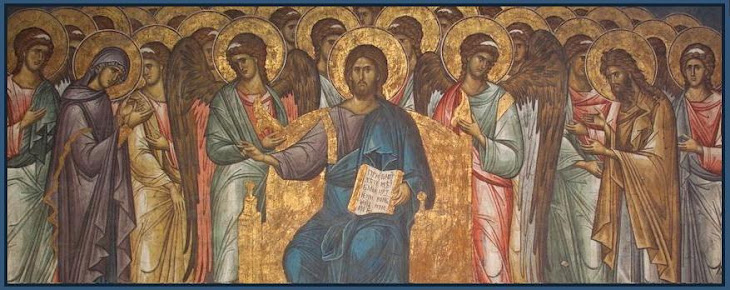
Jesus Christ Deisis with the Theotokos and the Precious Forerunner (source)
  
"When all our days are past, and passed in your wrath, our years will be seen like a spider. Day and night [the spider] works. She rises in the morning, and cleans her corner. She works until the night, and again, the next morning, she is in her same corner. Her web was destroyed. In the morning, she must weave it again. Days and nights of agony, and she sweats and suffers, without, ultimately, her work being completed.

"Whatever I might do, no matter how good it is, is like the work of a spider.

"A work has essential meaning, and is not like a spider's web, but is eternal, only when it is a search for You, when we turn to You, when it occurs for You, when it brings me, not to a desert place, not into a foreign land, not to this temporary earth, but to the true Chanaan, where You are, in Heaven.

"Thus, O Lord, was my life. I should have come to work for You. But I separated myself from You. For me, You no longer did exist, You Who exist from the ages and unto the ages. I thought, would my life be like this? A spider's corner, which would be gone tomorrow. Was I born for this, therefore?

"We have created something which has no worth before You, O Lord, it is nothing. I worked, thought, lived, thinking that I was progressing, that I was going towards the Promised Land. Because, however, I sinned, in reality, my life had no meaning to You. All things which have worth to You are those things that objectively have importance and meaning. Therefore, that which I thought was my success, that which I saw as my joy, that which for me was an object of enthusiasm and shouting for joy, this was something away from which You wished to turn away.

"Eternal life near our sweetest Jesus Christ exists, and You call us towards You, my God!"
-Elder Aimilianos of Simonopetra (+2019)
(source)
  
Elder Aimilianos of Simonopetra (+2019) (source)
  
Through the prayers of our Holy Fathers, Lord Jesus Christ our God, have mercy on us and save us! Amen!

Sunday, April 19, 2020

Photios Kontoglou on the Resurrection of Christ

Christ is risen! Truly He is risen!
Fresco of the Resurrection of Christ by Kontoglou, from the Church of Panagia Kapnikarea, Athens (source)

Photios Kontoglou: "Let us purify our senses..."
Orthodox Christians, today, the God-inspired tongue of the melodist, St. John of Damascus, says: "Let us purify our senses and we will see the unapproachable light of the Resurrection, and we will behold Christ shining forth, and we will hear Him say "Rejoice", as we sing the hymn of victory". (Canon of Pascha) Therefore, he cries to us to purify our senses, so that we might behold Christ Who is risen from the grave. We should purify our senses, because they are unclean, soiled, because we use them for fleshly and material ends.

And how are the senses cleansed? If our heart and mind are cleansed with spiritual nourishment, and with the grace of the Holy Spirit, then our senses will also be cleansed, and will changed from fleshly to spiritual. The melodist says this because he was taught this by our Lord and Savior Himself, when He said during the Beatitudes: "Blessed are the pure in heart, for they shall see God." And if we cleanse our senses, he says that we will see Christ "shining forth", with lightning, not dull, but most pure and shining with the uncreated Light of the Resurrection, "the unapproachable light of the Resurrection." And not only will be see Him "clearly", but we will hear Him also say (for this is why all of our senses must be pure), and His voice will not come from afar, that we might be unsure if we actually heard Him, but we will hear "clearly", with power.

We do not only soil our senses when we use them for fleshly deeds and activities, in other words, to use them for pleasures of the body, but when we use them for some deeds which even the world calls "spiritual", while they are in reality fleshly, and in some ways are even more evil than those that appear fleshly.***

These "spiritual" deeds are the evil thoughts which our nous has, seeking divine things, but are impious ones, and with these our pride is spread and our brazenness before God, because we give food to our vanity, so we appear to know more than others, while the wise Solomon said: "The beginning of wisdom (in other words, wisdom according to God) is the fear of the Lord". With these rummaging and with these philosophies, the Christian truly pollutes his senses, blunts them, and instead of making them spiritual, makes them organs of coarseness, because with them we have been studying coarse, physical things, and not spiritual things. Because, as I had said before, all of these activities appear spiritual, but in reality they are fleshly, according to the Apostle Paul, who says that we have made "the nous to be flesh", as he writes to the Colossians: "Let no one disqualify you, insisting on self-abasement and worship of angels, taking his stand on visions, puffed up without reason by his sensuous mind." (Colossians 2:18) And in the Epistle to the Ephesians he writes: "They are darkened in their understanding, alienated from the life of God because of the ignorance that is in them, due to their hardness of heart." (Ephesians 4:18) Why, therefore, does he say "you must no longer live as the Gentiles do, in the futility of their minds" (Ephesians 4:17)? Is he not speaking of those vain rummages which the philosophers do, even if done by those who appear more spiritual? Because that which they are speaking of is of the flesh (for "from the flesh come the things of the flesh"), in other words, we make spiritual things fleshly. Whoever seeks and studies with this fleshly spirit, first will loose the virginal simplicity of the mind, with which he was first blessed (this is the first blessedness), which our sweetest Christ has bestowed on them, saying: "Blessed are the poor in spirit". Later, he who uses his mind to excavate divine things troubles God, Who is hidden beneath undiscerning minds and covered by a dark cloud, and this is revealed by the mouth of the Prophet Isaiah, as he said: ""I revealed myself to those who did not ask for me; I was found by those who did not seek me." (Isaiah 65:1) St. Cyril of Alexandra says: "Faith is not something that is obtained, for it is a way of hope that beholds where there is no hope, and faith that searches for that which is lacking and cannot be found, faith is not according to the same reason as hope." And St. Basil the Great says: "The simple faith is more mighty than rational words of proof."

And many Christians pollute themselves even today, and even more so follow this form of rummage and searching  "distanced from the life of God", as St. Paul said of the Gentiles, and we stir up the faith, which these unfortunate people do not even recognize, and they "water it down" with various sciences and philosophies, with "commonly-held beliefs", while their vain thought becomes something "vain and false", abolished by arrogance and deafness to the holy Tradition of Orthodoxy, until Christianity becomes a systematic way of life, without revelation of Immortality, in other words, without Christ. And they wish to teach the simple and innocent sheep of Christ, Who blessed them with the Beatitudes, especially with the first and the eighth.

Therefore, how can people like this celebrate Christ Risen from the dead? How strange and paradoxical! Do philosophers and scientists believe? But whoever believed in a philosophy? I ask to learn. With Christ, philosophy is finished and buried for whoever believed in Him. Let us listen to St. Paul cry out: "The ancient things have passed away, for behold all things have been made new." What are the ancient things? "The vanity of the nous", the wise and mellifluous weavers of words, in order to falsely appear humble, while their pride is reavealed by their messages, like the ethical philosophers before Christ, and the current "ethical" Christians today. "Behold, all things have been made new." A voice bearing the hope of the blessed Paul, which again speaks to our heart, saying the "Rejoice" of his and our Risen Lord! "Yes, all things have been made new!" We have become new, because the Resurrection of Christ is something "new and strange", and this "newness" has made all things new, because all former things have been deposed. The old things have been deposed by Him Who "deposed death", because wherever is "The Author of Life" is lacking, there death reigns. He deposed the curse of the flesh and brought the blessing of the Spirit. He deposed knowledge and brought the Faith ("Righteousness is found from the faith").

The old things were Knowledge, searching, and man seeking blindly and not finding anything. The new is the Faith, which opens the spiritual eyes of man and beholds the Sun of Righteousness "Christ shining forth with the unapproachable light of the Resurrection." He is sufficient for all, our mind does not need anymore to seek like the philosophers of the nations, for "The Way" has been found, in other words, as He Himself said cleanly and in few words: "All things have been delivered to me by my Father; and no one knows the Son except the Father, and no one knows the Father except the Son and any one to whom the Son chooses to reveal him." (Matthew 11:27)

"Any one to whom the Son chooses to reveal Him", anyone to whom the Son wishes to reveal, can come to know the Father. Where are you going, therefore, O Christian, to come to know God and Christ, you who are blind, weak, impure, with your own power, while our Lord Himself said that only the Father can illumine the mind to come to know Christ, and Christ to come to know the Father? And you don't dare lower yourself to pray and to entreat Him to enlighten you, but you become filled with impious seeking, like the ancients beforehand who had not yet heard of Christ, speaking words with authority?  Elsewhere He says: "I am the door, I am the way, I am the teacher, I am the light, I am the physician, the intercessor" (I Timothy 2:2), the shepherd, the Rabbi. He is the "First-born of new creation", Who made "all things new", and also made "new men", "granting life to those in the graves."

Yes, with the Resurrection of Christ, all things have been made new. Because of this, the melodist says with joy and exaltation: "Come let us drink a new drink, not one marvelously brought forth from a barren rock (of philosophy), but the spring of incorruption which springs forth from the grave of Christ, in Whom we are fortified," and "Come, let us partake of the new vine of divine rejoicing on the auspicious day of the Resurrection, let us commune with the Kingdom of Christ, hymning Him as God unto the ages." (Canon of Pascha)

O Christians, my brethren, you who occupy yourselves [solely] with the sciences and with philosophies, hearken to our Lord Who speaks through the mouth of the prophet: "They have left me, Who am the spring of life, and have dug dry pits that have no water." And He says with His own mouth in the Gospel "Whoever puts his hand to the plow and looks back (in other wards, does not deny worldly knowledge which consumed men before I came into the world) is not fit for the Kingdom of God" (Luke 9:62) And He said another time: "you do not put new wine into old wine skins".

Let us therefore purify our minds from the filth of all forms of [vain] knowledge, because otherwise, we will not be able to behold Christ "shining forth with the unapproachable light of the Resurrection", and neither will we hear Him clearly say to us "Rejoice". Eyes to see Him and ears to hear Him cannot be given with knowledge that is "empty vanity", but only with the blessed Faith in our Lord and Savior Jesus Christ, Who is glorified unto the endless ages of ages. Amen.
Photis Kontoglou
(Kivotos Menaion, March 1st, 1952)
(source)
   
***Note: Kontoglou is referring to what many others have described as well, how we can even use external spiritual things for our pride and “spiritual gluttony”. For example, see this article by Abbot Tryphon: https://blogs.ancientfaith.com/morningoffering/2019/11/authentic-orthodoxy/.
  
Icon of Jesus Christ "The Savior of Souls", by Photios Kontoglou (source)
   
Photios Kontoglou: Faith and the Resurrection
The faith of the Christian is tested with the Resurrection of Christ, like gold in the furnace. From the whole Gospel, the Resurrection of Christ is the most unbelievable fact, totally unexpected by our logic, and a true witness to its truth. But because it is something totally unbelievable, our faith must be complete in order to believe it. We men continually say that we have faith, but we only hold what is believed from our mind. Therefore, there is no need for faith, because reason is sufficient. Faith requires unbelievable things.

Many men are faithless. The very Disciples of Christ did not put faith in the words off their Teacher, when He said that He would arise, despite all of the honor and dedication that they had towards Him, and their trust in His words. And when the Myrrhbears went at sunrise to the Tomb of Christ, and saw two Angels who spoke to them, saying that He had risen, they hastened to tell this joyous news to the Disciples, but they did not believe their words, having the notion that they were fantasies: "And their words appeared to them an idle tale, and they did not believe them."

Do you see all of the faithlessness that Christ Himself struggled against? Even with His own Disciples. Do you see with how much forbearance He endured it all? And despite this, today most of us are separated from Christ by a frozen wall, the wall of faithlessness. He opens His embrace and calls us, and we deny Him. He shows us His pierced hands and feet, and we say that we don't believe...

Yes, those who have this blessed simplicity of conscience, were blessed by the Lord, saying: "Blessed are the poor in spirit, for theirs is the kingdom of the heavens. Blessed are the pure of heart, for they will see God." And to Thomas, who needed to touch Him to believe, He said: "Because you have seen me, Thomas, do you believe? Blessed are those who have not seen and believe."

Let us entreat the Lord to grant us this rich poverty, and this pure heart, that we might be resurrected, and stand together with Him.

This "ignorance" is greater than knowledge: "This is the ignorance that is higher than knowledge." Blessed and thrice-blessed are those who have this. Christ is risen!
  
The Myrrhbearers at the Tomb of Christ, by Kontoglou (source)
  
Christ is risen from the dead, by death, trampling down upon death, and to those in the tombs, He has granted life!
Truly the Lord is risen!
Friday, January 31, 2020

St. Porphyrios: "Christ will conquer in the end..."

Christ willingly being judged before Pilate (source)
  
"My child, we Christians do not have money, nor power. Today, this world is governed by the mighty. Mighty powers, banks with a lot of money, other forces, very great...We are unable to cope with these forces and it is natural that these forces, many times, are antithetical to the Christian spirit, with the result being danger to Christians and those who desire to live according to the law of God. We cannot resist these forces, because in a worldly manner, we are unable. We, however, have Christ, my child. And if we ask Christ, then, we can resist whatever is difficult that comes our way, and we will be able to endure. Christ will conquer in the end, and righteousness and truth will prevail."
-St. Porphyrios of Kavsokalyvia

(source)
  
Through the prayers of our Holy Fathers, Lord Jesus Christ our God, have mercy on us and save us! Amen!

Thursday, January 9, 2020

Metropolitan Pavlos of Siatista: "What does Christmas mean to us?"

This is a beautiful recording of a Greek talk with English subtitles from Metropolitan Pavlos of Siatista of blessed memory (who reposed almost a year ago exactly, on January 13th, 2019) on the meaning of Christmas and on finding Christ in the feast as the source of our true joy. May he have a blessed Paradise, may we have his blessing, and may our newly-born and baptized Lord save His children! Amen! (source)
  
Through the prayers of our Holy Fathers, Lord Jesus Christ our God, have mercy on us and save us! Amen!

Friday, November 22, 2019

St. Iakovos of Evia on Temptations and Marriage

St. Iakovos of Evia (source)
  
"Do not hope in the world. Be careful in your social interactions. Never listen to what the world is telling you. Temptations come; we're human. The devil has many feet, altars and traps. Everything will be faced during marriage with love, meekness and patience. Have faith in God and prayer and everything will go according to the will of God."
-St. Iakovos of Evia

(source)
 
Through the prayers of our Holy Fathers, Lord Jesus Christ our God, have mercy on us and save us! Amen!
 

Friday, October 11, 2019

St. John Maximovitch on Struggle and Victory in Christ

Jesus Christ crucified (source)
  
God’s grace always assists those who struggle, but this does not mean that a struggler is always in the position of a victor. Sometimes in the arena the wild animals did not touch the righteous ones, but by no means were they all preserved untouched.
What is important is not victory or the position of a victor, but rather the labor of striving towards God and devotion to Him.
Though a man may be found in a weak state, that does not at all mean that he has been abandoned by God. On the cross, the Lord Jesus Christ was in trouble, as the world sees things. But when the sinful world considered Him to be completely destroyed, in fact He was victorious over death and hades. The Lord did not promise us positions as victors as a reward for righteousness, but told us, “In the world you will have tribulation — but be of good cheer, for I have overcome the world” (Jn. 16:33).
The power of God is effective when a person asks for the help from God, acknowledging his own weakness and sinfulness. This is why humility and the striving towards God are the fundamental virtues of a Christian.
+ St. John Maximovitch

(source)
  
St. John Maximovitch the Wonderworker (source)
  
Through the prayers of our Holy Fathers, Lord Jesus Christ our God, have mercy on us and save us! Amen!

Tuesday, September 3, 2019

St. Nektarios the Wonderworker on Seeking Happiness

St. Nektarios the Wonderworker (source)
  
“How mistaken are those people who seek happiness outside of themselves, in foreign lands and journeys, in riches and glory, in great possessions and pleasures, in diversions and vain things, which have a bitter end! In the same [way,] to construct the tower of happiness outside of ourselves as it is to build a house in a place that is consistently shaken by earthquakes. Happiness is found within ourselves, and blessed is the man who has understood this. Happiness is a pure heart, for such a heart becomes the throne of God. Thus says Christ of those who have pure hearts: “I will visit them, and will walk in them, and I will be a God to them, and they will be my people.” (II Cor. 6:16) What can be lacking to them? Nothing, nothing at all! For they have the greatest good in their hearts: God Himself!”
— St. Nektarios of Aegina, Path to Happiness, 1
(source)
  
Through the prayers of our Holy Fathers, Lord Jesus Christ our God, have mercy on us and save us! Amen!

Tuesday, April 2, 2019

St. John of the Ladder's advice for those living in the world

St. John writing his Ladder of Divine Ascent (source)
  
Some people living carelessly in the world have asked me: ‘We have wives and are beset with social cares, and how can we lead the solitary life?’ I replied to them: ‘Do all the good you can; do not speak evil of anyone; do not steal from anyone; do not lie to anyone; do not be arrogant towards anyone; do not hate any one; be sure you go to church; be compassionate to the needy; do not offend anyone; do not wreck another man’s domestic happiness; and be content with what your own wives can give you. If you behave in this way you will not be far from the Kingdom of Heaven.’
-St. John Klimakos, The Ladder of Divine Ascent, Step I
(source)
  
Through the prayers of our Holy Fathers, Lord Jesus Christ our God, have mercy on us and save us! Amen!

Thursday, January 17, 2019

38 Beneficial Sayings of St. Anthony the Great

St. Anthony the Great (Source)
  
Thanks to the blog Ora Et Labora for this wonderful post on the famous and spiritually-beneficial 38 sayings of St. Anthony the Great.

"In his 2007 Commencement Address at St Vladimir's Orthodox Seminary, Fr Thomas Hopko had this to say:
I urge you, and, if I could, I would command you, to read St. Anthony’s thirty-eight sayings in the Sayings of the Desert Fathers. Everything we need to know in order to live is there for us in its simplest and clearest form.
Heeding his command, I reproduce below these thirty-eight sayings, as translated by the late Sr Benedicta Ward SLG in her collection The Sayings of the Desert Fathers:
  
St. Anthony the Great (source)
1. When the holy Abba Anthony lived in the desert he was beset by accidie, and attacked by many sinful thoughts. He said to God, "Lord, I wand to be saved but these thoughts do not leave me alone; what shall I do in my affliction? How can I be saved?" A short while afterwards, when he got up to go out, Anthony say a man like himself sitting at his work, getting up from his work to pray, then sitting down again and plaiting a rope, then getting up again to pray. It was an angel of the Lord sent to correct and reassure him. He heard the angel saying to him, "Do this and you will be saved." At these words, Anthony was filled with joy and courage. He did this, and he was saved.

2. When the same Abba Anthony thought about the depth of the judgments of God, he asked, "Lord, how is it that some die when they are young, while others drag on to extreme old age? Why are there those who are poor and those who are rich? Why do wicked men proper and why are the just in need? He heard a voice answering him, "Anthony, keep your attention on yourself; these things are according to the judgment of God, and it is not to your advantage to known anything about them."

3. Someone asked Abba Anthony, "What must one do in order to please God?" The old man replied, "Pay attention to what I tell you: whoever you may be, always have God before your eyes, whatever you do, do it according to the testimony of the holy Scriptures; in whatever place you live, do not easily leave it. Keep these three precepts and you will be saved."

4. Abba Anthony said to Abba Poemen, "This is the great work of man: always to take the blame for his own sins before God and to expect temptation to his last breath.

5. He also said, "Whoever has not experienced temptation cannot enter into the Kingdom of Heaven." He even added, "Without temptations no-one can be saved."

6. Abba Pambo asked Abba Anthony, "What ought I to do?" and the old man said to him, "Do not trust in your own righteousness, do not worry about the past, but control your tongue and your stomach."

7. Abba Anthony said, "I saw the snares that the enemy spreads out over the world and I said groaning, "What can get through from such snares?" Then I heard a voice saying to me, 'Humility.'"

8. He also said, "Some have afflicted their bodies by asceticism, but they lack discernment, and so they are far from God."

9. He said also, "Our life and our death is with our neighbor. If we gain our brother, we have gained God, but if we scandalize our brother, we have sinned against Christ."

10. He also said, "Just as fish die if they stay too long out of water, so the monks who loiter outside their cells or pass their time with men of the world lose the intensity of inner peace. SO like a fish going towards the sea, we must hurry to reach our cell, for fear that if we delay outside we will lost our interior watchfulness."

11. He said also, "He who wishes to live in solitude in the desert is delivered from three conflicts: hearing, speech, and sight; there is only one conflict for him and that is with fornication."

12. Some brothers came to find Abba Anthony to tell him about the visions they were having, and to find out from him if they were true or if they came from the demons. They had a donkey which died on the way. When they reached the place where the old man was, he said to them before they could ask him anything, "How was is that the little donkey died on the way here?" They said, "How do you know about that, Father?" And he told them, "The demons shewed me what happened." So they said, "That was what we came to question you about, for fear we were being deceived, for we have visions which often turn out to be true." Thus the old man convinced them, by the example of the donkey, that their visions came from the demons.

13. A hunter in the desert saw Abba Anthony enjoying himself with the brethren and he was shocked. Wanting to show him that it was necessary sometimes to meet the needs of the brethren, the old man said to him, "Put an arrow in your bow and shoot it." So he did. The old man then said, "Shoot another," and he did so. Then the old man said, 'Shoot yet again," and the hunter replied "If I bend my bow so much I will break it." Then the old man said to him, "It is the same with the work of God. If we stretch the brethren beyond measure they will soon break. Sometimes it is necessary to come down to meet their needs." When he heard these words the hunter was pierced by compunction and, greatly edified by the old man, he went away. As for the brethren, they went home strengthened.

14. Abba Anthony heard of a very young monk who had performed a miracle on the road. Seeing the old man walking with difficulty along the road, he ordered the wild asses to come and carry them until they reached Abba Anthony. He said to them, "This monk seems to me to a ship loaded with goods but I do not know if he will reach harbor." After a while, Anthony suddenly began to weep, to tear his hair and lament. His disciples said to him, "Why are you weeping, Father?" and the old man replied, "A great pillar of the Church has just fallen (he meant the young monk) but go to him and see what has happened." So the disciples went and found the monk sitting on a mat and weeping for the sin he had committed. Seeing the disciples of the old man he said, "Tell the old man to pray that God will give me just ten days and I hope I will have made satisfaction." But in the space of five days he died.

15. The brothers praised a monk before Abba Anthony. When the monk came to see him, Anthony wanted to know how he would bear insults; and seeing that he could not bear them at all, he said to him, "You are like a village magnificently decorated on the outside, but destroyed from within by robbers."

16. A brother said to Abba Anthony, "Pray for me." The old man said to him, " I will have no mercy upon you, nor will God have any, if you yourself do not make an effort and if you do not pray to God.

17. One day some old men came to see Abba Anthony. In the midst of them was Abba Joseph. Wanting to test them, the old man suggested a text from the Scriptures, and, beginning with the youngest, he asked them what it meant. Each gave his opinion as he was able. But to each one the old man said, "You have not understood it." Last of all he said to Abba Joseph, "How would you explain this saying?" and he replied, "I do not know." Then Abba Anthony said, "Indeed, Abba Joseph has found the way, for he has said: 'I do not know.'"

18. Some brothers were coming from Scetis to see Abba Anthony. When they were getting into a boat to go there, they found an old man who also wanted to go there. The brothers did not know him. They sat in the boat, occupied by turns with the words of the Fathers, Scripture and their manual work. As for the old man, he remained silent. When they arrived on shore they found that the old man was going to the cell of Abba Anthony too. When they reached the place, Anthony said to them, "You found this old man a good companion for the journey?" Then he said to the old man, " You have brought many good brethren with you, father." The old man said, "No doubt they are good, but they do not have a door to their house and anyone who wishes can enter the stable and loose the ass." He meant that the brethren said whatever came into their mouths.

19. The brethren came to the Abba Anthony and said to him, "Speak a word; how are we to be saved?" The old man said to them, "You have heard the Scriptures. That should teach you how." But they said, "We want to hear from you too, Father." Then the old man said to them, "The Gospel says, 'if anyone strikes you on one cheek, turn to him the other also.'" (Matt. 5.39) They said, "We cannot do that." The old man said, "If you cannot offer the other cheek, at least allow one cheek to be struck." "We cannot do that either," they said. So he said, "If you are not able to do that, do not return evil for evil," and they said, "We cannot do that either." Then the old man said to his disciples, "Prepare a little brew of corn for these invalids. If you cannot do this, or that, what can I do for you? What you need is prayers."
  
St. Anthony the Great (source)
20. A brother renounced the world and gave his goods to the poor, but he kept back a little for his personal expenses. He went to see Abba Anthony. When he told him this, the old man said to him, "If you want to be a monk, go into the village, buy some meat, cover your naked body with it and come here like that." The brother did so, and the dogs and birds tore at his flesh. When he came back the old man asked him whether he had followed his advice. He showed him his wounded body, and Saint Anthony said, "Those who renounce the world but want to keep something for themselves are torn in this way by the demons who make war on them."

21. It happened one day that one of the brethren in the monastery of Abba Elias was tempted. Cast out of the monastery, he went over the mountain to Abba Anthony. The brother lived hear him for a while and then Anthony sent him back to the monastery from which he had been expelled. When the brothers saw him they cast him out yet again, and he went back to Abba Anthony saying, "My Father, they will not receive me." Then the old man sent them a message saying, "A boat was shipwrecked at sea and lost its cargo; with great difficulty it reached the shore; but you want to throw into the sea that which has found a safe harbor on the shore." When the brothers understood that it was Abba Anthony who had sent them this monk, they received him at once.

22. Abba Anthony said, "I believe that the body possesses a natural movement, to which it is adapted, but which it cannot follow without the consent of the soul; it only signifies in the body a movement without passion. There is another movement, which comes from the nourishment and warming of the body by eating and drinking, and this causes the heat of the blood to stir up the body to work. That is why the apostle said, 'Do not get drunk with win for that is debauchery.' (Ephes. 5.18) And in the Gospel the Lord also recommends this to his disciples: 'Take heed to yourselves lest your hearts be weighed down with dissipation and drunkenness.' (Luke 21.34) But there is yet another movement which afflicts those who fight, and that comes from the wiles and jealousy of the demons. You must understand what these three bodily movements are: one is natural, one comes from too much to eat, the third is caused by the demons."

23. He also said, "God does not allow the same warfare and temptations to this generation as he did formerly, for men are weaker now and cannot bear so much."

24. It was revealed to Abba Anthony in his desert that there was one who was his equal in the city. He was a doctor by profession and whatever he had beyond his needs he gave to the poor, and every day he sang the Sanctus with the angels.

25. Abba Anthony said, "A time is coming when men will go mad, and when they see someone who is not mad, they will attack him saying, 'You are mad, you are not like us.'"

26. The brethren came to Abba Anthony and laid before him a passage from Leviticus. The old man went out into the desert, secretly followed by Abba Ammonas, who knew that this was his custom. Abba Anthony went a long way off and stood there praying, crying in a loud voice, "God, send Moses, to make me understand this saying," Then there came a voice speaking with him. Abba Ammonas said that although he heard the voice speaking with him, he could not understand what it said.

27. Three Fathers used to go and visit blessed Anthony every year and two of them used to discuss their thoughts and the salvation of their souls with him, but the third always remained silent and did not ask him anything. After a long time, Abba Anthony said to him, "You often come here to see me, but you never ask me anything," and the other replied, "It is enough fo rme to see you, Father."

28. They said that a certain old man asked God to let him see the Fathers and he saw them all except Abba Anthony. So he asked his guide, "Where is Abba Anthony?" He told him in reply that in the place where God is, there Anthony would be.

29. A brother in a monastery was falsely accused of fornication and he arose and went to Abba Anthony. The brethren also came from the monastery to correct him and bring him back. They set about proving that he had done this thing, but he defended himself and denied that he had done anything of the kind. Now Abba Paphnutius, who is called Cephalus, happened to be there, and he told them this parable: "I have seen a man on the bank of the river buried up to his knees in mud and some men came to give him a hand to help him out, but they pushed him further in up to his neck." Then Abba Anthony said this about Abba Paphnutius: "Here is a real man, who can care for souls and save them." All those present were pierced to the heart by the words of the old man and they asked forgiveness of the brother. So, admonished by the Fathers, they took the brother back to the monastery.

30. Some say of Saint Anthony that he was "Spirit-borne," that is, carried along by the Holy Spirit, but he would never speak of this to men. Such men see what is happening in the world, as well as knowing what is going to happen.

31. One day Abba Anthony received a letter from the Emperor Constantius, asking him to come to Constantinople and he wondered whether he ought to go. So he said to Abba Paul, his disciple, "Ought I to go?" He replied, "If you go, you will be called Anthony; but if you stay here, you will be called Abba Anthony."

32. Abba Anthony said, "I no longer fear God, but I love Him. For love casts out fear." (John 4.18)

33. He also said, "Always have the fear of God before your eyes. Remember him who gives death and life. Hate the world and all that is in it. Hate all peace that comes from the flesh. Renounce this life, so that you may be alive to God. Remember what you have promised God, for it will be required of you on the day of judgment. Suffer hunger, thirst, nakedness, be watchful and sorrowful; weep, and groan in your heart; test yourselves, to see if you are worthy of God; despise the flesh, so that you may preserve your souls.

34. Abba Anthony once went to visit Abba Amoun in Mount Nitria and when they met, Abba Amoun said, "By your prayers, the number of the brethren increases, and some of them want to build more cells where they may live in peace. How far away from here do you think we should build the cells?" Abba Anthony said, "Let us eat at the ninth hour and then let us go out for a walk in the desert and explore the country." So they went out into the desert and they walked until sunset and then Abba Anthony said, "Let us pray and plant the cross here, so that those who wish to do so may build here. Then when those who remain there want to visit those who have come here, they can take a little food at the ninth hour and then come. If they do this, they will be able to keep in touch with each other without distraction of mind." The distance is twelve miles.

35. Abba Anthony said, "Whoever hammers a lump of iron, first decides what he is going to make of it, a scythe, a sword, or an axe. Even so we ought to make up our minds what kind of virute we want to forge or we labor in vain."

36. He also said, "Obedience with abstinence gives men power over wild beasts."

37. He also said, "Nine monks fell away after many labors and were obsessed with spiritual pride, for they put their trust in their own works and being deceived they did not give due heed to the commandment that says, 'Ask your father and he will tell you.'" (Deut. 32.7)

38. And he said this, "If he is able to, a monk ought to tell his elders confidently how many steps he takes and how many drops of water he drinks in his cell, in case he is in error about it."
(source)
  
St. Anthony the Great (source)
  
Through the prayers of our Holy Fathers, Lord Jesus Christ our God, have mercy on us and save us! Amen! 

Thursday, July 12, 2018

St. Paisios the Athonite: "A world may come..."

St. Paisios the Athonite (source)
  
A world may come [one day] when people will no longer reconcile themselves with God.
-St. Paisios the Athonite
  
(source)
  
Through the prayers of our Holy Fathers, Lord Jesus Christ our God, have mercy on us and save us! Amen!

Wednesday, July 11, 2018

Sermon by Saint Paisios on Humility and Life in Christ

This is a wonderful recorded sermon of St. Paisios the Athonite given to pilgrims during his life on various topics, but especially on humility and life in Christ. May we have his blessing and intercessions!
  
Through the prayers of our Holy Fathers, Lord Jesus Christ our God, have mercy on us and save us! Amen!

Wednesday, June 27, 2018

Elder Symeon Kragiopoulos on Sts. Peter and Paul the Apostles

Sts. Peter and Paul the Holy Apostles (source)
  
5th Sunday of June (June 29th, 2014)
Some main points in the life of the leaders of the Apostles.
   “For when I am weak, then I am strong” :  Behold the great, indomitable, and mysterious power of the Apostle Paul. The spirit of our age is entirely opposite. People think that money, rank, titles, wisdom, and worldly science, are power. The example of the Apostle persuades us that human works are finite, fleeting, sinful and vain, whereas those which are accomplished by divine power are true and everlasting. Divine power resides in people who are insignificant by the world’s standards. But it always works miracles so that the Christian who possesses this power, even while he is poor, he makes rich many others, and even though he has nothing, he possesses all things.
    Let us recall the answer of the Apostle Peter, “Yes, Lord; You know that I love You” , when the Lord asked him for the third time: “Peter, do you love me?” Peter was saddened, but his answer is amazing: “Lord, You know all things; You know that I love You.”  And he answers without hesitation, while he should have started to doubt. To say, “For the Lord to ask me again and again, maybe…” Peter, however, doesn’t waver. Peter is true.
    Now let’s you and I stand before God and imitate in some way Peter’s love in our relationship with God. Let’s have this same certainty within ourselves: knowing that the true God, who is entirely loving and compassionate, wants to save each one of us. And let’s approach Him without even the slightest doubt or reservation as to His holiness, goodness, and love for mankind, in which we can have complete trust.
    But maybe the temptation comes that God doesn’t love us. We don’t say it, but deep down our soul lives like this and there we find complaints, reservations, whining. We don’t understand how many things we ruin with God when we adopt such a stance. God wants us to completely believe in His goodness, to completely believe that He doesn’t hold any prejudices; He doesn’t ever show discrimination. This is a fact. And so we too, then, can say: “Lord, You know all things; You know that I love You.”  And we can have the trust that the Apostle Peter had, to whom the Lord finally said: “Feed My lambs, Feed my sheep.” 
Transcribed talks by Archimandrite Symeon Kragiopoulos
 From: Holy Hesychasterion “The Nativity of Theotokos” Publications.
Translated by fr. Matthew Penney
  
Through the prayers of our Holy Fathers, Lord Jesus Christ our God, have mercy on us and save us! Amen!

Wednesday, February 21, 2018

Elder Ephraim of Arizona on Great Lent

Jesus Christ, "Extreme Humility" (source)
  
At this time we’re entering the great spiritual arena of the blessed Great Lent. Holy and Great Lent is a time of compunction, for repentance, for tears, for a change in ourselves, for a new stage in the spiritual life. Like an affectionate mother caring for her children, us Christians, the Church has designated this time of Lent as dedicated to the struggle, in order to help its children fight harder, to purify themselves, draw closer to God and to be counted worthy of celebrating the great day of the radiant Resurrection.
  

Christians, especially monks, have always paid particular attention to this spiritual arena and have thought it especially sacred, because it’s a period which envisages both spiritual and bodily struggles. There’s the struggle of fasting, the struggle of vigils, the struggle of purification and the struggle to fulfill one’s spiritual duties which are many more than at other times of the year. There’s a spiritual “defragmentation” and people pay greater attention to the voice of their conscience in order to correct what they’ve maybe neglected and to improve spiritually.
   
The Church assists us but with penitential hymns and services, as well as with teachings, to oil us up for the fight for the purification of our souls.
  
We have the penitential evening Divine Liturgies of the Presanctified Gifts. The Presanctified is extremely beneficial. It’s Cherubic Hymn is full of spirituality, contemplation, angelic presence. That’s why we should come to these liturgies during Great Lent with even greater compunction. We who consume the Body and Blood of Christ must be so pure and clean, so straight in body and soul for divine grace to have its effect. For this reason we must lead very careful lives. Both in our cells and in church we must wet our face with tears so as to wash our souls and be worthy to take communion. Of course, the devil often makes us wanting in compunction, me more than anyone. Which means we can’t have tears and we often have bad thoughts. Bad thoughts and the sinful images that accompany them must be rejected as soon as they make their appearance. And when we have wicked thoughts or our soul is cold towards one of the brethren, let’s not approach the God of love, Who is so pure and holy.
  
Throughout this period, at every service in Great Lent, we say the prayer of Saint Efraim the Syrian, which is as follows: “Lord and Master of my life, do not give me the spirit of sloth, inquisitiveness, lust for power or idle talk, but give rather the spirit of sobriety, humility, patience and love to me, your servant. Indeed, Lord King, grant me to see my own errors and not to judge my brother, for you are blessed to the ages of ages. Amen”.
  
With these words, the saint wishes to make us understand very clearly, that, apart from other virtues we need to take special care with the last case, that of self-censure and of criticism of our bothers and that without love for our fellow human beings there’s no chance of making even the slightest progress towards our spiritual purification. If we don’t pay attention to our thoughts, our words and our heart, there’s no benefit in fasting. Fasting is of benefit when it’s combines with love for our neighbour and when we don’t criticize others. When we don’t criticize our fellows and instead criticize ourselves, then we’re marked by love for others and love for our soul, concern for purification and the fulfillment of the great commandment, that of love of God and one’s neighbour. Love for God and for our fellows  are the two great virtues which support the whole of the spiritual structure, because if they are absent, they others cannot take form. “God is love and those who live in God in love have God living in them, too” (I. Jn. 4, 16).
  
Another issue which demands that we push ourselves as hard as possible is prayer We should pray in the name of Christ, without neglecting any opportunity and without any waste of time. In the personal vigil in our cell, we should push ourselves, shouldn’t let sleep overcome us, nor neglect nor idleness; we should engage willingly I spiritual matters. As soon as we wake up, prayer should take first place then our rule, our prayer-rope, study and the contemplation of God. We should go to church with great readiness and so get the best results from our presence in the arena.
  
Apart from this, fasting together with bodily exertion helps as regards the forgiveness of sins. “Behold my humility and my efforts and forgive all my sins”. When we labour with the fast, with kneeling, with prayers, with an effort from our heart and mind, this Godly exertion is holy and is richly rewarded by God, because it make people worthy of the crown of glory and honour. The demons fear the fast greatly, because it lays them low. “This kind [of demon] will not depart other than with prayer and fasting”, said the Lord (Math. 17, 21). This is why the holy fathers always began any Godly task with a fast. They considered a fast to be very powerful and that the Holy Spirit does nor overshadow people when they’re replete with food and their stomachs are full. And any Christian who desires purification has to start from this foundation which is fasting, prayer and vigilance. When these three are combined, then people have acquired great stature.
  
In olden times, the fathers had a holy custom. On the eve of Lent, they would leave the monasteries and go deeper into the desert, where they lived in great asceticism until Lazarus Saturday, when they returned in order to celebrate Palm Sunday all together. Some would take a few of the basic essentials as far as food was concerned, others would eat only green plants, in order to struggle more fiercely in the desert. Thereafter they would spend all the days on Great Week together in church, existing on a piece of dried rusk and a few nuts a day. We were given the blessing and the grace of knowing ascetic people who spent not only Great Lent in fasting and spiritual struggle.
  
Our departed elder, Elder Iosif the Cave-Dweller (he used to live in caves, which is where I met him), kept a very strict fast during Great Lent. And, of course, he imposed it on us, too. From Monday to Friday, five days of the week there was no food, except a handful of flour, from which we made a batter with just water. That was it. A little plate every twenty-four hours. And, at the same time, hard work lifting loads on our back during the day and the whole night hundreds of prostrations and hours of prayer. And all of this in order to purify the inner person, to make it cleaner, more honourable in the eyes of God, in order to acquire boldness before God and be able to pray for the whole world. Because the world, people everywhere, needs the prayers of the saints, particularly those of ascetics. Saint Anthony the Great supported the whole world with his prayers.
  
 Of course, we must keep the fast only as far as we’re able, with discretion, because we’re not all the same. “Unless the good be done well, it is not good”. In other words, unless good is done in a good way, method, time and amount, but instead is done without discretion, then it’ll do more harm than good. Fasting is certainly extremely necessary, it’s good, but it’s a means rather than an end The means has an end and that is humility. This is why we need to arrange everything in accordance with the discretion of a spiritual father, someone illumined by the Holy Spirit. Your spiritual father will tell you  how much to fast, how often to receive communion, where to strike at the enemy, what you should do here and what there. And then, through the discretion of your spiritual father, you can put your house in order. We shouldn’t do more than is appropriate, we need moderation in all things, because immoderation cancels out any benefit. So fasting is holy, but it’s a means. We should adjust it according to what our spiritual father says and what out psychosomatic powers allow. As long as there’s good will. Basil the Great says there’s as much difference in resilience between people as there is between iron and grass.
  
Saint Synklitiki fell ill towards the end of her life with a throat disease. Her blessed throat, which had always spoken the word of God, festered on the inside. Her mouth had saved countless people. The devil had asked permission to test her and God had granted it. The stench from her rotting flesh became so bad that the nuns had the greatest difficulty in seeing to her needs. They used the most pungent perfumes to try and bring her a little respite in her sickness. When her mouth had been healthy, it had spoken and brought benefit to many, but when she fell ill, she was able to preach even more strongly. How could a silent and rotting mouth preach? She noiselessly declared her great patience and endurance in God’s trial. She made a titanic effort to deal with the devil of impatience, of complaint, of the labour and toil of sickness. What did she need with fasting? This is why illness is regarded as involuntary asceticism. One person has cancer, another diabetes, somebody else has lots of troublesome health problems. How will these people purify themselves? How will they see God’s light?
  
Through patience and giving thanks to Him. These make up for the fast which, because of their illness, they’re unable to keep, and, in fact, often struggle ten times harder than if they were fasting.
  
During this period, we really have to struggle to purify ourselves. From the ascetic tradition we have hermits who spent the whole of their lives in the desert, with labours, toil, fasts, tears, sleeping on the ground and deprivation of every other kind of pleasure. And all this effort, together with the struggle of the soul against all kinds of thoughts concerning the rebellions of the flesh, engendered sanctity.
  
So every Christian who’s a monk and wants to experience purification has the right to labour and not be deprived of his reward. Purity brings great boldness towards God, because He Himself is pure, the Mother of God is most pure and Saint John the Theologian lived his life as a virgin, as did so many other saints. The whole beauty of the Church is founded on purity and spotlessness. When our heart is pure and beautiful it will exude fragrance and loveliness. But if people have filth in their hearts, that’s what they’ll expel. Let’s struggle to cleanse the inside of our glass, our heart, so that we’ll be pure and pleasing in God’s eyes.

  
We have instances from Church history of many people “in the world” (not monastics, that is), who pleased God and became great. Abba Paphnuti [from Ancient Egyptian = “man of God”], an ascetic of great gifts, once prayed to God and said: “God, who have You placed me with. With whom do I share the same measure of virtue?”. And he heard a voice, saying to him: “Down in Alexandria there’s a poor man, a cobbler, down in a basement. You have the same amount of virtue as he does”. “But I’ve been a hermit in the desert from childhood and I’m equal in virtue with a lay person, a married man?”. “Yes, you’re equal to him”. The next day, the saint picked up his staff and his bag, put in some dry rusks and set off for Alexandria. He went down into the city, found the layman and said to him: “What do you do here, friend?”. “What should I do, father? I’m a sinner, the worst person in the world”. “Can we talk?”. “Certainly”. “What’s the virtue that you’re working on acquiring?”. “Virtue, me? I live ‘in the world’ and am completely mixed up. Now you, you’ve got virtues”. “No, you’re doing something”. “I’m not doing anything”. “God showed me, so you can’t tell me lies. I prayed and He told me that we share the same measure of virtue. There must be something about you”. “Sorry, Father. If what I do can be considered something, I’ll tell you. I married, and from the moment I put on the crown, I said to my wife: ‘If you love me, we’ll live apart, like brother and sister and work for the sanctification of our souls. Do you agree’. ‘I agree’. And since then we’ve lived in purity and virginity”.*
  
[*Note: This marital chastity described is similar to that experienced by other saints, for example, St. John of Kronstadt. St. Paphnoutios is not at all implying that sex and childbearing in marriage are evil or impure. But all married Christians are called to some degree of self-control and purity, (as is prayed for in every wedding service) according to their strength, according to their mutual consent and the guidance of their spiritual fathers, not all to a life of virginity.]
  
In the desert, Blessed Paphnuti tried to cleanse himself through the ascetic life, and restraint, in which he was greatly assisted by the condition of his way of life. The other man lived “in the world”, with a wife, with all the challenges of secular life and, with God’s help had reached the stature of a saint. And his struggle was greater than that of the hermit. Proof that he was great in the eyes of God.
  
After that, something else happened which has to do with this cobbler. One day a Christian went to the Blessed Paphnuti and said:
  
“Father, I quarrelled with a priest and I don’t know how he reacted, whether he cursed me or swore at me, but he’s now departed this life and we weren’t reconciled. What do I do now?”.
  
“There’s nothing I can do in this case, but there’s a holy man who I’ll send you to and he’ll help. Go down to Alexandria, to a basement where there’s this cobbler. Tell him I sent you, mention the problem and he’ll help”.
  
The Christian said to himself: “For goodness’ sake. A hermit can’t help and a layman can?”. Nevertheless, out of obedience to the hermit, he did as he was told. The cobbler told him to wait until night fell and then took him to a church in the city. After again telling him to wait, the cobbler went up to the large door made the sign of the cross and it opened. The inside of the church was bathed in light and there was heavenly music. The cobbler told the man:
  
“Go in there and look at the choirs on the left and right. You’ll see the priest there”.
  
The man went in, saw the priest in the left choir and received his forgiveness.
   
You see what ascetic effort can achieve? What the soul’s struggle can do? What did that layman do to purify his soul. When he told the girl he’d married  that they should live like brother and sister, was that an end to it? No, they fasted and kept vigil together, they made prostrations and read the Gospel. They read Patristic books, went to church, confessed, took communion, chased  away evil thoughts and struggled assiduously. And that’s how they became saints “in the world”.
  
So here is proof that even “in the world”, when Christians take on the struggle with good will, the Grace of God does not exclude anyone. But we make excuse for ourselves and say that because we’re “in the world”, we can’t. Desire gets the better of us. What do we need to do? Fight in the body and in the soul. In other words, control our thoughts. Thoughts come, sinful fantasies, images, faces, idols and scenes. We must get rid of them immediately with “Lord Jesus Christ, have mercy upon me”. When the mind is careful not to accept all of that and has the divine weapon, the Name of Christ, then every enemy of our soul is slain, whether it be the devil, sordid fantasies or repulsive thoughts. Then, if we guard our soul, mind and heart in this way, our inner self will remain clean and pure.
  
Let’s struggle really hard now, and the rewards will be very great. Nobody finds grace unless they make the effort. If a farmer doesn’t tend his crops, he won’t see any yield. When our fast is accompanied, reinforced and flanked by prayer, study, vigilance, church attendance, confession, Holy Communion, good works- especially almsgiving- then the beauty of the preparation of the soul for the reception of Great Week is complete. Then we’ll experience the Holy and Sacred Passion of Christ  more intensely, because our heart will soften, it’ll alter and it’ll realize how great God’s love for humankind is. Then, within us, we’ll experience very forcibly the Holy Resurrection, we’ll celebrate it in a way befitting to God and we’ll celebrate Holy Easter together with the angels. Amen.
  
Brethren, may we all have a blessed and spiritually-profitable Lent, and be made worthy of partaking in Christ's Passion and Resurrection! Please forgive me, and may God forgive us all!
  
Through the prayers of our Holy Fathers, Lord Jesus Christ our God, have mercy on us and save us! Amen!