Showing posts with label St. Paisios of the Holy Mountain. Show all posts

Monday, October 12, 2020

St. Paisios on Prayer and Lighting Candles

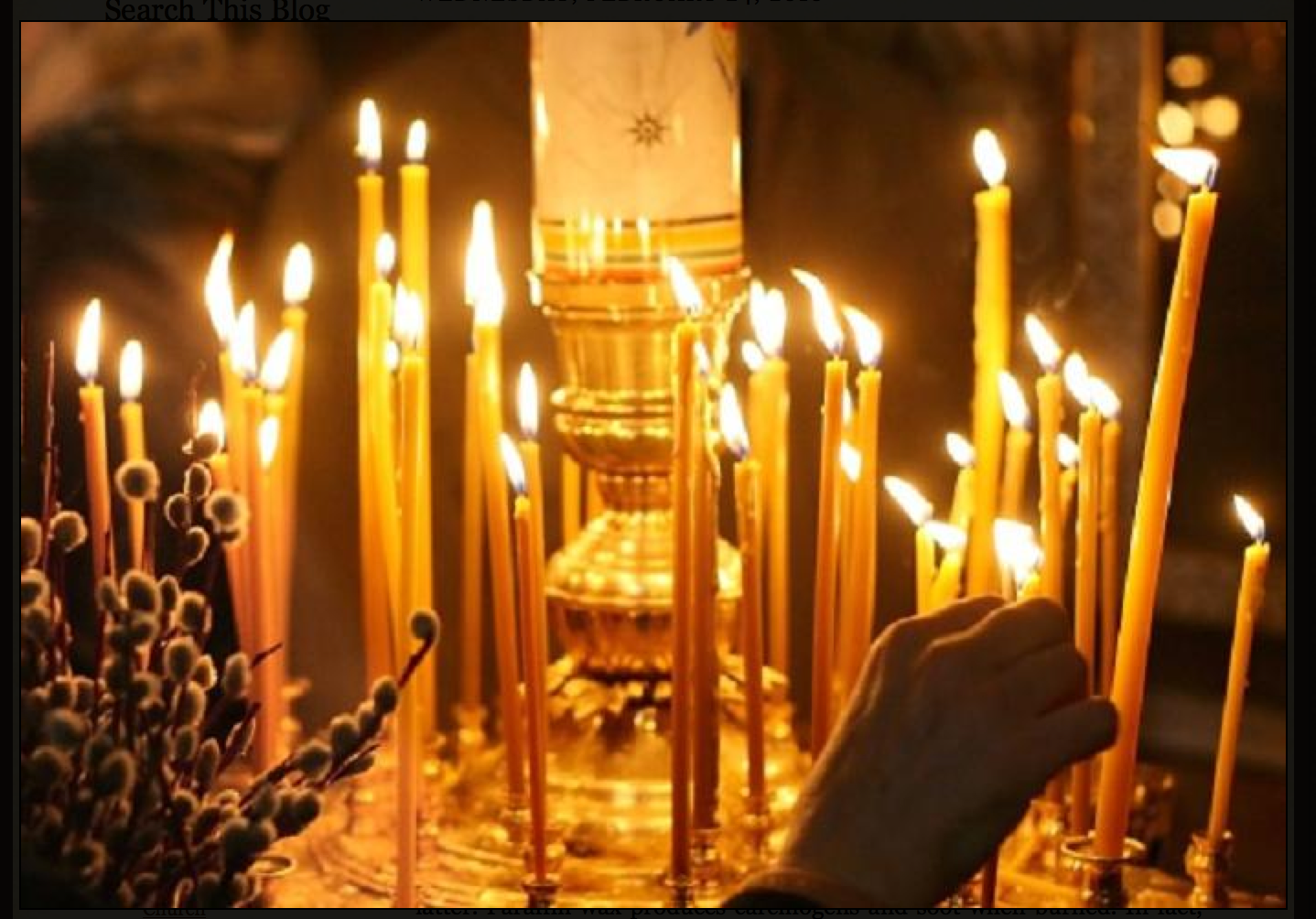
Lighting candles (source)

St. Paisios the Athonite on Prayer and Lighting Candles

Elder, when we light a candle, do we say that it is for some purpose?

-You are lighting it, but where do you send it? Aren't you sending it somewhere?

With a candle, we are seeking something from God. When you light it, you should say: "For those who are suffering in body and soul", "for those who have the greatest need", and among them is also the living and the reposed.

Do you know how much rest the departed sense when we light a candle for them? Thus, one has spiritual communication with the living and with the reposed.

The candle, in a few words, is an antenna*** that brings us into communication with God, with the sick, with the departed, etc.

***Note: St. Paisios is cleverly showing the resemblance of the words "κεράκι" and "κεραία" ("Candle" and "antenna") in Greek.

  
Through the prayers of our Holy Fathers, Lord Jesus Christ our God, have mercy on us and save us! Amen!

Wednesday, August 5, 2020

"Trinities of Saints", by Monk Arsenios

Famous depiction of the prefiguration of the Holy Trinity by Rublev (source)


"According to the grace-filled expression of our Saints: “The Holy Spirit is the head of the household of the Orthodox Church”…Without His presence, all the deeds and the Mysteries of the Church remain invalid, dead. Thus, great is our rejoicing and exaltation when we see how the Holy Spirit has not abandoned His Orthodox Church even to our days…


"Therefore, among the infinite gifts of the Holy Spirit to His Church, we see a most-beautiful and grace-filled phenomenon, in other words, throughout the centuries, we see revealed trinities of Saints, and this is not by accident.


Patriarchs Abraham, Isaac and Jacob (source)


"We see this begin with the three Forefathers and Patriarchs of the Jewish people: Abraham, Isaac and Jacob.


"Though we do not see the same with the Apostles***, after a few centuries, we see shining forth the Three Hierarchs: Basil the Great, John Chrysostom and Gregory the Theologian.


The Three Great Hierarchs and Ecumenical Teachers: Sts. Basil the Great, Gregory the Theologian and John Chrysostom (source)


[***Note: One could argue that Christ highlighted the Apostles Peter, James and John at His Holy Transfiguration]


"The next trinity are the great Venerable Ascetics Sts. Anthony, Euthemios and Savas the Sanctified.
  
Three Great Desert Fathers: Sts. Anthony the Great, Euthemios and Sabbas the Sanctified (source)
 
"After several centuries shown forth three Saints who conquered the terrible heresy of papism: Photios the Great, Gregory Palamas and Mark of Ephesus.

Three Great Pillars of Orthodoxy: Sts. Gregory Palamas, Mark of Ephesus and Photios the Great (source)
  
"And, while several centuries passed without this particularly pleasant phenomenon being seen, many Saints were recognized. However, in our days, even before our Holy Church recognized them as Saints, the faithful especially of the Church of Greece, had begun to paint the icon of three Holy Elders: Porphyrios, Paisios and Iakovos, whom our Church formally recognized a short time later. Behold, how in our days, which are especially evil ones, the Holy Spirit has given us a new grace-filled trinity of Saints, which many of us “have seen and touched with our hands.” (I Epistle of John 1:1)…

"They, in short, are three greatly loved Saints of our days. All three had as their calling the healing of the pain of wearied people. It is unable to overestimate their contribution…"
-Excerpt from "The Three Saints of our Days: Sts. Paisios, Porphyrios and Iakovos"

By Monk Arsenios of the Skete of Koutloumousiou, Mount Athos


Three Great Venerable Wonderworkers of the 20th Century: Sts. Paisios the Athonite, Porphyrios of Kavsokalyvia and Iakovos of Evia (source)
  
Through the prayers of our Holy Fathers, Lord Jesus Christ our God, have mercy on us and save us! Amen!

Tuesday, July 14, 2020

Elder Ephraim of St. Andrew's Skete on the Repose of St. Paisios

The wondrous body of St. Paisios the Athonite during his funeral (source)
  
"Gerontissa (Eldress) Philothei, from the Monastery of Souroti, told me that, as soon as St. Paisios reposed, his face shown, and his whole body began to pour forth fragrance and lightning!!! And he went from being very pale from his afflictions, to becoming totally white!

"A sign of his great humility and the many signs from God that he had in his life.

"St. Paisios had very many revelations, some of which he revealed to people, but he asked them to not make them known until he had died!

"His life was a martyrical one, and his battle with the devil and with the demons was not insignificant!

"To live one's whole life as a monk, this shows that he had a leonine soul, for otherwise he could not have withstood the attacks of the enemy, being totally alone."
-Elder Ephraim of St. Andrew's Skete, Mount Athos

(source)
  
Icon depicting the dormition of St. Paisios the Athonite (source)
  
Through the prayers of our Holy Fathers, Lord Jesus Christ our God, have mercy on us and save us! Amen!

Thursday, July 9, 2020

"Comfort, comfort my people, said the Prophet, for our God is a God of consolation..."

St. Paisios the Athonite (source)
  
Comfort, comfort my people, said the Prophet, for our God is a God of consolation. Therefore, you became like God, O God-bearer Paisios, becoming a spring of consolation, for you fed the souls of those hungry with the bread of your words, and you gave drink to those burning up amidst trials with the water of rest, and clothed those naked of virtues through your virtuous life, becoming a father, and brother and mother to strangers, and through your prayers, you granted healing, and even after your repose, you visit them, O Venerable Father, granting them rest through your prayers. And now, as you have become an inheritor of the kingdom of Christ, do not cease to be our benefactor, and heal the passions of our souls and bodies.
-Doxastikon of the Aposticha from the Feast of St. Paisios the Athonite
  
(source)
  
St. Paisios the Athonite (source)
  
Through the prayers of our Holy Fathers, Lord Jesus Christ our God, have mercy on us and save us! Amen!

Wednesday, December 4, 2019

The Answer to "Why me?"

The Crucifixion of Christ (source)
  
"The answer to 'Why me?', to the sorrows that occur for you, are you yourself."
-St. Sophrony of Essex
   
"The greatest humility is for our nous to submit before the mysteries of God, and not to ask "how" and "why".
-Blessed Ierotheos of Hydra
  
"After our death, when we face Christ face to face, we will understand the 'why' and 'how' of our life, and He will explain to us everything that we passed through in that world. Then, with the whole strength of our being, we will tell Him: 'Thank you, my God, that You allowed those things to happen to me!'"
-St. Paisios the Athonite

(source)
  
Through the prayers of our Holy Fathers, Lord Jesus Christ our God, have mercy on us and save us! Amen!

Tuesday, November 19, 2019

Recent Repose of Two Contemporary Elders of Greece

Blessed Eldress Styliani (Karatzogianni) of the Holy Monastery of Christ Pantocrator, Ntaou Penteli (+ October 8th, 2019) (source)
  
Gerontissa (Eldress) Styliani, Abbess of the Holy Monastery of Ntaou Penteli (+ October 8th, 2019)
On October 8th, 2019, the blessed Eldress of the Monastery of the Transfiguration of Christ, Ntaou Penteli, reposed in the Lord.

Eldress Nun Styliani was born on September 14th 1933 as Angeliki Karatzogianni, in Neochorion, Mesolongi. She completed elementary school in Neochorion, Masolongi, and Middle School in Nicea. At the age of 21, she became a novice at the Holy Monastery of Ypapanti (the Meeting) of the Lord in Kalamata under the guidance of Blessed Elder Joel Giannakopoulos and in September 1958, she entered the Holy Monastery of St. Patapios in Loutraki. There she became a rasophore nun on Palm Sunday 1950.

On March 9th 1963, through the activities of the then Archbishop Chrysostomos of Athens and All Greece, her Eldress, Styliane Gousopoulos, together with five other nuns from the Holy Monastery of St. Patapios, rebuilt the Holy Monastery of Christ Pantocrator Ntaou Penteli in the Holy Archdiocese of Athens.

On the feast of Theophany, 1963, the enthronement of the first Eldress Styliani occurred, but also the tonsure to the great-schema of the later Abbess by the blessed Archbishop Ieronymos I of Greece. The repose of the first Abbess occurred on September 6th, 1974, and on October 15th of the same year, blessed Eldress Styliane Karatzogianni was elected unanimously as the new Abbess of the Monastery. Her enthronement occurred under the blessed Archbishop Seraphim of Athens and All Greece.

During the period of her Abbacy, the Holy Monastery of Christ Pantocrator Ntaou Penteli came to know great spiritual flowering. It gathered a great sisterhood of young nuns, and the Monastery was rebuilt from the foundations.
(source)
  
See here for more on the Blessed Abbess Styliani's relationship with St. Porphyrios at the Monastery of Ntaou Penteli.
  
Picture of St. Paisios the Athonite (center), together with blessed Elder Gregory (right) and Eldress Euphemia (left), at the Holy Monastery of the Precious Forerunner, Metamorphosi, Halkidiki (source)
  
Elder Gregory (Papasotiriou), spiritual father of the Holy Monastery of the Precious Forerunner, Metamorphosi, Halkidiki (+ November 19th, 2019)
After many years of struggle, Elder Gregory (Papasotiriou), the spiritual father and founder of the Holy Monastery of the Precious Forerunner, Metamorphosi, Halkidiki, reposed in the Lord. He was a spiritual child of St. Paisios the Athonite.

The blessed Elder was ordained a deacon and a priest by the blessed Metropolitan Synesios of Kassandreias (Visvine), and was placed as a preacher of the Holy Metropolis of Kassandreias.

In 1977, with the blessing of Metropolitan Synesios, and through the spiritual guidance of St. Paisios the Athonite, he founded the women's hesychasterion of the Precious Forerunner, in Metamorphosi, Halkidiki, with the first nuns, Eugenia and Maria Choriataki, Sophia Kenanidou from Metamorphosi, Halkidiki, and nuns Tsaprazolou from Vatopedi, Halkidiki.

The blessed Elder Gregory was a spiritual child of St. Paisios the Athonite, and under his spiritual guidance, he received the angelic schema, and under his direction and blessing, he became the spiritual father of the Holy Monastery of the Precious Forerunner, which today includes 50 nuns.
(source)
  
Elder Gregory (right) (source)
  
May the Lord grant them a blessed repose and a blessed Paradise, and may we have their blessings!
  
Through the prayers of our Holy Fathers, Lord Jesus Christ our God, have mercy on us and save us! Amen!

Friday, October 25, 2019

A joyous reflection on the Newly-canonized Saints

Icon of our Venerable Father Sophrony of Essex (source)
  
Note: This is a pious reflection by a layman on the joy being experienced at the newly-announced upcoming canonization of new Saints of our Church. In a world with so much pain, sorrow, suffering and hatred (along with painful divisions among Orthodox Christians), we are thankful for these tokens of joy given by our Lord. We pray that these new Saints will entreat Him that peace be granted to the whole world, and especially that all hatred, divisions and animosity be dissolved between Orthodox Christians, and that we all might be granted love, humility, peace and unity in the Holy Trinity!
  
A joyous reflection on the Newly-canonized Saints
It feels like this is a festival without end--the joy of Pascha--which was given to us as a"mouth" and "voice" and expression of the Church by our Ecumenical Patriarch Bartholomew!
These announcements allow us to see a bit of heaven through the pure eyes and sweet hearts of our new Saints!
And this vision full of fruit is not from an individual!
It is in common, it is of the Church!
Many years to you, All-holiness! Fervent thanks!
Another spiritual father of ours, another radiant and true seeker of the truth, a delicate and gracious character, a cultivator of the spiritual life, a poet of the Divine Spirit, a universal and ecumenical rector of the teaching of Orthodox spirituality, the Athonite (cenobite, ascetic, confessor and spiritual father), the Russian, the Patron of Essex as the founder of the Holy Monastery of the Precious Forerunner, the Hieromonk, the Archimandrite Father Sophrony (Sakharov) is "consecrated" formally as a Saint of our Church!
We confess that we are experiencing unique moments!
"It is good for us to be here!"
Within this resurrectional atmosphere and joy!
The Saints show us and reveal to us how death was conquered!
They lived the Resurrection, during this life! Not [only] after their dormitions!
We are truly experiencing a Pascha--more properly, many together--in the face of every Saint of ours, as a victor over death!
And of course, this is occurring before the Autumn Pascha, the feast of St. Demetrios, which his hometown of Thessaloniki celebrates together with the Most-holy Theotokos!
Thus, with those eternal Children--"those to whom belongs the Kingdom of Heaven", our new Saints, from the Garden of Panagia, will shine especially this year within this Pascha and festal atmosphere. (We sense that our new Saints will stand beside us at the procession of the Holy Relics and the Icon of the Great Martyr and Myrrhstreamer St. Demetrios, throughout the radiant streets of Thessaloniki, together with those who are celebrating together, this year along the Panagia Soumela of Pontos.)
Because of this, amidst the autumn we could say:
"Today it smells of springtime, and new creation dances!"
The heaves are rejoicing together with us!
The heavens and the earth are united through our new Saints!
It seems like everything is occurring easily and speedily, beautifully, very spacious and beautiful!
And let beauty save the world! Our Saints!
The stars that illumine our darkness--internally and externally--with the Uncreated Light, which they experienced, tasted, lived!
They are our neighbors, who approach and stand in heaven!
Our fathers, our inspirers, and our guides!
Our mediators and intercessors!
And we don't know if they are gifts from Heaven to the earth, or from earth to Heaven! They may be both!
Once again, let us remember the names of our new Saints, mentioned previously, and how even this serves as a guide of noetic prayer:
The Venerable Daniel of Katounakia, Monk
The Venerable Joseph the Hesychast, Monk
The Venerable Ieronymos of Simonopetra, Hieromonk,
The Venerable Ephraim of Katounakia, Hieromonk,
The Venerable Sophrony of Essex, Hieromonk!

A beautiful icon depicting the five Athonote Fathers that were canonized together at the same time by the Ecumenical Patriarchate: (left to right) Sts. Ieronymos of Simonopetra, Daniel of Katounakia, Joseph the Hesychast, Ephraim of Katounakia, and Sophrony of Essex (source)

And we will not shy away at this time from remembering those other newly-canonized Saints:
The Venerable Porphyrios of Kavsokalyvia, Hieromonk
The Venerable Paisios, Monk!
In reality, we sense that we are partaking of a surpassingly radiant Athonite festival, with all of the polyeleoi of the Monasteries, Sketes, Kathismas, Cells, Kalyves encircling with joy and illumines, while the Fathers, full of rejoicing, chanting together and harmoniously:
"It is meet and right", "It is meet and right", "It is meet and right!"
And of course, they are celebrating full of light and with heavenly thoughts and good works lightning with grace even the Athonite dens and caves,  the makeshift, temporary and insignificant dwelling-places and adornments of ascetics and hermits...
And this occur with the unseen ranks of naked hermits, adorned, extraordinarily, with raiment shining with light!
The Light of Christ illumines all!
New Saints of the Church!
Fathers, teachers, and preservers of the World!
We owe them very much!
Our lives!
Intercede for us!
Or, another way: Stand besides us!
And note:
The dark and inhumane and criminal 20th century seems to become more humane from the light of so many auspicious Saints of the Orthodox Church!
Most likely, all of these Saints of the 20th Century serve as confirmation that: "where sin abounds, grace super abounds!"
And we live this fullness of grace through our Saints in our days!
Christ is risen!
-by Stelios Koukos
(source)
  
Icon of the New Choir of Venerable Athonite Fathers: Joseph the Hesychast, Ephraim of Katounakia, Porphyrios of Kavsokalyvia and Paisios the Athonite (source)
  
Through the prayers of our Holy Fathers, Lord Jesus Christ our God, have mercy on us and save us! Amen!

Thursday, July 11, 2019

"Blessed are you, O God-bearer Paisios..."

Icon of Jesus Christ as he was described by St. Paisios to the Nuns of Souroti Monastery after his divine visions of the Lord (source)
  
Blessed are you, O God-bearer Paisios, for you were made worthy to behold the comely beauty of Christ God, He Who is all light, all sweetness, all inexpressible beauty. Therefore in ecstasy you cried out, saying: How could men dare to spit upon Your radiant face, O Lover of mankind? How could I the wretched one be made worthy to behold this sight, of which only some of all of the struggles of the ascetics from the ages were made worthy to behold? Now, therefore, O all-blessed and Venerable One, as you ceaselessly behold Christ the Savior face-to-face, we entreat that you intercede for us on the Day of Judgment that we be made worthy, with an unhindered conscience, to behold His face.
-from the Litia of the Great Vespers for St. Paisios the Athonite

(source)
  
St. Paisios in prayer (source)
  
Through the prayers of our Holy Fathers, Lord Jesus Christ our God, have mercy on us and save us! Amen!

Wednesday, July 10, 2019

St. Paisios the Athonite on the Condition of the Modern World

This is a short but poignant audio recording of St. Paisios the Athonite with English subtitles in which he discusses the condition of modern man with regards to faith, works, thoughts, etc., and how to receive the true joy and peace of God. May he intercede to the Lord for us all and for all who are sick, suffering and distressed throughout the whole world! (source)
  
St. Paisios the Athonite (source)
  
Through the prayers of our Holy Fathers, Lord Jesus Christ our God, have mercy on us and save us! Amen!

Tuesday, July 2, 2019

Another prayerful encounter between Sts. Paisios and Porphyrios

Sts. Porphyrios of Kavsokalyvia and Paisios the Athonite (source)
  
The relationship between Sts. Porphyrios and Paisios was one of love and spiritual communication. Once, St. Paisios came to the little cell that St. Porphyrios had at first, and after they said whatever they said, St. Paisios left.

Then I went there, full of curiosity, to St. Paisios and told him: "What did you talk about, Elder? What did you discuss?"

He told me with disarming simplicity: "Eh, the 'Lord Jesus Christ... [i.e. the Jesus Prayer]"

I expected them to discuss the 666, the 12 bishops, or various ecclesiastical topics. But they prayed together. They found an opportunity to pray together, to "breathe together" in prayer.
  
(from Georgios Arvanitis, from the book, "O Dikos mou Paisios, by Antoni Makatouni and Kosta Pappa, source)
  
Sts. Paisios and Porphyrios (source)
  
Through the prayers of our Holy Fathers, Lord Jesus Christ our God, have mercy on us and save us! Amen!

Wednesday, June 26, 2019

St. Paisios the Athonite: "How have men become like this! Like animals!"

St. Paisios the Athonite (source)
   
Someone told me: "They say that Athens is a 'jungle', but no one leaves from there! They all call it a 'jungle' and everyone gathers in the jungle." How have men become like this! Like animals! Do you know what animals do? In the beginning they enter a stable, and soil it with dung and urinate...Afterwards, the dung begins to break down. As soon as it breaks down, it feels warm. And their hearts can't bear to leave the stable, they are comfortable. Thus people, I want to say, sense the warmth of sin and it makes their heart not want to flee. They understand that it wreaks, but from that warmth their heart does not want to leave. Yes, if one were to go now into the stable, he couldn't stand the stench. Another who is continuously in the stable is not bothered by it, he has gotten used to it.
-St. Paisios the Athonite

(source)
  
Through the prayers of our Holy Fathers, Lord Jesus Christ our God, have mercy on us and save us! Amen!

Wednesday, April 10, 2019

St. Paisios on the Donkey that carried Christ

Christ's Entry into Jerusalem on Palm Sunday (source)
  
I would want very much to be the little donkey that carried Christ, and later I would cry [for Him]!
-St. Paisios the Athonite
  
Through the prayers of our Holy Fathers, Lord Jesus Christ our God, have mercy on us and save us! Amen!

Thursday, February 28, 2019

St. Paisios the Athonite on Death, Prayer for the Departed and the Last Judgment

The classic iconographic type depicting the dormition of St. Ephraim the Syrian, with the choirs of his beloved fellow monastics coming from afar to venerate him and pray for him (source)
  
LIFE AFTER DEATH
by Saint Paisios of Mount Athos
  
--Geronda [Elder], when a person dies, does he become immediately aware of his spiritual condition?
--Yes, he does, and says to himself, "What have I done?" But the result in fayda yok, [An expression in the Turkish language, which means: "There is no benefit, there is no progress or success".) that is, this awareness is of no benefit. This can be likened to a drunk man who kills his mother and goes on singing and laughing, but who, upon becoming sober and realizing what he has done, will wail and lament and say, "What have I done?" In much the same way, those who commit wrongdoings in this life are like drunken men. They don't understand what they're doing; they don't have a sense of their guilt. But when they die, this "drunkenness" disappears and they become aware of their real condition. The eyes of their soul are opened and they realize their guilt, because the soul, when separated from the body, moves, sees and perceives with an inconceivable speed.
  
Some people ask when the Second Coming will take place. But for the person who dies, the Second Coming is, in a way, taking place, because he is judged on the basis of the state in which he is found at the time of death.
  
--Geronda [Elder], in what state are the souls of the tormented found at this time?
--They are indicted, imprisoned, and suffer in accordance with the sins they had committed; and they await the final trial, the future Judgment. There are those who have been indicted, facing heavy sentences, and those who have been indicted, facing lighter sentences.
  
--What about the Saints and the thief? (St. Luke 23:32-33 and 39-43)
--The Saints and the thief are in Paradise; but they have not received the final glory, just as those who have been indicted are in hell but have not received the final sentence. Even though God has taught us from centuries ago: "Repent ye, for the Kingdom of Heaven is at hand?" (St. Matthew 3:2 and 4:17) He extends the time more and more, because He waits for us (with the pronoun "us", the Elder means all of humanity) to correct ourselves. But we, by remaining in our (unrepentant) misery, are unjust to the Saints because they cannot receive the final glory, which they are to receive after the future judgment.
  
St. Paisios the Athonite (source)
  
PRAYER AND MEMORIALS FOR THE DEPARTED
  
--Geronda [Elder], can the indicted souls who await trial pray?
--They are aware of their condition and seek help, but they cannot help themselves. Those who are in Hades desire only one thing from Christ: to live for five minutes in order to repent. We, who live, still have time for repentance, but those unfortunate ones who have fallen asleep cannot improve their condition on their own; they await help from us. This is the reason why we have an obligation to help them with our prayer.
  
--It is my belief that only about ten percent of the indicted dead awaiting trial are, as the demons do. They don't seek any help, and they also reject all help. For what can God do for them? It's like a child who has alienated himself from his father, squanders all of his property, and on top of that, curses him. What can his father do for him? But the other indicted ones, who still have a little philotimo, are aware of their guilt. They repent and are tormented because of their sins. They ask to be helped and are helped through the prayers of the faithful. [Saint Nectarios, in his study, A Treatise on the Immortality of the Soul and on the Sacred Memorials, ed. Basil Regopoulos, Thessaloniki 1973, p. 202, writes as a conclusion to what he developed on the basis of the witness of the Holy Fathers: "On the basis of all the above, it becomes clear that the soul after death is unable to do any solitary deed and be relieved from the indissoluble bonds of Hades. Only the Divine Liturgies, the prayers of family members, of the just, which are offered for them, including charity, become instrumental agents of deliverance and freedom from the bonds of Hades."] In other words, God provides an opportunity for them, now that they are awaiting trial, to be helped until the Second Coming takes place. And just as in this life when one who's a friend of the king can intercede and request help for someone awaiting trial, so, too, if one is "a friend" of God, he can intercede with prayer to God, and He can transfer the indicted souls of the dead from one "prison" to another, better one, from one "detention-cell" to another, better one. Or God may transfer them to a "room" or to an "apartment".
Just as we provide some comfort to the imprisoned with the refreshments and other material goods we bring to them, so are the dead refreshed by the prayers and the charity we execute for their souls. The prayers and the sacred memorial offered by the living for the dead are the final chance that God gives to the dead to be helped until the Final Judgment takes place. After the Judgment, there will no longer be any possibility for help.
  
God wants to help those who have fallen asleep because He cares about their ultimate salvation; but He does not help because He has a noble spirit. He does not want to give the devil the right to say: "How can you save him, since he did not labor to achieve it?" But when we pray for those who have fallen asleep, we give God the right to intervene. God is moved more by our prayers for the dead than by those for the living.
  
Kollyva offered for memorial services on the Saturday of the Souls as a symbol of the Resurrection, and out of love and compassion for our departed brethren (source)
  
This is the reason why our Church has the sacred memorials with the kollyva. [Kollyva (κόλλυβα): boiled wheat kernels. The wheat kernels express belief in everlasting life, according to what Jesus said, "Except a grain of wheat fall into the ground and die, it abideth alone; but if it die, it bringeth forth much fruit" (St. John 12:24). It is a tradition among Orthodox Christians to bring a tray of boiled wheat kernels to church for the Memorial Service.] Memorials serve as the best attorney on behalf of the souls of those fallen asleep. They even have the power to bring a soul out of hell. At every Divine Liturgy, we should pray with kollyva for those who have fallen asleep. The wheat has a symbolic meaning: "It is sown in corruption; it is raided in incorruption" (1 Cor. 15:42) according to Sacred Scripture. Some people can't be bothered to boil some wheat and instead bring raisins, cookies or other pastries so that the priest may bless those things. Up on the Holy Mountain, there are some elderly monks who will prepare kollyva for every Divine Liturgy for those who have fallen asleep in the hope of the Resurrection and for the Saint commemorated that day, in order to have his blessing.
  
THE FUTURE JUDGMENT
  
--Geronda [Elder], how is the soul purified?
--When a person observes the Commandments of God, working to be cleansed of one's own passions, then the mind is enlightened; it attains spiritual vision, and the soul becomes as resplendent as it was before the Fall of man. This is the condition he will be in after the resurrection of the dead. But one can see the resurrection of his soul before the General Resurrection only if he is cleansed entirely from the passions. Then, his body will be Angelic, incorporeal, and will not be concerned with material nourishment.
  
--Geronda [Elder], how will the future Judgment take place?
--In the future Judgment, the condition of each person will be revealed in an instant, and each person on his own will proceed to where he belongs. Each person will recognize, as if on a television screen, his own wretchedness, as well as the spiritual condition of others. He will reflect himself upon the other, and he will bow his head, and proceed to the place where he belongs. For example, a daughter-in-law who sat comfortably with her legs crossed in front of her mother-in-law, who with a broken leg took care of the grandchild, will not be able to say, "My Christ, why are you putting my mother-in-law into Paradise without including me?" because that scene will come before her to condemn her..." (Note: Saint of Damascus writes: "For no one should imagine that there will be no recognition of one person by another on that fearful Day of the Judgment. Yes, truly each person will recognize his neighbor, not through the shape of the body, but by means of the vision of the eye of the soul.")
  
The Good Thief in Paradise (source)
  
THE FUTURE LIFE
  
--Geronda [Elder], I have brought some sweets for you to offer to your guests.
--Look how happy they are with that! In the other life we will be saying to ourselves, "In what foolish things we found joy! What things inspired us then!" While now our heart flutters over such things.
  
--Geronda [Elder], how can we understand this at this point in time?
--If you understand this from now, you will not say it in the next life. In any case, those who are to be found up there will be faring well. Have you any idea what handicraft they do there in Heaven? They constantly glorify God. (Note: Saint Symeon the New Theologian writes: "On the fearful Day of Judgment each sinful person will simply see, standing opposite them in the eternal life and in that inexpressible light, their fellow human beings; and they will be judged by them." On Repentance, Logos 5)
  
--Geronda [Elder}, in the other life will those in Hell see those in Paradise?
--Look, just as those who are out at night in the dark can see those who are in a lit room, so will those who will be in Hell see those in Paradise. And this will be an even greater hell for them. So, too, just as those who are in a lit room at night can't see those who are out in the dark, so will those who are in Paradise not see those in Hell. For if the saved were to see those who are condemned in Hell, they would be pained and grieved over their suffering, and would not enjoy Paradise, where "there is no pain..." And not only will they not see them, but they won't even remember if they had a brother or a father or a mother, if they, too are not in Paradise". The Psalmist says, "On that very day his thoughts perish" (Psalm 146:4). For if they are to be remembered, how can it be Paradise? Moreover, those in Paradise will have no awareness of that existence of others, nor will they remember the sins they had committed. For, if they were to remember their sins, they would not be able to bear, out of philotimo, the thought of ever having grieved God. (Source: The Family Life by Saint Paisios of Mount Athos, Spiritual Counsels IV)
(source)
  
Icon of the Second Coming of Christ and the Last Judgment (source)
  
Through the prayers of our Holy Fathers, Lord Jesus Christ our God, have mercy on us and save us! Amen!

Wednesday, February 13, 2019

St. Paisios the Athonite on Abstinence as Martyrdom

St. Paisios the Athonite, depicted with St. Arsenios and St. Euphemia (source)
  
The abstinence and chastity of the young people will be considered as a martyrdom of the moral sense.
-St. Paisios the Athonite
  
(source)
  
Through the prayers of our Holy Fathers, Lord Jesus Christ our God, have mercy on us and save us! Amen!

Tuesday, November 27, 2018

Metropolitan Neophytos on St. Porphyrios and other Contemporary Saints

This is a wonderful talk in Greek (with English subtitles) by Metropolitan Neophytos of Morphou (Cyprus) on his experiences with St. Porphyrios of Kavsokalyvia and other contemporary Saints and Elders of the Orthodox Church. This occurred on his Eminence's recent visit to the Monastery of the Transfiguration in Milesi (outside of Athens). This monastery was built and spiritually guided by St. Porphyrios. Pilgrims to the monastery can venerate the cell of St. Porphyrios and many of his personal articles. The Bishop came as a simple pilgrim and was asked by the Abbess to give a talk after lunch about his relationship with St. Porphyrios. May the Saint help all those who need his help throughout the world! (source)
  
St. Porphyrios of Kavsokalyvia (source)
  
Through the prayers of our Holy Fathers, Lord Jesus Christ our God, have mercy on us and save us! Amen!

Thursday, July 12, 2018

St. Paisios the Athonite: "A world may come..."

St. Paisios the Athonite (source)
  
A world may come [one day] when people will no longer reconcile themselves with God.
-St. Paisios the Athonite
  
(source)
  
Through the prayers of our Holy Fathers, Lord Jesus Christ our God, have mercy on us and save us! Amen!

Wednesday, July 11, 2018

Sermon by Saint Paisios on Humility and Life in Christ

This is a wonderful recorded sermon of St. Paisios the Athonite given to pilgrims during his life on various topics, but especially on humility and life in Christ. May we have his blessing and intercessions!
  
Through the prayers of our Holy Fathers, Lord Jesus Christ our God, have mercy on us and save us! Amen!

Tuesday, July 10, 2018

Homily by Metropolitan Neophytos of Morphou on St. Paisios the Athonite

In anticipation of the upcoming feast of St. Paisios the Athonite, here is a wonderful talk by Metropolitan Neophytos of Morphou (Cyprus) about St. Paisios the Athonite, where he talks about his life, example, and miracles witnessed by those near him. The talk is in Greek but has subtitles in English. May St. Paisios help all those who are sick and suffer throughout the world!
  
Through the prayers of our Holy Fathers, Lord Jesus Christ our God, have mercy on us and save us! Amen!

Saturday, December 16, 2017

Metropolitan Neophytos of Morphou: The Raising of Children According to Contemporary Saints

   
This is a wonderful talk from a great Metropolitan of Cyprus, and spiritual child of St. Iakovos Tsalikis of Evia. Here, he uses the words and example of many contemporary Orthodox Saints from Greece and Cyprus to give good advice about the blessed marital relationship, pre-conception counseling, pregnancy, delivery, nursing, and the raising of children. This video has English subtitles. Please note that this does not negate or replace the personal pastoral care and advice of your parish priest / spiritual father who knows you and your family situation in a much more detailed and personal way. But may some of the words from these great Saints, including St. Porphyrios, St. Paisios, St. Iakovos and Elder Sophrony, inspire and encourage in this great task. 
   
“Let everything take second place to our care of our children, our bringing them up to the discipline and instruction of the Lord. If from the beginning we teach them to love true wisdom, they will have great wealth and glory than riches can provide."
-St. John Chrysostom
       
Sts. Paisios the Athonite and Porphyrios of Kavsokalyvia (source)
  
Through the prayers of our Holy Fathers, Lord Jesus Christ our God, have mercy on us and save us! Amen!

Thursday, November 30, 2017

Akathist to St. Iakovos Tsalikis of Evia (+1991)

St. Iakovos Tsalikis of Evia (+1991) (source)
  
Note: The following is a from the Greek text, offered for the many who love the Saint and who benefit from his speedy help. Also note that the meter of this translation is not set to match the original music.
  
St. Iakovos of Evia (source)
  
Akathist to our Venerable Father Iakovos, who lately shown forth in Evia,
translated from the Greek text written by Dr. Charalampos Bousias  
  
St. Iakovos of Evia (source)
  
Kontakion in the Plagal of the Fourth Tone. O Champion General.
In Evia you lived practically, and were adorned with the pure roses of virtues, giving fragrance to your fellow refugees in these latter days, O Father, you who equalled the feats of the sacred David [of Evia] and the most sympathetic deliverer of those who suffer, therefore we cry out: Rejoice, O blessed Iakovos.
   
You were shown forth to be a light-bearing angel to us in our days, O Iakovos, lover of God (3), for you ceaselessly directed your nous towards God, having also trampled upon the enemy through asceticism, therefore we cry out to you:
Rejoice, O pillar of chastity,
Rejoice, O lamp of spotlessness.
Rejoice, dwelling-place of the Three-Sun Godhead,
Rejoice, offspring of Livisiou of Makri.
Rejoice, newly-illumined light of God-bearing ascetics,
Rejoice, abyss of humility and canon of mindfulness.
Rejoice, you who granted heavenly gifts to those who came to you,
Rejoice, you who watered them with mystical rain.
Rejoice, icon of the wisdom of the Creator,
Rejoice harbor of love of the age to come.
Rejoice, radiant ray of sympathy,
Rejoice, standard of prayer and fasting.
Rejoice, O blessed Iakovos.
   
You followed the steps of the former desert ascetics in these days, O Father, and showed forth the Monastery of St. David to be a strong valve of the steadfast, O Iakovos, who ceaselessly cry out to God at your struggles, Alleluia.
   
O holy one, you were an offspring of Livisiou, and from your childhood days you traveled paths as a refugee, tasting bitterness, and were deprived of bread for your food, while the faithful you made fully fed, who therefore cry out to you these things:
Rejoice, bread of the hungry,
Rejoice, lighthouse of those storm-tossed.
Rejoice, you who granted the water of salvation to all,
Rejoice, you who trampled upon the enemy who hates good.
Rejoice, fruitful tree distributing fruits,
Rejoice, most radiant star of divine sympathy.
Rejoice, for your made full the hearts of those hungry,
Rejoice, for you cast out every tribulation for those close to you.
Rejoice, you who grant joy to the faithful,
Rejoice, corruption, casting away the demon.
Rejoice, image of the life in Christ,
Rejoice, standard of the modest life.
Rejoice, O blessed Iakovos.
   
Having received divine power, you escaped the traps of childhood, and kept the robe of your soul chaste and white, ever casting out evil words far from you, O venerable Iakovos, and we cry out with fervor: Alleluia.
   
You hastened to the Monastery of the Venerable David as a deer to the springs of waters, and you were filled with true asceticism as a gift from God, O venerable one, watering with the streams of joy those who cry out to you in faith:
Rejoice, the well of steadfastness,
Rejoice, the nectar of gladness.
Rejoice, example of the monastic way,
Rejoice spiritual pillar of beauty.
Rejoice, most fragrant myrrh of the truly pure life,
Rejoice, star shining with the rays of grace to the faithful people.
Rejoice, for you quench the fires of the flesh,
Rejoice, for you pour forth gifts of healing.
Rejoice, ever-flowing river of wonders,
Rejoice, fierce striker of the demons.
Rejoice, through whom evil is conquered,
Rejoice, through whom every mortal is strengthened.
Rejoice, O blessed Iakovos.
   
Having a burning faith, you gave yourself to a multitude of struggles, and softened your flesh as wax, O ascetic, that your nous might be winged towards our Lord and God, O all wondrous Iakovos, to Whom you chanted in a spotless tongue: Alleluia.
   
The godly-minded David heard your fervent prayer, O divine Iakovos, and not only made you to serve in his monastery, O Father, but made you the sacred Abbot, O Iakovos, to whom we cry out:
Rejoice, the might of young chastity,
Rejoice, the boast of divine fasting.
Rejoice, you who were zealous for the deeds of the Fathers,
Rejoice, you who trampled upon the roaring of the enemy.
Rejoice, earthly angel, communicant with the Venerable,
Rejoice, heavenly man, guide on the monastic way.
Rejoice, for you lately lived ascetically on Evia,
Rejoice for you rightly were granted the crown of glory.
Rejoice, paintbrush of the graces of the Spirit,
Rejoice, newly-radiant lamp of purity.
Rejoice, deposer of shameful passions,
Rejoice, imitator of God-bearing men.
Rejoice, O blessed Iakovos.
   
Wishing to imitate the ways of the divine David, you approached him man-to-man every evening, O wise one, and throughout the whole night, O Father Iakovos, you chanted to the Creator, and mystically chanted, crying out: Alleluia.
   
St. Iakovos Tsalikis of Evia (source)
   
Dawned from amidst the dark clouds of winter, O Iakovos, a light-bearing star truly lit your path towards the sacred cave of the venerable David, which through prayer became your palace, therefore we cry out these things:
Rekoice, equal in honor to the Angels,
Rejoice, equal in deeds to the Venerable.
Rejoice, radiant workshop of prayer,
Rejoice, treasury of the divine life.
Rejoice, for you enlightened Greece with your rays,
Rejoice, for you watered them with your pious teachings.
Rejoice, the radiant guide towards poverty.
Rejoice, the God-loving practitioner of righteousness.
Rejoice, never-ending river of tears,
Rejoice, unconquerable flailing of the demons.
Rejoice, the new pride of the faithful,
Rejoice, the radiant vessel of grace.
Rejoice, O blessed Iakovos.

You became an inhabitant of perfect love towards your neighbor, ceaselessly praying on behalf of those near you, and for those who are terribly suffering, O Father. Speedily hasten to the aid of those who approach you in faith, and cry out loudly: Alleluia.

  
Shining in Evia as a newly-illumined moon, you enlightened with the rays of your simple words the rational flock dwelling in the dark and moonless night of ignorance, O all-precious one, therefore we who have been radiantly illumined cry out these things:
Rejoice, the healing of the sick,
Rejoice, the support of the storm-tossed.
Rejoice, most-radiant light of poverty,
Rejoice, most-bright lamp of fasting.
Rejoice, for you gladdened the choir of the faithful,
Rejoice, for you saddened the enemy who hates the good.
Rejoice, the newly-built foundation of the Church,
Rejoice, the one in extreme piety.
Rejoice, sweet nourishment of my soul,
Rejoice, present boast of my heart.
Rejoice, appearance of the heavenly light,
Rejoice, river of many kinds of wonders.
Rejoice, O blessed Iakovos.

The island of Evia magnifies your painful struggles with much endurance, O Iakovos, and everyone perceives you to be the protector of those who are sick, and takes boast in you, O Elder and leader of the Monastery of St. David, and in response to your sacred intercessions, cries out: Alleluia.
  
You purified your nous with vigil, fasting, and utter humility, and were lifted up to the heights of virtues of all kinds that are difficult to gaze upon, O spotless priest Iakovos, and you move your refugees to cry out ceaselessly:
Rejoice the chisel of dispassion,
Rejoice, the foundation of chastity.
Rejoice, the partaker of unspeakable grace,
Rejoice, the beloved of Christ the Master.
Rejoice, for you neglected earthly and passing things,
Rejoice, for you desired the wondrous things of heaven.
Rejoice, all-radiant lamp enlightening those in darkness,
Rejoice, unassailable pillar making firm the storm-tossed.
Rejoice, foundation of meekness,
Rejoice, ruler of humility.
Rejoice, you who beheld the beauty of God,
Rejoice, you who ever behold His radiance.
Rejoice, O blessed Iakovos.
  
Truly a strange hearing! How you trampled upon scorpions, O wise one, and through your prayer were unmoved by the assalts of the enemy, O Elder and Father, and remained glorifying the King of all with spotless lips, chanting: Alleluia.
  
You were shown to be wholly sanctified in our days, O all-blessed Iakovos, for you renounced every vile and dark pain and with prayer shown as the sun with goodness. Therefore, we cry out to you these things:
Rejoice, divine preacher of simplicity,
Rejoice, trumpet of modesty to all.
Rejoice, heavy-laden vine of piety,
Rejoice, the great teacher of the spiritual life.
Rejoice, undiminished type of the ancient ascetics,
Rejoice, very precious boast of monastics in asceticism.
Rejoice, for you endured deprivations upon the earth,
Rejoice, for you trampled upon the conceit of the enemy.
Rejoice, canon of righteous asceticism,
Rejoice, icon of love and watchfulness.
Rejoice, famed leader of your monastery,
Rejoice, radiant lamp of virginity.
Rejoice, O blessed Iakovos.
  
You were shown to be a newly-founded tower of chastity and perfect love, O Iakovos, and therefore we have come to know you to be a divine and joyous myrrh-container of discernment, O precious one, and we cry out to you mystical hymns: Alleluia.
  
You watered the all-sacred monastery of the venerable David with rivers of your sweat, and in it bore as fruit steadfast monastics who desire to see the Lord, O Iakovos, and who now cry out these things:
Rejoice, fragrance of asceticism,
Rejoice, lyre of the faith.
Rejoice, swallow of the godly mindset,
Rejoice, lamp of eternal resolve.
Rejoice, golden crown of heavenly virtues,
Rejoice, golden cloud richly granting healings.
Rejoice, most-precious shield of goodness,
Rejoice, shelter from the delusion of the crooked-mouthed enemy.
Rejoice, perfect fragrance of asceticism,
Rejoice, you who turn away shameful delusion.
Rejoice, sower of fruit of much prayer,
Rejoice, planter of God-pleasing plants.
Rejoice, O blessed Iakovos.
    
The ranks of the Orthodox gathered from all ends of creation to bury your joyous and wondrous body, and the people seeing you blessed you, O venerable and blessed Iakovos, and were moved to faith, crying out: Alleluia.


St. Iakovos of Evia, "O Me Sychoreire", or "The 'Forgive me'" (source)

  
You are a sheltering wall for the people of Evia in truth, and a most-fervent protector of those who approach you, and your intercessions to God which you offer daily, O ascetic. Therefore, we hasten that we might be protected through your grace, crying out to you in reverence:Rejoice, vessel pouring forth healings,
Rejoice, attacker of the error of the enemy.
Rejoice, divine bouquet of asceticism,
Rejoice, newly-built foundation of watchfulness.
Rejoice, new support of the faith of Christ,
Rejoice, pillar of purity and the monastic way.
Rejoice, for you sanctified the forests of Evia,
Rejoice, for you beautified the choirs of your monastery.
Rejoice, the divine adornment of the faithful,
Rejoice, our defender in dangers.
Rejoice, deliverer of your refugees,
Rejoice, the consolation of all the faithful.
Rejoice, O blessed Iakovos.
  
You did not give rest to your eyelids, or repose to your divine head, O Father, until your spirit proceeded to the hand of God, O new beloved one among ascetics, and you gave up your spirit, joining the chorus that sweetly hymns the Creator: Alleluia.
 
You were shown to be a true friend of Christ, the height of things desired, Whom you desired from childhood, O Iakovos. Therefore, you have become a divine word and sacred deed, a prototype of chastity, and therefore, the ascetics cry out:
Rejoice, the adornment of the unmarried,
Rejoice, the protection of mankind.
Rejoice, lifting up towards the deeds of the venerable,
Rejoice, imprint of the wisdom of God.
Rejoice, holy communicant with the heavenly armies.
Rejoice, blessed man and director towards God.
Rejoice, divine manna that nourishes the hungry,
Rejoice, comely mouth that drives away evil.
Rejoice, unwaning light that shines like fire,
Rejoice, adornment of the faithful people.
Rejoice, you who burn up the brushwood of nature,
Rejoice, fire that quenches delusion.
Rejoice, O blessed Iakovos.
  
You impart grace to all from the uncreated Trinity, for you were made worthy to see things aforetime, and to guide the faithful towards eternal life, and perfect joy, O Iakovos, therefore we piously hymn you, crying out: Alleluia.
  
You taught to chant with contrition unto the Savior of all, O Iakovos, and all entreat your help, that we receive grace richly from on high. Therefore, the faithful hasten to cry out to you things like this:
Rejoice, container of asceticism,
Rejoice, myrrh-vessel of simplicity.
Rejoice, adornment of Northern Evia,
Rejoice, guide towards the perfect life.
Rejoice, unassailable wall of love for Christ,
Rejoice, sword that cuts apart the roaring of the evil enemy.
Rejoice, for you spoke to the Saints as to friends,
Rejoice, for you now dwell with them in the heavenly mansions.
Rejoice, fellow-dweller with the divine David,
Rejoice, new enemy of satan.
Rejoice, shield against the invisible foe,
Rejoice, sweetness in the soul of your entreater.
Rejoice, O blessed Iakovos.
  
O fervent defender of those who hasten to you, and river of many kinds of wonders (3), with the clouds of your intercessions, rain upon us peace, and grant us your blessing, O Iakovos, that we might chant unto you: Alleluia.
  
Sts. Porphyrios, Paisios and Iakovos the New Venerable Wonderworkers (source)

And again the Kontakion.
      
Apolytikion of St. Iakovos Tsalikis in the Plagal of the First Tone.

The prototype of discernment and modesty, the wonderworking leader of the Monastery of David the venerable, who plowed and sowed love in the hardened hearts of the God-bearing people, O Father Iakovos. Do not neglect to intercede with Christ on behalf of those who call upon you in faith.

     
Sts. David and Iakovos of Evia (source)
   
Through the prayers of our Holy Fathers, Lord Jesus Christ our God, have mercy on us and save us! Amen!