Showing posts with label Temptations. Show all posts

Wednesday, April 22, 2020

Elder Vasilios of Iveron on Pascha 2020

Christ is risen! Truly He is risen!
The Resurrection of Christ (source)

"This year, the Resurrection tells us many things. If it is true what we believe, and if we are living that which we chant, that "we celebrate the death of death, the deposition of Hades, and the beginning of another, eternal life" (Canon of Pascha), then we would fear for nothing. And every single threat increases the power of the presence of the risen Lord.

"That which occurred this year with the Coronavirus is a temptation, but all temptations are transformed into blessings. We chant "let us say, O brethren, even to those who hate us." (Doxastikon of Pascha) And those who hate us are waiting for our love, and those who do not believe are waiting for the power of our faith. Therefore, if one believes, through this trial he has celebrated the best Pascha this year. In order to have the best Pascha at the time when you cannot celebrate Pascha, one must sense the power of the Risen One, and thus have community with all men.

"And while a temptation such as an illness can create problems, it can reveal the presence of the risen Lord. Amidst the messages and from within the souls of all men comes forth a consolation. The hymn of Kassiane says: "Who can recount the multitude of my sins, and the abysses of Your judgments, my soul-saving Savior?" On the one hand, there is the totality of sins and weaknesses. And on the other hand, there is an abyss of compassions, a bottomless ocean, where storms occur not just to clean out the debris that has accumulated in the lakes, but also to pour forth the element of healing.

"Therefore, the Church rejoices even more at the presence of the Risen One through this trial. And at the same time is also tested the material strength of our faith, and reveals the weakness of him who does not believe, but also, he who believes in himself and in his virtue. Therefore we have this current phenomenon. Some of the faithful--I don't know how to name them--trying to give consolation, condemn. They condemn the Church, and in essence, they reveal their own weakness. Therefore, let us thank the risen Christ, His Mother the Most-Holy Theotokos, and all the Saints who hold within them the Paradise of life.

"Let us entreat Christ to strengthen the truth of our humility, in other words, for us to sense our own weakness until our whole self is Christ. And then we can say together with the Apostle Paul: "For whether we live or die, we are with the Lord." Either we are living, or we are dead in the flesh, but our life is Christ. Therefore, "Christ is risen, and life reigns, Christ is risen, and not one dead remains in the tomb." (Paschal Homily of St. John Chrysostom) To Him belongs the glory and the might unto the ages of ages. Amen."
-Elder Vasilios (Gontikakis), former Abbot of Iveron Monastery, Mount Athos
(source)
  
Christ is risen from the death, by death, trampling down upon death, and to those in the tombs, He has granted life!
Truly the Lord is risen!

Wednesday, March 11, 2020

St. Joseph the Hesychast: "Even though you have fallen again, get up again."

Jesus Christ the Son of God the Savior of the world (source)
  
I received your letter, my child, and I saw your anxiety. But don’t be sad, my child. Don’t worry so much. Even though you have fallen again, get up again. You have been called to a heavenly road. It is not surprising for someone running to stumble. It just takes patience and repentance at every moment.
Therefore, always do a metanoia when you are wrong and don’t lose time, because the longer you wait to seek forgiveness, the more you allow the evil one to spread his roots within you. Don’t let him make roots to your detriment.
  
Therefore, don’t despair when you fall, but get up eagerly and do a metanoia saying, “Forgive me, my dear Christ. I am human and weak.” The Lord has not abandoned you. But since you still have a great deal of worldly pride, a great deal of vainglory, our Christ lets you make mistakes and fall, so that you perceive and come to know your weakness every day, so that you become patient with others who make mistakes, and so that you do not judge the brethren when they make mistakes, but rather put up with them.
  
So every time you fall, get up again and at once seek forgiveness. Don’t hide sorrow in your heart, because sorrow and despondency are the joy of the evil one. They fill one’s soul with bitterness and give birth to many evils. Whereas the frame of mind of someone who repents says, “I have sinned! Forgive me Father!” and he expels the sorrow. He says, “Am I not a weak human? So what do I expect?” Truly, my child this is how it is. So take courage.
  
Only when the grace of God comes does a person stand on his feet. Otherwise, without grace, he always changes and always falls. So be a man and don’t be afraid at all.
  
 Do you see how that brother you wrote about endured the temptation? You, too, should do likewise. Acquire a brave spirit against the temptations that come. In any case, they will come. Forget about what your despondency and indolence tell you. Don’t be afraid of them. Just as the previous temptations passed by the grace of God, these, too, will pass once they do their job.
  
Temptations are medicines and healing herbs that heal our visible passions and our invisible wounds. So have patience in order to profit every day, to store up wages, rest, and joy in the heavenly kingdom. For the night of death is coming when no one will be able to work anymore. Therefore, hurry. Time is short.
  
You should know this too: a victorious life lasting only one day with trophies and crowns is better than a negligent life lasting many years. Because one man’s struggle, with knowledge and spiritual perception that lasts one day, has the same value as another man’s struggle, who struggles negligently without knowledge for fifty years.
  
Without a struggle and shedding your blood, don’t expect freedom from the passions. Our earth produces thorns and thistles after the Fall. We have been ordered to clean it, but only with much pain, bloody hands, and many sighs are the thorns and thistles uprooted. So weep, shed streams of tears, and soften the earth of your heart. Once the ground is wet, you can easily uproot the thorns.
— Saint Joseph the Hesychast
(source)
  
St. Joseph the Hesychast (source)
  
Through the prayers of our Holy Fathers, Lord Jesus Christ our God, have mercy on us and save us! Amen!

Friday, November 22, 2019

St. Iakovos of Evia on Temptations and Marriage

St. Iakovos of Evia (source)
  
"Do not hope in the world. Be careful in your social interactions. Never listen to what the world is telling you. Temptations come; we're human. The devil has many feet, altars and traps. Everything will be faced during marriage with love, meekness and patience. Have faith in God and prayer and everything will go according to the will of God."
-St. Iakovos of Evia

(source)
 
Through the prayers of our Holy Fathers, Lord Jesus Christ our God, have mercy on us and save us! Amen!
 

Thursday, October 10, 2019

St. Ambrose of Optina: "A continuously happy life produces extremely unhappy consequences..."

St. Ambrose of Optina (source)
  
“A continuously happy life produces extremely unhappy consequences. In nature we see that there are not always pleasant springs and fruitful summers, and sometimes autumn is rainy and winter cold and snowy, and there is flooding and wind and storms, and moreover the crops fail and there are famine, troubles, sicknesses and many other misfortunes. All of this is beneficial so that man might learn through prudence, patience and humility. For the most part, in times of plenty he forgets himself, but in times of various sorrows he becomes more attentive to his salvation.”
-St. Ambrose of Optina
 
(source)
  
Through the prayers of our Holy Fathers, Lord Jesus Christ our God, have mercy on us and save us! Amen!

Tuesday, September 24, 2019

Fr. Seraphim Rose: "The devil will use every opportunity to pit the true Orthodox Christians against each other..."

St. Anthony the Great being tempted by the demons (source)
  
In the coming years, the devil will use every opportunity to pit the true Orthodox Christians against each other, sometimes with issues great and other times (more commonly) small. We must try with steadfastness to not get caught by the bait.

-Fr. Seraphim Rose (+1982)
  
  
Through the prayers of our Holy Fathers, Lord Jesus Christ our God, have mercy on us and save us! Amen!

Tuesday, June 11, 2019

St. Luke of Simferopol: "We must resist their evil works..."

St. Luke of Simferopol (source)
  
"The enemy of men, the devil and his angels, the demons, know very well how to whisper into our ear and to pass on to us evil under the guise of the good and to hypnotize our conscience. If that which passes into our mind corresponds to our hidden desires and our passions, then very easily they will be understood by our heart. We must resist their evil works. We can do this more easily if we manage to think of how much these things that we hear correspond with the Will of God and if we shut our ears to the devil."
(source)

"Holy people hate sin and do not accept the sin that tortures them. They are righteous and do not commit sin because they hate sin, not because they fear a God Who is a punisher."
(source)
-St. Luke Archbishop of Simferopol the Blessed Surgeon
  
St. Luke of Simferopol (source)
     
Through the prayers of our Holy Fathers, Lord Jesus Christ our God, have mercy on us and save us! Amen!

Thursday, January 17, 2019

38 Beneficial Sayings of St. Anthony the Great

St. Anthony the Great (Source)
  
Thanks to the blog Ora Et Labora for this wonderful post on the famous and spiritually-beneficial 38 sayings of St. Anthony the Great.

"In his 2007 Commencement Address at St Vladimir's Orthodox Seminary, Fr Thomas Hopko had this to say:
I urge you, and, if I could, I would command you, to read St. Anthony’s thirty-eight sayings in the Sayings of the Desert Fathers. Everything we need to know in order to live is there for us in its simplest and clearest form.
Heeding his command, I reproduce below these thirty-eight sayings, as translated by the late Sr Benedicta Ward SLG in her collection The Sayings of the Desert Fathers:
  
St. Anthony the Great (source)
1. When the holy Abba Anthony lived in the desert he was beset by accidie, and attacked by many sinful thoughts. He said to God, "Lord, I wand to be saved but these thoughts do not leave me alone; what shall I do in my affliction? How can I be saved?" A short while afterwards, when he got up to go out, Anthony say a man like himself sitting at his work, getting up from his work to pray, then sitting down again and plaiting a rope, then getting up again to pray. It was an angel of the Lord sent to correct and reassure him. He heard the angel saying to him, "Do this and you will be saved." At these words, Anthony was filled with joy and courage. He did this, and he was saved.

2. When the same Abba Anthony thought about the depth of the judgments of God, he asked, "Lord, how is it that some die when they are young, while others drag on to extreme old age? Why are there those who are poor and those who are rich? Why do wicked men proper and why are the just in need? He heard a voice answering him, "Anthony, keep your attention on yourself; these things are according to the judgment of God, and it is not to your advantage to known anything about them."

3. Someone asked Abba Anthony, "What must one do in order to please God?" The old man replied, "Pay attention to what I tell you: whoever you may be, always have God before your eyes, whatever you do, do it according to the testimony of the holy Scriptures; in whatever place you live, do not easily leave it. Keep these three precepts and you will be saved."

4. Abba Anthony said to Abba Poemen, "This is the great work of man: always to take the blame for his own sins before God and to expect temptation to his last breath.

5. He also said, "Whoever has not experienced temptation cannot enter into the Kingdom of Heaven." He even added, "Without temptations no-one can be saved."

6. Abba Pambo asked Abba Anthony, "What ought I to do?" and the old man said to him, "Do not trust in your own righteousness, do not worry about the past, but control your tongue and your stomach."

7. Abba Anthony said, "I saw the snares that the enemy spreads out over the world and I said groaning, "What can get through from such snares?" Then I heard a voice saying to me, 'Humility.'"

8. He also said, "Some have afflicted their bodies by asceticism, but they lack discernment, and so they are far from God."

9. He said also, "Our life and our death is with our neighbor. If we gain our brother, we have gained God, but if we scandalize our brother, we have sinned against Christ."

10. He also said, "Just as fish die if they stay too long out of water, so the monks who loiter outside their cells or pass their time with men of the world lose the intensity of inner peace. SO like a fish going towards the sea, we must hurry to reach our cell, for fear that if we delay outside we will lost our interior watchfulness."

11. He said also, "He who wishes to live in solitude in the desert is delivered from three conflicts: hearing, speech, and sight; there is only one conflict for him and that is with fornication."

12. Some brothers came to find Abba Anthony to tell him about the visions they were having, and to find out from him if they were true or if they came from the demons. They had a donkey which died on the way. When they reached the place where the old man was, he said to them before they could ask him anything, "How was is that the little donkey died on the way here?" They said, "How do you know about that, Father?" And he told them, "The demons shewed me what happened." So they said, "That was what we came to question you about, for fear we were being deceived, for we have visions which often turn out to be true." Thus the old man convinced them, by the example of the donkey, that their visions came from the demons.

13. A hunter in the desert saw Abba Anthony enjoying himself with the brethren and he was shocked. Wanting to show him that it was necessary sometimes to meet the needs of the brethren, the old man said to him, "Put an arrow in your bow and shoot it." So he did. The old man then said, "Shoot another," and he did so. Then the old man said, 'Shoot yet again," and the hunter replied "If I bend my bow so much I will break it." Then the old man said to him, "It is the same with the work of God. If we stretch the brethren beyond measure they will soon break. Sometimes it is necessary to come down to meet their needs." When he heard these words the hunter was pierced by compunction and, greatly edified by the old man, he went away. As for the brethren, they went home strengthened.

14. Abba Anthony heard of a very young monk who had performed a miracle on the road. Seeing the old man walking with difficulty along the road, he ordered the wild asses to come and carry them until they reached Abba Anthony. He said to them, "This monk seems to me to a ship loaded with goods but I do not know if he will reach harbor." After a while, Anthony suddenly began to weep, to tear his hair and lament. His disciples said to him, "Why are you weeping, Father?" and the old man replied, "A great pillar of the Church has just fallen (he meant the young monk) but go to him and see what has happened." So the disciples went and found the monk sitting on a mat and weeping for the sin he had committed. Seeing the disciples of the old man he said, "Tell the old man to pray that God will give me just ten days and I hope I will have made satisfaction." But in the space of five days he died.

15. The brothers praised a monk before Abba Anthony. When the monk came to see him, Anthony wanted to know how he would bear insults; and seeing that he could not bear them at all, he said to him, "You are like a village magnificently decorated on the outside, but destroyed from within by robbers."

16. A brother said to Abba Anthony, "Pray for me." The old man said to him, " I will have no mercy upon you, nor will God have any, if you yourself do not make an effort and if you do not pray to God.

17. One day some old men came to see Abba Anthony. In the midst of them was Abba Joseph. Wanting to test them, the old man suggested a text from the Scriptures, and, beginning with the youngest, he asked them what it meant. Each gave his opinion as he was able. But to each one the old man said, "You have not understood it." Last of all he said to Abba Joseph, "How would you explain this saying?" and he replied, "I do not know." Then Abba Anthony said, "Indeed, Abba Joseph has found the way, for he has said: 'I do not know.'"

18. Some brothers were coming from Scetis to see Abba Anthony. When they were getting into a boat to go there, they found an old man who also wanted to go there. The brothers did not know him. They sat in the boat, occupied by turns with the words of the Fathers, Scripture and their manual work. As for the old man, he remained silent. When they arrived on shore they found that the old man was going to the cell of Abba Anthony too. When they reached the place, Anthony said to them, "You found this old man a good companion for the journey?" Then he said to the old man, " You have brought many good brethren with you, father." The old man said, "No doubt they are good, but they do not have a door to their house and anyone who wishes can enter the stable and loose the ass." He meant that the brethren said whatever came into their mouths.

19. The brethren came to the Abba Anthony and said to him, "Speak a word; how are we to be saved?" The old man said to them, "You have heard the Scriptures. That should teach you how." But they said, "We want to hear from you too, Father." Then the old man said to them, "The Gospel says, 'if anyone strikes you on one cheek, turn to him the other also.'" (Matt. 5.39) They said, "We cannot do that." The old man said, "If you cannot offer the other cheek, at least allow one cheek to be struck." "We cannot do that either," they said. So he said, "If you are not able to do that, do not return evil for evil," and they said, "We cannot do that either." Then the old man said to his disciples, "Prepare a little brew of corn for these invalids. If you cannot do this, or that, what can I do for you? What you need is prayers."
  
St. Anthony the Great (source)
20. A brother renounced the world and gave his goods to the poor, but he kept back a little for his personal expenses. He went to see Abba Anthony. When he told him this, the old man said to him, "If you want to be a monk, go into the village, buy some meat, cover your naked body with it and come here like that." The brother did so, and the dogs and birds tore at his flesh. When he came back the old man asked him whether he had followed his advice. He showed him his wounded body, and Saint Anthony said, "Those who renounce the world but want to keep something for themselves are torn in this way by the demons who make war on them."

21. It happened one day that one of the brethren in the monastery of Abba Elias was tempted. Cast out of the monastery, he went over the mountain to Abba Anthony. The brother lived hear him for a while and then Anthony sent him back to the monastery from which he had been expelled. When the brothers saw him they cast him out yet again, and he went back to Abba Anthony saying, "My Father, they will not receive me." Then the old man sent them a message saying, "A boat was shipwrecked at sea and lost its cargo; with great difficulty it reached the shore; but you want to throw into the sea that which has found a safe harbor on the shore." When the brothers understood that it was Abba Anthony who had sent them this monk, they received him at once.

22. Abba Anthony said, "I believe that the body possesses a natural movement, to which it is adapted, but which it cannot follow without the consent of the soul; it only signifies in the body a movement without passion. There is another movement, which comes from the nourishment and warming of the body by eating and drinking, and this causes the heat of the blood to stir up the body to work. That is why the apostle said, 'Do not get drunk with win for that is debauchery.' (Ephes. 5.18) And in the Gospel the Lord also recommends this to his disciples: 'Take heed to yourselves lest your hearts be weighed down with dissipation and drunkenness.' (Luke 21.34) But there is yet another movement which afflicts those who fight, and that comes from the wiles and jealousy of the demons. You must understand what these three bodily movements are: one is natural, one comes from too much to eat, the third is caused by the demons."

23. He also said, "God does not allow the same warfare and temptations to this generation as he did formerly, for men are weaker now and cannot bear so much."

24. It was revealed to Abba Anthony in his desert that there was one who was his equal in the city. He was a doctor by profession and whatever he had beyond his needs he gave to the poor, and every day he sang the Sanctus with the angels.

25. Abba Anthony said, "A time is coming when men will go mad, and when they see someone who is not mad, they will attack him saying, 'You are mad, you are not like us.'"

26. The brethren came to Abba Anthony and laid before him a passage from Leviticus. The old man went out into the desert, secretly followed by Abba Ammonas, who knew that this was his custom. Abba Anthony went a long way off and stood there praying, crying in a loud voice, "God, send Moses, to make me understand this saying," Then there came a voice speaking with him. Abba Ammonas said that although he heard the voice speaking with him, he could not understand what it said.

27. Three Fathers used to go and visit blessed Anthony every year and two of them used to discuss their thoughts and the salvation of their souls with him, but the third always remained silent and did not ask him anything. After a long time, Abba Anthony said to him, "You often come here to see me, but you never ask me anything," and the other replied, "It is enough fo rme to see you, Father."

28. They said that a certain old man asked God to let him see the Fathers and he saw them all except Abba Anthony. So he asked his guide, "Where is Abba Anthony?" He told him in reply that in the place where God is, there Anthony would be.

29. A brother in a monastery was falsely accused of fornication and he arose and went to Abba Anthony. The brethren also came from the monastery to correct him and bring him back. They set about proving that he had done this thing, but he defended himself and denied that he had done anything of the kind. Now Abba Paphnutius, who is called Cephalus, happened to be there, and he told them this parable: "I have seen a man on the bank of the river buried up to his knees in mud and some men came to give him a hand to help him out, but they pushed him further in up to his neck." Then Abba Anthony said this about Abba Paphnutius: "Here is a real man, who can care for souls and save them." All those present were pierced to the heart by the words of the old man and they asked forgiveness of the brother. So, admonished by the Fathers, they took the brother back to the monastery.

30. Some say of Saint Anthony that he was "Spirit-borne," that is, carried along by the Holy Spirit, but he would never speak of this to men. Such men see what is happening in the world, as well as knowing what is going to happen.

31. One day Abba Anthony received a letter from the Emperor Constantius, asking him to come to Constantinople and he wondered whether he ought to go. So he said to Abba Paul, his disciple, "Ought I to go?" He replied, "If you go, you will be called Anthony; but if you stay here, you will be called Abba Anthony."

32. Abba Anthony said, "I no longer fear God, but I love Him. For love casts out fear." (John 4.18)

33. He also said, "Always have the fear of God before your eyes. Remember him who gives death and life. Hate the world and all that is in it. Hate all peace that comes from the flesh. Renounce this life, so that you may be alive to God. Remember what you have promised God, for it will be required of you on the day of judgment. Suffer hunger, thirst, nakedness, be watchful and sorrowful; weep, and groan in your heart; test yourselves, to see if you are worthy of God; despise the flesh, so that you may preserve your souls.

34. Abba Anthony once went to visit Abba Amoun in Mount Nitria and when they met, Abba Amoun said, "By your prayers, the number of the brethren increases, and some of them want to build more cells where they may live in peace. How far away from here do you think we should build the cells?" Abba Anthony said, "Let us eat at the ninth hour and then let us go out for a walk in the desert and explore the country." So they went out into the desert and they walked until sunset and then Abba Anthony said, "Let us pray and plant the cross here, so that those who wish to do so may build here. Then when those who remain there want to visit those who have come here, they can take a little food at the ninth hour and then come. If they do this, they will be able to keep in touch with each other without distraction of mind." The distance is twelve miles.

35. Abba Anthony said, "Whoever hammers a lump of iron, first decides what he is going to make of it, a scythe, a sword, or an axe. Even so we ought to make up our minds what kind of virute we want to forge or we labor in vain."

36. He also said, "Obedience with abstinence gives men power over wild beasts."

37. He also said, "Nine monks fell away after many labors and were obsessed with spiritual pride, for they put their trust in their own works and being deceived they did not give due heed to the commandment that says, 'Ask your father and he will tell you.'" (Deut. 32.7)

38. And he said this, "If he is able to, a monk ought to tell his elders confidently how many steps he takes and how many drops of water he drinks in his cell, in case he is in error about it."
(source)
  
St. Anthony the Great (source)
  
Through the prayers of our Holy Fathers, Lord Jesus Christ our God, have mercy on us and save us! Amen! 

Friday, October 12, 2018

"Do not therefore be cast down..."

Christ calming the storm (source)
  
"Come now let me relieve the wound of your despondency, and disperse the thoughts which gather this cloud of care around you. For what is it which upsets your mind, and why are you sorrowful and dejected? Is it because of the fierce black storm which has overtaken the Church, enveloping all things in darkness as of a night without a moon, and is growing to a head every day, travailing to bring forth disastrous shipwrecks, and increasing the ruin of the world? I know all this as well as you; none shall gainsay it, and if you like I will form an image of the things now taking place so as to present the tragedy yet more distinctly to you. We behold a sea upheaved from the very lowest depths, some sailors floating dead upon the waves, others engulfed by them, the planks of the ships breaking up, the sails torn to tatters, the masts sprung, the oars dashed out of the sailors' hands, the pilots seated on the deck, clasping their knees with their hands instead of grasping the rudder, bewailing the hopelessness of their situation with sharp cries and bitter lamentations, neither sky nor sea clearly visible, but all one deep and impenetrable darkness, so that no one can see his neighbour, while mighty is the roaring of the billows, and monsters of the sea attack the crews on every side.
  
"But how much further shall I pursue the unattainable? For whatever image of our present evils I may seek speech shrinks baffled from the attempt. Nevertheless even when I look at these calamities I do not abandon the hope of better things, considering as I do who the pilot is in all this — not one who gets the better of the storm by his art, but calms the raging waters by his rod. But if He does not effect this at the outset and speedily, such is His custom — He does not at the beginning put down these terrible evils, but when they have increased, and come to extremities, and most persons are reduced to despair, then He works wondrously, and beyond all expectation, thus manifesting his own power, and training the patience of those who undergo these calamities. Do not therefore be cast down. For there is only one thing, Olympias, which is really terrible, only one real trial, and that is sin; and I have never ceased continually harping upon this theme; but as for all other things, plots, enmities, frauds, calumnies, insults, accusations, confiscation, exile, the keen sword of the enemy, the peril of the deep, warfare of the whole world, or anything else you like to name, they are but idle tales. For whatever the nature of these things may be they are transitory and perishable, and operate in a mortal body without doing any injury to the vigilant soul. Therefore the blessed Paul, desiring to prove the insignificance both of the pleasures and sorrows relating to this life, declared the whole truth in one sentence when he said — “For the things which are seen are temporal.” 2 Corinthians 4:18 Why then do you fear temporal things which pass away like the stream of a river. For such is the nature of present things whether they be pleasant or painful. And another prophet compared all human prosperity not to grass, but to another material even more flimsy, describing the whole of it “as the flower of grass.” For he did not single out any one part of it, as wealth alone, or luxury alone, or power, or honour; but having comprised all the things which are esteemed splendid among men under the one designation of glory he said “all the glory of man is as the flower of grass.” Isaiah 40:6
Jesus Christ, the Son of God, the Savior of the world (source)
   
"Nevertheless, you will say, adversity is a terrible thing and grievous to be borne. Yet look at it again compared with another image and then also learn to despise it. For the railings, and insults, and reproaches, and gibes inflicted by enemies, and their plots are compared to a worn-out garment, and moth-eaten wool when God says “Fear ye not the reproach of men, neither be ye afraid of their revilings, for they shall wax old as does a garment, and like moth-eaten wool so shall they be consumed.” Isaiah 50:7-8 Therefore let none of these things which are happening trouble you, but ceasing to invoke the aid of this or that person, and to run after shadows (for such are human alliances), do thou persistently call upon Jesus, whom you serve, merely to bow his head; and in a moment of time all these evils will be dissolved. But if you have already called upon Him, and yet they have not been dissolved, such is the manner of God's dealing (for I will resume my former argument); He does not put down evils at the outset, but when they have grown to a head, when scarcely any form of the enemy's malice remains ungratified, then He suddenly converts all things to a state of tranquillity and conducts them to an unexpected settlement. For He is not only able to turn as many things as we expect and hope, to good, but many more, yea infinitely more. Wherefore also Paul says “now to Him who is able to do exceeding abundantly above all that we ask or think.” Ephesians 3:20 Could He not, for example, have prevented the three children at the outset from falling into trial? But He did not choose to do this, thereby conferring great pain upon them. Therefore He suffered them to be delivered into the hands of barbarians, and the furnace to be heated to an immeasurable height and the wrath of the king to blaze even more fiercely than the furnace, and hands and feet to be bound with great severity and they themselves to be cast into the fire; and then, when all they who beheld despaired of their rescue, suddenly, and beyond all hope, the wonder-working power of God, the supreme artificer, was displayed, and shone forth with exceeding splendour. For the fire was bound, and the bondmen were released; and the furnace became a temple of prayer, a place of fountains and dew, of higher dignity than a royal court, and the very hairs of their head prevailed over that all devouring element which gets the better even of iron and stone, and masters every kind of substance. And a solemn song of universal praise was instituted there by these holy men inviting every kind of created thing to join in the wondrous melody; and they uttered hymns of thanksgiving to God for that they had been bound, and also burnt, as far at least as the malice of their enemies had power; that they had been exiles from their country, captives deprived of their liberty, wandering outcasts from city and home, sojourners in a strange and barbarous land; for all this was the outpouring of a grateful heart. And when the malicious devices of their enemies were perfected (for what further could they attempt after their death?) and the labours of the heroes were completed, and the garland of victory was woven, and their rewards were prepared and nothing more was wanting for their renown; then at last their calamities were brought to an end, and he who caused the furnace to be kindled, and delivered them over to that great punishment, became himself the panegyrist of those holy heroes, and the herald of God's marvellous deed, and everywhere throughout the world issued letters full of reverent praise, recording what had taken place, and becoming the faithful herald of the miracles wrought by the wonder-working God. For inasmuch as he had been an enemy and adversary what he wrote was above suspicion even in the opinion of enemies.
  
"Do you see the abundance of resource belonging to God? His wisdom, His extraordinary power, His loving-kindness and care? Be not therefore dismayed or troubled but continue to give thanks to God for all things, praising, and invoking Him; beseeching and supplicating; even if countless tumults and troubles come upon you, even if tempests are stirred up before your eyes let none of these things disturb you. For our Master is not baffled by the difficulty, even if all things are reduced to the extremity of ruin..."
-Excerpt from St. John Chrysostom's letter to St. Olympia
  
Icon of Christ calming the sea (source)
  
Through the prayers of our Holy Fathers, Lord Jesus Christ our God, have mercy on us and save us! Amen!
Sunday, March 11, 2018

Elder Ephraim of Arizona: "Carry your cross with patience and joy"

Jesus Christ taken from the Cross, mourned by the Theotokos, His Mother (source)
 
About the grief that torments you, I have told you many times that it is your cross which our Jesus has given to you so that you may become an imitator of Him and not be a stranger to His love. For whoever loves Him sincerely follows Him not only to Mount Tabor, where the glory of His divinity appeared (in other words, not only at the time of His visitation through His sweet grace and joy ), but follows Him also on the uphill climb to Golgotha and His Crucifixion (in other words, also in the absence of His grace and in sorrowful occurrences, which produce distress, pain, despair, perplexity, labor, and sweat).
   
Precisely then is the inner man tested and it is revealed what he is: counterfeit or true, skilled or unskilled, captain or sailor. Precisely then are our intentions tested, and he who is courageous and patient is rewarded internally by the visitation of God through the increase of grace. In this manner, the Christian is trained in the spiritual struggle until he reaches the end and finds rest.
   
Struggle philosophically; carry your cross with patience and joy until you bring it to the Place of the Skull, to the tomb, so that our Jesus may give you the resurrection! He who bears his cross for the love of Christ will be raised by the Lord on the last day. How long will our life be? The time of our death is unknown, whereas patience will be rewarded eternally. This cross of grief you are bearing has already given you very much, and how much more it will give you! And yet you do not see this, for God wisely hides it from you for your benefit.
   
Entreat God continuously to give you patience, and thank Him with knowledge; then you will be able to endure ioyfully, awaiting your salvation through these afflictions.
   
Through the prayers of our Holy Fathers, Lord Jesus Christ our God, have mercy on us and save us! Amen!

Monday, March 5, 2018

Elder Nikon of New Skete: "If Christ benefited from fasting, then I will fast too!"

Christ being tempted and overcoming the devil in the desert (source)
   

“When man practices asceticism, the devil often gets in over his head. 
Because he knows what a weapon the fasting is! What power the fasting has! 
That is why, during the fasting seasons, during the Great Lent, Dormition Fast and now in the Nativity Fast, which is an easy fast, the devil is getting crazy seeking to destroy our fast by determining us to argue with each other, determining us to judge, to look at what the others are doing to lose the reward we will receive from God for fasting. 
During the fasting seasons we should be more cautious, more vigilant, in a deeper state of awakening and more prayer. 
Let the fast be not only of our stomach! 
Let it be of our eyes also, for the  ears to fast from what they hear, and the  tongue to fast from what it says, to fast from everything! 
Let us fast, but know that because we will make the devil to suffer, he will attack us! 
Do not worry at all about this! He can not do anything! If he could, then he would! 
And if you hear a smart one telling you that Scripture says that it is not a sin what goes into the mouth, but what comes out of it, what he or she says, that it is important, as Christ says, and not what you put into your mouth. 
And they want to say, using the Christ’s words, that fasting is not necessary, because Christ Himself said that what comes out of your mouth, that will condemn you, not what you put into your mouth. 
If somebody tells you such a thing, tell him or her too: If Christ benefited from fasting, then  I will fast too! If I will perform more miracles than Christ, then I will immediately interrupt my fasting. Meanwhile, if He benefited from fasting, then I will benefit even more! 
Continue to fast! And let the smart ones in their cleverness!”
   
Through the prayers of our Holy Fathers, Lord Jesus Christ our God, have mercy on us and save us! Amen!

Tuesday, February 21, 2017

St. Nikolai Velimirovic: Christ, our Consolation

Jesus Christ, the Son of God, the Savior (source)
  
  Here is consolation above all consolations! Here is consolation for those broken by tempest. Let them only remember that Christ is among them, and let them not be afraid. He is the Helmsman.

     Here is the consolation for those in pain. Let them know that Christ is there by their bed, and let them not despair. He is the Healer.

     Here is consolation for the old. Let them not lose sight of the fact that Christ goes with them through the years right to eternity and eternal youth, and let them be at peace.

     Here is consolation for those who are tormented by men. Let them not think that they are left alone, for Christ is with them in all their pain, and at their judgment, and in prison; and let them rejoice. He is the Judge.

     Here is consolation for those tormented by evil spirits. Let them remember that Christ, the Conqueror of evil spirits, is on their side, and let them be strengthened. He is the Victor.

     Here is consolation for those who seek the light of righteousness and truth. Let them believe that Christ is closer to their souls than to their eyes, and let them follow His leading. He is the Light.

     Oh, my brethren, Christ is truly always with us, as a light that is ever present to the eyes of those who look, But, to our loss, if the eyes of our soul are closed, then the light seeks in vain to encounter the pupil of our eye! Oh, what sorrow and grief is ours when we are not with Christ!

     He comes to meet us - do we go to meet Him? He desires to be with us - do we desire to be with Him? If we desire consolation, we must be with Him every day to the end of our lives.

     O Lord, our only Consoler, do not leave us! To Thee be glory and praise forever.
  
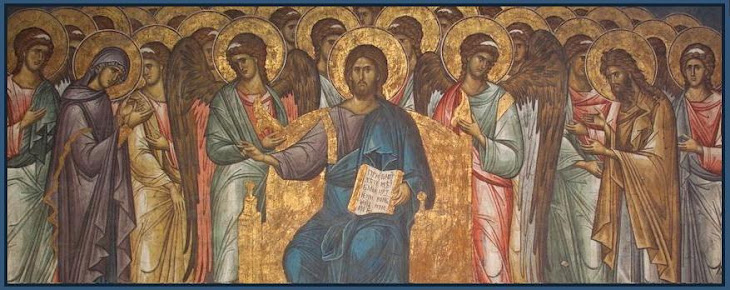
Christ Pantocrator, surrounded by the Holy Angels depicted as serving the Divine Liturgy (source)
   
Through the prayers of our Holy Fathers, Lord Jesus Christ our God, have mercy on us and save us! Amen!

Monday, September 28, 2015

St. Isaac the Syrian: " Blessed is the man who knows his own weakness..."

St. Isaac the Syrian (source)
  
Blessed is the man who knows his own weakness, because this knowledge becomes to him the foundation, root, and beginning of all goodness. For whenever a man learns and truly perceives his own weakness, at that moment he contracts his soul on every side from the laxity that dims knowledge, and he treasures up watchfulness in himself. But no one can perceive his own infirmity if he is not allowed to be tempted a little, either by things that oppress his body, or his soul. For then, comparing his own weakness with God's help, he will straightway understand the greatness of the latter.
-St. Isaac the Syrian, "Ascetical Homilies" (Homily 8)
  
  
Through the prayers of our Holy Fathers, Lord Jesus Christ our God, have mercy on us and save us! Amen!

Sunday, August 17, 2014

Elder Joseph the Hesychast on Enduring Temptations

Jesus Christ, the Bridegroom (source)
 
"There is nothing else that can help appease anger and all the passions as much as love for God and for every fellow man. It is with love rather than with other struggles that you can win easily. In addition, when love reigns in your nous you feel no pain while struggling. For this reason, "love never faileth" (1 Cor. 13:8), as long as you constantly steer the soul's rudder towards it. And no matter what happens, you shout your maxim: "For the sake of Thy love, Jesus, my sweet love, I will endure curses, disgraces, injustices, toils, and all afflictions that I might encounter!" And at once, while you are pondering these words, the burden of pain is lightened, and the demons' bitterness ceases.
   
"Let me tell you a true story. Once, because of my continual and frightful temptations, I was overcome with sadness and faintheartedness, and I presented my case to God as if I had been treated unjustly. I was complaining because He kept allowing so many temptations to befall me without curbing them even a little, that I couldn't even catch my breath. In this time of bitterness, I heard a very sweet and clear voice within me say with extreme compassion, "Will you not endure everything for My love?" As soon as I heard that voice, I broke out with many tears and repented for being overcome with faintheartedness. I shall never forget that voice, which was so sweet that the temptation and all my faintheartedness immediately disappeared.
"Will you not endure everything for my love?"
"O truly sweet Love! For Thy love, we are crucified and endure everything!"
Elder Joseph the Hesychast, "Monastic Wisdom: Eighth Letter"
   
An icon of the Blessed Elder Joseph the Cave-dweller and Hesychast (+ August 15th / 28th 1959). This year completes 55 years since his blessed repose. We pray that we might follow his great spiritual example, according to our strength, and that he might pray for us all to the Most-merciful Lord. (source)
   
Through the prayers of our Holy Fathers, Lord Jesus Christ our God, have mercy on us and save us! Amen!

Thursday, December 12, 2013

St. John of Kronstadt on Divine Providence

Jesus Christ, the Son of God, the Savior, the open Gospel says: "I am the way, the truth and the life..." (source)
   
St. John of Kronstadt on Divine Providence (Excerpts compiled from: My Life in Christ)
If God does not leave a blade of grass, a flower, or a small leaf of a tree without His good providence, will He leave us? O, let every man be convinced with his whole heart that God is true to Himself in His providence for even the least of His creatures. Let him understand that the Creator invisibly dwells in all His creatures. In the words of our Saviour, God clothes the grass of the field, feeds the fowls of the air.[52]

We must trust in God in all temptations, in all desolate conditions of the soul. The Lord will deliver.

Give yourself up entirely to God's providence, to the Lord's Will, and do not grieve at losing anything material, nor in general at the loss of visible things; do not rejoice at gain, but let your only and constant joy be to win the Lord Himself. Trust entirely in Him: He knows how to lead you safely through this present life, and to bring you to Himself — into His eternal Kingdom. From want of trust in God's providence many and great afflictions proceed: despondency, murmurings, envy, avarice, love of money or the passion for amassing money and property in general, so that it may last for many years, in order to eat, drink, sleep and enjoy; from want of trust in God's providence proceed in particular afflictions such as arise, for instance: from some loss of income through our own oversight, from the loss of objects, specially valuable and necessary, as well as immoderate joy at recovering some objects, or at receiving some large income or gain, or some profitable place or employment. We, as Christians, as "fellow citizens with the Saints and of the household of God,"[574] ought to commit all our life, together with all its sorrows, sicknesses, griefs, joys, scarcities and abundance unto Christ our God.

Bear with humble submission to the will of God every sorrow, every sickness and infirmity, every labour, every offence and disappointment, saying: "Thy Will be done,"[1360] knowing that God's mercy orders everything for your good, and that the Lord can easily change every disappointment into happiness and joy.

"That they all may be one, as Thou, Father, art in me, and I in Thee, that they also may be one in us."[522] What separates us from God and each other? Money, food, and drink — this dust, this dross, this corruption. Why? Because we have not living Christian trust and faith in God. We do not know, or we forget, that man's true life is love for God and his neighbour. Setting our life upon dust and trusting in it, we do not render to the Heavenly Father the glory that is due to Him, by putting our whole trust in Him, by casting all our care upon Him, as His faithful children in Christ should do. "If then I be a Father, where is Mine honour? [523] Where is your trust in Me? Where is your love for Me? Where is your detachment from earthly, corrupt things, and your hearty desire for the heavenly, spiritual, and eternal ones?

When you are disturbed and depressed by the wickedness of men, remember how boundlessly you are beloved by the Almighty and All-righteous God, Who suffers the evil until the time comes, and then will justly punish it. You cannot master yourself, your tongue, or one single member of your body. Judge by this what He must be, Who governs the whole world, Who keeps it in such wonderful order, Who governs the whole of mankind, evil, perverted as we are, ever ready as we are to destroy each other, and yet meanwhile more prosperous than needy under His sovereignty. How almighty and wise must He be to govern such heterogeneous multitudes! Trust in Him entirely.

"Thy will be done." For instance, when you wish and by every means endeavour to be well and healthy, and yet remain ill, then say: "Thy will be done." When you undertake something and your undertaking does not succeed, Say: "Thy will be done." When you do good to others, and they repay you by evil, say: "Thy will be done." Or when you would like to sleep and are overtaken by sleeplessness, Say: "Thy will be done." In general, do not become irritated when anything is not done in accordance with your will, but learn to submit in everything to the Will of the Heavenly Father. You would like not to experience any temptations, and yet the enemy daily harasses you by them; provokes and annoys you by every means. Do not become irritated and angered, but say: "Thy will be done."

It is never so difficult to say from the heart, "Thy Will be done, Father," as when we are in sore affliction or grievous sickness, and especially when we are subjected to the injustice of men, or the assaults and wiles of the enemy. It is also difficult to say from the heart "Thy Will be done" when we ourselves were the cause of some misfortune, for then we think that it is not God's Will, but our own will, that has placed us in such a position, although nothing can happen without the Will of God. In general, it is difficult to sincerely believe that it is the Will of God that we should suffer, when the heart knows both by faith and experience that God is our blessedness; and therefore it is difficult to say in misfortune, "Thy Will be done." We think, "Is it possible that this is the Will of God? Why does God torment us? Why are others quiet and happy? What have we done? Will there be an end to our torments?" And so on. But when it is difficult for our corrupt nature to acknowledge the Will of God over us, that Will of God without which nothing happens, and to humbly submit to it, then is the very time for us to humbly submit to this Will, and to offer to the Lord our most precious sacrifice — that is, heartfelt devotion to Him, not only in the time of ease and happiness, but also in suffering and misfortune; it is then that we must submit our vain erring wisdom to the perfect Wisdom of God, for our thoughts are as far from the thoughts of God "as the heavens are higher than the earth."[317]

"For Thine is the kingdom, and the power, and the glory," not ours. We ourselves should like to reign with our passions — that is, to order everything as we like, to trust to our own power, and not to Thine, to seek our own glory, and not Thine; but this is the Devil's wish in us. We ought to submit everything to Thy will, seek in all matters Thy power, and do everything for Thy glory. "Do all to the glory of God."[756]

"Let it be as I will, and not as thou wilt." Such is the mighty voice of God, which our soul ever hears when it has fallen into sin and desires to emerge from a state of spiritual, sinful affliction. "Let it be as I will: either repent from the depths of your heart in proportion to the sin, and return to the road that leads to life, shown by Me; either bear the punishment, corresponding to the sin and determined by My justice, or your sin will torment you as a deviation from My laws." And only then will our soul enjoy peace when we truly repent from the depths of our heart in proportion to the sin, or bear the punishment due from God. O! Almighty and most just power of our God, invisibly governing our invisible souls, all glory to Thee, glory to Thee, God our Saviour! Thy will be done in us!

Breathe by faith (by certitude in God's truth), by trust in God, and by love for God and your neighbour. And how can you help yourself in this? By unbelief in the durability of everything earthly; by not putting your trust in earthly blessings, such as food, drink, money, riches, and earthly ties; by not caring for, by being indifferent to everything earthly and perishable. Do not let your heart cling to anything, do not attach yourself to anything. "Set your affection on things above, not on things on the earth."[1295]

To trust in God means to confide to Him our life, our fate, all our future, and to wait with confidence for the fulfilment of His promises. Hope proceeds from faith, as the plant from the seed, or the stream from the source. We believe that the Lord is good and merciful, that He loves us as a Father, and therefore that He desires every good and true happiness for us. He is most wise and omniscient, and consequently He knows better than we ourselves what is really needful and useful for us. He is almighty; and thus He is always able to bestow upon us that which He pleases, to fulfil that which He has promised. He is holy and righteous, and therefore all His words are truth. His promises are unchangeable. The highest proof of God's love to man is shown in the fact that He did not spare His Only begotten Son, but delivered Him for our sakes unto sufferings and death. Having strengthened our soul by the thought of the boundless mercy, wisdom, omnipotence, and holiness of our Creator and Provider, we can pass through the course of our earthly life without fear and without disturbance, like a child in its mother's arms, like a ship with trusty anchors. And therefore "Blessed is the man that trusteth in the Lord, and whose hope the Lord is."[1166] "The Lord is my deliverer, in Whom I will trust."[1167] "I will not be afraid for ten thousand of the people."[1168] However, while having trust, we must not ourselves be careless and idle. The essence of Christian hope is a lively, active, and constant aspiration after the Highest Blessing and the Source of all blessings, God, with an insatiable longing to come near or to Him and to receive from Him and in Him the kingdom of heaven, prepared before the creation of the world. "Like as the hart desireth the water-brooks, so longeth my soul after Thee, O God. My soul is athirst for God, yea, even for the living God. When shall I come to appear before the presence of God?"[1169]

Thy name, Lord, is Almighty, because Thou holdest not only heaven and earth, but also all mankind, the life of every man, the hearts of all in Thy Hand; and not only the life of every man, but also of every beast, bird, fish, insect, worm, reptile, and of every infusoria invisible to the eye. Glory to Thine infinite Omnipotence, Lord! Glory to Thine All-merciful, Most-wise, and All-powerful Providence! Lord of heaven and earth! Almighty Sovereign! Thou likewise holdest in Thy Hand all hell, with Satan and his innumerable hordes; and it is only by Thy permission, for our instruction and punishment, that Satan and his angels can lay their snares for us. As soon as we pray to Thee our Saviour, as soon as we unfeignedly repent before Thee of our sins, Thou, having taught us, sendest away our enemies from us, saying: "You have done enough evil to My servants; they belong to Me again." Thus, Lord, if Thine unceasing benefits and mercies to us do not teach us, what remains to be done? It only remains for Thee to teach us by chastisement, by bitterness, by oppression, by fire, and by our own wickedness — we sensual men, who love space, freedom, vain carnal freshness; who are slothful, negligent, and evil by nature.

How must we look upon the gifts of intellect, feeling and freedom? With the intellect we must learn to know God in the works of His creation, revelation, providence, and in the destinies of men; with the heart we must feel God's love, His most heavenly peace, the sweetness of His love, we must love our neighbour, sympathise with him in joy and in sorrow, in health and in sickness, in poverty and in wealth, in distinction and in low estate (humiliation); we must use freedom, as a means, as an instrument for doing as much good as possible, and for perfecting ourselves in every virtue, so as to render unto God fruits a hundredfold.

Concerning praise. The soul involuntarily longs to praise when we gaze upon the starry sky; but still more when, in looking upon the sky and the stars, we represent to ourselves God's providence towards men, how infinitely He loves men, cares for their eternal beatitude, not having even spared His only-begotten Son for our salvation and our repose in the Heavenly Kingdom! It is impossible not to praise God when you remember that you were created from nothing, that you were predestined from the foundation of the world for eternal blessedness, quite without cause, not in accordance with your merits — when you remember what grace God has bestowed upon you for your salvation during all your life-time, what an innumerable multitude of sins are forgiven you, and this not once or twice but an incalculable number of times, what a multitude of natural gifts are bestowed upon you, beginning with health down to the current of air, down to the drop of water. We are involuntarily incited to praise when we see with wonder the infinite variety of things created on the earth, in the animal kingdom, in the vegetable kingdom, and in the mineral kingdom. What wise order in all, both in great and small! We involuntarily praise and exclaim: "O Lord! how manifold are Thy works! in wisdom hast Thou made them all: Glory to Thee, Lord, Who hath created everything!"[219]

Until now I have not become impoverished by being merciful to others, and shall not become impoverished to the last, for "Jesus Christ is the same yesterday and to-day."[696] It is not said without reason: "He that giveth to the poor shall not lack." Indeed, up till now the Lord has only increased my temporal blessings, and has not taken them away. I praise the bountifulness of the Lord, His rich Providence.

Maladies in our eyes only appear painful, unpleasant, and terrible. It is seldom that any one of us during the time of sickness represents to himself the profit which his illness brings to his soul; but in God's all wise and most merciful Providence, not a single malady remains without some profit to our soul. Sicknesses in the hands of Providence are the same as bitter medicines for our soul, curing its passions, its bad habits and inclinations. Not a single malady sent to us shall return void. Therefore, we must keep in view the utility of sicknesses, in order that we may bear them more easily and more calmly. "He that hath suffered in the flesh hath ceased from sin,"[848] says the Holy Scripture.

Let heaven and earth, created by the Lord, and existing, acting, and moving through Him, teach me — I, who am one spirit with the Lord! What is there for me to grieve at, when I am, and can ever be, one spirit with the Lord? I will cast all my care upon Him. Heaven and earth exist for thousands of years through the Lord, through His power and laws, though they are soulless, inert, inactive, and powerless matter. And the grass, the flowers of the field, the birds, fishes, and so forth. How all these teach us to entirely trust in God's providence!

In the matter of God's providence for men, and in accordance with the requirements of reason, there must be mediators between men and God from the spiritual world (as men occupy the medium between the spiritual and material worlds), who may guide us to the heavenly kingdom — namely, the angels. There is an astonishing gradation and order with the Lord in all His works. Everywhere in His kingdom the lower are guided by the higher; hence the necessity of guardian-angels for Christians redeemed by the blood of the Lord. Besides this, the angels themselves are full of love for us, and rejoice over the conversion of one sinner; but love is active, and the Lord has given perfect freedom to their noble and useful activity, as we see from the Holy Scripture. Guardian-angels are indispensable for men, owing to the craftiness of the evil spirits. Men themselves do not see them, for men are very infirm in the spiritual life. Therefore, besides the grace of God, we require a person, or persons, full of this grace, wise, firm by their nature: and such are the angels. Besides this, after man departs this life, there must be witnesses of his deeds against the demons.

A visible proof of the omnipresence and of the providence of God is presented to us by vegetation. Where is it not to be found upon the terrestrial globe? It covers the plains, it climbs up the inaccessible heights of rocky mountains, it grows in the deserts, spreads its roots in the waters and amongst the waters, upon desert islands. And who is it that gives it growth and adorns it with beautiful varieties of shapes, colours, and flowers? The Lord God. "God so clothes it." But if God so carefully clothes the grass, then shall He forsake and forget man, even for a minute? "Wherefore, if God so clothe the grass of the field, which to-day is and to-morrow is cast into the oven, shall He not much more clothe you, O ye of little faith?"[1241] If God at every instant vivifies the grass, and His life does not forsake it, then shall He cease to give life to me? No; if He clothes and gives life to the grass, then in me He dwells continually, as in His temple, if I do not voluntarily drive Him away by my sins. "Know ye not that ye are the temple of God, and that the Spirit of God dwelleth in you?"[1242] In reference to the temple, we may remark that the Apostle calls a Christian the temple, because the Spirit of God dwells in him. This signifies that God dwells continually in Christian temples. Hence the holiness of the temple; hence the reverence due to it. And the action of God dwelling in the temple is very perceptible upon the hearts of those who turn to Him in prayer.

May my soul understand that as everything proceeded from God and exists in God, therefore the Lord God in the most perfect manner knows at every moment of the existence and of the nature of every being, and that He supports its existence, at every moment, by the laws of nature given by Him. If we, ourselves, having written a book, know all about its disposition and contents, about all the ideas to be found in it, so that when other people explain us the idea, and especially the plan of our book, we say that it is our plan, our idea; then why should we take from the Lord His omniscience of all worlds, of all creatures, of all things contained in the world, with all their qualities and conditions? Are they not, so to say, the book of God? And thus, my soul, reverence thy Creator every moment of thy life, and know that at every moment He knows thee wholly, that He supports and gives thee life and everything necessary for thy existence and welfare. "How could anything have endured if it had not been Thy will?"[1131]

Concerning trust in God's providence. "Can a woman" (a mother) " forget her sucking child, that she should not have compassion on the son of her womb? Yea, they may forget, yet will I not forget thee,"[1367] says the Lord. And who could be more tender and careful than a mother of her children? What woman will forget to feed the children of her womb? But let us even admit that mothers who forsake their children may be found; "But I," says the Lord, "am not like such carnal mothers, and will not forget nor forsake you." What trust, what hope, the Lord Himself inspires in us by these words, in His Providence con- tinually caring for us and never forsaking any one of us! You are sometimes anxious about what you shall eat and drink, and how you shall be clothed; you greatly afflict your heart if you part grudgingly, sorrowfully with your money, when it is necessary to give to another, although you have plenty left, and you thus show that you put your trust and hope in earthly dross. But why are you anxious? Why do you cling to dross? Cling to the heavenly Father; He will not forget you, and will not forsake you. Let the dross forsake you; you will only feel easier without it; for the more money you have, the greater the quantity of this dross that adheres to your heart, the more will your heart which is not earthly be afflicted. There is a saying amongst men that money is no hindrance, however much of it we may have. This is untrue. It greatly hinders our soul from rising upwards, or from meditating upon our heavenly country, and the more we have of it the more it drags our soul down to earth, inciting us to occupy ourselves with various earthly devices, such as buildings, rich furniture in our houses, rich clothes, luxurious viands and drinks, and thus depriving our soul of holy zeal and precious time, during which it ought to be earning future bliss for itself.

If you wish to be humble, consider yourself worthy of all malice and hatred on the part of others, and of every calumny. Do not grow irritated, and do not nourish malice against those who bear malice against you, slander you, or falsely blame you. Say: "Holy Father, Thy will be done! "Remember the words of the Lord: "The servant is not greater than his Lord; if the world hate you, ye know that it hated Me before it hated you."[1396] If the world hated Him, the Most-righteous, the Most-merciful, then why should it be wonderful if other people hate you, a sinful and evil man?

My God! to what have we come? In what are we better than heathens in our mode of life? Where is our faith, our trust in God, our love for our neighbour? O, pride of Satan! O, what shame is ours! Heavenly Father! Thou who knowest what things we have need of, and givest them to us before we ask Thee, [468] have mercy upon us unfaithful, ungrateful, and evil-natured ones. Lord, we hear Thy merciful words: "I will never leave thee nor forsake thee;"[469] but being daily tempted by earthly blessings, we do not heed them, and transgress Thy will.
  
Footnotes

 [219] Psalm civ. 24.
[317] Isaiah lv. 8, 9.

[468] St. Matthew vi. 8.
[469] Hebrews xiii. 5.
[522] St. John xvii. 21.
[523] Malachi i. 6.
[574] Ephesians ii. 19.
[696] Hebrews xiii. 8.
[756] 1 Corinthians x. 31.
[848] 1 Peter iv. 1.
[1131] Wisdom xi. 25.
[1166] Jeremiah xvii. 7; Psalm ii. 12; Proverbs xvi. 20.
[1167] Psalm xviii. 1.
[1168] Psalm iii. 6.
[1169] Psalm xlii. 2, 3.
[1241] St. Matthew vi. 30; St. Luke xii. 28.
[1242] 1 Corinthians iii. 16.
[1295] Colossians iii. 2.
[1360] St. Matthew vi. 10; St. Luke xi. 2.
[1367] Isaiah xlix. 15.
[1396] St. John xiii. 16; xv. 18.

Excerpts compiled from: My Life in Christ or Moments of Spiritual Serenity and Contemplation, of Reverent Feeling, of Earnest Self-Amendment, and of Peace in God, St. John of Kronstadt. (source)

   
 St. John of Kronstadt, the Wonderworker (source)
  
Through the prayers of our Holy Fathers, Lord Jesus Christ our God, have mercy on us and save us! Amen!